
Palindrome detection

You are encouraged to solve this task according to the task description, using any language you may know.
A palindrome is a phrase which reads the same backward and forward.
Write a function or program that checks whether a given sequence of characters (or, if you prefer, bytes) is a palindrome.
For extra credit:
- Support Unicode characters.
- Write a second function (possibly as a wrapper to the first) which detects inexact palindromes, i.e. phrases that are palindromes if white-space and punctuation is ignored and case-insensitive comparison is used.
- It might be useful for this task to know how to reverse a string.
- This task's entries might also form the subjects of the task Test a function.
- Metrics
- Counting
- Word frequency
- Letter frequency
- Jewels and stones
- I before E except after C
- Bioinformatics/base count
- Count occurrences of a substring
- Count how many vowels and consonants occur in a string
- Remove/replace
- XXXX redacted
- Conjugate a Latin verb
- Remove vowels from a string
- String interpolation (included)
- Strip block comments
- Strip comments from a string
- Strip a set of characters from a string
- Strip whitespace from a string -- top and tail
- Strip control codes and extended characters from a string
- Anagrams/Derangements/shuffling
- Word wheel
- ABC problem
- Sattolo cycle
- Knuth shuffle
- Ordered words
- Superpermutation minimisation
- Textonyms (using a phone text pad)
- Anagrams
- Anagrams/Deranged anagrams
- Permutations/Derangements
- Find/Search/Determine
- ABC words
- Odd words
- Word ladder
- Semordnilap
- Word search
- Wordiff (game)
- String matching
- Tea cup rim text
- Alternade words
- Changeable words
- State name puzzle
- String comparison
- Unique characters
- Unique characters in each string
- Extract file extension
- Levenshtein distance
- Palindrome detection
- Common list elements
- Longest common suffix
- Longest common prefix
- Compare a list of strings
- Longest common substring
- Find common directory path
- Words from neighbour ones
- Change e letters to i in words
- Non-continuous subsequences
- Longest common subsequence
- Longest palindromic substrings
- Longest increasing subsequence
- Words containing "the" substring
- Sum of the digits of n is substring of n
- Determine if a string is numeric
- Determine if a string is collapsible
- Determine if a string is squeezable
- Determine if a string has all unique characters
- Determine if a string has all the same characters
- Longest substrings without repeating characters
- Find words which contains all the vowels
- Find words which contains most consonants
- Find words which contains more than 3 vowels
- Find words which first and last three letters are equals
- Find words which odd letters are consonants and even letters are vowels or vice_versa
- Formatting
- Substring
- Rep-string
- Word wrap
- String case
- Align columns
- Literals/String
- Repeat a string
- Brace expansion
- Brace expansion using ranges
- Reverse a string
- Phrase reversals
- Comma quibbling
- Special characters
- String concatenation
- Substring/Top and tail
- Commatizing numbers
- Reverse words in a string
- Suffixation of decimal numbers
- Long literals, with continuations
- Numerical and alphabetical suffixes
- Abbreviations, easy
- Abbreviations, simple
- Abbreviations, automatic
- Song lyrics/poems/Mad Libs/phrases
- Mad Libs
- Magic 8-ball
- 99 Bottles of Beer
- The Name Game (a song)
- The Old lady swallowed a fly
- The Twelve Days of Christmas
- Tokenize
- Text between
- Tokenize a string
- Word break problem
- Tokenize a string with escaping
- Split a character string based on change of character
- Sequences
11l
F is_palindrome(s)
   R s == reversed(s)
360 Assembly
*        Reverse b string          25/06/2018
PALINDRO CSECT
         USING  PALINDRO,R13       base register
         B      72(R15)            skip savearea
         DC     17F'0'             savearea
         STM    R14,R12,12(R13)    prolog
         ST     R13,4(R15)         "
         ST     R15,8(R13)         "
         LR     R13,R15            "
         LA     R8,BB              @b[1]
         LA     R9,AA+L'AA-1       @a[n-1]
         LA     R6,1               i=1
LOOPI    C      R6,=A(L'AA)        do i=1 to length(a)
         BH     ELOOPI             leave i
         MVC    0(1,R8),0(R9)        substr(b,i,1)=substr(a,n-i+1,1)
         LA     R8,1(R8)             @b=@b+1
         BCTR   R9,0                 @a=@a-1
         LA     R6,1(R6)             i=i+1
         B      LOOPI              end do
ELOOPI   XPRNT  AA,L'AA            print a
         CLC    BB,AA              if b=a
         BNE    SKIP
         XPRNT  MSG,L'MSG          then print msg
SKIP     L      R13,4(0,R13)       epilog
         LM     R14,R12,12(R13)    "
         XR     R15,R15            "
         BR     R14                exit
AA       DC     CL32'INGIRUMIMUSNOCTEETCONSUMIMURIGNI'  a
BB       DS     CL(L'AA)           b
MSG      DC     CL23'IT IS A TRUE PALINDROME'
         YREGS
END PALINDRO- Output:
INGIRUMIMUSNOCTEETCONSUMIMURIGNI
IT IS A TRUE PALINDROME
8080 Assembly
	org	100h
	jmp	demo
	;;;	Is the $-terminated string at DE a palindrome?
	;;;	Returns: zero flag set if palindrome
palin:	mov	h,d	; Find end of string
	mov	l,e
	mvi	a,'$'
	cmp	m	; The empty string is a palindrome
	rz
pend:	inx	h	; Scan until terminator found
	cmp	m
	jnz	pend
	dcx	h	; Move to last byte of text
ptest:	ldax	d	; Load char at left pointer
	cmp 	m	; Compare to char at right pointer
	rnz		; If not equal, not a palindrome
	inx	d	; Move pointers
	dcx	h
	mov	a,d	; Check if left pointer is before right pointer
	cmp 	h	; High byte
	jc	ptest
	mov	a,e	; Low byte
	cmp	l
	jc	ptest
	xra	a	; Made it to the end - set zero flag
	ret		; Return
	;;;	Test the routine on a few examples
demo:	lxi	h,words	; Word list pointer
loop:	mov	e,m	; Load word pointer
	inx	h
	mov	d,m
	inx	h
	mov	a,e	; Stop when zero reached
	ora	d
	rz
	push	h	; Keep word list pointer
	call	pstr	; Print word
	call	palin	; Check if palindrome
	lxi	d,no
	jnz 	print	; Print "no" if not a palindrome
	lxi	d,yes	; Print "yes" otherwise
print:	call	pstr
	pop	h
	jmp 	loop
	;;;	Print strint using CP/M keeping DEHL registers
pstr:	push	d
	push	h
	mvi	c,9
	call	5
	pop	h
	pop	d
	ret
yes:	db	': yes',13,10,'$'
no:	db	': no',13,10,'$'
words:	dw	w1,w2,w3,w4,0
w1:	db	'rotor$'
w2:	db	'racecar$'
w3:	db	'level$'
w4: db 'rosetta$'- Output:
rotor: yes
racecar: yes
level: yes
rosetta: no
8086 Assembly
	cpu	8086
	org	100h
section	.text
	jmp	demo
	;;;	Check if the $-terminated string in [DS:SI] is a palindrome.
	;;;	Returns with zero flag set if so.
	;;;	Destroyed: AL, CX, SI, DI, ES.
palin:	push	es		; Set ES=DS.
	pop	ds
	mov	al,'$'		; Find end of string
	mov	cx,-1
	mov	di,si
	repne	scasb
	dec	di		; Move back to last actual character
.loop:	cmp	si,di
	ja	.ok		; If SI > DI, it is a palindrome
	lodsb
	dec	di		; Compare left character to right character
	cmp	al,[di]
	jne	.no		; If not equal, not a palindrome
	jmp 	.loop		; Otherwise, try next pair of characters
.ok:	cmp	al,al		; Set zero flag
.no: 	ret 			; Return
	;;;	Try the routine on a couple of strings
demo:	mov	si,words
.loop:	lodsw			; Grab word pointer
	test	ax,ax		; Zero?
	jz	.done		; Then we are done
	mov	dx,ax		; Otherwise, print word
	mov	ah,9
	int	21h
	xchg	bp,si		; Keep array pointer in BP
	xchg	si,dx		; Put word pointer in SI
	call	palin		; Check if it is a palindrome
	mov	dx,yes		; Print 'yes'...
	jz	.print		; ...if it is a palindrome
	mov	dx,no		; Otherwise, print 'no'
.print:	int 	21h
	xchg	si,bp		; Restore array pointer
	jmp	.loop		; Get next word.
.done:	ret
yes:	db	': yes',13,10,'$'	; Yes and no
no:	db	': no',13,10,'$'
words:	dw	.w1,.w2,.w3,.w4,.w5,0
.w1:	db	'rotor$'	; Words to check
.w2:	db	'racecar$'
.w3:	db	'level$'
.w4:	db	'redder$'
.w5:	db	'rosetta$'
- Output:
rotor: yes
racecar: yes
level: yes
redder: yes
rosetta: no
ACL2
(defun reverse-split-at-r (xs i ys)
  (if (zp i)
      (mv xs ys)
      (reverse-split-at-r (rest xs) (1- i)
                          (cons (first xs) ys))))

(defun reverse-split-at (xs i)
  (reverse-split-at-r xs i nil))

(defun is-palindrome (str)
  (let* ((lngth (length str))
         (idx (floor lngth 2)))
    (mv-let (xs ys)
            (reverse-split-at (coerce str 'list) idx)
            (if (= (mod lngth 2) 1)
                (equal (rest xs) ys)
                (equal xs ys)))))
Acornsoft Lisp
This is a small Lisp that doesn't have strings; symbols are used instead. Explode takes a symbol and returns a list of single-character symbols, one for each character in the symbol's name. Implode does the reverse.
Since the exact palindrome tests compares two symbols, it can use eq, and equal isn't needed.
The character set is ASCII. Given a symbol, ordinal returns the numeric ASCII code of the the first character in the symbol's name. Character goes in the other direction and returns a single-character symbol.
The peculiar definition of digit-p is because it's not possible to type a symbol that has a digit character as its name, and so the between comparison has to be defined using the character before '0' and the one after '9'.
(defun palindrome-type (text)
  (cond ((exact-palindrom-p text)    'exact)
        ((inexact-palindrome-p text) 'inexact)
        (t 'not-a-palindrome)))

(defun exact-palindrom-p (text)
  (eq text (implode (reverse (explode text)))))

(defun inexact-palindrome-p (text)
  (exact-palindrom-p (implode (normalise (explode text)))))

(defun reverse (list (result . ()))
  (map '(lambda (e) (setq result (cons e result)))
       list)
  result)

(defun normalise (chars)
  (cond ((null chars)
         nil)
        ((not (alphanumeric-p (car chars)))
         (normalise (cdr chars)))
        ((upper-case-p (car chars))
         (cons (to-lower-case (car chars))
               (normalise (cdr chars))))
        (t
         (cons (car chars) (normalise (cdr chars))))))

(defun between-p (lowest-value n highest-value)
  (not (or (lessp n lowest-value)
           (greaterp n highest-value))))

(defun alphanumeric-p (ch)
  (or (lower-case-p ch) (upper-case-p ch) (digit-p ch)))

(defun digit-p (ch)
  (between-p (add1 (ordinal '/))
             (ordinal ch)
             (sub1 (ordinal ':))))

(defun upper-case-p (ch)
  (between-p (ordinal 'A) (ordinal ch) (ordinal 'Z)))

(defun lower-case-p (ch)
  (between-p (ordinal 'a) (ordinal ch) (ordinal 'z)))

(defun to-lower-case (ch)
  (character (plus (ordinal ch)
                   (difference (ordinal 'a) (ordinal 'A)))))

(defun examples ()
  (map '(lambda (text)
          (printc '!" text '!"
                  '! is!  (palindrome-type text)))
       '(a
         abba   Abba
         abcba
         baba
         Able! was! I! ere! I! saw! Elba!!
         In! girum! imus! nocte,! et! consumimur! igni)))
- Output:
Calling (examples) will output:
"a" is exact
"abba" is exact
"Abba" is inexact
"abcba" is exact
"baba" is not-a-palindrome
"Able was I ere I saw Elba!" is inexact
"In girum imus nocte, et consumimur igni" is inexact
Action!
BYTE FUNC Palindrome(CHAR ARRAY s)
  BYTE l,r

  l=1 r=s(0)
  WHILE l<r
  DO
    IF s(l)#s(r) THEN RETURN (0) FI
    l==+1 r==-1
  OD
RETURN (1)

BYTE FUNC IsIgnored(BYTE c)
  IF (c>='  AND c<='/) OR
     (c>=': AND c<='@) OR
     (c>='[ AND c<='_) THEN
    RETURN (1)
  FI
RETURN (0)

BYTE FUNC ToUpper(BYTE c)
  IF c>='a AND c<='z THEN
    RETURN (c-'a+'A)
  FI
RETURN (c)

BYTE FUNC InexactPalindrome(CHAR ARRAY s)
  BYTE l,r,lc,rc

  l=1 r=s(0)
  WHILE l<r
  DO
    WHILE IsIgnored(s(l))
    DO
      l==+1
      IF l>=r THEN RETURN (1) FI
    OD
    WHILE IsIgnored(s(r))
    DO
      r==-1
      IF l>=r THEN RETURN (1) FI
    OD

    lc=ToUpper(s(l))
    rc=ToUpper(s(r))

    IF lc#rc THEN RETURN (0) FI
    l==+1 r==-1
  OD
RETURN (1)

PROC Test(CHAR ARRAY s)
  IF Palindrome(s) THEN
    PrintF("'%S' is a palindrome%E%E",s)
  ELSEIF InexactPalindrome(s) THEN
    PrintF("'%S' is an inexact palindrome%E%E",s)
  ELSE
    PrintF("'%S' is not a palindrome%E%E",s)
  FI
RETURN

PROC Main()
  Test("rotavator")
  Test("13231+464+989=989+464+13231")
  Test("Was it a car or a cat I saw?")
  Test("Did Hannah see bees? Hannah did.")
  Test("This sentence is not a palindrome.")
  Test("123 456 789 897 654 321")
RETURN- Output:
Screenshot from Atari 8-bit computer

'rotavator' is a palindrome

'13231+464+989=989+464+13231' is a palindrome

'Was it a car or a cat I saw?' is an inexact palindrome

'Did Hannah see bees? Hannah did.' is an inexact palindrome

'This sentence is not a palindrome.' is not a palindrome

'123 456 789 897 654 321' is not a palindrome
ActionScript
The following function handles non-ASCII characters properly, since charAt() returns a single Unicode character.
function isPalindrome(str:String):Boolean
{
	for(var first:uint = 0, second:uint = str.length - 1; first < second; first++, second--)
		if(str.charAt(first) != str.charAt(second)) return false;
	return true;
}
Ada
function Palindrome (Text : String) return Boolean is
begin
   for Offset in 0..Text'Length / 2 - 1 loop
      if Text (Text'First + Offset) /= Text (Text'Last - Offset) then
         return False;
      end if;
   end loop;
   return True;
end Palindrome;
Ada 2012 version:
function Palindrome (Text : String) return Boolean is
(for all i in Text'Range => Text(i)= Text(Text'Last-i+Text'First));
ALGOL 68
# Iterative #
PROC palindrome = (STRING s)BOOL:(
   FOR i TO UPB s OVER 2 DO
     IF s[i] /= s[UPB s-i+1] THEN GO TO return false FI
   OD;Power
   else: TRUE EXIT
   return false: FALSE
);

# Recursive #
PROC palindrome r = (STRING s)BOOL:
   IF LWB s >= UPB s THEN TRUE
   ELIF s[LWB s] /= s[UPB s] THEN FALSE
   ELSE palindrome r(s[LWB s+1:UPB s-1])
   FI
;

# Test #
main:
(
   STRING t = "ingirumimusnocteetconsumimurigni";
   FORMAT template = $"sequence """g""" "b("is","isnt")" a palindrome"l$;

   printf((template, t, palindrome(t)));
   printf((template, t, palindrome r(t)))
)- Output:
sequence "ingirumimusnocteetconsumimurigni" is a palindrome
sequence "ingirumimusnocteetconsumimurigni" is a palindrome
APL
NARS2000 APL, dynamic function "if the argument matches the reverse of the argument", with Unicode character support:
      {⍵≡⌽⍵} 'abc'
0
      {⍵≡⌽⍵} '⍋racecar⍋'
1
Or in tacit function form, a combination of three functions, right tack (echo), reverse, then the result of each compared with the middle one, match (equals):
      (⊢≡⌽) 'abc'
0
      (⊢≡⌽) 'nun'
1
An inexact version is harder, because uppercase and lowercase with Unicode awareness depends on APL interpreter; NARS2000 has no support for it. Classic case conversion means lookup up the letters in an alphabet of UppercaseLowercase, then mapping those positions into an UppercaseUppercase or LowercaseLowercase array. Remove non-A-Za-z first to get rid of punctuation, and get an inexact dynamic function with just English letter support:
inexact←{Aa←(⎕A,⎕a) ⋄ (⊢≡⌽)(⎕a,⎕a)[Aa⍳⍵/⍨⍵∊Aa]}
      inexact 'abc,-cbA2z'
0
      inexact 'abc,-cbA2'
1
Dyalog APL has a Unicode-aware uppercase/lowercase function (819 I-beam), AFAIK no support for looking up Unicode character classes.
AppleScript
Using post-Yosemite AppleScript (to pull in lowercaseStringWithLocale from Foundation classes)
use framework "Foundation"

------ CASE-INSENSITIVE PALINDROME, IGNORING SPACES ? ----

-- isPalindrome :: String -> Bool
on isPalindrome(s)
    s = intercalate("", reverse of characters of s)
end isPalindrome

-- toSpaceFreeLower :: String -> String
on spaceFreeToLower(s)
    script notSpace
        on |λ|(s)
            s is not space
        end |λ|
    end script

    intercalate("", filter(notSpace, characters of toLower(s)))
end spaceFreeToLower


--------------------------- TEST -------------------------
on run

    isPalindrome(spaceFreeToLower("In girum imus nocte et consumimur igni"))

    --> true

end run


-------------------- GENERIC FUNCTIONS -------------------

-- filter :: (a -> Bool) -> [a] -> [a]
on filter(f, xs)
    tell mReturn(f)
        set lst to {}
        set lng to length of xs
        repeat with i from 1 to lng
            set v to item i of xs
            if |λ|(v, i, xs) then set end of lst to v
        end repeat
        return lst
    end tell
end filter


-- intercalate :: Text -> [Text] -> Text
on intercalate(strText, lstText)
    set {dlm, my text item delimiters} to {my text item delimiters, strText}
    set strJoined to lstText as text
    set my text item delimiters to dlm
    return strJoined
end intercalate


-- Lift 2nd class handler function into 1st class script wrapper
-- mReturn :: Handler -> Script
on mReturn(f)
    if class of f is script then
        f
    else
        script
            property |λ| : f
        end script
    end if
end mReturn


-- toLower :: String -> String
on toLower(str)
    set ca to current application
    ((ca's NSString's stringWithString:(str))'s ¬
        lowercaseStringWithLocale:(ca's NSLocale's currentLocale())) as text
end toLower
- Output:
true
Core language only
It's not clear if "sequence of characters" means an array thereof or a single piece of text. But the basic method in AppleScript would be:
on isPalindrome(txt)
    set txt to join(txt, "") -- In case the input's a list (array).
    return (txt = join(reverse of txt's characters, ""))
end isPalindrome

on join(lst, delim)
    set astid to AppleScript's text item delimiters
    set AppleScript's text item delimiters to delim
    set txt to lst as text
    set AppleScript's text item delimiters to astid
    return txt
end join

return isPalindrome("Radar")
Text comparisons in AppleScript are case-insensitive by default, so:
- Output:
true
If case is to be taken into account, the call to the handler can be enclosed in a 'considering case' control statement.
considering case
    return isPalindrome("Radar")
end considering
- Output:
false
It's also possible to "ignore" white space, hyphens, and punctuation, which are considered by default. And of course case can be ignored explicitly, if desired, to ensure that this condition's in force during the call to the handler. The attributes can be combined in one statement. So to check for inexact palindromicity (if that's a word):
ignoring case, white space, hyphens and punctuation
    return isPalindrome("Was it a 😀car, or a c😀at-I-saw?")
end ignoring
- Output:
true
Applesoft BASIC
100 DATA"MY DOG HAS FLEAS"
110 DATA"MADAM, I'M ADAM."
120 DATA"1 ON 1"
130 DATA"IN GIRUM IMUS NOCTE ET CONSUMIMUR IGNI"
140 DATA"A man, a plan, a canal: Panama!"
150 DATA"KAYAK"
160 DATA"REDDER"
170 DATA"H"
180 DATA""

200 FOR L1 = 1 TO 9
210    READ W$ : GOSUB 300" IS PALINDROME?
220    PRINT CHR$(34); W$; CHR$(34); " IS ";
230    IF NOT PALINDROME THEN PRINT "NOT ";
240    PRINT "A PALINDROME"
250 NEXT
260 END

300 REMIS PALINDROME?
310 PA = 1
320 L = LEN(W$)
330 IF L = 0 THEN RETURN
340 FOR L0 = 1 TO L / 2 + .5
350     PA = MID$(W$, L0, 1) = MID$(W$, L - L0 + 1, 1)
360     IF PALINDROME THEN NEXT L0
370 RETURN
ARM Assembly
@ Check whether the ASCII string in [r0] is a palindrome
@ Returns with zero flag set if palindrome.
palin:	mov	r1,r0		@ Find end of string
1:	ldrb	r2,[r1],#1	@ Grab character and increment pointer
	tst	r2,r2		@ Zero yet?
	bne	1b		@ If not try next byte
	sub	r1,r1,#2	@ Move R1 to last actual character.
2:	cmp	r0,r1		@ When R0 >= R1,
	cmpgt	r2,r2		@ make sure zero is set,
	bxeq	lr		@ and stop (the string is a palindrome).
	ldrb	r2,[r1],#-1	@ Grab [R1] (end) and decrement.
	ldrb	r3,[r0],#1	@ Grab [R0] (begin) and increment
	cmp	r2,r3		@ Are they equal?
	bxne	lr		@ If not, it's not a palindrome.
	b	2b		@ Otherwise, try next pair.

@ Try the function on a couple of strings
.global _start
_start:	ldr	r8,=words	@ Word pointer
1:	ldr	r9,[r8],#4	@ Grab word and move pointer
	tst	r9,r9		@ Null?
	moveq	r7,#1		@ Then we're done; syscall 1 = exit
	swieq	#0
	mov	r1,r9		@ Print the word
	bl	print
	mov	r0,r9		@ Test if the word is a palindrome
	bl	palin
	ldreq	r1,=yes		@ "Yes" if it is a palindrome
	ldrne	r1,=no		@ "No" if it's not a palindrome
	bl	print
	b	1b		@ Next word

@ Print zero-terminated string [r1] using Linux syscall
print:	push	{r7,lr}		@ Keep R7 and link register
	mov	r2,r1		@ Find end of string
1:	ldrb	r0,[r2],#1	@ Grab character and increment pointer
	tst	r0,r0		@ Zero yet?
	bne	1b		@ If not, keep going
	sub	r2,r2,r1	@ Calculate length of string (bytes to write)
	mov	r0,#1		@ Stdout = 1
	mov	r7,#4		@ Syscall 4 = write
	swi	#0		@ Make the syscall
	pop	{r7,lr}		@ Restore R7 and link register
	bx	lr

@ Strings
yes:	.asciz	": yes\n"	@ Output yes or no
no:	.asciz	": no\n"
w1:	.asciz	"rotor"		@ Words to test
w2:	.asciz	"racecar"
w3:	.asciz	"level"
w4:	.asciz	"redder"
w5:	.asciz	"rosetta"
words:	.word	w1,w2,w3,w4,w5,0
- Output:
rotor: yes
racecar: yes
level: yes
redder: yes
rosetta: no
Arturo
palindrome?: $[seq] -> seq = reverse seq

loop ["abba" "boom" "radar" "civic" "great"] 'wrd [
	print [wrd ": palindrome?" palindrome? wrd]
]
- Output:
abba : palindrome? true
boom : palindrome? false
radar : palindrome? true
civic : palindrome? true
great : palindrome? false
AutoHotkey
Reversing the string:
IsPalindrome(Str){
	Loop, Parse, Str
		ReversedStr := A_LoopField . ReversedStr
	return, (ReversedStr == Str)?"Exact":(RegExReplace(ReversedStr,"\W")=RegExReplace(Str,"\W"))?"Inexact":"False"
}
AutoIt
;== AutoIt Version: 3.3.8.1

Global $aString[7] = [ _
"In girum imus nocte, et consumimur igni", _  ; inexact palindrome
"Madam, I'm Adam.", _                         ; inexact palindrome
"salàlas", _                                  ; exact palindrome
"radar", _                                    ; exact palindrome
"Lagerregal", _                               ; exact palindrome
"Ein Neger mit Gazelle zagt im Regen nie.", _ ; inexact palindrome
"something wrong"]                            ; no palindrome
Global $sSpace42 = "                                          "

For $i = 0 To 6
	If _IsPalindrome($aString[$i]) Then
		ConsoleWrite('"' & $aString[$i] & '"' & StringLeft($sSpace42, 42-StringLen($aString[$i])) & 'is an exact palindrome.' & @LF)
	Else
		If _IsPalindrome( StringRegExpReplace($aString[$i], '\W', '') ) Then
			ConsoleWrite('"' & $aString[$i] & '"' & StringLeft($sSpace42, 42-StringLen($aString[$i])) & 'is an  inexact palindrome.' & @LF)
		Else
			ConsoleWrite('"' & $aString[$i] & '"' & StringLeft($sSpace42, 42-StringLen($aString[$i])) & 'is not a palindrome.' & @LF)
		EndIf
	EndIf
Next

Func _IsPalindrome($_string)
	Local $iLen = StringLen($_string)
	For $i = 1  To Int($iLen/2)
		If StringMid($_string, $i, 1) <> StringMid($_string, $iLen-($i-1), 1) Then Return False
	Next
	Return True
EndFunc
- Output:
"In girum imus nocte, et consumimur igni"   is an inexact palindrome.
"Madam, I'm Adam."                          is an inexact palindrome.
"salàlas"                                   is an exact palindrome.
"radar"                                     is an exact palindrome.
"Lagerregal"                                is an exact palindrome.
"Ein Neger mit Gazelle zagt im Regen nie."  is an inexact palindrome.
"something wrong"                           is not a palindrome.
--BugFix (talk) 14:26, 13 November 2013 (UTC)
AWK
Non-recursive
See Reversing a string.
function is_palindro(s)
{
  if ( s == reverse(s) ) return 1
  return 0
}
Recursive
function is_palindro_r(s)
{
  if ( length(s) < 2 ) return 1
  if ( substr(s, 1, 1) != substr(s, length(s), 1) ) return 0
  return is_palindro_r(substr(s, 2, length(s)-2))
}
Testing
BEGIN {
  pal = "ingirumimusnocteetconsumimurigni"
  print is_palindro(pal)
  print is_palindro_r(pal)
}
BaCon
OPTION COMPARE TRUE

INPUT "Enter your line... ", word$

IF word$ = REVERSE$(word$) THEN
    PRINT "This is an exact palindrome!"
ELIF EXTRACT$(word$, "[[:punct:]]|[[:blank:]]", TRUE) = REVERSE$(EXTRACT$(word$, "[[:punct:]]|[[:blank:]]", TRUE)) THEN
    PRINT "This is an inexact palindrome!"
ELSE
    PRINT "Not a palindrome."
ENDIF- Output:
Enter your line... In girum imus nocte, et consumimur igni
This is an inexact palindrome!
Enter your line... Madam, I'm Adam.
This is an inexact palindrome!
Enter your line... radar
This is an exact palindrome!
Enter your line... Something else
Not a palindrome.
Bash
#! /bin/bash
# very simple way to detect a palindrome in Bash
# output of bash --version -> GNU bash, version 4.4.7(1)-release x86_64 ...

echo "enter a string"
read input

size=${#input}
count=0

while (($count < $size))
do
    array[$count]=${input:$count:1}
    (( count+=1 ))
done

count=0

for ((i=0 ; i < $size; i+=1))
do
    if [ "${array[$i]}" == "${array[$size - $i - 1]}" ]
    then
        (( count += 1 ))
    fi
done

if (( $count == $size ))
then
    echo "$input is a palindrome"
fi
BASIC
' OPTION _EXPLICIT ' For QB64. In VB-DOS remove the underscore.

DIM txt$

' Palindrome
CLS
PRINT "This is a palindrome detector program."
PRINT
INPUT "Please, type a word or phrase: ", txt$

IF IsPalindrome(txt$) THEN
  PRINT "Is a palindrome."
ELSE
  PRINT "Is Not a palindrome."
END IF

END


FUNCTION IsPalindrome (AText$)
  ' Var
  DIM CleanTXT$, RvrsTXT$

  CleanTXT$ = CleanText$(AText$)
  RvrsTXT$ = RvrsText$(CleanTXT$)

  IsPalindrome = (CleanTXT$ = RvrsTXT$)

END FUNCTION

FUNCTION CleanText$ (WhichText$)
  ' Var
  DIM i%, j%, c$, NewText$, CpyTxt$, AddIt%, SubsTXT$
  CONST False = 0, True = NOT False

  SubsTXT$ = "AIOUE"
  CpyTxt$ = UCASE$(WhichText$)
  j% = LEN(CpyTxt$)

  FOR i% = 1 TO j%
    c$ = MID$(CpyTxt$, i%, 1)

    ' See if it is a letter. Includes Spanish letters.
    SELECT CASE c$
      CASE "A" TO "Z"
        AddIt% = True
      CASE " ", "¡", "¢", "£"
        c$ = MID$(SubsTXT$, ASC(c$) - 159, 1)
        AddIt% = True
      CASE "‚"
        c$ = "E"
        AddIt% = True
      CASE "¤"
        c$ = "¥"
        AddIt% = True
      CASE ELSE
        AddIt% = False
    END SELECT

    IF AddIt% THEN
      NewText$ = NewText$ + c$
    END IF
  NEXT i%

  CleanText$ = NewText$

END FUNCTION

FUNCTION RvrsText$ (WhichText$)
  ' Var
  DIM i%, c$, NewText$, j%

  j% = LEN(WhichText$)
  FOR i% = 1 TO j%
    NewText$ = MID$(WhichText$, i%, 1) + NewText$
  NEXT i%

  RvrsText$ = NewText$

END FUNCTION
- Output:
This is a palindrome detector program.
Please, type a word or phrase: Madam, I'm Adam. Is a palindrome.
This is a palindrome detector program.
Please, type a word or phrase: This is just a test. Is not a palindrome.
IS-BASIC
100 PROGRAM "Palindr.bas"
110 LINE INPUT PROMPT "Text: ":TX$
120 PRINT """";TX$;""" is ";
130 IF PALIND(TX$) THEN
140   PRINT "a palindrome."
150 ELSE
160   PRINT "not a palindrome."
170 END IF
180 DEF TRIM$(TX$)
190   LET T$=""
200   FOR I=1 TO LEN(TX$)
210     IF TX$(I)>="A" AND TX$(I)<="Z" THEN LET T$=T$&TX$(I)
220   NEXT
230   LET TRIM$=T$
240 END DEF
250 DEF PALIND(TX$)
260   LET PALIND=-1:LET TX$=TRIM$(UCASE$(TX$))
270   FOR I=1 TO LEN(TX$)/2
280     IF TX$(I)<>TX$(LEN(TX$)-I+1) THEN LET PALIND=0:EXIT FOR
290   NEXT
300 END DEF
Sinclair ZX81 BASIC
Exact palindrome
The specification suggests, but does not insist, that we reverse the input string and then test for equality; this algorithm is more efficient.
 10 INPUT S$
 20 FOR I=1 TO LEN S$/2
 30 IF S$(I)<>S$(LEN S$-I+1) THEN GOTO 60
 40 NEXT I
 50 GOTO 70
 60 PRINT "NOT A ";
 70 PRINT "PALINDROME"
Inexact palindrome
Add the following lines to convert the program into an inexact-palindrome checker (i.e. one that ignores non-alphabetic characters). The resulting program still works with only 1k of RAM. The ZX81 only supports its own character set, which does not include lower case, so that case-insensitive comparison and a fortiori Unicode are not possible.
 15 GOSUB 90
 80 STOP
 90 LET T$=""
100 FOR I=1 TO LEN S$
110 IF S$(I)>="A" AND S$(I)<="Z" THEN LET T$=T$+S$(I)
120 NEXT I
130 LET S$=T$
140 RETURN
BBC BASIC
      test$ = "A man, a plan, a canal: Panama!"
      PRINT """" test$ """" ;
      IF FNpalindrome(FNletters(test$)) THEN
        PRINT " is a palindrome"
      ELSE
        PRINT " is not a palindrome"
      ENDIF
      END

      DEF FNpalindrome(A$) = (A$ = FNreverse(A$))

      DEF FNreverse(A$)
      LOCAL B$, P%
      FOR P% = LEN(A$) TO 1 STEP -1
        B$ += MID$(A$,P%,1)
      NEXT
      = B$

      DEF FNletters(A$)
      LOCAL B$, C%, P%
      FOR P% = 1 TO LEN(A$)
        C% = ASC(MID$(A$,P%))
        IF C% > 64 AND C% < 91 OR C% > 96 AND C% < 123 THEN
          B$ += CHR$(C% AND &5F)
        ENDIF
      NEXT
      = B$
- Output:
"A man, a plan, a canal: Panama!" is a palindrome
Batch File
@echo off
setlocal enabledelayedexpansion
set /p string=Your string :
set count=0
:loop
	if "!%string%:~%count%,1!" neq "" (
		set reverse=!%string%:~%count%,1!!reverse!
		set /a count+=1
		goto loop
	)
set palindrome=isn't
if "%string%"=="%reverse%" set palindrome=is
echo %string% %palindrome% a palindrome.
pause
exit
Or, recursive (and without setlocal enabledelayedexpansion) (compatible with ReactOS cmd.exe)
@echo off
set /p testString=Your string (all same case please) :
call :isPalindrome result %testString: =%
if %result%==1 echo %testString% is a palindrome
if %result%==0 echo %testString% isn't a palindrome
pause
goto :eof

:isPalindrome
	set %1=0
	set string=%2
	if "%string:~2,1%"=="" (
		set %1=1
		goto :eof
	)
	if "%string:~0,1%"=="%string:~-1%" (
		call :isPalindrome %1 %string:~1,-1%
	)
	goto :eof
BCPL
get "libhdr"

let palindrome(s) = valof
$(  let l = s%0
    for i = 1 to l/2
        unless s%i = s%(l+1-i)
            resultis false
    resultis true
$)

let inexact(s) = valof
$(  let temp = vec 1+256/BYTESPERWORD
    temp%0 := 0
    for i = 1 to s%0 do
    $(  let ch = s%i | 32
        if '0'<=ch & ch<='9' | 'a'<=ch & ch<='z' then
        $(  temp%0 := temp%0 + 1
            temp%(temp%0) := ch
        $)
    $)
    resultis palindrome(temp)
$)

let check(s) =
    palindrome(s) -> "exact palindrome",
    inexact(s) -> "inexact palindrome",
    "not a palindrome"

let start() be
$(  let tests = vec 8
    tests!0 := "rotor"
    tests!1 := "racecar"
    tests!2 := "RACEcar"
    tests!3 := "level"
    tests!4 := "redder"
    tests!5 := "rosetta"
    tests!6 := "A man, a plan, a canal: Panama"
    tests!7 := "Egad, a base tone denotes a bad age"
    tests!8 := "This is not a palindrome"

    for i = 0 to 8 do
        writef("'%S': %S*N", tests!i, check(tests!i))
$)- Output:
'rotor': exact palindrome
'racecar': exact palindrome
'RACEcar': inexact palindrome
'level': exact palindrome
'redder': exact palindrome
'rosetta': not a palindrome
'A man, a plan, a canal: Panama': inexact palindrome
'Egad, a base tone denotes a bad age': inexact palindrome
'This is not a palindrome': not a palindrome
Befunge
The following code reads a line from stdin and prints "True" if it is a palindrome, or False" otherwise.
v_$0:8p>:#v_:18p08g1-08p >:08g`!v
~->p5p ^  0v1p80-1g80vj!-g5g80g5_0'ev
:a^80+1:g8<>8g1+:18pv>0"eslaF">:#,_@
[[relet]]-2010------>003-x   -^"Tru"<
To check a string, replace "dennis sinned" with your own string.
Note that this has some limits.:
- There must be a quotation mark immediately after the string, and then nothing but spaces for the rest of that line.
- The v at the end of that same line must remain immediately above the 2. (Very important.) The closing quotation mark can be against the v, but can't replace it.
- The potential palindrome can be no longer than 76 characters (which beats the previous version's 11), and everything (spaces, punctuation, capitalization, etc.) is considered part of the palindrome. (Best to just use lower case letters and nothing else.)
v>    "emordnilap a toN",,,,,,,,,,,,,,,,@,,,,,,,,,,,,,,,"Is a palindrome"     <
2^ < < < < < < < < < < < < < < < < < < < < < < < < < < < < < < < < < < < < <
4    ^_v   ^_v   ^_v   ^_v   ^_v   ^_v   ^_v   ^_v   ^_v   ^_v   ^_v   ^_v
8  ^_v # ^_v # ^_v # ^_v # ^_v # ^_v # ^_v # ^_v # ^_v # ^_v # ^_v # ^_v # ^_v
*^_v   ^_v   ^_v   ^_v   ^_v   ^_v   ^_v   ^_v   ^_v   ^_v   ^_v   ^_v   ^_v
+ - - - - - - - - - - - - - - - - - - - - - - - - - - - - - - - - - - - - - -
  """"""""""""""""""""""""""""""""""""""""""""""""""""""""""""""""""""""""""""
>"dennis sinned"                                                               v
 "                                                                             2
  """""""""""""""""""""""""""""""""""""""""""""""""""""""""""""""""""""""""""" 0
> ^- - - - - - - - - - - - - - - - - - - - - - - - - - - - - - - - - - - - - - 9
   _^   v_^   v_^   v_^   v_^   v_^   v_^   v_^   v_^   v_^   v_^   v_^   v_^  p
    v_^ # v_^ # v_^ # v_^ # v_^ # v_^ # v_^ # v_^ # v_^ # v_^ # v_^ # v_^ # v_^
      v_^   v_^   v_^   v_^   v_^   v_^   v_^   v_^   v_^   v_^   v_^   v_^
 ^< < < < < < < < < < < < < < < < < < < < < < < < < < < < < < < < < < < < < <
 >09g8p09g1+09pv
 |:            <                                                               <
^<
BQN
3 functions in three different styles to check if a string is a palindrome. All three forms return 1 for palindrome, and 0 for non-palindrome.
BQN considers characters as single units, and hence the functions support unicode by default.
Pal ← ≡⊸⌽
Pal1 ← ⊢≡⌽
Pal2 ← {𝕩≡⌽𝕩}
Bracmat
( ( palindrome
  =   a
    .     @(!arg:(%?a&utf$!a) ?arg !a)
        & palindrome$!arg
      | utf$!arg
  )
& ( desep
  =   x
    .     @(!arg:?x (" "|"-"|",") ?arg)
        & !x desep$!arg
      | !arg
  )
&     "In girum imus nocte et consumimur igni"
      "Я иду с мечем, судия"
      "The quick brown fox"
      "tregða, gón, reiði - er nóg að gert"
      "人人為我,我為人人"
      "가련하시다 사장집 아들딸들아 집장사 다시 하련가"
  : ?candidates
&   whl
  ' ( !candidates:%?candidate ?candidates
    &   out
      $ ( !candidate
          is
          (   palindrome$(low$(str$(desep$!candidate)))
            & indeed
          | not
          )
          a
          palindrome
        )
    )
&
);
Output:
In girum imus nocte et consumimur igni is indeed a palindrome
Я иду с мечем, судия is indeed a palindrome
The quick brown fox is not a palindrome
tregða, gón, reiði - er nóg að gert is indeed a palindrome
人人為我,我為人人 is indeed a palindrome
  가련하시다 사장집 아들딸들아 집장사 다시 하련가
  is
  indeed
  a
  palindrome
Bruijn
:import std/String .

main [<~>0 =? 0]

:test (main "tacocat") ([[1]])
:test (main "bruijn") ([[0]])
Burlesque
zz{ri}f[^^<-==C
Non-recursive
This function compares the first char with the last, the second with the one previous the last, and so on. The first different pair it finds, return 0 (false); if all the pairs were equal, then return 1 (true). You only need to go up to (the length) / 2 because the second half just re-checks the same stuff as the first half; and if the length is odd, the middle doesn't need to be checked (so it's okay to do integer division by 2, which rounds down).
#include <string.h>

int palindrome(const char *s)
{
   int i,l;
   l = strlen(s);
   for(i=0; i<l/2; i++)
   {
     if ( s[i] != s[l-i-1] ) return 0;
   }
   return 1;
}
More idiomatic version:
int palindrome(const char *s)
{
   const char *t; /* t is a pointer that traverses backwards from the end */
   for (t = s; *t != '\0'; t++) ; t--; /* set t to point to last character */
   while (s < t)
   {
     if ( *s++ != *t-- ) return 0;
   }
   return 1;
}
Recursive
A single char is surely a palindrome; a string is a palindrome if first and last char are the same and the remaining string (the string starting from the second char and ending to the char preceding the last one) is itself a palindrome.
int palindrome_r(const char *s, int b, int e)
{
   if ( (e - 1) <= b ) return 1;
   if ( s[b] != s[e-1] ) return 0;
   return palindrome_r(s, b+1, e-1);
}
Testing
#include <stdio.h>
#include <string.h>
/* testing */
int main()
{
   const char *t = "ingirumimusnocteetconsumimurigni";
   const char *template = "sequence \"%s\" is%s palindrome\n";
   int l = strlen(t);

   printf(template,
          t, palindrome(t) ? "" : "n't");
   printf(template,
          t, palindrome_r(t, 0, l) ? "" : "n't");
   return 0;
}
C#
Non-recursive
using System;

class Program
{
    static string Reverse(string value)
    {
        char[] chars = value.ToCharArray();
        Array.Reverse(chars);
        return new string(chars);
    }

    static bool IsPalindrome(string value)
    {
        return value == Reverse(value);
    }

    static void Main(string[] args)
    {
        Console.WriteLine(IsPalindrome("ingirumimusnocteetconsumimurigni"));
    }
}
Using LINQ operators
using System;
using System.Linq;

class Program
{
	static bool IsPalindrome(string text)
	{
		return text == new String(text.Reverse().ToArray());
	}

	static void Main(string[] args)
	{
		Console.WriteLine(IsPalindrome("ingirumimusnocteetconsumimurigni"));
	}
}
No string reversal
Reversing a string is very slow. A much faster way is to simply compare characters.
using System;

static class Program
{
    //As an extension method (must be declared in a static class)
    static bool IsPalindrome(this string sentence)
    {
        for (int l = 0, r = sentence.Length - 1; l < r; l++, r--)
            if (sentence[l] != sentence[r]) return false;
        return true;
    }

    static void Main(string[] args)
    {
        Console.WriteLine("ingirumimusnocteetconsumimurigni".IsPalindrome());
    }
}
C++
The C solutions also work in C++, but C++ allows a simpler one:
#include <string>
#include <algorithm>

bool is_palindrome(std::string const& s)
{
  return std::equal(s.begin(), s.end(), s.rbegin());
}
Or, checking half is sufficient (on odd-length strings, this will ignore the middle element):
#include <string>
#include <algorithm>

bool is_palindrome(std::string const& s)
{
  return std::equal(s.begin(), s.begin()+s.length()/2, s.rbegin());
}
Clojure
(defn palindrome? [s]
  (= s (clojure.string/reverse s)))
lower-level, but somewhat faster
(defn palindrome? [^String s]
  (loop [front 0 back (dec (.length s))]
    (or (>= front back)
        (and (= (.charAt s front) (.charAt s back))
             (recur (inc front) (dec back)))))
Test
user=> (palindrome? "amanaplanacanalpanama")
true
user=> (palindrome? "Test 1, 2, 3")
false
CLU
% Reverse a string
str_reverse = proc (s: string) returns (string)
    chs: array[char] := array[char]$predict(0, string$size(s))
    for c: char in string$chars(s) do
        array[char]$addl(chs, c)
    end
    return (string$ac2s(chs))
end str_reverse

% 'Normalize' a string (remove everything but letters and make uppercase)
normalize = proc (s: string) returns (string)
    chs: array[char] := array[char]$predict(0, string$size(s))
    for c: char in string$chars(s) do
        if c>='a' cand c<='z' then
            c := char$i2c(char$c2i(c) - 32)
        end
        if c>='A' cand c<='Z' then
            array[char]$addh(chs, c)
        end
    end
    return (string$ac2s(chs))
end normalize

% Check if a string is an exact palindrome
palindrome = proc (s: string) returns (bool)
    return (s = str_reverse(s))
end palindrome

% Check if a string is an inexact palindrome
inexact_palindrome = proc (s: string) returns (bool)
    return (palindrome(normalize(s)))
end inexact_palindrome

% Test cases
start_up = proc ()
    po: stream := stream$primary_output()
    tests: array[string] := array[string]$[
        "rotor", "racecar", "RACEcar", "level", "rosetta",
        "A man, a plan, a canal: Panama",
        "Egad, a base tone denotes a bad age",
        "This is not a palindrome"
    ]

    for test: string in array[string]$elements(tests) do
        stream$puts(po, "\"" || test || "\": ")
        if palindrome(test) then
            stream$putl(po, "exact palindrome")
        elseif inexact_palindrome(test) then
            stream$putl(po, "inexact palindrome")
        else
            stream$putl(po, "not a palindrome")
        end
    end
end start_up- Output:
"rotor": exact palindrome
"racecar": exact palindrome
"RACEcar": inexact palindrome
"level": exact palindrome
"rosetta": not a palindrome
"A man, a plan, a canal: Panama": inexact palindrome
"Egad, a base tone denotes a bad age": inexact palindrome
"This is not a palindrome": not a palindrome
COBOL
       identification division.
       function-id. palindromic-test.

       data division.
       linkage section.
       01 test-text            pic x any length.
       01 result               pic x.
          88 palindromic       value high-value
                               when set to false low-value.

       procedure division using test-text returning result.

       set palindromic to false
       if test-text equal function reverse(test-text) then
           set palindromic to true
       end-if

       goback.
       end function palindromic-test.
CoffeeScript
    String::isPalindrome = ->
        for i in [0...@length / 2] when @[i] isnt @[@length - (i + 1)]
            return no
        yes

    String::stripped = -> @toLowerCase().replace /\W/gi, ''

    console.log "'#{ str }' : #{ str.stripped().isPalindrome() }" for str in [
        'In girum imus nocte et consumimur igni'
        'A man, a plan, a canal: Panama!'
        'There is no spoon.'
    ]
- Output:
   'In girum imus nocte et consumimur igni' : true
   'A man, a plan, a canal: Panama!' : true
   'There is no spoon.' : false
Common Lisp
(defun palindrome-p (s)
  (string= s (reverse s)))
Alternate solution
I use Allegro CL 10.1
;; Project : Palindrome detection

(defun palindrome(x)
          (if (string= x (reverse x))
          (format t "~d" ": palindrome" (format t x))
          (format t "~d" ": not palindrome" (format t x))))
(terpri)
(setq x "radar")
(palindrome x)
(terpri)
(setq x "books")
(palindrome x)
(terpri)
Output:
radar: palindrome
books: not palindrome
Component Pascal
BlackBox Component Builder
MODULE BbtPalindrome;
IMPORT StdLog;

PROCEDURE ReverseStr(str: ARRAY OF CHAR): POINTER TO ARRAY OF CHAR;
VAR
	top,middle,i: INTEGER;
	c: CHAR;
	rStr: POINTER TO ARRAY OF CHAR;
BEGIN
	NEW(rStr,LEN(str$) + 1);
	top := LEN(str$) - 1; middle := (top - 1) DIV 2;
	FOR i := 0 TO middle DO
		rStr[i] := str[top - i];
		rStr[top - i] := str[i];
	END;
	IF ODD(LEN(str$)) THEN rStr[middle + 1] := str[middle + 1] END;
	RETURN rStr;
END ReverseStr;

PROCEDURE IsPalindrome(str: ARRAY OF CHAR): BOOLEAN;
BEGIN
	RETURN str = ReverseStr(str)$;
END IsPalindrome;

PROCEDURE Do*;
VAR
	x: CHAR;
BEGIN
	StdLog.String("'salalas' is palindrome?:> ");
	StdLog.Bool(IsPalindrome("salalas"));StdLog.Ln;
	StdLog.String("'madamimadam' is palindrome?:> ");
	StdLog.Bool(IsPalindrome("madamimadam"));StdLog.Ln;
	StdLog.String("'abcbda' is palindrome?:> ");
	StdLog.Bool(IsPalindrome("abcbda"));StdLog.Ln;
END Do;
END BbtPalindrome.
Execute: ^Q BbtPalindrome.Do
- Output:
'salalas' is palindrome?:>  $TRUE
'madamimadam' is palindrome?:>  $TRUE
'abcbda' is palindrome?:>  $FALSE
Cowgol
include "cowgol.coh";

# Check if a string is a palindrome
sub palindrome(word: [uint8]): (r: uint8) is
    r := 1;

    # empty string is a palindrome
    if [word] == 0 then
        return;
    end if;

    # find the end of the word
    var end_ := word;
    while [@next end_] != 0 loop
        end_ := @next end_;
    end loop;

    # check if bytes match in both directions
    while word < end_ loop
        if [word] != [end_] then
            r := 0;
            return;
        end if;
        word := @next word;
        end_ := @prev end_;
    end loop;
end sub;

# Check if a string is an inexact palindrome
sub inexact(word: [uint8]): (r: uint8) is
    var buf: uint8[256];
    var ptr := &buf[0];
    # filter non-letters and non-numbers
    while [word] != 0 loop
        var c := [word];
        if (c >= 'a' and c <= 'z') or (c >= '0' and c <= '9') then
            # copy lowercase letters and numbers over verbatim
            [ptr] := c;
            ptr := @next ptr;
        elseif c >= 'A' and c <= 'Z' then
            # make uppercase letters lowercase
            [ptr] := c | 32;
            ptr := @next ptr;
        end if;
        word := @next word;
    end loop;
    [ptr] := 0;
    r := palindrome(&buf[0]);
end sub;

var tests: [uint8][] := {
    "civic", "level", "racecar",
    "A man, a plan, a canal: Panama",
    "Egad, a base tone denotes a bad age",
    "There is no spoon."
};

var i: @indexof tests := 0;
while i < @sizeof tests loop
    print(tests[i]);
    print(": ");
    if palindrome(tests[i]) == 1 then
        print("exact palindrome\n");
    elseif inexact(tests[i]) == 1 then
        print("inexact palindrome\n");
    else
        print("not a palindrome\n");
    end if;
    i := i + 1;
end loop;- Output:
civic: exact palindrome
level: exact palindrome
racecar: exact palindrome
A man, a plan, a canal: Panama: inexact palindrome
Egad, a base tone denotes a bad age: inexact palindrome
There is no spoon.: not a palindrome
Crystal
Declarative
def palindrome(s)
  s == s.reverse
end
Imperative
def palindrome_imperative(s) : Bool
  mid = s.size // 2
  last = s.size - 1
  (0...mid).each do |i|
    if s[i] != s[last - i]
      return false
    end
  end

  true
end
Also
def palindrome_2(s)
  mid = s.size // 2
  mid.times { |j| return false if s[j] != s[-1 - j] }
  true
end
Performance comparison
require "benchmark"
Benchmark.ips do |x|
  x.report("declarative") { palindrome("hannah") }
  x.report("imperative1") { palindrome_imperative("hannah")}
  x.report("imperative2") { palindrome_2("hannah")}
end
declarative  45.45M ( 22.00ns) (±11.16%)  32.0B/op        fastest
imperative1  35.49M ( 28.18ns) (± 2.82%)   0.0B/op   1.28× slower
imperative2  40.73M ( 24.55ns) (± 3.82%)   0.0B/op   1.12× slower
D
High-level 32-bit Unicode Version
import std.traits, std.algorithm;
bool isPalindrome1(C)(in C[] s) pure /*nothrow*/
if (isSomeChar!C) {
auto s2 = s.dup;
s2.reverse(); // works on Unicode too, not nothrow.
return s == s2;
}
void main() {
alias pali = isPalindrome1;
assert(pali(""));
assert(pali("z"));
assert(pali("aha"));
assert(pali("sees"));
assert(!pali("oofoe"));
assert(pali("deified"));
assert(!pali("Deified"));
assert(pali("amanaplanacanalpanama"));
assert(pali("ingirumimusnocteetconsumimurigni"));
assert(pali("salà las"));
}
Mid-level 32-bit Unicode Version
import std.traits;
bool isPalindrome2(C)(in C[] s) pure if (isSomeChar!C) {
dchar[] dstr;
foreach (dchar c; s) // not nothrow
dstr ~= c;
for (int i; i < dstr.length / 2; i++)
if (dstr[i] != dstr[$ - i - 1])
return false;
return true;
}
void main() {
alias isPalindrome2 pali;
assert(pali(""));
assert(pali("z"));
assert(pali("aha"));
assert(pali("sees"));
assert(!pali("oofoe"));
assert(pali("deified"));
assert(!pali("Deified"));
assert(pali("amanaplanacanalpanama"));
assert(pali("ingirumimusnocteetconsumimurigni"));
assert(pali("salà las"));
}
Low-level 32-bit Unicode Version
import std.stdio, core.exception, std.traits;
// assume alloca() to be pure for this program
extern(C) pure nothrow void* alloca(in size_t size);
bool isPalindrome3(C)(in C[] s) pure if (isSomeChar!C) {
auto p = cast(dchar*)alloca(s.length * 4);
if (p == null)
// no fallback heap allocation used
throw new OutOfMemoryError();
dchar[] dstr = p[0 .. s.length];
// use std.utf.stride for an even lower level version
int i = 0;
foreach (dchar c; s) { // not nothrow
dstr[i] = c;
i++;
}
dstr = dstr[0 .. i];
foreach (j; 0 .. dstr.length / 2)
if (dstr[j] != dstr[$ - j - 1])
return false;
return true;
}
void main() {
alias isPalindrome3 pali;
assert(pali(""));
assert(pali("z"));
assert(pali("aha"));
assert(pali("sees"));
assert(!pali("oofoe"));
assert(pali("deified"));
assert(!pali("Deified"));
assert(pali("amanaplanacanalpanama"));
assert(pali("ingirumimusnocteetconsumimurigni"));
assert(pali("salà las"));
}
Low-level ASCII Version
bool isPalindrome4(in string str) pure nothrow {
if (str.length == 0) return true;
immutable(char)* s = str.ptr;
immutable(char)* t = &(str[$ - 1]);
while (s < t)
if (*s++ != *t--) // ugly
return false;
return true;
}
void main() {
alias isPalindrome4 pali;
assert(pali(""));
assert(pali("z"));
assert(pali("aha"));
assert(pali("sees"));
assert(!pali("oofoe"));
assert(pali("deified"));
assert(!pali("Deified"));
assert(pali("amanaplanacanalpanama"));
assert(pali("ingirumimusnocteetconsumimurigni"));
//assert(pali("salà las"));
}
Dart
bool isPalindrome(String s){
  for(int i = 0; i < s.length/2;i++){
    if(s[i] != s[(s.length-1) -i])
      return false;
  }
  return true;
}
Delphi
uses
  SysUtils, StrUtils;

function IsPalindrome(const aSrcString: string): Boolean;
begin
  Result := SameText(aSrcString, ReverseString(aSrcString));
end;
Dyalect
func isPalindrom(str) {
    str == str.Reverse()
}

print(isPalindrom("ingirumimusnocteetconsumimurigni"))
Déjà Vu
palindrome?:
	local :seq chars
	local :len-seq -- len seq

	for i range 0 / len-seq 2:
		if /= seq! i seq! - len-seq i:
			return false
	true

!. palindrome? "ingirumimusnocteetconsumimurigni"
!. palindrome? "nope"- Output:
true
false
E
It is only necessarily to scan the first half of the string, upper(0, upper.size() // 2), and compare each character to the corresponding character from the other end, upper[last - i].
The for loop syntax is for key pattern => value pattern in collection { ... }, ? imposes an additional boolean condition on a pattern (it may be read “such that”), and if the pattern does not match in a for loop then the iteration is skipped, so false is returned only if upper[last - i] != c.
def isPalindrome(string :String) {
  def upper := string.toUpperCase()
  def last := upper.size() - 1
  for i => c ? (upper[last - i] != c) in upper(0, upper.size() // 2) {
    return false
  }
  return true
}
EasyLang
func$ reverse s$ .
   a$[] = strchars s$
   for i = 1 to len a$[] div 2
      swap a$[i] a$[len a$[] - i + 1]
   .
   return strjoin a$[]
.
func palin s$ .
   if s$ = reverse s$
      return 1
   .
   return 0
.
for s$ in [ "rotor" "rosetta" "step on no pets" "été" "🦊😀🦊" ]
   if palin s$ = 1
      print s$ & " is a palindrome"
   else
      print s$ & " is not a palindrome"
   .
.
EchoLisp
;; returns #t or #f
(define (palindrome? string)
(equal? (string->list string) (reverse (string->list string))))

;; to strip spaces, use the following
;;(define (palindrome? string)
;;(let ((string (string-replace string "/\ /" "" "g")))
;;(equal? (string->list string) (reverse (string->list string)))))
Eiffel
	is_palindrome (a_string: STRING): BOOLEAN
			-- Is `a_string' a palindrome?
		require
			string_attached: a_string /= Void
		local
			l_index, l_count: INTEGER
		do
			from
				Result := True
				l_index := 1
				l_count := a_string.count
			until
				l_index >= l_count - l_index + 1 or not Result
			loop
				Result := (Result and a_string [l_index] = a_string [l_count - l_index + 1])
				l_index := l_index + 1
			end
		end
Ela
open list string

isPalindrome xs = xs == reverse xs
isPalindrome <| toList "ingirumimusnocteetconsumimurigni"
Function reverse is taken from list module and is defined as:
reverse = foldl (flip (::)) (nil xs)

foldl f z (x::xs) = foldl f (f z x) xs
foldl _ z []      = z
Elixir
defmodule PalindromeDetection do
  def is_palindrome(str), do: str == String.reverse(str)
end
Note: Because of Elixir's strong Unicode support, this even supports graphemes:
iex(1)> PalindromeDetection.is_palindrome("salàlas")
true
iex(2)> PalindromeDetection.is_palindrome("as⃝df̅")
false
iex(3)> PalindromeDetection.is_palindrome("as⃝df̅f̅ds⃝a")
true
Elm
import String exposing (reverse, length)
import Html exposing (Html, Attribute, text, div, input)
import Html.Attributes exposing (placeholder, value, style)
import Html.Events exposing (on, targetValue)
import Html.App exposing (beginnerProgram)

-- The following function (copied from Haskell) satisfies the
-- rosettacode task description.
is_palindrome x = x == reverse x

-- The remainder of the code demonstrates the use of the function
-- in a complete Elm program.
main = beginnerProgram { model = "" , view = view , update = update }

update newStr oldStr = newStr

view : String -> Html String
view candidate =
  div []
    ([ input
        [ placeholder "Enter a string to check."
        , value candidate
        , on "input" targetValue
        , myStyle
        ]
        []
     ] ++
     [ let testResult =
             is_palindrome candidate

           statement =
             if testResult then "PALINDROME!" else "not a palindrome"

       in div [ myStyle] [text statement]
     ])

myStyle : Attribute msg
myStyle =
  style
    [ ("width", "100%")
    , ("height", "20px")
    , ("padding", "5px 0 0 5px")
    , ("font-size", "1em")
    , ("text-align", "left")
    ]
Link to live demo: http://dc25.github.io/palindromeDetectionElm/
Emacs Lisp
(defun palindrome (s)
  (string= s (reverse s)))
The version below will work correctly with inexact palindromes, as defined in this exercise:
(defun test-if-palindrome (text)
  (setq text (replace-regexp-in-string "[[:space:][:punct:]]" "" text))  ; remove spaces and punctuation, by replacing them with nothing
  (string-equal-ignore-case text (reverse text)))                        ; ignore case when looking at reversed text
- Output:
(test-if-palindrome "A man, a plan, a canal, Panama")
t
Erlang
-module( palindrome ).

-export( [is_palindrome/1, task/0] ).

is_palindrome( String ) -> String =:= lists:reverse(String).

task() ->
	display( "abcba" ),
	display( "abcdef" ),
	Latin = "In girum imus nocte et consumimur igni",
	No_spaces_same_case = lists:append( string:tokens(string:to_lower(Latin), " ") ),
	display( Latin, No_spaces_same_case ).


display( String ) -> io:fwrite( "Is ~p a palindrom? ~p~n", [String, is_palindrome(String)] ).

display( String1, String2 ) -> io:fwrite( "Is ~p a palindrom? ~p~n", [String1, is_palindrome(String2)] ).
- Output:
22> palindrome:task().
Is "abcba" a palindrom? true
Is "abcdef" a palindrom? false
Is "In girum imus nocte et consumimur igni" a Latin palindrom? true
Euphoria
function isPalindrome(sequence s)
    for i = 1 to length(s)/2 do
        if s[i] != s[$-i+1] then
            return 0
        end if
    end for
    return 1
end function
include std/sequence.e -- reverse
include std/console.e -- display
include std/text.e -- upper
include std/utils.e -- iif
IsPalindrome("abcba")
IsPalindrome("abcdef")
IsPalindrome("In girum imus nocte et consumimur igni")
procedure IsPalindrome(object s)
display("Is '[]' a palindrome? ",{s},0)
s = remove_all(' ',upper(s))
display(iif(equal(s,reverse(s)),"true","false"))
end procedure- Output:
Is 'abcba' a palindrome? true
Is 'abcdef' a palindrome? false
Is 'In girum imus nocte et consumimur igni' a palindrome? true
Excel
LAMBDA
Binding the following lambda expression to the name ISPALINDROME in the Name Manager for the Excel WorkBook:
(See LAMBDA: The ultimate Excel worksheet function)
ISPALINDROME
=LAMBDA(s,
    LET(
        lcs, FILTERP(
            LAMBDA(c, " " <> c)
        )(
            CHARS(LOWER(s))
        ),
        CONCAT(lcs) = CONCAT(REVERSE(lcs))
    )
)
and assuming that the following generic lambdas are also bound to the names CHARS, FILTERP, and REVERSE in the Name Manager for the active WorkBook:
CHARS
=LAMBDA(s,
    MID(s, ROW(INDIRECT("1:" & LEN(s))), 1)
)


FILTERP
=LAMBDA(p,
    LAMBDA(xs,
        FILTER(xs, p(xs))
    )
)


REVERSE
=LAMBDA(xs,
    LET(
        n, ROWS(xs),
        SORTBY(
            xs,
            SEQUENCE(n, 1, n, -1)
        )
    )
)
- Output:
| fx | =ISPALINDROME(A2) | ||
|---|---|---|---|
| A | B | ||
| 1 | Test string | Is palindrome ? | |
| 2 | In girum imus nocte et consumimur igni | TRUE | |
| 3 | abban | FALSE | |
| 4 | abba | TRUE | |
| 5 | aba | TRUE | |
| 6 | ab | FALSE | |
| 7 | a | TRUE | |
F#
let isPalindrome (s: string) =
   let arr = s.ToCharArray()
   arr = Array.rev arr
Examples:
isPalindrome "abcba"
val it : bool = true
isPalindrome ("In girum imus nocte et consumimur igni".Replace(" ", "").ToLower());;
val it : bool = true
isPalindrome "abcdef"
val it : bool = false
Factor
USING: kernel sequences ;
: palindrome? ( str -- ? ) dup reverse = ;
Falcon
VBA/Python programmer's approach not sure if it's the most falconic way
/* created by Aykayayciti Earl Lamont Montgomery
April 9th, 2018 */

function is_palindrome(a)
	a = strUpper(a).replace(" ", "")
	b = a[-1:0]
	return b == a
end

a = "mom"
> is_palindrome(a)- Output:
true
[Finished in 1.7s]
more falconic
/* created by Aykayayciti Earl Lamont Montgomery
April 9th, 2018 */

b = "mom"
> strUpper(b).replace(" ", "") == strUpper(b[-1:0]) ? "Is a palindrome" : "Is not a palindrome"- Output:
Is a palindrome
[Finished in 1.5s]
Fantom
class Palindrome
{
  // Function to test if given string is a palindrome
  public static Bool isPalindrome (Str str)
  {
    str == str.reverse
  }

  // Give it a test run
  public static Void main ()
  {
    echo (isPalindrome(""))
    echo (isPalindrome("a"))
    echo (isPalindrome("aa"))
    echo (isPalindrome("aba"))
    echo (isPalindrome("abb"))
    echo (isPalindrome("salàlas"))
    echo (isPalindrome("In girum imus nocte et consumimur igni".lower.replace(" ","")))
  }
}
FBSL
#APPTYPE CONSOLE

FUNCTION stripNonAlpha(BYVAL s AS STRING) AS STRING
	DIM sTemp AS STRING = ""
	DIM c AS STRING
	FOR DIM i = 1 TO LEN(s)
		c = MID(s, i, 1)
		IF INSTR("ABCDEFGHIJKLMNOPQRSTUVWXYZ", c, 0, 1) THEN
			sTemp = stemp & c
		END IF
	NEXT
	RETURN sTemp
END FUNCTION

FUNCTION IsPalindrome(BYVAL s AS STRING) AS INTEGER
	FOR DIM i = 1 TO STRLEN(s) \ 2 ' only check half of the string, as scanning from both ends
		IF s{i} <> s{STRLEN - (i - 1)} THEN RETURN FALSE 'comparison is not case sensitive
	NEXT

	RETURN TRUE
END FUNCTION

PRINT IsPalindrome(stripNonAlpha("A Toyota"))
PRINT IsPalindrome(stripNonAlpha("Madam, I'm Adam"))
PRINT IsPalindrome(stripNonAlpha("the rain in Spain falls mainly on the rooftops"))

PAUSE
- Output:
 1
 1
 0
Forth
: first   over c@ ;
: last    >r 2dup + 1- c@ r> swap ;
: palindrome? ( c-addr u -- f )
  begin
    dup 1 <=      if 2drop true  exit then
    first last <> if 2drop false exit then
    1 /string 1-
  again ;
FIRST and LAST are once-off words that could be beheaded immediately afterwards. The version taking advantage of Tail Call Optimization or a properly tail-recursive variant of RECURSE (easily added to any Forth) is very similar. The horizontal formatting highlights the parallel code - and potential factor; a library of many string tests like this could have ?SUCCESS and ?FAIL .
Below is a separate Forth program that detects palindrome phrases as well as single word palindromes. It was programmed using gforth.
variable temp-addr

: valid-char? ( addr1 u -- f ) ( check for valid character )
    + dup C@ 48 58 within
    over C@ 65 91 within or
    swap C@ 97 123 within or ;

: >upper ( c1 -- c2 )
    dup 97 123 within if 32 - then ;

: strip-input ( addr1 u -- addr2 u ) ( Strip characters, then copy stripped string to temp-addr )
    pad temp-addr !
    temp-addr @ rot rot 0 do dup I 2dup valid-char? if
        + C@ >upper temp-addr @ C! 1 temp-addr +!
        else 2drop
        then loop drop temp-addr @ pad - ;

: get-phrase ( -- addr1 u )
    ." Type a phrase: " here 1024 accept here swap -trailing cr ;

: position-phrase ( addr1 u -- addr1 u addr2 u addr1 addr2 u )
    temp-addr @ over 2over 2over drop swap ;

: reverse-copy ( addr1 addr2 u -- addr1 addr2 )
    0 do over I' 1- I - + over I + 1 cmove loop 2drop ;

: palindrome? ( -- )
    get-phrase strip-input position-phrase reverse-copy compare 0= if
    ." << Valid >> Palindrome."
    else ." << Not >> a Palindrome."
    then cr ;
Example:
palindrome?
Type a phrase: A man, a plan, a cat, a ham, a yak, a yam, a hat, a canal-Panama!
<< Valid >> Palindrome.
Fortran
program palindro

  implicit none

  character(len=*), parameter :: p = "ingirumimusnocteetconsumimurigni"

  print *, is_palindro_r(p)
  print *, is_palindro_r("anothertest")
  print *, is_palindro2(p)
  print *, is_palindro2("test")
  print *, is_palindro(p)
  print *, is_palindro("last test")

contains
Non-recursive
! non-recursive
function is_palindro(t)
  logical :: is_palindro
  character(len=*), intent(in) :: t

  integer :: i, l

  l = len(t)
  is_palindro = .false.
  do i=1, l/2
     if ( t(i:i) /= t(l-i+1:l-i+1) ) return
  end do
  is_palindro = .true.
end function is_palindro

! non-recursive 2
function is_palindro2(t) result(isp)
  logical :: isp
  character(len=*), intent(in) :: t

  character(len=len(t)) :: s
  integer :: i

  forall(i=1:len(t)) s(len(t)-i+1:len(t)-i+1) = t(i:i)
  isp = ( s == t )
end function is_palindro2
Recursive
  recursive function is_palindro_r (t) result (isp)

    implicit none
    character (*), intent (in) :: t
    logical :: isp

    isp = len (t) == 0 .or. t (: 1) == t (len (t) :) .and. is_palindro_r (t (2 : len (t) - 1))

  end function is_palindro_r
end program palindro
FreeBASIC
' version 20-06-2015
' compile with: fbc -s console "filename".bas

#Ifndef TRUE        ' define true and false for older freebasic versions
    #Define FALSE 0
    #Define TRUE Not FALSE
#EndIf

Function reverse(norm As String) As Integer

    Dim As String rev
    Dim As Integer i, l = Len(norm) -1

    rev = norm
    For i = 0 To l
        rev[l-i] = norm[i]
    Next

    If norm = rev Then
        Return TRUE
    Else
        Return FALSE
    End If

End Function

Function cleanup(in As String, action As String = "") As String
    ' action = "" do nothing, [l|L] = convert to lowercase,
    ' [s|S] = strip spaces,  [p|P] = strip punctuation.
    If action = "" Then Return in

    Dim As Integer i, p_, s_
    Dim As String ch

    action = LCase(action)
    For i = 1 To Len(action)
        ch = Mid(action, i, 1)
        If ch = "l" Then in = LCase(in)
        If ch = "p" Then
            p_ = 1
        ElseIf ch = "s" Then
            s_ = 1
        End If
    Next

    If p_ = 0 And s_ = 0 Then Return in

    Dim As String unwanted, clean

    If s_ = 1 Then unwanted = " "
    If p_ = 1 Then unwanted = unwanted + "`~!@#$%^&*()-=_+[]{}\|;:',.<>/?"

    For i = 1 To Len(in)
        ch = Mid(in, i, 1)
        If InStr(unwanted, ch) = 0 Then clean = clean + ch
    Next

    Return clean

End Function

' ------=< MAIN >=------

Dim As String test = "In girum imus nocte et consumimur igni"
'IIf ( cond, true, false ), true and false must be of the same type (num, string, UDT)
Print
Print "                 reverse(test) = "; IIf(reverse(test) = FALSE, "FALSE", "TRUE")
Print "  reverse(cleanup(test,""l"")) = "; IIf(reverse(cleanup(test,"l")) = FALSE, "FALSE", "TRUE")
Print " reverse(cleanup(test,""ls"")) = "; IIf(reverse(cleanup(test,"ls")) = FALSE, "FALSE", "TRUE")
Print "reverse(cleanup(test,""PLS"")) = "; IIf(reverse(cleanup(test,"PLS")) = FALSE, "FALSE", "TRUE")

' empty keyboard buffer
While InKey <> "" : Wend
Print : Print : Print "Hit any key to end program"
Sleep
End- Output:
               reverse(test) = FALSE
  reverse(cleanup(test,"l")) = FALSE
 reverse(cleanup(test,"ls")) = TRUE
reverse(cleanup(test,"PLS")) = TRUE
Frink
This version will even work with upper-plane Unicode characters. Many languages will not work correctly with upper-plane Unicode characters because they are represented as Unicode "surrogate pairs" which are represented as two characters in a UTF-16 stream. In addition, Frink uses a grapheme-based reverse, which allows the algorithm below to operate on combined sequences of Unicode characters.
For example, the string "og\u0308o" represents an o, a g with combining diaeresis, followed by the letter o. Or, in other words, "og̈o". Note that while there are four Unicode codepoints, only three "graphemes" are displayed. Using Frink's smart "reverse" function preserves these combined graphemes and detects them correctly as palindromes.
isPalindrome[x] := x == reverse[x]Test in Frink with upper-plane Unicode:
isPalindrome["x\u{1f638}x"]
true
FutureBasic
include "NSLog.incl"

local fn IsCleanStringPalindrome( testStr as CFStringRef ) as BOOL
  NSUInteger i
  BOOL       result = NO

  NSUInteger strLen = len(testStr)
  for i = 0 to strLen / 2
    if ( fn StringCharacterAtIndex( testStr, i ) != fn StringCharacterAtIndex( testStr, strLen -i -1 ) )
      result = NO
      exit fn
    end if
  next
  result = YES
end fn = result

local fn IsDirtyStringPalindrome( dirtyStr as CFStringRef )
  BOOL        result = NO
  CFStringRef tempStr

  CFStringRef lowerCaseStr = fn StringLowercaseString( dirtyStr )
  CFStringRef removeStr = @"!\"#$%&'()*+,-./:;<=>?@[]^_ {|}~"
  NSUInteger  i, count = len(removeStr)

  tempStr = lowerCaseStr
  for i = 0 to count -1
    CFStringRef chrStr = fn StringWithFormat( @"%c", fn StringCharacterAtIndex( removeStr, i ) )
    tempStr = fn StringByReplacingOccurrencesOfString( tempStr, chrStr, @"" )
  next
  result = fn IsCleanStringPalindrome( tempStr )
end fn = result


local fn PalindromeTest( testStr as CFStringRef )
  BOOL result = NO

  result = fn IsCleanStringPalindrome( testStr )
  if ( result == YES )
    NSLog( @"%17s : %@", fn StringUTF8String( @"Clean palindrome" ), testStr ) : exit fn
  else
    result = fn IsDirtyStringPalindrome( testStr )
    if ( result == YES )
      NSLog( @"%17s : %@", fn StringUTF8String( @"Dirty palindrome" ), testStr ) : exit fn
    else
      NSLog( @"%17s : %@", fn StringUTF8String( @"Not a palindrome" ), testStr )
    end if
  end if
end fn

fn PalindromeTest( @"racecar" )
fn PalindromeTest( @"level" )
fn PalindromeTest( @"rosetta" )
fn PalindromeTest( @"rotavator" )
fn PalindromeTest( @"13231+464+989=989+464+13231" )
fn PalindromeTest( @"Was it a car or a cat I saw?" )
fn PalindromeTest( @"Did Hannah see bees? Hannah did." )
fn PalindromeTest( @"This sentence is not a palindrome." )
fn PalindromeTest( @"123 456 789 897 654 321" )
fn PalindromeTest( @"123 456 789 987 654 321" )
fn PalindromeTest( @"Radar" )
fn PalindromeTest( @"abba" )
fn PalindromeTest( @"boom  " )
fn PalindromeTest( @"radar" )
fn PalindromeTest( @"civic" )
fn PalindromeTest( @"great" )
fn PalindromeTest( @"Madam, I'm Adam." )
fn PalindromeTest( @"salàla" )
fn PalindromeTest( @"A man, a plan, a canal: Panama" )
fn PalindromeTest( @"a man a plan a canal panama" )
fn PalindromeTest( @"Egad, a base tone denotes a bad age" )
fn PalindromeTest( @"In girum imus nocte et consumimur igni" )
fn PalindromeTest( @"sees" )
fn PalindromeTest( @"solo" )
fn PalindromeTest( @"solos" )

HandleEvents- Output:
 Clean palindrome : racecar
 Clean palindrome : level
 Not a palindrome : rosetta
 Clean palindrome : rotavator
 Clean palindrome : 13231+464+989=989+464+13231
 Dirty palindrome : Was it a car or a cat I saw?
 Dirty palindrome : Did Hannah see bees? Hannah did.
 Not a palindrome : This sentence is not a palindrome.
 Not a palindrome : 123 456 789 897 654 321
 Clean palindrome : 123 456 789 987 654 321
 Dirty palindrome : Radar
 Clean palindrome : abba
 Not a palindrome : boom
 Clean palindrome : radar
 Clean palindrome : civic
 Not a palindrome : great
 Dirty palindrome : Madam, I'm Adam.
 Not a palindrome : salàla
 Dirty palindrome : A man, a plan, a canal: Panama
 Dirty palindrome : a man a plan a canal panama
 Dirty palindrome : Egad, a base tone denotes a bad age
 Dirty palindrome : In girum imus nocte et consumimur igni
 Clean palindrome : sees
 Not a palindrome : solo
 Clean palindrome : solos
Fōrmulæ
Fōrmulæ programs are not textual, visualization/edition of programs is done showing/manipulating structures but not text. Moreover, there can be multiple visual representations of the same program. Even though it is possible to have textual representation —i.e. XML, JSON— they are intended for storage and transfer purposes more than visualization and edition.
Programs in Fōrmulæ are created/edited online in its website.
In this page you can see and run the program(s) related to this task and their results. You can also change either the programs or the parameters they are called with, for experimentation, but remember that these programs were created with the main purpose of showing a clear solution of the task, and they generally lack any kind of validation.
Solution


Test cases


GAP
ZapGremlins := function(s)
  local upper, lower, c, i, n, t;
  upper := "ABCDEFGHIJKLMNOPQRSTUVWXYZ";
  lower := "abcdefghijklmnopqrstuvwxyz";
  t := [ ];
  i := 1;
  for c in s do
    n := Position(upper, c);
    if n <> fail then
      t[i] := lower[n];
      i := i + 1;
    else
      n := Position(lower, c);
      if n <> fail then
        t[i] := c;
        i := i + 1;
      fi;
    fi;
  od;
  return t;
end;

IsPalindrome := function(s)
  local t;
  t := ZapGremlins(s);
  return t = Reversed(t);
end;
GML
//Setting a var from an argument passed to the script
var str;
str = argument0
//Takes out all spaces/anything that is not a letter or a number and turns uppercase letters to lowercase
str = string_lettersdigits(string_lower(string_replace(str,' ','')));
var inv;
inv = '';
//for loop that reverses the sequence
var i;
for (i = 0; i < string_length(str); i += 1;)
    {
    inv += string_copy(str,string_length(str)-i,1);
    }
//returns true if the sequence is a palindrome else returns false
return (str == inv);
Palindrome detection using a Downward For-Loop
//Remove everything except for letters and digits and convert the string to lowercase. source is what will be compared to str.
var str = string_lower(string_lettersdigits(string_replace(argument0," ",""))), source = "";

//Loop through and store each character of str in source.
for (var i = string_length(str); i > 0; i--) {
    source += string_char_at(str,i);
}

//Return if it is a palindrome.
return source == str;
Go
package pal

func IsPal(s string) bool {
    mid := len(s) / 2
    last := len(s) - 1
    for i := 0; i < mid; i++ {
        if s[i] != s[last-i] {
            return false
        }
    }
    return true
}
This version works with Unicode,
func isPalindrome(s string) bool {
	runes := []rune(s)
	numRunes := len(runes) - 1
	for i := 0; i < len(runes)/2; i++ {
		if runes[i] != runes[numRunes-i] {
			return false
		}
	}
	return true
}
Or using more slicing,
func isPalindrome(s string) bool {
	runes := []rune(s)
	for len(runes) > 1 {
		if runes[0] != runes[len(runes)-1] {
			return false
		}
		runes = runes[1 : len(runes)-1]
	}
	return true
}
GolfScript
Recursive
{.,1>{(\)@={pal}0if}1if\;}:pal;Test program:
"ABBA" pal
"a" pal
"13231+464+989=989+464+13231" pal
"123 456 789 897 654 321" pal
- Output:
1
1
1
0
Groovy
Trivial
Solution:
def isPalindrome = { String s ->
    s == s?.reverse()
}
Test program:
println isPalindrome("")
println isPalindrome("a")
println isPalindrome("abcdefgfedcba")
println isPalindrome("abcdeffedcba")
println isPalindrome("abcedfgfedcb")
- Output:
true
true
true
true
false
This solution assumes nulls are palindromes.
Non-recursive
Solution:
def isPalindrome = { String s ->
    def n = s.size()
    n < 2 || s[0..<n/2] == s[-1..(-n/2)]
}
Test program and output are the same. This solution does not handle nulls.
Recursive
Solution follows the C palindrome_r recursive solution:
def isPalindrome
isPalindrome = { String s ->
    def n = s.size()
    n < 2 || (s[0] == s[n-1] && isPalindrome(s[1..<(n-1)]))
}
Test program and output are the same. This solution does not handle nulls.
Haskell
Non-recursive
A string is a palindrome if reversing it we obtain the same string.
is_palindrome x = x == reverse x
Or, applicative and point-free, with some pre-processing of data (shedding white space and upper case):
import Data.Bifunctor (second)
import Data.Char (toLower)

------------------- PALINDROME DETECTION -----------------

isPalindrome :: Eq a => [a] -> Bool
isPalindrome = (==) <*> reverse

-- Or, comparing just the leftward characters with
-- with a reflection of just the rightward characters.

isPal :: String -> Bool
isPal s =
  let (q, r) = quotRem (length s) 2
   in uncurry (==) $
        second (reverse . drop r) $ splitAt q s

--------------------------- TEST -------------------------
main :: IO ()
main =
  mapM_ putStrLn $
    (showResult <$> [isPalindrome, isPal])
      <*> fmap
        prepared
        [ "",
          "a",
          "ab",
          "aba",
          "abba",
          "In girum imus nocte et consumimur igni"
        ]

prepared :: String -> String
prepared cs = [toLower c | c <- cs, ' ' /= c]

showResult f s = (show s) <> " -> " <> show (f s)
- Output:
"" -> True
"a" -> True
"ab" -> False
"aba" -> True
"abba" -> True
"ingirumimusnocteetconsumimurigni" -> True
"" -> True
"a" -> True
"ab" -> False
"aba" -> True
"abba" -> True
"ingirumimusnocteetconsumimurigni" -> True
Recursive
See the C palindrome_r code for an explanation of the concept used in this solution, though it may be better suited to indexed arrays than to linked lists.
(last is expensive, and entails multiplied recursions over the right hand side of the remaining list here).
is_palindrome_r x | length x <= 1 = True
                  | head x == last x = is_palindrome_r . tail. init $ x
                  | otherwise = False
HicEst
   result = Palindrome( "In girum imus nocte et consumimur igni" ) ! returns 1
END

FUNCTION Palindrome(string)
   CHARACTER string, CopyOfString

   L = LEN(string)
   ALLOCATE(CopyOfString, L)
   CopyOfString = string
   EDIT(Text=CopyOfString, UpperCase=L)
   L = L - EDIT(Text=CopyOfString, End, Left=' ', Delete, DO=L) ! EDIT returns number of deleted spaces

   DO i = 1, L/2
     Palindrome = CopyOfString(i) == CopyOfString(L - i + 1)
     IF( Palindrome == 0 ) RETURN
   ENDDO
END
Icon and Unicon
The following simple procedure uses the built-in reverse. Reverse creates a transient string which will get garbage collected.
Note: The IPL procedure strings contains a palindrome tester called ispal that uses reverse and is equivalent to the version of palindrome above.
This version uses positive and negative sub-scripting and works not only on strings but lists of strings, such as ["ab","ab"] or ["ab","x"] the first list would pass the test but the second wouldn't.
Insitux
This function works also for vectors.
(var palindrome? (= (reverse %)))

(palindrome? "deified") ;returns true
Space and punctuation insensitive version:
(var palindrome? (comp (filter letter?) lower-case (= (reverse %))))

(palindrome? "In girum imus nocte et consumimur igni.") ;returns true
Ioke
Text isPalindrome? = method(self chars == self chars reverse)
J
Non-recursive
Reverse and match method
isPalin0=: -: |.
Example usage
   isPalin0 'ABBA'
1
   isPalin0 -.&' ' tolower 'In girum imus nocte et consumimur igni'
1
Recursive
Tacit and explicit verbs:
isPalin1=: 0:`($:@(}.@}:))@.({.={:)`1:@.(1>:#)

isPalin2=: monad define
 if. 1>:#y do. 1 return. end.
 if. ({.={:)y do. isPalin2 }.}:y else. 0 end.
)
Note that while these recursive verbs are bulkier and more complicated, they are also several thousand times more inefficient than isPalin0.
   foo=: foo,|.foo=:2000$a.
   ts=:6!:2,7!:2  NB. time and space required to execute sentence
   ts 'isPalin0 foo'
2.73778e_5 5184
   ts 'isPalin1 foo'
0.0306667 6.0368e6
   ts 'isPalin2 foo'
0.104391 1.37965e7
   'isPalin1 foo' %&ts 'isPalin0 foo'
1599.09 1164.23
   'isPalin2 foo' %&ts 'isPalin0 foo'
3967.53 2627.04
Jakt
fn is_palindrome(anon string: String) throws -> bool {
    mut points: [u32] = []
    for point in string.code_points() {
        points.push(point)
    }

    mut i: usize = 0
    while i < points.size() / 2 {
        if points[i] != points[points.size() - 1 - i] {
            return false
        }
        i++
    }
    return true
}

fn main() {
    println("{}", is_palindrome("amanaplanacanalpanama"))
    println("{}", is_palindrome("madamimadam"))
    println("{}", is_palindrome("madamimddam"))
    println("{}", is_palindrome("私は私"))
}
Java
Non-Recursive
public static boolean pali(String testMe){
	StringBuilder sb = new StringBuilder(testMe);
	return testMe.equals(sb.reverse().toString());
}
Non-Recursive using indexes (supports upper-plane Unicode)
public static boolean isPalindrome(String input) {
	for (int i = 0, j = input.length() - 1; i < j; i++, j--) {
		char startChar = input.charAt(i);
		char endChar = input.charAt(j);

		// Handle surrogate pairs in UTF-16
		if (Character.isLowSurrogate(endChar)) {
			if (startChar != input.charAt(--j)) {
				return false;
			}
			if (input.charAt(++i) != endChar) {
				return false;
			}
		} else if (startChar != endChar) {
			return false;
		}
	}
	return true;
}
Recursive (this version does not work correctly with upper-plane Unicode)
public static boolean rPali(String testMe){
	if(testMe.length()<=1){
		return true;
	}
	if(!(testMe.charAt(0)+"").equals(testMe.charAt(testMe.length()-1)+"")){
		return false;
	}
	return rPali(testMe.substring(1, testMe.length()-1));
}
Recursive using indexes (this version does not work correctly with upper-plane Unicode)
public static boolean rPali(String testMe){
	int strLen = testMe.length();
	return rPaliHelp(testMe, strLen-1, strLen/2, 0);
}

public static boolean rPaliHelp(String testMe, int strLen, int testLen, int index){
	if(index > testLen){
		return true;
	}
	if(testMe.charAt(index) != testMe.charAt(strLen-index)){
		return false;
	}
	return rPaliHelp(testMe, strLen, testLen, index + 1);
}
Regular Expression (source)
public static boolean pali(String testMe){
	return testMe.matches("|(?:(.)(?<=(?=^.*?(\\1\\2?)$).*))+(?<=(?=^\\2$).*)");
}
JavaScript
function isPalindrome(str) {
  return str === str.split("").reverse().join("");
}

console.log(isPalindrome("ingirumimusnocteetconsumimurigni"));
ES6 implementation
var isPal = str => str === str.split("").reverse().join("");Or, ignoring spaces and variations in case:
(() => {

    // isPalindrome :: String -> Bool
    const isPalindrome = s => {
        const cs = filter(c => ' ' !== c, s.toLocaleLowerCase());
        return cs.join('') === reverse(cs).join('');
    };


    // TEST -----------------------------------------------
    const main = () =>
        isPalindrome(
            'In girum imus nocte et consumimur igni'
        )

    // GENERIC FUNCTIONS ----------------------------------

    // filter :: (a -> Bool) -> [a] -> [a]
    const filter = (f, xs) => (
        'string' !== typeof xs ? (
            xs
        ) : xs.split('')
    ).filter(f);

    // reverse :: [a] -> [a]
    const reverse = xs =>
        'string' !== typeof xs ? (
            xs.slice(0).reverse()
        ) : xs.split('').reverse().join('');

    // MAIN ---
    return main();
})();- Output:
true
jq
The definitional implementation would probably be fine except for very long strings:
def palindrome: explode | reverse == .;So here is an implementation with a view to efficiency:
def isPalindrome:
  length as $n
  | explode as $in
  | first(range(0; $n/2)
          | select($in[.] != $in[$n - 1 - .]) )
    // false
| not;Example:
"salàlas" | palindrome
- Output:
true
Jsish
/* Palindrome detection, in Jsish */
function isPalindrome(str:string, exact:boolean=true) {
  if (!exact) {
      str = str.toLowerCase();
      str = str.replace(/[ \t,;:!?.]/g, '');
  }
  return str === str.match(/./g).reverse().join('');
}

;isPalindrome('BUB');
;isPalindrome('CUB');
;isPalindrome('Bub');
;isPalindrome('Bub', false);
;isPalindrome('In girum imus nocte et consumimur igni', false);
;isPalindrome('A man, a plan, a canal; Panama!', false);
;isPalindrome('Never odd or even', false);

/*
=!EXPECTSTART!=
isPalindrome('BUB') ==> true
isPalindrome('CUB') ==> false
isPalindrome('Bub') ==> false
isPalindrome('Bub', false) ==> true
isPalindrome('In girum imus nocte et consumimur igni', false) ==> true
isPalindrome('A man, a plan, a canal; Panama!', false) ==> true
isPalindrome('Never odd or even', false) ==> true
=!EXPECTEND!=
*/
Most of that code is for testing, using echo mode lines (semicolon in column 1)
- Output:
prompt$ jsish --U palindrome.jsi
isPalindrome('BUB') ==> true
isPalindrome('CUB') ==> false
isPalindrome('Bub') ==> false
isPalindrome('Bub', false) ==> true
isPalindrome('In girum imus nocte et consumimur igni', false) ==> true
isPalindrome('A man, a plan, a canal; Panama!', false) ==> true
isPalindrome('Never odd or even', false) ==> true

prompt$ jsish -u palindrome.jsi
[PASS] palindrome.jsi
Julia
palindrome(s) = s == reverse(s)Non-Recursive
function palindrome(s)
    len = length(s)
    for i = 1:(len/2)
        if(s[len-i+1]!=s[i])
            return false
        end
    end
    return true
end
Recursive
function palindrome(s)
    len = length(s)
    if(len==0 || len==1)
        return true
    end
    if(s[1] == s[len])
        return palindrome(SubString(s,2,len-1))
    end
    return false
end
k
is_palindrome:{x~|x}Kotlin
// version 1.1.2

/* These functions deal automatically with Unicode as all strings are UTF-16 encoded in Kotlin */

fun isExactPalindrome(s: String) = (s == s.reversed())

fun isInexactPalindrome(s: String): Boolean {
    var t = ""
    for (c in s) if (c.isLetterOrDigit()) t += c
    t = t.toLowerCase()
    return t == t.reversed()
}

fun main(args: Array<String>) {
    val candidates = arrayOf("rotor", "rosetta", "step on no pets", "été")
    for (candidate in candidates) {
        println("'$candidate' is ${if (isExactPalindrome(candidate)) "an" else "not an"} exact palindrome")
    }
    println()
    val candidates2 = arrayOf(
         "In girum imus nocte et consumimur igni",
         "Rise to vote, sir",
         "A man, a plan, a canal - Panama!",
         "Ce repère, Perec"  // note: 'è' considered a distinct character from 'e'
    )
    for (candidate in candidates2) {
        println("'$candidate' is ${if (isInexactPalindrome(candidate)) "an" else "not an"} inexact palindrome")
    }
}- Output:
'rotor' is an exact palindrome
'rosetta' is not an exact palindrome
'step on no pets' is an exact palindrome
'été' is an exact palindrome

'In girum imus nocte et consumimur igni' is an inexact palindrome
'Rise to vote, sir' is an inexact palindrome
'A man, a plan, a canal - Panama!' is an inexact palindrome
'Ce repère, Perec' is not an inexact palindrome
LabVIEW
This image is a VI Snippet, an executable image of LabVIEW code. The LabVIEW version is shown on the top-right hand corner. You can download it, then drag-and-drop it onto the LabVIEW block diagram from a file browser, and it will appear as runnable, editable code.
langur
val .ispal = fn(.s) len(.s) > 0 and .s == reverse .s

val .tests = h{
    "": false,
    "z": true,
    "aha": true,
    "αηα": true,
    "αννα": true,
    "αννασ": false,
    "sees": true,
    "seas": false,
    "deified": true,
    "solo": false,
    "solos": true,
    "amanaplanacanalpanama": true,
    "a man a plan a canal panama": false,   # true if we remove spaces
    "ingirumimusnocteetconsumimurigni": true,
}

for .word in sort(keys .tests) {
    val .foundpal = .ispal(.word)
    writeln .word, ": ", .foundpal, if(.foundpal == .tests[.word]: ""; " (FAILED TEST)")
}- Output:
: false
a man a plan a canal panama: false
aha: true
amanaplanacanalpanama: true
deified: true
ingirumimusnocteetconsumimurigni: true
seas: false
sees: true
solo: false
solos: true
z: true
αηα: true
αννα: true
αννασ: false
Lasso
define ispalindrome(text::string) => {

	local(_text = string(#text)) // need to make copy to get rid of reference issues

	#_text -> replace(regexp(`(?:$|\W)+`), -ignorecase)

	local(reversed = string(#_text))
	#reversed -> reverse

	return #_text == #reversed
}

ispalindrome('Tätatät') // works with high ascii
ispalindrome('Hello World')

ispalindrome('A man, a plan, a canoe, pasta, heros, rajahs, a coloratura, maps, snipe, percale, macaroni, a gag, a banana bag, a tan, a tag, a banana bag again (or a camel), a crepe, pins, Spam, a rut, a Rolo, cash, a jar, sore hats, a peon, a canal – Panama!')- Output:
true
false
true
Liberty BASIC
print isPalindrome("In girum imus nocte et consumimur igni")
print isPalindrome(removePunctuation$("In girum imus nocte et consumimur igni", "S"))
print isPalindrome(removePunctuation$("In girum imus nocte et consumimur igni", "SC"))

function isPalindrome(string$)
    isPalindrome = 1
    for i = 1 to int(len(string$)/2)
        if mid$(string$, i, 1) <> mid$(string$, len(string$)-i+1, 1) then isPalindrome = 0 : exit function
    next i
end function

function removePunctuation$(string$, remove$)
    'P = remove puctuation.  S = remove spaces   C = remove case
    If instr(upper$(remove$), "C") then string$ = lower$(string$)
    If instr(upper$(remove$), "P") then removeCharacters$ = ",.!'()-&*?<>:;~[]{}"
    If instr(upper$(remove$), "S") then removeCharacters$ = removeCharacters$;" "

    for i = 1 to len(string$)
        if instr(removeCharacters$, mid$(string$, i, 1)) then string$ = left$(string$, i-1);right$(string$, len(string$)-i) : i = i - 1
    next i
    removePunctuation$ = string$
end function- Output:
0
0
1
LiveCode
This implementation defaults to exact match, but has an optional parameter to do inexact.
function palindrome txt exact
    if exact is empty or exact is not false then
        set caseSensitive to true  --default is false
    else
        replace space with empty in txt
        put lower(txt) into txt
    end if
    return txt is reverse(txt)
end palindrome

function reverse str
    repeat with i = the length of str down to 1
        put byte i of str after revstr
    end repeat
    return revstr
end reverse
Logo
to palindrome? :w
  output equal? :w reverse :w
end
Lua
function ispalindrome(s) return s == string.reverse(s) endM4
Non-recursive
This uses the invert from Reversing a string.
define(`palindrorev',`ifelse(`$1',invert(`$1'),`yes',`no')')dnl
palindrorev(`ingirumimusnocteetconsumimurigni')
palindrorev(`this is not palindrome')
Recursive
define(`striptwo',`substr(`$1',1,eval(len(`$1')-2))')dnl
define(`cmplast',`ifelse(`striptwo(`$1')',,`yes',dnl
substr(`$1',0,1),substr(`$1',eval(len(`$1')-1),1),`yes',`no')')dnl
define(`palindro',`dnl
ifelse(eval(len(`$1')<1),1,`yes',cmplast(`$1'),`yes',`palindro(striptwo(`$1'))',`no')')dnl
palindro(`ingirumimusnocteetconsumimurigni')
palindro(`this is not palindrome')
MACRO-11
        .TITLE  PALIN
        .MCALL  .GTLIN,.PRINT,.EXIT
PALIN:: .GTLIN  #INBUF          ; READ INPUT
        MOV     #INBUF,R0
        TSTB    (R0)            ; END OF INPUT?
        BEQ     3$
        JSR     PC,EPALIN       ; CHECK (EXACT) PALINDROME
        BNE     1$
        .PRINT  #4$
        BR      PALIN
1$:     MOV     #INBUF,R0       ; CHECK INEXACT PALINDROME
        JSR     PC,IPALIN
        BNE     2$
        .PRINT  #5$
        BR      PALIN
2$:     .PRINT  #6$             ; NOT A PALINDROME AT ALL
        BR      PALIN
3$:     .EXIT
4$:     .ASCIZ  /EXACT PALINDROME/
5$:     .ASCIZ  /INEXACT PALINDROME/
6$:     .ASCIZ  /NOT A PALINDROME/
        .EVEN

        ; IS STRING AT R0 AN EXACT PALINDROME?
        ; ZERO FLAG SET IF TRUE
EPALIN: MOV     R0,R1
1$:     TSTB    (R1)+           ; FIND END OF STRING
        BNE     1$
        DEC     R1
2$:     CMPB    (R0)+,-(R1)     ; SCAN BACKWARDS AND FORWARDS
        BNE     4$              ; NOT PALINDROME?
        CMP     R0,R1           ; DONE YET?
        BLT     2$
3$:     CLR     R1
4$:     RTS     PC

        ; IS STRING AT R0 AN INEXACT PALINDROME?
IPALIN: MOV     #3$,R1          ; COPY TO BUFFER
        BR      2$
1$:     BICB    #40,R2          ; MAKE UPPERCASE IF LETTER
        CMPB    R2,#101         ; < A = DISREGARD
        BLT     2$
        CMPB    R2,#132         ; > Z = DISREGARD
        BGT     2$
        MOVB    R2,(R1)+        ; STORE IN BUFFER
2$:     MOVB    (R0)+,R2        ; GET CHARACTER
        BNE     1$              ; END?
        CLRB    (R1)            ; ZERO TERMINATE BUFFER
        MOV     #3$,R0          ; NOW SEE IF RESULT IS EXACT PALINDROME
        BR      EPALIN
3$:     .BLKB   200             ; BUFFER

INBUF:  .BLKB   200
.END PALIN- Output:
.palin racecar
EXACT PALINDROME

.palin raceCAR
INEXACT PALINDROME

.palin rosetta
NOT A PALINDROME
Maple
This uses functions from Maple's built-in StringTools package.
with(StringTools):

IsPalindrome("ingirumimusnocteetconsumimurigni");

IsPalindrome("In girum imus nocte et consumimur igni");

IsPalindrome(LowerCase(DeleteSpace("In girum imus nocte et consumimur igni")));- Output:
                                    true

                                    false

                                    true
Mathematica/Wolfram Language
Built-in function handling lists, numbers, and strings:
PalindromeQ- Examples:
PalindromeQ["TNT"]
PalindromeQ["test"]
PalindromeQ["deified"]
PalindromeQ["salálas"]
PalindromeQ["ingirumimusnocteetconsumimurigni"]
- Output:
True
False
True
True
True
MATLAB
function trueFalse = isPalindrome(string)

    trueFalse = all(string == fliplr(string)); %See if flipping the string produces the original string

    if not(trueFalse) %If not a palindrome
        string = lower(string); %Lower case everything
        trueFalse = all(string == fliplr(string)); %Test again
    end

    if not(trueFalse) %If still not a palindrome
        string(isspace(string)) = []; %Strip all space characters out
        trueFalse = all(string == fliplr(string)); %Test one last time
    end

end- Sample Usage:
>> isPalindrome('In girum imus nocte et consumimur igni')

ans =

     1
Maxima
palindromep(s) := block([t], t: sremove(" ", sdowncase(s)), sequal(t, sreverse(t)))$

palindromep("Sator arepo tenet opera rotas");  /* true */
MAXScript
Non-recursive
fn isPalindrome s =
(
    local reversed = ""
    for i in s.count to 1 by -1 do reversed += s[i]
    return reversed == s
)
Recursive
fn isPalindrome_r s =
(
    if s.count <= 1 then
    (
        true
    )
    else
    (
        if s[1] != s[s.count] then
        (
            return false
        )
        isPalindrome_r (substring s 2 (s.count-2))
    )
)
Testing
local p = "ingirumimusnocteetconsumimurigni"
format ("'%' is a palindrome? %\n") p (isPalindrome p)
format ("'%' is a palindrome? %\n") p (isPalindrome_r p)
min
(dup reverse ==) :palindrome?
(dup "" split reverse "" join ==) :str-palindrome?

"apple" str-palindrome? puts
"racecar" str-palindrome? puts
(a b c) palindrome? puts
(a b b a) palindrome? puts- Output:
false
true
false
true
MiniScript
isPalindrome = function(s)
    // convert to lowercase, and strip non-letters
    stripped = ""
    for c in s.lower
    	if c >= "a" and c <= "z" then stripped = stripped + c
    end for

    // check palindromity
    mid = floor(stripped.len/2)
    for i in range(0, mid)
    	if stripped[i] != stripped[-i - 1] then return false
    end for
    return true
end function

testStr = "Madam, I'm Adam"
answer = [testStr, "is"]
if not isPalindrome(testStr) then answer.push "NOT"
answer.push "a palindrome"
print answer.join- Output:
Madam, I'm Adam is a palindrome
Mirah
def reverse(s:string)
    StringBuilder.new(s).reverse.toString()
end

def palindrome?(s:string)
    s.equals(reverse(s))
end

puts palindrome?("anna")        # ==> true
puts palindrome?("Erik")        # ==> false
puts palindrome?("palindroom-moordnilap") # ==> true
puts nil                        # ==> null
ML
mLite
fun to_locase s = implode ` map (c_downcase) ` explode s

fun only_alpha s = implode ` filter (fn x = c_alphabetic x) ` explode s

fun is_palin
	( h1 :: t1, h2 :: t2, n = 0 ) 		       = true
|	( h1 :: t1, h2 :: t2, n ) where ( h1 eql h2 )  = is_palin( t1, t2, n - 1)
|	( h1 :: t1, h2 :: t2, n )                      = false
|       (str s) =
		let
			val es = explode ` to_locase ` only_alpha s;
			val res = rev es;
			val k = (len es) div 2
		in
			is_palin (es, res, k)
		end

fun test_is_palin s =
	(print "\""; print s; print "\" is a palindrome: "; print ` is_palin s; println "")

fun test (f, arg, res, ok, notok) = if (f arg eql res) then ("'" @ arg @ "' " @ ok) else ("'" @ arg @ "' " @ notok)

;

println ` test (is_palin, "In girum imus nocte, et consumimur igni", true, "is a palindrome", "is NOT a palindrome");
println ` test (is_palin, "Madam, I'm Adam.", true, "is a palindrome", "is NOT a palindrome");
println ` test (is_palin, "salàlas", true, "is a palindrome", "is NOT a palindrome");
println ` test (is_palin, "radar", true, "is a palindrome", "is NOT a palindrome");
println ` test (is_palin, "Lagerregal", true, "is a palindrome", "is NOT a palindrome");
println ` test (is_palin, "Ein Neger mit Gazelle zagt im Regen nie.", true, "is a palindrome", "is NOT a palindrome");
println ` test (is_palin, "something wrong", true, "is a palindrome", "is NOT a palindrome");
Output:
'In girum imus nocte, et consumimur igni' is a palindrome
'Madam, I'm Adam.' is a palindrome
'salàlas' is a palindrome
'radar' is a palindrome
'Lagerregal' is a palindrome
'Ein Neger mit Gazelle zagt im Regen nie.' is a palindrome
'something wrong' is NOT a palindrome
Standard ML
fun palindrome s =
  let val cs = explode s in
    cs = rev cs
  end
MMIX
argc     IS $0
argv     IS $1

         LOC Data_Segment
DataSeg  GREG @

          LOC @+1000
ItsPalStr IS @-Data_Segment
          BYTE "It's palindrome",10,0
          LOC @+(8-@)&7
NoPalStr  IS  @-Data_Segment
          BYTE "It is not palindrome",10,0

         LOC #100
         GREG @
% input: $255 points to where the string to be checked is
% returns $255 0 if not palindrome, not zero otherwise
% trashs: $0,$1,$2,$3
% return address $4
DetectPalindrome LOC @
         ADDU $1,$255,0      % $1 = $255
2H       LDB  $0,$1,0        % get byte at $1
         BZ   $0,1F          % if zero, end (length)
         INCL $1,1           % $1++
         JMP  2B             % loop
1H       SUBU $1,$1,1        % ptr last char of string
         ADDU $0,DataSeg,0   % $0 to data seg.
3H       CMP  $3,$1,$255     % is $0 == $255?
         BZ   $3,4F          % then jump
         LDB  $3,$1,0        % otherwise get the byte
         STB  $3,$0,0        % and copy it
         INCL $0,1           % $0++
         SUB  $1,$1,1        % $1--
         JMP  3B
4H       LDB  $3,$1,0
         STB  $3,$0,0        % copy the last byte
% now let us compare reversed string and straight string
         XOR  $0,$0,$0       % index
         ADDU $1,DataSeg,0
6H       LDB  $2,$1,$0       % pick char from rev str
         LDB  $3,$255,$0     % pick char from straight str
         BZ   $3,PaliOk      % finished as palindrome
         CMP  $2,$2,$3       % == ?
         BNZ  $2,5F          % if not, exit
         INCL $0,1           % $0++
         JMP  6B
5H       XOR  $255,$255,$255
         GO   $4,$4,0        % return false
PaliOk   NEG  $255,0,1
         GO   $4,$4,0        % return true

% The Main for testing the function
% run from the command line
% $ mmix ./palindrome.mmo ingirumimusnocteetconsumimurigni
Main     CMP  argc,argc,2    % argc > 2?
         BN   argc,3F        % no -> not enough arg
         ADDU $1,$1,8        % argv+1
         LDOU $255,$1,0      % argv[1]
         GO   $4,DetectPalindrome
         BZ   $255,2F        % if not palindrome, jmp
         SETL $0,ItsPalStr   % pal string
         ADDU $255,DataSeg,$0
         JMP  1F
2H       SETL $0,NoPalStr    % no pal string
         ADDU $255,DataSeg,$0
1H       TRAP 0,Fputs,StdOut % print
3H       XOR  $255,$255,$255
         TRAP 0,Halt,0       % exit(0)
Modula-2
MODULE Palindrome;
FROM FormatString IMPORT FormatString;
FROM Terminal IMPORT WriteString,ReadChar;

PROCEDURE IsPalindrome(str : ARRAY OF CHAR) : BOOLEAN;
VAR i,m : INTEGER;
VAR buf : ARRAY[0..63] OF CHAR;
BEGIN
    i := 0;
    m := HIGH(str) - 1;
    WHILE i<m DO
        IF str[i] # str[m-i] THEN
            RETURN FALSE
        END;
        INC(i)
    END;
    RETURN TRUE
END IsPalindrome;

PROCEDURE Print(str : ARRAY OF CHAR);
VAR buf : ARRAY[0..63] OF CHAR;
BEGIN
    FormatString("%s: %b\n", buf, str, IsPalindrome(str));
    WriteString(buf)
END Print;

BEGIN
    Print("");
    Print("z");
    Print("aha");
    Print("sees");
    Print("oofoe");
    Print("deified");
    Print("Deified");
    Print("amanaplanacanalpanama");
    Print("ingirumimusnocteetconsumimurigni");

    ReadChar
END Palindrome.
Modula-3
MODULE Palindrome;
IMPORT Text;
PROCEDURE isPalindrome(string: TEXT): BOOLEAN =
VAR len := Text.Length(string);
BEGIN
FOR i := 0 TO len DIV 2 - 1 DO
IF Text.GetChar(string, i) # Text.GetChar(string, (len - i - 1)) THEN
RETURN FALSE;
END;
END;
RETURN TRUE;
END isPalindrome;
END Palindrome.Nanoquery
def is_palindrome(s)
temp = ""
for char in s
if "abcdefghikjklmnopqrstuvwxyz" .contains. lower(char)
temp += lower(char)
end
end
return list(temp) = list(temp).reverse()
endNemerle
using System;
using System.Console;
using Nemerle.Utility.NString; //contains methods Explode() and Implode() which convert string -> list[char] and back
module Palindrome
{
IsPalindrome( text : string) : bool
{
Implode(Explode(text).Reverse()) == text;
}
Main() : void
{
WriteLine("radar is a palindrome: {0}", IsPalindrome("radar"));
}
}And a function to remove spaces and punctuation and convert to lowercase
Clean( text : string ) : string
{
def sepchars = Explode(",.;:-?!()' ");
Concat( "", Split(text, sepchars)).ToLower()
}NetRexx
y='In girum imus nocte et consumimur igni'
-- translation: We walk around in the night and
-- we are burnt by the fire (of love)
say
say 'string = 'y
say
pal=isPal(y)
if pal==0 then say "The string isn't palindromic."
else say 'The string is palindromic.'
method isPal(x) static
x=x.upper().space(0) /* removes all blanks (spaces) */
/* and translate to uppercase. */
return x==x.reverse() /* returns 1 if exactly equal */NewLISP
Works likewise for strings and for lists
(define (palindrome? s)
(setq r s)
(reverse r) ; Reverse is destructive.
(= s r))
;; Make ‘reverse’ non-destructive and avoid a global variable
(define (palindrome? s)
(= s (reverse (copy s))))Nim
The following program detects if UTF-8 strings are exact palindromes. If "exact" is set to "false", it ignores the white spaces and the differences of letter case to detect inexact palindromes. Differences in punctuation are still relevant.
import unicode
func isPalindrome(rseq: seq[Rune]): bool =
## Return true if a sequence of runes is a palindrome.
for i in 1..(rseq.len shr 1):
if rseq[i - 1] != rseq[^i]:
return false
result = true
func isPalindrome(str: string; exact = true): bool {.inline.} =
## Return true if a UTF-8 string is a palindrome.
## If "exact" is false, ignore white spaces and ignore case.
if exact:
result = str.toRunes.isPalindrome()
else:
var rseq: seq[Rune]
for rune in str.runes:
if not rune.isWhiteSpace:
rseq.add rune.toLower
result = rseq.isPalindrome()
when isMainModule:
proc check(s: string) =
var exact, inexact: bool
exact = s.isPalindrome()
if not exact:
inexact = s.isPalindrome(exact = false)
let txt = if exact: " is an exact palindrome."
elif inexact: " is an inexact palindrome."
else: " is not a palindrome."
echo '"', s, '"', txt
check "rotor"
check "été"
check "αννα"
check "salà las"
check "In girum imus nocte et consumimur igni"
check "Esope reste ici et se repose"
check "This is a palindrom"- Output:
"rotor" is an exact palindrome. "été" is an exact palindrome. "αννα" is an exact palindrome. "salà las" is an inexact palindrome. "In girum imus nocte et consumimur igni" is an inexact palindrome. "Esope reste ici et se repose" is an inexact palindrome. "This is a palindrom" is not a palindrome.
Objeck
bundle Default {
class Test {
function : Main(args : String[]) ~ Nil {
IsPalindrome("aasa")->PrintLine();
IsPalindrome("acbca")->PrintLine();
IsPalindrome("xx")->PrintLine();
}
function : native : IsPalindrome(s : String) ~ Bool {
l := s->Size();
for(i := 0; i < l / 2; i += 1;) {
if(s->Get(i) <> s->Get(l - i - 1)) {
return false;
};
};
return true;
}
}
}OCaml
let is_palindrome s =
let l = String.length s in
let rec comp n =
n = 0 || (s.[l-n] = s.[n-1] && comp (n-1)) in
comp (l / 2)and here a function to remove the white spaces in the string:
let rem_space str =
let len = String.length str in
let res = Bytes.create len in
let rec aux i j =
if i >= len
then (Bytes.sub_string res 0 j)
else match str.[i] with
| ' ' | '\n' | '\t' | '\r' ->
aux (i+1) (j)
| _ ->
Bytes.set res j str.[i];
aux (i+1) (j+1)
in
aux 0 0and to make the test case insensitive, just use the function String.lowercase_ascii.
Octave
Recursive
function v = palindro_r(s)
if ( length(s) == 1 )
v = true;
return;
elseif ( length(s) == 2 )
v = s(1) == s(2);
return;
endif
if ( s(1) == s(length(s)) )
v = palindro_r(s(2:length(s)-1));
else
v = false;
endif
endfunctionNon-recursive
function v = palindro(s)
v = all( (s == s(length(s):-1:1)) == 1);
endfunctionTesting
palindro_r("ingirumimusnocteetconsumimurigni")
palindro("satorarepotenetoperarotas")Oforth
String method: isPalindrome self reverse self == ;Ol
; simple case - only lowercase letters
(define (palindrome? str)
(let ((l (string->runes str)))
(equal? l (reverse l))))
(print (palindrome? "ingirumimusnocteetconsumimurigni"))
; ==> #true
(print (palindrome? "thisisnotapalindrome"))
; ==> #false
; complex case - with ignoring letter case and punctuation
(define (alpha? x)
(<= #\a x #\z))
(define (lowercase x)
(if (<= #\A x #\Z)
(- x (- #\A #\a))
x))
(define (palindrome? str)
(let ((l (filter alpha? (map lowercase (string->runes str)))))
(equal? l (reverse l))))
(print (palindrome? "A man, a plan, a cat, a ham, a yak, a yam, a hat, a canal-Panama!"))
; ==> #true
(print (palindrome? "This is not a palindrome"))
; ==> #falseOz
fun {IsPalindrome S}
{Reverse S} == S
endPARI/GP
ispal(s)={
s=Vec(s);
for(i=1,#v\2,
if(v[i]!=v[#v-i+1],return(0))
);
1
};A version for numbers:
ispal(s)={
my(d=digits(n));
for(i=1,#d\2,
if(d[i]!=d[n+1=i],return(0))
);
1
};Pascal
program Palindro;
{ RECURSIVE }
function is_palindro_r(s : String) : Boolean;
begin
if length(s) <= 1 then
is_palindro_r := true
else begin
if s[1] = s[length(s)] then
is_palindro_r := is_palindro_r(copy(s, 2, length(s)-2))
else
is_palindro_r := false
end
end; { is_palindro_r }
{ NON RECURSIVE; see [[Reversing a string]] for "reverse" }
function is_palindro(s : String) : Boolean;
begin
if s = reverse(s) then
is_palindro := true
else
is_palindro := false
end;procedure test_r(s : String; r : Boolean);
begin
write('"', s, '" is ');
if ( not r ) then
write('not ');
writeln('palindrome')
end;
var
s1, s2 : String;
begin
s1 := 'ingirumimusnocteetconsumimurigni';
s2 := 'in girum imus nocte';
test_r(s1, is_palindro_r(s1));
test_r(s2, is_palindro_r(s2));
test_r(s1, is_palindro(s1));
test_r(s2, is_palindro(s2))
end.program PalindromeDetection;
var
input, output: string;
s: char; i: integer;
begin
writeln('write down your input:');
readln(input);
output:='';
for i:=1 to length(input) do
begin
s:=input[i];
output:=s+output;
end;
writeln('');
if(input=output)then
writeln('input was palindrome')
else
writeln('input was not palindrome');
end.Perl
There is more than one way to do this.
- palindrome uses the built-in function reverse().
- palindrome_c uses iteration; it is a translation of the C solution.
- palindrome_r uses recursion.
- palindrome_e uses a recursive regular expression.
All of these functions take a parameter, or default to $_ if there is no parameter. None of these functions ignore case or strip characters; if you want do that, you can use ($s = lc $s) =~ s/[\W_]//g before you call these functions.
# Palindrome.pm
package Palindrome;
use strict;
use warnings;
use Exporter 'import';
our @EXPORT = qw(palindrome palindrome_c palindrome_r palindrome_e);
sub palindrome
{
my $s = (@_ ? shift : $_);
return $s eq reverse $s;
}
sub palindrome_c
{
my $s = (@_ ? shift : $_);
for my $i (0 .. length($s) >> 1)
{
return 0 unless substr($s, $i, 1) eq substr($s, -1 - $i, 1);
}
return 1;
}
sub palindrome_r
{
my $s = (@_ ? shift : $_);
if (length $s <= 1) { return 1; }
elsif (substr($s, 0, 1) ne substr($s, -1, 1)) { return 0; }
else { return palindrome_r(substr($s, 1, -1)); }
}
sub palindrome_e
{
(@_ ? shift : $_) =~ /^(.?|(.)(?1)\2)$/ + 0
}This example shows how to use the functions:
# pbench.pl
use strict;
use warnings;
use Benchmark qw(cmpthese);
use Palindrome;
printf("%d, %d, %d, %d: %s\n",
palindrome, palindrome_c, palindrome_r, palindrome_e, $_)
for
qw/a aa ab abba aBbA abca abba1 1abba
ingirumimusnocteetconsumimurigni/,
'ab cc ba', 'ab ccb a';
printf "\n";
my $latin = "ingirumimusnocteetconsumimurigni";
cmpthese(100_000, {
palindrome => sub { palindrome $latin },
palindrome_c => sub { palindrome_c $latin },
palindrome_r => sub { palindrome_r $latin },
palindrome_e => sub { palindrome_e $latin },
});- Output:
on a machine running Perl 5.10.1 on amd64-openbsd
$ perl pbench.pl
1, 1, 1, 1: a
1, 1, 1, 1: aa
0, 0, 0, 0: ab
1, 1, 1, 1: abba
0, 0, 0, 0: aBbA
0, 0, 0, 0: abca
0, 0, 0, 0: abba1
0, 0, 0, 0: 1abba
1, 1, 1, 1: ingirumimusnocteetconsumimurigni
1, 1, 1, 1: ab cc ba
0, 0, 0, 0: ab ccb a
(warning: too few iterations for a reliable count)
Rate palindrome_r palindrome_e palindrome_c palindrome
palindrome_r 51020/s -- -50% -70% -97%
palindrome_e 102041/s 100% -- -41% -94%
palindrome_c 172414/s 238% 69% -- -90%
palindrome 1666667/s 3167% 1533% 867% --
With this machine, palindrome() ran far faster than the alternatives (and too fast for a reliable count). The Perl regular expression engine recursed twice as fast as the Perl interpreter.
Phix
function is_palindrome(sequence s) return s==reverse(s) end function ?is_palindrome("rotator") -- prints 1 ?is_palindrome("tractor") -- prints 0 constant punctuation = " `~!@#$%^&*()-=_+[]{}\\|;:',.<>/?", nulls = repeat("",length(punctuation)) function extra_credit(sequence s) s = utf8_to_utf32(lower(substitute_all(s,punctuation,nulls))) return s==reverse(s) end function -- these all print 1 (true) ?extra_credit("Madam, I'm Adam.") ?extra_credit("A man, a plan, a canal: Panama!") ?extra_credit("In girum imus nocte et consumimur igni") ?extra_credit("人人為我,我為人人") ?extra_credit("Я иду с мечем, судия") ?extra_credit("아들딸들아") ?extra_credit("가련하시다 사장집 아들딸들아 집장사 다시 하련가") ?extra_credit("tregða, gón, reiði - er nóg að gert")
Phixmonti
include ..\Utilitys.pmt
def palindrome? dup reverse == enddef
( "abba" "boom" "radar" "civic" "great" )
len for get
dup print " : palindrome? " print palindrome?
if "true" else "false" endif ?
endfor
def letter? dup 'z' <= swap 'a' >= and enddef
"" >ps
"In girum imus nocte, et consumimur igni" dup ? lower
len for get
dup letter?
if
ps> swap chain >ps
else
drop
endif
endfor
ps> palindrome? if "This is an inexact palindrome!" else "Not a palindrome." endif ?- Output:
abba : palindrome? true boom : palindrome? false radar : palindrome? true civic : palindrome? true great : palindrome? false In girum imus nocte, et consumimur igni This is an inexact palindrome! === Press any key to exit ===
PHP
<?php
function is_palindrome($string) {
return $string == strrev($string);
}
?>Regular expression-based solution (source)
<?php
function is_palindrome($string) {
return preg_match('/^(?:(.)(?=.*(\1(?(2)\2|))$))*.?\2?$/', $string);
}
?>Picat
go =>
Tests = ["In girum imus nocte et consumimur igni",
"this is a non palindrome string",
"anna ABcdcBA anna",
"anna ABcdcBA annax",
"A man, a plan, a canoe, pasta, heros, rajahs" ++
"a coloratura, maps, snipe, percale, macaroni, " ++
"a gag, a banana bag, a tan, a tag, " ++
"a banana bag again (or a camel), a crepe, pins, " ++
"Spam, a rut, a Rolo, cash, a jar, sore hats, " ++
"a peon, a canal - Panama!",
10,
111111,
12221,
9384212,
10.01
],
foreach(Test in Tests)
if is_palindrome(Test) then
println([Test, "exact palindrome"])
elseif is_palindrome_inexact(Test) then
println([Test, "inexact palindrome"])
else
println([Test, "no"])
end
end,
nl.
% Detect palindromes for strings (and numbers).
is_palindrome(N), number(N) => is_palindrome(N.to_string()).
is_palindrome(S) => S == S.reverse().
% Detect inexact palindromes.
is_palindrome_inexact(N), number(N) => is_palindrome_inexact(N.to_string()).
is_palindrome_inexact(S) =>
is_palindrome(strip(S)).
% convert to lowercase and
% skips punctuation and white space.
strip(S) = [C : C in S.to_lowercase(),
not C.membchk("!?,.;-_ \t\n()[]{}")].- Output:
[In girum imus nocte et consumimur igni,inexact palindrome] [this is a non palindrome string,no] [anna ABcdcBA anna,exact palindrome] [anna ABcdcBA annax,no] [A man, a plan, a canoe, pasta, heros, rajahsa coloratura, maps, snipe, percale, macaroni, a gag, a banana bag, a tan, a tag, a banana bag again (or a camel), a crepe, pins, Spam, a rut, a Rolo, cash, a jar, sore hats, a peon, a canal - Panama!,inexact palindrome] [10,no] [11,exact palindrome] [111111,exact palindrome] [12221,exact palindrome] [9384212,no] [10.01,exact palindrome]
PicoLisp
(de palindrome? (S)
(= (setq S (chop S)) (reverse S)) )- Output:
: (palindrome? "ingirumimusnocteetconsumimurigni") -> T
Pike
int main(){
if(pal("rotator")){
write("palindrome!\n");
}
if(!pal("asdf")){
write("asdf isn't a palindrome.\n");
}
}
int pal(string input){
if( reverse(input) == input ){
return 1;
} else {
return 0;
}
}PL/I
To satisfy the revised specification (which contradicts the preceding explanation) the following trivially solves the problem in PL/I:
is_palindrome = (text = reverse(text));The following solution strips spaces:
is_palindrome: procedure (text) returns (bit(1));
declare text character (*) varying;
text = remove_blanks(text);
text = lowercase(text);
return (text = reverse(text));
remove_blanks: procedure (text);
declare text character (*) varying;
declare (i, j) fixed binary (31);
j = 0;
do i = 1 to length(text);
if substr(text, i, 1) = ' ' then
do; j = j + 1; substr(text, j, 1) = substr(text, i, 1); end;
end;
return (substr(text, 1, j));
end remove_blanks;
end is_palindrome;PL/M
100H:
/* CHECK EXACT PALINDROME ASSUMING $-TERMINATED STRING */
PALINDROME: PROCEDURE(PTR) BYTE;
DECLARE (PTR, FRONT, BACK) ADDRESS, STR BASED PTR BYTE;
/* FIND END */
FRONT, BACK = 0;
DO WHILE STR(BACK) <> '$';
BACK = BACK + 1;
END;
BACK = BACK - 1;
/* CHECK MATCH */
DO WHILE (FRONT < BACK) AND (STR(FRONT) = STR(BACK));
FRONT = FRONT + 1;
BACK = BACK - 1;
END;
RETURN FRONT >= BACK;
END PALINDROME;
/* CHECK INEXACT PALINDROME: FILTER OUT NON-LETTERS AND NUMBERS */
INEXACT$PALINDROME: PROCEDURE(PTR) BYTE;
/* 256 BYTES OUGHT TO BE ENOUGH FOR EVERYONE */
DECLARE (PTR, OPTR) ADDRESS;
DECLARE FILTER (256) BYTE;
DECLARE (IN BASED PTR, OUT BASED OPTR) BYTE;
OPTR = .FILTER;
DO WHILE IN <> '$';
OUT = IN OR 32;
/* LOWERCASE CHARACTERS ARE NOT IN THE PL/M CHARSET,
BUT WE CAN JUST WRITE THE ASCII VALUES AS NUMBERS */
IF (OUT >= '0' AND OUT <= '9')
OR (OUT >= 97 AND OUT <= 122) THEN
OPTR = OPTR + 1;
PTR = PTR + 1;
END;
OUT = '$';
RETURN PALINDROME(.FILTER);
END INEXACT$PALINDROME;
/* CP/M BDOS CALLS */
BDOS: PROCEDURE(FUNC, ARG);
DECLARE FUNC BYTE, ARG ADDRESS;
GO TO 5;
END BDOS;
PRINT: PROCEDURE(STRING);
DECLARE STRING ADDRESS;
CALL BDOS(9, STRING);
END PRINT;
/* TEST SOME STRINGS */
DECLARE STRINGS (8) ADDRESS;
STRINGS(0) = .'ROTOR$';
STRINGS(1) = .'RACECAR$';
STRINGS(2) = .'LEVEL$';
STRINGS(3) = .'REDDER$';
STRINGS(4) = .'RACECAR$';
STRINGS(5) = .'A MAN, A PLAN, A CANAL: PANAMA$';
STRINGS(6) = .'EGAD, A BASE TONE DENOTES A BAD AGE.$';
STRINGS(7) = .'ROSETTA$';
DECLARE N BYTE;
DO N = 0 TO LAST(STRINGS);
CALL PRINT(STRINGS(N));
CALL PRINT(.': $');
IF PALINDROME(STRINGS(N)) THEN
CALL PRINT(.'EXACT$');
ELSE IF INEXACT$PALINDROME(STRINGS(N)) THEN
CALL PRINT(.'INEXACT$');
ELSE
CALL PRINT(.'NOT A PALINDROME$');
CALL PRINT(.(13,10,'$'));
END;
CALL BDOS(0,0);
EOF- Output:
ROTOR: EXACT RACECAR: EXACT LEVEL: EXACT REDDER: EXACT RACECAR: EXACT A MAN, A PLAN, A CANAL: PANAMA: INEXACT EGAD, A BASE TONE DENOTES A BAD AGE.: INEXACT ROSETTA: NOT A PALINDROME
Plain English
Strings and substrings all come with two byte pointers by default:
first, which points to the first byte in the string.last, which points to the last byte in the string.
first is an address, while first's target is the byte at that address.
No need to actually reverse the string; just compare the first's target with the last's target until they meet in the middle.
To decide if a string is palindromic:
Slap a substring on the string.
Loop.
If the substring's first is greater than the substring's last, say yes.
If the substring's first's target is not the substring's last's target, say no.
Add 1 to the substring's first.
Subtract 1 from the substring's last.
Repeat.Pointless
Basic Function
isPalindrome(chars) =
chars == reverse(chars)With Pre-processing
output =
"A man, a plan, a canal -- Panama"
|> toList
|> filter(inFunc(alNums))
|> map(toLower)
|> isPalindrome
|> println- Output:
true
Potion
# The readable recursive version
palindrome_i = (s, b, e):
if (e <= b): true.
elsif (s ord(b) != s ord(e)): false.
else: palindrome_i(s, b+1, e-1).
.
palindrome = (s):
palindrome_i(s, 0, s length - 1).
palindrome(argv(1))PowerBASIC
The output is identical to the QBasic version, above.
FUNCTION isPalindrome (what AS STRING) AS LONG
DIM whatcopy AS STRING, chk AS STRING, tmp AS STRING * 1, L0 AS LONG
FOR L0 = 1 TO LEN(what)
tmp = UCASE$(MID$(what, L0, 1))
SELECT CASE tmp
CASE "A" TO "Z"
whatcopy = whatcopy & tmp
chk = tmp & chk
CASE "0" TO "9"
MSGBOX "Numbers are cheating! (""" & what & """)"
FUNCTION = 0
EXIT FUNCTION
END SELECT
NEXT
FUNCTION = ISTRUE((whatcopy) = chk)
END FUNCTION
FUNCTION PBMAIN () AS LONG
DATA "My dog has fleas", "Madam, I'm Adam.", "1 on 1", "In girum imus nocte et consumimur igni"
DIM L1 AS LONG, w AS STRING
FOR L1 = 1 TO DATACOUNT
w = READ$(L1)
IF ISTRUE(isPalindrome(w)) THEN
MSGBOX $DQ & w & """ is a palindrome"
ELSE
MSGBOX $DQ & w & """ is not a palindrome"
END IF
NEXT
END FUNCTIONPowerShell
An exact version based on reversing the string:
Function Test-Palindrome( [String] $Text ){
$CharArray = $Text.ToCharArray()
[Array]::Reverse($CharArray)
$Text -eq [string]::join('', $CharArray)
}PowerShell (Regex Version)
This version is much faster because it does not manipulate arrays. [This is not clear; the above version was slowed down by using -join instead of [string]::join, and -like instead of -eq. After changing those it is similar, if not faster, than this version].
function Test-Palindrome
{
<#
.SYNOPSIS
Tests if a string is a palindrome.
.DESCRIPTION
Tests if a string is a true palindrome or, optionally, an inexact palindrome.
.EXAMPLE
Test-Palindrome -Text "racecar"
.EXAMPLE
Test-Palindrome -Text '"Deliver desserts," demanded Nemesis, "emended, named, stressed, reviled."' -Inexact
#>
[CmdletBinding()]
[OutputType([bool])]
Param
(
# The string to test for palindrominity.
[Parameter(Mandatory=$true)]
[string]
$Text,
# When specified, detects an inexact palindrome.
[switch]
$Inexact
)
if ($Inexact)
{
# Strip all punctuation and spaces
$Text = [Regex]::Replace("$Text($7&","[^1-9a-zA-Z]","")
}
$Text -match "^(?'char'[a-z])+[a-z]?(?:\k'char'(?'-char'))+(?(char)(?!))$"
}Test-Palindrome -Text 'radar'- Output:
True
Test-Palindrome -Text "In girum imus nocte et consumimur igni."- Output:
False
Test-Palindrome -Text "In girum imus nocte et consumimur igni." -Inexact- Output:
True
PowerShell (Unicode category aware, no string reverse)
An inexact version can remove punctuation by looking at Unicode categories for each character, either using .Net methods or a regex.
Function Test-Palindrome {
[CmdletBinding()]
Param(
[Parameter(ValueFromPipeline)]
[string[]]$Text
)
process {
:stringLoop foreach ($T in $Text)
{
# Normalize Unicode combining characters,
# so character á compares the same as (a+combining accent)
$T = $T.Normalize([Text.NormalizationForm]::FormC)
# Remove anything from outside the Unicode category
# "Letter from any language"
$T = $T -replace '\P{L}', ''
# Walk from each end of the string inwards,
# comparing a char at a time.
# Avoids string copy / reverse overheads.
$Left, $Right = 0, [math]::Max(0, ($T.Length - 1))
while ($Left -lt $Right)
{
if ($T[$Left] -ne $T[$Right])
{
# return early if string is not a palindrome
[PSCustomObject]@{
Text = $T
IsPalindrome = $False
}
continue stringLoop
}
else
{
$Left++
$Right--
}
}
# made it to here, then string is a palindrome
[PSCustomObject]@{
Text = $T
IsPalindrome = $True
}
}
}
}
'ánu-ná', 'nowt' | Test-Palindrome- Output:
PS C:\> 'ánu-ná', 'nowt' | Test-Palindrome Text IsPalindrome ---- ------------ ánuná True now False
Processing
void setup(){
println(isPalindrome(InsertPalindromeHere));
}
boolean isPalindrome(string check){
char[] letters = new char[check.length];
string invert = " ";
string modCheck = " " + check;
for(int i = 0; i < letters.length; i++){
letters[i] = check.charAt(i);
}
for(int i = letters.length-1; i >= 0; i--){
invert = invert + letters[i];
}
if(invert == modCheck){
return true;
} else {
return false;
}
}- Output:
"true" or "false" depending
Alternative Implementation: using StringBuilder, implementing exact and inexact check
void setup(){
println("PalindromeDetection");
String[] tests = {
"abcba",
"aa",
"a",
"",
" ",
"ab",
"abcdba",
"A man, a plan, a canal: Panama!",
"Dammit, I’m Mad!",
"Never odd or even",
"ingirumimusnocteetconsumimurigni"
};
for (int i = 0; i < tests.length; i++){
println((i + 1) + ". '" + tests[i] + "' isExactPalindrome: " + isExactPalindrome(tests[i]) + " isInexactPalindrome: " + isInexactPalindrome(tests[i]));
}
}
/*
* Check for exact palindrome using StringBuilder and String since String in Java does not provide any reverse functionality because Strings are immutable.
*/
boolean isExactPalindrome(String s){
StringBuilder sb = new StringBuilder(s);
return s.equals(sb.reverse().toString());
}
/*
* Check for inexact palindrome using the check for exact palindromeabove.
*/
boolean isInexactPalindrome(String s){
// removes all whitespaces and non-visible characters,
// remove anything besides alphabet characters
// ignore case
return isExactPalindrome(s.replaceAll("\\s+","").replaceAll("[^A-Za-z]+", "").toLowerCase());
}- Output:
PalindromeDetection 1. 'abcba' isExactPalindrome: true isInexactPalindrome: true 2. 'aa' isExactPalindrome: true isInexactPalindrome: true 3. 'a' isExactPalindrome: true isInexactPalindrome: true 4. '' isExactPalindrome: true isInexactPalindrome: true 5. ' ' isExactPalindrome: true isInexactPalindrome: true 6. 'ab' isExactPalindrome: false isInexactPalindrome: false 7. 'abcdba' isExactPalindrome: false isInexactPalindrome: false 8. 'A man, a plan, a canal: Panama!' isExactPalindrome: false isInexactPalindrome: true 9. 'Dammit, I’m Mad!' isExactPalindrome: false isInexactPalindrome: true 10. 'Never odd or even' isExactPalindrome: false isInexactPalindrome: true 11. 'ingirumimusnocteetconsumimurigni' isExactPalindrome: true isInexactPalindrome: true
Prolog
Non-recursive
From this tutorial.
palindrome(Word) :- name(Word,List), reverse(List,List).Recursive
pali(Str) :- sub_string(Str, 0, 1, _, X), string_concat(Str2, X, Str), string_concat(X, Mid, Str2), pali(Mid).
pali(Str) :- string_length(Str, Len), Len < 2.Changing string into atom makes the program run also on GNU Prolog. I.e.
pali(Str) :- sub_atom(Str, 0, 1, _, X), atom_concat(Str2, X, Str), atom_concat(X, Mid, Str2), pali(Mid).
pali(Str) :- atom_length(Str, Len), Len < 2.PureBasic
Procedure IsPalindrome(StringToTest.s)
If StringToTest=ReverseString(StringToTest)
ProcedureReturn 1
Else
ProcedureReturn 0
EndIf
EndProcedurePython
Now that Python 2.7 and Python 3.4 are quite different, We should include the version IMHO.
Non-recursive
This one uses the reversing the string technique (to reverse a string Python can use the odd but right syntax string[::-1])
def is_palindrome(s):
return s == s[::-1]Non-recursive, Ignoring Punctuation/Case/Spaces
A word is a palindrome if the letters are the same forwards as backwards, but the other methods given here will return False for, e.g., an input of "Go hang a salami, I'm a lasagna hog" or "A man, a plan, a canal: Panama." An implementation that traverses the string and ignores case differences, spaces, and non-alpha characters is pretty trivial.
def is_palindrome(s):
low = 0
high = len(s) - 1
while low < high:
if not s[low].isalpha():
low += 1
elif not s[high].isalpha():
high -= 1
else:
if s[low].lower() != s[high].lower():
return False
else:
low += 1
high -= 1
return TrueRecursive
def is_palindrome_r(s):
if len(s) <= 1:
return True
elif s[0] != s[-1]:
return False
else:
return is_palindrome_r(s[1:-1])Python has short-circuit evaluation of Boolean operations so a shorter and still easy to understand recursive function is
def is_palindrome_r2(s):
return not s or s[0] == s[-1] and is_palindrome_r2(s[1:-1])Testing
def test(f, good, bad):
assert all(f(x) for x in good)
assert not any(f(x) for x in bad)
print '%s passed all %d tests' % (f.__name__, len(good)+len(bad))
pals = ('', 'a', 'aa', 'aba', 'abba')
notpals = ('aA', 'abA', 'abxBa', 'abxxBa')
for ispal in is_palindrome, is_palindrome_r, is_palindrome_r2:
test(ispal, pals, notpals)Palindrome Using Regular Expressions Python 2.7
def p_loop():
import re, string
re1="" # Beginning of Regex
re2="" # End of Regex
pal=raw_input("Please Enter a word or phrase: ")
pd = pal.replace(' ','')
for c in string.punctuation:
pd = pd.replace(c,"")
if pal == "" :
return -1
c=len(pd) # Count of chars.
loops = (c+1)/2
for x in range(loops):
re1 = re1 + "(\w)"
if (c%2 == 1 and x == 0):
continue
p = loops - x
re2 = re2 + "\\" + str(p)
regex= re1+re2+"$" # regex is like "(\w)(\w)(\w)\2\1$"
#print(regex) # To test regex before re.search
m = re.search(r'^'+regex,pd,re.IGNORECASE)
if (m):
print("\n "+'"'+pal+'"')
print(" is a Palindrome\n")
return 1
else:
print("Nope!")
return 0
Checking the left half against a reflection of the right half
'''Palindrome detection'''
# isPalindrome :: String -> Bool
def isPalindrome(s):
'''True if the string is unchanged under reversal.
(The left half is a reflection of the right half)
'''
d, m = divmod(len(s), 2)
return s[0:d] == s[d + m:][::-1]
# ------------------------- TEST -------------------------
# main :: IO ()
def main():
'''Test'''
print('\n'.join(
f'{repr(s)} -> {isPalindrome(cleaned(s))}' for s in [
"",
"a",
"ab",
"aba",
"abba",
"In girum imus nocte et consumimur igni"
]
))
# cleaned :: String -> String
def cleaned(s):
'''A lower-case copy of s, with spaces pruned.'''
return [c.lower() for c in s if ' ' != c]
# MAIN ---
if __name__ == '__main__':
main()- Output:
'' -> True 'a' -> True 'ab' -> False 'aba' -> True 'abba' -> True 'In girum imus nocte et consumimur igni' -> True
Twiddle Indexing
I have no idea what this technique is called, so I'm going with "Twiddle Indexing".
Twiddle Indexing v. Negative Indexing
0 1 2 3 4 <-- index
[ a, b, c, d, e ]
~4 ~3 ~2 ~1 ~0 <-- twiddle index
0 1 2 3 4 <-- index
[ a, b, c, d, e ]
-5 -4 -3 -2 -1 <-- negative index
def palindromic(str):
for i in range(len(str)//2):
if str[i] != str[~i]:
return(False)
return(True)Quackery
[ dup reverse = ] is palindromic ( [ --> b )
[ [] swap witheach
[ upper dup
dup lower = iff
drop else join ]
palindromic ] is inexactpalindrome ( $ --> b )Twiddle Indexing
[ true swap
dup size 2 / times
[ dup i peek
over i ~ peek != if
[ dip not conclude ] ]
drop ] is palindromic ( [ --> b )R
Recursive
Note that the recursive method will fail if the string length is too long. R will assume an infinite recursion if a recursion nests deeper than 5,000. Options may be set in the environment to increase this to 500,000.
palindro <- function(p) {
if ( nchar(p) == 1 ) {
return(TRUE)
} else if ( nchar(p) == 2 ) {
return(substr(p,1,1) == substr(p,2,2))
} else {
if ( substr(p,1,1) == substr(p, nchar(p), nchar(p)) ) {
return(palindro(substr(p, 2, nchar(p)-1)))
} else {
return(FALSE)
}
}
}Iterative
palindroi <- function(p) {
for(i in 1:floor(nchar(p)/2) ) {
r <- nchar(p) - i + 1
if ( substr(p, i, i) != substr(p, r, r) ) return(FALSE)
}
TRUE
}Comparative
This method is somewhat faster than the other two.
Note that this method incorrectly regards an empty string as not a palindrome. Please leave this bug in the code, and take a look a the Testing_a_Function page.
revstring <- function(stringtorev) {
return(
paste(
strsplit(stringtorev,"")[[1]][nchar(stringtorev):1]
,collapse="")
)
}
palindroc <- function(p) {return(revstring(p)==p)}Rev
R has a built-in function for reversing vectors, so we only have to coerce our input in to the proper form.
Unicode is supported, but this ignores the "inexact palindromes" extra credit requirement because, without some sort of regex, supporting Unicode while stripping punctuation and white space is hard in R.
is.Palindrome <- function(string)
{
characters <- unlist(strsplit(string, ""))
all(characters == rev(characters))
}- Output:
The rev solution is not benchmarked.
test <- "ingirumimusnocteetconsumimurigni"
tester <- paste(rep(test,38),collapse="")
> test <- "ingirumimusnocteetconsumimurigni"
> tester <- paste(rep(test,38),collapse="")
> system.time(palindro(tester))
user system elapsed
0.04 0.00 0.04
> system.time(palindroi(tester))
user system elapsed
0.01 0.00 0.02
> system.time(palindroc(tester))
user system elapsed
0 0 0
Racket
(define (palindromb str)
(let* ([lst (string->list (string-downcase str))]
[slst (remove* '(#\space) lst)])
(string=? (list->string (reverse slst)) (list->string slst))))
;;example output
> (palindromb "able was i ere i saw elba")
#t
> (palindromb "waht the hey")
#f
> (palindromb "In girum imus nocte et consumimur igni")
#t
>Raku
(formerly Perl 6)
subset Palindrom of Str where {
.flip eq $_ given .comb(/\w+/).join.lc
}
my @tests = q:to/END/.lines;
A man, a plan, a canal: Panama.
My dog has fleas
Madam, I'm Adam.
1 on 1
In girum imus nocte et consumimur igni
END
for @tests { say $_ ~~ Palindrom, "\t", $_ }- Output:
True A man, a plan, a canal: Panama. False My dog has fleas True Madam, I'm Adam. False 1 on 1 True In girum imus nocte et consumimur igni
Rascal
The most simple solution:
import String;
public bool palindrome(str text) = toLowerCase(text) == reverse(text);A solution that handles sentences with spaces and capitals:
import String;
public bool palindrome(str text){
text = replaceAll(toLowerCase(text), " ", "");
return text == reverse(text);
}Example:
rascal>palindrome("In girum imus nocte et consumimur igni")
bool: trueREBOL
REBOL [
Title: "Palindrome Recognizer"
URL: http://rosettacode.org/wiki/Palindrome
]
; In order to compete with all the one-liners, the operation is
; compressed: parens force left hand side to evaluate first, where I
; copy the phrase, then uppercase it and assign it to 'p'. Now the
; right hand side is evaluated: p is copied, then reversed in place;
; the comparison is made and implicitely returned.
palindrome?: func [
phrase [string!] "Potentially palindromatic prose."
/local p
][(p: uppercase copy phrase) = reverse copy p]
; Teeny Tiny Test Suite
assert: func [code][print [either do code [" ok"]["FAIL"] mold code]]
print "Simple palindromes, with an exception for variety:"
repeat phrase ["z" "aha" "sees" "oofoe" "Deified"][
assert compose [palindrome? (phrase)]]
print [crlf "According to the problem statement, these should fail:"]
assert [palindrome? "A man, a plan, a canal, Panama."] ; Punctuation not ignored.
assert [palindrome? "In girum imus nocte et consumimur igni"] ; Spaces not removed.
; I know we're doing palindromes, not alliteration, but who could resist...?- Output:
Simple palindromes, with an exception for variety: ok [palindrome? "z"] ok [palindrome? "aha"] ok [palindrome? "sees"] FAIL [palindrome? "oofoe"] ok [palindrome? "Deified"] According to the problem statement, these should fail: FAIL [palindrome? "A man, a plan, a canal, Panama."] FAIL [palindrome? "In girum imus nocte et consumimur igni"]
Retro
:palindrome? (s-f) dup s:hash [ s:reverse s:hash ] dip eq? ;
'ingirumimusnocteetconsumimurigni palindrome? n:putREXX
version 1
/*REXX pgm checks if phrase is palindromic; ignores the case of the letters. */
parse arg y /*get (optional) phrase from the C.L. */
if y='' then y='In girum imus nocte et consumimur igni' /*[↓] translation.*/
/*We walk around in the night and we are burnt by the fire (of love).*/
say 'string = ' y
if isTpal(y) then say 'The string is a true palindrome.'
else if isPal(y) then say 'The string is an inexact palindrome.'
else say "The string isn't palindromic."
exit /*stick a fork in it, we're all done. */
/*────────────────────────────────────────────────────────────────────────────*/
isTpal: return reverse(arg(1))==arg(1)
isPal: return isTpal(translate(space(x,0)))- output :
string = In girum imus nocte et consumimur igni The string is an inexact palindrome.
version 2
(Works with Regina 3.8 and later, with options: AREXX_BIFS and AREXX_SEMANTICS)
It should be noted that the COMPRESS function is not a Classic REXX BIF and isn't present in many REXXes.
The SPACE(string,0) BIF can be used instead.
It should also be noted that UPPER BIF is not present in some REXXes.
Use the PARSE UPPER statement or TRANSLATE() BIF instead.
/* REXX */
/*Check whether a string is a palindrome */
parse pull string
select
when palindrome(string) then say string 'is an exact palindrome.'
when palindrome(compress(upper(string))) then say string 'is an inexact palindrome.'
otherwise say string 'is not palindromic.'
end
exit 0
palindrome: procedure
parse arg string
return string==reverse(string)- Output:
ABBA is an exact palindrome. In girum imus nocte et consumimur igni is an inexact palindrome. djdjdj is not palindromic.
Ring
aString = "radar"
bString = ""
for i=len(aString) to 1 step -1
bString = bString + aString[i]
next
see aString
if aString = bString see " is a palindrome." + nl
else see " is not a palindrome" + nl okRPL
≪ ""
OVER SIZE 1 FOR j
OVER j DUP SUB + -1 STEP
==
≫ ‘XPAL?’ STO
Stretch
RPL does not support Unicode. To detect inexact palindromes, we just need a clean-up word:
≪ ""
1 3 PICK SIZE FOR j
OVER j DUP SUB
IF DUP "a" ≥ OVER "z" ≤ AND THEN NUM 32 - CHR END
IF DUP "A" ≥ OVER "Z" ≤ AND THEN + ELSE DROP END
NEXT SWAP DROP
≫ ‘AZONLY’ STO
≪ AZONLY ""
OVER SIZE 1 FOR j
OVER j DUP SUB + -1 STEP
==
≫ ‘IPAL?’ STO
"rotor" XPAL? "In girum imus nocte et consumimur igni." IPAL?
- Output:
2: 1 1: 1
Ruby
Non-recursive
def palindrome?(s)
s == s.reverse
endRecursive
def r_palindrome?(s)
if s.length <= 1
true
elsif s[0] != s[-1]
false
else
r_palindrome?(s[1..-2])
end
endTesting Note that the recursive method is much slower -- using the 2151 character palindrome by Dan Hoey here, we have:
str = "A man, a plan, a caret, [...2110 chars deleted...] a canal--Panama.".downcase.delete('^a-z')
puts palindrome?(str) # => true
puts r_palindrome?(str) # => true
require 'benchmark'
Benchmark.bm do |b|
b.report('iterative') {10000.times {palindrome?(str)}}
b.report('recursive') {10000.times {r_palindrome?(str)}}
end- Output:
true
true
user system total real
iterative 0.062000 0.000000 0.062000 ( 0.055000)
recursive 16.516000 0.000000 16.516000 ( 16.562000)
Rhovas
Simplest solution using String.reverse:
func isPalindromeReverse(string: String): Boolean {
return string == string.reverse();
}Alternate character-based solution using pattern matching. Unlike String.reverse, this has limited unicode support due to surrogates (code points split into multiple characters).
func isPalindromeChars(chars: List<String>): Boolean {
match (chars) {
[]: return true;
[elem]: return true;
[first, middle*, last]: return first == last && isPalindromeChars(middle);
}
}Overall result and test cases:
func isPalindrome(string: String): Boolean {
return isPalindromeReverse(string) && isPalindromeChars(string.chars);
}
assert isPalindrome("");
assert isPalindrome("f");
assert isPalindrome("noon");
assert isPalindrome("kayak");
assert isPalindrome("step on no pets");
assert !isPalindrome("palindrome");
assert !isPalindrome("A man, a plan, a canal - Panama!"); //inexact
assert isPalindrome("§★♖★§"); //single utf16 code points
assert isPalindromeReverse("🗲"); //string reverse handles surrogates
assert !isPalindromeChars("🗲".chars); //.chars splits surrogates into two charsRun BASIC
data "My dog has fleas", "Madam, I'm Adam.", "1 on 1", "In girum imus nocte et consumimur igni"
for i = 1 to 4
read w$
print w$;" is ";isPalindrome$(w$);" Palindrome"
next
FUNCTION isPalindrome$(str$)
for i = 1 to len(str$)
a$ = upper$(mid$(str$,i,1))
if (a$ >= "A" and a$ <= "Z") or (a$ >= "0" and a$ <= "9") then b$ = b$ + a$: c$ = a$ + c$
next i
if b$ <> c$ then isPalindrome$ = "not"- Output:
My dog has fleas is not Palindrome Madam, I'm Adam. is Palindrome 1 on 1 is not Palindrome In girum imus nocte et consumimur igni is Palindrome
Rust
fn is_palindrome(string: &str) -> bool {
let half_len = string.len() / 2;
string
.chars()
.take(half_len)
.eq(string.chars().rev().take(half_len))
}
macro_rules! test {
( $( $x:tt ),* ) => { $( println!("'{}': {}", $x, is_palindrome($x)); )* };
}
fn main() {
test!(
"",
"a",
"ada",
"adad",
"ingirumimusnocteetconsumimurigni",
"人人為我,我為人人",
"Я иду с мечем, судия",
"아들딸들아",
"The quick brown fox"
);
}- Output:
'': true 'a': true 'ada': true 'adad': false 'ingirumimusnocteetconsumimurigni': true '人人為我,我為人人': true 'Я иду с мечем, судия': false '아들딸들아': true 'The quick brown fox': false
The above soluion checks if the codepoints form a pallindrome, but it is perhaps more correct to consider if the graphemes form a pallindrome. This can be accomplished with an external library and a slight modification to is_palindrome.
extern crate unicode_segmentation;
use unicode_segmentation::UnicodeSegmentation;
fn is_palindrome(string: &str) -> bool {
string.graphemes(true).eq(string.graphemes(true).rev())
}SAS
Description
The macro "palindro" has two parameters: string and ignorewhitespace.
string is the expression to be checked.
ignorewhitespace, (Y/N), determines whether or not to ignore blanks and punctuation.
This macro was written in SAS 9.2. If you use a version before SAS 9.1.3,
the compress function options will not work.Code
%MACRO palindro(string, ignorewhitespace);
DATA _NULL_;
%IF %UPCASE(&ignorewhitespace)=Y %THEN %DO;
/* The arguments of COMPRESS (sp) ignore blanks and puncutation */
/* We take the string and record it in reverse order using the REVERSE function. */
%LET rev=%SYSFUNC(REVERSE(%SYSFUNC(COMPRESS(&string,,sp))));
%LET string=%SYSFUNC(COMPRESS(&string.,,sp));
%END;
%ELSE %DO;
%LET rev=%SYSFUNC(REVERSE(&string));
%END;
/*%PUT rev=&rev.;*/
/*%PUT string=&string.;*/
/* Here we determine if the string and its reverse are the same. */
%IF %UPCASE(&string)=%UPCASE(&rev.) %THEN %DO;
%PUT TRUE;
%END;
%ELSE %DO;
%PUT FALSE;
%END;
RUN;
%MEND;Example macro call and output
%palindro("a man, a plan, a canal: panama",y);
TRUE
NOTE: DATA statement used (Total process time):
real time 0.00 seconds
cpu time 0.00 seconds
%palindro("a man, a plan, a canal: panama",n);
FALSE
NOTE: DATA statement used (Total process time):
real time 0.00 seconds
cpu time 0.00 secondsScala
Non-recursive, robustified
def isPalindrome(s: String): Boolean = (s.size >= 2) && s == s.reverseBonus: Detect and account for odd space and punctuation
def isPalindromeSentence(s: String): Boolean =
(s.size >= 2) && {
val p = s.replaceAll("[^\\p{L}]", "").toLowerCase
p == p.reverse
}Recursive
import scala.annotation.tailrec
def isPalindromeRec(s: String) = {
@tailrec
def inner(s: String): Boolean =
(s.length <= 1) || (s.head == s.last) && inner(s.tail.init)
(s.size >= 2) && inner(s)
}Testing
// Testing
assert(!isPalindrome(""))
assert(!isPalindrome("z"))
assert(isPalindrome("amanaplanacanalpanama"))
assert(!isPalindrome("Test 1,2,3"))
assert(isPalindrome("1 2 1"))
assert(!isPalindrome("A man a plan a canal Panama."))
assert(!isPalindromeSentence(""))
assert(!isPalindromeSentence("z"))
assert(isPalindromeSentence("amanaplanacanalpanama"))
assert(!isPalindromeSentence("Test 1,2,3"))
assert(isPalindromeSentence("1 2 1"))
assert(isPalindromeSentence("A man a plan a canal Panama."))
assert(!isPalindromeRec(""))
assert(!isPalindromeRec("z"))
assert(isPalindromeRec("amanaplanacanalpanama"))
assert(!isPalindromeRec("Test 1,2,3"))
assert(isPalindromeRec("1 2 1"))
assert(!isPalindromeRec("A man a plan a canal Panama."))
println("Successfully completed without errors.")Scheme
Non-recursive
(define (palindrome? s)
(let ((chars (string->list s)))
(equal? chars (reverse chars))))Recursive
(define (palindrome? s)
(let loop ((i 0)
(j (- (string-length s) 1)))
(or (>= i j)
(and (char=? (string-ref s i) (string-ref s j))
(loop (+ i 1) (- j 1))))))
;; Or:
(define (palindrome? s)
(let loop ((s (string->list s))
(r (reverse (string->list s))))
(or (null? s)
(and (char=? (car s) (car r))
(loop (cdr s) (cdr r))))))
> (palindrome? "ingirumimusnocteetconsumimurigni")
#t
> (palindrome? "This is not a palindrome")
#f
>sed
h
:l
s/^\(.\)\(.*\)\1$/\2/
tl
/../d
x$ printf '%s\n' a zz az bag gag none madamimadam otto | sed -f palindrome.sed a zz gag madamimadam otto
Seed7
const func boolean: palindrome (in string: stri) is func
result
var boolean: isPalindrome is TRUE;
local
var integer: index is 0;
var integer: length is 0;
begin
length := length(stri);
for index range 1 to length div 2 do
if stri[index] <> stri[length - index + 1] then
isPalindrome := FALSE;
end if;
end for;
end func;For palindromes where spaces shuld be ignore use:
palindrome(replace("in girum imus nocte et consumimur igni", " ", ""))SequenceL
Using the Reverse Library Function
import <Utilities/Sequence.sl>;
isPalindrome(string(1)) := equalList(string, reverse(string));Version Using an Indexed Function
isPalindrome(string(1)) :=
let
compares[i] := string[i] = string[size(string) - (i - 1)] foreach i within 1 ... (size(string) / 2);
in
all(compares);Sidef
Built-in
say "noon".is_palindrome # trueNon-recursive
func palindrome(s) {
s == s.reverse
}Recursive
func palindrome(s) {
if (s.len <= 1) {
true
}
elsif (s.first != s.last) {
false
}
else {
__FUNC__(s.first(-1).last(-1))
}
}Simula
BEGIN
BOOLEAN PROCEDURE ISPALINDROME(T); TEXT T;
BEGIN
BOOLEAN RESULT;
INTEGER I, J;
I := 1;
J := T.LENGTH;
RESULT := TRUE;
WHILE RESULT AND I < J DO
BEGIN
CHARACTER L, R;
T.SETPOS(I); L := T.GETCHAR; I := I + 1;
T.SETPOS(J); R := T.GETCHAR; J := J - 1;
RESULT := L = R;
END;
ISPALINDROME := RESULT;
END ISPALINDROME;
TEXT T;
FOR T :- "", "A", "AA", "ABA", "SALALAS", "MADAMIMADAM",
"AB", "AAB", "ABCBDA"
DO
BEGIN
OUTTEXT(IF ISPALINDROME(T) THEN "IS " ELSE "ISN'T");
OUTTEXT(" PALINDROME: ");
OUTCHAR('"');
OUTTEXT(T);
OUTCHAR('"');
OUTIMAGE;
END;
END.- Output:
IS PALINDROME: "" IS PALINDROME: "A" IS PALINDROME: "AA" IS PALINDROME: "ABA" IS PALINDROME: "SALALAS" IS PALINDROME: "MADAMIMADAM" ISN'T PALINDROME: "AB" ISN'T PALINDROME: "AAB" ISN'T PALINDROME: "ABCBDA"
Slate
Non-Recursive
s@(String traits) isPalindrome
[
(s lexicographicallyCompare: s reversed) isZero
].Recursive Defined on Sequence since we are not using String-specific methods:
s@(Sequence traits) isPalindrome
[
s isEmpty
ifTrue: [True]
ifFalse: [(s first = s last) /\ [(s sliceFrom: 1 to: s indexLast - 1) isPalindrome]]
].Testing
define: #p -> 'ingirumimusnocteetconsumimurigni'.
inform: 'sequence ' ; p ; ' is ' ; (p isPalindrome ifTrue: [''] ifFalse: ['not ']) ; 'a palindrome.'.Smalltalk
isPalindrome := [:aString |
str := (aString select: [:chr| chr isAlphaNumeric]) collect: [:chr | chr asLowercase].
str = str reversed.
].String extend [
palindro [ "Non-recursive"
^ self = (self reverse)
]
palindroR [ "Recursive"
(self size) <= 1 ifTrue: [ ^true ]
ifFalse: [ |o i f| o := self asOrderedCollection.
i := o removeFirst.
f := o removeLast.
i = f ifTrue: [ ^ (o asString) palindroR ]
ifFalse: [ ^false ]
]
]
].Testing
('hello' palindro) printNl.
('hello' palindroR) printNl.
('ingirumimusnocteetconsumimurigni' palindro) printNl.
('ingirumimusnocteetconsumimurigni' palindroR) printNl.SequenceableCollection>>isPalindrome
^self reverse = selfSNOBOL4
define('pal(str)') :(pal_end)
pal str notany(&ucase &lcase) = :s(pal)
str = replace(str,&ucase,&lcase)
leq(str,reverse(str)) :s(return)f(freturn)
pal_end
define('palchk(str)tf') :(palchk_end)
palchk output = str;
tf = 'False'; tf = pal(str) 'True'
output = 'Palindrome: ' tf :(return)
palchk_end
* # Test and display
palchk('Able was I ere I saw Elba')
palchk('In girum imus nocte et consumimur igni')
palchk('The quick brown fox jumped over the lazy dogs')
end- Output:
Able was I ere I saw Elba Palindrome: True In girum imus nocte et consumimur igni Palindrome: True The quick brown fox jumped over the lazy dogs Palindrome: False
SparForte
As a structured script.
#!/usr/local/bin/spar
pragma annotate( summary, "palindrome" );
pragma annotate( description, "Write at least one function/method (or whatever it is" );
pragma annotate( description, "called in your preferred language) to check if a" );
pragma annotate( description, "sequence of characters (or bytes) is a palindrome or" );
pragma annotate( description, "not. The function must return a boolean value (or" );
pragma annotate( description, "something that can be used as boolean value, like an" );
pragma annotate( description, "integer)." );
pragma annotate( see_also, "http://rosettacode.org/wiki/Palindrome_detection" );
pragma annotate( author, "Ken O. Burtch" );
pragma license( unrestricted );
pragma restriction( no_external_commands );
procedure palindrome is
function is_palindrome( text : string ) return boolean is
begin
for offset in 0..strings.length( text ) / 2 -1 loop
if strings.element( text, offset+1) /= strings.element( text, positive( strings.length( text ) - offset ) ) then
return false;
end if;
end loop;
return true;
end is_palindrome;
sentence : string;
result : boolean;
begin
sentence := "this is a test";
result := is_palindrome( sentence );
put( sentence ) @ ( " : " ) @ ( result );
new_line;
sentence := "ablewasiereisawelba";
result := is_palindrome( sentence );
put( sentence ) @ ( " : " ) @ ( result );
new_line;
end palindrome;SQL
SET @txt = REPLACE('In girum imus nocte et consumimur igni', ' ', '');
SELECT REVERSE(@txt) = @txt;Swift
import Foundation
// Allow for easy character checking
extension String {
subscript (i: Int) -> String {
return String(Array(self)[i])
}
}
func isPalindrome(str:String) -> Bool {
if (count(str) == 0 || count(str) == 1) {
return true
}
let removeRange = Range<String.Index>(start: advance(str.startIndex, 1), end: advance(str.endIndex, -1))
if (str[0] == str[count(str) - 1]) {
return isPalindrome(str.substringWithRange(removeRange))
}
return false
}func isPal(str: String) -> Bool {
let c = str.characters
return lazy(c).reverse()
.startsWith(c[c.startIndex...advance(c.startIndex, c.count / 2)])
}Tailspin
templates palindrome
[$...] -> #
when <=$(last..first:-1)> do '$...;' !
end palindrome
[['rotor', 'racecar', 'level', 'rosetta']... -> palindrome ] -> !OUT::write- Output:
[rotor, racecar, level]
Tcl
Non-recursive
package require Tcl 8.5
proc palindrome {s} {
return [expr {$s eq [string reverse $s]}]
}Recursive
proc palindrome_r {s} {
if {[string length $s] <= 1} {
return true
} elseif {[string index $s 0] ne [string index $s end]} {
return false
} else {
return [palindrome_r [string range $s 1 end-1]]
}
}Testing
set p ingirumimusnocteetconsumimurigni
puts "'$p' is palindrome? [palindrome $p]"
puts "'$p' is palindrome? [palindrome_r $p]"TUSCRIPT
$$ MODE TUSCRIPT
pal ="ingirumimusnocteetconsumimurigni"
pal_r=TURN(pal)
SELECT pal
CASE $pal_r
PRINT "true"
DEFAULT
PRINT/ERROR "untrue"
ENDSELECT- Output:
true
TypeScript
const detectNonLetterRegexp=/[^A-ZÀ-ÞЀ-Я]/g;
function stripDiacritics(phrase:string){
return phrase.normalize('NFD').replace(/[\u0300-\u036f]/g, "")
}
function isPalindrome(phrase:string){
const TheLetters = stripDiacritics(phrase.toLocaleUpperCase().replace(detectNonLetterRegexp, ''));
const middlePosition = TheLetters.length/2;
const leftHalf = TheLetters.substr(0, middlePosition);
const rightReverseHalf = TheLetters.substr(-middlePosition).split('').reverse().join('');
return leftHalf == rightReverseHalf;
}
console.log(isPalindrome('Sueño que esto no es un palíndromo'))
console.log(isPalindrome('Dábale arroz a la zorra el abad!'))
console.log(isPalindrome('Я иду с мечем судия'))Uiua
Does not ignore spaces.
≍⇌."tacocat"UNIX Shell
if [[ "${text}" == "$(rev <<< "${text}")" ]]; then
echo "Palindrome"
else
echo "Not a palindrome"
fiUrsala
The algorithm is to convert to lower case, and then compare the intersection of the argument and the set of letters (declared in the standard library) with its reversal. This is done using the built in operator suffixes for intersection (c), identity (i), reversal (x) and equality (E).
#import std
palindrome = ~&cixE\letters+ * -:~& ~=`A-~rlp lettersThis test programs applies the function to each member of a list of three strings, of which only the first two are palindromes.
#cast %bL
examples = palindrome* <'abccba','foo ba rra bo of','notone'>- Output:
<true,true,false>
Vala
Checks if a word is a palindrome ignoring the case and spaces.
bool is_palindrome (string str) {
var tmp = str.casefold ().replace (" ", "");
return tmp == tmp.reverse ();
}
int main (string[] args) {
print (is_palindrome (args[1]).to_string () + "\n");
return 0;
}VBA
This function uses function Reverse() (or Rreverse()) from Reverse a string, after first stripping spaces from the string using the built-in function Replace and converting it to lower case. It can't handle punctuation (yet). Just like the VBScript version it could also work using StrReverse.
Public Function isPalindrome(aString as string) as Boolean
dim tempstring as string
tempstring = Lcase(Replace(aString, " ", ""))
isPalindrome = (tempstring = Reverse(tempstring))
End Function- Example:
print isPalindrome("In girum imus nocte et consumimur igni")
True
VBScript
Implementation
function Squish( s1 )
dim sRes
sRes = vbNullString
dim i, c
for i = 1 to len( s1 )
c = lcase( mid( s1, i, 1 ))
if instr( "abcdefghijklmnopqrstuvwxyz0123456789", c ) then
sRes = sRes & c
end if
next
Squish = sRes
end function
function isPalindrome( s1 )
dim squished
squished = Squish( s1 )
isPalindrome = ( squished = StrReverse( squished ) )
end functionInvocation
wscript.echo isPalindrome( "My dog has fleas")
wscript.echo isPalindrome( "Madam, I'm Adam.")
wscript.echo isPalindrome( "1 on 1")
wscript.echo isPalindrome( "In girum imus nocte et consumimur igni")- Output:
0 -1 0 -1
Vedit macro language
This routine checks if current line is a palindrome:
:PALINDROME:
EOL #2 = Cur_Col-2
BOL
for (#1 = 0; #1 <= #2/2; #1++) {
if (CC(#1) != CC(#2-#1)) { Return(0) }
}
Return(1)Testing:
Call("PALINDROME")
if (Return_Value) {
Statline_Message("Yes")
} else {
Statline_Message("No")
}
ReturnVisual Basic .NET
Module Module1
Function IsPalindrome(p As String) As Boolean
Dim temp = p.ToLower().Replace(" ", "")
Return StrReverse(temp) = temp
End Function
Sub Main()
Console.WriteLine(IsPalindrome("In girum imus nocte et consumimur igni"))
End Sub
End Module- Output:
True
V (Vlang)
fn is_pal_1(ss string) bool {
s := ss.runes()
for i in 0..s.len/2 {
if s[i] != s[s.len-1-i]{
return false
}
}
return true
}
fn is_pal_2(word string) bool {
if word == word.runes().reverse().string() {return true}
return false
}
fn main() {
words := ["rotor", "rosetta", "step on no pets", "été", "wren", "🦊😀🦊"]
println('Check from is_pal_1:')
for word in words {
println('$word => ${is_pal_1(word)}')
}
println('\nCheck from is_pal_2:')
for word in words {
println('$word => ${is_pal_2(word)}')
}
}- Output:
Are the following palindromes? rotor => true rosetta => false step on no pets => true été => true wren => false 🦊😀🦊 => true
Wortel
@let {
; Using a hook
pal1 @(= @rev)
; Function with argument
pal2 &s = s @rev s
; for inexact palindromes
pal3 ^(@(= @rev) .toLowerCase. &\@replace[&"\s+"g ""])
[[
!pal1 "abcba"
!pal2 "abcbac"
!pal3 "In girum imus nocte et consumimur igni"
]]
}Returns:
[true false true]
Wren
var isPal = Fn.new { |word| word == ((word.count > 0) ? word[-1..0] : "") }
System.print("Are the following palindromes?")
for (word in ["rotor", "rosetta", "step on no pets", "été", "wren", "🦊😀🦊"]) {
System.print(" %(word) => %(isPal.call(word))")
}- Output:
Are the following palindromes? rotor => true rosetta => false step on no pets => true été => true wren => false 🦊😀🦊 => true
X86 Assembly
; x86_84 Linux nasm
section .text
isPalindrome:
mov rsi, rax
mov rdi, rax
get_end:
cmp byte [rsi], 0
je get_result
inc rsi
jmp get_end
get_result:
mov rax, 0
dec rsi
compare:
mov cl, byte [rdi]
cmp byte [rsi], cl
jne not_palindrome
cmp rsi, rdi
je palindrome
inc rdi
cmp rdi, rsi
je palindrome
dec rsi
jmp compare
not_palindrome:
mov rax, 0
ret
palindrome:
mov rax, 1
retXPL0
include c:\cxpl\codes; \intrinsic 'code' declarations
string 0; \use zero-terminated strings
func StrLen(Str); \Return number of characters in an ASCIIZ string
char Str;
int I;
for I:= 0 to -1>>1-1 do
if Str(I) = 0 then return I;
func Palindrome(S); \Return 'true' if S is a palindrome
char S;
int L, I;
[L:= StrLen(S);
for I:= 0 to L/2-1 do
if S(I) # S(L-1-I) then return false;
return true;
]; \Palindrome
int Word, I;
[Word:=
["otto", "mary", "ablewasiereisawelba", "ingirumimusnocteetconsumimurigni"];
for I:= 0 to 4-1 do
[Text(0, if Palindrome(Word(I)) then "yes" else "no");
CrLf(0);
];
]- Output:
yes no yes yes
Yorick
Function is_palindrome meets the task description. Function prep_palindrome demonstrates how to convert an English sentence into a form that can be tested with is_palindrome (by changing case and stripping non-alphabetical characters).
func is_palindrome(str) {
s = strchar(str)(:-1);
return allof(s == s(::-1));
}
func prep_palindrome(str) {
s = strchar(strlower(str));
w = where(s >= 'a' & s <= 'z');
return strchar(s(w));
}Z80 Assembly
Use the /S8 switch on the ZSM4 assembler for 8 significant characters for labels and names
Inexact palindrome detection is integrated - blanks are eliminated and all characters converted to uppercase
Converted string is printed
;
; Check if input string is a palindrome using Z80 assembly language
;
; Runs under CP/M 3.1 on YAZE-AG-2.51.2 Z80 emulator
; Assembled with zsm4 on same emulator/OS, uses macro capabilities of said assembler
; Created with vim under Windows
;
; 2023-04-17 Xorph
;
;
; Useful definitions
;
bdos equ 05h ; Call to CP/M BDOS function
strdel equ 6eh ; Set string delimiter
readstr equ 0ah ; Read string from console
wrtstr equ 09h ; Write string to console
nul equ 00h ; ASCII control characters
esc equ 1bh
cr equ 0dh
lf equ 0ah
buflen equ 30h ; Length of input buffer
;
; Macros for BDOS calls
;
setdel macro char ; Set string delimiter to char
ld c,strdel
ld e,char
call bdos
endm
print macro msg ; Output string to console
ld c,wrtstr
ld de,msg
call bdos
endm
newline macro ; Print newline
ld c,wrtstr
ld de,crlf
call bdos
endm
readln macro buf ; Read a line from input
ld c,readstr
ld de,buf
call bdos
endm
;
; Other macros
;
toupper macro
local notlow
cp 'a'
jr c,notlow
cp 'z'+1
jr nc,notlow
add a,'A'-'a'
notlow:
endm
;
; =====================
; Start of main program
; =====================
;
cseg
setdel nul ; Set string delimiter to 00h
ld b,buflen ; Clear input buffer
ld hl,bufcont
clrloop:
ld (hl),0
inc hl
djnz clrloop
readln inputbuf ; Read a line from input
newline ; Newline is discarded during input, so write one...
ld b,buflen ; Convert all to uppercase
ld hl,bufcont
uprloop:
ld a,(hl)
toupper
ld (hl),a
inc hl
djnz uprloop
ld a,(inputbuf+1) ; Eliminate all spaces
ld b,a
ld c,0 ; Counter for non-spaces
ld ix,bufcont ; String (buffer) address in ix
ld iy,compress ; Compressed string (without blanks) goes to iy
spcloop:
ld a,(ix)
cp ' '
jr z,isblank
inc c ; If not blank, move to (iy) and increment counter
ld (iy),a
inc iy
isblank:
inc ix
djnz spcloop
ld a,c ; Move back to original buffer
ld (inputbuf+1),a ; New length of text without spaces for further processing
ld b,0 ; bc now set correctly to new length
ld de,bufcont ; Set up and use block move
ld hl,compress
ldir
ex de,hl ; Add nul terminator - target is in de, but memory load only via hl
ld (hl),nul
print bufcont ; Print actual text before start of check
newline
ld a,(inputbuf+1) ; Get number of characters entered into bc, if 0 quit
ld b,0 ; bc can be used for adding the text length to iy
cp b ; b is 0 for setting bc correctly and so can also be used for comparison
jr z,isnopali
ld c,a ; bc is now loaded correctly
ld ix,bufcont ; ix points to start of string
ld iy,bufcont ; iy points to end of string: Let it point to start...
add iy,bc ; ...and add the string's length - 1
dec iy
ld b,c ; Use b as counter for comparison (djnz)
srl b ; Only need to check half the chars - if odd, the middle char need not be checked
chkloop:
ld a,(ix) ; Actual comparison: Get (ix) into a and compare with (iy)
cp (iy) ; Upon mismatch, quit immediately
jr nz,isnopali
inc ix
dec iy
djnz chkloop
; All comparisons ok, print success - fall through to ispali
ispali:
ld de,messagey
jr writeres
isnopali:
ld de,messagen
; Fall through to writeres
writeres:
ld c,wrtstr ; Echo the text on screen
call bdos
newline
ret ; Return to CP/M
;
; ===================
; End of main program
; ===================
;
;
; ================
; Data definitions
; ================
;
dseg
inputbuf: ; Input buffer
defb buflen ; Maximum possible length
defb 00h ; Returned length of actual input
bufcont:
defs buflen ; Actual input area
compress:
defs buflen ; For eliminating spaces
messagey:
defz 'Yes' ; Is a Palindrome
messagen:
defz 'No' ; Is not a Palindrome
crlf: defb cr,lf,nul ; Generic newline- Output:
E>palindrm 1 2 3 2 1 12321 Yes E>palindrm Hello World HELLOWORLD No E>palindrm AbC D cBa ABCDCBA Yes E>palindrm aaabbbccc AAABBBCCC No
zkl
fcn pali(text){
if (text.len()<2) return(False);
text==text.reverse();
}
fcn pali2(text){ pali((text - " \t\n.,").toLower()) } // or whatever punctuation is- Output:
pali("red rum sir is murder") //--> False
pali("red rum sir is murder" - " ") //-->True, remove spaces
pali2("In girum imus nocte et consumimur igni") //-->True
Zoea
program: palindrome
case: 1
input: abcdcba
output: true
case: 2
input: dog
output: false
case: 3
input: x
output: true
case: 4
input: abc
output: falseZoea Visual
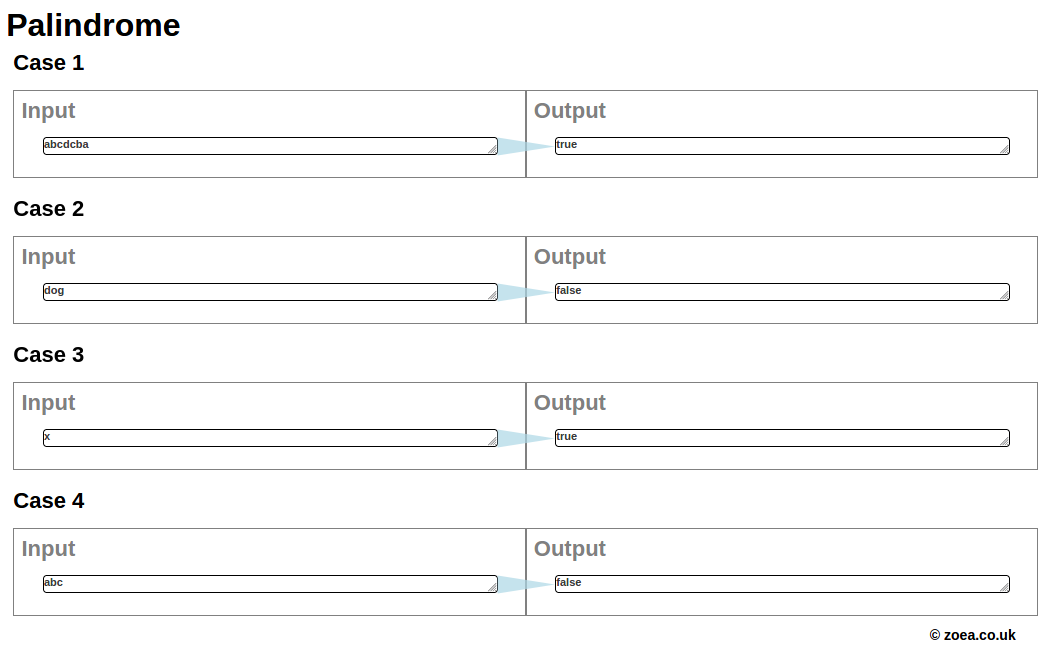
- Programming Tasks
- Text processing
- Recursion
- String manipulation
- Classic CS problems and programs
- Palindromes
- 11l
- 360 Assembly
- 8080 Assembly
- 8086 Assembly
- ACL2
- Acornsoft Lisp
- Action!
- ActionScript
- Ada
- ALGOL 68
- APL
- AppleScript
- Applesoft BASIC
- ARM Assembly
- Arturo
- AutoHotkey
- AutoIt
- AWK
- BaCon
- Bash
- BASIC
- IS-BASIC
- Sinclair ZX81 BASIC
- BBC BASIC
- Batch File
- BCPL
- Befunge
- BQN
- Bracmat
- Bruijn
- Burlesque
- C
- C sharp
- C++
- Clojure
- CLU
- COBOL
- CoffeeScript
- Common Lisp
- Component Pascal
- Cowgol
- Crystal
- D
- Dart
- Delphi
- Dyalect
- Déjà Vu
- E
- EasyLang
- EchoLisp
- Eiffel
- Ela
- Elixir
- Elm
- Emacs Lisp
- Erlang
- Euphoria
- Excel
- F Sharp
- Factor
- Falcon
- Fantom
- FBSL
- Forth
- Fortran
- FreeBASIC
- Frink
- FutureBasic
- Fōrmulæ
- GAP
- GML
- Go
- GolfScript
- Groovy
- Haskell
- HicEst
- HicEst examples needing attention
- Examples needing attention
- Icon
- Unicon
- Icon Programming Library
- Insitux
- Ioke
- J
- Jakt
- Java
- JavaScript
- Jq
- Jsish
- Julia
- K
- Kotlin
- LabVIEW
- Langur
- Lasso
- Liberty BASIC
- LiveCode
- Logo
- Lua
- M4
- MACRO-11
- Maple
- Mathematica
- Wolfram Language
- MATLAB
- Maxima
- MAXScript
- Min
- MiniScript
- Mirah
- ML
- MLite
- Standard ML
- MMIX
- Modula-2
- Modula-3
- Nanoquery
- Nemerle
- NetRexx
- NewLISP
- Nim
- Objeck
- OCaml
- Octave
- Oforth
- Ol
- Oz
- PARI/GP
- Pascal
- Perl
- Phix
- Phixmonti
- PHP
- Picat
- PicoLisp
- Pike
- PL/I
- PL/M
- Plain English
- Pointless
- Potion
- PowerBASIC
- PowerShell
- Processing
- Prolog
- PureBasic
- Python
- Quackery
- R
- Racket
- Raku
- Rascal
- REBOL
- Retro
- REXX
- Ring
- RPL
- Ruby
- Rhovas
- Run BASIC
- Rust
- SAS
- Scala
- Scheme
- Sed
- Seed7
- SequenceL
- Sidef
- Simula
- Slate
- Smalltalk
- SNOBOL4
- SparForte
- SQL
- Swift
- Tailspin
- Tcl
- TUSCRIPT
- TypeScript
- Uiua
- UNIX Shell
- Ursala
- Vala
- VBA
- VBScript
- Vedit macro language
- Visual Basic .NET
- V (Vlang)
- Wortel
- Wren
- X86 Assembly
- XPL0
- Yorick
- Z80 Assembly
- Zkl
- Zoea
- Zoea Visual
- Pages with too many expensive parser function calls