
Sum of a series

You are encouraged to solve this task according to the task description, using any language you may know.
Compute the nth term of a series, i.e. the sum of the n first terms of the corresponding sequence.
Informally this value, or its limit when n tends to infinity, is also called the sum of the series, thus the title of this task.
For this task, use:
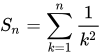
- and compute

This approximates the zeta function for S=2, whose exact value

is the solution of the Basel problem.
11l
print(sum((1..1000).map(x -> 1.0/x^2)))- Output:
1.64393
360 Assembly
*        Sum of a series           30/03/2017
SUMSER   CSECT
         USING  SUMSER,12          base register
         LR     12,15              set addressability
         LR     10,14              save r14
         LE     4,=E'0'            s=0
         LE     2,=E'1'            i=1
       DO WHILE=(CE,2,LE,=E'1000') do i=1 to 1000
         LER    0,2                  i
         MER    0,2                  *i
         LE     6,=E'1'              1
         DER    6,0                  1/i**2
         AER    4,6                  s=s+1/i**2
         AE     2,=E'1'              i=i+1
       ENDDO    ,                  enddo i
         LA     0,4                format F13.4
         LER    0,4                s
         BAL    14,FORMATF         call formatf
         MVC    PG(13),0(1)        retrieve result
         XPRNT  PG,80              print buffer
         BR     10                 exit
         COPY   FORMATF            formatf code
PG       DC     CL80' '            buffer
END SUMSER- Output:
1.6439
ACL2
(defun sum-x^-2 (max-x)
   (if (zp max-x)
       0
       (+ (/ (* max-x max-x))
          (sum-x^-2 (1- max-x)))))
Action!
INCLUDE "D2:REAL.ACT" ;from the Action! Tool Kit

PROC Calc(CARD n REAL POINTER res)
  CARD i,st
  BYTE perc
  REAL one,a,b

  IntToReal(0,res)
  IF n=0 THEN RETURN FI

  IntToReal(1,one)
  st=n/100
  FOR i=1 TO n
  DO
    IF i MOD st=0 THEN
      PrintB(perc) Put('%) PutE() Put(28)
      perc==+1
    FI

    IntToReal(i,a)
    RealMult(a,a,b)
    RealDiv(one,b,a)
    RealAdd(res,a,b)
    RealAssign(b,res)
  OD
RETURN

PROC Main()
  REAL POINTER res
  CARD n=[1000]

  Put(125) PutE() ;clear screen
  Calc(n,res)
  PrintF("s(%U)=",n)
  PrintRE(res)
RETURN- Output:
Screenshot from Atari 8-bit computer
s(1000)=1.64392967
ActionScript
function partialSum(n:uint):Number
{
	var sum:Number = 0;
	for(var i:uint = 1; i <= n; i++)
		sum += 1/(i*i);
	return sum;
}
trace(partialSum(1000));
Ada
with Ada.Text_Io; use Ada.Text_Io;

procedure Sum_Series is
   function F(X : Long_Float) return Long_Float is
   begin
      return 1.0 / X**2;
   end F;
   package Lf_Io is new Ada.Text_Io.Float_Io(Long_Float);
   use Lf_Io;
   Sum : Long_Float := 0.0;
   subtype Param_Range is Integer range 1..1000;
begin
   for I in Param_Range loop
      Sum := Sum + F(Long_Float(I));
   end loop;
   Put("Sum of F(x) from" & Integer'Image(Param_Range'First) &
      " to" & Integer'Image(Param_Range'Last) & " is ");
   Put(Item => Sum, Aft => 10, Exp => 0);
   New_Line;
end Sum_Series;
Aime
real
Invsqr(real n)
{
    1 / (n * n);
}

integer
main(void)
{
    integer i;
    real sum;

    sum = 0;

    i = 1;
    while (i < 1000) {
        sum += Invsqr(i);
        i += 1;
    }

    o_real(14, sum);
    o_byte('\n');

    0;
}
ALGOL 68
MODE RANGE = STRUCT(INT lwb, upb);

PROC sum = (PROC (INT)LONG REAL f, RANGE range)LONG REAL:(
  LONG REAL sum := LENG 0.0;
  FOR i FROM lwb OF range TO upb OF range DO
     sum := sum + f(i)
  OD;
  sum
);

test:(
  RANGE range = (1,1000);
  PROC f = (INT x)LONG REAL: LENG REAL(1) / LENG REAL(x)**2;
  print(("Sum of f(x) from ", whole(lwb OF range, 0), " to ",whole(upb OF range, 0)," is ", fixed(SHORTEN sum(f,range),-8,5),".", new line))
)
Output:
Sum of f(x) from 1 to 1000 is 1.64393.
ALGOL W
Uses Jensen's Device (first introduced in Algol 60) which uses call by name to allow a summation index and the expression to sum to be specified as parameters to a summation procedure.
begin % compute the sum of 1/k^2 for k = 1..1000 %
    integer k;
    % computes the sum of a series from lo to hi using Jensen's Device %
    real procedure sum  ( integer %name% k; integer value lo, hi; real procedure term );
    begin
        real temp;
        temp := 0;
        k := lo;
        while k <= hi do begin
            temp := temp + term;
            k := k + 1
        end while_k_le_temp;
        temp
    end;
    write( r_format := "A", r_w := 8, r_d := 5, sum( k, 1, 1000, 1 / ( k * k ) ) )
end.- Output:
1.64393
APL
      +/÷2*⍨⍳1000
1.64393
AppleScript
----------------------- SUM OF SERIES ----------------------

-- seriesSum :: Num a => (a -> a) -> [a] -> a
on seriesSum(f, xs)
    script go
        property mf : |λ| of mReturn(f)
        on |λ|(a, x)
            a + mf(x)
        end |λ|
    end script

    foldl(go, 0, xs)
end seriesSum


---------------------------- TEST --------------------------

-- inverseSquare :: Num -> Num
on inverseSquare(x)
    1 / (x ^ 2)
end inverseSquare

on run
    seriesSum(inverseSquare, enumFromTo(1, 1000))

    --> 1.643934566682
end run


--------------------- GENERIC FUNCTIONS --------------------

-- enumFromTo :: Int -> Int -> [Int]
on enumFromTo(m, n)
    if m ≤ n then
        set lst to {}
        repeat with i from m to n
            set end of lst to i
        end repeat
        lst
    else
        {}
    end if
end enumFromTo


-- foldl :: (a -> b -> a) -> a -> [b] -> a
on foldl(f, startValue, xs)
    tell mReturn(f)
        set v to startValue
        set lng to length of xs
        repeat with i from 1 to lng
            set v to |λ|(v, item i of xs, i, xs)
        end repeat
        return v
    end tell
end foldl


-- Lift 2nd class handler function into 1st class script wrapper
-- mReturn :: Handler -> Script
on mReturn(f)
    if class of f is script then
        f
    else
        script
            property |λ| : f
        end script
    end if
end mReturn
- Output:
1.643934566682
Arturo
series: map 1..1000 => [1.0/&^2]
print [sum series]
- Output:
1.643934566681561
Asymptote
real sum;
for(int i = 1; i < 1000; ++i)  sum = sum + 1 / (i * i);
write(sum, suffix=none);
- Output:
1.64393356668156
AutoHotkey
AutoHotkey allows the precision of floating point numbers generated by math operations to be adjusted via the SetFormat command. The default is 6 decimal places.
SetFormat, FloatFast, 0.15
While A_Index <= 1000
 sum += 1/A_Index**2
MsgBox,% sum  ;1.643934566681554
AWK
$ awk 'BEGIN{for(i=1;i<=1000;i++)s+=1/(i*i);print s}'
1.64393
BASIC
function s(x%)
   s = 1 / x ^ 2
end function

function sum(low%, high%)
   ret = 0
   for i = low to high
      ret = ret + s(i)
   next i
   sum = ret
end function
print sum(1, 1000)
BASIC256
function sumSeries(n)
    if n = 0 then sumSeries = 0
    let sum = 0
    for k = 1 to n
        let sum = sum + 1 / k ^ 2
    next k
    sumSeries = sum
end function

print "s(1000) = "; sumSeries(1000)
print "zeta(2) = "; pi * pi / 6
end
BBC BASIC
      FOR i% = 1 TO 1000
        sum += 1/i%^2
      NEXT
      PRINT sum
Gambas
Public Sub Main()

  Print "s(1000) = "; sumSeries(1000)
  Print "zeta(2) = "; Pi * Pi / 6

End

Function sumSeries(n As Integer) As Float

  If n = 0 Then Return 0
  Dim sum As Float = 0
  For k As Integer = 1 To n
    sum += 1.0 / (k * k)
  Next
  Return sum

End Function
QBasic
FUNCTION sumSeries# (n)
    IF n = 0 THEN sunSeries = 0
    FOR k = 1 TO n
        sum# = sum# + 1! / (k * k)
    NEXT
    sumSeries# = sum#
END FUNCTION

pi# = 4 * ATN(1)
PRINT "s(1000) = "; sumSeries#(1000)
PRINT "zeta(2) = "; pi# * pi# / 6
END
True BASIC
FUNCTION sumSeries(n)
    IF n = 0 then
       LET sumSeries = 0
    END IF
    LET sum = 0
    FOR k = 1 to n
        LET sum = sum + 1 / k ^ 2
    NEXT k
    LET sumSeries = sum
END FUNCTION

PRINT "s(1000) = "; sumSeries(1000)
PRINT "zeta(2) = "; pi * pi / 6
END
XBasic
PROGRAM	"SumOfASeries"
VERSION	"0.0000"

DECLARE FUNCTION Entry ()
DECLARE FUNCTION sumSeries#(n)

FUNCTION Entry ()

pi# = 3.1415926535896

PRINT "s(1000) = "; sumSeries#(1000)
PRINT "zeta(2) = "; pi# * pi# / 6

END FUNCTION

FUNCTION sumSeries#(n)
  IF n = 0 THEN RETURN 0
  sum# = 0
  FOR k = 1 TO n
    sum# = sum# + 1.0/(k * k)
  NEXT
  RETURN sum#
END FUNCTION
END PROGRAM
Yabasic
sub sumSeries(n)
    if n = 0 then return 0 : fi
    sum = 0
    for k = 1 to n
        sum = sum + 1 / k ^ 2
    next k
    return sum
end sub

print "s(1000) = ", sumSeries(1000)
print "zeta(2) = ", pi * pi / 6
end
bc
define f(x) {
    return(1 / (x * x))
}

define s(n) {
    auto i, s

    for (i = 1; i <= n; i++) {
        s += f(i)
    }

    return(s)
}

scale = 20
s(1000)
- Output:
1.64393456668155979824
Beads
beads 1 program 'Sum of a series'
calc main_init
	var k = 0
	loop reps:1000 count:n
		k = k + 1/n^2
log to_str(k)- Output:
1.6439345666815615
Befunge
Emulates fixed point arithmetic with a 32 bit integer so the result is not very accurate.
05558***>::"~"%00p"~"/10p"( }}2"*v
v*8555$_^#!:-1+*"~"g01g00+/*:\***<
<@$_,#!>#:<+*<v+*86%+55:p00<6\0/**
   "."\55+%68^>\55+/00g1-:#^_$
- Output:
1.643934
BQN
√⁼ here reads as the inverse of the square root, which can be changed to 2⋆˜ or ט. It has been used here since it is the most intuitive.
  +´÷√⁼1+↕1000
1.6439345666815597
Bracmat
( 0:?i
& 0:?S
& whl'(1+!i:~>1000:?i&!i^-2+!S:?S)
& out$!S
& out$(flt$(!S,10))
);
Output:
8354593848314...../5082072010432.....  (1732 digits and a slash)
1,6439345667*10E0
Brat
p 1.to(1000).reduce 0 { sum, x | sum + 1.0 / x ^ 2 } #Prints 1.6439345666816C
#include <stdio.h>

double Invsqr(double n)
{
	return 1 / (n*n);
}

int main (int argc, char *argv[])
{
	int i, start = 1, end = 1000;
	double sum = 0.0;

	for( i = start; i <= end; i++)
		sum += Invsqr((double)i);

	printf("%16.14f\n", sum);

	return 0;
}
C#
class Program
{
    static void Main(string[] args)
    {
        // Create and fill a list of number 1 to 1000

        List<double> myList = new List<double>();
        for (double i = 1; i < 1001; i++)
        {
            myList.Add(i);
        }
        // Calculate the sum of 1/x^2

        var sum = myList.Sum(x => 1/(x*x));

        Console.WriteLine(sum);
        Console.ReadLine();
    }
}
An alternative approach using Enumerable.Range() to generate the numbers.
class Program
{
    static void Main(string[] args)
    {
        double sum = Enumerable.Range(1, 1000).Sum(x => 1.0 / (x * x));

        Console.WriteLine(sum);
        Console.ReadLine();
    }
}
C++
#include <iostream>

double f(double x);

int main()
{
    unsigned int start = 1;
    unsigned int end = 1000;
    double sum = 0;

    for( unsigned int x = start; x <= end; ++x )
    {
        sum += f(x);
    }
    std::cout << "Sum of f(x) from " << start << " to " << end << " is " << sum << std::endl;
    return 0;
}


double f(double x)
{
    return ( 1.0 / ( x * x ) );
}
CLIPS
(deffunction S (?x) (/ 1 (* ?x ?x)))
(deffunction partial-sum-S
  (?start ?stop)
  (bind ?sum 0)
  (loop-for-count (?i ?start ?stop) do
    (bind ?sum (+ ?sum (S ?i)))
  )
  (return ?sum)
)
Usage:
CLIPS> (partial-sum-S 1 1000)
1.64393456668156
Clojure
(reduce + (map #(/ 1.0 % %) (range 1 1001)))
CLU
series_sum = proc (from, to: int,
                   fn: proctype (real) returns (real))
             returns (real)
    sum: real := 0.0
    for i: int in int$from_to(from, to) do
        sum := sum + fn(real$i2r(i))
    end
    return(sum)
end series_sum

one_over_k_squared = proc (k: real) returns (real)
    return(1.0 / (k * k))
end one_over_k_squared

start_up = proc ()
    po: stream := stream$primary_output()
    result: real := series_sum(1, 1000, one_over_k_squared)
    stream$putl(po, f_form(result, 1, 6))
end start_up- Output:
1.643935
COBOL
       IDENTIFICATION DIVISION.
       PROGRAM-ID. sum-of-series.

       DATA DIVISION.
       WORKING-STORAGE SECTION.
       78  N                       VALUE 1000.

       01  series-term             USAGE FLOAT-LONG.
       01  i                       PIC 9(4).

       PROCEDURE DIVISION.
           PERFORM VARYING i FROM 1 BY 1 UNTIL N < i
               COMPUTE series-term = series-term + (1 / i ** 2)
           END-PERFORM

           DISPLAY series-term

           GOBACK
           .
- Output:
1.643933784000000120
CoffeeScript
console.log [1..1000].reduce((acc, x) -> acc + (1.0 / (x*x)))
Common Lisp
(loop for x from 1 to 1000 summing (expt x -2))
Crystal
puts (1..1000).sum{ |x| 1.0 / x ** 2 }
puts (1..5000).sum{ |x| 1.0 / x ** 2 }
puts (1..9999).sum{ |x| 1.0 / x ** 2 }
puts Math::PI ** 2 / 6
- Output:
1.6439345666815615
1.6447340868469014
1.6448340618480652
1.6449340668482264
D
More Procedural Style
import std.stdio, std.traits;

ReturnType!TF series(TF)(TF func, int end, int start=1)
pure nothrow @safe @nogc {
    typeof(return) sum = 0;
    foreach (immutable i; start .. end + 1)
        sum += func(i);
    return sum;
}

void main() {
    writeln("Sum: ", series((in int n) => 1.0L / (n ^^ 2), 1_000));
}
- Output:
Sum: 1.64393
More functional Style
Same output.
import std.stdio, std.algorithm, std.range;

enum series(alias F) = (in int end, in int start=1)
    pure nothrow @nogc => iota(start, end + 1).map!F.sum;

void main() {
    writeln("Sum: ", series!q{1.0L / (a ^^ 2)}(1_000));
}
dc
20 k 0 [ln 1 + d sn _2 ^ + 1000 ln <l] d sl x p- Output:
1.64393456668155979824
Dart
main() {
  var list = new List<int>.generate(1000, (i) => i + 1);

  num sum = 0;

  (list.map((x) => 1.0 / (x * x))).forEach((num e) {
    sum += e;
  });
  print(sum);
}
f(double x) {
  if (x == 0)
    return x;
  else
    return (1.0 / (x * x)) + f(x - 1.0);
}

main() {
  print(f(1000));
}
Delphi
unit Form_SumOfASeries_Unit;

interface

uses
  Windows, Messages, SysUtils, Variants, Classes, Graphics, Controls, Forms,
  Dialogs, StdCtrls;

type
  TFormSumOfASeries = class(TForm)
    M_Log: TMemo;
    B_Calc: TButton;
    procedure B_CalcClick(Sender: TObject);
  private
    { Private-Deklarationen }
  public
    { Public-Deklarationen }
  end;

var
  FormSumOfASeries: TFormSumOfASeries;

implementation

{$R *.dfm}

function Sum_Of_A_Series(_from,_to:int64):extended;
begin
  result:=0;
  while _from<=_to do
  begin
    result:=result+1.0/(_from*_from);
    inc(_from);
  end;
end;

procedure TFormSumOfASeries.B_CalcClick(Sender: TObject);
begin
  try
    M_Log.Lines.Add(FloatToStr(Sum_Of_A_Series(1, 1000)));
  except
    M_Log.Lines.Add('Error');
  end;
end;

end.
- Output:
1.64393456668156
DWScript
var s : Float;
for var i := 1 to 1000 do
   s += 1 / Sqr(i);

PrintLn(s);
Dyalect
func Integer.SumSeries() {
    var ret = 0

    for i in 1..this {
       ret += 1 / pow(Float(i), 2)
    }

    ret
}

var x = 1000
print(x.SumSeries())- Output:
1.6439345666815615
E
pragma.enable("accumulator")
accum 0 for x in 1..1000 { _ + 1 / x ** 2 }
EasyLang
numfmt 8 0
for i = 1 to 1000
   s += 1 / (i * i)
.
print s
EchoLisp
(lib 'math) ;; for (sigma f(n) nfrom nto) function
(Σ (λ(n) (// (* n n))) 1 1000)
;; or
(sigma (lambda(n) (// (* n n))) 1 1000)
    → 1.6439345666815615

(// (* PI PI) 6)
    → 1.6449340668482264
EDSAC order code
Real numbers on EDSAC were restricted to the range -1 <= x < 1. The posted solution cheats slightly by omitting the term with k = 1, while printing '1' before the decimal part. The first eight decimals of the output are correct; the last two should be 67 not 41.
In floating-point arithmetic, summing the smallest terms first is more accurate than summing the largest terms first, as can be seen e.g. in the Pascal solution. EDSAC used fixed-point arithmetic, so the order of summation makes no difference.
 [Sum of a series, Rosetta Code website.
  EDSAC program, Initial Orders 2.]
            ..PZ  [blank tape and terminator]

 [Library subroutine D6 - Division, accurate, fast.
  36 locations, working positons 6D and 8D.
  C(0D) := C(0D)/C(4D), where C(4D) <> 0, -1.]
            T56K
  GKA3FT34@S4DE13@T4DSDTDE2@T4DADLDTDA4DLDE8@RDU4DLDA35@
  T6DE25@U8DN8DA6DT6DH6DS6DN4DA4DYFG21@SDVDTDEFW1526D

 [Library subroutine P1 - Print positive number, no formatting or round-off.
  Prints number in 0D to n places of decimals, where n is specified by 'P n F'
  pseudo-order after subroutine call.  21 locations.]
            T92K
  GKA18@U17@S20@T5@H19@PFT5@VDUFOFFFSFL4FTDA5@A2FG6@EFU3FJFM1F

 [Custom subroutine to calculate 1/k^2 for a 17-bit integer k > 1.
  Input:  0F = k (with the usual scaling; actually k/(2^16).
  Output: 0D = 1/k^2.]
            T120K  GK
            A3F  T11@   [set up return to caller as usual]
            HF          [multiply register := k/(2^16)]
            VF          [acc := k/(2^16) squared]
   [At this point acc =(k^2)/(2^32). Now we switch to 35-bit
    arithmetic, in which integers are scaled by 2^(-34)]
            R1F         [shift acc 2 right to adjust scaling]
            T4D         [4D := k^2]
            TD          [set 0D := 0; clears "sandwich bit" between 0F and 1F]
            A12@  TF    [set 0D := 1 by setting 0F := 1]
            A9@  G56F   [call EDSAC library subroutine for division]
     [11]   ZF          [overwritten by jump back to caller]
     [12]   PD          [short constant 1]

 [Main program]
            T200K  GK   [load at even address because of long variable at 0]
      [0]   PF  PF      [build sum here]
      [2]   PD          [short constant 1]
      [3]   P500F       [short constant 1000]
      [4]   K2048F  #F  !F  @F  &F  [letters, figures, space, CR, LF]
      [9]   HF  IF  LF  [letters H, I, L (in letters mode)]
     [12]   QF  MF      [digit 1, dot (in figures mode)]
     [14]   PF          [variable k]

     [15]   T#@  A2@ T14@            [sum := 0, k := 1]
     [18]   TF  A14@  A2@  U14@  TF  [inc k; pass new k to function in 0F]
            A23@  G120F              [call function; places 1/k^2 at 0D]
            AD  A#@  T#@             [add 1/k^2 into sum]
            A14@  S3@  G18@          [test for k = maximum, loop back if not]
            O4@  O11@  O89@  O6@  O15@  O89@  O6@  O9@  O10@  O6@  [print 'LO TO HI ']
            O5@  O12@  O13@          [print '1.']
            A#@  TD  A46@  G92F      [call subroutine to print decimal part]
            P10F                     [parameter for print subroutine; 10 decimal places]
            O7@  O8@                 [print CR, LF]

       [Sum in reverse order to confirm that the result is identical on EDSAC.
        Not much different from the above, so given in condensed form.]
            TFT#@A3@T14@TFA14@TFA58@G120FADA#@T#@A14@S2@U14@S2FE55@TDA#@TD
            O4@O9@O10@O6@O15@O89@O6@O11@O89@O6@O5@O12@O13@A84@G92FP10FO7@O8@

     [89]   O5@  ZF                  [flush teleprinter buffer; stop]
E15Z PF [define entry point; enter with acc = 0]- Output:
LO TO HI 1.6439345641
HI TO LO 1.6439345641
Eiffel
note
	description: "Compute the n-th term of a series"

class
	SUM_OF_SERIES_EXAMPLE

inherit
	MATH_CONST

create
	make

feature -- Initialization

	make
		local
			approximated, known: REAL_64
		do
			known := Pi^2 / 6

			approximated := sum_until (agent g, 1001)
			print ("%Nzeta function exact value: %N")
			print (known)
			print ("%Nzeta function approximated value: %N")
			print (approximated)
		end

feature -- Access

	g (k: INTEGER): REAL_64
			-- 'k'-th term of the serie
		require
			k_positive: k > 0
		do
			Result := 1 / (k * k)
		end

	sum_until (s: FUNCTION [ANY, TUPLE [INTEGER], REAL_64]; n: INTEGER): REAL_64
			-- sum of the 'n' first terms of 's'
		require
			n_positive: n > 0
			one_parameter: s.open_count = 1
		do
			Result := 0
			across 1 |..| n as it loop
				Result := Result + s.item ([it.item])
			end
		end

end
Elena
ELENA 6.x :
import system'routines;
import extensions;

public program()
{
    var sum := new Range(1, 1000).selectBy::(x => 1.0r / (x * x)).summarize(new Real());

    console.printLine(sum)
}- Output:
1.643933566682
Elixir
iex(1)> Enum.reduce(1..1000, 0, fn x,sum -> sum + 1/(x*x) end)
1.6439345666815615
Elm
module Main exposing (main)

import Html exposing (h1, div, p, text)
import Html.Attributes exposing (style)

aList : List Int
aList = List.range 1 1000


-- version a with a list
k2xSum : Float
k2xSum = List.sum
  <| List.map (\x -> 1.0 / x / x )
    <| List.map (\n -> toFloat n) aList


-- version b with a list
fx : Int -> Float
fx =
    (\n -> toFloat n |> \m -> 1.0 / m / m)

f2kSum : Float
f2kSum = List.sum
  <| List.map fx aList

-- version with recursion, without a list
untilMax : Int -> Int -> Float -> Float
untilMax k kmax accum =
  if k > kmax
    then accum
  else
    let
        x = toFloat k
        dx = 1.0 / x / x
    in  untilMax (k + 1)  kmax (accum + dx)

recSum : Float
recSum = untilMax 1 1000 0.0

main = div [style "margin" "5%", style "color" "blue"] [
   h1 [] [text "Sum of series Σ 1/k²"]
   , text (" Version a with a list: Sum = " ++ String.fromFloat k2xSum)
   , p [] [text (" Version b with a list: Sum = " ++ String.fromFloat f2kSum)]
   , p [] [text (" Recursion version c: Sum = " ++ String.fromFloat recSum)]
]
- Output:
Sum of series Σ 1/k²
Version a with a list: Sum = 1.6439345666815615

Version b with a list: Sum = 1.6439345666815615

Recursion version c: Sum = 1.6439345666815615
Emacs Lisp
(defun series (n)
  (when (<= n 0)
    (user-error "n must be positive"))
  (apply #'+ (mapcar (lambda (k) (/ 1.0 (* k k))) (number-sequence 1 n))))

(format "%.10f" (series 1000)) ;=> "1.6439345667"
Erlang
lists:sum([1/math:pow(X,2) || X <- lists:seq(1,1000)]).
Euphoria
This is based on the BASIC example.
function s( atom x )
	return 1 / power( x, 2 )
end function

function sum( atom low, atom high )
	atom ret = 0.0
	for i = low to high do
		ret = ret + s( i )
	end for
	return ret
end function

printf( 1, "%.15f\n", sum( 1, 1000 ) )
Excel
LAMBDA
Binding the names sumOfSeries, and inverseSquare to the following lambda expressions in the Name Manager of the Excel WorkBook:
(See LAMBDA: The ultimate Excel worksheet function)
Excel automatically lifts a function over a scalar to a function over an array:
sumOfSeries
=LAMBDA(f,
    LAMBDA(n,
        SUM(
            f(SEQUENCE(n, 1, 1, 1))
        )
    )
)


inverseSquare
=LAMBDA(n,
    1 / (n ^ 2)
)
- Output:
| fx | =sumOfSeries(inverseSquare)(A2) | ||
|---|---|---|---|
| A | B | ||
| 1 | N terms | Sum of inverse square series | |
| 2 | 1 | 1 | |
| 3 | 10 | 1.5497677311665408 | |
| 4 | 100 | 1.63498390018489 | |
| 5 | 1000 | 1.64393456668156 | |
Ezhil
## இந்த நிரல் தொடர் கூட்டல் (Sum Of Series) என்ற வகையைச் சேர்ந்தது

## இந்த நிரல் ஒன்று முதல் தரப்பட்ட எண் வரை 1/(எண் * எண்) எனக் கணக்கிட்டுக் கூட்டி விடை தரும்

நிரல்பாகம் தொடர்க்கூட்டல்(எண்1)

  எண்2 = 0

  @(எண்3 = 1, எண்3 <= எண்1, எண்3 = எண்3 + 1) ஆக

    ## ஒவ்வோர் எண்ணின் வர்க்கத்தைக் கணக்கிட்டு, ஒன்றை அதனால் வகுத்துக் கூட்டுகிறோம்

    எண்2 = எண்2 + (1 / (எண்3 * எண்3))

  முடி

  பின்கொடு (எண்2)

முடி

அ = int(உள்ளீடு("ஓர் எண்ணைச் சொல்லுங்கள்: "))

பதிப்பி "நீங்கள் தந்த எண் " அ
பதிப்பி "அதன் தொடர்க் கூட்டல் " தொடர்க்கூட்டல்(அ)
F#
The following function will do the task specified.
let rec f (x : float) =
    match x with
        | 0. -> x
        | x -> (1. / (x * x)) + f (x - 1.)
In the interactive F# console, using the above gives:
> f 1000. ;;
val it : float = 1.643934567
However, this recursive function will run out of stack space eventually (try 100000). A tail-recursive implementation will not consume stack space and can therefore handle much larger ranges. Here is such a version:
#light
let sum_series (max : float) =
    let rec f (a:float, x : float) =
        match x with
            | 0. -> a
            | x -> f ((1. / (x * x) + a), x - 1.)
    f (0., max)

[<EntryPoint>]
let main args =
    let (b, max) = System.Double.TryParse(args.[0])
    printfn "%A" (sum_series max)
    0
This block can be compiled using fsc --target exe filename.fs or used interactively without the main function.
For a much more elegant and FP style of solving this problem, use:
Seq.sum [for x in [1..1000] do 1./(x * x |> float)]
Factor
1000 [1,b] [ >float sq recip ] map-sum
Fantom
Within 'fansh':
fansh> (1..1000).toList.reduce(0.0f) |Obj a, Int v -> Obj| { (Float)a + (1.0f/(v*v)) }
1.6439345666815615
Fermat
Sigma<k=1,1000>[1/k^2]- Output:
 83545938483149689478187854264854884386044454314086472930763839512603803291207881839588904977469387999844962675327115010933 `
 903589145654299730231109091124308462732153297321867661093162618281746011828755017021645889046777854795025297006943669294 `
 330752479399654716368801794529682603741344724733173765262964463970763934463926259796895140901128384286333311745462863716 `
 753134735154188954742414035836608258393970996630553795415075904205673610359458498106833291961256452756993199997231825920 `
 203667952667546787052535763624910912251107083702817265087341966845358732584971361645348091123849687614886682117125784781 `
 422103460192439394780707024963279033532646857677925648889105430050030795563141941157379481719403833258405980463950499887 `
 302926152552848089894630843538497552630691676216896740675701385847032173192623833881016332493844186817408141003602396236 `
 858699094240207812766449 / 50820720104325812617835292273000760481839790754374852703215456050992581046448162621598030244504097 `
 240825920773913981926305208272518886258627010933716354037062979680120674828102224650586465553482032614190502746121717248 `
 161892239954030493982549422690846180552358769564169076876408783086920322038142618269982747137757706040198826719424371333 `
 781947889528085329853597116893889786983109597085041878513917342099206896166585859839289193299599163669641323895022932959 `
 750057616390808553697984192067774252834860398458100840611325353202165675189472559524948330224159123505567527375848194800 `
 452556940453530457590024173749704941834382709198515664897344438584947842793131829050180589581507273988682409028088248800 `
 576590497216884808783192565859896957125449502802395453976401743504938336291933628859306247684023233969172475385327442707 `
 968328512729836445886537101453118476390400000000;  or  1.6439345666815598031390580238222155896521
Fish
0&aaa**>::*1$,&v
    ;n&^?:-1&+ <
Forth
: sum ( fn start count -- fsum )
  0e
  bounds do
    i s>d d>f dup execute f+
  loop drop ;

:noname ( x -- 1/x^2 ) fdup f* 1/f ;   ( xt )
1 1000 sum f.       \ 1.64393456668156
pi pi f* 6e f/ f.   \ 1.64493406684823
Fortran
In ISO Fortran 90 and later, use SUM intrinsic:
real, dimension(1000) :: a = (/ (1.0/(i*i), i=1, 1000) /)
real :: result

result = sum(a);
Or in Fortran 77:
      s=0
      do i=1,1000
          s=s+1./i**2
      end do
      write (*,*) s
      end
FreeBASIC
' FB 1.05.0 Win64

Const pi As Double = 3.141592653589793

Function sumSeries (n As UInteger) As Double
  If n = 0 Then Return 0
  Dim sum As Double = 0
  For k As Integer = 1 To n
    sum += 1.0/(k * k)
  Next
  Return sum
End Function

Print "s(1000) = "; sumSeries(1000)
Print "zeta(2) = "; Pi * pi / 6
Print
Print "Press any key to quit"
Sleep- Output:
s(1000) =  1.643934566681562
zeta(2) =  1.644934066848226
Frink
Frink can calculate the series with exact rational numbers or floating-point values.
sum[map[{|k| 1/k^2}, 1 to 1000]]- Output:
83545938483149689478187854264854884386044454314086472930763839512603803291207881839588904977469387999844962675327115010933903589145654299730231109091124308462732153297321867661093162618281746011828755017021645889046777854795025297006943669294330752479399654716368801794529682603741344724733173765262964463970763934463926259796895140901128384286333311745462863716753134735154188954742414035836608258393970996630553795415075904205673610359458498106833291961256452756993199997231825920203667952667546787052535763624910912251107083702817265087341966845358732584971361645348091123849687614886682117125784781422103460192439394780707024963279033532646857677925648889105430050030795563141941157379481719403833258405980463950499887302926152552848089894630843538497552630691676216896740675701385847032173192623833881016332493844186817408141003602396236858699094240207812766449/50820720104325812617835292273000760481839790754374852703215456050992581046448162621598030244504097240825920773913981926305208272518886258627010933716354037062979680120674828102224650586465553482032614190502746121717248161892239954030493982549422690846180552358769564169076876408783086920322038142618269982747137757706040198826719424371333781947889528085329853597116893889786983109597085041878513917342099206896166585859839289193299599163669641323895022932959750057616390808553697984192067774252834860398458100840611325353202165675189472559524948330224159123505567527375848194800452556940453530457590024173749704941834382709198515664897344438584947842793131829050180589581507273988682409028088248800576590497216884808783192565859896957125449502802395453976401743504938336291933628859306247684023233969172475385327442707968328512729836445886537101453118476390400000000 (approx. 1.6439345666815598)
Change 1/k^2 to 1.0/k^2 to use floating-point math.
Fōrmulæ
Fōrmulæ programs are not textual, visualization/edition of programs is done showing/manipulating structures but not text. Moreover, there can be multiple visual representations of the same program. Even though it is possible to have textual representation —i.e. XML, JSON— they are intended for storage and transfer purposes more than visualization and edition.
Programs in Fōrmulæ are created/edited online in its website.
In this page you can see and run the program(s) related to this task and their results. You can also change either the programs or the parameters they are called with, for experimentation, but remember that these programs were created with the main purpose of showing a clear solution of the task, and they generally lack any kind of validation.
Solution
In the following function, the first parameter is the series is provided as a lambda expression. The second parameter is the number of terms to calculate

Test case
The exact value (of the sum) is:

(click to enlarge)

The approximate value is:


While the (approximate) value of π2/6 is:


GAP
# We will compute the sum exactly

# Computing an approximation of a rationnal (giving a string)
# Value is truncated toward zero
Approx := function(x, d)
	local neg, a, b, n, m, s;
	if x < 0 then
		x := -x;
		neg := true;
	else
		neg := false;
	fi;
	a := NumeratorRat(x);
	b := DenominatorRat(x);
	n := QuoInt(a, b);
	a := RemInt(a, b);
	m := 10^d;
	s := "";
	if neg then
		Append(s, "-");
	fi;
	Append(s, String(n));
	n := Size(s) + 1;
	Append(s, String(m + QuoInt(a*m, b)));
	s[n] := '.';
	return s;
end;

a := Sum([1 .. 1000], n -> 1/n^2);;
Approx(a, 10);
"1.6439345666"
# and pi^2/6 is 1.6449340668, truncated to ten digits
Genie
[indent=4]
/*
   Sum of series, in Genie
   valac sumOfSeries.gs
   ./sumOfSeries
*/

delegate sumFunc(n:int):double

def sum_series(start:int, end:int, f:sumFunc):double
    sum:double = 0.0
    for var i = start to end do sum += f(i)
    return sum


def oneOverSquare(n:int):double
    return (1 / (double)(n * n))

init
    Intl.setlocale()
    print "ζ(2) approximation: %16.15f", sum_series(1, 1000, oneOverSquare)
print "π² / 6 : %16.15f", Math.PI * Math.PI / 6.0- Output:
prompt$ valac sumOfSeries.gs
prompt$ ./sumOfSeries
ζ(2) approximation: 1.643934566681561
π² / 6            : 1.644934066848226
GEORGE
0 (s)
1, 1000 rep (i)
   s 1 i dup × / + (s) ;
]
P
Output:-
1.643934566681561
Go
package main

import ("fmt"; "math")

func main() {
    fmt.Println("known:   ", math.Pi*math.Pi/6)
    sum := 0.
    for i := 1e3; i > 0; i-- {
        sum += 1 / (i * i)
    }
    fmt.Println("computed:", sum)
}
Output:
known:    1.6449340668482264
computed: 1.6439345666815597
Groovy
Start with smallest terms first to minimize rounding error:
println ((1000..1).collect { x -> 1/(x*x) }.sum())
Output:
1.6439345654
Haskell
With a list comprehension:
sum [1 / x ^ 2 | x <- [1..1000]]
With higher-order functions:
sum $ map (\x -> 1 / x ^ 2) [1..1000]
In point-free style:
(sum . map (1/) . map (^2)) [1..1000]
or
(sum . map ((1 /) . (^ 2))) [1 .. 1000]
or, as a single fold:
seriesSum f = foldr ((+) . f) 0

inverseSquare = (1 /) . (^ 2)

main :: IO ()
main = print $ seriesSum inverseSquare [1 .. 1000]
- Output:
1.6439345666815615
Haxe
Procedural
using StringTools;

class Main {
  static function main() {
    var sum = 0.0;
    for (x in 1...1001)
      sum += 1.0/(x * x);
    Sys.println('Approximation: $sum');
    Sys.println('Exact: '.lpad(' ', 15) + Math.PI * Math.PI / 6);
  }
}
- Output:
Approximation: 1.64393456668156146
        Exact: 1.64493406684822641
Functional
using Lambda;
using StringTools;

class Main {
  static function main() {
    var approx = [for (x in 1...1001) x].fold(function(x, sum) return sum += 1.0 / (x * x), 0);
    Sys.println('Approximation: $approx');
    Sys.println('Exact: '.lpad(' ', 15) + Math.PI * Math.PI / 6);
  }
}
- Output:
Same as for procedural
HicEst
REAL :: a(1000)
        a = 1 / $^2
WRITE(ClipBoard, Format='F17.15') SUM(a)1.643934566681561Icon and Unicon
or
Note: The terse version requires some explanation. Icon expressions all return values or references if they succeed. As a result, it is possible to have expressions like these below:
IDL
print,total( 1/(1+findgen(1000))^2)
Io
Io 20110905
Io> sum := 0 ; Range 1 to(1000) foreach(k, sum = sum + 1/(k*k))
==> 1.6439345666815615
Io> 1 to(1000) map(k, 1/(k*k)) sum
==> 1.6439345666815615
Io>
The expression using map generates a list internally. Using foreach does not.
J
   NB. sum of reciprocals of squares of first thousand positive integers
   +/ % *: >: i. 1000
1.64393

   (*:o.1)%6       NB. pi squared over six, for comparison
1.64493

   1r6p2           NB.  As a constant (J has a rich constant notation)
1.64493
Java
public class Sum{
    public static double f(double x){
       return 1/(x*x);
    }

    public static void main(String[] args){
       double start = 1;
       double end = 1000;
       double sum = 0;

       for(double x = start;x <= end;x++) sum += f(x);

       System.out.println("Sum of f(x) from " + start + " to " + end +" is " + sum);
    }
}
JavaScript
ES5
function sum(a,b,fn) {
   var s = 0;
   for ( ; a <= b; a++) s += fn(a);
   return s;
}

 sum(1,1000, function(x) { return 1/(x*x) } )  // 1.64393456668156
or, in a functional idiom:
(function () {

  function sum(fn, lstRange) {
    return lstRange.reduce(
      function (lngSum, x) {
        return lngSum + fn(x);
      }, 0
    );
  }

  function range(m, n) {
    return Array.apply(null, Array(n - m + 1)).map(function (x, i) {
      return m + i;
    });
  }


  return sum(
    function (x) {
      return 1 / (x * x);
    },
    range(1, 1000)
  );

})();
- Output:
1.6439345666815615
ES6
(() => {
    'use strict';

    // SUM OF A SERIES -------------------------------------------------------

    // seriesSum :: Num a => (a -> a) -> [a] -> a
    const seriesSum = (f, xs) =>
        foldl((a, x) => a + f(x), 0, xs);


    // GENERIC ---------------------------------------------------------------

    // enumFromToInt :: Int -> Int -> [Int]
    const enumFromTo = (m, n) =>
        Array.from({
            length: Math.floor(n - m) + 1
        }, (_, i) => m + i);

    // foldl :: (b -> a -> b) -> b -> [a] -> b
    const foldl = (f, a, xs) => xs.reduce(f, a);

    // TEST ------------------------------------------------------------------

    return seriesSum(x => 1 / (x * x), enumFromTo(1, 1000));
})();
- Output:
1.6439345666815615
Joy
1000 [0] [swap -2 pow +] primrec.- Output:
1.64393
jq
The jq idiom for efficient computation of this kind of sum is to use "reduce", either directly or using a summation wrapper function.
Directly:
def s(n): reduce range(1; n+1) as $k (0; . + 1/($k * $k) );

s(1000)- Output:
1.6439345666815615
Using a generic summation wrapper function allows problems specified in "sigma" notation to be solved using syntax that closely resembles that notation:
def summation(s): reduce s as $k (0; . + $k);

summation( range(1; 1001) | (1/(. * .) ) )
An important point is that nothing is lost in efficiency using the declarative and quite elegant approach using "summation".
Jsish
From Javascript ES5.
#!/usr/bin/jsish
/* Sum of a series */
function sum(a:number, b:number , fn:function):number {
   var s = 0;
   for ( ; a <= b; a++) s += fn(a);
   return s;
}

;sum(1, 1000, function(x) { return 1/(x*x); } );

/*
=!EXPECTSTART!=
sum(1, 1000, function(x) { return 1/(x*x); } ) ==> 1.643934566681561
=!EXPECTEND!=
*/
- Output:
prompt$ jsish --U sumOfSeries.jsi
sum(1, 1000, function(x) { return 1/(x*x); } ) ==> 1.643934566681561
Julia
Using a higher-order function:
julia> sum(k -> 1/k^2, 1:1000)
1.643934566681559

julia> pi^2/6
1.6449340668482264
A simple loop is more optimized:
julia> function f(n)
    s = 0.0
    for k = 1:n
      s += 1/k^2
    end
    return s
end

julia> f(1000)
1.6439345666815615
K
  ssr: +/1%_sqr
  ssr 1+!1000
1.643935
Kotlin
// version 1.0.6

fun main(args: Array<String>) {
    val n = 1000
    val sum = (1..n).sumByDouble { 1.0 / (it * it) }
    println("Actual sum is $sum")
    println("zeta(2)    is ${Math.PI * Math.PI / 6.0}")
}
- Output:
Actual sum is 1.6439345666815615
zeta(2)    is 1.6449340668482264
Lambdatalk
{+ {S.map {lambda {:k} {/ 1 {* :k :k}}} {S.serie 1 1000}}}
-> 1.6439345666815615 ~  1.6449340668482264 = PI^2/6
Lang5
1000 iota 1 + 1 swap / 2 ** '+ reduce .langur
writeln "calc.: ", fold fn{+}, map fn(.x) 1/.x^2, 1..1000
writeln "known: ", pi^2/6- Output:
calc.: 1.643934566681559803139058023822206
exact: 1.644934066848226436472415166646025
If we set a higher arbitrary maximum for division, we get more digits.
mode divMaxScale = 100

writeln "calc.: ", fold fn{+}, map fn(.x) 1/.x^2, 1..1000
writeln "known: ", pi^2/6- Output:
calc.: 1.6439345666815598031390580238222155896521034464936853167172372054281147052136371544864376381235947140
exact: 1.6449340668482264364724151666460251892189499012067984377355582293700074704032008738336289006197587053
Lasso
define sum_of_a_series(n::integer,k::integer) => {
	local(sum = 0)
	loop(-from=#k,-to=#n) => {
		#sum += 1.00/(math_pow(loop_count,2))
	}
	return #sum
}
sum_of_a_series(1000,1)
- Output:
1.643935
LFE
With lists:foldl
(defun sum-series (nums)
  (lists:foldl
    #'+/2
    0
    (lists:map
      (lambda (x) (/ 1 x x))
      nums)))
With lists:sum
(defun sum-series (nums)
  (lists:sum
    (lists:map
      (lambda (x) (/ 1 x x))
      nums)))
Both have the same result:
> (sum-series (lists:seq 1 100000))
1.6449240668982423
Liberty BASIC
for i =1 to 1000
  sum =sum +1 /( i^2)
next i

print sum

end
Lingo
the floatprecision = 8
sum = 0
repeat with i = 1 to 1000
  sum = sum + 1/power(i, 2)
end repeat
put sum
-- 1.64393457
LiveCode
repeat with i = 1 to 1000
    add 1/(i^2) to summ
end repeat
put summ  //1.643935
Logo
to series :fn :a :b
  localmake "sigma 0
  for [i :a :b] [make "sigma :sigma + invoke :fn :i]
  output :sigma
end
to zeta.2 :x
  output 1 / (:x * :x)
end
print series "zeta.2 1 1000
make "pi (radarctan 0 1) * 2
print :pi * :pi / 6
Lua
sum = 0
for i = 1, 1000 do sum = sum + 1/i^2 end
print(sum)
Lucid
series = ssum asa  n >= 1000
   where
         num = 1 fby num + 1;
         ssum = ssum + 1/(num * num)
   end;
Maple
sum(1/k^2, k=1..1000);- Output:
-Psi(1, 1001)+(1/6)*Pi^2
Mathematica/Wolfram Language
This is the straightforward solution of the task:
Sum[1/x^2, {x, 1, 1000}]
However this returns a quotient of two huge integers (namely the exact sum); to get a floating point approximation, use N:
N[Sum[1/x^2, {x, 1, 1000}]]
or better:
NSum[1/x^2, {x, 1, 1000}]
Which gives a higher or equal accuracy/precision. Alternatively, get Mathematica to do the whole calculation in floating point by using a floating point value in the formula:
Sum[1./x^2, {x, 1, 1000}]
Other ways include (exact, approximate,exact,approximate):
Total[Table[1/x^2, {x, 1, 1000}]]
Total[Table[1./x^2, {x, 1, 1000}]]
Plus@@Table[1/x^2, {x, 1, 1000}]
Plus@@Table[1./x^2, {x, 1, 1000}]
MATLAB
sum([1:1000].^(-2))
Maxima
(%i45) sum(1/x^2, x, 1, 1000);
       835459384831496894781878542648[806 digits]396236858699094240207812766449
(%o45) ------------------------------------------------------------------------
       508207201043258126178352922730[806 digits]886537101453118476390400000000

(%i46) sum(1/x^2, x, 1, 1000),numer;
(%o46) 1.643934566681561
MAXScript
total = 0
for i in 1 to 1000 do
(
    total += 1.0 / pow i 2
)
print total
min
0 1 (
  ((dup * 1 swap /) (id)) cleave
  ((+) (succ)) spread
) 1000 times pop print- Output:
1.643934566681562
MiniScript
zeta = function(num)
    return 1 / num^2
end function

sum = function(start, finish, formula)
    total = 0
    for i in range(start, finish)
        total = total + formula(i)
    end for
    return total
end function

print sum(1, 1000, @zeta)
- Output:
1.643935
МК-61/52
0	П0	П1	ИП1	1	+	П1	x^2	1/x	ИП0
+	П0	ИП1	1	0	0	0	-	x>=0	03
ИП0	С/П
ML
Standard ML
(* 1.64393456668 *)
List.foldl op+ 0.0 (List.tabulate(1000, fn x => 1.0 / Math.pow(real(x + 1),2.0)))
mLite
println ` fold (+, 0) ` map (fn x = 1 / x ^ 2) ` iota (1,1000);
Output:
1.6439345666815549
MMIX
x	IS	$1	% flt calculations
y	IS	$2	%   id
z	IS	$3	% z = sum series
t	IS	$4	% temp var

	LOC	Data_Segment
	GREG	@
BUF	OCTA	0,0,0		% print buffer

	LOC	#1000
	GREG	@

// print floating point number in scientific format: 0.xxx...ey..
// most of this routine is adopted from:
// http://www.pspu.ru/personal/eremin/emmi/rom_subs/printreal.html
// float number in z
	GREG	@
NaN	BYTE	"NaN..",0
NewLn	BYTE	#a,0
1H	LDA	x,NaN
	TRAP	0,Fputs,StdOut
	GO	$127,$127,0

prtFlt	FUN	x,z,z		% test if z == NaN
	BNZ	x,1B
	CMP	$73,z,0		% if necessary remember it is neg
	BNN	$73,4F
Sign	BYTE	'-'
	LDA	$255,Sign
	TRAP	0,Fputs,StdOut
	ANDNH	z,#8000		% make number pos
// normalizing float number
4H	SETH	$74,#4024	% initialize mulfactor = 10.0
	SETH	$73,#0023
	INCMH	$73,#86f2
	INCML	$73,#6fc1	%
	FLOT	$73,$73		% $73 = float 10^16
	SET	$75,16		% set # decimals to 16
8H	FCMP	$72,z,$73	% while z >= 10^16 do
	BN	$72,9F		%
	FDIV	z,z,$74		%  z = z / 10.0
	ADD	$75,$75,1	%  incr exponent
	JMP	8B		% wend
9H	FDIV	$73,$73,$74	% 10^16 / 10.0
5H	FCMP	$72,z,$73	% while z < 10^15 do
	BNN	$72,6F
	FMUL	z,z,$74		%  z = z * 10.0
	SUB	$75,$75,1	%  exp = exp - 1
	JMP	5B
NulPnt	BYTE	'0','.',#00
6H	LDA	$255,NulPnt	% print '0.' to StdOut
	TRAP	0,Fputs,StdOut
	FIX	z,0,z		% convert float z to integer
// print mantissa
0H	GREG	#3030303030303030
	STO	0B,BUF
	STO	0B,BUF+8	% store print mask in buffer
	LDA	$255,BUF+16	% points after LSD
				% repeat
2H	SUB	$255,$255,1	%   move pointer down
	DIV	z,z,10		%   (q,r) = divmod z 10
	GET	t,rR		%   get remainder
	INCL	t,'0'		%   convert to ascii digit
	STBU	t,$255,0	%   store digit in buffer
	BNZ	z,2B		% until q == 0
	TRAP	0,Fputs,StdOut	% print mantissa
Exp	BYTE	'e',#00
	LDA	$255,Exp	% print 'exponent' indicator
	TRAP	0,Fputs,StdOut
// print exponent
0H	GREG	#3030300000000000
	STO	0B,BUF
	LDA	$255,BUF+2	% store print mask in buffer
	CMP	$73,$75,0	% if exp neg then place - in buffer
	BNN	$73,2F
ExpSign	BYTE	'-'
	LDA	$255,ExpSign
	TRAP	0,Fputs,StdOut
	NEG	$75,$75		% make exp positive
2H	LDA	$255,BUF+3	% points after LSD
				% repeat
3H	SUB	$255,$255,1	%   move pointer down
	DIV	$75,$75,10	%   (q,r) = divmod exp 10
	GET	t,rR
	INCL	t,'0'
	STBU	t,$255,0	%   store exp. digit in buffer
	BNZ	$75,3B		% until q == 0
	TRAP	0,Fputs,StdOut	% print exponent
	LDA	$255,NewLn
	TRAP	0,Fputs,StdOut	% do a NL
	GO	$127,$127,0	% return

i  IS $5 ;iu IS $6
Main	SET	iu,1000
	SETH	y,#3ff0     y = 1.0
	SETH	z,#0000     z = 0.0
	SET	i,1          for (i=1;i<=1000; i++ ) {
1H	FLOT	x,i           x = int i
	FMUL	x,x,x         x = x^2
	FDIV	x,y,x         x = 1 / x
	FADD	z,z,x         s = s + x
	ADD	i,i,1
	CMP	t,i,iu
	PBNP	t,1B         } z = sum
	GO	$127,prtFlt  print sum --> StdOut
	TRAP	0,Halt,0
Output:
~/MIX/MMIX/Rosetta> mmix sumseries
0.1643934566681562e1
Modula-2
MODULE SeriesSum;
FROM InOut IMPORT WriteLn;
FROM RealInOut IMPORT WriteReal;

TYPE RealFunc = PROCEDURE (REAL): REAL;

PROCEDURE seriesSum(k, n: CARDINAL; f: RealFunc): REAL;
    VAR total: REAL;
        i: CARDINAL;
BEGIN
    total := 0.0;
    FOR i := k TO n DO
        total := total + f(FLOAT(i));
    END;
    RETURN total;
END seriesSum;

PROCEDURE oneOverKSquared(k: REAL): REAL;
BEGIN
    RETURN 1.0 / (k * k);
END oneOverKSquared;

BEGIN
    WriteReal(seriesSum(1, 1000, oneOverKSquared), 10);
    WriteLn;
END SeriesSum.
- Output:
1.6439E+00
Modula-3
Modula-3 uses D0 after a floating point number as a literal for LONGREAL.
MODULE Sum EXPORTS Main;

IMPORT IO, Fmt, Math;

VAR sum: LONGREAL := 0.0D0;

PROCEDURE F(x: LONGREAL): LONGREAL =
  BEGIN
    RETURN 1.0D0 / Math.pow(x, 2.0D0);
  END F;

BEGIN
  FOR i := 1 TO 1000 DO
    sum := sum + F(FLOAT(i, LONGREAL));
  END;
  IO.Put("Sum of F(x) from 1 to 1000 is ");
  IO.Put(Fmt.LongReal(sum));
  IO.Put("\n");
END Sum.
Output:
Sum of F(x) from 1 to 1000 is 1.6439345666815612
MUMPS
SOAS(N)
 NEW SUM,I SET SUM=0
 FOR I=1:1:N DO
 .SET SUM=SUM+(1/((I*I)))
 QUIT SUM
This is an extrinsic function so the usage is:
USER>SET X=$$SOAS^ROSETTA(1000) WRITE X
1.643934566681559806
NewLISP
(let (s 0)
  (for (i 1 1000)
    (inc s (div 1 (* i i))))
  (println s))
Nial
|sum (1 / power (count 1000) 2)
=1.64393
Nim
var s = 0.0
for n in 1..1000: s += 1 / (n * n)
echo s
- Output:
1.643934566681561
Oberon-2
MODULE SS;

  IMPORT Out;

  TYPE
    RealFunc = PROCEDURE(r:REAL):REAL;

  PROCEDURE SeriesSum(k,n:LONGINT;f:RealFunc):REAL;
    VAR
      total:REAL;
      i:LONGINT;
  BEGIN
    total := 0.0;
    FOR i := k TO n DO total := total + f(i) END;
    RETURN total
  END SeriesSum;

  PROCEDURE OneOverKSquared(k:REAL):REAL;
  BEGIN RETURN 1.0 / (k * k)
  END OneOverKSquared;

BEGIN
  Out.Real(SeriesSum(1,1000,OneOverKSquared),10);
  Out.Ln;
END SS.- Output:
1.64393E+00
Objeck
bundle Default {
  class SumSeries {
    function : Main(args : String[]) ~ Nil {
      DoSumSeries();
    }

    function : native : DoSumSeries() ~ Nil {
      start := 1;
      end := 1000;

      sum := 0.0;

      for(x : Float := start; x <= end; x += 1;) {
        sum += f(x);
      };

      IO.Console->GetInstance()->Print("Sum of f(x) from ")->Print(start)->Print(" to ")->Print(end)->Print(" is ")->PrintLine(sum);
    }

    function : native : f(x : Float) ~ Float {
      return 1.0 / (x * x);
    }
  }
}
OCaml
let sum a b fn =
  let result = ref 0. in
  for i = a to b do
    result := !result +. fn i
  done;
  !result
# sum 1 1000 (fun x -> 1. /. (float x ** 2.))
- : float = 1.64393456668156124
or in a functional programming style:
let sum a b fn =
  let rec aux i r =
    if i > b then r
    else aux (succ i) (r +. fn i)
  in
  aux a 0.
;;
Simple recursive solution:
let rec sum n = if n < 1 then 0.0 else sum (n-1) +. 1.0 /. float (n*n)
in sum 1000
Octave
Given a vector, the sum of all its elements is simply sum(vector); a range can be generated through the range notation: sum(1:1000) computes the sum of all numbers from 1 to 1000. To compute the requested series, we can simply write:
sum(1 ./ [1:1000] .^ 2)Oforth
: sumSerie(s, n) 0 n seq apply(#[ s perform + ]) ;Usage :
#[ sq inv ] 1000 sumSerie println- Output:
1.64393456668156
OpenEdge/Progress
Conventionally like elsewhere:
def var dcResult as decimal no-undo.
def var n as int no-undo.

do n = 1 to 1000 :
  dcResult = dcResult + 1 / (n * n)  .
end.

display dcResult .
or like this:
def var n as int no-undo.

repeat n = 1 to 1000 :
  accumulate 1 / (n * n) (total).
end.

display ( accum total 1 / (n * n) )  .
Oz
With higher-order functions:
declare
  fun {SumSeries S N}
     {FoldL {Map {List.number 1 N 1} S}
      Number.'+' 0.}
  end

  fun {S X}
     1. / {Int.toFloat X*X}
  end
in
  {Show {SumSeries S 1000}}
Iterative:
  fun {SumSeries S N}
     R = {NewCell 0.}
  in
     for I in 1..N do
        R := @R + {S I}
     end
     @R
  end
Panda
sum{{1.0.divide(1..1000.sqr)}}Output:
1.6439345666815615
PARI/GP
Exact rational solution:
sum(n=1,1000,1/n^2)Real number solution (accurate to at standard precision):

sum(n=1,1000,1./n^2)Approximate solution (accurate to at standard precision):

zeta(2)-intnum(x=1000.5,[1],1/x^2)or
zeta(2)-1/1000.5Pascal
Program SumSeries;
type
  tOutput = double;//extended;
  tmyFunc = function(number: LongInt): tOutput;

function f(number: LongInt): tOutput;
begin
  f := 1/sqr(tOutput(number));
end;

function Sum(from,upto: LongInt;func:tmyFunc):tOutput;
var
  res: tOutput;
begin
  res := 0.0;
//  for from:= from to upto do res := res + f(from);
  for upTo := upto downto from do res := res + f(upTo);
  Sum := res;
end;

BEGIN
  writeln('The sum of 1/x^2 from 1 to 1000 is: ', Sum(1,1000,@f));
  writeln('Whereas pi^2/6 is:                  ', pi*pi/6:10:8);
end.
Output
different version of type and calculation
extended low to high 1.64393456668155980263E+0000
extended high to low 1.64393456668155980307E+0000
  double low to high 1.6439345666815612E+000
  double high to low 1.6439345666815597E+000
Out:
The sum of 1/x^2 from 1 to 1000 is:  1.6439345666815612E+000
Whereas pi^2/6 is:                  1.64493407
Perl
my $sum = 0;
$sum += 1 / $_ ** 2 foreach 1..1000;
print "$sum\n";
or
use List::Util qw(reduce);
$sum = reduce { $a + 1 / $b ** 2 } 0, 1..1000;
print "$sum\n";
An other way of doing it is to define the series as a closure:
my $S = do { my ($sum, $k); sub { $sum += 1/++$k**2 } };
my @S = map &$S, 1 .. 1000;
print $S[-1];
Phix
function sumto(atom n)
    atom res = 0
    for i=1 to n do
        res += 1/(i*i)
    end for
    return res
end function
?sumto(1000)
- Output:
1.643934567
PHP
<?php

/**
 * @author Elad Yosifon
 */

/**
 * @param int $n
 * @param int $k
 * @return float|int
 */
function sum_of_a_series($n,$k)
{
	$sum_of_a_series = 0;
	for($i=$k;$i<=$n;$i++)
	{
		$sum_of_a_series += (1/($i*$i));
	}
	return $sum_of_a_series;
}

echo sum_of_a_series(1000,1);- Output:
1.6439345666816
Picat
List comprehension
s(N) = sum([1.0/K**2 : K in 1..N]).Iterative
s2(N) = Sum =>
  K = 1,
  Sum1 = 0,
  while(K <= N)
    Sum1 := Sum1 + 1/K**2,
    K := K + 1
  end,
  Sum = Sum1.
Test
go =>
  % List comprehension
  test(s,1000),
  nl,
  % Iterative
  test(s2,1000),
  nl.

test(Fun,N) =>
  println([fun=Fun,n=N]),
  Pi2_6 = math.pi**2/6,
  println(Pi2_6='math.pi**2/6'),
  nl,
  foreach(I in 1..6)
    S = apply(Fun,10**I),
    printf("%f (diff: %w)\n", S,Pi2_6-S)
  end,
nl.- Output:
[fun = s,n = 1000]
1.644934066848226 = math.pi**2/6

1.549768 (diff: 0.095166335681686)
1.634984 (diff: 0.009950166663334)
1.643935 (diff: 0.000999500166665)
1.644834 (diff: 0.000099995000161)
1.644924 (diff: 0.000009999949984)
1.644933 (diff: 0.000000999999456)

[fun = s2,n = 1000]
1.644934066848226 = math.pi**2/6

1.549768 (diff: 0.095166335681686)
1.634984 (diff: 0.009950166663334)
1.643935 (diff: 0.000999500166665)
1.644834 (diff: 0.000099995000161)
1.644924 (diff: 0.000009999949984)
1.644933 (diff: 0.000000999999456)
PicoLisp
(scl 9)  # Calculate with 9 digits precision

(let S 0
   (for I 1000
      (inc 'S (*/ 1.0 (* I I))) )
   (prinl (round S 6)) )  # Round result to 6 digits
Output:
1.643935
Pike
array(int) x = enumerate(1000,1,1);
`+(@(1.0/pow(x[*],2)[*]));
Result: 1.64393
PL/I
/* sum the first 1000 terms of the series 1/n**2. */
s = 0;

do i = 1000 to 1 by -1;
   s = s + 1/float(i**2);
end;

put skip list (s);- Output:
1.64393456668155980E+0000
Pop11
lvars s = 0, j;
for j from 1 to 1000 do
    s + 1.0/(j*j) -> s;
endfor;

s =>
PostScript
/aproxriemann{
/x exch def
/i 1 def
/sum 0 def
x{
/sum sum i -2 exp add def
/i i 1 add def
}repeat
sum ==
}def

1000 aproxriemann
Output:
1.64393485% using map
[1 1000] 1 range {dup * 1 exch div} map 0 {+} fold
% just using fold
[1 1000] 1 range 0 {dup * 1 exch div +} foldPotion
sum = 0.0
1 to 1000 (i): sum = sum + 1.0 / (i * i).
sum print
PowerShell
$x = 1..1000 `
       | ForEach-Object { 1 / ($_ * $_) } `
       | Measure-Object -Sum
Write-Host Sum = $x.Sum
Prolog
Works with SWI-Prolog.
sum(S) :-
        findall(L, (between(1,1000,N),L is 1/N^2), Ls),
        sumlist(Ls, S).
Ouptput :
?- sum(S).
S = 1.643934566681562.
PureBasic
Define i, sum.d

For i=1 To 1000
  sum+1.0/(i*i)
Next i

Debug sum
Answer = 1.6439345666815615
Python
print ( sum(1.0 / (x * x) for x in range(1, 1001)) )Or, as a generalised map, or fold / reduction – (see Catamorphism#Python):
'''The sum of a series'''

from functools import reduce


# seriesSumA :: (a -> b) -> [a] -> b
def seriesSumA(f):
    '''The sum of the map of f over xs.'''
    return lambda xs: sum(map(f, xs))


# seriesSumB :: (a -> b) -> [a] -> b
def seriesSumB(f):
    '''Folding acc + f(x) over xs where acc begins at 0.'''
    return lambda xs: reduce(
        lambda a, x: a + f(x), xs, 0
    )


# TEST ----------------------------------------------------
# main:: IO ()
def main():
    '''Summing 1/x^2 over x = 1..1000'''

    def f(x):
        return 1 / (x * x)

    print(
        fTable(
            __doc__ + ':\n' + '(1/x^2 over x = 1..1000)'
        )(lambda f: '\tby ' + f.__name__)(str)(
            lambda g: g(f)(enumFromTo(1)(1000))
        )([seriesSumA, seriesSumB])
    )


# GENERIC -------------------------------------------------

# compose (<<<) :: (b -> c) -> (a -> b) -> a -> c
def compose(g):
    '''Right to left function composition.'''
    return lambda f: lambda x: g(f(x))


# enumFromTo :: (Int, Int) -> [Int]
def enumFromTo(m):
    '''Integer enumeration from m to n.'''
    return lambda n: list(range(m, 1 + n))


# fTable :: String -> (a -> String) ->
#                     (b -> String) ->
#        (a -> b) -> [a] -> String
def fTable(s):
    '''Heading -> x display function -> fx display function ->
          f -> value list -> tabular string.'''
    def go(xShow, fxShow, f, xs):
        w = max(map(compose(len)(xShow), xs))
        return s + '\n' + '\n'.join([
            xShow(x).rjust(w, ' ') + (
                ' -> '
            ) + fxShow(f(x)) for x in xs
        ])
    return lambda xShow: lambda fxShow: (
        lambda f: lambda xs: go(
            xShow, fxShow, f, xs
        )
    )


# MAIN ---
if __name__ == '__main__':
main()- Output:
The sum of a series:
(1/x^2 over x = 1..1000)
    by seriesSumA -> 1.6439345666815615
    by seriesSumB -> 1.6439345666815615
Q
sn:{sum xexp[;-2] 1+til x}
sn 1000- Output:
1.643935
Quackery
Using the Quackery bignum rational arithmetic suite bigrat.qky.
  [ $ "bigrat.qky" loadfile ] now!

  [ 0 n->v rot times
      [ i^ 1+ 2 ** n->v 1/v v+ ] ] is sots ( n --> n/d )

  1000 sots
  2dup
  proper 1000000 round improper

  say "Sum of the series to n=1000."
  cr cr
  say "As a proper fraction, best approximation where the denominator does not exceed 1 million."
  cr cr
  proper$ echo$ say " (Correct to ten places after the decimal point.)"
  cr cr
  say "As a decimal fraction, first 1000 places after the decimal point."
  cr cr
1000 point$ echo$- Output:
Sum of the series to n=1000.

As a proper fraction, best approximation where the denominator does not exceed 1 million.

1 120258/186755 (Correct to ten places after the decimal point.)

As a decimal fraction, first 1000 places after the decimal point.

1.6439345666815598031390580238222155896521034464936853167172372054281147052136371544864376381235947140840247689830052307986940209330560586814364561437341082161835849587934021025978122814760355990612544129425222414004531893441493046096060608253065583656711834617047405403932309749347134167799683552617330444813936406879861764067575322580319473862296485681925322084905899406792924876019403018468725753572490400061711335030331913299036845451416705045304303525919036749150124063804931627056349457943068021121600349225249063311667960633996823281725263770542297902063202752003109461373037518723003263479387388393217302120377472207068721127250339809048861023369090772476245864265860225860011245643262424159227627089164279360808513966752516418684047190163638741163457263381145491031118582607024223083056005537196735365330300185181967964028738217100545990163108755787441026888189509196651819302024386462242896954169347538400396493562377033255763634275476803474905179930119321187665211349199562778792639603861646
R
print( sum( 1/seq(1000)^2 ) )Racket
A solution using Typed Racket:
#lang typed/racket

(: S : Natural -> Real)
(define (S n)
  (for/sum: : Real ([k : Natural (in-range 1 (+ n 1))])
    (/ 1.0 (* k k))))
Raku
(formerly Perl 6)
In general, the $nth partial sum of a series whose terms are given by a unary function &f is
[+] map &f, 1 .. $nSo what's needed in this case is
say [+] map { 1 / $^n**2 }, 1 .. 1000;Or, using the "hyper" metaoperator to vectorize, we can use a more "point free" style while keeping traditional precedence:
say [+] 1 «/« (1..1000) »**» 2;Or we can use the X "cross" metaoperator, which is convenient even if one side or the other is a scalar. In this case, we demonstrate a scalar on either side:
say [+] 1 X/ (1..1000 X** 2);Note that cross ops are parsed as list infix precedence rather than using the precedence of the base op as hypers do. Hence the difference in parenthesization.
With list comprehensions, you can write:
say [+] (1 / $_**2 for 1..1000);That's fine for a single result, but if you're going to be evaluating the sequence multiple times, you don't want to be recalculating the sum each time, so it's more efficient to define the sequence as a constant to let the run-time automatically cache those values already calculated. In a lazy language like Raku, it's generally considered a stronger abstraction to write the correct infinite sequence, and then take the part of it you're interested in. Here we define an infinite sequence of partial sums (by adding a backslash into the reduction to make it look "triangular"), then take the 1000th term of that:
constant @x = [\+] 0, { 1 / ++(state $n) ** 2 } ... *;
say @x[1000];  # prints 1.64393456668156
Note that infinite constant sequences can be lazily generated in Raku, or this wouldn't work so well...
A cleaner style is to combine these approaches with a more FP look:
constant ζish = [\+] map -> \𝑖 { 1 / 𝑖**2 }, 1..*;
say ζish[1000];
Perhaps the cleanest way is to just define the zeta function and evaluate it for s=2, possibly using memoization:
use experimental :cached;
sub ζ($s) is cached { [\+] 1..* X** -$s }
say ζ(2)[1000];
Notice how the thus-defined zeta function returns a lazy list of approximated values, which is arguably the closest we can get from the mathematical definition.
Raven
0 1 1000 1 range each 1.0 swap dup * / +
"%g\n" print- Output:
1.64393
Raven uses a 32 bit float, so precision limits the accuracy of the result for large iterations.
Red
Red []
s: 0
repeat n 1000 [  s:   1.0 / n ** 2  + s  ]
print s
REXX
sums specific terms
/*REXX program sums the first    N    terms of     1/(k**2),          k=1 ──►  N.       */
parse arg N D .                                  /*obtain optional arguments from the CL*/
if N=='' | N==","  then N=1000                   /*Not specified?  Then use the default.*/
if D=='' | D==","  then D=  60                   /* "      "         "   "   "     "    */
numeric digits D                                 /*use D digits (9 is the REXX default).*/
$=0                                              /*initialize the sum to zero.          */
          do k=1  for N                          /* [↓]  compute for   N   terms.       */
          $=$  +  1/k**2                         /*add a squared reciprocal to the sum. */
          end   /*k*/

say 'The sum of'     N     "terms is:"    $      /*stick a fork in it,  we're all done. */
output when using the default input:
The sum of 1000 terms is: 1.64393456668155980313905802382221558965210344649368531671713
sums with running total
This REXX version shows the running total for every 10th term.
/*REXX program sums the first    N    terms o f    1/(k**2),          k=1 ──►  N.       */
parse arg N D .                                  /*obtain optional arguments from the CL*/
if N=='' | N==","  then N=1000                   /*Not specified?  Then use the default.*/
if D=='' | D==","  then D=  60                   /* "      "         "   "   "     "    */
numeric digits D                                 /*use D digits (9 is the REXX default).*/
w=length(N)                                      /*W   is used for aligning the output. */
$=0                                              /*initialize the sum to zero.          */
      do k=1  for N                              /* [↓]  compute for   N   terms.       */
      $=$  +  1/k**2                             /*add a squared reciprocal to the sum. */
      parse var k s 2 m '' -1 e                  /*obtain the start and end decimal digs*/
      if e\==0  then iterate                     /*does K  end  with the dec digit  0 ? */
      if s\==1  then iterate                     /*  "  " start   "   "   "    "    1 ? */
      if m\=0   then iterate                     /*  "  " middle  contain any non-zero ?*/
      if k==N   then iterate                     /*  "  " equal N, then skip running sum*/
      say  'The sum of'   right(k,w)     "terms is:"  $         /*display a running sum.*/
      end   /*k*/
say                                                             /*a blank line for sep. */
say        'The sum of'   right(k-1,w)   "terms is:"  $         /*display the final sum.*/
                                                 /*stick a fork in it,  we're all done. */
output when using the input of: 1000000000
The sum of         10 terms is: 1.54976773116654069035021415973796926177878558830939783320736
The sum of        100 terms is: 1.63498390018489286507716949818032376668332170003126381385307
The sum of       1000 terms is: 1.64393456668155980313905802382221558965210344649368531671713
The sum of      10000 terms is: 1.64483407184805976980608183331031090353799751949684175308996
The sum of     100000 terms is: 1.64492406689822626980574850331269185564752132981156034248806
The sum of    1000000 terms is: 1.64493306684872643630574849997939185588561654406394129491321
The sum of   10000000 terms is: 1.64493396684823143647224849997935852288561656787346272343397
The sum of  100000000 terms is: 1.64493405684822648647241499997935852255228656787346510441026
The sum of 1000000000 terms is: 1.64493406584822643697241516647935852255228323457346510444171
output from a calculator computing 2/6, (using 60 digits) showing the correct number (nine) of decimal digits [the superscripting of the digits was edited after-the-fact]:


1.64493406684822643647241516664602518921894990120679843773556
sums with running significance
This is a technique to show a running significance (based on the previous calculation).
If the old REXX variable would be set to 1.64 (instead of 1), the first noise digits could be bypassed to make the display cleaner.
/*REXX program sums the first    N    terms of     1/(k**2),          k=1 ──►  N.       */
parse arg N D .                                  /*obtain optional arguments from the CL*/
if N=='' | N==","  then N=1000                   /*Not specified?  Then use the default.*/
if D=='' | D==","  then D=  60                   /* "      "         "   "   "     "    */
numeric digits D                                 /*use D digits (9 is the REXX default).*/
w=length(N)                                      /*W   is used for aligning the output. */
$=0                                              /*initialize the sum to zero.          */
old=1                                            /*the new sum to compared to the old.  */
p=0                                              /*significant decimal precision so far.*/
     do k=1  for N                               /* [↓]  compute for   N   terms.       */
     $=$  +  1/k**2                              /*add a squared reciprocal to the sum. */
     c=compare($,old)                            /*see how we're doing with precision.  */
     if c>p  then do                             /*Got another significant decimal dig? */
                  say 'The significant sum of'  right(k,w)      "terms is:"      left($,c)
                  p=c                            /*use the new significant precision.   */
                  end                            /* [↑]  display significant part of sum*/
     old=$                                       /*use "old" sum for the next compare.  */
     end   /*k*/
say                                              /*display blank line for the separator.*/
say 'The sum of'   right(N,w)    "terms is:"     /*display the  sum's  preamble line.   */
say $                                            /*stick a fork in it,  we're all done. */
output when using the input of (one billion [limit], and one hundred decimal digits): 1000000000 100
The significant sum of          3 terms is: 1.3
The significant sum of          5 terms is: 1.46
The significant sum of         14 terms is: 1.575
The significant sum of         34 terms is: 1.6159
The significant sum of        110 terms is: 1.63588
The significant sum of        328 terms is: 1.641889
The significant sum of       1024 terms is: 1.6439579
The significant sum of       3207 terms is: 1.64462229
The significant sum of      10043 terms is: 1.644834499
The significant sum of      31782 terms is: 1.6449026029
The significant sum of     100314 terms is: 1.64492409819
The significant sum of     316728 terms is: 1.644930909569
The significant sum of    1000853 terms is: 1.6449330677009
The significant sum of    3163463 terms is: 1.64493375073899
The significant sum of   10001199 terms is: 1.644933966860219
The significant sum of   31627592 terms is: 1.6449340352302649
The significant sum of  100009299 terms is: 1.64493405684915629
The significant sum of  316233759 terms is: 1.644934063686008709

The sum of 1000000000 terms is:
1.644934065848226436972415166479358522552283234573465104402224896012864613260343731009819376810240620
One can see a pattern in the number of significant digits computed based on the number of terms used. (See a discussion in the talk section.)
Ring
sum = 0
for i =1 to 1000
    sum = sum + 1 /(pow(i,2))
next
decimals(8)
see sum
RLaB
>> sum( (1 ./ [1:1000]) .^ 2 ) - const.pi^2/6
-0.000999500167
RPL
≪ 0 1 ROT FOR k SQ INV + NEXT ≫ '∑INV2' STO
1000 ∑INV2
The emulator immediately returns
1: 1.64393456668
A basic HP-28S calculator returns after 27.5 seconds
1: 1.64393456674
'k' 1 1000 '1/SQ(k)' ∑
returns in 2 minutes 27 seconds, with exact mode set:
1: 83545938483149689478187854264854884386044454314086472930763839512603803291207881839588904977469387999844962675327115010933903589145654299730231109091124308462732153297321867661093162618281746011828755017021645889046777854795025297006943669294330752479399654716368801794529682603741344724733173765262964463970763934463926259796895140901128384286333311745462863716753134735154188954742414035836608258393970996630553795415075904205673610359458498106833291961256452756993199997231825920203667952667546787052535763624910912251107083702817265087341966845358732584971361645348091123849687614886682117125784781422103460192439394780707024963279033532646857677925648889105430050030795563141941157379481719403833258405980463950499887302926152552848089894630843538497552630691676216896740675701385847032173192623833881016332493844186817408141003602396236858699094240207812766449 / 50820720104325812617835292273000760481839790754374852703215456050992581046448162621598030244504097240825920773913981926305208272518886258627010933716354037062979680120674828102224650586465553482032614190502746121717248161892239954030493982549422690846180552358769564169076876408783086920322038142618269982747137757706040198826719424371333781947889528085329853597116893889786983109597085041878513917342099206896166585859839289193299599163669641323895022932959750057616390808553697984192067774252834860398458100840611325353202165675189472559524948330224159123505567527375848194800452556940453530457590024173749704941834382709198515664897344438584947842793131829050180589581507273988682409028088248800576590497216884808783192565859896957125449502802395453976401743504938336291933628859306247684023233969172475385327442707968328512729836445886537101453118476390400000000
Ruby
puts (1..1000).sum{ |x| 1r / x ** 2 }.to_f- Output:
1.64393456668156
Run BASIC
for i =1 to 1000
  sum = sum + 1 /( i^2)
next i
print sum
Rust
const LOWER: i32 = 1;
const UPPER: i32 = 1000;

// Because the rule for our series is simply adding one, the number of terms are the number of
// digits between LOWER and UPPER
const NUMBER_OF_TERMS: i32 = (UPPER + 1) - LOWER;
fn main() {
    // Formulaic method
    println!("{}", (NUMBER_OF_TERMS * (LOWER + UPPER)) / 2);
    // Naive method
    println!("{}", (LOWER..UPPER + 1).fold(0, |sum, x| sum + x));
}
SAS
data _null_;
s=0;
do n=1 to 1000;
   s+1/n**2;        /* s+x is synonym of s=s+x */
end;
e=s-constant('pi')**2/6;
put s e;
run;
Scala
scala> 1 to 1000 map (x => 1.0 / (x * x)) sum
res30: Double = 1.6439345666815615
Scheme
(define (sum a b fn)
  (do ((i a (+ i 1))
       (result 0 (+ result (fn i))))
      ((> i b) result)))

(sum 1 1000 (lambda (x) (/ 1 (* x x)))) ; fraction
(exact->inexact (sum 1 1000 (lambda (x) (/ 1 (* x x))))) ; decimal
More idiomatic way (or so they say) by tail recursion:
(define (invsq f to)
  (let loop ((f f) (s 0))
    (if (> f to)
      s
      (loop (+ 1 f) (+ s (/ 1 f f))))))

;; whether you get a rational or a float depends on implementation
(invsq 1 1000) ; 835459384831...766449/50820...90400000000
(exact->inexact (invsq 1 1000)) ; 1.64393456668156
Seed7
$ include "seed7_05.s7i";
  include "float.s7i";

const func float: invsqr (in float: n) is
  return 1.0 / n**2;

const proc: main is func
  local
    var integer: i is 0;
    var float: sum is 0.0;
  begin
    for i range 1 to 1000 do
      sum +:= invsqr(flt(i));
    end for;
    writeln(sum digits 6 lpad 8);
  end func;
SETL
print( +/[1/k**2 : k in [1..1000]] );- Output:
1.64393456668156
Sidef
say sum(1..1000, {|n| 1 / n**2 })Alternatively, using the reduce{} method:
say (1..1000 -> reduce { |a,b| a + (1 / b**2) })- Output:
1.64393456668155980313905802382221558965210344649369
Slate
Manually coerce it to a float, otherwise you will get an exact (and slow) answer:
((1 to: 1000) reduce: [|:x :y | x + (y squared reciprocal as: Float)]).Smalltalk
( (1 to: 1000) fold: [:sum :aNumber |
  sum + (aNumber squared reciprocal) ] ) asFloat displayNl.
SparForte
As a structured script.
#!/usr/local/bin/spar
pragma annotate( summary, "sumseries" )
              @( description, "Compute the nth term of a series, i.e. the " )
              @( description, "sum of the n first terms of the " )
              @( description, "corresponding sequence.  For this task " )
              @( description, "repeat 1000 times. " )
              @( see_also, "http://rosettacode.org/wiki/Sum_of_a_series" )
              @( author, "Ken O. Burtch" );
pragma license( unrestricted );

pragma restriction( no_external_commands );

procedure sumseries is

  function inverse_square( x : long_float ) return long_float is
  begin
    return 1/x**2;
  end inverse_square;

total : long_float := 0.0;
max_param : constant natural := 1000;

begin
  for i in 1..max_param loop
    total := @ + inverse_square( i );
  end loop;

  put( "Sum of F(x) from 1 to" )
    @( max_param )
    @( " is" )
    @( total );
  new_line;
end sumseries;
SQL
create table t1 (n real);
-- this is postgresql specific, fill the table
insert into t1 (select generate_series(1,1000)::real);
with tt as (
  select 1/(n*n) as recip from t1
) select sum(recip) from tt;
Result of select (with locale DE):
       sum
------------------
 1.64393456668156
(1 Zeile)
Stata
function series(n) {
	return(sum((n..1):^-2))
}

series(1000)-pi()^2/6
  -.0009995002
Swift
func sumSeries(var n: Int) -> Double {
    var ret: Double = 0

    for i in 1...n {
        ret += (1 / pow(Double(i), 2))
    }

    return ret
}

output: 1.64393456668156
Swift also allows extension to datatypes. Here's similar code using an extension to Int.
extension Int {
func SumSeries() -> Double {
var ret: Double = 0
for i in 1...self {
ret += (1 / pow(Double(i), 2))
}
return ret
}
}
var x: Int = 1000
var y: Double
y = x.sumSeries() /* y = 1.64393456668156 */
Swift also allows you to do this:
y = 1000.sumSeries()Tcl
Using Expansion Operator and mathop
package require Tcl 8.5
namespace path {::tcl::mathop ::tcl::} ;# Ease of access to mathop commands
proc lsum_series {l} {+ {*}[lmap n $l {/ [** $n 2]}]} ;# an expr would be clearer, but this is a demonstration of mathop

# using range function defined below
lsum_series [range 1 1001] ;# ==> 1.6439345666815615
Using Loop
package require Tcl 8.5

proc partial_sum {func - start - stop} {
    for {set x $start; set sum 0} {$x <= $stop} {incr x} {
        set sum [expr {$sum + [apply $func $x]}]
    }
    return $sum
}

set S {x {expr {1.0 / $x**2}}}

partial_sum $S from 1 to 1000 ;# => 1.6439345666815615
Using tcllib
package require Tcl 8.5
package require struct::list

proc sum_of {lambda nums} {
    struct::list fold [struct::list map $nums [list apply $lambda]] 0 ::tcl::mathop::+
}

set S {x {expr {1.0 / $x**2}}}

sum_of $S [range 1 1001] ;# ==> 1.6439345666815615
The helper range procedure is:
# a range command akin to Python's
proc range args {
    foreach {start stop step} [switch -exact -- [llength $args] {
        1 {concat 0 $args 1}
        2 {concat   $args 1}
        3 {concat   $args  }
        default {error {wrong # of args: should be "range ?start? stop ?step?"}}
    }] break
    if {$step == 0} {error "cannot create a range when step == 0"}
    set range [list]
    while {$step > 0 ? $start < $stop : $stop < $start} {
        lappend range $start
        incr start $step
    }
    return $range
}
TI-83 BASIC
TI-84 Version
∑(1/X²,X,1,1000)- Output:
1.643934567
TI-83 Version
The TI-83 does not have the new summation notation, and caps lists at 999 entries.
sum(seq(1/X²,X,1,999))- Output:
1.643933567
TI-89 BASIC
∑(1/x^2,x,1,1000)TXR
Reduce with + operator over a lazily generated list.
Variant A1: limit the list generation inside the gen operator.
txr -p '[reduce-left + (let ((i 0)) (gen (< i 1000) (/ 1.0 (* (inc i) i)))) 0]'
1.64393456668156
Variant A2: generate infinite list, but take only the first 1000 items using [list-expr 0..999].
txr -p '[reduce-left + [(let ((i 0)) (gen t (/ 1.0 (* (inc i) i)))) 0..999] 0]'
1.64393456668156
Variant B: generate lazy integer range, and pump it through a series of function with the help of the chain functional combinator and the op partial evaluation/binding operator.
txr -p '[[chain range (op mapcar (op / 1.0 (* @1 @1))) (op reduce-left + @1 0)] 1 1000]'
1.64393456668156
Variant C: unravel the chain in Variant B using straightforward nesting.
txr -p '[reduce-left + (mapcar (op / 1.0 (* @1 @1)) (range 1 1000)) 0]'
1.64393456668156Variant D: bring Variant B's inverse square calculation into the fold, eliminating mapcar. Final answer.
txr -p '[reduce-left (op + @1 (/ 1.0 (* @2 @2))) (range 1 1000) 0]'
1.64393456668156Unicon
See Icon.
UnixPipes
term() {
b=$1;res=$2
echo "scale=5;1/($res*$res)+$b" | bc
}
sum() {
(read B; res=$1;
test -n "$B" && (term $B $res) || (term 0 $res))
}
fold() {
func=$1
(while read a ; do
fold $func | $func $a
done)
}
(echo 3; echo 1; echo 4) | fold sumUrsala
The expression plus:-0. represents a function returning the sum of any given list of floating point numbers, or zero if it's empty, using the built in reduction operator, :-, and the binary addition function, plus. The rest the expression constructs the series by inverting the square of each number in the list from 1 to 1000.
#import flo
#import nat
#cast %e
total = plus:-0 div/*1. sqr* float*t iota 1001output:
1.643935e+00
Vala
public static void main(){
int i, start = 1, end = 1000;
double sum = 0.0;
for(i = start; i<= end; i++)
sum += (1 / (double)(i * i));
stdout.printf("%s\n", sum.to_string());
}Output:
1.6439345666815615
VBA
Private Function sumto(n As Integer) As Double
Dim res As Double
For i = 1 To n
res = res + 1 / i ^ 2
Next i
sumto = res
End Function
Public Sub main()
Debug.Print sumto(1000)
End Sub- Output:
1,64393456668156
VBScript
' Sum of a series
for i=1 to 1000
s=s+1/i^2
next
wscript.echo s- Output:
1.64393456668156
Visual Basic .NET
' Sum of a series
Sub SumOfaSeries()
Dim s As Double
s = 0
For i = 1 To 1000
s = s + 1 / i ^ 2
Next 'i
Console.WriteLine(s)
End Sub- Output:
1.64393456668156
Verilog
module main;
integer i;
real sum;
initial begin
sum = 0.0;
for(i = 1; i <= 1000; i=i+1) sum = sum + 1.0 / (i * i);
$display(sum);
end
endmodule1.64393
V (Vlang)
import math
fn main(){
println('known: ${math.pi*math.pi/6}')
mut sum := f64(0)
for i :=1e3; i >0; i-- {
sum += 1/(i*i)
}
println('computed: $sum')
}Output:
known: 1.6449340668482264 computed: 1.6439345666815597
WDTE
let s => import 'stream';
s.range 1 1001
-> s.map (@ inner k => / 1 (* k k))
-> s.reduce 0 +
-- io.writeln io.stdout
;- Output:
1.643933567
Wortel
@sum !*#~V1Sn @to 1000 ; returns 1.6439345666815615@to 1000 ; generates a list of 1 to 1000 (inclusive)
#~V1Sn ; number expression which stands for: square push(1) swap divide
!* ; maps the number expression over the list
@sum ; sums the listWren
var sumSeries = Fn.new { |n| (1..n).reduce(0) { |sum, i| sum + 1/(i*i) } }
System.print("s(1000) = %(sumSeries.call(1000))")
System.print("zeta(2) = %(Num.pi*Num.pi/6)")- Output:
s(1000) = 1.6439345666816 zeta(2) = 1.6449340668482
XPL0
code CrLf=9; code real RlOut=48;
int X; real S;
[S:= 0.0;
for X:= 1 to 1000 do S:= S + 1.0/float(X*X);
RlOut(0, S); CrLf(0);
]Output:
1.64393
Yorick
(1./indgen(1:1000)^2)(sum)Zig
const std = @import("std");
fn f(x: u64) f64 {
return 1 / @as(f64, @floatFromInt(x * x));
}
fn sum(comptime func: fn (u64) f64, n: u64) f64 {
var s: f64 = 0.0;
var i: u64 = n;
while (i != 0) : (i -= 1)
s += func(i);
return s;
}
pub fn main() !void {
const stdout = std.io.getStdOut().writer();
try stdout.print("S_1000 = {d:.15}\n", .{sum(f, 1000)});
}- Output:
S_1000 = 1.643934566681560
zkl
[1.0..1000].reduce(fcn(p,n){ p + 1.0/(n*n) },0.0) //-->1.64394ZX Spectrum Basic
10 LET n=1000
20 LET s=0
30 FOR k=1 TO n
40 LET s=s+1/(k*k)
50 NEXT k
60 PRINT s- Output:
1.6439346 0 OK, 60:1
- Programming Tasks
- Arithmetic operations
- 11l
- 360 Assembly
- ACL2
- Action!
- Action! Tool Kit
- ActionScript
- Ada
- Aime
- ALGOL 68
- ALGOL W
- APL
- AppleScript
- Arturo
- Asymptote
- AutoHotkey
- AWK
- BASIC
- BASIC256
- BBC BASIC
- Gambas
- QBasic
- True BASIC
- XBasic
- Yabasic
- Bc
- Beads
- Befunge
- BQN
- Bracmat
- Brat
- C
- C sharp
- C++
- CLIPS
- Clojure
- CLU
- COBOL
- CoffeeScript
- Common Lisp
- Crystal
- D
- Dc
- Dart
- Delphi
- DWScript
- Dyalect
- E
- EasyLang
- EchoLisp
- EDSAC order code
- Eiffel
- Elena
- Elixir
- Elm
- Emacs Lisp
- Erlang
- Euphoria
- Excel
- Ezhil
- F Sharp
- Factor
- Fantom
- Fermat
- Fish
- Forth
- Fortran
- FreeBASIC
- Frink
- Fōrmulæ
- GAP
- Genie
- GEORGE
- Go
- Groovy
- Haskell
- Haxe
- HicEst
- Icon
- Unicon
- IDL
- Io
- J
- Java
- JavaScript
- Joy
- Jq
- Jsish
- Julia
- K
- Kotlin
- Lambdatalk
- Lang5
- Langur
- Lasso
- LFE
- Liberty BASIC
- Lingo
- LiveCode
- Logo
- Lua
- Lucid
- Maple
- Mathematica
- Wolfram Language
- MATLAB
- Maxima
- MAXScript
- Min
- MiniScript
- МК-61/52
- ML
- Standard ML
- MLite
- MMIX
- Modula-2
- Modula-3
- MUMPS
- NewLISP
- Nial
- Nim
- Oberon-2
- Objeck
- OCaml
- Octave
- Oforth
- OpenEdge/Progress
- Oz
- Panda
- PARI/GP
- Pascal
- Perl
- Phix
- PHP
- Picat
- PicoLisp
- Pike
- PL/I
- Pop11
- PostScript
- Initlib
- Potion
- PowerShell
- Prolog
- PureBasic
- Python
- Q
- Quackery
- R
- Racket
- Raku
- Raven
- Red
- REXX
- Ring
- RLaB
- RPL
- Ruby
- Run BASIC
- Rust
- SAS
- Scala
- Scheme
- Seed7
- SETL
- Sidef
- Slate
- Smalltalk
- SparForte
- SQL
- Stata
- Swift
- Tcl
- Tcllib
- TI-83 BASIC
- TI-89 BASIC
- TXR
- UnixPipes
- Ursala
- Vala
- VBA
- VBScript
- Visual Basic .NET
- Verilog
- V (Vlang)
- WDTE
- Wortel
- Wren
- XPL0
- Yorick
- Zig
- Zkl
- ZX Spectrum Basic
- Pages with too many expensive parser function calls