
Factorial

You are encouraged to solve this task according to the task description, using any language you may know.
- Definitions
-
- The factorial of 0 (zero) is defined as being 1 (unity).
- The Factorial Function of a positive integer, n, is defined as the product of the sequence:
n, n-1, n-2, ... 1
- Task
Write a function to return the factorial of a number.
Solutions can be iterative or recursive.
Support for trapping negative n errors is optional.
- Related task
0815
This is an iterative solution which outputs the factorial of each number supplied on standard input.
}:r:        Start reader loop.
  |~  	    Read n,
  #:end:    if n is 0 terminates
  >=        enqueue it as the initial product, reposition.
  }:f:      Start factorial loop.
    x<:1:x- Decrement n.
    {=*>    Dequeue product, position n, multiply, update product.
  ^:f:
  {+%       Dequeue incidental 0, add to get Y into Z, output fac(n).
  <:a:~$    Output a newline.
^:r:- Output:
seq 6 | 0815 fac.0
1
2
6
18
78
2d0
11l
F factorial(n)
   V result = 1
   L(i) 2..n
      result *= i
   R result

L(n) 0..5
print(n‘ ’factorial(n))- Output:
0 1
1 1
2 2
3 6
4 24
5 120
360 Assembly
For maximum compatibility, this program uses only the basic instruction set.
FACTO    CSECT
         USING  FACTO,R13
SAVEAREA B      STM-SAVEAREA(R15)
         DC     17F'0'
         DC     CL8'FACTO'
STM      STM    R14,R12,12(R13)
         ST     R13,4(R15)
         ST     R15,8(R13)
         LR     R13,R15         base register and savearea pointer
         ZAP    N,=P'1'         n=1
LOOPN    CP     N,NN            if n>nn
         BH     ENDLOOPN        then goto endloop
         LA     R1,PARMLIST
         L      R15,=A(FACT)
         BALR   R14,R15         call fact(n)
         ZAP    F,0(L'R,R1)     f=fact(n)
DUMP     EQU    *
         MVC    S,MASK
         ED     S,N
         MVC    WTOBUF+5(2),S+30
         MVC    S,MASK
         ED     S,F
         MVC    WTOBUF+9(32),S
         WTO    MF=(E,WTOMSG)
         AP     N,=P'1'         n=n+1
         B      LOOPN
ENDLOOPN EQU    *
RETURN   EQU    *
         L      R13,4(0,R13)
         LM     R14,R12,12(R13)
         XR     R15,R15
         BR     R14
FACT     EQU    *               function FACT(l)
         L      R2,0(R1)
         L      R3,12(R2)
         ZAP    L,0(L'N,R2)     l=n
         ZAP    R,=P'1'         r=1
         ZAP    I,=P'2'         i=2
LOOP     CP     I,L             if i>l
         BH     ENDLOOP         then goto endloop
         MP     R,I             r=r*i
         AP     I,=P'1'         i=i+1
         B      LOOP
ENDLOOP  EQU    *
         LA     R1,R            return r
         BR     R14             end function FACT
         DS     0D
NN       DC     PL16'29'
N        DS     PL16
F        DS     PL16
C        DS     CL16
II       DS     PL16
PARMLIST DC     A(N)
S        DS     CL33
MASK     DC     X'40',29X'20',X'212060'  CL33
WTOMSG   DS     0F
         DC     H'80',XL2'0000'
WTOBUF   DC     CL80'FACT(..)=................................ '
L        DS     PL16
R        DS     PL16
I        DS     PL16
         LTORG
         YREGS
END FACTO- Output:
FACT(29)= 8841761993739701954543616000000
68000 Assembly
This implementation takes a 16-bit parameter as input and outputs a 32-bit product. It does not trap overflow from 0xFFFFFFFF to 0, and treats both input and output as unsigned.
Factorial:
;input: D0.W: number you wish to get the factorial of.
;output: D0.L
	CMP.W #0,D0
	BEQ .isZero
	CMP.W #1,D0
	BEQ .isOne
	MOVEM.L D4-D5,-(SP)
		MOVE.W D0,D4
		MOVE.W D0,D5
		SUBQ.W #2,D5		;D2 = LOOP COUNTER.
		;Since DBRA stops at FFFF we can't use it as our multiplier.
		;If we did, we'd always return 0!
.loop:
		SUBQ.L #1,D4
                      MOVE.L D1,-(SP)
		      MOVE.L D4,D1
		      JSR MULU_48		;multiplies D0.L by D1.W
		      EXG D0,D1                 ;output is in D1 so we need to put it in D0
                MOVE.L (SP)+,D1
		DBRA D5,.loop
	MOVEM.L (SP)+,D4-D5
	RTS
.isZero:
.isOne:
	MOVEQ #1,D0
	RTS
MULU_48:
        ;"48-BIT" MULTIPLICATION.
	;OUTPUTS HIGH LONG IN D0, LOW LONG IN D1
	;INPUT: D0.L, D1.W = FACTORS
	MOVEM.L D2-D7,-(SP)
	SWAP D1
	CLR.W D1
	SWAP D1				;CLEAR THE TOP WORD OF D1.

	MOVE.L D1,D2
	EXG D0,D1			;D1 IS OUR BASE VALUE, WE'LL USE BIT SHIFTS TO REPEATEDLY MULTIPLY.
	MOVEQ #0,D0			;CLEAR UPPER LONG OF PRODUCT
	MOVE.L D1,D3		;BACKUP OF "D1" (WHICH USED TO BE D0)

	;EXAMPLE: $40000000*$225 = ($40000000 << 9) + ($40000000 << 5) + ($40000000 << 2) + $40000000
	;FACTOR OUT AS MANY POWERS OF 2 AS POSSIBLE.

	MOVEQ #0,D0
	LSR.L #1,D2
	BCS .wasOdd			;if odd, leave D1 alone. Otherwise, clear it. This is our +1 for an odd second operand.
		MOVEQ #0,D1
.wasOdd:
		MOVEQ #31-1,D6		;30 BITS TO CHECK
		MOVEQ #1-1,D7		;START AT BIT 1, MINUS 1 IS FOR DBRA CORRECTION FACTOR
.shiftloop:
		LSR.L #1,D2
		BCC .noShift
		MOVE.W D7,-(SP)
			MOVEQ #0,D4
			MOVE.L D3,D5
.innershiftloop:
			ANDI #%00001111,CCR       ;clear extend flag
			ROXL.L D5
			ROXL.L D4
			DBRA D7,.innershiftloop
			ANDI #%00001111,CCR
			ADDX.L D5,D1
			ADDX.L D4,D0
		MOVE.W (SP)+,D7
.noShift:
	addq.l #1,d7
	dbra d6,.shiftloop
	MOVEM.L (SP)+,D2-D7
RTS- Output:
10! = 0x375F00 or 3,628,800
AArch64 Assembly
/* ARM assembly AARCH64 Raspberry PI 3B */
/*  program factorial64.s   */

/*******************************************/
/* Constantes file                         */
/*******************************************/
/* for this file see task include a file in language AArch64 assembly*/
.include "../includeConstantesARM64.inc"

/*********************************/
/* Initialized data              */
/*********************************/
.data
szMessLargeNumber:   .asciz "Number N to large. \n"
szMessNegNumber:     .asciz "Number N is negative. \n"

szMessResult:        .asciz "Resultat =  @ \n"      // message result

/*********************************/
/* UnInitialized data            */
/*********************************/
.bss
sZoneConv:         .skip 24
/*********************************/
/*  code section                 */
/*********************************/
.text
.global main
main:                      // entry of program

    mov x0,#-5
    bl factorial
    mov x0,#10
    bl factorial
    mov x0,#20
    bl factorial
    mov x0,#30
    bl factorial

100:                      // standard end of the program
    mov x0,0              // return code
    mov x8,EXIT           // request to exit program
    svc 0                 // perform the system call

/********************************************/
/*     calculation                         */
/********************************************/
/* x0 contains number N */
factorial:
    stp x1,lr,[sp,-16]!            // save  registers
    cmp x0,#0
    blt 99f
    beq 100f
    cmp x0,#1
    beq 100f
    bl calFactorial
    cmp x0,#-1                      // overflow ?
    beq 98f
    ldr x1,qAdrsZoneConv
    bl conversion10
    ldr x0,qAdrszMessResult
    ldr x1,qAdrsZoneConv
    bl strInsertAtCharInc          // insert result at @ character
    bl affichageMess               // display message
    b 100f

98:                               // display error message
    ldr x0,qAdrszMessLargeNumber
    bl affichageMess
    b 100f
99:                               // display error message
    ldr x0,qAdrszMessNegNumber
    bl affichageMess

100:
    ldp x1,lr,[sp],16             // restaur  2 registers
    ret                           // return to address lr x30

qAdrszMessNegNumber:       .quad szMessNegNumber
qAdrszMessLargeNumber:     .quad szMessLargeNumber
qAdrsZoneConv:             .quad sZoneConv
qAdrszMessResult:          .quad szMessResult
/******************************************************************/
/*     calculation                         */
/******************************************************************/
/* x0 contains the number N */
calFactorial:
    cmp x0,1                // N = 1 ?
    beq 100f                // yes -> return
    stp x20,lr,[sp,-16]!    // save  registers
    mov x20,x0              // save N in x20
    sub x0,x0,1             // call function with N - 1
    bl calFactorial
    cmp x0,-1               // error overflow ?
    beq 99f                 // yes -> return
    mul x10,x20,x0          // multiply result by N
    umulh x11,x20,x0        // x11 is the hi rd  if <> 0 overflow
    cmp x11,0
    mov x11,-1              // if overflow  -1 -> x0
    csel x0,x10,x11,eq      // else x0 = x10

99:
    ldp x20,lr,[sp],16      // restaur  2 registers
100:
    ret                     // return to address lr x30
/********************************************************/
/*        File Include fonctions                        */
/********************************************************/
/* for this file see task include a file in language AArch64 assembly */
.include "../includeARM64.inc"- Output:
Number N is negative.
Resultat =  3628800
Resultat =  2432902008176640000
Number N to large.
ABAP
Iterative
form factorial using iv_val type i.
  data: lv_res type i value 1.
  do iv_val times.
    multiply lv_res by sy-index.
  enddo.

  iv_val = lv_res.
endform.
Recursive
form fac_rec using iv_val type i.
  data: lv_temp type i.

  if iv_val = 0.
    iv_val = 1.
  else.
    lv_temp = iv_val - 1.
    perform fac_rec using lv_temp.
    multiply iv_val by lv_temp.
  endif.
endform.
Acornsoft Lisp
Recursive
(defun factorial (n)
  (cond ((zerop n) 1)
        (t (times n (factorial (sub1 n))))))
Iterative
(defun factorial (n (result . 1))
  (loop
    (until (zerop n) result)
    (setq result (times n result))
    (setq n (sub1 n))))
Action!
Action! language does not support recursion. Another limitation are integer variables of size up to 16-bit.
CARD FUNC Factorial(INT n BYTE POINTER err)
  CARD i,res

  IF n<0 THEN
    err^=1 RETURN (0)
  ELSEIF n>8 THEN
    err^=2 RETURN (0)
  FI

  res=1
  FOR i=2 TO n
  DO
    res=res*i
  OD

  err^=0
RETURN (res)

PROC Main()
  INT i,f
  BYTE err

  FOR i=-2 TO 10
  DO
    f=Factorial(i,@err)

    IF err=0 THEN
      PrintF("%I!=%U%E",i,f)
    ELSEIF err=1 THEN
      PrintF("%I is negative value%E",i)
    ELSE
      PrintF("%I! is to big%E",i)
    FI
  OD
RETURN- Output:
Screenshot from Atari 8-bit computer
-2 is negative value
-1 is negative value
0!=1
1!=1
2!=2
3!=6
4!=24
5!=120
6!=720
7!=5040
8!=40320
9! is to big
10! is to big
ActionScript
Iterative
public static function factorial(n:int):int
{
    if (n < 0)
        return 0;

    var fact:int = 1;
    for (var i:int = 1; i <= n; i++)
        fact *= i;

    return fact;
}
Recursive
public static function factorial(n:int):int
{
   if (n < 0)
       return 0;

   if (n == 0)
       return 1;

   return n * factorial(n - 1);
}
Ada
Iterative
function Factorial (N : Positive) return Positive is
   Result : Positive := N;
   Counter : Natural := N - 1;
begin
   for I in reverse 1..Counter loop
      Result := Result * I;
   end loop;
   return Result;
end Factorial;
Recursive
function Factorial(N : Positive) return Positive is
   Result : Positive := 1;
begin
   if N > 1 then
      Result := N * Factorial(N - 1);
   end if;
   return Result;
end Factorial;
Numerical Approximation
with Ada.Numerics.Generic_Complex_Types;
with Ada.Numerics.Generic_Complex_Elementary_Functions;
with Ada.Numerics.Generic_Elementary_Functions;
with Ada.Text_IO.Complex_Io;
with Ada.Text_Io; use Ada.Text_Io;

procedure Factorial_Numeric_Approximation is
   type Real is digits 15;
   package Complex_Pck is new Ada.Numerics.Generic_Complex_Types(Real);
   use Complex_Pck;
   package Complex_Io is new Ada.Text_Io.Complex_Io(Complex_Pck);
   use Complex_IO;
   package Cmplx_Elem_Funcs is new Ada.Numerics.Generic_Complex_Elementary_Functions(Complex_Pck);
   use Cmplx_Elem_Funcs;

   function Gamma(X : Complex) return Complex is
      package Elem_Funcs is new Ada.Numerics.Generic_Elementary_Functions(Real);
      use Elem_Funcs;
      use Ada.Numerics;
      -- Coefficients used by the GNU Scientific Library
      G : Natural := 7;
      P : constant array (Natural range 0..G + 1) of Real := (
         0.99999999999980993, 676.5203681218851, -1259.1392167224028,
         771.32342877765313, -176.61502916214059, 12.507343278686905,
         -0.13857109526572012, 9.9843695780195716e-6, 1.5056327351493116e-7);
      Z : Complex := X;
      Cx : Complex;
      Ct : Complex;
   begin
      if Re(Z) < 0.5 then
         return Pi / (Sin(Pi * Z) * Gamma(1.0 - Z));
      else
         Z := Z - 1.0;
         Set_Re(Cx, P(0));
         Set_Im(Cx, 0.0);
         for I in 1..P'Last loop
            Cx := Cx + (P(I) / (Z + Real(I)));
         end loop;
         Ct := Z + Real(G) + 0.5;
         return Sqrt(2.0 * Pi) * Ct**(Z + 0.5) * Exp(-Ct) * Cx;
      end if;
   end Gamma;

   function Factorial(N : Complex) return Complex is
   begin
      return Gamma(N + 1.0);
   end Factorial;
   Arg : Complex;
begin
   Put("factorial(-0.5)**2.0 = ");
   Set_Re(Arg, -0.5);
   Set_Im(Arg, 0.0);
   Put(Item => Factorial(Arg) **2.0, Fore => 1, Aft => 8, Exp => 0);
   New_Line;
   for I in 0..9 loop
      Set_Re(Arg, Real(I));
      Set_Im(Arg, 0.0);
      Put("factorial(" & Integer'Image(I) & ") = ");
      Put(Item => Factorial(Arg), Fore => 6, Aft => 8, Exp => 0);
      New_Line;
   end loop;
end Factorial_Numeric_Approximation;
- Output:
factorial(-0.5)**2.0 = (3.14159265,0.00000000)
factorial( 0) = (     1.00000000,     0.00000000)
factorial( 1) = (     1.00000000,     0.00000000)
factorial( 2) = (     2.00000000,     0.00000000)
factorial( 3) = (     6.00000000,     0.00000000)
factorial( 4) = (    24.00000000,     0.00000000)
factorial( 5) = (   120.00000000,     0.00000000)
factorial( 6) = (   720.00000000,     0.00000000)
factorial( 7) = (  5040.00000000,     0.00000000)
factorial( 8) = ( 40320.00000000,     0.00000000)
factorial( 9) = (362880.00000000,     0.00000000)
Agda
module Factorial where

open import Data.Nat using (ℕ ; zero ; suc ; _*_)

factorial : (n : ℕ) → ℕ
factorial zero = 1
factorial (suc n) = (suc n) * (factorial n)
Aime
Iterative
integer
factorial(integer n)
{
    integer i, result;

    result = 1;
    i = 1;
    while (i < n) {
        i += 1;
        result *= i;
    }

    return result;
}
ALGOL 60
begin
	comment factorial - algol 60;
	integer procedure factorial(n); integer n;
	begin
		integer i,fact;
		fact:=1;
		for i:=2 step 1 until n do
			fact:=fact*i;
		factorial:=fact
	end;
	integer i;
	for i:=1 step 1 until 10 do outinteger(1,factorial(i));
	outstring(1,"\n")
end- Output:
1 2 6 24 120 720 5040 40320 362880 3628800
ALGOL 68
Iterative
PROC factorial = (INT upb n)LONG LONG INT:(
  LONG LONG INT z := 1;
  FOR n TO upb n DO z *:= n OD;
  z
); ~
Numerical Approximation
INT g = 7;
[]REAL p = []REAL(0.99999999999980993, 676.5203681218851,   -1259.1392167224028,
                771.32342877765313,   -176.61502916214059,     12.507343278686905,
                 -0.13857109526572012,   9.9843695780195716e-6, 1.5056327351493116e-7)[@0];

PROC complex gamma = (COMPL in z)COMPL: (
  # Reflection formula #
  COMPL z := in z;
  IF re OF z < 0.5 THEN
    pi / (complex sin(pi*z)*complex gamma(1-z))
  ELSE
    z -:= 1;
    COMPL x := p[0];
    FOR i TO g+1 DO x +:= p[i]/(z+i) OD;
    COMPL t := z + g + 0.5;
    complex sqrt(2*pi) * t**(z+0.5) * complex exp(-t) * x
  FI
);

OP ** = (COMPL z, p)COMPL: ( z=0|0|complex exp(complex ln(z)*p) );
PROC factorial = (COMPL n)COMPL: complex gamma(n+1);

FORMAT compl fmt = $g(-16, 8)"⊥"g(-10, 8)$;

test:(
  printf(($q"factorial(-0.5)**2="f(compl fmt)l$, factorial(-0.5)**2));
  FOR i TO 9 DO
    printf(($q"factorial("d")="f(compl fmt)l$, i, factorial(i)))
  OD
)- Output:
 factorial(-0.5)**2=      3.14159265⊥0.00000000
 factorial(1)=      1.00000000⊥0.00000000
 factorial(2)=      2.00000000⊥0.00000000
 factorial(3)=      6.00000000⊥0.00000000
 factorial(4)=     24.00000000⊥0.00000000
 factorial(5)=    120.00000000⊥0.00000000
 factorial(6)=    720.00000000⊥0.00000000
 factorial(7)=   5040.00000000⊥0.00000000
 factorial(8)=  40320.00000000⊥0.00000000
 factorial(9)= 362880.00000000⊥0.00000000
Recursive
PROC factorial = (INT n)LONG LONG INT:
  CASE n+1 IN
    1,1,2,6,24,120,720 # a brief lookup #
  OUT
    n*factorial(n-1)
  ESAC
; ~
ALGOL W
Iterative solution
begin
    % computes factorial n iteratively                                       %
    integer procedure factorial( integer value n ) ;
        if n < 2
        then 1
        else begin
            integer f;
            f := 2;
            for i := 3 until n do f := f * i;
            f
        end factorial ;

    for t := 0 until 10 do write( "factorial: ", t, factorial( t ) );

end.
ALGOL-M
INTEGER FUNCTION FACTORIAL( N ); INTEGER N;
BEGIN
    INTEGER I, FACT;
    FACT := 1;
    FOR I := 2 STEP 1 UNTIL N DO
        FACT := FACT * I;
    FACTORIAL := FACT;
END;
AmigaE
Recursive solution:
PROC fact(x) IS IF x>=2 THEN x*fact(x-1) ELSE 1

PROC main()
  WriteF('5! = \d\n', fact(5))
ENDPROC
Iterative:
PROC fact(x)
  DEF r, y
  IF x < 2 THEN RETURN 1
  r := 1; y := x;
  FOR x := 2 TO y DO r := r * x
ENDPROC r
AntLang
AntLang is a functional language, but it isn't made for recursion - it's made for list processing.
factorial:{1 */ 1+range[x]} /Call: factorial[1000]Apex
Iterative
public static long fact(final Integer n) {
    if (n < 0) {
        System.debug('No negative numbers');
        return 0;
    }
    long ans = 1;
    for (Integer i = 1; i <= n; i++) {
        ans *= i;
    }
    return ans;
}
Recursive
public static long factRec(final Integer n) {
    if (n < 0){
        System.debug('No negative numbers');
        return 0;
    }
    return (n < 2) ? 1 : n * fact(n - 1);
}
APL
Both GNU APL and the DYALOG dialect of APL provides a factorial function:
      !6
720
But, if we want to reimplement it, we can start by noting that n! is found by multiplying together a vector of integers 1, 2... n. This definition ('multiply'—'together'—'integers from 1 to'—'n') can be expressed directly in APL notation:
FACTORIAL←{×/⍳⍵} ⍝ OR: FACTORIAL←×/⍳
And the resulting function can then be used instead of the (admittedly more convenient) builtin one:
      FACTORIAL 6
720
A recursive definition is also possible:
      fac←{⍵>1 : ⍵×fac ⍵-1 ⋄ 1}
      fac 5
120
AppleScript
Iteration
on factorial(x)
    if x < 0 then return 0
    set R to 1
    repeat while x > 1
        set {R, x} to {R * x, x - 1}
    end repeat
    return R
end factorial
Recursion
Curiously, this recursive version executes a little faster than the iterative version above. (Perhaps because the iterative code is making use of list splats)
-- factorial :: Int -> Int
on factorial(x)
    if x > 1 then
        x * (factorial(x - 1))
    else
        1
    end if
end factorial
Fold
We can also define factorial as product(enumFromTo(1, x)), where product is defined in terms of a fold.
------------------------ FACTORIAL -----------------------

-- factorial :: Int -> Int
on factorial(x)

    product(enumFromTo(1, x))

end factorial


--------------------------- TEST -------------------------
on run

    factorial(11)

    --> 39916800

end run


-------------------- GENERIC FUNCTIONS -------------------

-- enumFromTo :: Int -> Int -> [Int]
on enumFromTo(m, n)
    if m ≤ n then
        set xs to {}
        repeat with i from m to n
            set end of xs to i
        end repeat
        xs
    else
        {}
    end if
end enumFromTo


-- foldl :: (a -> b -> a) -> a -> [b] -> a
on foldl(f, startValue, xs)
    tell mReturn(f)
        set v to startValue
        set lng to length of xs
        repeat with i from 1 to lng
            set v to |λ|(v, item i of xs, i, xs)
        end repeat
        return v
    end tell
end foldl


-- Lift 2nd class handler function into 1st class script wrapper
-- mReturn :: Handler -> Script
on mReturn(f)
    if class of f is script then
        f
    else
        script
            property |λ| : f
        end script
    end if
end mReturn


-- product :: [Num] -> Num
on product(xs)
    script multiply
        on |λ|(a, b)
            a * b
        end |λ|
    end script

    foldl(multiply, 1, xs)
end product
- Output:
39916800
Arendelle
< n >

{ @n = 0 ,
   ( return , 1 )
,
   ( return ,
       @n * !factorial( @n - ! )
   )
}
ARM Assembly
/* ARM assembly Raspberry PI  */
/*  program factorial.s   */

/* Constantes    */
.equ STDOUT, 1     @ Linux output console
.equ EXIT,   1     @ Linux syscall
.equ WRITE,  4     @ Linux syscall

/*********************************/
/* Initialized data              */
/*********************************/
.data
szMessLargeNumber:   .asciz "Number N to large. \n"
szMessNegNumber:      .asciz "Number N is negative. \n"

szMessResult:  .ascii "Resultat = "      @ message result
sMessValeur:   .fill 12, 1, ' '
                   .asciz "\n"
/*********************************/
/* UnInitialized data            */
/*********************************/
.bss
/*********************************/
/*  code section                 */
/*********************************/
.text
.global main
main:                @ entry of program
    push {fp,lr}      @ saves 2 registers

    mov r0,#-5
    bl factorial
    mov r0,#10
    bl factorial
    mov r0,#20
    bl factorial


100:   @ standard end of the program
    mov r0, #0                  @ return code
    pop {fp,lr}                 @restaur 2 registers
    mov r7, #EXIT              @ request to exit program
    swi 0                       @ perform the system call


/********************************************/
/*     calculation                         */
/********************************************/
/* r0 contains number N */
factorial:
    push {r1,r2,lr}    	@ save  registres
    cmp r0,#0
    blt 99f
    beq 100f
    cmp r0,#1
    beq 100f
    bl calFactorial
    cmp r0,#-1          @ overflow ?
    beq 98f
    ldr r1,iAdrsMessValeur
    bl conversion10       @ call function with 2 parameter (r0,r1)
    ldr r0,iAdrszMessResult
    bl affichageMess            @ display message
    b 100f

98:   @ display error message
    ldr r0,iAdrszMessLargeNumber
    bl affichageMess
    b 100f
99:  @ display error message
    ldr r0,iAdrszMessNegNumber
    bl affichageMess

100:
    pop {r1,r2,lr}    			@ restaur registers
    bx lr	        			@ return
iAdrszMessNegNumber:       .int szMessNegNumber
iAdrszMessLargeNumber:	    .int szMessLargeNumber
iAdrsMessValeur:            .int sMessValeur
iAdrszMessResult:          .int szMessResult
/******************************************************************/
/*     calculation                         */
/******************************************************************/
/* r0 contains the number N */
calFactorial:
    cmp r0,#1          @ N = 1 ?
    bxeq lr           @ yes -> return
    push {fp,lr}    		@ save  registers
    sub sp,#4           @ 4 byte on the stack
    mov fp,sp           @ fp <- start address stack
    str r0,[fp]                    @ fp contains  N
    sub r0,#1          @ call function with N - 1
    bl calFactorial
    cmp r0,#-1         @ error overflow ?
    beq 100f         @ yes -> return
    ldr r1,[fp]       @ load N
    umull r0,r2,r1,r0   @ multiply result by N
    cmp r2,#0           @ r2 is the hi rd  if <> 0 overflow
    movne r0,#-1      @ if overflow  -1 -> r0

100:
    add sp,#4            @ free 4 bytes on stack
    pop {fp,lr}    			@ restau2 registers
    bx lr	        		@ return

/******************************************************************/
/*     display text with size calculation                         */
/******************************************************************/
/* r0 contains the address of the message */
affichageMess:
    push {fp,lr}    			/* save  registres */
    push {r0,r1,r2,r7}    		/* save others registers */
    mov r2,#0   				/* counter length */
1:      	/* loop length calculation */
    ldrb r1,[r0,r2]  			/* read octet start position + index */
    cmp r1,#0       			/* if 0 its over */
    addne r2,r2,#1   			/* else add 1 in the length */
    bne 1b          			/* and loop */
                                /* so here r2 contains the length of the message */
    mov r1,r0        			/* address message in r1 */
    mov r0,#STDOUT      		/* code to write to the standard output Linux */
    mov r7, #WRITE             /* code call system "write" */
    swi #0                      /* call systeme */
    pop {r0,r1,r2,r7}     		/* restaur others registers */
    pop {fp,lr}    				/* restaur des  2 registres */
    bx lr	        			/* return  */
/******************************************************************/
/*     Converting a register to a decimal                                 */
/******************************************************************/
/* r0 contains value and r1 address area   */
conversion10:
    push {r1-r4,lr}    /* save registers */
    mov r3,r1
    mov r2,#10

1:	   @ start loop
    bl divisionpar10 @ r0 <- dividende. quotient ->r0 reste -> r1
    add r1,#48        @ digit
    strb r1,[r3,r2]  @ store digit on area
    sub r2,#1         @ previous position
    cmp r0,#0         @ stop if quotient = 0 */
    bne 1b	          @ else loop
    @ and move spaves in first on area
    mov r1,#' '   @ space
2:
    strb r1,[r3,r2]  @ store space in area
    subs r2,#1       @ @ previous position
    bge 2b           @ loop if r2 >= zéro

100:
    pop {r1-r4,lr}    @ restaur registres
    bx lr	          @return
/***************************************************/
/*   division par 10   signé                       */
/* Thanks to http://thinkingeek.com/arm-assembler-raspberry-pi/*
/* and   http://www.hackersdelight.org/            */
/***************************************************/
/* r0 dividende   */
/* r0 quotient */
/* r1 remainder  */
divisionpar10:
  /* r0 contains the argument to be divided by 10 */
   push {r2-r4}   /* save registers  */
   mov r4,r0
   ldr r3, .Ls_magic_number_10 /* r1 <- magic_number */
   smull r1, r2, r3, r0   /* r1 <- Lower32Bits(r1*r0). r2 <- Upper32Bits(r1*r0) */
   mov r2, r2, ASR #2     /* r2 <- r2 >> 2 */
   mov r1, r0, LSR #31    /* r1 <- r0 >> 31 */
   add r0, r2, r1         /* r0 <- r2 + r1 */
   add r2,r0,r0, lsl #2   /* r2 <- r0 * 5 */
   sub r1,r4,r2, lsl #1   /* r1 <- r4 - (r2 * 2)  = r4 - (r0 * 10) */
   pop {r2-r4}
   bx lr                  /* leave function */
   .align 4
.Ls_magic_number_10: .word 0x66666667
ArnoldC
LISTEN TO ME VERY CAREFULLY factorial
I NEED YOUR CLOTHES YOUR BOOTS AND YOUR MOTORCYCLE n
GIVE THESE PEOPLE AIR
BECAUSE I'M GOING TO SAY PLEASE n
BULLS***
I'LL BE BACK 1
YOU HAVE NO RESPECT FOR LOGIC
HEY CHRISTMAS TREE product
YOU SET US UP @NO PROBLEMO
STICK AROUND n
GET TO THE CHOPPER product
HERE IS MY INVITATION product
YOU'RE FIRED n
ENOUGH TALK
GET TO THE CHOPPER n
HERE IS MY INVITATION n
GET DOWN @NO PROBLEMO
ENOUGH TALK
CHILL
I'LL BE BACK product
HASTA LA VISTA, BABY
Arturo
Recursive
factorial: $[n][
	if? n>0 [n * factorial n-1]
	else [1]
]
Fold
factorial: $[n][
    fold.seed:1 1..n [a,b][a*b]
]
Product
factorial: $[n][product 1..n]

loop 1..19 [x][
	print ["Factorial of" x "=" factorial x]
]
- Output:
Factorial of 1 = 1
Factorial of 2 = 2
Factorial of 3 = 6
Factorial of 4 = 24
Factorial of 5 = 120
Factorial of 6 = 720
Factorial of 7 = 5040
Factorial of 8 = 40320
Factorial of 9 = 362880
Factorial of 10 = 3628800
Factorial of 11 = 39916800
Factorial of 12 = 479001600
Factorial of 13 = 6227020800
Factorial of 14 = 87178291200
Factorial of 15 = 1307674368000
Factorial of 16 = 20922789888000
Factorial of 17 = 355687428096000
Factorial of 18 = 6402373705728000
Factorial of 19 = 121645100408832000
AsciiDots
/---------*--~-$#-&
| /--;---\| [!]-\
| *------++--*#1/
| | /1#\ ||
[*]*{-}-*~<+*?#-.
*-------+-</
\-#0----/
ATS
Iterative
fun
fact
(
  n: int
) : int = res where
{
  var n: int = n
  var res: int = 1
  val () = while (n > 0) (res := res * n; n := n - 1)
}
Recursive
fun
factorial
  (n:int): int =
  if n > 0 then n * factorial(n-1) else 1
// end of [factorial]
Tail-recursive
fun
factorial
  (n:int): int = let
  fun loop(n: int, res: int): int =
    if n > 0 then loop(n-1, n*res) else res
in
  loop(n, 1)
end // end of [factorial]
Asymptote
Iterative
real factorial(int n) {
    real f = 1;
    for (int i = 2; i <= n; ++i)
        f = f * i;
    return f;
}

write("The factorials for the first 5 positive integers are:");
for (int j = 1; j <= 5; ++j)
    write(string(j) + "! = " + string(factorial(j)));
AutoHotkey
Iterative
MsgBox % factorial(4)

factorial(n)
{
  result := 1
  Loop, % n
    result *= A_Index
  Return result
}
Recursive
MsgBox % factorial(4)

factorial(n)
{
  return n > 1 ? n-- * factorial(n) : 1
}
AutoIt
Iterative
;AutoIt Version: 3.2.10.0
MsgBox (0,"Factorial",factorial(6))
Func factorial($int)
    If $int < 0 Then
      Return 0
   EndIf
   $fact = 1
   For $i = 1 To $int
        $fact = $fact * $i
   Next
   Return $fact
EndFunc
Recursive
;AutoIt Version: 3.2.10.0
MsgBox (0,"Factorial",factorial(6))
Func factorial($int)
   if $int < 0 Then
      return 0
   Elseif $int == 0 Then
      return 1
   EndIf
   return $int * factorial($int - 1)
EndFunc
Avail
Avail has a built-in factorial method using the standard exclamation point.
Assert: 7! = 5040;Its implementation is quite simple, using iterative left fold_through_.
Method "_`!" is [n : [0..1] | 1];

Method "_`!" is
[
	n : [2..∞)
|
	left fold 2 to n through [k : [2..∞), s : [2..∞) | k × s]
];
AWK
Recursive
function fact_r(n)
{
  if ( n <= 1 ) return 1;
  return n*fact_r(n-1);
}
Iterative
function fact(n)
{
  if ( n < 1 ) return 1;
  r = 1
  for(m = 2; m <= n; m++) {
    r *= m;
  }
  return r
}
Axe
Iterative
Lbl FACT
1→R
For(I,1,r₁)
 R*I→R
End
R
Return
Recursive
Lbl FACT
r₁??1,r₁*FACT(r₁-1)
Return
Babel
Iterative
((main
    {(0 1 2 3 4 5 6 7 8 9 10)
    {fact ! %d nl <<}
    each})

(fact
       {({dup 0 =}{ zap 1 }
         {dup 1 =}{ zap 1 }
         {1      }{ <- 1 {iter 1 + *} -> 1 - times })
        cond}))
Recursive
((main
    {(0 1 2 3 4 5 6 7 8 9 10)
    {fact ! %d nl <<}
    each})

(fact
       {({dup 0 =}{ zap 1 }
         {dup 1 =}{ zap 1 }
         {1      }{ dup 1 - fact ! *})
        cond}))
When run, either code snippet generates the following
- Output:
1
1
2
6
24
120
720
5040
40320
362880
3628800
bash
Recursive
factorial()
{
  if [ $1 -le 1 ]
  then
    echo 1
  else
    result=$(factorial $[$1-1])
    echo $((result*$1))
  fi
}
Imperative
factorial()
{
  declare -nI _result=$1
  declare -i n=$2

  _result=1
  while (( n > 0 )); do
    let _result*=n
    let n-=1
  done
}
(the imperative version will write to a variable, and can be used as factorial f 10; echo $f)
BASIC
Iterative
FUNCTION factorial (n AS Integer) AS Integer
    DIM f AS Integer, i AS Integer
    f = 1
    FOR  i = 2 TO n
        f = f*i
    NEXT i
    factorial = f
END FUNCTION
Recursive
FUNCTION factorial (n AS Integer) AS Integer
    IF n < 2 THEN
        factorial = 1
    ELSE
        factorial = n * factorial(n-1)
    END IF
END FUNCTION
Applesoft BASIC
Iterative
100 N = 4 : GOSUB 200"FACTORIAL
110 PRINT N
120 END

200 N = INT(N)
210 IF N > 1 THEN FOR I = N - 1 TO 2 STEP -1 : N = N * I : NEXT I
220 RETURN
Recursive
 10 A = 768:L = 7
 20  DATA 165,157,240,3
 30  DATA 32,149,217,96
 40  FOR I = A TO A + L
 50  READ B: POKE I,B: NEXT
 60 H = 256: POKE 12,A / H
 70  POKE 11,A -  PEEK (12) * H
 80  DEF  FN FA(N) =  USR (N < 2) + N *  FN FA(N - 1)
 90  PRINT  FN FA(4)
http://hoop-la.ca/apple2/2013/usr-if-recursive-fn/
BaCon
Overflow occurs at 21 or greater. Negative values treated as 0.
' Factorial
FUNCTION factorial(NUMBER n) TYPE NUMBER
    IF n <= 1 THEN
        RETURN 1
    ELSE
        RETURN n * factorial(n - 1)
    ENDIF
END FUNCTION

n = VAL(TOKEN$(ARGUMENT$, 2))
PRINT n, factorial(n) FORMAT "%ld! = %ld\n"- Output:
prompt$ ./factorial 0
0! = 1
prompt$ ./factorial 20
20! = 2432902008176640000
BASIC256
Iterative
print "enter a number, n = ";
input n
print string(n) + "! = " + string(factorial(n))

function factorial(n)
   factorial = 1
   if n > 0 then
      for p = 1 to n
      factorial *= p
      next p
   end if
end function
Recursive
print "enter a number, n = ";
input n
print string(n) + "! = " + string(factorial(n))

function factorial(n)
   if n > 0 then
      factorial = n * factorial(n-1)
   else
      factorial = 1
   end if
end function
BBC BASIC
18! is the largest that doesn't overflow.
      *FLOAT64
      @% = &1010

      PRINT FNfactorial(18)
      END

      DEF FNfactorial(n)
      IF n <= 1 THEN = 1 ELSE = n * FNfactorial(n-1)
- Output:
6402373705728000
Chipmunk Basic
Iterative
100 cls
110 limite = 13
120 for i = 0 to limite
130   print right$(str$(i),2);"! = ";tab (6);factoriali(i)
140 next i
150 sub factoriali(n) : 'Iterative
160   f = 1
170   if n > 1 then
180     for j = 2 to n
190       f = f*j
200     next j
210   endif
220 factoriali = f
230 end sub
Recursive
100 cls
110 limite = 13
120 for i = 0 to limite
130   print right$(str$(i),2);"! = ";tab (6);factorialr(i)
140 next i
150 sub factorialr(n) : 'Recursive
160   if n < 2 then
170     f = 1
180   else
190     f = n*factorialr(n-1)
200   endif
210 factorialr = f
220 end sub
Commodore BASIC
All numbers in Commodore BASIC are stored as floating-point with a 32-bit mantissa. The maximum representable value is 1.70141183 × 1038, so it can handle factorials up to 33! = 8.68331762 × 1036, but only keeps 32 bits of precision. That means that what you see is what you get; the mantissa for 33! is 8.68331762 exactly instead of 8.68331761881188649551819440128.
Iterative
10 REM FACTORIAL
20 REM COMMODORE BASIC 2.0
30 INPUT "N=";N: GOSUB 100
40 PRINT N;"! =";F
50 GOTO 30
100 REM FACTORIAL CALC USING SIMPLE LOOP
110 F = 1
120 FOR I=1 TO N
130   F = F*I
140 NEXT
150 RETURN
Recursive with memoization and demo
The demo stops at 13!, which is when the numbers start being formatted in scientific notation.
100 REM FACTORIAL
110 DIM F(35): F(0)=1:  REM MEMOS
120 DIM S(35): SP=0:    REM STACK+PTR
130 FOR I=1 TO 13
140 : S(SP)=I: SP=SP+1: REM PUSH(I)
150 : GOSUB 200
160 : SP=SP-1:          REM POP
170 : PRINT I;"! = ";S(SP)
180 NEXT I
190 END
200 REM FACTORIAL: S(SP-1) = S(SP-1)!
210 IF F(S(SP-1)) THEN 240: REM MEMOIZED
220 S(SP)=S(SP-1)-1: SP=SP+1: GOSUB 200: REM RECURSE
230 SP=SP-1: F(S(SP-1))=S(SP-1)*S(SP): REM MEMOIZE
240 S(SP-1)=F(S(SP-1)): REM PUSH(RESULT)
250 RETURN
- Output:
 1 ! =   1
 2 ! =   2
 3 ! =   6
 4 ! =   24
 5 ! =   120
 6 ! =   720
 7 ! =   5040
 8 ! =   40320
 9 ! =   362880
 10 ! =   3628800
 11 ! =   39916800
 12 ! =   479001600
 13 ! =   6.2270208E+09
Craft Basic
'accurate between 1-12

print "version 1 without function"

for i = 1 to 12

	let n = i
	let f = 1

	do

		let f = f * n
		let n = n - 1

	loop n > 0

	print f, " ",
	wait

next i

print newline, newline, "version 2 with function"

for i = 1 to 12

	print factorial(i), " ",

next i
- Output:
version 1 without function1 2 6 24 120 720 5040 40320 362880 3628800 39916800 479001600
version 2 with function
1 2 6 24 120 720 5040 40320 362880 3628800 39916800 479001600
FreeBASIC
' FB 1.05.0 Win64

Function Factorial_Iterative(n As Integer) As Integer
  Var result = 1
  For i As Integer = 2 To n
    result *= i
  Next
  Return result
End Function

Function Factorial_Recursive(n As Integer) As Integer
  If n = 0 Then Return 1
  Return n * Factorial_Recursive(n - 1)
End Function

For i As Integer = 1 To 5
  Print i; " =>"; Factorial_Iterative(i)
Next

For i As Integer = 6 To 10
  Print Using "##"; i;
  Print " =>"; Factorial_Recursive(i)
Next

Print
Print "Press any key to quit"
Sleep- Output:
 1 => 1
 2 => 2
 3 => 6
 4 => 24
 5 => 120
 6 => 720
 7 => 5040
 8 => 40320
 9 => 362880
10 => 3628800
FTCBASIC
define f = 1, n = 0

print "Factorial"
print "Enter an integer: " \

input n

do

	let f = f * n

	-1 n

loop n > 0

print f
pause
end
Gambas
' Task: Factorial
' Language: Gambas
' Author: Sinuhe Masan (2019)
' Function factorial iterative
Function factorial_iter(num As Integer) As Long
  Dim fact As Long
  Dim i As Integer
  fact = 1
  If num > 1 Then
    For i = 2 To num
      fact = fact * i
    Next
  Endif
  Return fact
End

' Function factorial recursive
Function factorial_rec(num As Integer) As Long
  If num <= 1 Then
    Return 1
  Else
    Return num * factorial_rec(num - 1)
  Endif
End

Public Sub Main()
  Print factorial_iter(6)
  Print factorial_rec(7)
End
Output:
720
5040
GW-BASIC
10 INPUT "Enter a non/negative integer: ", N
20 IF N < 0 THEN GOTO 10
30 F# = 1
40 IF N = 0 THEN PRINT F# : END
50 F# = F# * N
60 N = N - 1
70 GOTO 40
IS-BASIC
100 DEF FACT(N)
110   LET F=1
120   FOR I=2 TO N
130     LET F=F*I
140   NEXT
150   LET FACT=F
160 END DEF
Liberty BASIC
    for i =0 to 40
        print " FactorialI( "; using( "####", i); ") = "; factorialI( i)
        print " FactorialR( "; using( "####", i); ") = "; factorialR( i)
    next i

    wait

    function factorialI( n)
        if n >1 then
            f =1
            For i = 2 To n
                f = f * i
            Next i
        else
            f =1
        end if
    factorialI =f
    end function

    function factorialR( n)
        if n <2 then
            f =1
        else
            f =n *factorialR( n -1)
        end if
    factorialR =f
    end function

    end
Microsoft Small Basic
'Factorial - smallbasic - 05/01/2019
For n = 1 To 25
    f = 1
    For i = 1 To n
        f = f * i
    EndFor
    TextWindow.WriteLine("Factorial(" + n + ")=" + f)
EndFor- Output:
Factorial(25)=15511210043330985984000000
Minimal BASIC
10 PRINT "ENTER AN INTEGER:";
20 INPUT N
30 LET F = 1
40 FOR K = 1 TO N
50 LET F = F * K
60 NEXT K
70 PRINT F
80 END
MSX Basic
100 CLS
110 LIMITE = 13
120 FOR N = 0 TO LIMITE
130 PRINT RIGHT$(STR$(N),2);"! = ";
135 GOSUB 150
137 PRINT I
140 NEXT N
145 END
150 'factorial iterative
160 I = 1
170 IF N > 1 THEN FOR J = 2 TO N : I = I*J : NEXT J
230 RETURN
Palo Alto Tiny BASIC
10 REM FACTORIAL
20 INPUT "ENTER AN INTEGER"N
30 LET F=1
40 FOR K=1 TO N
50 LET F=F*K
60 NEXT K
70 PRINT F
80 STOP
- Output:
ENTER AN INTEGER:7
   5040
PowerBASIC
function fact1#(n%)
local i%,r#
r#=1
for i%=1 to n%
r#=r#*i%
next
fact1#=r#
end function

function fact2#(n%)
if n%<=2 then fact2#=n% else fact2#=fact2#(n%-1)*n%
end function

for i%=1 to 20
print i%,fact1#(i%),fact2#(i%)
next
PureBasic
Iterative
Procedure factorial(n)
  Protected i, f = 1
  For i = 2 To n
    f = f * i
  Next
  ProcedureReturn f
EndProcedure
Recursive
Procedure Factorial(n)
  If n < 2
    ProcedureReturn 1
  Else
    ProcedureReturn n * Factorial(n - 1)
  EndIf
EndProcedure
QB64
REDIM fac#(0)
Factorial fac#(), 655, 10, power#
PRINT power#
SUB Factorial (fac#(), n&, numdigits%, power#)
power# = 0
fac#(0) = 1
remain# = 0
stx& = 0
slog# = 0
NumDiv# = 10 ^ numdigits%
FOR fac# = 1 TO n&
    slog# = slog# + LOG(fac#) / LOG(10)
    FOR x& = 0 TO stx&
        fac#(x&) = fac#(x&) * fac# + remain#
        tx# = fac#(x&) MOD NumDiv#
        remain# = (fac#(x&) - tx#) / NumDiv#
        fac#(x&) = tx#
    NEXT
    IF remain# > 0 THEN
        stx& = UBOUND(fac#) + 1
        REDIM _PRESERVE fac#(stx&)
        fac#(stx&) = remain#
        remain# = 0
    END IF
NEXT

scanz& = LBOUND(fac#)
DO
    IF scanz& < UBOUND(fac#) THEN
        IF fac#(scanz&) THEN
            EXIT DO
        ELSE
            scanz& = scanz& + 1
        END IF
    ELSE
        EXIT DO
    END IF
LOOP

FOR x& = UBOUND(fac#) TO scanz& STEP -1
    m$ = LTRIM$(RTRIM$(STR$(fac#(x&))))
    IF x& < UBOUND(fac#) THEN
        WHILE LEN(m$) < numdigits%
            m$ = "0" + m$
        WEND
    END IF
    PRINT m$; " ";
    power# = power# + LEN(m$)
NEXT
power# = power# + (scanz& * numdigits%) - 1
PRINT slog#
END SUB
QB64_2022
N = 18: DIM F AS DOUBLE ' Factorial.bas from Russia
F = 1: FOR I = 1 TO N: F = F * I: NEXT: PRINT F
'N = 5 F = 120
'N = 18 F = 6402373705728000
Quite BASIC
10 CLS
20 INPUT "Enter an integer:"; N
30 LET F = 1
40 FOR K = 1 TO N
50 LET F = F * K
60 NEXT K
70 PRINT F
80 END
Run BASIC
for i = 0 to 100
   print " fctrI(";right$("00";str$(i),2); ") = "; fctrI(i)
   print " fctrR(";right$("00";str$(i),2); ") = "; fctrR(i)
next i
end

function fctrI(n)
fctrI = 1
 if n >1 then
  for i = 2 To n
    fctrI = fctrI * i
  next i
 end if
end function

function fctrR(n)
fctrR = 1
if n > 1 then fctrR = n * fctrR(n -1)
end function
Sinclair ZX81 BASIC
Iterative
 10 INPUT N
 20 LET FACT=1
 30 FOR I=2 TO N
 40 LET FACT=FACT*I
 50 NEXT I
 60 PRINT FACT
- Input:
13
- Output:
6227020800
Recursive
A GOSUB is just a procedure call that doesn't pass parameters.
 10 INPUT N
 20 LET FACT=1
 30 GOSUB 60
 40 PRINT FACT
 50 STOP
 60 IF N=0 THEN RETURN
 70 LET FACT=FACT*N
 80 LET N=N-1
 90 GOSUB 60
100 RETURN
- Input:
13
- Output:
6227020800
TI-83 BASIC
TI-83 BASIC has a built-in factorial operator: x! is the factorial of x. An other way is to use a combination of prod() and seq() functions:
10→N
N! 			---> 362880
prod(seq(I,I,1,N)) 	---> 362880
Note: maximum integer value is:
13! ---> 6227020800
TI-89 BASIC
TI-89 BASIC also has the factorial function built in: x! is the factorial of x.
factorial(x)
Func
  Return Π(y,y,1,x)
EndFunc
Π is the standard product operator:
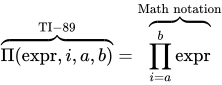
Tiny BASIC
10 LET F = 1
20 PRINT "Enter an integer."
30 INPUT N
40 IF N = 0 THEN GOTO 80
50 LET F = F * N
60 LET N = N - 1
70 GOTO 40
80 PRINT F
90 END
True BASIC
Iterative
DEF FNfactorial(n)
    LET f = 1
    FOR  i = 2 TO n
        LET f = f*i
    NEXT i
    LET FNfactorial = f
END DEF
END
Recursive
DEF FNfactorial(n)
    IF n < 2 THEN
       LET FNfactorial = 1
    ELSE
       LET FNfactorial = n * FNfactorial(n-1)
    END IF
END DEF
END
VBA
Public Function factorial(n As Integer) As Long
    factorial = WorksheetFunction.Fact(n)
End Function==VBA==
For numbers < 170 only
Option Explicit

Sub Main()
Dim i As Integer
For i = 1 To 17
    Debug.Print "Factorial " & i & " , recursive : " & FactRec(i) & ", iterative : " & FactIter(i)
Next
Debug.Print "Factorial 120, recursive : " & FactRec(120) & ", iterative : " & FactIter(120)
End Sub

Private Function FactRec(Nb As Integer) As String
If Nb > 170 Or Nb < 0 Then FactRec = 0: Exit Function
    If Nb = 1 Or Nb = 0 Then
        FactRec = 1
    Else
        FactRec = Nb * FactRec(Nb - 1)
    End If
End Function

Private Function FactIter(Nb As Integer)
If Nb > 170 Or Nb < 0 Then FactIter = 0: Exit Function
Dim i As Integer, F
    F = 1
    For i = 1 To Nb
        F = F * i
    Next i
    FactIter = F
End Function- Output:
Factorial 1 , recursive : 1, iterative : 1
Factorial 2 , recursive : 2, iterative : 2
Factorial 3 , recursive : 6, iterative : 6
Factorial 4 , recursive : 24, iterative : 24
Factorial 5 , recursive : 120, iterative : 120
Factorial 6 , recursive : 720, iterative : 720
Factorial 7 , recursive : 5040, iterative : 5040
Factorial 8 , recursive : 40320, iterative : 40320
Factorial 9 , recursive : 362880, iterative : 362880
Factorial 10 , recursive : 3628800, iterative : 3628800
Factorial 11 , recursive : 39916800, iterative : 39916800
Factorial 12 , recursive : 479001600, iterative : 479001600
Factorial 13 , recursive : 6227020800, iterative : 6227020800
Factorial 14 , recursive : 87178291200, iterative : 87178291200
Factorial 15 , recursive : 1307674368000, iterative : 1307674368000
Factorial 16 , recursive : 20922789888000, iterative : 20922789888000
Factorial 17 , recursive : 355687428096000, iterative : 355687428096000
Factorial 120, recursive : 6,68950291344919E+198, iterative : 6,68950291344912E+198
VBScript
Optimized with memoization, works for numbers up to 170 (because of the limitations on Doubles), exits if -1 is input
Dim lookupTable(170), returnTable(170), currentPosition, input
currentPosition = 0

Do While True
	input = InputBox("Please type a number (-1 to quit):")
	MsgBox "The factorial of " & input & " is " & factorial(CDbl(input))
Loop

Function factorial (x)
	If x = -1 Then
		WScript.Quit 0
	End If
	Dim temp
	temp = lookup(x)
	If x <= 1 Then
		factorial = 1
	ElseIf temp <> 0 Then
		factorial = temp
	Else
		temp = factorial(x - 1) * x
		store x, temp
		factorial = temp
	End If
End Function

Function lookup (x)
	Dim i
	For i = 0 To currentPosition - 1
		If lookupTable(i) = x Then
			lookup = returnTable(i)
			Exit Function
		End If
	Next
	lookup = 0
End Function

Function store (x, y)
	lookupTable(currentPosition) = x
	returnTable(currentPosition) = y
	currentPosition = currentPosition + 1
End Function
Visual Basic
Option Explicit

Sub Main()
    Dim i As Variant
    For i = 1 To 27
        Debug.Print "Factorial(" & i & ")= , recursive : " & Format$(FactRec(i), "#,###") & " - iterative : " & Format$(FactIter(i), "#,####")
    Next
End Sub 'Main

Private Function FactRec(n As Variant) As Variant
    n = CDec(n)
    If n = 1 Then
        FactRec = 1#
    Else
        FactRec = n * FactRec(n - 1)
    End If
End Function 'FactRec

Private Function FactIter(n As Variant)
    Dim i As Variant, f As Variant
    f = 1#
    For i = 1# To CDec(n)
        f = f * i
    Next i
    FactIter = f
End Function 'FactIter- Output:
Factorial(1)= , recursive : 1 - iterative : 1
Factorial(2)= , recursive : 2 - iterative : 2
Factorial(3)= , recursive : 6 - iterative : 6
Factorial(4)= , recursive : 24 - iterative : 24
Factorial(5)= , recursive : 120 - iterative : 120
Factorial(6)= , recursive : 720 - iterative : 720
Factorial(7)= , recursive : 5,040 - iterative : 5,040
Factorial(8)= , recursive : 40,320 - iterative : 40,320
Factorial(9)= , recursive : 362,880 - iterative : 362,880
Factorial(10)= , recursive : 3,628,800 - iterative : 3,628,800
Factorial(11)= , recursive : 39,916,800 - iterative : 39,916,800
Factorial(12)= , recursive : 479,001,600 - iterative : 479,001,600
Factorial(13)= , recursive : 6,227,020,800 - iterative : 6,227,020,800
Factorial(14)= , recursive : 87,178,291,200 - iterative : 87,178,291,200
Factorial(15)= , recursive : 1,307,674,368,000 - iterative : 1,307,674,368,000
Factorial(16)= , recursive : 20,922,789,888,000 - iterative : 20,922,789,888,000
Factorial(17)= , recursive : 355,687,428,096,000 - iterative : 355,687,428,096,000
Factorial(18)= , recursive : 6,402,373,705,728,000 - iterative : 6,402,373,705,728,000
Factorial(19)= , recursive : 121,645,100,408,832,000 - iterative : 121,645,100,408,832,000
Factorial(20)= , recursive : 2,432,902,008,176,640,000 - iterative : 2,432,902,008,176,640,000
Factorial(21)= , recursive : 51,090,942,171,709,440,000 - iterative : 51,090,942,171,709,440,000
Factorial(22)= , recursive : 1,124,000,727,777,607,680,000 - iterative : 1,124,000,727,777,607,680,000
Factorial(23)= , recursive : 25,852,016,738,884,976,640,000 - iterative : 25,852,016,738,884,976,640,000
Factorial(24)= , recursive : 620,448,401,733,239,439,360,000 - iterative : 620,448,401,733,239,439,360,000
Factorial(25)= , recursive : 15,511,210,043,330,985,984,000,000 - iterative : 15,511,210,043,330,985,984,000,000
Factorial(26)= , recursive : 403,291,461,126,605,635,584,000,000 - iterative : 403,291,461,126,605,635,584,000,000
Factorial(27)= , recursive : 10,888,869,450,418,352,160,768,000,000 - iterative : 10,888,869,450,418,352,160,768,000,000
Visual Basic .NET
Various type implementations follow. No error checking, so don't try to evaluate a number less than zero, or too large of a number.
Imports System
Imports System.Numerics
Imports System.Linq

Module Module1

    ' Type Double:

    Function DofactorialI(n As Integer) As Double ' Iterative
        DofactorialI = 1 : For i As Integer = 1 To n : DofactorialI *= i : Next
    End Function

    ' Type Unsigned Long:

    Function ULfactorialI(n As Integer) As ULong ' Iterative
        ULfactorialI = 1 : For i As Integer = 1 To n : ULfactorialI *= i : Next
    End Function

    ' Type Decimal:

    Function DefactorialI(n As Integer) As Decimal ' Iterative
        DefactorialI = 1 : For i As Integer = 1 To n : DefactorialI *= i : Next
    End Function

    ' Extends precision by "dehydrating" and "rehydrating" the powers of ten
    Function DxfactorialI(n As Integer) As String ' Iterative
        Dim factorial as Decimal = 1, zeros as integer = 0
        For i As Integer = 1 To n : factorial *= i
            If factorial Mod 10 = 0 Then factorial /= 10 : zeros += 1
        Next : Return factorial.ToString() & New String("0", zeros)
    End Function

    ' Arbitrary Precision:

    Function FactorialI(n As Integer) As BigInteger ' Iterative
        factorialI = 1 : For i As Integer = 1 To n : factorialI *= i : Next
    End Function

    Function Factorial(number As Integer) As BigInteger ' Functional
        Return Enumerable.Range(1, number).Aggregate(New BigInteger(1),
            Function(acc, num) acc * num)
    End Function

    Sub Main()
        Console.WriteLine("Double  : {0}! = {1:0}", 20, DoFactorialI(20))
        Console.WriteLine("ULong   : {0}! = {1:0}", 20, ULFactorialI(20))
        Console.WriteLine("Decimal : {0}! = {1:0}", 27, DeFactorialI(27))
        Console.WriteLine("Dec.Ext : {0}! = {1:0}", 32, DxFactorialI(32))
        Console.WriteLine("Arb.Prec: {0}! = {1}", 250, Factorial(250))
    End Sub
End Module
- Output:
Note that the first four are the maximum possible for their type without causing a run-time error.
Double  : 20! = 2432902008176640000
ULong   : 20! = 2432902008176640000
Decimal : 27! = 10888869450418352160768000000
Dec.Ext : 32! = 263130836933693530167218012160000000
Arb.Prec: 250! = 3232856260909107732320814552024368470994843717673780666747942427112823747555111209488817915371028199450928507353189432926730931712808990822791030279071281921676527240189264733218041186261006832925365133678939089569935713530175040513178760077247933065402339006164825552248819436572586057399222641254832982204849137721776650641276858807153128978777672951913990844377478702589172973255150283241787320658188482062478582659808848825548800000000000000000000000000000000000000000000000000000000000000
Yabasic
// recursive
sub factorial(n)
    if n > 1 then return n * factorial(n - 1) else return 1 end if
end sub

//iterative
sub factorial2(n)
    local i, t

    t = 1
    for i = 1 to n
        t = t * i
    next
    return t
end sub

for n = 0 to 9
    print "Factorial(", n, ") = ", factorial(n)
next
ZX Spectrum Basic
Iterative
10 LET x=5: GO SUB 1000: PRINT "5! = ";r
999 STOP
1000 REM *************
1001 REM * FACTORIAL *
1002 REM *************
1010 LET r=1
1020 IF x<2 THEN RETURN
1030 FOR i=2 TO x: LET r=r*i: NEXT i
1040 RETURN- Output:
5! = 120
Recursive
Using VAL for delayed evaluation and AND's ability to return given string or empty, we can now control the program flow within an expression in a manner akin to LISP's cond:
DEF FN f(n) = VAL (("1" AND n<=0) + ("n*FN f(n-1)" AND n>0))But, truth be told, the parameter n does not withstand recursive calling. Changing the order of the product gives naught:
DEF FN f(n) = VAL (("1" AND n<=0) + ("FN f(n-1)*n" AND n>0))Some little tricks with string slicing can get us there though:
DEF FN f(n) = VAL "n*FN f(n-1)*1"((n<1)*10+1 TO )(lack of spaces important) will jump to the 11th character of the string ("1") on the last iteration, allowing the function call to unroll.
Batch File
@echo off
set /p x=
set /a fs=%x%-1
set y=%x%
FOR /L %%a IN (%fs%, -1, 1) DO SET /a y*=%%a
if %x% EQU 0 set y=1
echo %y%
pause
exit
bc
#! /usr/bin/bc -q

define f(x) {
  if (x <= 1) return (1); return (f(x-1) * x)
}
f(1000)
quit
Beads
beads 1 program Factorial
//  only works for cardinal numbers 0..N
calc main_init
	log to_str(Iterative(4))  //  24
	log to_str(Recursive(5))  //  120

calc Iterative(
	n:num	--  number of iterations
	):num   --  result
	var total = 1
	loop from:2 to:n index:ix
		total = ix * total
	return total

calc Recursive ditto
	if n <= 1
		return 1
	else
return n * Recursive(n-1)- Output:
24
120
beeswax
Infinite loop for entering n and getting the result n!:
        p      <
_>1FT"pF>M"p~.~d
      >Pd  >~{Np
 d             <
Calculate n! only once:
       p      <
_1FT"pF>M"p~.~d
     >Pd  >~{;
Limits for UInt64 numbers apply to both examples.
Examples:
i indicates that the program expects the user to enter an integer.
julia> beeswax("factorial.bswx")
i0
1
i1
1
i2
2
i3
6
i10
3628800
i22
17196083355034583040
Input of negative numbers forces the program to quit with an error message.
Befunge
&1\>  :v v *<
   ^-1:_$>\:|
         @.$<
Binary Lambda Calculus
Factorial on Church numerals in the lambda calculus is λn.λf.n(λf.λn.n(f(λf.λx.n f(f x))))(λx.f)(λx.x) (see https://github.com/tromp/AIT/blob/master/numerals/fac.lam) which in BLC is the 57 bits
000001010111000000110011100000010111101100111010001100010
BQN
Fac ← ×´1+↕
! 720 ≡ Fac 6
Bracmat
Compute 10! and checking that it is 3628800, the esoteric way
      (
      =
        .   !arg:0&1
          |   !arg
            *   ( (
                  =   r
                    .   !arg:?r
                      &
                        ' (
                          .   !arg:0&1
                            | !arg*(($r)$($r))$(!arg+-1)
                          )
                  )
                $ (
                  =   r
                    .   !arg:?r
                      &
                        ' (
                          .   !arg:0&1
                            | !arg*(($r)$($r))$(!arg+-1)
                          )
                  )
                )
              $ (!arg+-1)
      )
    $ 10
  : 3628800
This recursive lambda function is made in the following way (see http://en.wikipedia.org/wiki/Lambda_calculus):
Recursive lambda function for computing factorial.
   g := λr. λn.(1, if n = 0; else n × (r r (n-1)))
   f := g g
or, translated to Bracmat, and computing 10!
      ( (=(r.!arg:?r&'(.!arg:0&1|!arg*(($r)$($r))$(!arg+-1)))):?g
    & (!g$!g):?f
    & !f$10
    )
The following is a straightforward recursive solution. Stack overflow occurs at some point, above 4243! in my case (Win XP).
factorial=.!arg:~>1|!arg*factorial$(!arg+-1)
  factorial$4243
  (13552 digits, 2.62 seconds) 52254301882898638594700346296120213182765268536522926.....0000000
Lastly, here is an iterative solution
(factorial=
  r
.   !arg:?r
  &   whl
    ' (!arg:>1&(!arg+-1:?arg)*!r:?r)
  & !r
);
factorial$5000 (16326 digits) 422857792660554352220106420023358440539078667462664674884978240218135805270810820069089904787170638753708474665730068544587848606668381273 ... 000000
Brainf***
Prints sequential factorials in an infinite loop.
>++++++++++>>>+>+[>>>+[-[<<<<<[+<<<<<]>>[[-]>[<<+>+>-]<[>+<-]<[>+<-[>+<-[>
+<-[>+<-[>+<-[>+<-[>+<-[>+<-[>+<-[>[-]>>>>+>+<<<<<<-[>+<-]]]]]]]]]]]>[<+>-
]+>>>>>]<<<<<[<<<<<]>>>>>>>[>>>>>]++[-<<<<<]>>>>>>-]+>>>>>]<[>++<-]<<<<[<[
>+<-]<<<<]>>[->[-]++++++[<++++++++>-]>>>>]<<<<<[<[>+>+<<-]>.<<<<<]>.>>>>]
Brat
factorial = { x |
  true? x == 0 1 { x * factorial(x - 1)}
}
Bruijn
Implementation for numbers encoded in balanced ternary using Mixfix syntax defined in the Math module:
:import std/Math .

factorial [∏ (+1) → 0 | [0]]

:test ((factorial (+10)) =? (+3628800)) ([[1]])
Burlesque
Using the builtin Factorial function:
blsq ) 6?!
720
Burlesque does not have functions nor is it iterative. Burlesque's strength are its implicit loops.
Following examples display other ways to calculate the factorial function:
blsq ) 1 6r@pd
720
blsq ) 1 6r@{?*}r[
720
blsq ) 2 6r@(.*)\/[[1+]e!.*
720
blsq ) 1 6r@p^{.*}5E!
720
blsq ) 6ropd
720
blsq ) 7ro)(.*){0 1 11}die!
720
C
Iterative
int factorial(int n) {
    int result = 1;
    for (int i = 1; i <= n; ++i)
        result *= i;
    return result;
}
Handle negative n (returning -1)
int factorialSafe(int n) {
    int result = 1;
    if(n<0)
        return -1;
    for (int i = 1; i <= n; ++i)
        result *= i;
    return result;
}
Recursive
int factorial(int n) {
    return n == 0 ? 1 : n * factorial(n - 1);
}
Handle negative n (returning -1).
int factorialSafe(int n) {
    return n<0 ? -1 : n == 0 ? 1 : n * factorialSafe(n - 1);
}
Tail Recursive
Safe with some compilers (for example: GCC with -O2, LLVM's clang)
int fac_aux(int n, int acc) {
    return n < 1 ? acc : fac_aux(n - 1, acc * n);
}

int fac_auxSafe(int n, int acc) {
    return n<0 ? -1 : n < 1 ? acc : fac_aux(n - 1, acc * n);
}

int factorial(int n) {
    return fac_aux(n, 1);
}
Obfuscated
This is simply beautiful, 1995 IOCCC winning entry by Michael Savastio, largest factorial possible : 429539!
#include <stdio.h>

#define l11l 0xFFFF
#define ll1 for
#define ll111 if
#define l1l1 unsigned
#define l111 struct
#define lll11 short
#define ll11l long
#define ll1ll putchar
#define l1l1l(l) l=malloc(sizeof(l111 llll1));l->lll1l=1-1;l->ll1l1=1-1;
#define l1ll1 *lllll++=l1ll%10000;l1ll/=10000;
#define l1lll ll111(!l1->lll1l){l1l1l(l1->lll1l);l1->lll1l->ll1l1=l1;}\
lllll=(l1=l1->lll1l)->lll;ll=1-1;
#define llll 1000


                                                     l111 llll1 {
                                                     l111 llll1 *
      lll1l,*ll1l1        ;l1l1                      lll11 lll [
      llll];};main      (){l111 llll1                *ll11,*l1l,*
      l1, *ll1l, *    malloc ( ) ; l1l1              ll11l l1ll ;
      ll11l l11,ll  ,l;l1l1 lll11 *lll1,*            lllll; ll1(l
      =1-1 ;l< 14; ll1ll("\t\"8)>l\"9!.)>vl"         [l]^'L'),++l
      );scanf("%d",&l);l1l1l(l1l) l1l1l(ll11         ) (l1=l1l)->
      lll[l1l->lll[1-1]     =1]=l11l;ll1(l11         =1+1;l11<=l;
      ++l11){l1=ll11;         lll1 = (ll1l=(         ll11=l1l))->
      lll; lllll =(            l1l=l1)->lll;         ll=(l1ll=1-1
      );ll1(;ll1l->             lll1l||l11l!=        *lll1;){l1ll
      +=l11**lll1++             ;l1ll1 ll111         (++ll>llll){
      l1lll lll1=(              ll1l =ll1l->         lll1l)->lll;
      }}ll1(;l1ll;              ){l1ll1 ll111        (++ll>=llll)
      { l1lll} } *              lllll=l11l;}
      ll1(l=(ll=1-              1);(l<llll)&&
      (l1->lll[ l]              !=l11l);++l);        ll1 (;l1;l1=
      l1->ll1l1,l=              llll){ll1(--l        ;l>=1-1;--l,
      ++ll)printf(              (ll)?((ll%19)        ?"%04d":(ll=
      19,"\n%04d")              ):"%4d",l1->         lll[l] ) ; }
                                                     ll1ll(10); }
C#
Iterative
using System;

class Program
{
    static int Factorial(int number)
    {
        if(number < 0)
            throw new ArgumentOutOfRangeException(nameof(number), number, "Must be zero or a positive number.");

        var accumulator = 1;
        for (var factor = 1; factor <= number; factor++)
        {
            accumulator *= factor;
        }
        return accumulator;
    }

    static void Main()
    {
        Console.WriteLine(Factorial(10));
    }
}
Recursive
using System;

class Program
{
    static int Factorial(int number)
    {
        if(number < 0)
            throw new ArgumentOutOfRangeException(nameof(number), number, "Must be zero or a positive number.");

        return number == 0 ? 1 : number * Factorial(number - 1);
    }

    static void Main()
    {
        Console.WriteLine(Factorial(10));
    }
}
Tail Recursive
using System;

class Program
{
    static int Factorial(int number)
    {
        if(number < 0)
            throw new ArgumentOutOfRangeException(nameof(number), number, "Must be zero or a positive number.");

        return Factorial(number, 1);
    }

    static int Factorial(int number, int accumulator)
    {
        if(number < 0)
            throw new ArgumentOutOfRangeException(nameof(number), number, "Must be zero or a positive number.");
        if(accumulator < 1)
            throw new ArgumentOutOfRangeException(nameof(accumulator), accumulator, "Must be a positive number.");

        return number == 0 ? accumulator : Factorial(number - 1, number * accumulator);
    }

    static void Main()
    {
        Console.WriteLine(Factorial(10));
    }
}
Functional
using System;
using System.Linq;

class Program
{
    static int Factorial(int number)
    {
        return Enumerable.Range(1, number).Aggregate((accumulator, factor) => accumulator * factor);
    }

    static void Main()
    {
        Console.WriteLine(Factorial(10));
    }
}
Arbitrary Precision
Factorial() can calculate 200000! in around 40 seconds over at Tio.run.
FactorialQ() can calculate 1000000! in around 40 seconds over at Tio.run.
The "product tree" algorithm multiplies pairs of items on a list until there is only one item. Even though around the same number of multiply operations occurs (compared to the plain "accumulator" method), this is faster because the "bigger" numbers are generated near the end of the algorithm, instead of around halfway through. There is a significant space overhead incurred due to the creation of the temporary array to hold the partial results. The additional time overhead for array creation is negligible compared with the time savings of not dealing with the very large numbers until near the end of the algorithm.
For example, for 50!, here are the number of digits created for each product for either method:
plain:
1 1 1 2 3 3 4 5 6 7 8 9 10 11 13 14 15 16 18 19 20 22 23 24 26 27 29 30 31 33 34 36 37 39 41 42 44 45 47 48 50 52 53 55 57 58 60 62 63 65
product tree:
2 2 3 3 3 3 3 3 3 3 3 3 3 3 3 3 3 3 3 3 3 3 3 3 3 5 5 5 6 6 6 6 6 6 6 6 6 8 11 11 11 11 11 13 21 21 23 42 65
One can see the plain method increases linearly up to the final value of 65. The product tree method stays low for quite awhile, then jumps up at the end.
For 200000!, when one sums up the number of digits of each product for all 199999 multiplications, the plain method is nearly 93 billion, while the product tree method is only about 17.3 million.
using System;
using System.Numerics;
using System.Linq;
class Program
{
    static BigInteger factorial(int n) // iterative
    {
        BigInteger acc = 1; for (int i = 1; i <= n; i++) acc *= i; return acc;
    }

    static public BigInteger Factorial(int number) // functional
    {
        return Enumerable.Range(1, number).Aggregate(new BigInteger(1), (acc, num) => acc * num);
    }

    static public BI FactorialQ(int number) // functional quick, uses prodtree method
    {
        var s = Enumerable.Range(1, number).Select(num => new BI(num)).ToArray();
        int top = s.Length, nt, i, j;
        while (top > 1) {
            for (i = 0, j = top, nt = top >> 1; i < nt; i++) s[i] *= s[--j];
            top = nt + ((top & 1) == 1 ? 1 : 0);
        }
        return s[0];
    }

    static void Main(string[] args)
    {
        Console.WriteLine(Factorial(250));
    }
}
- Output:
3232856260909107732320814552024368470994843717673780666747942427112823747555111209488817915371028199450928507353189432926730931712808990822791030279071281921676527240189264733218041186261006832925365133678939089569935713530175040513178760077247933065402339006164825552248819436572586057399222641254832982204849137721776650641276858807153128978777672951913990844377478702589172973255150283241787320658188482062478582659808848825548800000000000000000000000000000000000000000000000000000000000000
C++
The C versions work unchanged with C++, however, here is another possibility using the STL and boost:
#include <boost/iterator/counting_iterator.hpp>
#include <algorithm>

int factorial(int n)
{
  // last is one-past-end
  return std::accumulate(boost::counting_iterator<int>(1), boost::counting_iterator<int>(n+1), 1, std::multiplies<int>());
}
Iterative
This version of the program is iterative, with a while loop.
//iteration with while
long long int factorial(long long int n)
{
   long long int r = 1;
   while(1<n)
       r *= n--;
   return r;
}
Template
template <int N>
struct Factorial
{
    enum { value = N * Factorial<N - 1>::value };
};

template <>
struct Factorial<0>
{
    enum { value = 1 };
};

// Factorial<4>::value == 24
// Factorial<0>::value == 1
void foo()
{
    int x = Factorial<4>::value; // == 24
    int y = Factorial<0>::value; // == 1
}
Compare all Solutions (except the meta)
#include <algorithm>
#include <chrono>
#include <iostream>
#include <numeric>
#include <vector>
#include <boost/iterator/counting_iterator.hpp>

using ulli = unsigned long long int;

// bad style do-while and wrong for Factorial1(0LL) -> 0 !!!
ulli Factorial1(ulli m_nValue) {
    ulli result = m_nValue;
    ulli result_next;
    ulli pc = m_nValue;
    do {
        result_next = result * (pc - 1);
        result = result_next;
        pc--;
    } while (pc > 2);
    return result;
}

// iteration with while
ulli Factorial2(ulli n) {
    ulli r = 1;
    while (1 < n)
        r *= n--;
    return r;
}

// recursive
ulli Factorial3(ulli n) {
    return n < 2 ? 1 : n * Factorial3(n - 1);
}

// tail recursive
inline ulli _fac_aux(ulli n, ulli acc) {
    return n < 1 ? acc : _fac_aux(n - 1, acc * n);
}
ulli Factorial4(ulli n) {
    return _fac_aux(n, 1);
}

// accumulate with functor
ulli Factorial5(ulli n) {
    // last is one-past-end
    return std::accumulate(boost::counting_iterator<ulli>(1ULL),
                           boost::counting_iterator<ulli>(n + 1ULL), 1ULL,
                           std::multiplies<ulli>());
}

// accumulate with lambda
ulli Factorial6(ulli n) {
    // last is one-past-end
    return std::accumulate(boost::counting_iterator<ulli>(1ULL),
                           boost::counting_iterator<ulli>(n + 1ULL), 1ULL,
                           [](ulli a, ulli b) { return a * b; });
}

int main() {
    ulli v = 20; // max value with unsigned long long int
    ulli result;
    std::cout << std::fixed;
    using duration = std::chrono::duration<double, std::micro>;

    {
        auto t1 = std::chrono::high_resolution_clock::now();
        result = Factorial1(v);
        auto t2 = std::chrono::high_resolution_clock::now();
        std::cout << "do-while(1)               result " << result << " took " << duration(t2 - t1).count() << " µs\n";
    }

    {
        auto t1 = std::chrono::high_resolution_clock::now();
        result = Factorial2(v);
        auto t2 = std::chrono::high_resolution_clock::now();
        std::cout << "while(2)                  result " << result << " took " << duration(t2 - t1).count() << " µs\n";
    }

    {
        auto t1 = std::chrono::high_resolution_clock::now();
        result = Factorial3(v);
        auto t2 = std::chrono::high_resolution_clock::now();
        std::cout << "recursive(3)              result " << result << " took " << duration(t2 - t1).count() << " µs\n";
    }

    {
        auto t1 = std::chrono::high_resolution_clock::now();
        result = Factorial3(v);
        auto t2 = std::chrono::high_resolution_clock::now();
        std::cout << "tail recursive(4)         result " << result << " took " << duration(t2 - t1).count() << " µs\n";
    }

    {
        auto t1 = std::chrono::high_resolution_clock::now();
        result = Factorial5(v);
        auto t2 = std::chrono::high_resolution_clock::now();
        std::cout << "std::accumulate(5)        result " << result << " took " << duration(t2 - t1).count() << " µs\n";
    }

    {
        auto t1 = std::chrono::high_resolution_clock::now();
        result = Factorial6(v);
        auto t2 = std::chrono::high_resolution_clock::now();
        std::cout << "std::accumulate lambda(6) result " << result << " took " << duration(t2 - t1).count() << " µs\n";
    }
}
do-while(1)               result 2432902008176640000 took 0.110000 µs
while(2)                  result 2432902008176640000 took 0.078000 µs
recursive(3)              result 2432902008176640000 took 0.057000 µs
tail recursive(4)         result 2432902008176640000 took 0.056000 µs
std::accumulate(5)        result 2432902008176640000 took 0.056000 µs
std::accumulate lambda(6) result 2432902008176640000 took 0.079000 µs
C3
Iterative
fn int factorial(int n)
{
    int result = 1;
    for (int i = 1; i <= n; ++i)
    {
        result *= i;
    }
    return result;
}
Recursive
 fn int factorial(int n)
{
    return n == 0 ? 1 : n * factorial(n - 1);
}
Recursive macro
In this case the value of x is compiled to a constant.
macro int factorial($n)
{
    $if ($n == 0):
        return 1;
    $else:
        return $n * @factorial($n - 1);
    $endif;
}

fn void test()
{
    int x = @factorial(10);
}
Cat
Taken direct from the Cat manual:
define rec_fac
      { dup 1 <= [pop 1] [dec rec_fac *] if }
Ceylon
shared void run() {

	Integer? recursiveFactorial(Integer n) =>
			switch(n <=> 0)
			case(smaller) null
			case(equal) 1
			case(larger) if(exists f = recursiveFactorial(n - 1)) then n * f else null;


	Integer? iterativeFactorial(Integer n) =>
			switch(n <=> 0)
			case(smaller) null
			case(equal) 1
			case(larger) (1:n).reduce(times);

	for(Integer i in 0..10) {
		print("the iterative factorial of     ``i`` is ``iterativeFactorial(i) else "negative"``
		       and the recursive factorial of ``i`` is ``recursiveFactorial(i) else "negative"``\n");
	}
}
Chapel
proc fac(n) {
	var r = 1;
	for i in 1..n do
		r *= i;

	return r;
}
Chef
Caramel Factorials.

Only reads one value.

Ingredients.
1 g Caramel
2 g Factorials

Method.
Take Factorials from refrigerator.
Put Caramel into 1st mixing bowl.
Verb the Factorials.
Combine Factorials into 1st mixing bowl.
Verb Factorials until verbed.
Pour contents of the 1st mixing bowl into the 1st baking dish.

Serves 1.
ChucK
Recursive
0 => int total;
fun int factorial(int i)
{
    if (i == 0) return 1;
    else
    {
        i * factorial(i - 1) => total;
    }
    return total;
}

// == another way
fun int factorial(int x)
{
    if (x <= 1 ) return 1;
    else return x * factorial (x - 1);
}

// call
factorial (5) => int answer;

// test
if ( answer == 120 ) <<<"success">>>;
Iterative
1 => int total;
fun int factorial(int i)
{
    while(i > 0)
    {
        total * i => total;
        1 -=> i;
    }
    return total;
}
Clay
Obviously there’s more than one way to skin a cat. Here’s a selection — recursive, iterative, and “functional” solutions.
factorialRec(n) {
    if (n == 0) return 1;
    return n * factorialRec(n - 1);
}

factorialIter(n) {
    for (i in range(1, n))
        n *= i;
    return n;
}

factorialFold(n) {
    return reduce(multiply, 1, range(1, n + 1));
}
We could also do it at compile time, because — hey — why not?
[n|n > 0] factorialStatic(static n) = n * factorialStatic(static n - 1);
overload factorialStatic(static 0) = 1;
Because a literal 1 has type Int32, these functions receive and return numbers of that type. We must be a bit more careful if we wish to permit other numeric types (e.g. for larger integers).
[N|Integer?(N)] factorial(n: N) {
    if (n == 0) return N(1);
    return n * factorial(n - 1);
}
And testing:
main() {
    println(factorialRec(5));           // 120
    println(factorialIter(5));          // 120
    println(factorialFold(5));          // 120
    println(factorialStatic(static 5)); // 120
    println(factorial(Int64(20)));      // 2432902008176640000
}
Clio
Recursive
fn factorial n:
  if n <= 1: n
  else:
    n * (n - 1 -> factorial)

10 -> factorial -> print
CLIPS
 (deffunction factorial (?a)
    (if (or (not (integerp ?a)) (< ?a 0)) then
        (printout t "Factorial Error!" crlf)
     else
        (if (= ?a 0) then
            1
         else
            (* ?a (factorial (- ?a 1))))))
Clojure
Folding
(defn factorial [x]
  (apply *' (range 2 (inc x))))
Recursive
(defn factorial [x]
  (if (< x 2)
      1
      (*' x (factorial (dec x)))))
Tail recursive
(defn factorial [x]
  (loop [x x
         acc 1]
    (if (< x 2)
        acc
        (recur (dec x) (*' acc x)))))
Trampolining
(defn factorial
  ([x] (trampoline factorial x 1))
  ([x acc]
   (if (< x 2)
     acc
     #(factorial (dec x) (*' acc x)))))
CLU
factorial = proc (n: int) returns (int) signals (negative)
    if n<0 then signal negative
    elseif n=0 then return(1)
    else return(n * factorial(n-1))
    end
end factorial

start_up = proc ()
    po: stream := stream$primary_output()

    for i: int in int$from_to(0, 10) do
        fac: int := factorial(i)
        stream$putl(po, int$unparse(i) || "! = " || int$unparse(fac))
    end
end start_up- Output:
0! = 1
1! = 1
2! = 2
3! = 6
4! = 24
5! = 120
6! = 720
7! = 5040
8! = 40320
9! = 362880
10! = 3628800
CMake
function(factorial var n)
  set(product 1)
  foreach(i RANGE 2 ${n})
    math(EXPR product "${product} * ${i}")
  endforeach(i)
  set(${var} ${product} PARENT_SCOPE)
endfunction(factorial)

factorial(f 12)
message("12! = ${f}")
COBOL
The following functions have no need to check if their parameters are negative because they are unsigned.
Intrinsic Function
COBOL includes an intrinsic function which returns the factorial of its argument.
MOVE FUNCTION FACTORIAL(num) TO result
Iterative
       IDENTIFICATION DIVISION.
       FUNCTION-ID. factorial_iterative.

       DATA DIVISION.
       LOCAL-STORAGE SECTION.
       01  i      PIC 9(38).

       LINKAGE SECTION.
       01  n      PIC 9(38).
       01  ret    PIC 9(38).

       PROCEDURE DIVISION USING BY VALUE n RETURNING ret.
           MOVE 1 TO ret

           PERFORM VARYING i FROM 2 BY 1 UNTIL n < i
               MULTIPLY i BY ret
           END-PERFORM

           GOBACK.

       END FUNCTION factorial_iterative.
Recursive
       IDENTIFICATION DIVISION.
       FUNCTION-ID. factorial_recursive.

       DATA DIVISION.
       LOCAL-STORAGE SECTION.
       01  prev-n PIC 9(38).

       LINKAGE SECTION.
       01  n      PIC 9(38).
       01  ret    PIC 9(38).

       PROCEDURE DIVISION USING BY VALUE n RETURNING ret.
           IF n = 0
               MOVE 1 TO ret
           ELSE
               SUBTRACT 1 FROM n GIVING prev-n
               MULTIPLY n BY factorial_recursive(prev-n) GIVING ret
           END-IF

           GOBACK.

       END FUNCTION factorial_recursive.
Test
       IDENTIFICATION DIVISION.
       PROGRAM-ID. factorial_test.

       ENVIRONMENT DIVISION.
       CONFIGURATION SECTION.
       REPOSITORY.
           FUNCTION factorial_iterative
           FUNCTION factorial_recursive.

       DATA DIVISION.
       LOCAL-STORAGE SECTION.
       01  i      PIC 9(38).

       PROCEDURE DIVISION.
           DISPLAY
               "i = "
               WITH NO ADVANCING
           END-DISPLAY.
           ACCEPT i END-ACCEPT.
           DISPLAY SPACE END-DISPLAY.

           DISPLAY
               "factorial_iterative(i) = "
               factorial_iterative(i)
           END-DISPLAY.

           DISPLAY
               "factorial_recursive(i) = "
               factorial_recursive(i)
           END-DISPLAY.

           GOBACK.

       END PROGRAM factorial_test.
- Output:
i = 14

factorial_iterative(i) = 00000000000000000000000000087178291200
factorial_recursive(i) = 00000000000000000000000000087178291200
CoffeeScript
Several solutions are possible in JavaScript:
Recursive
fac = (n) ->
  if n <= 1
    1
  else
    n * fac n-1
Functional
(See MDC)
fac = (n) ->
  [1..n].reduce (x,y) -> x*y
Comal
Recursive:
  PROC Recursive(n) CLOSED
    r:=1
    IF n>1 THEN
      r:=n*Recursive(n-1)
    ENDIF
    RETURN r
  ENDPROC Recursive
Comefrom0x10
This is iterative; recursion is not possible in Comefrom0x10.
n = 5 # calculates n!
acc = 1

factorial
  comefrom

  comefrom accumulate if n < 1

accumulate
  comefrom factorial
  acc = acc * n
  comefrom factorial if n is 0
  n = n - 1

acc # prints the result
Common Lisp
Recursive:
(defun factorial (n)
  (if (zerop n) 1 (* n (factorial (1- n)))))
or
(defun factorial (n)
  (if (< n 2) 1 (* n (factorial (1- n)))))
Tail Recursive:
(defun factorial (n &optional (m 1))
  (if (zerop n) m (factorial (1- n) (* m n))))
Iterative:
(defun factorial (n)
  "Calculates N!"
  (loop for result = 1 then (* result i)
     for i from 2 to n
     finally (return result)))
Functional:
(defun factorial (n)
    (reduce #'* (loop for i from 1 to n collect i)))
Alternate solution
;; Project : Factorial

(defun factorial (n)
          (cond ((= n 1) 1)
          (t (* n (factorial (- n 1))))))
(format t "~a" "factorial of 8: ")
(factorial 8)
Output:
factorial of 8: 40320
Computer/zero Assembly
Both these programs find !. Values of higher than 5 are not supported, because their factorials will not fit into an unsigned byte.

Iterative
        LDA  x
        BRZ  done_i   ; 0! = 1

        STA  i

loop_i: LDA  fact
        STA  n

        LDA  i
        SUB  one
        BRZ  done_i

        STA  j

loop_j: LDA  fact
        ADD  n
        STA  fact

        LDA  j
        SUB  one
        BRZ  done_j

        STA  j
        JMP  loop_j

done_j: LDA  i
        SUB  one
        STA  i

        JMP  loop_i

done_i: LDA  fact
        STP

one:         1

fact:        1

i:           0
j:           0
n:           0

x:           5
Lookup
Since there is only a small range of possible values of , storing the answers and looking up the one we want is much more efficient than actually calculating them. This lookup version uses 5 bytes of code and 7 bytes of data and finds 5! in 5 instructions, whereas the iterative solution uses 23 bytes of code and 6 bytes of data and takes 122 instructions to find 5!.
        LDA  load
        ADD  x
        STA  load

load:   LDA  fact
        STP

fact:        1
             1
             2
             6
             24
             120

x:           5
Coq
Fixpoint factorial (n : nat) : nat :=
  match n with
    | 0 => 1
    | S k => (S k) * (factorial k)
  end.
Crystal
Iterative
def factorial(x : Int)
    ans = 1
    (1..x).each do |i|
        ans *= i
    end
    return ans
end
Recursive
def factorial(x : Int)
    if x <= 1
        return 1
    end
    return x * factorial(x - 1)
end
D
Iterative Version
uint factorial(in uint n) pure nothrow @nogc
in {
    assert(n <= 12);
} body {
    uint result = 1;
    foreach (immutable i; 1 .. n + 1)
        result *= i;
    return result;
}

// Computed and printed at compile-time.
pragma(msg, 12.factorial);

void main() {
    import std.stdio;

    // Computed and printed at run-time.
    12.factorial.writeln;
}
- Output:
479001600u
479001600
Recursive Version
uint factorial(in uint n) pure nothrow @nogc
in {
    assert(n <= 12);
} body {
    if (n == 0)
        return 1;
    else
        return n * factorial(n - 1);
}

// Computed and printed at compile-time.
pragma(msg, 12.factorial);

void main() {
    import std.stdio;

    // Computed and printed at run-time.
    12.factorial.writeln;
}
(Same output.)
Functional Version
import std.stdio, std.algorithm, std.range;

uint factorial(in uint n) pure nothrow @nogc
in {
    assert(n <= 12);
} body {
    return reduce!q{a * b}(1u, iota(1, n + 1));
}

// Computed and printed at compile-time.
pragma(msg, 12.factorial);

void main() {
    // Computed and printed at run-time.
    12.factorial.writeln;
}
(Same output.)
Tail Recursive (at run-time, with DMD) Version
uint factorial(in uint n) pure nothrow
in {
    assert(n <= 12);
} body {
    static uint inner(uint n, uint acc) pure nothrow @nogc {
        if (n < 1)
            return acc;
        else
            return inner(n - 1, acc * n);
    }
    return inner(n, 1);
}

// Computed and printed at compile-time.
pragma(msg, 12.factorial);

void main() {
    import std.stdio;

    // Computed and printed at run-time.
    12.factorial.writeln;
}
(Same output.)
Dart
Recursive
int fact(int n) {
if(n<0) {
throw new IllegalArgumentException('Argument less than 0');
}
return n==0 ? 1 : n*fact(n-1);
}
main() {
print(fact(10));
print(fact(-1));
}Iterative
int fact(int n) {
if(n<0) {
throw new IllegalArgumentException('Argument less than 0');
}
int res=1;
for(int i=1;i<=n;i++) {
res*=i;
}
return res;
}
main() {
print(fact(10));
print(fact(-1));
}dc
This factorial uses tail recursion to iterate from n down to 2. Some implementations, like OpenBSD dc, optimize the tail recursion so the call stack never overflows, though n might be large.
[*
* (n) lfx -- (factorial of n)
*]sz
[
1 Sp [product = 1]sz
[ [Loop while 1 < n:]sz
d lp * sp [product = n * product]sz
1 - [n = n - 1]sz
d 1 <f
]Sf d 1 <f
Lfsz [Drop loop.]sz
sz [Drop n.]sz
Lp [Push product.]sz
]sf
[*
* For example, print the factorial of 50.
*]sz
50 lfx pszDelphi
Iterative
program Factorial1;
{$APPTYPE CONSOLE}
function FactorialIterative(aNumber: Integer): Int64;
var
i: Integer;
begin
Result := 1;
for i := 1 to aNumber do
Result := i * Result;
end;
begin
Writeln('5! = ', FactorialIterative(5));
end.Recursive
program Factorial2;
{$APPTYPE CONSOLE}
function FactorialRecursive(aNumber: Integer): Int64;
begin
if aNumber < 1 then
Result := 1
else
Result := aNumber * FactorialRecursive(aNumber - 1);
end;
begin
Writeln('5! = ', FactorialRecursive(5));
end.Tail Recursive
program Factorial3;
{$APPTYPE CONSOLE}
function FactorialTailRecursive(aNumber: Integer): Int64;
function FactorialHelper(aNumber: Integer; aAccumulator: Int64): Int64;
begin
if aNumber = 0 then
Result := aAccumulator
else
Result := FactorialHelper(aNumber - 1, aNumber * aAccumulator);
end;
begin
if aNumber < 1 then
Result := 1
else
Result := FactorialHelper(aNumber, 1);
end;
begin
Writeln('5! = ', FactorialTailRecursive(5));
end.Draco
/* Note that ulong is 32 bits, so fac(12) is the largest
* supported value. This is why the input parameter
* is a byte. The parameters are all unsigned. */
proc nonrec fac(byte n) ulong:
byte i;
ulong rslt;
rslt := 1;
for i from 2 upto n do
rslt := rslt * i
od;
rslt
corp
proc nonrec main() void:
byte i;
for i from 0 upto 12 do
writeln(i:2, "! = ", fac(i):9)
od
corp- Output:
0! = 1 1! = 1 2! = 2 3! = 6 4! = 24 5! = 120 6! = 720 7! = 5040 8! = 40320 9! = 362880 10! = 3628800 11! = 39916800 12! = 479001600
Dragon
select "std"
factorial = 1
n = readln()
for(i=1,i<=n,++i)
{
factorial = factorial * i
}
showln "factorial of " + n + " is " + factorialDWScript
Note that Factorial is part of the standard DWScript maths functions.
Iterative
function IterativeFactorial(n : Integer) : Integer;
var
i : Integer;
begin
Result := 1;
for i := 2 to n do
Result *= i;
end;Recursive
function RecursiveFactorial(n : Integer) : Integer;
begin
if n>1 then
Result := RecursiveFactorial(n-1)*n
else Result := 1;
end;Dyalect
func factorial(n) {
if n < 2 {
1
} else {
n * factorial(n - 1)
}
}Dylan
Functional
define method factorial (n)
if (n < 1)
error("invalid argument");
else
reduce1(\*, range(from: 1, to: n))
end
end method;Iterative
define method factorial (n)
if (n < 1)
error("invalid argument");
else
let total = 1;
for (i from n to 2 by -1)
total := total * i;
end;
total
end
end method;Recursive
define method factorial (n)
if (n < 1)
error("invalid argument");
end;
local method loop (n)
if (n <= 2)
n
else
n * loop(n - 1)
end
end;
loop(n)
end method;Tail recursive
define method factorial (n)
if (n < 1)
error("invalid argument");
end;
// Dylan implementations are required to perform tail call optimization so
// this is equivalent to iteration.
local method loop (n, total)
if (n <= 2)
total
else
let next = n - 1;
loop(next, total * next)
end
end;
loop(n, n)
end method;Déjà Vu
Iterative
factorial:
1
while over:
* over
swap -- swap
drop swapRecursive
factorial:
if dup:
* factorial -- dup
else:
1 dropE
pragma.enable("accumulator")
def factorial(n) {
return accum 1 for i in 2..n { _ * i }
}EasyLang
func factorial n .
r = 1
for i = 2 to n
r *= i
.
return r
.
print factorial 7EchoLisp
Iterative
(define (fact n)
(for/product ((f (in-range 2 (1+ n)))) f))
(fact 10)
→ 3628800Recursive with memoization
(define (fact n)
(if (zero? n) 1
(* n (fact (1- n)))))
(remember 'fact)
(fact 10)
→ 3628800Tail recursive
(define (fact n (acc 1))
(if (zero? n) acc
(fact (1- n) (* n acc))))
(fact 10)
→ 3628800Primitive
(factorial 10)
→ 3628800Numerical approximation
(lib 'math)
math.lib v1.13 ® EchoLisp
(gamma 11)
→ 3628800.0000000005Ecstasy
module ShowFactorials {
static <Value extends IntNumber> Value factorial(Value n) {
assert:arg n >= Value.zero();
return n <= Value.one() ? n : n * factorial(n-Value.one());
}
@Inject Console console;
void run() {
// 128-bit test
UInt128 bigNum = 34;
console.print($"factorial({bigNum})={factorial(bigNum)}");
// 64-bit test
for (Int i : 10..-1) {
console.print($"factorial({i})={factorial(i)}");
}
}
}- Output:
factorial(34)=295232799039604140847618609643520000000 factorial(10)=3628800 factorial(9)=362880 factorial(8)=40320 factorial(7)=5040 factorial(6)=720 factorial(5)=120 factorial(4)=24 factorial(3)=6 factorial(2)=2 factorial(1)=1 factorial(0)=0 2023-01-19 10:14:52.716 Service "ShowFactorials" (id=1) at ^ShowFactorials (CallLaterRequest: native), fiber 1: Unhandled exception: IllegalArgument: "n >= Value.zero()": n=-1, Value.zero()=0, Value=Int at factorial(Type<IntNumber>, factorial(?)#Value) (test.x:5) at run() (test.x:19) at ^ShowFactorials (CallLaterRequest: native)
EDSAC order code
[Demo of subroutine to calculate factorial.
EDSAC program, Initial Orders 2.]
[Arrange the storage]
T45K P56F [H parameter: subroutine for factorial]
T46K P80F [N parameter: library subroutine P7 to print integer]
T47K P128F [M parameter: main routine]
[================================ H parameter ================================]
E25K TH
[Subroutine for N factorial. Works for 0 <= N <= 13 (no checking done).
Input: 17-bit integer N in 6F (preserved).
Output: 35-bit N factorial is returned in 0D.
Workspace: 7F]
GK
A3F T19@ [plant return link as usual]
TD [clear the whole of 0D, including the sandwich bit]
A20@ TF [0D := 35-bit 1]
A6F T7F [7F = current factor, initialize to N]
E15@ [jump into middle of loop]
[Head of loop: here with 7F = factor, acc = factor - 2]
[8] H7F [mult reg := factor]
A20@ [acc := factor - 1]
T7F [update factor, clear acc]
VD [acc := 0D times factor]
L64F L64F [shift 16 left (as 8 + 8) for integer scaling]
TD [update product, clear acc]
[15] A7F S2F [is factor >= 2 ? (2F permanently holds P1F)]
E8@ [if so, loop back]
T7F [clear acc on exit]
[19] ZF [(planted) return to caller]
[20] PD [constant: 17-bit 1]
[================================ M parameter ================================]
E25K TM GK
[Main routine]
[Teleprinter characters]
[0] K2048F [1] #F [letters mode, figures mode]
[2] FF [3] AF [4] CF [5] VF [F, A, C, equals]
[6] !F [7] @F [8] &F [space, carriage return, line feed]
[Enter here with acc = 0]
[9] TD [clear the whole of 0D, including the sandwich bit]
A33@ [load 17-bit number N whose factorial is required]
UF [store N in 0D, extended to 35 bits for printing]
T6F [also store N in 6F, for factorial subroutine]
O1@ [set teleprinter to figures]
[14] A14@ GN [print N (print subroutine preserves 6F)]
[Print " FAC = " (EDSAC teleprinter had no exclamation mark)]
O@ O6@ O2@ O3@ O4@ O1@ O6@ O5@ O6@
[25] A25@ GH [call the above subroutine, 0D := N factorial]
[27] A27@ GN [call subroutine to print 0D]
O7@ O8@ [print CR, LF]
O1@ [print dummy character to flush teleprinter buffer]
ZF [stop]
[33] P6D [constant: 17-bit 13]
[================================ N parameter ================================]
E25K TN
[Library subroutine P7, prints long strictly positive integer in 0D.
10 characters, right justified, padded left with spaces.
Even address; 35 storage locations; working position 4D.]
GKA3FT26@H28#@NDYFLDT4DS27@TFH8@S8@T1FV4DAFG31@SFLDUFOFFFSFL4F
T4DA1FA27@G11@XFT28#ZPFT27ZP1024FP610D@524D!FO30@SFL8FE22@
[============================= M parameter again =============================]
E25K TM GK
E9Z [define entry point]
PF [acc = 0 on entry]
[end]- Output:
13 FAC = 6227020800
EGL
Iterative
function fact(n int in) returns (bigint)
if (n < 0)
writestdout("No negative numbers");
return (0);
end
ans bigint = 1;
for (i int from 1 to n)
ans *= i;
end
return (ans);
endRecursive
function fact(n int in) returns (bigint)
if (n < 0)
SysLib.writeStdout("No negative numbers");
return (0);
end
if (n < 2)
return (1);
else
return (n * fact(n - 1));
end
endEiffel
note
description: "recursive and iterative factorial example of a positive integer."
class
FACTORIAL_EXAMPLE
create
make
feature -- Initialization
make
local
n: NATURAL
do
n := 5
print ("%NFactorial of " + n.out + " = ")
print (recursive_factorial (n))
end
feature -- Access
recursive_factorial (n: NATURAL): NATURAL
-- factorial of 'n'
do
if n = 0 then
Result := 1
else
Result := n * recursive_factorial (n - 1)
end
end
iterative_factorial (n: NATURAL): NATURAL
-- factorial of 'n'
local
v: like n
do
from
Result := 1
v := n
until
v <= 1
loop
Result := Result * v
v := v - 1
end
end
endEla
Tail recursive version:
fact = fact' 1L
where fact' acc 0 = acc
fact' acc n = fact' (n * acc) (n - 1)Elixir
defmodule Factorial do
# Simple recursive function
def fac(0), do: 1
def fac(n) when n > 0, do: n * fac(n - 1)
# Tail recursive function
def fac_tail(0), do: 1
def fac_tail(n), do: fac_tail(n, 1)
def fac_tail(1, acc), do: acc
def fac_tail(n, acc) when n > 1, do: fac_tail(n - 1, acc * n)
# Tail recursive function with default parameter
def fac_default(n, acc \\ 1)
def fac_default(0, acc), do: acc
def fac_default(n, acc) when n > 0, do: fac_default(n - 1, acc * n)
# Using Enumeration features
def fac_reduce(0), do: 1
def fac_reduce(n) when n > 0, do: Enum.reduce(1..n, 1, &*/2)
# Using Enumeration features with pipe operator
def fac_pipe(0), do: 1
def fac_pipe(n) when n > 0, do: 1..n |> Enum.reduce(1, &*/2)
endElm
Recursive
factorial : Int -> Int
factorial n =
if n < 1 then 1 else n*factorial(n-1)Tail Recursive
factorialAux : Int -> Int -> Int
factorialAux a acc =
if a < 2 then acc else factorialAux (a - 1) (a * acc)
factorial : Int -> Int
factorial a =
factorialAux a 1Functional
import List exposing (product, range)
factorial : Int -> Int
factorial a =
product (range 1 a)Emacs Lisp
;; Functional (most elegant and best suited to Lisp dialects):
(defun fact (n)
"Return the factorial of integer N, which require to be positive or 0."
;; Elisp won't do any type checking automatically, so
;; good practice would be doing that ourselves:
(if (not (and (integerp n) (>= n 0)))
(error "Function fact (N): Not a natural number or 0: %S" n))
;; But the actual code is very short:
(apply '* (number-sequence 1 n)))
;; (For N = 0, number-sequence returns the empty list, resp. nil,
;; and the * function works with zero arguments, returning 1.);; Recursive:
(defun fact (n)
"Return the factorial of integer N, which require to be positive or 0."
(if (not (and (integerp n) (>= n 0))) ; see above
(error "Function fact (N): Not a natural number or 0: %S" n))
(cond ; (or use an (if ...) with an else part)
((or (= n 0) (= n 1)) 1)
(t (* n (fact (1- n))))))Both of these only work up to N = 19, beyond which arithmetic overflow seems to happen.
The calc package (which comes with Emacs) has a builtin fact(). It automatically uses the bignums implemented by calc.
(require 'calc)
(calc-eval "fact(30)")
=>
"265252859812191058636308480000000"EMal
fun iterative = int by int n
int result = 1
for int i = 2; i <= n; ++i do result *= i end
return result
end
fun recursive = int by int n do return when(n <= 0, 1, n * recursive(n - 1)) end
writeLine("n".padStart(2, " ") + " " + "iterative".padStart(19, " ") + " " + "recursive".padStart(19, " "))
for int n = 0; n < 21; ++n
write((text!n).padStart(2, " "))
write(" " + (text!iterative(n)).padStart(19, " "))
write(" " + (text!recursive(n)).padStart(19, " "))
writeLine()
end- Output:
n iterative recursive 0 1 1 1 1 1 2 2 2 3 6 6 4 24 24 5 120 120 6 720 720 7 5040 5040 8 40320 40320 9 362880 362880 10 3628800 3628800 11 39916800 39916800 12 479001600 479001600 13 6227020800 6227020800 14 87178291200 87178291200 15 1307674368000 1307674368000 16 20922789888000 20922789888000 17 355687428096000 355687428096000 18 6402373705728000 6402373705728000 19 121645100408832000 121645100408832000 20 2432902008176640000 2432902008176640000
embedded C for AVR MCU
Iterative
long factorial(int n) {
long result = 1;
do {
result *= n;
while(--n);
return result;
}Erlang
With a fold:
lists:foldl(fun(X,Y) -> X*Y end, 1, lists:seq(1,N)).With a recursive function:
fac(1) -> 1;
fac(N) -> N * fac(N-1).With a tail-recursive function:
fac(N) -> fac(N-1,N).
fac(1,N) -> N;
fac(I,N) -> fac(I-1,N*I).ERRE
You must use a procedure to implement factorial because ERRE has one-line FUNCTION only.
Iterative procedure:
PROCEDURE FACTORIAL(X%->F)
F=1
IF X%<>0 THEN
FOR I%=X% TO 2 STEP Ä1 DO
F=F*X%
END FOR
END IF
END PROCEDURERecursive procedure:
PROCEDURE FACTORIAL(FACT,X%->FACT)
IF X%>1 THEN FACTORIAL(X%*FACT,X%-1->FACT)
END IF
END PROCEDUREProcedure call is for example FACTORIAL(1,5->N)
Euphoria
Straight forward methods
Iterative
function factorial(integer n)
atom f = 1
while n > 1 do
f *= n
n -= 1
end while
return f
end functionRecursive
function factorial(integer n)
if n > 1 then
return factorial(n-1) * n
else
return 1
end if
end functionTail Recursive
function factorial(integer n, integer acc = 1)
if n <= 0 then
return acc
else
return factorial(n-1, n*acc)
end if
end function'Paper tape' / Virtual Machine version
Another 'Paper tape' / Virtual Machine version, with as much as possible happening in the tape itself. Some command line handling as well.
include std/mathcons.e
enum MUL_LLL,
TESTEQ_LIL,
TESTLT_LIL,
TRUEGO_LL,
MOVE_LL,
INCR_L,
TESTGT_LLL,
GOTO_L,
OUT_LI,
OUT_II,
STOP
global sequence tape = {
1,
1,
0,
0,
0,
{TESTLT_LIL, 5, 0, 4},
{TRUEGO_LL, 4, 22},
{TESTEQ_LIL, 5, 0, 4},
{TRUEGO_LL, 4, 20},
{MUL_LLL, 1, 2, 3},
{TESTEQ_LIL, 3, PINF, 4},
{TRUEGO_LL, 4, 18},
{MOVE_LL, 3, 1},
{INCR_L, 2},
{TESTGT_LLL, 2, 5, 4 },
{TRUEGO_LL, 4, 18},
{GOTO_L, 10},
{OUT_LI, 3, "%.0f\n"},
{STOP},
{OUT_II, 1, "%.0f\n"},
{STOP},
{OUT_II, "Negative argument", "%s\n"},
{STOP}
}
global integer ip = 1
procedure eval( sequence cmd )
atom i = 1
while i <= length( cmd ) do
switch cmd[ i ] do
case MUL_LLL then -- multiply location location giving location
tape[ cmd[ i + 3 ] ] = tape[ cmd[ i + 1 ] ] * tape[ cmd[ i + 2 ] ]
i += 3
case TESTEQ_LIL then -- test if location eq value giving location
tape[ cmd[ i + 3 ]] = ( tape[ cmd[ i + 1 ] ] = cmd[ i + 2 ] )
i += 3
case TESTLT_LIL then -- test if location eq value giving location
tape[ cmd[ i + 3 ]] = ( tape[ cmd[ i + 1 ] ] < cmd[ i + 2 ] )
i += 3
case TRUEGO_LL then -- if true in location, goto location
if tape[ cmd[ i + 1 ] ] then
ip = cmd[ i + 2 ] - 1
end if
i += 2
case MOVE_LL then -- move value at location to location
tape[ cmd[ i + 2 ] ] = tape[ cmd[ i + 1 ] ]
i += 2
case INCR_L then -- increment value at location
tape[ cmd[ i + 1 ] ] += 1
i += 1
case TESTGT_LLL then -- test if location gt location giving location
tape[ cmd[ i + 3 ]] = ( tape[ cmd[ i + 1 ] ] > tape[ cmd[ i + 2 ] ] )
i += 3
case GOTO_L then -- goto location
ip = cmd[ i + 1 ] - 1
i += 1
case OUT_LI then -- output location using format
printf( 1, cmd[ i + 2], tape[ cmd[ i + 1 ] ] )
i += 2
case OUT_II then -- output immediate using format
if sequence( cmd[ i + 1 ] ) then
printf( 1, cmd[ i + 2], { cmd[ i + 1 ] } )
else
printf( 1, cmd[ i + 2], cmd[ i + 1 ] )
end if
i += 2
case STOP then -- stop
abort(0)
end switch
i += 1
end while
end procedure
include std/convert.e
sequence cmd = command_line()
if length( cmd ) > 2 then
puts( 1, cmd[ 3 ] & "! = " )
tape[ 5 ] = to_number(cmd[3])
else
puts( 1, "eui fact.ex <number>\n" )
abort(1)
end if
while 1 do
if sequence( tape[ ip ] ) then
eval( tape[ ip ] )
end if
ip += 1
end whileExcel
Choose a cell and write in the function bar on the top :
=fact(5)The result is shown as :
120
Ezhil
Recursive
நிரல்பாகம் fact ( n )
@( n == 0 ) ஆனால்
பின்கொடு 1
இல்லை
பின்கொடு n*fact( n - 1 )
முடி
முடி
பதிப்பி fact ( 10 )F#
//val inline factorial :
// ^a -> ^a
// when ^a : (static member get_One : -> ^a) and
// ^a : (static member ( + ) : ^a * ^a -> ^a) and
// ^a : (static member ( * ) : ^a * ^a -> ^a)
let inline factorial n = Seq.reduce (*) [ LanguagePrimitives.GenericOne .. n ]> factorial 8;; val it : int = 40320 > factorial 800I;; val it : bigint = 771053011335386004144639397775028360595556401816010239163410994033970851827093069367090769795539033092647861224230677444659785152639745401480184653174909762504470638274259120173309701702610875092918816846985842150593623718603861642063078834117234098513725265045402523056575658860621238870412640219629971024686826624713383660963127048195572279707711688352620259869140994901287895747290410722496106151954257267396322405556727354786893725785838732404646243357335918597747405776328924775897564519583591354080898117023132762250714057271344110948164029940588827847780442314473200479525138318208302427727803133219305210952507605948994314345449325259594876385922128494560437296428386002940601874072732488897504223793518377180605441783116649708269946061380230531018291930510748665577803014523251797790388615033756544830374909440162270182952303329091720438210637097105616258387051884030288933650309756289188364568672104084185529365727646234588306683493594765274559497543759651733699820639731702116912963247441294200297800087061725868223880865243583365623482704395893652711840735418799773763054887588219943984673401051362280384187818611005035187862707840912942753454646054674870155072495767509778534059298038364204076299048072934501046255175378323008217670731649519955699084482330798811049166276249251326544312580289357812924825898217462848297648349400838815410152872456707653654424335818651136964880049831580548028614922852377435001511377656015730959254647171290930517340367287657007606177675483830521499707873449016844402390203746633086969747680671468541687265823637922007413849118593487710272883164905548707198762911703545119701275432473548172544699118836274377270607420652133092686282081777383674487881628800801928103015832821021286322120460874941697199487758769730544922012389694504960000000000000000000000000000000000000000000000000000000000000000000000000000000000000000000000000000000000000000000000000000000000000000000000000000000000000000000000000000000000000000000000000000000I
Factor
USING: math.ranges sequences ;
: factorial ( n -- n ) [1,b] product ;The [1,b] word takes a number from the stack and pushes a range, which is then passed to product.
FALSE
[1\[$][$@*\1-]#%]f:
^'0- f;!.Recursive:
[$1=~[$1-f;!*]?]f:Fancy
def class Number {
def factorial {
1 upto: self . product
}
}
# print first ten factorials
1 upto: 10 do_each: |i| {
i to_s ++ "! = " ++ (i factorial) println
}Fantom
The following uses 'Ints' to hold the computed factorials, which limits results to a 64-bit signed integer.
class Main
{
static Int factorialRecursive (Int n)
{
if (n <= 1)
return 1
else
return n * (factorialRecursive (n - 1))
}
static Int factorialIterative (Int n)
{
Int product := 1
for (Int i := 2; i <=n ; ++i)
{
product *= i
}
return product
}
static Int factorialFunctional (Int n)
{
(1..n).toList.reduce(1) |a,v|
{
v->mult(a) // use a dynamic invoke
// alternatively, cast a: v * (Int)a
}
}
public static Void main ()
{
echo (factorialRecursive(20))
echo (factorialIterative(20))
echo (factorialFunctional(20))
}
}Fermat
The factorial function is built in.
666!- Output:
10106320568407814933908227081298764517575823983241454113404208073574138021 ` 03697022989202806801491012040989802203557527039339704057130729302834542423840165 ` 85642874066153029797241068282869939717688434251350949378748077490349338925526287 ` 83417618832618994264849446571616931313803111176195730515264233203896418054108160 ` 67607893067483259816815364609828668662748110385603657973284604842078094141556427 ` 70874534510059882948847250594907196772727091196506088520929434066550648022642608 ` 33579015030977811408324970137380791127776157191162033175421999994892271447526670 ` 85796752482688850461263732284539176142365823973696764537603278769322286708855475 ` 06983568164371084614056976933006577541441308350104365957229945444651724282400214 ` 05551404642962910019014384146757305529649145692697340385007641405511436428361286 ` 13304734147348086095123859660926788460671181469216252213374650499557831741950594 ` 82714722569989641408869425126104519667256749553222882671938160611697400311264211 ` 15613325735032129607297117819939038774163943817184647655275750142521290402832369 ` 63922624344456975024058167368431809068544577258472983979437818072648213608650098 ` 74936976105696120379126536366566469680224519996204004154443821032721047698220334 ` 84585960930792965695612674094739141241321020558114937361996687885348723217053605 ` 11305248710796441479213354542583576076596250213454667968837996023273163069094700 ` 42946710666392541958119313633986054565867362395523193239940480940410876723200000 ` 00000000000000000000000000000000000000000000000000000000000000000000000000000000 ` 00000000000000000000000000000000000000000000000000000000000000000000000000000000
FOCAL
1.1 F N=0,10; D 2
1.2 S N=-3; D 2
1.3 S N=100; D 2
1.4 S N=300; D 2
1.5 Q
2.1 I (N)3.1,4.1
2.2 S R=1
2.3 F I=1,N; S R=R*I
2.4 T "FACTORIAL OF ", %3.0, N, " IS ", %8.0, R, !
2.9 R
3.1 T "N IS NEGATIVE" !; D 2.9
4.1 T "FACTORIAL OF 0 IS 1" !; D 2.9- Output:
FACTORIAL OF 0 IS 1 FACTORIAL OF = 1 IS = 1 FACTORIAL OF = 2 IS = 2 FACTORIAL OF = 3 IS = 6 FACTORIAL OF = 4 IS = 24 FACTORIAL OF = 5 IS = 120 FACTORIAL OF = 6 IS = 720 FACTORIAL OF = 7 IS = 5040 FACTORIAL OF = 8 IS = 40320 FACTORIAL OF = 9 IS = 362880 FACTORIAL OF = 10 IS = 3628800 N IS NEGATIVE FACTORIAL OF = 100 IS = 0.93325720E+158 FACTORIAL OF = 300 IS = 0.30605100E+615
The factorial of 300 is the largest one which FOCAL can compute, 301 causes an overflow.
Forth
Single Precision
: fac ( n -- n! ) 1 swap 1+ 1 ?do i * loop ;Double Precision
On a 64 bit computer, can compute up to 33! Also does error checking. In gforth, error code -24 is "invalid numeric argument."
: factorial ( n -- d )
dup 33 u> -24 and throw
dup 2 < IF
drop 1.
ELSE
1.
rot 1+ 2 DO
i 1 m*/
LOOP
THEN ;
33 factorial d. 8683317618811886495518194401280000000 ok
-5 factorial d.
:2: Invalid numeric argumentFortran
Fortran 90
A simple one-liner is sufficient.
nfactorial = PRODUCT((/(i, i=1,n)/))Recursive functions were added in Fortran 90, allowing the following:
INTEGER RECURSIVE FUNCTION RECURSIVE_FACTORIAL(X) RESULT(ANS)
INTEGER, INTENT(IN) :: X
IF (X <= 1) THEN
ANS = 1
ELSE
ANS = X * RECURSIVE_FACTORIAL(X-1)
END IF
END FUNCTION RECURSIVE_FACTORIALFORTRAN 77
INTEGER FUNCTION MFACT(N)
INTEGER N,I,FACT
FACT=1
IF (N.EQ.0) GOTO 20
DO 10 I=1,N
FACT=FACT*I
10 CONTINUE
20 CONTINUE
MFACT = FACT
RETURN
ENDfriendly interactive shell
Asterisk is quoted to prevent globbing.
Iterative
function factorial
set x $argv[1]
set result 1
for i in (seq $x)
set result (expr $i '*' $result)
end
echo $result
endRecursive
function factorial
set x $argv[1]
if [ $x -eq 1 ]
echo 1
else
expr (factorial (expr $x - 1)) '*' $x
end
endFrink
Frink has a built-in factorial operator and function that creates arbitrarily-large numbers and caches results so that subsequent calls are fast. Some notes on its implementation:
- Factorials are calculated once and cached in memory so further recalculation is fast.
- There is a limit to the size of factorials that gets cached in memory. Currently this limit is 10000!. Numbers larger than this will not be cached, but re-calculated on demand.
- When calculating a factorial within the caching limit, say, 5000!, all of the factorials smaller than this will get calculated and cached in memory.
- Calculations of huge factorials larger than the cache limit 10000! are calculated by a binary splitting algorithm which makes them significantly faster on Java 1.8 and later. (Did you know that Java 1.8's BigInteger calculations got drastically faster because Frink's internal algorithms were contributed to it?)
- Functions that calculate binomial coefficients like binomial[m,n] are more efficient because of the use of binary splitting algorithms, especially for large numbers.
- The function factorialRatio[a, b] allows efficient calculation of the ratio of two factorials a! / b!, using a binary splitting algorithm.
// Calculate factorial with math operator
x = 5
println[x!]
// Calculate factorial with built-in function
println[factorial[x]]Building a factorial function with no recursion
// Build factorial function with using a range and product function.
factorial2[x] := product[1 to x]
println[factorial2[5]]Building a factorial function with recursion
factorial3[x] :=
{
if x <= 1
return 1
else
return x * factorial3[x-1] // function calling itself
}
println[factorial3[5]]FunL
Procedural
def factorial( n ) =
if n < 0
error( 'factorial: n should be non-negative' )
else
res = 1
for i <- 2..n
res *= i
resRecursive
def
factorial( (0|1) ) = 1
factorial( n )
| n > 0 = n*factorial( n - 1 )
| otherwise = error( 'factorial: n should be non-negative' )Tail-recursive
def factorial( n )
| n >= 0 =
def
fact( acc, 0 ) = acc
fact( acc, n ) = fact( acc*n, n - 1 )
fact( 1, n )
| otherwise = error( 'factorial: n should be non-negative' )Using a library function
def factorial( n )
| n >= 0 = product( 1..n )
| otherwise = error( 'factorial: n should be non-negative' )Futhark
Recursive
fun fact(n: int): int =
if n == 0 then 1
else n * fact(n-1)Iterative
fun fact(n: int): int =
loop (out = 1) = for i < n do
out * (i+1)
in outFutureBasic
window 1, @"Factorial", ( 0, 0, 300, 550 )
local fn factorialIterative( n as long ) as double
double f
long i
if ( n > 1 )
f = 1
for i = 2 to n
f = f * i
next
else
f = 1
end if
end fn = f
local fn factorialRecursive( n as long ) as double
double f
if ( n < 2 )
f = 1
else
f = n * fn factorialRecursive( n -1 )
end if
end fn = f
long i
for i = 0 to 12
print "Iterative:"; using "####"; i; " = "; fn factorialIterative( i )
print "Recursive:"; using "####"; i; " = "; fn factorialRecursive( i )
print
next
HandleEvents- Output:
Iterative: 0 = 1 Recursive: 0 = 1 Iterative: 1 = 1 Recursive: 1 = 1 Iterative: 2 = 2 Recursive: 2 = 2 Iterative: 3 = 6 Recursive: 3 = 6 Iterative: 4 = 24 Recursive: 4 = 24 Iterative: 5 = 120 Recursive: 5 = 120 Iterative: 6 = 720 Recursive: 6 = 720 Iterative: 7 = 5040 Recursive: 7 = 5040 Iterative: 8 = 40320 Recursive: 8 = 40320 Iterative: 9 = 362880 Recursive: 9 = 362880 Iterative: 10 = 3628800 Recursive: 10 = 3628800 Iterative: 11 = 39916800 Recursive: 11 = 39916800 Iterative: 12 = 479001600 Recursive: 12 = 479001600
GAP
# Built-in
Factorial(5);
# An implementation
fact := n -> Product([1 .. n]);Genyris
def factorial (n)
if (< n 2) 1
* n
factorial (- n 1)GML
n = argument0
j = 1
for(i = 1; i <= n; i += 1)
j *= i
return jgnuplot
Gnuplot has a builtin ! factorial operator for use on integers.
set xrange [0:4.95]
set key left
plot int(x)!If you wanted to write your own it can be done recursively.
# Using int(n) allows non-integer "n" inputs with the factorial
# calculated on int(n) in that case.
# Arranging the condition as "n>=2" avoids infinite recursion if
# n==NaN, since any comparison involving NaN is false. Could change
# "1" to an expression like "n*0+1" to propagate a NaN input to the
# output too, if desired.
#
factorial(n) = (n >= 2 ? int(n)*factorial(n-1) : 1)
set xrange [0:4.95]
set key left
plot factorial(x)Go
Iterative
Sequential, but at least handling big numbers:
package main
import (
"fmt"
"math/big"
)
func main() {
fmt.Println(factorial(800))
}
func factorial(n int64) *big.Int {
if n < 0 {
return nil
}
r := big.NewInt(1)
var f big.Int
for i := int64(2); i <= n; i++ {
r.Mul(r, f.SetInt64(i))
}
return r
}Built in, exact
Built in function currently uses a simple divide and conquer technique. It's a step up from sequential multiplication.
package main
import (
"math/big"
"fmt"
)
func factorial(n int64) *big.Int {
var z big.Int
return z.MulRange(1, n)
}
func main() {
fmt.Println(factorial(800))
}Efficient exact
For a bigger step up, an algorithm fast enough to compute factorials of numbers up to a million or so, see Factorial/Go.
Built in, Gamma
package main
import (
"fmt"
"math"
)
func factorial(n float64) float64 {
return math.Gamma(n + 1)
}
func main() {
for i := 0.; i <= 10; i++ {
fmt.Println(i, factorial(i))
}
fmt.Println(100, factorial(100))
}- Output:
0 1 1 1 2 2 3 6 4 24 5 120 6 720 7 5040 8 40320 9 362880 10 3.6288e+06 100 9.332621544394405e+157
Built in, Lgamma
package main
import (
"fmt"
"math"
"math/big"
)
func lfactorial(n float64) float64 {
l, _ := math.Lgamma(n + 1)
return l
}
func factorial(n float64) *big.Float {
i, frac := math.Modf(lfactorial(n) * math.Log2E)
z := big.NewFloat(math.Exp2(frac))
return z.SetMantExp(z, int(i))
}
func main() {
for i := 0.; i <= 10; i++ {
fmt.Println(i, factorial(i))
}
fmt.Println(100, factorial(100))
fmt.Println(800, factorial(800))
}- Output:
0 1 1 1 2 2 3 6 4 24 5 119.99999999999994 6 720.0000000000005 7 5039.99999999999 8 40320.000000000015 9 362880.0000000001 10 3.6288000000000084e+06 100 9.332621544394454e+157 800 7.710530113351238e+1976
Golfscript
Iterative (uses folding)
{.!{1}{,{)}%{*}*}if}:fact;
5fact puts # testor
{),(;{*}*}:fact;Recursive
{.1<{;1}{.(fact*}if}:fact;Gridscript
#FACTORIAL.
@width 14
@height 8
(1,3):START
(7,1):CHECKPOINT 0
(3,3):INPUT INT TO n
(5,3):STORE n
(7,3):GO EAST
(9,3):DECREMENT n
(11,3):SWITCH n
(11,5):MULTIPLY BY n
(11,7):GOTO 0
(13,3):PRINTGroovy
Recursive
A recursive closure must be pre-declared.
def rFact
rFact = { (it > 1) ? it * rFact(it - 1) : 1 as BigInteger }Iterative
def iFact = { (it > 1) ? (2..it).inject(1 as BigInteger) { i, j -> i*j } : 1 }Test Program:
def time = { Closure c ->
def start = System.currentTimeMillis()
def result = c()
def elapsedMS = (System.currentTimeMillis() - start)/1000
printf '(%6.4fs elapsed)', elapsedMS
result
}
def dashes = '---------------------'
print " n! elapsed time "; (0..15).each { def length = Math.max(it - 3, 3); printf " %${length}d", it }; println()
print "--------- -----------------"; (0..15).each { def length = Math.max(it - 3, 3); print " ${dashes[0..<length]}" }; println()
[recursive:rFact, iterative:iFact].each { name, fact ->
printf "%9s ", name
def factList = time { (0..15).collect {fact(it)} }
factList.each { printf ' %3d', it }
println()
}- Output:
n! elapsed time 0 1 2 3 4 5 6 7 8 9 10 11 12 13 14 15 --------- ----------------- --- --- --- --- --- --- --- ---- ----- ------ ------- -------- --------- ---------- ----------- ------------ recursive (0.0040s elapsed) 1 1 2 6 24 120 720 5040 40320 362880 3628800 39916800 479001600 6227020800 87178291200 1307674368000 iterative (0.0060s elapsed) 1 1 2 6 24 120 720 5040 40320 362880 3628800 39916800 479001600 6227020800 87178291200 1307674368000
Guish
Recursive
fact = {
if eq(@1, 0) {
return 1
} else {
return mul(@1, fact(sub(@1, 1)))
}
}
puts fact(7)Tail recursive
fact = {
if eq(@1, 1) {
return @2
}
return fact(sub(@1, 1), mul(@1, @2))
}
puts fact(7, 1)Haskell
The simplest description: factorial is the product of the numbers from 1 to n:
factorial n = product [1..n]Or, using composition and omitting the argument (partial application):
factorial = product . enumFromTo 1Or, written explicitly as a fold:
factorial n = foldl (*) 1 [1..n]See also: The Evolution of a Haskell Programmer
Or, if you wanted to generate a list of all the factorials:
factorials = scanl (*) 1 [1..]Or, written without library functions:
factorial :: Integral -> Integral
factorial 0 = 1
factorial n = n * factorial (n-1)Tail-recursive, checking the negative case:
fac n
| n >= 0 = go 1 n
| otherwise = error "Negative factorial!"
where go acc 0 = acc
go acc n = go (acc * n) (n - 1)Using postfix notation:
{-# LANGUAGE PostfixOperators #-}
(!) :: Integer -> Integer
(!) 0 = 1
(!) n = n * (pred n !)
main :: IO ()
main = do
print (5 !)
print ((4 !) !)
Binary splitting
The following method is more efficient for large numbers.
-- product of [a,a+1..b]
productFromTo a b =
if a>b then 1
else if a == b then a
else productFromTo a c * productFromTo (c+1) b
where c = (a+b) `div` 2
factorial = productFromTo 1Haxe
Iterative
static function factorial(n:Int):Int {
var result = 1;
while (1<n)
result *= n--;
return result;
}Recursive
static function factorial(n:Int):Int {
return n == 0 ? 1 : n * factorial2(n - 1);
}Tail-Recursive
inline static function _fac_aux(n, acc:Int):Int {
return n < 1 ? acc : _fac_aux(n - 1, acc * n);
}
static function factorial(n:Int):Int {
return _fac_aux(n,1);
}Functional
static function factorial(n:Int):Int {
return [for (i in 1...(n+1)) i].fold(function(num, total) return total *= num, 1);
}Comparison
using StringTools;
using Lambda;
class Factorial {
// iterative
static function factorial1(n:Int):Int {
var result = 1;
while (1<n)
result *= n--;
return result;
}
// recursive
static function factorial2(n:Int):Int {
return n == 0 ? 1 : n * factorial2(n - 1);
}
// tail-recursive
inline static function _fac_aux(n, acc:Int):Int {
return n < 1 ? acc : _fac_aux(n - 1, acc * n);
}
static function factorial3(n:Int):Int {
return _fac_aux(n,1);
}
// functional
static function factorial4(n:Int):Int {
return [for (i in 1...(n+1)) i].fold(function(num, total) return total *= num, 1);
}
static function main() {
var v = 12;
// iterative
var start = haxe.Timer.stamp();
var result = factorial1(v);
var duration = haxe.Timer.stamp() - start;
Sys.println('iterative'.rpad(' ', 20) + 'result: $result time: $duration ms');
// recursive
start = haxe.Timer.stamp();
result = factorial2(v);
duration = haxe.Timer.stamp() - start;
Sys.println('recursive'.rpad(' ', 20) + 'result: $result time: $duration ms');
// tail-recursive
start = haxe.Timer.stamp();
result = factorial3(v);
duration = haxe.Timer.stamp() - start;
Sys.println('tail-recursive'.rpad(' ', 20) + 'result: $result time: $duration ms');
// functional
start = haxe.Timer.stamp();
result = factorial4(v);
duration = haxe.Timer.stamp() - start;
Sys.println('functional'.rpad(' ', 20) + 'result: $result time: $duration ms');
}
}- Output:
iterative result: 479001600 time: 6.198883056640625e-06 ms recursive result: 479001600 time: 1.31130218505859375e-05 ms tail-recursive result: 479001600 time: 1.9073486328125e-06 ms functional result: 479001600 time: 1.40666961669921875e-05 ms
hexiscript
Iterative
fun fac n
let acc 1
while n > 0
let acc (acc * n--)
endwhile
return acc
endfunRecursive
fun fac n
if n <= 0
return 1
else
return n * fac (n - 1)
endif
endfunHicEst
WRITE(Clipboard) factorial(6) ! pasted: 720
FUNCTION factorial(n)
factorial = 1
DO i = 2, n
factorial = factorial * i
ENDDO
ENDHolyC
Iterative
U64 Factorial(U64 n) {
U64 i, result = 1;
for (i = 1; i <= n; ++i)
result *= i;
return result;
}
Print("1: %d\n", Factorial(1));
Print("10: %d\n", Factorial(10));Note: Does not support negative numbers.
Recursive
I64 Factorial(I64 n) {
if (n == 0)
return 1;
if (n < 0)
return -1 * ((-1 * n) * Factorial((-1 * n) - 1));
return n * Factorial(n - 1));
}
Print("+1: %d\n", Factorial(1));
Print("+10: %d\n", Factorial(10));
Print("-10: %d\n", Factorial(-10));Hy
(defn ! [n]
(reduce *
(range 1 (inc n))
1))
(print (! 6)) ; 720
(print (! 0)) ; 1i
concept factorial(n) {
return n!
}
software {
print(factorial(-23))
print(factorial(0))
print(factorial(1))
print(factorial(2))
print(factorial(3))
print(factorial(22))
}Icon and Unicon
Recursive
Iterative
The
factors provides the following iterative procedure which can be included with 'link factors':
IDL
function fact,n
return, product(lindgen(n)+1)
endInform 6
[ factorial n;
if (n == 0)
return 1;
else
return n * factorial(n - 1);
];Insitux
Iterative
(function factorial n
(... *1 (range 2 (inc n))))Recursive
(function factorial x
(if (< x 2)
1
(*1 x (factorial (dec x)))))Io
Factorials are built-in to Io:
3 factorialJ
Operator
! 8 NB. Built in factorial operator
40320Iterative / Functional
*/1+i.8
40320Recursive
(*$:@:<:)^:(1&<) 8
40320Generalization
Factorial, like most of J's primitives, is generalized (mathematical generalization is often something to avoid in application code while being something of a curated virtue in utility code):
! 8 0.8 _0.8 NB. Generalizes as 1 + the gamma function
40320 0.931384 4.59084
! 800x NB. Also arbitrarily large
7710530113353860041446393977750283605955564018160102391634109940339708518270930693670907697955390330926478612242306774446597851526397454014801846531749097625044706382742591201733097017026108750929188168469858421505936237186038616420630788341172340985137252...Jakt
fn factorial(anon n: i64) throws -> i64 {
if n < 0 {
throw Error::from_string_literal("Factorial's operand must be non-negative")
}
mut result = 1
for i in 1..(n + 1) {
result *= i
}
return result
}
fn main() {
for i in 0..11 {
println("{} factorial is {}", i, factorial(i))
}
}Janet
Recursive
Non-Tail Recursive
(defn factorial [x]
(cond
(< x 0) nil
(= x 0) 1
(* x (factorial (dec x)))))Tail Recursive
Given the initial recursive sample is not using tail recursion, there is a possibility to hit a stack overflow (if the user has lowered Janet's very high default max stack size) or exhaust the host's available memory.
The recursive sample can be written with tail recursion (Janet supports TCO) to perform the algorithm in linear time and constant space, instead of linear space.
(defn factorial-iter [product counter max-count]
(if (> counter max-count)
product
(factorial-iter (* counter product) (inc counter) max-count)))
(defn factorial [n]
(factorial-iter 1 1 n))Iterative
(defn factorial [x]
(cond
(< x 0) nil
(= x 0) 1
(do
(var fac 1)
(for i 1 (inc x)
(*= fac i))
fac)))Functional
(defn factorial [x]
(cond
(< x 0) nil
(= x 0) 1
(product (range 1 (inc x)))))Java
Iterative
package programas;
import java.math.BigInteger;
import java.util.InputMismatchException;
import java.util.Scanner;
public class IterativeFactorial {
public BigInteger factorial(BigInteger n) {
if ( n == null ) {
throw new IllegalArgumentException();
}
else if ( n.signum() == - 1 ) {
// negative
throw new IllegalArgumentException("Argument must be a non-negative integer");
}
else {
BigInteger factorial = BigInteger.ONE;
for ( BigInteger i = BigInteger.ONE; i.compareTo(n) < 1; i = i.add(BigInteger.ONE) ) {
factorial = factorial.multiply(i);
}
return factorial;
}
}
public static void main(String[] args) {
Scanner scanner = new Scanner(System.in);
BigInteger number, result;
boolean error = false;
System.out.println("FACTORIAL OF A NUMBER");
do {
System.out.println("Enter a number:");
try {
number = scanner.nextBigInteger();
result = new IterativeFactorial().factorial(number);
error = false;
System.out.println("Factorial of " + number + ": " + result);
}
catch ( InputMismatchException e ) {
error = true;
scanner.nextLine();
}
catch ( IllegalArgumentException e ) {
error = true;
scanner.nextLine();
}
}
while ( error );
scanner.close();
}
}Recursive
package programas;
import java.math.BigInteger;
import java.util.InputMismatchException;
import java.util.Scanner;
public class RecursiveFactorial {
public BigInteger factorial(BigInteger n) {
if ( n == null ) {
throw new IllegalArgumentException();
}
else if ( n.equals(BigInteger.ZERO) ) {
return BigInteger.ONE;
}
else if ( n.signum() == - 1 ) {
// negative
throw new IllegalArgumentException("Argument must be a non-negative integer");
}
else {
return n.equals(BigInteger.ONE)
? BigInteger.ONE
: factorial(n.subtract(BigInteger.ONE)).multiply(n);
}
}
public static void main(String[] args) {
Scanner scanner = new Scanner(System.in);
BigInteger number, result;
boolean error = false;
System.out.println("FACTORIAL OF A NUMBER");
do {
System.out.println("Enter a number:");
try {
number = scanner.nextBigInteger();
result = new RecursiveFactorial().factorial(number);
error = false;
System.out.println("Factorial of " + number + ": " + result);
}
catch ( InputMismatchException e ) {
error = true;
scanner.nextLine();
}
catch ( IllegalArgumentException e ) {
error = true;
scanner.nextLine();
}
}
while ( error );
scanner.close();
}
}Simplified and Combined Version
import java.math.BigInteger;
import java.util.InputMismatchException;
import java.util.Scanner;
public class LargeFactorial {
public static long userInput;
public static void main(String[]args){
Scanner input = new Scanner(System.in);
System.out.println("Input factorial integer base: ");
try {
userInput = input.nextLong();
System.out.println(userInput + "! is\n" + factorial(userInput) + " using standard factorial method.");
System.out.println(userInput + "! is\n" + factorialRec(userInput) + " using recursion method.");
}catch(InputMismatchException x){
System.out.println("Please give integral numbers.");
}catch(StackOverflowError ex){
if(userInput > 0) {
System.out.println("Number too big.");
}else{
System.out.println("Please give non-negative(positive) numbers.");
}
}finally {
System.exit(0);
}
}
public static BigInteger factorialRec(long n){
BigInteger result = BigInteger.ONE;
return n == 0 ? result : result.multiply(BigInteger.valueOf(n)).multiply(factorial(n-1));
}
public static BigInteger factorial(long n){
BigInteger result = BigInteger.ONE;
for(int i = 1; i <= n; i++){
result = result.multiply(BigInteger.valueOf(i));
}
return result;
}
}JavaScript
Iterative
function factorial(n) {
//check our edge case
if (n < 0) { throw "Number must be non-negative"; }
var result = 1;
//we skip zero and one since both are 1 and are identity
while (n > 1) {
result *= n;
n--;
}
return result;
}Recursive
ES5 (memoized )
(function(x) {
var memo = {};
function factorial(n) {
return n < 2 ? 1 : memo[n] || (memo[n] = n * factorial(n - 1));
}
return factorial(x);
})(18);- Output:
6402373705728000Or, assuming that we have some sort of integer range function, we can memoize using the accumulator of a fold/reduce:
(function () {
'use strict';
// factorial :: Int -> Int
function factorial(x) {
return range(1, x)
.reduce(function (a, b) {
return a * b;
}, 1);
}
// range :: Int -> Int -> [Int]
function range(m, n) {
var a = Array(n - m + 1),
i = n + 1;
while (i-- > m) a[i - m] = i;
return a;
}
return factorial(18);
})();- Output:
6402373705728000
ES6
var factorial = n => (n < 2) ? 1 : n * factorial(n - 1);
Or, as an alternative to recursion, we can fold/reduce a product function over the range of integers 1..n
(() => {
'use strict';
// factorial :: Int -> Int
const factorial = n =>
enumFromTo(1, n)
.reduce(product, 1);
const test = () =>
factorial(18);
// --> 6402373705728000
// GENERIC FUNCTIONS ----------------------------------
// product :: Num -> Num -> Num
const product = (a, b) => a * b;
// range :: Int -> Int -> [Int]
const enumFromTo = (m, n) =>
Array.from({
length: (n - m) + 1
}, (_, i) => m + i);
// MAIN ------
return test();
})();- Output:
6402373705728000
The first part outputs the factorial for every addition to the array and the second part calculates factorial from a single number.
<html>
<body>
<button onclick="incrementFact()">Factorial</button>
<p id="FactArray"></p>
<p id="Factorial"></p>
<br>
</body>
</html>
<input id="userInput" value="">
<br>
<button onclick="singleFact()">Single Value Factorial</button>
<p id="SingleFactArray"></p>
<p id="SingleFactorial"></p>
<script>
function mathFact(total, sum) {
return total * sum;
}
var incNumbers = [1];
function incrementFact() {
var n = incNumbers.pop();
incNumbers.push(n);
incNumbers.push(n + 1);
document.getElementById("FactArray").innerHTML = incNumbers;
document.getElementById("Factorial").innerHTML = incNumbers.reduceRight(mathFact);
}
var singleNum = [];
function singleFact() {
var x = document.getElementById("userInput").value;
for (i = 0; i < x; i++) {
singleNum.push(i + 1);
document.getElementById("SingleFactArray").innerHTML = singleNum;
}
document.getElementById("SingleFactorial").innerHTML = singleNum.reduceRight(mathFact);
singleNum = [];
}
</script>JOVIAL
PROC FACTORIAL(ARG) U;
BEGIN
ITEM ARG U;
ITEM TEMP U;
TEMP = 1;
FOR I:2 BY 1 WHILE I<=ARG;
TEMP = TEMP*I;
FACTORIAL = TEMP;
ENDJoy
<
DEFINE ! == [1] [*] primrec.
6!.jq
An efficient and idiomatic definition in jq is simply to multiply the first n integers:
def fact:
reduce range(1; .+1) as $i (1; . * $i);Here is a rendition in jq of the standard recursive definition of the factorial function, assuming n is non-negative:
def fact(n):
if n <= 1 then n
else n * fact(n-1)
end;Recent versions of jq support tail recursion optimization for 0-arity filters, so here is an implementation that would would benefit from this optimization. The helper function, _fact, is defined here as a subfunction of the main function, which is a filter that accepts the value of n from its input.
def fact:
def _fact:
# Input: [accumulator, counter]
if .[1] <= 1 then .
else [.[0] * .[1], .[1] - 1]| _fact
end;
# Extract the accumulated value from the output of _fact:
[1, .] | _fact | .[0] ;Jsish
/* Factorial, in Jsish */
/* recursive */
function fact(n) { return ((n < 2) ? 1 : n * fact(n - 1)); }
/* iterative */
function factorial(n:number) {
if (n < 0) throw format("factorial undefined for negative values: %d", n);
var fac = 1;
while (n > 1) fac *= n--;
return fac;
}
if (Interp.conf('unitTest') > 0) {
;fact(18);
;fact(1);
;factorial(18);
;factorial(42);
try { factorial(-1); } catch (err) { puts(err); }
}- Output:
prompt$ jsish --U factorial.jsi fact(18) ==> 6402373705728000 fact(1) ==> 1 factorial(18) ==> 6402373705728000 factorial(42) ==> 1.40500611775288e+51 factorial undefined for negative values: -1
Julia
Built-in version:
help?> factorial search: factorial Factorization factorize factorial(n) Factorial of n. If n is an Integer, the factorial is computed as an integer (promoted to at least 64 bits). Note that this may overflow if n is not small, but you can use factorial(big(n)) to compute the result exactly in arbitrary precision. If n is not an Integer, factorial(n) is equivalent to gamma(n+1). julia> factorial(6) 720 julia> factorial(21) ERROR: OverflowError() [...] julia> factorial(21.0) 5.109094217170944e19 julia> factorial(big(21)) 51090942171709440000
Dynamic version:
function fact(n::Integer)
n < 0 && return zero(n)
f = one(n)
for i in 2:n
f *= i
end
return f
end
for i in 10:20
println("$i -> ", fact(i))
end- Output:
10 -> 3628800 11 -> 39916800 12 -> 479001600 13 -> 6227020800 14 -> 87178291200 15 -> 1307674368000 16 -> 20922789888000 17 -> 355687428096000 18 -> 6402373705728000 19 -> 121645100408832000 20 -> 2432902008176640000
Alternative version:
fact2(n::Integer) = prod(Base.OneTo(n))
@show fact2(20)- Output:
fact2(20) = 2432902008176640000
K
Iterative
facti:*/1+!:
facti 5
120Recursive
factr:{:[x>1;x*_f x-1;1]}
factr 6
720Klingphix
{ recursive }
:factorial
dup 1 great (
[dup 1 - factorial *]
[drop 1]
) if
;
{ iterative }
:factorial2
1 swap [*] for
;
( 0 22 ) [
"Factorial(" print dup print ") = " print factorial2 print nl
] for
" " input- Output:
Factorial(0) = 1 Factorial(1) = 1 Factorial(2) = 2 Factorial(3) = 6 Factorial(4) = 24 Factorial(5) = 120 Factorial(6) = 720 Factorial(7) = 5040 Factorial(8) = 40320 Factorial(9) = 362880 Factorial(10) = 3628800 Factorial(11) = 39916800 Factorial(12) = 479001600 Factorial(13) = 6.22703e+9 Factorial(14) = 8.71783e+10 Factorial(15) = 1.30768e+12 Factorial(16) = 2.09228e+13 Factorial(17) = 3.55688e+14 Factorial(18) = 6.40238e+15 Factorial(19) = 1.21646e+17 Factorial(20) = 2.4329e+18 Factorial(21) = 5.1091e+19 Factorial(22) = 1.124e+21
Klong
Based on the K examples above.
factRecursive::{:[x>1;x*.f(x-1);1]}
factIterative::{*/1+!x}KonsolScript
function factorial(Number n):Number {
Var:Number ret;
if (n >= 0) {
ret = 1;
Var:Number i = 1;
for (i = 1; i <= n; i++) {
ret = ret * i;
}
} else {
ret = 0;
}
return ret;
}Kotlin
fun facti(n: Int) = when {
n < 0 -> throw IllegalArgumentException("negative numbers not allowed")
else -> {
var ans = 1L
for (i in 2..n) ans *= i
ans
}
}
fun factr(n: Int): Long = when {
n < 0 -> throw IllegalArgumentException("negative numbers not allowed")
n < 2 -> 1L
else -> n * factr(n - 1)
}
fun main(args: Array<String>) {
val n = 20
println("$n! = " + facti(n))
println("$n! = " + factr(n))
}- Output:
20! = 2432902008176640000 20! = 2432902008176640000
Lambdatalk
{def fac
{lambda {:n}
{if {< :n 1}
then 1
else {long_mult :n {fac {- :n 1}}}}}}
{fac 6}
-> 720
{fac 100}
-> 93326215443944152681699238856266700490715968264381621468592963895217599993229
915608941463976156518286253697920827223758251185210916864000000000000000000000000Lang
Iterative
fp.fact = ($n) -> {
if($n < 0) {
throw fn.withErrorMessage($LANG_ERROR_INVALID_ARGUMENTS, n must be >= 0)
}
$ret = 1L
$i = 2
while($i <= $n) {
$ret *= $i
$i += 1
}
return $ret
}Recursive
fp.fact = ($n) -> {
if($n < 0) {
throw fn.withErrorMessage($LANG_ERROR_INVALID_ARGUMENTS, n must be >= 0)
}elif($n < 2) {
return 1L
}
return parser.op($n * fp.fact(-|$n))
}Array Reduce
fp.fact = ($n) -> {
if($n < 0) {
throw fn.withErrorMessage($LANG_ERROR_INVALID_ARGUMENTS, n must be >= 0)
}
return fn.arrayReduce(fn.arrayGenerateFrom(fn.inc, $n), 1L, fn.mul)
}Lang5
Folding
: fact iota 1 + '* reduce ;
5 fact
120Recursive
: fact dup 2 < if else dup 1 - fact * then ;
5 fact
120langur
Folding
val .factorial = fn(.n) fold(fn{*}, 2 .. .n)
writeln .factorial(7)Recursive
val .factorial = fn(.x) if(.x < 2: 1; .x * self(.x - 1))
writeln .factorial(7)Iterative
val .factorial = fn(.i) {
var .answer = 1
for .x in 2 .. .i {
.answer *= .x
}
.answer
}
writeln .factorial(7)Iterative Folding
val .factorial = fn(.n) for[=1] .x in .n { _for *= .x }
writeln .factorial(7)- Output:
5040
Lasso
Iterative
define factorial(n) => {
local(x = 1)
with i in generateSeries(2, #n)
do {
#x *= #i
}
return #x
}Recursive
define factorial(n) => #n < 2 ? 1 | #n * factorial(#n - 1)Latitude
Functional
factorial := {
1 upto ($1 + 1) product.
}.Recursive
factorial := {
takes '[n].
if { n == 0. } then {
1.
} else {
n * factorial (n - 1).
}.
}.Iterative
factorial := {
local 'acc = 1.
1 upto ($1 + 1) do {
acc = acc * $1.
}.
acc.
}.LDPL
data:
n is number
procedure:
sub factorial
parameters:
n is number
result is number
local data:
i is number
m is number
procedure:
store 1 in result
in m solve n + 1
for i from 1 to m step 1 do
multiply result by i in result
repeat
end sub
create statement "get factorial of $ in $" executing factorial
get factorial of 5 in n
display n lf- Output:
120
Lean
def factorial (n : Nat) : Nat :=
match n with
| 0 => 1
| (k + 1) => (k + 1) * factorial (k)LFE
Non-Tail-Recursive Versions
The non-tail-recursive versions of this function are easy to read: they look like the math textbook definitions. However, they will cause the Erlang VM to throw memory errors when passed very large numbers. To avoid such errors, use the tail-recursive version below.
Using the cond form:
(defun factorial (n)
(cond
((== n 0) 1)
((> n 0) (* n (factorial (- n 1))))))Using guards (with the when form):
(defun factorial
((n) (when (== n 0)) 1)
((n) (when (> n 0))
(* n (factorial (- n 1)))))Using pattern matching and a guard:
(defun factorial
((0) 1)
((n) (when (> n 0))
(* n (factorial (- n 1)))))Tail-Recursive Version
(defun factorial (n)
(factorial n 1))
(defun factorial
((0 acc) acc)
((n acc) (when (> n 0))
(factorial (- n 1) (* n acc))))Example usage in the REPL:
> (lists:map #'factorial/1 (lists:seq 10 20))
(3628800
39916800
479001600
6227020800
87178291200
1307674368000
20922789888000
355687428096000
6402373705728000
121645100408832000
2432902008176640000)Or, using io:format to print results to stdout:
> (lists:foreach
(lambda (x)
(io:format '"~p~n" `(,(factorial x))))
(lists:seq 10 20))
3628800
39916800
479001600
6227020800
87178291200
1307674368000
20922789888000
355687428096000
6402373705728000
121645100408832000
2432902008176640000
okNote that the use of progn above was simply to avoid the list of oks that are generated as a result of calling io:format inside a lists:map's anonymous function.
Lingo
Recursive
on fact (n)
if n<=1 then return 1
return n * fact(n-1)
endIterative
on fact (n)
res = 1
repeat with i = 2 to n
res = res*i
end repeat
return res
endLisaac
- factorial x : INTEGER : INTEGER <- (
+ result : INTEGER;
(x <= 1).if {
result := 1;
} else {
result := x * factorial(x - 1);
};
result
);Little Man Computer
The Little Man can cope with integers up to 999. So he can calculate up to 6 factorial before it all gets too much for him.
// Little Man Computer
// Reads an integer n and prints n factorial
// Works for n = 0..6
LDA one // initialize factorial to 1
STA fac
INP // get n from user
BRZ done // if n = 0, return 1
STA n // else store n
LDA one // initialize k = 1
outer STA k // outer loop: store latest k
LDA n // test for k = n
SUB k
BRZ done // done if so
LDA fac // save previous factorial
STA prev
LDA k // initialize i = k
inner STA i // inner loop: store latest i
LDA fac // build factorial by repeated addition
ADD prev
STA fac
LDA i // decrement i
SUB one
BRZ next_k // if i = 0, move on to next k
BRA inner // else loop for another addition
next_k LDA k // increment k
ADD one
BRA outer // back to start of outer loop
done LDA fac // done, load the result
OUT // print it
HLT // halt
n DAT 0 // input value
k DAT 0 // outer loop counter, 1 up to n
i DAT 0 // inner loop counter, k down to 0
fac DAT 0 // holds k!, i.e. n! when done
prev DAT 0 // previous value of fac
one DAT 1 // constant 1
// end
LiveCode
// recursive
function factorialr n
if n < 2 then
return 1
else
return n * factorialr(n-1)
end if
end factorialr
// using accumulator
function factorialacc n acc
if n = 0 then
return acc
else
return factorialacc(n-1, n * acc)
end if
end factorialacc
function factorial n
return factorialacc(n,1)
end factorial
// iterative
function factorialit n
put 1 into f
if n > 1 then
repeat with i = 1 to n
multiply f by i
end repeat
end if
return f
end factorialitLLVM
; ModuleID = 'factorial.c'
; source_filename = "factorial.c"
; target datalayout = "e-m:w-i64:64-f80:128-n8:16:32:64-S128"
; target triple = "x86_64-pc-windows-msvc19.21.27702"
; This is not strictly LLVM, as it uses the C library function "printf".
; LLVM does not provide a way to print values, so the alternative would be
; to just load the string into memory, and that would be boring.
; Additional comments have been inserted, as well as changes made from the output produced by clang such as putting more meaningful labels for the jumps
$"\01??_C@_04PEDNGLFL@?$CFld?6?$AA@" = comdat any
@"\01??_C@_04PEDNGLFL@?$CFld?6?$AA@" = linkonce_odr unnamed_addr constant [5 x i8] c"%ld\0A\00", comdat, align 1
;--- The declaration for the external C printf function.
declare i32 @printf(i8*, ...)
; Function Attrs: noinline nounwind optnone uwtable
define i32 @factorial(i32) #0 {
;-- local copy of n
%2 = alloca i32, align 4
;-- long result
%3 = alloca i32, align 4
;-- int i
%4 = alloca i32, align 4
;-- local n = parameter n
store i32 %0, i32* %2, align 4
;-- result = 1
store i32 1, i32* %3, align 4
;-- i = 1
store i32 1, i32* %4, align 4
br label %loop
loop:
;-- i <= n
%5 = load i32, i32* %4, align 4
%6 = load i32, i32* %2, align 4
%7 = icmp sle i32 %5, %6
br i1 %7, label %loop_body, label %exit
loop_body:
;-- result *= i
%8 = load i32, i32* %4, align 4
%9 = load i32, i32* %3, align 4
%10 = mul nsw i32 %9, %8
store i32 %10, i32* %3, align 4
br label %loop_increment
loop_increment:
;-- ++i
%11 = load i32, i32* %4, align 4
%12 = add nsw i32 %11, 1
store i32 %12, i32* %4, align 4
br label %loop
exit:
;-- return result
%13 = load i32, i32* %3, align 4
ret i32 %13
}
; Function Attrs: noinline nounwind optnone uwtable
define i32 @main() #0 {
;-- factorial(5)
%1 = call i32 @factorial(i32 5)
;-- printf("%ld\n", factorial(5))
%2 = call i32 (i8*, ...) @printf(i8* getelementptr inbounds ([5 x i8], [5 x i8]* @"\01??_C@_04PEDNGLFL@?$CFld?6?$AA@", i32 0, i32 0), i32 %1)
;-- return 0
ret i32 0
}
attributes #0 = { noinline nounwind optnone uwtable "correctly-rounded-divide-sqrt-fp-math"="false" "disable-tail-calls"="false" "less-precise-fpmad"="false" "no-frame-pointer-elim"="false" "no-infs-fp-math"="false" "no-jump-tables"="false" "no-nans-fp-math"="false" "no-signed-zeros-fp-math"="false" "no-trapping-math"="false" "stack-protector-buffer-size"="8" "target-cpu"="x86-64" "target-features"="+fxsr,+mmx,+sse,+sse2,+x87" "unsafe-fp-math"="false" "use-soft-float"="false" }
!llvm.module.flags = !{!0, !1}
!llvm.ident = !{!2}
!0 = !{i32 1, !"wchar_size", i32 2}
!1 = !{i32 7, !"PIC Level", i32 2}
!2 = !{!"clang version 6.0.1 (tags/RELEASE_601/final)"}- Output:
120
Logo
Recursive
to factorial :n
if :n < 2 [output 1]
output :n * factorial :n-1
endIterative
NOTE: Slight code modifications may needed in order to run this as each Logo implementation differs in various ways.
to factorial :n
make "fact 1
make "i 1
repeat :n [make "fact :fact * :i make "i :i + 1]
print :fact
endLOLCODE
HAI 1.3
HOW IZ I Faktorial YR Number
BOTH SAEM 1 AN BIGGR OF Number AN 1
O RLY?
YA RLY
FOUND YR 1
NO WAI
FOUND YR PRODUKT OF Number AN I IZ Faktorial YR DIFFRENCE OF Number AN 1 MKAY
OIC
IF U SAY SO
IM IN YR Loop UPPIN YR Index WILE DIFFRINT Index AN 13
VISIBLE Index "! = " I IZ Faktorial YR Index MKAY
IM OUTTA YR Loop
KTHXBYE- Output:
0! = 1 1! = 1 2! = 2 3! = 6 4! = 24 5! = 120 6! = 720 7! = 5040 8! = 40320 9! = 362880 10! = 3628800 11! = 39916800 12! = 479001600
Lua
Recursive
function fact(n)
return n > 0 and n * fact(n-1) or 1
endTail Recursive
function fact(n, acc)
acc = acc or 1
if n == 0 then
return acc
end
return fact(n-1, n*acc)
endMemoization
The memoization table can be accessed directly (eg. fact[10]) and will return the memoized value,
or nil if the value has not been memoized yet.
If called as a function (eg. fact(10)), the value will be calculated, memoized and returned.
fact = setmetatable({[0] = 1}, {
__call = function(t,n)
if n < 0 then return 0 end
if not t[n] then t[n] = n * t(n-1) end
return t[n]
end
})M2000 Interpreter
M2000 Interpreter running in M2000 Environment, a Visual Basic 6.0 application. So we use Decimals, for output.
Normal Print overwrite console screen, and at the last line scroll up on line, feeding a new clear line. Some time needed to print over and we wish to erase the line before doing that. Here we use another aspect of this variant of Print. Any special formatting function $() are kept local, so after the end of statement formatting return to whatever has before.
We want here to change width of column. Normally column width for all columns are the same. For this statement (Print Over) this not hold, we can change column width as print with it. Also we can change justification, and we can choose on column the use of proportional or non proportional text rendering (console use any font as non proportional by default, and if it is proportional font then we can use it as proportional too). Because no new line append to end of this statement, we need to use a normal Print to send new line.
1@ is 1 in Decimal type (27 digits).
Module CheckIt {
Locale 1033 ' ensure #,### print with comma
Function factorial (n){
If n<0 then Error "Factorial Error!"
If n>27 then Error "Overflow"
m=1@:While n>1 {m*=n:n--}:=m
}
Const Proportional=4
Const ProportionalLeftJustification=5
Const NonProportional=0
Const NonProportionalLeftJustification=1
For i=1 to 27
\\ we can print over (erasing line first), without new line at the end
\\ and we can change how numbers apears, and the with of columns
\\ numbers by default have right justification
\\ all $() format have temporary use in this kind of print.
Print Over $(Proportional),$("\f\a\c\t\o\r\i\a\l\(#\)\=",15), i, $(ProportionalLeftJustification), $("#,###",40), factorial(i)
Print \\ new line
Next i
}
Checkit- Output:
factorial(1)= 1
factorial(2)= 2
factorial(3)= 6
factorial(4)= 24
factorial(5)= 120
factorial(6)= 720
factorial(7)= 5,040
factorial(8)= 40,320
factorial(9)= 362,880
factorial(10)= 3,628,800
factorial(11)= 39,916,800
factorial(12)= 479,001,600
factorial(13)= 6,227,020,800
factorial(14)= 87,178,291,200
factorial(15)= 1,307,674,368,000
factorial(16)= 20,922,789,888,000
factorial(17)= 355,687,428,096,000
factorial(18)= 6,402,373,705,728,000
factorial(19)= 121,645,100,408,832,000
factorial(20)= 2,432,902,008,176,640,000
factorial(21)= 51,090,942,171,709,440,000
factorial(22)= 1,124,000,727,777,607,680,000
factorial(23)= 25,852,016,738,884,976,640,000
factorial(24)= 620,448,401,733,239,439,360,000
factorial(25)= 15,511,210,043,330,985,984,000,000
factorial(26)= 403,291,461,126,605,635,584,000,000
factorial(27)= 10,888,869,450,418,352,160,768,000,000
M4
define(`factorial',`ifelse(`$1',0,1,`eval($1*factorial(decr($1)))')')dnl
dnl
factorial(5)- Output:
120
MAD
NORMAL MODE IS INTEGER
R CALCULATE FACTORIAL OF N
INTERNAL FUNCTION(N)
ENTRY TO FACT.
RES = 1
THROUGH FACMUL, FOR MUL = 2, 1, MUL.G.N
FACMUL RES = RES * MUL
FUNCTION RETURN RES
END OF FUNCTION
R USE THE FUNCTION TO PRINT 0! THROUGH 12!
VECTOR VALUES FMT = $I2,6H ! IS ,I9*$
THROUGH PRNFAC, FOR NUM = 0, 1, NUM.G.12
PRNFAC PRINT FORMAT FMT, NUM, FACT.(NUM)
END OF PROGRAM- Output:
0! IS 1 1! IS 1 2! IS 2 3! IS 6 4! IS 24 5! IS 120 6! IS 720 7! IS 5040 8! IS 40320 9! IS 362880 10! IS 3628800 11! IS 39916800 12! IS 479001600
MANOOL
Recursive version, MANOOLish “cascading” notation:
{ let rec
{ Fact = -- compile-time constant binding
{ proc { N } as -- precondition: N.IsI48[] & (N >= 0)
: if N == 0 then 1 else
N * Fact[N - 1]
}
}
in -- use Fact here or just make the whole expression to evaluate to it:
Fact
}Conventional notation (equivalent to the above up to AST):
{ let rec
{ Fact = -- compile-time constant binding
{ proc { N } as -- precondition: N.IsI48[] & (N >= 0)
{ if N == 0 then 1 else
N * Fact[N - 1]
}
}
}
in -- use Fact here or just make the whole expression to evaluate to it:
Fact
}Iterative version (in MANOOL, probably more appropriate in this particular case):
{ let
{ Fact = -- compile-time constant binding
{ proc { N } as -- precondition: N.IsI48[] & (N >= 0)
: var { Res = 1 } in -- variable binding
: do Res after -- return result
: while N <> 0 do -- loop while N does not equal to zero
Res = N * Res; N = N - 1
}
}
in -- use Fact here or just make the whole expression to evaluate to it:
Fact
}Maple
Builtin
> 5!;
120Recursive
RecFact := proc( n :: nonnegint )
if n = 0 or n = 1 then
1
else
n * thisproc( n - 1 )
end if
end proc:> seq( RecFact( i ) = i!, i = 0 .. 10 );
1 = 1, 1 = 1, 2 = 2, 6 = 6, 24 = 24, 120 = 120, 720 = 720, 5040 = 5040,
40320 = 40320, 362880 = 362880, 3628800 = 3628800Iterative
IterFact := proc( n :: nonnegint )
local i;
mul( i, i = 2 .. n )
end proc:> seq( IterFact( i ) = i!, i = 0 .. 10 );
1 = 1, 1 = 1, 2 = 2, 6 = 6, 24 = 24, 120 = 120, 720 = 720, 5040 = 5040,
40320 = 40320, 362880 = 362880, 3628800 = 3628800Mathematica / Wolfram Language
Note that Mathematica already comes with a factorial function, which can be used as e.g. 5! (gives 120). So the following implementations are only of pedagogical value.
Recursive
factorial[n_Integer] := n*factorial[n-1]
factorial[0] = 1Iterative (direct loop)
factorial[n_Integer] :=
Block[{i, result = 1}, For[i = 1, i <= n, ++i, result *= i]; result]Iterative (list)
factorial[n_Integer] := Block[{i}, Times @@ Table[i, {i, n}]]MATLAB
Built-in
The factorial function is built-in to MATLAB. The built-in function is only accurate for N <= 21 due to the precision limitations of floating point numbers.
answer = factorial(N)Recursive
function f=fac(n)
if n==0
f=1;
return
else
f=n*fac(n-1);
endIterative
A possible iterative solution:
function b=factorial(a)
b=1;
for i=1:a
b=b*i;
endMaude
fmod FACTORIAL is
protecting INT .
op undefined : -> Int .
op _! : Int -> Int .
var n : Int .
eq 0 ! = 1 .
eq n ! = if n < 0 then undefined else n * (sd(n, 1) !) fi .
endfm
red 11 ! .Maxima
Built-in
n!Recursive
fact(n) := if n < 2 then 1 else n * fact(n - 1)$Iterative
fact2(n) := block([r: 1], for i thru n do r: r * i, r)$MAXScript
Iterative
fn factorial n =
(
if n == 0 then return 1
local fac = 1
for i in 1 to n do
(
fac *= i
)
fac
)Recursive
fn factorial_rec n =
(
local fac = 1
if n > 1 then
(
fac = n * factorial_rec (n - 1)
)
fac
)Mercury
Recursive (using arbitrary large integers and memoisation)
:- module factorial.
:- interface.
:- import_module integer.
:- func factorial(integer) = integer.
:- implementation.
:- pragma memo(factorial/1).
factorial(N) =
( N =< integer(0)
-> integer(1)
; factorial(N - integer(1)) * N
).A small test program:
:- module test_factorial.
:- interface.
:- import_module io.
:- pred main(io::di, io::uo) is det.
:- implementation.
:- import_module factorial.
:- import_module char, integer, list, string.
main(!IO) :-
command_line_arguments(Args, !IO),
filter(is_all_digits, Args, CleanArgs),
Arg1 = list.det_index0(CleanArgs, 0),
Number = integer.det_from_string(Arg1),
Result = factorial(Number),
Fmt = integer.to_string,
io.format("factorial(%s) = %s\n", [s(Fmt(Number)), s(Fmt(Result))], !IO).Example output:
factorial(100) = 93326215443944152681699238856266700490715968264381621468592963895217599993229915608941463976156518286253697920827223758251185210916864000000000000000000000000min
((dup 0 ==) 'succ (dup pred) '* linrec) :factorialMiniScript
Iterative
factorial = function(n)
result = 1
for i in range(2,n)
result = result * i
end for
return result
end function
print factorial(10)Recursive
factorial = function(n)
if n <= 0 then return 1 else return n * factorial(n-1)
end function
print factorial(10)- Output:
3628800
MiniZinc
var int: factorial(int: n) =
let {
array[0..n] of var int: factorial;
constraint forall(a in 0..n)(
factorial[a] == if (a == 0) then
1
else
a*factorial[a-1]
endif
)} in factorial[n];
var int: fac = factorial(6);
solve satisfy;
output [show(fac),"\n"];MIPS Assembly
Iterative
##################################
# Factorial; iterative #
# By Keith Stellyes :) #
# Targets Mars implementation #
# August 24, 2016 #
##################################
# This example reads an integer from user, stores in register a1
# Then, it uses a0 as a multiplier and target, it is set to 1
# Pseudocode:
# a0 = 1
# a1 = read_int_from_user()
# while(a1 > 1)
# {
# a0 = a0*a1
# DECREMENT a1
# }
# print(a0)
.text ### PROGRAM BEGIN ###
### GET INTEGER FROM USER ###
li $v0, 5 #set syscall arg to READ_INTEGER
syscall #make the syscall
move $a1, $v0 #int from READ_INTEGER is returned in $v0, but we need $v0
#this will be used as a counter
### SET $a1 TO INITAL VALUE OF 1 AS MULTIPLIER ###
li $a0,1
### Multiply our multiplier, $a1 by our counter, $a0 then store in $a1 ###
loop: ble $a1,1,exit # If the counter is greater than 1, go back to start
mul $a0,$a0,$a1 #a1 = a1*a0
subi $a1,$a1,1 # Decrement counter
j loop # Go back to start
exit:
### PRINT RESULT ###
li $v0,1 #set syscall arg to PRINT_INTEGER
#NOTE: syscall 1 (PRINT_INTEGER) takes a0 as its argument. Conveniently, that
# is our result.
syscall #make the syscall
#exit
li $v0, 10 #set syscall arg to EXIT
syscall #make the syscallRecursive
#reference code
#int factorialRec(int n){
# if(n<2){return 1;}
# else{ return n*factorial(n-1);}
#}
.data
n: .word 5
result: .word
.text
main:
la $t0, n
lw $a0, 0($t0)
jal factorialRec
la $t0, result
sw $v0, 0($t0)
addi $v0, $0, 10
syscall
factorialRec:
addi $sp, $sp, -8 #calling convention
sw $a0, 0($sp)
sw $ra, 4($sp)
addi $t0, $0, 2 #if (n < 2) do return 1
slt $t0, $a0, $t0 #else return n*factorialRec(n-1)
beqz $t0, anotherCall
lw $ra, 4($sp) #recursive anchor
lw $a0, 0($sp)
addi $sp, $sp, 8
addi $v0, $0, 1
jr $ra
anotherCall:
addi $a0, $a0, -1
jal factorialRec
lw $ra, 4($sp)
lw $a0, 0($sp)
addi $sp, $sp, 8
mul $v0, $a0, $v0
jr $raMirah
def factorial_iterative(n:int)
2.upto(n-1) do |i|
n *= i
end
n
end
puts factorial_iterative 10МК-61/52
ВП П0 1 ИП0 * L0 03 С/П
ML/I
Iterative
MCSKIP "WITH" NL
"" Factorial - iterative
MCSKIP MT,<>
MCINS %.
MCDEF FACTORIAL WITHS ()
AS <MCSET T1=%A1.
MCSET T2=1
MCSET T3=1
%L1.MCGO L2 IF T3 GR T1
MCSET T2=T2*T3
MCSET T3=T3+1
MCGO L1
%L2.%T2.>
fact(1) is FACTORIAL(1)
fact(2) is FACTORIAL(2)
fact(3) is FACTORIAL(3)
fact(4) is FACTORIAL(4)Recursive
MCSKIP "WITH" NL
"" Factorial - recursive
MCSKIP MT,<>
MCINS %.
MCDEF FACTORIAL WITHS ()
AS <MCSET T1=%A1.
MCGO L1 UNLESS T1 EN 0
1<>MCGO L0
%L1.%%T1.*FACTORIAL(%T1.-1).>
fact(1) is FACTORIAL(1)
fact(2) is FACTORIAL(2)
fact(3) is FACTORIAL(3)
fact(4) is FACTORIAL(4)Modula-2
MODULE Factorial;
FROM FormatString IMPORT FormatString;
FROM Terminal IMPORT WriteString,ReadChar;
PROCEDURE Factorial(n : CARDINAL) : CARDINAL;
VAR result : CARDINAL;
BEGIN
result := 1;
WHILE n#0 DO
result := result * n;
DEC(n)
END;
RETURN result
END Factorial;
VAR
buf : ARRAY[0..63] OF CHAR;
n : CARDINAL;
BEGIN
FOR n:=0 TO 10 DO
FormatString("%2c! = %7c\n", buf, n, Factorial(n));
WriteString(buf)
END;
ReadChar
END Factorial.Modula-3
Iterative
PROCEDURE FactIter(n: CARDINAL): CARDINAL =
VAR
result := n;
counter := n - 1;
BEGIN
FOR i := counter TO 1 BY -1 DO
result := result * i;
END;
RETURN result;
END FactIter;Recursive
PROCEDURE FactRec(n: CARDINAL): CARDINAL =
VAR result := 1;
BEGIN
IF n > 1 THEN
result := n * FactRec(n - 1);
END;
RETURN result;
END FactRec;Mouse
Mouse 79
"PRIME NUMBERS!" N1 = (NN. 1 + = #P,N.; )
$P F1 = N1 =
( FF . 1 + = %AF. - ^ %AF./F. * %A - 1 + [N0 = 0 ^ ] )
N. [ %A! "!" ] @
$$MUMPS
Iterative
factorial(num) New ii,result
If num<0 Quit "Negative number"
If num["." Quit "Not an integer"
Set result=1 For ii=1:1:num Set result=result*ii
Quit result
Write $$factorial(0) ; 1
Write $$factorial(1) ; 1
Write $$factorial(2) ; 2
Write $$factorial(3) ; 6
Write $$factorial(10) ; 3628800
Write $$factorial(-6) ; Negative number
Write $$factorial(3.7) ; Not an integerRecursive
factorial(num) ;
If num<0 Quit "Negative number"
If num["." Quit "Not an integer"
If num<2 Quit 1
Quit num*$$factorial(num-1)
Write $$factorial(0) ; 1
Write $$factorial(1) ; 1
Write $$factorial(2) ; 2
Write $$factorial(3) ; 6
Write $$factorial(10) ; 3628800
Write $$factorial(-6) ; Negative number
Write $$factorial(3.7) ; Not an integerMyrtleScript
func factorial args: int a : returns: int {
int factorial = a
repeat int i = (a - 1) : i == 0 : i-- {
factorial *= i
}
return factorial
}Nanoquery
def factorial(n)
result = 1
for i in range(1, n)
result = result * i
end
return result
endNeko
var factorial = function(number) {
var i = 1;
var result = 1;
while(i <= number) {
result *= i;
i += 1;
}
return result;
};
$print(factorial(10));Nemerle
Here's two functional programming ways to do this and an iterative example translated from the C# above. Using long, we can only use number <= 20, I just don't like the scientific notation output from using a double. Note that in the iterative example, variables whose values change are explicitly defined as mutable; the default in Nemerle is immutable values, encouraging a more functional approach.
using System;
using System.Console;
module Program
{
Main() : void
{
WriteLine("Factorial of which number?");
def number = long.Parse(ReadLine());
WriteLine("Using Fold : Factorial of {0} is {1}", number, FactorialFold(number));
WriteLine("Using Match: Factorial of {0} is {1}", number, FactorialMatch(number));
WriteLine("Iterative : Factorial of {0} is {1}", number, FactorialIter(number));
}
FactorialFold(number : long) : long
{
$[1L..number].FoldLeft(1L, _ * _ )
}
FactorialMatch(number : long) : long
{
|0L => 1L
|n => n * FactorialMatch(n - 1L)
}
FactorialIter(number : long) : long
{
mutable accumulator = 1L;
for (mutable factor = 1L; factor <= number; factor++)
{
accumulator *= factor;
}
accumulator //implicit return
}
}NetRexx
/* NetRexx */
options replace format comments java crossref savelog symbols nobinary
numeric digits 64 -- switch to exponential format when numbers become larger than 64 digits
say 'Input a number: \-'
say
do
n_ = long ask -- Gets the number, must be an integer
say n_'! =' factorial(n_) '(using iteration)'
say n_'! =' factorial(n_, 'r') '(using recursion)'
catch ex = Exception
ex.printStackTrace
end
return
method factorial(n_ = long, fmethod = 'I') public static returns Rexx signals IllegalArgumentException
if n_ < 0 then -
signal IllegalArgumentException('Sorry, but' n_ 'is not a positive integer')
select
when fmethod.upper = 'R' then -
fact = factorialRecursive(n_)
otherwise -
fact = factorialIterative(n_)
end
return fact
method factorialIterative(n_ = long) private static returns Rexx
fact = 1
loop i_ = 1 to n_
fact = fact * i_
end i_
return fact
method factorialRecursive(n_ = long) private static returns Rexx
if n_ > 1 then -
fact = n_ * factorialRecursive(n_ - 1)
else -
fact = 1
return fact- Output:
Input a number: 49 49! = 608281864034267560872252163321295376887552831379210240000000000 (using iteration) 49! = 608281864034267560872252163321295376887552831379210240000000000 (using recursion)
newLISP
> (define (factorial n) (exp (gammaln (+ n 1))))
(lambda (n) (exp (gammaln (+ n 1))))
> (factorial 4)
24Nial
(from Nial help file)
fact is recur [ 0 =, 1 first, pass, product, -1 +]Using it
|fact 4
=24Nickle
Factorial is a built-in operator in Nickle. To more correctly satisfy the task, it is wrapped in a function here, but does not need to be. Inputs of 1 or below, return 1.
int fact(int n) { return n!; }- Output:
prompt$ nickle
> load "fact.5c"
> fact(66)
544344939077443064003729240247842752644293064388798874532860126869671081148416000000000000000
> fact(-5)
1
> -5!
-120
> fact(1.1)
Unhandled exception invalid_argument ("Incompatible argument", 0, 1.1)
<stdin>:11: fact ((11/10));
Note the precedence of factorial before negation, (-5)! is 1 in Nickle, -5! is the negation of 5!, -120.
Also note how the input of 1.1 is internally managed as 11/10 in the error message.
Nim
Library
import math
let i:int = fac(x)Recursive
proc factorial(x): int =
if x > 0: x * factorial(x - 1)
else: 1Iterative
proc factorial(x: int): int =
result = 1
for i in 2..x:
result *= iNiue
Recursive
[ dup 1 > [ dup 1 - factorial * ] when ] 'factorial ;
( test )
4 factorial . ( => 24 )
10 factorial . ( => 3628800 )Nu
def 'math factorial' [] {[$in 1] | math max | 1..$in | math product}
..10 | each {math factorial}- Output:
╭────┬─────────╮ │ 0 │ 1 │ │ 1 │ 1 │ │ 2 │ 2 │ │ 3 │ 6 │ │ 4 │ 24 │ │ 5 │ 120 │ │ 6 │ 720 │ │ 7 │ 5040 │ │ 8 │ 40320 │ │ 9 │ 362880 │ │ 10 │ 3628800 │ ╰────┴─────────╯
Nyquist
Lisp Syntax
Iterative:
(defun factorial (n)
(do ((x n (* x n)))
((= n 1) x)
(setq n (1- n))))Recursive:
(defun factorial (n)
(if (= n 1)
1
(* n (factorial (1- n)))))Oberon
MODULE Factorial;
IMPORT
Out;
VAR
i: INTEGER;
PROCEDURE Iterative(n: LONGINT): LONGINT;
VAR
i, r: LONGINT;
BEGIN
ASSERT(n >= 0);
r := 1;
FOR i := n TO 2 BY -1 DO
r := r * i
END;
RETURN r
END Iterative;
PROCEDURE Recursive(n: LONGINT): LONGINT;
VAR
r: LONGINT;
BEGIN
ASSERT(n >= 0);
r := 1;
IF n > 1 THEN
r := n * Recursive(n - 1)
END;
RETURN r
END Recursive;
BEGIN
FOR i := 0 TO 9 DO
Out.String("Iterative ");Out.Int(i,0);Out.String('! =');Out.Int(Iterative(i),0);Out.Ln;
END;
Out.Ln;
FOR i := 0 TO 9 DO
Out.String("Recursive ");Out.Int(i,0);Out.String('! =');Out.Int(Recursive(i),0);Out.Ln;
END
END Factorial.- Output:
Iterative 0! =1 Iterative 1! =1 Iterative 2! =2 Iterative 3! =6 Iterative 4! =24 Iterative 5! =120 Iterative 6! =720 Iterative 7! =5040 Iterative 8! =40320 Iterative 9! =362880 Recursive 0! =1 Recursive 1! =1 Recursive 2! =2 Recursive 3! =6 Recursive 4! =24 Recursive 5! =120 Recursive 6! =720 Recursive 7! =5040 Recursive 8! =40320 Recursive 9! =362880
Objeck
Iterative
bundle Default {
class Fact {
function : Main(args : String[]) ~ Nil {
5->Factorial()->PrintLine();
}
}
}OCaml
Recursive
let rec factorial n =
if n <= 0 then 1
else n * factorial (n-1)The following is tail-recursive, so it is effectively iterative:
let factorial n =
let rec loop i accum =
if i > n then accum
else loop (i + 1) (accum * i)
in loop 1 1Iterative
It can be done using explicit state, but this is usually discouraged in a functional language:
let factorial n =
let result = ref 1 in
for i = 1 to n do
result := !result * i
done;
!resultBignums
All of the previous examples use normal OCaml ints, so on a 64-bit platform the factorial of 100 will be equal to 0, rather than to a 158-digit number.
The following code uses the Zarith package to calculate the factorials of larger numbers:
let rec factorial n =
let rec loop acc = function
| 0 -> acc
| n -> loop (Z.mul (Z.of_int n) acc) (n - 1)
in loop Z.one n
let () =
if not !Sys.interactive then
begin
Sys.argv.(1) |> int_of_string |> factorial |> Z.print;
print_newline ()
end- Output:
$ ocamlfind ocamlopt -package zarith zarith.cmxa fact.ml -o fact $ ./fact 100 93326215443944152681699238856266700490715968264381621468592963895217599993229915608941463976156518286253697920827223758251185210916864000000000000000000000000
Octave
% built in factorial
printf("%d\n", factorial(50));
% let's define our recursive...
function fact = my_fact(n)
if ( n <= 1 )
fact = 1;
else
fact = n * my_fact(n-1);
endif
endfunction
printf("%d\n", my_fact(50));
% let's define our iterative
function fact = iter_fact(n)
fact = 1;
for i = 2:n
fact = fact * i;
endfor
endfunction
printf("%d\n", iter_fact(50));- Output:
30414093201713018969967457666435945132957882063457991132016803840 30414093201713375576366966406747986832057064836514787179557289984 30414093201713375576366966406747986832057064836514787179557289984
(Built-in is fast but use an approximation for big numbers)
Suggested correction: Neither of the three (two) results above is exact. The exact result (computed with Haskell) should be:
30414093201713378043612608166064768844377641568960512000000000000
In fact, all results given by Octave are precise up to their 16th digit, the rest seems to be "random" in all cases. Apparently, this is a consequence of Octave not being capable of arbitrary precision operation.
Odin
package main
factorial :: proc(n: int) -> int {
return 1 if n == 0 else n * factorial(n - 1)
}
factorial_iterative :: proc(n: int) -> int {
result := 1
for i in 2..=n do result *= i
return result
}
main :: proc() {
assert(factorial(4) == 24)
assert(factorial_iterative(4) == 24)
}Oforth
Recursive :
: fact(n) n ifZero: [ 1 ] else: [ n n 1- fact * ] ;Imperative :
: fact | i | 1 swap loop: i [ i * ] ;- Output:
>50 fact .s [1] (Integer) 30414093201713378043612608166064768844377641568960512000000000000 ok
Order
Simple recursion:
#include <order/interpreter.h>
#define ORDER_PP_DEF_8fac \
ORDER_PP_FN(8fn(8N, \
8if(8less_eq(8N, 0), \
1, \
8mul(8N, 8fac(8dec(8N))))))
ORDER_PP(8to_lit(8fac(8))) // 40320Tail recursion:
#include <order/interpreter.h>
#define ORDER_PP_DEF_8fac \
ORDER_PP_FN(8fn(8N, \
8let((8F, 8fn(8I, 8A, 8G, \
8if(8greater(8I, 8N), \
8A, \
8apply(8G, 8seq_to_tuple(8seq(8inc(8I), 8mul(8A, 8I), 8G)))))), \
8apply(8F, 8seq_to_tuple(8seq(1, 1, 8F))))))
ORDER_PP(8to_lit(8fac(8))) // 40320Oz
Folding
fun {Fac1 N}
{FoldL {List.number 1 N 1} Number.'*' 1}
endTail recursive
fun {Fac2 N}
fun {Loop N Acc}
if N < 1 then Acc
else
{Loop N-1 N*Acc}
end
end
in
{Loop N 1}
endIterative
fun {Fac3 N}
Result = {NewCell 1}
in
for I in 1..N do
Result := @Result * I
end
@Result
endPanda
fun fac(n) type integer->integer
product{{1..n}}
1..10.facPARI/GP
All of these versions include bignum support. The recursive version is limited by the operating system's stack size; it may not be able to compute factorials larger than twenty thousand digits. The gamma function method is reliant on precision; to use it for large numbers increase default(realprecision) as needed.
Recursive
fact(n)=if(n<2,1,n*fact(n-1))Iterative
This is an improvement on the naive recursion above, being faster and not limited by stack space.
fact(n)=my(p=1);for(k=2,n,p*=k);pBinary splitting
PARI's factorback automatically uses binary splitting, preventing subproducts from growing overly large. This function is dramatically faster than the above.
fact(n)=factorback([2..n])Recursive 1
Even faster
f( a, b )={
my(c);
if( b == a, return(a));
if( b-a > 1,
c=(b + a) >> 1;
return(f(a, c) * f(c+1, b))
);
return( a * b );
}
fact(n) = f(1, n)Built-in
Uses binary splitting. According to the source, this was found to be faster than prime decomposition methods. This is, of course, faster than the above.
fact(n)=n!Gamma
Note also the presence of factorial and lngamma.
fact(n)=round(gamma(n+1))Moessner's algorithm
Not practical, just amusing. Note the lack of * or ^. A variant of an algorithm presented in
- Alfred Moessner, "Eine Bemerkung über die Potenzen der natürlichen Zahlen." S.-B. Math.-Nat. Kl. Bayer. Akad. Wiss. 29:3 (1952).
This is very slow but should be able to compute factorials until it runs out of memory (usage is about bits to compute n!); a machine with 1 GB of RAM and unlimited time could, in theory, find 100,000-digit factorials.

fact(n)={
my(v=vector(n+1,i,i==1));
for(i=2,n+1,
forstep(j=i,2,-1,
for(k=2,j,v[k]+=v[k-1])
)
);
v[n+1]
};Pascal
Iterative
function factorial(n: integer): integer;
var
i, result: integer;
begin
result := 1;
for i := 2 to n do
result := result * i;
factorial := result
end;Iterative FreePascal
{$mode objFPC}{R+}
FUNCTION Factorial ( n : qword ) : qword;
(*)
Update for version 3.2.0
Factorial works until 20! , which is good enough for me for now
replace qword with dword and rax,rcx with eax, ecx for 32-bit
for Factorial until 12!
(*)
VAR
F: qword;
BEGIN
asm
mov $1, %rax
mov n, %rcx
.Lloop1:
imul %rcx, %rax
loopnz .Lloop1
mov %rax, F
end;
Result := F ;
END;JPD 2021/03/24
using FreePascal with GMP lib
PROGRAM EXBigFac ;
{$IFDEF FPC}
{$mode objfpc}{$H+}{$J-}{R+}
{$ELSE}
{$APPTYPE CONSOLE}
{$ENDIF}
(*)
Free Pascal Compiler version 3.2.0 [2020/06/14] for x86_64
The free and readable alternative at C/C++ speeds
compiles natively to almost any platform, including raspberry PI *
Can run independently from DELPHI / Lazarus
For debian Linux: apt -y install fpc
It contains a text IDE called fp
https://www.freepascal.org/advantage.var
(*)
USES
gmp;
FUNCTION WriteBigNum ( c: pchar ) : ansistring ;
CONST
CrLf = #13 + #10 ;
VAR
i: longint;
len: longint;
preview: integer;
ret: ansistring = '';
threshold: integer;
BEGIN
len := length ( c ) ;
WriteLn ( 'Digits: ', len ) ;
threshold := 12 ;
preview := len div threshold ;
IF ( len < 91 ) THEN
BEGIN
FOR i := 0 TO len DO
ret:= ret + c [ i ] ;
END
ELSE
BEGIN
FOR i := 0 TO preview DO
ret:= ret + c [ i ] ;
ret:= ret + '...' ;
FOR i := len - preview -1 TO len DO
ret:= ret + c [ i ] ;
END;
ret:= ret + CrLf ;
WriteBigNum := ret;
END;
FUNCTION BigFactorial ( n : qword ) : ansistring ;
(*)
See https://gmplib.org/#DOC
(*)
VAR
S: mpz_t;
c: pchar;
BEGIN
mpz_init_set_ui ( S, 1 ) ;
mpz_fac_ui ( S, n ) ;
c := mpz_get_str ( NIL, 10, S ) ;
BigFactorial := WriteBigNum ( c ) ;
END;
BEGIN
WriteLn ( BigFactorial ( 99 ) ) ;
END.
Output:
Digits: 156
93326215443944...00000000000000JPD 2021/05/15
Recursive
function factorial(n: integer): integer;
begin
if n = 0
then
factorial := 1
else
factorial := n*factorial(n-1)
end;Pebble
;Factorial example program for x86 DOS
;Compiles to 207 bytes com executable
program examples\fctrl
data
int f[1]
int n[0]
begin
echo "Factorial"
echo "Enter an integer: "
input [n]
label loop
[f] = [f] * [n]
-1 [n]
if [n] > 0 then loop
echo [f]
pause
kill
endPeloton
Peloton has an opcode for factorial so there's not much point coding one.
<@ SAYFCTLIT>5</@>However, just to prove that it can be done, here's one possible implementation:
<@ DEFUDOLITLIT>FAT|__Transformer|<@ LETSCPLIT>result|1</@><@ ITEFORPARLIT>1|<@ ACTMULSCPPOSFOR>result|...</@></@><@ LETRESSCP>...|result</@></@>
<@ SAYFATLIT>123</@>Perl
Iterative
sub factorial
{
my $n = shift;
my $result = 1;
for (my $i = 1; $i <= $n; ++$i)
{
$result *= $i;
};
$result;
}
# using a .. range
sub factorial {
my $r = 1;
$r *= $_ for 1..shift;
$r;
}Recursive
sub factorial
{
my $n = shift;
($n == 0)? 1 : $n*factorial($n-1);
}Functional
use List::Util qw(reduce);
sub factorial
{
my $n = shift;
reduce { $a * $b } 1, 1 .. $n
}Modules
Each of these will print 35660, the number of digits in 10,000!.
use ntheory qw/factorial/;
# factorial returns a UV (native unsigned int) or Math::BigInt depending on size
say length( factorial(10000) );use bigint;
say length( 10000->bfac );use Math::GMP;
say length( Math::GMP->new(10000)->bfac );use Math::Pari qw/ifact/;
say length( ifact(10000) );Peylang
-- calculate factorial
chiz a = 5;
chiz n = 1;
ta a >= 2
{
n *= a;
a -= 1;
}
chaap n;Phix
standard iterative factorial builtin, reproduced below. returns inf for 171 and above, and is not accurate above 22 on 32-bit, or 25 on 64-bit.
global function factorial(integer n) atom res = 1 while n>1 do res *= n n -= 1 end while return res end function
The compiler knows where to find that for you, so a runnable program is just
?factorial(8)
- Output:
40320
gmp
For seriously big numbers, with perfect accuracy, use the mpz_fac_ui() routine. For a bit of fun, we'll see just how far we can push it, in ten seconds or less.
with javascript_semantics include mpfr.e mpz f = mpz_init() integer n = 2 bool still_running = true, still_printing = true constant ten_s = iff(platform()=JS?0.2:10) -- (10s on desktop/Phix, 0.2s under p2js) while still_running do atom t0 = time() mpz_fac_ui(f, n) still_running = (time()-t0)<ten_s -- (stop once over 10s) string ct = elapsed(time()-t0), res, what, pt t0 = time() if still_printing then res = shorten(mpz_get_str(f)) what = "printed" still_printing = (time()-t0)<ten_s -- (stop once over 10s) else res = sprintf("%,d digits",mpz_sizeinbase(f,10)) what = "size in base" end if pt = elapsed(time()-t0) printf(1,"factorial(%d):%s, calculated in %s, %s in %s\n", {n,res,ct,what,pt}) n *= 2 end while
- Output:
factorial(2):2, calculated in 0.0s, printed in 0.0s factorial(4):24, calculated in 0s, printed in 0s factorial(8):40320, calculated in 0s, printed in 0s factorial(16):20922789888000, calculated in 0s, printed in 0s factorial(32):263130836933693530167218012160000000, calculated in 0s, printed in 0s factorial(64):1268869321858841641...4230400000000000000 (90 digits), calculated in 0s, printed in 0s factorial(128):3856204823625804217...0000000000000000000 (216 digits), calculated in 0s, printed in 0s factorial(256):8578177753428426541...0000000000000000000 (507 digits), calculated in 0s, printed in 0s factorial(512):3477289793132605363...0000000000000000000 (1,167 digits), calculated in 0s, printed in 0s factorial(1024):5418528796058857283...0000000000000000000 (2,640 digits), calculated in 0s, printed in 0s factorial(2048):1672691931910011705...0000000000000000000 (5,895 digits), calculated in 0s, printed in 0s factorial(4096):3642736389457041931...0000000000000000000 (13,020 digits), calculated in 0s, printed in 0s factorial(8192):1275885799409419815...0000000000000000000 (28,504 digits), calculated in 0s, printed in 0s factorial(16384):1207246711959629373...0000000000000000000 (61,937 digits), calculated in 0s, printed in 0.0s factorial(32768):9092886296374209477...0000000000000000000 (133,734 digits), calculated in 0s, printed in 0.1s factorial(65536):5162948523097509165...0000000000000000000 (287,194 digits), calculated in 0.0s, printed in 0.2s factorial(131072):2358150556532892503...0000000000000000000 (613,842 digits), calculated in 0.0s, printed in 0.8s factorial(262144):1396355768630047926...0000000000000000000 (1,306,594 digits), calculated in 0.1s, printed in 3.1s factorial(524288):5578452507102649524...0000000000000000000 (2,771,010 digits), calculated in 0.3s, printed in 13.4s factorial(1048576):5,857,670 digits, calculated in 0.7s, size in base in 0.2s factorial(2097152):12,346,641 digits, calculated in 1.7s, size in base in 0.5s factorial(4194304):25,955,890 digits, calculated in 3.6s, size in base in 1.0s factorial(8388608):54,436,999 digits, calculated in 8.1s, size in base in 2.2s factorial(16777216):113,924,438 digits, calculated in 17.7s, size in base in 4.9s
Phixmonti
/# recursive #/
def factorial
dup 1 > if
dup 1 - factorial *
else
drop 1
endif
enddef
/# iterative #/
def factorial2
1 swap for * endfor
enddef
0 22 2 tolist for
"Factorial(" print dup print ") = " print factorial2 print nl
endforPHP
Iterative
<?php
function factorial($n) {
if ($n < 0) {
return 0;
}
$factorial = 1;
for ($i = $n; $i >= 1; $i--) {
$factorial = $factorial * $i;
}
return $factorial;
}
?>Recursive
<?php
function factorial($n) {
if ($n < 0) {
return 0;
}
if ($n == 0) {
return 1;
}
else {
return $n * factorial($n-1);
}
}
?>One-Liner
<?php
function factorial($n) { return $n == 0 ? 1 : array_product(range(1, $n)); }
?>Library
Requires the GMP library to be compiled in:
gmp_fact($n)Picat
fact(N) = prod(1..N)Note: Picat has factorial/1 as a built-in function.
PicoLisp
(de fact (N)
(if (=0 N)
1
(* N (fact (dec N))) ) )or:
(de fact (N)
(apply * (range 1 N) ) )which only works for 1 and bigger.
Piet

Codel width: 25
This is the text code. It is a bit difficult to write as there are some loops and loops doesn't really show well when I write it down as there is no way to explicitly write a loop in the language. I have tried to comment as best to show how it works
push 1
not
in(number)
duplicate
not // label a
pointer // pointer 1
duplicate
push 1
subtract
push 1
pointer
push 1
noop
pointer
duplicate // the next op is back at label a
push 1 // this part continues from pointer 1
noop
push 2 // label b
push 1
rot 1 2
duplicate
not
pointer // pointer 2
multiply
push 3
pointer
push 3
pointer
push 3
push 3
pointer
pointer // back at label b
pop // continues from pointer 2
out(number)
exitPlain English
Due to the compiler being implemented in 32-bit, this implementation can calculate only up to 12!.
A factorial is a number.
To run:
Start up.
Demonstrate input.
Write "Bye-bye!" to the console.
Wait for 1 second.
Shut down.
To demonstrate input:
Write "Enter a number: " to the console without advancing.
Read a string from the console.
If the string is empty, exit.
Convert the string to a number.
If the number is negative, repeat.
Compute a factorial of the number.
Write "Factorial of the number: " then the factorial then the return byte to the console.
Repeat.
To decide if a string is empty:
If the string's length is 0, say yes.
Say no.
To compute a factorial of a number:
If the number is 0, put 1 into the factorial; exit.
Compute another factorial of the number minus 1. \ recursion
Put the other factorial times the number into the factorial.PL/0
The program waits for n. Then it displays n!.
var n, f;
begin
? n;
f := 1;
while n <> 0 do
begin
f := f * n;
n := n - 1
end;
! f
end.2 runs.
- Input:
5
- Output:
120
- Input:
7
- Output:
5040
PL/I
factorial: procedure (N) returns (fixed decimal (30));
declare N fixed binary nonassignable;
declare i fixed decimal (10);
declare F fixed decimal (30);
if N < 0 then signal error;
F = 1;
do i = 2 to N;
F = F * i;
end;
return (F);
end factorial;PL/SQL
Declare
/*====================================================================================================
-- For : https://rosettacode.org/
-- --
-- Task : Factorial
-- Method : iterative
-- Language: PL/SQL
--
-- 2020-12-30 by alvalongo
====================================================================================================*/
--
function fnuFactorial(inuValue integer)
return number
is
nuFactorial number;
Begin
if inuValue is not null then
nuFactorial:=1;
--
if inuValue>=1 then
--
For nuI in 1..inuValue loop
nuFactorial:=nuFactorial*nuI;
end loop;
--
End if;
--
End if;
--
return(nuFactorial);
End fnuFactorial;
BEGIN
For nuJ in 0..100 loop
Dbms_Output.Put_Line('Factorial('||nuJ||')='||fnuFactorial(nuJ));
End loop;
END;- Output:
Text PL/SQL block, executed in 115 ms Factorial(0)=1 Factorial(1)=1 Factorial(2)=2 Factorial(3)=6 Factorial(4)=24 Factorial(5)=120 Factorial(6)=720 Factorial(7)=5040 Factorial(8)=40320 Factorial(9)=362880 Factorial(10)=3628800 Factorial(11)=39916800 Factorial(12)=479001600 Factorial(13)=6227020800 Factorial(14)=87178291200 Factorial(15)=1307674368000 Factorial(16)=20922789888000 Factorial(17)=355687428096000 Factorial(18)=6402373705728000 Factorial(19)=121645100408832000 Factorial(20)=2432902008176640000 Factorial(21)=51090942171709440000 Factorial(22)=1124000727777607680000 Factorial(23)=25852016738884976640000 Factorial(24)=620448401733239439360000 Factorial(25)=15511210043330985984000000 Factorial(26)=403291461126605635584000000 Factorial(27)=10888869450418352160768000000 Factorial(28)=304888344611713860501504000000 Factorial(29)=8841761993739701954543616000000 Factorial(30)=265252859812191058636308480000000 Factorial(31)=8222838654177922817725562880000000 Factorial(32)=263130836933693530167218012160000000 Factorial(33)=8683317618811886495518194401280000000 Factorial(34)=295232799039604140847618609643520000000 Factorial(35)=10333147966386144929666651337523200000000 Factorial(36)=371993326789901217467999448150835200000000 Factorial(37)=13763753091226345046315979581580902400000000 Factorial(38)=523022617466601111760007224100074291200000000 Factorial(39)=20397882081197443358640281739902897356800000000 Factorial(40)=815915283247897734345611269596115894272000000000 Factorial(41)=33452526613163807108170062053440751665150000000000 Factorial(42)=1405006117752879898543142606244511569936000000000000 Factorial(43)=60415263063373835637355132068513997507200000000000000 Factorial(44)=2658271574788448768043625811014615890320000000000000000 Factorial(45)=119622220865480194561963161495657715064000000000000000000 Factorial(46)=5502622159812088949850305428800254892944000000000000000000 Factorial(47)=258623241511168180642964355153611979968400000000000000000000 Factorial(48)=12413915592536072670862289047373375038480000000000000000000000 Factorial(49)=608281864034267560872252163321295376886000000000000000000000000 Factorial(50)=30414093201713378043612608166064768844300000000000000000000000000 Factorial(51)=1551118753287382280224243016469303211060000000000000000000000000000 Factorial(52)=80658175170943878571660636856403766975120000000000000000000000000000 Factorial(53)=4274883284060025564298013753389399649681000000000000000000000000000000 Factorial(54)=230843697339241380472092742683027581082800000000000000000000000000000000 Factorial(55)=12696403353658275925965100847566516959550000000000000000000000000000000000 Factorial(56)=710998587804863451854045647463724949735000000000000000000000000000000000000 Factorial(57)=40526919504877216755680601905432322134900000000000000000000000000000000000000 Factorial(58)=2350561331282878571829474910515074683820000000000000000000000000000000000000000 Factorial(59)=138683118545689835737939019720389406345000000000000000000000000000000000000000000 Factorial(60)=8320987112741390144276341183223364380700000000000000000000000000000000000000000000 Factorial(61)=507580213877224798800856812176625227222700000000000000000000000000000000000000000000 Factorial(62)=31469973260387937525653122354950764087810000000000000000000000000000000000000000000000 Factorial(63)=1982608315404440064116146708361898137532000000000000000000000000000000000000000000000000 Factorial(64)=126886932185884164103433389335161480802000000000000000000000000000000000000000000000000000 Factorial(65)=8247650592082470666723170306785496252130000000000000000000000000000000000000000000000000000 Factorial(66)=544344939077443064003729240247842752641000000000000000000000000000000000000000000000000000000 Factorial(67)=36471110918188685288249859096605464426900000000000000000000000000000000000000000000000000000000 Factorial(68)=2480035542436830599600990418569171581030000000000000000000000000000000000000000000000000000000000 Factorial(69)=171122452428141311372468338881272839091000000000000000000000000000000000000000000000000000000000000 Factorial(70)=1,197857166996989179607278372168909873640000000000000000000000000000000000000000000000000000000E+100 Factorial(71)=8,504785885678623175211676442399260102844000000000000000000000000000000000000000000000000000000E+101 Factorial(72)=6,123445837688608686152407038527467274048000000000000000000000000000000000000000000000000000000E+103 Factorial(73)=4,470115461512684340891257138125051110055000000000000000000000000000000000000000000000000000000E+105 Factorial(74)=3,307885441519386412259530282212537821441000000000000000000000000000000000000000000000000000000E+107 Factorial(75)=2,480914081139539809194647711659403366081000000000000000000000000000000000000000000000000000000E+109 Factorial(76)=1,885494701666050254987932260861146558222000000000000000000000000000000000000000000000000000000E+111 Factorial(77)=1,451830920282858696340707840863082849831000000000000000000000000000000000000000000000000000000E+113 Factorial(78)=1,132428117820629783145752115873204622868000000000000000000000000000000000000000000000000000000E+115 Factorial(79)=8,946182130782975286851441715398316520660000000000000000000000000000000000000000000000000000000E+116 Factorial(80)=7,156945704626380229481153372318653216530000000000000000000000000000000000000000000000000000000E+118 Factorial(81)=5,797126020747367985879734231578109105390000000000000000000000000000000000000000000000000000000E+120 Factorial(82)=4,753643337012841748421382069894049466420000000000000000000000000000000000000000000000000000000E+122 Factorial(83)=3,945523969720658651189747118012061057130000000000000000000000000000000000000000000000000000000E+124 Factorial(84)=~ Factorial(85)=~ Factorial(86)=~ Factorial(87)=~ Factorial(88)=~ Factorial(89)=~ Factorial(90)=~ Factorial(91)=~ Factorial(92)=~ Factorial(93)=~ Factorial(94)=~ Factorial(95)=~ Factorial(96)=~ Factorial(97)=~ Factorial(98)=~ Factorial(99)=~ Factorial(100)=~ Total execution time 176 ms
PostScript
Recursive
/fact {
dup 0 eq % check for the argument being 0
{
pop 1 % if so, the result is 1
}
{
dup
1 sub
fact % call recursively with n - 1
mul % multiply the result with n
} ifelse
} defIterative
/fact {
1 % initial value for the product
1 1 % for's start value and increment
4 -1 roll % bring the argument to the top as for's end value
{ mul } for
} defCombinator
/myfact {{dup 0 eq} {pop 1} {dup pred} {mul} linrec}.PowerShell
Recursive
function Get-Factorial ($x) {
if ($x -eq 0) {
return 1
}
return $x * (Get-Factorial ($x - 1))
}Iterative
function Get-Factorial ($x) {
if ($x -eq 0) {
return 1
} else {
$product = 1
1..$x | ForEach-Object { $product *= $_ }
return $product
}
}Evaluative
This one first builds a string, containing 1*2*3... and then lets PowerShell evaluate it. A bit of mis-use but works.
function Get-Factorial ($x) {
if ($x -eq 0) {
return 1
}
return (Invoke-Expression (1..$x -join '*'))
}Processing
Recursive
int fact(int n){
if(n <= 1){
return 1;
} else{
return n*fact(n-1);
}
}- Output:
returns the appropriate value as an int
Iterative
long fi(int n) {
if (n < 0){
return -1;
}
if (n == 0){
return 1;
} else {
long r = 1;
for (long i = 1; i <= n; i++){
r = r * i;
}
return r;
}
}- Output:
for n < 0 the function returns -1 as an error code. for n >= 0 the appropriate value is returned as a long.
Prolog
Recursive
fact(X, 1) :- X<2.
fact(X, F) :- Y is X-1, fact(Y,Z), F is Z*X.Tail recursive
fact(N, NF) :-
fact(1, N, 1, NF).
fact(X, X, F, F) :- !.
fact(X, N, FX, F) :-
X1 is X + 1,
FX1 is FX * X1,
fact(X1, N, FX1, F).Fold
We can simulate foldl.
% foldl(Pred, Init, List, R).
%
foldl(_Pred, Val, [], Val).
foldl(Pred, Val, [H | T], Res) :-
call(Pred, Val, H, Val1),
foldl(Pred, Val1, T, Res).
% factorial
p(X, Y, Z) :- Z is X * Y).
fact(X, F) :-
numlist(2, X, L),
foldl(p, 1, L, F).Fold with anonymous function
Using the module lambda written by Ulrich Neumerkel found there http://www.complang.tuwien.ac.at/ulrich/Prolog-inedit/lambda.pl, we can use anonymous functions and write :
:- use_module(lambda).
% foldl(Pred, Init, List, R).
%
foldl(_Pred, Val, [], Val).
foldl(Pred, Val, [H | T], Res) :-
call(Pred, Val, H, Val1),
foldl(Pred, Val1, T, Res).
fact(N, F) :-
numlist(2, N, L),
foldl(\X^Y^Z^(Z is X * Y), 1, L, F).Continuation passing style
Works with SWI-Prolog and module lambda written by Ulrich Neumerkel found there http://www.complang.tuwien.ac.at/ulrich/Prolog-inedit/lambda.pl.
:- use_module(lambda).
fact(N, FN) :-
cont_fact(N, FN, \X^Y^(Y = X)).
cont_fact(N, F, Pred) :-
( N = 0 ->
call(Pred, 1, F)
; N1 is N - 1,
P = \Z^T^(T is Z * N),
cont_fact(N1, FT, P),
call(Pred, FT, F)
).Pure
Recursive
fact n = n*fact (n-1) if n>0;
= 1 otherwise;
let facts = map fact (1..10); facts;Tail Recursive
fact n = loop 1 n with
loop p n = if n>0 then loop (p*n) (n-1) else p;
end;Python
Library
import math
math.factorial(n)Iterative
def factorial(n):
result = 1
for i in range(1, n+1):
result *= i
return resultFunctional
from operator import mul
from functools import reduce
def factorial(n):
return reduce(mul, range(1,n+1), 1)or
from itertools import (accumulate, chain)
from operator import mul
# factorial :: Integer
def factorial(n):
return list(
accumulate(chain([1], range(1, 1 + n)), mul)
)[-1]or including the sequence that got us there:
from itertools import (accumulate, chain)
from operator import mul
# factorials :: [Integer]
def factorials(n):
return list(
accumulate(chain([1], range(1, 1 + n)), mul)
)
print(factorials(5))
# -> [1, 1, 2, 6, 24, 120]or
from numpy import prod
def factorial(n):
return prod(range(1, n + 1), dtype=int)Recursive
def factorial(n):
z=1
if n>1:
z=n*factorial(n-1)
return z- Output:
>>> for i in range(6):
print(i, factorial(i))
0 1
1 1
2 2
3 6
4 24
5 120
>>>
or
def factorial(n):
return n * factorial(n - 1) if n else 1Numerical Approximation
The following sample uses Lanczos approximation from wp:Lanczos_approximation to approximate the gamma function.
The gamma function Γ(x) extends the domain of the factorial function, while maintaining the relationship that factorial(x) = Γ(x+1).
from cmath import *
# Coefficients used by the GNU Scientific Library
g = 7
p = [0.99999999999980993, 676.5203681218851, -1259.1392167224028,
771.32342877765313, -176.61502916214059, 12.507343278686905,
-0.13857109526572012, 9.9843695780195716e-6, 1.5056327351493116e-7]
def gamma(z):
z = complex(z)
# Reflection formula
if z.real < 0.5:
return pi / (sin(pi*z)*gamma(1-z))
else:
z -= 1
x = p[0]
for i in range(1, g+2):
x += p[i]/(z+i)
t = z + g + 0.5
return sqrt(2*pi) * t**(z+0.5) * exp(-t) * x
def factorial(n):
return gamma(n+1)
print "factorial(-0.5)**2=",factorial(-0.5)**2
for i in range(10):
print "factorial(%d)=%s"%(i,factorial(i))- Output:
factorial(-0.5)**2= (3.14159265359+0j) factorial(0)=(1+0j) factorial(1)=(1+0j) factorial(2)=(2+0j) factorial(3)=(6+0j) factorial(4)=(24+0j) factorial(5)=(120+0j) factorial(6)=(720+0j) factorial(7)=(5040+0j) factorial(8)=(40320+0j) factorial(9)=(362880+0j)
Q
Iterative
Point-free
f:(*/)1+til@or
f:(*)over 1+til@or
f:prd 1+til@As a function
f:{(*/)1+til x}Recursive
f:{$[x=1;1;x*.z.s x-1]}Quackery
Iterative
[ 1 swap times [ i 1+ * ] ] is ! ( n --> n! )Overly Complicated and Inefficient
Words named in the form [Annnnnn] refer to entries in the The On-Line Encyclopedia of Integer Sequences® [1].
[ 1 & ] is odd ( n --> b )
[ odd not ] is even ( n --> b )
[ 1 >> ] is 2/ ( n --> n )
[ [] swap
witheach
[ i^ swap - join ] ] is [i^-] ( [ --> [ )
[ 1 split
witheach
[ over -1 peek
* join ] ] is [prod] ( [ --> [ )
[ 1 - ' [ 0 ]
swap times
[ dup i^ 1+
dup dip
[ 2/ peek ]
odd +
join ] ] is [A000120] ( n --> [ )
[ [A000120] [i^-] ] is [A011371] ( n --> [ )
[ ' [ 0 ] swap
1 - times
[ i^ 1+ dup even if
[ dip dup 2/ peek ]
join ]
behead drop ] is [A000265] ( n --> [ )
[ ' [ 1 ] swap dup
[A000265] [prod]
swap [A011371]
swap witheach
[ over i^ 1+ peek
<< rot swap join
swap ] drop ] is [A000142] ( n --> [ )
[ 1+ [A000142] -1 peek ] is !R
Recursive
fact <- function(n) {
if (n <= 1) 1
else n * Recall(n - 1)
}Iterative
factIter <- function(n) {
f = 1
if (n > 1) {
for (i in 2:n) f <- f * i
}
f
}Numerical Approximation
R has a native gamma function and a wrapper for that function that can produce factorials. E.g.
print(factorial(50)) # 3.041409e+64Racket
Recursive
The standard recursive style:
(define (factorial n)
(if (= 0 n)
1
(* n (factorial (- n 1)))))However, it is inefficient. It's more efficient to use an accumulator.
(define (factorial n)
(define (fact n acc)
(if (= 0 n)
acc
(fact (- n 1) (* n acc))))
(fact n 1))Fold
We can also define factorial as for/fold (product startvalue) (range) (operation))
(define (factorial n)
(for/fold ([pro 1]) ([i (in-range 1 (+ n 1))]) (* pro i)))Or quite simpler by an for/product
(define (factorial n)
(for/product ([i (in-range 1 (+ n 1))]) i))Raku
(formerly Perl 6)
via User-defined Postfix Operator
[*] is a reduction operator that multiplies all the following values together. Note that we don't need to start at 1, since the degenerate case of [*]() correctly returns 1, and multiplying by 1 to start off with is silly in any case.
sub postfix:<!> (Int $n) { [*] 2..$n }
say 5!;- Output:
120
via Memoized Constant Sequence
This approach is much more efficient for repeated use, since it automatically caches. [\*] is the so-called triangular version of [*]. It returns the intermediate results as a list. Note that Raku allows you to define constants lazily, which is rather helpful when your constant is of infinite size...
constant fact = 1, |[\*] 1..*;
say fact[5]- Output:
120
Rapira
Iterative
Фун Факт(n)
f := 1
для i от 1 до n
f := f * i
кц
Возврат f
Кон ФунRecursive
Фун Факт(n)
Если n = 1
Возврат 1
Иначе
Возврат n * Факт(n - 1)
Всё
Кон Фун
Проц Старт()
n := ВводЦел('Введите число (n <= 12) :')
печать 'n! = '
печать Факт(n)
Кон процRecursive (English)
fun factorial(number)
if number = 0 then
return 1
fi
return number * factorial(number - 1)
endRascal
Iterative
The standard implementation:
public int factorial_iter(int n){
result = 1;
for(i <- [1..n])
result *= i;
return result;
}However, Rascal supports an even neater solution. By using a reducer we can write this code on one short line:
public int factorial_iter2(int n) = (1 | it*e | int e <- [1..n]);- Output:
rascal>factorial_iter(10) int: 3628800 rascal>factorial_iter2(10) int: 3628800
Recursive
public int factorial_rec(int n){
if(n>1) return n*factorial_rec(n-1);
else return 1;
}- Output:
rascal>factorial_rec(10) int: 3628800
RASEL
1&$:?v:1-3\$/1\
>$11\/.@REBOL
REBOL [
Title: "Factorial"
URL: http://rosettacode.org/wiki/Factorial_function
]
; Standard recursive implementation.
factorial: func [n][
either n > 1 [n * factorial n - 1] [1]
]
; Iteration.
ifactorial: func [n][
f: 1
for i 2 n 1 [f: f * i]
f
]
; Automatic memoization.
; I'm just going to say up front that this is a stunt. However, you've
; got to admit it's pretty nifty. Note that the 'memo' function
; works with an unlimited number of arguments (although the expected
; gains decrease as the argument count increases).
memo: func [
"Defines memoizing function -- keeps arguments/results for later use."
args [block!] "Function arguments. Just specify variable names."
body [block!] "The body block of the function."
/local m-args m-r
][
do compose/deep [
func [
(args)
/dump "Dump memory."
][
m-args: []
if dump [return m-args]
if m-r: select/only m-args reduce [(args)] [return m-r]
m-r: do [(body)]
append m-args reduce [reduce [(args)] m-r]
m-r
]
]
]
mfactorial: memo [n][
either n > 1 [n * mfactorial n - 1] [1]
]
; Test them on numbers zero to ten.
for i 0 10 1 [print [i ":" factorial i ifactorial i mfactorial i]]- Output:
0 : 1 1 1 1 : 1 1 1 2 : 2 2 2 3 : 6 6 6 4 : 24 24 24 5 : 120 120 120 6 : 720 720 720 7 : 5040 5040 5040 8 : 40320 40320 40320 9 : 362880 362880 362880 10 : 3628800 3628800 3628800
- See also more on memoization...
Red
Iterative (variants):
fac: function [n][r: 1 repeat i n [r: r * i] r]
fac: function [n][repeat i also n n: 1 [n: n * i] n]Recursive (variants):
fac: func [n][either n > 1 [n * fac n - 1][1]]
fac: func [n][any [if n = 0 [1] n * fac n - 1]]
fac: func [n][do pick [[n * fac n - 1] 1] n > 1]Memoized:
fac: function [n][m: #(0 1) any [m/:n m/:n: n * fac n - 1]]Refal
$ENTRY Go {
= <Facts 0 10>;
}
Facts {
s.N s.Max, <Compare s.N s.Max>: '+' = ;
s.N s.Max = <Prout <Symb s.N>'! = ' <Fact s.N>>
<Facts <+ s.N 1> s.Max>;
};
Fact {
0 = 1;
s.N = <* s.N <Fact <- s.N 1>>>;
};- Output:
0! = 1 1! = 1 2! = 2 3! = 6 4! = 24 5! = 120 6! = 720 7! = 5040 8! = 40320 9! = 362880 10! = 3628800
Relation
function factorial (n)
set result = 1
if n > 1
set k = 2
while k <= n
set result = result * k
set k = k + 1
end while
end if
end functionRetro
A recursive implementation from the benchmarking code.
: <factorial> dup 1 = if; dup 1- <factorial> * ;
: factorial dup 0 = [ 1+ ] [ <factorial> ] if ;REXX
simple version
This version of the REXX program calculates the exact value of factorial of numbers up to 25,000.
25,000! is exactly 99,094 decimal digits.
Most REXX interpreters can handle eight million decimal digits.
/*REXX pgm computes & shows the factorial of a non─negative integer, and also its length*/
numeric digits 100000 /*100k digits: handles N up to 25k.*/
parse arg n /*obtain optional argument from the CL.*/
if n='' then call er 'no argument specified.'
if arg()>1 | words(n)>1 then call er 'too many arguments specified.'
if \datatype(n,'N') then call er "argument isn't numeric: " n
if \datatype(n,'W') then call er "argument isn't a whole number: " n
if n<0 then call er "argument can't be negative: " n
!= 1 /*define the factorial product (so far)*/
do j=2 to n; !=!*j /*compute the factorial the hard way. */
end /*j*/ /* [↑] where da rubber meets da road. */
say n'! is ['length(!) "digits]:" /*display number of digits in factorial*/
say /*add some whitespace to the output. */
say ! /*display the factorial product──►term.*/
exit /*stick a fork in it, we're all done. */
/*──────────────────────────────────────────────────────────────────────────────────────*/
er: say; say '***error***'; say; say arg(1); say; exit 13- output when using the input of: 100
100! is [158 digits]: 93326215443944152681699238856266700490715968264381621468592963895217599993229915608941463976156518286253697920827223758251185210916864000000000000000000000000
precision auto-correction
This version of the REXX program allows the use of (practically) unlimited digits.
╔═══════════════════════════════════════════════════════════════════════════╗
║ ───── Some factorial lengths ───── ║
║ ║
║ 10 ! = 7 digits ║
║ 20 ! = 19 digits ║
║ 52 ! = 68 digits (a 1 card deck shoe.) ║
║ 104 ! = 167 digits " 2 " " " ║
║ 208 ! = 394 digits " 4 " " " ║
║ 416 ! = 911 digits " 8 " " " ║
║ ║
║ 1k ! = 2,568 digits ║
║ 10k ! = 35,660 digits ║
║ 100k ! = 456,574 digits ║
║ ║
║ 1m ! = 5,565,709 digits ║
║ 10m ! = 65,657,060 digits ║
║ 100m ! = 756,570,556 digits ║
║ ║
║ Only one result is shown below for practical reasons. ║
║ ║
║ This version of the Regina REXX interpreter is essentially limited to ║
║ around 8 million digits, but with some programming tricks, it could ║
║ yield a result up to ≈ 16 million decimal digits. ║
║ ║
║ Also, the Regina REXX interpreter is limited to an exponent of 9 ║
║ decimal digits. I.E.: 9.999...999e+999999999 ║
╚═══════════════════════════════════════════════════════════════════════════╝
/*REXX program computes the factorial of a non─negative integer, and it automatically */
/*────────────────────── adjusts the number of decimal digits to accommodate the answer.*/
numeric digits 99 /*99 digits initially, then expanded. */
parse arg n /*obtain optional argument from the CL.*/
if n='' then call er 'no argument specified'
if arg()>1 | words(n)>1 then call er 'too many arguments specified.'
if \datatype(n,'N') then call er "argument isn't numeric: " n
if \datatype(n,'W') then call er "argument isn't a whole number: " n
if n<0 then call er "argument can't be negative: " n
!= 1 /*define the factorial product (so far)*/
do j=2 to n; !=!*j /*compute the factorial the hard way. */
if pos(.,!)==0 then iterate /*is the ! in exponential notation? */
parse var ! 'E' digs /*extract exponent of the factorial, */
numeric digits digs + digs % 10 /* ··· and increase it by ten percent.*/
end /*j*/ /* [↑] where da rubber meets da road. */
!= !/1 /*normalize the factorial product. */
say n'! is ['length(!) "digits]:" /*display number of digits in factorial*/
say /*add some whitespace to the output. */
say ! /*display the factorial product ──►term*/
exit /*stick a fork in it, we're all done. */
/*──────────────────────────────────────────────────────────────────────────────────────*/
er: say; say '***error!***'; say; say arg(1); say; exit 13- output when using the input of: 1000
1000! is [2568 digits]: 4023872600770937735437024339230039857193748642107146325437999104299385123986290205920442084869694048004799886101971960586316668729948085589013238296699445909974245040870737599188236277271887325197795059509952761208749754624970436014182780946464962910563938874378864873371191810458257836478499770124766328898359557354325131853239584630755574091142624174743493475534286465766116677973966688202912073791438537195882498081268678383745597317461360853795345242215865932019280908782973084313928444032812315586110369768013573042161687476096758713483120254785893207671691324484262361314125087802080002616831510273418279777047846358681701643650241536 9139828126481021309276124489635992870511496497541990934222156683257208082133318611681155361583654698404670897560290095053761647584772842188967964624494516076535340819890138544248798495995331910172335555660213945039973628075013783761530712776192684903435262520001588853514733161170210396817592151090778801939317811419454525722386554146106289218796022383897147608850627686296714667469756291123408243920816015378088989396451826324367161676217916890977991190375403127462228998800519544441428201218736174599264295658174662830295557029902432415318161721046583203678690611726015878352075151628422554026517048330422614397428693306169089796848259012 5458327168226458066526769958652682272807075781391858178889652208164348344825993266043367660176999612831860788386150279465955131156552036093988180612138558600301435694527224206344631797460594682573103790084024432438465657245014402821885252470935190620929023136493273497565513958720559654228749774011413346962715422845862377387538230483865688976461927383814900140767310446640259899490222221765904339901886018566526485061799702356193897017860040811889729918311021171229845901641921068884387121855646124960798722908519296819372388642614839657382291123125024186649353143970137428531926649875337218940694281434118520158014123344828015051399694290 1534830776445690990731524332782882698646027898643211390835062170950025973898635542771967428222487575867657523442202075736305694988250879689281627538488633969099598262809561214509948717012445164612603790293091208890869420285106401821543994571568059418727489980942547421735824010636774045957417851608292301353580818400969963725242305608559037006242712434169090041536901059339838357779394109700277534720000000000000000000000000000000000000000000000000000000000000000000000000000000000000000000000000000000000000000000000000000000000000000000000000000000000000000000000000000000000000000000000000000000000000000000000000000000000000000000000000 00000000
rehydration (trailing zero replacement)
This version of the REXX program takes advantage of the fact that the decimal version of factorials (≥5) have trailing zeroes,
so it simply strips them (thereby reducing the magnitude of the factorial).
When the factorial is finished computing, the trailing zeroes are simply concatenated to the (dehydrated) factorial product.
This technique will allow other programs to extend their range, especially those that use decimal or floating point decimal,
but can work with binary numbers as well ─── albeit you'd most probably convert the number to decimal when a multiplier
is a multiple of five [or some other method], strip the trailing zeroes, and then convert it back to binary ── although it
wouldn't be necessary to convert to/from base ten for checking for trailing zeros (in decimal).
/*REXX program computes & shows the factorial of an integer, striping trailing zeroes. */
numeric digits 200 /*start with two hundred digits. */
parse arg N . /*obtain an optional argument from CL. */
if N=='' | N=="," then N= 0 /*Not specified? Then use the default.*/
!= 1 /*define the factorial product so far. */
do j=2 to N /*compute factorial the hard way. */
old!= ! /*save old product in case of overflow.*/
!= ! * j /*multiple the old factorial with J. */
if pos(.,!) \==0 then do /*is the ! in exponential notation?*/
d= digits() /*D temporarily stores number digits.*/
numeric digits d+d%10 /*add 10% to the decimal digits. */
!= old! * j /*re─calculate for the "lost" digits.*/
end /*IFF ≡ if and only if. [↓] */
parse var ! '' -1 _ /*obtain the right-most digit of ! */
if _==0 then != strip(!, , 0) /*strip trailing zeroes IFF the ... */
end /*j*/ /* [↑] ... right-most digit is zero. */
z= 0 /*the number of trailing zeroes in ! */
do v=5 by 0 while v<=N /*calculate number of trailing zeroes. */
z= z + N % v /*bump Z if multiple power of five.*/
v= v * 5 /*calculate the next power of five. */
end /*v*/ /* [↑] we only advance V by ourself.*/
/*stick a fork in it, we're all done. */
!= ! || copies(0, z) /*add water to rehydrate the product. */
if z==0 then z= 'no' /*use gooder English for the message. */
say N'! is ['length(!) " digits with " z ' trailing zeroes]:'
say /*display blank line (for whitespace).*/
say ! /*display the factorial product. */- output when using the input of: 100
100! is [158 digits with 24 trailing zeroes]: 93326215443944152681699238856266700490715968264381621468592963895217599993229915608941463976156518286253697920827223758251185210916864000000000000000000000000
- output when using the input of: 10000
(Output is shown at 4/5 size.)
10000! is [35660 digits with 2499 trailing zeroes]: 284625968091705451890641321211986889014805140170279923079417999427441134000376444377299078675778477581588406214231752883004233994015351873905242116138271617481982419982759241828925978789812425312059465996259867065601615720360323979263287367170557419759620994797203461536981198970926112775004841988454104755446424421365733030767036288258035489674611170973695786036701910715127305872810411586405612811653853259684258259955846881464304255898366493170592517172042765974074461334000541940524623034368691540594040662278282483715120383221786446271838229238996389928272218797024593876938030946273322925705554596900278752822425443480211275590 191694254290289169072190970836905398737474524833728995218023632827412170402680867692104515558405671725553720158521328290342799898184493136106403814893044996215999993596708929801903369984844046654192362584249471631789611920412331082686510713545168455409360330096072103469443779823494307806260694223026818852275920570292308431261884976065607425862794488271559568315334405344254466484168945804257094616736131876052349822863264529215294234798706033442907371586884991789325806914831688542519560061723726363239744207869246429560123062887201226529529640915083013366309827338063539729015065818225742954758943997651138655412081257886837042392 087644847615690012648892715907063064096616280387840444851916437908071861123706221334154150659918438759610239267132765469861636577066264386380298480519527695361952592409309086144719073907685857559347869817207343720931048254756285677776940815640749622752549933841128092896375169902198704924056175317863469397980246197370790418683299310165541507423083931768783669236948490259996077296842939774275362631198254166815318917632348391908210001471789321842278051351817349219011462468757698353734414560131226152213911787596883673640872079370029920382791980387023720780391403123689976081528403060511167094847222248703891999934420713958369830639 622320791156240442508089199143198371204455983440475567594892121014981524545435942854143908435644199842248554785321636240300984428553318292531542065512370797058163934602962476970103887422064415366267337154287007891227493406843364428898471008406416000936239352612480379752933439287643983163903127764507224792678517008266695983895261507590073492151975926591927088732025940663821188019888547482660483422564577057439731222597006719360617635135795298217942907977053272832675014880244435286816450261656628375465190061718734422604389192985060715153900311066847273601358167064378617567574391843764796581361005996386895523346487817461432435732 248643267984819814584327030358955084205347884933645824825920332880890257823882332657702052489709370472102142484133424652682068067323142144838540741821396218468701083595829469652356327648704757183516168792350683662717437119157233611430701211207676086978515597218464859859186436417168508996255168209107935702311185181747750108046225855213147648974906607528770828976675149510096823296897320006223928880566580361403112854659290840780339749006649532058731649480938838161986588508273824680348978647571166798904235680183035041338757319726308979094357106877973016339180878684749436335338933735869064058484178280651962758264344292580584222129 476494029486226707618329882290040723904037331682074174132516566884430793394470192089056207883875853425128209573593070181977083401638176382785625395168254266446149410447115795332623728154687940804237185874230262002642218226941886262121072977766574010183761822801368575864421858630115398437122991070100940619294132232027731939594670067136953770978977781182882424429208648161341795620174718316096876610431404979581982364458073682094040222111815300514333870766070631496161077711174480595527643483333857440402127570318515272983774359218785585527955910286644579173620072218581433099772947789237207179428577562713009239823979219575811972647 426428782666823539156878572716201461922442662667084007656656258071094743987401107728116699188062687266265655833456650078903090506560746330780271585308176912237728135105845273265916262196476205714348802156308152590053437211410003030392428664572073284734817120341681863289688650482873679333984439712367350845273401963094276976526841701749907569479827578258352299943156333221074391315501244590053247026803129123922979790304175878233986223735350546426469135025039510092392865851086820880706627347332003549957203970864880660409298546070063394098858363498654661367278807487647007024587901180465182961112770906090161520221114615431583176699 570609746180853593904000678928785488278509386373537039040494126846189912728715626550012708330399502578799317054318827526592258149489507466399760073169273108317358830566126147829976631880700630446324291122606919312788815662215915232704576958675128219909389426866019639044897189185974729253103224802105438410443258284728305842978041624051081103269140019005687843963415026965210489202721402321602348985888273714286953396817551062874709074737181880142234872484985581984390946517083643689943061896502432883532796671901845276205510857076262042445096233232047447078311904344993514426255017017710173795511247461594717318627015655712662958551 250777117383382084197058933673237244532804565371785149603088025802840678478094146418386592266528068679788432506605379430462502871051049293472674712674998926346273581671469350604951103407554046581703934810467584856259677679597682994093340263872693783653209122877180774511526226425487718354611088863608432728062277766430972838790567286180360486334648933714394152502594596525015209595361579771355957949657297756509026944280884797612766648470036196489060437619346942704440702153179435838310514049154626087284866787505416741467316489993563813128669314276168635373056345866269578945682750658102359508148887789550739393653419373657008483185 044756822154440675992031380770735399780363392673345495492966687599225308938980864306065329617931640296124926730806380318739125961511318903593512664808185683667702865377423907465823909109555171797705807977892897524902307378017531426803639142447202577288917849500781178893366297504368042146681978242729806975793917422294566831858156768162887978706245312466517276227582954934214836588689192995874020956960002435603052898298663868920769928340305497102665143223061252319151318438769038237062053992069339437168804664297114767435644863750268476981488531053540633288450620121733026306764813229315610435519417610507124490248732772731120919458 651374931909651624976916575538121985664322079786663003989386602386073578581143947158728008933741650337929658326184360731333275260236051155242272284472514638632693697637625101967143801256912277844284269994408291522159046944372824986580852051865762929927755088331286726384187132777808744466438753526447335624411394476287809746506839529821081749679588364522733446948737934717907100649782364660166805720342979292074468223228486658395222114468595728584038633772780302275915304978658739195136502462741958990883743873315942873720297706202071202130385721759332111624133304227737424163535535879770653096476858860773014327782903288947958184043 788585677729320944767786693575374600481423767411941826716368704810569111562156143575162905273512243500806046536689174581965494826086122607502930627614788132689552807361490225258196828150510333181321296596649581590304212387756459909732967280666838491662579497479229053618455637410347914307715611686504842924902811029925296787352987678292690407887784802624792227507359484058174390862518779468900459420601686051427722444862724699111462001498806627235388378093806285443847630532350701320280294883920081321354464500561349870178342711061581772898192906564986880810455622337030672542512772773302834984335957725759562247037077933871465930330 886296994403183326657975146765027173462988837773978482187007180267412659971587280354404784324786749071279216728985235884869435466922551013376063779151645972542571169684773399511589983490818882812639844005055462100669887926145582145653196969098272539345157604086134762587781658672944107753588241623157790825380547469335405824697176743245234514984830271703965438877376373581917365824542733474904242629460112998819165637138471118491569150547681404117498014542657123942044254410280758060013881986506137592885390389226443229479902864828400995986759635809991126953676015271730868527565721475835071222982965295649178350717508357413622825450 556202709694174767992592297748886274113145876761475314568953280931170526964864101874076732969866492364373825654750228164719268155598831966298483077766668406223143158843849105190582818167407644630333001197102930364558665946518690744752508378419876229904159117936827997606541860887216266548864923443910309232569106337759697390517811227646684867917360494043937033393519006093872683972992464784837272747709774666935997848571201567890002419472692209749841273231474015499809203814598214164811763571478015542315996678385348544864069364105569135313352311840535813489409381918218986948253839609899428220275993396352062177053435720733962505742 167694651016084956014393032443042715760995273086846092044222261031542299844448021100981613338248273752189987382053151649271344981059501599748005715919122021544877487501034732461906339413030308923994119850062259021841644099881732143244221085542486208962502606043981801890263177811466174549997714406652328638463638470016556181538610981881111817341913055050248603458567555856375117297742993290749442365796683327009183673389773479017592488856603799527715405690830173117238941403261596122929122251910959487438056733812785386164918427869384175568980471008598683720336151751580970225662752001609561922299254017598785220385459137717839763898 111984858032910487516669211951045148966777615982494687274206634375932078526189226872855276713248832677941529128391654079683441902390948036766887078380113670427539713962014247849351967353014444040378235266744375567408830252257452738062099804512331881027290120429979890054231262179681352377580411625114591759932791341765072928267622368972919605282896752235214252342172478418693173974604118776346046256371353098015906177367587153368039585590548273618761121513846734328843250900456453581866819051087317913462157303395405809871720138443770992795327976755310993813658404035567957318941419765114363255262706397431465263481200327200967556677 019262425850577706178937982310969867884485466595273270616703089182772064325519193936735913460377570831931808459295651588752445976017294557205055950859291755065101156650755216351423181535481768841960320850508714962704940176841839805825940381825939864612602759542474333762262562871539160690250989850707986606217322001635939386114753945614066356757185266170314714535167530074992138652077685238248846006237358966080549516524064805472958699186943588111978336801414880783212134571523601240659222085089129569078353705767346716678637809088112834503957848122121011172507183833590838861875746612013172982171310729447376562651723106948844254983 695141473838924777423209402078312008072353262880539062660181860504249387886778724955032554242842265962710506926460717674675023378056718934501107373770341193461133740338653646751367336613947315502114571046711614452533248501979010834316419899984140450449011301637595206757155675094852435802691040776372109986716242547953853128528899309565707292186735232166660978749896353626105298214725694827999962208257758409884584842503911894476087296851849839763679182422665711671665801579145008116571922002337597653174959223978849828147055061906892756252104621856613058002556079746097267150333270323100252746404287555565468837658388025432274035074 316842786206376970547917264843781744463615205709332285872843156907562555693055588188226035900067393399525043798874709350792761811162763097712579839759965266121203174958820594357548838622825084014088857205839924009712192125480740977529742787759125660264434827136472318491251808662787086261166999896348124058036847945873648201246536632288890116365722708877577361520034501022688901891016735720586614100117236647626578353963642978190116470561702796319223322942287393092333307482589376261989975965300841353832411258996396294451290828020232254989366275064995308389256322467946959606690469066862926450062197401217828998729797048590217750600 928933289572723920195899944719451473608507704007257174393181484619094062695452850305263410005650222261523093648828871220464542677005771489943351471625042523651737102660686472534581201866832739536825474565365535975466857887000569883602866864507402569930874834410940860863037079082952405767316849418558104824753047589233928015713028241062349999459323905214098565595656613460033961505151647588527422147325179995489779928495227460298556667008118712008561550164574004841702103030389963392533374665568178244107374093369192941046323077319947598263073834996007703724104462854146487041162738956498345551621656851145513838220470054839966717062 464675661012913820489091211172293862442531589130669874620455872448060528293781483026221645422804217577607623654598282230708155034694049383177550533050946989994761194192312807218072169643784333136067606769651871383943387724854936890618457005720436966664650807344958144959663062466986798328725863000642152202101718139173252751736722626214549454685060063346927138383117158497530926432524869602200590998026637653862254632651684149633063695480865511012567577178906166947583440434862184853695916021720304561834975241620399264413316518847686068306420048585579244733402901425888764037125186422290163336915850632737271995963629127833447862188 878710095337535510546889802363782637149269132895643394408994701214521345721177156575914517348951950168006213539271754198438761635434798069208866662270995123717062419249142825764531257699397353416730468645851819796682320156937926849269999839924135719414968822737040228208051718080034004806152617920139789451862952905584407037383005335524211539033851858293667791906101163062336731444192028938572018555695963308336154502904248223092970871247880020173830720604826801566753975937899317935157999589295621563073384162945999002767308328277165950642179665231904392505432267537318117553154767807394703389311851072977243183789726749574557781833 454959423173535582910469673153912759756872818616911610831563372326399688814905439432611971822749967911766285534018601983158096299817911072088049922920160620590672712735994618716349457749958053379471871054564525793960242102591364155283983952017730127125148920510617082280083399856657866469207371142696823017704163248294794095586946990893791651910063051853521023451897981276191430618643627030819771249927510567329094812020577471006877033797089342292071839037441675034938188363422292849467906602856742932516425690443634730876567970565956772852910812427331544065801998027115791262541727974528625748659219332938059152395247355188871198603 913196542875762901905039640835602462775343144091556421817294599415960619796226332427158634259779473486820748020215387347297079997533329877855310538201621697918803807530063343507661477371359393626519052222425281410847470452956886477579135021609220403484491499507787431071896557254926512826934895157950754861723413946103651766167503299486422440396595118822649813159250801851263866353086222234910946290593178294081956404847024565383054320565069244226718632553076407618720867803917113563635012695250912910204960428232326289965027589510528443681774157309418748944280654275614309758281276981249369933130289466705604140843089422311409127222 381484703643410196304136307367710600381595908297464101144213583210425743583502207371732197450890355731873504458272387707282714061629979196293572241044771550516525358675441093950792183690152611384403826800541509243465117114364778994445539936536677275895657139875055429908245856095100369346631006737147080299276569334355009271898540501099174749799915543920319089619676154446860481754006956894714639282453838070104441810455061713051605843558175210323384658292010710300611242834074586070060601948305513648670210203647084708074227043718937069656887956179287130452245168420274020219664156052803350612935587390793935244040925842483806071774 446099640352218910229619090325690423813744924949068923143308842243996313963915458540652863264688075811487483714082841764552263863135202648940162624948023885682315991029526203371264492799019382111345184463875445163912393779741905766499117642376377222828023184657380501212778096803156914772649102575035087587922481102235445244108724485657007551871321465920935485045528291707495967754044507794948363717560623269257574128131102419103733380804343253108846948315557294022653949729138175813386194570577995618087559514136449076131096171559283765858400364893740768222575239359887310816896676882874038371928276904315141069976783038190856907130 919313408460195111474827663507246765349220400586266776329355166319396224989799127080044659822648991252268131243005281049950585956765271235914944426125544376186450292028813585828717895772241163808151618316031297287969874801398286216456291961530963583373136197247733323530254665711969026112373806290302429042757945490300226608474465131617416919168517464649454596960053308852527920834724952354731106741090992235410555062996876421539512493559863113466617251168907856333289355691504494851891134883018763651006385025659164330219285655962639143828950683248387271656165601115315170552229557659449724547888155323164174532671679788611411653555 975883319796380709629988807673036169403177364481404278677842512324499746934213482171795951906982046029971720011748573038897192055974147424530111358697662566077709702256332617011084637847955552585045780588794407560649741279745309184184052075585264622088214836467546522376092107875391904546848523497599860449433228280731206799224024775075141058907746273343190912554513522253292759138420473846030561631542365529353122783897594465157873373434631722800010313804254814040220905804050560038609374034350688630814346838489007089385650500275690596780694046984351845351341410316151336830437147866429253897171659786290107284007589397003883177426 481637251132773699268277094653425835961118819550924620621539781211972447626237715344520480698190825249439639622511138311774289785358255908324904804975160471042575697534425515157798156003708472306034847539775136883904043160174862488713393118185230294254256762024856883939708367487884537891725741451559179190353985350772009005949793529394596312134455033682606900598287177235333752219419155473037420623432628929683970150588921911120492498647920534108723491154309871821600557622090757323046261065977449476583463130255986363150299596723524769439754625302067881933043722848002093053541556406648385693781446031386975634592002334626069959555 134847541478911808303298164215874529229526789379256477520290526753493566737442931826733745716424654077482679010467787590854081305314471764558698941696689404364899524652474439883495838712062964854133575538134195004987438133690627039738745866042968715958207157665998266073170056244655417630245013491595672889426197461444969086716558597827292287027237748350973629010191304178127357730377818040815891360052073158069410343050031843493423602692447330600138611197817744726696089283210525431164960334201020326038636725328896483334058622048436165753620014684054766496664735669795729533948091382637033242209308393669549806882404916220631479114 946420425000224504134255585619374429052572524363200544874415243073052150704910204340765724768650957511741254137295316445217655772353486018215668333525205328300001083440087622668438170232356056451582569541773591978136499755596019125677449427179863600458474052092900893973152760243049516538644313881478769775414787574326101598797097588556258067661979730984724607694848211279484279765366070550516391044150225544203297212920330093533566872945959123279658863764868941884336405484940095749657916576872139273301535550978651147679473996906231848783775154626138236516659563372093457082083018404827970057280714329257275774362295870473616416097 318172415942042703660664040897402455215307252273886372418596464552236732604111645984640200102169208233151553888210715271912678765317950719082045251004478212913185440548144941518671142071036938911291250127508534663377177493760165434546963900427111298292550968304206657253642794722000208353138837087816499571897176293387948542712768826520037663259245616148687448974715193662192756658524621144574070106753804275641844408348052038382650526016985840600847884224218878569278977518104428054744272294551674203356864606099779731249504333214252050536757904995207835976504153790011325795360406551726548790221735954441511394292316489506631778130 390574620824491719213118641296337046614064569001789423567387755231309527859127745332418554424844844936642107313488191806401892223173021566458134731864499979057816620914698707180393888857812807402263636022941143548698714021435720559477308928086536789202019351026053615679244832767494761178583160718657103108422005602595451151913913091195444478443610327418761023388433916875892334237908598419682665256106287512375723184914749519459857288979349817917618226524804082371281097907726388642860679170822885758527034708397145616199262478447946927949968459456323827022973641735034307831941156982478200132908512028784748058601889600459017459740 556307327144876790852888679788099706952406810066256114400149834135808897372468440649488570741676879164132242053736540673301863924979109154747859591638655975070905811759248995022147992509456355825143158144640601342834904227983579396592589852007638456466816407326819283460077672858762849000688745646392749644159040340336723378144915970329417872941550610541295154001593938516639293256774295575494800466582735796539909402335436446493768272725418736275475329768081903253361410864330842377717389952215367630953020459024386946327028952939944830135775890812148845584938198745059209140672095224690962630769417533409836988593637003149737289779 963600186265001749292900879311899978229637123066422979961635825726001122889836476514180459757700421208339493646596473364642890444993253962270919073737057720513228159578632275919127860542978629531886155598047281607108641328035854001600555756868557917859778991979026565926212830072253514015259735693007290153922111168685047404021721744420517380002513610004945341193243316683442431259630988123969622023588583955878316851948331266535773532443799356832152691770422490345745348589138125826813669089294768090526355606381196613060639369384118177135459298843172329122362624588683942028899816935611698654298847765131182276625267399788088160104 706515423350156713537448170862343146625311902910401522629271040992850724188433290072777947541116375521765635893163266360493812184018375128188847711689754794837676640848427536230740195421832179854962606665903479258163423926709478399070629231665350372850197513248138038370708946389254708870390857235810061306286466647100061043521157789266134322146553114118825969429262845221090266884149757633415549211355812546165580782734701158140060083457621331303899878432706537199567095708473857860926491888583787392391655542635773012922436416040625517368923356365688543658516462078218757417243645258141434876327613417527073767549222762877822647651 543153415857137735227303354033763642042580342572647496862178236669513534106773784211313711319873732228918052750628122777164124944124012071259543199917465747458925826137128255555350804041439445572959945546356084872513394629363589408320989648016195831304297209647941285393889962653689282638076771687595885022164645824309401650096887973661577335603168367103868952282709415095452227440027354992536702147159940565448138421863801287999008209335763207363694059914242637182940006137419005795130962985453307481978025683010896728738022348204888629731303696898826406579047815623897784853650256910642317957360253309087632717849111897484322468680 863403839641761276057886465744722848249326874430625512205069551684646694771836819114328735448158363505481464110999601433905957997662906468812950250391509236330110760706328633173933781496933802475800350527897827557509286040394205063429393270646361610318228792481526793068627492372756318522256542660085568494977202859091509304954259674736483314372363495554489015986684083621769135596560395196704253688634823695871294625247590317768131849775882765767404825581365021036495855057032592199576753342642237837235860585094035839771034766706447886408311096503025652156074640196527169997323734652371734565955145594930981666440062115993491331801 351505286518421788280263433259347558507611686977091255800561856837105408560812495194031480646187194025776632852670196983875675615246967590281068648968692933159543520976875271372016161609311742501997092896849400346962423256884106651133043774122561762586589412367281711455264238945126317178347902769211714528873529550193367592189080060486337377867281806102547825704367884495035189257874998366947859086129755430841226770609543476121337174331567837901620123372370233383164147064285921859776101582327219979150628718681867509816655377450130208803339043536397702633638090985264945326281465580655465048234864294953906132574004969128883405182 229336444766838550379679758096199835758070277595359687882261946596122230445492756002749551685835425822953360428344263184780688253954507466918778977654060384325128438128113168562046086172894082296586261744207669202974279300881295198546787135486232366104132165812792671515459615943525934567574459923078892055195400823164097195912500254552375031067356397488355424804496813830306718519314913357892021236053081999520205845034234999321509626349778124566583046805818245635248146258493319261954068848184464452484294860630161694766632426252314763223711096953694838244823164103962245076754056142874682678357237048956069906527926884558445120466 548533785340266466450423396384882577198749536113004942155937355452119261867214782654168856040949282900566168838076376566905107408925105491652229688786769686316525149177014999000666373445461202627807019256987062255409289451947187780043061300218282874258670487484808269485734447782440787341027108248702695238308049109604820139012940246312448001593366702126583176778797529659634725768943265404358892672939506878608306262662632873920873273025479100999321133889778078143367287914487683736864677485287777374035474728716442177678207129645062708809786379281440711925051411480049070556080972292997924414710628522470298706998692276763417735132 586029089038757074543680778764223853337006920896163510092335873039865439060718809525575533803647258950073067721225280781794710564811713785574510576910443229254290241494335883960936793213616969542512997310310328044369545019298438208423831212658257405945094269427773071248021769157818357200871705387732560179871330055059113778238417916402808414096238208476373930139307784285545452223675598246662506087542848761041456613622276424059143044555808563181809352304077938916149021162924005150749140684432032303656099548786209991943065644553325471355573653185160117003215506907877167520628815278858971494103209869840830489665243510305024446799 317791476591034289491290541203616016956712221408063694059403045521862128799330928562310224184463652890974446401519866231838819624448225907835859140436861930190414589626938789070349821698686969344480862139905345917928266543047982072196341347556465254831437711566784590777971965107724680002935815462676463102242790073136313525220670629511259358744731341864924972827847966445854489629329052620580652485887070208793891344760833446531709392424082493280089157313195413483118209277524868805487339433158675626661221793550511906099929113794456349956273918984590290217131557060962678816733029401984642373904450980280309489759812592520558509735 374365568257803136819020071516756938272818188245875417107211808065564480391225045370894226953583821925350756928340956398592655997403913167092900439962759768303752175033608790282956730688622630777297335338536826687345190357097096873223237383004940901232392743187590465263270951784062672648288936468965932191695211063617297570743761480616013311049116922713186094041450148428664236347169828924181804843652305388645598098392738364906854808230142678031439374404318078226787794940062064891512489525165430056344483750467517542070433133724868706332375616452323604819320243775968909147833721795536769926032357151855133910984027390637532807023 133017557542693962026294239109453235379101259489649418125636729929670842506675998034562734555985596285122814145825560248417833056452405084500659887559875186013358606249327844877720068422965919455165395629829605916100465789072148420548618304181756045598151680880317830802614459944446779180124321464009836106786834129748725967292587868062230801158220262890143644590023016458236667092655712645599257906223047452356255751117707915120027893809757754685461210173075227992414070263081377929719094614131458020810877381216245398587696973714258818361526050693809269177120873219150058319771133227935723850719406127612918725720994049302502777481 566140213274347438819664133300526342290829064009279449248085561311834401618048013570325078363239389215676431596204426128097009441077761306389090712944563940566015592460254542047711861404201552333712705013771210345700095780093892653293857204785765087771496634030035623805957571916093821713122228104658583889435071764319399730126615914238371702844001203994858809962318594724748587765843550770069340992203403787721927283703013808381443941149849717307661629613420591050148142839497006959516769390415579028563569110555473126845714974496353205546779407751840566676372229690903461287068298871042787610900909991604438217945117636208353797161 618331243644312678554355508005079861246643977241355021282380267267199149897272485129812872836974892764207928686669701772597944078581559093325085541312999465811185276916524647908191193842332758976995730120981030091710016957187916169422700795289151919125210538918385389593151674005057238174010306210043802430111879777042523280732365751296093724560536800375165961642361477093303912244097528717320679761281204280267392565573056759315126457500478757565318548258214115740304731474925119108356157657320025461096867018903076485313738329126824817411813590328266250825493132114314789533523170439890539285349466428860742683718249024980924794872 266336868237995808756370408086556493219054896377855495311673979352707994704523991532975343586905141058640965345141828964744393671828527118435607992858959781765439501130888484191635166732136928608309567445028018003737164580091680829727087156091850386540534366600455049856246873760225570415958002501740953618392876434580036708649540579417200851363571271637683234931342307038212744845014405295416953743819454594565331651409909937227228010196546527262278315121034676861668261314718436100255178632479501500229536954663177395893441314814858346943745239811599546660712059977943634401850783608991089480734196339392593189739409431100421167291 201997226266098719270140241058055153151001098049960441472910394510303126641147267368399733150350367427415469926331652704329406752374490750567395089296747791158008643999925648172088474292508215462798560791277686119460862103494055358501344721902445438245210892844094981327170106739664711149318967899776615954881861931769001750279017838246243878738314832795008790264339925770265880058497789846242956603212769458108243481296908409725506710547324713172549971919010395533058470407280816931586260938860191476899441376736214320836073751315743763167546664791867538965715551008506268100051198274868077805926677656541008347785710242501332533915 873847610241297947367510011634989778037459300254576098706710921535971151782520142812166475430340751286002402970384286159842898166021434298490889173596821922844691230359043298772318433099141872646746075583187257131388323560158090095941825302077993976484625979018833417938309209658414635744119858782964758509430530081483418217478266037737622529977034687529035173107920832200380808092121643465868179898105042743753857867891863505177175016065318264069288832501359195171785376878658817523664215340109612957630747626480703127573657877623528590571539324845765039443904966680877118991924989338965248523955367958275306141671317579157563866060 048399941795487058682092011951549520312945624513154225065748586291616065237966430101726939502822946674896817468211639967949502942840130992359012782504374281925576345332175761622927511105983682715672297786200537229323140828870587494440601162365216277175585030134514714527658418642770717699684354996202575474318119948833858067596923595806221658324640920953506483579358177429030183153512900143214955181774569083887193206977696956577717544991499114313689508361606925396064698933748709429332191856012991085644702562571635055086206892402975896847142836786847354555335834776525361565781899969830686546717364459963431364681954274204904724330 646750014426975083223690130838954926370667784065313286648860801295137717208475811577194910123451417749414827735800414326673323796177169656985827858323005052658835022478680506482014445705931973433829238600726016965109032589809099128376522753814935298450994149669338628155680313069810645251927038185158726486917625632394414252161184277691450677184117357143966810056154839524431549448642383842989003998261133224689633465221046925451379692760097196453389553321055842456401874486110509591117668289427116400540105037704203460525213182280458929986379035723506651087823500433499423912852363088965109892466410563315841711428853041437722866298 323189708690304003013259514767742375161588409158380591516735045191311781939434284829222723040614225820780278291480704267616293025392283210849177599842005951053121647318184094931398004440728473259026091697309981538539390312808788239029480015790080000000000000000000000000000000000000000000000000000000000000000000000000000000000000000000000000000000000000000000000000000000000000000000000000000000000000000000000000000000000000000000000000000000000000000000000000000000000000000000000000000000000000000000000000000000000000000000000000000000000000000000000000000000000000000000000000000000000000000000000000000000000000000000000000000 000000000000000000000000000000000000000000000000000000000000000000000000000000000000000000000000000000000000000000000000000000000000000000000000000000000000000000000000000000000000000000000000000000000000000000000000000000000000000000000000000000000000000000000000000000000000000000000000000000000000000000000000000000000000000000000000000000000000000000000000000000000000000000000000000000000000000000000000000000000000000000000000000000000000000000000000000000000000000000000000000000000000000000000000000000000000000000000000000000000000000000000000000000000000000000000000000000000000000000000000000000000000000000000000000000000 000000000000000000000000000000000000000000000000000000000000000000000000000000000000000000000000000000000000000000000000000000000000000000000000000000000000000000000000000000000000000000000000000000000000000000000000000000000000000000000000000000000000000000000000000000000000000000000000000000000000000000000000000000000000000000000000000000000000000000000000000000000000000000000000000000000000000000000000000000000000000000000000000000000000000000000000000000000000000000000000000000000000000000000000000000000000000000000000000000000000000000000000000000000000000000000000000000000000000000000000000000000000000000000000000000000 000000000000000000000000000000000000000000000000000000000000000000000000000000000000000000000000000000000000000000000000000000000000000000000000000000000000000000000000000000000000000000000000000000000000000000000000000000000000000000000000000000000000000000000000000000000000000000000000000000000000000000000000000000000000000000000000000000000000000000000000000000000000000000000000000000000000000000000000000000000000000000000000000000000000000000000000000000000000000000000000000000000000000000000000000000000000000000000000000000000000000000000000000000000000000000000000000000000000000000000000000000000000000000000000000000000 00000000000000000000000000000000000000000000000000000000000000000000000000000000000000000000000000000000000000000000000000000000000000000000000000000000000000000000000000000000000000000000000000000000000000000000
Rhovas
Solutions support arbitrarily large numbers as Rhovas's Integer type is arbitrary-precision (Java BigInteger). Additional notes:
require num >= 0;asserts input range preconditions, throwing on negative numbers
Iterative
Standard iterative solution using a for loop:
range(2, num, :incl)creates an inclusive range (2 <= i <= num) for iteration
func factorial(num: Integer): Integer {
require num >= 0;
var result = 1;
for (val i in range(2, num, :incl)) {
result = result * i;
}
return result;
}Recursive
Standard recursive solution using a pattern matching approach:
matchwithout arguments is a conditional match, which works likeif/elsechains.- Rhovas doesn't perform tail-call optimization yet, hence why this solution isn't tail recursive.
func factorial(num: Integer): Integer {
require num >= 0;
match {
num == 0: return 1;
else: return num * factorial(num - 1);
}
}Ring
give n
x = fact(n)
see n + " factorial is : " + x
func fact nr if nr = 1 return 1 else return nr * fact(nr-1) okRobotic
Iterative
input string "Enter a number:"
set "in" to "('ABS('input')')"
if "in" <= 1 then "one"
set "result" to 1
: "factorial"
set "result" to "('result' * 'in')"
dec "in" by 1
if "in" > 1 then "factorial"
* "('result')"
end
: "one"
* "1"
endRockstar
Here's the "minimized" Rockstar:
Factorial takes a number
If a number is 0
Give back 1.
Put a number into the first
Knock a number down
Give back the first times Factorial taking a numberAnd here's a more "idiomatic" version:
Real Love takes a heart
A page is a memory.
Put A page over A page into the book
If a heart is nothing
Give back the book
Put a heart into my hands
Knock my hands down
Give back a heart of Real Love taking my handsRPL
We can either directly call FACT or recode it in two ways:
Iterative
≪ IF DUP 2 < THEN DROP 1
ELSE
DUP WHILE DUP 1 > REPEAT 1 - SWAP OVER * SWAP END
DROP
END
≫ 'FACTi' STO
Recursive
≪ IF DUP 2 < THEN DROP 1 ELSE DUP 1 - FACTr * END ≫ 'FACTr' STO
69 FACT 69 FACTi 69 FACTr
- Output:
3: 1.71122452428E+98 2: 1.71122452428E+98 1: 1.71122452428E+98
Ruby
Beware of recursion! Iterative solutions are better for large n.
- With large n, the recursion can overflow the call stack and raise a SystemStackError. So factorial_recursive(10000) might fail.
- MRI does not optimize tail recursion. So factorial_tail_recursive(10000) might also fail.
# Recursive
def factorial_recursive(n)
n.zero? ? 1 : n * factorial_recursive(n - 1)
end
# Tail-recursive
def factorial_tail_recursive(n, prod = 1)
n.zero? ? prod : factorial_tail_recursive(n - 1, prod * n)
end
# Iterative with Range#each
def factorial_iterative(n)
(2...n).each { |i| n *= i }
n.zero? ? 1 : n
end
# Iterative with Range#inject
def factorial_inject(n)
(1..n).inject(1){ |prod, i| prod * i }
end
# Iterative with Range#reduce, requires Ruby 1.8.7
def factorial_reduce(n)
(2..n).reduce(1, :*)
end
require 'benchmark'
n = 400
m = 10000
Benchmark.bm(16) do |b|
b.report('recursive:') {m.times {factorial_recursive(n)}}
b.report('tail recursive:') {m.times {factorial_tail_recursive(n)}}
b.report('iterative:') {m.times {factorial_iterative(n)}}
b.report('inject:') {m.times {factorial_inject(n)}}
b.report('reduce:') {m.times {factorial_reduce(n)}}
endThe benchmark depends on the Ruby implementation.
With MRI, #factorial_reduce seems slightly faster than others.
This might happen because (1..n).reduce(:*) loops through fast C code, and avoids interpreted Ruby code.
- Output:
user system total real recursive: 2.350000 0.260000 2.610000 ( 2.610410) tail recursive: 2.710000 0.270000 2.980000 ( 2.996830) iterative: 2.250000 0.250000 2.500000 ( 2.510037) inject: 2.500000 0.130000 2.630000 ( 2.641898) reduce: 2.110000 0.230000 2.340000 ( 2.338166)
Rust
fn factorial_recursive (n: u64) -> u64 {
match n {
0 => 1,
_ => n * factorial_recursive(n-1)
}
}
fn factorial_iterative(n: u64) -> u64 {
(1..=n).product()
}
fn main () {
for i in 1..10 {
println!("{}", factorial_recursive(i))
}
for i in 1..10 {
println!("{}", factorial_iterative(i))
}
}SASL
Copied from SASL manual, page 3
fac 4
where fac 0 = 1
fac n = n * fac (n - 1)
?Sather
class MAIN is
-- recursive
fact(a: INTI):INTI is
if a < 1.inti then return 1.inti; end;
return a * fact(a - 1.inti);
end;
-- iterative
fact_iter(a:INTI):INTI is
s ::= 1.inti;
loop s := s * a.downto!(1.inti); end;
return s;
end;
main is
a :INTI := 10.inti;
#OUT + fact(a) + " = " + fact_iter(a) + "\n";
end;
end;Scala
Imperative
An imperative style using a mutable variable:
def factorial(n: Int) = {
var res = 1
for (i <- 1 to n)
res *= i
res
}Recursive
Using naive recursion:
def factorial(n: Int): Int =
if (n < 1) 1
else n * factorial(n - 1)Using tail recursion with a helper function:
def factorial(n: Int) = {
@tailrec def fact(x: Int, acc: Int): Int = {
if (x < 2) acc else fact(x - 1, acc * x)
}
fact(n, 1)
}Stdlib .product
Using standard library builtin:
def factorial(n: Int) = (2 to n).productFolding
Using folding:
def factorial(n: Int) =
(2 to n).foldLeft(1)(_ * _)Using implicit functions to extend the Int type
Enriching the integer type to support unary exclamation mark operator and implicit conversion to big integer:
implicit def IntToFac(i : Int) = new {
def ! = (2 to i).foldLeft(BigInt(1))(_ * _)
}- Example used in the REPL:
scala> 20! res0: scala.math.BigInt = 2432902008176640000 scala> 100! res1: scala.math.BigInt = 93326215443944152681699238856266700490715968264381621468592963895217599993229915608941463976156518286253697920827223758251185210916864000000000000000000000000
Scheme
Recursive
(define (factorial n)
(if (<= n 0)
1
(* n (factorial (- n 1)))))The following is tail-recursive, so it is effectively iterative:
(define (factorial n)
(let loop ((i 1)
(accum 1))
(if (> i n)
accum
(loop (+ i 1) (* accum i)))))Iterative
(define (factorial n)
(do ((i 1 (+ i 1))
(accum 1 (* accum i)))
((> i n) accum)))Folding
;Using a generator and a function that apply generated values to a function taking two arguments
;A generator knows commands 'next? and 'next
(define (range a b)
(let ((k a))
(lambda (msg)
(cond
((eq? msg 'next?) (<= k b))
((eq? msg 'next)
(cond
((<= k b) (set! k (+ k 1)) (- k 1))
(else 'nothing-left)))))))
;Similar to List.fold_left in OCaml, but uses a generator
(define (fold fun a gen)
(let aux ((a a))
(if (gen 'next?) (aux (fun a (gen 'next))) a)))
;Now the factorial function
(define (factorial n) (fold * 1 (range 1 n)))
(factorial 8)
;40320Scilab
Built-in
The factorial function is built-in to Scilab. The built-in function is only accurate for due to the precision limitations of floating point numbers, but if we want to stay in integers, because .


answer = factorial(N)Iterative
function f=factoriter(n)
f=1
for i=2:n
f=f*i
end
endfunctionRecursive
function f=factorrec(n)
if n==0 then f=1
else f=n*factorrec(n-1)
end
endfunctionNumerical approximation
The gamma function, , can be used to calculate factorials, for .
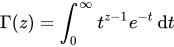
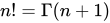

function f=factorgamma(n)
f = gamma(n+1)
endfunctionSeed7
Seed7 defines the prefix operator ! , which computes a factorial of an integer. The maximum representable number of an integer is 9223372036854775807. This limits the maximum factorial for integers to factorial(20)=2432902008176640000. Because of this limitations factorial is a very bad example to show the performance advantage of an iterative solution. To avoid this limitations the functions below use bigInteger:
Iterative
const func bigInteger: factorial (in bigInteger: n) is func
result
var bigInteger: fact is 1_;
local
var bigInteger: i is 0_;
begin
for i range 1_ to n do
fact *:= i;
end for;
end func;Original source: [2]
Recursive
const func bigInteger: factorial (in bigInteger: n) is func
result
var bigInteger: fact is 1_;
begin
if n > 1_ then
fact := n * factorial(pred(n));
end if;
end func;Original source: [3]
Self
Built in:
n factorialIterative version:
factorial: n = (|r <- 1| 1 to: n + 1 Do: [|:i| r: r * i]. r)Recursive version:
factorial: n = (n <= 1 ifTrue: 1 False: [n * (factorial: n predecessor)])Factorial is product of list of numbers from 1 to n. (Vector indexes start at 0)
factorial: n = (((vector copySize: n) mapBy: [|:e. :i| i + 1]) product)SequenceL
The simplest description: factorial is the product of the numbers from 1 to n:
factorial(n) := product(1 ... n);Or, if you wanted to generate a list of all the factorials:
factorials(n)[i] := product(1 ... i) foreach i within 1 ... n;Or, written recursively:
factorial: int -> int;
factorial(n) :=
1 when n <= 0
else
n * factorial(n-1);Tail-recursive:
factorial(n) :=
factorialHelper(1, n);
factorialHelper(acc, n) :=
acc when n <= 0
else
factorialHelper(acc * n, n-1);SETL
$ Recursive
proc fact(n);
if (n < 2) then
return 1;
else
return n * fact(n - 1);
end if;
end proc;
$ Iterative
proc factorial(n);
v := 1;
for i in {2..n} loop
v *:= i;
end loop;
return v;
end proc;Shen
(define factorial
0 -> 1
X -> (* X (factorial (- X 1))))Sidef
Recursive:
func factorial_recursive(n) {
n == 0 ? 1 : (n * __FUNC__(n-1))
}Catamorphism:
func factorial_reduce(n) {
1..n -> reduce({|a,b| a * b }, 1)
}Iterative:
func factorial_iterative(n) {
var f = 1
{|i| f *= i } << 2..n
return f
}Built-in:
say 5!Simula
begin
integer procedure factorial(n);
integer n;
begin
integer fact, i;
fact := 1;
for i := 2 step 1 until n do
fact := fact * i;
factorial := fact
end;
integer f; outtext("factorials:"); outimage;
for f := 0, 1, 2, 6, 9 do begin
outint(f, 2); outint(factorial(f), 8); outimage
end
end- Output:
factorials: 0 1 1 1 2 2 6 720 9 362880
Sisal
Solution using a fold:
define main
function main(x : integer returns integer)
for a in 1, x
returns
value of product a
end for
end functionSimple example using a recursive function:
define main
function main(x : integer returns integer)
if x = 0 then
1
else
x * main(x - 1)
end if
end functionSlate
This is already implemented in the core language as:
n@(Integer traits) factorial
"The standard recursive definition."
[
n isNegative ifTrue: [error: 'Negative inputs to factorial are invalid.'].
n <= 1
ifTrue: [1]
ifFalse: [n * ((n - 1) factorial)]
].Here is another way to implement it:
n@(Integer traits) factorial2
[
n isNegative ifTrue: [error: 'Negative inputs to factorial are invalid.'].
(1 upTo: n by: 1) reduce: [|:a :b| a * b]
].- Output:
slate[5]> 100 factorial. 93326215443944152681699238856266700490715968264381621468592963895217599993229915608941463976156518286253697920827223758251185210916864000000000000000000000000
Slope
Slope supports 64 bit floating point numbers and renders ints via conversion from float. There is no "big int" library. As such the largest integer that can be given the below factorial procedures is 171, anything larger will produce +Inf.
Using reduce:
(define factorial (lambda (n)
(cond
((negative? n) (! "Negative inputs to factorial are invalid"))
((zero? n) 1)
(else (reduce (lambda (num acc) (* num acc)) 1 (range n 1))))))Using a loop:
(define factorial (lambda (n)
(cond
((negative? n) (! "Negative inputs to factorial are invalid"))
((zero? n) 1)
(else
(for ((acc 1 (* acc i))(i 1 (+ i 1))) ((<= i n) acc))))))Smalltalk
Smalltalk Number class already has a factorial method ¹;
however, let's see how we could implement it by ourselves.
Iterative with fold
Number extend [
my_factorial [
(self < 2)
ifTrue: [ ^1 ]
ifFalse: [
^ (2 to: self) fold: [ :a :b | a * b ]
]
]
].
7 factorial printNl.
7 my_factorial printNl.Recursive
Number extend [
factorial [
self < 0 ifTrue: [ self error: 'factorial is defined for natural numbers' ].
self isZero ifTrue: [ ^1 ].
^self * ((self - 1) factorial)
]
].Recursive (functional)
Defining a local function (aka closure) named 'fac':
|fac|
fac := [:n |
n < 0 ifTrue: [ self error: 'fac is defined for natural numbers' ].
n <= 1
ifTrue: [ 1 ]
ifFalse: [ n * (fac value:(n - 1)) ]
].
fac value:1000.| fac |
fac := [ :n | (1 to: n) inject: 1 into: [ :prod :next | prod * next ] ].
fac value: 10.
"3628800"fac := [:n | (1 to: n) product].
fac value:40
-> 815915283247897734345611269596115894272000000000Note ¹) the builtin factorial (where builtin means: the already provided method in the class library) typically uses a *much* better algorithm than both the iterative and especially the recursive versions presented here. So it is a bad idea, to not use them as a programmer.
SNOBOL4
Note: Snobol4+ overflows after 7! because of signed short int limitation.
Recursive
define('rfact(n)') :(rfact_end)
rfact rfact = le(n,0) 1 :s(return)
rfact = n * rfact(n - 1) :(return)
rfact_endTail-recursive
define('trfact(n,f)') :(trfact_end)
trfact trfact = le(n,0) f :s(return)
trfact = trfact(n - 1, n * f) :(return)
trfact_endIterative
define('ifact(n)') :(ifact_end)
ifact ifact = 1
if1 ifact = gt(n,0) n * ifact :f(return)
n = n - 1 :(if1)
ifact_endTest and display factorials 0 .. 10
loop i = le(i,10) i + 1 :f(end)
output = rfact(i) ' ' trfact(i,1) ' ' ifact(i) :(loop)
end- Output:
1 1 1 2 2 2 6 6 6 24 24 24 120 120 120 720 720 720 5040 5040 5040 40320 40320 40320 362880 362880 362880 3628800 3628800 3628800 39916800 39916800 39916800
Soda
Recursive
factorial (n : Int) : Int =
if n < 2
then 1
else n * factorial (n - 1)Tail recursive
_tailrec_fact (n : Int) (accum : Int) : Int =
if n < 2
then accum
else _tailrec_fact (n - 1) (n * accum)
factorial (n : Int) : Int =
_tailrec_fact (n) (1)SparForte
As a structured script.
#!/usr/local/bin/spar
pragma annotate( summary, "factorial n" )
@( description, "Write a function to return the factorial of a number." )
@( author, "Ken O. Burtch" );
pragma license( unrestricted );
pragma restriction( no_external_commands );
procedure factorial is
fact_pos : constant integer := numerics.value( $1 );
result : natural;
count : natural;
begin
if fact_pos < 0 then
put_line( standard_error, source_info.source_location & ": number must be >= 0" );
command_line.set_exit_status( 192 );
return;
end if;
if fact_pos = 0 then
? 0;
return;
end if;
result := natural( fact_pos );
count := natural( fact_pos - 1 );
for i in reverse 1..count loop
result := @ * i;
end loop;
? result;
end factorial;Spin
con
_clkmode = xtal1 + pll16x
_clkfreq = 80_000_000
obj
ser : "FullDuplexSerial.spin"
pub main | i
ser.start(31, 30, 0, 115200)
repeat i from 0 to 10
ser.dec(fac(i))
ser.tx(32)
waitcnt(_clkfreq + cnt)
ser.stop
cogstop(0)
pub fac(n) : f
f := 1
repeat while n > 0
f *= n
n -= 1- Output:
1 1 2 6 24 120 720 5040 40320 362880 3628800
SPL
fact(n)=
? n!>1, <=1
<= n*fact(n-1)
.SSEM
The factorial function gets large quickly: so quickly that 13! already overflows a 32-bit integer. For any real-world algorithm that may require factorials, therefore, the most economical approach on a machine comparable to the SSEM would be to store the values of 0! to 12! and simply look up the one we want. This program does that. (Note that what we actually store is the two's complement of each value: this is purely because the SSEM cannot load a number from storage without negating it, so providing the data pre-negated saves some tiresome juggling between accumulator and storage.) If word 21 holds n, the program will halt with the accumulator storing n!; as an example, we shall find 10!
11100000000000100000000000000000 0. -7 to c
10101000000000010000000000000000 1. Sub. 21
10100000000001100000000000000000 2. c to 5
10100000000000100000000000000000 3. -5 to c
10100000000001100000000000000000 4. c to 5
00000000000000000000000000000000 5. generated at run time
00000000000001110000000000000000 6. Stop
00010000000000100000000000000000 7. -8 to c
11111111111111111111111111111111 8. -1
11111111111111111111111111111111 9. -1
01111111111111111111111111111111 10. -2
01011111111111111111111111111111 11. -6
00010111111111111111111111111111 12. -24
00010001111111111111111111111111 13. -120
00001100101111111111111111111111 14. -720
00001010001101111111111111111111 15. -5040
00000001010001101111111111111111 16. -40320
00000001011011100101111111111111 17. -362880
00000000100001010001001111111111 18. -3628800
00000000110101110111100110111111 19. -39916800
00000000001000001100111011000111 20. -479001600
01010000000000000000000000000000 21. 10Standard ML
Recursive
fun factorial n =
if n <= 0 then 1
else n * factorial (n-1)The following is tail-recursive, so it is effectively iterative:
fun factorial n = let
fun loop (i, accum) =
if i > n then accum
else loop (i + 1, accum * i)
in
loop (1, 1)
endStata
Mata has the built-in factorial function. Here are two implementations.
mata
real scalar function fact1(real scalar n) {
if (n<2) return(1)
else return(fact1(n-1)*n)
}
real scalar function fact2(real scalar n) {
a=1
for (i=2;i<=n;i++) a=a*i
return(a)
}
printf("%f\n",fact1(8))
printf("%f\n",fact2(8))
printf("%f\n",factorial(8))
SuperCollider
Iterative
f = { |n| (1..n).product };
f.(10);
// for numbers larger than 12, use 64 bit float
// instead of 32 bit integers, because the integer range is exceeded
// (1..n) returns an array of floats when n is a float
f.(20.0);Recursive
f = { |n| if(n < 2) { 1 } { n * f.(n - 1) } };
f.(10);
Swift
Iterative
func factorial(_ n: Int) -> Int {
return n < 2 ? 1 : (2...n).reduce(1, *)
}Recursive
func factorial(_ n: Int) -> Int {
return n < 2 ? 1 : n * factorial(n - 1)
}Symsyn
fact
if n < 1
return
endif
* n fn fn
- n
call fact
return
start
if i < 20
1 fn
i n
call fact
fn []
+ i
goif
endifTailspin
Iterative
templates factorial
when <0..> do
@: 1;
1..$ -> @: $@ * $;
$@ !
end factorialRecursive
templates factorial
when <=0> do 1 !
when <0..> $ * ($ - 1 -> factorial) !
end factorialTcl
Use Tcl 8.5 for its built-in arbitrary precision integer support.
Iterative
proc ifact n {
for {set i $n; set sum 1} {$i >= 2} {incr i -1} {
set sum [expr {$sum * $i}]
}
return $sum
}Recursive
proc rfact n {
expr {$n < 2 ? 1 : $n * [rfact [incr n -1]]}
}The recursive version is limited by the default stack size to roughly 850!
When put into the tcl::mathfunc namespace, the recursive call stays inside the expr language, and thus looks clearer:
proc tcl::mathfunc::fact n {expr {$n < 2? 1: $n*fact($n-1)}}Iterative with caching
proc ifact_caching n {
global fact_cache
if { ! [info exists fact_cache]} {
set fact_cache {1 1}
}
if {$n < [llength $fact_cache]} {
return [lindex $fact_cache $n]
}
set i [expr {[llength $fact_cache] - 1}]
set sum [lindex $fact_cache $i]
while {$i < $n} {
incr i
set sum [expr {$sum * $i}]
lappend fact_cache $sum
}
return $sum
}Performance Analysis
puts [ifact 30]
puts [rfact 30]
puts [ifact_caching 30]
set n 400
set iterations 10000
puts "calculate $n factorial $iterations times"
puts "ifact: [time {ifact $n} $iterations]"
puts "rfact: [time {rfact $n} $iterations]"
# for the caching proc, reset the cache between each iteration so as not to skew the results
puts "ifact_caching: [time {ifact_caching $n; unset -nocomplain fact_cache} $iterations]"- Output:
265252859812191058636308480000000 265252859812191058636308480000000 265252859812191058636308480000000 calculate 400 factorial 10000 times ifact: 661.4324 microseconds per iteration rfact: 654.7593 microseconds per iteration ifact_caching: 613.1989 microseconds per iteration
Using the Γ Function
Note that this only works correctly for factorials that produce correct representations in double precision floating-point numbers.
package require math::special
proc gfact n {
expr {round([::math::special::Gamma [expr {$n+1}]])}
}TI-57
The program stack has only three levels, which means that the recursive approach can be dispensed with.
| Machine code | Comment |
|---|---|
Lbl 0 C.t x=t 1 STO 0 Lbl 1 RCL 0 × Dsz GTO 1 1 = R/S RST |
program factorial(x) // x is the display register if x=0 then x=1 r0 = x loop multiply r0 by what will be in the next loop decrement r0 and exit loop if r0 = 0 end loop complete the multiplication sequence return x! end program reset program pointer |
TorqueScript
Iterative
function Factorial(%num)
{
if(%num < 2)
return 1;
for(%a = %num-1; %a > 1; %a--)
%num *= %a;
return %num;
}Recursive
function Factorial(%num)
{
if(%num < 2)
return 1;
return %num * Factorial(%num-1);
}TransFORTH
: FACTORIAL
1 SWAP
1 + 1 DO
I * LOOP ;TUSCRIPT
$$ MODE TUSCRIPT
LOOP num=-1,12
IF (num==0,1) THEN
f=1
ELSEIF (num<0) THEN
PRINT num," is negative number"
CYCLE
ELSE
f=VALUE(num)
LOOP n=#num,2,-1
f=f*(n-1)
ENDLOOP
ENDIF
formatnum=CENTER(num,+2," ")
PRINT "factorial of ",formatnum," = ",f
ENDLOOP- Output:
-1 is negative number factorial of 0 = 1 factorial of 1 = 1 factorial of 2 = 2 factorial of 3 = 6 factorial of 4 = 24 factorial of 5 = 120 factorial of 6 = 720 factorial of 7 = 5040 factorial of 8 = 40320 factorial of 9 = 362880 factorial of 10 = 3628800 factorial of 11 = 39916800 factorial of 12 = 479001600
TXR
Built-in
Via nPk function:
$ txr -p '(n-perm-k 10 10)'
3628800Functional
$ txr -p '[reduce-left * (range 1 10) 1]'
3628800UNIX Shell
Iterative
factorial() {
set -- "$1" 1
until test "$1" -lt 2; do
set -- "`expr "$1" - 1`" "`expr "$2" \* "$1"`"
done
echo "$2"
}If expr uses 32-bit signed integers, then this function overflows after factorial 12.
Or in Korn style:
function factorial {
typeset n=$1 f=1 i
for ((i=2; i < n; i++)); do
(( f *= i ))
done
echo $f
}- bash and zsh use 64-bit signed integers, overflows after
factorial 20. - ksh93 uses floating-point numbers, prints
factorial 19as an integer, printsfactorial 20in floating-point exponential format.
Recursive
These solutions fork many processes, because each level of recursion spawns a subshell to capture the output.
factorial ()
{
if [ $1 -eq 0 ]
then echo 1
else echo $(($1 * $(factorial $(($1-1)) ) ))
fi
}Or in Korn style:
function factorial {
typeset n=$1
(( n < 2 )) && echo 1 && return
echo $(( n * $(factorial $((n-1))) ))
}C Shell
This is an iterative solution. csh uses 32-bit signed integers, so this alias overflows after factorial 12.
alias factorial eval \''set factorial_args=( \!*:q ) \\
@ factorial_n = $factorial_args[2] \\
@ factorial_i = 1 \\
while ( $factorial_n >= 2 ) \\
@ factorial_i *= $factorial_n \\
@ factorial_n -= 1 \\
end \\
@ $factorial_args[1] = $factorial_i \\
'\'
factorial f 12
echo $f
# => 479001600Ursa
Iterative
def factorial (int n)
decl int result
set result 1
decl int i
for (set i 1) (< i (+ n 1)) (inc i)
set result (* result i)
end
return result
endRecursive
def factorial (int n)
decl int z
set z 1
if (> n 1)
set z (* n (factorial (- n 1)))
end if
return z
endUrsala
There is already a library function for factorials, but they can be defined anyway like this. The good method treats natural numbers as an abstract type, and the better method factors out powers of 2 by bit twiddling.
#import nat
good_factorial = ~&?\1! product:-1^lrtPC/~& iota
better_factorial = ~&?\1! ^T(~&lSL,@rS product:-1)+ ~&Z-~^*lrtPC/~& iotatest program:
#cast %nL
test = better_factorial* <0,1,2,3,4,5,6,7,8>- Output:
<1,1,2,6,24,120,720,5040,40320>
Uxntal
@factorial ( n* -: fact* )
ORAk ?{ POP2 #0001 JMP2r }
DUP2 #0001 SUB2 factorial MUL2
JMP2rVerbexx
// ----------------
// recursive method (requires INTV_T input parm)
// ----------------
fact_r @FN [n]
{
@CASE
when:(n < 0iv) {-1iv }
when:(n == 0iv) { 1iv }
else: { n * (@fact_r n-1iv) }
};
// ----------------
// iterative method (requires INTV_T input parm)
// ----------------
fact_i @FN [n]
{
@CASE
when:(n < 0iv) {-1iv }
when:(n == 0iv) { 1iv }
else: {
@VAR i fact = 1iv 1iv;
@LOOP while:(i <= n) { fact *= i++ };
}
};
// ------------------
// Display factorials
// ------------------
@VAR i = -1iv;
@LOOP times:15
{
@SAY «recursive » i «! = » (@fact_r i) between:"";
@SAY «iterative » i «! = » (@fact_i i) between:"";
i = 5iv * i / 4iv + 1iv;
};
/]=========================================================================================
Output:
recursive -1! = -1
iterative -1! = -1
recursive 0! = 1
iterative 0! = 1
recursive 1! = 1
iterative 1! = 1
recursive 2! = 2
iterative 2! = 2
recursive 3! = 6
iterative 3! = 6
recursive 4! = 24
iterative 4! = 24
recursive 6! = 720
iterative 6! = 720
recursive 8! = 40320
iterative 8! = 40320
recursive 11! = 39916800
iterative 11! = 39916800
recursive 14! = 87178291200
iterative 14! = 87178291200
recursive 18! = 6402373705728000
iterative 18! = 6402373705728000
recursive 23! = 25852016738884976640000
iterative 23! = 25852016738884976640000
recursive 29! = 8841761993739701954543616000000
iterative 29! = 8841761993739701954543616000000
recursive 37! = 13763753091226345046315979581580902400000000
iterative 37! = 13763753091226345046315979581580902400000000
recursive 47! = 258623241511168180642964355153611979969197632389120000000000
iterative 47! = 258623241511168180642964355153611979969197632389120000000000
Verilog
Recursive
module main;
function automatic [7:0] factorial;
input [7:0] i_Num;
begin
if (i_Num == 1)
factorial = 1;
else
factorial = i_Num * factorial(i_Num-1);
end
endfunction
initial
begin
$display("Factorial of 1 = %d", factorial(1));
$display("Factorial of 2 = %d", factorial(2));
$display("Factorial of 3 = %d", factorial(3));
$display("Factorial of 4 = %d", factorial(4));
$display("Factorial of 5 = %d", factorial(5));
end
endmodule
VHDL
LIBRARY ieee;
USE ieee.std_logic_1164.ALL;
USE ieee.numeric_std.ALL;
ENTITY Factorial IS
GENERIC (
Nbin : INTEGER := 3 ; -- number of bit to input number
Nbou : INTEGER := 13) ; -- number of bit to output factorial
PORT (
clk : IN STD_LOGIC ; -- clock of circuit
sr : IN STD_LOGIC_VECTOR(1 DOWNTO 0); -- set and reset
N : IN STD_LOGIC_VECTOR(Nbin-1 DOWNTO 0) ; -- max number
Fn : OUT STD_LOGIC_VECTOR(Nbou-1 DOWNTO 0)); -- factorial of "n"
END Factorial ;
ARCHITECTURE Behavior OF Factorial IS
---------------------- Program Multiplication --------------------------------
FUNCTION Mult ( CONSTANT MFa : IN UNSIGNED ;
CONSTANT MI : IN UNSIGNED ) RETURN UNSIGNED IS
VARIABLE Z : UNSIGNED(MFa'RANGE) ;
VARIABLE U : UNSIGNED(MI'RANGE) ;
BEGIN
Z := TO_UNSIGNED(0, MFa'LENGTH) ; -- to obtain the multiplication
U := MI ; -- regressive counter
LOOP
Z := Z + MFa ; -- make multiplication
U := U - 1 ;
EXIT WHEN U = 0 ;
END LOOP ;
RETURN Z ;
END Mult ;
-------------------Program Factorial ---------------------------------------
FUNCTION Fact (CONSTANT Nx : IN NATURAL ) RETURN UNSIGNED IS
VARIABLE C : NATURAL RANGE 0 TO 2**Nbin-1 ;
VARIABLE I : UNSIGNED(Nbin-1 DOWNTO 0) ;
VARIABLE Fa : UNSIGNED(Nbou-1 DOWNTO 0) ;
BEGIN
C := 0 ; -- counter
I := TO_UNSIGNED(1, Nbin) ;
Fa := TO_UNSIGNED(1, Nbou) ;
LOOP
EXIT WHEN C = Nx ; -- end loop
C := C + 1 ; -- progressive couter
Fa := Mult (Fa , I ); -- call function to make a multiplication
I := I + 1 ; --
END LOOP ;
RETURN Fa ;
END Fact ;
--------------------- Program TO Call Factorial Function ------------------------------------------------------
TYPE Table IS ARRAY (0 TO 2**Nbin-1) OF UNSIGNED(Nbou-1 DOWNTO 0) ;
FUNCTION Call_Fact RETURN Table IS
VARIABLE Fc : Table ;
BEGIN
FOR c IN 0 TO 2**Nbin-1 LOOP
Fc(c) := Fact(c) ;
END LOOP ;
RETURN Fc ;
END FUNCTION Call_Fact;
CONSTANT Result : Table := Call_Fact ;
------------------------------------------------------------------------------------------------------------
SIGNAL Nin : STD_LOGIC_VECTOR(N'RANGE) ;
BEGIN -- start of architecture
Nin <= N WHEN RISING_EDGE(clk) AND sr = "10" ELSE
(OTHERS => '0') WHEN RISING_EDGE(clk) AND sr = "01" ELSE
UNAFFECTED;
Fn <= STD_LOGIC_VECTOR(Result(TO_INTEGER(UNSIGNED(Nin)))) WHEN RISING_EDGE(clk) ;
END Behavior ;Vim Script
function! Factorial(n)
if a:n < 2
return 1
else
return a:n * Factorial(a:n-1)
endif
endfunctionV (Vlang)
Updated to V (Vlang) version 0.2.2
Imperative
const max_size = 10
fn factorial_i() {
mut facs := [0].repeat(max_size + 1)
facs[0] = 1
println('The 0-th Factorial number is: 1')
for i := 1; i <= max_size; i++ {
facs[i] = i * facs[i - 1]
num := facs[i]
println('The $i-th Factorial number is: $num')
}
}
fn main() {
factorial_i()
}Recursive
const max_size = 10
fn factorial_r(n int) int {
if n == 0 {
return 1
}
return n * factorial_r(n - 1)
}
fn main() {
for i := 0; i <= max_size; i++ {
println('factorial($i) is: ${factorial_r(i)}')
}
}Tail Recursive
const max_size = 10
fn factorial_tail(n int) int {
sum := 1
return factorial_r(n, sum)
}
fn factorial_r(n int, sum int) int {
if n == 0 {
return sum
}
return factorial_r(n - 1, n * sum )
}
fn main() {
for i := 0; i <= max_size; i++ {
println('factorial($i) is: ${factorial_tail(i)}')
}
}Memoized
const max_size = 10
struct Cache {
mut:
values []int
}
fn fac_cached(n int, mut cache Cache) int {
is_in_cache := cache.values.len > n
if is_in_cache {
return cache.values[n]
}
fac_n := if n == 0 { 1 } else { n * fac_cached(n - 1, mut cache) }
cache.values << fac_n
return fac_n
}
fn main() {
mut cache := Cache{}
for n := 0; n <= max_size; n++ {
fac_n := fac_cached(n, mut cache)
println('The $n-th Factorial is: $fac_n')
}
}- Output:
The 0-th Factorial is: 1 The 1-th Factorial is: 1 The 2-th Factorial is: 2 The 3-th Factorial is: 6 The 4-th Factorial is: 24 The 5-th Factorial is: 120 The 6-th Factorial is: 720 The 7-th Factorial is: 5040 The 8-th Factorial is: 40320 The 9-th Factorial is: 362880 The 10-th Factorial is: 3628800
Wart
Recursive, all at once
def (fact n)
if (n = 0)
1
(n * (fact n-1))Recursive, using cases and pattern matching
def (fact n)
(n * (fact n-1))
def (fact 0)
1Iterative, with an explicit loop
def (fact n)
ret result 1
for i 1 (i <= n) ++i
result <- result*iIterative, with a pseudo-generator
# a useful helper to generate all the natural numbers until n
def (nums n)
collect+for i 1 (i <= n) ++i
yield i
def (fact n)
(reduce (*) nums.n 1)WDTE
Recursive
let max a b => a { < b => b };
let ! n => n { > 1 => - n 1 -> ! -> * n } -> max 1;Iterative
let s => import 'stream';
let ! n => s.range 1 (+ n 1) -> s.reduce 1 *;WebAssembly
(module
;; recursive
(func $fac (param f64) (result f64)
get_local 0
f64.const 1
f64.lt
if (result f64)
f64.const 1
else
get_local 0
get_local 0
f64.const 1
f64.sub
call $fac
f64.mul
end)
(export "fac" (func $fac)))(module
;; recursive, more compact version
(func $fac_f64 (export "fac_f64") (param f64) (result f64)
get_local 0 f64.const 1 f64.lt
if (result f64)
f64.const 1
else
get_local 0
get_local 0 f64.const 1 f64.sub
call $fac_f64
f64.mul
end
)
)(module
;; recursive, refactored to use s-expressions
(func $fact_f64 (export "fact_f64") (param f64) (result f64)
(if (result f64) (f64.lt (get_local 0) (f64.const 1))
(then f64.const 1)
(else
(f64.mul
(get_local 0)
(call $fact_f64 (f64.sub (get_local 0) (f64.const 1)))
)
)
)
)
)(module
;; recursive, refactored to use s-expressions and named variables
(func $fact_f64 (export "fact_f64") (param $n f64) (result f64)
(if (result f64) (f64.lt (get_local $n) (f64.const 1))
(then f64.const 1)
(else
(f64.mul
(get_local $n)
(call $fact_f64 (f64.sub (get_local $n) (f64.const 1)))
)
)
)
)
)(module
;; iterative, generated by C compiler (LLVM) from recursive code!
(func $factorial (export "factorial") (param $p0 i32) (result i32)
(local $l0 i32) (local $l1 i32)
block $B0
get_local $p0
i32.eqz
br_if $B0
i32.const 1
set_local $l0
loop $L1
get_local $p0
get_local $l0
i32.mul
set_local $l0
get_local $p0
i32.const -1
i32.add
tee_local $l1
set_local $p0
get_local $l1
br_if $L1
end
get_local $l0
return
end
i32.const 1
)
)Wortel
Operator:
@fac 10Number expression:
!#~F 10Folding:
!/^* @to 10
; or
@prod @to 10Iterative:
~!10 &n [
@var r 1
@for x to n
:!*r x
r
]Recursive:
@let {
fac &{fac n}?{
<n 2 n
*n !fac -n 1
}
; memoized
facM @mem &n?{
<n 2 n
*n !facM -n 1
}
[[!fac 10 !facM 10]]
}Wrapl
Product
DEF fac(n) n <= 1 | PROD 1:to(n);Recursive
DEF fac(n) n <= 0 => 1 // n * fac(n - 1);Folding
DEF fac(n) n <= 1 | :"*":foldl(ALL 1:to(n));Wren
import "./fmt" for Fmt
import "./big" for BigInt
class Factorial {
static iterative(n) {
if (n < 2) return BigInt.one
var fact = BigInt.one
for (i in 2..n.toSmall) fact = fact * i
return fact
}
static recursive(n) {
if (n < 2) return BigInt.one
return n * recursive(n-1)
}
}
var n = BigInt.new(24)
Fmt.print("Factorial(%(n)) iterative -> $,s", Factorial.iterative(n))
Fmt.print("Factorial(%(n)) recursive -> $,s", Factorial.recursive(n))- Output:
Factorial(24) iterative -> 620,448,401,733,239,439,360,000 Factorial(24) recursive -> 620,448,401,733,239,439,360,000
x86 Assembly
Iterative
global factorial
section .text
; Input in ECX register (greater than 0!)
; Output in EAX register
factorial:
mov eax, 1
.factor:
mul ecx
loop .factor
retRecursive
global fact
section .text
; Input and output in EAX register
fact:
cmp eax, 1
je .done ; if eax == 1 goto done
; inductive case
push eax ; save n (ie. what EAX is)
dec eax ; n - 1
call fact ; fact(n - 1)
pop ebx ; fetch old n
mul ebx ; multiplies EAX with EBX, ie. n * fac(n - 1)
ret
.done:
; base case: return 1
mov eax, 1
retTail Recursive
global factorial
section .text
; Input in ECX register
; Output in EAX register
factorial:
mov eax, 1 ; default argument, store 1 in accumulator
.base_case:
test ecx, ecx
jnz .inductive_case ; return accumulator if n == 0
ret
.inductive_case:
mul ecx ; accumulator *= n
dec ecx ; n -= 1
jmp .base_case ; tail callXL
0! -> 1
N! -> N * (N-1)!XLISP
(defun factorial (x)
(if (< x 0)
nil
(if (<= x 1)
1
(* x (factorial (- x 1))) ) ) )XPL0
func FactIter(N); \Factorial of N using iterative method
int N; \range: 0..12
int F, I;
[F:= 1;
for I:= 2 to N do F:= F*I;
return F;
];
func FactRecur(N); \Factorial of N using recursive method
int N; \range: 0..12
return if N<2 then 1 else N*FactRecur(N-1);YAMLScript
#!/usr/bin/env ys-0
defn main(n):
say: "$n! = $factorial(n)"
defn factorial(x):
apply *: 2 .. xZig
Supports all integer data types, and checks for both overflow and negative numbers; returns null when there is a domain error.
pub fn factorial(comptime Num: type, n: i8) ?Num {
return if (@typeInfo(Num) != .Int)
@compileError("factorial called with non-integral type: " ++ @typeName(Num))
else if (n < 0)
null
else calc: {
var i: i8 = 1;
var fac: Num = 1;
while (i <= n) : (i += 1) {
const tmp = @mulWithOverflow(fac, i);
if (tmp[1] != 0)
break :calc null; // overflow
fac = tmp[0];
} else break :calc fac;
};
}
pub fn main() !void {
const stdout = @import("std").io.getStdOut().writer();
try stdout.print("-1! = {?}\n", .{factorial(i32, -1)});
try stdout.print("0! = {?}\n", .{factorial(i32, 0)});
try stdout.print("5! = {?}\n", .{factorial(i32, 5)});
try stdout.print("33!(64 bit) = {?}\n", .{factorial(i64, 33)}); // not valid i64 factorial
try stdout.print("33! = {?}\n", .{factorial(i128, 33)}); // biggest i128 factorial possible
try stdout.print("34! = {?}\n", .{factorial(i128, 34)}); // will overflow
}- Output:
-1! = null 0! = 1 5! = 120 33!(64 bit) = null 33! = 8683317618811886495518194401280000000 34! = null
zkl
fcn fact(n){[2..n].reduce('*,1)}
fcn factTail(n,N=1) { // tail recursion
if (n == 0) return(N);
return(self.fcn(n-1,n*N));
}fact(6).println();
var BN=Import("zklBigNum");
factTail(BN(42)) : "%,d".fmt(_).println(); // built in as BN(42).factorial()- Output:
720 1,405,006,117,752,879,898,543,142,606,244,511,569,936,384,000,000,000
The [..] notation understands int, float and string but not big int so fact(BN) doesn't work but tail recursion is just a loop so the two versions are pretty much the same.
- Programming Tasks
- Arithmetic operations
- Recursion
- Memoization
- Classic CS problems and programs
- Arithmetic
- Simple
- 0815
- 11l
- 360 Assembly
- 68000 Assembly
- AArch64 Assembly
- ABAP
- Acornsoft Lisp
- Action!
- ActionScript
- Ada
- Agda
- Aime
- ALGOL 60
- ALGOL 68
- ALGOL W
- ALGOL-M
- AmigaE
- AntLang
- Apex
- APL
- AppleScript
- Arendelle
- ARM Assembly
- ArnoldC
- Arturo
- AsciiDots
- ATS
- Asymptote
- AutoHotkey
- AutoIt
- Avail
- AWK
- Axe
- Babel
- Bash
- BASIC
- Applesoft BASIC
- BaCon
- BASIC256
- BBC BASIC
- Chipmunk Basic
- Commodore BASIC
- Craft Basic
- FreeBASIC
- FTCBASIC
- Gambas
- GW-BASIC
- IS-BASIC
- Liberty BASIC
- Microsoft Small Basic
- Minimal BASIC
- MSX Basic
- Palo Alto Tiny BASIC
- PowerBASIC
- PureBasic
- QB64
- Quite BASIC
- Run BASIC
- Sinclair ZX81 BASIC
- TI-83 BASIC
- TI-89 BASIC
- Tiny BASIC
- True BASIC
- VBA
- VBScript
- Visual Basic
- Visual Basic .NET
- System.Numerics
- Yabasic
- ZX Spectrum Basic
- Batch File
- Bc
- Beads
- Beeswax
- Befunge
- Binary Lambda Calculus
- BQN
- Bracmat
- Brainf***
- Brat
- Bruijn
- Burlesque
- C
- C sharp
- C++
- C3
- Cat
- Ceylon
- Chapel
- Chef
- ChucK
- Clay
- Clio
- CLIPS
- Clojure
- CLU
- CMake
- COBOL
- CoffeeScript
- Comal
- Comefrom0x10
- Common Lisp
- Computer/zero Assembly
- Coq
- Crystal
- D
- Dart
- Dc
- Delphi
- Draco
- Dragon
- DWScript
- Dyalect
- Dylan
- Déjà Vu
- E
- EasyLang
- EchoLisp
- Ecstasy
- EDSAC order code
- EGL
- Eiffel
- Ela
- Elixir
- Elm
- Emacs Lisp
- EMal
- Embedded C for AVR MCU
- Erlang
- ERRE
- Euphoria
- Excel
- Ezhil
- F Sharp
- Factor
- FALSE
- Fancy
- Fantom
- Fermat
- FOCAL
- Forth
- Fortran
- Friendly interactive shell
- Frink
- FunL
- Futhark
- Futhark examples needing attention
- Examples needing attention
- FutureBasic
- GAP
- Genyris
- GML
- Gnuplot
- Go
- Golfscript
- Gridscript
- Groovy
- Guish
- Haskell
- Haxe
- Hexiscript
- HicEst
- HolyC
- Hy
- I
- Icon
- Unicon
- Icon Programming Library
- IDL
- Inform 6
- Insitux
- Io
- J
- Jakt
- Janet
- Java
- JavaScript
- JOVIAL
- Joy
- Jq
- Jsish
- Julia
- K
- Klingphix
- Klong
- KonsolScript
- Kotlin
- Lambdatalk
- Lang
- Lang5
- Langur
- Lasso
- Latitude
- LDPL
- Lean
- LFE
- Lingo
- Lisaac
- Little Man Computer
- LiveCode
- LLVM
- Logo
- LOLCODE
- Lua
- M2000 Interpreter
- M4
- MAD
- MANOOL
- Maple
- Mathematica
- Wolfram Language
- MATLAB
- Maude
- Maxima
- MAXScript
- Mercury
- Min
- MiniScript
- MiniZinc
- MIPS Assembly
- Mirah
- МК-61/52
- ML/I
- Modula-2
- Modula-3
- Mouse
- MUMPS
- MyrtleScript
- Nanoquery
- Neko
- Nemerle
- NetRexx
- NewLISP
- Nial
- Nickle
- Nim
- Niue
- Nu
- Nyquist
- Oberon
- Objeck
- OCaml
- Octave
- Odin
- Oforth
- Order
- Oz
- Panda
- PARI/GP
- Pascal
- Pebble
- Peloton
- Perl
- Ntheory
- Peylang
- Phix
- Phix/basics
- Phix/mpfr
- Phixmonti
- PHP
- Picat
- PicoLisp
- Piet
- Plain English
- PL/0
- PL/I
- PL/SQL
- PostScript
- Initlib
- PowerShell
- Processing
- Prolog
- Pure
- Python
- Q
- Quackery
- R
- Racket
- Raku
- Rapira
- Rascal
- RASEL
- REBOL
- Red
- Refal
- Relation
- Retro
- REXX
- Rhovas
- Ring
- Robotic
- Rockstar
- RPL
- Ruby
- Rust
- SASL
- Sather
- Scala
- Scheme
- Scilab
- Seed7
- Self
- SequenceL
- SETL
- Shen
- Sidef
- Simula
- Sisal
- Slate
- Slope
- Smalltalk
- SNOBOL4
- Soda
- SparForte
- Spin
- SPL
- SSEM
- Standard ML
- Stata
- SuperCollider
- Swift
- Symsyn
- Tailspin
- Tcl
- Tcllib
- TI-57
- TorqueScript
- TransFORTH
- TUSCRIPT
- TXR
- UNIX Shell
- C Shell
- Ursa
- Ursala
- Uxntal
- Verbexx
- Verilog
- VHDL
- Vim Script
- V (Vlang)
- Wart
- WDTE
- WebAssembly
- Wortel
- Wrapl
- Wren
- Wren-fmt
- Wren-big
- X86 Assembly
- XL
- XLISP
- XPL0
- YAMLScript
- Zig
- Zkl
- Pages with too many expensive parser function calls