
100 doors

You are encouraged to solve this task according to the task description, using any language you may know.
There are 100 doors in a row that are all initially closed.
You make 100 passes by the doors.
The first time through, visit every door and toggle the door (if the door is closed, open it; if it is open, close it).
The second time, only visit every 2nd door (door #2, #4, #6, ...), and toggle it.
The third time, visit every 3rd door (door #3, #6, #9, ...), etc, until you only visit the 100th door.
- Task
Answer the question: what state are the doors in after the last pass? Which are open, which are closed?
Alternate:
As noted in this page's discussion page, the only doors that remain open are those whose numbers are perfect squares.
Opening only those doors is an optimization that may also be expressed;
however, as should be obvious, this defeats the intent of comparing implementations across programming languages.
11l
V doors = [0B] * 100
L(i) 100
   L(j) (i .< 100).step(i + 1)
      doors[j] = !doors[j]
   print(‘Door ’(i + 1)‘: ’(I doors[i] {‘open’} E ‘close’))
360 Assembly
*        100 doors                 13/08/2015
HUNDOOR  CSECT
         USING  HUNDOOR,R12
         LR     R12,R15
         LA     R6,0
         LA     R8,1               step 1
         LA     R9,100
LOOPI    BXH    R6,R8,ELOOPI       do ipass=1 to 100 (R6)
         LR     R7,R6
         SR     R7,R6
         LR     R10,R6             step ipass
         LA     R11,100
LOOPJ    BXH    R7,R10,ELOOPJ      do idoor=ipass to 100 by ipass (R7)
         LA     R5,DOORS-1
         AR     R5,R7
         XI     0(R5),X'01'        doors(idoor)=not(doors(idoor))
NEXTJ    B      LOOPJ
ELOOPJ   B      LOOPI
ELOOPI   LA     R10,BUFFER         R10 address of the buffer
         LA     R5,DOORS           R5 address of doors item
         LA     R6,1               idoor=1 (R6)
         LA     R9,100             loop counter
LOOPN    CLI    0(R5),X'01'        if doors(idoor)=1
         BNE    NEXTN
         XDECO  R6,XDEC            idoor to decimal
         MVC    0(4,R10),XDEC+8    move decimal to buffer
         LA     R10,4(R10)
NEXTN	 LA     R6,1(R6)           idoor=idoor+1
         LA     R5,1(R5)
         BCT    R9,LOOPN           loop
ELOOPN   XPRNT  BUFFER,80
RETURN   XR     R15,R15
         BR     R14
DOORS    DC     100X'00'
BUFFER   DC     CL80' '
XDEC     DS     CL12
         YREGS
END HUNDOOR- Output:
1 4 9 16 25 36 49 64 81 100
4DOS Batch
@echo off
set doors=%@repeat[C,100]
do step = 1 to 100
  do door = %step to 100 by %step
    set doors=%@left[%@eval[%door-1],%doors]%@if[%@instr[%@eval[%door-1],1,%doors]==C,O,C]%@right[%@eval[100-%door],%doors]
  enddo
enddo
The SET line consists of three functions:
%@left[n,string]                      ^: Return n leftmost chars in string
%@right[n,string]                     ^: Return n rightmost chars in string
%@if[condition,true-val,false-val]    ^: Evaluate condition; return true-val if true, false-val if false
Here @IF is used to toggle between C and O.
6502 Assembly
unoptimized Based on BASIC QB64 unoptimized version
; 100 DOORS in  6502 assembly language for: http://www.6502asm.com/beta/index.html
; Written for the original MOS Technology, Inc. NMOS version of the 6502, but should work with any version.
; Based on BASIC QB64 unoptimized version: http://rosettacode.org/wiki/100_doors#BASIC
;
; Notes:
;    Doors array[1..100] is at $0201..$0264. On the specified emulator, this is in video memory, so tbe results will
; be directly shown as pixels in the display.
;    $0200 (door 0) is cleared for display purposes but is not involved in the open/close loops.
;    Y register holds Stride
;    X register holds Index
;    Zero Page address $01 used to add Stride to Index (via A) because there's no add-to-X or add-Y-to-A instruction.

  ; First, zero door array
    LDA #00
    LDX #100
Z_LOOP:
    STA 200,X
    DEX
    BNE Z_LOOP
    STA 200,X

  ; Now do doors repeated open/close
    LDY #01        ; Initial value of Stride
S_LOOP:
    CPY #101
    BCS S_DONE
    TYA            ; Initial value of Index
I_LOOP:
    CMP #101
    BCS I_DONE
    TAX            ; Use as Door array index
    INC $200,X     ; Toggle bit 0 to reverse state of door
    STY 01         ; Add stride (Y) to index (X, via A)
    ADC 01
    BCC I_LOOP
I_DONE:
    INY
    BNE S_LOOP
S_DONE:

  ; Finally, format array values for output: 0 for closed, 1 for open
    LDX #100
C_LOOP:
    LDA $200,X
    AND #$01
    STA $200,X
    DEX
    BNE C_LOOP
48. bytes of code; the specified emulator does not report cycles.
optimized Largely inspired by the optimized C implementation - makes use of the fact that finally only the doors whose numbers are squares of integers are open, as well as the fact that
.

  ;assumes memory at $02xx is initially set to 0 and stack pointer is initialized
  ;the 1 to 100 door byte array will be at $0200-$0263 (decimal 512 to 611)
  ;Zero-page location $01 will hold delta
  ;At end, closed doors = $00, open doors = $01

start:    ldx #0        ;initialize index - first door will be at $200 + $0
          stx $1
          inc $1        ;start out with a delta of 1 (0+1=1)
openloop: inc $200,X    ;open X'th door
          inc $1        ;add 2 to delta
          inc $1
          txa           ;add delta to X by transferring X to A, adding delta to A, then transferring back to X
          clc           ;  clear carry before adding (6502 has no add-without-carry instruction)
          adc $1
          tax
          cpx #$64      ;check to see if we're at or past the 100th door (at $200 + $63)
          bmi openloop  ;jump back to openloop if less than 100
22. bytes of code; the specified emulator does not report cycles.
68000 Assembly
Some of the macro code is derived from the examples included with EASy68K.
*-----------------------------------------------------------
* Title      : 100Doors.X68
* Written by : G. A. Tippery
* Date       : 2014-01-17
* Description: Solves "100 Doors" problem, see: http://rosettacode.org/wiki/100_doors
* Notes      : Translated from C "Unoptimized" version, http://rosettacode.org/wiki/100_doors#unoptimized
*            : No optimizations done relative to C version; "for("-equivalent loops could be optimized.
*-----------------------------------------------------------

*
*   System-specific general console I/O macros (Sim68K, in this case)
*
PUTS    MACRO
    ** Print a null-terminated string w/o CRLF **
    ** Usage: PUTS stringaddress
    ** Returns with D0, A1 modified
        MOVEQ   #14,D0      ; task number 14 (display null string)
        LEA     \1,A1       ; address of string
        TRAP    #15         ; display it
        ENDM
*
PRINTN  MACRO
    ** Print decimal integer from number in register
    ** Usage: PRINTN register
    ** Returns with D0,D1 modified
        IFNC '\1','D1'      ;if some register other than D1
          MOVE.L \1,D1      ;put number to display in D1
        ENDC
        MOVE.B  #3,D0
        TRAP    #15         ;display number in D1
*
*   Generic constants
*
CR      EQU     13      ;ASCII Carriage Return
LF      EQU     10      ;ASCII Line Feed

*
*   Definitions specific to this program
*
*   Register usage:
*   D3 == pass (index)
*   D4 == door (index)
*   A2 == Doors array pointer
*
SIZE    EQU     100             ;Define a symbolic constant for # of doors

        ORG     $1000           ;Specify load address for program -- actual address system-specific
START:                          ; Execution starts here
        LEA     Doors,A2        ; make A2 point to Doors byte array
        MOVEQ   #0,D3
PassLoop:
        CMP     #SIZE,D3
        BCC     ExitPassLoop    ; Branch on Carry Clear - being used as Branch on Higher or Equal
        MOVE    D3,D4
DoorLoop:
        CMP     #SIZE,D4
        BCC     ExitDoorLoop
        NOT.B   0(A2,D4)
        ADD     D3,D4
        ADDQ    #1,D4
        BRA     DoorLoop
ExitDoorLoop:
        ADDQ    #1,D3
        BRA     PassLoop
ExitPassLoop:

* $28 = 40. bytes of code to this point. 32626 cycles so far.
*   At this point, the result exists as the 100 bytes starting at address Doors.
* To get output, we must use methods specific to the particular hardware, OS, or
* emulator system that the code is running on.  I use macros to "hide" some of the
* system-specific details; equivalent macros would be written for another system.

        MOVEQ   #0,D4
PrintLoop:
        CMP     #SIZE,D4
        BCC     ExitPrintLoop
        PUTS    DoorMsg1
        MOVE    D4,D1
        ADDQ    #1,D1           ; Convert index to 1-based instead of 0-based
        PRINTN  D1
        PUTS    DoorMsg2
        TST.B   0(A2,D4)        ; Is this door open (!= 0)?
        BNE     ItsOpen
        PUTS    DoorMsgC
        BRA     Next
ItsOpen:
        PUTS    DoorMsgO
Next:
        ADDQ    #1,D4
        BRA     PrintLoop
ExitPrintLoop:

*  What to do at end of program is also system-specific
        SIMHALT             ;Halt simulator
*
* $78 = 120. bytes of code to this point, but this will depend on how the I/O macros are actually written.
* Cycle count is nearly meaningless, as the I/O hardware and routines will dominate the timing.

*
*   Data memory usage
*
        ORG     $2000
Doors   DCB.B   SIZE,0      ;Reserve 100 bytes, prefilled with zeros

DoorMsg1 DC.B   'Door ',0
DoorMsg2 DC.B   ' is ',0
DoorMsgC DC.B   'closed',CR,LF,0
DoorMsgO DC.B   'open',CR,LF,0

        END     START       ;last line of source
8080 Assembly
page:	equ	2	; Store doors in page 2
doors:	equ	100	; 100 doors
puts:	equ	9	; CP/M string output
	org	100h
	xra	a	; Set all doors to zero
	lxi	h,256*page
	mvi	c,doors
zero:	mov	m,a
	inx	h
	dcr	c
	jnz	zero
	mvi	m,'$'	; CP/M string terminator (for easier output later)
	mov	d,a	; D=0 so that DE=E=pass counter
	mov	e,a	; E=0, first pass
	mvi	a,doors-1	; Last pass and door
pass:	mov	l,e	; L=door counter, start at first door in pass
door:	inr	m	; Incrementing always toggles the low bit
	dad	d	; Go to next door in pass
	inr	l
	cmp	l	; Was this the last door?
	jnc	door	; If not, do the next door
	inr	e	; Next pass
	cmp	e	; Was this the last pass?
	jnc	pass	; If not, do the next pass
	lxi	h,256*page
	mvi	c,doors	; Door counter
	lxi	d,130h	; D=1 (low bit), E=30h (ascii 0)
char:	mov	a,m	; Get door
	ana	d	; Low bit gives door status
	ora	e	; ASCII 0 or 1
	mov	m,a	; Write character back
	inx	h	; Next door
	dcr	c	; Any doors left?
	jnz	char	; If so, next door
	lxi	d,256*page
	mvi	c,puts	; CP/M system call to print the string
jmp 5- Output:
1001000010000001000000001000000000010000000000001000000000000001000000000000000010000000000000000001
8086 Assembly
8th
\ Array of doors; init to empty; accessing a non-extant member will return
\ 'null', which is treated as 'false', so we don't need to initialize it:
[] var, doors

\ given a door number, get the value and toggle it:
: toggle-door \ n --
	doors @ over a:@
	not rot swap a:! drop ;

\ print which doors are open:
: .doors
	(
		doors @ over a:@ nip
		if . space else drop then
	) 1 100 loop ;

\ iterate over the doors, skipping 'n':
: main-pass \ n --
	0
	true
	repeat
		drop
		dup toggle-door
		over n:+
		dup 101 <
	while 2drop drop ;

\ calculate the first 100 doors:
' main-pass 1 100 loop
\ print the results:
.doors cr bye
- Output:
1 4 9 16 25 36 49 64 81 100
AArch64 Assembly
unoptimized
/* ARM assembly AARCH64 Raspberry PI 3B */
/*  program 100doors64.s   */

/*******************************************/
/* Constantes file                         */
/*******************************************/
/* for this file see task include a file in language AArch64 assembly*/
.include "../includeConstantesARM64.inc"

.equ NBDOORS,   100
/*********************************/
/* Initialized data              */
/*********************************/
.data
sMessResult:       .asciz "The door @ is open.\n"

/*********************************/
/* UnInitialized data            */
/*********************************/
.bss
stTableDoors:    .skip   8 * NBDOORS
sZoneConv:       .skip 24
/*********************************/
/*  code section                 */
/*********************************/
.text
.global main
main:                             // entry of program
    // display first line
    ldr x3,qAdrstTableDoors       // table address
    mov x5,1
1:
    mov x4,x5
2:                               // begin loop
    ldr x2,[x3,x4,lsl #3]        // read doors index x4
    cmp x2,#0
    cset x2,eq
    //moveq x2,#1                // if x2 = 0   1 -> x2
    //movne x2,#0                // if x2 = 1   0 -> x2
    str x2,[x3,x4,lsl #3]        // store value of doors
    add x4,x4,x5                 // increment x4 with  x5 value
    cmp x4,NBDOORS               // number of doors ?
    ble 2b                       // no -> loop
    add x5,x5,#1                 // increment the increment !!
    cmp x5,NBDOORS               // number of doors ?
    ble 1b                       // no -> loop

                                 // loop display state doors
    mov x4,#0
3:
    ldr x2,[x3,x4,lsl #3]        // read state doors x4 index
    cmp x2,#0
    beq 4f
    mov x0,x4                    // open -> display message
    ldr x1,qAdrsZoneConv          // display value index
    bl conversion10              // call function
    ldr x0,qAdrsMessResult
    ldr x1,qAdrsZoneConv
    bl strInsertAtCharInc        // insert result at first @ character
    bl affichageMess             // display message
4:
    add x4,x4,1
    cmp x4,NBDOORS
    ble 3b                       // loop


100:                             // standard end of the program
    mov x0,0                     // return code
    mov x8,EXIT                  // request to exit program
    svc 0                        // perform the system call

qAdrstTableDoors:        .quad stTableDoors
qAdrsMessResult:         .quad sMessResult
qAdrsZoneConv:           .quad sZoneConv
/***********************************************/
/*        File Include fonctions                        */
/********************************************************/
/* for this file see task include a file in language AArch64 assembly */
.include "../includeARM64.inc"
optimized
/* ARM assembly AARCH64 Raspberry PI 3B */
/*  program 100doors64_1.s   */

/*******************************************/
/* Constantes file                         */
/*******************************************/
/* for this file see task include a file in language AArch64 assembly*/
.include "../includeConstantesARM64.inc"

.equ NBDOORS,   100
/*********************************/
/* Initialized data              */
/*********************************/
.data
sMessResult:       .asciz "The door @ is open.\n"

/*********************************/
/* UnInitialized data            */
/*********************************/
.bss
sZoneConv:        .skip 24
/*********************************/
/*  code section                 */
/*********************************/
.text
.global main
main:                             // entry of program

    mov x5,3
    mov x4,1
1:
    mov x0,x4
    ldr x1,qAdrsZoneConv          // display value index
    bl conversion10              // call function
    ldr x0,qAdrsMessResult
    ldr x1,qAdrsZoneConv
    bl strInsertAtCharInc        // insert result at first @ character
    bl affichageMess             // display message
    add x4,x4,x5
    add x5,x5,2
    cmp x4,NBDOORS
    ble 1b                       // loop


100:                             // standard end of the program
    mov x0,0                     // return code
    mov x8,EXIT                  // request to exit program
    svc 0                        // perform the system call

qAdrsMessResult:         .quad sMessResult
qAdrsZoneConv:           .quad sZoneConv
/***********************************************/
/*        File Include fonctions                        */
/********************************************************/
/* for this file see task include a file in language AArch64 assembly */
.include "../includeARM64.inc"
ABAP
unoptimized
form open_doors_unopt.
  data: lv_door  type i,
        lv_count type i value 1.
  data: lt_doors type standard table of c initial size 100.
  field-symbols: <wa_door> type c.
  do 100 times.
    append initial line to lt_doors assigning <wa_door>.
    <wa_door> = 'X'.
  enddo.

  while lv_count < 100.
    lv_count = lv_count + 1.
    lv_door = lv_count.
    while lv_door < 100.
      read table lt_doors index lv_door assigning <wa_door>.
      if <wa_door> = ' '.
        <wa_door> = 'X'.
      else.
        <wa_door> = ' '.
      endif.
      add lv_count to lv_door.
    endwhile.
  endwhile.

  loop at lt_doors assigning <wa_door>.
    if <wa_door> = 'X'.
      write : / 'Door', (4) sy-tabix right-justified, 'is open' no-gap.
    endif.
  endloop.
endform.
unoptimized / functional
cl_demo_output=>display( REDUCE stringtab( INIT list TYPE stringtab
                                              aux TYPE i
                                          FOR door = 1 WHILE door <= 100
                                          FOR pass = 1 WHILE pass <= 100
                                         NEXT aux   = COND #( WHEN pass = 1 THEN 1
                                                              WHEN door MOD pass = 0 THEN aux + 1 ELSE aux  )
                                              list  = COND #( WHEN pass = 100
                                                                THEN COND #( WHEN aux MOD 2 <> 0 THEN VALUE #( BASE list ( CONV #( door ) ) )
                                                                              ELSE list ) ELSE list ) ) ).
optimized
Using
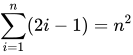
form open_doors_opt.
  data: lv_square type i value 1,
        lv_inc    type i value 3.
  data: lt_doors  type standard table of c initial size 100.
  field-symbols: <wa_door> type c.
  do 100 times.
    append initial line to lt_doors assigning <wa_door>.
    if sy-index = lv_square.
      <wa_door> = 'X'.
      add: lv_inc to lv_square, 2 to lv_inc.
      write : / 'Door', (4) sy-index right-justified, 'is open' no-gap.
    endif.
  enddo.
endform.
ultra-optimized / imperative
DO 10 TIMES.
  DATA(val) = sy-index * sy-index.
  WRITE: / val.
ENDDO.
ultra-optimized / functional
cl_demo_output=>display( REDUCE stringtab( INIT list TYPE stringtab
                                          FOR i = 1 WHILE i <= 10
                                         NEXT list = VALUE #( BASE list ( i * i ) ) ) ).
ABC
HOW TO INITIALIZE:
    SHARE doors
    PUT {} IN doors
    FOR door IN {1..100}:
        PUT 0 IN doors[door]

HOW TO TOGGLE door:
    SHARE doors
    PUT 1-doors[door] IN doors[door]

HOW TO WALK step:
    SHARE doors
    PUT step IN door
    WHILE door <= 100:
        TOGGLE door
        PUT door+step IN door

HOW TO DISPLAY OPEN DOORS:
    SHARE doors
    FOR door IN {1..100}:
        IF doors[door] = 1:
            WRITE "Door", door, "is open"/

INITIALIZE
FOR pass IN {1..100}: WALK pass
DISPLAY OPEN DOORS- Output:
Door 1 is open
Door 4 is open
Door 9 is open
Door 16 is open
Door 25 is open
Door 36 is open
Door 49 is open
Door 64 is open
Door 81 is open
Door 100 is open
ACL2
(defun rep (n x)
   (if (zp n)
       nil
       (cons x
             (rep (- n 1) x))))

(defun toggle-every-r (n i bs)
   (if (endp bs)
       nil
       (cons (if (zp i)
                 (not (first bs))
                 (first bs))
             (toggle-every-r n (mod (1- i) n) (rest bs)))))

(defun toggle-every (n bs)
   (toggle-every-r n (1- n) bs))

(defun 100-doors (i doors)
   (if (zp i)
       doors
       (100-doors (1- i) (toggle-every i doors))))
Action!
DEFINE COUNT="100"

PROC Main()
  BYTE ARRAY doors(COUNT+1)
  BYTE door,pass

  FOR door=1 TO COUNT
  DO
    doors(door)=0
  OD

  PrintE("Following doors are open:")
  FOR pass=1 TO COUNT
  DO
    FOR door=pass TO COUNT STEP pass
    DO
      doors(door)==!$FF
    OD
    IF doors(pass)=$FF THEN
      PrintB(pass) Put(32)
    FI
  OD
RETURN- Output:
Screenshot from Atari 8-bit computer
Following doors are open:
1 4 9 16 25 36 49 64 81 100
ActionScript
unoptimized
package {
    import flash.display.Sprite;

    public class Doors extends Sprite {
        public function Doors() {

            // Initialize the array
            var doors:Array = new Array(100);
            for (var i:Number = 0; i < 100; i++) {
                doors[i] = false;

            // Do the work
            for (var pass:Number = 0; pass < 100; pass++) {
                for (var j:Number = pass; j < 100; j += (pass+1)) {
                    doors[j] = !doors[j];
                }
            }
            trace(doors);
        }
    }
}
Acurity Architect
Using #HASH-OFF, OPTION OICC ="^" , CICC ="^"
VAR sStatus: SHORT
VAR sArray: SHORT
VAR sCount: SHORT
VAR sDoor: SHORT
VAR sPass: SHORT
VAR zIndex: STRING
VAR zState: STRING
//
SET sStatus = GET_UNUSED_ARRAY_HANDLE(sArray)
SET sStatus = INIT_SORTED_ARRAY(sArray, 0, 0, 1)
//
DO sCount = 1 TO 100
  DO sPass = 1 TO 100
    SET sDoor = sCount * sPass
    IF sDoor <= 100
      SET zIndex = REPEAT("0", 3 - LENGTH(STR(sDoor))) + STR(sDoor)
      SET sStatus = READ_ARRAY_REC("=", sArray, zIndex)
      SET zState = "OPEN"
      IF GET_STRING_SAY(sArray, 1) = "OPEN"
        SET zState = "CLOSE"
      ENDIF
      //
      SET sStatus = ADD_ARRAY_REC(sArray, zIndex)
      SET sStatus = PUT_STRING_SAY(sArray, 1, zState)
    ELSE
      BREAK
    ENDIF
  ENDDO
ENDDO
//
SET zIndex = ""
SET sStatus = READ_ARRAY_REC(">=", sArray, zIndex)
DO WHILE sStatus = 0
  >>Door:  ^zIndex^  State: ^GET_STRING_SAY(sArray, 1)^
  SET sStatus = READ_ARRAY_REC("+", sArray, zIndex)
ENDDO- Output:
Door:  001  State: OPEN
Door:  002  State: CLOSE
Door:  003  State: CLOSE
Door:  004  State: OPEN
Door:  005  State: CLOSE
Door:  006  State: CLOSE
Door:  007  State: CLOSE
Door:  008  State: CLOSE
Door:  009  State: OPEN
Door:  010  State: CLOSE
Door:  011  State: CLOSE
Door:  012  State: CLOSE
Door:  013  State: CLOSE
Door:  014  State: CLOSE
Door:  015  State: CLOSE
Door:  016  State: OPEN
Door:  017  State: CLOSE
Door:  018  State: CLOSE
Door:  019  State: CLOSE
Door:  020  State: CLOSE
Door:  021  State: CLOSE
Door:  022  State: CLOSE
Door:  023  State: CLOSE
Door:  024  State: CLOSE
Door:  025  State: OPEN
Door:  026  State: CLOSE
Door:  027  State: CLOSE
Door:  028  State: CLOSE
Door:  029  State: CLOSE
Door:  030  State: CLOSE
Door:  031  State: CLOSE
Door:  032  State: CLOSE
Door:  033  State: CLOSE
Door:  034  State: CLOSE
Door:  035  State: CLOSE
Door:  036  State: OPEN
Door:  037  State: CLOSE
Door:  038  State: CLOSE
Door:  039  State: CLOSE
Door:  040  State: CLOSE
Door:  041  State: CLOSE
Door:  042  State: CLOSE
Door:  043  State: CLOSE
Door:  044  State: CLOSE
Door:  045  State: CLOSE
Door:  046  State: CLOSE
Door:  047  State: CLOSE
Door:  048  State: CLOSE
Door:  049  State: OPEN
Door:  050  State: CLOSE
Door:  051  State: CLOSE
Door:  052  State: CLOSE
Door:  053  State: CLOSE
Door:  054  State: CLOSE
Door:  055  State: CLOSE
Door:  056  State: CLOSE
Door:  057  State: CLOSE
Door:  058  State: CLOSE
Door:  059  State: CLOSE
Door:  060  State: CLOSE
Door:  061  State: CLOSE
Door:  062  State: CLOSE
Door:  063  State: CLOSE
Door:  064  State: OPEN
Door:  065  State: CLOSE
Door:  066  State: CLOSE
Door:  067  State: CLOSE
Door:  068  State: CLOSE
Door:  069  State: CLOSE
Door:  070  State: CLOSE
Door:  071  State: CLOSE
Door:  072  State: CLOSE
Door:  073  State: CLOSE
Door:  074  State: CLOSE
Door:  075  State: CLOSE
Door:  076  State: CLOSE
Door:  077  State: CLOSE
Door:  078  State: CLOSE
Door:  079  State: CLOSE
Door:  080  State: CLOSE
Door:  081  State: OPEN
Door:  082  State: CLOSE
Door:  083  State: CLOSE
Door:  084  State: CLOSE
Door:  085  State: CLOSE
Door:  086  State: CLOSE
Door:  087  State: CLOSE
Door:  088  State: CLOSE
Door:  089  State: CLOSE
Door:  090  State: CLOSE
Door:  091  State: CLOSE
Door:  092  State: CLOSE
Door:  093  State: CLOSE
Door:  094  State: CLOSE
Door:  095  State: CLOSE
Door:  096  State: CLOSE
Door:  097  State: CLOSE
Door:  098  State: CLOSE
Door:  099  State: CLOSE
Door:  100  State: OPEN
Ada
unoptimized
with Ada.Text_Io; use Ada.Text_Io;

 procedure Doors is
    type Door_State is (Closed, Open);
    type Door_List is array(Positive range 1..100) of Door_State;
    The_Doors : Door_List := (others => Closed);
 begin
    for I in 1..100 loop
       for J in The_Doors'range loop
          if J mod I = 0 then
             if The_Doors(J) = Closed then
                 The_Doors(J) := Open;
             else
                The_Doors(J) := Closed;
             end if;
          end if;
       end loop;
    end loop;
    for I in The_Doors'range loop
       Put_Line(Integer'Image(I) & " is " & Door_State'Image(The_Doors(I)));
    end loop;
 end Doors;
optimized
with Ada.Text_Io; use Ada.Text_Io;
 with Ada.Numerics.Elementary_Functions; use Ada.Numerics.Elementary_Functions;

 procedure Doors_Optimized is
    Num : Float;
 begin
    for I in 1..100 loop
       Num := Sqrt(Float(I));
       Put(Integer'Image(I) & " is ");
       if Float'Floor(Num) = Num then
          Put_Line("Opened");
       else
          Put_Line("Closed");
       end if;
    end loop;
 end Doors_Optimized;
Agena
Translation of Algol W. Tested with Agena 2.9.5 Win32
# find the first few squares via the unoptimised door flipping method
scope

    local doorMax := 100;
    local door;
    create register door( doorMax );

    # set all doors to closed
    for i to doorMax do door[ i ] := false od;

    # repeatedly flip the doors
    for i to doorMax do
        for j from i to doorMax by i do door[ j ] := not door[ j ] od
    od;

    # display the results
    for i to doorMax do if door[ i ] then write( " ", i ) fi od; print()

epocs
Aikido
var doors = new int [100]

foreach pass 100 {
    for (var door = pass ; door < 100 ; door += pass+1) {
        doors[door] = !doors[door]
    }
}

var d = 1
foreach door doors {
    println ("door " + d++ + " is " + (door ? "open" : "closed"))

}
ALGOL 60
begin

comment - 100 doors problem in ALGOL-60;

boolean array doors[1:100];
integer i, j;
boolean open, closed;

open := true;
closed := not true;

outstring(1,"100 Doors Problem\n");

comment - all doors are initially closed;
for i := 1 step 1 until 100 do
  doors[i] := closed;

comment
  cycle through at increasing intervals
  and flip each door encountered;
for i := 1 step 1 until 100 do
  for j := i step i until 100 do
    doors[j] := not doors[j];

comment - show which doors are open;
outstring(1,"The open doors are:");
for i := 1 step 1 until 100 do
  if doors[i] then
     outinteger(1,i);

end
- Output:
100 Doors Problem
The open doors are: 1  4  9  16  25  36  49  64  81  100
ALGOL 68
unoptimized
PROC doors = (INT limit)VOID:
(
  MODE DOORSTATE = BOOL;
  BOOL closed = FALSE;
  BOOL open = NOT closed;
  MODE DOORLIST = [limit]DOORSTATE;

  DOORLIST the doors;
  FOR i FROM LWB the doors TO UPB the doors DO the doors[i]:=closed OD;

  FOR i FROM LWB the doors TO UPB the doors DO
    FOR j FROM LWB the doors BY i TO UPB the doors DO
      the doors[j] := NOT the doors[j]
    OD
  OD;
  FOR i FROM LWB the doors TO UPB the doors DO
    print((whole(i,-12)," is ",(the doors[i]|"opened"|"closed"),newline))
  OD
);
doors(100)
optimized
PROC doors optimised = ( INT limit )VOID:
  FOR i TO limit DO
    REAL num := sqrt(i);
    print((whole(i,0)," is ",(ENTIER num = num |"opened"|"closed"),newline))
  OD
;
doors optimised(100)
ALGOL W
begin
    % find the first few squares via the unoptimised door flipping method   %

    integer doorMax;
    doorMax := 100;

    begin
        % need to start a new block so the array can have variable bounds   %

        % array of doors - door( i ) is true if open, false if closed       %
        logical array door( 1 :: doorMax );

        % set all doors to closed                                           %
        for i := 1 until doorMax do door( i ) := false;

        % repeatedly flip the doors                                         %
        for i := 1 until doorMax
        do begin
            for j := i step i until doorMax
            do begin
                door( j ) := not door( j )
            end
        end;

        % display the results                                               %
        i_w := 1; % set integer field width                                 %
        s_w := 1; % and separator width                                     %
        for i := 1 until doorMax do if door( i ) then writeon( i )

    end

end.
- Output:
1 4 9 16 25 36 49 64 81 100
ALGOL-M
BEGIN

INTEGER ARRAY DOORS[1:100];
INTEGER I, J, OPEN, CLOSED;

OPEN := 1;
CLOSED := 0;

% ALL DOORS ARE INITIALLY CLOSED %
FOR I := 1 STEP 1 UNTIL 100 DO
  BEGIN
    DOORS[I] := CLOSED;
  END;

% PASS THROUGH AT INCREASING INTERVALS AND FLIP %
FOR I := 1 STEP 1 UNTIL 100 DO
  BEGIN
     FOR J := I STEP I UNTIL 100 DO
       BEGIN
         DOORS[J] := 1 - DOORS[J];
       END;
  END;

% SHOW RESULTS %
WRITE("THE OPEN DOORS ARE:");
WRITE("");
FOR I := 1 STEP 1 UNTIL 100 DO
  BEGIN
    IF DOORS[I] = OPEN THEN
      WRITEON(I);
  END;

END- Output:
THE OPEN DOORS ARE:
     1     4     9    16    25    36    49    64    81   100
AmigaE
PROC main()
  DEF t[100]: ARRAY,
      pass, door
  FOR door := 0 TO 99 DO t[door] := FALSE
  FOR pass := 0 TO 99
    door := pass
    WHILE door <= 99
      t[door] := Not(t[door])
      door := door + pass + 1
    ENDWHILE
  ENDFOR
  FOR door := 0 TO 99 DO WriteF('\d is \s\n', door+1,
                                IF t[door] THEN 'open' ELSE 'closed')
ENDPROC
APL
doors←{100⍴((⍵-1)⍴0),1}
≠⌿⊃doors¨ ⍳100
- Output:
1 0 0 1 0 0 0 0 1 0 0 0 0 0 0 1 0 0 0 0 0 0 0 0 1 0 0 0 0 0 0 0 0 0 0 1 0 0 0 0
      0 0 0 0 0 0 0 0 1 0 0 0 0 0 0 0 0 0 0 0 0 0 0 1 0 0 0 0 0 0 0 0 0 0 0 0 0
      0 0 0 1 0 0 0 0 0 0 0 0 0 0 0 0 0 0 0 0 0 0 1
optimized Note that ⎕IO = 1
2|+/[1]0=D∘.|D←⍳100
The idea is that the n:th door will be flipped the same number of times as there are divisors for n. So first we make D all ints 1..100 (D←⍳100).
The next step is to find the remainders of every such int when divided by every other (D∘.|D).
This results in a 100×100 matrix which we turn into a binary one by testing if the values are equal to zero i.e. divisors.
Next: sum along axis 1, i.e. the columns. This tells us the number of divisors. Finally calculate the remainder of these when divided by 2, i.e. find which n have an odd number of divisors, i.e. will be flipped an odd number of times and thus end up open.
⍝⍝ Also works with GNU APL after introduction of
⍝⍝ the ⍸ function with SVN r1368, Dec 03 2020
⍸≠⌿0=(⍳100)∘.|⍳100
- Output:
1 4 9 16 25 36 49 64 81 100
AppleScript
Iteration
set is_open to {}
repeat 100 times
   set end of is_open to false
end
repeat with pass from 1 to 100
  repeat with door from pass to 100 by pass
    set item door of is_open to not item door of is_open
  end
end
set open_doors to {}
repeat with door from 1 to 100
   if item door of is_open then
     set end of open_doors to door
   end
end
set text item delimiters to ", "
display dialog "Open doors: " & open_doors
This is similar to the above, but makes use of the fact that the final status of the first door in each pass is known as it's about to be set and the door number can thus be logged at that point if needed. It makes a separate checking repeat at the end unnecessary, the toggled status boolean doesn't need to be put back into the list, and the door number can be stored in the redundant list slot instead of a separate results list having to be built. It would be satisfying if the first pass, opening all the doors, could be combined with the initial creation of the doors list, but the task description does say "all initially closed"!
on _100doors()
    script o
        property doors : {}
    end script
    repeat 100 times
        set end of o's doors to false -- false = "not open".
    end repeat
    repeat with pass from 1 to 100
        if (not item pass of o's doors) then set item pass of o's doors to pass
        repeat with d from (pass + pass) to 100 by pass
            set item d of o's doors to (not item d of o's doors)
        end repeat
    end repeat

    return o's doors's integers
end _100doors

on join(lst, delim)
    set astid to AppleScript's text item delimiters
    set AppleScript's text item delimiters to delim
    set txt to lst as text
    set AppleScript's text item delimiters to astid
    return txt
end join

return "Open doors:
" & join(_100doors(), ", ")
- Output:
"Open doors:
1, 4, 9, 16, 25, 36, 49, 64, 81, 100"
Functional composition
-- FINAL DOOR STATES ---------------------------------------------------------

-- finalDoors :: Int -> [(Int, Bool)]
on finalDoors(n)

    -- toggledCorridor :: [(Int, Bool)] -> (Int, Bool) -> Int -> [(Int, Bool)]
    script toggledCorridor
        on |λ|(a, _, k)

            -- perhapsToggled :: Bool -> Int -> Bool
            script perhapsToggled
                on |λ|(x, i)
                    if i mod k = 0 then
                        {i, not item 2 of x}
                    else
                        {i, item 2 of x}
                    end if
                end |λ|
            end script

            map(perhapsToggled, a)
        end |λ|
    end script

    set xs to enumFromTo(1, n)

    foldl(toggledCorridor, ¬
        zip(xs, replicate(n, {false})), xs)
end finalDoors

-- TEST ----------------------------------------------------------------------
on run
    -- isOpenAtEnd :: (Int, Bool) -> Bool
    script isOpenAtEnd
        on |λ|(door)
            (item 2 of door)
        end |λ|
    end script

    -- doorNumber :: (Int, Bool) -> Int
    script doorNumber
        on |λ|(door)
            (item 1 of door)
        end |λ|
    end script

    map(doorNumber, filter(isOpenAtEnd, finalDoors(100)))

    --> {1, 4, 9, 16, 25, 36, 49, 64, 81, 100}
end run


-- GENERIC FUNCTIONS ---------------------------------------------------------

-- enumFromTo :: Int -> Int -> [Int]
on enumFromTo(m, n)
    if n < m then
        set d to -1
    else
        set d to 1
    end if
    set lst to {}
    repeat with i from m to n by d
        set end of lst to i
    end repeat
    return lst
end enumFromTo

-- filter :: (a -> Bool) -> [a] -> [a]
on filter(f, xs)
    tell mReturn(f)
        set lst to {}
        set lng to length of xs
        repeat with i from 1 to lng
            set v to item i of xs
            if |λ|(v, i, xs) then set end of lst to v
        end repeat
        return lst
    end tell
end filter

-- foldl :: (a -> b -> a) -> a -> [b] -> a
on foldl(f, startValue, xs)
    tell mReturn(f)
        set v to startValue
        set lng to length of xs
        repeat with i from 1 to lng
            set v to |λ|(v, item i of xs, i, xs)
        end repeat
        return v
    end tell
end foldl

-- map :: (a -> b) -> [a] -> [b]
on map(f, xs)
    tell mReturn(f)
        set lng to length of xs
        set lst to {}
        repeat with i from 1 to lng
            set end of lst to |λ|(item i of xs, i, xs)
        end repeat
        return lst
    end tell
end map

-- min :: Ord a => a -> a -> a
on min(x, y)
    if y < x then
        y
    else
        x
    end if
end min

-- Lift 2nd class handler function into 1st class script wrapper
-- mReturn :: Handler -> Script
on mReturn(f)
    if class of f is script then
        f
    else
        script
            property |λ| : f
        end script
    end if
end mReturn

-- replicate :: Int -> a -> [a]
on replicate(n, a)
    set out to {}
    if n < 1 then return out
    set dbl to {a}

    repeat while (n > 1)
        if (n mod 2) > 0 then set out to out & dbl
        set n to (n div 2)
        set dbl to (dbl & dbl)
    end repeat
    return out & dbl
end replicate

-- zip :: [a] -> [b] -> [(a, b)]
on zip(xs, ys)
    set lng to min(length of xs, length of ys)
    set lst to {}
    repeat with i from 1 to lng
        set end of lst to {item i of xs, item i of ys}
    end repeat
    return lst
end zip
- Output:
{1, 4, 9, 16, 25, 36, 49, 64, 81, 100}
Odd numbers of integer factors
The question of which doors are flipped an odd number of times reduces to the question of which numbers in the range have an odd number of integer factors (for an AppleScript implementation of integerFactors(n) see Factors of An Integer). Using map from the functional composition example above:
map(factorCountMod2, enumFromTo(1, 100))

on factorCountMod2(n)
    {n, (length of integerFactors(n)) mod 2 = 1}
end factorCountMod2
This, on inspection, and further reflection, then collapses to the even simpler question of which numbers are perfect squares, since all other numbers have an even number of integer factors (n factors below the square root, plus n paired cofactors above the square root). Using map and enumFromTo from the functional composition example above:
-- perfectSquaresUpTo :: Int -> [Int]
on perfectSquaresUpTo(n)
    script squared
        -- (Int -> Int)
        on |λ|(x)
            x * x
        end |λ|
    end script

    set realRoot to n ^ (1 / 2)
    set intRoot to realRoot as integer
    set blnNotPerfectSquare to not (intRoot = realRoot)

    map(squared, enumFromTo(1, intRoot - (blnNotPerfectSquare as integer)))
end perfectSquaresUpTo

on run

    perfectSquaresUpTo(100)

end run
- Output:
{1, 4, 9, 16, 25, 36, 49, 64, 81, 100}
Arbre
openshut(n):
  for x in [1..n]
    x%n==0

pass(n):
  if n==100
    openshut(n)
  else
    openshut(n) xor pass(n+1)

100doors():
  pass(1) -> io
Argile
use std, array

close all doors
for each pass from 1 to 100
  for (door = pass) (door <= 100) (door += pass)
    toggle door

let int pass, door.

.: close all doors :. {memset doors 0 size of doors}
.:toggle <int door>:. {    !!(doors[door - 1])     }

let doors be an array of 100 bool

for each door from 1 to 100
  printf "#%.3d %s\n" door (doors[door - 1]) ? "[ ]", "[X]"
ARM Assembly
unoptimized
/* ARM assembly Raspberry PI  */
/*  program 100doors.s   */

/************************************/
/* Constantes                       */
/************************************/
.equ STDOUT, 1                                 @ Linux output console
.equ EXIT,   1                                 @ Linux syscall
.equ WRITE,  4                                 @ Linux syscall
.equ NBDOORS,   100
/*********************************/
/* Initialized data              */
/*********************************/
.data
sMessResult:       .ascii "The door "
sMessValeur:       .fill 11, 1, ' '            @ size => 11
                      .asciz "is open.\n"

/*********************************/
/* UnInitialized data            */
/*********************************/
.bss
stTableDoors:	.skip   4 * NBDOORS
/*********************************/
/*  code section                 */
/*********************************/
.text
.global main
main:                                         @ entry of program
    push {fp,lr}                              @ saves 2 registers
    @ display first line
    ldr r3,iAdrstTableDoors                   @ table address
    mov r5,#1
1:
    mov r4,r5
2:                                            @ begin loop
    ldr r2,[r3,r4,lsl #2]                     @ read doors index r4
    cmp r2,#0
    moveq r2,#1                               @ if r2 = 0   1 -> r2
    movne r2,#0                               @ if r2 = 1   0 -> r2
    str r2,[r3,r4,lsl #2]                     @ store value of doors
    add r4,r5                                 @ increment r4 with  r5 value
    cmp r4,#NBDOORS                           @ number of doors ?
    ble 2b                                    @ no -> loop
    add r5,#1                                 @ increment the increment !!
    cmp r5,#NBDOORS                           @ number of doors ?
    ble 1b                                    @ no -> loop

                                              @ loop display state doors
    mov r4,#0
3:
    ldr r2,[r3,r4,lsl #2]                     @ read state doors r4 index
    cmp r2,#0
    beq 4f
    mov r0,r4                                 @ open -> display message
    ldr r1,iAdrsMessValeur                    @ display value index
    bl conversion10                           @ call function
    ldr r0,iAdrsMessResult
    bl affichageMess                          @ display message
4:
    add r4,#1
    cmp r4,#NBDOORS
    ble 3b                                    @ loop


100:                                          @ standard end of the program
    mov r0, #0                                @ return code
    pop {fp,lr}                               @restaur 2 registers
    mov r7, #EXIT                             @ request to exit program
    svc #0                                    @ perform the system call

iAdrsMessValeur:                .int sMessValeur
iAdrstTableDoors:		.int stTableDoors
iAdrsMessResult:		.int sMessResult

/******************************************************************/
/*     display text with size calculation                         */
/******************************************************************/
/* r0 contains the address of the message */
affichageMess:
    push {r0,r1,r2,r7,lr}                     @ save  registres
    mov r2,#0                                 @ counter length
1:                                            @ loop length calculation
    ldrb r1,[r0,r2]                           @ read octet start position + index
    cmp r1,#0                                 @ if 0 its over
    addne r2,r2,#1                            @ else add 1 in the length
    bne 1b                                    @ and loop
                                              @ so here r2 contains the length of the message
    mov r1,r0        			      @ address message in r1
    mov r0,#STDOUT      		      @ code to write to the standard output Linux
    mov r7, #WRITE                            @ code call system "write"
    svc #0                                    @ call systeme
    pop {r0,r1,r2,r7,lr}                      @ restaur des  2 registres */
    bx lr                                     @ return
/******************************************************************/
/*     Converting a register to a decimal unsigned                */
/******************************************************************/
/* r0 contains value and r1 address area   */
/* r0 return size of result (no zero final in area) */
/* area size => 11 bytes          */
.equ LGZONECAL,   10
conversion10:
    push {r1-r4,lr}                            @ save registers
    mov r3,r1
    mov r2,#LGZONECAL

1:	                                       @ start loop
    bl divisionpar10U                          @unsigned  r0 <- dividende. quotient ->r0 reste -> r1
    add r1,#48                                 @ digit
    strb r1,[r3,r2]                            @ store digit on area
    cmp r0,#0                                  @ stop if quotient = 0
    subne r2,#1                                @ else previous position
    bne 1b	                               @ and loop
    // and move digit from left of area
    mov r4,#0
2:
    ldrb r1,[r3,r2]
    strb r1,[r3,r4]
    add r2,#1
    add r4,#1
    cmp r2,#LGZONECAL
    ble 2b
    // and move spaces in end on area
    mov r0,r4                                 @ result length
    mov r1,#' '                               @ space
3:
    strb r1,[r3,r4]                           @ store space in area
    add r4,#1                                 @ next position
    cmp r4,#LGZONECAL
    ble 3b                                    @ loop if r4 <= area size

100:
    pop {r1-r4,lr}                            @ restaur registres
    bx lr                                     @return

/***************************************************/
/*   division par 10   unsigned                    */
/***************************************************/
/* r0 dividende   */
/* r0 quotient */
/* r1 remainder  */
divisionpar10U:
    push {r2,r3,r4, lr}
    mov r4,r0                                        @ save value
    //mov r3,#0xCCCD                                 @ r3 <- magic_number  lower   @ for Raspberry pi 3
    //movt r3,#0xCCCC                                @ r3 <- magic_number  upper   @ for Raspberry pi 3
    ldr r3,iMagicNumber                              @ for Raspberry pi 1 2
    umull r1, r2, r3, r0                             @ r1<- Lower32Bits(r1*r0) r2<- Upper32Bits(r1*r0)
    mov r0, r2, LSR #3                               @ r2 <- r2 >> shift 3
    add r2,r0,r0, lsl #2                             @ r2 <- r0 * 5
    sub r1,r4,r2, lsl #1                             @ r1 <- r4 - (r2 * 2)  = r4 - (r0 * 10)
    pop {r2,r3,r4,lr}
    bx lr                                            @ leave function
iMagicNumber:            .int 0xCCCCCCCD
optimized
/*********************************************/
/* optimized version                         */
/*********************************************/
/* ARM assembly Raspberry PI  */
/*  program 100doors.s   */

/************************************/
/* Constantes                       */
/************************************/
.equ STDOUT, 1     @ Linux output console
.equ EXIT,   1     @ Linux syscall
.equ WRITE,  4     @ Linux syscall
.equ NBDOORS,   100
/*********************************/
/* Initialized data              */
/*********************************/
.data
sMessResult:       .ascii "The door "
sMessValeur:       .fill 11, 1, ' '                 @ size => 11
                   .asciz "is open.\n"

/*********************************/
/* UnInitialized data            */
/*********************************/
.bss
/*********************************/
/*  code section                 */
/*********************************/
.text
.global main
main:                                               @ entry of program
    push {fp,lr}                                    @ saves 2 registers
                                                    @ display first line
    mov r5,#3                                       @ start value of increment
    mov r4,#1                                       @ start doors
                                                    @ loop display state doors
1:
    mov r0,r4                                       @ open -> display message
    ldr r1,iAdrsMessValeur                          @ display value index
    bl conversion10                                 @ call function
    ldr r0,iAdrsMessResult
    bl affichageMess                                @ display message
    add r4,r5                                       @ add increment
    add r5,#2                                       @ new increment
    cmp r4,#NBDOORS
    ble 1b                                          @ loop


100:   @ standard end of the program
    mov r0, #0                                      @ return code
    pop {fp,lr}                                     @ restaur 2 registers
    mov r7, #EXIT                                   @ request to exit program
    svc #0                                          @ perform the system call

iAdrsMessValeur:                .int sMessValeur
iAdrsMessResult:		.int sMessResult

/******************************************************************/
/*     display text with size calculation                         */
/******************************************************************/
/* r0 contains the address of the message */
affichageMess:
    push {r0,r1,r2,r7,lr}                           @ save  registres
    mov r2,#0                                       @ counter length
1:                                                  @ loop length calculation
    ldrb r1,[r0,r2]                                 @ read octet start position + index
    cmp r1,#0                                       @ if 0 its over
    addne r2,r2,#1                                  @ else add 1 in the length
    bne 1b                                          @ and loop
                                                    @ so here r2 contains the length of the message
    mov r1,r0        			            @ address message in r1
    mov r0,#STDOUT      		            @ code to write to the standard output Linux
    mov r7, #WRITE                                  @ code call system "write"
    svc #0                                          @ call systeme
    pop {r0,r1,r2,r7,lr}                            @ restaur des  2 registres */
    bx lr                                           @ return
/******************************************************************/
/*     Converting a register to a decimal unsigned                */
/******************************************************************/
/* r0 contains value and r1 address area   */
/* r0 return size of result (no zero final in area) */
/* area size => 11 bytes          */
.equ LGZONECAL,   10
conversion10:
    push {r1-r4,lr}                                 @ save registers
    mov r3,r1
    mov r2,#LGZONECAL

1:	                                            @ start loop
    bl divisionpar10U                               @ unsigned  r0 <- dividende. quotient ->r0 reste -> r1
    add r1,#48                                      @ digit
    strb r1,[r3,r2]                                 @ store digit on area
    cmp r0,#0                                       @ stop if quotient = 0
    subne r2,#1                                     @ else previous position
    bne 1b	                                    @ and loop
                                                    @ and move digit from left of area
    mov r4,#0
2:
    ldrb r1,[r3,r2]
    strb r1,[r3,r4]
    add r2,#1
    add r4,#1
    cmp r2,#LGZONECAL
    ble 2b
                                                    @ and move spaces in end on area
    mov r0,r4                                       @ result length
    mov r1,#' '                                     @ space
3:
    strb r1,[r3,r4]                                 @ store space in area
    add r4,#1                                       @ next position
    cmp r4,#LGZONECAL
    ble 3b                                          @ loop if r4 <= area size

100:
    pop {r1-r4,lr}                                  @ restaur registres
    bx lr                                           @return

/***************************************************/
/*   division par 10   unsigned                    */
/***************************************************/
/* r0 dividende   */
/* r0 quotient */
/* r1 remainder  */
divisionpar10U:
    push {r2,r3,r4, lr}
    mov r4,r0                                       @ save value
    //mov r3,#0xCCCD                                @ r3 <- magic_number  lower   @ for raspberry 3
    //movt r3,#0xCCCC                               @ r3 <- magic_number  upper   @ for raspberry 3
    ldr r3,iMagicNumber                             @ for raspberry 1 2
    umull r1, r2, r3, r0                            @ r1<- Lower32Bits(r1*r0) r2<- Upper32Bits(r1*r0)
    mov r0, r2, LSR #3                              @ r2 <- r2 >> shift 3
    add r2,r0,r0, lsl #2                            @ r2 <- r0 * 5
    sub r1,r4,r2, lsl #1                            @ r1 <- r4 - (r2 * 2)  = r4 - (r0 * 10)
    pop {r2,r3,r4,lr}
    bx lr                                           @ leave function
iMagicNumber:            .int 0xCCCCCCCD
Arturo
isOpen: map 1..101 => false

loop 1..100 'pass ->
	loop (range.step:pass pass 100) 'door [
		isOpen\[door]: not? isOpen\[door]
	]

loop 1..100 'x ->
	if isOpen\[x] [
		print ["Door" x "is open."]
	]
- Output:
Door 1 is open.
Door 4 is open.
Door 9 is open.
Door 16 is open.
Door 25 is open.
Door 36 is open.
Door 49 is open.
Door 64 is open.
Door 81 is open.
Door 100 is open.
Astro
var doors = falses(100)

for a in 1..100: for b in a..a..100:
    doors[b] = not doors[b]

for a in 1..100:
    print "Door $a is ${(doors[a]) ? 'open.': 'closed.'}"
Asymptote
for(int i = 1; i < 100; ++i) {
    if (i % i^2 < 11)  {
      write("Door ", i^2, suffix=none);
      write(" is open");
    }
  }
ATS
#include "share/atspre_staload.hats"

implement
main0((*void*)) = let
//
var A = @[bool][100](false)
val A = $UNSAFE.cast{arrayref(bool,100)}(addr@A)
//
fnx
loop
(
  pass: intGte(0)
) : void =
  if pass < 100
    then loop2 (pass, pass)
  // end of [if]
and
loop2
(
  pass: natLt(100), door: intGte(0)
) : void =
  if door < 100
    then (A[door] := ~A[door]; loop2(pass, door+pass+1))
    else loop(pass+1)
  // end of [if]
//
fun
loop3
(
  door: intGte(0)
) : void =
  if door < 100
    then (
      println!("door #", door+1, " is ", (if A[door] then "open" else "closed"): string, ".");
      loop3(door+1)
    ) (* end of [then] *)
  // end of [if]
//
in
  loop(0); loop3 (0)
end // end of [main0]
AutoHotkey
Standard Approach
Loop, 100
  Door%A_Index% := "closed"

Loop, 100 {
  x := A_Index, y := A_Index
  While (x <= 100)
  {
    CurrentDoor := Door%x%
    If CurrentDoor contains closed
    {
      Door%x% := "open"
      x += y
    }
    else if CurrentDoor contains open
    {
      Door%x% := "closed"
      x += y
    }
  }
}

Loop, 100 {
   CurrentDoor := Door%A_Index%
   If CurrentDoor contains open
      Res .= "Door " A_Index " is open`n"
}
MsgBox % Res
Alternative Approach
Making use of the identity:
increment := 3, square := 1
Loop, 100
    If (A_Index = square)
        outstring .= "`nDoor " A_Index " is open"
        ,square += increment, increment += 2
MsgBox,, Succesfull, % SubStr(outstring, 2)
Optimized
While (Door := A_Index ** 2) <= 100
   Result .= "Door " Door " is open`n"
MsgBox, %Result%
AutoIt
#include <array.au3>
$doors = 100

;door array, 0 = closed, 1 = open
Local $door[$doors +1]

For $ii = 1 To $doors
	For $i = $ii To $doors Step $ii
		$door[$i] = Not $door[$i]
	next
Next

;display to screen
For $i = 1 To $doors
	ConsoleWrite (Number($door[$i])& " ")
	If Mod($i,10) = 0 Then ConsoleWrite(@CRLF)
Next
AWK
unoptimized
BEGIN {
  for(i=1; i <= 100; i++)
  {
    doors[i] = 0 # close the doors
  }
  for(i=1; i <= 100; i++)
  {
    for(j=i; j <= 100; j += i)
    {
      doors[j] = (doors[j]+1) % 2
    }
  }
  for(i=1; i <= 100; i++)
  {
    print i, doors[i] ? "open" : "close"
  }
}
optimized
BEGIN {
  for(i=1; i <= 100; i++) {
    doors[i] = 0 # close the doors
  }
  for(i=1; i <= 100; i++) {
    if ( int(sqrt(i)) == sqrt(i) ) {
      doors[i] = 1
    }
  }
  for(i=1; i <= 100; i++)
  {
    print i, doors[i] ? "open" : "close"
  }
}
Axiom
Unoptimized:
(open,closed,change,open?) := (true,false,not,test);
doors := bits(100,closed);
for i in 1..#doors repeat
  for j in i..#doors by i repeat
    doors.j := change doors.j
[i for i in 1..#doors | open? doors.i]
Optimized:
[i for i in 1..100 | perfectSquare? i] -- or
[i^2 for i in 1..sqrt(100)::Integer]
B
main()
{
  auto doors[100]; /* != 0 means open */
  auto pass, door;

  door = 0;
  while( door<100 ) doors[door++] = 0;

  pass = 0;
  while( pass<100 )
  {
    door = pass;
    while( door<100 )
    {
      doors[door] = !doors[door];
      door =+ pass+1;
    }
    ++pass;
  }

  door = 0;
  while( door<100 )
  {
    printf("door #%d is %s.*n", door+1, doors[door] ? "open" : "closed");
    ++door;
  }

  return(0);
}
BabyCobol
      * NB: the implementation is rather vanilla
      * besides using the idiomatic buffer overrun.
      * LOOP is what PERFORM in COBOL is, with defaults.
      * MOVE in this language acts like OVE CORRESPONDING,
      * which is actually good here.
       IDENTIFICATION DIVISION.
           PROGRAM-ID. ONE HUNDRED DOORS.
       DATA DIVISION.
       01 I PICTURE IS 9(3).
       01 J LIKE I.
       01 DOOR PICTURE IS 9 OCCURS 100 TIMES.
       01 STOP LIKE DOOR.
       PROCEDURE DIVISION.
      * Initialise the data
           MOVE HIGH-VALUES TO STOP
           MOVE SPACES TO DOOR.
      * Do the main algorithm
           LOOP VARYING I UNTIL DOOR(I) = 9
               LOOP VARYING J FROM I TO 100 BY I
                   SUBTRACT DOOR (J) FROM 1 GIVING DOOR (J)
               END
           END.
      * Print the results
           LOOP VARYING I UNTIL DOOR(I) = 9
               DISPLAY "Door" I "is" WITH NO ADVANCING
               IF DOOR (I) = 1
               THEN DISPLAY "open"
               ELSE DISPLAY "closed".
           END.
BaCon
OPTION BASE 1

DECLARE doors[100]

FOR size = 1 TO 100
    FOR pass = 0 TO 100 STEP size
	doors[pass] = NOT(doors[pass])
    NEXT
NEXT

FOR which = 1 TO 100
    IF doors[which] THEN PRINT which
NEXT
- Output:
1
4
9
16
25
36
49
64
81
100
Bait
const NUM_DOORS := 100

fun main() {
	// All doors are closed by default (`false`)
	mut is_open := []bool{length = NUM_DOORS}

	// Make 100 passes by the doors
	for pass := 0; pass < 100; pass += 1 {
		// Only visit every `pass + 1`th door
		for door := pass; door < NUM_DOORS; door += pass + 1 {
			is_open[door] = not is_open[door]
		}
	}

	// Print the doors that are open
	for i, open in is_open {
		if open {
			println("Door #${i + 1} is open.")
		}
	}

}- Output:
Door #1 is open.
Door #4 is open.
Door #9 is open.
Door #16 is open.
Door #25 is open.
Door #36 is open.
Door #49 is open.
Door #64 is open.
Door #81 is open.
Door #100 is open.
BASIC
Applesoft BASIC
Based on the Sinclair ZX81 BASIC implementation.
 100 :
 110  REM  100 DOORS PROBLEM
 120 :
 130  DIM D(100)
 140  FOR P = 1 TO 100
 150  FOR T = P TO 100 STEP P
 160  D(T) =  NOT D(T): NEXT T
 170  NEXT P
 180  FOR I = 1 TO 100
 190  IF D(I) THEN  PRINT I;" ";
 200  NEXT I
- Output:
]RUN
1 4 9 16 25 36 49 64 81 100
BASIC256
# 100 doors problem
dim d(100)

# simple solution
print "simple solution"
gosub initialize
for t = 1 to 100
   for j = t to 100 step t
      d[j-1] = not d[j-1]
   next j
next t
gosub showopen

# more optimized solution
print "more optimized solution"
gosub initialize
for t = 1 to 10
      d[t^2-1] = true
next t
gosub showopen
end

initialize:
for t = 1 to d[?]
   d[t-1] = false	 # closed
next t
return

showopen:
for t = 1 to d[?]
   print d[t-1]+ " ";
   if t%10 = 0 then print
next t
return
ultra optimizado: portado desde la versión Julia
for i = 1 to 10 : if i % i^2 < 11 then print "La puerta "; int(i^2); " esta abierta" : end if : next i : end
Chipmunk Basic
Based on the Sinclair ZX81 BASIC implementation.
100 CLS : REM  10 HOME for Applesoft BASIC
110 DIM D(100)
120 FOR P = 1 TO 100
130   FOR T = P TO 100 STEP P
140     D(T) = NOT D(T)
150   NEXT T
160 NEXT P
170 ' Print "opened" doors
180 FOR I = 1 TO 100
190   IF D(I) THEN PRINT I;" ";
200 NEXT I
210 END
- Output:
>RUN
1  4  9  16  25  36  49  64  81  100  >
Commodore BASIC
Based on the Sinclair ZX81 BASIC implementation.
10 DIM D(100)
20 FOR I=1 TO 100
30 FOR J=I TO 100 STEP I
40 D(J) = NOT D(J)
50 NEXT J
60 NEXT I
70 FOR I=1 TO 100
80 IF D(I) THEN PRINT I,
90 NEXT I
GW-BASIC
Based on the Sinclair ZX81 BASIC implementation.
100 CLS : REM  10 HOME for Applesoft BASIC
110 DIM D(100)
120 FOR P = 1 TO 100
130   FOR T = P TO 100 STEP P
140     D(T) = NOT D(T)
150   NEXT T
160 NEXT P
170 ' Print "opened" doors
180 FOR I = 1 TO 100
190   IF D(I) THEN PRINT I;" ";
200 NEXT I
210 END
- Output:
1 4 9 16 25 36 49 64 81 100
IS-BASIC
100 PROGRAM "100doors.bas"
110 NUMERIC D(1 TO 100)
120 FOR I=1 TO 100
130   LET D(I)=0
140 NEXT
150 FOR I=1 TO 100
160   FOR J=I TO 100 STEP I
170     LET D(J)=NOT D(J)
180   NEXT
190 NEXT
200 FOR I=1 TO 100
210   IF D(I) THEN PRINT I
220 NEXT
Optimized:
100 PROGRAM "100doors.bas"
110 LET NR=1:LET D=3
120 DO
130   PRINT NR
140   LET NR=NR+D:LET D=D+2
150 LOOP WHILE NR<=100
Minimal BASIC
10 PRINT "FOLLOWING DOORS ARE OPEN:"
20 LET I = 0
30 REM LOOP
40 LET I = I + 1
50 PRINT I * I; " ";
60 IF I * I < 100 THEN 30
70 END
MSX Basic
Based on the Sinclair ZX81 BASIC implementation.
10 DIM D(100)
20 FOR I=1 TO 100
30 FOR J=i TO 100 STEP I
40 D(J)=NOT D(J)
50 NEXT J
60 NEXT I
70 FOR I=1 TO 100
80 IF D(I) THEN PRINT I;
90 NEXT I
100 END
- Output:
]RUN
1 4 9 16 25 36 49 64 81 100
QBasic
unoptimized
REM "100 Doors" program for QB64 BASIC (http://www.qb64.net/), a QuickBASIC-like compiler.
REM Author: G. A. Tippery
REM Date: 12-Feb-2014
REM
REM   Unoptimized (naive) version, per specifications at http://rosettacode.org/wiki/100_doors

DEFINT A-Z
CONST N = 100
DIM door(N)

FOR stride = 1 TO N
    FOR index = stride TO N STEP stride
        LET door(index) = NOT (door(index))
    NEXT index
NEXT stride

PRINT "Open doors:"
FOR index = 1 TO N
    IF door(index) THEN PRINT index
NEXT index

END
unoptimized
DIM doors(0 TO 99)
FOR pass = 0 TO 99
	FOR door = pass TO 99 STEP pass + 1
		PRINT doors(door)
		PRINT NOT doors(door)
		doors(door) = NOT doors(door)
	NEXT door
NEXT pass
FOR i = 0 TO 99
	PRINT "Door #"; i + 1; " is ";
	IF NOT doors(i) THEN
		PRINT "closed"
	ELSE
		PRINT "open"
	END IF
NEXT i
optimized
DIM doors(0 TO 99)
FOR door = 0 TO 99
	IF INT(SQR(door)) = SQR(door) THEN doors(door) = -1
NEXT door
FOR i = 0 TO 99
	PRINT "Door #"; i + 1; " is ";
	IF NOT doors(i) THEN
		PRINT "closed"
	ELSE
		PRINT "open"
	END IF
NEXT i
Quite BASIC
100 ARRAY D
110 FOR P = 1 TO 100
120  FOR T = P TO 100 STEP P
130   LET D[T] =  (D[T] <> 1)
140  NEXT T
150 NEXT P
160 FOR I = 1 TO 100
170  IF D[I] THEN PRINT I;" ";
180 NEXT I
190 END
Tiny BASIC
    PRINT "Open doors are:"

    LET I = 1
10  IF I = 100 THEN END
    rem funcion SQR
    LET B = I*I
    rem funcion MODULO
    LET A = I - (I / B) * B
    IF A < 11 THEN PRINT B
    LET I = I + 1
    GOTO 10
Sinclair ZX81 BASIC
Works with only 1k of RAM, although it doesn't leave too much to play with.
10 DIM D(100)
20 FOR I=1 TO 100
30 FOR J=I TO 100 STEP I
40 LET D(J)=NOT D(J)
50 NEXT J
60 NEXT I
70 FOR I=1 TO 100
80 IF D(I) THEN PRINT I,
90 NEXT I
Batch File
unoptimized
@echo off
setlocal enableDelayedExpansion
:: 0 = closed
:: 1 = open
:: SET /A treats undefined variable as 0
:: Negation operator ! must be escaped because delayed expansion is enabled
for /l %%p in (1 1 100) do for /l %%d in (%%p %%p 100) do set /a "door%%d=^!door%%d"
for /l %%d in (1 1 100) do if !door%%d!==1 (
  echo door %%d is open
) else echo door %%d is closed
optimized
@echo off
setlocal enableDelayedExpansion
set /a square=1, incr=3
for /l %%d in (1 1 100) do (
  if %%d neq !square! (echo door %%d is closed) else (
    echo door %%d is open
    set /a square+=incr, incr+=2
  )
)
BBC BASIC
DIM doors%(100)
FOR pass% = 1 TO 100
    FOR door% = pass% TO 100 STEP pass%
        doors%(door%) = NOT doors%(door%)
    NEXT door%
NEXT pass%
FOR door% = 1 TO 100
    IF doors%(door%) PRINT "Door " ; door% " is open"
NEXT door%
bc
/* 0 means door is closed, 1 means door is open */
for (i = 0; i < 100; i++) {
    for (j = i; j < 100; j += (i + 1)) {
        d[j] = 1 - d[j]     /* Toggle door */
    }
}

"Open doors:
"
for (i = 0; i < 100; i++) {
    if (d[i] == 1) (i + 1)
}
BCPL
get "libhdr"

let start() be
$(  let doors = vec 100

    // close all doors
    for n = 1 to 100 do doors!n := 0

    // make 100 passes
    for pass = 1 to 100 do
    $(  let n = pass
        while n <= 100 do
        $(  doors!n := ~doors!n
            n := n + pass
        $)
    $)

    // report which doors are open
    for n = 1 to 100 do
        if doors!n then
            writef("Door %N is open.*N", n)
$)- Output:
Door 1 is open.
Door 4 is open.
Door 9 is open.
Door 16 is open.
Door 25 is open.
Door 36 is open.
Door 49 is open.
Door 64 is open.
Door 81 is open.
Door 100 is open.
Befunge
Befunge-93
Unoptimized
Requires an interpreter with working read-write memory support. Padding the code page with extra blank lines can sometimes help.
>"d">:00p1-:>:::9%\9/9+g2%!\:9v
$.v_^#!$::$_^#`"c":+g00p+9/9\%<
::<_@#`$:\*:+55:+1p27g1g+9/9\%9
Optimized
Just calculates the first 10 perfect squares.
1+:::*.9`#@_
Befunge-98
108p0>:18p;;>:9g!18g9p08g]
*`!0\|+relet|-1`*aap81::+]
;::+1<r]!g9;>$08g1+:08paa[
*`#@_^._aa
Binary Lambda Calculus
This computes the characteristic sequence of squares by flipping every i'th door in round i, for infinitely many rounds i. But since it's computed lazily and the prefix stabilizes, we can still take the first 100 bits and print them! See corresponding source code at https://github.com/tromp/AIT/blob/master/characteristic_sequences/squares.lam
0001000100010101000110100000010110000011001110110010100011010000000000101111111000000101111101011001011001000110100001111100110100101111101111000000001011111111110110011001111111011100000000101111110000001011111010110011011100101011000000101111011001011110011110011110110100000000001011011100111011110000000001000000111001110100000000101101110110
Output
1001000010000001000000001000000000010000000000001000000000000001000000000000000010000000000000000001
Blade
Unoptimized version
var doors = [false] * 100
for i in 0..100 {
  iter var j = i; j < 100; j += i + 1 {
    doors[j] = !doors[j]
  }
  var state = doors[i] ? 'open' : 'closed'
  echo 'Door ${i + 1} is ${state}'
}
Optimized version
for i in 1..101 {
  echo 'Door ${i} is ${i ** 0.5 % 1 > 0 ? "closed" : "open"}'
}
Ultra-optimized version
for i in 1..11 echo 'Door ${i**2} is open'BlitzMax
optimized
Graphics 640,480
i=1
While ((i*i)<=100)
	a$=i*i
	DrawText a$,10,20*i
	Print i*i
	i=i+1
Wend
Flip
WaitKey
BlooP
The currently available BlooP interpreters don't really allow iterating over cells with any level of ease, so instead I loop over each door in turn, running it through all 100 cycles and toggling it when it is a multiple of the step number.
DEFINE PROCEDURE ''DIVIDE'' [A,B]:
BLOCK 0: BEGIN
  IF A < B, THEN:
    QUIT BLOCK 0;
  CELL(0) <= 1;
  OUTPUT <= 1;
  LOOP AT MOST A TIMES:
  BLOCK 2: BEGIN
    IF OUTPUT * B = A, THEN:
    QUIT BLOCK 0;
    OUTPUT <= OUTPUT + 1;
    IF OUTPUT * B > A, THEN:
    BLOCK 3: BEGIN
      OUTPUT <= CELL(0);
      QUIT BLOCK 0;
    BLOCK 3: END;
    CELL(0) <= OUTPUT;
  BLOCK 2: END;
BLOCK 0: END.

DEFINE PROCEDURE ''MINUS'' [A,B]:
BLOCK 0: BEGIN
  IF A < B, THEN:
    QUIT BLOCK 0;
  LOOP AT MOST A TIMES:
  BLOCK 1: BEGIN
    IF OUTPUT + B = A, THEN:
      QUIT BLOCK 0;
    OUTPUT <= OUTPUT + 1;
  BLOCK 1: END;
BLOCK 0: END.

DEFINE PROCEDURE ''MODULUS'' [A,B]:
BLOCK 0: BEGIN
  CELL(0) <= DIVIDE[A,B];
  OUTPUT <= MINUS[A,CELL(0) * B];
BLOCK 0: END.


DEFINE PROCEDURE ''TOGGLE'' [DOOR]:
BLOCK 0: BEGIN
  IF DOOR = 1, THEN:
    QUIT BLOCK 0;
  OUTPUT <= 1;
BLOCK 0: END.

DEFINE PROCEDURE ''NUMBERS'' [DOOR, COUNT]:
BLOCK 0: BEGIN
  CELL(0) <= 1; /*each number*/
  OUTPUT <= 0; /*current door state*/

  LOOP COUNT TIMES:
  BLOCK 1: BEGIN

    IF MODULUS[DOOR, CELL(0)] = 0, THEN:
      OUTPUT <= TOGGLE[OUTPUT];

    CELL(0) <= CELL(0) + 1;

  BLOCK 1: END;

BLOCK 0: END.

DEFINE PROCEDURE ''DOORS'' [COUNT]:
BLOCK 0: BEGIN

  CELL(0) <= 1; /*each door*/
  LOOP COUNT TIMES:
  BLOCK 1: BEGIN

    CELL(1) <= NUMBERS[CELL(0), COUNT];  /*iterate over the states of this door to get its final state*/
    IF CELL(1) = 1, THEN: /*door state = open*/
      PRINT[CELL(0), '   '];

    CELL(0) <= CELL(0) + 1;

  BLOCK 1: END;
BLOCK 0: END.

DOORS[100];- Output:
 > 1
 > 4
 > 9
 > 16
 > 25
 > 36
 > 49
 > 64
 > 81
 > 100
Bracmat
Bracmat is not really at home in tasks that involve addressing things by index number. Here are four solutions that each do the task, but none should win a price for cleanliness.
Solution 1. Use an indexable array. Local variables are stored in stacks. Each stack corresponds to one variable name and vice versa. Stacks can also be used as arrays, but because of how local variables are implemented, arrays cannot be declared as local variables.
( 100doors-tbl
=   door step
  .   tbl$(doors.101) { Create an array. Indexing is 0-based. Add one extra for addressing element nr. 100 }
    & 0:?step
    &   whl
      ' ( 1+!step:~>100:?step   { ~> means 'not greater than', i.e. 'less than or equal' }
        & 0:?door
        &   whl
          ' ( !step+!door:~>100:?door
            & 1+-1*!(!door$doors):?doors  { <number>$<variable> sets the current index, which stays the same until explicitly changed. }
            )
        )
    & 0:?door
    &   whl
      ' ( 1+!door:~>100:?door
        &   out
          $ ( door
              !door
              is
              ( !(!door$doors):1&open
              | closed
              )
            )
        )
    & tbl$(doors.0)  { clean up the array }
)
Solution 2. Use one variable for each door. In Bracmat, a variable name can be any non-empty string, even a number, so we use the numbers 1 .. 100 as variable names, but also as door numbers. When used as variable an extra level of indirection is needed. See the occurrences of ?! and !! in the following code.
( 100doors-var
=   step door
  .   0:?door
    &   whl
      ' ( 1+!door:~>100:?door
        & closed:?!door { this creates a variable and assigns a value 'closed' to it }
        )
    & 0:?step
    &   whl
      ' ( 1+!step:~>100:?step
        & 0:?door
        &   whl
          ' ( !step+!door:~>100:?door
            &   ( !!door:closed&open
                | closed
                )
              : ?!door
            )
        )
    & 0:?door
    &   whl
      ' ( 1+!door:~>100:?door
        & out$(door !door is !!door)
        )
    & 0:?door
    &   whl
      ' ( 1+!door:~>100:?door
        & tbl$(!door.0)         { cleanup the variable }
        )
)
Solution 3. Use a list and a dedicated positioning pattern to address the right door in the list. Create a new list by concatenating the skipped elements with the toggled elements. This solution is computationally unfavourable because of the many concatenations.
( 100doors-list
=   doors door doorIndex step
  .   :?doors
    & 0:?door
    &   whl
      ' ( 1+!door:~>100:?door
        & closed !doors:?doors
        )
    & 0:?skip
    &   whl
      ' ( :?ndoors
        &   whl
          ' ( !doors:?skipped [!skip %?door ?doors  { the [<number> pattern only succeeds when the scanning cursor is at position <number> }
            &     !ndoors
                  !skipped
                  ( !door:open&closed
                  | open
                  )
              : ?ndoors
            )
        & !ndoors !doors:?doors
        & 1+!skip:<100:?skip
        )
    & out$!doors
)
Solution 4. Use a list of objects. Each object can be changed without the need to re-create the whole list.
( 100doors-obj
=   doors door doorIndex step
  .   :?doors
    & 0:?door
    &   whl
      ' ( 1+!door:~>100:?door
        & new$(=closed) !doors:?doors
        )
    & 0:?skip
    &   whl
      ' ( !doors:?tododoors
        &   whl
          ' ( !tododoors:? [!skip %?door ?tododoors
            &   ( !(door.):open&closed
                | open
                )
              : ?(door.)
            )
        & 1+!skip:<100:?skip
        )
    & out$!doors
)
These four functions are called in the following way:
100doors-tbl$
& 100doors-var$
& 100doors-list$
& 100doors-obj$;
Burlesque
Version using square numbers:
blsq ) 10ro2?^
{1 4 9 16 25 36 49 64 81 100}
BQN
swch ← ≠´{100⥊1«𝕩⥊0}¨1+↕100
¯1↓∾{𝕩∾@+10}¨•Fmt¨⟨swch,/swch⟩
"⟨ 1 0 0 1 0 0 0 0 1 0 0 0 0 0 0 1 0 0 0 0 0 0 0 0 1 0 0 0 0 0 0 0 0 0 0 1 0 0 0 0 0 0 0 0 0 0 0 0 1 0 0 0 0 0 0 0 0 0 0 0 0 0 0 1 0 0 0 0 0 0 0 0 0 0 0 0 0 0 0 0 1 0 0 0 0 0 0 0 0 0 0 0 0 0 0 0 0 0 0 1 ⟩
⟨ 0 3 8 15 24 35 48 63 80 99 ⟩"
swch
uses an idea similar to the GNU APL solution to generate a boolean array of the correct switches.
The second line then formats the boolean array and the truthy indices into a string for display.
C
unoptimized
#include <stdio.h>

int main()
{
  char is_open[100] = { 0 };
  int pass, door;

  /* do the 100 passes */
  for (pass = 0; pass < 100; ++pass)
    for (door = pass; door < 100; door += pass+1)
      is_open[door] = !is_open[door];

  /* output the result */
  for (door = 0; door < 100; ++door)
    printf("door #%d is %s.\n", door+1, (is_open[door]? "open" : "closed"));

  return 0;
}
Using defensive programming, pointers, sentinel values and some other standard programming practices,
#include <stdio.h>

#define NUM_DOORS 100

int main(int argc, char *argv[])
{
  int is_open[NUM_DOORS] = { 0 } ;
  int * doorptr, * doorlimit = is_open + NUM_DOORS ;
  int pass ;

  /* do the N passes, go backwards because the order is not important */
  for ( pass= NUM_DOORS ; ( pass ) ; -- pass ) {
    for ( doorptr= is_open + ( pass-1 ); ( doorptr < doorlimit ) ; doorptr += pass ) {
      ( * doorptr ) ^= 1 ;
    }
  }

  /* output results */
  for ( doorptr= is_open ; ( doorptr != doorlimit ) ; ++ doorptr ) {
    printf("door #%lld is %s\n", ( doorptr - is_open ) + 1, ( * doorptr ) ? "open" : "closed" ) ;
  }
}
optimized
This optimized version makes use of the fact that finally only the doors with square index are open, as well as the fact that .
#include <stdio.h>

int main()
{
  int square = 1, increment = 3, door;
  for (door = 1; door <= 100; ++door)
  {
    printf("door #%d", door);
    if (door == square)
    {
      printf(" is open.\n");
      square += increment;
      increment += 2;
    }
    else
      printf(" is closed.\n");
  }
  return 0;
}
The following ultra-short optimized version demonstrates the flexibility of C loops, but isn't really considered good C style:
#include <stdio.h>

int main()
{
  int door, square, increment;
  for (door = 1, square = 1, increment = 1; door <= 100; door++ == square && (square += increment += 2))
    printf("door #%d is %s.\n", door, (door == square? "open" : "closed"));
  return 0;
}
Or really optimize it -- square of an integer is, well, computable:
#include <stdio.h>

int main()
{
	int i;
	for (i = 1; i * i <= 100; i++)
		printf("door %d open\n", i * i);

	return 0;
}
C#
Unoptimized with Modulus % Operator
namespace ConsoleApplication1
{
    using System;
    class Program
    {
        static void Main(string[] args)
        {
            bool[] doors = new bool[100];

            //Close all doors to start.
            for (int d = 0; d < 100; d++) doors[d] = false;

            //For each pass...
            for (int p = 0; p < 100; p++)//number of passes
            {
                //For each door to toggle...
                for (int d = 0; d < 100; d++)//door number
                {
                    if ((d + 1) % (p + 1) == 0)
                    {
                        doors[d] = !doors[d];
                    }
                }
            }

            //Output the results.
            Console.WriteLine("Passes Completed!!!  Here are the results: \r\n");
            for (int d = 0; d < 100; d++)
            {
                if (doors[d])
                {
                    Console.WriteLine(String.Format("Door #{0}: Open", d + 1));
                }
                else
                {
                    Console.WriteLine(String.Format("Door #{0}: Closed", d + 1));
                }
            }
            Console.ReadKey(true);
        }
    }
}
Optimized for Orthogonality
(This version demonstrates a different thought pattern during development, where operation and presentation are separated. It could easily be refactored so that the operations to determine which doors are opened and to display the list of doors would be in separate methods, at which point it would become simple to extract them to separate classes and employ a DI pattern to switch the algorithm or display mechanism being used. It also keeps the calculation clear and concise.)
namespace ConsoleApplication1
{
    using System;
    class Program
    {
        static void Main(string[] args)
        {
            //Perform the operation.
            bool[] doors = new bool[100];
            int n = 0;
            int d;
            while ((d = (++n * n)) <= 100)
                doors[d - 1] = true;

            //Perform the presentation.
            for (d = 0; d < doors.Length; d++)
                Console.WriteLine("Door #{0}: {1}", d + 1, doors[d] ? "Open" : "Closed");
            Console.ReadKey(true);
        }
    }
}
Unoptimized but Concise
namespace ConsoleApplication1
{
    using System;
    class Program
    {
        static void Main()
        {
            bool[] doors = new bool[100];

            //The number of passes can be 1-based, but the number of doors must be 0-based.
            for (int p = 1; p <= 100; p++)
                for (int d = p - 1; d < 100; d += p)
                    doors[d] = !doors[d];
            for (int d = 0; d < 100; d++)
                Console.WriteLine("Door #{0}: {1}", d + 1, doors[d] ? "Open" : "Closed");
            Console.ReadKey(true);
        }
    }
}
Optimized for brevity
namespace ConsoleApplication1
{
    using System;
    class Program
    {
        static void Main()
        {
            double n;

            //If the current door number is the perfect square of an integer, say it is open, else say it is closed.
            for (int d = 1; d <= 100; d++)
                Console.WriteLine("Door #{0}: {1}", d, (n = Math.Sqrt(d)) == (int)n ? "Open" : "Closed");
            Console.ReadKey(true);
        }
    }
}
Optimized for Flexibility
This version supports altering the number of doors through console commands. Its main intent is to be flexible and easy to use.
using System;
using System.IO;
using System.Collections.Generic;

class Program
{
    static void Main()
    {
        Console.Clear();
        Console.WriteLine("Input a number of doors to calculate, then press enter");
        StartCalculator();
    }

    static void StartCalculator()
    {
        //The number to calculate is input here
        string input = Console.ReadLine();
        Console.Clear();

        try
        {
            //The program attempts to convert the string to an int
            //Exceptions will be caught on this line
            int numberOfDoors = Convert.ToInt32(input);

            //Will call method recursively if input number is less than 1
            if (numberOfDoors <= 0)
            {
                Console.WriteLine("Please use a number greater than 0");
                StartCalculator();
            }

            //The program then starts the calculation process
            Calculate(numberOfDoors);

            //After calculation process is finished, restart method is called
            RestartCalculator();
        }
        catch(FormatException)
        {
            //Code will be executed if the number has a decimal or has an unrecognizable symbol
            Console.WriteLine("Unable to read. Please use a real number without a decimal");
            StartCalculator();
        }
        catch (OverflowException)
        {
            //Code will be executed if number is too long
            Console.WriteLine("You number is too long");
            StartCalculator();
        }
    }

    static void Calculate(int numberOfDoors)
    {
        //Increases numberOfDoors by 1 since array starts at 0
        numberOfDoors++;

        //Dictionary key represents door number, value represents if the door is open
        //if value == true, the door is open
        Dictionary<int, bool> doors = new Dictionary<int, bool>();

        //Creates Dictionary size of numberOfDoors, all initialized at false
        for(int i = 0; i < numberOfDoors; i++)
        {
            doors.Add(i, false);
        }

        //Creates interval between doors, starting at 0, while less than numberOfDoors
        for (int doorInterval = 0; doorInterval < numberOfDoors; doorInterval++)
        {
            //Will alter every cubby at doorInterval
            //1 needs to be added since doorInterval will start at 0 and end when equal to numberOfDoors
            for(int i = 0; i < numberOfDoors; i += doorInterval + 1)
            {
                //Changes a false value to true and vice versa
                doors[i] = doors[i] ? false: true;
            }
        }

        //Writes each door and whether it is open or closed
        for(int i = 0; i < numberOfDoors; i++)
        {
            //Skips over door 0
            if (i == 0) continue;
            //Writes open if door value is true, writes closed if door value is false
            Console.WriteLine("Door " + (i) + " is " + (doors[i] ? "open" : "closed"));
        }
    }

    static void RestartCalculator()
    {
        Console.WriteLine("Press any key to restart");
        Console.ReadKey(true);
        Main();
    }
}
C++
unoptimized
#include <iostream>

int main()
{
  bool is_open[100] = { false };

  // do the 100 passes
  for (int pass = 0; pass < 100; ++pass)
    for (int door = pass; door < 100; door += pass+1)
      is_open[door] = !is_open[door];

  // output the result
  for (int door = 0; door < 100; ++door)
    std::cout << "door #" << door+1 << (is_open[door]? " is open." : " is closed.") << std::endl;
  return 0;
}
optimized This optimized version makes use of the fact that finally only the doors with square index are open, as well as the fact that .


#include <iostream>

int main()
{
  int square = 1, increment = 3;
  for (int door = 1; door <= 100; ++door)
  {
    std::cout << "door #" << door;
    if (door == square)
    {
      std::cout << " is open." << std::endl;
      square += increment;
      increment += 2;
    }
    else
      std::cout << " is closed." << std::endl;
  }
  return 0;
}
The only calculation that's really needed:
#include <iostream> //compiled with "Dev-C++" , from RaptorOne

int main()
{
    for(int i=1; i*i<=100; i++)
            std::cout<<"Door "<<i*i<<" is open!"<<std::endl;
}
Compile time computation using C++17 to produce fastest runtime.
#include <iostream>    // compiled with clang (tags/RELEASE_600/final)
#include <type_traits> // or g++ (GCC) 7.3.1 20180406 -- from hare1039
namespace functional_list // basic building block for template meta programming
{
struct NIL
{
	using head = NIL;
	using tail = NIL;
	friend std::ostream& operator << (std::ostream& os, NIL const) { return os; }
};

template <typename H, typename T = NIL>
struct list
{
	using head = H;
	using tail = T;
};

template <int i>
struct integer
{
	static constexpr int value = i;
	friend std::ostream& operator << (std::ostream& os, integer<i> const) { os << integer<i>::value; return os;}
};

template <typename L, int nTH> constexpr
auto at()
{
	if constexpr (nTH == 0)
		return (typename L::head){};
	else if constexpr (not std::is_same_v<typename L::tail, NIL>)
		return at<typename L::tail, nTH - 1>();
	else
		return NIL{};
}
template <typename L, int nTH>
using at_t = decltype(at<L, nTH>());

template <typename L, typename elem> constexpr
auto prepend() { return list<elem, L>{}; }

template <typename L, typename elem>
using prepend_t = decltype(prepend<L, elem>());

template <int Size, typename Dat = integer<0>> constexpr
auto gen_list()
{
	if constexpr (Size == 0)
		return NIL{};
	else
	{
		using next = decltype(gen_list<Size - 1, Dat>());
		return prepend<next, Dat>();
	}
}
template <int Size, typename Dat = integer<0>>
using gen_list_t = decltype(gen_list<Size, Dat>());

} namespace fl = functional_list;

constexpr int door_amount = 101; // index from 1 to 100

template <typename L, int current, int moder> constexpr
auto construct_loop()
{
	using val_t = fl::at_t<L, current>;
	if constexpr (std::is_same_v<val_t, fl::NIL>)
		return fl::NIL{};
	else
	{
		constexpr int val = val_t::value;
		using val_add_t = fl::integer<val + 1>;
		using val_old_t = fl::integer<val>;

		if constexpr (current == door_amount)
		{
			if constexpr(current % moder == 0)
				return fl::list<val_add_t>{};
			else
				return fl::list<val_old_t>{};
		}
		else
		{
			using sub_list = decltype(construct_loop<L, current + 1, moder>());
			if constexpr(current % moder == 0)
				return fl::prepend<sub_list, val_add_t>();
			else
				return fl::prepend<sub_list, val_old_t>();
		}
	}
}

template <int iteration> constexpr
auto construct()
{
	if constexpr (iteration == 1) // door index = 1
	{
		using l = fl::gen_list_t<door_amount>;
		return construct_loop<l, 0, iteration>();
	}
	else
	{
		using prev_iter_list = decltype(construct<iteration - 1>());
		return construct_loop<prev_iter_list, 0, iteration>();
	}
}

template <typename L, int pos> constexpr
void show_ans()
{
	if constexpr (std::is_same_v<typename L::head, fl::NIL>)
		return;
	else
	{
		if constexpr (L::head::value % 2 == 1)
			std::cout << "Door " << pos << " is opened.\n";
		show_ans<typename L::tail, pos + 1>();
	}
}

int main()
{
	using result = decltype(construct<100>());
	show_ans<result, 0>();
}
C1R
100_doors
Caché ObjectScript
 for i=1:1:100 {
	 set doors(i) = 0
 }
 for i=1:1:100 {
	 for door=i:i:100 {
		  Set doors(door)='doors(door)
	 }
 }
 for i = 1:1:100
 {
	if doors(i)=1 write i_": open",!
 }
Output:
1: open
4: open
9: open
16: open
25: open
36: open
49: open
64: open
81: open
100: open
Ceylon
shared void run() {
    print("Open doors (naive):     ``naive()``
           Open doors (optimized): ``optimized()``");

}

shared {Integer*} naive(Integer count = 100) {
    variable value doors = [ for (_ in 1..count) closed ];
    for (step in 1..count) {
        doors = [for (i->door in doors.indexed) let (index = i+1) if (step == 1 || step.divides(index)) then door.toggle() else door ];
    }
    return doors.indexesWhere((door) => door == opened).map(1.plusInteger);
}

shared {Integer*} optimized(Integer count = 100) =>
        { for (i in 1..count) i*i }.takeWhile(count.notSmallerThan);


shared abstract class Door(shared actual String string) of opened | closed {
    shared formal Door toggle();
}
object opened extends Door("opened") { toggle() => closed; }
object closed extends Door("closed") { toggle() => opened; }
Output:
Open doors (naive):     { 1, 4, 9, 16, 25, 36, 49, 64, 81, 100 }
Open doors (optimized): { 1, 4, 9, 16, 25, 36, 49, 64, 81, 100 }
Clarion
    program

    map
    end

MAX_DOOR_NUMBER         equate(100)
CRLF                    equate('<13,10>')

Doors                   byte,dim(MAX_DOOR_NUMBER)
Pass                    byte
DoorNumber              byte
DisplayString           cstring(2000)

ResultWindow            window('Result'),at(,,133,291),center,double,auto
                            prompt('Door states:'),at(8,4),use(?PromptTitle)
                            text,at(8,16,116,266),use(DisplayString),boxed,vscroll,font('Courier New',,,,CHARSET:ANSI),readonly
                        end

    code

    Doors :=: false
    loop Pass = 1 to MAX_DOOR_NUMBER
        loop DoorNumber = Pass to MAX_DOOR_NUMBER by Pass
            Doors[DoorNumber] = choose(Doors[DoorNumber], false, true)
        end
    end

    clear(DisplayString)
    loop DoorNumber = 1 to MAX_DOOR_NUMBER
        DisplayString = DisplayString & format(DoorNumber, @n3) & ' is ' & choose(Doors[DoorNumber], 'opened', 'closed') & CRLF
    end
    open(ResultWindow)
    accept
    end
    close(ResultWindow)

    return
Clio
Unoptimized
fn visit-doors doors step:
  if step > 100: doors
  else:
    [1:100]
      -> * fn index:
            if index % step: doors[(index - 1)]
            else: not doors[(index - 1)]
      -> visit-doors (step + 1)

[1:100] -> * n: false -> visit-doors 1 => doors
[1:100] -> * (@eager) fn i:
  doors[(i - 1)]
    -> if = true: #open
            else: #closed
    -> print #Door i #is @
Optimized
[1:100] -> * (@eager) fn i:
  i ^ 0.5
    -> eq @ (transform i: floor)
    -> if = true: #open
            else: #closed
    -> print #Door i #is @
CLIPS
Unoptimized
(deffacts initial-state
  (door-count 100)
)

(deffunction toggle
  (?state)
  (switch ?state
    (case "open" then "closed")
    (case "closed" then "open")
  )
)

(defrule create-doors-and-visits
  (door-count ?count)
  =>
  (loop-for-count (?num 1 ?count) do
    (assert (door ?num "closed"))
    (assert (visit-from ?num ?num))
  )
  (assert (doors initialized))
)

(defrule visit
  (door-count ?max)
  ?visit <- (visit-from ?num ?step)
  ?door <- (door ?num ?state)
  =>
  (retract ?visit)
  (retract ?door)
  (assert (door ?num (toggle ?state)))
  (if
    (<= (+ ?num ?step) ?max)
    then
    (assert (visit-from (+ ?num ?step) ?step))
  )
)

(defrule start-printing
  (doors initialized)
  (not (visit-from ? ?))
  =>
  (printout t "These doors are open:" crlf)
  (assert (print-from 1))
)

(defrule print-door
  (door-count ?max)
  ?pf <- (print-from ?num)
  (door ?num ?state)
  =>
  (retract ?pf)
  (if
    (= 0 (str-compare "open" ?state))
    then
    (printout t ?num " ")
  )
  (if
    (< ?num ?max)
    then
    (assert (print-from (+ ?num 1)))
    else
    (printout t crlf "All other doors are closed." crlf)
  )
)
Optimized
(deffacts initial-state
  (door-count 100)
)

(deffunction is-square
  (?num)
  (= (sqrt ?num) (integer (sqrt ?num)))
)

(defrule check-doors
  (door-count ?count)
  =>
  (printout t "These doors are open:" crlf)
  (loop-for-count (?num 1 ?count) do
    (if (is-square ?num) then
      (printout t ?num " ")
    )
  )
  (printout t crlf "All other doors are closed." crlf)
)
Clojure
Unoptimized / mutable array
(defn doors []
  (let [doors (into-array (repeat 100 false))]
    (doseq [pass   (range 1 101)
            i      (range (dec pass) 100 pass) ]
      (aset doors i (not (aget doors i))))
    doors))

(defn open-doors [] (for [[d n] (map vector (doors) (iterate inc 1)) :when d] n))

(defn print-open-doors []
  (println
    "Open doors after 100 passes:"
    (apply str (interpose ", " (open-doors)))))
Unoptimized / functional
(defn doors []
  (reduce (fn [doors toggle-idx] (update-in doors [toggle-idx] not))
          (into [] (repeat 100 false))
          (for [pass   (range 1 101)
                i      (range (dec pass) 100 pass) ]
            i)))

(defn open-doors [] (for [[d n] (map vector (doors) (iterate inc 1)) :when d] n))

(defn print-open-doors []
  (println
    "Open doors after 100 passes:"
    (apply str (interpose ", " (open-doors)))))
Alternative Unoptimized / functional
(defn open-doors []
  (->> (for [step (range 1 101), occ (range step 101 step)] occ)
       frequencies
       (filter (comp odd? val))
       keys
       sort))

(defn print-open-doors []
  (println
    "Open doors after 100 passes:"
    (apply str (interpose ", " (open-doors)))))
Optimized / functional
(defn doors []
	(reduce (fn [doors idx] (assoc doors idx true))
	        (into [] (repeat 100 false))
	        (map #(dec (* % %)) (range 1 11))))

(defn open-doors [] (for [[d n] (map vector (doors) (iterate inc 1)) :when d] n))

(defn print-open-doors []
  (println
    "Open doors after 100 passes:"
    (apply str (interpose ", " (open-doors)))))
Alternative Optimized / functional
(defn open-doors [] (->> (iterate inc 1) (map #(* % %)) (take-while #(<= % 100))))

(defn print-open-doors []
  (println
    "Open doors after 100 passes:"
    (apply str (interpose ", " (open-doors)))))
CLU
start_up = proc ()
    max = 100
    po: stream := stream$primary_output()
    open: array[bool] := array[bool]$fill(1, max, false)

    for pass: int in int$from_to(1, max) do
        for door: int in int$from_to_by(pass, max, pass) do
            open[door] := ~open[door]
        end
    end

    for door: int in array[bool]$indexes(open) do
        if open[door] then
            stream$putl(po, "Door " || int$unparse(door) || " is open.")
        end
    end
end start_up- Output:
Door 1 is open.
Door 4 is open.
Door 9 is open.
Door 16 is open.
Door 25 is open.
Door 36 is open.
Door 49 is open.
Door 64 is open.
Door 81 is open.
Door 100 is open.
COBOL
       IDENTIFICATION DIVISION.
       PROGRAM-ID. 100Doors.

       DATA DIVISION.
       WORKING-STORAGE SECTION.
       01 Current-n      PIC 9(3).
       01 StepSize       PIC 9(3).
       01 DoorTable.
          02 Doors       PIC 9(1)   OCCURS 100 TIMES.
             88 ClosedDoor          VALUE ZERO.
       01 Idx            PIC 9(3).

       PROCEDURE DIVISION.
       Begin.
           INITIALIZE DoorTable
           PERFORM VARYING StepSize FROM 1 BY 1 UNTIL StepSize > 100
             PERFORM VARYING Current-n FROM StepSize BY StepSize
                     UNTIL Current-n > 100
               SUBTRACT Doors (Current-n) FROM 1 GIVING Doors (Current-n)
             END-PERFORM
           END-PERFORM

           PERFORM VARYING Idx FROM 1 BY 1
                   UNTIL Idx > 100
             IF ClosedDoor (Idx)
               DISPLAY Idx " is closed."
             ELSE
               DISPLAY Idx " is open."
             END-IF
           END-PERFORM

           STOP RUN
           .
Coco
We use the naive algorithm.
doors = [false] * 100

for pass til doors.length
    for i from pass til doors.length by pass + 1
        ! = doors[i]

for i til doors.length
    console.log 'Door %d is %s.', i + 1, if doors[i] then 'open' else 'closed'
CoffeeScript
unoptimized:
doors = []

for pass in [1..100]
  for i in [pass..100] by pass
    doors[i] = !doors[i]

console.log "Doors #{index for index, open of doors when open} are open"

# matrix output
console.log doors.map (open) -> +open
optimized:
isInteger = (i) -> Math.floor(i) == i

console.log door for door in [1..100] when isInteger Math.sqrt door
ultra-optimized:
console.log Math.pow(i,2) for i in [1..10]
ColdFusion
Basic Solution: Returns List of 100 values: 1=open 0=closed
	doorCount = 1;
	doorList = "";
	// create all doors and set all doors to open
	while (doorCount LTE 100) {
		doorList = ListAppend(doorList,"1");
		doorCount = doorCount + 1;
	}
	loopCount = 2;
	doorListLen = ListLen(doorList);
	while (loopCount LTE 100) {
		loopDoorListCount = 1;
		while (loopDoorListCount LTE 100) {
			testDoor = loopDoorListCount / loopCount;
			if (testDoor EQ Int(testDoor)) {
				checkOpen = ListGetAt(doorList,loopDoorListCount);
				if (checkOpen EQ 1) {
					doorList = ListSetAt(doorList,loopDoorListCount,"0");
				} else {
					doorList = ListSetAt(doorList,loopDoorListCount,"1");
				}
			}
			loopDoorListCount = loopDoorListCount + 1;
		}
		loopCount = loopCount + 1;
	}
Squares of Integers Solution: Returns List of 100 values: 1=open 0=closed
	doorCount = 1;
	doorList = "";
	loopCount = 1;
	while (loopCount LTE 100) {
		if (Sqr(loopCount) NEQ Int(Sqr(loopCount))) {
			doorList = ListAppend(doorList,0);
		} else {
			doorList = ListAppend(doorList,1);
		}
		loopCount = loopCount + 1;
	}
Display only
// Display all doors
<cfloop from="1" to="100" index="x">
    Door #x# Open: #YesNoFormat(ListGetAt(doorList,x))#<br />
</cfloop>

// Output only open doors
<cfloop from="1" to="100" index="x">
    <cfif ListGetAt(doorList,x) EQ 1>
        #x#<br />
    </cfif>
</cfloop>
Another Route
<Cfparam name="doorlist" default="">
<cfloop from="1" to="100" index="i">
    <Cfset doorlist = doorlist & 'c,'>
</cfloop>
<cfloop from="1" to="100" index="i">
    <Cfloop from="1" to="100" index="door" step="#i#">
    <Cfif listgetat(doorlist, door) eq 'c'>
        <Cfset doorlist = listsetat(doorlist, door, 'O')>
    <Cfelse>
        <Cfset doorlist = listsetat(doorlist, door, 'c')>
    </Cfif>
    </Cfloop>
</cfloop>
<Cfoutput>#doorlist#</Cfoutput>
Comal
0010 DIM doors#(100)
0020 FOR pass#:=1 TO 100 DO
0030   FOR door#:=pass# TO 100 STEP pass# DO doors#(door#):=NOT doors#(door#)
0040 ENDFOR pass#
0050 FOR door#:=1 TO 100 DO
0060   IF doors#(door#) THEN PRINT "Door ",door#," is open."
0070 ENDFOR door#
0080 END
- Output:
Door 1 is open.
Door 4 is open.
Door 9 is open.
Door 16 is open.
Door 25 is open.
Door 36 is open.
Door 49 is open.
Door 64 is open.
Door 81 is open.
Door 100 is open.
Commodore BASIC
10 D=100: DIMD(D): P=1
20 PRINT CHR$(147);"PASS: ";P
22 FOR I=P TO D STEP P: D(I)=NOTD(I): NEXT
30 IF P=100 THEN 40
32 P=P+1: GOTO20
40 PRINT: PRINT"THE FOLLOWING DOORS ARE OPEN: "
42 FOR I=1 TO D: IF D(I)=-1 THEN PRINTI;
44 NEXT
Common Lisp
Unoptimized / functional This is a very unoptimized version of the problem, using recursion and quite considerable list-copying. It emphasizes the functional way of solving this problem.
(defun visit-door (doors doornum value1 value2)
  "visits a door, swapping the value1 to value2 or vice-versa"
  (let ((d (copy-list doors))
        (n (- doornum 1)))
    (if (eql  (nth n d) value1)
        (setf (nth n d) value2)
      (setf (nth n d) value1))
    d))

(defun visit-every (doors num iter value1 value2)
  "visits every 'num' door in the list"
  (if (> (* iter num) (length doors))
      doors
    (visit-every (visit-door doors (* num iter) value1 value2)
                 num
                 (+ 1 iter)
                 value1
                 value2)))

(defun do-all-visits (doors cnt value1 value2)
  "Visits all doors changing the values accordingly"
  (if (< cnt 1)
      doors
    (do-all-visits (visit-every doors cnt 1 value1 value2)
                   (- cnt 1)
                   value1
                   value2)))

(defun print-doors (doors)
  "Pretty prints the doors list"
  (format T "~{~A ~A ~A ~A ~A ~A ~A ~A ~A ~A~%~}~%" doors))

(defun start (&optional (size 100))
  "Start the program"
  (let* ((open "_")
         (shut "#")
         (doors (make-list size :initial-element shut)))
    (print-doors (do-all-visits doors size open shut))))
Unoptimized, imperative This is a version that closely follows the problem description and is still quite short. Of all the presented solutions it might be closest to "idiomatic Common Lisp".
(define-modify-macro toggle () not)

(defun 100-doors ()
  (let ((doors (make-array 100)))
    (dotimes (i 100)
      (loop for j from i below 100 by (1+ i)
	 do (toggle (svref doors j))))
    (dotimes (i 100)
      (format t "door ~a: ~:[closed~;open~]~%" (1+ i) (svref doors i)))))
Unoptimized, n-doors.
(defun doors (z &optional (w (make-list z)) (n 1))
  (if (> n z) w (doors z (toggle w n z) (1+ n))))

(defun toggle (w m z)
  (loop for a in w for n from 1 to z
        collect (if (zerop (mod n m)) (not a) a)))

> (doors 100)
(T NIL NIL T NIL NIL NIL NIL T NIL NIL NIL NIL NIL NIL T NIL NIL NIL NIL NIL
 NIL NIL NIL T NIL NIL NIL NIL NIL NIL NIL NIL NIL NIL T NIL NIL NIL NIL NIL
 NIL NIL NIL NIL NIL NIL NIL T NIL NIL NIL NIL NIL NIL NIL NIL NIL NIL NIL NIL
 NIL NIL T NIL NIL NIL NIL NIL NIL NIL NIL NIL NIL NIL NIL NIL NIL NIL NIL T
 NIL NIL NIL NIL NIL NIL NIL NIL NIL NIL NIL NIL NIL NIL NIL NIL NIL NIL T)
Optimized, n-doors.
(defun doors (n)
  (loop for a from 1 to n collect
        (zerop (mod (sqrt a) 1))))

> (doors 100)
(T NIL NIL T NIL NIL NIL NIL T NIL NIL NIL NIL NIL NIL T NIL NIL NIL NIL NIL
 NIL NIL NIL T NIL NIL NIL NIL NIL NIL NIL NIL NIL NIL T NIL NIL NIL NIL NIL
 NIL NIL NIL NIL NIL NIL NIL T NIL NIL NIL NIL NIL NIL NIL NIL NIL NIL NIL NIL
 NIL NIL T NIL NIL NIL NIL NIL NIL NIL NIL NIL NIL NIL NIL NIL NIL NIL NIL T
 NIL NIL NIL NIL NIL NIL NIL NIL NIL NIL NIL NIL NIL NIL NIL NIL NIL NIL T)
Optimized This is an optimized version, using the perfect square algorithm.
(defun 100-doors ()
  (let ((doors (make-array 100)))
    (dotimes (i 10)
      (setf (svref doors (* i i)) t))
    (dotimes (i 100)
      (format t "door ~a: ~:[closed~;open~]~%" (1+ i) (svref doors i)))))
Optimized 2 Another optimized version, with finer granular separation of functionality (might be a bit excessive).
(defun perfect-square-list (n)
  "Generates a list of perfect squares from 0 up to n"
  (loop for i from 1 to (isqrt n) collect (expt i 2)))

(defun print-doors (doors)
  "Pretty prints the doors list"
  (format T "~{~A ~A ~A ~A ~A ~A ~A ~A ~A ~A~%~}~%" doors))

(defun open-door (doors num open)
  "Sets door at num to open"
  (setf (nth (- num 1) doors) open))

(defun visit-all (doors vlist open)
  "Visits and opens all the doors indicated in vlist"
  (dolist (dn vlist doors)
    (open-door doors dn open)))

(defun start2 (&optional (size 100))
  "Start the program"
  (print-doors
   (visit-all (make-list size :initial-element '\#)
              (perfect-square-list size)
              '_)))
Optimized (2) This version displays a much more functional solution through the use of MAPCAR.
(let  ((i 0))
    (mapcar (lambda (x)
                (if (zerop (mod (sqrt (incf i)) 1))
                    "_" "#"))
            (make-list 100)))
Component Pascal
BlackBox Component Builder
MODULE Doors100;
IMPORT StdLog;

PROCEDURE Do*;
VAR
	i,j: INTEGER;
	closed: ARRAY 101 OF BOOLEAN;
BEGIN
	(* initialization of closed to true *)
	FOR i := 0 TO LEN(closed) - 1 DO closed[i] := TRUE END;
	(* process *)
	FOR i := 1 TO LEN(closed)  DO;
		j := 1;
		WHILE j < LEN(closed) DO
			IF j MOD i = 0 THEN closed[j] := ~closed[j] END;INC(j)
		END
	END;
	(* print results *)
	i := 1;
	WHILE  i < LEN(closed)  DO
		IF (i - 1) MOD 10 = 0 THEN StdLog.Ln END;
		IF closed[i] THEN StdLog.String("C ") ELSE StdLog.String("O ") END;
		INC(i)
	END;
END Do;
END Doors100.
Execute: ^Q Doors100.Do
- Output:
O C C O C C C C O C
C C C C C O C C C C
C C C C O C C C C C
C C C C C O C C C C
C C C C C C C C O C
C C C C C C C C C C
C C C O C C C C C C
C C C C C C C C C C
O C C C C C C C C C
C C C C C C C C C O
Coq
Basic solution:
Require Import List.

Fixpoint rep {A} (a : A) n :=
  match n with
    | O => nil
    | S n' => a::(rep a n')
  end.

Fixpoint flip (l : list bool) (n k : nat) : list bool :=
  match l with
    | nil => nil
    | cons h t => match k with
                | O => (negb h) :: (flip t n n)
                | S k' => h :: (flip t n k')
              end
  end.

Definition flipeach l n := flip l n n.

Fixpoint flipwhile l n :=
  match n with
    | O => flipeach l 0
    | S n' => flipwhile (flipeach l (S n')) n'
  end.

Definition prison cells := flipwhile (rep false cells) cells.
Optimized version ((n+1)^2 = n^2 + 2n + 1):
Require Import List.

Fixpoint prisoo' nd n k accu :=
  match nd with
    | O => rev accu
    | S nd' => let ra := match k with
                 | O => (true, S n, (n + n))
                 | S k' => (false, n, k')
               end in
               prisoo' nd' (snd (fst ra)) (snd ra) ((fst (fst ra))::accu)
  end.

Definition prisoo cells := prisoo' cells 1 0 nil.
Unit test:
Goal prison 100 = prisoo 100. compute. reflexivity. Qed.
Full proof at github:
Goal forall n, prison n = prisoo n. Abort.
Cowgol
include "cowgol.coh";

var doors: uint8[101];  # one extra so we can start at 1
var pass: @indexof doors;
var door: @indexof doors;

MemZero(&doors as [uint8], @bytesof doors);

pass := 1;
while pass <= 100 loop
    door := pass;
    while door <= 100 loop
        doors[door] := 1-doors[door];
        door := door + pass;
    end loop;
    pass := pass + 1;
end loop;

door := 1;
while door <= 100 loop
    if doors[door] == 1 then
        print_i8(door);
        print(" is open\n");
    end if;
    door := door + 1;
end loop;- Output:
1 is open
4 is open
9 is open
16 is open
25 is open
36 is open
49 is open
64 is open
81 is open
100 is open
Craft Basic
do

	let i = i + 1
	print i * i, " ",

loop i * i < 100
- Output:
1 4 9 16 25 36 49 64 81 100
Crystal
doors = Array.new(100, false)

1.upto(100) do |i|
  i.step(by: i, to: 100) do |j|
    doors[j - 1] = !doors[j - 1]
  end
end

doors.each_with_index do |open, i|
  puts "Door #{i + 1} is #{open ? "open" : "closed"}"
end
D
Unoptimized
import std.stdio;
const N = 101; // #doors + 1
void main() {
  bool[N] doors = false;
  for(auto door=1; door<N; door++ ) {
    for(auto i=door; i<N; i+=door ) doors[i] = !doors[i];
    if (doors[door]) write(door, " ");
  }
}
- Output:
1 4 9 16 25 36 49 64 81 100
Optimized
The problem of the 100 doors is an algorithm to find the squares between 1 and 100.
This optimized version prints these squares using an alternative algorithm based on
import std.stdio;
const N = 101; // #doors + 1
void main() {
  for( auto door=1,s=3; door<N; door+=s, s+=2 )
    write(door, " ");
}
- Output:
1 4 9 16 25 36 49 64 81 100
Other proposals
import std.stdio, std.algorithm, std.range;

enum DoorState : bool { closed, open }
alias Doors = DoorState[];

Doors flipUnoptimized(Doors doors) pure nothrow {
    doors[] = DoorState.closed;

    foreach (immutable i; 0 .. doors.length)
        for (ulong j = i; j < doors.length; j += i + 1)
            if (doors[j] == DoorState.open)
                doors[j] = DoorState.closed;
            else
                doors[j] = DoorState.open;
    return doors;
}

Doors flipOptimized(Doors doors) pure nothrow {
    doors[] = DoorState.closed;
    for (int i = 1; i ^^ 2 <= doors.length; i++)
        doors[i ^^ 2 - 1] = DoorState.open;
    return doors;
}

void main() {
    auto doors = new Doors(100);

    foreach (const open; [doors.dup.flipUnoptimized,
                          doors.dup.flipOptimized])
        iota(1, open.length + 1).filter!(i => open[i - 1]).writeln;
}
- Output:
[1, 4, 9, 16, 25, 36, 49, 64, 81, 100]
[1, 4, 9, 16, 25, 36, 49, 64, 81, 100]
Unoptimized. Demonstrates very basic language syntax/features. Program output allows to see what the code is doing:
import std.stdio;

void printAllDoors(bool[] doors)
{
   // Prints the state of all the doors
   foreach(i, door; doors)
   {
      writeln("#: ", i + 1, (door) ? " open" : " closed");
      }
}
void main()
{
   bool[100] doors = false;   //Create 100 closed doors
   for(int a = 0; a < 100; ++a) {
      writefln("Pass #%s; visiting every %s door.", a + 1, a + 1);  // Optional
	 for(int i = a; i < 100; i += (a + 1)) {
	 writefln("Visited door %s", i + 1);  //Optional
	 doors[i] = !doors[i];
	 }
      writeln();  // Optional
      }
   printAllDoors(doors);   // Prints the state of each door
}
Dafny
The InitializeDoors function demonstrates some of Dafny's advanced features.
datatype Door = Closed | Open

method InitializeDoors(n:int) returns (doors:array<Door>)
  // Precondition: n must be a valid array size.
  requires n >= 0
  // Postcondition: doors is an array, which is not an alias for any other
  // object, with a length of n, all of whose elements are Closed. The "fresh"
  // (non-alias) condition is needed to allow doors to be modified by the
  // remaining code.
  ensures doors != null && fresh(doors) && doors.Length == n
  ensures forall j :: 0 <= j < doors.Length ==> doors[j] == Closed;
{
  doors := new Door[n];
  var i := 0;
  // Invariant: i is always a valid index inside the loop, and all doors less
  // than i are Closed. These invariants are needed to ensure the second
  // postcondition.
  while i < doors.Length
    invariant i <= doors.Length
    invariant forall j :: 0 <= j < i ==> doors[j] == Closed;
  {
    doors[i] := Closed;
    i := i + 1;
  }
}

method Main ()
{
  var doors := InitializeDoors(100);

  var pass := 1;
  while pass <= doors.Length
  {
    var door := pass;
    while door < doors.Length
    {
      doors[door] := if doors[door] == Closed then Open else Closed;
      door := door + pass;
    }
    pass := pass + 1;
  }
  var i := 0;
  while i < doors.Length
  {
    print i, " is ", if doors[i] == Closed then "closed\n" else "open\n";
    i := i + 1;
  }
}
Dart
unoptimized
main() {
    for (var k = 1, x = new List(101); k <= 100; k++) {
        for (int i = k; i <= 100; i += k)
            x[i] = !x[i];
        if (x[k]) print("$k open");
    }
}
optimized version (including generating squares without multiplication)
main() {
  for(int i=1,s=3;i<=100;i+=s,s+=2)
    print("door $i is open");
}
comprehensible (not "code golf") version for a pedestrian language
import 'dart:io';

final numDoors = 100;
final List<bool> doorClosed = List(numDoors);

String stateToString(String message) {
  var res = '';
  for (var i = 0; i < numDoors; i++) {
    res += (doorClosed[i] ? 'X' : '\u2610');
  }
  return res + " " + message;
}

main() {
  for (var i = 0; i < numDoors; i++) {
    doorClosed[i] = true;
  }
  stdout.writeln(stateToString("after initialization"));
  for (var step = 1; step <= numDoors; step++) {
    final start = step - 1;
    for (var i = start; i < numDoors; i += step) {
      doorClosed[i] = !doorClosed[i];
    }
    stdout.writeln(stateToString("after toggling with step = $step"));
  }
}
XXXXXXXXXXXXXXXXXXXXXXXXXXXXXXXXXXXXXXXXXXXXXXXXXXXXXXXXXXXXXXXXXXXXXXXXXXXXXXXXXXXXXXXXXXXXXXXXXXXX after initialization ☐☐☐☐☐☐☐☐☐☐☐☐☐☐☐☐☐☐☐☐☐☐☐☐☐☐☐☐☐☐☐☐☐☐☐☐☐☐☐☐☐☐☐☐☐☐☐☐☐☐☐☐☐☐☐☐☐☐☐☐☐☐☐☐☐☐☐☐☐☐☐☐☐☐☐☐☐☐☐☐☐☐☐☐☐☐☐☐☐☐☐☐☐☐☐☐☐☐☐☐ after toggling with step = 1 ☐X☐X☐X☐X☐X☐X☐X☐X☐X☐X☐X☐X☐X☐X☐X☐X☐X☐X☐X☐X☐X☐X☐X☐X☐X☐X☐X☐X☐X☐X☐X☐X☐X☐X☐X☐X☐X☐X☐X☐X☐X☐X☐X☐X☐X☐X☐X☐X☐X☐X after toggling with step = 2 ☐XXX☐☐☐XXX☐☐☐XXX☐☐☐XXX☐☐☐XXX☐☐☐XXX☐☐☐XXX☐☐☐XXX☐☐☐XXX☐☐☐XXX☐☐☐XXX☐☐☐XXX☐☐☐XXX☐☐☐XXX☐☐☐XXX☐☐☐XXX☐☐☐XXX after toggling with step = 3 ☐XX☐☐☐☐☐XX☐X☐XX☐☐☐☐☐XX☐X☐XX☐☐☐☐☐XX☐X☐XX☐☐☐☐☐XX☐X☐XX☐☐☐☐☐XX☐X☐XX☐☐☐☐☐XX☐X☐XX☐☐☐☐☐XX☐X☐XX☐☐☐☐☐XX☐X☐XX☐ after toggling with step = 4 ☐XX☐X☐☐☐X☐☐X☐X☐☐☐☐☐XXX☐XXXX☐☐X☐☐XXXX☐XXX☐☐☐☐☐X☐X☐☐X☐☐☐X☐XX☐☐☐XX☐X☐☐☐X☐☐X☐X☐☐☐☐☐XXX☐XXXX☐☐X☐☐XXXX☐XXX after toggling with step = 5 ☐XX☐XX☐☐X☐☐☐☐X☐☐☐X☐XXX☐☐XXX☐☐☐☐☐XXX☐☐XXX☐X☐☐☐X☐☐☐☐X☐☐XX☐XX☐X☐XX☐XX☐☐X☐☐☐☐X☐☐☐X☐XXX☐☐XXX☐☐☐☐☐XXX☐☐XXX after toggling with step = 6 ☐XX☐XXX☐X☐☐☐☐☐☐☐☐X☐X☐X☐☐XXXX☐☐☐☐XX☐☐☐XXX☐☐☐☐☐X☐☐X☐X☐☐XXXXX☐X☐X☐☐XX☐☐XX☐☐☐X☐☐XX☐XXX☐XXXX☐☐☐X☐XXX☐☐☐XX after toggling with step = 7 ☐XX☐XXXXX☐☐☐☐☐☐X☐X☐X☐X☐XXXXX☐☐☐XXX☐☐☐XX☐☐☐☐☐☐X☐XX☐X☐☐XX☐XX☐X☐X☐XXX☐☐XX☐X☐X☐☐XX☐☐XX☐XXXXX☐☐X☐XXXX☐☐XX after toggling with step = 8 ☐XX☐XXXX☐☐☐☐☐☐☐X☐☐☐X☐X☐XXX☐X☐☐☐XXX☐X☐XX☐☐☐☐☐XX☐XX☐X☐☐☐X☐XX☐X☐XXXXX☐☐XX☐☐☐X☐☐XX☐☐☐X☐XXXXX☐XX☐XXXX☐☐☐X after toggling with step = 9 ☐XX☐XXXX☐X☐☐☐☐☐X☐☐☐☐☐X☐XXX☐X☐X☐XXX☐X☐XXX☐☐☐☐XX☐XXXX☐☐☐X☐XX☐☐☐XXXXX☐☐X☐☐☐☐X☐☐XX☐X☐X☐XXXXX☐☐X☐XXXX☐☐☐☐ after toggling with step = 10 ☐XX☐XXXX☐XX☐☐☐☐X☐☐☐☐☐☐☐XXX☐X☐X☐X☐X☐X☐XXX☐☐☐XXX☐XXXX☐☐☐☐☐XX☐☐☐XXXX☐☐☐X☐☐☐☐X☐☐☐X☐X☐X☐XXXX☐☐☐X☐XXXX☐☐X☐ after toggling with step = 11 ☐XX☐XXXX☐XXX☐☐☐X☐☐☐☐☐☐☐☐XX☐X☐X☐X☐X☐☐☐XXX☐☐☐XXX☐☐XXX☐☐☐☐☐XX☐X☐XXXX☐☐☐X☐☐X☐X☐☐☐X☐X☐X☐☐XXX☐☐☐X☐XXX☐☐☐X☐ after toggling with step = 12 ☐XX☐XXXX☐XXXX☐☐X☐☐☐☐☐☐☐☐X☐☐X☐X☐X☐X☐☐☐X☐X☐☐☐XXX☐☐XXXX☐☐☐☐XX☐X☐XXX☐☐☐☐X☐☐X☐X☐☐☐☐☐X☐X☐☐XXX☐☐☐☐☐XXX☐☐☐X☐ after toggling with step = 13 ☐XX☐XXXX☐XXXXX☐X☐☐☐☐☐☐☐☐X☐☐☐☐X☐X☐X☐☐☐X☐X☐X☐XXX☐☐XXXX☐☐☐XXX☐X☐XXX☐☐☐☐XX☐X☐X☐☐☐☐☐X☐X☐XXXX☐☐☐☐☐XXX☐☐XX☐ after toggling with step = 14 ☐XX☐XXXX☐XXXXXXX☐☐☐☐☐☐☐☐X☐☐☐☐☐☐X☐X☐☐☐X☐X☐X☐X☐X☐☐XXXX☐☐☐XXX☐☐☐XXX☐☐☐☐XX☐X☐XX☐☐☐☐X☐X☐XXXX☐☐X☐☐XXX☐☐XX☐ after toggling with step = 15 ☐XX☐XXXX☐XXXXXX☐☐☐☐☐☐☐☐☐X☐☐☐☐☐☐☐☐X☐☐☐X☐X☐X☐X☐X☐XXXXX☐☐☐XXX☐☐☐XX☐☐☐☐☐XX☐X☐XX☐☐☐☐☐☐X☐XXXX☐☐X☐☐XXXX☐XX☐ after toggling with step = 16 ☐XX☐XXXX☐XXXXXX☐X☐☐☐☐☐☐☐X☐☐☐☐☐☐☐☐☐☐☐☐X☐X☐X☐X☐X☐XXX☐X☐☐☐XXX☐☐☐XX☐☐☐☐XXX☐X☐XX☐☐☐☐☐☐X☐X☐XX☐☐X☐☐XXXX☐XX☐ after toggling with step = 17 ☐XX☐XXXX☐XXXXXX☐XX☐☐☐☐☐☐X☐☐☐☐☐☐☐☐☐☐X☐X☐X☐X☐X☐X☐XXX☐X☐X☐XXX☐☐☐XX☐☐☐☐XXX☐☐☐XX☐☐☐☐☐☐X☐X☐XX☐☐☐☐☐XXXX☐XX☐ after toggling with step = 18 ☐XX☐XXXX☐XXXXXX☐XXX☐☐☐☐☐X☐☐☐☐☐☐☐☐☐☐X☐☐☐X☐X☐X☐X☐XXX☐X☐X☐X☐X☐☐☐XX☐☐☐☐XXX☐☐☐XXX☐☐☐☐☐X☐X☐XX☐☐☐☐☐XX☐X☐XX☐ after toggling with step = 19 ☐XX☐XXXX☐XXXXXX☐XXXX☐☐☐☐X☐☐☐☐☐☐☐☐☐☐X☐☐☐☐☐X☐X☐X☐XXX☐X☐X☐X☐X☐X☐XX☐☐☐☐XXX☐☐☐XXX☐☐☐X☐X☐X☐XX☐☐☐☐☐XX☐X☐XXX after toggling with step = 20 ☐XX☐XXXX☐XXXXXX☐XXXXX☐☐☐X☐☐☐☐☐☐☐☐☐☐X☐☐☐☐☐☐☐X☐X☐XXX☐X☐X☐X☐X☐X☐X☐☐☐☐☐XXX☐☐☐XXX☐☐☐X☐X☐☐☐XX☐☐☐☐☐XX☐X☐XXX after toggling with step = 21 ☐XX☐XXXX☐XXXXXX☐XXXXXX☐☐X☐☐☐☐☐☐☐☐☐☐X☐☐☐☐☐☐☐☐☐X☐XXX☐X☐X☐X☐X☐X☐X☐☐☐X☐XXX☐☐☐XXX☐☐☐X☐X☐☐☐XXX☐☐☐☐XX☐X☐XXX after toggling with step = 22 ☐XX☐XXXX☐XXXXXX☐XXXXXXX☐X☐☐☐☐☐☐☐☐☐☐X☐☐☐☐☐☐☐☐☐☐☐XXX☐X☐X☐X☐X☐X☐X☐☐☐X☐X☐X☐☐☐XXX☐☐☐X☐X☐☐☐XXX☐☐☐XXX☐X☐XXX after toggling with step = 23 ☐XX☐XXXX☐XXXXXX☐XXXXXXXXX☐☐☐☐☐☐☐☐☐☐X☐☐☐☐☐☐☐☐☐☐☐☐XX☐X☐X☐X☐X☐X☐X☐☐☐X☐X☐X☐X☐XXX☐☐☐X☐X☐☐☐XXX☐☐☐XXX☐☐☐XXX after toggling with step = 24 ☐XX☐XXXX☐XXXXXX☐XXXXXXXX☐☐☐☐☐☐☐☐☐☐☐X☐☐☐☐☐☐☐☐☐☐☐☐X☐☐X☐X☐X☐X☐X☐X☐☐☐X☐X☐X☐X☐X☐X☐☐☐X☐X☐☐☐XXX☐☐☐XXX☐☐☐XX☐ after toggling with step = 25 ☐XX☐XXXX☐XXXXXX☐XXXXXXXX☐X☐☐☐☐☐☐☐☐☐X☐☐☐☐☐☐☐☐☐☐☐☐X☐☐☐☐X☐X☐X☐X☐X☐☐☐X☐X☐X☐X☐X☐X☐X☐X☐X☐☐☐XXX☐☐☐XXX☐☐☐XX☐ after toggling with step = 26 ☐XX☐XXXX☐XXXXXX☐XXXXXXXX☐XX☐☐☐☐☐☐☐☐X☐☐☐☐☐☐☐☐☐☐☐☐X☐☐☐☐☐☐X☐X☐X☐X☐☐☐X☐X☐X☐X☐X☐X☐X☐XXX☐☐☐XXX☐☐☐XXX☐☐☐XX☐ after toggling with step = 27 ☐XX☐XXXX☐XXXXXX☐XXXXXXXX☐XXX☐☐☐☐☐☐☐X☐☐☐☐☐☐☐☐☐☐☐☐X☐☐☐☐☐☐☐☐X☐X☐X☐☐☐X☐X☐X☐X☐X☐X☐X☐XXX☐X☐XXX☐☐☐XXX☐☐☐XX☐ after toggling with step = 28 ☐XX☐XXXX☐XXXXXX☐XXXXXXXX☐XXXX☐☐☐☐☐☐X☐☐☐☐☐☐☐☐☐☐☐☐X☐☐☐☐☐☐☐☐☐☐X☐X☐☐☐X☐X☐X☐X☐X☐X☐X☐XXX☐X☐X☐X☐☐☐XXX☐☐☐XX☐ after toggling with step = 29 ☐XX☐XXXX☐XXXXXX☐XXXXXXXX☐XXXXX☐☐☐☐☐X☐☐☐☐☐☐☐☐☐☐☐☐X☐☐☐☐☐☐☐☐☐☐☐☐X☐☐☐X☐X☐X☐X☐X☐X☐X☐XXX☐X☐X☐X☐X☐XXX☐☐☐XX☐ after toggling with step = 30 ☐XX☐XXXX☐XXXXXX☐XXXXXXXX☐XXXXXX☐☐☐☐X☐☐☐☐☐☐☐☐☐☐☐☐X☐☐☐☐☐☐☐☐☐☐☐☐☐☐☐☐X☐X☐X☐X☐X☐X☐X☐XXX☐X☐X☐X☐X☐X☐X☐☐☐XX☐ after toggling with step = 31 ☐XX☐XXXX☐XXXXXX☐XXXXXXXX☐XXXXXXX☐☐☐X☐☐☐☐☐☐☐☐☐☐☐☐X☐☐☐☐☐☐☐☐☐☐☐☐☐☐X☐X☐X☐X☐X☐X☐X☐X☐XXX☐X☐X☐X☐X☐X☐X☐X☐XX☐ after toggling with step = 32 ☐XX☐XXXX☐XXXXXX☐XXXXXXXX☐XXXXXXXX☐☐X☐☐☐☐☐☐☐☐☐☐☐☐X☐☐☐☐☐☐☐☐☐☐☐☐☐☐X☐☐☐X☐X☐X☐X☐X☐X☐XXX☐X☐X☐X☐X☐X☐X☐X☐X☐☐ after toggling with step = 33 ☐XX☐XXXX☐XXXXXX☐XXXXXXXX☐XXXXXXXXX☐X☐☐☐☐☐☐☐☐☐☐☐☐X☐☐☐☐☐☐☐☐☐☐☐☐☐☐X☐☐☐☐☐X☐X☐X☐X☐X☐XXX☐X☐X☐X☐X☐X☐X☐X☐X☐☐ after toggling with step = 34 ☐XX☐XXXX☐XXXXXX☐XXXXXXXX☐XXXXXXXXXXX☐☐☐☐☐☐☐☐☐☐☐☐X☐☐☐☐☐☐☐☐☐☐☐☐☐☐X☐☐☐☐☐☐☐X☐X☐X☐X☐XXX☐X☐X☐X☐X☐X☐X☐X☐X☐☐ after toggling with step = 35 ☐XX☐XXXX☐XXXXXX☐XXXXXXXX☐XXXXXXXXXX☐☐☐☐☐☐☐☐☐☐☐☐☐X☐☐☐☐☐☐☐☐☐☐☐☐☐☐X☐☐☐☐☐☐☐☐☐X☐X☐X☐XXX☐X☐X☐X☐X☐X☐X☐X☐X☐☐ after toggling with step = 36 ☐XX☐XXXX☐XXXXXX☐XXXXXXXX☐XXXXXXXXXX☐X☐☐☐☐☐☐☐☐☐☐☐X☐☐☐☐☐☐☐☐☐☐☐☐☐☐X☐☐☐☐☐☐☐☐☐☐☐X☐X☐XXX☐X☐X☐X☐X☐X☐X☐X☐X☐☐ after toggling with step = 37 ☐XX☐XXXX☐XXXXXX☐XXXXXXXX☐XXXXXXXXXX☐XX☐☐☐☐☐☐☐☐☐☐X☐☐☐☐☐☐☐☐☐☐☐☐☐☐X☐☐☐☐☐☐☐☐☐☐☐☐☐X☐XXX☐X☐X☐X☐X☐X☐X☐X☐X☐☐ after toggling with step = 38 ☐XX☐XXXX☐XXXXXX☐XXXXXXXX☐XXXXXXXXXX☐XXX☐☐☐☐☐☐☐☐☐X☐☐☐☐☐☐☐☐☐☐☐☐☐☐X☐☐☐☐☐☐☐☐☐☐☐☐☐☐☐XXX☐X☐X☐X☐X☐X☐X☐X☐X☐☐ after toggling with step = 39 ☐XX☐XXXX☐XXXXXX☐XXXXXXXX☐XXXXXXXXXX☐XXXX☐☐☐☐☐☐☐☐X☐☐☐☐☐☐☐☐☐☐☐☐☐☐X☐☐☐☐☐☐☐☐☐☐☐☐☐☐☐☐XX☐X☐X☐X☐X☐X☐X☐X☐X☐☐ after toggling with step = 40 ☐XX☐XXXX☐XXXXXX☐XXXXXXXX☐XXXXXXXXXX☐XXXXX☐☐☐☐☐☐☐X☐☐☐☐☐☐☐☐☐☐☐☐☐☐X☐☐☐☐☐☐☐☐☐☐☐☐☐☐☐☐X☐☐X☐X☐X☐X☐X☐X☐X☐X☐☐ after toggling with step = 41 ☐XX☐XXXX☐XXXXXX☐XXXXXXXX☐XXXXXXXXXX☐XXXXXX☐☐☐☐☐☐X☐☐☐☐☐☐☐☐☐☐☐☐☐☐X☐☐☐☐☐☐☐☐☐☐☐☐☐☐☐☐X☐☐☐☐X☐X☐X☐X☐X☐X☐X☐☐ after toggling with step = 42 ☐XX☐XXXX☐XXXXXX☐XXXXXXXX☐XXXXXXXXXX☐XXXXXXX☐☐☐☐☐X☐☐☐☐☐☐☐☐☐☐☐☐☐☐X☐☐☐☐☐☐☐☐☐☐☐☐☐☐☐☐X☐☐☐☐☐☐X☐X☐X☐X☐X☐X☐☐ after toggling with step = 43 ☐XX☐XXXX☐XXXXXX☐XXXXXXXX☐XXXXXXXXXX☐XXXXXXXX☐☐☐☐X☐☐☐☐☐☐☐☐☐☐☐☐☐☐X☐☐☐☐☐☐☐☐☐☐☐☐☐☐☐☐X☐☐☐☐☐☐☐☐X☐X☐X☐X☐X☐☐ after toggling with step = 44 ☐XX☐XXXX☐XXXXXX☐XXXXXXXX☐XXXXXXXXXX☐XXXXXXXXX☐☐☐X☐☐☐☐☐☐☐☐☐☐☐☐☐☐X☐☐☐☐☐☐☐☐☐☐☐☐☐☐☐☐X☐☐☐☐☐☐☐☐☐☐X☐X☐X☐X☐☐ after toggling with step = 45 ☐XX☐XXXX☐XXXXXX☐XXXXXXXX☐XXXXXXXXXX☐XXXXXXXXXX☐☐X☐☐☐☐☐☐☐☐☐☐☐☐☐☐X☐☐☐☐☐☐☐☐☐☐☐☐☐☐☐☐X☐☐☐☐☐☐☐☐☐☐☐☐X☐X☐X☐☐ after toggling with step = 46 ☐XX☐XXXX☐XXXXXX☐XXXXXXXX☐XXXXXXXXXX☐XXXXXXXXXXX☐X☐☐☐☐☐☐☐☐☐☐☐☐☐☐X☐☐☐☐☐☐☐☐☐☐☐☐☐☐☐☐X☐☐☐☐☐☐☐☐☐☐☐☐☐☐X☐X☐☐ after toggling with step = 47 ☐XX☐XXXX☐XXXXXX☐XXXXXXXX☐XXXXXXXXXX☐XXXXXXXXXXXXX☐☐☐☐☐☐☐☐☐☐☐☐☐☐X☐☐☐☐☐☐☐☐☐☐☐☐☐☐☐☐X☐☐☐☐☐☐☐☐☐☐☐☐☐☐☐☐X☐☐ after toggling with step = 48 ☐XX☐XXXX☐XXXXXX☐XXXXXXXX☐XXXXXXXXXX☐XXXXXXXXXXXX☐☐☐☐☐☐☐☐☐☐☐☐☐☐☐X☐☐☐☐☐☐☐☐☐☐☐☐☐☐☐☐X☐☐☐☐☐☐☐☐☐☐☐☐☐☐☐☐☐☐☐ after toggling with step = 49 ☐XX☐XXXX☐XXXXXX☐XXXXXXXX☐XXXXXXXXXX☐XXXXXXXXXXXX☐X☐☐☐☐☐☐☐☐☐☐☐☐☐X☐☐☐☐☐☐☐☐☐☐☐☐☐☐☐☐X☐☐☐☐☐☐☐☐☐☐☐☐☐☐☐☐☐☐X after toggling with step = 50 ☐XX☐XXXX☐XXXXXX☐XXXXXXXX☐XXXXXXXXXX☐XXXXXXXXXXXX☐XX☐☐☐☐☐☐☐☐☐☐☐☐X☐☐☐☐☐☐☐☐☐☐☐☐☐☐☐☐X☐☐☐☐☐☐☐☐☐☐☐☐☐☐☐☐☐☐X after toggling with step = 51 ☐XX☐XXXX☐XXXXXX☐XXXXXXXX☐XXXXXXXXXX☐XXXXXXXXXXXX☐XXX☐☐☐☐☐☐☐☐☐☐☐X☐☐☐☐☐☐☐☐☐☐☐☐☐☐☐☐X☐☐☐☐☐☐☐☐☐☐☐☐☐☐☐☐☐☐X after toggling with step = 52 ☐XX☐XXXX☐XXXXXX☐XXXXXXXX☐XXXXXXXXXX☐XXXXXXXXXXXX☐XXXX☐☐☐☐☐☐☐☐☐☐X☐☐☐☐☐☐☐☐☐☐☐☐☐☐☐☐X☐☐☐☐☐☐☐☐☐☐☐☐☐☐☐☐☐☐X after toggling with step = 53 ☐XX☐XXXX☐XXXXXX☐XXXXXXXX☐XXXXXXXXXX☐XXXXXXXXXXXX☐XXXXX☐☐☐☐☐☐☐☐☐X☐☐☐☐☐☐☐☐☐☐☐☐☐☐☐☐X☐☐☐☐☐☐☐☐☐☐☐☐☐☐☐☐☐☐X after toggling with step = 54 ☐XX☐XXXX☐XXXXXX☐XXXXXXXX☐XXXXXXXXXX☐XXXXXXXXXXXX☐XXXXXX☐☐☐☐☐☐☐☐X☐☐☐☐☐☐☐☐☐☐☐☐☐☐☐☐X☐☐☐☐☐☐☐☐☐☐☐☐☐☐☐☐☐☐X after toggling with step = 55 ☐XX☐XXXX☐XXXXXX☐XXXXXXXX☐XXXXXXXXXX☐XXXXXXXXXXXX☐XXXXXXX☐☐☐☐☐☐☐X☐☐☐☐☐☐☐☐☐☐☐☐☐☐☐☐X☐☐☐☐☐☐☐☐☐☐☐☐☐☐☐☐☐☐X after toggling with step = 56 ☐XX☐XXXX☐XXXXXX☐XXXXXXXX☐XXXXXXXXXX☐XXXXXXXXXXXX☐XXXXXXXX☐☐☐☐☐☐X☐☐☐☐☐☐☐☐☐☐☐☐☐☐☐☐X☐☐☐☐☐☐☐☐☐☐☐☐☐☐☐☐☐☐X after toggling with step = 57 ☐XX☐XXXX☐XXXXXX☐XXXXXXXX☐XXXXXXXXXX☐XXXXXXXXXXXX☐XXXXXXXXX☐☐☐☐☐X☐☐☐☐☐☐☐☐☐☐☐☐☐☐☐☐X☐☐☐☐☐☐☐☐☐☐☐☐☐☐☐☐☐☐X after toggling with step = 58 ☐XX☐XXXX☐XXXXXX☐XXXXXXXX☐XXXXXXXXXX☐XXXXXXXXXXXX☐XXXXXXXXXX☐☐☐☐X☐☐☐☐☐☐☐☐☐☐☐☐☐☐☐☐X☐☐☐☐☐☐☐☐☐☐☐☐☐☐☐☐☐☐X after toggling with step = 59 ☐XX☐XXXX☐XXXXXX☐XXXXXXXX☐XXXXXXXXXX☐XXXXXXXXXXXX☐XXXXXXXXXXX☐☐☐X☐☐☐☐☐☐☐☐☐☐☐☐☐☐☐☐X☐☐☐☐☐☐☐☐☐☐☐☐☐☐☐☐☐☐X after toggling with step = 60 ☐XX☐XXXX☐XXXXXX☐XXXXXXXX☐XXXXXXXXXX☐XXXXXXXXXXXX☐XXXXXXXXXXXX☐☐X☐☐☐☐☐☐☐☐☐☐☐☐☐☐☐☐X☐☐☐☐☐☐☐☐☐☐☐☐☐☐☐☐☐☐X after toggling with step = 61 ☐XX☐XXXX☐XXXXXX☐XXXXXXXX☐XXXXXXXXXX☐XXXXXXXXXXXX☐XXXXXXXXXXXXX☐X☐☐☐☐☐☐☐☐☐☐☐☐☐☐☐☐X☐☐☐☐☐☐☐☐☐☐☐☐☐☐☐☐☐☐X after toggling with step = 62 ☐XX☐XXXX☐XXXXXX☐XXXXXXXX☐XXXXXXXXXX☐XXXXXXXXXXXX☐XXXXXXXXXXXXXXX☐☐☐☐☐☐☐☐☐☐☐☐☐☐☐☐X☐☐☐☐☐☐☐☐☐☐☐☐☐☐☐☐☐☐X after toggling with step = 63 ☐XX☐XXXX☐XXXXXX☐XXXXXXXX☐XXXXXXXXXX☐XXXXXXXXXXXX☐XXXXXXXXXXXXXX☐☐☐☐☐☐☐☐☐☐☐☐☐☐☐☐☐X☐☐☐☐☐☐☐☐☐☐☐☐☐☐☐☐☐☐X after toggling with step = 64 ☐XX☐XXXX☐XXXXXX☐XXXXXXXX☐XXXXXXXXXX☐XXXXXXXXXXXX☐XXXXXXXXXXXXXX☐X☐☐☐☐☐☐☐☐☐☐☐☐☐☐☐X☐☐☐☐☐☐☐☐☐☐☐☐☐☐☐☐☐☐X after toggling with step = 65 ☐XX☐XXXX☐XXXXXX☐XXXXXXXX☐XXXXXXXXXX☐XXXXXXXXXXXX☐XXXXXXXXXXXXXX☐XX☐☐☐☐☐☐☐☐☐☐☐☐☐☐X☐☐☐☐☐☐☐☐☐☐☐☐☐☐☐☐☐☐X after toggling with step = 66 ☐XX☐XXXX☐XXXXXX☐XXXXXXXX☐XXXXXXXXXX☐XXXXXXXXXXXX☐XXXXXXXXXXXXXX☐XXX☐☐☐☐☐☐☐☐☐☐☐☐☐X☐☐☐☐☐☐☐☐☐☐☐☐☐☐☐☐☐☐X after toggling with step = 67 ☐XX☐XXXX☐XXXXXX☐XXXXXXXX☐XXXXXXXXXX☐XXXXXXXXXXXX☐XXXXXXXXXXXXXX☐XXXX☐☐☐☐☐☐☐☐☐☐☐☐X☐☐☐☐☐☐☐☐☐☐☐☐☐☐☐☐☐☐X after toggling with step = 68 ☐XX☐XXXX☐XXXXXX☐XXXXXXXX☐XXXXXXXXXX☐XXXXXXXXXXXX☐XXXXXXXXXXXXXX☐XXXXX☐☐☐☐☐☐☐☐☐☐☐X☐☐☐☐☐☐☐☐☐☐☐☐☐☐☐☐☐☐X after toggling with step = 69 ☐XX☐XXXX☐XXXXXX☐XXXXXXXX☐XXXXXXXXXX☐XXXXXXXXXXXX☐XXXXXXXXXXXXXX☐XXXXXX☐☐☐☐☐☐☐☐☐☐X☐☐☐☐☐☐☐☐☐☐☐☐☐☐☐☐☐☐X after toggling with step = 70 ☐XX☐XXXX☐XXXXXX☐XXXXXXXX☐XXXXXXXXXX☐XXXXXXXXXXXX☐XXXXXXXXXXXXXX☐XXXXXXX☐☐☐☐☐☐☐☐☐X☐☐☐☐☐☐☐☐☐☐☐☐☐☐☐☐☐☐X after toggling with step = 71 ☐XX☐XXXX☐XXXXXX☐XXXXXXXX☐XXXXXXXXXX☐XXXXXXXXXXXX☐XXXXXXXXXXXXXX☐XXXXXXXX☐☐☐☐☐☐☐☐X☐☐☐☐☐☐☐☐☐☐☐☐☐☐☐☐☐☐X after toggling with step = 72 ☐XX☐XXXX☐XXXXXX☐XXXXXXXX☐XXXXXXXXXX☐XXXXXXXXXXXX☐XXXXXXXXXXXXXX☐XXXXXXXXX☐☐☐☐☐☐☐X☐☐☐☐☐☐☐☐☐☐☐☐☐☐☐☐☐☐X after toggling with step = 73 ☐XX☐XXXX☐XXXXXX☐XXXXXXXX☐XXXXXXXXXX☐XXXXXXXXXXXX☐XXXXXXXXXXXXXX☐XXXXXXXXXX☐☐☐☐☐☐X☐☐☐☐☐☐☐☐☐☐☐☐☐☐☐☐☐☐X after toggling with step = 74 ☐XX☐XXXX☐XXXXXX☐XXXXXXXX☐XXXXXXXXXX☐XXXXXXXXXXXX☐XXXXXXXXXXXXXX☐XXXXXXXXXXX☐☐☐☐☐X☐☐☐☐☐☐☐☐☐☐☐☐☐☐☐☐☐☐X after toggling with step = 75 ☐XX☐XXXX☐XXXXXX☐XXXXXXXX☐XXXXXXXXXX☐XXXXXXXXXXXX☐XXXXXXXXXXXXXX☐XXXXXXXXXXXX☐☐☐☐X☐☐☐☐☐☐☐☐☐☐☐☐☐☐☐☐☐☐X after toggling with step = 76 ☐XX☐XXXX☐XXXXXX☐XXXXXXXX☐XXXXXXXXXX☐XXXXXXXXXXXX☐XXXXXXXXXXXXXX☐XXXXXXXXXXXXX☐☐☐X☐☐☐☐☐☐☐☐☐☐☐☐☐☐☐☐☐☐X after toggling with step = 77 ☐XX☐XXXX☐XXXXXX☐XXXXXXXX☐XXXXXXXXXX☐XXXXXXXXXXXX☐XXXXXXXXXXXXXX☐XXXXXXXXXXXXXX☐☐X☐☐☐☐☐☐☐☐☐☐☐☐☐☐☐☐☐☐X after toggling with step = 78 ☐XX☐XXXX☐XXXXXX☐XXXXXXXX☐XXXXXXXXXX☐XXXXXXXXXXXX☐XXXXXXXXXXXXXX☐XXXXXXXXXXXXXXX☐X☐☐☐☐☐☐☐☐☐☐☐☐☐☐☐☐☐☐X after toggling with step = 79 ☐XX☐XXXX☐XXXXXX☐XXXXXXXX☐XXXXXXXXXX☐XXXXXXXXXXXX☐XXXXXXXXXXXXXX☐XXXXXXXXXXXXXXXXX☐☐☐☐☐☐☐☐☐☐☐☐☐☐☐☐☐☐X after toggling with step = 80 ☐XX☐XXXX☐XXXXXX☐XXXXXXXX☐XXXXXXXXXX☐XXXXXXXXXXXX☐XXXXXXXXXXXXXX☐XXXXXXXXXXXXXXXX☐☐☐☐☐☐☐☐☐☐☐☐☐☐☐☐☐☐☐X after toggling with step = 81 ☐XX☐XXXX☐XXXXXX☐XXXXXXXX☐XXXXXXXXXX☐XXXXXXXXXXXX☐XXXXXXXXXXXXXX☐XXXXXXXXXXXXXXXX☐X☐☐☐☐☐☐☐☐☐☐☐☐☐☐☐☐☐X after toggling with step = 82 ☐XX☐XXXX☐XXXXXX☐XXXXXXXX☐XXXXXXXXXX☐XXXXXXXXXXXX☐XXXXXXXXXXXXXX☐XXXXXXXXXXXXXXXX☐XX☐☐☐☐☐☐☐☐☐☐☐☐☐☐☐☐X after toggling with step = 83 ☐XX☐XXXX☐XXXXXX☐XXXXXXXX☐XXXXXXXXXX☐XXXXXXXXXXXX☐XXXXXXXXXXXXXX☐XXXXXXXXXXXXXXXX☐XXX☐☐☐☐☐☐☐☐☐☐☐☐☐☐☐X after toggling with step = 84 ☐XX☐XXXX☐XXXXXX☐XXXXXXXX☐XXXXXXXXXX☐XXXXXXXXXXXX☐XXXXXXXXXXXXXX☐XXXXXXXXXXXXXXXX☐XXXX☐☐☐☐☐☐☐☐☐☐☐☐☐☐X after toggling with step = 85 ☐XX☐XXXX☐XXXXXX☐XXXXXXXX☐XXXXXXXXXX☐XXXXXXXXXXXX☐XXXXXXXXXXXXXX☐XXXXXXXXXXXXXXXX☐XXXXX☐☐☐☐☐☐☐☐☐☐☐☐☐X after toggling with step = 86 ☐XX☐XXXX☐XXXXXX☐XXXXXXXX☐XXXXXXXXXX☐XXXXXXXXXXXX☐XXXXXXXXXXXXXX☐XXXXXXXXXXXXXXXX☐XXXXXX☐☐☐☐☐☐☐☐☐☐☐☐X after toggling with step = 87 ☐XX☐XXXX☐XXXXXX☐XXXXXXXX☐XXXXXXXXXX☐XXXXXXXXXXXX☐XXXXXXXXXXXXXX☐XXXXXXXXXXXXXXXX☐XXXXXXX☐☐☐☐☐☐☐☐☐☐☐X after toggling with step = 88 ☐XX☐XXXX☐XXXXXX☐XXXXXXXX☐XXXXXXXXXX☐XXXXXXXXXXXX☐XXXXXXXXXXXXXX☐XXXXXXXXXXXXXXXX☐XXXXXXXX☐☐☐☐☐☐☐☐☐☐X after toggling with step = 89 ☐XX☐XXXX☐XXXXXX☐XXXXXXXX☐XXXXXXXXXX☐XXXXXXXXXXXX☐XXXXXXXXXXXXXX☐XXXXXXXXXXXXXXXX☐XXXXXXXXX☐☐☐☐☐☐☐☐☐X after toggling with step = 90 ☐XX☐XXXX☐XXXXXX☐XXXXXXXX☐XXXXXXXXXX☐XXXXXXXXXXXX☐XXXXXXXXXXXXXX☐XXXXXXXXXXXXXXXX☐XXXXXXXXXX☐☐☐☐☐☐☐☐X after toggling with step = 91 ☐XX☐XXXX☐XXXXXX☐XXXXXXXX☐XXXXXXXXXX☐XXXXXXXXXXXX☐XXXXXXXXXXXXXX☐XXXXXXXXXXXXXXXX☐XXXXXXXXXXX☐☐☐☐☐☐☐X after toggling with step = 92 ☐XX☐XXXX☐XXXXXX☐XXXXXXXX☐XXXXXXXXXX☐XXXXXXXXXXXX☐XXXXXXXXXXXXXX☐XXXXXXXXXXXXXXXX☐XXXXXXXXXXXX☐☐☐☐☐☐X after toggling with step = 93 ☐XX☐XXXX☐XXXXXX☐XXXXXXXX☐XXXXXXXXXX☐XXXXXXXXXXXX☐XXXXXXXXXXXXXX☐XXXXXXXXXXXXXXXX☐XXXXXXXXXXXXX☐☐☐☐☐X after toggling with step = 94 ☐XX☐XXXX☐XXXXXX☐XXXXXXXX☐XXXXXXXXXX☐XXXXXXXXXXXX☐XXXXXXXXXXXXXX☐XXXXXXXXXXXXXXXX☐XXXXXXXXXXXXXX☐☐☐☐X after toggling with step = 95 ☐XX☐XXXX☐XXXXXX☐XXXXXXXX☐XXXXXXXXXX☐XXXXXXXXXXXX☐XXXXXXXXXXXXXX☐XXXXXXXXXXXXXXXX☐XXXXXXXXXXXXXXX☐☐☐X after toggling with step = 96 ☐XX☐XXXX☐XXXXXX☐XXXXXXXX☐XXXXXXXXXX☐XXXXXXXXXXXX☐XXXXXXXXXXXXXX☐XXXXXXXXXXXXXXXX☐XXXXXXXXXXXXXXXX☐☐X after toggling with step = 97 ☐XX☐XXXX☐XXXXXX☐XXXXXXXX☐XXXXXXXXXX☐XXXXXXXXXXXX☐XXXXXXXXXXXXXX☐XXXXXXXXXXXXXXXX☐XXXXXXXXXXXXXXXXX☐X after toggling with step = 98 ☐XX☐XXXX☐XXXXXX☐XXXXXXXX☐XXXXXXXXXX☐XXXXXXXXXXXX☐XXXXXXXXXXXXXX☐XXXXXXXXXXXXXXXX☐XXXXXXXXXXXXXXXXXXX after toggling with step = 99 ☐XX☐XXXX☐XXXXXX☐XXXXXXXX☐XXXXXXXXXX☐XXXXXXXXXXXX☐XXXXXXXXXXXXXX☐XXXXXXXXXXXXXXXX☐XXXXXXXXXXXXXXXXXX☐ after toggling with step = 100
Dc
Unoptimized:
## NB: This code uses the dc command "r" via register "r".
##     You may comment out the unwanted version.
[SxSyLxLy]sr    # this should work with every "dc"
[r]sr           # GNU dc can exchange top 2 stack values by "r"
## Now use "lrx" instead of "r" ...

0k              # we work without decimal places
[q]sq           # useful e.g. as loop termination

## (x)(y)>R  ==  if (y)>(x) eval R
## isle         x y --> (x <= y)
[
    [1q]S. [ !<. 0 ]x s.L.
]sl
## l: isle

[
    100 llx
]sL
## L: isle100

## for  initcode condcode incrcode body
##       [1]      [2]      [3]      [4]
[
    [q]S. 4:. 3:. 2:. 1:.  1;.x [2;.x 0=. 4;.x 3;.x 0;.x]d0:.x Os.L.o
]sf
## f: for
##----------------------------------------------------------------------------

##      for( i=1 ; i<=100 ; ++i ) {
##          door[i] = 0;
##      }
#[init ...]P []ps-
[1si] [li lLx] [li1+si] [
    li 0:d
]lfx

##      for( s=1 ; s<=100 ; ++s ) {
##          for( i=s ; i<=100 ; i+=s ) {
##              door[i] = 1 - door[i]
##          }
##      }
[1ss] [ls lLx] [ls1+ss] [
    #[step ]P lsn [ ...]ps-
    [lssi] [li lLx] [lils+si] [
        1 li;d - li:d
    ]lfx
]lfx

##      long output:
##          for( i=1 ; i<=100 ; ++i ) {
##              print "door #", i, " is ", (door[i] ? "open" : "closed")), NL
##          }
[
    [1si] [li lLx] [li1+si] [
        [door #]P
        li n
        [ is ]P
            [closed]
            [open]
        li;d 0=r lrx s- n
        [.]ps-
    ]lfx
]

##      terse output:
##          for( i=1 ; i<=100 ; ++i ) {
##              if( door[i] ) {
##                  print i
##              }
##              print NL
##          }
[
    [1si] [li lLx] [li1+si] [
        [] [ [ ]n lin ]
        li;d 0=r lrx s- x
    ]lfx
    []ps-
]

lrx             # comment out for the long output version
s- x
#[stack rest...]P []ps- f
Output:
1 4 9 16 25 36 49 64 81 100
DCL
Adapted from optimized Batch example
$! doors.com
$! Excecute by running @doors at prompt.
$ square = 1
$ incr = 3
$ count2 = 0
$ d = 1
$ LOOP2:
$       count2 = count2 + 1
$       IF (d .NE. square)
$               THEN WRITE SYS$OUTPUT "door ''d' is closed"
$       ELSE WRITE SYS$OUTPUT "door ''d' is open"
$               square = incr + square
$               incr = incr + 2
$       ENDIF
$       d = d + 1
$       IF (count2 .LT. 100) THEN GOTO LOOP2
Delphi
- See Pascal
Draco
proc nonrec main() void:
    byte DOORS = 100;
    [DOORS+1] bool door_open;
    unsigned DOORS i, j;

    /* make sure all doors are closed */
    for i from 1 upto DOORS do door_open[i] := false od;

    /* pass through the doors */
    for i from 1 upto DOORS do
        for j from i by i upto DOORS do
            door_open[j] := not door_open[j]
        od
    od;

    /* show the open doors */
    for i from 1 upto DOORS do
        if door_open[i] then
            writeln("Door ", i, " is open.")
        fi
    od
corp- Output:
Door 1 is open.
Door 4 is open.
Door 9 is open.
Door 16 is open.
Door 25 is open.
Door 36 is open.
Door 49 is open.
Door 64 is open.
Door 81 is open.
Door 100 is open.
DUP
100[$][0^:1-]#                                                  {initialize doors}
%
[s;[$101<][$$;~\:s;+]#%]d:                                     {function d, switch door state function}
1s:[s;101<][d;!s;1+s:]#                                        {increment step width from 1 to 100, execute function d each time}
1[$101<][$$.' ,;['o,'p,'e,'n,10,]['c,'l,'o,'s,'e,'d,10,]?1+]#  {loop through doors, print door number and state}
Result:
1 open
2 closed
3 closed
4 open
5 closed
6 closed
7 closed
8 closed
9 open
10 closed
11 closed
12 closed
...
94 closed
95 closed
96 closed
97 closed
98 closed
99 closed
100 open
Compare this solution to the FALSE solution of this problem.
DWScript
Unoptimized
var doors : array [1..100] of Boolean;
var i, j : Integer;

for i := 1 to 100 do
   for j := i to 100 do
      if (j mod i) = 0 then
         doors[j] := not doors[j];F

for i := 1 to 100 do
   if doors[i] then
      PrintLn('Door '+IntToStr(i)+' is open');
Dyalect
Outputs only open doors to save up space:
var doors = Array.Empty(100, false)

for p in 0..99 {
    for d in 0..99 {
        if (d + 1) % (p + 1) == 0 {
            doors[d] = !doors[d];
        }
    }
}

for d in doors.Indices() when doors[d] {
    print("Door \(d+1): Open")
}- Output:
Door 1: Open
Door 4: Open
Door 9: Open
Door 16: Open
Door 25: Open
Door 36: Open
Door 49: Open
Door 64: Open
Door 81: Open
Door 100: Open
Dylan
Unoptimized
define function doors ()
  let n = 100;
  let doors = make(<vector>, size: n, fill: #f);
  for (x from 0 below n)
    for (y from x below n by x + 1)
      doors[y] := ~doors[y]
    end
  end;
  format-out("open: ");
  for (x from 0 below n)
    if (doors[x])
      format-out("%d ", x + 1)
    end
  end
end function;
Result:
open: 1 4 9 16 25 36 49 64 81 100
Déjà Vu
local :open-doors [ rep 101 false ]

for i range 1 100:
	local :j i
	while <= j 100:
		set-to open-doors j not open-doors! j
		set :j + j i

!print\ "Open doors: "
for i range 1 100:
	if open-doors! i:
!print\( to-str i " " )- Output:
Open doors: 1 4 9 16 25 36 49 64 81 100
E
Graphical
This version animates the changes of the doors (as checkboxes).
#!/usr/bin/env rune

var toggles := []
var gets := []

# Set up GUI (and data model)
def frame := <swing:makeJFrame>("100 doors")
frame.getContentPane().setLayout(<awt:makeGridLayout>(10, 10))
for i in 1..100 {
  def component := <import:javax.swing.makeJCheckBox>(E.toString(i))
  toggles with= fn { component.setSelected(!component.isSelected()) }
  gets with= fn { component.isSelected() }
  frame.getContentPane().add(component)
}

# Set up termination condition
def done
frame.addWindowListener(def _ {
  to windowClosing(event) {
    bind done := true
  }
  match _ {}
})

# Open and close doors
def loop(step, i) {
  toggles[i] <- ()
  def next := i + step
  timer.whenPast(timer.now() + 10, fn {
    if (next >= 100) {
      if (step >= 100) {
        # Done.
      } else {
        loop <- (step + 1, step)
      }
    } else {
      loop <- (step, i + step)
    }
  })
}
loop(1, 0)

frame.pack()
frame.show()
interp.waitAtTop(done)
EasyLang
len d[] 100
for p = 1 to 100
   i = p
   while i <= 100
      d[i] = 1 - d[i]
      i += p
   .
.
for i = 1 to 100
   if d[i] = 1
      print i
   .
.
EchoLisp
The result is obviously the same in we run the process backwards. So, we check the state of each door during the 100-th step (opening/closing every door)
; initial state = closed = #f
(define doors (make-vector 101 #f))
; run pass 100 to 1
(for*
   ((pass (in-range 100 0 -1))
   (door (in-range 0 101 pass)))
    (when (and
        (vector-set! doors door (not (vector-ref doors door)))
        (= pass 1))
        (writeln door "is open")))

1     "is open"
4     "is open"
9     "is open"
16     "is open"
25     "is open"
36     "is open"
49     "is open"
64     "is open"
81     "is open"
100     "is open"
ECL
optimized version
Doors := RECORD
 UNSIGNED1 DoorNumber;
 STRING6   State;
END;

AllDoors := DATASET([{0,0}],Doors);

Doors  OpenThem(AllDoors L,INTEGER Cnt) := TRANSFORM
 SELF.DoorNumber := Cnt;
 SELF.State      := IF((CNT * 10) % (SQRT(CNT)*10)<>0,'Closed','Opened');
END;

OpenDoors := NORMALIZE(AllDoors,100,OpenThem(LEFT,COUNTER));

OpenDoors;
unoptimized version - demonstrating LOOP
Doors := RECORD
  UNSIGNED1 DoorNumber;
  STRING6   State;
END;

AllDoors := DATASET([{0,'0'}],Doors);

//first build the 100 doors

Doors  OpenThem(AllDoors L,INTEGER Cnt) := TRANSFORM
  SELF.DoorNumber := Cnt;
  SELF.State      := 'Closed';
END;

ClosedDoors := NORMALIZE(AllDoors,100,OpenThem(LEFT,COUNTER));

//now iterate through them and use door logic

loopBody(DATASET(Doors) ds, UNSIGNED4 c) :=
            PROJECT(ds,    //ds=original input
              TRANSFORM(Doors,
                      	SELF.State := CASE((COUNTER % c) * 100,
		                            0 => IF(LEFT.STATE = 'Opened','Closed','Opened')
					    ,LEFT.STATE);
			SELF.DoorNumber := COUNTER;     //PROJECT COUNTER
                    ));

g1 := LOOP(ClosedDoors,100,loopBody(ROWS(LEFT),COUNTER));

OUTPUT(g1);
unoptimized version - using ITERATE This is a bit more efficient than the LOOP version
DoorSet := DATASET(100,TRANSFORM({UNSIGNED1 DoorState},SELF.DoorState := 1));
SetDoors := SET(DoorSet,DoorState);

Doors := RECORD
  UNSIGNED1 Pass;
  SET OF UNSIGNED1 DoorSet;
END;

StartDoors := DATASET(100,TRANSFORM(Doors,SELF.Pass := COUNTER,SELF.DoorSet := SetDoors));

Doors XF(Doors L, Doors R) := TRANSFORM
  ds := DATASET(L.DoorSet,{UNSIGNED1 DoorState});
  NextDoorSet := PROJECT(ds,
                         TRANSFORM({UNSIGNED1 DoorState},
                      	           SELF.DoorState := CASE((COUNTER % R.Pass) * 100,
                                                          0 => IF(LEFT.DoorState = 1,0,1),
                                                          LEFT.DoorState)));
  SELF.DoorSet := IF(L.Pass=0,R.DoorSet,SET(NextDoorSet,DoorState));
  SELF.Pass := R.Pass
END;

Res := DATASET(ITERATE(StartDoors,XF(LEFT,RIGHT))[100].DoorSet,{UNSIGNED1 DoorState});
PROJECT(Res,TRANSFORM({STRING20 txt},SELF.Txt := 'Door ' + COUNTER + ' is ' + IF(LEFT.DoorState=1,'Open','Closed')));
Ecstasy
module OneHundredDoors {
    void run() {
        Boolean[] doors = new Boolean[100];
        for (Int pass : 0 ..< 100) {
            for (Int door = pass; door < 100; door += 1+pass) {
                doors[door] = !doors[door];
            }
        }

        @Inject Console console;
        console.print($|open doors: {doors.mapIndexed((d, i) -> d ? i+1 : 0)
                       |                  .filter(i -> i > 0)}
                     );
    }
}- Output:
open doors: 1, 4, 9, 16, 25, 36, 49, 64, 81, 100
EDSAC order code
Since there are only 100 doors, we'll keep things simple and use a whole EDSAC location for each door. A single bit would be enough, but that would make the code much longer.
The program works through the array of doors by modifying its own orders (instructions). This would be considered bad practice today, but was quite usual on the EDSAC.
[Hundred doors problem from Rosetta Code website]
[EDSAC program, Initial Orders 2]

[Library subroutine M3. Prints header and is then overwritten.
Here, the last character sets the teleprinter to figures.]
       PFGKIFAFRDLFUFOFE@A6FG@E8FEZPF
       @&*THE!OPEN!DOORS!ARE@&#
       ..PZ   [blank tape, needed to mark end of header text]

[Library subroutine P6. Prints strictly positive integer.
32 locations; working locations 1, 4, 5]
        T56K  [define load address for subroutine]
        GKA3FT25@H29@VFT4DA3@TFH30@S6@T1F
        V4DU4DAFG26@TFTFO5FA4DF4FS4F
        L4FT4DA1FS3@G9@EFSFO31@E20@J995FJF!F

        T88K   [define load address for main program]
        GK     [set @ (theta) for relative addresses]

[The 100 doors are at locations 200..299.
Doors are numbered 0..99 internally, and 1..100 for output.
The base address and the number of doors can be varied.
The value of a door is 0 if open, negative if closed.]

                   [Constants. Program also uses order 'P 1 F'
                    which is permanently at absolute address 2.]
    [0] P200F  [address of door #0]
    [1] P100F  [number of doors, as an address]
    [2] UF     [makes S order from T, since 'S' = 'T' + 'U']
    [3] MF     [makes A order from T, since 'A' = 'T' + 'M']
    [4] V2047D [all 1's for "closed" (any negative value will do)]
    [5] &F     [line feed]
    [6] @F     [carriage return]
    [7] K4096F [teleprinter null[

                   [Variables]
    [8] PF   [pass number; step when toggling doors]
    [9] PF   [door number, as address, 0-based]
   [10] PF   [order referring to door 0]

                   [Enter with acc = 0]
                   [Part 1 : close all the doors]
   [11] T8@  [pass := 0 (used in part 2)]
        T9@  [door number := 0]
        A16@ [load 'T F' order]
        A@   [add base address]
        T10@ [store T order for door #0]
   [16] TF   [clear acc; also serves as constant]
        A9@  [load door number]
        A10@ [make T order]
        T21@ [plant in code]
        A4@  [load value for "closed"]
   [21] TF   [store in current door]
        A9@  [load door number]
        A2F  [add 1]
        U9@  [update door number]
        S1@  [done all doors yet?]
        G16@ [if not, loop back]

                   [Part 2 : 100 passes, toggling the doors]
   [27] TF   [clear acc]
        A8@  [load pass number]
        A2F  [add 1]
        T8@  [save updated pass number]
        S2F  [make -1]
        U9@  [door number := -1]
        A8@  [add pass number to get first door toggled on this pass]
        S1@  [gone beyond end?]
        E50@ [if so, move on to part 3]
   [36] A1@  [restore acc after test]
        U9@  [store current door number]
        A10@ [make T order to load status]
        U44@ [plant T order for first door in pass]
        A2@  [convert to S order]
        T43@ [plant S order]
        A4@  [load value for "closed"]
   [43] SF   [subtract status; toggles status]
   [44] TF   [update status]
        A9@  [load door number just toggled]
        A8@  [add pass number to get next door in pass]
        S1@  [gone beyond end?]
        G36@ [no, loop to do next door]
        E27@ [yes, loop to do next pass]

                   [Part 3 : Print list of open doors.
                    Header has set teleprinter to figures.]
   [50] TF   [clear acc]
        T9@  [door nr := 0]
        A10@ [T order for door 0]
        A3@  [convert to A order]
        T10@
   [55] TF
        A9@  [load door number]
        A10@ [make A order to load value]
        T59@ [plant in next order]
   [59] AF   [acc := 0 if open, < 0 if closed]
        G69@ [skip if closed]
        A9@  [door number as address]
        A2F  [add 1 for 1-based output]
        RD   [shift 1 right, address --> integer]
        TF   [store integer at 0 for printing]
   [65] A65@ [for return from subroutine]
        G56F [call subroutine to print door number]
        O6@  [followed by CRLF]
        O5@
   [69] TF   [clear acc]
        A9@  [load door number]
        A2F  [add 1]
        U9@  [update door number]
        S1@  [done all doors yet?]
        G55@  [if not, loop back]
   [75] O7@  [output null to flush teleprinter buffer]
        ZF   [stop]
        E11Z [define relative start address]
PF- Output:
THE OPEN DOORS ARE
    1
    4
    9
   16
   25
   36
   49
   64
   81
  100
Eero
#import <Foundation/Foundation.h>

int main()
  square := 1, increment = 3

  for int door in 1 .. 100
    printf("door #%d", door)

    if door == square
      puts(" is open.")
      square += increment
      increment += 2
    else
      puts(" is closed.")

  return 0
Egel
import "prelude.eg"

using System
using List

data open, closed

def toggle =
    [ open N -> closed N | closed N -> open N ]

def doors =
    [ N -> map [ N -> closed N ] (fromto 1 N) ]

def toggleK =
    [ K nil              -> nil
    | K (cons (D N) DD)  ->
         let DOOR = if (N%K) == 0 then toggle (D N) else D N in
             cons DOOR (toggleK K DD) ]

def toggleEvery =
    [ nil DOORS -> DOORS
    | (cons K KK) DOORS -> toggleEvery KK (toggleK K DOORS) ]

def run =
    [ N -> toggleEvery (fromto 1 N) (doors N) ]

def main = run 100
EGL
program OneHundredDoors

   function main()

      doors boolean[] = new boolean[100];
      n int = 100;

      for (i int from 1 to n)
         for (j int from i to n by i)
            doors[j] = !doors[j];
         end
      end

      for (i int from 1 to n)
         if (doors[i])
            SysLib.writeStdout( "Door " + i + " is open" );
         end
      end

   end

end
Eiffel
This is my first RosettaCode submission, as well as a foray into Eiffel for myself. I've tried to adhere to the description of the problem statement, as well as showcase a few Eiffelisms shown in the documentation.
The replacement code below took the original code and has made improvements in some ways, such as:
- Removal of "magic" many magic numbers and strings.
- Refactor of various code blocks to routines (commands and queries with good CQS).
- Utilization/Demonstration of full, secret, and selective feature exporting.
- Utilization/Demonstration of constants as expanded type constants and once-functions.
- Utilization/Demonstration of static-references (e.g. {APPLICATION}.min_door_count).
- Utilization/Demonstration of "like" keyword type anchoring (e.g. a_index_address: like {DOOR}.address).
- Utilization/Demonstration of semi-strict logical implication (e.g. consistency: is_open implies not Is_closed).
- Utilization/Demonstration of contracts, including require, ensure, and class invariant.
- Utilization/Demonstration of agent and `do_all' call on ITERABLE type.
- Utilization/Demonstration of various forms of across including "loop" and "all".
... as well as other Eiffel-ism's and some coding standards/best-practices.
file: application.e
note
	description: "100 Doors problem"
	date: "08-JUL-2015"
	revision: "1.1"

class
	APPLICATION

create
	make

feature {NONE} -- Initialization

	make
			-- Main application routine.
		do
			initialize_closed_doors
			toggle_doors
			output_door_states
		end

feature -- Access

	doors: ARRAYED_LIST [DOOR]
			-- A set of doors (self-initialized to capacity of `max_door_count').
		attribute
			create Result.make (max_door_count)
		end

feature -- Basic Operations

	initialize_closed_doors
			-- Initialize all `doors'.
		do
			across min_door_count |..| max_door_count as ic_address_list loop
				doors.extend (create {DOOR}.make_closed (ic_address_list.item))
			end
		ensure
			has_all_closed_doors: across doors as ic_doors_list all not ic_doors_list.item.is_open end
		end

	toggle_doors
			-- Toggle all `doors'.
		do
			across min_door_count |..| max_door_count as ic_addresses_list loop
				across doors as ic_doors_list loop
					if is_door_to_toggle (ic_doors_list.item.address, ic_addresses_list.item) then
						ic_doors_list.item.toggle_door
					end
				end
			end
		end

	output_door_states
			-- Output the state of all `doors'.
		do
			doors.do_all (agent door_state_out)
		end

feature -- Status Report

	is_door_to_toggle (a_door_address, a_index_address: like {DOOR}.address): BOOLEAN
			-- Is the door at `a_door_address' needing to be toggled, when compared to `a_index_address'?
		do
			Result := a_door_address \\ a_index_address = 0
		ensure
			only_modulus_zero: Result = (a_door_address \\ a_index_address = 0)
		end

feature -- Outputs

	door_state_out (a_door: DOOR)
			-- Output the state of `a_door'.
		do
			print ("Door " + a_door.address.out + " is ")
			if a_door.is_open then
				print ("open.")
			else
				print ("closed.")
			end
			io.new_line
		end

feature {DOOR} -- Constants

	min_door_count: INTEGER = 1
			-- Minimum number of doors.

	max_door_count: INTEGER = 100
			-- Maximum number of doors.

end
file: door.e
note
	description: "A door with an address and an open or closed state."
	date: "08-JUL-2015"
	revision: "1.1"

class
	DOOR

create
	make_closed,
	make

feature {NONE} -- initialization

	make_closed (a_address: INTEGER)
			-- Initialize Current {DOOR} at `a_address' and state of `Is_closed'.
		require
			positive: a_address >= {APPLICATION}.min_door_count and a_address >= Min_door_count
		do
			make (a_address, Is_closed)
		ensure
			closed: is_open = Is_closed
		end

	make (a_address: INTEGER; a_status: BOOLEAN)
			-- Initialize Current {DOOR} with `a_address' and `a_status', denoting position and `is_open' or `Is_closed'.
		require
			positive: a_address >= {APPLICATION}.min_door_count and a_address >= Min_door_count
		do
			address := a_address
			is_open := a_status
		ensure
			address_set: address = a_address
			status_set: is_open = a_status
		end

feature -- access

	address: INTEGER
			-- `address' of Current {DOOR}.

	is_open: BOOLEAN assign set_open
			-- `is_open' (or not) status of Current {DOOR}.

feature -- Setters

	set_open (a_status: BOOLEAN)
			-- Set `status' with `a_status'
		do
			is_open := a_status
		ensure
			open_updated: is_open = a_status
		end

feature {APPLICATION} -- Basic Operations

	toggle_door
			-- Toggle Current {DOOR} from `is_open' to not `is_open'.
		do
			is_open := not is_open
		ensure
			toggled: is_open /= old is_open
		end

feature {NONE} -- Implementation: Constants

	Is_closed: BOOLEAN = False
			-- State of being not `is_open'.

	Min_door_count: INTEGER = 1
			-- Minimum door count.

invariant
	one_or_more: address >= 1
	consistency: is_open implies not Is_closed

end
Ela
Standard Approach
open generic

type Door = Open | Closed
  deriving Show

gate [] _ = []
gate (x::xs) (y::ys)
  | x == y = Open :: gate xs ys
  | else = Closed :: gate xs ys

run n = gate [1..n] [& k*k \\ k <- [1..]]
Alternate Approach
open list
run n = takeWhile (<n) [& k*k \\ k <- [1..]]Elena
ELENA 6.x :
import system'routines;
import extensions;
public program()
{
var Doors := Array.allocate(100).populate::(n=>false);
for(int i := 0; i < 100; i++)
{
for(int j := i; j < 100; j := j + i + 1)
{
Doors[j] := Doors[j].Inverted
}
};
for(int i := 0; i < 100; i++)
{
console.printLine("Door #",i + 1," :",Doors[i].iif("Open","Closed"))
};
console.readChar()
}Elixir
defmodule HundredDoors do
def doors(n \\ 100) do
List.duplicate(false, n)
end
def toggle(doors, n) do
List.update_at(doors, n, &(!&1))
end
def toggle_every(doors, n) do
Enum.reduce( Enum.take_every((n-1)..99, n), doors, fn(n, acc) -> toggle(acc, n) end )
end
end
# unoptimized
final_state = Enum.reduce(1..100, HundredDoors.doors, fn(n, acc) -> HundredDoors.toggle_every(acc, n) end)
open_doors = Enum.with_index(final_state)
|> Enum.filter_map(fn {door,_} -> door end, fn {_,index} -> index+1 end)
IO.puts "All doors are closed except these: #{inspect open_doors}"
# optimized
final_state = Enum.reduce(1..10, HundredDoors.doors, fn(n, acc) -> HundredDoors.toggle(acc, n*n-1) end)
open_doors = Enum.with_index(final_state)
|> Enum.filter_map(fn {door,_} -> door end, fn {_,index} -> index+1 end)
IO.puts "All doors are closed except these: #{inspect open_doors}"- Output:
All doors are closed except these: [1, 4, 9, 16, 25, 36, 49, 64, 81, 100]
Elm
-- Unoptimized
import List exposing (indexedMap, foldl, repeat, range)
import Html exposing (text)
import Debug exposing (toString)
type Door = Open | Closed
toggle d = if d == Open then Closed else Open
toggleEvery : Int -> List Door -> List Door
toggleEvery k doors = indexedMap
(\i door -> if modBy k (i+1) == 0 then toggle door else door)
doors
n = 100
main =
text (toString (foldl toggleEvery (repeat n Closed) (range 1 n)))Emacs Lisp
Unoptimized
(defun create-doors ()
"Returns a list of closed doors
Each door only has two status: open or closed.
If a door is closed it has the value 0, if it's open it has the value 1."
(let ((return_value '(0))
;; There is already a door in the return_value, so k starts at 1
;; otherwise we would need to compare k against 99 and not 100 in
;; the while loop
(k 1))
(while (< k 100)
(setq return_value (cons 0 return_value))
(setq k (+ 1 k)))
return_value))
(defun toggle-single-door (doors)
"Toggle the stat of the door at the `car' position of the DOORS list
DOORS is a list of integers with either the value 0 or 1 and it represents
a row of doors.
Returns a list where the `car' of the list has it's value toggled (if open
it becomes closed, if closed it becomes open)."
(if (= (car doors) 1)
(cons 0 (cdr doors))
(cons 1 (cdr doors))))
(defun toggle-doors (doors step original-step)
"Step through all elements of the doors' list and toggle a door when step is 1
DOORS is a list of integers with either the value 0 or 1 and it represents
a row of doors.
STEP is the number of doors we still need to transverse before we arrive
at a door that has to be toggled.
ORIGINAL-STEP is the value of the argument step when this function is
called for the first time.
Returns a list of doors"
(cond ((null doors)
'())
((= step 1)
(cons (car (toggle-single-door doors))
(toggle-doors (cdr doors) original-step original-step)))
(t
(cons (car doors)
(toggle-doors (cdr doors) (- step 1) original-step)))))
(defun main-program ()
"The main loop for the program"
(let ((doors_list (create-doors))
(k 1)
;; We need to define max-specpdl-size and max-specpdl-size to big
;; numbers otherwise the loop reaches the max recursion depth and
;; throws an error.
;; If you want more information about these variables, press Ctrl
;; and h at the same time and then press v and then type the name
;; of the variable that you want to read the documentation.
(max-specpdl-size 5000)
(max-lisp-eval-depth 2000))
(while (< k 101)
(setq doors_list (toggle-doors doors_list k k))
(setq k (+ 1 k)))
doors_list))
(defun print-doors (doors)
"This function prints the values of the doors into the current buffer.
DOORS is a list of integers with either the value 0 or 1 and it represents
a row of doors.
"
;; As in the main-program function, we need to set the variable
;; max-lisp-eval-depth to a big number so it doesn't reach max recursion
;; depth.
(let ((max-lisp-eval-depth 5000))
(unless (null doors)
(insert (int-to-string (car doors)))
(print-doors (cdr doors)))))
;; Returns a list with the final solution
(main-program)
;; Print the final solution on the buffer
(print-doors (main-program))EMal
type Door:State
enum do int CLOSED, OPEN end
type Door
model
int id
Door:State state
new by int =id, Door:State =state do end
fun toggle ← <|me.state ← when(me.state æ Door:State.CLOSED, Door:State.OPEN, Door:State.CLOSED)
fun asText ← <|"Door #" + me.id + " is " + when(me.state æ Door:State.CLOSED, "closed", "open")
end
type Main
^|There are 100 doors in a row that are all initially closed.|^
List doors ← Door[].with(100, <int i|Door(i + 1, Door:State.CLOSED))
^|You make 100 passes by the doors.|^
for int pass ← 0; pass < 100; ++pass
for int i ← pass; i < 100; i += pass + 1
doors[i].toggle()
end
end
^|Which are open, which are closed?|^
for each Door door in doors
if door.state æ Door:State.CLOSED do continue end
writeLine(door)
end- Output:
Door #1 is open Door #4 is open Door #9 is open Door #16 is open Door #25 is open Door #36 is open Door #49 is open Door #64 is open Door #81 is open Door #100 is open
Erlang
non-optimized
-module(hundoors).
-export([go/0]).
toggle(closed) -> open;
toggle(open) -> closed.
go() -> go([closed || _ <- lists:seq(1, 100)],[], 1, 1).
go([], L, N, _I) when N =:= 101 -> lists:reverse(L);
go([], L, N, _I) -> go(lists:reverse(L), [], N + 1, 1);
go([H|T], L, N, I) ->
H2 = case I rem N of
0 -> toggle(H);
_ -> H
end,
go(T, [H2|L], N, I + 1).using an array is faster (around 2 time faster for 100 doors but already 25 faster for 10 000 doors)
array_go() -> go(array:new([101, fixed, {default, closed}]), 1, 1).
go(Array, Big, Inc) when Big > 100, Inc =< 100 ->
go(Array, Inc + 1, Inc + 1);
go(Array, Index, Inc) when Inc < 101 ->
go(array:set(Index, toggle(Array, Index), Array), Index + Inc, Inc);
go(Array, _, _) -> array:sparse_to_orddict(Array).
toggle(Array, Index) -> toggle(array:get(Index, Array)).and, as an added benefit, the output is nicer :)
- Output:
task_100_doors:array_go().
[{1,open},
{4,open},
{9,open},
{16,open},
{25,open},
{36,open},
{49,open},
{64,open},
{81,open},
{100,open}]
optimized
doors() ->
F = fun(X) -> Root = math:pow(X,0.5), Root == trunc(Root) end,
Out = fun(X, true) -> io:format("Door ~p: open~n",[X]);
(X, false)-> io:format("Door ~p: close~n",[X]) end,
[Out(X,F(X)) || X <- lists:seq(1,100)].ERRE
! "100 Doors" program for ERRE LANGUAGE
! Author: Claudio Larini
! Date: 21-Nov-2014
!
! PC Unoptimized version translated from a QB version
PROGRAM 100DOORS
!$INTEGER
CONST N=100
DIM DOOR[N]
BEGIN
FOR STRIDE=1 TO N DO
FOR INDEX=STRIDE TO N STEP STRIDE DO
DOOR[INDEX]=NOT(DOOR[INDEX])
END FOR
END FOR
PRINT("Open doors:";)
FOR INDEX=1 TO N DO
IF DOOR[INDEX] THEN PRINT(INDEX;) END IF
END FOR
PRINT
END PROGRAMEuler
In Euler, all variables have the value undefined until assigned another value. isu x returns true if x is currently undefined and the and/or operators short-circuit.
begin new doors; new i; label doorLoop; label outDoors;
doors <- list 100;
i <- 0;
doorLoop: if [ i <- i + 1 ] <= length doors then begin
new j; label flipLoop;
j <- 0;
flipLoop: if [ j <- J + i ] <= length doors then begin
doors[ j ] <- isu doors[ j ] or not doors[ j ];
goto flipLoop
end else 0;
goto doorLoop
end else 0;
i <- 0;
outDoors: if [ i <- i + 1 ] <= length doors then begin
if doors[ i ] then out i else 0;
goto outDoors
end else 0
end $
Euler Math Toolbox
>function Doors () ...
$ doors:=zeros(1,100);
$ for i=1 to 100
$ for j=i to 100 step i
$ doors[j]=!doors[j];
$ end;
$ end;
$ return doors
$endfunction
>nonzeros(Doors())
[ 1 4 9 16 25 36 49 64 81 100 ]Euphoria
unoptimised
-- doors.ex
include std/console.e
sequence doors
doors = repeat( 0, 100 ) -- 1 to 100, initialised to false
for pass = 1 to 100 do
for door = pass to 100 by pass do
--printf( 1, "%d", doors[door] )
--printf( 1, "%d", not doors[door] )
doors[door] = not doors[door]
end for
end for
sequence oc
for i = 1 to 100 do
if doors[i] then
oc = "open"
else
oc = "closed"
end if
printf( 1, "door %d is %s\n", { i, oc } )
end forExcel
Note: The use of Auto Fill saves a lot of time when entering this code. One can refer to Excel help pages to learn about Auto Fill features.
Create a labelling column (A) and row (1) labelling the number of the door (column A, labelling starts in row 2 with a "1" and continues counting up to "100" in row 101) and the number of the pass (row 1, labelling starts in column B with a "0" and continues counting up to "100" in column CX). Additonally, you can label cell A1 as "Door/Pass" or so.
Closed doors are represented by zeroes ("0"), open doors are represented by ones ("1"). To represent the initial condition fill rows 2 to 101 in column B (pass "0") with zeroes.
Starting in column C, row 2, you enter code as shown in the examples below. The examples show the code to be entered in cells C2, C3, and D2. Continue to write code for the rest of the 4245 data cells, accordingly. Excel Auto Fill feature is best used for this.
Cell C2:
=IF($A2/C$1=INT($A2/C$1),IF(B2=0,1,IF(B2=1,0)),B2)Cell C3:
=IF($A3/C$1=INT($A3/C$1),IF(B3=0,1,IF(B3=1,0)),B3)Cell D2:
=IF($A2/D$1=INT($A2/D$1),IF(C2=0,1,IF(C2=1,0)),C2)The last column (column CX, labelled "100") shows a "1" for each door (labelled by the rows in column A) that is open after the 100th pass. It shows a "1" for the following doors: 1, 4, 9, 16, 25, 36, 49, 64, 81, 100.
F#
type doorState=Open|Closed
let flip=function Open->Closed |_->Open
let Doors=Array.create 100 Closed
for n in 1..100 do {n-1..n..99}|>Seq.iter(fun n->Doors[n]<-flip Doors[n])
Doors|>Array.iteri(fun n g->if g=Open then printf "%d " (n+1)); printfn ""- Output:
1 4 9 16 25 36 49 64 81 100
Following is the solution using perfect squares. The coercions in PerfectSquare are, I believe, slightly different in versions prior to 2010 beta and, again, #light is required in those versions.
open System
let answer2 =
let PerfectSquare n =
let sqrt = int(Math.Sqrt(float n))
n = sqrt * sqrt
[| for i in 1..100 do yield PerfectSquare i |]Simple single line solution using nothing but List
[1..100] |> List.fold (fun doors pass->List.mapi (fun i x->if ((i + 1) % pass)=0 then not x else x) doors) (List.init 100 (fun _->false))Factor
Unoptimized
USING: bit-arrays formatting fry kernel math math.ranges
sequences ;
IN: rosetta.doors
CONSTANT: number-of-doors 100
: multiples ( n -- range )
0 number-of-doors rot <range> ;
: toggle-multiples ( n doors -- )
[ multiples ] dip '[ _ [ not ] change-nth ] each ;
: toggle-all-multiples ( doors -- )
[ number-of-doors [1,b] ] dip '[ _ toggle-multiples ] each ;
: print-doors ( doors -- )
[
swap "open" "closed" ? "Door %d is %s\n" printf
] each-index ;
: main ( -- )
number-of-doors 1 + <bit-array>
[ toggle-all-multiples ] [ print-doors ] bi ;
mainOptimized
USING:
formatting
math math.primes.factors math.ranges
sequences ;
IN: rosetta-doors2
: main ( -- )
100 [1,b] [ divisors length odd? ] filter "Open %[%d, %]\n" printf ;Falcon
Unoptimized code
doors = arrayBuffer( 101, false )
for pass in [ 0 : doors.len() ]
for door in [ 0 : doors.len() : pass+1 ]
doors[ door ] = not doors[ door ]
end
end
for door in [ 1 : doors.len() ] // Show Output
> "Door ", $door, " is: ", ( doors[ door ] ) ? "open" : "closed"
endOptimized code
for door in [ 1 : 101 ]: > "Door ", $door, " is: ", fract( door ** 0.5 ) ? "closed" : "open"FALSE
100[$][0 1ø:1-]# {initialize doors}
%
[s;[$101\>][$$;~\:s;+]#%]d: {function d, switch door state function}
1s:[s;101\>][d;!s;1+s:]# {increment step width from 1 to 100, execute function d each time}
1[$101\>][$$." ";$["open
"]?~["closed
"]?1+]# {loop through doors, print door number and state}Result:
1 open
2 closed
3 closed
4 open
5 closed
6 closed
7 closed
8 closed
9 open
10 closed
...
98 closed
99 closed
100 openCompare this solution to the DUP solution of this problem.
Fantom
Unoptimized
states := (1..100).toList
100.times |i| {
states = states.map |state| { state % (i+1) == 0 ? -state : +state }
}
echo("Open doors are " + states.findAll { it < 0 }.map { -it })Optimized
echo("Open doors are " + (1..100).toList.findAll { it.toFloat.pow(0.5f).toInt.pow(2) == it})FBSL
Unoptimised
#AppType Console
Dim doors[], n As Integer = 100
For Dim i = 1 To n
For Dim j = i To n Step i
doors[j] = Not doors[j]
Next
Next
For i = 1 To n
If doors[i] Then Print "Door ", i, " is open"
Next
PauseOptimised (by ML)
#APPTYPE CONSOLE
DIM i = 0, j = 0, door = 1
WHILE INCR(i) < 101
IF i = door THEN
PRINT "Door ", door, " open"
INCR(door, INCR((INCR(j) << 1)))
END IF
WEND
PAUSEFe
; macro for finite loop
(= repeat (mac (i n . body)
(list 'do
(list 'let i 0)
(list 'while (list '< i n)
(list '= i (list '+ i 1))
(cons 'do body)))))
; function to get n-th element of list
(= nth (fn (i lst)
(while (< 0 i)
(= i (- i 1))
(= lst (cdr lst)))
lst))
; make list of 100 nils
(repeat i 100 (= doors (cons nil doors)))
; do algorithm iterations
(repeat i 100
(let pos (nth (- i 1) doors))
(while pos
(setcar pos (not (car pos)))
(= pos (nth i pos))))
(print doors)Algorithm iterations can be simplified to:
; do algorithm iterations sqrt(100) = 10 times
(repeat i 10 (setcar (nth (- (* i i) 1) doors) 't))Fhidwfe
unoptomized
doors = malloc$ 100u
for uint [0u, sizeof$ doors) with l1 {
put_byte$ + doors l1 as false byte
}
function void pass(step:uint) {
location = step
while <= location sizeof$ doors {
ac = - + doors location 1u
put_byte$ ac ~ deref_byte$ ac// true is represented as 255 (0xff)
location = + location step
}
}
for uint (0u, sizeof$ doors] with l2 {//range exclusive of 0, inclusive of 100
pass$ l2
}
count = 1u
for ubyte as doors listubyte with isopen {// list for-each
if as isopen bool {// cast byte to bool
puts$ "door "
putui$ count
puts$ " is open\n"
} ;
count = + count 1u
}
free$ doorsFish
Unoptimized
1001-p01.
>0101-p02.
>101-g001-g+:::aa*)?v101-p03.
>02-g?v1}02-p02. >05.
>0}02-p02.
>~~~0101-p001-g:1+001-paa*)?v02.
>07.
>0101-p08.
>101-g::02-g?v >1+:101-paa*=?;
>n" "o^FOCAL
1.1 F N=1,100;S D(N)=0
1.2 F M=1,100;F N=M,M,100;S D(N)=1-D(N)
1.3 F N=1,100;D 2.0
1.4 Q
2.1 I (D(N)),,2.2;R
2.2 T "OPEN DOOR ",%3.0,N,!- Output:
OPEN DOOR = 1 OPEN DOOR = 4 OPEN DOOR = 9 OPEN DOOR = 16 OPEN DOOR = 25 OPEN DOOR = 36 OPEN DOOR = 49 OPEN DOOR = 64 OPEN DOOR = 81 OPEN DOOR = 100
Forth
Unoptimized
: toggle ( c-addr -- ) \ toggle the byte at c-addr
dup c@ 1 xor swap c! ;
100 1+ ( 1-based indexing ) constant ndoors
create doors ndoors allot
: init ( -- ) doors ndoors erase ; \ close all doors
: pass ( n -- ) \ toggle every nth door
ndoors over do
doors i + toggle
dup ( n ) +loop drop ;
: run ( -- ) ndoors 1 do i pass loop ;
: display ( -- ) \ display open doors
ndoors 1 do doors i + c@ if i . then loop cr ;
init run displayOptimized
: squared ( n -- n' ) dup * ;
: doors ( n -- )
1 begin 2dup squared >= while
dup squared .
1+ repeat 2drop ;
100 doorsFortran
unoptimized
program doors
implicit none
integer, allocatable :: door(:)
character(6), parameter :: s(0:1) = [character(6) :: "closed", "open"]
integer :: i, n
print "(A)", "Number of doors?"
read *, n
allocate (door(n))
door = 1
do i = 1, n
door(i:n:i) = 1 - door(i:n:i)
print "(A,G0,2A)", "door ", i, " is ", s(door(i))
end do
end programoptimized
PROGRAM DOORS
INTEGER, PARAMETER :: n = 100 ! Number of doors
INTEGER :: i
LOGICAL :: door(n) = .TRUE. ! Initially closed
DO i = 1, SQRT(REAL(n))
door(i*i) = .FALSE.
END DO
DO i = 1, n
WRITE(*,"(A,I3,A)", ADVANCE="NO") "Door ", i, " is "
IF (door(i)) THEN
WRITE(*,"(A)") "closed"
ELSE
WRITE(*,"(A)") "open"
END IF
END DO
END PROGRAM DOORSFree Pascal
program OneHundredIsOpen;
const
DoorCount = 100;
var
IsOpen: array[1..DoorCount] of boolean;
Door, Jump: integer;
begin
// Close all doors
for Door := 1 to DoorCount do
IsOpen[Door] := False;
// Iterations
for Jump := 1 to DoorCount do
begin
Door := Jump;
repeat
IsOpen[Door] := not IsOpen[Door];
Door := Door + Jump;
until Door > DoorCount;
end;
// Show final status
for Door := 1 to DoorCount do
begin
Write(Door, ' ');
if IsOpen[Door] then
WriteLn('open')
else
WriteLn('closed');
end;
// Wait for <enter>
Readln;
end.FreeBASIC
Toggle
' version 27-10-2016
' compile with: fbc -s console
#Define max_doors 100
Dim As ULong c, n, n1, door(1 To max_doors)
' toggle, at start all doors are closed (0)
' 0 = door closed, 1 = door open
For n = 1 To max_doors
For n1 = n To max_doors Step n
door(n1) = 1 - door(n1)
Next
Next
' count the doors that are open (1)
Print "doors that are open nr: ";
For n = 1 To max_doors
If door(n) = 1 Then
Print n; " ";
c = c + 1
End If
Next
Print : Print
Print "There are " + Str(c) + " doors open"
' empty keyboard buffer
While InKey <> "" : Wend
Print : Print "hit any key to end program"
Sleep
End- Output:
doors that are open nr: 1 4 9 16 25 36 49 64 81 100 There are 10 doors open
Count
' version 27-10-2016
' compile with: fbc -s console
#Define max_doors 100
Dim As ULong c, n, n1, door(1 To max_doors)
' at start all doors are closed
' simple add 1 each time we open or close a door
' doors with odd numbers are open
' doors with even numbers are closed
For n = 1 To max_doors
For n1 = n To max_doors Step n
door(n1) += 1
Next
Next
Print "doors that are open nr: ";
For n = 1 To max_doors
If door(n) And 1 Then
Print n; " ";
c = c + 1
End If
Next
Print : Print
Print "There are " + Str(c) + " doors open"
' empty keyboard buffer
While InKey <> "" : Wend
Print : Print "hit any key to end program"
Sleep
EndOutput is the same as the first version.
Optimized
' version 27-10-2016
' compile with: fbc -s console
#Define max_doors 100
Dim As ULong c, n
Print "doors that are open nr: ";
For n = 1 To 10
Print n * n; " ";
c = c + 1
Next
Print : Print
Print "There are " + Str(c) + " doors open"
' empty keyboard buffer
While InKey <> "" : Wend
Print : Print "hit any key to end program"
Sleep
EndOutput is the same as the first version.
Ultra optimizado
' version 16-06-2021
' portado desde Julia
For i As Integer = 1 To 10
If (i Mod i^2) < 11 Then Print "La puerta"; i^2; " esta abierta"
Next i
Sleepfriendly interactive shell
Unoptimized
# Set doors to empty list
set doors
# Initialize doors arrays
for i in (seq 100)
set doors[$i] 0
end
for i in (seq 100)
set j $i
while test $j -le 100
# Logical not on doors
set doors[$j] (math !$doors[$j])
set j (math $j + $i)
end
end
# Print every door
for i in (seq (count $doors))
echo -n "$i "
if test $doors[$i] -eq 0
echo closed
else
echo open
end
endOptimized
# Set doors to empty list
set doors
for i in (seq 100)
set doors[(math "$i * $i")] 1
echo -n "$i "
if test $doors[$i] -eq 1
echo open
else
echo closed
end
endFrink
doors = new array[[101], false]
for pass=1 to 100
for door=pass to 100 step pass
doors@door = ! doors@door
print["Open doors: "]
for door=1 to 100
if doors@door
print["$door "]FTCBASIC
define i = 0, d = 0
do
let i = i + 1
let d = i * i
print d
loop d < 100
pause
endFunL
Unoptimized
for i <- 1..100
r = foldl1( \a, b -> a xor b, [(a|i) | a <- 1..100] )
println( i + ' ' + (if r then 'open' else 'closed') )Optimized
import math.sqrt
for i <- 1..100
println( i + ' ' + (if sqrt(i) is Integer then 'open' else 'closed') )Futhark
let main(n: i32): [n]bool =
loop is_open = replicate n false for i < n do
let js = map (*i+1) (iota n)
let flips = map (\j ->
if j < n
then unsafe !is_open[j]
else true -- Doesn't matter.
) js
in scatter is_open js flipsFutureBasic
include "NSLog.incl"
NSInteger door, square = 1, increment = 3
for door = 1 to 100
if ( door == square )
NSLog( @"Door %ld is open.", door )
square += increment : increment += 2
else
NSLog( @"Door %ld is closed.", door )
end if
next
HandleEventsOutput:
Door 1 is open. Door 2 is closed. Door 3 is closed. Door 4 is open. Door 5 is closed. Door 6 is closed. Door 7 is closed. Door 8 is closed. Door 9 is open. Door 10 is closed. Door 11 is closed. Door 12 is closed. Door 13 is closed. Door 14 is closed. Door 15 is closed. Door 16 is open. Door 17 is closed. Door 18 is closed. Door 19 is closed. Door 20 is closed. Door 21 is closed. Door 22 is closed. Door 23 is closed. Door 24 is closed. Door 25 is open. Door 26 is closed. Door 27 is closed. Door 28 is closed. Door 29 is closed. Door 30 is closed. Door 31 is closed. Door 32 is closed. Door 33 is closed. Door 34 is closed. Door 35 is closed. Door 36 is open. Door 37 is closed. Door 38 is closed. Door 39 is closed. Door 40 is closed. Door 41 is closed. Door 42 is closed. Door 43 is closed. Door 44 is closed. Door 45 is closed. Door 46 is closed. Door 47 is closed. Door 48 is closed. Door 49 is open. Door 50 is closed. Door 51 is closed. Door 52 is closed. Door 53 is closed. Door 54 is closed. Door 55 is closed. Door 56 is closed. Door 57 is closed. Door 58 is closed. Door 59 is closed. Door 60 is closed. Door 61 is closed. Door 62 is closed. Door 63 is closed. Door 64 is open. Door 65 is closed. Door 66 is closed. Door 67 is closed. Door 68 is closed. Door 69 is closed. Door 70 is closed. Door 71 is closed. Door 72 is closed. Door 73 is closed. Door 74 is closed. Door 75 is closed. Door 76 is closed. Door 77 is closed. Door 78 is closed. Door 79 is closed. Door 80 is closed. Door 81 is open. Door 82 is closed. Door 83 is closed. Door 84 is closed. Door 85 is closed. Door 86 is closed. Door 87 is closed. Door 88 is closed. Door 89 is closed. Door 90 is closed. Door 91 is closed. Door 92 is closed. Door 93 is closed. Door 94 is closed. Door 95 is closed. Door 96 is closed. Door 97 is closed. Door 98 is closed. Door 99 is closed. Door 100 is open.
FUZE BASIC
READ x,y,z
PRINT "Open doors: ";x;" ";
CYCLE
z=x+y
PRINT z;" ";
x=z
y=y+2
REPEAT UNTIL z>=100
DATA 1,3,0
ENDFōrmulæ
Fōrmulæ programs are not textual, visualization/edition of programs is done showing/manipulating structures but not text. Moreover, there can be multiple visual representations of the same program. Even though it is possible to have textual representation —i.e. XML, JSON— they are intended for storage and transfer purposes more than visualization and edition.
Programs in Fōrmulæ are created/edited online in its website.
In this page you can see and run the program(s) related to this task and their results. You can also change either the programs or the parameters they are called with, for experimentation, but remember that these programs were created with the main purpose of showing a clear solution of the task, and they generally lack any kind of validation.
Solution
The solution consists in having a 100 element array, initialized with FALSE values. In each of the 100 rounds (controlled by a simple FOR-FROM-TO cycle), the values are flipped using a FOR-FROM-TO-STEP cycle. Finally the array is shown, using green colors for open doors, and red for closed ones. The resulting matrix is transposed in order to be shown horizontally.

The result of calling the function is:


Improvements. Graphic output, in order to show evolution in time, and an arbitrary number of doors

100 doors, each door is 3x3 pixel:


Gambas
Click this link to run this code
Public Sub Main()
Dim bDoor As New Boolean[101]
Dim siCount1, siCount2, siStart As Short
For siCount1 = 1 To 100
Inc siStart
For siCount2 = siStart To 100 Step siCount1
bDoor[siCount2] = Not bDoor[siCount2]
Next
Next
For siCount1 = 1 To 100
If bDoor[siCount1] Then Print siCount1;;
Next
EndOutput:
1 4 9 16 25 36 49 64 81 100
GAP
doors := function(n)
local a,j,s;
a := [ ];
for j in [1 .. n] do
a[j] := 0;
od;
for s in [1 .. n] do
j := s;
while j <= n do
a[j] := 1 - a[j];
j := j + s;
od;
od;
return Filtered([1 .. n], j -> a[j] = 1);
end;
doors(100);
# [ 1, 4, 9, 16, 25, 36, 49, 64, 81, 100 ]GDScript
func Doors(door_count:int) -> void :
var doors : Array
doors.resize(door_count)
# Note : Initialization is not necessarily mandatory (by default values are false)
# Intentionally left here
for i in door_count :
doors[i] = false
# do visits
for i in door_count :
for j in range(i,door_count,i+1) :
doors[j] = not doors[j]
# print results
var results : String = ""
for i in door_count :
results += str(i+1) + " " if doors[i] else ""
print("Doors open : %s" % [results] )
# calling the function from the _ready function
func _ready() -> void :
Doors(100)Output:
Doors open : 1 4 9 16 25 36 49 64 81 100
Genie
// 100 doors problem
// Author: Sinuhe masan (2019)
init
// 100 elements array of boolean type
doors:bool[100]
for var i = 1 to 100
doors[i] = false // set all doors closed
for var i = 1 to 100
j:int = i
while j <= 100 do
doors[j] = not doors[j]
j = j + i
print("Doors open: ")
for var i = 1 to 100
if doors[i]
stdout.printf ("%d ", i)Glee
100` *=0=>d $$ create vector 1..100, create bit pattern d, marking all equal to 0
:for (1..100[.s]){ $$ loop s from 1 to 100
d^(100` %s *=0 )=>d;} $$ d = d xor (bit pattern of vector 1..100 % s)
d $$ output dThe resulting output is the bit pattern showing the state of the 100 doors:
Result:
10010000 10000001 00000000 10000000 00010000 00000000 10000000 00000001 00000000 00000000 10000000 00000000 0001GML
var doors,a,i;
//Sets up the array for all of the doors.
for (i = 1; i<=100; i += 1)
{
doors[i]=0;
}
//This first for loop goes through and passes the interval down to the next for loop.
for (i = 1; i <= 100; i += 1;)
{
//This for loop opens or closes the doors and uses the interval(if interval is 2 it only uses every other etc..)
for (a = 0; a <= 100; a += i;)
{
//Opens or closes a door.
doors[a] = !doors[a];
}
}
open_doors = '';
//This for loop goes through the array and checks for open doors.
//If the door is open it adds it to the string then displays the string.
for (i = 1; i <= 100; i += 1;)
{
if (doors[i] == 1)
{
open_doors += "Door Number "+string(i)+" is open#";
}
}
show_message(open_doors);
game_end();Go
unoptimized
package main
import "fmt"
func main() {
doors := [100]bool{}
// the 100 passes called for in the task description
for pass := 1; pass <= 100; pass++ {
for door := pass-1; door < 100; door += pass {
doors[door] = !doors[door]
}
}
// one more pass to answer the question
for i, v := range doors {
if v {
fmt.Print("1")
} else {
fmt.Print("0")
}
if i%10 == 9 {
fmt.Print("\n")
} else {
fmt.Print(" ")
}
}
}Output:
1 0 0 1 0 0 0 0 1 0 0 0 0 0 0 1 0 0 0 0 0 0 0 0 1 0 0 0 0 0 0 0 0 0 0 1 0 0 0 0 0 0 0 0 0 0 0 0 1 0 0 0 0 0 0 0 0 0 0 0 0 0 0 1 0 0 0 0 0 0 0 0 0 0 0 0 0 0 0 0 1 0 0 0 0 0 0 0 0 0 0 0 0 0 0 0 0 0 0 1
optimized
package main
import "fmt"
func main() {
var door int = 1
var incrementer = 0
for current := 1; current <= 100; current++ {
fmt.Printf("Door %d ", current)
if current == door {
fmt.Printf("Open\n")
incrementer++
door += 2*incrementer + 1
} else {
fmt.Printf("Closed\n")
}
}
}optimized 2
// 100 (optimized) doors in Go
package main
import (
"fmt"
"math"
)
func main() {
for i := 1; i <= 100; i++ {
f := math.Sqrt(float64(i))
if math.Mod(f, 1) == 0 {
fmt.Print("O")
} else {
fmt.Print("-")
}
}
fmt.Println()
}Output:
O--O----O------O--------O----------O------------O--------------O----------------O------------------O
Golfscript
100:c;[{0}c*]:d;
c,{.c,>\)%{.d<\.d=1^\)d>++:d;}/}/
[c,{)"door "\+" is"+}%d{{"open"}{"closed"}if}%]zip
{" "*puts}/optimized with sqrt (Original version of GolfScript has no sqrt operator, but it can be added easily; the code was tested using a work-in-progress C interpreter for a language compatible enough with Golfscript)
100,{)}%
{:d.sqrt 2?=
{"open"}{"close"}if"door "d+" is "+\+puts}/optimized without sqrt
[{"close"}100*]:d;
10,{)2?(.d<\["open"]\)d>++:d;}/
[100,{)"door "\+" is"+}%d]zip
{" "*puts}/Gosu
unoptimized
uses java.util.Arrays
var doors = new boolean[100]
Arrays.fill( doors, false )
for( pass in 1..100 ) {
var counter = pass-1
while( counter < 100 ) {
doors[counter] = !doors[counter]
counter += pass
}
}
for( door in doors index i ) {
print( "door ${i+1} is ${door ? 'open' : 'closed'}" )
}optimized
var door = 1
var delta = 0
for( i in 1..100 ) {
if( i == door ) {
print( "door ${i} is open" )
delta++
door += 2*delta + 1
} else {
print( "door ${i} is closed" )
}
}Groovy
unoptimized
doors = [false] * 100
(0..99).each {
it.step(100, it + 1) {
doors[it] ^= true
}
}
(0..99).each {
println("Door #${it + 1} is ${doors[it] ? 'open' : 'closed'}.")
}optimized a Using square roots
(1..100).each {
println("Door #${it} is ${Math.sqrt(it).with{it==(int)it} ? 'open' : 'closed'}.")
}optimized b Without using square roots
doors = ['closed'] * 100
(1..10).each { doors[it**2 - 1] = 'open' }
(0..99).each {
println("Door #${it + 1} is ${doors[it]}.")
}GW-BASIC
10 DIM A(100)
20 FOR OFFSET = 1 TO 100
30 FOR I = 0 TO 100 STEP OFFSET
40 A(I) = A(I) + 1
50 NEXT I
60 NEXT OFFSET
70 ' Print "opened" doors
80 FOR I = 1 TO 100
90 IF A(I) MOD 2 = 1 THEN PRINT I
100 NEXT IOutput:
1 4 9 16 25 36 49 64 81 100
Harbour
Unoptimized code:
#define ARRAY_ELEMENTS 100
PROCEDURE Main()
LOCAL aDoors := Array( ARRAY_ELEMENTS )
LOCAL i, j
AFill( aDoors, .F. )
FOR i := 1 TO ARRAY_ELEMENTS
FOR j := i TO ARRAY_ELEMENTS STEP i
aDoors[ j ] = ! aDoors[ j ]
NEXT
NEXT
AEval( aDoors, {|e, n| QQout( Padl(n,3) + " is " + Iif(aDoors[n], "*open*", "closed" ) + "|" ), Iif( n%5 == 0, Qout(), e:=NIL) } )
RETURNOptimized code
#define ARRAY_ELEMENTS 100
PROCEDURE Main()
LOCAL aDoors := Array( ARRAY_ELEMENTS )
AFill( aDoors, .F. )
AEval( aDoors, {|e, n| aDoors[n] := e := Iif( Int(Sqrt(n))==Sqrt(n), .T., .F. ) } )
AEval( aDoors, {|e, n| QQout( Padl(n,3) + " is " + Iif(aDoors[n], "*open*", "closed" ) + "|" ), Iif( n%5 == 0, Qout(), e:=NIL )} )
RETURNOutput:
1 is *open*| 2 is closed| 3 is closed| 4 is *open*| 5 is closed| 6 is closed| 7 is closed| 8 is closed| 9 is *open*| 10 is closed| 11 is closed| 12 is closed| 13 is closed| 14 is closed| 15 is closed| 16 is *open*| 17 is closed| 18 is closed| 19 is closed| 20 is closed| 21 is closed| 22 is closed| 23 is closed| 24 is closed| 25 is *open*| 26 is closed| 27 is closed| 28 is closed| 29 is closed| 30 is closed| 31 is closed| 32 is closed| 33 is closed| 34 is closed| 35 is closed| 36 is *open*| 37 is closed| 38 is closed| 39 is closed| 40 is closed| 41 is closed| 42 is closed| 43 is closed| 44 is closed| 45 is closed| 46 is closed| 47 is closed| 48 is closed| 49 is *open*| 50 is closed| 51 is closed| 52 is closed| 53 is closed| 54 is closed| 55 is closed| 56 is closed| 57 is closed| 58 is closed| 59 is closed| 60 is closed| 61 is closed| 62 is closed| 63 is closed| 64 is *open*| 65 is closed| 66 is closed| 67 is closed| 68 is closed| 69 is closed| 70 is closed| 71 is closed| 72 is closed| 73 is closed| 74 is closed| 75 is closed| 76 is closed| 77 is closed| 78 is closed| 79 is closed| 80 is closed| 81 is *open*| 82 is closed| 83 is closed| 84 is closed| 85 is closed| 86 is closed| 87 is closed| 88 is closed| 89 is closed| 90 is closed| 91 is closed| 92 is closed| 93 is closed| 94 is closed| 95 is closed| 96 is closed| 97 is closed| 98 is closed| 99 is closed|100 is *open*|
Haskell
Unoptimized
data Door
= Open
| Closed
deriving (Eq, Show)
toggle :: Door -> Door
toggle Open = Closed
toggle Closed = Open
toggleEvery :: Int -> [Door] -> [Door]
toggleEvery k = zipWith toggleK [1 ..]
where
toggleK n door
| n `mod` k == 0 = toggle door
| otherwise = door
run :: Int -> [Door]
run n = foldr toggleEvery (replicate n Closed) [1 .. n]
main :: IO ()
main = print $ filter ((== Open) . snd) $ zip [1 ..] (run 100)- Output:
[(1,Open),(4,Open),(9,Open),(16,Open),(25,Open),(36,Open),(49,Open),(64,Open),(81,Open),(100,Open)]
One liner (unoptimized)
run n = findIndices odd $ foldr toggleEvery (replicate n 0) [0..n] where toggleEvery k = zipWith (+) $ cycle $ 1 : replicate k 0Optimized
(without using square roots)
gate :: Eq a => [a] -> [a] -> [Door]
gate (x:xs) (y:ys) | x == y = Open : gate xs ys
gate (x:xs) ys = Closed : gate xs ys
gate [] _ = []
run n = gate [1..n] [k*k | k <- [1..]]One liner (optimized)
Alternatively, returning a list of all open gates, it's a one-liner:
run n = takeWhile (< n) [k*k | k <- [1..]]Haxe
Unoptimised
class Main
{
static public function main()
{
findOpenDoors( 100 );
}
static function findOpenDoors( n : Int )
{
var door = [];
for( i in 0...n + 1 ){ door[ i ] = false; }
for( i in 1...n + 1 ){
var j = i;
while( j <= n ){
door[ j ] = ! door[ j ];
j += i;
}
}
for( i in 1...n + 1 ){
if( door[ i ] ){ Sys.print( ' $i' ); }
}
}
}- Output:
1 4 9 16 25 36 49 64 81 100
Optimised
class RosettaDemo
{
static public function main()
{
findOpenLockers(100);
}
static function findOpenLockers(n : Int)
{
var i = 1;
while((i*i) <= n)
{
Sys.println(i*i);
i++;
}
}
}HicEst
Unoptimized
REAL :: n=100, open=1, door(n)
door = 1 - open ! = closed
DO i = 1, n
DO j = i, n, i
door(j) = open - door(j)
ENDDO
ENDDO
DLG(Text=door, TItle=SUM(door)//" doors open")Optimized
door = 1 - open ! = closed
DO i = 1, n^0.5
door(i*i) = open
ENDDO
DLG(Text=door, TItle=SUM(door)//" doors open")HolyC
U8 is_open[100];
U8 pass = 0, door = 0;
/* do the 100 passes */
for (pass = 0; pass < 100; ++pass)
for (door = pass; door < 100; door += pass + 1)
is_open[door] = !is_open[door];
/* output the result */
for (door = 0; door < 100; ++door)
if (is_open[door])
Print("Door #%d is open.\n", door + 1);
else
Print("Door #%d is closed.\n", door + 1);Hoon
|^
=/ doors=(list ?) (reap 100 %.n)
=/ passes=(list (list ?)) (turn (gulf 1 100) pass-n)
|-
?~ passes doors
$(doors (toggle doors i.passes), passes t.passes)
++ pass-n
|= n=@ud
(turn (gulf 1 100) |=(k=@ud =((mod k n) 0)))
++ toggle
|= [a=(list ?) b=(list ?)]
=| c=(list ?)
|-
?: |(?=(~ a) ?=(~ b)) (flop c)
$(a t.a, b t.b, c [=((mix i.a i.b) 1) c])
--Huginn
#! /bin/sh
exec huginn --no-argv -E "${0}"
#! huginn
import Algorithms as algo;
main() {
doorCount = 100;
doors = [].resize( doorCount, false );
for ( pass : algo.range( doorCount ) ) {
i = 0;
step = pass + 1;
while ( i < doorCount ) {
doors[i] = ! doors[i];
i += step;
}
}
for ( i : algo.range( doorCount ) ) {
if ( doors[i] ) {
print( "door {} is open\n".format( i ) );
}
}
return ( 0 );
}Hy
(setv doors (* [False] 100))
(for [pass (range (len doors))]
(for [i (range pass (len doors) (inc pass))]
(assoc doors i (not (get doors i)))))
(for [i (range (len doors))]
(print (.format "Door {} is {}."
(inc i)
(if (get doors i) "open" "closed"))))I
software {
var doors = len(100)
for pass over [1, 100]
var door = pass - 1
loop door < len(doors) {
doors[door] = doors[door]/0
door += pass
}
end
for door,isopen in doors
if isopen
print("Door ",door+1,": open")
end
end
print("All other doors are closed")
}Icon and Unicon
Icon and Unicon don't have a boolean type because most often, logic is expressed in terms of success or failure, which affects flow at run time.
Unoptimized solution.
Optimized solution.
or
Idris
import Data.Vect
-- Creates list from 0 to n (not including n)
upTo : (m : Nat) -> Vect m (Fin m)
upTo Z = []
upTo (S n) = 0 :: (map FS (upTo n))
data DoorState = DoorOpen | DoorClosed
toggleDoor : DoorState -> DoorState
toggleDoor DoorOpen = DoorClosed
toggleDoor DoorClosed = DoorOpen
isOpen : DoorState -> Bool
isOpen DoorOpen = True
isOpen DoorClosed = False
initialDoors : Vect 100 DoorState
initialDoors = fromList $ map (\_ => DoorClosed) [1..100]
iterate : (n : Fin m) -> Vect m DoorState -> Vect m DoorState
iterate n doors {m} =
map (\(idx, doorState) =>
if ((S (finToNat idx)) `mod` (S (finToNat n))) == Z
then toggleDoor doorState
else doorState)
(zip (upTo m) doors)
-- Returns all doors left open at the end
solveDoors : List (Fin 100)
solveDoors =
findIndices isOpen $ foldl (\doors,val => iterate val doors) initialDoors (upTo 100)
main : IO ()
main = print $ map (\n => S (finToNat n)) solveDoorsInform 7
Hallway is a room.
A toggle door is a kind of thing.
A toggle door can be open or closed. It is usually closed.
A toggle door has a number called the door number.
Understand the door number property as referring to a toggle door.
Rule for printing the name of a toggle door: say "door #[door number]".
There are 100 toggle doors.
When play begins (this is the initialize doors rule):
let the next door number be 1;
repeat with D running through toggle doors:
now the door number of D is the next door number;
increment the next door number.
To toggle (D - open toggle door): now D is closed.
To toggle (D - closed toggle door): now D is open.
When play begins (this is the solve puzzle rule):
let the door list be the list of toggle doors;
let the door count be the number of entries in the door list;
repeat with iteration running from 1 to 100:
let N be the iteration;
while N is less than the door count:
toggle entry N in the door list;
increase N by the iteration;
say "Doors left open: [list of open toggle doors].";
end the story.Informix 4GL
MAIN
DEFINE
i, pass SMALLINT,
doors ARRAY[100] OF SMALLINT
FOR i = 1 TO 100
LET doors[i] = FALSE
END FOR
FOR pass = 1 TO 100
FOR i = pass TO 100 STEP pass
LET doors[i] = NOT doors[i]
END FOR
END FOR
FOR i = 1 TO 100
IF doors[i]
THEN DISPLAY i USING "Door <<& is open"
ELSE DISPLAY i USING "Door <<& is closed"
END IF
END FOR
END MAINInsitux
(var doors (times 100 false))
(for i (range 1 101)
i2 (range (dec i) 100 i)
(var! doors (set-at [i2] (! (i2 doors))))
(continue))
(-> (xmap vec doors)
(filter 1)
(map (comp 0 inc))
(join ", ")
@(str "open doors: "))- Output:
open doors: 1, 4, 9, 16, 25, 36, 49, 64, 81, 100
Io
simple boolean list solution:
doors := List clone
100 repeat(doors append(false))
for(i,1,100,
for(x,i,100, i, doors atPut(x - 1, doors at(x - 1) not))
)
doors foreach(i, x, if(x, "Door #{i + 1} is open" interpolate println))Optimized solution:
(Range 1 to(10) asList) foreach(v, "Door #{v ** 2} is open." interpolate println)Sample output:
Door 1 is open. Door 4 is open. Door 9 is open. Door 16 is open. Door 25 is open. Door 36 is open. Door 49 is open. Door 64 is open. Door 81 is open. Door 100 is open.
Ioke
Unoptimized Object Oriented solution.
NDoors = Origin mimic
NDoors Toggle = Origin mimic do(
initialize = method(toggled?, @toggled? = toggled?)
toggle! = method(@toggled? = !toggled?. self)
)
NDoors Doors = Origin mimic do(
initialize = method(n,
@n = n
@doors = {} addKeysAndValues(1..n, (1..n) map(_, NDoors Toggle mimic(false)))
)
numsToToggle = method(n, for(x <- (1..@n), (x % n) zero?, x))
toggleThese = method(nums, nums each(x, @doors[x] = @doors at(x) toggle))
show = method(@doors filter:dict(value toggled?) keys sort println)
)
; Test code
x = NDoors Doors mimic(100)
(1..100) each(n, x toggleThese(x numsToToggle(n)))
x showIsabelle
theory Scratch
imports Main
begin
section‹100 Doors›
datatype doorstate = Open | Closed
fun toggle :: "doorstate ⇒ doorstate" where
"toggle Open = Closed"
| "toggle Closed = Open"
fun walk :: "('a ⇒ 'a) ⇒ nat ⇒ nat ⇒ 'a list ⇒ 'a list" where
"walk f _ _ [] = []"
| "walk f every 0 (x#xs) = (f x) # walk f every every xs"
| "walk f every (Suc n) (x#xs) = x # walk f every n xs"
text‹Example: \<^const>‹toggle› every second door. (second = 1, because of 0 indexing)›
lemma "walk toggle 1 1 [Open, Open, Open, Open, Open, Open] =
[Open, Closed, Open, Closed, Open, Closed]" by code_simp
text‹Example: \<^const>‹toggle› every third door.›
lemma "walk toggle 2 2 [Open, Open, Open, Open, Open, Open] =
[Open, Open, Closed, Open, Open, Closed]" by code_simp
text‹Walking each door is essentially the same as the common \<^const>‹map› function.›
lemma "walk f 0 0 xs = map f xs"
by(induction xs) (simp)+
lemma walk_beginning:
"walk f every n xs = (walk f every n (take (Suc n) xs)) @ (walk f every every (drop (Suc n) xs))"
by(induction f every n xs rule:walk.induct) (simp)+
text‹A convenience definition to take the off-by-one into account and setting the starting position.›
definition visit_every :: "('a ⇒ 'a) ⇒ nat ⇒ 'a list ⇒ 'a list" where
"visit_every f every xs ≡ walk f (every - 1) (every - 1) xs"
fun iterate :: "nat ⇒ (nat ⇒ 'a ⇒ 'a) ⇒ nat ⇒ 'a ⇒ 'a" where
"iterate 0 _ _ a = a"
| "iterate (Suc i) f n a = iterate i f (Suc n) (f n a)"
text‹The 100 doors problem.›
definition "onehundred_doors ≡ iterate 100 (visit_every toggle) 1 (replicate 100 Closed)"
lemma "onehundred_doors =
[Open, Closed, Closed, Open, Closed, Closed, Closed,
Closed, Open, Closed, Closed, Closed, Closed, Closed,
Closed, Open, Closed, Closed, Closed, Closed, Closed,
Closed, Closed, Closed, Open, Closed, Closed, Closed,
Closed, Closed, Closed, Closed, Closed, Closed, Closed,
Open, Closed, Closed, Closed, Closed, Closed, Closed,
Closed, Closed, Closed, Closed, Closed, Closed, Open,
Closed, Closed, Closed, Closed, Closed, Closed, Closed,
Closed, Closed, Closed, Closed, Closed, Closed, Closed,
Open, Closed, Closed, Closed, Closed, Closed, Closed,
Closed, Closed, Closed, Closed, Closed, Closed, Closed,
Closed, Closed, Closed, Open, Closed, Closed, Closed,
Closed, Closed, Closed, Closed, Closed, Closed, Closed,
Closed, Closed, Closed, Closed, Closed, Closed, Closed,
Closed, Open]" by code_simp
text‹Filtering for the open doors, we get the same result as the Haskell implementation.›
lemma
"[(i, door) ← enumerate 1 onehundred_doors. door = Open] =
[(1,Open),(4,Open),(9,Open),(16,Open),(25,Open),(36,Open),(49,Open),(64,Open),(81,Open),(100,Open)]"
by code_simp
section‹Equivalence to Haskell Implementation›
text‹
We will now present an alternative implementation, which is similar to the Haskell implementation
on 🌐‹https://rosettacode.org/wiki/100_doors#Haskell›. We will prove, that the two behave the same;
in general, not just for a fixed set of 100 doors.
›
definition map_every_start :: "('a ⇒ 'a) ⇒ nat ⇒ nat ⇒ 'a list ⇒ 'a list" where
"map_every_start f every start xs ≡
map (λ(i, x). if i mod every = 0 then f x else x) (enumerate start xs)"
definition visit_every_alt :: "('a ⇒ 'a) ⇒ nat ⇒ 'a list ⇒ 'a list" where
"visit_every_alt f every xs ≡ map_every_start f every 1 xs"
text‹Essentially, \<^term>‹start› and \<^term>‹start mod every› behave the same.›
lemma map_every_start_cycle:
"map_every_start f every (start + k*every) xs = map_every_start f every start xs"
proof(induction xs arbitrary: start)
case Nil
show "map_every_start f every (start + k * every) [] = map_every_start f every start []"
by(simp add: map_every_start_def)
next
case (Cons x xs)
from Cons.IH[of "Suc start"]
show "map_every_start f every (start + k * every) (x # xs) =
map_every_start f every start (x # xs)"
by(simp add: map_every_start_def)
qed
corollary map_every_start_cycle_zero:
"map_every_start f every every xs = map_every_start f every 0 xs"
using map_every_start_cycle[where k=1 and start=0, simplified] by blast
lemma map_every_start_fst_zero:
"map_every_start f every 0 (x # xs) = f x # map_every_start f every (Suc 0) xs"
by(simp add: map_every_start_def)
text‹
The first \<^term>‹n› elements are not processed by \<^term>‹f›,
as long as \<^term>‹n› is less than the \<^term>‹every› cycle.
›
lemma map_every_start_skip_first: "Suc n < every ⟹
map_every_start f every (every - (Suc n)) (x # xs) =
x # map_every_start f every (every - n) xs"
by(simp add: map_every_start_def Suc_diff_Suc)
lemma map_every_start_append:
"map_every_start f n s (ds1 @ ds2) =
map_every_start f n s ds1 @ map_every_start f n (s + length ds1) ds2"
by(simp add: map_every_start_def enumerate_append_eq)
text‹
The \<^const>‹walk› function and \<^const>‹map_every_start› behave the same,
as long as the starting \<^term>‹n› is less than the \<^term>‹every› cycle,
because \<^const>‹walk› allows pushing the start arbitrarily far and
\<^const>‹map_every_start› only allows deferring the start within
the \<^term>‹every› cycle.
This generalization is needed to strengthen the induction hypothesis
for the proof.
›
lemma walk_eq_map_every_start:
"n ≤ every ⟹ walk f every n xs = map_every_start f (Suc every) (Suc every - n) xs"
proof(induction xs arbitrary: n)
case Nil
show "walk f every n [] = map_every_start f (Suc every) (Suc every - n) []"
by(simp add: map_every_start_def)
next
case (Cons x xs)
then show "walk f every n (x # xs) = map_every_start f (Suc every) (Suc every - n) (x # xs)"
proof(cases n)
case 0
with Cons.IH show ?thesis
by(simp add: map_every_start_cycle_zero map_every_start_fst_zero)
next
case (Suc n2)
with Cons.prems map_every_start_skip_first[of n2 "Suc every"] have
"map_every_start f (Suc every) (Suc every - Suc n2) (x # xs) =
x # map_every_start f (Suc every) (Suc every - n2) xs"
by fastforce
with Suc Cons show ?thesis
by(simp)
qed
qed
corollary walk_eq_visit_every_alt:
"walk f every every xs = visit_every_alt f (Suc every) xs"
unfolding visit_every_alt_def
using walk_eq_map_every_start by fastforce
text‹
Despite their very different implementations, our alternative visit function behaves the same
as our original visit function.
Text the theorem includes \<^term>‹Suc every› to express that we exclude \<^term>‹every = 0›.
›
theorem visit_every_eq_visit_every_alt:
"visit_every f (Suc every) xs = visit_every_alt f (Suc every) xs"
unfolding visit_every_def
using walk_eq_visit_every_alt by fastforce
text‹Also, the \<^const>‹iterate› function we implemented above can be implemented by a simple \<^const>‹fold›.›
lemma fold_upt_helper: assumes n_geq_1: "Suc 0 ≤ n"
shows "fold f [Suc s..<n + s] (f s xs) = fold f [s..<n + s] xs"
proof -
from n_geq_1 have "[s..<n + s] = s#[Suc s..<n + s]" by (simp add: Suc_le_lessD upt_rec)
from this have "fold f [s..<n + s] xs = fold f (s#[Suc s..<n + s]) xs" by simp
also have "fold f (s#[Suc s..<n + s]) xs = fold f [Suc s..<n + s] (f s xs)" by(simp)
ultimately show ?thesis by simp
qed
theorem iterate_eq_fold: "iterate n f s xs = fold f [s ..< n+s] xs"
proof(induction n arbitrary: s xs)
case 0
then show "iterate 0 f s xs = fold f [s..<0 + s] xs" by simp
next
case (Suc n)
from Suc show "iterate (Suc n) f s xs = fold f [s..<Suc n + s] xs"
by(simp add: fold_upt_helper not_less_eq_eq)
qed
section‹Efficient Implementation›
text ‹
As noted on this page, the only doors that remain open are those whose numbers are perfect squares.
Yet, rosettacode does not want us to take this shortcut, since we want to compare implementations
across programming languages. But we can prove that our code computes the same result as reporting
all doors with a perfect square number as open:
›
theorem "[(i, door) ← enumerate 1 onehundred_doors. door = Open] =
[(i*i, Open). i ← [1..<11]]"
by code_simp
endJ
unoptimized
~:/ (100 $ - {. 1:)"0 >:i.100
1 0 0 1 0 0 0 0 1 0 0 0 0 0 0 1 0 0 0 0 0 0 0 0 1 0 0 0 0 0 0 0 0 0 0 1 0 0 0 0 0 0 0 ...
~:/ 0=|/~ >:i.100 NB. alternative
1 0 0 1 0 0 0 0 1 0 0 0 0 0 0 1 0 0 0 0 0 0 0 0 1 0 0 0 0 0 0 0 0 0 0 1 0 0 0 0 0 0 0 ...
(*/"1)2|>:_ q:>:i.100 NB. alternativeoptimized
(e. *:) 1+i.100
1 0 0 1 0 0 0 0 1 0 0 0 0 0 0 1 0 0 0 0 0 0 0 0 1 0 0 0 0 0 0 0 0 0 0 1 0 0 0 0 0 0 0 ...
1 (<:*:i.10)} 100$0 NB. alternative
1 0 0 1 0 0 0 0 1 0 0 0 0 0 0 1 0 0 0 0 0 0 0 0 1 0 0 0 0 0 0 0 0 0 0 1 0 0 0 0 0 0 0 ...with formatting
'these doors are open: ',": I. (i.101) e. *: 1+i.10
these doors are open: 1 4 9 16 25 36 49 64 81 100Janet
(def doors (seq [_ :range [0 100]] false))
(loop [pass :range [0 100]
door :range [pass 100 (inc pass)]]
(put doors door (not (doors door))))
(print "open doors: " ;(seq [i :range [0 100] :when (doors i)] (string (inc i) " ")))Output:
open doors: 1 4 9 16 25 36 49 64 81 100
Java
With an array of boolean
class HundredDoors {
public static void main(String[] args) {
boolean[] doors = new boolean[101];
for (int i = 1; i < doors.length; i++) {
for (int j = i; j < doors.length; j += i) {
doors[j] = !doors[j];
}
}
for (int i = 1; i < doors.length; i++) {
if (doors[i]) {
System.out.printf("Door %d is open.%n", i);
}
}
}
}With a BitSet
import java.util.BitSet;
public class HundredDoors {
public static void main(String[] args) {
final int n = 100;
var a = new BitSet(n);
for (int i = 1; i <= n; i++) {
for (int j = i - 1; j < n; j += i) {
a.flip(j);
}
}
a.stream().map(i -> i + 1).forEachOrdered(System.out::println);
}
}Only print the result
class HundredDoors {
public static void main(String[] args) {
for (int i = 1; i <= 10; i++)
System.out.printf("Door %d is open.%n", i * i);
}
}Output:
Door 1 is open. Door 4 is open. Door 9 is open. Door 16 is open. Door 25 is open. Door 36 is open. Door 49 is open. Door 64 is open. Door 81 is open. Door 100 is open.
If only printing the result is required, using streams.
import java.util.stream.Collectors;
import java.util.stream.IntStream;
class HundredDoors {
public static void main(String args[]) {
String openDoors = IntStream.rangeClosed(1, 100)
.filter(i -> Math.pow((int) Math.sqrt(i), 2) == i)
.mapToObj(Integer::toString)
.collect(Collectors.joining(", "));
System.out.printf("Open doors: %s%n", openDoors);
}
}Output:
Open doors: 1, 4, 9, 16, 25, 36, 49, 64, 81, 100
JavaScript
ES5
Iterative
var doors=[];
for (var i=0;i<100;i++)
doors[i]=false;
for (var i=1;i<=100;i++)
for (var i2=i-1;i2<100;i2+=i)
doors[i2]=!doors[i2];
for (var i=1;i<=100;i++)
console.log("Door %d is %s",i,doors[i-1]?"open":"closed")Functional Composition
Naive search
(function (n) {
"use strict";
function finalDoors(n) {
var lstRange = range(1, n);
return lstRange
.reduce(function (a, _, k) {
var m = k + 1;
return a.map(function (x, i) {
var j = i + 1;
return [j, j % m ? x[1] : !x[1]];
});
}, zip(
lstRange,
replicate(n, false)
));
};
function zip(xs, ys) {
return xs.length === ys.length ? (
xs.map(function (x, i) {
return [x, ys[i]];
})
) : undefined;
}
function replicate(n, a) {
var v = [a],
o = [];
if (n < 1) return o;
while (n > 1) {
if (n & 1) o = o.concat(v);
n >>= 1;
v = v.concat(v);
}
return o.concat(v);
}
function range(m, n, delta) {
var d = delta || 1,
blnUp = n > m,
lng = Math.floor((blnUp ? n - m : m - n) / d) + 1,
a = Array(lng),
i = lng;
if (blnUp)
while (i--) a[i] = (d * i) + m;
else
while (i--) a[i] = m - (d * i);
return a;
}
return finalDoors(n)
.filter(function (tuple) {
return tuple[1];
})
.map(function (tuple) {
return {
door: tuple[0],
open: tuple[1]
};
});
})(100);Optimized (iterative)
for (var door = 1; door <= 100; door++) {
var sqrt = Math.sqrt(door);
if (sqrt === (sqrt | 0)) {
console.log("Door %d is open", door);
}
}Simple for loop. Optimizing the optimized?
for(var door=1;i<10/*Math.sqrt(100)*/;i++){
console.log("Door %d is open",i*i);
}Optimized (functional)
The question of which doors are flipped an odd number of times reduces to the question of which numbers have an odd number of integer factors. We can simply search for these:
(function (n) {
"use strict";
return range(1, 100)
.filter(function (x) {
return integerFactors(x)
.length % 2;
});
function integerFactors(n) {
var rRoot = Math.sqrt(n),
intRoot = Math.floor(rRoot),
lows = range(1, intRoot)
.filter(function (x) {
return (n % x) === 0;
});
return lows.concat(lows.map(function (x) {
return n / x;
})
.reverse()
.slice((rRoot === intRoot) | 0));
}
function range(m, n, delta) {
var d = delta || 1,
blnUp = n > m,
lng = Math.floor((blnUp ? n - m : m - n) / d) + 1,
a = Array(lng),
i = lng;
if (blnUp)
while (i--) a[i] = (d * i) + m;
else
while (i--) a[i] = m - (d * i);
return a;
}
})(100);Or we can note, on inspection and further reflection, that only perfect squares have odd numbers of integer factors - all other numbers have only matched pairs of factors - low factors below the non-integer square root, and the corresponding quotients above the square root. In the case of perfect squares, the additional integer square root (not paired with any other factor than itself) makes the total number of distinct factors odd.
(function (n) {
"use strict";
return perfectSquaresUpTo(100);
function perfectSquaresUpTo(n) {
return range(1, Math.floor(Math.sqrt(n)))
.map(function (x) {
return x * x;
});
}
function range(m, n, delta) {
var d = delta || 1,
blnUp = n > m,
lng = Math.floor((blnUp ? n - m : m - n) / d) + 1,
a = Array(lng),
i = lng;
if (blnUp)
while (i--) a[i] = (d * i) + m;
else
while (i--) a[i] = m - (d * i);
return a;
}
})(100);ES6
Array.apply(null, { length: 100 })
.map((v, i) => i + 1)
.forEach(door => {
var sqrt = Math.sqrt(door);
if (sqrt === (sqrt | 0)) {
console.log("Door %d is open", door);
}
});(Firefox) But not most (if any) other JavaScript engines. Array comprehension ([ for... ]) is non-standard.
// Array comprehension style
[ for (i of Array.apply(null, { length: 100 })) i ].forEach((_, i) => {
var door = i + 1
var sqrt = Math.sqrt(door);
if (sqrt === (sqrt | 0)) {
console.log("Door " + door + " is open");
}
});The result is always:
Door 1 is open Door 4 is open Door 9 is open Door 16 is open Door 25 is open Door 36 is open Door 49 is open Door 64 is open Door 81 is open Door 100 is open
Or using a more general function for listing perfect squares:
(function (n) {
// ONLY PERFECT SQUARES HAVE AN ODD NUMBER OF INTEGER FACTORS
// (Leaving the door open at the end of the process)
return perfectSquaresUpTo(n);
// perfectSquaresUpTo :: Int -> [Int]
function perfectSquaresUpTo(n) {
return range(1, Math.floor(Math.sqrt(n)))
.map(x => x * x);
}
// GENERIC
// range(intFrom, intTo, optional intStep)
// Int -> Int -> Maybe Int -> [Int]
function range(m, n, step) {
let d = (step || 1) * (n >= m ? 1 : -1);
return Array.from({
length: Math.floor((n - m) / d) + 1
}, (_, i) => m + (i * d));
}
})(100);- Output:
[1, 4, 9, 16, 25, 36, 49, 64, 81, 100]
School example
"use strict";
// Doors can be open or closed.
const open = "O";
const closed = "C";
// There are 100 doors in a row that are all initially closed.
const doorsCount = 100;
const doors = [];
for (let i = 0; i < doorsCount; doors[i] = closed, i++);
// You make 100 passes by the doors, visiting every door and toggle the door (if
// the door is closed, open it; if it is open, close it), according to the rules
// of the task.
for (let pass = 1; pass <= doorsCount; pass++)
for (let i = pass - 1; i < doorsCount; i += pass)
doors[i] = doors[i] == open ? closed : open;
// Answer the question: what state are the doors in after the last pass?
doors.forEach((v, i) =>
console.log(`Doors ${i + 1} are ${v == open ? 'opened' : 'closed'}.`));
// Which are open, which are closed?
let openKeyList = [];
let closedKeyList = [];
for (let door of doors.entries())
if (door[1] == open)
openKeyList.push(door[0] + 1);
else
closedKeyList.push(door[0] + 1);
console.log("These are open doors: " + openKeyList.join(", ") + ".");
console.log("These are closed doors: " + closedKeyList.join(", ") + ".");
// Assert:
const expected = [];
for (let i = 1; i * i <= doorsCount; expected.push(i * i), i++);
if (openKeyList.every((v, i) => v === expected[i]))
console.log("The task is solved.")
else
throw "These aren't the doors you're looking for.";jq
jq arrays have 0 as their index origin, but in the following, the 100 doors are numbered from 1 to 100.
Solution by simulation
# Solution for n doors:
def doors(n):
def print:
. as $doors
| range(1; length+1)
| if $doors[.] then "Door \(.) is open" else empty end;
[range(n+1)|null] as $doors
| reduce range(1; n+1) as $run
( $doors; reduce range($run; n+1; $run ) as $door
( .; .[$door] = (.[$door] | not) ) )
| print ;Analytical solution
# Solution for 100 doors:
def solution:
range(1;11) | "Door \(. * .) is open";Julia
Simple:
- falses(100) creates a 100-element Bool array filled with false values,
- 'b in a:a:100' translates to 'start:step:end',
- string concatenation by '*'.
doors = falses(100)
for a in 1:100, b in a:a:100
doors[b] = !doors[b]
end
for a = 1:100
println("Door $a is " * (doors[a] ? "open." : "closed."))
endGimmicky-optimized:
for i in 1:10 println("Door $(i^2) is open.") endK
K3
Converted from Q:
doors:{`closed`open![;2]@#:'1_=,/&:'0=t!\:/:t:!101}Optimized 1-based indices:
(1+!10)^2
1 4 9 16 25 36 49 64 81 100Indices as a parameterized function:
{(1+!_ x^%2)^2}100
1 4 9 16 25 36 49 64 81 100Klingphix
include ..\Utilitys.tlhy
%n 100 !n
0 $n repeat
$n [dup sqrt int dup * over
== ( [1 swap set] [drop] ) if] for
$n [ ( "The door " over " is " ) lprint get ( ["OPEN"] ["closed"] ) if print nl] for
( "Time elapsed: " msec " seconds" ) lprint nl
pstack
" " inputKlong
unoptimized
flip::{,/{(1-*x),1_x}'x:#y}
i::0;(100{i::i+1;flip(i;x)}:*100:^0)?1optimized
(1+!9)^2Koka
Iterative version
type state
Open
Closed
fun toggle(self: state): state
match self
Open -> Closed
Closed -> Open
inline extern unsafe-assign : forall<a> ( v : vector<a>, i : ssize_t, x : a ) -> total ()
c "kk_vector_unsafe_assign"
fun main()
val doors = vector(100, Closed)
for(0,99) fn(pass)
var door := pass
while { door < 99 }
doors.unsafe-assign(door.ssize_t, doors[door].toggle)
door := door + (pass+1)
doors.foreach-indexed fn(idx, it)
match it
Open -> println("door " ++ (idx + 1).show ++ " is open")
Closed -> println("door " ++ (idx + 1).show ++ " is closed")Functional Version (Same definitions as above with different main)
fun main()
val doors = list(0,99,1,fn(i) Closed)
val transformed = list(1,99).foldl(doors) fn(drs, pass)
drs.map-indexed fn(i, door)
if ((i + 1) % pass) == 0 then door.toggle else door
transformed.foreach-indexed fn(idx, it)
match it
Open -> println("door " ++ (idx + 1).show ++ " is open")
Closed -> println("door " ++ (idx + 1).show ++ " is closed")Kotlin
fun oneHundredDoors(): List<Int> {
val doors = BooleanArray(100) { false }
repeat(doors.size) { i ->
for (j in i until doors.size step (i + 1)) {
doors[j] = !doors[j]
}
}
return doors
.foldIndexed(emptyList()) { i, acc, door ->
if (door) acc + (i + 1) else acc
}
}KQL
range InitialDoor from 1 to 100 step 1
| extend DoorsVisited=range(InitialDoor, 100, InitialDoor)
| mvexpand DoorVisited=DoorsVisited to typeof(int)
| summarize VisitCount=count() by DoorVisited
| project Door=DoorVisited, IsOpen=(VisitCount % 2) == 1LabVIEW
This image is a VI Snippet, an executable image of LabVIEW code. The LabVIEW version is shown on the top-right hand corner. You can download it, then drag-and-drop it onto the LabVIEW block diagram from a file browser, and it will appear as runnable, editable code.
- Optimized
This image is a VI Snippet, an executable image of LabVIEW code. The LabVIEW version is shown on the top-right hand corner. You can download it, then drag-and-drop it onto the LabVIEW block diagram from a file browser, and it will appear as runnable, editable code.
Lambdatalk
Translation from Python
1) unoptimized version
{def doors
{A.new
{S.map {lambda {} false} {S.serie 1 100}}}}
-> doors
{def toggle
{lambda {:i :a}
{let { {_ {A.set! :i {not {A.get :i :a}} :a} }}}}}
-> toggle
{S.map {lambda {:b}
{S.map {lambda {:i} {toggle :i {doors}}}
{S.serie :b 99 {+ :b 1}}}}
{S.serie 0 99}}
->
{S.replace \s by space in
{S.map {lambda {:i} {if {A.get :i {doors}} then {+ :i 1} else}}
{S.serie 0 99}}}
-> 1 4 9 16 25 36 49 64 81 100
2.2) optimized version
{S.replace \s by space in
{S.map {lambda {:i}
{let { {:root {sqrt :i}} }
{if {= :root {round :root}}
then {* :root :root}
else}}}
{S.serie 1 100}}}
-> 1 4 9 16 25 36 49 64 81 100Lang
&doors = fn.arrayGenerateFrom(fn.inc, 100)
fp.mapper = ($i) -> {
$n
$open = 0
repeat($[n], 100) {
$open $= $i % +|$n?!$open:$open
}
return $open
}
fn.arrayMap(&doors, fp.mapper)
fn.print(Open doors:)
$i
repeat($[i], @&doors) {
if(&doors[$i]) {
fn.printf(\s%03d, parser.op(+|$i))
}
}
fn.println()- Output:
Open doors: 001 004 009 016 025 036 049 064 081 100
langur
not optimized
var .doors = [false] * 100
for .i of .doors {
for .j = .i; .j <= len(.doors); .j += .i {
.doors[.j] = not .doors[.j]
}
}
writeln for[=[]] .i of .doors { if(.doors[.i]: _for ~= [.i]) }Or, we could use the foldfrom() function to produce the output.
writeln foldfrom(fn(.a, .b, .c) if(.b: .a~[.c]; .a), [], .doors, series 1..len .doors)optimized
writeln map fn{^2}, 1..10- Output:
[1, 4, 9, 16, 25, 36, 49, 64, 81, 100]
Lasso
Loop
loop(100) => {^
local(root = math_sqrt(loop_count))
local(state = (#root == math_ceil(#root) ? '<strong>open</strong>' | 'closed'))
#state != 'closed' ? 'Door ' + loop_count + ': ' + #state + '<br>'
^}- Output:
Door 1: open Door 4: open Door 9: open Door 16: open Door 25: open Door 36: open Door 49: open Door 64: open Door 81: open Door 100: open
Latitude
use 'format importAllSigils.
doors := Object clone.
doors missing := { False. }.
doors check := {
self slot ($1 ordinal).
}.
doors toggle := {
self slot ($1 ordinal) = self slot ($1 ordinal) not.
}.
1 upto 101 do {
takes '[i].
local 'j = i.
while { j <= 100. } do {
doors toggle (j).
j = j + i.
}.
}.
$stdout printf: ~fmt "The open doors are: ~A", 1 upto 101 filter { doors check. } to (Array).Lhogho
This implementation defines 100 variables, named "1 through "100, rather than using a list. Thanks to Pavel Boytchev, the author of Lhogho, for help with the code.
to doors
;Problem 100 Doors
;Lhogho
for "p [1 100]
[
make :p "false
]
for "a [1 100 1]
[
for "b [:a 100 :a]
[
if :b < 101
[
make :b not thing :b
]
]
]
for "c [1 100]
[
if thing :c
[
(print "door :c "is "open)
]
]
end
doorsLiberty BASIC
dim doors(100)
for pass = 1 to 100
for door = pass to 100 step pass
doors(door) = not(doors(door))
next door
next pass
print "open doors ";
for door = 1 to 100
if doors(door) then print door;" ";
next doorLily
var doors = List.fill(100, false)
for i in 0...99:
for j in i...99 by i + 1:
doors[j] = !doors[j]
# The type must be specified since the list starts off empty.
var open_doors: List[Integer] = []
doors.each_index{|i|
if doors[i]:
open_doors.push(i + 1)
}
print($"Open doors: ^(open_doors)")- Output:
Open doors: [1, 4, 9, 16, 25, 36, 49, 64, 81, 100]
xTalk
on mouseUp
repeat with tStep = 1 to 100
repeat with tDoor = tStep to 100 step tStep
put not tDoors[tDoor] into tDoors[tDoor]
end repeat
if tDoors[tStep] then put "Door " & tStep & " is open" & cr after tList
end repeat
set the text of field "Doors" to tList
end mouseUpLogo
to doors
;Problem 100 Doors
;FMSLogo
;lrcvs 2010
make "door (vector 100 1)
for [p 1 100][setitem :p :door 0]
for [a 1 100 1][for [b :a 100 :a][make "x item :b :door
ifelse :x = 0 [setitem :b :door 1][setitem :b :door 0] ] ]
for [c 1 100][make "y item :c :door
ifelse :y = 0 [pr (list :c "Close)] [pr (list :c "Open)] ]
endLOLCODE
HAI 1.3
I HAS A doors ITZ A BUKKIT
IM IN YR hallway UPPIN YR door TIL BOTH SAEM door AN 100
doors HAS A SRS door ITZ FAIL BTW, INISHULIZE ALL TEH DOORZ AS CLOZD
IM OUTTA YR hallway
IM IN YR hallway UPPIN YR pass TIL BOTH SAEM pass AN 100
I HAS A door ITZ pass
IM IN YR passer
doors'Z SRS door R NOT doors'Z SRS door
door R SUM OF door AN SUM OF pass AN 1
DIFFRINT door AN SMALLR OF door AN 99, O RLY?
YA RLY, GTFO
OIC
IM OUTTA YR passer
IM OUTTA YR hallway
IM IN YR printer UPPIN YR door TIL BOTH SAEM door AN 100
VISIBLE "Door #" SUM OF door AN 1 " is "!
doors'Z SRS door, O RLY?
YA RLY, VISIBLE "open."
NO WAI, VISIBLE "closed."
OIC
IM OUTTA YR printer
KTHXBYELua
local is_open = {}
for pass = 1,100 do
for door = pass,100,pass do
is_open[door] = not is_open[door]
end
end
for i,v in next,is_open do
print ('Door '..i..':',v and 'open' or 'close')
endM2000 Interpreter
Second dim preserve values except explicit assign a value for each item using = or a different value using << and a lambda function as generator.
Here we use =false to make all items false (which is a double value of 0).
M2000 use True and False as -1 and 0 (type of double), but from comparisons return Boolean True and False, which used as -1 and 0 also. Using =1=1 we get Boolean True and =1=0 we get Boolean False. We can check type from a variable using Type$(), so x=1=1 : Print Type$(x)="Boolean". We can chack type of an expression using a function: Def ExpressionType$(x)=Type$(x)
Module Doors100 {
Dim Doors(1 to 100)
For i=1 to 100
For j=i to 100 step i
Doors(j)~
Next j
Next i
DispAll()
' optimization
Dim Doors(1 to 100)=False
For i=1 to 10
Doors(i**2)=True
Next i
Print
DispAll()
Sub DispAll()
Local i
For i=1 to 100
if Doors(i) then print i,
Next i
Print
End Sub
}
Doors100M4
define(`_set', `define(`$1[$2]', `$3')')dnl
define(`_get', `defn(`$1[$2]')')dnl
define(`for',`ifelse($#,0,``$0'',`ifelse(eval($2<=$3),1,
`pushdef(`$1',$2)$5`'popdef(`$1')$0(`$1',eval($2+$4),$3,$4,`$5')')')')dnl
define(`opposite',`_set(`door',$1,ifelse(_get(`door',$1),`closed',`open',`closed'))')dnl
define(`upper',`100')dnl
for(`x',`1',upper,`1',`_set(`door',x,`closed')')dnl
for(`x',`1',upper,`1',`for(`y',x,upper,x,`opposite(y)')')dnl
for(`x',`1',upper,`1',`door x is _get(`door',x)
')dnlMACRO-11
.TITLE DOORS
.MCALL .TTYOUT,.EXIT
NDOORS = ^D100
DOORS::
; CLOSE ALL DOORS
MOV #DOORBF+1,R0
CLOSE: CLR (R0)+
CMP R0,#BUFTOP
BLT CLOSE
; VISIT DOORS
MOV #1,R1 ; R1 = PASS
PASS: MOV R1,R2 ; R2 = DOOR
DOOR: COMB DOORBF(R2) ; VISIT DOOR
ADD R1,R2
CMP R2,#NDOORS ; NEXT DOOR
BLE DOOR
INC R1
CMP R1,R2 ; NEXT PASS
BLE PASS
; DISPLAY DOORS AS ASCII 0 OR 1
MOV #DOORBF+1,R1
DISP: MOVB (R1)+,R0
BICB #^C1,R0
BISB #^D48,R0
.TTYOUT
CMP R1,#BUFTOP
BLT DISP
.EXIT
DOORBF: .BLKB NDOORS+1
BUFTOP = .
.END DOORS- Output:
1001000010000001000000001000000000010000000000001000000000000001000000000000000010000000000000000001
MAD
NORMAL MODE IS INTEGER
DIMENSION OPEN(100)
PRINT COMMENT $ $
R MAKE SURE ALL DOORS ARE CLOSED AT BEGINNING
THROUGH CLOSE, FOR DOOR=1, 1, DOOR.G.100
CLOSE OPEN(DOOR) = 0
R MAKE 100 PASSES
THROUGH TOGGLE, FOR PASS=1, 1, PASS.G.100
THROUGH TOGGLE, FOR DOOR=PASS, PASS, DOOR.G.100
TOGGLE OPEN(DOOR) = 1 - OPEN(DOOR)
R PRINT THE DOORS THAT ARE OPEN
THROUGH SHOW, FOR DOOR=1, 1, DOOR.G.100
SHOW WHENEVER OPEN(DOOR).E.1, PRINT FORMAT ISOPEN, DOOR
VECTOR VALUES ISOPEN = $5HDOOR ,I3,S1,8HIS OPEN.*$
END OF PROGRAM- Output:
DOOR 1 IS OPEN. DOOR 4 IS OPEN. DOOR 9 IS OPEN. DOOR 16 IS OPEN. DOOR 25 IS OPEN. DOOR 36 IS OPEN. DOOR 49 IS OPEN. DOOR 64 IS OPEN. DOOR 81 IS OPEN. DOOR 100 IS OPEN.
make
Make does not have any built-in arithmetic. It does have easy access to the shell and plug-ins for other languages but using them would be 'cheating' because the real work would not be done by make. Instead of doing arithmetic with numbers, the number of passes is encoded as the number of X's in $(pass). The door to toggle is encoded as the number of X's in $(count) and toggling a door is achieved by adding a dependency to the door number. To prevent $(count) from containing a huge number of X's the 'if' in $(loop) short circuits the inner loop.
.DEFAULT_GOAL:=100
digit=1 2 3 4 5 6 7 8 9
doors:=$(digit) $(foreach i,$(digit),$(foreach j,0 $(digit),$i$j)) 100
$(doors):;@: $(if $(filter %1 %3 %5 %7 %9,$(words $^)),$(info $@))
$(foreach i,$(doors),$(eval $i: $(word $i,0 $(doors))))
0 $(addprefix pass,$(doors)):
pass:=X
dep=$(eval count+=$(pass))$(eval $(words $(count)):pass$(words $(pass)))
loop=$(foreach inner,$(doors),$(if $(word 101,$(count)),,$(dep)))
$(foreach outer,$(doors),$(eval pass+=X)$(eval count:=)$(loop))Maple
NDoors := proc( N :: posint )
# Initialise, using 0 to represent "closed"
local pass, door, doors := Array( 1 .. N, 'datatype' = 'integer'[ 1 ] );
# Now do N passes
for pass from 1 to N do
for door from pass by pass while door <= N do
doors[ door ] := 1 - doors[ door ]
end do
end do;
# Output
for door from 1 to N do
printf( "Door %d is %s.\n", door, `if`( doors[ door ] = 0, "closed", "open" ) )
end do;
# Since this is a printing routine, return nothing.
NULL
end proc:To solve the problem, call it with 100 as argument (output not shown here).
> NDoors( 100 );Here is the optimised version, which outputs only the open doors.
> seq( i^2, i = 1 .. isqrt( 100 ) );
1, 4, 9, 16, 25, 36, 49, 64, 81, 100Alternatively,
> [seq]( 1 .. 10 )^~2;
[1, 4, 9, 16, 25, 36, 49, 64, 81, 100]Mathematica/Wolfram Language
unoptimized 1
n=100;
tmp=ConstantArray[-1,n];
Do[tmp[[i;;;;i]]*=-1;,{i,n}];
Do[Print["door ",i," is ",If[tmp[[i]]==-1,"closed","open"]],{i,1,Length[tmp]}]unoptimized 2
f[n_] = "Closed";
Do[Do[If[f[n] == "Closed", f[n] = "Open", f[n] = "Closed"], {n, k, 100, k}], {k, 1, 100}];
Table[f[n], {n, 1, 100}]unoptimized 3
Mathematica also supports immutable data paradigms, like so:
Fold[
ReplacePart[#1, (i_ /; Mod[i, #2] == 0) :> (-#1[[i]])] &,
ConstantArray[-1, {100}],
Range[100]
] /. {1 -> "Open", -1 -> "Closed"}
optimized 1
Do[Print["door ",i," is ",If[IntegerQ[Sqrt[i]],"open","closed"]],{i,100}]optimized 2
n=100;
a=Range[1,Sqrt[n]]^2
Do[Print["door ",i," is ",If[MemberQ[a,i],"open","closed"]],{i,100}]optimized 3
n=100
nn=1
a=0
For[i=1,i<=n,i++,
If[i==nn,
Print["door ",i," is open"];
a++;
nn+=2a+1;
,
Print["door ",i," is closed"];
];
]These will only give the indices for the open doors: unoptimized 2
Pick[Range[100], Xor@@@Array[Divisible[#1,#2]&, {100,100}]]optimized 4
Range[Sqrt[100]]^2MATLAB / Octave
Iterative Method
Unoptimized
a = false(1,100);
for b=1:100
for i = b:b:100
a(i) = ~a(i);
end
end
aOptimized
for x=1:100;
if sqrt(x) == floor(sqrt(x))
a(i)=1;
end
end
aOptimized - Alternative
doors = zeros(1,100); // 0: closed 1: open
for i = 1:100
doors(i:i:100) = 1-doors(i:i:100)
end
doorsMore Optimized
a = zeros(100,1);
for counter = 1:sqrt(100);
a(counter^2) = 1;
end
aVectorized Method
function [doors,opened,closed] = hundredDoors()
%Initialize the doors, make them booleans for easy vectorization
doors = logical( (1:1:100) );
%Go through the flipping process, ignore the 1 case because the doors
%array is already initialized to all open
for initialPosition = (2:100)
doors(initialPosition:initialPosition:100) = not( doors(initialPosition:initialPosition:100) );
end
opened = find(doors); %Stores the numbers of the open doors
closed = find( not(doors) ); %Stores the numbers of the closed doors
endKnown-Result Method
doors((1:10).^2) = 1;
doorsMaxima
doors(n) := block([v], local(v),
v: makelist(true, n),
for i: 2 thru n do
for j: i step i thru n do v[j]: not v[j],
sublist_indices(v, 'identity));Usage:
doors(100);
/* [1, 4, 9, 16, 25, 36, 49, 64, 81, 100] */MAXScript
unoptimized
doorsOpen = for i in 1 to 100 collect false
for pass in 1 to 100 do
(
for door in pass to 100 by pass do
(
doorsOpen[door] = not doorsOpen[door]
)
)
for i in 1 to doorsOpen.count do
(
format ("Door % is open?: %\n") i doorsOpen[i]
)optimized
for i in 1 to 100 do
(
root = pow i 0.5
format ("Door % is open?: %\n") i (root == (root as integer))
)Mercury
:- module doors.
:- interface.
:- import_module io.
:- pred main(io::di, io::uo) is det.
:- implementation.
:- import_module bitmap, bool, list, string, int.
:- func doors = bitmap.
doors = bitmap.init(100, no).
:- pred walk(int, bitmap, bitmap).
:- mode walk(in, bitmap_di, bitmap_uo) is det.
walk(Pass, !Doors) :-
walk(Pass, Pass, !Doors).
:- pred walk(int, int, bitmap, bitmap).
:- mode walk(in, in, bitmap_di, bitmap_uo) is det.
walk(At, By, !Doors) :-
( if bitmap.in_range(!.Doors, At - 1) then
bitmap.unsafe_flip(At - 1, !Doors),
walk(At + By, By, !Doors)
else
true
).
:- pred report(bitmap, int, io, io).
:- mode report(bitmap_di, in, di, uo) is det.
report(Doors, N, !IO) :-
( if is_set(Doors, N - 1) then
State = "open"
else
State = "closed"
),
io.format("door #%d is %s\n",
[i(N), s(State)], !IO).
main(!IO) :-
list.foldl(walk, 1 .. 100, doors, Doors),
list.foldl(report(Doors), 1 .. 100, !IO).Metafont
boolean doors[];
for i = 1 upto 100: doors[i] := false; endfor
for i = 1 upto 100:
for j = 1 step i until 100:
doors[j] := not doors[j];
endfor
endfor
for i = 1 upto 100:
message decimal(i) & " " & if doors[i]: "open" else: "close" fi;
endfor
endMicrosoft Small Basic
For offset = 1 To 100
For i = 0 To 100 Step offset
a[i] = a[i] + 1
EndFor
EndFor
' Print "opened" doors
For i = 1 To 100
If math.Remainder(a[i], 2) = 1 Then
TextWindow.WriteLine(i)
EndIf
EndForOutput:
1 4 9 16 25 36 49 64 81 100
MiniScript
Using a map to hold the set of open doors:
d = {}
for p in range(1, 100)
for t in range(p, 100, p)
if d.hasIndex(t) then d.remove t else d.push t
end for
end for
print d.indexes.sort- Output:
[1, 4, 9, 16, 25, 36, 49, 64, 81, 100]
Using an array of boolean values to keep track of door state, and a separate list of indexes of the open doors:
d = [false] * 101
open = []
for p in range(1, 100)
for t in range(p, 100, p)
d[t] = not d[t]
end for
if d[p] then open.push p
end for
print open(Output same as above.)
MIPS Assembly
.data
doors: .space 100
num_str: .asciiz "Number "
comma_gap: .asciiz " is "
newline: .asciiz "\n"
.text
main:
# Clear all the cells to zero
li $t1, 100
la $t2, doors
clear_loop:
sb $0, ($t2)
add $t2, $t2, 1
sub $t1, $t1, 1
bnez $t1, clear_loop
# Now start the loops
li $t0, 1 # This will the the step size
li $t4, 1 # just an arbitrary 1
loop1:
move $t1, $t0 # Counter
la $t2, doors # Current pointer
add $t2, $t2, $t0
addi $t2, $t2, -1
loop2:
lb $t3, ($t2)
sub $t3, $t4, $t3
sb $t3, ($t2)
add $t1, $t1, $t0
add $t2, $t2, $t0
ble $t1, 100, loop2
addi $t0, $t0, 1
ble $t0, 100, loop1
# Now display everything
la $t0, doors
li $t1, 1
loop3:
li $v0, 4
la $a0, num_str
syscall
li $v0, 1
move $a0, $t1
syscall
li $v0, 4
la $a0, comma_gap
syscall
li $v0, 1
lb $a0, ($t0)
syscall
li $v0, 4,
la $a0, newline
syscall
addi $t0, $t0, 1
addi $t1, $t1, 1
bne $t1, 101 loop3Mirah
import java.util.ArrayList
class Door
:state
def initialize
@state=false
end
def closed?; !@state; end
def open?; @state; end
def close; @state=false; end
def open; @state=true; end
def toggle
if closed?
open
else
close
end
end
def toString; Boolean.toString(@state); end
end
doors=ArrayList.new
1.upto(100) do
doors.add(Door.new)
end
1.upto(100) do |multiplier|
index = 0
doors.each do |door|
Door(door).toggle if (index+1)%multiplier == 0
index += 1
end
end
i = 0
doors.each do |door|
puts "Door #{i+1} is #{door}."
i+=1
endMiranda
main :: [sys_message]
main = [Stdout (show (openDoors 100)),
Stdout "\n"]
openDoors :: num->[num]
openDoors doors =
map snd (filter fst (zip2 (doorStates doors) [1..]))
doorStates :: num->[bool]
doorStates doors =
take doors (foldr (zipWith (~=)) (repeat False) (map pass [1..doors]))
pass :: num->[bool]
pass n = tl (concat (repeat (take n (True:repeat False))))
zipWith f x y = map f' (zip2 x y)
where f' (x,y) = f x y- Output:
[1,4,9,16,25,36,49,64,81,100]
mIRC Scripting Language
var %d = $str(0 $+ $chr(32),100), %m = 1
while (%m <= 100) {
var %n = 1
while ($calc(%n * %m) <= 100) {
var %d = $puttok(%d,$iif($gettok(%d,$calc(%n * %m),32),0,1),$calc(%n * %m),32)
inc %n
}
inc %m
}
echo -ag All Doors (Boolean): %d
var %n = 1
while (%n <= $findtok(%d,1,0,32)) {
var %t = %t $findtok(%d,1,%n,32)
inc %n
}
echo -ag Open Door Numbers: %tML/I
MCSKIP "WITH" NL
"" 100 doors
MCINS %.
MCSKIP MT,<>
"" Doors represented by P1-P100, 0 is closed
MCPVAR 100
"" Set P variables to 0
MCDEF ZEROPS WITHS NL AS <MCSET T1=1
%L1.MCSET PT1=0
MCSET T1=T1+1
MCGO L1 UNLESS T1 EN 101
>
ZEROPS
"" Generate door state
MCDEF STATE WITHS () AS <MCSET T1=%A1.
MCGO L1 UNLESS T1 EN 0
closed<>MCGO L0
%L1.open>
"" Main macro - no arguments
"" T1 is pass number
"" T2 is door number
MCDEF DOORS WITHS NL
AS <MCSET T1=1
"" pass loop
%L1.MCGO L4 IF T1 GR 100
"" door loop
MCSET T2=T1
%L2.MCGO L3 IF T2 GR 100
MCSET PT2=1-PT2
MCSET T2=T2+T1
MCGO L2
%L3.MCSET T1=T1+1
MCGO L1
%L4."" now output the result
MCSET T1=1
%L5.door %T1. is STATE(%PT1.)
MCSET T1=T1+1
MCGO L5 UNLESS T1 GR 100
>
"" Do it
DOORSMMIX
See 100 doors/MMIX
Modula-2
unoptimized
MODULE Doors;
IMPORT InOut;
TYPE State = (Closed, Open);
TYPE List = ARRAY [1 .. 100] OF State;
VAR
Doors: List;
I, J: CARDINAL;
BEGIN
FOR I := 1 TO 100 DO
FOR J := 1 TO 100 DO
IF J MOD I = 0 THEN
IF Doors[J] = Closed THEN
Doors[J] := Open
ELSE
Doors[J] := Closed
END
END
END
END;
FOR I := 1 TO 100 DO
InOut.WriteCard(I, 3);
InOut.WriteString(' is ');
IF Doors[I] = Closed THEN
InOut.WriteString('Closed.')
ELSE
InOut.WriteString('Open.')
END;
InOut.WriteLn
END
END Doors.optimized
MODULE DoorsOpt;
IMPORT InOut;
TYPE State = (Closed, Open);
TYPE List = ARRAY [1 .. 100] OF State;
VAR
Doors: List;
I: CARDINAL;
BEGIN
FOR I := 1 TO 10 DO
Doors[I*I] := Open
END;
FOR I := 1 TO 100 DO
InOut.WriteCard(I, 3);
InOut.WriteString(' is ');
IF Doors[I] = Closed THEN
InOut.WriteString('Closed.')
ELSE
InOut.WriteString('Open.')
END;
InOut.WriteLn
END
END DoorsOpt.Modula-3
unoptimized
MODULE Doors EXPORTS Main;
IMPORT IO, Fmt;
TYPE State = {Closed, Open};
TYPE List = ARRAY [1..100] OF State;
VAR doors := List{State.Closed, ..};
BEGIN
FOR i := 1 TO 100 DO
FOR j := FIRST(doors) TO LAST(doors) DO
IF j MOD i = 0 THEN
IF doors[j] = State.Closed THEN
doors[j] := State.Open;
ELSE
doors[j] := State.Closed;
END;
END;
END;
END;
FOR i := FIRST(doors) TO LAST(doors) DO
IO.Put(Fmt.Int(i) & " is ");
IF doors[i] = State.Closed THEN
IO.Put("Closed.\n");
ELSE
IO.Put("Open.\n");
END;
END;
END Doors.optimized
MODULE DoorsOpt EXPORTS Main;
IMPORT IO, Fmt;
TYPE State = {Closed, Open};
TYPE List = ARRAY [1..100] OF State;
VAR doors := List{State.Closed, ..};
BEGIN
FOR i := 1 TO 10 DO
doors[i * i] := State.Open;
END;
FOR i := FIRST(doors) TO LAST(doors) DO
IO.Put(Fmt.Int(i) & " is ");
IF doors[i] = State.Closed THEN
IO.Put("Closed.\n");
ELSE
IO.Put("Open.\n");
END;
END;
END DoorsOpt.MontiLang
101 var l .
for l 0 endfor
arr
0 var i .
for l
i 1 + var i var j .
j l < var pass .
while pass
get j not insert j .
j i + var j
l < var pass .
endwhile
endfor
print /# show all doors #/
/# show only open doors #/
|| print .
0 var i .
for l
get i
if : i out | | out . . endif .
i 1 + var i .
endfor
input . /# pause until ENTER key pressed #/MOO
is_open = make(100);
for pass in [1..100]
for door in [pass..100]
if (door % pass)
continue;
endif
is_open[door] = !is_open[door];
endfor
endfor
"output the result";
for door in [1..100]
player:tell("door #", door, " is ", (is_open[door] ? "open" : "closed"), ".");
endforMoonScript
is_open = [false for door = 1,100]
for pass = 1,100
for door = pass,100,pass
is_open[door] = not is_open[door]
for i,v in ipairs is_open
print "Door #{i}: " .. if v then 'open' else 'closed'MUMPS
doors new door,pass
For door=1:1:100 Set door(door)=0
For pass=1:1:100 For door=pass:pass:100 Set door(door)='door(door)
For door=1:1:100 If door(door) Write !,"Door",$j(door,4)," is open"
Write !,"All other doors are closed."
Quit
Do doors
Door 1 is open
Door 4 is open
Door 9 is open
Door 16 is open
Door 25 is open
Door 36 is open
Door 49 is open
Door 64 is open
Door 81 is open
Door 100 is open
All other doors are closed.Myrddin
use std
const main = {
var isopen : bool[100]
std.slfill(isopen[:], false)
for var i = 0; i < isopen.len; i++
for var j = i; j < isopen.len; j += i + 1
isopen[j] = !isopen[j]
;;
;;
for var i = 0; i < isopen.len; i++
if isopen[i]
std.put("door {} is open\n", i + 1)
;;
;;
}- Output:
door 1 is open door 4 is open door 9 is open door 16 is open door 25 is open door 36 is open door 49 is open door 64 is open door 81 is open door 100 is open
MySQL
DROP PROCEDURE IF EXISTS one_hundred_doors;
DELIMITER |
CREATE PROCEDURE one_hundred_doors (n INT)
BEGIN
DROP TEMPORARY TABLE IF EXISTS doors;
CREATE TEMPORARY TABLE doors (
id INTEGER NOT NULL,
open BOOLEAN DEFAULT FALSE,
PRIMARY KEY (id)
);
SET @i = 1;
create_doors: LOOP
INSERT INTO doors (id, open) values (@i, FALSE);
SET @i = @i + 1;
IF @i > n THEN
LEAVE create_doors;
END IF;
END LOOP create_doors;
SET @i = 1;
toggle_doors: LOOP
UPDATE doors SET open = NOT open WHERE MOD(id, @i) = 0;
SET @i = @i + 1;
IF @i > n THEN
LEAVE toggle_doors;
END IF;
END LOOP toggle_doors;
SELECT id FROM doors WHERE open;
END|
DELIMITER ;
CALL one_hundred_doors(100);- Output:
+-----+ | id | +-----+ | 1 | | 4 | | 9 | | 16 | | 25 | | 36 | | 49 | | 64 | | 81 | | 100 | +-----+ 10 rows in set (0.02 sec)
Nanoquery
// allocate a boolean array with all closed doors (false)
// we need 101 since there will technically be a door 0
doors = {false} * 101
// loop through all the step lengths (1-100)
for step in range(1, 100)
// loop through all the doors, stepping by step
for door in range(0, len(doors) - 1, step)
// change the state of the current door
doors[door] = !doors[door]
end for
end for
// loop through and print the doors that are open, skipping door 0
for i in range(1, len(doors) - 1)
// if the door is open, display it
if doors[i]
println "Door " + i + " is open."
end if
end forNetRexx
unoptimized
/* NetRexx */
options replace format comments java crossref symbols binary
True = Rexx(1 == 1)
False = Rexx(\True)
doors = False
loop i_ = 1 to 100
loop j_ = 1 to 100
if 0 = (j_ // i_) then doors[j_] = \doors[j_]
end j_
end i_
loop d_ = 1 to 100
if doors[d_] then state = 'open'
else state = 'closed'
say 'Door Nr.' Rexx(d_).right(4) 'is' state
end d_optimized (Based on the Java 'optimized' version)
/* NetRexx */
options replace format comments java crossref symbols binary
True = (1 == 1)
False = \True
doors = boolean[100]
loop i_ = 0 to 9
doors[(i_ + 1) * (i_ + 1) - 1] = True;
end i_
loop i_ = 0 to 99
if doors[i_] then state = 'open'
else state = 'closed'
say 'Door Nr.' Rexx(i_ + 1).right(4) 'is' state
end i_optimized 2 (Based on the Java 'optimized 2' version)
/* NetRexx */
options replace format comments java crossref savelog symbols binary
resultstring = ''
loop i_ = 1 to 10
resultstring = resultstring || 'Door Nr.' Rexx(i_ * i_).right(4) 'is open\n'
end i_
say resultstringoptimized 3
/* NetRexx */
loop i = 1 to 10
say 'Door Nr.' i * i 'is open.'
end inewLISP
(define (status door-num)
(let ((x (int (sqrt door-num))))
(if
(= (* x x) door-num) (string "Door " door-num " Open")
(string "Door " door-num " Closed"))))
(dolist (n (map status (sequence 1 100)))
(println n))Not optimized:
(set 'Doors (array 100)) ;; Default value: nil (Closed)
(for (x 0 99)
(for (y x 99 (+ 1 x))
(setf (Doors y) (not (Doors y)))))
(for (x 0 99) ;; Display open doors
(if (Doors x)
(println (+ x 1) " : Open")))Output:
1 : Open 4 : Open 9 : Open 16 : Open 25 : Open 36 : Open 49 : Open 64 : Open 81 : Open 100 : Open
Nial
unoptimized solution (works with Q'Nial7):
Output of the boolean array showing the status of the doors. Truth values in Nial arrays are shown as l(true) and o(false):
n:=100;reduce xor (count n eachright mod count n eachall<1)
looloooolooooooloooooooolooooooooooloooooooooooolooooooooooooooloooooooooooooooo
loooooooooooooooooolIndices of the open doors:
true findall (n:=100;reduce xor (count n eachright mod count n eachall<1))+1
1 4 9 16 25 36 49 64 81 100optimized solution:
count 10 power 2
1 4 9 16 25 36 49 64 81 100Nim
unoptimized:
from strutils import `%`
const numDoors = 100
var doors: array[1..numDoors, bool]
for pass in 1..numDoors:
for door in countup(pass, numDoors, pass):
doors[door] = not doors[door]
for door in 1..numDoors:
echo "Door $1 is $2." % [$door, if doors[door]: "open" else: "closed"]Challenging C++'s compile time computation: https://rosettacode.org/wiki/100_doors#C.2B.2B
outputString is evaluated at compile time. Check the resulting binary in case of doubt.
from strutils import `%`
const numDoors = 100
var doors {.compileTime.}: array[1..numDoors, bool]
proc calcDoors(): string =
for pass in 1..numDoors:
for door in countup(pass, numDoors, pass):
doors[door] = not doors[door]
for door in 1..numDoors:
result.add("Door $1 is $2.\n" % [$door, if doors[door]: "open" else: "closed"])
const outputString: string = calcDoors()
echo outputStringOberon-07
Oberon-07, by Niklaus Wirth.
MODULE Doors;
IMPORT Out;
PROCEDURE Do*; (* In Oberon an asterisk after an identifier is an export mark *)
CONST N = 100; len = N + 1;
VAR i, j: INTEGER;
closed: ARRAY len OF BOOLEAN; (* Arrays in Oberon always start with index 0; closed[0] is not used *)
BEGIN
FOR i := 1 TO N DO closed[i] := TRUE END;
FOR i := 1 TO N DO
j := 1;
WHILE j < len DO
IF j MOD i = 0 THEN closed[j] := ~closed[j] END; INC(j) (* ~ = NOT *)
END
END;
(* Print a state diagram of all doors *)
FOR i := 1 TO N DO
IF (i - 1) MOD 10 = 0 THEN Out.Ln END;
IF closed[i] THEN Out.String("- ") ELSE Out.String("+ ") END
END; Out.Ln;
(* Print the numbers of the open doors *)
FOR i := 1 TO N DO
IF ~closed[i] THEN Out.Int(i, 0); Out.Char(" ") END
END; Out.Ln
END Do;
END Doors.Execute: Doors.Do
- Output:
+ – – + – – – – + – – – – – – + – – – – – – – – + – – – – – – – – – – + – – – – – – – – – – – – + – – – – – – – – – – – – – – + – – – – – – – – – – – – – – – – + – – – – – – – – – – – – – – – – – – + 1 4 9 16 25 36 49 64 81 100
Objeck
optimized
bundle Default {
class Doors {
function : Main(args : String[]) ~ Nil {
doors := Bool->New[100];
for(pass := 0; pass < 10; pass += 1;) {
doors[(pass + 1) * (pass + 1) - 1] := true;
};
for(i := 0; i < 100; i += 1;) {
IO.Console->GetInstance()->Print("Door #")->Print(i + 1)->Print(" is ");
if(doors[i]) {
"open."->PrintLine();
}
else {
"closed."->PrintLine();
};
};
}
}
}Objective-C
A basic implementation in Objective-C:
This is a very basic Objective-C sample that shows the usage of standard types and classes such as NSInteger and NSMutableArray.
It uses modern Objective-C syntax such as literals, blocks, and a compiler module import statement.
@import Foundation;
int main(int argc, const char * argv[]) {
@autoreleasepool {
// Create a mutable array
NSMutableArray *doorArray = [@[] mutableCopy];
// Fill the doorArray with 100 closed doors
for (NSInteger i = 0; i < 100; ++i) {
doorArray[i] = @NO;
}
// Do the 100 passes
for (NSInteger pass = 0; pass < 100; ++pass) {
for (NSInteger door = pass; door < 100; door += pass+1) {
doorArray[door] = [doorArray[door] isEqual: @YES] ? @NO : @YES;
}
}
// Print the results
[doorArray enumerateObjectsUsingBlock:^(id obj, NSUInteger idx, BOOL *stop) {
if ([obj isEqual: @YES]) {
NSLog(@"Door number %lu is open", idx + 1);
}
}];
}
}A more typical implementation in Objective-C:
This example is more along the lines of what typical Objective-C program would look like.
Language features used include:
- MVC design pattern with separate classes for the data model, user interface, and controller (Here, main steps in to represent the controller class.)
- Class category to extend the standard NSMutableArray class to add doors without a subclass
- Class inheritance in the DoorViewClass when subclassing NSObject
- Pragma mark statements for IDE navigation in Xcode
In a real world program classes are normally separated into different files.
@import Foundation;
#pragma mark - Classes
////////////////////////////////////////////////////
// Model class header - A we are using a category to add a method to MSMutableArray
@interface NSMutableArray (DoorModelExtension)
- (void)setNumberOfDoors:(NSUInteger)doors;
@end
// Model class implementation
@implementation NSMutableArray (DoorModelExtension)
- (void)setNumberOfDoors:(NSUInteger)doors {
// Fill the doorArray with 100 closed doors
for (NSInteger i = 0; i < doors; ++i) {
self[i] = @NO;
}
}
@end
////////////////////////////////////////////////////
// View class header - A simple class to handle printing our values
@interface DoorViewClass : NSObject
- (void)printResultsOfDoorTask:(NSMutableArray *)doors;
@end
// View class implementation
@implementation DoorViewClass
- (void)printResultsOfDoorTask:(NSMutableArray *)doors {
// Print the results, using an enumeration block for easy index tracking
[doors enumerateObjectsUsingBlock:^(id obj, NSUInteger idx, BOOL *stop) {
if ([obj isEqual: @YES]) {
NSLog(@"Door number %lu is open", idx + 1);
}
}];
}
@end
////////////////////////////////////////////////////
#pragma mark - main
// With our classes set we can use them from our controller, in this case main
int main(int argc, const char * argv[]) {
// Init our classes
NSMutableArray *doorArray = [NSMutableArray array];
DoorViewClass *doorView = [DoorViewClass new];
// Use our class category to add the doors
[doorArray setNumberOfDoors:100];
// Do the 100 passes
for (NSUInteger pass = 0; pass < 100; ++pass) {
for (NSUInteger door = pass; door < 100; door += pass+1) {
doorArray[door] = [doorArray[door] isEqual: @YES] ? @NO : @YES;
}
}
// Print the results
[doorView printResultsOfDoorTask:doorArray];
}OCaml
unoptimized
let max_doors = 100
let show_doors =
Array.iteri (fun i x -> Printf.printf "Door %d is %s\n" (i+1)
(if x then "open" else "closed"))
let flip_doors doors =
for i = 1 to max_doors do
let rec flip idx =
if idx < max_doors then begin
doors.(idx) <- not doors.(idx);
flip (idx + i)
end
in flip (i - 1)
done;
doors
let () =
show_doors (flip_doors (Array.make max_doors false))optimized
let optimised_flip_doors doors =
for i = 1 to int_of_float (sqrt (float_of_int max_doors)) do
doors.(i*i - 1) <- true
done;
doors
let () =
show_doors (optimised_flip_doors (Array.make max_doors false))This variant is more functional style (loops are recursions), unoptimized, and we do rather 100 passes on first element, then 100 * second, to avoid mutable data structures and many intermediate lists.
type door = Open | Closed (* human readable code *)
let flipdoor = function Open -> Closed | Closed -> Open
let string_of_door =
function Open -> "is open." | Closed -> "is closed."
let printdoors ls =
let f i d = Printf.printf "Door %i %s\n" (i + 1) (string_of_door d)
in List.iteri f ls
let outerlim = 100
let innerlim = 100
let rec outer cnt accu =
let rec inner i door = match i > innerlim with (* define inner loop *)
| true -> door
| false -> inner (i + 1) (if (cnt mod i) = 0 then flipdoor door else door)
in (* define and do outer loop *)
match cnt > outerlim with
| true -> List.rev accu
| false -> outer (cnt + 1) (inner 1 Closed :: accu) (* generate new entries with inner *)
let () = printdoors (outer 1 [])Octave
doors = false(100,1);
for i = 1:100
for j = i:i:100
doors(j) = !doors(j);
endfor
endfor
for i = 1:100
if ( doors(i) )
s = "open";
else
s = "closed";
endif
printf("%d %s\n", i, s);
endforSee also the solutions in Matlab. They will work in Octave, too.
Oforth
: doors
| i j l |
100 false Array newWith dup ->l
100 loop: i [
i 100 i step: j [ l put ( j , j l at not ) ]
]
;Ol
(define (flip doors every)
(map (lambda (door num)
(mod (+ door (if (eq? (mod num every) 0) 1 0)) 2))
doors
(iota (length doors) 1)))
(define doors
(let loop ((doors (repeat 0 100)) (n 1))
(if (eq? n 100)
doors
(loop (flip doors n) (+ n 1)))))
(print "100th doors: " doors)Output:
100th doors: (1 0 0 1 0 0 0 0 1 0 0 0 0 0 0 1 0 0 0 0 0 0 0 0 1 0 0 0 0 0 0 0 0 0 0 1 0 0 0 0 0 0 0 0 0 0 0 0 1 0 0 0 0 0 0 0 0 0 0 0 0 0 0 1 0 0 0 0 0 0 0 0 0 0 0 0 0 0 0 0 1 0 0 0 0 0 0 0 0 0 0 0 0 0 0 0 0 0 0 0)
Onyx
$Door dict def
1 1 100 {Door exch false put} for
$Toggle {dup Door exch get not Door up put} def
$EveryNthDoor {dup 100 {Toggle} for} def
$Run {1 1 100 {EveryNthDoor} for} def
$ShowDoor {dup `Door no. ' exch cvs cat ` is ' cat
exch Door exch get {`open.\n'}{`shut.\n'} ifelse cat
print flush} def
Run 1 1 100 {ShowDoor} for- Output:
Door no. 1 is open. Door no. 2 is shut. Door no. 3 is shut. Door no. 4 is open. Door no. 5 is shut. Door no. 6 is shut. Door no. 7 is shut. Door no. 8 is shut. Door no. 9 is open. Door no. 10 is shut. Door no. 11 is shut. Door no. 12 is shut. Door no. 13 is shut. Door no. 14 is shut. Door no. 15 is shut. Door no. 16 is open. Door no. 17 is shut. Door no. 18 is shut. Door no. 19 is shut. Door no. 20 is shut. Door no. 21 is shut. Door no. 22 is shut. Door no. 23 is shut. Door no. 24 is shut. Door no. 25 is open. Door no. 26 is shut. Door no. 27 is shut. Door no. 28 is shut. Door no. 29 is shut. Door no. 30 is shut. Door no. 31 is shut. Door no. 32 is shut. Door no. 33 is shut. Door no. 34 is shut. Door no. 35 is shut. Door no. 36 is open. Door no. 37 is shut. Door no. 38 is shut. Door no. 39 is shut. Door no. 40 is shut. Door no. 41 is shut. Door no. 42 is shut. Door no. 43 is shut. Door no. 44 is shut. Door no. 45 is shut. Door no. 46 is shut. Door no. 47 is shut. Door no. 48 is shut. Door no. 49 is open. Door no. 50 is shut. Door no. 51 is shut. Door no. 52 is shut. Door no. 53 is shut. Door no. 54 is shut. Door no. 55 is shut. Door no. 56 is shut. Door no. 57 is shut. Door no. 58 is shut. Door no. 59 is shut. Door no. 60 is shut. Door no. 61 is shut. Door no. 62 is shut. Door no. 63 is shut. Door no. 64 is open. Door no. 65 is shut. Door no. 66 is shut. Door no. 67 is shut. Door no. 68 is shut. Door no. 69 is shut. Door no. 70 is shut. Door no. 71 is shut. Door no. 72 is shut. Door no. 73 is shut. Door no. 74 is shut. Door no. 75 is shut. Door no. 76 is shut. Door no. 77 is shut. Door no. 78 is shut. Door no. 79 is shut. Door no. 80 is shut. Door no. 81 is open. Door no. 82 is shut. Door no. 83 is shut. Door no. 84 is shut. Door no. 85 is shut. Door no. 86 is shut. Door no. 87 is shut. Door no. 88 is shut. Door no. 89 is shut. Door no. 90 is shut. Door no. 91 is shut. Door no. 92 is shut. Door no. 93 is shut. Door no. 94 is shut. Door no. 95 is shut. Door no. 96 is shut. Door no. 97 is shut. Door no. 98 is shut. Door no. 99 is shut. Door no. 100 is open.
ooRexx
doors = .array~new(100) -- array containing all of the doors
do i = 1 to doors~size -- initialize with a collection of closed doors
doors[i] = .door~new(i)
end
do inc = 1 to doors~size
do d = inc to doors~size by inc
doors[d]~toggle
end
end
say "The open doors after 100 passes:"
do door over doors
if door~isopen then say door
end
::class door -- simple class to represent a door
::method init -- initialize an instance of a door
expose id state -- instance variables of a door
use strict arg id -- set the id
state = .false -- initial state is closed
::method toggle -- toggle the state of the door
expose state
state = \state
::method isopen -- test if the door is open
expose state
return state
::method string -- return a string value for a door
expose state id
if state then return "Door" id "is open"
else return "Door" id "is closed"
::method state -- return door state as a descriptive string
expose state
if state then return "open"
else return "closed"The two programs in the Rexx section run under ooRexx when '#' is replaced by, e.g., 'dd'.
'#' is not supported by ooRexx as part of or as a symbol.
Neither are @ and $.
OpenEdge/Progress
DEFINE VARIABLE lopen AS LOGICAL NO-UNDO EXTENT 100.
DEFINE VARIABLE idoor AS INTEGER NO-UNDO.
DEFINE VARIABLE ipass AS INTEGER NO-UNDO.
DEFINE VARIABLE cresult AS CHARACTER NO-UNDO.
DO ipass = 1 TO 100:
idoor = 0.
DO WHILE idoor <= 100:
idoor = idoor + ipass.
IF idoor <= 100 THEN
lopen[ idoor ] = NOT lopen[ idoor ].
END.
END.
DO idoor = 1 TO 100:
cresult = cresult + STRING( lopen[ idoor ], "1 /0 " ).
IF idoor MODULO 10 = 0 THEN
cresult = cresult + "~r":U.
END.
MESSAGE cresult VIEW-AS ALERT-BOX.OxygenBasic
def doors 100
int door[doors],i ,j, c
string cr,tab,pr
'
for i=1 to doors
for j=i to doors step i
door[j]=1-door[j]
if door[j] then c++ else c--
next
next
'
cr=chr(13) chr(10)
pr="Doors Open: " c cr cr
'
for i=1 to doors
if door[i] then pr+=i cr
next
print pr
Oz
declare
NumDoors = 100
NumPasses = 100
fun {NewDoor} closed end
fun {Toggle Door}
case Door of closed then open
[] open then closed
end
end
fun {Pass Doors I}
{List.mapInd Doors
fun {$ Index Door}
if Index mod I == 0 then {Toggle Door}
else Door
end
end}
end
Doors0 = {MakeList NumDoors}
{ForAll Doors0 NewDoor}
DoorsN = {FoldL {List.number 1 NumPasses 1} Pass Doors0}
in
%% print open doors
{List.forAllInd DoorsN
proc {$ Index Door}
if Door == open then
{System.showInfo "Door "#Index#" is open."}
end
end
}Output:
Door 1 is open. Door 4 is open. Door 9 is open. Door 16 is open. Door 25 is open. Door 36 is open. Door 49 is open. Door 64 is open. Door 81 is open. Door 100 is open.
PARI/GP
Unoptimized version.
v=vector(d=100);/*set 100 closed doors*/
for(i=1,d,forstep(j=i,d,i,v[j]=1-v[j]));
for(i=1,d,if(v[i],print("Door ",i," is open.")))Optimized version.
for(n=1,sqrt(100),print("Door ",n^2," is open."))Unoptimized version.
doors =vector(100);
print("open doors are : ");
for(i=1,100,for(j=i,100,doors[j]=!doors[j];j +=i-1))
for(k=1,100,if(doors[k]==1,print1(" ",k)))Output:
Open doors are: 1 4 9 16 25 36 49 64 81 100
Pascal
Program OneHundredDoors;
var
doors : Array[1..100] of Boolean;
i, j : Integer;
begin
for i := 1 to 100 do
doors[i] := False;
for i := 1 to 100 do begin
j := i;
while j <= 100 do begin
doors[j] := not doors[j];
j := j + i
end
end;
for i := 1 to 100 do begin
Write(i, ' ');
if doors[i] then
WriteLn('open')
else
WriteLn('closed');
end
end.Optimized version.
program OneHundredDoors;
{$APPTYPE CONSOLE}
uses
math, sysutils;
var
AOpendoors : String;
ACloseDoors : String;
i : Integer;
begin
for i := 1 to 100 do
begin
if (sqrt(i) = floor(sqrt(i))) then
AOpenDoors := AOpenDoors + IntToStr(i) + ';'
else
ACloseDoors := ACloseDoors + IntToStr(i) +';';
end;
WriteLn('Open doors: ' + AOpenDoors);
WriteLn('Close doors: ' + ACloseDoors);
end.PascalABC.NET
// 100 doors. Nigel Galloway: January 1th., 2023
type doorState=(Open,Closed);
function flip(n:doorState):doorState:=if n=Open then Closed else Open;
var Doors:Array of doorState:=ArrFill(100,Closed);
begin
for var n:=1 to 100 do for var g:=n-1 to 99 step n do Doors[g]:=flip(Doors[g]);
for var n:=0 to 99 do if Doors[n]=Open then write(n+1,' '); writeLn
end.- Output:
1 4 9 16 25 36 49 64 81 100
Pebble
;100 doors example program for x86 DOS
;Compiles with Pebble to 95 bytes com executable
program examples\100doors
data
int i[0]
int d[0]
begin
label loop
+1 [i]
[d] = [i] * [i]
echo [d]
crlf
if [d] < 100 then loop
pause
kill
endPerl
unoptimized
my @doors;
for my $pass (1 .. 100) {
for (1 .. 100) {
if (0 == $_ % $pass) {
$doors[$_] = not $doors[$_];
};
};
};
print "Door $_ is ", $doors[$_] ? "open" : "closed", "\n" for 1 .. 100;semi-optimized
This version flips doors, but doesn't visit (iterate over) doors that aren't toggled. Note: I represent open doors as 0 and closed as 1 just for preference. (When I print it as a bit vector, 0 looks more like an open door to me.)
#!/usr/bin/perl
use strict;
use warnings;
my @doors = (1) x 100;
for my $N (1 .. 100) {
$doors[$_]=1-$doors[$_] for map { $_*$N - 1 } 1 .. int(100/$N);
}
print join("\n", map { "Door $_ is Open" } grep { ! $doors[$_-1] } 1 .. 100), "\n";
print "The rest are closed\n";optimized
print "Door $_ is open\n" for map $_**2, 1 .. 10;print "Door $_ is ", qw"closed open"[int sqrt == sqrt], "\n" for 1..100;while( ++$i <= 100 )
{
$root = sqrt($i);
if ( int( $root ) == $root )
{
print "Door $i is open\n";
}
else
{
print "Door $i is closed\n";
}
}Perl5i
use perl5i::2;
package doors {
use perl5i::2;
use Const::Fast;
const my $OPEN => 1;
const my $CLOSED => 0;
# ----------------------------------------
# Constructor: door->new( @args );
# input: N - how many doors?
# returns: door object
#
method new($class: @args ) {
my $self = bless {}, $class;
$self->_init( @args );
return $self;
}
# ----------------------------------------
# class initializer.
# input: how many doors?
# sets N, creates N+1 doors ( door zero is not used ).
#
method _init( $N ) {
$self->{N} = $N;
$self->{doors} = [ ($CLOSED) x ($N+1) ];
}
# ----------------------------------------
# $self->toggle( $door_number );
# input: number of door to toggle.
# OPEN a CLOSED door; CLOSE an OPEN door.
#
method toggle( $which ) {
$self->{doors}[$which] = ( $self->{doors}[$which] == $OPEN
? $CLOSED
: $OPEN
);
}
# ----------------------------------------
# $self->toggle_n( $cycle );
# input: number.
# Toggle doors 0, $cycle, 2 * $cycle, 3 * $cycle, .. $self->{N}
#
method toggle_n( $n ) {
$self->toggle($_)
for map { $n * $_ }
( 1 .. int( $self->{N} / $n) );
}
# ----------------------------------------
# $self->toggle_all();
# Toggle every door, then every other door, every third door, ...
#
method toggle_all() {
$self->toggle_n( $_ ) for ( 1 .. $self->{N} );
}
# ----------------------------------------
# $self->print_open();
# Print list of which doors are open.
#
method print_open() {
say join ', ', grep { $self->{doors}[$_] == $OPEN } ( 1 ... $self->{N} );
}
}
# ----------------------------------------------------------------------
# Main Thread
#
my $doors = doors->new(100);
$doors->toggle_all();
$doors->print_open();Phix
unoptimised
sequence doors = repeat(false,100) for i=1 to 100 do for j=i to 100 by i do doors[j] = not doors[j] end for end for for i=1 to 100 do if doors[i] == true then printf(1,"Door #%d is open.\n", i) end if end for
- Output:
Door #1 is open. Door #4 is open. Door #9 is open. Door #16 is open. Door #25 is open. Door #36 is open. Door #49 is open. Door #64 is open. Door #81 is open. Door #100 is open.
optimised
function doors(integer n) -- returns the perfect squares<=n integer door = 1, step = 1 sequence res = {} while door<=n do res &= door step += 2 door += step end while return res end function ?doors(100)
- Output:
{1,4,9,16,25,36,49,64,81,100}
Phixmonti
101 var l
0 l repeat
l for
var s
s l s 3 tolist
for
var i
i get not i set
endfor
endfor
l for
var i
i get
if
i print " " print
endif
endforAnother way
100 var n /# Number of doors #/
0 n repeat /# Make the doors #/
n for
dup
sqrt int
dup * over == if 1 swap set else drop endif
endfor
n for
"The door " print dup print " is " print
get if "OPEN." else "closed." endif print nl
endforOptimized
100 sqrt for dup * print " " print endforPHL
unoptimized
module doors;
extern printf;
@Integer main [
@Array<@Boolean> doors = new @Array<@Boolean>.init(100);
var i = 1;
while (i <= 100) {
var j = i-1;
while (j < 100) {
doors.set(j, doors.get(j)::not);
j = j + i;
}
i = i::inc;
}
i = 0;
while (i < 100) {
printf("%i %s\n", i+1, iif(doors.get(i), "open", "closed"));
i = i::inc;
}
return 0;
]optimized
module var;
extern printf;
@Integer main [
var door = 1;
var incrementer = 0;
var current = 1;
while (current <= 100)
{
printf("Door %i ", current);
if (current == door)
{
printf("open\n");
incrementer = incrementer::inc;
door = door + 2 * incrementer + 1;
}
else
printf("closed\n");
current = current + 1;
}
return 0;
]PHP
See: Demo optimized
<?php
for ($i = 1; $i <= 100; $i++) {
$root = sqrt($i);
$state = ($root == ceil($root)) ? 'open' : 'closed';
echo "Door {$i}: {$state}\n";
}
?>unoptimized
<?php
$doors = array_fill(1, 100, false);
for ($pass = 1; $pass <= 100; ++$pass) {
for ($nr = 1; $nr <= 100; ++$nr) {
if ($nr % $pass == 0) {
$doors[$nr] = !$doors[$nr];
}
}
}
for ($nr = 1; $nr <= 100; ++$nr)
printf("Door %d: %s\n", $nr, ($doors[$nr])?'open':'closed');
?>Picat
Non-optimized:
doors(N) =>
Doors = new_array(N),
foreach(I in 1..N) Doors[I] := 0 end,
foreach(I in 1..N)
foreach(J in I..I..N)
Doors[J] := 1^Doors[J]
end,
if N <= 10 then
print_open(Doors)
end
end,
println(Doors),
print_open(Doors),
nl.
print_open(Doors) => println([I : I in 1..Doors.length, Doors[I] == 1]).optimized version 1:
doors_opt(N) =>
foreach(I in 1..N)
Root = sqrt(I),
println([I, cond(Root == 1.0*round(Root), open, closed)])
end,
nl.optimized version 2:
doors_opt2(N) =>
println([I**2 : I in 1..N, I**2 <= N]).PicoLisp
unoptimized
(let Doors (need 100)
(for I 100
(for (D (nth Doors I) D (cdr (nth D I)))
(set D (not (car D))) ) )
(println Doors) )optimized
(let Doors (need 100)
(for I (sqrt 100)
(set (nth Doors (* I I)) T) )
(println Doors) )Output in both cases:
(T NIL NIL T NIL NIL NIL NIL T NIL NIL NIL NIL NIL NIL T NIL NIL NIL NIL NIL NIL NIL NIL T NIL NIL NIL NIL NIL NIL NIL NIL NIL NIL T NIL NIL NIL NIL NIL NIL NIL NIL NIL NIL NIL NIL T NIL NIL NIL NIL NIL NIL NIL NIL NIL NIL NIL NIL NIL NIL T NIL NIL NIL NIL NIL NIL NIL NIL NIL NIL NIL NIL NIL NIL NIL NIL T NIL NIL NIL N IL NIL NIL NIL NIL NIL NIL NIL NIL NIL NIL NIL NIL NIL NIL T)
With formatting:
(let Doors (need 100)
(for I (sqrt 100)
(set (nth Doors (* I I)) T) )
(make
(for (N . D) Doors
(when D (link N)) ) ) )Output:
(1 4 9 16 25 36 49 64 81 100)
Piet

Pike
array onehundreddoors()
{
array doors = allocate(100);
foreach(doors; int i;)
for(int j=i; j<100; j+=i+1)
doors[j] = !doors[j];
return doors;
}optimized version:
array doors = map(enumerate(100,1,1), lambda(int x)
{
return sqrt((float)x)%1 == 0.0;
});write("%{%d %d %d %d %d %d %d %d %d %d\n%}\n", doors/10)output:
1 0 0 1 0 0 0 0 1 0 0 0 0 0 0 1 0 0 0 0 0 0 0 0 1 0 0 0 0 0 0 0 0 0 0 1 0 0 0 0 0 0 0 0 0 0 0 0 1 0 0 0 0 0 0 0 0 0 0 0 0 0 0 1 0 0 0 0 0 0 0 0 0 0 0 0 0 0 0 0 1 0 0 0 0 0 0 0 0 0 0 0 0 0 0 0 0 0 0 1
PL/I
declare door(100) bit (1) aligned;
declare closed bit (1) static initial ('0'b),
open bit (1) static initial ('1'b);
declare (i, inc) fixed binary;
door = closed;
inc = 1;
do until (inc >= 100);
do i = inc to 100 by inc;
door(i) = ^door(i); /* close door if open; open it if closed. */
end;
inc = inc+1;
end;
do i = 1 to 100;
put skip edit ('Door ', trim(i), ' is ') (a);
if door(i) then put edit (' open.') (a);
else put edit (' closed.') (a);
end;See also #Polyglot:PL/I and PL/M
PL/I-80
/* Solution to the 100 doors problem in PLI-80 */
hundred_doors:
procedure options (main);
%replace
open_door by '1'b,
closed_door by '0'b,
numdoors by 100;
dcl
doors(1:numdoors) bit(1),
(i, j) fixed bin(15);
/* all doors are initially closed */
do i = 1 to numdoors;
doors(i) = closed_door;
end;
/* cycle through at increasing intervals and flip doors */
do i = 1 to numdoors;
j = i;
do while (j <= numdoors);
doors(j) = ^doors(j);
j = j + i;
end;
end;
/* show results - open doors should all be perfect squares */
put skip list ('The open doors are:');
do i = 1 to numdoors;
if doors(i) = open_door then
put edit (i) (F(4));
end;
end hundred_doors;- Output:
The open doors are: 1 4 9 16 25 36 49 64 81 100
See also #Polyglot:PL/I and PL/M
PL/M
100H: /* FIND THE FIRST FEW SQUARES VIA THE UNOPTIMISED DOOR FLIPPING METHOD */
/* BDOS SYSTEM CALL */
BDOS: PROCEDURE( FN, ARG );
DECLARE FN BYTE, ARG ADDRESS;
GO TO 5;
END BDOS;
/* PRINTS A BYTE AS A CHARACTER */
PRINT$CHAR: PROCEDURE( CH );
DECLARE CH BYTE;
CALL BDOS( 2, CH );
END PRINT$CHAR;
/* PRINTS A BYTE AS A NUMBER */
PRINT$BYTE: PROCEDURE( N );
DECLARE N BYTE;
DECLARE ( V, D3, D2 ) BYTE;
V = N;
D3 = V MOD 10;
IF ( V := V / 10 ) <> 0 THEN DO;
D2 = V MOD 10;
IF ( V := V / 10 ) <> 0 THEN CALL PRINT$CHAR( '0' + V );
CALL PRINT$CHAR( '0' + D2 );
END;
CALL PRINT$CHAR( '0' + D3 );
END PRINT$BYTE;
DECLARE DOOR$DCL LITERALLY '101';
DECLARE FALSE LITERALLY '0';
DECLARE CR LITERALLY '0DH';
DECLARE LF LITERALLY '0AH';
/* ARRAY OF DOORS - DOOR( I ) IS TRUE IF OPEN, FALSE IF CLOSED */
DECLARE DOOR( DOOR$DCL ) BYTE;
DECLARE ( I, J ) BYTE;
/* SET ALL DOORS TO CLOSED */
DO I = 0 TO LAST( DOOR ); DOOR( I ) = FALSE; END;
/* REPEATEDLY FLIP THE DOORS */
DO I = 1 TO LAST( DOOR );
DO J = I TO LAST( DOOR ) BY I;
DOOR( J ) = NOT DOOR( J );
END;
END;
/* DISPLAY THE RESULTS */
DO I = 1 TO LAST( DOOR );
IF DOOR( I ) THEN DO;
CALL PRINT$CHAR( ' ' );
CALL PRINT$BYTE( I );
END;
END;
CALL PRINT$CHAR( CR );
CALL PRINT$CHAR( LF );
EOF- Output:
1 4 9 16 25 36 49 64 81 100
See Also #Polyglot:PL/I and PL/M
PL/SQL
Unoptimized
DECLARE
TYPE doorsarray IS VARRAY(100) OF BOOLEAN;
doors doorsarray := doorsarray();
BEGIN
doors.EXTEND(100); --ACCOMMODATE 100 DOORS
FOR i IN 1 .. doors.COUNT --MAKE ALL 100 DOORS FALSE TO INITIALISE
LOOP
doors(i) := FALSE;
END LOOP;
FOR j IN 1 .. 100 --ITERATE THRU USING MOD LOGIC AND FLIP THE DOOR RIGHT OPEN OR CLOSE
LOOP
FOR k IN 1 .. 100
LOOP
IF MOD(k,j)=0 THEN
doors(k) := NOT doors(k);
END IF;
END LOOP;
END LOOP;
FOR l IN 1 .. doors.COUNT --PRINT THE STATUS IF ALL 100 DOORS AFTER ALL ITERATION
LOOP
DBMS_OUTPUT.PUT_LINE('DOOR '||l||' IS -->> '||CASE WHEN SYS.DBMS_SQLTCB_INTERNAL.I_CONVERT_FROM_BOOLEAN(doors(l)) = 'TRUE'
THEN 'OPEN'
ELSE 'CLOSED'
END);
END LOOP;
END;Plain English
To create some doors given a count:
Loop.
If a counter is past the count, exit.
Allocate memory for a door.
Clear the door's flag.
Append the door to the doors.
Repeat.
A door is a flag thing.
To go through some doors given a number and some passes:
Put 0 into a counter.
Loop.
Add the number to the counter.
If the counter is greater than the passes, exit.
Pick a door from the doors given the number.
Invert the door's flag.
Repeat.
To output the states of some doors:
Loop.
Bump a counter.
Get a door from the doors.
If the door is nil, exit.
If the door's flag is set, write "Door " then the counter then " is open" to the output; repeat.
Write "Door " then the counter then " is closed" to the output.
Repeat.
To pass doors given a count and some passes:
Create some doors given the count.
Loop.
If a counter is past the passes, break.
Go through the doors given the counter and the passes.
Repeat.
Output the states of the doors.
Destroy the doors.
A pass is a number.
To pick a door from some doors given a number:
Loop.
If a counter is past the number, exit.
Get the door from the doors.
If the door is nil, exit.
Repeat.
To run:
Start up.
Pass doors given 100 and 100 passes.
Wait for the escape key.
Shut down.- Output:
Door 1 is open Door 2 is closed Door 3 is closed Door 4 is open Door 5 is closed Door 6 is closed Door 7 is closed Door 8 is closed Door 9 is open Door 10 is closed Door 11 is closed Door 12 is closed Door 13 is closed Door 14 is closed Door 15 is closed Door 16 is open Door 17 is closed Door 18 is closed Door 19 is closed Door 20 is closed Door 21 is closed Door 22 is closed Door 23 is closed Door 24 is closed Door 25 is open Door 26 is closed Door 27 is closed Door 28 is closed Door 29 is closed Door 30 is closed Door 31 is closed Door 32 is closed Door 33 is closed Door 34 is closed Door 35 is closed Door 36 is open Door 37 is closed Door 38 is closed Door 39 is closed Door 40 is closed Door 41 is closed Door 42 is closed Door 43 is closed Door 44 is closed Door 45 is closed Door 46 is closed Door 47 is closed Door 48 is closed Door 49 is open Door 50 is closed Door 51 is closed Door 52 is closed Door 53 is closed Door 54 is closed Door 55 is closed Door 56 is closed Door 57 is closed Door 58 is closed Door 59 is closed Door 60 is closed Door 61 is closed Door 62 is closed Door 63 is closed Door 64 is open Door 65 is closed Door 66 is closed Door 67 is closed Door 68 is closed Door 69 is closed Door 70 is closed Door 71 is closed Door 72 is closed Door 73 is closed Door 74 is closed Door 75 is closed Door 76 is closed Door 77 is closed Door 78 is closed Door 79 is closed Door 80 is closed Door 81 is open Door 82 is closed Door 83 is closed Door 84 is closed Door 85 is closed Door 86 is closed Door 87 is closed Door 88 is closed Door 89 is closed Door 90 is closed Door 91 is closed Door 92 is closed Door 93 is closed Door 94 is closed Door 95 is closed Door 96 is closed Door 97 is closed Door 98 is closed Door 99 is closed Door 100 is open
Pointless
output =
range(1, 100)
|> map(visit(100))
|> println
----------------------------------------------------------
toggle(state) =
if state == Closed then Open else Closed
----------------------------------------------------------
-- Door state on iteration i is recursively
-- defined in terms of previous door state
visit(i, index) = cond {
case (i == 0) Closed
case (index % i == 0) toggle(lastState)
else lastState
} where lastState = visit(i - 1, index)- Output:
[Open, Closed, Closed, Open, Closed, Closed, Closed, Closed, Open, Closed, Closed, Closed, Closed, Closed, Closed, Open, Closed, Closed, Closed, Closed, Closed, Closed, Closed, Closed, Open, Closed, Closed, Closed, Closed, Closed, Closed, Closed, Closed, Closed, Closed, Open, Closed, Closed, Closed, Closed, Closed, Closed, Closed, Closed, Closed, Closed, Closed, Closed, Open, Closed, Closed, Closed, Closed, Closed, Closed, Closed, Closed, Closed, Closed, Closed, Closed, Closed, Closed, Open, Closed, Closed, Closed, Closed, Closed, Closed, Closed, Closed, Closed, Closed, Closed, Closed, Closed, Closed, Closed, Closed, Open, Closed, Closed, Closed, Closed, Closed, Closed, Closed, Closed, Closed, Closed, Closed, Closed, Closed, Closed, Closed, Closed, Closed, Closed, Open]
Polyglot:PL/I and PL/M
... under CP/M (or an emulator)
Should work with many PL/I implementations.
The PL/I include file "pg.inc" can be found on the Polyglot:PL/I and PL/M page.
Note the use of text in column 81 onwards to hide the PL/I specifics from the PL/M compiler.
/* FIND THE FIRST FEW SQUARES VIA THE UNOPTIMISED DOOR FLIPPING METHOD */
doors_100H: procedure options (main);
/* PROGRAM-SPECIFIC %REPLACE STATEMENTS MUST APPEAR BEFORE THE %INCLUDE AS */
/* E.G. THE CP/M PL/I COMPILER DOESN'T LIKE THEM TO FOLLOW PROCEDURES */
/* PL/I */
%replace dcldoors by 100;
/* PL/M */ /*
DECLARE DCLDOORS LITERALLY '101';
/* */
/* PL/I DEFINITIONS */
%include 'pg.inc';
/* PL/M DEFINITIONS: CP/M BDOS SYSTEM CALL AND CONSOLE I/O ROUTINES, ETC. */ /*
DECLARE BINARY LITERALLY 'ADDRESS', CHARACTER LITERALLY 'BYTE';
DECLARE FIXED LITERALLY ' ', BIT LITERALLY 'BYTE';
DECLARE STATIC LITERALLY ' ', RETURNS LITERALLY ' ';
DECLARE FALSE LITERALLY '0', TRUE LITERALLY '1';
DECLARE HBOUND LITERALLY 'LAST', SADDR LITERALLY '.';
BDOSF: PROCEDURE( FN, ARG )BYTE;
DECLARE FN BYTE, ARG ADDRESS; GOTO 5; END;
BDOS: PROCEDURE( FN, ARG ); DECLARE FN BYTE, ARG ADDRESS; GOTO 5; END;
PRCHAR: PROCEDURE( C ); DECLARE C BYTE; CALL BDOS( 2, C ); END;
PRSTRING: PROCEDURE( S ); DECLARE S ADDRESS; CALL BDOS( 9, S ); END;
PRNL: PROCEDURE; CALL PRCHAR( 0DH ); CALL PRCHAR( 0AH ); END;
PRNUMBER: PROCEDURE( N );
DECLARE N ADDRESS;
DECLARE V ADDRESS, N$STR( 6 ) BYTE, W BYTE;
N$STR( W := LAST( N$STR ) ) = '$';
N$STR( W := W - 1 ) = '0' + ( ( V := N ) MOD 10 );
DO WHILE( ( V := V / 10 ) > 0 );
N$STR( W := W - 1 ) = '0' + ( V MOD 10 );
END;
CALL BDOS( 9, .N$STR( W ) );
END PRNUMBER;
MODF: PROCEDURE( A, B )ADDRESS;
DECLARE ( A, B ) ADDRESS;
RETURN A MOD B;
END MODF;
/* END LANGUAGE DEFINITIONS */
/* TASK */
/* ARRAY OF DOORS - DOOR( I ) IS TRUE IF OPEN, FALSE IF CLOSED */
DECLARE DOOR( DCLDOORS ) BIT;
DECLARE ( I, J, MAXDOOR ) FIXED BINARY;
MAXDOOR = HBOUND( DOOR ,1
);
/* SET ALL DOORS TO CLOSED */
DO I = 0 TO MAXDOOR; DOOR( I ) = FALSE; END;
/* REPEATEDLY FLIP THE DOORS */
DO I = 1 TO MAXDOOR;
DO J = I TO MAXDOOR BY I;
DOOR( J ) = NOT( DOOR( J ) );
END;
END;
/* DISPLAY THE RESULTS */
DO I = 1 TO MAXDOOR;
IF DOOR( I ) THEN DO;
CALL PRCHAR( ' ' );
CALL PRNUMBER( I );
END;
END;
CALL PRNL;
EOF: end doors_100H;- Output:
1 4 9 16 25 36 49 64 81 100
Pony
Combined Optimized and Unoptimized
Probably also rather pointless in its use of actors, but, after all, they're cheap.
actor Toggler
let doors:Array[Bool]
let env: Env
new create(count:USize,_env:Env) =>
var i:USize=0
doors=Array[Bool](count)
env=_env
while doors.size() < count do
doors.push(false)
end
be togglin(interval : USize)=>
var i:USize=0
try
while i < doors.size() do
doors.update(i,not doors(i)?)?
i=i+interval
end
else
env.out.print("Errored while togglin'!")
end
be printn(onlyOpen:Bool)=>
try
for i in doors.keys() do
if onlyOpen and not doors(i)? then
continue
end
env.out.print("Door " + i.string() + " is " +
if doors(i)? then
"Open"
else
"closed"
end)
end
else
env.out.print("Error!")
end
true
actor OptimizedToggler
let doors:Array[Bool]
let env:Env
new create(count:USize,_env:Env)=>
env=_env
doors=Array[Bool](count)
while doors.size()<count do
doors.push(false)
end
be togglin()=>
var i:USize=0
if alreadydone then
return
end
try
doors.update(0,true)?
doors.update(1,true)?
while i < doors.size() do
i=i+1
let z=i*i
let x=z*z
if z > doors.size() then
break
else
doors.update(z,true)?
end
if x < doors.size() then
doors.update(x,true)?
end
end
end
be printn(onlyOpen:Bool)=>
try
for i in doors.keys() do
if onlyOpen and not doors(i)? then
continue
end
env.out.print("Door " + i.string() + " is " +
if doors(i)? then
"Open"
else
"closed"
end)
end
else
env.out.print("Error!")
end
true
actor Main
new create(env:Env)=>
var count: USize =100
try
let index=env.args.find("-n",0,0,{(l,r)=>l==r})?
try
match env.args(index+1)?.read_int[USize]()?
| (let x:USize, _)=>count=x
end
else
env.out.print("You either neglected to provide an argument after -n or that argument was not an integer greater than zero.")
return
end
end
if env.args.contains("optimized",{(l,r)=>r==l}) then
let toggler=OptimizedToggler(count,env)
var i:USize = 1
toggler.togglin()
toggler.printn(env.args.contains("onlyopen", {(l,r)=>l==r}))
else
let toggler=Toggler(count,env)
var i:USize = 1
while i < count do
toggler.togglin(i)
i=i+1
end
toggler.printn(env.args.contains("onlyopen", {(l,r)=>l==r}))
endPop11
unoptimized
lvars i;
lvars doors = {% for i from 1 to 100 do false endfor %};
for i from 1 to 100 do
for j from i by i to 100 do
not(doors(j)) -> doors(j);
endfor;
endfor;
;;; Print state
for i from 1 to 100 do
printf('Door ' >< i >< ' is ' ><
if doors(i) then 'open' else 'closed' endif, '%s\n');
endfor;optimized
for i to 100 do
lvars root = sqrt(i);
i; if root = round(root) then ' open' ><; else ' closed' ><; endif; =>
endfor;PostScript
Bruteforce:
/doors [ 100 { false } repeat ] def
1 1 100 { dup 1 sub exch 99 {
dup doors exch get not doors 3 1 roll put
} for } for
doors pstackShows:
[true false false true false false false false true false ...<90 doors later>... true]Potion
square=1, i=3
1 to 100(door):
if (door == square):
("door", door, "is open") say
square += i
i += 2.
.PowerShell
unoptimized
$doors = @(0..99)
for($i=0; $i -lt 100; $i++) {
$doors[$i] = 0 # start with all doors closed
}
for($i=0; $i -lt 100; $i++) {
$step = $i + 1
for($j=$i; $j -lt 100; $j = $j + $step) {
$doors[$j] = $doors[$j] -bxor 1
}
}
foreach($doornum in 1..100) {
if($doors[($doornum-1)] -eq $true) {"$doornum open"}
else {"$doornum closed"}
}Alternative Method
function Get-DoorState($NumberOfDoors)
{
begin
{
$Doors = @()
$Multiple = 1
}
process
{
for ($i = 1; $i -le $NumberOfDoors; $i++)
{
$Door = [pscustomobject]@{
Name = $i
Open = $false
}
$Doors += $Door
}
While ($Multiple -le $NumberOfDoors)
{
Foreach ($Door in $Doors)
{
if ($Door.name % $Multiple -eq 0)
{
If ($Door.open -eq $False){$Door.open = $True}
Else {$Door.open = $False}
}
}
$Multiple++
}
}
end {$Doors}
}unoptimized Pipeline
$doors = 1..100 | ForEach-Object {0}
1..100 | ForEach-Object { $a=$_;1..100 | Where-Object { -not ( $_ % $a ) } | ForEach-Object { $doors[$_-1] = $doors[$_-1] -bxor 1 }; if ( $doors[$a-1] ) { "door opened" } else { "door closed" } }unoptimized Pipeline 2
$doors = 1..100 | ForEach-Object {0}
$visited = 1..100
1..100 | ForEach-Object { $a=$_;$visited[0..([math]::floor(100/$a)-1)] | Where-Object { -not ( $_ % $a ) } | ForEach-Object { $doors[$_-1] = $doors[$_-1] -bxor 1;$visited[$_/$a-1]+=($_/$a) }; if ( $doors[$a-1] ) { "door opened" } else { "door closed" } }unoptimized Pipeline 3 (dynamically build pipeline)
1..100|foreach-object {$pipe += "toggle $_ |"} -begin {$pipe=""}
filter toggle($pass) {$_.door = $_.door -xor !($_.index % $pass);$_}
invoke-expression "1..100| foreach-object {@{index=`$_;door=`$false}} | $pipe out-host"Using Powershell Workflow for Parallelism
Workflow Calc-Doors {
Foreach –parallel ($number in 1..100) {
"Door " + $number.ToString("0000") + ": " + @{$true="Closed";$false="Open"}[([Math]::pow($number, 0.5)%1) -ne 0]
}
}
Calc-Doors | sortoptimized
1..10|%{"Door "+ $_*$_ + " is open"}Processing
Unoptimized:
boolean[] doors = new boolean[100];
void setup() {
for (int i = 0; i < 100; i++) {
doors[i] = false;
}
for (int i = 1; i < 100; i++) {
for (int j = 0; j < 100; j += i) {
doors[j] = !doors[j];
}
}
println("Open:");
for (int i = 1; i < 100; i++) {
if (doors[i]) {
println(i);
}
}
exit();
}- Output:
Open: 1 4 9 16 25 36 49 64 81
Processing.R
Unoptimized:
setup <- function() {
for(door in doors(100, 100)) {
stdout$print(paste(door, ""))
}
}
doors <- function(ndoors=100,passes=100) {
doors <- rep(FALSE,ndoors)
for (ii in seq(1,passes)) {
mask <- seq(0,ndoors,ii)
doors[mask] <- !doors[mask]
}
return (which(doors == TRUE))
}- Output:
1 4 9 16 25 36 49 64 81 100
ProDOS
Uses math module.
enableextensions
enabledelayedexpansion
editvar /newvar /value=0 /title=closed
editvar /newvar /value=1 /title=open
editvar /newvar /range=1-100 /increment=1 /from=2
editvar /newvar /value=2 /title=next
:doors
for /alloccurrences (!next!-!102!) do editvar /modify /value=-open-
editvar /modify /value=-next-=+1
if -next- /hasvalue=100 goto :cont else goto :doors
:cont
printline !1!-!102!
stoptaskProlog
unoptimized
Declarative:
main :-
forall(between(1,100,Door), ignore(display(Door))).
% show output if door is open after the 100th pass
display(Door) :-
status(Door, 100, open),
format("Door ~d is open~n", [Door]).
% true if Door has Status after Pass is done
status(Door, Pass, Status) :-
Pass > 0,
Remainder is Door mod Pass,
toggle(Remainder, OldStatus, Status),
OldPass is Pass - 1,
status(Door, OldPass, OldStatus).
status(_Door, 0, closed).
toggle(Remainder, Status, Status) :-
Remainder > 0.
toggle(0, open, closed).
toggle(0, closed, open).Doors as a list:
doors_unoptimized(N) :-
length(L, N),
maplist(init, L),
doors(N, N, L, L1),
affiche(N, L1).
init(close).
doors(Max, 1, L, L1) :-
!,
inverse(1, 1, Max, L, L1).
doors(Max, N, L, L1) :-
N1 is N - 1,
doors(Max, N1, L, L2),
inverse(N, 1, Max, L2, L1).
inverse(N, Max, Max, [V], [V1]) :-
!,
0 =:= Max mod N -> inverse(V, V1); V1 = V.
inverse(N, M, Max, [V|T], [V1|T1]) :-
M1 is M+1,
inverse(N, M1, Max, T, T1),
( 0 =:= M mod N -> inverse(V, V1); V1 = V).
inverse(open, close).
inverse(close, open).
affiche(N, L) :-
forall(between(1, N, I),
( nth1(I, L, open) -> format('Door ~w is open.~n', [I]); true)).Using dynamic-rules. Tried to be ISO:
doors(Num, Passes) :-
forall(( everyNth(1,Passes,1,Pass)
, forall((everyNth(Pass,Num,Pass,Door), toggle(Door)))
))
, show(Num)
.
toggle(Door) :-
Opened = opened(Door)
, ( clause(Opened,_) -> retract(Opened)
; asserta(Opened)
).
show(Num) :-
forall(( between(1,Num,Door)
, (opened(Door) -> State = opened ; State = closed)
, write(Door), write(' '), write(State), nl
)).
% utils
forall(X) :- findall(_, X, _).
everyNth(From,To,Step,X) :-
From =< To
, ( X = From ; From1 is From + Step, everyNth(From1,To,Step,X) )
.
main :- doors(100,100), halt.optimized
doors_optimized(N) :-
Max is floor(sqrt(N)),
forall(between(1, Max, I),
( J is I*I,format('Door ~w is open.~n',[J]))).PROMAL
;;; find the first few squares via the unoptimised door flipping method
PROGRAM hundredDoors
INCLUDE LIBRARY
CON INT doorMax = 100
BYTE door [ doorMax + 1 ] ; door( i ) is true if open, false if closed
WORD i
BYTE j
BEGIN
FOR i = 0 TO doorMax ; set all doors to closed
door[ i ] = false
FOR i = 1 TO doorMax ; repeatedly flip the doors
j = i:<
WHILE j <= doorMax
door[ j ] = not door[ j ]
j = j + i:<
FOR i = 1 TO doorMax ; display the results
IF door[ i ]
OUTPUT " #W", i
OUTPUT "#C"
ENDPure
using system;
// initialize doors as pairs: number, status where 0 means open
let doors = zip (1..100) (repeat 1);
toogle (x,y) = x,~y;
toogleEvery n d = map (tooglep n) d with
tooglep n d@((x,_)) = toogle d if ~(x mod n);
= d otherwise; end;
// show description of given doors
status (n,x) = (str n) + (case x of
1 = " close";
0 = " open"; end);
let result = foldl (\a n -> toogleEvery n a) doors (1..100);
// pretty print the result (only open doors)
showResult = do (puts.status) final when
final = filter open result with
open (_,x) = ~x;
end; end;- Output:
> showResult; 1 open 4 open 9 open 16 open 25 open ...
Pure Data
100Doors.pd
#N canvas 241 375 414 447 10;
#X obj 63 256 expr doors[$f1] = doors[$f1] ^ 1;
#X msg 83 118 \; doors const 0;
#X msg 44 66 bang;
#X obj 44 92 t b b b;
#X obj 43 28 table doors 101;
#X obj 44 360 sel 0;
#X obj 44 336 expr if (doors[$f1] == 1 \, $f1 \, 0);
#X obj 63 204 t b f f;
#X text 81 66 run;
#X obj 71 384 print -n;
#X text 132 310 print results (open doors);
#X obj 63 179 loop 1 100 1;
#X obj 63 231 loop 1 100 1;
#X obj 44 310 loop 1 100 1;
#X text 148 28 create array;
#X text 151 180 100 passes;
#X text 179 123 set values to 0;
#X connect 2 0 3 0;
#X connect 3 0 13 0;
#X connect 3 1 11 0;
#X connect 3 2 1 0;
#X connect 5 1 9 0;
#X connect 6 0 5 0;
#X connect 7 0 12 0;
#X connect 7 1 12 1;
#X connect 7 2 12 3;
#X connect 11 0 7 0;
#X connect 12 0 0 0;
#X connect 13 0 6 0;
loop.pd
#N canvas 656 375 427 447 10;
#X obj 62 179 until;
#X obj 102 200 f;
#X obj 62 89 inlet;
#X obj 303 158 f \$3;
#X obj 270 339 outlet;
#X obj 223 89 inlet;
#X obj 138 89 inlet;
#X obj 324 89 inlet;
#X obj 117 158 f \$1;
#X text 323 68 step;
#X obj 202 158 f \$2;
#X obj 62 118 t b b b b;
#X obj 270 315 spigot;
#X obj 89 314 sel 0;
#X obj 137 206 +;
#X obj 102 237 expr $f1 \; if ($f3 > 0 \, if ($f1 > $f2 \, 0 \, 1)
\, if ($f3 < 0 \, if ($f1 < $f2 \, 0 \, 1) \, 0)), f 34;
#X text 63 68 run;
#X text 136 68 start;
#X text 227 68 end;
#X text 58 31 loop (abstraction);
#X connect 0 0 1 0;
#X connect 1 0 14 0;
#X connect 1 0 15 0;
#X connect 2 0 11 0;
#X connect 3 0 14 1;
#X connect 3 0 15 2;
#X connect 5 0 10 1;
#X connect 6 0 8 1;
#X connect 7 0 3 1;
#X connect 8 0 1 1;
#X connect 10 0 15 1;
#X connect 11 0 0 0;
#X connect 11 1 8 0;
#X connect 11 2 10 0;
#X connect 11 3 3 0;
#X connect 12 0 4 0;
#X connect 13 0 0 1;
#X connect 14 0 1 1;
#X connect 15 0 12 0;
#X connect 15 1 12 1;
#X connect 15 1 13 0;PureBasic
unoptimized
Dim doors.i(100)
For x = 1 To 100
y = x
While y <= 100
doors(y) = 1 - doors(y)
y + x
Wend
Next
OpenConsole()
PrintN("Following Doors are open:")
For x = 1 To 100
If doors(x)
Print(Str(x) + ", ")
EndIf
Next
Input()optimized
OpenConsole()
PrintN("Following Doors are open:")
For i = 1 To 100
root.f = Sqr(i)
If root = Int(root)
Print (Str(i) + ", ")
EndIf
Next
Input()
Output:
Following Doors are open: 1, 4, 9, 16, 25, 36, 49, 64, 81, 100,
Pyret
data Door:
| open
| closed
end
fun flip-door(d :: Door) -> Door:
cases(Door) d:
| open => closed
| closed => open
end
end
fun flip-doors(doors :: List<Door>) -> List<Door>:
doc:```Given a list of door positions, repeatedly switch the positions of
every nth door for every nth pass, and return the final list of door
positions```
for fold(flipped-doors from doors, n from range(1, doors.length() + 1)):
for map_n(m from 1, d from flipped-doors):
if num-modulo(m, n) == 0:
flip-door(d)
else:
d
end
end
end
where:
flip-doors([list: closed, closed, closed]) is
[list: open, closed, closed]
flip-doors([list: closed, closed, closed, closed]) is
[list: open, closed, closed, open]
flip-doors([list: closed, closed, closed, closed, closed, closed]) is
[list: open, closed, closed, open, closed, closed]
closed-100 = for map(_ from range(1, 101)): closed end
answer-100 = for map(n from range(1, 101)):
if num-is-integer(num-sqrt(n)): open
else: closed
end
end
flip-doors(closed-100) is answer-100
end
fun find-indices<A>(pred :: (A -> Boolean), xs :: List<A>) -> List<Number>:
doc:```Given a list and a predicate function, produce a list of index
positions where there's a match on the predicate```
ps = map_n(lam(n,e): if pred(e): n else: -1 end end, 1, xs)
ps.filter(lam(x): x >= 0 end)
where:
find-indices((lam(i): i == true end), [list: true,false,true]) is [list:1,3]
end
fun run(n):
doc:```Given a list of doors that are closed, make repeated passes
over the list, switching the positions of every nth door for
each nth pass. Return a list of positions in the list where the
door is Open.```
doors = repeat(n, closed)
ys = flip-doors(doors)
find-indices((lam(y): y == open end), ys)
where:
run(4) is [list: 1,4]
end
run(100)Python
unoptimized
doors = [False] * 100
for i in range(100):
for j in range(i, 100, i+1):
doors[j] = not doors[j]
print("Door %d:" % (i+1), 'open' if doors[i] else 'close')optimized
A version that only visits each door once:
for i in xrange(1, 101):
root = i ** 0.5
print "Door %d:" % i, 'open' if root == int(root) else 'close'One liner using a list comprehension, item lookup, and is_integer
print '\n'.join(['Door %s is %s' % (i, ('closed', 'open')[(i**0.5).is_integer()]) for i in xrange(1, 101)])One liner using a generator expression, ternary operator, and modulo
print '\n'.join('Door %s is %s' % (i, 'closed' if i**0.5 % 1 else 'open') for i in range(1, 101))for i in range(1, 101):
if i**0.5 % 1:
state='closed'
else:
state='open'
print("Door {}:{}".format(i, state))ultra-optimized: ported from Julia version
for i in range(1,11): print("Door %s is open" % i**2)Q
unoptimized
`closed`open(100#0b){@[x;where y;not]}/100#'(til[100]#'0b),'1bBinary function {@[x;where y;not]} is applied using Over. The initial state is 100#0b and the right argument is a list of 100 boolean masks. The boolean vector result is used to index the pair of states.
Following expressions simply flag perfect squares.
optimized
`closed`open (1+til 100) in {x*x} 1+til 10alternative
@[100#`closed; -1+{x*x}1+til 10; :; `open]
QB64
Const Opened = -1, Closed = 0
Dim Doors(1 To 100) As Integer, Passes As Integer, Index As Integer
Rem Normal implementation
Print "100doors Normal method"
For Passes = 1 To 100 Step 1
Doors(Passes) = Closed
Next Passes
For Passes = 1 To 100 Step 1
For Index = 0 To 100 Step Passes
If Index > 100 Then Exit For
If Index > 0 Then If Doors(Index) = Opened Then Doors(Index) = Closed Else Doors(Index) = Opened
Next Index
Next Passes
Print "OPEN DOORS after 100th passes"
For Passes = 1 To 100 Step 1
If Doors(Passes) = Opened Then Print Passes; " ";
Next
Rem Alternative solution of perfect squares
Print "Alternative method"
Passes = 0
For Passes = 1 To 100 Step 1
Doors(Passes) = Closed
Next Passes
For Passes = 1 To 100 Step 1
If Sqr(Passes) = Int(Sqr(Passes)) Then Doors(Passes) = Opened
Next
Print "Opened doors found by SQR method"
For Passes = 1 To 100 Step 1
If Doors(Passes) = Opened Then Print Passes; " ";
Next Passes
EndQuackery
unoptimized
/O> [ bit ^ ] is toggle ( f n --> f )
...
... [ 0
... 100 times
... [ i^ 1+ swap
... 101 times
... [ i^ toggle over step ]
... nip ] ] is toggledoors ( --> f )
...
... [ 100 times
... [ 1 >> dup 1 &
... if [ i^ 1+ echo sp ] ]
... drop ] is echodoors ( f --> )
...
... toggledoors
... say " These doors are open: " echodoors cr
... say " The rest are closed." cr
...
These doors are open: 1 4 9 16 25 36 49 64 81 100
The rest are closed.
Stack empty.R
Using a loop
doors_puzzle <- function(ndoors, passes = ndoors) {
doors <- logical(ndoors)
for (ii in seq(passes)) {
mask <- seq(ii, ndoors, ii)
doors[mask] <- !doors[mask]
}
which(doors)
}
doors_puzzle(100)
optimized
x <- rep(1, 100)
for (i in 1:100-1) {
x <- xor(x, rep(c(rep(0,i),1), length.out=100))
}
which(!x)Using a **ply function
doors_puzzle <- function(ndoors=100,passes=100) {
names(which(table(unlist(sapply(1:passes, function(X) seq(0, ndoors, by=X)))) %% 2 == 1))
}
doors_puzzle()
Using Reduce
H=100
f=rep(F,H)
which(Reduce(function(d,n) xor(replace(f,seq(n,H,n),T),d), 1:H, f))- Output:
1 4 9 16 25 36 49 64 81 100
Racket
#lang racket
;; Applies fun to every step-th element of seq, leaving the others unchanged.
(define (map-step fun step seq)
(for/list ([elt seq] [i (in-naturals)])
((if (zero? (modulo i step)) fun values) elt)))
(define (toggle-nth n seq)
(map-step not n seq))
(define (solve seq)
(for/fold ([result seq]) ([_ seq] [pass (in-naturals 1)])
(toggle-nth pass result)))
(for ([door (solve (make-vector 101 #f))] [index (in-naturals)]
#:when (and door (> index 0)))
(printf "~a is open~%" index))Optimized:
#lang racket
(for ([x (in-range 1 101)] #:when (exact-integer? (sqrt x)))
(printf "~a is open\n" x))Unoptimized imperative, with graphic rendering:
#lang slideshow
(define-syntax-rule (vector-neg! vec pos)
(vector-set! vec pos (not (vector-ref vec pos))))
(define (make-doors)
(define doors (make-vector 100 #f))
(for* ([i 100] [j (in-range i 100 (add1 i))]) (vector-neg! doors j))
doors)
(displayln (list->string (for/list ([d (make-doors)]) (if d #\o #\-))))
(define closed-door (inset (filled-rectangle 4 20) 2))
(define open-door (inset (rectangle 4 20) 2))
(for/fold ([doors (rectangle 0 0)]) ([open? (make-doors)])
(hc-append doors (if open? open-door closed-door)))Output:

Raku
(formerly Perl 6)
unoptimized
my @doors = False xx 101;
(.=not for @doors[0, $_ ... 100]) for 1..100;
say "Door $_ is ", <closed open>[ @doors[$_] ] for 1..100;optimized
say "Door $_ is open" for map {$^n ** 2}, 1..10;probably the most compact idiom
say 'Door $_ is open' for (1..10)»²;Here's a version using the cross meta-operator instead of a map:
say "Door $_ is open" for 1..10 X** 2;This one prints both opened and closed doors:
say "Door $_ is ", <closed open>[.sqrt == .sqrt.floor] for 1..100;verbose version, but uses ordinary components
sub output( @arr, $max ) {
my $output = 1;
for 1..^$max -> $index {
if @arr[$index] {
printf "%4d", $index;
say '' if $output++ %% 10;
}
}
say '';
}
sub MAIN ( Int :$doors = 100 ) {
my $doorcount = $doors + 1;
my @door[$doorcount] = 0 xx ($doorcount);
INDEX:
for 1...^$doorcount -> $index {
# flip door $index & its multiples, up to last door.
#
for ($index, * + $index ... *)[^$doors] -> $multiple {
next INDEX if $multiple > $doors;
@door[$multiple] = @door[$multiple] ?? 0 !! 1;
}
}
output @door, $doors+1;
}- Output:
$ ./100_doors.pl6 -doors=100 1 4 9 16 25 36 49 64 81
RapidQ
dim x as integer, y as integer
dim door(1 to 100) as byte
'initialize array
for x = 1 to 100 : door(x) = 0 : next
'set door values
for y = 1 to 100
for x = y to 100 step y
door(x) = not door(x)
next x
next y
'print result
for x = 1 to 100
if door(x) then print "Door " + str$(x) + " = open"
next
while inkey$="":wend
endOutput
Door 1 = open Door 4 = open Door 9 = open Door 16 = open Door 25 = open Door 36 = open Door 49 = open Door 64 = open Door 81 = open Door 100 = open
REBOL
Unoptimized
doors: array/initial 100 'closed
repeat i 100 [
door: at doors i
forskip door i [change door either 'open = first door ['closed] ['open]]
]Optimized
doors: array/initial 100 'closed
repeat i 10 [doors/(i * i): 'open]Red
Unoptimized
Red [
Purpose: "100 Doors Problem (Perfect Squares)"
Author: "Barry Arthur"
Date: "07-Oct-2016"
]
doors: make vector! [char! 8 100]
repeat i 100 [change at doors i #"."]
repeat i 100 [
j: i
while [j <= 100] [
door: at doors j
change door either #"O" = first door [#"."] [#"O"]
j: j + i
]
]
repeat i 10 [
print copy/part at doors (i - 1 * 10 + 1) 10
]Using bitset! type
Red ["Doors"]
doors: make bitset! len: 100
repeat step len [
repeat n to-integer len / step [
m: step * n
doors/:m: not doors/:m
]
]
repeat n len [if doors/:n [print n]]Refal
$ENTRY Go {
= <Show 1 <Walk 1 <Doors>>>;
};
NDoors { = 100; };
Doors { = <Repeat <NDoors> Closed>; };
Repeat {
0 s.val = ;
s.N s.val = s.val <Repeat <- s.N 1> s.val> ;
};
Toggle {
1 Closed e.rest = Open e.rest;
1 Open e.rest = Closed e.rest;
s.N s.door e.rest = s.door <Toggle <- s.N 1> e.rest>;
};
Pass {
s.pass s.door e.doors, <Compare s.door <NDoors>>: '+'
= e.doors;
s.pass s.door e.doors
= <Pass s.pass <+ s.pass s.door> <Toggle s.door e.doors>>;
};
Walk {
s.pass e.doors, <Compare s.pass <NDoors>>: '+'
= e.doors;
s.pass e.doors
= <Walk <+ s.pass 1> <Pass s.pass s.pass e.doors>>;
};
Show {
s.N Open e.rest = <Prout Door s.N is open>
<Show <+ s.N 1> e.rest>;
s.N Closed e.rest = <Show <+ s.N 1> e.rest>;
s.N = ;
};- Output:
Door 1 is open Door 4 is open Door 9 is open Door 16 is open Door 25 is open Door 36 is open Door 49 is open Door 64 is open Door 81 is open Door 100 is open
Relation
relation door, state
set i = 1
while i <= 100
insert i, 1
set i = i+1
end while
set i = 2
while i <= 100
update state = 1-state where not (door mod i)
set i = i+1
end while
update state = "open" where state
update state = "closed" where state !== "open"
print| door | state |
|---|---|
| 1 | open |
| 2 | closed |
| 3 | closed |
| 4 | open |
| 5 | closed |
| 6 | closed |
| 7 | closed |
| 8 | closed |
| 9 | open... |
Retro
:doors (n-) [ #1 repeat dup-pair n:square gt? 0; drop dup n:square n:put sp n:inc again ] do drop-pair ;
#100 doorsREXX
the idiomatic way
/*REXX pgm solves the 100 doors puzzle, doing it the hard way by opening/closing doors.*/
parse arg doors . /*obtain the optional argument from CL.*/
if doors=='' | doors=="," then doors=100 /*not specified? Then assume 100 doors*/
/* 0 = the door is closed. */
/* 1 = " " " open. */
door.=0 /*assume all doors are closed at start.*/
do #=1 for doors /*process a pass─through for all doors.*/
do j=# by # to doors /* ··· every Jth door from this point.*/
door.j= \door.j /*toggle the "openness" of the door. */
end /*j*/
end /*#*/
say 'After ' doors " passes, the following doors are open:"
say
do k=1 for doors
if door.k then say right(k, 20) /*add some indentation for the output. */
end /*k*/ /*stick a fork in it, we're all done. */- output when using the default input:
After 100 passes, the following doors are open:
1
4
9
16
25
36
49
64
81
100
the shortcut way
/*REXX pgm solves the 100 doors puzzle, doing it the easy way by calculating squares.*/
parse arg doors . /*obtain the optional argument from CL.*/
if doors=='' | doors=="," then doors=100 /*not specified? Then assume 100 doors*/
say 'After ' doors " passes, the following doors are open:"
say
do #=1 while #**2 <= doors /*process easy pass─through (squares).*/
say right(#**2, 20) /*add some indentation for the output. */
end /*#*/ /*stick a fork in it, we're all done. */- output is identical to the 1st REXX version.
Ring
Unoptimized
doors = list(100)
for i = 1 to 100
doors[i] = false
next
For pass = 1 To 100
For door = pass To 100
if doors[door] doors[door] = false else doors[door] = true ok
door += pass-1
Next
Next
For door = 1 To 100
see "Door (" + door + ") is "
If doors[door] see "Open" else see "Closed" ok
see nl
NextOptimized
doors = list(100)
for i = 1 to 100
doors[i] = false
next
For p = 1 To 10
doors[pow(p,2)] = True
Next
For door = 1 To 100
see "Door (" + door + ") is "
If doors[door] see "Open" else see "Closed" ok
see nl
NextRPL
| RPL code | Comment |
|---|---|
≪ { }
{ 100 } 0 CON
1 100 FOR ii
ii 100 FOR j
DUP j GET NOT j SWAP PUT ii STEP
IF DUP ii GET THEN SWAP ii + SWAP END
NEXT DROP
≫ 'DOORS' STO
|
DOORS ( -- { open_doors } )
doors = [False] * 100
for i in range(100):
for j in range(i, 100, i+1):
doors[j] = not doors[j]
if doors[i} then print(i)
// clean stack
|
- Output:
1: { 1 4 9 16 25 36 49 64 81 100 }
Optimized
≪ { } 1 100 FOR ii IF ii √ FP NOT THEN ii + END NEXT ≫
Run time on standard HP-28S:
- unoptimized: 45 seconds
- optimized: 3 seconds
Ruby
doors = Array.new(101,0)
print "Open doors "
(1..100).step(){ |i|
(i..100).step(i) { |d|
doors[d] = doors[d]^= 1
if i == d and doors[d] == 1 then
print "#{i} "
end
}
}Output:
Open doors 1 4 9 16 25 36 49 64 81 100
unoptimized; Ruby-way
class Door
attr_reader :state
def initialize
@state = :closed
end
def close
@state = :closed
end
def open
@state = :open
end
def closed?
@state == :closed
end
def open?
@state == :open
end
def toggle
if closed? then open else close end
end
def to_s
@state.to_s
end
end
doors = Array.new(100) { Door.new }
1.upto(100) do |multiplier|
doors.each_with_index do |door, i|
door.toggle if (i + 1) % multiplier == 0
end
end
doors.each_with_index { |door, i| puts "Door #{i+1} is #{door}." }unoptimized
n = 100
Open = "open"
Closed = "closed"
def Open.toggle
Closed
end
def Closed.toggle
Open
end
doors = [Closed] * (n + 1)
for mul in 1..n
for x in (mul..n).step(mul)
doors[x] = doors[x].toggle
end
end
doors.each_with_index do |b, i|
puts "Door #{i} is #{b}" if i > 0
endoptimized
n = 100
(1..n).each do |i|
puts "Door #{i} is #{i**0.5 == (i**0.5).round ? "open" : "closed"}"
endgeneric true/false, with another way of handling the inner loop demonstrating Range#step
doors = [false] * 100
100.times do |i|
(i ... doors.length).step(i + 1) do |j|
doors[j] = !doors[j]
end
end
puts doors.map.with_index(1){|d,i| "Door #{i} is #{d ? 'open' : 'closed'}."}- Output:
Door 1 is open Door 2 is closed Door 3 is closed Door 4 is open Door 5 is closed Door 6 is closed Door 7 is closed Door 8 is closed Door 9 is open Door 10 is closed Door 11 is closed Door 12 is closed Door 13 is closed Door 14 is closed Door 15 is closed Door 16 is open Door 17 is closed Door 18 is closed Door 19 is closed Door 20 is closed Door 21 is closed Door 22 is closed Door 23 is closed Door 24 is closed Door 25 is open Door 26 is closed Door 27 is closed Door 28 is closed Door 29 is closed Door 30 is closed Door 31 is closed Door 32 is closed Door 33 is closed Door 34 is closed Door 35 is closed Door 36 is open Door 37 is closed Door 38 is closed Door 39 is closed Door 40 is closed Door 41 is closed Door 42 is closed Door 43 is closed Door 44 is closed Door 45 is closed Door 46 is closed Door 47 is closed Door 48 is closed Door 49 is open Door 50 is closed Door 51 is closed Door 52 is closed Door 53 is closed Door 54 is closed Door 55 is closed Door 56 is closed Door 57 is closed Door 58 is closed Door 59 is closed Door 60 is closed Door 61 is closed Door 62 is closed Door 63 is closed Door 64 is open Door 65 is closed Door 66 is closed Door 67 is closed Door 68 is closed Door 69 is closed Door 70 is closed Door 71 is closed Door 72 is closed Door 73 is closed Door 74 is closed Door 75 is closed Door 76 is closed Door 77 is closed Door 78 is closed Door 79 is closed Door 80 is closed Door 81 is open Door 82 is closed Door 83 is closed Door 84 is closed Door 85 is closed Door 86 is closed Door 87 is closed Door 88 is closed Door 89 is closed Door 90 is closed Door 91 is closed Door 92 is closed Door 93 is closed Door 94 is closed Door 95 is closed Door 96 is closed Door 97 is closed Door 98 is closed Door 99 is closed Door 100 is open
Run BASIC
dim doors(100)
print "Open doors ";
for i = 1 to 100
for door = i to 100 step i
doors(door) = (doors(door) <> 1)
if i = door and doors(door) = 1 then print i;" ";
next door
next iOutput:
Open doors 1 4 9 16 25 36 49 64 81 100
Rust
fn main() {
let mut door_open = [false; 100];
for pass in 1..101 {
let mut door = pass;
while door <= 100 {
door_open[door - 1] = !door_open[door - 1];
door += pass;
}
}
for (i, &is_open) in door_open.iter().enumerate() {
println!(
"Door {} is {}.",
i + 1,
if is_open { "open" } else { "closed" }
);
}
}Declarative version of above:
fn main() {
let doors = vec![false; 100]
.iter_mut()
.enumerate()
.map(|(door, door_state)| {
(1..100)
.into_iter()
.filter(|pass| (door + 1) % pass == 0)
.map(|_| {
*door_state = !*door_state;
*door_state
})
.last()
.unwrap()
})
.collect::<Vec<_>>();
println!("{:?}", doors);
}Optimized version:
(In this case the printing is the bottleneck so this version is not faster than the above one.)
fn main() {
let squares: Vec<_> = (1..11).map(|n| n * n).collect();
let is_square = |num| squares.binary_search(&num).is_ok();
for i in 1..101 {
let state = if is_square(i) { "open" } else { "closed" };
println!("Door {} is {}", i, state);
}
}ultra-optimized: ported from Julia version
fn main() {
for i in 1u32..11u32 {
println!("Door {} is open", i.pow(2));
}
}S-BASIC
$constant DOOR_OPEN = 1
$constant DOOR_CLOSED = 0
$constant MAX_DOORS = 100
var i, j = integer
dim integer doors(MAX_DOORS)
rem - all doors are initially closed
for i = 1 to MAX_DOORS
doors(i) = DOOR_CLOSED
next i
rem - cycle through at increasing intervals and flip doors
for i = 1 to MAX_DOORS
for j = i to MAX_DOORS step i
doors(j) = 1 - doors(j)
next j
next i
rem - report results
print "The open doors are:"
for i = 1 to MAX_DOORS
if doors(i) = DOOR_OPEN then
print i;
next i
end- Output:
The open doors are: 1 4 9 16 25 36 49 64 81 100
S-lang
variable door,
isOpen = Char_Type [101],
pass;
for (door = 1; door <= 100; door++) {
isOpen[door] = 0;
}
for (pass = 1; pass <= 100; pass++) {
for (door = pass; door <= 100; door += pass) {
isOpen[door] = not isOpen[door];
}
}
for (door = 1; door <= 100; door++) {
if (isOpen[door]) {
print("Door " + string(door) + ":open");
} else {
print("Door " + string(door) + ":close");
}
}Salmon
Here's an unoptimized version:
variable open := <<(* --> false)>>;
for (pass; 1; pass <= 100)
for (door_num; pass; door_num <= 100; pass)
open[door_num] := !(open[door_num]);;;
iterate (door_num; [1...100])
print("Door ", door_num, " is ",
(open[door_num] ? "open.\n" : "closed.\n"));;And here's an optimized one-line version:
iterate (x; [1...10]) { iterate (y; [(x-1)*(x-1)+1...x*x-1]) { print("Door ", y, " is closed.\n"); }; print("Door ", x*x, " is open.\n"); };And a shorter optimized one-line version:
variable y:=1;for(x;1;x<101)"Door "~sprint(x)~" is "~(x==y*y?{++y;return"open";}:"closed")!;SAS
data _null_;
open=1;
close=0;
array Door{100};
do Pass = 1 to 100;
do Current = Pass to 100 by Pass;
if Door{Current} ne open
then Door{Current} = open;
else Door{Current} = close;
end;
end;
NumberOfOpenDoors = sum(of Door{*});
put "Number of Open Doors: " NumberOfOpenDoors;
run;Sather
class MAIN is
main is
doors :ARRAY{BOOL} := #(100);
loop
pass::= doors.ind!;
loop
i::= pass.stepto!(doors.size - 1, pass + 1);
doors[i] := ~doors[i];
end;
end;
loop
#OUT + (doors.ind! + 1) + " " + doors.elt! + "\n";
end;
end;
end;Scala
for { i <- 1 to 100
r = 1 to 100 map (i % _ == 0) reduceLeft (_^_)
} println (i +" "+ (if (r) "open" else "closed"))The map operation maps each door (i) to a boolean sequence of toggles, one for each pass: true toggles, false leaves the same.
The reduceLeft method combines all the toggles sequentially, using the XOR operator.
And then we just need to output the result.
I made a version that optional accepts an argument for the number of doors. It is also a little more a ‘classical’ solution:
def openDoors(length : Int = 100) = {
var isDoorOpen = new Array[Boolean](length)
for (i <- 0 until length) {
for (j <- i until length by i + 1) {
isDoorOpen(j) ^= true
}
}
isDoorOpen
}
val doorState = scala.collection.immutable.Map(false -> "closed", true -> "open")
val isDoorOpen = openDoors()
for (doorNo <- 0 until isDoorOpen.length) {
println("Door %d is %s".format(doorNo + 1, doorState(isDoorOpen(doorNo))))
}I created the function openDoors which gives back an array signifying if a door is open and optional accepts an argument for the number of doors. (I like to make things general.) I call the function and use the result to display the status of the doors.
"Optimized" version:
val o = 1 to 10 map (i => i * i)
println("open: " + o)
println("closed: " + (1 to 100 filterNot o.contains))Scheme
unoptimized
(define *max-doors* 100)
(define (show-doors doors)
(let door ((i 0)
(l (vector-length doors)))
(cond ((= i l)
(newline))
(else
(printf "~nDoor ~a is ~a"
(+ i 1)
(if (vector-ref doors i) "open" "closed"))
(door (+ i 1) l)))))
(define (flip-doors doors)
(define (flip-all i)
(cond ((> i *max-doors*) doors)
(else
(let flip ((idx (- i 1)))
(cond ((>= idx *max-doors*)
(flip-all (+ i 1)))
(else
(vector-set! doors idx (not (vector-ref doors idx)))
(flip (+ idx i))))))))
(flip-all 1))
(show-doors (flip-doors (make-vector *max-doors* #f)))optimized
(define (optimised-flip-doors doors)
(define (flip-all i)
(cond ((> i (floor (sqrt *max-doors*))) doors)
(else
(vector-set! doors (- (* i i) 1) #t)
(flip-all (+ i 1)))))
(flip-all 1))
(show-doors (optimised-flip-doors (make-vector *max-doors* #f)))the 3rd version
(define (N_doors N)
(define (init)
(define (str n)
(if (> n N) '() (cons 0 (str (+ 1 n)))))
(str 1))
(define (toggle x str)
(define (s n lis)
(define (revert x)
(if (eq? x 0) 1 0))
(cond ((null? lis) '())
((zero? (remainder n x)) (cons (revert (car lis)) (s (+ n 1) (cdr lis))))
(else (cons (car lis) (s (+ n 1) (cdr lis))))))
(s 1 str))
(define (iterate x lis)
(if (> x N) lis (iterate (+ x 1) (toggle x lis))))
(iterate 1 (init)))
(N_doors 100)Output of the 3rd version: 1 represents open, 0 represents closed.
(1 0 0 1 0 0 0 0 1 0 0 0 0 0 0 1 0 0 0 0 0 0 0 0 1 0 0 0 0 0 0 0 0 0 0 1 0 0 0 0 0 0 0 0 0 0 0 0 1 0 0 0 0 0 0 0 0 0 0 0 0 0 0 1 0 0 0 0 0 0 0 0 0 0 0 0 0 0 0 0 1 0 0 0 0 0 0 0 0 0 0 0 0 0 0 0 0 0 0 1)
Scilab
doors=zeros(1,100);
for i = 1:100
for j = i:i:100
doors(j) = ~doors(j);
end
end
for i = 1:100
if ( doors(i) )
s = "open";
else
s = "closed";
end
printf("%d %s\n", i, s);
end- Output:
1 open 2 closed 3 closed 4 open 5 closed 6 closed 7 closed 8 closed 9 open 10 closed 11 closed 12 closed 13 closed 14 closed 15 closed 16 open 17 closed 18 closed 19 closed 20 closed 21 closed 22 closed 23 closed 24 closed 25 open 26 closed 27 closed 28 closed 29 closed 30 closed 31 closed 32 closed 33 closed 34 closed 35 closed 36 open 37 closed 38 closed 39 closed 40 closed 41 closed 42 closed 43 closed 44 closed 45 closed 46 closed 47 closed 48 closed 49 open 50 closed 51 closed 52 closed 53 closed 54 closed 55 closed 56 closed 57 closed 58 closed 59 closed 60 closed 61 closed 62 closed 63 closed 64 open 65 closed 66 closed 67 closed 68 closed 69 closed 70 closed 71 closed 72 closed 73 closed 74 closed 75 closed 76 closed 77 closed 78 closed 79 closed 80 closed 81 open 82 closed 83 closed 84 closed 85 closed 86 closed 87 closed 88 closed 89 closed 90 closed 91 closed 92 closed 93 closed 94 closed 95 closed 96 closed 97 closed 98 closed 99 closed 100 open
Scratch
Scratch is a visual programming language. Click the link, then "see inside" to see the code.
https://scratch.mit.edu/projects/168687954/
Output: 100 indications that "Door ___ is _____," where doors with perfect square indices are open and the rest are closed.
Seed7
unoptimized
$ include "seed7_05.s7i";
const proc: main is func
local
var array boolean: doorOpen is 100 times FALSE;
var integer: pass is 0;
var integer: index is 0;
var array[boolean] string: closedOrOpen is [boolean] ("closed", "open");
begin
for pass range 1 to 100 do
for key index range doorOpen do
if index rem pass = 0 then
doorOpen[index] := not doorOpen[index];
end if;
end for;
end for;
for key index range doorOpen do
write(index lpad 3 <& " is " <& closedOrOpen[doorOpen[index]] rpad 7);
if index rem 5 = 0 then
writeln;
end if;
end for;
end func;optimized
$ include "seed7_05.s7i";
const proc: main is func
local
var integer: index is 0;
var integer: number is 0;
var array[boolean] string: closedOrOpen is [boolean] ("closed", "open");
begin
for index range 1 to 100 do
number := sqrt(index);
write(index lpad 3 <& " is " <& closedOrOpen[number**2 = index] rpad 7);
if index rem 5 = 0 then
writeln;
end if;
end for;
end func;Output of both programs:
1 is open 2 is closed 3 is closed 4 is open 5 is closed 6 is closed 7 is closed 8 is closed 9 is open 10 is closed 11 is closed 12 is closed 13 is closed 14 is closed 15 is closed 16 is open 17 is closed 18 is closed 19 is closed 20 is closed 21 is closed 22 is closed 23 is closed 24 is closed 25 is open 26 is closed 27 is closed 28 is closed 29 is closed 30 is closed 31 is closed 32 is closed 33 is closed 34 is closed 35 is closed 36 is open 37 is closed 38 is closed 39 is closed 40 is closed 41 is closed 42 is closed 43 is closed 44 is closed 45 is closed 46 is closed 47 is closed 48 is closed 49 is open 50 is closed 51 is closed 52 is closed 53 is closed 54 is closed 55 is closed 56 is closed 57 is closed 58 is closed 59 is closed 60 is closed 61 is closed 62 is closed 63 is closed 64 is open 65 is closed 66 is closed 67 is closed 68 is closed 69 is closed 70 is closed 71 is closed 72 is closed 73 is closed 74 is closed 75 is closed 76 is closed 77 is closed 78 is closed 79 is closed 80 is closed 81 is open 82 is closed 83 is closed 84 is closed 85 is closed 86 is closed 87 is closed 88 is closed 89 is closed 90 is closed 91 is closed 92 is closed 93 is closed 94 is closed 95 is closed 96 is closed 97 is closed 98 is closed 99 is closed 100 is open
SenseTalk
put false repeated 100 times as a list into Doors100
repeat 1 to 100
set step to it
repeat step to 100 by step
set newValue to not item it of Doors100
set item it of Doors100 to newValue
end repeat
end repeat
put the counter for each item of Doors100 which is trueOutput:
(1,4,9,16,25,36,49,64,81,100)
SequenceL
Unoptimized
import <Utilities/Sequence.sl>;
main:=
let
doors := flipDoors(duplicate(false, 100), 1);
open[i] := i when doors[i];
in
open;
flipDoors(doors(1), count) :=
let
newDoors[i] := not doors[i] when i mod count = 0 else doors[i];
in
doors when count >= 100 else flipDoors(newDoors, count + 1);Optimized
main := flipDoors([1], 2);
flipDoors(openDoors(1), i) :=
openDoors when i * i >= 100 else flipDoors(openDoors ++ [i * i], i + 1);SETL
Unoptimized
program hundred_doors;
const toggle := {['open', 'closed'], ['closed', 'open']};
doorStates := ['closed'] * 100;
(for interval in [1..100])
doorStates := [if i mod interval = 0 then
toggle(prevState) else
prevState end:
prevState = doorStates(i)];
end;
(for finalState = doorStates(i))
print('door', i, 'is', finalState);
end;
end program;If 'open' weren't a reserved word, we could omit the single quotes around it.
Optimized Exploits the fact that squares are separated by successive odd numbers. Use array replication to insert the correct number of closed doors in between the open ones.
program hundred_doors;
doorStates := (+/ [['closed'] * oddNum with 'open': oddNum in [1,3..17]]);
(for finalState = doorStates(i))
print('door', i, 'is', finalState);
end;
end program;SheerPower 4GL
!%%%%%%%%%%%%%%%%%%%%%%%%%%%%%%%%%%%%%%%%%%%%%%%%%%%%%%%%%%%%%%%%%
! I n i t i a l i z a t i o n
!%%%%%%%%%%%%%%%%%%%%%%%%%%%%%%%%%%%%%%%%%%%%%%%%%%%%%%%%%%%%%%%%%
doors% = 100
dim doorArray?(doors%)
!%%%%%%%%%%%%%%%%%%%%%%%%%%%%%%%%%%%%%%%%%%%%%%%%%%%%%%%%%%%%%%%%%
! M a i n L o g i c A r e a
!%%%%%%%%%%%%%%%%%%%%%%%%%%%%%%%%%%%%%%%%%%%%%%%%%%%%%%%%%%%%%%%%%
// Initialize Array
for index% = 1 to doors%
doorArray?(index%) = false
next index%
// Execute routine
toggle_doors
// Print results
for index% = 1 to doors%
if doorArray?(index%) = true then print index%, ' is open'
next index%
stop
!%%%%%%%%%%%%%%%%%%%%%%%%%%%%%%%%%%%%%%%%%%%%%%%%%%%%%%%%%%%%%%%%%
! R o u t i n e s
!%%%%%%%%%%%%%%%%%%%%%%%%%%%%%%%%%%%%%%%%%%%%%%%%%%%%%%%%%%%%%%%%%
routine toggle_doors
for index_outer% = 1 to doors%
for index_inner% = 1 to doors%
if mod(index_inner%, index_outer%) = 0 then
doorArray?(index_inner%) = not doorArray?(index_inner%)
end if
next index_inner%
next index_outer%
end routine
endSidef
Unoptimized
var doors = []
{ |pass|
{ |i|
if (pass `divides` i) {
doors[i] := false -> not!
}
} << 1..100
} << 1..100
{ |i|
say ("Door %3d is %s" % (i, doors[i] ? 'open' : 'closed'))
} << 1..100Optimized
{ |i|
"Door %3d is %s\n".printf(i, <closed open>[i.is_sqr])
} << 1..100Simula
BEGIN
INTEGER LIMIT = 100, door, stride;
BOOLEAN ARRAY DOORS(1:LIMIT);
TEXT intro;
FOR stride := 1 STEP 1 UNTIL LIMIT DO
FOR door := stride STEP stride UNTIL LIMIT DO
DOORS(door) := NOT DOORS(door);
intro :- "All doors closed but ";
FOR door := 1 STEP 1 UNTIL LIMIT DO
IF DOORS(door) THEN BEGIN
OUTTEXT(intro); OUTINT(door, 0); intro :- ", "
END;
OUTIMAGE
END.- Output:
All doors closed but 1, 4, 9, 16, 25, 36, 49, 64, 81, 100
Slate
Unoptimized
define: #a -> (Array newSize: 100).
a infect: [| :_ | False].
a keysDo: [| :pass |
pass to: a indexLast by: pass do: [| :door |
a at: door infect: #not `er]].
a keysAndValuesDo: [| :door :isOpen |
inform: 'door #' ; door ; ' is ' ; (isOpen ifTrue: ['open'] ifFalse: ['closed'])].Optimized
define: #a -> (Array newSize: 100).
a infect: [| :_ | False].
0 below: 10 do: [| :door | a at: door squared put: True].
a keysAndValuesDo: [| :door :isOpen |
inform: 'door #' ; door ; ' is ' ; (isOpen ifTrue: ['open'] ifFalse: ['closed'])].Smalltalk
Unoptimized
|a|
a := Array new: 100 .
1 to: 100 do: [ :i | a at: i put: false ].
1 to: 100 do: [ :pass |
pass to: 100 by: pass do: [ :door |
a at: door put: (a at: door) not .
]
].
"output"
1 to: 100 do: [ :door |
( 'door #%1 is %2' %
{ door . (a at: door) ifTrue: [ 'open' ] ifFalse: [ 'closed' ] } ) displayNl
]Optimized
|a|
a := (1 to: 100) collect: [ :x | false ].
1 to: 10 do: [ :i | a at: (i squared) put: true ].
1 to: 100 do: [ :i |
( 'door #%1 is %2' % { i .
(a at: i) ifTrue: [ 'open' ]
ifFalse: [ 'closed' ] }
) displayNl
]Unoptimized, using Morphs
| m w h smh smw delay closedDoor border subMorphList |
closedDoor := Color black.
border := Color veryLightGray.
delay := Delay forMilliseconds: 50.
w := World bounds corner x.
h := (World bounds corner y) / 2.
smw := w/100.
smh := h/2.
m := BorderedMorph new position: 0@h.
m height: smh; width: w; borderColor: border.
m color: Color veryLightGray.
1 to: 100 do: [ :pos || sm |
sm := BorderedMorph new height: smh ; width: smw ;
borderColor: border; color: closedDoor;
position: (smw*pos)@h.
m addMorph: sm asElementNumber: pos].
m openInWorld.
delay wait.
subMorphList := m submorphs.
"display every step"
[1 to: 100 do: [ :step |
step to: 100 by: step do: [ :pos | | subMorph |
subMorph := subMorphList at: pos.
subMorph color: subMorph color negated.
delay wait]]] fork.smart BASIC
x=1!y=3!z=0
PRINT "Open doors: ";x;" ";
DO
z=x+y
PRINT z;" ";
x=z
y=y+2
UNTIL z>=100
ENDSNOBOL4
unoptimized
DEFINE('PASS(A,I),O') :(PASS.END)
PASS O = 0
PASS.LOOP O = O + I
EQ(A<O>,1) :S(PASS.1)F(PASS.0)
PASS.0 A<O> = 1 :S(PASS.LOOP)F(RETURN)
PASS.1 A<O> = 0 :S(PASS.LOOP)F(RETURN)
PASS.END
MAIN D = ARRAY(100,0)
I = 0
MAIN.LOOP I = LE(I,100) I + 1 :F(OUTPUT)
PASS(D,I) :(MAIN.LOOP)
OUTPUT I = 1 ; OPEN = 'Opened doors are: '
OUTPUT.LOOP OPEN = OPEN EQ(D<I>,1) " " I
I = LE(I,100) I + 1 :S(OUTPUT.LOOP)F(OUTPUT.WRITE)
OUTPUT.WRITE OUTPUT = OPEN
ENDA run of this using CSNOBOL4 looks like this:
$ snobol4 100doors.sno
The Macro Implementation of SNOBOL4 in C (CSNOBOL4) Version 1.3+
by Philip L. Budne, January 23, 2011
SNOBOL4 (Version 3.11, May 19, 1975)
Bell Telephone Laboratories, Incorporated
No errors detected in source program
Opened doors are: 1 4 9 16 25 36 49 64 81 100
Normal termination at level 0
100doors.sno:18: Last statement executed was 19
(There are command flags to remove the header and the summary, but these have been left in to keep the original SNOBOL4 experience intact.)
optimized
MAIN D = ARRAY(100,0)
I = 1
MAIN.LOOP LE(I, 10) :F(OUTPUT)
D<I ** 2> = 1
I = I + 1 :(MAIN.LOOP)
OUTPUT I = 1 ; O = 'Opened doors are: '
OUTPUT.LOOP O = O EQ(D<I>,1) " " I
I = LE(I,100) I + 1 :S(OUTPUT.LOOP)F(OUTPUT.WRITE)
OUTPUT.WRITE OUTPUT = O
ENDThe output of this version is almost identical to the above.
SparForte
As a structured script.
#!/usr/local/bin/spar
pragma annotate( summary, "doors" )
@( description, "Problem: You have 100 doors in a row that are all initially closed. You" )
@( description, "make 100 passes by the doors. The first time through, you visit every door" )
@( description, "and toggle the door (if the door is closed, you open it; if it is open, you" )
@( description, "close it). The second time you only visit every 2nd door (door #2, #4, #6," )
@( description, "...). The third time, every 3rd door (door #3, #6, #9, ...), etc, until you" )
@( description, "only visit the 100th door." )
@( description, "Question: What state are the doors in after the last pass? Which are open," )
@( description, "which are closed?" )
@( see_also, "http://rosettacode.org/wiki/100_doors" )
@( author, "Ken O. Burtch" );
pragma license( unrestricted );
pragma restriction( no_external_commands );
procedure Doors is
type Door_State is (Closed, Open);
type Door_List is array(1..100) of Door_State;
The_Doors : Door_List;
begin
for I in 1..100 loop
The_Doors(I) := Closed;
end loop;
for I in 1..100 loop
for J in arrays.first(The_Doors)..arrays.last(The_Doors) loop
if J mod I = 0 then
if The_Doors(J) = Closed then
The_Doors(J) := Open;
else
The_Doors(J) := Closed;
end if;
end if;
end loop;
end loop;
for I in arrays.first(The_Doors)..arrays.last(The_Doors) loop
put (I) @ (" is ") @ (The_Doors(I));
new_line;
end loop;
end Doors;Sparkling
unoptimized
/* declare the variables */
var isOpen = {};
var pass, door;
/* initialize the doors */
for door = 0; door < 100; door++ {
isOpen[door] = true;
}
/* do the 99 remaining passes */
for pass = 1; pass < 100; ++pass {
for door = pass; door < 100; door += pass+1 {
isOpen[door] = !isOpen[door];
}
}
/* print the results */
var states = { true: "open", false: "closed" };
for door = 0; door < 100; door++ {
printf("Door #%d is %s.\n", door+1, states[isOpen[door]]);
}optimized
/* declare the variables */
var door_sqrt = 1;
var door;
/* print the perfect square doors as open */
for door = 0; door < 100; door++ {
if (door_sqrt*door_sqrt == door+1) {
printf("Door #%d is open.\n", door+1);
door_sqrt ++;
} else {
printf("Door #%d is closed.\n", door+1);
}
}Spin
con
_clkmode = xtal1+pll16x
_clkfreq = 80_000_000
obj
ser : "FullDuplexSerial.spin"
pub init
ser.start(31, 30, 0, 115200)
doors
waitcnt(_clkfreq + cnt)
ser.stop
cogstop(0)
var
byte door[101] ' waste one byte by using only door[1..100]
pri doors | i,j
repeat i from 1 to 100
repeat j from i to 100 step i
not door[j]
ser.str(string("Open doors: "))
repeat i from 1 to 100
if door[i]
ser.dec(i)
ser.tx(32)
ser.str(string(13,10))- Output:
Open doors: 1 4 9 16 25 36 49 64 81 100
SQL
optimized
DECLARE @sqr int,
@i int,
@door int;
SELECT @sqr =1,
@i = 3,
@door = 1;
WHILE(@door <=100)
BEGIN
IF(@door = @sqr)
BEGIN
PRINT 'Door ' + RTRIM(CAST(@door as char)) + ' is open.';
SET @sqr= @sqr+@i;
SET @i=@i+2;
END
ELSE
BEGIN
PRINT 'Door ' + RTRIM(CONVERT(char,@door)) + ' is closed.';
END
SET @door = @door + 1
ENDA postgres version, in one request
principle: the number of passes per door is counted, if this is odd, the door is open.
with numbers as (
select generate_series(1, 100) as n
),
passes as (
select passes.n pass, doors.n door
from numbers doors
cross join numbers passes
where doors.n % passes.n = 0 -- modulo
),
counting as (
select door, count(pass) pass_number
from passes
group by door
)
select door from counting
where pass_number % 2 = 1
order by doorA Oracle version, in one request
with numbers as (
select rownum as n from dual connect by level <= 100
),
passes as (
select doors.n door, count(passes.n) pass_number
from numbers doors
cross join numbers passes
where MOD(doors.n, passes.n) = 0 -- modulo
group by doors.n
)
select door from passes
where MOD(pass_number, 2) = 1
order by door- Output:
door| ----+ 1| 4| 9| ...
SQL PL
With SQL only:
--#SET TERMINATOR @
SET SERVEROUTPUT ON @
BEGIN
DECLARE TYPE DOORS_ARRAY AS BOOLEAN ARRAY [100];
DECLARE DOORS DOORS_ARRAY;
DECLARE I SMALLINT;
DECLARE J SMALLINT;
DECLARE STATUS CHAR(10);
DECLARE SIZE SMALLINT DEFAULT 100;
-- Initializes the array, with all spaces (doors) as false (closed).
SET I = 1;
WHILE (I <= SIZE) DO
SET DOORS[I] = FALSE;
SET I = I + 1;
END WHILE;
-- Processes the doors.
SET I = 1;
WHILE (I <= SIZE) DO
SET J = 1;
WHILE (J <= SIZE) DO
IF (MOD(J, I) = 0) THEN
IF (DOORS[J] = TRUE) THEN
SET DOORS[J] = FALSE;
ELSE
SET DOORS[J] = TRUE;
END IF;
END IF;
SET J = J + 1;
END WHILE;
SET I = I + 1;
END WHILE;
-- Prints the final status o the doors.
SET I = 1;
WHILE (I <= SIZE) DO
SET STATUS = (CASE WHEN (DOORS[I] = TRUE) THEN 'OPEN' ELSE 'CLOSED' END);
CALL DBMS_OUTPUT.PUT_LINE('Door ' || I || ' is '|| STATUS);
SET I = I + 1;
END WHILE;
END @Output:
db2 -td@ db2 => BEGIN ... db2 (cont.) => END @ DB20000I The SQL command completed successfully. Door 1 is OPEN Door 2 is CLOSED Door 3 is CLOSED Door 4 is OPEN Door 5 is CLOSED Door 6 is CLOSED Door 7 is CLOSED Door 8 is CLOSED Door 9 is OPEN Door 10 is CLOSED Door 11 is CLOSED Door 12 is CLOSED Door 13 is CLOSED Door 14 is CLOSED Door 15 is CLOSED Door 16 is OPEN Door 17 is CLOSED Door 18 is CLOSED Door 19 is CLOSED Door 20 is CLOSED Door 21 is CLOSED Door 22 is CLOSED Door 23 is CLOSED Door 24 is CLOSED Door 25 is OPEN Door 26 is CLOSED Door 27 is CLOSED Door 28 is CLOSED Door 29 is CLOSED Door 30 is CLOSED Door 31 is CLOSED Door 32 is CLOSED Door 33 is CLOSED Door 34 is CLOSED Door 35 is CLOSED Door 36 is OPEN Door 37 is CLOSED Door 38 is CLOSED Door 39 is CLOSED Door 40 is CLOSED Door 41 is CLOSED Door 42 is CLOSED Door 43 is CLOSED Door 44 is CLOSED Door 45 is CLOSED Door 46 is CLOSED Door 47 is CLOSED Door 48 is CLOSED Door 49 is OPEN Door 50 is CLOSED Door 51 is CLOSED Door 52 is CLOSED Door 53 is CLOSED Door 54 is CLOSED Door 55 is CLOSED Door 56 is CLOSED Door 57 is CLOSED Door 58 is CLOSED Door 59 is CLOSED Door 60 is CLOSED Door 61 is CLOSED Door 62 is CLOSED Door 63 is CLOSED Door 64 is OPEN Door 65 is CLOSED Door 66 is CLOSED Door 67 is CLOSED Door 68 is CLOSED Door 69 is CLOSED Door 70 is CLOSED Door 71 is CLOSED Door 72 is CLOSED Door 73 is CLOSED Door 74 is CLOSED Door 75 is CLOSED Door 76 is CLOSED Door 77 is CLOSED Door 78 is CLOSED Door 79 is CLOSED Door 80 is CLOSED Door 81 is OPEN Door 82 is CLOSED Door 83 is CLOSED Door 84 is CLOSED Door 85 is CLOSED Door 86 is CLOSED Door 87 is CLOSED Door 88 is CLOSED Door 89 is CLOSED Door 90 is CLOSED Door 91 is CLOSED Door 92 is CLOSED Door 93 is CLOSED Door 94 is CLOSED Door 95 is CLOSED Door 96 is CLOSED Door 97 is CLOSED Door 98 is CLOSED Door 99 is CLOSED Door 100 is OPEN
Standard ML
datatype Door = Closed | Opened
fun toggle Closed = Opened
| toggle Opened = Closed
fun pass (step, doors) = List.map (fn (index, door) => if (index mod step) = 0
then (index, toggle door)
else (index, door))
doors
(* [1..n] *)
fun runs n = List.tabulate (n, fn k => k+1)
fun run n =
let
val initialdoors = List.tabulate (n, fn i => (i+1, Closed))
val counter = runs n
in
foldl pass initialdoors counter
end
fun opened_doors n = List.mapPartial (fn (index, Closed) => NONE
| (index, Opened) => SOME (index))
(run n)- Output:
- opened_doors 100; val it = [1,4,9,16,25,36,49,64,81,100] : int list
Stata
clear
set obs 100
gen doors=0
gen index=_n
forvalues i=1/100 {
quietly replace doors=!doors if mod(_n,`i')==0
}
list index if doors, noobs noheader
+-------+
| 1 |
| 4 |
| 9 |
| 16 |
| 25 |
|-------|
| 36 |
| 49 |
| 64 |
| 81 |
| 100 |
+-------+Stringle
d "."
#d
i d
#i
p "door" #i
*p *p "."
i d f "oc"
i d #@f #*p
i d .\f "o" $ #i
i i d
#i +101 i ""
#i
d d "."
#d +101 d ""
#d- Output:
1 4 9 16 25 36 49 64 81 100
SuperCollider
(
var n = 100, doors = false ! n;
var pass = { |j| (0, j .. n-1).do { |i| doors[i] = doors[i].not } };
(1..n-1).do(pass);
doors.selectIndices { |open| open }; // all are closed except [ 0, 1, 4, 9, 16, 25, 36, 49, 64, 81 ]
)Swift
unoptimized
/* declare enum to identify the state of a door */
enum DoorState : String {
case Opened = "Opened"
case Closed = "Closed"
}
/* declare list of doors state and initialize them */
var doorsStateList = [DoorState](count: 100, repeatedValue: DoorState.Closed)
/* do the 100 passes */
for i in 1...100 {
/* map on a strideTo instance to only visit the needed doors on each iteration */
map(stride(from: i - 1, to: 100, by: i)) {
doorsStateList[$0] = doorsStateList[$0] == .Opened ? .Closed : .Opened
}
}
/* print the results */
for (index, item) in enumerate(doorsStateList) {
println("Door \(index+1) is \(item.rawValue)")
}optimized
/* declare enum to identify the state of a door */
enum DoorState : String {
case Opened = "Opened"
case Closed = "Closed"
}
/* declare list of doors state and initialize them */
var doorsStateList = [DoorState](count: 100, repeatedValue: DoorState.Closed)
/* set i^2 doors to opened */
var i = 1
do {
doorsStateList[(i*i)-1] = DoorState.Opened
++i
} while (i*i) <= doorsStateList.count
/* print the results */
for (index, item) in enumerate(doorsStateList) {
println("Door \(index+1) is \(item.rawValue)")
}One-liner
var arr: [Bool] = Array(1...100).map{ remquo(exp(log(Float($0))/2.0),1).0 == 0 }Tailspin
source hundredDoors
@: [ 1..100 -> 0 ];
templates toggle
def jump: $;
$jump..100:$jump -> \(when <?($@hundredDoors($) <=0>)> do @hundredDoors($): 1; otherwise @hundredDoors($): 0;\) -> !VOID
end toggle
1..100 -> toggle -> !VOID
$@ -> \[i](<=1> ' $i;' !\) !
end hundredDoors
$hundredDoors -> 'Open doors:$...;' -> !OUT::write- Output:
Open doors: 1 4 9 16 25 36 49 64 81 100
Tcl
unoptimized
package require Tcl 8.5
set n 100
set doors [concat - [lrepeat $n 0]]
for {set step 1} {$step <= $n} {incr step} {
for {set i $step} {$i <= $n} {incr i $step} {
lset doors $i [expr { ! [lindex $doors $i]}]
}
}
for {set i 1} {$i <= $n} {incr i} {
puts [format "door %d is %s" $i [expr {[lindex $doors $i] ? "open" : "closed"}]]
}optimized
package require Tcl 8.5
set doors [lrepeat [expr {$n + 1}] closed]
for {set i 1} {$i <= sqrt($n)} {incr i} {
lset doors [expr {$i ** 2}] open
}
for {set i 1} {$i <= $n} {incr i} {
puts [format "door %d is %s" $i [lindex $doors $i]]
}graphical
Inspired by the E solution, here's a visual representation
package require Tcl 8.5
package require Tk
array set door_status {}
# create the gui
set doors [list x]
for {set i 0} {$i < 10} {incr i} {
for {set j 0} {$j < 10} {incr j} {
set k [expr {1 + $j + 10*$i}]
lappend doors [radiobutton .d_$k -text $k -variable door_status($k) \
-indicatoron no -offrelief flat -width 3 -value open]
grid [lindex $doors $k] -column $j -row $i
}
}
# create the controls
button .start -command go -text Start
label .i_label -text " door:"
entry .i -textvariable i -width 4
label .step_label -text " step:"
entry .step -textvariable step -width 4
grid .start - .i_label - .i - .step_label - .step - -row $i
grid configure .start -sticky ew
grid configure .i_label .step_label -sticky e
grid configure .i .step -sticky w
proc go {} {
global doors door_status i step
# initialize the door_status (all closed)
for {set d 1} {$d <= 100} {incr d} {
set door_status($d) closed
}
# now, begin opening and closing
for {set step 1} {$step <= 100} {incr step} {
for {set i 1} {$i <= 100} {incr i} {
if {$i % $step == 0} {
[lindex $doors $i] [expr {$door_status($i) eq "open" ? "deselect" : "select"}]
update
after 50
}
}
}
}TI-83 BASIC
Naive
seq(0,X,1,100 For(X,1,100 0 or Ans-not(fPart(cumSum(1 or Ans)/A End Pause Ans
A-1cumsum(1 or Ans should be able to replace cumsum(1 or Ans)/A (saving a byte because of the unnecessary closing parenthesis) but it falls victim to a rounding error that causes X^(-1)*X to be stored as 0.99999999999999... (although it's still displayed as the original X). When the fPart( [fractional part] command evaluates this, it returns .999999999, which not( turns to 0 (meaning a closed door). Regular division, as shown, isn't prone to this.
Optimized
Pause not(fPart(√(seq(X,X,1,100
TI-89 BASIC
Define doors(fast) = Func
Local doors,i,j
seq(false,x,1,100) ? doors
If fast Then
For i,1,10,1
true ? doors[i^2]
EndFor
Else
For i,1,100,1
For j,i,100,i
not doors[j] ? doors[j]
EndFor
EndFor
EndIf
Return doors
EndFuncTorqueScript
for(%steps = 1; %a <= 100; %a++)
for(%current = %steps; %current <= 100; %current += %steps)
%door[%current] = !%door[%current];
for(%a = 1; %a <= 100; %a++)
echo("Door #" @ %a @ " is" SPC %door[%current] ? "Open" : "Closed" @ ".");Transact-SQL
WITH OneToTen (N)
AS ( SELECT N
FROM ( VALUES (0), (1), (2), (3), (4), (5), (6), (7), (8), (9)
) V(N)
)
, InitDoors (Num, IsOpen)
AS ( SELECT 1
+ 1 * Units.N
+ 10 * Tens.N As Num
, Convert(Bit, 0) As IsOpen
FROM OneToTen As Units
CROSS JOIN OneToTen As Tens
) -- This part could be easier with a tally table or equivalent table-valued function
, States (NbStep, Num, IsOpen)
AS ( SELECT 0 As NbStep
, Num
, IsOpen
FROM InitDoors As InitState
UNION ALL
SELECT 1 + NbStep
, Num
, CASE Num % (1 + NbStep)
WHEN 0 THEN ~IsOpen
ELSE IsOpen
END
FROM States
WHERE NbStep < 100
)
SELECT Num As DoorNumber
, Concat( 'Door number ', Num, ' is '
, CASE IsOpen
WHEN 1 THEN ' open'
ELSE ' closed'
END ) As Result -- Concat needs SQL Server 2012
FROM States
WHERE NbStep = 100
ORDER By Num
; -- Fortunately, maximum recursion is 100 in SQL Server.
-- For more doors, the MAXRECURSION hint should be used.
-- More doors would also need an InitDoors with more rows.School example
SET NOCOUNT ON;
-- Doors can be open or closed.
DECLARE @open CHAR(1) = 'O';
DECLARE @closed CHAR(1) = 'C';
-- There are 100 doors in a row that are all initially closed.
DECLARE @doorsCount INT = 100;
DECLARE @doors TABLE (doorKey INT PRIMARY KEY, doorState CHAR(1));
WITH sample100 AS (
SELECT TOP(100) object_id
FROM sys.objects
)
INSERT @doors
SELECT ROW_NUMBER() OVER (ORDER BY A.object_id) AS doorKey,
@closed AS doorState
FROM sample100 AS A
CROSS JOIN sample100 AS B
CROSS JOIN sample100 AS C
CROSS JOIN sample100 AS D
ORDER BY 1
OFFSET 0 ROWS
FETCH NEXT @doorsCount ROWS ONLY;
-- You make 100 passes by the doors, visiting every door and toggle the door (if
-- the door is closed, open it; if it is open, close it), according to the rules
-- of the task.
DECLARE @pass INT = 1;
WHILE @pass <= @doorsCount BEGIN
UPDATE @doors
SET doorState = CASE doorState WHEN @open THEN @closed ELSE @open END
WHERE doorKey >= @pass
AND doorKey % @pass = 0;
SET @pass = @pass + 1;
END;
-- Answer the question: what state are the doors in after the last pass?
-- The answer as the query result is:
SELECT doorKey, doorState FROM @doors;
-- The answer as the console output is:
DECLARE @log VARCHAR(max);
DECLARE @doorKey INT = (SELECT MIN(doorKey) FROM @doors);
WHILE @doorKey <= @doorsCount BEGIN
SET @log = (
SELECT TOP(1) CONCAT('Doors ', doorKey, ' are ',
CASE doorState WHEN @open THEN ' open' ELSE 'closed' END, '.')
FROM @doors
WHERE doorKey = @doorKey
);
RAISERROR (@log, 0, 1) WITH NOWAIT;
SET @doorKey = (SELECT MIN(doorKey) FROM @doors WHERE doorKey > @doorKey);
END;
-- Which are open, which are closed?
-- The answer as the query result is:
SELECT doorKey, doorState FROM @doors WHERE doorState = @open;
SELECT doorKey, doorState FROM @doors WHERE doorState = @closed;
-- The answer as the console output is:
SET @log = (
SELECT CONCAT('These are open doors: ',
STRING_AGG(CAST(doorKey AS VARCHAR(max)), ', '), '.')
FROM @doors
WHERE doorState = @open
);
RAISERROR (@log, 0, 1) WITH NOWAIT;
SET @log = (
SELECT CONCAT('These are closed doors: ',
STRING_AGG(CAST(doorKey AS VARCHAR(max)), ', '), '.')
FROM @doors
WHERE doorState = @closed
);
RAISERROR (@log, 0, 1) WITH NOWAIT;
-- Assert:
DECLARE @expected TABLE (doorKey INT PRIMARY KEY);
SET @doorKey = 1;
WHILE @doorKey * @doorKey <= @doorsCount BEGIN
INSERT @expected VALUES (@doorKey * @doorKey);
SET @doorKey = @doorKey + 1;
END;
IF NOT EXISTS (
SELECT doorKey FROM @doors WHERE doorState = @open
EXCEPT
SELECT doorKey FROM @expected
)
AND NOT EXISTS (
SELECT doorKey FROM @expected
EXCEPT
SELECT doorKey FROM @doors WHERE doorState = @open
)
PRINT 'The task is solved.';
ELSE
THROW 50000, 'These aren''t the doors you''re looking for.', 1;Transd
#lang transd
MainModule: {
doors: Vector<Bool>(100),
_start: (λ
(for i in Seq(100) do
(for k in Seq(i 100 (+ i 1)) do
(set-el doors k (not (get doors k)))
))
(for i in Seq(100) do
(if (get doors i) (textout (+ i 1) " "))
))
}- Output:
1 4 9 16 25 36 49 64 81 100
True BASIC
! Optimized solution with True BASIC
OPTION NOLET
x = 1
y = 3
z = 0
PRINT STR$(x) & " Open"
DO UNTIL z >= 100
z = x + y
PRINT STR$(z) & " Open"
x = z
y = y + 2
LOOP
ENDTSE SAL
// library: math: get: task: door: open: close100 <description></description> <version control></version control> <version>1.0.0.0.11</version> <version control></version control> (filenamemacro=getmaocl.s) [<Program>] [<Research>] [kn, ri, mo, 31-12-2012 22:03:16]
PROC PROCMathGetTaskDoorOpenClose( INTEGER doorMaxI, INTEGER passMaxI )
// e.g. PROC Main()
// e.g. PROCMathGetTaskDoorOpenClose( 100, 100 )
// e.g. END
// e.g.
// e.g. <F12> Main()
//
// ===
//
// The output will be:
//
// door 1 is open
// door 4 is open
// door 9 is open
// door 16 is open
// door 25 is open
// door 36 is open
// door 49 is open
// door 64 is open
// door 81 is open
// door 100 is open
// all other doors are closed
//
// ===
//
INTEGER passMinI = 1
INTEGER passI = 0
//
INTEGER doorminI = 1
INTEGER doorI = 0
//
STRING s[255] = ""
//
INTEGER bufferI = 0
//
PushPosition()
bufferI = CreateTempBuffer()
PopPosition()
//
FOR doorI = doorMinI TO doorMaxI
//
SetGlobalInt( Format( "doorsI", doorI ), 0 )
//
ENDFOR
//
FOR passI = passMinI TO passMaxI
//
doorI = passI - passI
//
REPEAT
//
doorI = doorI + passI
//
SetGlobalInt( Format( "doorsI", doorI ), NOT( GetGlobalInt( Format( "doorsI", doorI ) ) ) )
//
UNTIL ( doorI >= doorMaxI )
//
ENDFOR
//
FOR doorI = doorMinI TO doorMaxI
//
IF ( GetGlobalInt( Format( "doorsI", doorI ) ) > 0 )
//
s = "open"
//
AddLine( Format( "door", " ", doorI, " ", "is", " ", s ), bufferI )
//
ELSE
//
s = "closed"
//
ENDIF
//
ENDFOR
//
AddLine( "all other doors are closed", bufferI )
//
GotoBufferId( bufferI )
//
END
PROC Main()
PROCMathGetTaskDoorOpenClose( 100, 100 )
ENDTUSCRIPT
$$ MODE TUSCRIPT
DICT doors create
COMPILE
LOOP door=1,100
LOOP pass=1,100
SET go=MOD (door,pass)
DICT doors lookup door,num,cnt,status
IF (num==0) THEN
SET status="open"
DICT doors add door,num,cnt,status
ELSE
IF (go==0) THEN
IF (status=="closed") THEN
SET status="open"
ELSE
SET status="closed"
ENDIF
DICT doors update door,num,cnt,status
ENDIF
ENDIF
ENDLOOP
ENDLOOP
ENDCOMPILE
DICT doors unload door,num,cnt,statusOutput (variable status):
status = *
1 = open
2 = closed
3 = closed
4 = open
5 = closed
6 = closed
7 = closed
8 = closed
9 = open
10 = closed
11 = closed
12 = closed
13 = closed
14 = closed
15 = closed
16 = open
17 = closed
18 = closed
19 = closed
20 = closed
21 = closed
22 = closed
23 = closed
24 = closed
25 = open
26 = closed
27 = closed
28 = closed
29 = closed
30 = closed
31 = closed
32 = closed
33 = closed
34 = closed
35 = closed
36 = open
37 = closed
38 = closed
39 = closed
40 = closed
41 = closed
42 = closed
43 = closed
44 = closed
45 = closed
46 = closed
47 = closed
48 = closed
49 = open
50 = closed
51 = closed
52 = closed
53 = closed
54 = closed
55 = closed
56 = closed
57 = closed
58 = closed
59 = closed
60 = closed
61 = closed
62 = closed
63 = closed
64 = open
65 = closed
66 = closed
67 = closed
68 = closed
69 = closed
70 = closed
71 = closed
72 = closed
73 = closed
74 = closed
75 = closed
76 = closed
77 = closed
78 = closed
79 = closed
80 = closed
81 = open
82 = closed
83 = closed
84 = closed
85 = closed
86 = closed
87 = closed
88 = closed
89 = closed
90 = closed
91 = closed
92 = closed
93 = closed
94 = closed
95 = closed
96 = closed
97 = closed
98 = closed
99 = closed
100 = open
TypeScript
interface Door {
id: number;
open: boolean;
}
function doors(): Door[] {
var Doors: Door[] = [];
for (let i = 1; i <= 100; i++) {
Doors.push({id: i, open: false});
}
for (let secuence of Doors) {
for (let door of Doors) {
if (door.id % secuence.id == 0) {
door.open = !door.open;
}
}
}
return Doors.filter(a => a.open);
}TXR
(defun hyaku-mai-tobira ()
(let ((doors (vector 100)))
(each ((i (range 0 99)))
(each ((j (range i 99 (+ i 1))))
(flip [doors j])))
doors))
(each ((counter (range 1))
(door (hyaku-mai-tobira)))
(put-line `door @counter is @(if door "open" "closed")`))uBasic/4tH
Deliberately unoptimized.
FOR p = 1 TO 100
FOR d = p TO 100 STEP p
@(d) = @(d) = 0
NEXT d
NEXT p
FOR d= 1 TO 100
IF @(d) PRINT "Door ";d;" is open"
NEXT dUniface
unoptimized
entry LP_DO_IT
variables
string V_DOORS
boolean V_DOOR_STATE
string V_DOOR_STATE_S
numeric V_IDX
numeric V_TOTAL_DOORS
string V_DOOR_STATE_LIST
numeric V_LOOP_COUNT
endvariables
V_TOTAL_DOORS = 100
putitem V_DOORS, V_TOTAL_DOORS, 0
V_DOORS = $replace (V_DOORS, 1, "·;", "·;0", -1)
putitem/id V_DOOR_STATE_LIST, "1", "Open"
putitem/id V_DOOR_STATE_LIST, "0", "Close"
V_LOOP_COUNT = 1
while (V_LOOP_COUNT <= V_TOTAL_DOORS)
V_IDX = 0
V_IDX = V_IDX + V_LOOP_COUNT
getitem V_DOOR_STATE, V_DOORS, V_IDX
while (V_IDX <= V_TOTAL_DOORS)
V_DOOR_STATE = !V_DOOR_STATE
getitem/id V_DOOR_STATE_S, V_DOOR_STATE_LIST, $number(V_DOOR_STATE)
putitem V_DOORS, V_IDX, V_DOOR_STATE
V_IDX = V_IDX + V_LOOP_COUNT
getitem V_DOOR_STATE, V_DOORS, V_IDX
endwhile
V_LOOP_COUNT = V_LOOP_COUNT + 1
endwhile
V_IDX = 1
getitem V_DOOR_STATE, V_DOORS, V_IDX
while (V_IDX <= V_TOTAL_DOORS)
getitem/id V_DOOR_STATE_S, V_DOOR_STATE_LIST, $number(V_DOOR_STATE)
if (V_DOOR_STATE)
putmess "Door %%V_IDX%%% is finally %%V_DOOR_STATE_S%%%"
endif
V_IDX = V_IDX + 1
getitem V_DOOR_STATE, V_DOORS, V_IDX
endwhile
end ; LP_DO_IT- Output:
Door 1 is finally Open Door 4 is finally Open Door 9 is finally Open Door 16 is finally Open Door 25 is finally Open Door 36 is finally Open Door 49 is finally Open Door 64 is finally Open Door 81 is finally Open Door 100 is finally Open
Unison
hundredDoors : [Boolean]
hundredDoors =
toggleEachNth : Nat -> [Boolean] -> [Boolean]
toggleEachNth n doors =
go counter = cases
[] -> []
(d +: ds) -> if counter == n
then (not d) +: go 1 ds
else d +: go (counter+1) ds
go 1 doors
foldr toggleEachNth (replicate 100 'false) (range 1 101)
results = filterMap (cases (open, ix) -> if open then Some (ix+1) else None)
(indexed hundredDoors)UNIX Shell
#! /bin/bash
declare -a doors
for((i=1; i <= 100; i++)); do
doors[$i]=0
done
for((i=1; i <= 100; i++)); do
for((j=i; j <= 100; j += i)); do
echo $i $j
doors[$j]=$(( doors[j] ^ 1 ))
done
done
for((i=1; i <= 100; i++)); do
if [[ ${doors[$i]} -eq 0 ]]; then
op="closed"
else
op="open"
fi
echo $i $op
doneOptimised version
#!/bin/bash
for i in {1..100}; do
door[$i*$i]=1
[ -z ${door[$i]} ] && echo "$i closed" || echo "$i open"
doneUrsa
#
# 100 doors
#
decl int i j
decl boolean<> doors
# append 101 boolean values to doors stream
for (set i 0) (or (< i 100) (= i 100)) (inc i)
append false doors
end for
# loop through, opening and closing doors
for (set i 1) (or (< i 100) (= i 100)) (inc i)
for (set j i) (or (< j 100) (= j 100)) (inc j)
if (= (mod j i) 0)
set doors<j> (not doors<j>)
end if
end for
end for
# loop through and output which doors are open
for (set i 1) (or (< i 100) (= i 100)) (inc i)
out "Door " i ": " console
if doors<i>
out "open" endl console
else
out "closed" endl console
end if
end ifUrsala
The doors are represented as a list of 100 booleans initialized to false. The pass function takes a number and a door list to a door list with doors toggled at indices that are multiples of the number. The main program folds the pass function (to the right) over the list of pass numbers from 100 down to 1, numbers the result, and filters out the numbers of the open doors.
#import std
#import nat
doors = 0!* iota 100
pass("n","d") = remainder\"n"?l(~&r,not ~&r)* num "d"
#cast %nL
main = ~&rFlS num pass=>doors nrange(100,1)optimized version:
#import nat
#cast %nL
main = product*tiiXS iota10output:
<1,4,9,16,25,36,49,64,81>
UTFool
···
http://rosettacode.org/wiki/100_doors
···
■ HundredDoors
§ static
▶ main
• args⦂ String[]
open⦂ boolean: true
closed⦂ boolean: false
doors⦂ boolean[1+100] · all initially closed
🔁 pass from 1 to 100
∀ visited ∈ pass‥100 by pass
· toggle the visited doors
if the doors[visited] are closed
let the doors[visited] be open
else
let the doors[visited] be closed
for each door #n in doors⦂ boolean
if the door is open
System.out.println "Door #⸨n⸩ is open."Vala
Unoptimized
int main() {
bool doors_open[101];
for(int i = 1; i < doors_open.length; i++) {
for(int j = 1; i*j < doors_open.length; j++) {
doors_open[i*j] = !doors_open[i*j];
}
stdout.printf("%d: %s\n", i, (doors_open[i] ? "open" : "closed"));
}
return 0;
}Output:
1: open 2: closed 3: closed 4: open 5: closed 6: closed 7: closed 8: closed 9: open 10: closed 11: closed ...
Optimized
int main() {
int i = 1;
while(i*i <= 100) {
stdout.printf("${i*i} open\n");
i++;
}
return 0;
}Output:
1 open 4 open 9 open 16 open 25 open 36 open 49 open 64 open 81 open 100 open
VAX Assembly
00000064 0000 1 n = 100
0000 0000 2 .entry doors, ^m<>
26'AF 9F 0002 3 pushab b^arr ; offset signed byte
50 64 8F 9A 0005 4 movzbl #n, r0
50 DD 0009 5 pushl r0 ; (sp) -> .ascid arr
000B 6 10$:
51 50 D0 000B 7 movl r0, r1 ; step = start index
000E 8 20$:
25'AF41 01 8C 000E 9 xorb2 #^a"0" \^a"1", b^arr-1[r1] ; \ xor toggle "1"<->"0"
FFF5 51 50 6E F1 0013 10 acbl (sp), r0, r1, 20$ ; limit, step, index
EF 50 F5 0019 11 sobgtr r0, 10$ ; n..1
001C 12
5E DD 001C 13 pushl sp ; descriptor by reference
00000000'GF 01 FB 001E 14 calls #1, g^lib$put_output ; show result
04 0025 15 ret
0026 16
30'30'30'30'30'30'30'30'30'30'30'30' 0026 17 arr: .byte ^a"0"[n]
30'30'30'30'30'30'30'30'30'30'30'30' 0032
30'30'30'30'30'30'30'30'30'30'30'30' 003E
30'30'30'30'30'30'30'30'30'30'30'30' 004A
30'30'30'30'30'30'30'30'30'30'30'30' 0056
30'30'30'30'30'30'30'30'30'30'30'30' 0062
30'30'30'30'30'30'30'30'30'30'30'30' 006E
30'30'30'30'30'30'30'30'30'30'30'30' 007A
30'30'30'30' 0086
008A 18 .end doors
$ run doors
1001000010000001000000001000000000010000000000001000000000000001000000000000000010000000000000000001VBA
Sub Rosetta_100Doors()
Dim Door(100) As Boolean, i As Integer, j As Integer
For i = 1 To 100 Step 1
For j = i To 100 Step i
Door(j) = Not Door(j)
Next j
If Door(i) = True Then
Debug.Print "Door " & i & " is Open"
Else
Debug.Print "Door " & i & " is Closed"
End If
Next i
End Sub
<!-- /lang -->
*** USE THIS ONE, SEE COMMENTED LINES, DONT KNOW WHY EVERYBODY FOLLOWED OTHERS ANSWERS AND CODED THE PROBLEM DIFFERENTLY ***
*** ALWAYS USE AND TEST A READABLE, EASY TO COMPREHEND CODING BEFORE 'OPTIMIZING' YOUR CODE AND TEST THE 'OPTIMIZED' CODE AGAINST THE 'READABLE' ONE.
Panikkos Savvides.
Sub Rosetta_100Doors2()
Dim Door(100) As Boolean, i As Integer, j As Integer
Dim strAns As String
' There are 100 doors in a row that are all initially closed.
' You make 100 passes by the doors.
For j = 1 To 100
' The first time through, visit every door and toggle the door
' (if the door is closed, open it; if it is open, close it).
For i = 1 To 100 Step 1
Door(i) = Not Door(i)
Next i
' The second time, only visit every 2nd door (door #2, #4, #6, ...), and toggle it.
For i = 2 To 100 Step 2
Door(i) = Not Door(i)
Next i
' The third time, visit every 3rd door (door #3, #6, #9, ...), etc, until you only visit the 100th door.
For i = 3 To 100 Step 3
Door(i) = Not Door(i)
Next i
Next j
For j = 1 To 100
If Door(j) = True Then
strAns = j & strAns & ", "
End If
Next j
If Right(strAns, 2) = ", " Then strAns = Left(strAns, Len(strAns) - 2)
If Len(strAns) = 0 Then strAns = "0"
Debug.Print "Doors [" & strAns & "] are open, the rest are closed."
' Doors [0] are open, the rest are closed., AKA ZERO DOORS OPEN
End SubVBScript
Unoptimized
Dim doorIsOpen(100), pass, currentDoor, text
For currentDoor = 0 To 99
doorIsOpen(currentDoor) = False
Next
For pass = 0 To 99
For currentDoor = pass To 99 Step pass + 1
doorIsOpen(currentDoor) = Not doorIsOpen(currentDoor)
Next
Next
For currentDoor = 0 To 99
text = "Door #" & currentDoor + 1 & " is "
If doorIsOpen(currentDoor) Then
text = text & "open."
Else
text = text & "closed."
End If
WScript.Echo(text)
NextVedit macro language
Unoptimized
This implementation uses a free edit buffer as data array and for displaying the results.
A closed door is represented by a character '-' and an open door by character 'O'.
Buf_Switch(Buf_Free)
Ins_Char('-', COUNT, 100) // All doors closed
for (#1 = 1; #1 <= 100; #1++) {
for (#2 = #1; #2 <= 100; #2 += #1) {
Goto_Col(#2)
Ins_Char((Cur_Char^0x62), OVERWRITE) // Toggle between '-' and 'O'
}
}Optimized
Buf_Switch(Buf_Free)
Ins_Char('-', COUNT, 100)
for (#1=1; #1 <= 10; #1++) {
Goto_Col(#1*#1)
Ins_Char('O', OVERWRITE)
}Output:
O--O----O------O--------O----------O------------O--------------O----------------O------------------O
Verilog
module main;
integer i;
initial begin
$display("Las siguientes puertas están abiertas:");
for (i=1; i<=10; i=i+1) if (i%i*i<11) $display(i*i);
$finish ;
end
endmodule
VHDL
unoptimized
library IEEE;
use IEEE.STD_LOGIC_1164.ALL;
entity DOORS is
port (CLK: in std_logic; OUTPUT: out std_logic_vector(1 to 100));
end DOORS;
architecture Behavioral of DOORS is
begin
process (CLK)
variable TEMP: std_logic_vector(1 to 100);
begin
--setup closed doors
TEMP := (others => '0');
--looping through
for i in 1 to TEMP'length loop
for j in i to TEMP'length loop
if (j mod i) = 0 then
TEMP(j) := not TEMP(j);
end if;
end loop;
end loop;
--assign output
OUTPUT <= TEMP;
end process;
end Behavioral;unoptimized and synthesizable
LIBRARY ieee;
USE ieee.std_logic_1164.all;
entity doors is
port (
clk : in std_logic;
reset : in std_logic;
door : buffer std_logic_vector(1 to 100)
);
end entity doors;
architecture rtl of doors is
signal step : integer range 1 to 101;
signal addr : integer range 1 to 201;
begin
proc_step: process(clk, reset)
begin
if reset = '1' then
step <= 1;
addr <= 1;
door <= (others => '0');
elsif rising_edge(clk) then
if addr <= 100 then
door(addr) <= not door(addr);
addr <= addr + step;
elsif step <= 100 then
addr <= step + 1;
step <= step + 1;
end if;
end if;
end process;
end;The synthesis requires 116 FFs plus combinatorial logic.
The result is stable after 581 clock cycles.
Visual Basic
Public Sub Doors100()
' the state of a door is represented by the data type boolean (false = door closed, true = door opened)
Dim doorstate(1 To 100) As Boolean ' the doorstate()-array is initialized by VB with value 'false'
Dim i As Long, j As Long
For i = 1 To 100
For j = i To 100 Step i
doorstate(j) = Not doorstate(j)
Next j
Next i
Debug.Print "The following doors are open:"
For i = 1 To 100
' print number if door is openend
If doorstate(i) Then Debug.Print CStr(i)
Next i
End SubOutput:
The following doors are open: 1 4 9 16 25 36 49 64 81 100
Visual Basic .NET
unoptimized
Module Module1
Sub Main()
Dim doors(100) As Boolean 'Door 1 is at index 0
For pass = 1 To 100
For door = pass - 1 To 99 Step pass
doors(door) = Not doors(door)
Next
Next
For door = 0 To 99
Console.WriteLine("Door # " & (door + 1) & " is " & If(doors(door), "Open", "Closed"))
Next
Console.ReadLine()
End Sub
End Moduleoptimized
Module Module1
Sub Main()
Dim doors(100) As Boolean 'Door 1 is at index 0
For i = 1 To 10
doors(i ^ 2 - 1) = True
Next
For door = 0 To 99
Console.WriteLine("Door # " & (door + 1) & " is " & If(doors(door), "Open", "Closed"))
Next
Console.ReadLine()
End Sub
End ModuleV (Vlang)
Unoptimized
const number_doors = 101
fn main() {
mut closed_doors := []bool{len: number_doors, init: true}
for pass in 0..number_doors {
for door := 0; door < number_doors; door += pass + 1 {
closed_doors[door] = !closed_doors[door]
}
}
for pass in 1..number_doors {
if !closed_doors[pass] {
println('Door #$pass Open')
}
}
}Output:
Door #1 Open Door #4 Open Door #9 Open Door #16 Open Door #25 Open Door #36 Open Door #49 Open Door #64 Open Door #81 Open Door #100 Open
Optimised GO Inspired
const door_number = 100
fn main(){
mut doors := []bool{ len: door_number, init: false } //true open false closed
mut door_nbr := 1
mut increment := 0
for current in 1..( door_number + 1) {
if current == door_nbr {
doors[current - 1] = true
increment++
door_nbr += 2 * increment + 1
}
}
doors.map( fn( it bool) bool { // graphically represent opened doors
print( if it {( 'O')} else {('=')} )
return it
})
println('')
}Output:
O==O====O======O========O==========O============O==============O================O==================O
VTL-2
10 D=1
20 :D)=0
30 D=D+1
40 #=100>D*20
50 P=1
60 D=P
70 :D)=:D)=0
80 D=D+P
90 #=100>D*70
100 P=P+1
110 #=100>P*60
120 D=1
130 #=:D)*170
140 D=D+1
150 #=100>D*130
160 #=999
170 ?="DOOR ";
180 ?=D
190 ?=" IS OPEN"
200 #=!- Output:
DOOR 1 IS OPEN DOOR 4 IS OPEN DOOR 9 IS OPEN DOOR 16 IS OPEN DOOR 25 IS OPEN DOOR 36 IS OPEN DOOR 49 IS OPEN DOOR 64 IS OPEN DOOR 81 IS OPEN DOOR 100 IS OPEN
Wart
def (doors n)
let door (table)
for step 1 (step <= n) ++step
for j 0 (j < n) (j <- j+step)
zap! not door.j
for j 0 (j < n) ++j
when door.j
pr j
pr " "WDTE
let a => import 'arrays';
let s => import 'stream';
let io => import 'io';
let toggle doors m =>
a.stream doors
-> s.enumerate
-> s.map (@ s n => [+ (a.at n 0) 1; a.at n 1])
-> s.map (@ s n => switch n {
(@ s n => == (% (a.at n 0) m) 0) => ! (a.at n 1);
true => a.at n 1;
})
-> s.collect
;
s.range 100
-> s.map false
-> s.collect : doors
-> s.range 1 100
-> s.reduce doors toggle
-> a.stream
-> s.map (@ s n => switch 0 {
n => 'Open';
true => 'Closed';
} -- io.writeln io.stdout)
-> s.drain
;Not the most efficient code, to say the least. This has a few more allocations than should sanely be used for a problem like this.
Wortel
; unoptimized
+^[
@var doors []
@for i rangei [1 100]
@for j rangei [i 100 i]
:!@not `j doors
@for i rangei [1 100]
@if `i doors
!console.log "door {i} is open"
]
; optimized, map square over 1 to 10
!*^@sq @to 10Wrapl
Unoptimized
MOD Doors;
IMP Agg.Table;
IMP Std.String;
IMP IO.Terminal USE Out;
VAR door <- {}; EVERY door[1:to(100), "closed"];
DEF toggle(num) door[num] <- door[num] = "open" => "closed" // "open";
EVERY WITH pass <- 1:to(100), num <- pass:to(100, pass) DO toggle(num);
Out:write('Doors {door @ String.T}.');
END Doors.Optimized
MOD Doors;
IMP IO.Terminal USE Out;
DEF open <- ALL 1:to(100) ^ 2 \ $ <= 100;
DEF closed <- ALL 1:to(100) \ NOT $ IN open;
Out:write('Doors {open} are open.\n');
Out:write('Doors {closed} are closed.\n');
END Doors.Wren
Unoptimized
var doors = [true] * 100
for (i in 1..100) {
var j = i
while (j < 100) {
doors[j] = !doors[j]
j = j + i + 1
}
}
for (i in 0...100) {
if (doors[i]) System.write("%(i + 1) ")
}
System.print()Optimized
var door = 1
var increment = 3
while (door <= 100) {
System.write("%(door) ")
door = door + increment
increment = increment + 2
}
System.print()- Output:
For both versions:
1 4 9 16 25 36 49 64 81 100
X86 Assembly
.NOLIST
; The task can be completed in 48 and "half" steps:
; On the first pass ALL doors are opened.
; On the second pass every EVEN door is closed.
; So, instead of all closed, the doors can initially be:
; Every odd door open, every even door closed and start at pass 3.
; On 51st and all the next passes, only one door is visited per pass:
; On 51st pass door 51, on 52nd pass door 52 etc.
; So, after pass 50, we can make "half a pass" starting with door 51
; and toggling every door up to and including 100.
; The code uses only volatile registers, so, no string (STOS etc) instructions.
TITLE 100 Doors
PAGE , 132
.686
.MODEL FLAT
OPTION CASEMAP:NONE
.SFCOND
.LIST
; =============================================================================
.DATA?
Doors BYTE 100 DUP ( ? )
; =============================================================================
.CODE
Pass_Doors PROC
MOV EDX, OFFSET Doors ; Initialize all doors.
MOV ECX, SIZEOF Doors / SIZEOF DWORD
MOV EAX, 01010101h ; This does first and second pass.
Close_Doors: MOV [ EDX ], EAX
ADD EDX, SIZEOF DWORD
LOOP Close_Doors
MOV ECX, 2 ; Pass and step.
Pass_Loop: MOV EDX, OFFSET Doors
ASSUME EDX:PTR BYTE
Doors_Loop: XOR [ EDX ], 1 ; Toggle this door.
ADD EDX, ECX ; Advance.
CMP EDX, OFFSET Doors[ SIZEOF Doors ]
JB Doors_Loop
INC ECX
CMP ECX, SIZEOF Doors
JB Pass_Loop
XOR Doors[ SIZEOF Doors -1 ], 1 ; This is pass 100.
RET
Pass_Doors ENDP
; =============================================================================
ENDXBasic
PROGRAM "100doors"
VERSION "0.0001"
IMPORT "xma"
IMPORT "xst"
DECLARE FUNCTION Entry()
FUNCTION Entry()
maxpuertas = 100
cont = 0
DIM puertas[100]
FOR p = 1 TO maxpuertas
IF INT(SQRT(p)) = SQRT(p) THEN puertas[p] = 1
NEXT p
PRINT "The doors are open: ";
FOR p = 1 TO maxpuertas
IF puertas[p] = 1 THEN
PRINT p; " ";
INC cont
END IF
NEXT p
PRINT CHR$(10); "Are "; STR$(cont); " open doors."
END FUNCTION
END PROGRAMXojo
// True=Open; False=Closed
Dim doors(100) As Boolean // Booleans default to false
For j As Integer = 1 To 100
For i As Integer = 1 to 100
If i Mod j = 0 Then doors(i) = Not doors(i)
Next
NextXPL0
include c:\cxpl\codes; \intrinsic 'code' declarations
int Door(100); \You have 100 doors in a row
define Open, Closed;
int D, Pass, Step;
[for D:= 0 to 100-1 do \that are all initially closed
Door(D):= Closed;
Step:= 1; \The first time through, you visit every door
for Pass:= 1 to 100 do \You make 100 passes by the doors
[D:= Step-1;
repeat \if the door is closed, you open it; if it is open, you close it
if Door(D)=Closed then Door(D):= Open else Door(D):= Closed;
D:= D+Step;
until D>=100;
Step:= Step+1; \The second time you only visit every 2nd door
]; \The third time, every 3rd door
\until you only visit the 100th door
\What state are the doors in after the last pass?
Text(0, "Open: "); \Which are open?
for D:= 0 to 100-1 do
if Door(D)=Open then [IntOut(0, D+1); ChOut(0,^ )];
CrLf(0);
Text(0, "Closed: "); \Which are closed?
for D:= 0 to 100-1 do
if Door(D)=Closed then [IntOut(0, D+1); ChOut(0,^ )];
CrLf(0);
\Optimized: The only doors that remain open are those that are perfect squares
Text(0, "Open: ");
D:= 1;
repeat IntOut(0, D*D); ChOut(0,^ );
D:= D+1;
until D*D>100;
CrLf(0);
]XSLT 1.0
With input document ...
<hallway>
<door number="1">closed</door>
<door number="2">closed</door>
<door number="3">closed</door>
<door number="4">closed</door>
... etc ...
<door number="100">closed</door>
<hallway>... visually representing the initial state of the hallway, apply the following XSLT 1.0 style-sheet...
<xsl:stylesheet version="1.0"
xmlns:xsl="http://www.w3.org/1999/XSL/Transform"
xmlns:exsl="http://exslt.org/common"
exclude-result-prefixes="xsl exsl">
<xsl:output method="xml" indent="yes" omit-xml-declaration="yes"/>
<xsl:template match="/*">
<xsl:copy>
<xsl:apply-templates select="door" />
</xsl:copy>
</xsl:template>
<xsl:template match="door">
<xsl:variable name="door-num" select="@number" />
<xsl:variable name="knocks">
<xsl:for-each select="/*/door">
<xsl:if test="$door-num mod position() = 0">
<xsl:text>!</xsl:text>
</xsl:if>
</xsl:for-each>
</xsl:variable>
<door number="{$door-num}">
<xsl:choose>
<xsl:when test="string-length($knocks) mod 2 = 1">
<xsl:text>open</xsl:text>
</xsl:when>
<xsl:otherwise>
<xsl:text>closed</xsl:text>
</xsl:otherwise>
</xsl:choose>
</door>
</xsl:template>
</xsl:stylesheet>Also see: 100 doors/XSLT
XSLT 2.0
This XSLT 2.0 style-sheet does not use the input document.
<xsl:stylesheet version="2.0"
xmlns:xsl="http://www.w3.org/1999/XSL/Transform">
<xsl:output method="xml" indent="yes" omit-xml-declaration="yes"/>
<xsl:template match="/">
<hallway>
<xsl:for-each select="1 to 100">
<xsl:variable name="door-num" select="position()" />
<door number="{$door-num}">
<xsl:value-of select="('closed','open')[
number( sum( for $pass in 1 to 100 return
number(($door-num mod $pass) = 0)) mod 2 = 1) + 1]" />
</door>
</xsl:for-each>
</hallway>
</xsl:template>
</xsl:stylesheet>Yabasic
n = 100 // doors
ppa = 1 // next open door
p2 = 1
for i = 1 to n
print "Door ", i, " is ";
if i < p2 then
print "closed."
else
ppa = ppa + 1
p2 = ppa^2
print "OPEN."
end if
nextOptimized
for i = 1 to sqrt(100) : print "Door ", i**2, " is open" : next
YAMLScript
!yamlscript/v0
defn main():
say: |-
Open doors after 100 passes:
$(apply str interpose(', ' open-doors()))
defn open-doors():
for [[d n] map(vector doors() iterate(inc 1)) :when d]:
n
defn doors():
reduce:
fn(doors idx): assoc(doors idx true)
into []: repeat(100 false)
map \(dec (%1 * %1)): 1 .. 10- Output:
$ ys 100-doors.ys Open doors after 100 passes: 1, 4, 9, 16, 25, 36, 49, 64, 81, 100
Yorick
Unoptimized, iterative
doors = array(0, 100);
for(i = 1; i <= 100; i++)
for(j = i; j <= 100; j += i)
doors(j) ~= 1;
print, where(doors);Unoptimized, vectorized
doors = array(0, 100);
for(i = 1; i <= 100; i++)
doors(i::i) ~= 1;
print, where(doors);Optimized
print, indgen(1:long(sqrt(100)))^2All of the above output:
[1,4,9,16,25,36,49,64,81,100]
Zig
Unoptimized
pub fn main() !void {
const stdout = @import("std").io.getStdOut().writer();
var doors = [_]bool{false} ** 101;
var pass: u8 = 1;
var door: u8 = undefined;
while (pass <= 100) : (pass += 1) {
door = pass;
while (door <= 100) : (door += pass)
doors[door] = !doors[door];
}
for (doors, 0..) |open, num|
if (open)
try stdout.print("Door {d} is open.\n", .{num});
}Optimized
pub fn main() !void {
const stdout = @import("std").io.getStdOut().writer();
var square: u8 = 1;
var increment: u8 = 3;
var door: u8 = 1;
while (door <= 100) : (door += 1) {
if (door == square) {
try stdout.print("Door {d} is open\n", .{door});
square += increment;
increment += 2;
}
}
}Optimized with new for-loop (since Zig 0.11)
pub fn main() !void {
const stdout = @import("std").io.getStdOut().writer();
var square: u8 = 1;
var increment: u8 = 3;
for (1..101) |door| {
if (door == square) {
try stdout.print("Door {d} is open\n", .{door});
square += increment;
increment += 2;
}
}
}Really Optimized
pub fn main() !void {
const stdout = @import("std").io.getStdOut().writer();
var door: u8 = 1;
while (door * door <= 100) : (door += 1) {
try stdout.print("Door {d} is open\n", .{door * door});
}
}- Output:
Door 1 is open. Door 4 is open. Door 9 is open. Door 16 is open. Door 25 is open. Door 36 is open. Door 49 is open. Door 64 is open. Door 81 is open. Door 100 is open.
zkl
Pure brute force.
doors:=List.createLong(100,False); // list of 100 Falses
foreach n,m in (100,[n..99,n+1]){ doors[m]=(not doors[m]); } //foreach{ foreach{} }
doors.filterNs().apply('+(1)).println();The filterNs method returns the index of each item that passes the filter.
- Output:
L(1,4,9,16,25,36,49,64,81,100)
ZX Spectrum Basic
simple calculation
10 REM 100 doors open/closed? 20 DIM d(100) 25 LET o=0 30 FOR a=1 TO 100 40 FOR b=a TO 100 STEP a 50 LET d(b)=NOT d(b) 55 LET o=o+(d(b)=1)-(d(b)=0) 60 NEXT b 70 NEXT a 80 PRINT o;" open doors"
changing viewable grid
10 REM 100 doors open/closed? 20 DIM d(100) 25 GO SUB 170 30 FOR a=1 TO 100 35 PRINT AT 0,0;"step ";a 40 FOR b=a TO 100 STEP a 45 PRINT AT 0,10;"door:";b;" " 50 LET d(b)=NOT d(b) 55 GO SUB 150 60 NEXT b 70 NEXT a 80 GO SUB 170 90 STOP 150 REM print door status 151 LET p=(b-1)/10 152 LET q=1+10*(p-INT p) 153 LET p=INT p 154 LET op=op+(d(b)=1)-(d(b)=0) 156 PRINT AT 2*p+2,2*q;d(b);AT 0,27;op;" " 160 RETURN 165 REM print step status 170 LET op=0 175 FOR p=0 TO 9 180 FOR q=1 TO 10 185 PRINT AT 2*p+2,2*q;d(p*10+q) 188 LET op=op+d(p*10+q) 190 NEXT q 200 NEXT p 205 PRINT AT 0,22;"open:";op;" " 210 RETURN
- Programming Tasks
- Solutions by Programming Task
- 11l
- 360 Assembly
- 4DOS Batch
- 6502 Assembly
- 68000 Assembly
- 8080 Assembly
- 8086 Assembly
- 8th
- AArch64 Assembly
- ABAP
- ABC
- ACL2
- Action!
- ActionScript
- Acurity Architect
- Ada
- Agena
- Aikido
- ALGOL 60
- ALGOL 68
- ALGOL W
- ALGOL-M
- AmigaE
- APL
- AppleScript
- Arbre
- Argile
- ARM Assembly
- Arturo
- Astro
- Asymptote
- ATS
- AutoHotkey
- AutoIt
- AWK
- Axiom
- B
- BabyCobol
- BaCon
- Bait
- BASIC
- Applesoft BASIC
- BASIC256
- Chipmunk Basic
- Commodore BASIC
- GW-BASIC
- IS-BASIC
- Minimal BASIC
- MSX Basic
- Quite BASIC
- Tiny BASIC
- Sinclair ZX81 BASIC
- Batch File
- BBC BASIC
- Bc
- BCPL
- Befunge
- Binary Lambda Calculus
- Blade
- BlitzMax
- BlooP
- Bracmat
- Burlesque
- BQN
- C
- C Runtime
- C sharp
- C++
- C1R
- Caché ObjectScript
- Ceylon
- Clarion
- Clio
- CLIPS
- Clojure
- CLU
- COBOL
- Coco
- CoffeeScript
- ColdFusion
- Comal
- Common Lisp
- Component Pascal
- Coq
- Cowgol
- Craft Basic
- Crystal
- D
- Dafny
- Dart
- Dc
- DCL
- Delphi
- Draco
- DUP
- DWScript
- Dyalect
- Dylan
- Déjà Vu
- E
- EasyLang
- EchoLisp
- ECL
- Ecstasy
- EDSAC order code
- Eero
- Egel
- EGL
- Eiffel
- Ela
- Elena
- Elixir
- Elm
- Emacs Lisp
- EMal
- Erlang
- ERRE
- Euler
- Euler Math Toolbox
- Euphoria
- Excel
- F Sharp
- Factor
- Falcon
- FALSE
- Fantom
- FBSL
- Fe
- Fhidwfe
- Fish
- FOCAL
- Forth
- Fortran
- Free Pascal
- FreeBASIC
- Friendly interactive shell
- Frink
- FTCBASIC
- FunL
- Futhark
- FutureBasic
- FUZE BASIC
- Fōrmulæ
- Gambas
- GAP
- GDScript
- Genie
- Glee
- GML
- Go
- Golfscript
- Gosu
- Groovy
- Harbour
- Haskell
- Haxe
- HicEst
- HolyC
- Hoon
- Huginn
- Hy
- I
- Icon
- Unicon
- Idris
- Inform 7
- Informix 4GL
- Insitux
- Io
- Ioke
- Isabelle
- J
- Janet
- Java
- JavaScript
- Jq
- Julia
- K
- Klingphix
- Klong
- Koka
- Kotlin
- KQL
- LabVIEW
- Lambdatalk
- Lang
- Langur
- Lasso
- Latitude
- Lhogho
- Liberty BASIC
- Lily
- XTalk
- Logo
- LOLCODE
- Lua
- M2000 Interpreter
- M4
- MACRO-11
- MAD
- Make
- Maple
- Mathematica
- Wolfram Language
- MATLAB
- Octave
- Maxima
- MAXScript
- Mercury
- Metafont
- Microsoft Small Basic
- MiniScript
- MIPS Assembly
- Mirah
- Miranda
- MIRC Scripting Language
- ML/I
- MMIX
- Modula-2
- Modula-3
- MontiLang
- MOO
- MoonScript
- MUMPS
- Myrddin
- MySQL
- Nanoquery
- NetRexx
- NewLISP
- Nial
- Nim
- Oberon-07
- Objeck
- Objective-C
- OCaml
- Oforth
- Ol
- Onyx
- OoRexx
- OpenEdge/Progress
- OxygenBasic
- Oz
- PARI/GP
- Pascal
- PascalABC.NET
- Pebble
- Perl
- Perl5i
- Phix
- Phixmonti
- PHL
- PHP
- Picat
- PicoLisp
- Piet
- Pike
- PL/I
- PL/I-80
- PL/M
- PL/SQL
- Plain English
- Plain English-output
- Plain English-things
- Pointless
- Polyglot:PL/I and PL/M
- Pony
- Pop11
- PostScript
- Potion
- PowerShell
- Processing
- Processing.R
- ProDOS
- Prolog
- PROMAL
- Pure
- Pure Data
- PureBasic
- Pyret
- Python
- Q
- QB64
- Quackery
- R
- Racket
- Raku
- RapidQ
- REBOL
- Red
- Refal
- Relation
- Retro
- REXX
- Ring
- RPL
- Ruby
- Run BASIC
- Rust
- S-BASIC
- S-lang
- Salmon
- SAS
- Sather
- Scala
- Scheme
- Scilab
- Scratch
- Seed7
- SenseTalk
- SequenceL
- SETL
- SheerPower 4GL
- Sidef
- Simula
- Slate
- Smalltalk
- Smart BASIC
- SNOBOL4
- SparForte
- Sparkling
- Spin
- SQL
- SQL PL
- Standard ML
- Stata
- Stringle
- SuperCollider
- Swift
- Tailspin
- Tcl
- Tk
- TI-83 BASIC
- TI-89 BASIC
- TorqueScript
- Transact-SQL
- Transd
- True BASIC
- TSE SAL
- TUSCRIPT
- TypeScript
- TXR
- UBasic/4tH
- Uniface
- Unison
- UNIX Shell
- Ursa
- Ursala
- UTFool
- Vala
- VAX Assembly
- VBA
- VBScript
- Vedit macro language
- Verilog
- VHDL
- Visual Basic
- Visual Basic .NET
- V (Vlang)
- VTL-2
- Wart
- WDTE
- Wortel
- Wrapl
- Wren
- X86 Assembly
- XBasic
- Xojo
- XPL0
- XSLT 1.0
- XSLT 2.0
- Yabasic
- YAMLScript
- Yorick
- Zig
- Zkl
- ZX Spectrum Basic
- GUISS/Omit
- Pages with too many expensive parser function calls