
Mutual recursion

You are encouraged to solve this task according to the task description, using any language you may know.
Two functions are said to be mutually recursive if the first calls the second, and in turn the second calls the first.
Write two mutually recursive functions that compute members of the Hofstadter Female and Male sequences defined as:
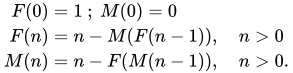
(If a language does not allow for a solution using mutually recursive functions
then state this rather than give a solution by other means).
8080 Assembly
The 8080 processor has built-in support for recursion, at the instruction level.
The processor keeps a stack pointer, called SP,
which is a 16-bit register that can be set by the program to point anywhere in the address space.
The stack pointer points to the topmost word on the stack. The stack grows downward into memory:
when a word is pushed onto the stack, the SP is decremented by 2, and the word written
at the new location. When a word is popped from the stack, it is read from the location the
SP is pointing to, and afterwards the SP is incremented by 2.
The instruction set includes a call instruction, which pushes the location of the
next instruction onto the stack, and then jumps to the given location. Its counterpart is the
ret instruction, which pops a location from the stack and jumps there.
There are also push and pop instructions, to push and
pop the values of register
pairs on and off the stack directly. This can be used, among other things, to save 'local variables'
in a recursive routine, as the code below does.
	org	100h
	jmp	test
	;;; Implementation of F(A).
F:	ana	a	; Zero?
	jz	one	; Then set A=1
	mov	b,a	; Otherwise, set B=A,
	push	b	; And put it on the stack
	dcr	a	; Set A=A-1
	call	F	; Set A=F(A-1)
	call	M 	; Set A=M(F(A-1))
	pop	b	; Retrieve input value
	cma		; (-A)+B is actually one cycle faster
	inr	a	; than C=A;A=B;A-=B, and equivalent
	add	b
	ret
one:	mvi	a,1	; Set A to 1,
	ret		; and return.
	;;; Implementation of M(A).
M:	ana	a	; Zero?
	rz		; Then keep it that way and return.
	mov	b,a
	push	b	; Otherwise, same deal as in F,
	dcr	a	; but M and F are called in opposite
	call	M 	; order.
	call	F
	pop	b
	cma
	inr	a
	add	b
	ret
	;;; Demonstration code.
test:	lhld	6	; Set stack pointer to highest usable
	sphl		; memory.
	;;; Print F([0..15])
	lxi	d,fpfx	; Print "F: "
	mvi 	c,9
	call	5
	xra	a	; Start with N=0
floop:	push	psw	; Keep N
	call	F	; Get value for F(N)
	call	pdgt	; Print it
	pop	psw	; Restore N
	inr 	a	; Next N
	cpi	16	; Done yet?
	jnz	floop
	;;; Print M([0..15])
	lxi	d,mpfx	; Print "\r\nM: "
	mvi	c,9
	call	5
	xra	a	; Start with N=0
mloop:	push	psw	; same deal as above
	call	M
	call	pdgt
	pop	psw	; Restore N
	inr	a
	cpi	16
	jnz	mloop
	rst	0	; Explicit exit, we got rid of system stack
	;;; Print digit and space
pdgt:	adi	'0'	; ASCII
	mov	e,a
	mvi	c,2
	call	5
	mvi	e,' '	; Space
	mvi	c,2
	jmp	5	; Tail call optimization
fpfx:	db	'F: $'
mpfx: db 13,10,'M: $'- Output:
F: 1 1 2 2 3 3 4 5 5 6 6 7 8 8 9 9
M: 0 0 1 2 2 3 4 4 5 6 6 7 7 8 9 9
ABAP
This works for ABAP Version 7.40 and can be implemented in procedural ABAP as well, but with classes it is much more readable. As this allows a method with a returning value to be an input for a subsequent method call.
report z_mutual_recursion.

class hoffstadter_sequences definition.
  public section.
    class-methods:
      f
        importing
          n             type int4
        returning
          value(result) type int4,

      m
        importing
          n             type int4
        returning
          value(result) type int4.
endclass.


class hoffstadter_sequences implementation.
  method f.
    result = cond int4(
      when n eq 0
      then 1
      else n - m( f( n - 1 ) ) ).
  endmethod.


  method m.
    result = cond int4(
      when n eq 0
      then 0
      else n - f( m( n - 1 ) ) ).
  endmethod.
endclass.


start-of-selection.
  write: |{ reduce string(
    init results = |f(0 - 19): { hoffstadter_sequences=>f( 0 ) }|
    for i = 1 while i < 20
    next results = |{ results }, { hoffstadter_sequences=>f( i ) }| ) }|, /.

  write: |{ reduce string(
    init results = |m(0 - 19): { hoffstadter_sequences=>m( 0 ) }|
    for i = 1 while i < 20
    next results = |{ results }, { hoffstadter_sequences=>m( i ) }| ) }|, /.
- Output:
f(0 - 19): 1, 1, 2, 2, 3, 3, 4, 5, 5, 6, 6, 7, 8, 8, 9, 9, 10, 11, 11, 12

m(0 - 19): 0, 0, 1, 2, 2, 3, 4, 4, 5, 6, 6, 7, 7, 8, 9, 9, 10, 11, 11, 12
ABC
HOW TO RETURN f n:
    IF n=0: RETURN 1
    RETURN n - m f (n-1)

HOW TO RETURN m n:
    IF n=0: RETURN 0
    RETURN n - f m (n-1)

WRITE "F:"
FOR n IN {0..15}: WRITE f n
WRITE /

WRITE "M:"
FOR n IN {0..15}: WRITE m n
WRITE /- Output:
F: 1 1 2 2 3 3 4 5 5 6 6 7 8 8 9 9
M: 0 0 1 2 2 3 4 4 5 6 6 7 7 8 9 9
ACL2
(mutual-recursion
 (defun f (n)
    (declare (xargs :mode :program))
    (if (zp n)
        1
        (- n (m (f (1- n))))))

 (defun m (n)
    (declare (xargs :mode :program))
    (if (zp n)
        0
        (- n (f (m (1- n)))))))
Ada
with Ada.Text_Io; use Ada.Text_Io;
procedure Mutual_Recursion is
   function M(N : Integer) return Integer;
   function F(N : Integer) return Integer is
   begin
      if N = 0 then
         return 1;
      else
         return N - M(F(N - 1));
      end if;
   end F;
   function M(N : Integer) return Integer is
   begin
      if N = 0 then
         return 0;
      else
         return N - F(M(N-1));
      end if;
   end M;
begin
   for I in 0..19 loop
      Put_Line(Integer'Image(F(I)));
   end loop;
   New_Line;
   for I in 0..19 loop
      Put_Line(Integer'Image(M(I)));
   end loop;
end Mutual_recursion;
with Ada.Text_Io; use Ada.Text_Io;
procedure Mutual_Recursion is
   function M(N: Natural) return Natural;
   function F(N: Natural) return Natural;

   function M(N: Natural) return Natural is
       (if N = 0 then 0 else N – F(M(N–1)));

   function F(N: Natural) return Natural is
       (if N =0 then 1 else N – M(F(N–1)));
begin
   for I in 0..19 loop
      Put_Line(Integer'Image(F(I)));
   end loop;
   New_Line;
   for I in 0..19 loop
      Put_Line(Integer'Image(M(I)));
   end loop;

end Mutual_recursion;
Aime
integer F(integer n);
integer M(integer n);

integer F(integer n)
{
    integer r;
    if (n) {
	r = n - M(F(n - 1));
    } else {
	r = 1;
    }
    return r;
}

integer M(integer n)
{
    integer r;
    if (n) {
	r = n - F(M(n - 1));
    } else {
	r = 0;
    }
    return r;
}

integer main(void)
{
    integer i;
    i = 0;
    while (i < 20) {
	o_winteger(3, F(i));
	i += 1;
    }
    o_byte('\n');
    i = 0;
    while (i < 20) {
	o_winteger(3, M(i));
	i += 1;
    }
    o_byte('\n');
    return 0;
}
ALGOL 68
PROC (INT)INT m; # ONLY required for ELLA ALGOL 68RS - an official subset OF full ALGOL 68 #

PROC f = (INT n)INT:
  IF n = 0 THEN 1
  ELSE n - m(f(n-1)) FI;

m := (INT n)INT:
  IF n = 0 THEN 0
  ELSE n - f(m(n-1)) FI;

main:
(
  FOR i FROM 0 TO 19 DO
    print(whole(f(i),-3))
  OD;
  new line(stand out);
  FOR i FROM 0 TO 19 DO
    print(whole(m(i),-3))
  OD;
  new line(stand out)
)- Output:
  1  1  2  2  3  3  4  5  5  6  6  7  8  8  9  9 10 11 11 12
  0  0  1  2  2  3  4  4  5  6  6  7  7  8  9  9 10 11 11 12
ALGOL W
begin
    % define mutually recursive funtions F and M that compute the elements   %
    % of the Hofstadter Female and Male sequences                            %

    integer procedure F ( integer value n ) ;
        if n = 0 then 1 else n - M( F( n - 1 ) );

    integer procedure M ( integer value n ) ;
        if n = 0 then 0 else n - F( M( n - 1 ) );

    % print the first few elements of the sequences                          %
    i_w := 2; s_w := 1; % set I/O formatting                                 %
    write( "F: " );
    for i := 0 until 20 do writeon( F( i ) );
    write( "M: " );
    for i := 0 until 20 do writeon( M( i ) );

end.
APL
f ← {⍵=0:1 ⋄ ⍵-m∇⍵-1}
m ← {⍵=0:0 ⋄ ⍵-f∇⍵-1}
⍉'nFM'⍪↑(⊢,f,m)¨0,⍳20
- Output:
n 0 1 2 3 4 5 6 7 8 9 10 11 12 13 14 15 16 17 18 19 20
F 1 1 2 2 3 3 4 5 5 6  6  7  8  8  9  9 10 11 11 12 13
M 0 0 1 2 2 3 4 4 5 6  6  7  7  8  9  9 10 11 11 12 12
AppleScript
-- f :: Int -> Int
on f(x)
    if x = 0 then
        1
    else
        x - m(f(x - 1))
    end if
end f

-- m :: Int -> Int
on m(x)
    if x = 0 then
        0
    else
        x - f(m(x - 1))
    end if
end m


-- TEST
on run
    set xs to range(0, 19)

    {map(f, xs), map(m, xs)}
end run


-- GENERIC FUNCTIONS

-- map :: (a -> b) -> [a] -> [b]
on map(f, xs)
    tell mReturn(f)
        set lng to length of xs
        set lst to {}
        repeat with i from 1 to lng
            set end of lst to lambda(item i of xs, i, xs)
        end repeat
        return lst
    end tell
end map

-- Lift 2nd class handler function into 1st class script wrapper
-- mReturn :: Handler -> Script
on mReturn(f)
    if class of f is script then
        f
    else
        script
            property lambda : f
        end script
    end if
end mReturn

-- range :: Int -> Int -> [Int]
on range(m, n)
    if n < m then
        set d to -1
    else
        set d to 1
    end if
    set lst to {}
    repeat with i from m to n by d
        set end of lst to i
    end repeat
    return lst
end range
- Output:
{{1, 1, 2, 2, 3, 3, 4, 5, 5, 6, 6, 7, 8, 8, 9, 9, 10, 11, 11, 12},
 {0, 0, 1, 2, 2, 3, 4, 4, 5, 6, 6, 7, 7, 8, 9, 9, 10, 11, 11, 12}}
ARM Assembly
Unlike on the x86 family of processors, the ARM instruction set does not include specialized
call and ret instructions. However, the program counter is a visible
register (r15, also called pc), so it can be loaded and saved
as any other. Nor is there a specialized stack pointer, though the load and store instructions offer
pre- and postincrement as well as pre- and postdecrement on the register used as a pointer, making
any register usable as a stack pointer.
By convention, r13 is used as the system stack pointer and is therefore also
called sp, and r14 is used to store the return address for
a function, and is therefore also called the *link register* or lr.
The assembler recognizes push {x} and pop {x} instructions, though these
are really pseudoinstructions, that generate the exact same machine code as
ldmia r13!,{x} and stmdb r13!,{x},
these being, respectively, load with postincrement and store with predecrement on r13.
The link register is slightly special in that there is a family of branch-and-link instructions
(bl). These are the same as mov r14,pc ; mov/ldr pc,<destination>, but in
one machine instruction instead of two. This is the general way of calling subroutines,
meaning no stack access is necessary unless the subroutine wants to call others in turn, in which case
the link register must be saved by hand (as the code below shows several ways of doing).
.text
.global _start
	@@@	Implementation of F(n), n in R0. n is considered unsigned.
F:	tst	r0,r0		@ n = 0?
	moveq	r0,#1		@ In that case, the result is 1
	bxeq	lr		@ And we can return to the caller
	push	{r0,lr}		@ Save link register and argument to stack
	sub	r0,r0,#1	@ r0 -= 1    = n-1
	bl	F		@ r0 = F(r0) = F(n-1)
	bl	M		@ r0 = M(r0) = M(F(n-1))
	pop	{r1,lr}		@ Restore link register and argument in r1
	sub	r0,r1,r0	@ Result is n-F(M(n-1))
	bx	lr		@ Return to caller.

	@@@	Implementation of M(n), n in R0. n is considered unsigned.
M:	tst	r0,r0		@ n = 0?
	bxeq	lr		@ In that case the result is also 0; return.
	push	{r0,lr}		@ Save link register and argument to stack
	sub	r0,r0,#1	@ r0 -= 1    = n-1
	bl	M		@ r0 = M(r0) = M(n-1)
	bl	F		@ r0 = M(r0) = F(M(n-1))
	pop	{r1,lr}		@ Restore link register and argument in r1
	sub	r0,r1,r0	@ Result is n-M(F(n-1))
	bx	lr		@ Return to caller

	@@@	Print F(0..15) and M(0..15)
_start:	ldr	r1,=fmsg	@ Print values for F
	ldr	r4,=F
	bl	prfn
	ldr	r1,=mmsg	@ Print values for M
	ldr	r4,=M
	bl	prfn
	mov	r7,#1		@ Exit process
	swi	#0

	@@@	Helper function for output: print [r1], then [r4](0..15)
	@@@	This assumes [r4] preserves r3 and r4; M and F do.
prfn:	push	{lr}		@ Keep link register
	bl	pstr		@ Print the string
	mov	r3,#0		@ Start at 0
1:	mov	r0,r3		@ Call the function in r4 with current number
	blx	r4
	add	r0,r0,#'0	@ Make ASCII digit
	ldr	r1,=dgt		@ Store in digit string
	strb	r0,[r1]
	ldr	r1,=dstr	@ Print result
	bl	pstr
	add	r3,r3,#1	@ Next number
	cmp	r3,#15		@ Keep going up to and including 15
	bls	1b
	ldr	r1,=nl		@ Print newline afterwards
	bl	pstr
	pop	{pc}		@ Return to address on stack
	@@@	Print length-prefixed string r1 to stdout
pstr:	push	{lr}		@ Keep link register
	mov	r0,#1		@ stdout = 1
	ldrb	r2,[r1],#1	@ r2 = length prefix
	mov	r7,#4		@ 4 = write syscall
	swi	#0
	pop	{pc}		@ Return to address on stack
.data
fmsg:	.ascii	"\3F: "
mmsg:	.ascii	"\3M: "
dstr:	.ascii	"\2"
dgt:	.ascii	"* "
nl:	.ascii 	"\1\n"
- Output:
F: 1 1 2 2 3 3 4 5 5 6 6 7 8 8 9 9
M: 0 0 1 2 2 3 4 4 5 6 6 7 7 8 9 9
Arturo
f: $[n][ if? n=0 -> 1 else -> n-m f n-1 ]
m: $[n][ if? n=0 -> 0 else -> n-f m n-1 ]

loop 0..20 'i [
	print ["f(" i ")=" f i]
	print ["m(" i ")=" m i]
	print ""
]
- Output:
f( 0 )= 1
m( 0 )= 0

f( 1 )= 1
m( 1 )= 0

f( 2 )= 2
m( 2 )= 1

f( 3 )= 2
m( 3 )= 2

f( 4 )= 3
m( 4 )= 2

f( 5 )= 3
m( 5 )= 3

f( 6 )= 4
m( 6 )= 4

f( 7 )= 5
m( 7 )= 4

f( 8 )= 5
m( 8 )= 5

f( 9 )= 6
m( 9 )= 6

f( 10 )= 6
m( 10 )= 6

f( 11 )= 7
m( 11 )= 7

f( 12 )= 8
m( 12 )= 7

f( 13 )= 8
m( 13 )= 8

f( 14 )= 9
m( 14 )= 9

f( 15 )= 9
m( 15 )= 9

f( 16 )= 10
m( 16 )= 10

f( 17 )= 11
m( 17 )= 11

f( 18 )= 11
m( 18 )= 11

f( 19 )= 12
m( 19 )= 12

f( 20 )= 13
m( 20 )= 12
AutoHotkey
Loop 20
   i := A_Index-1, t .= "`n" i "`t   " M(i) "`t     " F(i)
MsgBox x`tmale`tfemale`n%t%

F(n) {
   Return n ? n - M(F(n-1)) : 1
}

M(n) {
   Return n ? n - F(M(n-1)) : 0
}
This one is an alternative to the above.
main()
Return

F(n)
{
  If (n == 0)
    Return 1
  Else
    Return n - M(F(n-1))
}

M(n)
{
  If (n == 0)
    Return 0
  Else
    Return n - F(M(n-1)) ;
}

main()
{
  i = 0
  While, i < 20
  {
    male .= M(i) . "`n"
    female .= F(i) . "`n"
    i++
  }
  MsgBox % "male:`n" . male
  MsgBox % "female:`n" . female
}
AWK
In AWK it is enough that both functions are defined somewhere. It matters not whether the BEGIN block is before or after the function definitions.
cat mutual_recursion.awk:
#!/usr/local/bin/gawk -f

# User defined functions
function F(n)
{ return n == 0 ? 1 : n - M(F(n-1)) }

function M(n)
{ return n == 0 ? 0 : n - F(M(n-1)) }

BEGIN {
  for(i=0; i <= 20; i++) {
    printf "%3d ", F(i)
  }
  print ""
  for(i=0; i <= 20; i++) {
    printf "%3d ", M(i)
  }
  print ""
}
- Output:
$ awk -f mutual_recursion.awk
  1   1   2   2   3   3   4   5   5   6   6   7   8   8   9   9  10  11  11  12  13
  0   0   1   2   2   3   4   4   5   6   6   7   7   8   9   9  10  11  11  12  12
BaCon
' Mutually recursive
FUNCTION F(int n) TYPE int
    RETURN IIF(n = 0, 1, n - M(F(n -1)))
END FUNCTION

FUNCTION M(int n) TYPE int
    RETURN IIF(n = 0, 0, n - F(M(n - 1)))
END FUNCTION

' Get iteration limit, default 20
SPLIT ARGUMENT$ BY " " TO arg$ SIZE args
limit = IIF(args > 1, VAL(arg$[1]), 20)

FOR i = 0 TO limit
    PRINT F(i) FORMAT "%2d "
NEXT
PRINT
FOR i = 0 TO limit
    PRINT M(i) FORMAT "%2d "
NEXT
PRINT- Output:
prompt$ ./mutually-recursive
 1  1  2  2  3  3  4  5  5  6  6  7  8  8  9  9 10 11 11 12 13
 0  0  1  2  2  3  4  4  5  6  6  7  7  8  9  9 10 11 11 12 12
BASIC
DECLARE FUNCTION f! (n!)
DECLARE FUNCTION m! (n!)

FUNCTION f! (n!)
    IF n = 0 THEN
        f = 1
    ELSE
        f = m(f(n - 1))
    END IF
END FUNCTION

FUNCTION m! (n!)
    IF n = 0 THEN
        m = 0
    ELSE
        m = f(m(n - 1))
    END IF
END FUNCTION
BBC BASIC
      @% = 3 : REM Column width
      PRINT "F sequence:"
      FOR i% = 0 TO 20
        PRINT FNf(i%) ;
      NEXT
      PRINT
      PRINT "M sequence:"
      FOR i% = 0 TO 20
        PRINT FNm(i%) ;
      NEXT
      PRINT
      END

      DEF FNf(n%) IF n% = 0 THEN = 1 ELSE = n% - FNm(FNf(n% - 1))

      DEF FNm(n%) IF n% = 0 THEN = 0 ELSE = n% - FNf(FNm(n% - 1))
- Output:
F sequence:
  1  1  2  2  3  3  4  5  5  6  6  7  8  8  9  9 10 11 11 12 13
M sequence:
  0  0  1  2  2  3  4  4  5  6  6  7  7  8  9  9 10 11 11 12 12
IS-BASIC
100 PROGRAM "Hofstad.bas"
110 PRINT "F sequence:"
120 FOR I=0 TO 20
130   PRINT F(I);
140 NEXT
150 PRINT :PRINT "M sequence:"
160 FOR I=0 TO 20
170   PRINT M(I);
180 NEXT
190 DEF F(N)
200   IF N=0 THEN
210     LET F=1
220   ELSE
230     LET F=N-M(F(N-1))
240   END IF
250 END DEF
260 DEF M(N)
270   IF N=0 THEN
280     LET M=0
290   ELSE
300     LET M=N-F(M(N-1))
310   END IF
320 END DEF
BASIC256
# Rosetta Code problem: http://rosettacode.org/wiki/Mutual_recursion
# by Jjuanhdez, 06/2022

n = 24
print "n : ";
for i = 0 to n : print ljust(i, 3);    : next i
print chr(10); ("-" * 78)
print "F : ";
for i = 0 to n : print ljust(F(i), 3); : next i
print chr(10); "M : ";
for i = 0 to n : print ljust(M(i), 3); : next i
end

function F(n)
    if n = 0 then return 0 else return n - M(F(n-1))
end function

function M(n)
    if n = 0 then return 0 else return n - F(M(n-1))
end function
Bc
cat mutual_recursion.bc:
define f(n) {
  if ( n == 0 ) return(1);
  return(n - m(f(n-1)));
}

define m(n) {
  if ( n == 0 ) return(0);
  return(n - f(m(n-1)));
}
POSIX bc doesn't have the print statement.
/* GNU bc */
for(i=0; i < 19; i++) {
  print f(i); print " ";
}
print "\n";
for(i=0; i < 19; i++) {
  print m(i); print " ";
}
print "\n";
quit
- Output:
GNU bc mutual_recursion.bc
bc 1.06.95
Copyright 1991-1994, 1997, 1998, 2000, 2004, 2006 Free Software Foundation, Inc.
This is free software with ABSOLUTELY NO WARRANTY.
For details type `warranty'.
1 1 2 2 3 3 4 5 5 6 6 7 8 8 9 9 10 11 11 12 13
0 0 1 2 2 3 4 4 5 6 6 7 7 8 9 9 10 11 11 12 12
BCPL
get "libhdr"

// Mutually recursive functions
let f(n) = n=0 -> 1, n - m(f(n-1))
and m(n) = n=0 -> 0, n - f(m(n-1))

// Print f(0..15) and m(0..15)
let start() be
$(  writes("F:")
    for i=0 to 15 do
    $(  writes(" ")
        writen(f(i))
    $)
    writes("*NM:")
    for i=0 to 15 do
    $(  writes(" ")
        writen(m(i))
    $)
    writes("*N")
$)- Output:
F: 1 1 2 2 3 3 4 5 5 6 6 7 8 8 9 9
M: 0 0 1 2 2 3 4 4 5 6 6 7 7 8 9 9
BQN
F ← {0:1; 𝕩-M F𝕩-1}
M ← {0:0; 𝕩-F M𝕩-1}
⍉"FM"∾>(F∾M)¨↕15
- Output:
┌─
╵ 'F' 1 1 2 2 3 3 4 5 5 6 6 7 8 8 9
  'M' 0 0 1 2 2 3 4 4 5 6 6 7 7 8 9
                                    ┘
Bracmat
 (F=.!arg:0&1|!arg+-1*M$(F$(!arg+-1)));
 (M=.!arg:0&0|!arg+-1*F$(M$(!arg+-1)));

 -1:?n&whl'(!n+1:~>20:?n&put$(F$!n " "))&put$\n
 1  1  2  2  3  3  4  5  5  6  6  7  8  8  9  9  10  11  11  12  13

 -1:?n&whl'(!n+1:~>20:?n&put$(M$!n " "))&put$\n
 0  0  1  2  2  3  4  4  5  6  6  7  7  8  9  9  10  11  11  12  12
Brat
female = null #yes, this is necessary

male = { n |
  true? n == 0
    { 0 }
    { n - female male(n - 1) }
}

female = { n |
  true? n == 0
    { 1 }
    { n - male female(n - 1 ) }
}

p 0.to(20).map! { n | female n }
p 0.to(20).map! { n | male n }
Bruijn
Normally it's not possible to call functions before they are defined. We can still induce mutual recursion using its variadic fixed-point combinator.
:import std/Combinator .
:import std/Number .
:import std/List .

f' [[[=?0 (+1) (0 - (1 (2 --0)))]]]

m' [[[=?0 (+0) (0 - (2 (1 --0)))]]]

f ^(y* (f' : {}m'))

m _(y* (f' : {}m'))

:test ((f (+0)) =? (+1)) ([[1]])
:test ((m (+0)) =? (+0)) ([[1]])
:test ((f (+4)) =? (+3)) ([[1]])
:test ((m (+4)) =? (+2)) ([[1]])
:test ((f (+15)) =? (+9)) ([[1]])
:test ((m (+15)) =? (+9)) ([[1]])
C
To let C see functions that will be used, it is enough to declare them. Normally this is done in a header file; in this example we do it directly in the code. If we do not declare them explicitly, they get an implicit declaration (if implicit declaration matches the use, everything's fine; but it is better however to write an explicit declaration)
#include <stdio.h>
#include <stdlib.h>

/* let us declare our functions; indeed here we need
   really only M declaration, so that F can "see" it
   and the compiler won't complain with a warning */
int F(const int n);
int M(const int n);

int F(const int n)
{
  return (n == 0) ? 1 : n - M(F(n - 1));
}

int M(const int n)
{
  return (n == 0) ? 0 : n - F(M(n - 1));
}

int main(void)
{
  int i;
  for (i = 0; i < 20; i++)
    printf("%2d ", F(i));
  printf("\n");
  for (i = 0; i < 20; i++)
    printf("%2d ", M(i));
  printf("\n");
  return EXIT_SUCCESS;
}
C#
namespace RosettaCode {
    class Hofstadter {
        static public int F(int n) {
            int result = 1;
            if (n > 0) {
                result = n - M(F(n-1));
            }

            return result;
        }

        static public int M(int n) {
            int result = 0;
            if (n > 0) {
                result = n - F(M(n - 1));
            }

            return result;
        }
    }
}
C++
C++ has prior declaration rules similar to those stated above for C, if we would use two functions. Instead here we define M and F as static (class) methods of a class, and specify the bodies inline in the declaration of the class. Inlined methods in the class can still call other methods or access fields in the class, no matter what order they are declared in, without any additional pre-declaration. This is possible because all the possible methods and fields are declared somewhere in the class declaration, which is known the first time the class declaration is parsed.
#include <iostream>
#include <vector>
#include <iterator>

class Hofstadter
{
public:
  static int F(int n) {
    if ( n == 0 ) return 1;
    return n - M(F(n-1));
  }
  static int M(int n) {
    if ( n == 0 ) return 0;
    return n - F(M(n-1));
  }
};

using namespace std;

int main()
{
  int i;
  vector<int> ra, rb;

  for(i=0; i < 20; i++) {
    ra.push_back(Hofstadter::F(i));
    rb.push_back(Hofstadter::M(i));
  }
  copy(ra.begin(), ra.end(),
       ostream_iterator<int>(cout, " "));
  cout << endl;
  copy(rb.begin(), rb.end(),
       ostream_iterator<int>(cout, " "));
  cout << endl;
  return 0;
}
The following version shows better what's going on and why we seemingly didn't need pre-declaration (like C) when "encapsulating" the functions as static (class) methods.
This version is equivalent to the above but does not inline the definition of the methods into the definition of the class. Here the method declarations in the class definition serves as the "pre-declaration" for the methods, as in C.
class Hofstadter
{
public:
  static int F(int n);
  static int M(int n);
};

int Hofstadter::F(int n)
{
  if ( n == 0 ) return 1;
  return n - M(F(n-1));
}

int Hofstadter::M(int n)
{
  if ( n == 0 ) return 0;
  return n - F(M(n-1));
}
Ceylon
Integer f(Integer n)
    =>  if (n > 0)
        then n - m(f(n-1))
        else 1;

Integer m(Integer n)
    =>  if (n > 0)
        then n - f(m(n-1))
        else 0;

shared void run() {
    printAll((0:20).map(f));
    printAll((0:20).map(m));
}
- Output:
1, 1, 2, 2, 3, 3, 4, 5, 5, 6, 6, 7, 8, 8, 9, 9, 10, 11, 11, 12
0, 0, 1, 2, 2, 3, 4, 4, 5, 6, 6, 7, 7, 8, 9, 9, 10, 11, 11, 12
Clojure
(declare F) ; forward reference

(defn M [n]
  (if (zero? n)
    0
    (- n (F (M (dec n))))))

(defn F [n]
  (if (zero? n)
    1
    (- n (M (F (dec n))))))
CLU
% To declare things you can either write an .spc file or you can use
% the clu file itself as a specfile.  For a small program a common
% idiom is to spec and compile the same source file:
%
%   pclu -spec mutrec.clu -clu mutrec.clu
%
start_up = proc ()
    print_first_16("F", F)
    print_first_16("M", M)
  end start_up

% Print the first few values for F and M
print_first_16 = proc (name: string, fn: proctype (int) returns (int))
    po: stream := stream$primary_output()
    stream$puts(po, name || ":")
    for i: int in int$from_to(0, 15) do
        stream$puts(po, " " || int$unparse(fn(i)))
      end
    stream$putl(po, "")
  end print_first_16

F = proc (n: int) returns (int)
    if n = 0 then
        return (1)
      else
        return (n - M(F(n-1)))
      end
  end F

M = proc (n: int) returns (int)
    if n = 0 then
        return (0)
      else
        return (n - F(M(n-1)))
      end
end M- Output:
F: 1 1 2 2 3 3 4 5 5 6 6 7 8 8 9 9
M: 0 0 1 2 2 3 4 4 5 6 6 7 7 8 9 9
CoffeeScript
F = (n) ->
  if n is 0 then 1 else n - M F n - 1

M = (n) ->
  if n is 0 then 0 else n - F M n - 1

console.log [0...20].map F
console.log [0...20].map M
- Output:
> coffee mutual_recurse.coffee
[ 1, 1, 2, 2, 3, 3, 4, 5, 5, 6, 6, 7, 8, 8, 9, 9, 10, 11, 11, 12 ]
[ 0, 0, 1, 2, 2, 3, 4, 4, 5, 6, 6, 7, 7, 8, 9, 9, 10, 11, 11, 12 ]
Common Lisp
(defun m (n)
    (if (zerop n)
        0
        (- n (f (m (- n 1))))))

(defun f (n)
    (if (zerop n)
        1
        (- n (m (f (- n 1))))))
D
import std.stdio, std.algorithm, std.range;

int male(in int n) pure nothrow {
    return n ? n - male(n - 1).female : 0;
}

int female(in int n) pure nothrow {
    return n ? n - female(n - 1).male : 1;
}

void main() {
    20.iota.map!female.writeln;
    20.iota.map!male.writeln;
}
- Output:
[1, 1, 2, 2, 3, 3, 4, 5, 5, 6, 6, 7, 8, 8, 9, 9, 10, 11, 11, 12]
[0, 0, 1, 2, 2, 3, 4, 4, 5, 6, 6, 7, 7, 8, 9, 9, 10, 11, 11, 12]
Dart
int M(int n) => n==0?1:n-F(M(n-1));
int F(int n) => n==0?0:n-M(F(n-1));

main() {
  String f="",m="";
  for(int i=0;i<20;i++) {
    m+="${M(i)} ";
    f+="${F(i)} ";
  }
  print("M: $m");
  print("F: $f");
}
Delphi
unit Hofstadter;

interface

type
  THofstadterFemaleMaleSequences = class
  public
    class function F(n: Integer): Integer;
    class function M(n: Integer): Integer;
  end;

implementation

class function THofstadterFemaleMaleSequences.F(n: Integer): Integer;
begin
  Result:= 1;
  if (n > 0) then
    Result:= n - M(F(n-1));
end;

class function THofstadterFemaleMaleSequences.M(n: Integer): Integer;
begin
  Result:= 0;
  if (n > 0) then
    Result:= n - F(M(n - 1));
end;

end.
Déjà Vu
F n:
	if n:
		- n M F -- n
	else:
		1

M n:
	if n:
		- n F M -- n
	else:
		0

for i range 0 10:
!.( M i F i )- Output:
0 1
0 1
1 2
2 2
2 3
3 3
4 4
4 5
5 5
6 6
6 6
Draco
/* We need to predeclare M if we want F to be able to see it.
 * This is done using 'extern', same as if it had been in a
 * different compilation unit. */
extern M(byte n) byte;

/* Mutually recursive functions */
proc F(byte n) byte:
    if n=0 then 1 else n - M(F(n-1)) fi
corp

proc M(byte n) byte:
    if n=0 then 0 else n - F(M(n-1)) fi
corp

/* Show the first 16 values of each */
proc nonrec main() void:
    byte i;

    write("F:");
    for i from 0 upto 15 do write(F(i):2) od;
    writeln();

    write("M:");
    for i from 0 upto 15 do write(M(i):2) od;
    writeln()
corp- Output:
F: 1 1 2 2 3 3 4 5 5 6 6 7 8 8 9 9
M: 0 0 1 2 2 3 4 4 5 6 6 7 7 8 9 9
Dyalect
func f(n) {
    n == 0 ? 1 : n - m(f(n-1))
}
and m(n) {
    n == 0 ? 0 : n - f(m(n-1))
}

print( (0..20).Map(i => f(i)).ToArray() )
print( (0..20).Map(i => m(i)).ToArray() )
E
In E, nouns (variable names) always refer to preceding definitions, so to have mutual recursion, either one must be forward-declared or we must use a recursive def construct. Either one of these is syntactic sugar for first binding the noun to an E promise (a reference with an undetermined target), then resolving the promise to the value.
Recursive def:
def [F, M] := [
  fn n { if (n <=> 0) { 1 } else { n - M(F(n - 1)) } },
  fn n { if (n <=> 0) { 0 } else { n - F(M(n - 1)) } },
]
Forward declaration:
def M
def  F(n) { return if (n <=> 0) { 1 } else { n - M(F(n - 1)) } }
bind M(n) { return if (n <=> 0) { 0 } else { n - F(M(n - 1)) } }
def M binds M to a promise, and stashes the resolver for that promise where bind can get to it. When def F... is executed, the function F closes over the promise which is the value of M. bind M... uses the resolver to resolve M to the provided definition. The recursive def operates similarly, except that it constructs promises for every variable on the left side ([F, M]), executes the right side ([fn ..., fn ...]) and collects the values, then resolves each promise to its corresponding value.
But you don't have to worry about that to use it.
EasyLang
funcdecl M n .
func F n .
   if n = 0
      return 1
   .
   return n - M F (n - 1)
.
func M n .
   if n = 0
      return 0
   .
   return n - F M (n - 1)
.
for i = 0 to 15
   write F i & " "
.
print ""
for i = 0 to 15
   write M i & " "
.
Eiffel
class
	APPLICATION

create
	make

feature

	make
			-- Test of the mutually recursive functions Female and Male.
		do
			across
				0 |..| 19 as c
			loop
				io.put_string (Female (c.item).out + " ")
			end
			io.new_line
			across
				0 |..| 19 as c
			loop
				io.put_string (Male (c.item).out + " ")
			end
		end

	Female (n: INTEGER): INTEGER
			-- Female sequence of the Hofstadter Female and Male sequences.
		require
			n_not_negative: n >= 0
		do
			Result := 1
			if n /= 0 then
				Result := n - Male (Female (n - 1))
			end
		end

	Male (n: INTEGER): INTEGER
			-- Male sequence of the Hofstadter Female and Male sequences.
		require
			n_not_negative: n >= 0
		do
			Result := 0
			if n /= 0 then
				Result := n - Female (Male (n - 1))
			end
		end

end
- Output:
1 1 2 2 3 3 4 5 5 6 6 7 8 8 9 9 10 11 11 12
0 0 1 2 2 3 4 4 5 6 6 7 7 8 9 9 10 11 11 12
Elena
ELENA 6.x :
import extensions;
import system'collections;

F = (n => (n == 0) ? 1 : (n - M(F(n-1))) );
M = (n => (n == 0) ? 0 : (n - F(M(n-1))) );

public program()
{
    var ra := new ArrayList();
    var rb := new ArrayList();

    for(int i := 0; i <= 19; i += 1)
    {
        ra.append(F(i));
        rb.append(M(i))
    };

    console.printLine(ra.asEnumerable());
    console.printLine(rb.asEnumerable())
}- Output:
1,1,2,2,3,3,4,5,5,6,6,7,8,8,9,9,10,11,11,12
0,0,1,2,2,3,4,4,5,6,6,7,7,8,9,9,10,11,11,12
Elixir
defmodule MutualRecursion do
  def f(0), do: 1
  def f(n), do: n - m(f(n - 1))
  def m(0), do: 0
  def m(n), do: n - f(m(n - 1))
end

IO.inspect Enum.map(0..19, fn n -> MutualRecursion.f(n) end)
IO.inspect Enum.map(0..19, fn n -> MutualRecursion.m(n) end)
- Output:
[1, 1, 2, 2, 3, 3, 4, 5, 5, 6, 6, 7, 8, 8, 9, 9, 10, 11, 11, 12]
[0, 0, 1, 2, 2, 3, 4, 4, 5, 6, 6, 7, 7, 8, 9, 9, 10, 11, 11, 12]
Erlang
-module(mutrec).
-export([mutrec/0, f/1, m/1]).

f(0) -> 1;
f(N) -> N - m(f(N-1)).

m(0) -> 0;
m(N) -> N - f(m(N-1)).

mutrec() -> lists:map(fun(X) -> io:format("~w ", [f(X)]) end, lists:seq(0,19)),
	    io:format("~n", []),
	    lists:map(fun(X) -> io:format("~w ", [m(X)]) end, lists:seq(0,19)),
	    io:format("~n", []).
Euphoria
integer idM, idF

function F(integer n)
    if n = 0 then
        return 1
    else
        return n - call_func(idM,{F(n-1)})
    end if
end function

idF = routine_id("F")

function M(integer n)
    if n = 0 then
        return 0
    else
        return n - call_func(idF,{M(n-1)})
    end if
end function

idM = routine_id("M")
F#
let rec f n =
    match n with
    | 0 -> 1
    | _ -> n - (m (f (n-1)))
and m n =
    match n with
    | 0 -> 0
    | _ -> n - (f (m (n-1)))
Like OCaml, the let rec f .. and m ... construct indicates that the functions call themselves (rec) and each other (and).
Factor
In Factor, if you need a word before it's defined, you have to DEFER: it.
DEFER: F
: M ( n -- n' ) dup 0 = [ dup 1 - M F - ] unless ;
: F ( n -- n' ) dup 0 = [ drop 1 ] [ dup 1 - F M - ] if ;
FALSE
[$[$1-f;!m;!-1-]?1+]f:
[$[$1-m;!f;!-  ]?  ]m:
[0[$20\>][\$@$@!." "1+]#%%]t:
 f; t;!"
"m; t;!
Fantom
class Main
{
  static Int f (Int n)
  {
    if (n <= 0) // ensure n > 0
      return 1
    else
      return n - m(f(n-1))
  }

  static Int m (Int n)
  {
    if (n <= 0) // ensure n > 0
      return 0
    else
      return n - f(m(n-1))
  }

  public static Void main ()
  {
    50.times |Int n| { echo (f(n)) }
  }
}
FOCAL
01.01 C--PRINT F(0..15) AND M(0..15)
01.10 T "F(0..15)"
01.20 F X=0,15;S N=X;D 4;T %1,N
01.30 T !"M(0..15)"
01.40 F X=0,15;S N=X;D 5;T %1,N
01.50 T !
01.60 Q

04.01 C--N = F(N)
04.10 I (N(D)),4.11,4.2
04.11 S N(D)=1;R
04.20 S D=D+1;S N(D)=N(D-1)-1;D 4;D 5
04.30 S D=D-1;S N(D)=N(D)-N(D+1)

05.01 C--N = M(N)
05.10 I (N(D)),5.11,5.2
05.11 R
05.20 S D=D+1;S N(D)=N(D-1)-1;D 5;D 4
05.30 S D=D-1;S N(D)=N(D)-N(D+1)- Output:
F(0..15)= 1= 1= 2= 2= 3= 3= 4= 5= 5= 6= 6= 7= 8= 8= 9= 9
M(0..15)= 0= 0= 1= 2= 2= 3= 4= 4= 5= 6= 6= 7= 7= 8= 9= 9
Forth
Forward references required for mutual recursion may be set up using DEFER.
defer m

: f ( n -- n )
  dup 0= if 1+ exit then
  dup 1- recurse m - ;

:noname ( n -- n )
  dup 0= if exit then
  dup 1- recurse f - ;
is m

: test ( xt n -- ) cr 0 do i over execute . loop drop ;

' m defer@ 20 test \ 0 0 1 2 2 3 4 4 5 6 6 7 7 8 9 9 10 11 11 12
' f 20 test        \ 1 1 2 2 3 3 4 5 5 6 6 7 8 8 9 9 10 11 11 12
Fortran
As long as the code of the two functions is inside the same "block" (module or program) we don't need special care. Otherwise, we should "load" at least the interface of the other function (each module will load mutually the other; of course the compiler won't enter in a infinite loop), e.g. by using a "use" (we do that if M and F function are inside different modules)
module MutualRec
  implicit none
contains
  pure recursive function m(n) result(r)
    integer :: r
    integer, intent(in) :: n
    if ( n == 0 ) then
       r = 0
       return
    end if
    r = n - f(m(n-1))
  end function m

  pure recursive function f(n) result(r)
    integer :: r
    integer, intent(in) :: n
    if ( n == 0 ) then
       r = 1
       return
    end if
    r = n - m(f(n-1))
  end function f

end module
I've added the attribute pure so that we can use them in a forall statement.
program testmutrec
  use MutualRec
  implicit none

  integer :: i
  integer, dimension(20) :: a = (/ (i, i=0,19) /), b = (/ (i, i=0,19) /)
  integer, dimension(20) :: ra, rb

  forall(i=1:20)
     ra(i) = m(a(i))
     rb(i) = f(b(i))
  end forall

  write(*,'(20I3)') rb
  write(*,'(20I3)') ra

end program testmutrec
FreeBASIC
' FB 1.05.0 Win64

' Need forward declaration of M as it's used
' by F before its defined
Declare Function M(n As Integer) As Integer

Function F(n As Integer) As Integer
   If n = 0 Then
     Return 1
   End If
   Return n - M(F(n - 1))
End Function

Function M(n As Integer) As Integer
   If n = 0 Then
     Return 0
   End If
   Return n - F(M(n - 1))
End Function

Dim As Integer n = 24
Print "n :";
For i As Integer = 0 to n : Print Using "###"; i;    : Next
Print
Print String(78, "-")
Print "F :";
For i As Integer = 0 To n : Print Using "###"; F(i); : Next
Print
Print "M :";
For i As Integer = 0 To n : Print Using "###"; M(i); : Next
Print
Print "Press any key to quit"
Sleep- Output:
n :  0  1  2  3  4  5  6  7  8  9 10 11 12 13 14 15 16 17 18 19 20 21 22 23 24
------------------------------------------------------------------------------
F :  1  1  2  2  3  3  4  5  5  6  6  7  8  8  9  9 10 11 11 12 13 13 14 14 15
M :  0  0  1  2  2  3  4  4  5  6  6  7  7  8  9  9 10 11 11 12 12 13 14 14 15
Fōrmulæ
Fōrmulæ programs are not textual, visualization/edition of programs is done showing/manipulating structures but not text. Moreover, there can be multiple visual representations of the same program. Even though it is possible to have textual representation —i.e. XML, JSON— they are intended for storage and transfer purposes more than visualization and edition.
Programs in Fōrmulæ are created/edited online in its website.
In this page you can see and run the program(s) related to this task and their results. You can also change either the programs or the parameters they are called with, for experimentation, but remember that these programs were created with the main purpose of showing a clear solution of the task, and they generally lack any kind of validation.
Solution


FutureBasic
def fn F( n as long ) as long
def fn M( n as long ) as long

local fn F( n as long ) as long
  long result

  if n == 0 then exit fn = 1
  result = n - fn M( fn F( n-1 ) )
end fn = result

local fn M( n as long ) as long
  long result

  if n == 0 then exit fn = 0
  result = n - fn F( fn M( n-1 ) )
end fn = result

long i, counter

counter =  0
for i = 0 to 19
  printf @"%3ld\b", fn F( i )
  counter++
  if counter mod 5 == 0 then print : counter = 0
next

print : print

counter = 0
for i = 0 to 19
  printf @"%3ld\b", fn M( i )
  counter++
  if counter mod 5 == 0 then print : counter = 0
next

NSLog( @"%@", fn WindowPrintViewString( 1 ) )

HandleEvents- Output:
  1  1  2  2  3
  3  4  5  5  6
  6  7  8  8  9
  9 10 11 11 12


  0  0  1  2  2
  3  4  4  5  6
  6  7  7  8  9
  9 10 11 11 12
Go
It just works. No special pre-declaration is necessary.
package main
import "fmt"

func F(n int) int {
  if n == 0 { return 1 }
  return n - M(F(n-1))
}

func M(n int) int {
  if n == 0 { return 0 }
  return n - F(M(n-1))
}

func main() {
  for i := 0; i < 20; i++ {
    fmt.Printf("%2d ", F(i))
  }
  fmt.Println()
  for i := 0; i < 20; i++ {
    fmt.Printf("%2d ", M(i))
  }
  fmt.Println()
}
Groovy
Solution:
def f, m  // recursive closures must be declared before they are defined
f = { n -> n == 0 ? 1 : n - m(f(n-1)) }
m = { n -> n == 0 ? 0 : n - f(m(n-1)) }
Test program:
println 'f(0..20): ' + (0..20).collect { f(it) }
println 'm(0..20): ' + (0..20).collect { m(it) }
- Output:
f(0..20): [1, 1, 2, 2, 3, 3, 4, 5, 5, 6, 6, 7, 8, 8, 9, 9, 10, 11, 11, 12, 13]
m(0..20): [0, 0, 1, 2, 2, 3, 4, 4, 5, 6, 6, 7, 7, 8, 9, 9, 10, 11, 11, 12, 12]
Haskell
Haskell's definitions constructs (at the top level, or inside a let or where construct) are always mutually-recursive:
f 0 = 1
f n | n > 0 = n - m (f $ n-1)

m 0 = 0
m n | n > 0 = n - f (m $ n-1)

main = do
       print $ map f [0..19]
       print $ map m [0..19]
Icon and Unicon
Idris
mutual {
  F : Nat -> Nat
  F Z = (S Z)
  F (S n) = (S n) `minus` M(F(n))

  M : Nat -> Nat
  M Z = Z
  M (S n) = (S n) `minus` F(M(n))
}
Io
f := method(n, if( n == 0, 1, n - m(f(n-1))))
m := method(n, if( n == 0, 0, n - f(m(n-1))))

Range
0 to(19) map(n,f(n)) println
0 to(19) map(n,m(n)) println
- Output:
list(1, 1, 2, 2, 3, 3, 4, 5, 5, 6, 6, 7, 8, 8, 9, 9, 10, 11, 11, 12)
list(0, 0, 1, 2, 2, 3, 4, 4, 5, 6, 6, 7, 7, 8, 9, 9, 10, 11, 11, 12)
J
F =: 1:`(-  M @ $: @ <:) @.* M."0
M =: 0:`(-  F @ $: @ <:) @.* M."0
Example use:
   F i. 20
1 1 2 2 3 3 4 5 5 6 6 7 8 8 9 9 10 11 11 12
That said, note that numbers are defined recursively, so some other approaches using numbers which give equivalent results should be acceptable.
Java
Replace translation (that doesn't compile) with a Java native implementation.
import java.util.HashMap;
import java.util.Map;

public class MutualRecursion {

    public static void main(final String args[]) {
        int max = 20;
        System.out.printf("First %d values of the Female sequence:  %n", max);
        for (int i = 0; i < max; i++) {
            System.out.printf("  f(%d) = %d%n", i, f(i));
        }
        System.out.printf("First %d values of the Male sequence:  %n", max);
        for (int i = 0; i < 20; i++) {
            System.out.printf("  m(%d) = %d%n", i, m(i));
        }
    }

    private static Map<Integer,Integer> F_MAP = new HashMap<>();

    private static int f(final int n) {
        if ( F_MAP.containsKey(n) ) {
            return F_MAP.get(n);
        }
        int fn = n == 0 ? 1 : n - m(f(n - 1));
        F_MAP.put(n, fn);
        return fn;
    }

    private static Map<Integer,Integer> M_MAP = new HashMap<>();

    private static int m(final int n) {
        if ( M_MAP.containsKey(n) ) {
            return M_MAP.get(n);
        }
        int mn = n == 0 ? 0 : n - f(m(n - 1));
        M_MAP.put(n, mn);
        return mn;
    }


}
- Output:
First 20 values of the Female sequence:
 f(0) = 1
 f(1) = 1
 f(2) = 2
 f(3) = 2
 f(4) = 3
 f(5) = 3
 f(6) = 4
 f(7) = 5
 f(8) = 5
 f(9) = 6
 f(10) = 6
 f(11) = 7
 f(12) = 8
 f(13) = 8
 f(14) = 9
 f(15) = 9
 f(16) = 10
 f(17) = 11
 f(18) = 11
 f(19) = 12
First 20 values of the Male sequence:
 m(0) = 0
 m(1) = 0
 m(2) = 1
 m(3) = 2
 m(4) = 2
 m(5) = 3
 m(6) = 4
 m(7) = 4
 m(8) = 5
 m(9) = 6
 m(10) = 6
 m(11) = 7
 m(12) = 7
 m(13) = 8
 m(14) = 9
 m(15) = 9
 m(16) = 10
 m(17) = 11
 m(18) = 11
 m(19) = 12
JavaScript
function f(num) {
 return (num === 0) ? 1 : num - m(f(num - 1));
}

function m(num) {
 return (num === 0) ? 0 : num - f(m(num - 1));
}

function range(m, n) {
  return Array.apply(null, Array(n - m + 1)).map(
    function (x, i) { return m + i; }
  );
}

var a = range(0, 19);

//return a new array of the results and join with commas to print
console.log(a.map(function (n) { return f(n); }).join(', '));
console.log(a.map(function (n) { return m(n); }).join(', '));
- Output:
1,1,2,2,3,3,4,5,5,6,6,7,8,8,9,9,10,11,11,12
0,0,1,2,2,3,4,4,5,6,6,7,7,8,9,9,10,11,11,12
ES6 implementation
var f = num => (num === 0) ? 1 : num - m(f(num - 1));
var m = num => (num === 0) ? 0 : num - f(m(num - 1));

function range(m, n) {
  return Array.apply(null, Array(n - m + 1)).map(
    function (x, i) { return m + i; }
  );
}

var a = range(0, 19);

//return a new array of the results and join with commas to print
console.log(a.map(n => f(n)).join(', '));
console.log(a.map(n => m(n)).join(', '));
More ES6 implementation
var range = (m, n) => Array(... Array(n - m + 1)).map((x, i) => m + i)
jq
jq supports mutual recursion but requires functions to be defined before they are used. In the present case, this can be accomplished by defining an inner function.
He we define F and M as arity-0 filters:
def M:
  def F: if . == 0 then 1 else . - ((. - 1) | F | M) end;
  if . == 0 then 0 else . - ((. - 1) | M | F) end;

def F:
  if . == 0 then 1 else . - ((. - 1) | F | M) end;
Example:
[range(0;20) | F],
[range(0;20) | M]
$ jq -n -c -f Mutual_recursion.jq
[1,1,2,2,3,3,4,5,5,6,6,7,8,8,9,9,10,11,11,12]
[0,0,1,2,2,3,4,4,5,6,6,7,7,8,9,9,10,11,11,12]
Jsish
/* Mutual recursion, is jsish */
function f(num):number { return (num === 0) ? 1 : num - m(f(num - 1)); }
function m(num):number { return (num === 0) ? 0 : num - f(m(num - 1)); }

function range(n=10, start=0, step=1):array {
   var a = Array(n).fill(0);
   for (var i in a) a[i] = start+i*step;
   return a;
}

var a = range(21);
puts(a.map(function (n) { return f(n); }).join(', '));
puts(a.map(function (n) { return m(n); }).join(', '));

/*
=!EXPECTSTART!=
1, 1, 2, 2, 3, 3, 4, 5, 5, 6, 6, 7, 8, 8, 9, 9, 10, 11, 11, 12, 13
0, 0, 1, 2, 2, 3, 4, 4, 5, 6, 6, 7, 7, 8, 9, 9, 10, 11, 11, 12, 12
=!EXPECTEND!=
*/
- Output:
prompt$ jsish -u mutual-recursion.jsi
[PASS] mutual-recursion.jsi

prompt$ jsish mutual-recursion.jsi
1, 1, 2, 2, 3, 3, 4, 5, 5, 6, 6, 7, 8, 8, 9, 9, 10, 11, 11, 12
0, 0, 1, 2, 2, 3, 4, 4, 5, 6, 6, 7, 7, 8, 9, 9, 10, 11, 11, 12
Julia
F(n) = n < 1 ? one(n) : n - M(F(n - 1))
M(n) = n < 1 ? zero(n) : n - F(M(n - 1))
- Output:
julia> [F(i) for i = 0:19], [M(i) for i = 0:19]
([1,1,2,2,3,3,4,5,5,6,6,7,8,8,9,9,10,11,11,12],[0,0,1,2,2,3,4,4,5,6,6,7,7,8,9,9,10,11,11,12])
Kotlin
// version 1.0.6

fun f(n: Int): Int =
    when {
        n == 0 -> 1
        else   -> n - m(f(n - 1))
    }

fun m(n: Int): Int =
    when {
        n == 0 -> 0
        else   -> n - f(m(n - 1))
    }

fun main(args: Array<String>) {
    val n = 24
    print("n :")
    for (i in 0..n) print("%3d".format(i))
    println()
    println("-".repeat((n + 2) * 3))
    print("F :")
    for (i in 0..n) print("%3d".format(f(i)))
    println()
    print("M :")
    for (i in 0..n) print("%3d".format(m(i)))
    println()
}
- Output:
n :  0  1  2  3  4  5  6  7  8  9 10 11 12 13 14 15 16 17 18 19 20 21 22 23 24
------------------------------------------------------------------------------
F :  1  1  2  2  3  3  4  5  5  6  6  7  8  8  9  9 10 11 11 12 13 13 14 14 15
M :  0  0  1  2  2  3  4  4  5  6  6  7  7  8  9  9 10 11 11 12 12 13 14 14 15
Lambdatalk
{def F {lambda {:n} {if {= :n 0} then 1 else {- :n {M {F {- :n 1}}}} }}}
{def M {lambda {:n} {if {= :n 0} then 0 else {- :n {F {M {- :n 1}}}} }}}

{map F {serie 0 19}}
-> 1 1 2 2 3 3 4 5 5 6 6 7 8 8 9 9 10 11 11 12
{map M {serie 0 19}}
-> 0 0 1 2 2 3 4 4 5 6 6 7 7 8 9 9 10 11 11 12
The naïve version is very slow, {F 80} requires 3800 ms on a recent laptop, so let's memoize:
{def cache
 {def cache.F {#.new}}
 {def cache.M {#.new}}
 {lambda {:f :n}
   {let { {:f :f} {:n :n}
          {:cx {if {equal? :f MF}
                then {cache.F}
                else {cache.M}}}
        } {if {equal? {#.get :cx :n} undefined}
           then {#.get {#.set! :cx :n {:f :n}} :n}
           else {#.get :cx :n}}}}}
-> cache

{def MF
 {lambda {:n}
  {if {= :n 0}
   then 1
   else {- :n {MM {cache MF {- :n 1}}}}}}}
-> MF

{def MM
 {lambda {:n}
  {if {= :n 0}
   then 0
   else {- :n {MF {cache MM {- :n 1}}}}}}}
-> MM

{MF 80}
-> 50  (requires 55 ms)

{map MF {serie 0 100}}  (requires75ms)
-> 1 1 2 2 3 3 4 5 5 6 6 7 8 8 9 9 10 11 11 12 13 13 14 14 15 16 16 17 17
18 19 19 20 21 21 22 22 23 24 24 25 25 26 27 27 28 29 29 30 30 31 32 32
33 34 34 35 35 36 37 37 38 38 39 40 40 41 42 42 43 43 44 45 45 46 46 47
48 48 49 50 50 51 51 52 53 53 54 55 55 56 56 57 58 58 59 59 60 61 61 62
Liberty BASIC
print "F sequence."
for i = 0 to 20
print f(i);" ";
next
print
print "M sequence."
for i = 0 to 20
print m(i);" ";
next

end

function f(n)
    if n = 0 then
        f = 1
    else
        f = n - m(f(n - 1))
    end if
    end function

function m(n)
    if n = 0 then
        m = 0
    else
        m = n - f(m(n - 1))
    end if
end function- Output:
F sequence.
1 1 2 2 3 3 4 5 5 6 6 7 8 8 9 9 10 11 11 12 13
M sequence.
0 0 1 2 2 3 4 4 5 6 6 7 7 8 9 9 10 11 11 12 12
LibreOffice Basic
'// LibreOffice Basic Implementation of Hofstadter Female-Male sequences

'// Utility functions
sub setfont(strfont)
	ThisComponent.getCurrentController.getViewCursor.charFontName = strfont
end sub

sub newline
	oVC = thisComponent.getCurrentController.getViewCursor
	oText = oVC.text
	oText.insertControlCharacter(oVC, com.sun.star.text.ControlCharacter.PARAGRAPH_BREAK, False)
end sub

sub out(sString)
	oVC = ThisComponent.getCurrentController.getViewCursor
	oText = oVC.text
	oText.insertString(oVC, sString, false)
end sub

sub outln(optional sString)
	if not ismissing (sString) then out(sString)
	newline
end sub

function intformat(n as integer,nlen as integer) as string
	dim nstr as string
	nstr = CStr(n)
	while len(nstr) < nlen
		nstr = " " & nstr
	wend
	intformat = nstr
end function

'// Hofstadter Female-Male function definitions
function F(n as long) as long
	if n = 0 Then
		F =  1
	elseif n > 0 Then
		F = n - M(F(n - 1))
	endif
end function

function M(n)
	if n = 0 Then
		M = 0
	elseif n > 0 Then
		M = n - F(M(n - 1))
	endif
end function

'// Hofstadter Female Male sequence demo routine
sub Hofstadter_Female_Male_Demo
	'// Introductory Text
	setfont("LM Roman 10")
	outln("Rosetta Code Hofstadter Female and Male Sequence Challenge")
	outln
	out("Two functions are said to be mutually recursive if the first calls the second,")
	outln(" and in turn the second calls the first.")
	out("Write two mutually recursive functions that compute members of the Hofstadter")
	outln(" Female and Male sequences defined as:")
	outln
	setfont("LM Mono Slanted 10")
	outln(chr(9)+"F(0) = 1 ; M(0)=0")
	outln(chr(9)+"F(n) = n - M(F(n-1)), n > 0")
	outln(chr(9)+"M(n) = n - F(M(n-1)), n > 0")
	outln
	'// Sequence Generation
	const nmax as long = 20
	dim n as long
	setfont("LM Mono 10")
	out("n    = "
	for n = 0 to nmax
		out(" " + intformat(n, 2))
	next n
	outln
	out("F(n) = "
	for n = 0 to nmax
		out(" " + intformat(F(n),2))
	next n
	outln
	out("M(n) = "
	for n = 0 to nmax
		out(" " + intformat(M(n), 2))
	next n
	outln

end sub

------------------------------
Output
------------------------------
n    =   0  1  2  3  4  5  6  7  8  9 10 11 12 13 14 15 16 17 18 19 20
F(n) =   1  1  2  2  3  3  4  5  5  6  6  7  8  8  9  9 10 11 11 12 13
M(n) =   0  0  1  2  2  3  4  4  5  6  6  7  7  8  9  9 10 11 11 12 12
Logo
Like Lisp, symbols in Logo are late-bound so no special syntax is required for forward references.
to m :n
  if 0 = :n [output 0]
  output :n - f m :n-1
end
to f :n
  if 0 = :n [output 1]
  output :n - m f :n-1
end

show cascade 20 [lput m #-1 ?] []
[1 1 2 2 3 3 4 5 5 6 6 7 8 8 9 9 10 11 11 12]
show cascade 20 [lput f #-1 ?] []
[0 0 1 2 2 3 4 4 5 6 6 7 7 8 9 9 10 11 11 12]
LSL
To test it yourself; rez a box on the ground, and add the following as a New Script.
integer iDEPTH = 100;
integer f(integer n) {
	if(n==0) {
		return 1;
	} else {
		return n-m(f(n - 1));
	}
}
integer m(integer n) {
	if(n==0) {
		return 0;
	} else {
		return n-f(m(n - 1));
	}
}
default {
	state_entry() {
		integer x = 0;
		string s = "";
		for(x=0 ; x<iDEPTH ; x++) {
			s += (string)(f(x))+" ";
		}
		llOwnerSay(llList2CSV(llParseString2List(s, [" "], [])));
		s = "";
		for(x=0 ; x<iDEPTH ; x++) {
			s += (string)(m(x))+" ";
		}
		llOwnerSay(llList2CSV(llParseString2List(s, [" "], [])));
	}
}
- Output:
1, 1, 2, 2, 3, 3, 4, 5, 5, 6, 6, 7, 8, 8, 9, 9, 10, 11, 11, 12, 13, 13, 14, 14, 15, 16, 16, 17, 17, 18, 19, 19, 20, 21, 21, 22, 22, 23, 24, 24, 25, 25, 26, 27, 27, 28, 29, 29, 30, 30, 31, 32, 32, 33, 34, 34, 35, 35, 36, 37, 37, 38, 38, 39, 40, 40, 41, 42, 42, 43, 43, 44, 45, 45, 46, 46, 47, 48, 48, 49, 50, 50, 51, 51, 52, 53, 53, 54, 55, 55, 56, 56, 57, 58, 58, 59, 59, 60, 61, 61
0, 0, 1, 2, 2, 3, 4, 4, 5, 6, 6, 7, 7, 8, 9, 9, 10, 11, 11, 12, 12, 13, 14, 14, 15, 16, 16, 17, 17, 18, 19, 19, 20, 20, 21, 22, 22, 23, 24, 24, 25, 25, 26, 27, 27, 28, 29, 29, 30, 30, 31, 32, 32, 33, 33, 34, 35, 35, 36, 37, 37, 38, 38, 39, 40, 40, 41, 42, 42, 43, 43, 44, 45, 45, 46, 46, 47, 48, 48, 49, 50, 50, 51, 51, 52, 53, 53, 54, 54, 55, 56, 56, 57, 58, 58, 59, 59, 60, 61, 61
Lua
function m(n) return n > 0 and n - f(m(n-1)) or 0 end
function f(n) return n > 0 and n - m(f(n-1)) or 1 end
It is important to note, that if m and f are to be locally scoped functions rather than global, that they would need to be forward declared:
local m,n
function m(n) return n > 0 and n - f(m(n-1)) or 0 end
function f(n) return n > 0 and n - m(f(n-1)) or 1 end
M2000 Interpreter
A function can call a global function and must be global to call it again by the second function
A group's function can call sibling function from same group. We can use This.F() or simply .f() to use group's f() member.
We can use subroutines, which can call each other, in a module, and we can use the modules stack of values to get results from subs. Subs running as parts of module, and see same variables and same stack of values. Arguments are local to sub, and we can define local variables too.
Last module export to clipboard and that used for output here.
\\ set console 70 characters by 40 lines
Form 70, 40
Module CheckSubs {
      Flush
      Document one$, two$
      For i =0 to 20
            Print format$("{0::-3}",i);
            f(i)
            \\  number pop then top value of stack
            one$=format$("{0::-3}",number)
            m(i)
            two$=format$("{0::-3}",number)
      Next i
      Print
      Print one$
      Print two$
      Sub f(x)
            if x<=0 then Push 1 : Exit sub
            f(x-1)  ' leave result to for m(x)
            m()
            push x-number
      End Sub
      Sub m(x)
            if x<=0 then Push 0 : Exit sub
            m(x-1)
            f()
            push x-number
      End Sub
}
CheckSubs

Module Checkit {
      Function global f(n) {
            if n=0 then =1: exit
            if n>0 then  =n-m(f(n-1))
      }
      Function global m(n) {
            if n=0 then =0
            if n>0 then  =n-f(m(n-1))

      }
      Document one$, two$
      For i =0 to 20
            Print format$("{0::-3}",i);
            one$=format$("{0::-3}",f(i))
            two$=format$("{0::-3}",m(i))
      Next i
      Print
      Print one$
      Print two$
}
Checkit
Module Checkit2 {
      Group Alfa {
            function f(n) {
                  if n=0 then =1: exit
                  if n>0 then  =n-.m(.f(n-1))
            }
            function m(n) {
                  if n=0 then =0
                  if n>0 then  =n-.f(.m(n-1))
            }
      }
      Document one$, two$
      For i =0 to 20
            Print format$("{0::-3}",i);
            one$=format$("{0::-3}",Alfa.f(i))
            two$=format$("{0::-3}",Alfa.m(i))
      Next i
      Print
      Print one$
      Print two$
      Clipboard one$+{
      }+two$
}
Checkit2- Output:
  1  1  2  2  3  3  4  5  5  6  6  7  8  8  9  9 10 11 11 12 13
  0  0  1  2  2  3  4  4  5  6  6  7  7  8  9  9 10 11 11 12 12
M4
define(`female',`ifelse(0,$1,1,`eval($1 - male(female(decr($1))))')')dnl
define(`male',`ifelse(0,$1,0,`eval($1 - female(male(decr($1))))')')dnl
define(`loop',`ifelse($1,$2,,`$3($1) loop(incr($1),$2,`$3')')')dnl
loop(0,20,`female')
loop(0,20,`male')
MAD
By default, functions in MAD are not reentrant. There is also no variable scope, all variables are always global. Functions can call other functions, but on the old IBM mainframes this was done by storing the return address in a special location (one per function); should a function call itself (either directly or indirectly), the return address would be overwritten.
MAD does include a stack mechanism, but it is entirely manual. The programmer
must allocate memory for it himself and activate it by hand, by default there
is no stack. The command for this is SET LIST TO array.
Once this is done, however, variables can be pushed and popped
(using the SAVE and RESTORE commands).
Furthermore, SAVE RETURN and RESTURE RETURN can
be used to push and pop the current return address, enabling proper recursion,
as long as the programmer is careful.
The downside to this is that it does not play well with argument passing. All variables are still global. This means that passing arguments to a recursive function has to be done either by pushing them on the stack beforehand, or by setting global variables that the functions will push and pop themselves. (This program does the latter.)
At the same time, the language syntax demands that all functions take at least one
argument, so a dummy argument must be passed. To obtain a recursive function that uses the
argument it is given, it is necessary to write a front-end function that uses its argument
to pass it through the actual function in the manner described above. This is also shown.
In this program, F. and M. are the front ends, taking an
argument and using it to set N, then calling either FREC.
or MREC., which are the actual recursive functions, with a dummy zero argument.
            NORMAL MODE IS INTEGER

          R SET UP STACK SPACE

            DIMENSION STACK(100)
            SET LIST TO STACK

          R DEFINE RECURSIVE FUNCTIONS
          R INPUT ARGUMENT ASSUMED TO BE IN N

            INTERNAL FUNCTION(DUMMY)
            ENTRY TO FREC.
            WHENEVER N.LE.0, FUNCTION RETURN 1
            SAVE RETURN
            SAVE DATA N
            N = N-1
            N = FREC.(0)
            X = MREC.(0)
            RESTORE DATA N
            RESTORE RETURN
            FUNCTION RETURN N-X
            END OF FUNCTION

            INTERNAL FUNCTION(DUMMY)
            ENTRY TO MREC.
            WHENEVER N.LE.0, FUNCTION RETURN 0
            SAVE RETURN
            SAVE DATA N
            N = N-1
            N = MREC.(0)
            X = FREC.(0)
            RESTORE DATA N
            RESTORE RETURN
            FUNCTION RETURN N-X
            END OF FUNCTION

          R DEFINE FRONT-END FUNCTIONS THAT CAN BE CALLED WITH ARGMT

            INTERNAL FUNCTION(NN)
            ENTRY TO F.
            N = NN
            FUNCTION RETURN FREC.(0)
            END OF FUNCTION

            INTERNAL FUNCTION(NN)
            ENTRY TO M.
            N = NN
            FUNCTION RETURN MREC.(0)
            END OF FUNCTION

          R PRINT F(0..19) AND M(0..19)

            THROUGH SHOW, FOR I=0, 1, I.GE.20
SHOW        PRINT FORMAT FMT,I,F.(I),I,M.(I)
            VECTOR VALUES FMT =
          0      $2HF(,I2,4H) = ,I2,S8,2HM(,I2,4H) = ,I2*$
END OF PROGRAM- Output:
F( 0) =  1        M( 0) =  0
F( 1) =  1        M( 1) =  0
F( 2) =  2        M( 2) =  1
F( 3) =  2        M( 3) =  2
F( 4) =  3        M( 4) =  2
F( 5) =  3        M( 5) =  3
F( 6) =  4        M( 6) =  4
F( 7) =  5        M( 7) =  4
F( 8) =  5        M( 8) =  5
F( 9) =  6        M( 9) =  6
F(10) =  6        M(10) =  6
F(11) =  7        M(11) =  7
F(12) =  8        M(12) =  7
F(13) =  8        M(13) =  8
F(14) =  9        M(14) =  9
F(15) =  9        M(15) =  9
F(16) = 10        M(16) = 10
F(17) = 11        M(17) = 11
F(18) = 11        M(18) = 11
F(19) = 12        M(19) = 12
Maple
female_seq := proc(n)
	if (n = 0) then
		return 1;
	else
		return n - male_seq(female_seq(n-1));
	end if;
end proc;

male_seq  := proc(n)
	if (n = 0) then
		return 0;
	else
		return n - female_seq(male_seq(n-1));
	end if;
end proc;
seq(female_seq(i), i=0..10);
seq(male_seq(i), i=0..10);- Output:
1, 1, 2, 2, 3, 3, 4, 5, 5, 6, 6
0, 0, 1, 2, 2, 3, 4, 4, 5, 6, 6
Mathematica/Wolfram Language
Without caching:
f[0]:=1
m[0]:=0
f[n_]:=n-m[f[n-1]]
m[n_]:=n-f[m[n-1]]
With caching:
f[0]:=1
m[0]:=0
f[n_]:=f[n]=n-m[f[n-1]]
m[n_]:=m[n]=n-f[m[n-1]]
Example finding f(1) to f(30) and m(1) to m(30):
m /@ Range[30]
f /@ Range[30]
gives back:
{0,1,2,2,3,4,4,5,6,6,7,7,8,9,9,10,11,11,12,12,13,14,14,15,16,16,17,17,18,19}
{1,2,2,3,3,4,5,5,6,6,7,8,8,9,9,10,11,11,12,13,13,14,14,15,16,16,17,17,18,19}
MATLAB
female.m:
function Fn = female(n)

    if n == 0
        Fn = 1;
        return
    end

    Fn = n - male(female(n-1));
end
male.m:
function Mn = male(n)

    if n == 0
        Mn = 0;
        return
    end

    Mn = n - female(male(n-1));
end
- Output:
>> n = (0:10);
>> arrayfun(@female,n)

ans =

     1     1     2     2     3     3     4     5     5     6     6

>> arrayfun(@male,n)

ans =

     0     0     1     2     2     3     4     4     5     6     6
Maxima
f[0]: 1$
m[0]: 0$
f[n] := n - m[f[n - 1]]$
m[n] := n - f[m[n - 1]]$

makelist(f[i], i, 0, 10);
[1, 1, 2, 2, 3, 3, 4, 5, 5, 6, 6]

makelist(m[i], i, 0, 10);
[0, 0, 1, 2, 2, 3, 4, 4, 5, 6, 6]

remarray(m, f)$

f(n) := if n = 0 then 1 else n - m(f(n - 1))$
m(n) := if n = 0 then 0 else n - f(m(n - 1))$

makelist(f(i), i, 0, 10);
[1, 1, 2, 2, 3, 3, 4, 5, 5, 6, 6]

makelist(m(i), i, 0, 10);
[0, 0, 1, 2, 2, 3, 4, 4, 5, 6, 6]

remfunction(f, m)$
Mercury
:- module mutual_recursion.
:- interface.

:- import_module io.
:- pred main(io::di, io::uo) is det.

:- implementation.
:- import_module int, list.

main(!IO) :-
   io.write(list.map(f, 0..19), !IO), io.nl(!IO),
   io.write(list.map(m, 0..19), !IO), io.nl(!IO).

:- func f(int) = int.

f(N) = ( if N = 0 then 1 else N - m(f(N - 1)) ).

:- func m(int) = int.

m(N) = ( if N = 0 then 0 else N - f(m(N - 1)) ).
MiniScript
f = function(n)
    if n > 0 then return n - m(f(n - 1))
    return 1
end function

m = function(n)
    if n > 0 then return n - f(m(n - 1))
    return 0
end function

print f(12)
print m(12)
- Output:
8
7
MiniZinc
function var int: F(var int:n) =
  if n == 0 then
    1
  else
    n - M(F(n - 1))
  endif;

function var int: M(var int:n) =
  if (n == 0) then
    0
  else
    n - F(M(n - 1))
  endif;
MMIX
	LOC	Data_Segment

	GREG	@
NL	BYTE	#a,0
	GREG	@
buf	OCTA	0,0

t	IS	$128
Ja	IS	$127

	LOC #1000

	GREG @
// print 2 digits integer with trailing space to StdOut
// reg $3 contains int to be printed
bp	IS	$71
0H	GREG	#0000000000203020
prtInt	STO	0B,buf		% initialize buffer
	LDA	bp,buf+7	% points after LSD
				% REPEAT
1H	SUB	bp,bp,1		%  move buffer pointer
	DIV	$3,$3,10		%  divmod (x,10)
	GET	t,rR		%  get remainder
	INCL	t,'0'		%  make char digit
	STB	t,bp		%  store digit
	PBNZ	$3,1B		% UNTIL no more digits
	LDA	$255,bp
	TRAP	0,Fputs,StdOut	% print integer
	GO	Ja,Ja,0		% 'return'

// Female function
F	GET	$1,rJ		% save return addr
	PBNZ	$0,1F		% if N != 0 then F N
	INCL	$0,1		% F 0 = 1
	PUT	rJ,$1		% restore return addr
	POP	1,0		% return 1
1H	SUBU	$3,$0,1		% N1 = N - 1
	PUSHJ	$2,F		% do F (N - 1)
	ADDU	$3,$2,0		% place result in arg. reg.
	PUSHJ	$2,M		% do M F ( N - 1)
	PUT	rJ,$1		% restore ret addr
	SUBU	$0,$0,$2
	POP	1,0		% return N - M F ( N - 1 )

// Male function
M	GET	$1,rJ
	PBNZ	$0,1F
	PUT	rJ,$1
	POP	1,0		% return M 0 = 0
1H	SUBU	$3,$0,1
	PUSHJ	$2,M
	ADDU	$3,$2,0
	PUSHJ	$2,F
	PUT	rJ,$1
	SUBU	$0,$0,$2
	POP	1,0		$ return N - F M ( N - 1 )

// do a female run
Main	SET	$1,0		% for (i=0; i<25; i++){
1H	ADDU	$4,$1,0		%
	PUSHJ	$3,F		%  F (i)
	GO	Ja,prtInt	%  print F (i)
	INCL	$1,1
	CMP	t,$1,25
	PBNZ	t,1B		% }
	LDA	$255,NL
	TRAP	0,Fputs,StdOut
// do a male run
	SET	$1,0		% for (i=0; i<25; i++){
1H	ADDU	$4,$1,0		%
	PUSHJ	$3,M		%  M (i)
	GO	Ja,prtInt	%  print M (i)
	INCL	$1,1
	CMP	t,$1,25
	PBNZ	t,1B		% }
	LDA	$255,NL
	TRAP	0,Fputs,StdOut
TRAP 0,Halt,0- Output:
~/MIX/MMIX/Rosetta> mmix mutualrecurs1
1 1 2 2 3 3 4 5 5 6 6 7 8 8 9 9 10 11 11 12 13 13 14 14 15
0 0 1 2 2 3 4 4 5 6 6 7 7 8 9 9 10 11 11 12 12 13 14 14 15
Modula-2
MODULE MutualRecursion;
FROM InOut IMPORT WriteCard, WriteString, WriteLn;

TYPE Fn = PROCEDURE(CARDINAL): CARDINAL;

PROCEDURE F(n: CARDINAL): CARDINAL;
BEGIN
    IF n=0 THEN RETURN 1;
    ELSE RETURN n-M(F(n-1));
    END;
END F;

PROCEDURE M(n: CARDINAL): CARDINAL;
BEGIN
    IF n=0 THEN RETURN 0;
    ELSE RETURN n-F(M(n-1));
    END;
END M;

(* Print the first few values of one of the functions *)
PROCEDURE Show(name: ARRAY OF CHAR; fn: Fn);
    CONST Max = 15;
    VAR i: CARDINAL;
BEGIN
    WriteString(name);
    WriteString(": ");
    FOR i := 0 TO Max DO
        WriteCard(fn(i), 0);
        WriteString(" ");
    END;
    WriteLn;
END Show;

(* Show the first values of both F and M *)
BEGIN
    Show("F", F);
    Show("M", M);
END MutualRecursion.
- Output:
F: 1 1 2 2 3 3 4 5 5 6 6 7 8 8 9 9
M: 0 0 1 2 2 3 4 4 5 6 6 7 7 8 9 9
Nemerle
using System;
using System.Console;

module Hofstadter
{
    F(n : int) : int
    {
        |0 => 1
        |_ => n - M(F(n - 1))
    }

    M(n : int) : int
    {
        |0 => 0
        |_ => n - F(M(n - 1))
    }

    Main() : void
    {
        foreach (n in [0 .. 20]) Write("{0} ", F(n));
        WriteLine();
        foreach (n in [0 .. 20]) Write("{0} ", M(n));
    }
}
Nim
proc m(n: int): int

proc f(n: int): int =
  if n == 0: 1
  else: n - m(f(n-1))

proc m(n: int): int =
  if n == 0: 0
  else: n - f(m(n-1))

for i in 1 .. 10:
  echo f(i)
  echo m(i)
Oberon-2
MODULE MutualRecursion;

  IMPORT Out;

  TYPE
    Fn = PROCEDURE(n:INTEGER):INTEGER;

  PROCEDURE^ M(n:INTEGER):INTEGER;

  PROCEDURE F(n:INTEGER):INTEGER;
  BEGIN
    IF n=0 THEN RETURN 1
    ELSE RETURN n-M(F(n-1))
    END;
  END F;

  PROCEDURE M(n:INTEGER):INTEGER;
  BEGIN
    IF n=0 THEN RETURN 0
    ELSE RETURN n-F(M(n-1))
    END;
  END M;

(* Print the first few values of one of the functions *)
  PROCEDURE Show(name:ARRAY OF CHAR;fn:Fn);
    CONST Max = 15;
    VAR i:INTEGER;
  BEGIN
    Out.String(name);
    Out.String(": ");
    FOR i := 0 TO Max DO
      Out.Int(fn(i),0);
      Out.String(" ");
    END;
    Out.Ln;
  END Show;

(* Show the first values of both F and M *)
BEGIN
  Show("F", F);
  Show("M", M);
END MutualRecursion.- Output:
F: 1 1 2 2 3 3 4 5 5 6 6 7 8 8 9 9
M: 0 0 1 2 2 3 4 4 5 6 6 7 7 8 9 9
Objeck
class MutualRecursion {
  function : Main(args : String[]) ~ Nil {
    for(i := 0; i < 20; i+=1;) {
      f(i)->PrintLine();
    };
    "---"->PrintLine();
    for (i := 0; i < 20; i+=1;) {
      m(i)->PrintLine();
    };
  }

  function : f(n : Int) ~ Int {
    return n = 0 ? 1 : n - m(f(n - 1));
  }

  function : m(n : Int) ~ Int {
    return n = 0 ? 0 : n - f(m(n - 1));
  }
}
Objective-C
Objective-C has prior declaration rules similar to those stated above for C, for C-like types. In this example we show the use of a two class method; this works since we need an interface block that is like declaration of functions in C code.
#import <Foundation/Foundation.h>

@interface Hofstadter : NSObject
+ (int)M: (int)n;
+ (int)F: (int)n;
@end

@implementation Hofstadter
+ (int)M: (int)n
{
  if ( n == 0 ) return 0;
  return n - [self F: [self M: (n-1)]];
}
+ (int)F: (int)n
{
  if ( n == 0 ) return 1;
  return n - [self M: [self F: (n-1)]];
}
@end

int main()
{
  int i;

  for(i=0; i < 20; i++) {
    printf("%3d ", [Hofstadter F: i]);
  }
  printf("\n");
  for(i=0; i < 20; i++) {
    printf("%3d ", [Hofstadter M: i]);
  }
  printf("\n");
  return 0;
}
OCaml
let rec f = function
  | 0 -> 1
  | n -> n - m(f(n-1))
and m = function
  | 0 -> 0
  | n -> n - f(m(n-1))
;;
The let rec f ... and m ... construct indicates that the functions call themselves (rec) and each other (and).
Octave
We don't need to pre-declare or specify in some other way a function that will be defined later; but both must be declared before their use.
(The code is written to handle vectors, as the testing part shows)
function r = F(n)
  for i = 1:length(n)
    if (n(i) == 0)
      r(i) = 1;
    else
      r(i) = n(i) - M(F(n(i)-1));
    endif
  endfor
endfunction

function r = M(n)
  for i = 1:length(n)
    if (n(i) == 0)
      r(i) = 0;
    else
      r(i) = n(i) - F(M(n(i)-1));
    endif
  endfor
endfunction
# testing
ra = F([0:19]);
rb = M([0:19]);
disp(ra);
disp(rb);
Oforth
Oforth can declare methods objects without any implementation. This allows to implement mutual recursion. This does not work with functions (declaration and implementation must be together).
Method new: M

Integer method: F
   self 0 == ifTrue: [ 1 return ]
   self self 1 - F M - ;

Integer method: M
   self 0 == ifTrue: [ 0 return ]
   self self 1 - M F - ;

0 20 seqFrom map(#F) println
0 20 seqFrom map(#M) println- Output:
[1, 1, 2, 2, 3, 3, 4, 5, 5, 6, 6, 7, 8, 8, 9, 9, 10, 11, 11, 12, 13]
[0, 0, 1, 2, 2, 3, 4, 4, 5, 6, 6, 7, 7, 8, 9, 9, 10, 11, 11, 12, 12]
Ol
The `letrec` indicates that the definitions can be recursive, and fact that we placed these two in the same letrec block makes them mutually recursive.
(letrec ((F (lambda (n)
               (if (= n 0) 1
                  (- n (M (F (- n 1)))))))
         (M (lambda (n)
               (if (= n 0) 0
                  (- n (F (M (- n 1))))))))
   (print (F 19)))
; produces 12
Order
Since Order is powered by the C preprocessor, definitions follow the same rule as CPP macros: they can appear in any order relative to each other as long as all are defined before the ORDER_PP block that calls them.
#include <order/interpreter.h>

#define ORDER_PP_DEF_8f                         \
ORDER_PP_FN(8fn(8N,                             \
                8if(8is_0(8N),                  \
                    1,                          \
                    8sub(8N, 8m(8f(8dec(8N)))))))

#define ORDER_PP_DEF_8m                         \
ORDER_PP_FN(8fn(8N,                             \
                8if(8is_0(8N),                  \
                    0,                          \
                    8sub(8N, 8f(8m(8dec(8N)))))))

//Test
ORDER_PP(8for_each_in_range(8fn(8N, 8print(8f(8N))), 0, 19))
ORDER_PP(8for_each_in_range(8fn(8N, 8print(8m(8N))), 0, 19))
Oz
declare
  fun {F N}
     if N == 0 then 1
     elseif N > 0 then N - {M {F N-1}}
     end
  end

  fun {M N}
     if N == 0 then 0
     elseif N > 0 then N - {F {M N-1}}
     end
  end
in
  {Show {Map {List.number 0 9 1} F}}
  {Show {Map {List.number 0 9 1} M}}
PARI/GP
F(n)=if(n,n-M(F(n-1)),1)
M(n)=if(n,n-F(M(n-1)),0)
Pascal
In Pascal we need to pre-declare functions/procedures; to do so, the forward statement is used.
Program MutualRecursion;

{M definition comes after F which uses it}
function M(n : Integer) : Integer; forward;

function F(n : Integer) : Integer;
begin
   if n = 0 then
      F := 1
   else
      F := n - M(F(n-1));
end;

function M(n : Integer) : Integer;
begin
   if n = 0 then
      M := 0
   else
      M := n - F(M(n-1));
end;

var
   i : Integer;

begin
   for i := 0 to 19 do begin
      write(F(i) : 4)
   end;
   writeln;
   for i := 0 to 19 do begin
      write(M(i) : 4)
   end;
   writeln;
end.
Perl
sub F { my $n = shift; $n ? $n - M(F($n-1)) : 1 }
sub M { my $n = shift; $n ? $n - F(M($n-1)) : 0 }

# Usage:
foreach my $sequence (\&F, \&M) {
    print join(' ', map $sequence->($_), 0 .. 19), "\n";
}
- Output:
1 1 2 2 3 3 4 5 5 6 6 7 8 8 9 9 10 11 11 12
0 0 1 2 2 3 4 4 5 6 6 7 7 8 9 9 10 11 11 12
Phix
You should normally explicitly declare forward routines since it often makes things easier to understand (strictly only necessary when using optional or named parameters). There would be no point pre-declaring F, since it is not called before it is defined anyway.
with javascript_semantics
forward function M(integer n)

function F(integer n)
    return iff(n?n-M(F(n-1)):1)
end function

function M(integer n)
    return iff(n?n-F(M(n-1)):0)
end function

for i=0 to 20 do
    printf(1," %d",F(i))
end for
printf(1,"\n")
for i=0 to 20 do
    printf(1," %d",M(i))
end for
- Output:
 1 1 2 2 3 3 4 5 5 6 6 7 8 8 9 9 10 11 11 12 13
 0 0 1 2 2 3 4 4 5 6 6 7 7 8 9 9 10 11 11 12 12
PHP
<?php
function F($n)
{
  if ( $n == 0 ) return 1;
  return $n - M(F($n-1));
}

function M($n)
{
  if ( $n == 0) return 0;
  return $n - F(M($n-1));
}

$ra = array();
$rb = array();
for($i=0; $i < 20; $i++)
{
  array_push($ra, F($i));
  array_push($rb, M($i));
}
echo implode(" ", $ra) . "\n";
echo implode(" ", $rb) . "\n";
?>
Picat
Here are two approaches, both using tabling. For small values (say N < 50) tabling is not really needed.
Tabled functions
table
f(0) = 1.
f(N) = N - m(f(N-1)), N > 0 => true.

table
m(0) = 0.
m(N) = N - f(m(N-1)), N > 0 => true.
Tabled predicates
table
female(0,1).
female(N,F) :-
  N>0,
  N1 = N-1,
  female(N1,R),
  male(R, R1),
  F = N-R1.

table
male(0,0).
male(N,F) :-
  N>0,
  N1 = N-1,
  male(N1,R),
  female(R, R1),
  F = N-R1.
Test
go =>
  N = 30,
  println(func),
  test_func(N),
  println(pred),
  test_pred(N),
  nl.
  nl.

% Testing the function based approach
test_func(N) =>
  println([M : I in 0..N, male(I,M)]),
  println([F : I in 0..N, female(I,F)]),
  nl.

% Testing the predicate approach
test_pred(N) =>
  println([M : I in 0..N, male(I,M)]),
  println([F : I in 0..N, female(I,F)]),
nl.- Output:
func
[0,0,1,2,2,3,4,4,5,6,6,7,7,8,9,9,10,11,11,12,12,13,14,14,15,16,16,17,17,18,19]
[1,1,2,2,3,3,4,5,5,6,6,7,8,8,9,9,10,11,11,12,13,13,14,14,15,16,16,17,17,18,19]

pred
[0,0,1,2,2,3,4,4,5,6,6,7,7,8,9,9,10,11,11,12,12,13,14,14,15,16,16,17,17,18,19]
[1,1,2,2,3,3,4,5,5,6,6,7,8,8,9,9,10,11,11,12,13,13,14,14,15,16,16,17,17,18,19]
Larger values
For larger values, tabling is essential and then one can discern that the predicate based approach is a little faster. Here are the times for testing N=1 000 000:
- func: 1.829s
- pred: 1.407s
PicoLisp
(de f (N)
   (if (=0 N)
      1
      (- N (m (f (dec N)))) ) )

(de m (N)
   (if (=0 N)
      0
      (- N (f (m (dec N)))) ) )
PL/I
test: procedure options (main);

M: procedure (n) returns (fixed) recursive;    /* 8/1/2010 */
   declare n fixed;
   if n <= 0 then return (0);
   else return ( n - F(M(n-1)) );
end M;

F: procedure (n) returns (fixed) recursive;
   declare n fixed;
   if n <= 0 then return (1);
   else return ( n - M(F(n-1)) );
end F;

   declare i fixed;

   do i = 1 to 15;
      put skip list ( F(i), M(i) );
   end;
end test;
PostScript
/female{
/n exch def
n 0 eq
{1}
{
n n 1 sub female male sub
}ifelse
}def

/male{
/n exch def
n 0 eq
{0}
{
n n 1 sub male female sub
}ifelse
}def
/F {
{
    {0 eq} {pop 1} is?
    {0 gt} {dup 1 sub F M sub} is?
} cond
}.

/M {
{
    {0 eq} {pop 0} is?
    {0 gt} {dup 1 sub M F sub} is?
} cond
}.
PowerShell
function F($n) {
    if ($n -eq 0) { return 1 }
    return $n - (M (F ($n - 1)))
}

function M($n) {
    if ($n -eq 0) { return 0 }
    return $n - (F (M ($n - 1)))
}
Prolog
female(0,1).
female(N,F) :- N>0,
	       N1 is N-1,
	       female(N1,R),
	       male(R, R1),
	       F is N-R1.

male(0,0).
male(N,F) :- N>0,
	     N1 is N-1,
	     male(N1,R),
	     female(R, R1),
	     F is N-R1.
flist(S) :- for(X, 0, S), female(X, R), format('~d ', [R]), fail.
mlist(S) :- for(X, 0, S), male(X, R), format('~d ', [R]), fail.
Testing
| ?- flist(19).
1 1 2 2 3 3 4 5 5 6 6 7 8 8 9 9 10 11 11 12

no
| ?- mlist(19).
0 0 1 2 2 3 4 4 5 6 6 7 7 8 9 9 10 11 11 12
Pure
The Pure definitions very closely maps to the mathematical definitions.
F 0 = 1;
M 0 = 0;
F n = n - M(F(n-1)) if n>0;
M n = n - F(M(n-1)) if n>0;
> let females = map F (0..10); females;
[1,1,2,2,3,3,4,5,5,6,6]
> let males = map M (0..10); males;
[0,0,1,2,2,3,4,4,5,6,6]PureBasic
Declare M(n)

Procedure F(n)
  If n = 0
    ProcedureReturn 1
  ElseIf n > 0
    ProcedureReturn n - M(F(n - 1))
  EndIf
EndProcedure

Procedure M(n)
  If n = 0
    ProcedureReturn 0
  ElseIf n > 0
    ProcedureReturn n - F(M(n - 1))
  EndIf
EndProcedure

Define i
If OpenConsole()

  For i = 0 To 19
    Print(Str(F(i)))
    If i = 19
      Continue
    EndIf
    Print(", ")
  Next

  PrintN("")
  For i = 0 To 19
    Print(Str(M(i)))
    If i = 19
      Continue
    EndIf
    Print(", ")
  Next

  Print(#CRLF$ + #CRLF$ + "Press ENTER to exit")
  Input()
  CloseConsole()
EndIf- Output:
1, 1, 2, 2, 3, 3, 4, 5, 5, 6, 6, 7, 8, 8, 9, 9, 10, 11, 11, 12
0, 0, 1, 2, 2, 3, 4, 4, 5, 6, 6, 7, 7, 8, 9, 9, 10, 11, 11, 12
Python
.
def F(n): return 1 if n == 0 else n - M(F(n-1))
def M(n): return 0 if n == 0 else n - F(M(n-1))

print ([ F(n) for n in range(20) ])
print ([ M(n) for n in range(20) ])
- Output:
[1, 1, 2, 2, 3, 3, 4, 5, 5, 6, 6, 7, 8, 8, 9, 9, 10, 11, 11, 12]
[0, 0, 1, 2, 2, 3, 4, 4, 5, 6, 6, 7, 7, 8, 9, 9, 10, 11, 11, 12]
In python there is no need to pre-declare M for it to be used in the definition of F. (However M must be defined before F calls it).
Quackery
See also Even or Odd#Quackery: With Anonymous Mutual recursion.
                  forward is f ( n --> n )

  [ dup 0 = if done
    dup 1 - recurse f - ] is m ( n --> n )

  [ dup 0 = iff 1+ done
    dup 1 - recurse m - ]
                    resolves f ( n --> n )

  say "f = "
  20 times [ i^ f echo sp ] cr
  say "m = "
20 times [ i^ m echo sp ] cr- Output:
f = 1 1 2 2 3 3 4 5 5 6 6 7 8 8 9 9 10 11 11 12
m = 0 0 1 2 2 3 4 4 5 6 6 7 7 8 9 9 10 11 11 12
R
F <- function(n) ifelse(n == 0, 1, n - M(F(n-1)))
M <- function(n) ifelse(n == 0, 0, n - F(M(n-1)))
print.table(lapply(0:19, M))
print.table(lapply(0:19, F))
Racket
#lang racket
(define (F n)
  (if (>= 0 n)
      1
      (- n (M (F (sub1 n))))))

(define (M n)
  (if (>= 0 n)
      0
      (- n (F (M (sub1 n))))))
Raku
(formerly Perl 6) A direct translation of the definitions of and :


multi F(0) { 1 }; multi M(0) { 0 }
multi F(\𝑛) { 𝑛 - M(F(𝑛 - 1)) }
multi M(\𝑛) { 𝑛 - F(M(𝑛 - 1)) }

say map &F, ^20;
say map &M, ^20;
- Output:
1 1 2 2 3 3 4 5 5 6 6 7 8 8 9 9 10 11 11 12
0 0 1 2 2 3 4 4 5 6 6 7 7 8 9 9 10 11 11 12
REBOL
REBOL [
    Title: "Mutual Recursion"
    URL: http://rosettacode.org/wiki/Mutual_Recursion
	References: [http://en.wikipedia.org/wiki/Hofstadter_sequence#Hofstadter_Female_and_Male_sequences]
]

f: func [
	"Female."
	n [integer!] "Value."
] [either 0 = n [1][n - m f n - 1]]

m: func [
	"Male."
	n [integer!] "Value."
] [either 0 = n [0][n - f m n - 1]]

fs: []  ms: []  for i 0 19 1 [append fs f i  append ms m i]
print ["F:" mold fs  crlf  "M:" mold ms]
- Output:
F: [1 1 2 2 3 3 4 5 5 6 6 7 8 8 9 9 10 11 11 12]
M: [0 0 1 2 2 3 4 4 5 6 6 7 7 8 9 9 10 11 11 12]
REFAL
$ENTRY Go {
    = <Prout 'F: ' <S F 0 14>>
      <Prout 'M: ' <S M 0 14>>;
};


F { 0 = 1; s.N = <- s.N <M <F <- s.N 1>>>>; };
M { 0 = 0; s.N = <- s.N <F <M <- s.N 1>>>>; };

S {
    s.F s.N s.M, <Compare s.N s.M>: '+' = ;
    s.F s.N s.M = <Mu s.F s.N> <S s.F <+ s.N 1> s.M>;
};- Output:
F: 1 1 2 2 3 3 4 5 5 6 6 7 8 8 9
M: 0 0 1 2 2 3 4 4 5 6 6 7 7 8 9
REXX
vanilla
This version uses vertical formatting of the output.
/*REXX program shows  mutual recursion  (via the Hofstadter Male and Female sequences). */
parse arg lim .;      if lim=''  then lim= 40;     w= length(lim);      pad= left('', 20)

     do j=0  for lim+1;   jj= right(j, w);   ff= right(F(j), w);        mm= right(M(j), w)
     say    pad       'F('jj") ="            ff   pad   'M('jj") ="     mm
     end   /*j*/
exit                                             /*stick a fork in it,  we're all done. */
/*──────────────────────────────────────────────────────────────────────────────────────*/
F: procedure;  parse arg n;   if n==0  then return 1;           return  n - M( F(n-1) )
M: procedure;  parse arg n;   if n==0  then return 0;           return  n - F( M(n-1) )
- output when using the default input of: 40
Shown at three-quarter size.)
                     F( 0) =  1                      M( 0) =  0
                     F( 1) =  1                      M( 1) =  0
                     F( 2) =  2                      M( 2) =  1
                     F( 3) =  2                      M( 3) =  2
                     F( 4) =  3                      M( 4) =  2
                     F( 5) =  3                      M( 5) =  3
                     F( 6) =  4                      M( 6) =  4
                     F( 7) =  5                      M( 7) =  4
                     F( 8) =  5                      M( 8) =  5
                     F( 9) =  6                      M( 9) =  6
                     F(10) =  6                      M(10) =  6
                     F(11) =  7                      M(11) =  7
                     F(12) =  8                      M(12) =  7
                     F(13) =  8                      M(13) =  8
                     F(14) =  9                      M(14) =  9
                     F(15) =  9                      M(15) =  9
                     F(16) = 10                      M(16) = 10
                     F(17) = 11                      M(17) = 11
                     F(18) = 11                      M(18) = 11
                     F(19) = 12                      M(19) = 12
                     F(20) = 13                      M(20) = 12
                     F(21) = 13                      M(21) = 13
                     F(22) = 14                      M(22) = 14
                     F(23) = 14                      M(23) = 14
                     F(24) = 15                      M(24) = 15
                     F(25) = 16                      M(25) = 16
                     F(26) = 16                      M(26) = 16
                     F(27) = 17                      M(27) = 17
                     F(28) = 17                      M(28) = 17
                     F(29) = 18                      M(29) = 18
                     F(30) = 19                      M(30) = 19
                     F(31) = 19                      M(31) = 19
                     F(32) = 20                      M(32) = 20
                     F(33) = 21                      M(33) = 20
                     F(34) = 21                      M(34) = 21
                     F(35) = 22                      M(35) = 22
                     F(36) = 22                      M(36) = 22
                     F(37) = 23                      M(37) = 23
                     F(38) = 24                      M(38) = 24
                     F(39) = 24                      M(39) = 24
                     F(40) = 25                      M(40) = 25
with memoization
This version uses memoization as well as a horizontal (aligned) output format.
The optimization due to memoization is faster by many orders of magnitude.
/*REXX program shows  mutual recursion  (via the Hofstadter Male and Female sequences). */
parse arg lim .;      if lim==''  then lim=40             /*assume the default for LIM? */
w= length(lim);       $m.=.;    $m.0= 0;     $f.=.;    $f.0= 1;     Js=;     Fs=;     Ms=

               do j=0  for lim+1
               Js= Js right(j, w);     Fs= Fs right( F(j), w);      Ms= Ms right( M(j), w)
               end   /*j*/
say 'Js='  Js                                    /*display the list of  Js  to the term.*/
say 'Fs='  Fs                                    /*   "     "    "   "  Fs   "  "    "  */
say 'Ms='  Ms                                    /*   "     "    "   "  Ms   "  "    "  */
exit                                             /*stick a fork in it,  we're all done. */
/*──────────────────────────────────────────────────────────────────────────────────────*/
F: procedure expose $m. $f.; parse arg n; if $f.n==.  then $f.n= n-M(F(n-1));  return $f.n
M: procedure expose $m. $f.; parse arg n; if $m.n==.  then $m.n= n-F(M(n-1));  return $m.n
- output when using the default input of: 99
Js=  0  1  2  3  4  5  6  7  8  9 10 11 12 13 14 15 16 17 18 19 20 21 22 23 24 25 26 27 28 29 30 31 32 33 34 35 36 37 38 39 40 41 42 43 44 45 46 47 48 49 50 51 52 53 54 55 56 57 58 59 60 61 62 63 64 65 66 67 68 69 70 71 72 73 74 75 76 77 78 79 80 81 82 83 84 85 86 87 88 89 90 91 92 93 94 95 96 97 98 99
Fs=  1  1  2  2  3  3  4  5  5  6  6  7  8  8  9  9 10 11 11 12 13 13 14 14 15 16 16 17 17 18 19 19 20 21 21 22 22 23 24 24 25 25 26 27 27 28 29 29 30 30 31 32 32 33 34 34 35 35 36 37 37 38 38 39 40 40 41 42 42 43 43 44 45 45 46 46 47 48 48 49 50 50 51 51 52 53 53 54 55 55 56 56 57 58 58 59 59 60 61 61
Ms=  0  0  1  2  2  3  4  4  5  6  6  7  7  8  9  9 10 11 11 12 12 13 14 14 15 16 16 17 17 18 19 19 20 20 21 22 22 23 24 24 25 25 26 27 27 28 29 29 30 30 31 32 32 33 33 34 35 35 36 37 37 38 38 39 40 40 41 42 42 43 43 44 45 45 46 46 47 48 48 49 50 50 51 51 52 53 53 54 54 55 56 56 57 58 58 59 59 60 61 61
with memoization, specific entry
This version is identical in function to the previous example, but it also can compute and
display a specific request (indicated by a negative number for the argument).
/*REXX program shows mutual recursion (via the Hofstadter Male and Female sequences). */
/*───────────────── If LIM is negative, a single result is shown for the abs(lim) entry.*/
parse arg lim .; if lim=='' then lim= 99; aLim= abs(lim)
w= length(aLim); $m.=.; $m.0= 0; $f.=.; $f.0= 1; Js=; Fs=; Ms=
do j=0 for aLim+1; call F(J); call M(j)
if lim<0 then iterate
Js= Js right(j, w); Fs= Fs right($f.j, w); Ms= Ms right($m.j, w)
end /*j*/
if lim>0 then say 'Js=' Js; else say 'J('aLim")=" right( aLim, w)
if lim>0 then say 'Fs=' Fs; else say 'F('aLim")=" right($f.aLim, w)
if lim>0 then say 'Ms=' Ms; else say 'M('aLim")=" right($m.aLIM, w)
exit /*stick a fork in it, we're all done. */
/*──────────────────────────────────────────────────────────────────────────────────────*/
F: procedure expose $m. $f.; parse arg n; if $f.n==. then $f.n= n-M(F(n-1)); return $f.n
M: procedure expose $m. $f.; parse arg n; if $m.n==. then $m.n= n-F(M(n-1)); return $m.n
- output when using the input of: -70000
J(70000)= 70000 F(70000)= 43262 M(70000)= 43262
- output when using the input of a negative ¼ million: -250000
J(250000)= 250000 F(250000)= 154509 M(250000)= 154509
Ring
see "F sequence : "
for i = 0 to 20
see "" + f(i) + " "
next
see nl
see "M sequence : "
for i = 0 to 20
see "" + m(i) + " "
next
func f n
fr = 1
if n != 0 fr = n - m(f(n - 1)) ok
return fr
func m n
mr = 0
if n != 0 mr = n - f(m(n - 1)) ok
return mrRPL
≪ IF DUP THEN DUP 1 - FEML MALE - ELSE DROP 1 END ≫ 'FEML' STO ( n -- F(n) )
For M(n), here is a little variant, less readable but saving one word !
≪ IF THEN LAST DUP 1 - MALE FEML - ELSE 0 END ≫ 'MALE' STO ( n -- M(n) )
- Input:
≪ {} 0 20 FOR n n MALE + NEXT ≫ EVAL
≪ {} 0 20 FOR n n FEML + NEXT ≫ EVAL
- Output:
2: { 0 0 1 2 2 3 4 4 5 6 6 7 7 8 9 9 10 11 11 12 12 }
1: { 1 1 2 2 3 3 4 5 5 6 6 7 8 8 9 9 10 11 11 12 13 }
Ruby
def F(n)
n == 0 ? 1 : n - M(F(n-1))
end
def M(n)
n == 0 ? 0 : n - F(M(n-1))
end
p (Array.new(20) {|n| F(n) })
p (Array.new(20) {|n| M(n) })
- Output:
[1, 1, 2, 2, 3, 3, 4, 5, 5, 6, 6, 7, 8, 8, 9, 9, 10, 11, 11, 12] [0, 0, 1, 2, 2, 3, 4, 4, 5, 6, 6, 7, 7, 8, 9, 9, 10, 11, 11, 12]
In ruby there is no need to pre-declare M for it to be used in the definition of F. (However M must be defined before F calls it).
Run BASIC
print "F sequence:";
for i = 0 to 20
print f(i);" ";
next i
print :print "M sequence:";
for i = 0 to 20
print m(i);" ";
next i
end
function f(n)
f = 1
if n <> 0 then f = n - m(f(n - 1))
end function
function m(n)
m = 0
if n <> 0 then m = n - f(m(n - 1))
end function- Output:
F sequence:1 1 2 2 3 3 4 5 5 6 6 7 8 8 9 9 10 11 11 12 13 M sequence:0 0 1 2 2 3 4 4 5 6 6 7 7 8 9 9 10 11 11 12 12
Rust
fn f(n: u32) -> u32 {
match n {
0 => 1,
_ => n - m(f(n - 1))
}
}
fn m(n: u32) -> u32 {
match n {
0 => 0,
_ => n - f(m(n - 1))
}
}
fn main() {
for i in (0..20).map(f) {
print!("{} ", i);
}
println!("");
for i in (0..20).map(m) {
print!("{} ", i);
}
println!("")
}
- Output:
1 1 2 2 3 3 4 5 5 6 6 7 8 8 9 9 10 11 11 12 0 0 1 2 2 3 4 4 5 6 6 7 7 8 9 9 10 11 11 12
S-lang
% Forward definitions: [also deletes any existing definition]
define f();
define m();
define f(n) {
if (n == 0) return 1;
else if (n < 0) error("oops");
return n - m(f(n - 1));
}
define m(n) {
if (n == 0) return 0;
else if (n < 0) error("oops");
return n - f(m(n - 1));
}
foreach $1 ([0:19])
() = printf("%d ", f($1));
() = printf("\n");
foreach $1 ([0:19])
() = printf("%d ", m($1));
() = printf("\n");- Output:
1 1 2 2 3 3 4 5 5 6 6 7 8 8 9 9 10 11 11 12 0 0 1 2 2 3 4 4 5 6 6 7 7 8 9 9 10 11 11 12
Sather
class MAIN is
f(n:INT):INT
pre n >= 0
is
if n = 0 then return 1; end;
return n - m(f(n-1));
end;
m(n:INT):INT
pre n >= 0
is
if n = 0 then return 0; end;
return n - f(m(n-1));
end;
main is
loop i ::= 0.upto!(19);
#OUT + #FMT("%2d ", f(i));
end;
#OUT + "\n";
loop i ::= 0.upto!(19);
#OUT + #FMT("%2d ", m(i));
end;
end;
end;There's no need to pre-declare F or M.
Scala
def F(n:Int):Int =
if (n == 0) 1 else n - M(F(n-1))
def M(n:Int):Int =
if (n == 0) 0 else n - F(M(n-1))
println((0 until 20).map(F).mkString(", "))
println((0 until 20).map(M).mkString(", "))
- Output:
1, 1, 2, 2, 3, 3, 4, 5, 5, 6, 6, 7, 8, 8, 9, 9, 10, 11, 11, 12 0, 0, 1, 2, 2, 3, 4, 4, 5, 6, 6, 7, 7, 8, 9, 9, 10, 11, 11, 12
Scheme
define declarations are automatically mutually recursive:
(define (F n)
(if (= n 0) 1
(- n (M (F (- n 1))))))
(define (M n)
(if (= n 0) 0
(- n (F (M (- n 1))))))
If you wanted to use a let-like construct to create local bindings, you would do the following. The define construct above is just a syntactic sugar for the following where the entire rest of the scope is used as the body.
(letrec ((F (lambda (n)
(if (= n 0) 1
(- n (M (F (- n 1)))))))
(M (lambda (n)
(if (= n 0) 0
(- n (F (M (- n 1))))))))
(F 19)) # evaluates to 12The letrec indicates that the definitions can be recursive, and fact that we placed these two in the same letrec block makes them mutually recursive.
Seed7
$ include "seed7_05.s7i";
const func integer: m (in integer: n) is forward;
const func integer: f (in integer: n) is func
result
var integer: res is 0;
begin
if n = 0 then
res := 1;
else
res := n - m(f(n - 1));
end if;
end func;
const func integer: m (in integer: n) is func
result
var integer: res is 0;
begin
if n = 0 then
res := 0;
else
res := n - f(m(n - 1));
end if;
end func;
const proc: main is func
local
var integer: i is 0;
begin
for i range 0 to 19 do
write(f(i) lpad 3);
end for;
writeln;
for i range 0 to 19 do
write(m(i) lpad 3);
end for;
writeln;
end func;- Output:
1 1 2 2 3 3 4 5 5 6 6 7 8 8 9 9 10 11 11 12 0 0 1 2 2 3 4 4 5 6 6 7 7 8 9 9 10 11 11 12
SETL
program mutual_recursion;
print("F", [f(n) : n in [0..14]]);
print("M", [m(n) : n in [0..14]]);
proc f(n);
return {[0,1]}(n) ? n - m(f(n-1));
end proc;
proc m(n);
return {[0,0]}(n) ? n - f(m(n-1));
end proc;
end program;- Output:
F [1 1 2 2 3 3 4 5 5 6 6 7 8 8 9] M [0 0 1 2 2 3 4 4 5 6 6 7 7 8 9]
Sidef
func F(){}
func M(){}
F = func(n) { n > 0 ? (n - M(F(n-1))) : 1 }
M = func(n) { n > 0 ? (n - F(M(n-1))) : 0 }
[F, M].each { |seq|
{|i| seq.call(i)}.map(^20).join(' ').say
}- Output:
1 1 2 2 3 3 4 5 5 6 6 7 8 8 9 9 10 11 11 12 0 0 1 2 2 3 4 4 5 6 6 7 7 8 9 9 10 11 11 12
Smalltalk
Using block closure.
|F M ra rb|
F := [ :n |
(n == 0)
ifTrue: [ 1 ]
ifFalse: [ n - (M value: (F value: (n-1))) ]
].
M := [ :n |
(n == 0)
ifTrue: [ 0 ]
ifFalse: [ n - (F value: (M value: (n-1))) ]
].
ra := OrderedCollection new.
rb := OrderedCollection new.
0 to: 19 do: [ :i |
ra add: (F value: i).
rb add: (M value: i)
].
ra displayNl.
rb displayNl.SNOBOL4
define('f(n)') :(f_end)
f f = eq(n,0) 1 :s(return)
f = n - m(f(n - 1)) :(return)
f_end
define('m(n)') :(m_end)
m m = eq(n,0) 0 :s(return)
m = n - f(m(n - 1)) :(return)
m_end
* # Test and display
L1 s1 = s1 m(i) ' ' ; s2 = s2 f(i) ' '
i = le(i,25) i + 1 :s(L1)
output = 'M: ' s1; output = 'F: ' s2
end- Output:
M: 0 0 1 2 2 3 4 4 5 6 6 7 7 8 9 9 10 11 11 12 12 13 14 14 15 16 16 F: 1 1 2 2 3 3 4 5 5 6 6 7 8 8 9 9 10 11 11 12 13 13 14 14 15 16 16
SNUSP
The program shown calculates F(3) and demonstrates simple and mutual recursion.
/======\
F==!/=!\?\+# | />-<-\
| \@\-@/@\===?/<#
| | |
$+++/======|====/
! /=/ /+<<-\
| \!/======?\>>=?/<# dup
| \<<+>+>-/
! !
\======|====\
| | |
| /===|==\ |
M==!\=!\?\#| | |
\@/-@/@/===?\<#
^ \>-<-/
| ^ ^ ^ ^
| | | | subtract from n
| | | mutual recursion
| | recursion
| n-1
check for zeroSPL
f(n)=
? n=0, <= 1
<= n-m(f(n-1))
.
m(n)=
? n=0, <= 0
<= n-f(m(n-1))
.
> i, 0..20
fs += " "+f(i)
ms += " "+m(i)
<
#.output("F:",fs)
#.output("M:",ms)- Output:
F: 1 1 2 2 3 3 4 5 5 6 6 7 8 8 9 9 10 11 11 12 13 M: 0 0 1 2 2 3 4 4 5 6 6 7 7 8 9 9 10 11 11 12 12
Standard ML
fun f 0 = 1
| f n = n - m (f (n-1))
and m 0 = 0
| m n = n - f (m (n-1))
;The fun construct creates recursive functions, and the and allows a group of functions to call each other. The above is just a shortcut for the following:
val rec f = fn 0 => 1
| n => n - m (f (n-1))
and m = fn 0 => 0
| n => n - f (m (n-1))
;which indicates that the functions call themselves (rec) and each other (and).
- Output:
> val terms = List.tabulate (10, fn x => x); val terms = [0, 1, 2, 3, 4, 5, 6, 7, 8, 9]: int list > map f terms; val it = [1, 1, 2, 2, 3, 3, 4, 5, 5, 6]: int list > map m terms; val it = [0, 0, 1, 2, 2, 3, 4, 4, 5, 6]: int list
Swift
It just works. No special pre-declaration is necessary.
func F(n: Int) -> Int {
return n == 0 ? 1 : n - M(F(n-1))
}
func M(n: Int) -> Int {
return n == 0 ? 0 : n - F(M(n-1))
}
for i in 0..20 {
print("\(F(i)) ")
}
println()
for i in 0..20 {
print("\(M(i)) ")
}
println()Symsyn
F param Fn
if Fn = 0
1 R
else
(Fn-1) nm1
save Fn
call F nm1
result Fr
save Fr
call M Fr
result Mr
restore Fr
restore Fn
(Fn-Mr) R
endif
return R
M param Mn
if Mn = 0
0 R
else
(Mn-1) nm1
save Mn
call M nm1
result Mr
save Mr
call F Mr
result Fr
restore Mr
restore Mn
(Mn-Fr) R
endif
return R
start
i
if i <= 19
call F i
result res
" $s res ' '" $s
+ i
goif
endif
$s []
$s
i
if i <= 19
call M i
result res
" $s res ' '" $s
+ i
goif
endif
$s []Tailspin
templates male
when <=0> do 0 !
otherwise def n: $;
$n - 1 -> male -> female -> $n - $ !
end male
templates female
when <=0> do 1 !
otherwise def n: $;
$n - 1 -> female -> male -> $n - $ !
end female
0..10 -> 'M$;: $->male; F$;: $->female;
' -> !OUT::write- Output:
M0: 0 F0: 1 M1: 0 F1: 1 M2: 1 F2: 2 M3: 2 F3: 2 M4: 2 F4: 3 M5: 3 F5: 3 M6: 4 F6: 4 M7: 4 F7: 5 M8: 5 F8: 5 M9: 6 F9: 6 M10: 6 F10: 6
Tcl
proc m {n} {
if { $n == 0 } { expr 0; } else {
expr {$n - [f [m [expr {$n-1}] ]]};
}
}
proc f {n} {
if { $n == 0 } { expr 1; } else {
expr {$n - [m [f [expr {$n-1}] ]]};
}
}
for {set i 0} {$i < 20} {incr i} {
puts -nonewline [f $i];
puts -nonewline " ";
}
puts ""
for {set i 0} {$i < 20} {incr i} {
puts -nonewline [m $i];
puts -nonewline " ";
}
puts ""TI-89 BASIC
Define F(n) = when(n=0, 1, n - M(F(n - 1)))
Define M(n) = when(n=0, 0, n - F(M(n - 1)))TXR
(defun f (n)
(if (>= 0 n)
1
(- n (m (f (- n 1))))))
(defun m (n)
(if (>= 0 n)
0
(- n (f (m (- n 1))))))
(each ((n (range 0 15)))
(format t "f(~s) = ~s; m(~s) = ~s\n" n (f n) n (m n)))$ txr mutual-recursion.txr f(0) = 1; m(0) = 0 f(1) = 1; m(1) = 0 f(2) = 2; m(2) = 1 f(3) = 2; m(3) = 2 f(4) = 3; m(4) = 2 f(5) = 3; m(5) = 3 f(6) = 4; m(6) = 4 f(7) = 5; m(7) = 4 f(8) = 5; m(8) = 5 f(9) = 6; m(9) = 6 f(10) = 6; m(10) = 6 f(11) = 7; m(11) = 7 f(12) = 8; m(12) = 7 f(13) = 8; m(13) = 8 f(14) = 9; m(14) = 9 f(15) = 9; m(15) = 9
uBasic/4tH
uBasic/4tH supports mutual recursion. However, the underlying system can't support the stress this puts on the stack - at least not for the full sequence. This version uses memoization to alleviate the stress and speed up execution.
LOCAL(1) ' main uses locals as well
FOR a@ = 0 TO 200 ' set the array
@(a@) = -1
NEXT
PRINT "F sequence:" ' print the F-sequence
FOR a@ = 0 TO 20
PRINT FUNC(_f(a@));" ";
NEXT
PRINT
PRINT "M sequence:" ' print the M-sequence
FOR a@ = 0 TO 20
PRINT FUNC(_m(a@));" ";
NEXT
PRINT
END
_f PARAM(1) ' F-function
IF a@ = 0 THEN RETURN (1) ' memoize the solution
IF @(a@) < 0 THEN @(a@) = a@ - FUNC(_m(FUNC(_f(a@ - 1))))
RETURN (@(a@)) ' return array element
_m PARAM(1) ' M-function
IF a@ = 0 THEN RETURN (0) ' memoize the solution
IF @(a@+100) < 0 THEN @(a@+100) = a@ - FUNC(_f(FUNC(_m(a@ - 1))))
RETURN (@(a@+100)) ' return array element- Output:
F sequence: 1 1 2 2 3 3 4 5 5 6 6 7 8 8 9 9 10 11 11 12 13 M sequence: 0 0 1 2 2 3 4 4 5 6 6 7 7 8 9 9 10 11 11 12 12 0 OK, 0:199
UNIX Shell
M()
{
local n
n=$1
if [[ $n -eq 0 ]]; then
echo -n 0
else
echo -n $(( n - $(F $(M $((n-1)) ) ) ))
fi
}
F()
{
local n
n=$1
if [[ $n -eq 0 ]]; then
echo -n 1
else
echo -n $(( n - $(M $(F $((n-1)) ) ) ))
fi
}
for((i=0; i < 20; i++)); do
F $i
echo -n " "
done
echo
for((i=0; i < 20; i++)); do
M $i
echo -n " "
done
echoUrsala
Forward declarations are not an issue in Ursala, which allows any
definition to depend on any symbol declared within the same
scope. However, cyclic dependences are not accepted unless the
programmer explicitly accounts for their semantics. If the recurrence
can be solved using a fixed point combinator, the compiler can be
directed to use one by the #fix directive as shown, in this case
with one of a family of functional fixed point combinators from
a library. (There are easier ways to define these functions in Ursala
than by mutual recursion, but fixed points are useful for other things as well.)
#import std
#import nat
#import sol
#fix general_function_fixer 0
F = ~&?\1! difference^/~& M+ F+ predecessor
M = ~&?\0! difference^/~& F+ M+ predecessorThis test program applies both functions to the first twenty natural numbers.
#cast %nLW
test = ^(F*,M*) iota 20- Output:
( <1,1,2,2,3,3,4,5,5,6,6,7,8,8,9,9,10,11,11,12>, <0,0,1,2,2,3,4,4,5,6,6,7,7,8,9,9,10,11,11,12>)
Vala
int F(int n) {
if (n == 0) return 1;
return n - M(F(n - 1));
}
int M(int n) {
if (n == 0) return 0;
return n - F(M(n - 1));
}
void main() {
print("n : ");
for (int s = 0; s < 25; s++){
print("%2d ", s);
}
print("\n------------------------------------------------------------------------------\n");
print("F : ");
for (int s = 0; s < 25; s++){
print("%2d ", F(s));
}
print("\nM : ");
for (int s = 0; s < 25; s++){
print("%2d ", M(s));
}
}- Output:
n : 0 1 2 3 4 5 6 7 8 9 10 11 12 13 14 15 16 17 18 19 20 21 22 23 24 ------------------------------------------------------------------------------ F : 1 1 2 2 3 3 4 5 5 6 6 7 8 8 9 9 10 11 11 12 13 13 14 14 15 M : 0 0 1 2 2 3 4 4 5 6 6 7 7 8 9 9 10 11 11 12 12 13 14 14 15
VBA
Private Function F(ByVal n As Integer) As Integer
If n = 0 Then
F = 1
Else
F = n - M(F(n - 1))
End If
End Function
Private Function M(ByVal n As Integer) As Integer
If n = 0 Then
M = 0
Else
M = n - F(M(n - 1))
End If
End Function
Public Sub MR()
Dim i As Integer
For i = 0 To 20
Debug.Print F(i);
Next i
Debug.Print
For i = 0 To 20
Debug.Print M(i);
Next i
End Sub- Output:
1 1 2 2 3 3 4 5 5 6 6 7 8 8 9 9 10 11 11 12 13 0 0 1 2 2 3 4 4 5 6 6 7 7 8 9 9 10 11 11 12 12
Wren
var F = Fn.new { |n|
if (n == 0) return 1
return n - M.call(F.call(n-1))
}
var M = Fn.new { |n|
if (n == 0) return 0
return n - F.call(M.call(n-1))
}
System.write("F(0..20): ")
(0..20).each { |i| System.write("%(F.call(i)) ") }
System.write("\nM(0..20): ")
(0..20).each { |i| System.write("%(M.call(i)) ") }
System.print()- Output:
F(0..20): 1 1 2 2 3 3 4 5 5 6 6 7 8 8 9 9 10 11 11 12 13 M(0..20): 0 0 1 2 2 3 4 4 5 6 6 7 7 8 9 9 10 11 11 12 12
x86 Assembly
Since all "labels" (symbols), if not local, can be seen by the whole code in the same source unit, we don't need special care to let the subroutine func_f call func_m. If the function would have been in another source unit, we should have declared it extern (the linker will resolve the symbol), as done for printf.
(It must be linked with the C standard library libc or similar and a startup code; lazyly a gcc mutrec.o works, being mutrec.o produced by e.g. nasm -f elf mutrec.asm)
global main
extern printf
section .text
func_f
mov eax, [esp+4]
cmp eax, 0
jz f_ret
dec eax
push eax
call func_f
mov [esp+0], eax
call func_m
add esp, 4
mov ebx, [esp+4]
sub ebx, eax
mov eax, ebx
ret
f_ret
mov eax, 1
ret
func_m
mov eax, [esp+4]
cmp eax, 0
jz m_ret
dec eax
push eax
call func_m
mov [esp+0], eax
call func_f
add esp, 4
mov ebx, [esp+4]
sub ebx, eax
mov eax, ebx
ret
m_ret
xor eax, eax
ret
main
mov edx, func_f
call output_res
mov edx, func_m
call output_res
ret
output_res
xor ecx, ecx
loop0
push ecx
call edx
push edx
push eax
push form
call printf
add esp, 8
pop edx
pop ecx
inc ecx
cmp ecx, 20
jnz loop0
push newline
call printf
add esp, 4
ret
section .rodata
form
db '%d ',0
newline
db 10,0
endXPL0
code ChOut=8, CrLf=9, IntOut=11;
ffunc M; \forward-referenced function declaration
func F(N);
int N;
return if N=0 then 1 else N - M(F(N-1));
func M(N);
int N;
return if N=0 then 0 else N - F(M(N-1));
int I;
[for I:= 0 to 19 do [IntOut(0, F(I)); ChOut(0, ^ )];
CrLf(0);
for I:= 0 to 19 do [IntOut(0, M(I)); ChOut(0, ^ )];
CrLf(0);
]- Output:
1 1 2 2 3 3 4 5 5 6 6 7 8 8 9 9 10 11 11 12 0 0 1 2 2 3 4 4 5 6 6 7 7 8 9 9 10 11 11 12
Yabasic
// User defined functions
sub F(n)
if n = 0 return 1
return n - M(F(n-1))
end sub
sub M(n)
if n = 0 return 0
return n - F(M(n-1))
end sub
for i = 0 to 20
print F(i) using "###";
next
print
for i = 0 to 20
print M(i) using "###";
next
printzkl
This works if the functions are in a file or on one line (in the REPL) as zkl doesn't like referencing undefined objects. You could also pass/close the other function.
fcn f(n){ if(n==0)return(1); n-m(f(n-1,m),f) }
fcn m(n){ if(n==0)return(0); n-f(m(n-1,f),m) }
[0..19].apply(f).println(); // or foreach n in ([0..19]){ print(f(n)," ") }
[0..19].apply(m).println(); // or foreach n in ([0..19]){ print(m(n)," ") }- Output:
L(1,1,2,2,3,3,4,5,5,6,6,7,8,8,9,9,10,11,11,12) L(0,0,1,2,2,3,4,4,5,6,6,7,7,8,9,9,10,11,11,12)
- Programming Tasks
- Recursion
- 8080 Assembly
- ABAP
- ABC
- ACL2
- Ada
- Aime
- ALGOL 68
- ALGOL W
- APL
- AppleScript
- ARM Assembly
- Arturo
- AutoHotkey
- AWK
- BaCon
- BASIC
- BBC BASIC
- IS-BASIC
- BASIC256
- Bc
- BCPL
- BQN
- Bracmat
- Brat
- Bruijn
- C
- C sharp
- C++
- Ceylon
- Clojure
- CLU
- CoffeeScript
- Common Lisp
- D
- Dart
- Delphi
- Déjà Vu
- Draco
- Dyalect
- E
- EasyLang
- Eiffel
- Elena
- Elixir
- Erlang
- Euphoria
- F Sharp
- Factor
- FALSE
- Fantom
- FOCAL
- Forth
- Fortran
- FreeBASIC
- Fōrmulæ
- FutureBasic
- Go
- Groovy
- Haskell
- Icon
- Unicon
- Idris
- Io
- J
- Java
- JavaScript
- Jq
- Jsish
- Julia
- Kotlin
- Lambdatalk
- Liberty BASIC
- LibreOffice Basic
- Logo
- LSL
- Lua
- M2000 Interpreter
- M4
- MAD
- Maple
- Mathematica
- Wolfram Language
- MATLAB
- Maxima
- Mercury
- MiniScript
- MiniZinc
- MMIX
- Modula-2
- Nemerle
- Nim
- Oberon-2
- Objeck
- Objective-C
- OCaml
- Octave
- Oforth
- Ol
- Order
- Oz
- PARI/GP
- Pascal
- Perl
- Phix
- PHP
- Picat
- PicoLisp
- PL/I
- PostScript
- Initlib
- PowerShell
- Prolog
- Pure
- PureBasic
- Python
- Quackery
- R
- Racket
- Raku
- REBOL
- REFAL
- REXX
- Ring
- RPL
- Ruby
- Run BASIC
- Rust
- S-lang
- Sather
- Scala
- Scheme
- Seed7
- SETL
- Sidef
- Smalltalk
- SNOBOL4
- SNUSP
- SPL
- Standard ML
- Swift
- Symsyn
- Tailspin
- Tcl
- TI-89 BASIC
- TXR
- UBasic/4tH
- UNIX Shell
- Ursala
- Vala
- VBA
- Wren
- X86 Assembly
- XPL0
- Yabasic
- Zkl
- Pages with too many expensive parser function calls