
Averages/Pythagorean means

You are encouraged to solve this task according to the task description, using any language you may know.
- Task
Compute all three of the Pythagorean means of the set of integers 1 through 10 (inclusive).
Show that for this set of positive integers.

- The most common of the three means, the arithmetic mean, is the sum of the list divided by its length:

- The geometric mean is the th root of the product of the list:

![{\displaystyle G(x_1, \ldots, x_n) = \sqrt[n]{x_1 \cdots x_n} }](https://wikimedia.org/api/rest_v1/media/math/render/svg/4b515904d8f34a3cf79416819601eb459ea6470d)
- The harmonic mean is divided by the sum of the reciprocal of each item in the list:
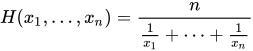
| ||||||||||||||||||||||||||||||||||||||||||||||
11l
F amean(num)
   R sum(num)/Float(num.len)

F gmean(num)
   R product(num) ^ (1.0/num.len)

F hmean(num)
   return num.len / sum(num.map(n -> 1.0/n))

V numbers = [1, 2, 3, 4, 5, 6, 7, 8, 9, 10]
print(amean(numbers))
print(gmean(numbers))
print(hmean(numbers))- Output:
5.5
4.52873
3.41417
Action!
INCLUDE "D2:REAL.ACT" ;from the Action! Tool Kit

PROC InverseI(INT a,result)
  REAL one,x

  IntToReal(1,one)
  IntToReal(a,x)
  RealDiv(one,x,result)
RETURN

PROC ArithmeticMean(INT ARRAY a INT count REAL POINTER result)
  INT i
  REAL x,sum,tmp

  IntToReal(0,sum)
  FOR i=0 TO count-1
  DO
    IntToReal(a(i),x)
    RealAdd(sum,x,tmp)
    RealAssign(tmp,sum)
  OD
  IntToReal(count,tmp)
  RealDiv(sum,tmp,result)
RETURN

PROC GeometricMean(INT ARRAY a INT count REAL POINTER result)
  INT i
  REAL x,prod,tmp

  IntToReal(1,prod)
  FOR i=0 TO count-1
  DO
    IntToReal(a(i),x)
    RealMult(prod,x,tmp)
    RealAssign(tmp,prod)
  OD
  InverseI(count,tmp)
  Power(prod,tmp,result)
RETURN

PROC HarmonicMean(INT ARRAY a INT count REAL POINTER result)
  INT i
  REAL x,sum,tmp

  IntToReal(0,sum)
  FOR i=0 TO count-1
  DO
    InverseI(a(i),x)
    RealAdd(sum,x,tmp)
    RealAssign(tmp,sum)
  OD
  IntToReal(count,tmp)
  RealDiv(tmp,sum,result)
RETURN

PROC Main()
  BYTE i
  INT ARRAY a=[1 2 3 4 5 6 7 8 9 10]
  REAL result

  Put(125) PutE() ;clear screen

  ArithmeticMean(a,10,result)
  Print("Arithmetic mean=") PrintRE(result)
  GeometricMean(a,10,result)
  Print(" Geometric mean=") PrintRE(result)
  HarmonicMean(a,10,result)
  Print("  Harmonic mean=") PrintRE(result)
RETURN- Output:
Screenshot from Atari 8-bit computer
Arithmetic mean=5.5
 Geometric mean=4.52872861
  Harmonic mean=3.41417153
ActionScript
function arithmeticMean(v:Vector.<Number>):Number
{
	var sum:Number = 0;
	for(var i: uint = 0; i < v.length; i++)
		sum += v[i];
	return sum/v.length;
}
function geometricMean(v:Vector.<Number>):Number
{
	var product:Number = 1;
	for(var i: uint = 0; i < v.length; i++)
		product *= v[i];
	return Math.pow(product, 1/v.length);
}
function harmonicMean(v:Vector.<Number>):Number
{
	var sum:Number = 0;
	for(var i: uint = 0; i < v.length; i++)
		sum += 1/v[i];
	return v.length/sum;
}
var list:Vector.<Number> = Vector.<Number>([1,2,3,4,5,6,7,8,9,10]);
trace("Arithmetic: ", arithmeticMean(list));
trace("Geometric: ", geometricMean(list));
trace("Harmonic: ", harmonicMean(list));
Ada
pythagorean_means.ads:
package Pythagorean_Means is
   type Set is array (Positive range <>) of Float;
   function Arithmetic_Mean (Data : Set) return Float;
   function Geometric_Mean  (Data : Set) return Float;
   function Harmonic_Mean   (Data : Set) return Float;
end Pythagorean_Means;
pythagorean_means.adb:
with Ada.Numerics.Generic_Elementary_Functions;
package body Pythagorean_Means is
   package Math is new Ada.Numerics.Generic_Elementary_Functions (Float);
   function "**" (Left, Right : Float) return Float renames Math."**";

   function Arithmetic_Mean (Data : Set) return Float is
      Sum : Float := 0.0;
   begin
      for I in Data'Range loop
         Sum := Sum + Data (I);
      end loop;
      return Sum / Float (Data'Length);
   end Arithmetic_Mean;

   function Geometric_Mean (Data : Set) return Float is
      Product : Float := 1.0;
   begin
      for I in Data'Range loop
         Product := Product * Data (I);
      end loop;
      return Product**(1.0/Float(Data'Length));
   end Geometric_Mean;

   function Harmonic_Mean (Data : Set) return Float is
      Reciprocal_Sum : Float := 0.0;
   begin
      for I in Data'Range loop
         Reciprocal_Sum := Reciprocal_Sum + Data (I)**(-1);
      end loop;
      return Float (Data'Length) / Reciprocal_Sum;
   end Harmonic_Mean;

end Pythagorean_Means;
example main.adb:
with Ada.Text_IO;
with Pythagorean_Means;
procedure Main is
   My_Set : Pythagorean_Means.Set := (1.0, 2.0, 3.0, 4.0,  5.0,
                                      6.0, 7.0, 8.0, 9.0, 10.0);
   Arithmetic_Mean : Float := Pythagorean_Means.Arithmetic_Mean (My_Set);
   Geometric_Mean  : Float := Pythagorean_Means.Geometric_Mean  (My_Set);
   Harmonic_Mean   : Float := Pythagorean_Means.Harmonic_Mean   (My_Set);
begin
   Ada.Text_IO.Put_Line (Float'Image (Arithmetic_Mean) & " >= " &
                         Float'Image (Geometric_Mean)  & " >= " &
                         Float'Image (Harmonic_Mean));
end Main;
ALGOL 68
main: (
  INT count:=0;
  LONG REAL f, sum:=0, prod:=1, resum:=0;

  FORMAT real = $g(0,4)$; # preferred real format #

  FILE fbuf; STRING sbuf; associate(fbuf,sbuf);

  BOOL opts := TRUE;

  FOR i TO argc DO
    IF opts THEN # skip args up to the - token #
      opts := argv(i) NE "-"
    ELSE
      rewind(fbuf); sbuf := argv(i); get(fbuf,f);
      count +:= 1;
      sum +:= f;
      prod *:= f;
      resum +:= 1/f
    FI
  OD;
  printf(($"c: "f(real)l"s: "f(real)l"p: "f(real)l"r: "f(real)l$,count,sum,prod,resum));
  printf(($"Arithmetic mean = "f(real)l$,sum/count));
  printf(($"Geometric mean = "f(real)l$,prod**(1/count)));
  printf(($"Harmonic mean = "f(real)l$,count/resum))
)
Lunix command:
a68g Averages_Pythagorean_means.a68 - 1 2 3 4 5 6 7 8 9 10
- Output:
c: 10.0000
s: 55.0000
p: 3628800.0000
r: 2.9290
Arithmetic mean = 5.5000
Geometric mean = 4.5287
Harmonic mean = 3.4142
ALGOL W
begin
    % returns the arithmetic mean of the elements of n from lo to hi %
    real procedure arithmeticMean ( real array n ( * ); integer value lo, hi ) ;
    begin
        real sum;
        sum := 0;
        for i := lo until hi do sum := sum + n( i );
        sum / ( 1 + ( hi - lo ) )
    end arithmeticMean ;
    % returns the geometric mean of the elements of n from lo to hi %
    real procedure geometricMean ( real array n ( * ); integer value lo, hi ) ;
    begin
        real product;
        product := 1;
        for i := lo until hi do product := product * n( i );
        exp( ln( product ) / ( 1 + ( hi - lo ) ) )
    end geometricMean ;
    % returns the harminic mean of the elements of n from lo to hi %
    real procedure harmonicMean ( real array n ( * ); integer value lo, hi ) ;
    begin
        real sum;
        sum := 0;
        for i := lo until hi do sum := sum + ( 1 / n( i ) );
        ( 1 + ( hi - lo ) ) / sum
    end harmonicMean ;

    real array v ( 1 :: 10 );
    for i := 1 until 10 do v( i ) := i;

    r_w := 10; r_d := 5; r_format := "A"; s_w := 0; % set output format %

    write( "Arithmetic mean: ", arithmeticMean( v, 1, 10 ) );
    write( "Geometric  mean: ",  geometricMean( v, 1, 10 ) );
    write( "Harmonic   mean: ",   harmonicMean( v, 1, 10 ) )

end.- Output:
Arithmetic mean:    5.50000
Geometric  mean:    4.52872
Harmonic   mean:    3.41417
Amazing Hopper
Think about "talk" programming...
#include <hopper.h>

/* An example of definitions in pseudo-natural language, with synonimous.
   These definitions can be inside a definition file (xxxx.h) */
#define getasinglelistof(_X_)   {_X_},
#synon  getasinglelistof        getalistof
#define integerrandomnumbers    _V1000_=-1,rand array(_V1000_),mulby(10),ceil,
#define randomnumbers           _V1000_=-1,rand array(_V1000_)
#define rememberitin(_X_)       _X_=0,cpy(_X_)
#synon  rememberitin            rememberthisnumbersin
#define rememberas(_X_)         mov(_X_)
#define remember(_X_)           {_X_}
//#synon  remember            with   ---> this exist in HOPPER.H
#defn   nowconsiderthis(_X_)    #ATOM#CMPLX,print
#synon  nowconsiderthis         nowconsider,considerthis,consider,nowputtext,puttext,andprint
#define andprintwithanewline    {"\n"}print
#synon  andprintwithanewline    printwithanewline
//#defn   andprint(_X_)           #ATOM#CMPLX,print
#define putanewline             {"\n"}
#define withanewline            "\n"
#define andprintit              print
#synon  andprintit              printit,andprint
#define showit                  show
#define afterdoingit            emptystack?,not,do{ {"I cannot continue due to retentive data "},throw(1001) }
#synon  afterdoingit            secondly,finally
#define then                    emptystack?do{ {"I cannot continue because data is missing "},throw(1000) }
/* why "#context" and not "#define"?
   becose "#context" need a value in the stack for continue.
   Internally, "domeanit" tranform to "gosub(calculatearithmeticmean)",
   and "gosub" works only if it finds a data in the stack */
#context  calculatethegeometricmean
#synon    calculatethegeometricmean   calculategeometricmean,getgeometricmean
#context  calculatetheharmonicmean
#synon    calculatetheharmonicmean    calculateharmonicmean,getharmonicmean
#context  calculatearitmethicmean
#synon    calculatearitmethicmean     calculatesinglemean,calculatemean,domeanit

main:
  consider this ("Arithmetic Mean: ")
  get a list of '10,10' integer random numbers; remember this numbers in 'list of numbers';
  then, do mean it, and print with a new line.
  after doing it, consider ("Geometric Mean: "), remember 'list of numbers', calculate the geometric mean;
  then, put a new line, and print it.
  /*
       Okay. This can be a bit long, if we have to write the program;
       But what if we just had to talk, and the language interpreter takes care of the rest?
  */
  secondly, now consider ("Harmonic Mean: "), with 'list of numbers', get harmonic mean, and print with a new line.
  finally, put text ("Original Array:\n"), and print (list of numbers, with a new line)
exit(0)
.locals
calculate aritmethic mean:
  stats(MEAN)
back
calculate the geometric mean:
  stats(GEOMEAN)
back
calculatetheharmonicmean:
  stats(HARMEAN)
back- Output:
Arithmetic Mean: 5.51
Geometric Mean: 4.47333
Harmonic Mean: 3.29515
Original Array:
4 3 10 6 10 1 1 10 4 1
7 4 5 8 9 7 3 8 1 10
5 5 2 5 8 9 1 5 10 10
6 4 3 5 9 2 6 9 2 9
10 9 3 4 6 2 1 8 10 1
7 5 5 9 9 3 7 9 7 7
9 2 10 1 7 9 3 2 7 4
1 6 2 4 10 7 5 1 5 5
1 2 9 5 10 7 7 6 6 4
3 4 5 2 4 1 10 6 3 7
Notice:
  The line "stats(GEOMEAN)" is identical to:
     stats(MULTIPLICATORY),POW BY({1}div by (100))
  and...
     #defn reciprocalof(_X_)  {1},#ATOM#CMPLX,postfix,div,postfix
  then:
     stats(MULTIPLICATORY),POW BY( reciprocal of (100) )
  or...
     #defn   N-ROOTof(_DATA_,_N_)  #ATOM#CMPLX,{1}div by(_N_),postfix,pow,postfix
     #define Multiplicatoryof(_DATA_)   {_DATA_}stats(MULTIPLICATORY)
  then:
     N-ROOT of ( Multiplicatory of (list of numbers), 100)
  etc.
APL
 arithmetic←{(+/⍵)÷⍴⍵}
 geometric←{(×/⍵)*÷⍴⍵}
 harmonic←{(⍴⍵)÷(+/÷⍵)}


 x←⍳10

 arithmetic x
5.5
 geometric x
4.528728688
 harmonic x
3.414171521
AppleScript
-- arithmetic_mean :: [Number] -> Number
on arithmetic_mean(xs)

    -- sum :: Number -> Number -> Number
    script sum
        on |λ|(accumulator, x)
            accumulator + x
        end |λ|
    end script

    foldl(sum, 0, xs) / (length of xs)
end arithmetic_mean

-- geometric_mean :: [Number] -> Number
on geometric_mean(xs)

    -- product :: Number -> Number -> Number
    script product
        on |λ|(accumulator, x)
            accumulator * x
        end |λ|
    end script

    foldl(product, 1, xs) ^ (1 / (length of xs))
end geometric_mean

-- harmonic_mean :: [Number] -> Number
on harmonic_mean(xs)

    -- addInverse :: Number -> Number -> Number
    script addInverse
        on |λ|(accumulator, x)
            accumulator + (1 / x)
        end |λ|
    end script

    (length of xs) / (foldl(addInverse, 0, xs))
end harmonic_mean

-- TEST -----------------------------------------------------------------------
on run
    set {A, G, H} to ap({arithmetic_mean, geometric_mean, harmonic_mean}, ¬
        {{1, 2, 3, 4, 5, 6, 7, 8, 9, 10}})

    {values:{arithmetic:A, geometric:G, harmonic:H}, inequalities:¬
        {|A >= G|:A ≥ G}, |G >= H|:G ≥ H}
end run


-- GENERIC FUNCTIONS ----------------------------------------------------------

-- A list of functions applied to a list of arguments
-- (<*> | ap) :: [(a -> b)] -> [a] -> [b]
on ap(fs, xs)
    set {nf, nx} to {length of fs, length of xs}
    set acc to {}
    repeat with i from 1 to nf
        tell mReturn(item i of fs)
            repeat with j from 1 to nx
                set end of acc to |λ|(contents of (item j of xs))
            end repeat
        end tell
    end repeat
    return acc
end ap

-- foldl :: (a -> b -> a) -> a -> [b] -> a
on foldl(f, startValue, xs)
    tell mReturn(f)
        set v to startValue
        set lng to length of xs
        repeat with i from 1 to lng
            set v to |λ|(v, item i of xs, i, xs)
        end repeat
        return v
    end tell
end foldl

-- map :: (a -> b) -> [a] -> [b]
on map(f, xs)
    tell mReturn(f)
        set lng to length of xs
        set lst to {}
        repeat with i from 1 to lng
            set end of lst to |λ|(item i of xs, i, xs)
        end repeat
        return lst
    end tell
end map

-- Lift 2nd class handler function into 1st class script wrapper
-- mReturn :: Handler -> Script
on mReturn(f)
    if class of f is script then
        f
    else
        script
            property |λ| : f
        end script
    end if
end mReturn
- Output:
{values:{arithmetic:5.5, geometric:4.528728688117, harmonic:3.414171521474},
inequalities:{|A >= G|:true}, |G >= H|:true}
Arturo
arithmeticMean: function [arr]->
    average arr

geometricMean: function [arr]->
    (product arr) ^ 1//size arr

harmonicMean: function [arr]->
    (size arr) // sum map arr 'i [1//i]

print arithmeticMean 1..10
print geometricMean 1..10
print harmonicMean 1..10
- Output:
5.5
4.528728688116765
3.414171521474055
AutoHotkey
A := ArithmeticMean(1, 10)
G := GeometricMean(1, 10)
H := HarmonicMean(1, 10)

If G Between %H% And %A%
    Result := "True"
Else
    Result := "False"

MsgBox, %A%`n%G%`n%H%`n%Result%


;---------------------------------------------------------------------------
ArithmeticMean(a, b) { ; of integers a through b
;---------------------------------------------------------------------------
    n := b - a + 1
    Loop, %n%
        Sum += (a + A_Index - 1)
    Return, Sum / n
}


;---------------------------------------------------------------------------
GeometricMean(a, b) { ; of integers a through b
;---------------------------------------------------------------------------
    n := b - a + 1
    Prod := 1
    Loop, %n%
        Prod *= (a + A_Index - 1)
    Return, Prod ** (1 / n)
}


;---------------------------------------------------------------------------
HarmonicMean(a, b) { ; of integers a through b
;---------------------------------------------------------------------------
    n := b - a + 1
    Loop, %n%
        Sum += 1 / (a + A_Index - 1)
    Return, n / Sum
}
Message box shows:
5.500000
4.528729
3.414172
True
AWK
#!/usr/bin/awk -f
{
    x  = $1;   # value of 1st column
    A += x;
    G += log(x);
    H += 1/x;
    N++;
}

END {
   print "Arithmethic mean: ",A/N;
   print "Geometric mean  : ",exp(G/N);
   print "Harmonic mean   : ",N/H;
}
BBC BASIC
The arithmetic and harmonic means use BBC BASIC's built-in array operations; only the geometric mean needs a loop.
      DIM a(9)
      a() = 1, 2, 3, 4, 5, 6, 7, 8, 9, 10
      PRINT "Arithmetic mean = " ; FNarithmeticmean(a())
      PRINT "Geometric mean =  " ; FNgeometricmean(a())
      PRINT "Harmonic mean =  " ; FNharmonicmean(a())
      END

      DEF FNarithmeticmean(a())
      = SUM(a()) / (DIM(a(),1)+1)

      DEF FNgeometricmean(a())
      LOCAL a, I%
      a = 1
      FOR I% = 0 TO DIM(a(),1)
        a *= a(I%)
      NEXT
      = a ^ (1/(DIM(a(),1)+1))

      DEF FNharmonicmean(a())
      LOCAL b()
      DIM b(DIM(a(),1))
      b() = 1/a()
      = (DIM(a(),1)+1) / SUM(b())
- Output:
Arithmetic mean = 5.5
Geometric mean =  4.52872869
Harmonic mean =  3.41417152
BQN
A ← +´÷≠
G ← ≠√×´
H ← A⌾÷

⋈⟜(∧´ ¯1⊸↓ ≥ 1⊸↓) (A∾G∾H) 1+↕10
- Output:
⟨ ⟨ 5.5 4.528728688116765 3.414171521474055 ⟩ 1 ⟩
C
#include <stdio.h>
#include <stdlib.h> // atoi()
#include <math.h> // pow()

int main(int argc, char* argv[])
{
  int i, count=0;
  double f, sum=0.0, prod=1.0, resum=0.0;

  for (i=1; i<argc; ++i) {
    f = atof(argv[i]);
    count++;
    sum += f;
    prod *= f;
    resum += (1.0/f);
  }
  //printf(" c:%d\n s:%f\n p:%f\n r:%f\n",count,sum,prod,resum);
  printf("Arithmetic mean = %f\n",sum/count);
  printf("Geometric mean = %f\n",pow(prod,(1.0/count)));
  printf("Harmonic mean = %f\n",count/resum);

  return 0;
}
C#
The standard Linq extension method Average provides arithmetic mean. This example adds two more extension methods for the geometric and harmonic means.
using System;
using System.Collections.Generic;
using System.Diagnostics;
using System.Linq;

namespace PythMean
{
    static class Program
    {
        static void Main(string[] args) {
            var nums = from n in Enumerable.Range(1, 10) select (double)n;

            var a = nums.Average();
            var g = nums.Gmean();
            var h = nums.Hmean();

            Console.WriteLine("Arithmetic mean {0}", a);
            Console.WriteLine("Geometric mean  {0}", g);
            Console.WriteLine("Harmonic mean   {0}", h);

            Debug.Assert(a >= g && g >= h);
        }

        // Geometric mean extension method.
        static double Gmean(this IEnumerable<double> n) {
            return Math.Pow(n.Aggregate((s, i) => s * i), 1.0 / n.Count());
        }

        // Harmonic mean extension method.
        static double Hmean(this IEnumerable<double> n) {
            return n.Count() / n.Sum(i => 1.0 / i);
        }
    }
}
- Output:
Arithmetic mean 5.5
Geometric mean  4.52872868811677
Harmonic mean   3.41417152147406
C++
#include <vector>
#include <iostream>
#include <numeric>
#include <cmath>
#include <algorithm>

double toInverse ( int i ) {
   return  1.0 / i  ;
}

int main( ) {
   std::vector<int> numbers ;
   for ( int i = 1 ; i < 11 ; i++ )
      numbers.push_back( i ) ;
   double arithmetic_mean = std::accumulate( numbers.begin( ) , numbers.end( ) , 0 ) / 10.0 ;
   double geometric_mean =
      pow( std::accumulate( numbers.begin( ) , numbers.end( ) , 1 , std::multiplies<int>( ) ), 0.1 ) ;
   std::vector<double> inverses ;
   inverses.resize( numbers.size( ) ) ;
   std::transform( numbers.begin( ) , numbers.end( ) , inverses.begin( ) , toInverse ) ;
   double harmonic_mean = 10 / std::accumulate( inverses.begin( ) , inverses.end( ) , 0.0 ); //initial value of accumulate must be a double!
   std::cout << "The arithmetic mean is " << arithmetic_mean << " , the geometric mean "
      << geometric_mean << " and the harmonic mean " << harmonic_mean << " !\n" ;
   return 0 ;
}
- Output:
The arithmetic mean is 5.5 , the geometric mean 4.52873 and the harmonic mean 3.41417 !
Clojure
(use '[clojure.contrib.math :only (expt)])

(defn a-mean [coll]
  (/ (apply + coll) (count coll)))

(defn g-mean [coll]
  (expt (apply * coll) (/ (count coll))))

(defn h-mean [coll]
  (/ (count coll) (apply + (map / coll))))

(let [numbers (range 1 11)
      a (a-mean numbers) g (g-mean numbers) h (h-mean numbers)]
  (println a ">=" g ">=" h)
  (>= a g h))
CoffeeScript
a = [ 1..10 ]
arithmetic_mean = (a) -> a.reduce(((s, x) -> s + x), 0) / a.length
geometic_mean = (a) -> Math.pow(a.reduce(((s, x) -> s * x), 1), (1 / a.length))
harmonic_mean = (a) -> a.length / a.reduce(((s, x) -> s + 1 / x), 0)

A = arithmetic_mean a
G = geometic_mean a
H = harmonic_mean a

console.log "A = ", A, " G = ", G, " H = ", H
console.log "A >= G : ", A >= G, " G >= H : ", G >= H
- Output:
A =  5.5  G =  4.528728688116765  H =  3.414171521474055
A >= G :  true  G >= H :  true
Common Lisp
(defun generic-mean (nums reduce-op final-op)
  (funcall final-op (reduce reduce-op nums)))

(defun a-mean (nums)
  (generic-mean nums #'+ (lambda (x) (/ x (length nums)))))

(defun g-mean (nums)
  (generic-mean nums #'* (lambda (x) (expt x (/ 1 (length nums))))))

(defun h-mean (nums)
  (generic-mean nums
                (lambda (x y) (+ x
                                 (/ 1 y)))
                (lambda (x) (/ (length nums) x))))

(let ((numbers (loop for i from 1 to 10 collect i)))
  (let ((a-mean (a-mean numbers))
        (g-mean (g-mean numbers))
        (h-mean (h-mean numbers)))
    (assert (> a-mean g-mean h-mean))
    (format t "a-mean ~a~%" a-mean)
    (format t "g-mean ~a~%" g-mean)
    (format t "h-mean ~a~%" h-mean)))
Craft Basic
precision 6

define bxsum = 1, sum = 0, sum1i = 0
define average = 0, geometric = 0, harmonic = 0

for i = 1 to 10

	let sum = sum + i
	let bxsum = bxsum * i
	let sum1i = sum1i + (1 / i)

next i

let average = sum / 10
let geometric = bxsum ^ (1 / 10)
let harmonic = 10 / sum1i

print "arithmetic mean: ", average
print "geometric mean: ", geometric
print "harmonic mean: ", harmonic

if average >= geometric and geometric >= harmonic then

	print "true"
	end

endif

print "false"
- Output:
arithmetic mean: 5.500000
geometric mean: 4.528729
harmonic mean: 3.414172
true
D
The output for the harmonic mean is wrong.
import std.stdio, std.algorithm, std.range, std.functional;

auto aMean(T)(T data) pure nothrow @nogc {
    return data.sum / data.length;
}

auto gMean(T)(T data) pure /*@nogc*/ {
    return data.reduce!q{a * b} ^^ (1.0 / data.length);
}

auto hMean(T)(T data) pure /*@nogc*/ {
    return data.length / data.reduce!q{ 1.0 / a + b };
}

void main() {
    immutable m = [adjoin!(hMean, gMean, aMean)(iota(1.0L, 11.0L))[]];
    writefln("%(%.19f %)", m);
    assert(m.isSorted);
}
- Output:
0.9891573712076470036 4.5287286881167647619 5.5000000000000000000
Delphi
program AveragesPythagoreanMeans;

{$APPTYPE CONSOLE}

uses Types, Math;

function ArithmeticMean(aArray: TDoubleDynArray): Double;
var
  lValue: Double;
begin
  Result := 0;
  for lValue in aArray do
    Result := Result + lValue;
  if Result > 0 then
    Result := Result / Length(aArray);
end;

function GeometricMean(aArray: TDoubleDynArray): Double;
var
  lValue: Double;
begin
  Result := 1;
  for lValue in aArray do
    Result := Result * lValue;
  Result := Power(Result, 1 / Length(aArray));
end;

function HarmonicMean(aArray: TDoubleDynArray): Double;
var
  lValue: Double;
begin
  Result := 0;
  for lValue in aArray do
    Result := Result + 1 / lValue;
  Result := Length(aArray) / Result;
end;

var
  lSourceArray: TDoubleDynArray;
  AMean, GMean, HMean: Double;
begin
  lSourceArray := TDoubleDynArray.Create(1,2,3,4,5,6,7,8,9,10);
  AMean := ArithmeticMean(lSourceArray));
  GMean := GeometricMean(lSourceArray));
  HMean := HarmonicMean(lSourceArray));
  if (AMean >= GMean) and (GMean >= HMean) then
    Writeln(AMean, " ≥ ", GMean, " ≥ ", HMean)
  else
    writeln("Error!");
end.
E
Given that we're defining all three together, it makes sense to express their regularities:
def makeMean(base, include, finish) {
    return def mean(numbers) {
        var count := 0
        var acc := base
        for x in numbers {
            acc := include(acc, x)
            count += 1
        }
        return finish(acc, count)
    }
}

def A := makeMean(0, fn b,x { b+x   }, fn acc,n { acc / n      })
def G := makeMean(1, fn b,x { b*x   }, fn acc,n { acc ** (1/n) })
def H := makeMean(0, fn b,x { b+1/x }, fn acc,n { n / acc      })
? A(1..10)
# value: 5.5
? G(1..10)
# value: 4.528728688116765
? H(1..10)
# value: 3.414171521474055EasyLang
proc mean . v[] a g h .
   prod = 1
   for v in v[]
      sum += v
      prod *= v
      resum += 1 / v
   .
   a = sum / len v[]
   g = pow prod (1 / len v[])
   h = len v[] / resum
.
a[] = [ 1 2 3 4 5 6 7 8 9 10 ]
mean a[] a g h
print a
print g
print h
EchoLisp
(define (A xs) (// (for/sum ((x xs)) x) (length xs)))

(define (G xs) (expt (for/product ((x xs)) x) (// (length xs))))

(define (H xs) (// (length xs) (for/sum ((x xs)) (// x))))

(define xs (range 1 11))
(and (>= (A xs) (G xs)) (>= (G xs) (H xs)))
    → #t
Elixir
defmodule Means do
  def arithmetic(list) do
    Enum.sum(list) / length(list)
  end
  def geometric(list) do
    :math.pow(Enum.reduce(list, &(*/2)), 1 / length(list))
  end
  def harmonic(list) do
    1 / arithmetic(Enum.map(list, &(1 / &1)))
  end
end

list = Enum.to_list(1..10)
IO.puts "Arithmetic mean: #{am = Means.arithmetic(list)}"
IO.puts "Geometric mean:  #{gm = Means.geometric(list)}"
IO.puts "Harmonic mean:   #{hm = Means.harmonic(list)}"
IO.puts "(#{am} >= #{gm} >= #{hm}) is #{am >= gm and gm >= hm}"
- Output:
Arithmetic mean: 5.5
Geometric mean:  4.528728688116765
Harmonic mean:   3.414171521474055
(5.5 >= 4.528728688116765 >= 3.414171521474055) is true
Erlang
%% Author: Abhay Jain <abhay_1303@yahoo.co.in>

-module(mean_calculator).
-export([find_mean/0]).

find_mean() ->
%% This is function calling. First argument is the the beginning number
%% and second argument is the initial value of sum for AM & HM and initial value of product for GM.
	arithmetic_mean(1, 0),
	geometric_mean(1, 1),
	harmonic_mean(1, 0).

%% Function to calculate Arithmetic Mean
arithmetic_mean(Number, Sum) when Number > 10 ->
	AM = Sum / 10,
	io:format("Arithmetic Mean ~p~n", [AM]);
arithmetic_mean(Number, Sum) ->
	NewSum = Sum + Number,
	arithmetic_mean(Number+1, NewSum).

%% Function to calculate Geometric Mean
geometric_mean(Number, Product) when Number > 10 ->
	GM = math:pow(Product, 0.1),
	io:format("Geometric Mean ~p~n", [GM]);
geometric_mean(Number, Product) ->
	NewProd = Product * Number,
	geometric_mean(Number+1, NewProd).

%% Function to calculate Harmonic Mean
harmonic_mean(Number, Sum) when Number > 10 ->
	HM = 10 / Sum,
	io:format("Harmonic Mean ~p~n", [HM]);
harmonic_mean(Number, Sum) ->
	NewSum = Sum + (1/Number),
	harmonic_mean(Number+1, NewSum).
- Output:
Arithmetic Mean 5.5
Geometric Mean 4.528728688116765
Harmonic Mean 3.414171521474055
ERRE
PROGRAM MEANS

DIM A[9]

PROCEDURE ARITHMETIC_MEAN(A[]->M)
      LOCAL S,I%
      NEL%=UBOUND(A,1)
      S=0
      FOR I%=0 TO NEL% DO
        S+=A[I%]
      END FOR
      M=S/(NEL%+1)
END PROCEDURE

PROCEDURE GEOMETRIC_MEAN(A[]->M)
      LOCAL S,I%
      NEL%=UBOUND(A,1)
      S=1
      FOR I%=0 TO NEL% DO
        S*=A[I%]
      END FOR
      M=S^(1/(NEL%+1))
END PROCEDURE

PROCEDURE HARMONIC_MEAN(A[]->M)
      LOCAL S,I%
      NEL%=UBOUND(A,1)
      S=0
      FOR I%=0 TO NEL% DO
        S+=1/A[I%]
      END FOR
      M=(NEL%+1)/S
END PROCEDURE

BEGIN
      A[]=(1,2,3,4,5,6,7,8,9,10)
      ARITHMETIC_MEAN(A[]->M)
      PRINT("Arithmetic mean = ";M)
      GEOMETRIC_MEAN(A[]->M)
      PRINT("Geometric mean =  ";M)
      HARMONIC_MEAN(A[]->M)
      PRINT("Harmonic mean =  ";M)
END PROGRAM
Euler Math Toolbox
>function A(x) := mean(x)
>function G(x) := exp(mean(log(x)))
>function H(x) := 1/mean(1/x)
>x=1:10; A(x), G(x), H(x)
 5.5
 4.52872868812
 3.41417152147
Alternatively, e.g.,
>function G(x) := prod(x)^(1/length(x))Euphoria
function arithmetic_mean(sequence s)
    atom sum
    if length(s) = 0 then
        return 0
    else
        sum = 0
        for i = 1 to length(s) do
            sum += s[i]
        end for
        return sum/length(s)
    end if
end function

function geometric_mean(sequence s)
    atom p
    p = 1
    for i = 1 to length(s) do
        p *= s[i]
    end for
    return power(p,1/length(s))
end function

function harmonic_mean(sequence s)
    atom sum
    if length(s) = 0 then
        return 0
    else
        sum = 0
        for i = 1 to length(s) do
            sum += 1/s[i]
        end for
        return length(s) / sum
    end if
end function

function true_or_false(atom x)
    if x then
        return "true"
    else
        return "false"
    end if
end function

constant s = {1,2,3,4,5,6,7,8,9,10}
constant arithmetic = arithmetic_mean(s),
    geometric = geometric_mean(s),
    harmonic = harmonic_mean(s)
printf(1,"Arithmetic: %g\n", arithmetic)
printf(1,"Geometric: %g\n", geometric)
printf(1,"Harmonic: %g\n", harmonic)
printf(1,"Arithmetic>=Geometric>=Harmonic: %s\n",
{true_or_false(arithmetic>=geometric and geometric>=harmonic)})- Output:
Arithmetic: 5.5
Geometric: 4.52873
Harmonic: 3.41417
Arithmetic>=Geometric>=Harmonic: true
Excel
Use the functions : AVERAGE, GEOMEAN and HARMEAN
=AVERAGE(1;2;3;4;5;6;7;8;9;10)
=GEOMEAN(1;2;3;4;5;6;7;8;9;10)
=HARMEAN(1;2;3;4;5;6;7;8;9;10)- Output:
5.5
4.528728688
3,414171521
F#
let P = [1.0; 2.0; 3.0; 4.0; 5.0; 6.0; 7.0; 8.0; 9.0; 10.0]

let arithmeticMean (x : float list) =
    x |> List.sum
      |> (fun acc -> acc / float (List.length(x)))

let geometricMean (x: float list) =
    x |> List.reduce (*)
      |> (fun acc -> Math.Pow(acc, 1.0 / (float (List.length(x)))))

let harmonicMean (x: float list) =
    x |> List.map (fun a -> 1.0 / a)
      |> List.sum
      |> (fun acc -> float (List.length(x)) / acc)

printfn "Arithmetic Mean: %A" (arithmeticMean P)
printfn "Geometric Mean: %A" (geometricMean P)
printfn "Harmonic Mean: %A" (harmonicMean P)
Factor
: a-mean ( seq -- mean )
    [ sum ] [ length ] bi / ;

: g-mean ( seq -- mean )
    [ product ] [ length recip ] bi ^ ;

: h-mean ( seq -- mean )
    [ length ] [ [ recip ] map-sum ] bi / ;
( scratchpad ) 10 [1,b] [ a-mean ] [ g-mean ] [ h-mean ] tri
               "%f >= %f >= %f\n" printf
5.500000 >= 4.528729 >= 3.414172
Fantom
class Main
{
  static Float arithmeticMean (Int[] nums)
  {
    if (nums.size == 0) return 0.0f
    sum := 0
    nums.each |n| { sum += n }
    return sum.toFloat / nums.size
  }

  static Float geometricMean (Int[] nums)
  {
    if (nums.size == 0) return 0.0f
    product := 1
    nums.each |n| { product *= n }
    return product.toFloat.pow(1f/nums.size)
  }

  static Float harmonicMean (Int[] nums)
  {
    if (nums.size == 0) return 0.0f
    reciprocals := 0f
    nums.each |n| { reciprocals += 1f / n }
    return nums.size.toFloat / reciprocals
  }

  public static Void main ()
  {
    items := (1..10).toList
    // display results
    echo (arithmeticMean (items))
    echo (geometricMean (items))
    echo (harmonicMean (items))
    // check given relation
    if ((arithmeticMean (items) >= geometricMean (items)) &&
        (geometricMean (items) >= harmonicMean (items)))
      echo ("relation holds")
    else
      echo ("relation failed")
  }
}
Forth
: famean ( faddr n -- f )
  0e
  tuck floats bounds do
    i f@ f+
  float +loop
  0 d>f f/ ;

: fgmean ( faddr n -- f )
  1e
  tuck floats bounds do
    i f@ f*
  float +loop
  0 d>f 1/f f** ;

: fhmean ( faddr n -- f )
  dup 0 d>f  0e
  floats bounds do
    i f@ 1/f f+
  float +loop
  f/ ;

create test 1e f, 2e f, 3e f, 4e f, 5e f, 6e f, 7e f, 8e f, 9e f, 10e f,
test 10 famean fdup f.
test 10 fgmean fdup fdup f.
test 10 fhmean fdup f.
( A G G H )
f>= . f>= .  \ -1 -1
Fortran
program Mean

  real :: a(10) = (/ (i, i=1,10) /)
  real :: amean, gmean, hmean

  amean = sum(a) / size(a)
  gmean = product(a)**(1.0/size(a))
  hmean = size(a) / sum(1.0/a)

  if ((amean < gmean) .or. (gmean < hmean)) then
    print*, "Error!"
  else
    print*, amean, gmean, hmean
  end if

end program Mean
FreeBASIC
' FB 1.05.0 Win64

Function ArithmeticMean(array() As Double) As Double
  Dim length As Integer = Ubound(array) - Lbound(array) + 1
  Dim As Double sum = 0.0
  For i As Integer = LBound(array) To UBound(array)
    sum += array(i)
  Next
  Return sum/length
End Function

Function GeometricMean(array() As Double) As Double
  Dim length As Integer = Ubound(array) - Lbound(array) + 1
  Dim As Double product = 1.0
  For i As Integer = LBound(array) To UBound(array)
    product *= array(i)
  Next
  Return product ^ (1.0 / length)
End Function

Function HarmonicMean(array() As Double) As Double
  Dim length As Integer = Ubound(array) - Lbound(array) + 1
  Dim As Double sum = 0.0
  For i As Integer = LBound(array) To UBound(array)
    sum += 1.0 / array(i)
  Next
  Return length / sum
End Function

Dim vector(1 To 10) As Double
For i As Integer = 1 To 10
  vector(i) = i
Next

Print "Arithmetic mean is :"; ArithmeticMean(vector())
Print "Geometric mean is  :"; GeometricMean(vector())
Print "Harmonic mean is   :"; HarmonicMean(vector())
Print
Print "Press any key to quit the program"
Sleep- Output:
Arithmetic mean is : 5.5
Geometric mean is  : 4.528728688116765
Harmonic mean is   : 3.414171521474055
FunL
import lists.zip

def
  mean( s, 0 ) = product( s )^(1/s.length())
  mean( s, p ) = (1/s.length() sum( x^p | x <- s ))^(1/p)

def
  monotone( [_], _ ) = true
  monotone( a1:a2:as, p ) = p( a1, a2 ) and monotone( a2:as, p )

means = [mean( 1..10, m ) | m <- [1, 0, -1]]

for (m, l) <- zip( means, ['Arithmetic', 'Geometric', 'Harmonic'] )
  println( "$l: $m" + (if m is Rational then " or ${m.doubleValue()}" else '') )

println( monotone(means, (>=)) )- Output:
Arithmetic: 11/2 or 5.5
Geometric: 4.528728688116765
Harmonic: 25200/7381 or 3.414171521474055
true
Futhark
fun arithmetic_mean(as: [n]f64): f64 =
  reduce (+) 0.0 (map (/f64(n)) as)

fun geometric_mean(as: [n]f64): f64 =
  reduce (*) 1.0 (map (**(1.0/f64(n))) as)

fun harmonic_mean(as: [n]f64): f64 =
  f64(n) / reduce (+) 0.0 (map (1.0/) as)

fun main(as: [n]f64): (f64,f64,f64) =
  (arithmetic_mean as,
   geometric_mean as,
   harmonic_mean as)
FutureBasic
Double ari = 1, geo = 0, har = 0
Short i, n = 10

for i = 1 to n
  ari += i
  geo *= i
  har += 1 \ i
next

print "ari:", ari \ n
print "geo:", geo^( 1 \ n )
print "har:", n \ har

handleevents
ari: 5.5 geo: 4.528728688116765 har: 3.414171521474055
GAP
# The first two work with rationals or with floats
# (but bear in mind that support of floating point is very poor in GAP)
mean := v -> Sum(v) / Length(v);
harmean := v -> Length(v) / Sum(v, Inverse);
geomean := v -> EXP_FLOAT(Sum(v, LOG_FLOAT) / Length(v));

mean([1 .. 10]);
# 11/2
harmean([1 .. 10]);
# 25200/7381

v := List([1..10], FLOAT_INT);;
mean(v);
# 5.5
harmean(v);
# 3.41417
geomean(v);
# 4.52873
Go
package main

import (
    "fmt"
    "math"
)

func main() {
    sum, sumr, prod := 0., 0., 1.
    for n := 1.; n <= 10; n++ {
        sum += n
        sumr += 1 / n
        prod *= n
    }
    a, g, h := sum/10, math.Pow(prod, .1), 10/sumr
    fmt.Println("A:", a, "G:", g, "H:", h)
    fmt.Println("A >= G >= H:", a >= g && g >= h)
}
- Output:
A: 5.5 G: 4.528728688116765 H: 3.414171521474055
A >= G >= H: true
Groovy
Solution:
def arithMean = { list ->
    list == null \
        ? null \
        : list.empty \
            ? 0 \
            : list.sum() / list.size()
}

def geomMean = { list ->
    list == null \
        ? null \
        : list.empty \
            ? 1 \
            : list.inject(1) { prod, item -> prod*item } ** (1 / list.size())
}

def harmMean = { list ->
    list == null \
        ? null \
        : list.empty \
            ? 0 \
            : list.size() / list.collect { 1.0/it }.sum()
}
Test:
def list = 1..10
def A = arithMean(list)
def G = geomMean(list)
assert A >= G
def H = harmMean(list)
assert G >= H
println """
list: ${list}
   A: ${A}
   G: ${G}
   H: ${H}
"""
- Output:
list: [1, 2, 3, 4, 5, 6, 7, 8, 9, 10]
   A: 5.5
   G: 4.528728688116765
   H: 3.4141715214
Haskell
One generalized function
The general function given here yields an arithmetic mean when its first argument is 1, a geometric mean when its first argument is 0, and a harmonic mean when its first argument is -1.
import Data.List (genericLength)
import Control.Monad (zipWithM_)

mean :: Double -> [Double] -> Double
mean 0 xs = product xs ** (1 / genericLength xs)
mean p xs = (1 / genericLength xs * sum (map (** p) xs)) ** (1/p)

main = do
  let ms = zipWith ((. flip mean [1..10]). (,)) "agh" [1, 0, -1]
  mapM_ (\(t,m) -> putStrLn $ t : ": " ++ show m) ms
  putStrLn $ " a >= g >= h is " ++  show ((\(_,[a,g,h])-> a>=g && g>=h) (unzip ms))
Three applicatively defined functions
These three functions (each combining the length of a list with some kind of fold over the elements of that same list), all share the same applicative structure.
import Data.List (genericLength)

-- ARITHMETIC, GEOMETRIC AND HARMONIC MEANS ---------------
arithmetic, geometric, harmonic :: [Double] -> Double
arithmetic = (/) . sum <*> genericLength

geometric = (**) . product <*> ((1 /) . genericLength)

harmonic = (/) . genericLength <*> foldr ((+) . (1 /)) 0

-- TEST ---------------------------------------------------
xs :: [Double]
xs = [arithmetic, geometric, harmonic] <*> [[1 .. 10]]

main :: IO ()
main =
  (putStrLn . unlines)
    [ zip ["Arithmetic", "Geometric", "Harmonic"] xs >>= show
    , mappend "\n A >= G >= H is " $ --
      (show . and) $ zipWith (>=) xs (tail xs)
    ]
- Output:
("Arithmetic",5.5)("Geometric",4.528728688116765)("Harmonic",3.414171521474055)

 a >= g >= h is True
HicEst
AGH = ALIAS( A, G, H ) ! named vector elements
AGH = (0, 1, 0)
DO i = 1, 10
   A = A + i
   G = G * i
   H = H + 1/i
ENDDO
AGH = (A/10, G^0.1, 10/H)

WRITE(ClipBoard, Name) AGH, "Result = " // (A>=G) * (G>=H)
! A=5.5; G=4.528728688; H=3.414171521; Result = 1;
Icon and Unicon
numbers:amean, numbers:gmean, and numbers:hmean are shown below:
- Output:
#means.exe
x := [ 1 2 3 4 5 6 7 8 9 10 ]
Arithmetic mean:5.5
Geometric mean:4.528728688116765
Harmonic mean:3.414171521474055
 a >= g >= h is true
IS-BASIC
100 PROGRAM "Averages.bas"
110 NUMERIC ARR(1 TO 10)
120 FOR I=LBOUND(ARR) TO UBOUND(ARR)
130   LET ARR(I)=I
140 NEXT
150 PRINT "Arithmetic mean =";ARITHM(ARR)
160 PRINT "Geometric mean  =";GEOMETRIC(ARR)
170 PRINT "Harmonic mean   =";HARMONIC(ARR)
180 DEF ARITHM(REF A)
190   LET T=0
200   FOR I=LBOUND(A) TO UBOUND(A)
210     LET T=T+A(I)
220   NEXT
230   LET ARITHM=T/SIZE(A)
240 END DEF
250 DEF GEOMETRIC(REF A)
260   LET T=1
270   FOR I=LBOUND(A) TO UBOUND(A)
280     LET T=T*A(I)
290   NEXT
300   LET GEOMETRIC=T^(1/SIZE(A))
310 END DEF
320 DEF HARMONIC(REF A)
330   LET T=0
340   FOR I=LBOUND(A) TO UBOUND(A)
350     LET T=T+(1/A(I))
360   NEXT
370   LET HARMONIC=SIZE(A)/T
380 END DEF
J
Solution:
amean=: +/ % #
gmean=: # %: */
hmean=: amean&.:%
Example Usage:
   (amean , gmean , hmean) >: i. 10
5.5 4.528729 3.414172
   assert 2 >:/\ (amean , gmean , hmean) >: i. 10    NB. check amean >= gmean and gmean >= hmean
Note that gmean could have instead been defined as mean under logarithm, for example:
gmean=:amean&.:^.
(and this variant should probably be preferred - especially if the argument list is long, to avoid problems with floating point infinity.)
Java
import java.util.Arrays;
import java.util.List;

public class PythagoreanMeans {
    public static double arithmeticMean(List<Double> numbers) {
        if (numbers.isEmpty()) return Double.NaN;
        double mean = 0.0;
        for (Double number : numbers) {
            mean += number;
        }
        return mean / numbers.size();
    }

    public static double geometricMean(List<Double> numbers) {
        if (numbers.isEmpty()) return Double.NaN;
        double mean = 1.0;
        for (Double number : numbers) {
            mean *= number;
        }
        return Math.pow(mean, 1.0 / numbers.size());
    }

    public static double harmonicMean(List<Double> numbers) {
        if (numbers.isEmpty() || numbers.contains(0.0)) return Double.NaN;
        double mean = 0.0;
        for (Double number : numbers) {
            mean += (1.0 / number);
        }
        return numbers.size() / mean;
    }

    public static void main(String[] args) {
        Double[] array = {1.0, 2.0, 3.0, 4.0, 5.0, 6.0, 7.0, 8.0, 9.0, 10.0};
        List<Double> list = Arrays.asList(array);
        double arithmetic = arithmeticMean(list);
        double geometric = geometricMean(list);
        double harmonic = harmonicMean(list);
        System.out.format("A = %f  G = %f  H = %f%n", arithmetic, geometric, harmonic);
        System.out.format("A >= G is %b, G >= H is %b%n", (arithmetic >= geometric), (geometric >= harmonic));
    }
}
- Output:
A = 5.500000  G = 4.528729  H = 3.414172
A >= G is true, G >= H is true
We can rewrite the 3 methods using the new JAVA Stream API:
   public static double arithmAverage(double array[]){
       if (array == null ||array.length == 0) {
         return 0.0;
      }
      else {
         return DoubleStream.of(array).average().getAsDouble();
      }
   }

    public static double geomAverage(double array[]){
      if (array == null ||array.length == 0) {
         return 0.0;
      }
      else {
         double aver = DoubleStream.of(array).reduce(1, (x, y) -> x * y);
         return   Math.pow(aver, 1.0 / array.length);
      }
   }

     public static double harmAverage(double array[]){
         if (array == null ||array.length == 0) {
         return 0.0;
      }
      else {
         double aver = DoubleStream.of(array)
                  // remove null values
                  .filter(n -> n > 0.0)
                  // generate 1/n array
                  .map( n-> 1.0/n)
                  // accumulating
                  .reduce(0, (x, y) -> x + y);
                  // just this reduce is not working- need to do in 2 steps
                 // .reduce(0, (x, y) -> 1.0/x + 1.0/y);
         return   array.length / aver ;
      }
   }
JavaScript
ES5
(function () {
    'use strict';

    // arithmetic_mean :: [Number] -> Number
    function arithmetic_mean(ns) {
        return (
            ns.reduce( // sum
                function (sum, n) {
                    return (sum + n);
                },
                0
            ) / ns.length
        );
    }

    // geometric_mean :: [Number] -> Number
    function geometric_mean(ns) {
        return Math.pow(
            ns.reduce( // product
                function (product, n) {
                    return (product * n);
                },
                1
            ),
            1 / ns.length
        );
    }

    // harmonic_mean :: [Number] -> Number
    function harmonic_mean(ns) {
        return (
            ns.length / ns.reduce( // sum of inverses
                function (invSum, n) {
                    return (invSum + (1 / n));
                },
                0
            )
        );
    }

    var values = [arithmetic_mean, geometric_mean, harmonic_mean]
        .map(function (f) {
            return f([1, 2, 3, 4, 5, 6, 7, 8, 9, 10]);
        }),
        mean = {
            Arithmetic: values[0], // arithmetic
            Geometric: values[1], // geometric
            Harmonic: values[2] // harmonic
        }

    return JSON.stringify({
        values: mean,
        test: "is A >= G >= H ? " +
            (
                mean.Arithmetic >= mean.Geometric &&
                mean.Geometric >= mean.Harmonic ? "yes" : "no"
            )
    }, null, 2);

})();
- Output:
{
  "values": {
    "Arithmetic": 5.5,
    "Geometric": 4.528728688116765,
    "Harmonic": 3.414171521474055
  },
  "test": "is A >= G >= H ? yes"
}
ES6
(() => {

    // arithmeticMean :: [Number] -> Number
    const arithmeticMean = xs =>
        foldl((sum, n) => sum + n, 0, xs) / length(xs);

    // geometricMean :: [Number] -> Number
    const geometricMean = xs =>
        raise(foldl((product, x) => product * x, 1, xs), 1 / length(xs));

    // harmonicMean :: [Number] -> Number
    const harmonicMean = xs =>
        length(xs) / foldl((invSum, n) => invSum + (1 / n), 0, xs);

    // GENERIC FUNCTIONS ------------------------------------------------------

    // A list of functions applied to a list of arguments
    // <*> :: [(a -> b)] -> [a] -> [b]
    const ap = (fs, xs) => //
        [].concat.apply([], fs.map(f => //
            [].concat.apply([], xs.map(x => [f(x)]))));

    // foldl :: (b -> a -> b) -> b -> [a] -> b
    const foldl = (f, a, xs) => xs.reduce(f, a);

    // length :: [a] -> Int
    const length = xs => xs.length;

    // mapFromList :: [(k, v)] -> Dictionary
    const mapFromList = kvs =>
        foldl((a, [k, v]) =>
            (a[(typeof k === 'string' && k) || show(k)] = v, a), {}, kvs);

    // raise :: Num -> Int -> Num
    const raise = (n, e) => Math.pow(n, e);

    // show :: a -> String
    // show :: a -> Int -> String
    const show = (...x) =>
        JSON.stringify.apply(
            null, x.length > 1 ? [x[0], null, x[1]] : x
        );

    // zip :: [a] -> [b] -> [(a,b)]
    const zip = (xs, ys) =>
        xs.slice(0, Math.min(xs.length, ys.length))
        .map((x, i) => [x, ys[i]]);

    // TEST -------------------------------------------------------------------
    // mean :: Dictionary
    const mean = mapFromList(zip(
        ['Arithmetic', 'Geometric', 'Harmonic'],
        ap([arithmeticMean, geometricMean, harmonicMean], [
            [1, 2, 3, 4, 5, 6, 7, 8, 9, 10]
        ])
    ));

    return show({
        values: mean,
        test: `is A >= G >= H ? ${mean.Arithmetic >= mean.Geometric &&
            mean.Geometric >= mean.Harmonic ? "yes" : "no"}`
    }, 2);
})();
- Output:
{
  "values": {
    "Arithmetic": 5.5,
    "Geometric": 4.528728688116765,
    "Harmonic": 3.414171521474055
  },
  "test": "is A >= G >= H ? yes"
}
jq
def amean: add/length;

def logProduct: map(log) | add;

def gmean:  (logProduct / length) | exp;

def hmean: length / (map(1/.) | add);

# Tasks:
 [range(1;11) ] | [amean, gmean, hmean] as $ans
 | ( $ans[],
"amean > gmean > hmean => \($ans[0] > $ans[1] and $ans[1] > $ans[2] )" )- Output:
5.5
4.528728688116766
3.414171521474055
"amean > gmean > hmean => true"
Julia
Julia has a `mean` function to compute the arithmetic mean of a collections of numbers. We can redefine it as follows.
amean(A) = sum(A)/length(A)

gmean(A) = prod(A)^(1/length(A))

hmean(A) = length(A)/sum(1./A)
- Output:
julia> map(f-> f(1:10), [amean, gmean, hmean])
3-element Array{Float64,1}:
 5.5
 4.52873
 3.41417
julia> ans[1] > ans[2] > ans[3]
true
K
  am:{(+/x)%#x}
  gm:{(*/x)^(%#x)}
  hm:{(#x)%+/%:'x}

  {(am x;gm x;hm x)} 1+!10
5.5 4.528729 3.414172
Kotlin
import kotlin.math.round
import kotlin.math.pow

fun Collection<Double>.geometricMean() =
    if (isEmpty()) Double.NaN
    else (reduce { n1, n2 -> n1 * n2 }).pow(1.0 / size)

fun Collection<Double>.harmonicMean() =
    if (isEmpty() || contains(0.0)) Double.NaN
    else size / fold(0.0) { n1, n2 -> n1 + 1.0 / n2 }

fun Double.toFixed(len: Int = 6) =
    round(this * 10.0.pow(len)) / 10.0.pow(len)

fun main() {
    val list = listOf(1.0, 2.0, 3.0, 4.0, 5.0, 6.0, 7.0, 8.0, 9.0, 10.0)
    val a = list.average()  // arithmetic mean
    val g = list.geometricMean()
    val h = list.harmonicMean()
    println("A = $a  G = ${g.toFixed()}  H = ${h.toFixed()}")
    println("A >= G is ${a >= g}, G >= H is ${g >= h}")
    require(g in h..a)
}
- Output:
A = 5.500000  G = 4.528729  H = 3.414172
A >= G is true, G >= H is true
Lasso
define arithmetic_mean(a::staticarray)::decimal => {
	//sum of the list divided by its length
	return (with e in #a sum #e) / decimal(#a->size)
}
define geometric_mean(a::staticarray)::decimal => {
	// The geometric mean is the nth root of the product of the list
	local(prod = 1)
	with e in #a do => { #prod *= #e }
	return math_pow(#prod,1/decimal(#a->size))
}
define harmonic_mean(a::staticarray)::decimal => {
	// The harmonic mean is n divided by the sum of the reciprocal of each item in the list
	return decimal(#a->size)/(with e in #a sum 1/decimal(#e))
}

arithmetic_mean(generateSeries(1,10)->asStaticArray)
geometric_mean(generateSeries(1,10)->asStaticArray)
harmonic_mean(generateSeries(1,10)->asStaticArray)
- Output:
5.500000
4.528729
3.414172
Liberty BASIC
for i = 1 to 10
    a = a + i
next
ArithmeticMean = a/10

b = 1
for i = 1 to 10
    b = b * i
next
GeometricMean = b ^ (1/10)

for i = 1 to 10
    c = c + (1/i)
next
HarmonicMean = 10/c

print "ArithmeticMean: ";ArithmeticMean
print "Geometric Mean: ";GeometricMean
print "Harmonic Mean: ";HarmonicMean

if (ArithmeticMean>=GeometricMean) and (GeometricMean>=HarmonicMean) then
print "True"
else
print "False"
end if
Logo
to compute_means :count
  local "sum
  make "sum     0
  local "product
  make "product 1
  local "reciprocal_sum
  make "reciprocal_sum  0

  repeat :count [
    make "sum sum :sum repcount
    make "product product :product repcount
    make "reciprocal_sum sum :reciprocal_sum (quotient repcount)
  ]

  output (sentence (quotient :sum :count) (power :product (quotient :count))
                   (quotient :count :reciprocal_sum))
end

make "means compute_means 10
print sentence [Arithmetic mean is] item 1 :means
print sentence [Geometric mean is] item 2 :means
print sentence [Harmonic mean is] item 3 :means
bye
Lua
function fsum(f, a, ...) return a and f(a) + fsum(f, ...) or 0 end
function pymean(t, f, finv) return finv(fsum(f, unpack(t)) / #t) end
nums = {1, 2, 3, 4, 5, 6, 7, 8, 9, 10}

--arithmetic
a = pymean(nums, function(n) return n end, function(n) return n end)
--geometric
g = pymean(nums, math.log, math.exp)
--harmonic
h = pymean(nums, function(n) return 1/n end, function(n) return 1/n end)
print(a, g, h)
assert(a >= g and g >= h)
M2000 Interpreter
Dimension(m,0) is the base (lower bound) for each dimension in an array, and can be 0 or 1. Len(a) or len(M()) return length of a pointer to array and an array, as number of array elements. For one dimension arrays len() is equal to Dimension(m(),1) where 1 is the first dimension Dim A(10,10) : Print Len(A())=100
Module CheckIt {
      sum=lambda -> {
              Read m as array
              if len(m)=0 then =0 : exit
              sum=Array(m, Dimension(m,0))
              If len(m)=1 then =sum : exit
              k=each(m,2,-1)
              While k {
                  sum+=Array(k)
            }
            =sum
      }
      mean=lambda sum (a as array) ->{
            =sum(a)/len(a)
      }
      prod=lambda -> {
              m=array
              if len(m)=0 then =0 : exit
              prod=Array(m, Dimension(m,0))
              If len(m)=1 then =prod : exit
              k=each(m,2,-1)
              While k {
                  prod*=Array(k)
            }
            =prod
      }
      geomean=lambda prod (a as array) -> {
            =prod(a)^(1/len(a))
      }
      harmomean=lambda (a as array) -> {
              if len(a)=0 then =0 : exit
              sum=1/Array(a, Dimension(a,0))
              If len(a)=1 then =1/sum : exit
              k=each(a,2,-1)
              While k {
                  sum+=1/Array(k)
            }
            =len(a)/sum
      }
      Print sum((1,2,3,4,5))=15
      Print prod((1,2,3,4,5))=120
      Print mean((1,2,3,4,5))==3
      \\ use == to apply rounding before comparison
      Print geomean((1,2,3,4,5))==2.60517108469735
      Print harmomean((1,2,3,4,5))==2.18978102189784
      Generator =lambda x=1 ->{=x : x++}
      dim a(10)<<Generator()
      Print mean(a())==5.5
      Print geomean(a())==4.52872868811677
      Print harmomean(a())==3.41417152147412
}
CheckIt
Maple
x := [ seq( 1 .. 10 ) ];
Means := proc( x )
    uses Statistics;
    return Mean( x ), GeometricMean( x ), HarmonicMean( x );
end proc:
Arithmeticmean, Geometricmean, Harmonicmean := Means( x );

is( Arithmeticmean >= Geometricmean and Geometricmean >= Harmonicmean );- Output:
Arithmeticmean, Geometricmean, Harmonicmean := 5.50000000000000, 4.52872868811677, 3.41417152147406

true
Mathematica / Wolfram Language
Print["{Arithmetic Mean, Geometric Mean, Harmonic Mean} = ",
 N@Through[{Mean, GeometricMean, HarmonicMean}[Range@10]]]
- Output:
{Arithmetic Mean, Geometric Mean, Harmonic Mean} = {5.5,4.52873,3.41417}
MATLAB
function [A,G,H] = pythagoreanMeans(list)

    A = mean(list);
    G = geomean(list);
    H = harmmean(list);

end
A solution that works for both, Matlab and Octave, is this
function [A,G,H] = pythagoreanMeans(list)
    A = mean(list);           % arithmetic mean
    G = exp(mean(log(list))); % geometric mean
    H = 1./mean(1./list);     % harmonic mean
end
Solution:
>> [A,G,H]=pythagoreanMeans((1:10))

A =

   5.500000000000000


G =

   4.528728688116765


H =

   3.414171521474055
Maxima
/* built-in */
L: makelist(i, i, 1, 10)$

mean(L), numer;            /* 5.5 */
geometric_mean(L), numer;  /* 4.528728688116765 */
harmonic_mean(L), numer;   /* 3.414171521474055 */
min
'avg ^A
(dup product 1 rolldown size / pow) ^G
('size keep (1 swap /) (+) map-reduce /) ^H

(((1 10)) range (((A) (G) (H))) cleave) => (puts!) foreach- Output:
5.5
4.528728688116765
3.414171521474055
Modula-2
MODULE PythagoreanMeans;
FROM FormatString IMPORT FormatString;
FROM LongMath IMPORT power;
FROM LongStr IMPORT RealToStr;
FROM Terminal IMPORT WriteString,WriteLn,ReadChar;

PROCEDURE ArithmeticMean(numbers : ARRAY OF LONGREAL) : LONGREAL;
VAR
    i,cnt : CARDINAL;
    mean : LONGREAL;
BEGIN
    mean := 0.0;
    cnt := 0;
    FOR i:=0 TO HIGH(numbers) DO
        mean := mean + numbers[i];
        INC(cnt);
    END;
    RETURN mean / LFLOAT(cnt)
END ArithmeticMean;

PROCEDURE GeometricMean(numbers : ARRAY OF LONGREAL) : LONGREAL;
VAR
    i,cnt : CARDINAL;
    mean : LONGREAL;
BEGIN
    mean := 1.0;
    cnt := 0;
    FOR i:=0 TO HIGH(numbers) DO
        mean := mean * numbers[i];
        INC(cnt);
    END;
    RETURN power(mean, 1.0 / LFLOAT(cnt))
END GeometricMean;

PROCEDURE HarmonicMean(numbers : ARRAY OF LONGREAL) : LONGREAL;
VAR
    i,cnt : CARDINAL;
    mean : LONGREAL;
BEGIN
    mean := 0.0;
    cnt := 0;
    FOR i:=0 TO HIGH(numbers) DO
        mean := mean + ( 1.0 / numbers[i]);
        INC(cnt);
    END;
    RETURN LFLOAT(cnt) / mean
END HarmonicMean;


CONST Size = 10;
TYPE DA = ARRAY[1..Size] OF LONGREAL;

VAR
    buf : ARRAY[0..63] OF CHAR;
    array : DA;
    arithmetic,geometric,harmonic : LONGREAL;
BEGIN
    array := DA{1.0, 2.0, 3.0, 4.0, 5.0, 6.0, 7.0, 8.0, 9.0, 10.0};

    arithmetic := ArithmeticMean(array);
    geometric := GeometricMean(array);
    harmonic := HarmonicMean(array);

    WriteString("A = ");
    RealToStr(arithmetic, buf);
    WriteString(buf);
    WriteString(" G = ");
    RealToStr(geometric, buf);
    WriteString(buf);
    WriteString(" H = ");
    RealToStr(harmonic, buf);
    WriteString(buf);
    WriteLn;

    FormatString("A >= G is %b, G >= H is %b\n", buf, arithmetic >= geometric, geometric >= harmonic);
    WriteString(buf);

    ReadChar
END PythagoreanMeans.
MUMPS
Pyth(n)	New a,ii,g,h,x
	For ii=1:1:n set x(ii)=ii
	;
	; Average
	Set a=0 For ii=1:1:n Set a=a+x(ii)
	Set a=a/n
	;
	; Geometric
	Set g=1 For ii=1:1:n Set g=g*x(ii)
	Set g=g**(1/n)
	;
	; Harmonic
	Set h=0 For ii=1:1:n Set h=1/x(ii)+h
	Set h=n/h
	;
	Write !,"Pythagorean means for 1..",n,":",!
	Write "Average = ",a," >= Geometric ",g," >= harmonic ",h,!
	Quit
Do Pyth(10)

Pythagorean means for 1..10:
Average = 5.5 >= Geometric 4.528728688116178495 >= harmonic 3.414171521474055006
NetRexx
/* NetRexx */
options replace format comments java crossref symbols nobinary

numeric digits 20

a1 = ArrayList(Arrays.asList([Rexx 1.0, 2.0, 3.0, 4.0, 5.0, 6.0, 7.0, 8.0, 9.0, 10.0]))
say "Arithmetic =" arithmeticMean(a1)", Geometric =" geometricMean(a1)", Harmonic =" harmonicMean(a1)

return

-- ~~~~~~~~~~~~~~~~~~~~~~~~~~~~~~~~~~~~~~~~~~~~~~~~~~~~~~~~~~~~~~~~~~~~~~~~~~~~~
method arithmeticMean(numbers = java.util.List) public static returns Rexx
  -- somewhat arbitrary return for ooRexx
  if numbers.isEmpty then return "NaN"

  mean = 0
  number = Rexx
  loop number over numbers
      mean = mean + number
  end
  return mean / numbers.size

-- ~~~~~~~~~~~~~~~~~~~~~~~~~~~~~~~~~~~~~~~~~~~~~~~~~~~~~~~~~~~~~~~~~~~~~~~~~~~~~
method geometricMean(numbers = java.util.List) public static returns Rexx
  -- somewhat arbitrary return for ooRexx
  if numbers.isEmpty then return "NaN"

  mean = 1
  number = Rexx
  loop number over numbers
      mean = mean * number
  end
  return Math.pow(mean, 1 / numbers.size)

-- ~~~~~~~~~~~~~~~~~~~~~~~~~~~~~~~~~~~~~~~~~~~~~~~~~~~~~~~~~~~~~~~~~~~~~~~~~~~~~
method harmonicMean(numbers = java.util.List) public static returns Rexx
  -- somewhat arbitrary return for ooRexx
  if numbers.isEmpty then return "NaN"

  mean = 0
  number = Rexx
  loop number over numbers
      if number = 0 then return "Nan"
      mean = mean + (1 / number)
  end

  -- problem here...
return numbers.size / mean- Output:
Arithmetic = 5.5, Geometric = 4.528728688116765, Harmonic = 3.4141715214740550062
Nim
import math, sequtils, sugar

proc amean(num: seq[float]): float =
  sum(num) / float(len(num))

proc gmean(num: seq[float]): float =
  result = 1
  for n in num: result *= n
  result = pow(result, 1.0 / float(num.len))

proc hmean(num: seq[float]): float =
  for n in num: result += 1.0 / n
  result = float(num.len) / result

proc ameanFunctional(num: seq[float]): float =
  sum(num) / float(num.len)

proc gmeanFunctional(num: seq[float]): float =
  num.foldl(a * b).pow(1.0 / float(num.len))

proc hmeanFunctional(num: seq[float]): float =
  float(num.len) / sum(num.mapIt(1.0 / it))

let numbers = toSeq(1..10).map((x: int) => float(x))
echo amean(numbers), " ", gmean(numbers), " ", hmean(numbers)
- Output:
5.5 4.528728688116765 3.414171521474055
Oberon-2
Oxford Oberon-2
MODULE PythMean;
IMPORT Out, ML := MathL;

PROCEDURE Triplets(a: ARRAY OF INTEGER;VAR triplet: ARRAY OF LONGREAL);
VAR
	i: INTEGER;
BEGIN
	triplet[0] := 0.0;triplet[1] := 0.0; triplet[2] := 0.0;
	FOR i:= 0 TO LEN(a) - 1 DO
		triplet[0] := triplet[0] + a[i];
		triplet[1] := triplet[1] + ML.Ln(a[i]);
		triplet[2] := triplet[2] + (1 / a[i])
	END
END Triplets;

PROCEDURE Means*(a: ARRAY OF INTEGER);
VAR
	triplet: ARRAY 3 OF LONGREAL;
BEGIN
	Triplets(a,triplet);
	Out.String("A(1 .. 10): ");Out.LongReal(triplet[0] / LEN(a));Out.Ln;
	Out.String("G(1 .. 10): ");Out.LongReal(ML.Exp(triplet[1]/ LEN(a)));Out.Ln;
	Out.String("H(1 .. 10): ");Out.LongReal(LEN(a) / triplet[2]);Out.Ln;
END Means;

VAR
	nums: ARRAY 10 OF INTEGER;
	i: INTEGER;
BEGIN
	FOR i := 0 TO LEN(nums) - 1 DO
		nums[i] := i + 1
	END;
	Means(nums)
END PythMean.- Output:
A(1 .. 10): 5.50000000000
G(1 .. 10): 4.52872868812
H(1 .. 10): 3.41417152147
Objeck
class PythagMeans {
  function : Main(args : String[]) ~ Nil {
    array := [1.0, 2.0, 3.0, 4.0, 5.0, 6.0, 7.0, 8.0, 9.0, 10.0];
    arithmetic := ArithmeticMean(array);
    geometric := GeometricMean(array);
    harmonic := HarmonicMean(array);

    arith_geo := arithmetic >= geometric;
    geo_harm := geometric >= harmonic;

    "A = {$arithmetic}, G = {$geometric}, H = {$harmonic}"->PrintLine();
    "A >= G is {$arith_geo}, G >= H is {$geo_harm}"->PrintLine();
  }

  function : native : ArithmeticMean(numbers : Float[]) ~ Float {
    if(numbers->Size() = 0) { return -1.0; };

    mean := 0.0;
    each(i : numbers) {
      mean += numbers[i];
    };

    return mean / numbers->Size();
  }

  function : native : GeometricMean(numbers : Float[]) ~ Float {
    if(numbers->Size() = 0) { return -1.0; };

    mean := 1.0;
    each(i : numbers) {
      mean *= numbers[i];
    };

    return mean->Power(1.0 / numbers->Size());
  }

  function : native : HarmonicMean(numbers : Float[]) ~ Float {
    if(numbers->Size() = 0) { return -1.0; };

    mean := 0.0;
    each(i : numbers) {
      mean += (1.0 / numbers[i]);
    };

    return numbers->Size() / mean;
  }
}
Output:
A = 5.500, G = 4.529, H = 3.414
A >= G is true, G >= H is true
OCaml
The three means in one function
let means v =
  let n = Array.length v
  and a = ref 0.0
  and b = ref 1.0
  and c = ref 0.0 in
  for i=0 to n-1 do
    a := !a +. v.(i);
    b := !b *. v.(i);
    c := !c +. 1.0/.v.(i);
  done;
  let nn = float_of_int n in
  (!a /. nn, !b ** (1.0/.nn), nn /. !c)
;;
- Output:
means (Array.init 10 (function i -> (float_of_int (i+1)))) ;;
(* (5.5, 4.5287286881167654, 3.4141715214740551) *)
Another implementation using Array.fold_left instead of a for loop:
let means v =
  let (a, b, c) =
    Array.fold_left
      (fun (a, b, c) x -> (a+.x, b*.x, c+.1./.x))
      (0.,1.,0.) v
  in
  let n = float_of_int (Array.length v) in
  (a /. n, b ** (1./.n), n /. c)
;;
Octave
    A = mean(list);     % arithmetic mean
    G = mean(list,'g'); % geometric mean
    H = mean(list,'a'); % harmonic mean
See also Matlab implementation #MATLAB
Oforth
import: mapping

: A ( x )
   x sum
   x size dup ifZero: [ 2drop null ] else: [ >float / ]
;

: G( x )   #* x reduce  x size inv powf ;

: H( x )   x size x map( #inv ) sum / ;

: averages
| g |
   "Geometric mean  :" . 10 seq G dup .cr ->g
   "Arithmetic mean :" . 10 seq A dup . g >= ifTrue: [ " ==> A >= G" .cr ]
   "Harmonic mean   :" . 10 seq H dup . g <= ifTrue: [ " ==> G >= H" .cr ]
;- Output:
Geometric mean  : 4.52872868811677
Arithmetic mean : 5.5 ==> A >= G
Harmonic mean   : 3.41417152147406 ==> G >= H
ooRexx
a = .array~of(1.0, 2.0, 3.0, 4.0, 5.0, 6.0, 7.0, 8.0, 9.0, 10.0)
say "Arithmetic =" arithmeticMean(a)", Geometric =" geometricMean(a)", Harmonic =" harmonicMean(a)

::routine arithmeticMean
  use arg numbers
  -- somewhat arbitrary return for ooRexx
  if numbers~isEmpty then return "NaN"

  mean = 0
  loop number over numbers
      mean += number
  end
  return mean / numbers~items

::routine geometricMean
  use arg numbers
  -- somewhat arbitrary return for ooRexx
  if numbers~isEmpty then return "NaN"

  mean = 1
  loop number over numbers
      mean *= number
  end

  return rxcalcPower(mean, 1 / numbers~items)

::routine harmonicMean
  use arg numbers
  -- somewhat arbitrary return for ooRexx
  if numbers~isEmpty then return "NaN"

  mean = 0
  loop number over numbers
      if number = 0 then return "Nan"
      mean += 1 / number
  end

  -- problem here....
  return numbers~items / mean

::requires rxmath LIBRARY- Output:
Arithmetic = 5.5, Geometric = 4.52872869, Harmonic = 3.41417153
Oz
declare
  %% helpers
  fun {Sum Xs} {FoldL Xs Number.'+' 0.0} end
  fun {Product Xs} {FoldL Xs Number.'*' 1.0} end
  fun {Len Xs} {Int.toFloat {Length Xs}} end

  fun {AMean Xs}
     {Sum Xs}
     /
     {Len Xs}
  end

  fun {GMean Xs}
     {Pow
      {Product Xs}
      1.0/{Len Xs}}
  end

  fun {HMean Xs}
     {Len Xs}
     /
     {Sum {Map Xs fun {$ X} 1.0 / X end}}
  end

  Numbers = {Map {List.number 1 10 1} Int.toFloat}

  [A G H] = [{AMean Numbers} {GMean Numbers} {HMean Numbers}]
in
  {Show [A G H]}
  A >= G = true
  G >= H = true
PARI/GP
General implementations:
arithmetic(v)={
  sum(i=1,#v,v[i])/#v
};
geometric(v)={
  prod(i=1,#v,v[i])^(1/#v)
};
harmonic(v)={
  #v/sum(i=1,#v,1/v[i])
};

v=vector(10,i,i);
[arithmetic(v),geometric(v),harmonic(v)]
Specific to the first n positive integers:
arithmetic_first(n)={
  (n+1)/2
};
geometric_first(n)={
  n!^(1/n)
};
harmonic_first(n)={
  n/if(n>1000,
    log(n)+Euler+1/(n+n)+1/(12*n^2)-1/(120*n^4)+1/(252*n^6)-1/(240*n^8)+1/(132*n^10)
  ,
    n/sum(k=1,n,1/k)
  )
};

[arithmetic_first(10),geometric_first(10),harmonic_first(10)]
%[1]>=%[2] && %[2] >= %[3]
These are, asymptotically, n/2, n/e, and n/log n.
Pascal
See Delphi
Perl
sub A
{
        my $a = 0;
        $a += $_ for @_;
        return $a / @_;
}
sub G
{
        my $p = 1;
        $p *= $_ for @_;
        return  $p**(1/@_); # power of 1/n == root of n
}
sub H
{
        my $h = 0;
        $h += 1/$_ for @_;
        return @_/$h;
}
my @ints = (1..10);

my $a = A(@ints);
my $g = G(@ints);
my $h = H(@ints);

print "A=$a\nG=$g\nH=$h\n";
die "Error" unless $a >= $g and $g >= $h;
Phix
with javascript_semantics
function arithmetic_mean(sequence s)
    return sum(s)/length(s)
end function

function geometric_mean(sequence s)
    return power(product(s),1/length(s))
end function

function harmonic_mean(sequence s)
    return length(s)/sum(sq_div(1,s))
end function

constant s = {1,2,3,4,5,6,7,8,9,10}
constant arithmetic = arithmetic_mean(s),
         geometric = geometric_mean(s),
         harmonic = harmonic_mean(s)
printf(1,"Arithmetic: %.10g\n", arithmetic)
printf(1,"Geometric: %.10g\n", geometric)
printf(1,"Harmonic: %.10g\n", harmonic)
printf(1,"Arithmetic>=Geometric>=Harmonic: %t\n", {arithmetic>=geometric and geometric>=harmonic})
- Output:
Arithmetic: 5.5
Geometric: 4.528728688
Harmonic: 3.414171521
Arithmetic>=Geometric>=Harmonic: true
PHP
<?php
// Created with PHP 7.0

function ArithmeticMean(array $values)
{
    return array_sum($values) / count($values);
}

function GeometricMean(array $values)
{
    return array_product($values) ** (1 / count($values));
}

function HarmonicMean(array $values)
{
    $sum = 0;

    foreach ($values as $value) {
        $sum += 1 / $value;
    }

    return count($values) / $sum;
}

$values = array(1, 2, 3, 4, 5, 6, 7, 8, 9, 10);

echo "Arithmetic: " . ArithmeticMean($values) . "\n";
echo "Geometric: " . GeometricMean($values) . "\n";
echo "Harmonic: " . HarmonicMean($values) . "\n";
- Output:
Arithmetic: 5.5
Geometric: 4.5287286881168
Harmonic: 3.4141715214741
PicoLisp
(load "@lib/math.l")

(let (Lst (1.0 2.0 3.0 4.0 5.0 6.0 7.0 8.0 9.0 10.0)  Len (length Lst))
   (prinl "Arithmetic mean: "
      (format
         (/ (apply + Lst) Len)
         *Scl ) )
   (prinl "Geometric mean: "
      (format
         (pow (*/ (apply * Lst) (** 1.0 (dec Len))) (/ 1.0 Len))
         *Scl ) )
   (prinl "Harmonic mean: "
      (format
         (*/ (* 1.0 Len) 1.0 (sum '((N) (*/ 1.0 1.0 N)) Lst))
*Scl ) ) )- Output:
Arithmetic mean: 5.500000
Geometric mean: 4.528729
Harmonic mean: 3.414172
PL/I
declare n fixed binary,
        (Average, Geometric, Harmonic) float;
declare A(10) float static initial (1,2,3,4,5,6,7,8,9,10);

n = hbound(A,1);

/* compute the average */
Average = sum(A)/n;

/* Compute the geometric mean: */
Geometric = prod(A)**(1/n);

/* Compute the Harmonic mean: */
Harmonic = n / sum(1/A);

put skip data (Average);
put skip data (Geometric);
put skip data (Harmonic);

if Average < Geometric then put skip list ('Error');
if Geometric < Harmonic then put skip list ('Error');
Results:
AVERAGE= 5.50000E+0000;
GEOMETRIC= 4.52873E+0000;
HARMONIC= 3.41417E+0000;
PostScript
/pythamean{
/x exch def
/sum 0 def
/prod 1 def
/invsum 0 def
/i 1 def

x{
/sum sum i add def
/prod prod i mul def
/invsum invsum i -1 exp add def
/i i 1 add def
}repeat
(Arithmetic Mean : ) print
sum x div =
(Geometric Mean : ) print
prod x -1 exp exp =
(Harmonic Mean : ) print
x invsum div =
}def

10 pythamean
- Output:
Arithmetic Mean : 5.5
Geometric Mean : 4.52873
Harmonic Mean : 3.41417
/numbers {[1 10] 1 range}.
/recip {1 exch div}.

% Arithmetic mean
numbers dup 0 {+} fold exch length div
% Geometric mean
numbers dup 1 {*} fold exch length recip exp
% Harmonic mean
numbers dup 0 {recip +} fold exch length exch div
PowerShell
$A = 0
$LogG = 0
$InvH = 0

$ii = 1..10
foreach($i in $ii) {
	# Arithmetic mean is computed directly
	$A += $i / $ii.Count
	# Geometric mean is computed using Logarithms
	$LogG += [Math]::Log($i) / $ii.Count
	# Harmonic mean is computed using its inverse
	$InvH += 1 / ($i * $ii.Count)
}

$G = [Math]::Exp($LogG)
$H = 1/$InvH

write-host "Arithmetic mean: A = $A"
write-host "Geometric mean:  G = $G"
write-host "Harmonic mean:   H = $H"

write-host "Is A >= G ? $($A -ge $G)"
write-host "Is G >= H ? $($G -ge $H)"
- Output:
Arithmetic mean: A = 5.5
Geometric mean:  G = 4.52872868811676
Harmonic mean:   H = 3.41417152147405
Is A >= G ? True
Is G >= H ? True
Processing
void setup() {
  float[] numbers = {1, 2, 3, 4, 5, 6, 7, 8, 9, 10};
  println("Arithmetic mean: " + arithmeticMean(numbers));
  println("Geometric mean: " + geometricMean(numbers));
  println("Harmonic mean: " + harmonicMean(numbers));
}

float arithmeticMean(float[] nums) {
  float mean = 0;
  for (float n : nums) {
    mean += n;
  }
  mean = mean / nums.length;
  return mean;
}

float geometricMean(float[] nums) {
  float mean = 1;
  for (float n : nums) {
    mean *= n;
  }
  mean = pow(mean, 1.0 / nums.length);
  return mean;
}

float harmonicMean(float[] nums) {
  float mean = 0;
  for (float n : nums) {
    mean += 1 / n;
  }
  mean = nums.length / mean;
  return mean;
}- Output:
Arithmetic mean: 5.5
Geometric mean: 4.528729
Harmonic mean: 3.4141712
PureBasic
Procedure.d ArithmeticMean()
  For a = 1 To 10
    mean + a
  Next
  ProcedureReturn mean / 10
EndProcedure
Procedure.d GeometricMean()
  mean = 1
  For a = 1 To 10
    mean * a
  Next
  ProcedureReturn Pow(mean, 1 / 10)
EndProcedure
Procedure.d HarmonicMean()
  For a = 1 To 10
    mean.d + 1 / a
  Next
  ProcedureReturn 10 / mean
EndProcedure

If HarmonicMean() <= GeometricMean() And GeometricMean() <= ArithmeticMean()
  Debug "true"
EndIf
Debug ArithmeticMean()
Debug GeometricMean()
Debug HarmonicMean()
Python
from operator import mul
from functools import reduce


def amean(num):
    return sum(num) / len(num)


def gmean(num):
    return reduce(mul, num, 1)**(1 / len(num))


def hmean(num):
    return len(num) / sum(1 / n for n in num)


numbers = range(1, 11)  # 1..10
a, g, h = amean(numbers), gmean(numbers), hmean(numbers)
print(a, g, h)
assert a >= g >= h
- Output:
5.5 4.52872868812 3.41417152147
These are the same in Python 2 apart from requiring explicit float division (either through float() casts or float literals such as 1./n); or better, do a from __future__ import division, which works on Python 2.2+ as well as Python 3, and makes division work consistently like it does in Python 3.
Quackery
Uses root from Integer roots#Quackery.
  [] 10 times [ i^ 1+ join ]

  say "Arithmetic mean:" sp
  0 over witheach +
  over size 8 point$ echo$
  cr
  say " Geometric mean:" sp
  1 over witheach *
  over size 80 ** * 10 root
  10 8 ** 8 point$ echo$
  cr
  say "  Harmonic mean:" sp
  dup size dip
    [ 0 n->v rot
      witheach [ n->v 1/v v+ ] ]
n->v 2swap v/ 8 point$ echo$- Output:
Arithmetic mean: 5.5
 Geometric mean: 4.52872868
  Harmonic mean: 3.41417152
R
Initialise x
x <- 1:10
Arithmetic mean
a <- sum(x)/length(x)
or
a <- mean(x)
The geometric mean
g <- prod(x)^(1/length(x))
The harmonic mean (no error checking that )

h <- length(x)/sum(1/x)
Then:
a > g
and
g > h
give both
[1] TRUE
Racket
#lang racket

(define (arithmetic xs)
  (/ (for/sum ([x xs]) x)
     (length xs)))

(define (geometric xs)
  (expt (for/product ([x xs]) x)
        (/ (length xs))))

(define (harmonic xs)
  (/ (length xs)
     (for/sum ([x xs]) (/ x))))

(define xs (range 1 11))
(arithmetic xs)
(geometric xs)
(harmonic xs)
(>= (arithmetic xs) (geometric xs) (harmonic xs))
- Output:
5 1/2
4.528728688116765
3 3057/7381
#t
Raku
(formerly Perl 6)
sub A { ([+] @_) / @_ }
sub G { ([*] @_) ** (1 / @_) }
sub H { @_ / [+] 1 X/ @_ }

say "A(1,...,10) = ", A(1..10);
say "G(1,...,10) = ", G(1..10);
say "H(1,...,10) = ", H(1..10);
- Output:
A(1,...,10) = 5.5
G(1,...,10) = 4.52872868811677
H(1,...,10) = 3.41417152147406
REXX
REXX doesn't have a POW function, so an IROOT (integer root) function is included here; it includes an
extra error check if used as a general purpose function that would otherwise yield a complex result.
/*REXX program  computes and displays the   Pythagorean means  [Amean,  Gmean,  Hmean]. */
numeric digits 20                                /*use a little extra for the precision.*/
parse arg n .                                    /*obtain the optional argument from CL.*/
if n=='' | n==","  then n= 10                    /*None specified?  Then use the default*/
sum= 0;  prod= 1;  rSum= 0                       /*initialize sum/product/reciprocal sum*/
$=;                       do #=1  for n;  $= $ # /*generate list by appending # to list.*/
                          sum = sum   +   #      /*compute the sum of all the elements. */
                          prod= prod  *   #      /*compute the product of all elements. */
                          rSum= rSum  + 1/#      /*compute the sum of the reciprocals.  */
                          end   /*#*/
say ' list ='$                                   /*display the list of numbers used.    */
say 'Amean ='  sum / n                           /*calculate & display  arithmetic mean.*/
say 'Gmean ='  Iroot(prod, n)                    /*    "     "     "    geometric    "  */
if result=="[n/a]"  then say '***error***: root' y "can't be even if 1st argument is < 0."
say 'Hmean ='  n   / rSum                        /*    "     "     "    harmonic     "  */
exit 0                                           /*stick a fork in it,  we're all done. */
/*──────────────────────────────────────────────────────────────────────────────────────*/
Iroot: procedure; parse arg x 1 ox, y 1 oy       /*get both args, and also a copy of X&Y*/
       if x=0 | x=1 | y=1  then return x         /*handle special case of zero and unity*/
       if y=0              then return 1         /*   "      "      "   " a   zero root.*/
       if x<0 & y//2==0    then return  '[n/a]'  /*indicate result is "not applicable". */
       x= abs(x);          y= abs(y);   m= y - 1 /*use the absolute value for  X and Y. */
       oDigs= digits();    a= oDigs + 5          /*save original digits;  add five digs.*/
       g= (x+1) / y*2                            /*use this as the first guesstimate.   */
       d= 5                                      /*start with 5 dec digs, saves CPU time*/
           do  until d==a;      d= min(d + d, a) /*keep going as digits are increased.  */
           numeric digits d;    f= d - 2         /*limit digits to  original digits + 5.*/
           og=                                   /*use a non─guess for the old G (guess)*/
              do forever;       gm= g**m         /*keep computing at the   Yth   root.  */
              _= format( (m*g*gm + x)/(y*gm),,f) /*this is the nitty─gritty calculation.*/
              if _=g  |  _=og  then leave        /*are we close enough yet?             */
              og= g;            g= _             /*save guess ──► OG; set the new guess.*/
              end   /*forever*/
           end      /*until  */

       g= g * sign(ox);  if oy<0  then  g= 1 / g /*adjust for original X sign; neg. root*/
       numeric digits oDigs;      return   g / 1 /*normalize to original decimal digits.*/
- output when using the default input:
 list = 1 2 3 4 5 6 7 8 9 10
Amean = 5.5
Gmean = 4.5287286881167647622
Hmean = 3.4141715214740550062
Ring
decimals(8)
array = [1, 2, 3, 4, 5, 6, 7, 8, 9, 10]
see "arithmetic mean = "  + arithmeticMean(array) + nl
see "geometric mean =  "  + geometricMean(array) + nl
see "harmonic mean =  "  + harmonicMean(array) + nl

func arithmeticMean a
     return summary(a) / len(a)

func geometricMean a
     b = 1
     for i = 1 to len(a)
         b *= a[i]
     next
     return pow(b, (1/len(a)))

func harmonicMean a
     b = list(len(a))
     for nr = 1 to len(a)
         b[nr] = 1/a[nr]
     next
     return len(a) / summary(b)

func summary s
     sum = 0
     for n = 1 to len(s)
         sum += s[n]
     next
     return sum
Output:
arithmetic mean = 5.50000000
geometric mean =  4.52872869
harmonic mean =  3.41417152
RPL
These words can be used either on vectors or lists.
≪ → array op
  ≪ array 1 GET 2 array SIZE
     IF DUP2 > THEN DROP2 ELSE FOR j array GET op EVAL NEXT END
≫ ≫ 'REDUCE' STO

≪ DUP ≪ + ≫ REDUCE SWAP SIZE /
≫ 'AMEAN' STO

≪ DUP ≪ * ≫ REDUCE SWAP SIZE INV ^
≫ 'GMEAN' STO

≪ SIZE LAST ≪ INV + ≫ REDUCE /
≫ 'HMEAN' STO
{ 1 2 3 4 5 6 7 8 9 0 } AMEAN
{ 1 2 3 4 5 6 7 8 9 0 } GMEAN
[ 1 2 3 4 5 6 7 8 9 0 ] HMEAN
- Output:
3:                 5.5
2:       4.52872868812
1:       3.41417152147
Ruby
class Array
  def arithmetic_mean
    inject(0.0, :+) / length
  end

  def geometric_mean
    inject(:*) ** (1.0 / length)
  end

  def harmonic_mean
    length / inject(0.0) {|s, m| s + 1.0/m}
  end
end

class Range
  def method_missing(m, *args)
    case m
    when /_mean$/ then to_a.send(m)
    else super
    end
  end
end

p a = (1..10).arithmetic_mean
p g = (1..10).geometric_mean
p h = (1..10).harmonic_mean
# is h < g < a ??
p g.between?(h, a)
- Output:
5.5
4.528728688116765
3.414171521474055
true
Run BASIC
bXsum   = 1
for i   = 1 to 10
  sum   = sum + i                ' sum of 1 -> 10
  bXsum = bXsum * i              ' sum i * i
  sum1i = sum1i + (1/i)          ' sum 1/i
next

average   = sum / 10
geometric = bXsum ^ (1/10)
harmonic  = 10/sum1i

 print "ArithmeticMean:";average
 print "Geometric Mean:";geometric
 print " Harmonic Mean:";harmonic

if (average >= geometric) and (geometric >= harmonic) then print "True" else print "False"- Output:
Arithmetic Mean:5.5
 Geometric Mean:4.52872869
  Harmonic Mean:3.41417132
True
Rust
fn main() {
    let mut sum = 0.0;
    let mut prod = 1;
    let mut recsum = 0.0;
    for i in 1..11{
        sum += i as f32;
        prod *= i;
        recsum += 1.0/(i as f32);
    }
    let avg = sum/10.0;
    let gmean = (prod as f32).powf(0.1);
    let hmean = 10.0/recsum;
    println!("Average: {}, Geometric mean: {}, Harmonic mean: {}", avg, gmean, hmean);
    assert!( ( (avg >= gmean) && (gmean >= hmean) ), "Incorrect calculation");

}
- Output:
Average: 5.5, Geometric mean:4.528729, Harmonic mean: 3.4141712
Scala
def arithmeticMean(n: Seq[Int]) = n.sum / n.size.toDouble
def geometricMean(n: Seq[Int])  = math.pow(n.foldLeft(1.0)(_*_), 1.0 / n.size.toDouble)
def harmonicMean(n: Seq[Int])   = n.size / n.map(1.0 / _).sum

var nums = 1 to 10
var a = arithmeticMean(nums)
var g = geometricMean(nums)
var h = harmonicMean(nums)

println("Arithmetic mean " + a)
println("Geometric mean  " + g)
println("Harmonic mean   " + h)

assert(a >= g && g >= h)
- Output:
Arithmetic mean 5.5
Geometric mean  4.528728688116765
Harmonic mean   3.414171521474055
Scheme


(define (a-mean l)
  (/ (apply + l) (length l)))

(define (g-mean l)
  (expt (apply * l) (/ (length l))))

(define (h-mean l)
  (/ (length l) (apply + (map / l))))

(define (iota start stop)
  (if (> start stop)
      (list)
      (cons start (iota (+ start 1) stop))))

(let* ((l (iota 1 10)) (a (a-mean l)) (g (g-mean l)) (h (h-mean l)))
  (display a)
  (display " >= ")
  (display g)
  (display " >= ")
  (display h)
  (newline)
  (display (>= a g h))
  (newline))
- Output:
11/2 >= 4.528728688116765 >= 25200/7381
#t
Seed7
$ include "seed7_05.s7i";
  include "float.s7i";

const array float: numbers is [] (1.0, 2.0, 3.0, 4.0, 5.0, 6.0, 7.0, 8.0, 9.0, 10.0);

const func proc: main is func
  local
    var float: number is 0.0;
    var float: sum is 0.0;
    var float: product is 1.0;
    var float: reciprocalSum is 0.0;
  begin
    for number range numbers do
      sum +:= number;
      product *:= number;
      reciprocalSum +:= 1.0 / number;
    end for;
    writeln("Arithmetic mean: " <& sum / flt(length(numbers)));
    writeln("Geometric mean:  " <& product ** (1.0 / flt(length(numbers))));
    writeln("Harmonic mean:   " <& flt(length(numbers)) / reciprocalSum);
end func;- Output:
Arithmetic mean: 5.5
Geometric mean:  4.528728961944580078125
Harmonic mean:   3.4141712188720703125
Sidef
func A(a) { a.sum / a.len }
func G(a) { a.prod.root(a.len) }
func H(a) { a.len / a.map{1/_}.sum }
The same thing, using hyper-operators:
func A(a) { a«+» / a.len }
func G(a) { a«*» ** (1/a.len) }
func H(a) { a.len / (a«/«1 «+») }
Calling the functions:
say("A(1,...,10) = ", A(1..10));
say("G(1,...,10) = ", G(1..10));
say("H(1,...,10) = ", H(1..10));- Output:
A(1,...,10) = 5.5
G(1,...,10) = 4.528728688116764762203309337195508793499
H(1,...,10) = 3.414171521474055006096734859775098225173
Smalltalk
This extends the class Collection, so these three methods can be called over any kind of collection, it is enough the the objects of the collection understand +, *, raisedTo, reciprocal and /.
Collection extend
[
    arithmeticMean
    [
	^ (self fold: [:a :b| a + b ]) / (self size)
    ]

    geometricMean
    [
	^ (self fold: [:a :b| a * b]) raisedTo: (self size reciprocal)
    ]

    harmonicMean
    [
	^ (self size) / ((self collect: [:x|x reciprocal]) fold: [:a :b| a + b ] )
    ]
]

|a|
a := #(1 2 3 4 5 6 7 8 9 10).

a arithmeticMean asFloat displayNl.
a geometricMean asFloat displayNl.
a harmonicMean asFloat displayNl.

((a arithmeticMean) >= (a geometricMean)) displayNl.
((a geometricMean) >= (a harmonicMean)) displayNl.
- Output:
5.5
4.528728688116765
3.414171521474055
true
true
SQL
It may not be possible to calculate a geometric mean in a query, but the other two are easy enough.
--setup
create table averages (val integer);
insert into averages values (1);
insert into averages values (2);
insert into averages values (3);
insert into averages values (4);
insert into averages values (5);
insert into averages values (6);
insert into averages values (7);
insert into averages values (8);
insert into averages values (9);
insert into averages values (10);
-- calculate means
select
  1/avg(1/val) as harm,
  avg(val) as arith
from
  averages;
- Output:
      HARM      ARITH
---------- ----------
3.41417152        5.5
Stata
The command ameans prints the arithmetic, geometric and harmonic means, together with confidence intervals.
clear all
set obs 10
gen x=_n
ameans x

    Variable |    Type             Obs        Mean       [95% Conf. Interval]
-------------+---------------------------------------------------------------
           x | Arithmetic           10         5.5        3.334149   7.665851
             |  Geometric           10    4.528729        2.680672   7.650836
             |   Harmonic           10    3.414172        2.035664   10.57602
-----------------------------------------------------------------------------
Swift
    // Utility for easy creation of Double from any Numeric
extension Double {
	init(withNum v: any Numeric) {
		switch v {
		case let ii as any BinaryInteger: self.init(ii)
		case let ff as any BinaryFloatingPoint: self.init(ff)
		default: self.init()
		}
	}
}
    // Extension for numeric collections
extension Collection where Element: Numeric {
	var arithmeticMean: Double {
		self.reduce(0.0, {$0 + Double(withNum: $1)})/Double(self.count)
	}
	var geometricMean: Double {
		pow(self.reduce(1.0, {$0 * Double(withNum: $1)}), 1.0/Double(self.count))
	}
	var harmonicMean: Double {
		Double(self.count) / self.reduce(0.0, {$0 + 1.0/Double(withNum:$1)})
	}
}
//Usage:
var c: [Int] = (1...10).map {$0}

print(c.arithmeticMean)
print(c.geometricMean)
print(c.harmonicMean)

// output:
// 5.5
// 4.528728688116765
// 3.414171521474055
Tcl
proc arithmeticMean list {
    set sum 0.0
    foreach value $list { set sum [expr {$sum + $value}] }
    return [expr {$sum / [llength $list]}]
}
proc geometricMean list {
    set product 1.0
    foreach value $list { set product [expr {$product * $value}] }
    return [expr {$product ** (1.0/[llength $list])}]
}
proc harmonicMean list {
    set sum 0.0
    foreach value $list { set sum [expr {$sum + 1.0/$value}] }
    return [expr {[llength $list] / $sum}]
}

set nums {1 2 3 4 5 6 7 8 9 10}
set A10 [arithmeticMean $nums]
set G10 [geometricMean $nums]
set H10 [harmonicMean $nums]
puts "A10=$A10, G10=$G10, H10=$H10"
if {$A10 >= $G10} { puts "A10 >= G10" }
if {$G10 >= $H10} { puts "G10 >= H10" }
- Output:
A10=5.5, G10=4.528728688116765, H10=3.414171521474055
A10 >= G10
G10 >= H10
Ursala
#import std
#import flo

data = ari10(1.,10.)   # arithmetic progression, length 10 with endpoints 1 and 10

a = mean data
g = exp mean ln* data
h = div/1. mean div/*1. data

#cast %eLbX

main = ^(~&,ordered not fleq) <a,g,h>- Output:
(
   <5.500000e+00,4.528729e+00,3.414172e+00>,
   true)
Vala
Most valac setups will need "-X -lm" added to the compile command to include the C math library.
double arithmetic(int[] list){
	double mean;
	double sum = 0;
	foreach(int number in list){
		sum += number;
	} // foreach

	mean = sum / list.length;

	return mean;
} // end arithmetic mean

double geometric(int[] list){
	double mean;
	double product = 1;
	foreach(int number in list){
		product *= number;
	} // foreach

	mean = Math.pow(product, (1 / (double) list.length));

	return mean;
} // end geometric mean

double harmonic(int[] list){
	double mean;
	double sum_inverse = 0;
	foreach(int number in list){
		sum_inverse += (1 / (double) number);
	} // foreach

	mean = (double) list.length / sum_inverse;

	return mean;
} // end harmonic mean

public static void main(){
	int[] list = {1, 2, 3, 4, 5, 6, 7, 8, 9, 10};

	double arithmetic_mean = arithmetic(list);
	double geometric_mean = geometric(list);
	double harmonic_mean = harmonic(list);

	// should be 5.5
	stdout.printf("Arithmetic mean: %s\n", arithmetic_mean.to_string());

	// should be 4.528728688116765
	stdout.printf("Geometric mean: %s\n", geometric_mean.to_string());

	// should be 4.528728688116765
	stdout.printf("Harmonic mean: %s\n", harmonic_mean.to_string());
}
- Output:
Arithmetic mean: 5.5
Geometric mean: 4.5287286881167654
Harmonic mean: 3.4141715214740551
VBA
Uses Excel VBA.
Private Function arithmetic_mean(s() As Variant) As Double
    arithmetic_mean = WorksheetFunction.Average(s)
End Function
Private Function geometric_mean(s() As Variant) As Double
    geometric_mean = WorksheetFunction.GeoMean(s)
End Function
Private Function harmonic_mean(s() As Variant) As Double
    harmonic_mean = WorksheetFunction.HarMean(s)
End Function
Public Sub pythagorean_means()
    Dim s() As Variant
    s = [{1, 2, 3, 4, 5, 6, 7, 8, 9, 10}]
    Debug.Print "A ="; arithmetic_mean(s)
    Debug.Print "G ="; geometric_mean(s)
    Debug.Print "H ="; harmonic_mean(s)
End Sub- Output:
A = 5,5
G = 4,52872868811677
H = 3,41417152147406
VBScript
Function arithmetic_mean(arr)
	sum = 0
	For i = 0 To UBound(arr)
		sum = sum + arr(i)
	Next
	arithmetic_mean = sum / (UBound(arr)+1)
End Function

Function geometric_mean(arr)
	product = 1
	For i = 0 To UBound(arr)
		product = product * arr(i)
	Next
	geometric_mean = product ^ (1/(UBound(arr)+1))
End Function

Function harmonic_mean(arr)
	sum = 0
	For i = 0 To UBound(arr)
		sum = sum + (1/arr(i))
	Next
	harmonic_mean = (UBound(arr)+1) / sum
End Function

WScript.StdOut.WriteLine arithmetic_mean(Array(1,2,3,4,5,6,7,8,9,10))
WScript.StdOut.WriteLine geometric_mean(Array(1,2,3,4,5,6,7,8,9,10))
WScript.StdOut.WriteLine harmonic_mean(Array(1,2,3,4,5,6,7,8,9,10))- Output:
5.5
4.52872868811677
3.41417152147406
Visual Basic .NET
Imports System.Runtime.CompilerServices

Module Module1

    <Extension()>
    Function Gmean(n As IEnumerable(Of Double)) As Double
        Return Math.Pow(n.Aggregate(Function(s, i) s * i), 1.0 / n.Count())
    End Function

    <Extension()>
    Function Hmean(n As IEnumerable(Of Double)) As Double
        Return n.Count() / n.Sum(Function(i) 1.0 / i)
    End Function

    Sub Main()
        Dim nums = From n In Enumerable.Range(1, 10) Select CDbl(n)

        Dim a = nums.Average()
        Dim g = nums.Gmean()
        Dim h = nums.Hmean()

        Console.WriteLine("Arithmetic mean {0}", a)
        Console.WriteLine(" Geometric mean {0}", g)
        Console.WriteLine("  Harmonic mean {0}", h)
        Debug.Assert(a >= g AndAlso g >= h)
    End Sub

End Module
- Output:
Arithmetic mean 5.5
 Geometric mean 4.52872868811677
  Harmonic mean 3.41417152147406
V (Vlang)
Updated for Vlang version 0.2.2
import math

fn main() {
    mut sum := 0.0
    mut prod :=1.0
    mut recip_sum := 0.0
    n := 10

    for val in 1..(n + 1) {
        sum += val
        prod *= val
        recip_sum = recip_sum + ( 1.0 / val )
    }

    a := sum / n
    g := math.pow( prod, ( 1.0 / f32(n) ) )
    h := n / recip_sum

    result := 'Arithmetic Mean: ${a:3.2f} \nGeometric Mean: ${g:3.2f}\nHarmonic Mean: ${h:3.2f}'
    println( result )

    compare := if a >= g && g >= h { "Yes" } else { "Nope" }
    println('Is A >= G >= H? $compare')
}
- Output:
Arithmetic Mean: 5.50
Geometric Mean: 4.53
Harmonic Mean: 3.41
Is A >= G >= H? Yes
Wren
var rng = 1..10
var count = rng.count
var A = rng.reduce { |acc, x| acc + x }/count
var G = rng.reduce { |prod, x| prod * x}.pow(1/count)
var H = rng.reduce { |acc, x| acc + 1/x}.pow(-1) * count

System.print("For the numbers %(rng):")
System.print("  Arithmetic mean = %(A)")
System.print("  Geometric mean  = %(G)")
System.print("  Harmonic mean   = %(H)")
System.print("  A >= G >= H     = %(A >= G && G >= H)")
- Output:
For the numbers 1..10:
  Arithmetic mean = 5.5
  Geometric mean  = 4.5287286881168
  Harmonic mean   = 3.4141715214741
  A >= G >= H     = true
XPL0
include c:\cxpl\codes;

func real Power(X, Y);          \X raised to the Y power
real X, Y;                      \ (from StdLib.xpl)
return Exp(Y * Ln(X));

int  N, Order;
real R, A, A1, G, G1, H, H1;
[A1:= 0.0;  G1:= 1.0;  H1:= 0.0;
Order:= true;
for N:= 1 to 10 do
        [R:= float(N);          \convert integer N to real R
        A1:= A1 + R;
        A:= A1/R;               \arithmetic mean
        G1:= G1 * R;
        G:= Power(G1, 1.0/R);   \geometric mean (Nth root of G1)
        if G>A then Order:= false;
        H1:= H1 + 1.0/R;
        H:= R/H1;               \harmonic mean
        if H>G then Order:= false;
        ];
RlOut(0, A); CrLf(0);
RlOut(0, G); CrLf(0);
RlOut(0, H); CrLf(0);
if not Order then Text(0, "NOT ");
Text(0, "ALWAYS DECREASING ORDER
");
]- Output:
    5.50000
    4.52873
    3.41417
ALWAYS DECREASING ORDER
zkl
ns:=T(1,2,3,4,5,6,7,8,9,10);
ns.sum(0.0)/ns.len();					   // Arithmetic mean
ns.reduce('*,1.0).pow(1.0/ns.len());			   // Geometric mean
ns.len().toFloat() / ns.reduce(fcn(p,n){ p + 1.0/n },0.0); // Harmonic mean- Output:
5.5
4.52873
3.41417
- Geometry
- Programming Tasks
- Solutions by Programming Task
- 11l
- Action!
- Action! Tool Kit
- ActionScript
- Ada
- ALGOL 68
- ALGOL W
- Amazing Hopper
- APL
- AppleScript
- Arturo
- AutoHotkey
- AWK
- BBC BASIC
- BQN
- C
- C sharp
- C++
- Clojure
- CoffeeScript
- Common Lisp
- Craft Basic
- D
- Delphi
- E
- EasyLang
- EchoLisp
- Elixir
- Erlang
- ERRE
- Euler Math Toolbox
- Euphoria
- Excel
- F Sharp
- Factor
- Fantom
- Forth
- Fortran
- FreeBASIC
- FunL
- Futhark
- FutureBasic
- GAP
- Go
- Groovy
- Haskell
- HicEst
- Icon
- Unicon
- Icon Programming Library
- IS-BASIC
- J
- Java
- JavaScript
- Jq
- Julia
- K
- Kotlin
- Lasso
- Liberty BASIC
- Logo
- Lua
- M2000 Interpreter
- Maple
- Mathematica
- Wolfram Language
- MATLAB
- Maxima
- Min
- Modula-2
- MUMPS
- NetRexx
- Nim
- Oberon-2
- Objeck
- OCaml
- Octave
- Oforth
- OoRexx
- Oz
- PARI/GP
- Pascal
- Perl
- Phix
- PHP
- PicoLisp
- PL/I
- PostScript
- Initlib
- PowerShell
- Processing
- PureBasic
- Python
- Quackery
- R
- Racket
- Raku
- REXX
- Ring
- RPL
- Ruby
- Run BASIC
- Rust
- Scala
- Scheme
- Seed7
- Sidef
- Smalltalk
- SQL
- Stata
- Swift
- Tcl
- Ursala
- Vala
- VBA
- VBScript
- Visual Basic .NET
- V (Vlang)
- Wren
- XPL0
- Zkl