
Averages/Root mean square

You are encouraged to solve this task according to the task description, using any language you may know.
- Task
Compute the Root mean square of the numbers 1..10.
The root mean square is also known by its initials RMS (or rms), and as the quadratic mean.
The RMS is calculated as the mean of the squares of the numbers, square-rooted:

- See also
| ||||||||||||||||||||||||||||||||||||||||||||||
11l
F qmean(num)
   R sqrt(sum(num.map(n -> n * n)) / Float(num.len))

print(qmean(1..10))- Output:
6.20484
Action!
INCLUDE "D2:REAL.ACT" ;from the Action! Tool Kit

BYTE FUNC Equal(REAL POINTER a,b)
  BYTE ARRAY x,y

  x=a y=b
  IF x(0)=y(0) AND x(1)=y(1) AND x(2)=y(2) THEN
    RETURN (1)
  FI
RETURN (0)

PROC Sqrt(REAL POINTER a,b)
  REAL z,half

  IntToReal(0,z)
  ValR("0.5",half)

  IF Equal(a,z) THEN
    RealAssign(z,b)
  ELSE
    Power(a,half,b)
  FI
RETURN

PROC Main()
  BYTE i
  REAL x,x2,sum,tmp

  IntToReal(0,sum)
  FOR i=1 TO 10
  DO
    IntToReal(i,x)
    RealMult(x,x,x2)
    RealAdd(sum,x2,tmp)
    RealAssign(tmp,sum)
  OD
  IntToReal(10,x)
  RealDiv(sum,x,tmp)
  Sqrt(tmp,x)

  Put(125) PutE() ;clear screen
  Print("RMS of 1..10 is ")
  PrintRE(x)
RETURN- Output:
Screenshot from Atari 8-bit computer
RMS of 1..10 is 6.20483663
Ada
with Ada.Float_Text_IO; use Ada.Float_Text_IO;
with Ada.Numerics.Elementary_Functions;
use Ada.Numerics.Elementary_Functions;
procedure calcrms is
	type float_arr is array(1..10) of Float;

	function rms(nums : float_arr) return Float is
		sum : Float := 0.0;
		begin
		for p in nums'Range loop
			sum := sum + nums(p)**2;
		end loop;
		return sqrt(sum/Float(nums'Length));
	end rms;

	list : float_arr;
begin
list := (1.0,2.0,3.0,4.0,5.0,6.0,7.0,8.0,9.0,10.0);
put( rms(list) , Exp=>0);
end calcrms;
- Output:
6.20484
ALGOL 68
# Define the rms PROCedure & ABS OPerators for LONG... REAL #
MODE RMSFIELD = #LONG...# REAL;
PROC (RMSFIELD)RMSFIELD rms field sqrt = #long...# sqrt;
INT rms field width = #long...# real width;

PROC crude rms = ([]RMSFIELD v)RMSFIELD: (
  RMSFIELD sum := 0;
  FOR i FROM LWB v TO UPB v DO sum +:= v[i]**2 OD;
  rms field sqrt(sum / (UPB v - LWB v + 1))
);

PROC rms = ([]RMSFIELD v)RMSFIELD: (
# round off error accumulated at standard precision #
  RMSFIELD sum := 0, round off error:= 0;
  FOR i FROM LWB v TO UPB v DO
    RMSFIELD org = sum, prod = v[i]**2;
    sum +:= prod;
    round off error +:= sum - org - prod
  OD;
  rms field sqrt((sum - round off error)/(UPB v - LWB v + 1))
);

main: (
  []RMSFIELD one to ten = (1,2,3,4,5,6,7,8,9,10);

  print(("crude rms(one to ten): ", crude rms(one to ten), new line));
  print(("rms(one to ten): ",       rms(one to ten), new line))
)- Output:
crude rms(one to ten): +6.20483682299543e  +0
rms(one to ten): +6.20483682299543e  +0
ALGOL-M
Because ALGOL-M lacks a built-in square root function, we have to supply our own.
BEGIN

DECIMAL FUNCTION SQRT(X);
DECIMAL X;
BEGIN
    DECIMAL R1, R2, TOL;
    TOL := .00001;   % reasonable for most purposes %
    IF X >= 1.0 THEN
       BEGIN
          R1 := X;
          R2 := 1.0;
       END
    ELSE
       BEGIN
          R1 := 1.0;
          R2 := X;
       END;
    WHILE (R1-R2) > TOL DO
        BEGIN
            R1 := (R1+R2) / 2.0;
            R2 := X / R1;
        END;
    SQRT := R1;
END;

COMMENT - MAIN PROGRAM BEGINS HERE;

DECIMAL N, SQSUM, SQMEAN;

SQSUM := 0.0;
FOR N := 1.0 STEP 1.0 UNTIL 10.0 DO
    SQSUM := SQSUM + (N * N);
SQMEAN := SQSUM / (N - 1.0);
WRITE("RMS OF WHOLE NUMBERS 1.0 THROUGH 10.0 =", SQRT(SQMEAN));

END- Output:
Based on the limited precision of the square root function, only the first six decimal places of the output can actually be relied on (but that's more than sufficient for most real world uses).
RMS OF WHOLE NUMBERS 1.0 THROUGH 10.0 = 6.20483683432
ALGOL W
begin
    % computes the root-mean-square of an array of numbers with               %
    % the specified lower bound (lb) and upper bound (ub)                     %
    real procedure rms( real    array numbers ( * )
                      ; integer value lb
                      ; integer value ub
                      ) ;
        begin
            real sum;
            sum := 0;
            for i := lb until ub do sum := sum + ( numbers(i) * numbers(i) );
            sqrt( sum / ( ( ub - lb ) + 1 ) )
        end rms ;

    % test the rms procedure with the numbers 1 to 10                         %
    real array testNumbers( 1 :: 10 );
    for i := 1 until 10 do testNumbers(i) := i;
    r_format := "A"; r_w := 10; r_d := 4; % set fixed point output           %
    write( "rms of 1 .. 10: ", rms( testNumbers, 1, 10 ) );

end.- Output:
rms of 1 .. 10: 6.2048
APL
 rms←{((+/⍵*2)÷⍴⍵)*0.5}
 x←⍳10

 rms x
6.204836823
AppleScript
Functional
( ES6 version )
--------------------- ROOT MEAN SQUARE -------------------

-- rootMeanSquare :: [Num] -> Real
on rootMeanSquare(xs)
    script
        on |λ|(a, x)
            a + x * x
        end |λ|
    end script

    (foldl(result, 0, xs) / (length of xs)) ^ (1 / 2)
end rootMeanSquare


--------------------------- TEST -------------------------
on run

    rootMeanSquare({1, 2, 3, 4, 5, 6, 7, 8, 9, 10})

    -- > 6.204836822995
end run


-------------------- GENERIC FUNCTIONS -------------------

-- foldl :: (a -> b -> a) -> a -> [b] -> a
on foldl(f, startValue, xs)
    tell mReturn(f)
        set v to startValue
        set lng to length of xs
        repeat with i from 1 to lng
            set v to |λ|(v, item i of xs, i, xs)
        end repeat
        return v
    end tell
end foldl

-- Lift 2nd class handler function into 1st class script wrapper
-- mReturn :: Handler -> Script
on mReturn(f)
    if class of f is script then
        f
    else
        script
            property |λ| : f
        end script
    end if
end mReturn
- Output:
6.204836822995
Straightforward
on rootMeanSquare(listOfNumbers)
    script o
        property lst : listOfNumbers
    end script
    set r to 0.0
    repeat with n in o's lst
        set r to r + (n ^ 2)
    end repeat

    return (r / (count o's lst)) ^ 0.5
end rootMeanSquare

rootMeanSquare({1, 2, 3, 4, 5, 6, 7, 8, 9, 10})
- Output:
6.204836822995
Integer range alternative
("Avoiding a loop" solution)
-- RMS of integer range a to b.
on rootMeanSquare(a, b)
	return ((b * (b + 1) * (2 * b + 1) - a * (a - 1) * (2 * a - 1)) / 6 / (b - a + 1)) ^ 0.5
end rootMeanSquare

rootMeanSquare(1, 10)
- Output:
6.204836822995
Arturo
rootMeanSquare: function [arr]->
    sqrt (sum map arr 'i -> i^2) // size arr

print rootMeanSquare 1..10
- Output:
6.204836822995428
Astro
sqrt(mean(x²))
AutoHotkey
Using a loop
MsgBox, % RMS(1, 10)


;---------------------------------------------------------------------------
RMS(a, b) { ; Root Mean Square of integers a through b
;---------------------------------------------------------------------------
    n := b - a + 1
    Loop, %n%
        Sum += (a + A_Index - 1) ** 2
    Return, Sqrt(Sum / n)
}
Message box shows:
6.204837
Avoiding a loop
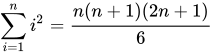
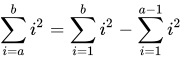
Using these equations:
See wp:List of mathematical series
for :
We can show that:


MsgBox, % RMS(1, 10)


;---------------------------------------------------------------------------
RMS(a, b) { ; Root Mean Square of integers a through b
;---------------------------------------------------------------------------
    Return, Sqrt((b*(b+1)*(2*b+1)-a*(a-1)*(2*a-1))/6/(b-a+1))
}
Message box shows:
6.204837
AWK
#!/usr/bin/awk -f
# computes RMS of the 1st column of a data file
{
    x  = $1;   # value of 1st column
    S += x*x;
    N++;
}

END {
   print "RMS: ",sqrt(S/N);
}
BASIC
Note that this will work in Visual Basic and the Windows versions of PowerBASIC by simply wrapping the module-level code into the MAIN function, and changing PRINT to MSGBOX.
DIM i(1 TO 10) AS DOUBLE, L0 AS LONG
FOR L0 = 1 TO 10
    i(L0) = L0
NEXT
PRINT STR$(rms#(i()))

FUNCTION rms# (what() AS DOUBLE)
    DIM L0 AS LONG, tmp AS DOUBLE, rt AS DOUBLE
    FOR L0 = LBOUND(what) TO UBOUND(what)
        rt = rt + (what(L0) ^ 2)
    NEXT
    tmp = UBOUND(what) - LBOUND(what) + 1
    rms# = SQR(rt / tmp)
END FUNCTION
See also: BBC BASIC, Liberty BASIC, PureBasic, Run BASIC
Applesoft BASIC
 10 N = 10
 20  FOR I = 1 TO N
 30 S = S + I * I
 40  NEXT
 50 X =  SQR (S / N)
60 PRINT X- Output:
6.20483683
Craft Basic
precision 8

let n = 10

for i = 1 to n

	let s = s + i * i

next i

print sqrt(s / n)
- Output:
6.20483682
IS-BASIC
100 PRINT RMS(10)
110 DEF RMS(N)
120   LET R=0
130   FOR X=1 TO N
140     LET R=R+X^2
150   NEXT
160   LET RMS=SQR(R/N)
170 END DEF
Sinclair ZX81 BASIC
10 FAST
20 LET RMS=0
30 FOR X=1 TO 10
40 LET RMS=RMS+X**2
50 NEXT X
60 LET RMS=SQR (RMS/10)
70 SLOW
80 PRINT RMS
- Output:
6.2048368
BBC BASIC
      DIM array(9)
      array() = 1, 2, 3, 4, 5, 6, 7, 8, 9, 10

      PRINT FNrms(array())
      END

      DEF FNrms(a()) = MOD(a()) / SQR(DIM(a(),1)+1)
BQN
RMS is a tacit function which computes root mean square.
RMS ← √+´∘ט÷≠

RMS 1+↕10
6.2048368229954285
Another solution is to take the arithmetic mean +´÷≠ under the square (ט) function. Under (⌾) squares the arguments, then applies the mean, then inverts the square function.
RMS ← (+´÷≠)⌾(ט)
C
#include <stdio.h>
#include <math.h>

double rms(double *v, int n)
{
  int i;
  double sum = 0.0;
  for(i = 0; i < n; i++)
    sum += v[i] * v[i];
  return sqrt(sum / n);
}

int main(void)
{
  double v[] = {1., 2., 3., 4., 5., 6., 7., 8., 9., 10.};
  printf("%f\n", rms(v, sizeof(v)/sizeof(double)));
  return 0;
}
C#
using System;

namespace rms
{
    class Program
    {
        static void Main(string[] args)
        {
            int[] x = new int[] { 1, 2, 3, 4, 5, 6, 7, 8, 9, 10 };
            Console.WriteLine(rootMeanSquare(x));
        }

        private static double rootMeanSquare(int[] x)
        {
            double sum = 0;
            for (int i = 0; i < x.Length; i++)
            {
                sum += (x[i]*x[i]);
            }
            return Math.Sqrt(sum / x.Length);
        }
    }
}
An alternative method demonstrating the more functional style introduced by LINQ and lambda expressions in C# 3.
using System;
using System.Collections.Generic;
using System.Linq;

namespace rms
{
    class Program
    {
        static void Main(string[] args)
        {
            Console.WriteLine(rootMeanSquare(Enumerable.Range(1, 10)));
        }

        private static double rootMeanSquare(IEnumerable<int> x)
        {
            return Math.Sqrt(x.Average(i => (double)i * i));
        }
    }
}
C++
#include <iostream>
#include <vector>
#include <cmath>
#include <numeric>

int main( ) {
  std::vector<int> numbers ;
  for ( int i = 1 ; i < 11 ; i++ )
    numbers.push_back( i ) ;
  double meansquare = sqrt( ( std::inner_product( numbers.begin(), numbers.end(), numbers.begin(), 0 ) ) / static_cast<double>( numbers.size() ) );
  std::cout << "The quadratic mean of the numbers 1 .. " << numbers.size() << " is " << meansquare << " !\n" ;
  return 0 ;
}
- Output:
The quadratic mean of the numbers 1 .. 10 is 6.20484 !
Clojure
(defn rms [xs]
  (Math/sqrt (/ (reduce + (map #(* % %) xs))
	   (count xs))))

(println (rms (range 1 11)))
- Output:
6.2048368229954285
COBOL
Could be written more succinctly, with an inline loop and more COMPUTE statements; but that wouldn't be very COBOLic.
IDENTIFICATION DIVISION.
PROGRAM-ID. QUADRATIC-MEAN-PROGRAM.
DATA DIVISION.
WORKING-STORAGE SECTION.
01  QUADRATIC-MEAN-VARS.
    05 N               PIC 99        VALUE 0.
    05 N-SQUARED       PIC 999.
    05 RUNNING-TOTAL   PIC 999       VALUE 0.
    05 MEAN-OF-SQUARES PIC 99V9(16).
    05 QUADRATIC-MEAN  PIC 9V9(15).
PROCEDURE DIVISION.
CONTROL-PARAGRAPH.
    PERFORM MULTIPLICATION-PARAGRAPH 10 TIMES.
    DIVIDE  RUNNING-TOTAL BY 10 GIVING MEAN-OF-SQUARES.
    COMPUTE QUADRATIC-MEAN = FUNCTION SQRT(MEAN-OF-SQUARES).
    DISPLAY QUADRATIC-MEAN UPON CONSOLE.
    STOP RUN.
MULTIPLICATION-PARAGRAPH.
    ADD      1         TO N.
    MULTIPLY N         BY N GIVING N-SQUARED.
    ADD      N-SQUARED TO RUNNING-TOTAL.
- Output:
6.204836822995428
CoffeeScript
    root_mean_square = (ary) ->
        sum_of_squares = ary.reduce ((s,x) -> s + x*x), 0
        return Math.sqrt(sum_of_squares / ary.length)

    alert root_mean_square([1..10])
Common Lisp
(loop for x from 1 to 10
      for xx = (* x x)
      for n from 1
      summing xx into xx-sum
      finally (return (sqrt (/ xx-sum n))))
Here's a non-iterative solution.
(defun root-mean-square (numbers)
  "Takes a list of numbers, returns their quadratic mean."
  (sqrt
   (/ (apply #'+ (mapcar #'(lambda (x) (* x x)) numbers))
      (length numbers))))

(root-mean-square (loop for i from 1 to 10 collect i))
Crystal
def rms(seq)
  Math.sqrt(seq.sum { |x| x*x } / seq.size)
end

puts rms (1..10).to_a
- Output:
6.2048368229954285
D
import std.stdio, std.math, std.algorithm, std.range;

real rms(R)(R d) pure {
    return sqrt(d.reduce!((a, b) => a + b * b) / real(d.length));
}

void main() {
    writefln("%.19f", iota(1, 11).rms);
}
- Output:
6.2048368229954282979
Delphi/Pascal
program AveragesMeanSquare;

{$APPTYPE CONSOLE}

uses Types;

function MeanSquare(aArray: TDoubleDynArray): Double;
var
  lValue: Double;
begin
  Result := 0;

  for lValue in aArray do
    Result := Result + (lValue * lValue);
  if Result > 0 then
    Result := Sqrt(Result / Length(aArray));
end;

begin
  Writeln(MeanSquare(TDoubleDynArray.Create()));
  Writeln(MeanSquare(TDoubleDynArray.Create(1,2,3,4,5,6,7,8,9,10)));
end.
E
Using the same generic mean function as used in pythagorean means:
def makeMean(base, include, finish) {
    return def mean(numbers) {
        var count := 0
        var acc := base
        for x in numbers {
            acc := include(acc, x)
            count += 1
        }
        return finish(acc, count)
    }
}

def RMS := makeMean(0, fn b,x { b+x**2 }, fn acc,n { (acc/n).sqrt() })
? RMS(1..10)
# value: 6.2048368229954285EasyLang
func rms v[] .
   for v in v[]
      sum += v * v
   .
   return sqrt (sum / len v[])
.
v[] = [ 1 2 3 4 5 6 7 8 9 10 ]
print rms v[]
EchoLisp
(define (rms xs)
    (sqrt (// (for/sum ((x xs)) (* x x)) (length xs))))

(rms (range 1 11))
    → 6.2048368229954285
Elena
ELENA 6.x :
import extensions;
import system'routines;
import system'math;

extension op
{
    get RootMeanSquare()
        = (self.selectBy::(x => x * x).summarize(Real.new()) / self.Length).sqrt();
}

public program()
{
    console.printLine(new Range(1, 10).RootMeanSquare)
}- Output:
6.204836822995
Elixir
defmodule RC do
  def root_mean_square(enum) do
    enum
    |> square
    |> mean
    |> :math.sqrt
  end

  defp mean(enum), do: Enum.sum(enum) / Enum.count(enum)

  defp square(enum), do: (for x <- enum, do: x * x)
end

IO.puts RC.root_mean_square(1..10)
- Output:
6.2048368229954285
Emacs Lisp
(defun rms (nums)
  (sqrt (/ (apply '+ (mapcar (lambda (x) (* x x)) nums))
           (float (length nums)))))

(rms (number-sequence 1 10))
- Output:
6.2048368229954285
Erlang
rms(Nums) ->
    math:sqrt(lists:foldl(fun(E,S) -> S+E*E end, 0, Nums) / length(Nums)).

rms([1,2,3,4,5,6,7,8,9,10]).
- Output:
6.2048368229954285
ERRE
PROGRAM ROOT_MEAN_SQUARE
BEGIN
  N=10
  FOR I=1 TO N DO
     S=S+I*I
  END FOR
  X=SQR(S/N)
  PRINT("Root mean square is";X)
END PROGRAM
You can, obviously, generalize reading data from a DATA line or from a file.
Euphoria
function rms(sequence s)
    atom sum
    if length(s) = 0 then
        return 0
    end if
    sum = 0
    for i = 1 to length(s) do
        sum += power(s[i],2)
    end for
    return sqrt(sum/length(s))
end function

constant s = {1,2,3,4,5,6,7,8,9,10}
? rms(s)- Output:
6.204836823
Excel
Cell reference expression
If values are entered in the cells A1 to A10, the below expression will give the RMS value
=SQRT(SUMSQ($A1:$A10)/COUNT($A1:$A10))The RMS of [1,10] is then : 6.204836823 ( Actual displayed value 6.204837)
LAMBDA
In Excel builds equipped with the LAMBDA function, we can also rework the cell reference expression above to define a custom function, binding a name like ROOTMEANSQR to it in the workBook Name Manager:
(See LAMBDA: The ultimate Excel worksheet function)
ROOTMEANSQR
=LAMBDA(xs,
    SQRT(SUMSQ(xs)/COUNT(xs))
)
For this test, we assume that the following generic lambda is also bound to the name ENUMFROMTO in the Name Manager:
ENUMFROMTO
=LAMBDA(a,
    LAMBDA(z,
        SEQUENCE(1 + z - a, 1, a, 1)
    )
)
- Output:
| fx | =ROOTMEANSQR( ENUMFROMTO( 1 )( 10 ) ) | ||
|---|---|---|---|
| A | B | ||
| 1 | [1..10] | ||
| 2 | Root mean square | 6.2048368229954285 | |
F#
Uses a lambda expression and function piping.
let RMS (x:float list) : float = List.map (fun y -> y**2.0) x |> List.average |> System.Math.Sqrt

let res = RMS [1.0..10.0]
Answer (in F# Interactive window):
val res : float = 6.204836823
Factor
: root-mean-square ( seq -- mean )
    [ [ sq ] map-sum ] [ length ] bi / sqrt ;
( scratchpad ) 10 [1,b] root-mean-square .
6.204836822995428
Fantom
class Main
{
  static Float averageRms (Float[] nums)
  {
    if (nums.size == 0) return 0.0f
    Float sum := 0f
    nums.each { sum += it * it }
    return (sum / nums.size.toFloat).sqrt
  }

  public static Void main ()
  {
    a := [1f,2f,3f,4f,5f,6f,7f,8f,9f,10f]
    echo ("RMS Average of $a is: " + averageRms(a))
  }
}
Forth
: rms ( faddr len -- frms )
  dup >r 0e
  floats bounds do
    i f@ fdup f* f+
  float +loop
  r> s>f f/ fsqrt ;

create test 1e f, 2e f, 3e f, 4e f, 5e f, 6e f, 7e f, 8e f, 9e f, 10e f,
test 10 rms f.    \ 6.20483682299543
Fortran
Assume stored in array x.

print *,sqrt( sum(x**2)/size(x) )
FreeBASIC
' FB 1.05.0 Win64

Function QuadraticMean(array() As Double) As Double
  Dim length As Integer = Ubound(array) - Lbound(array) + 1
  Dim As Double sum = 0.0
  For i As Integer = LBound(array) To UBound(array)
    sum += array(i) * array(i)
  Next
  Return Sqr(sum/length)
End Function

Dim vector(1 To 10) As Double
For i As Integer = 1 To 10
  vector(i) = i
Next

Print "Quadratic mean (or RMS) is :"; QuadraticMean(vector())
Print
Print "Press any key to quit the program"
Sleep- Output:
Quadratic mean (or RMS) is : 6.204836822995429
Futhark
import "futlib/math"

fun main(as: [n]f64): f64 =
  f64.sqrt ((reduce (+) 0.0 (map (**2.0) as)) / f64(n))
GEORGE
1, 10 rep (i)
   i i | (v) ;
0
 1, 10 rep (i)
   i dup mult +
   ]
10 div
 sqrt
 print
6.204836822995428
Go
package main

import (
    "fmt"
    "math"
)

func main() {
    const n = 10
    sum := 0.
    for x := 1.; x <= n; x++ {
        sum += x * x
    }
    fmt.Println(math.Sqrt(sum / n))
}
- Output:
6.2048368229954285
Groovy
Solution:
def quadMean = { list ->
    list == null \
        ? null \
        : list.empty \
            ? 0 \
            : ((list.collect { it*it }.sum()) / list.size()) ** 0.5
}
Test:
def list = 1..10
def Q = quadMean(list)
println """
list: ${list}
   Q: ${Q}
"""
- Output:
list: [1, 2, 3, 4, 5, 6, 7, 8, 9, 10]
   Q: 6.2048368229954285
Haskell
Given the mean function defined in Averages/Pythagorean means:
main = print $ mean 2 [1 .. 10]
Or, writing a naive mean of our own, (but see https://donsbot.wordpress.com/2008/06/04/haskell-as-fast-as-c-working-at-a-high-altitude-for-low-level-performance/):
import Data.List (genericLength)

rootMeanSquare :: [Double] -> Double
rootMeanSquare = sqrt . (((/) . foldr ((+) . (^ 2)) 0) <*> genericLength)

main :: IO ()
main = print $ rootMeanSquare [1 .. 10]
- Output:
6.2048368229954285
HicEst
sum = 0
DO i = 1, 10
   sum = sum + i^2
ENDDO
WRITE(ClipBoard) "RMS(1..10) = ", (sum/10)^0.5
RMS(1..10) = 6.204836823
Icon and Unicon
Io
rms := method (figs, (figs map(** 2) reduce(+) / figs size) sqrt)

rms( Range 1 to(10) asList ) println
J
Solution:
rms=: (+/ % #)&.:*:
Example Usage:
  rms 1 + i. 10
6.20484
*: means square
(+/ % #) is an idiom for mean.
&.: means under -- in other words, we square numbers, take their average and then use the inverse of square on the result. (see also the page on &. which does basically the same thing but with different granularity -- item at a time instead of everything at once.
Java
public class RootMeanSquare {

    public static double rootMeanSquare(double... nums) {
        double sum = 0.0;
        for (double num : nums)
            sum += num * num;
        return Math.sqrt(sum / nums.length);
    }

    public static void main(String[] args) {
        double[] nums = {1.0, 2.0, 3.0, 4.0, 5.0, 6.0, 7.0, 8.0, 9.0, 10.0};
        System.out.println("The RMS of the numbers from 1 to 10 is " + rootMeanSquare(nums));
    }
}
- Output:
The RMS of the numbers from 1 to 10 is 6.2048368229954285
JavaScript
ES5
function root_mean_square(ary) {
    var sum_of_squares = ary.reduce(function(s,x) {return (s + x*x)}, 0);
    return Math.sqrt(sum_of_squares / ary.length);
}

print( root_mean_square([1,2,3,4,5,6,7,8,9,10]) ); // ==> 6.2048368229954285
ES6
(() => {
    'use strict';


    // rootMeanSquare :: [Num] -> Real
    const rootMeanSquare = xs =>
       Math.sqrt(
            xs.reduce(
                (a, x) => (a + x * x),
                0
           ) / xs.length
        );


    return rootMeanSquare([1, 2, 3, 4, 5, 6, 7, 8, 9, 10]);

     // -> 6.2048368229954285
})();
- Output:
6.2048368229954285
jq
The following filter returns null if given an empty array:
def rms: length as $length
  | if $length == 0 then null
    else map(. * .) | add | sqrt / $length
    end ;
With this definition, the following program would compute the rms of each array in a file or stream of numeric arrays:
rmsJulia
There are a variety of ways to do this via built-in functions in Julia, given an array A = [1:10] of values. The formula can be implemented directly as:
sqrt(sum(A.^2.) / length(A))
or shorter with using Statistics (and as spoken: root-mean-square)
sqrt(mean(A.^2.))
or the implicit allocation of a new array by A.^2. can be avoided by using sum as a higher-order function:
sqrt(sum(x -> x*x, A) / length(A))
One can also use an explicit loop for near-C performance
function rms(A)
   s = 0.0
   for a in A
      s += a*a
   end
   return sqrt(s / length(A))
end
Potentially even better is to use the built-in norm function, which computes the square root of the sum of the squares of the entries of A in a way that avoids the possibility of spurious floating-point overflow (if the entries of A are so large that they may overflow if squared):
norm(A) / sqrt(length(A))
K
  rms:{_sqrt (+/x^2)%#x}
  rms 1+!10
6.204837
Kotlin
// version 1.0.5-2

fun quadraticMean(vector: Array<Double>) : Double {
    val sum = vector.sumByDouble { it * it }
    return Math.sqrt(sum / vector.size)
}

fun main(args: Array<String>) {
    val vector = Array(10, { (it + 1).toDouble() })
    print("Quadratic mean of numbers 1 to 10 is ${quadraticMean(vector)}")
}
- Output:
Quadratic mean of numbers 1 to 10 is 6.2048368229954285
Lambdatalk
{def rms
 {lambda {:n}
  {sqrt
   {/ {+ {S.map {lambda {:i} {* :i :i}}
                {S.serie 1 :n}}}
      :n}}}}
-> rms

{rms 10}
-> 6.2048368229954285
Lasso
define rms(a::staticarray)::decimal => {
	return math_sqrt((with n in #a sum #n*#n) / decimal(#a->size))
}
rms(generateSeries(1,10)->asStaticArray)
- Output:
6.204837
Liberty BASIC
'   [RC] Averages/Root mean square

    SourceList$     ="1 2 3 4 5 6 7 8 9 10"

    '   If saved as an array we'd have to have a flag for last data.
    '   LB has the very useful word$() to read from delimited strings.
    '   The default delimiter is a space character, " ".

    SumOfSquares    =0
    n               =0      '   This holds index to number, and counts number of data.
    data$           ="666"  '   temporary dummy to enter the loop.

    while data$ <>""                                '   we loop until no data left.
        data$           =word$( SourceList$, n +1)  '   first data, as a string
        NewVal          =val( data$)                '   convert string to number
        SumOfSquares    =SumOfSquares +NewVal^2     '   add to existing sum of squares
        n =n +1                                     '   increment number of data items found
    wend

    n =n -1

    print "Supplied data was ";         SourceList$
    print "This contained ";            n; " numbers."
    print "R.M.S. value is ";           ( SumOfSquares /n)^0.5

    end
Logo
to rms :v
  output sqrt quotient (apply "sum map [? * ?] :v) count :v
end

show rms iseq 1 10
Lua
function sumsq(a, ...) return a and a^2 + sumsq(...) or 0 end
function rms(t) return (sumsq(unpack(t)) / #t)^.5 end

print(rms{1, 2, 3, 4, 5, 6, 7, 8, 9, 10})
Maple
y := [ seq(1..10) ]:
RMS := proc( x )
    return sqrt( Statistics:-Mean( x ^~ 2 ) );
end proc:
RMS( y );- Output:
6.20483682299543
Mathematica / Wolfram Language
RootMeanSquare@Range[10]
The above will give the precise solution , to downgrade to 6.20484, use '10.' to imply asking for numeric solution, or append '//N' after the whole expression.


MATLAB
function rms = quadraticMean(list)
    rms = sqrt(mean(list.^2));
end
Solution:
>> quadraticMean((1:10))

ans =

   6.204836822995429
Maxima
L: makelist(i, i, 10)$

rms(L) := sqrt(lsum(x^2, x, L)/length(L))$

rms(L), numer;   /* 6.204836822995429 */
MAXScript
fn RMS arr =
(
	local sumSquared = 0
	for i in arr do sumSquared += i^2
	return (sqrt (sumSquared/arr.count as float))
)
Output:
rms #{1..10}
6.20484
min
(((dup *) map sum) keep size / sqrt) ^rms

(1 2 3 4 5 6 7 8 9 10) rms puts!- Output:
6.204836822995428
МК-61/52
0	П0	П1	С/П	x^2	ИП0	x^2	ИП1	*
+	ИП1	1	+	П1	/	КвКор	П0	БП
03
Instruction: В/О С/П Number С/П Number ...
Each time you press the С/П on the indicator would mean already entered numbers.
Morfa
import morfa.base;
import morfa.functional.base;

template <TRange>
func rms(d: TRange): float
{
    var count = 1;
    return sqrt(reduce( (a: float, b: float) { count += 1; return a + b * b; }, d) / count);
}

func main(): void
{
    println(rms(1 .. 11));
}- Output:
6.204837
Nemerle
using System;
using System.Console;
using System.Math;

module RMS
{
    RMS(x : list[int]) : double
    {
        def sum = x.Map(fun (x) {x*x}).FoldLeft(0, _+_);
        Sqrt((sum :> double) / x.Length)
    }

    Main() : void
    {
        WriteLine("RMS of [1 .. 10]: {0:g6}", RMS($[1 .. 10]));
    }
}
NetRexx
/* NetRexx */
options replace format comments java crossref symbols nobinary

parse arg maxV .
if maxV = '' | maxV = '.' then maxV = 10

sum = 0
loop nr = 1 for maxV
  sum = sum + nr ** 2
  end nr
rmsD = Math.sqrt(sum / maxV)

say 'RMS of values from 1 to' maxV':' rmsD

return- Output:
RMS of values from 1 to 10: 6.204836822995428
Nim
from math import sqrt, sum
from sequtils import mapIt

proc qmean(num: seq[float]): float =
  result = num.mapIt(it * it).sum
  result = sqrt(result / float(num.len))

echo qmean(@[1.0,2.0,3.0,4.0,5.0,6.0,7.0,8.0,9.0,10.0])
- Output:
6.204836822995428
Oberon-2
Oxford Oberon-2
MODULE QM;
IMPORT ML := MathL, Out;
VAR
	nums: ARRAY 10 OF LONGREAL;
	i: INTEGER;

PROCEDURE Rms(a: ARRAY OF LONGREAL): LONGREAL;
VAR
	i: INTEGER;
	s: LONGREAL;
BEGIN
	s := 0.0;
	FOR i := 0 TO LEN(a) - 1 DO
		s := s + (a[i] * a[i])
	END;
	RETURN ML.Sqrt(s / LEN(a))
END Rms;

BEGIN
	FOR i := 0 TO LEN(nums) - 1 DO
		nums[i] := i + 1
	END;
	Out.String("Quadratic Mean: ");Out.LongReal(Rms(nums));Out.Ln
END QM.- Output:
Quadratic Mean: 6.20483682300
Objeck
bundle Default {
  class Hello {
    function : Main(args : String[]) ~ Nil {
      values := [1.0, 2.0, 3.0, 4.0, 5.0, 6.0, 7.0, 8.0, 9.0, 10.0];
      RootSquareMean(values)->PrintLine();
    }

    function : native : RootSquareMean(values : Float[]) ~ Float {
      sum := 0.0;
      each(i : values) {
        x := values[i]->Power(2.0);
        sum += values[i]->Power(2.0);
      };

      return (sum / values->Size())->SquareRoot();
    }
  }
}
OCaml
let rms a =
  sqrt (Array.fold_left (fun s x -> s +. x*.x) 0.0 a /.
        float_of_int (Array.length a))
;;

rms (Array.init 10 (fun i -> float_of_int (i+1))) ;;
(* 6.2048368229954285 *)
Oforth
10 seq map(#sq) sum 10.0 / sqrt .- Output:
6.20483682299543
ooRexx
call testAverage .array~of(10, 9, 8, 7, 6, 5, 4, 3, 2, 1)
call testAverage .array~of(10, 9, 8, 7, 6, 5, 4, 3, 2, 1, 0, 0, 0, 0, .11)
call testAverage .array~of(30, 10, 20, 30, 40, 50, -100, 4.7, -11e2)

::routine testAverage
  use arg list
  say "list =" list~toString("l", ", ")
  say "root mean square =" rootmeansquare(list)
  say

::routine rootmeansquare
  use arg numbers
  -- return zero for an empty list
  if numbers~isempty then return 0

  sum = 0
  do number over numbers
      sum += number * number
  end
  return rxcalcsqrt(sum/numbers~items)

::requires rxmath LIBRARY- Output:
list = 10, 9, 8, 7, 6, 5, 4, 3, 2, 1
root mean square = 6.20483682

list = 10, 9, 8, 7, 6, 5, 4, 3, 2, 1, 0, 0, 0, 0, .11
root mean square = 5.06630766

list = 30, 10, 20, 30, 40, 50, -100, 4.7, -1100
root mean square = 369.146476
Oz
declare
  fun {Square X} X*X end

  fun {RMS Xs}
     {Sqrt
      {Int.toFloat {FoldL {Map Xs Square} Number.'+' 0}}
      /
      {Int.toFloat {Length Xs}}}
  end
in
{Show {RMS {List.number 1 10 1}}}- Output:
6.2048
PARI/GP
General RMS calculation:
RMS(v)={
  sqrt(sum(i=1,#v,v[i]^2)/#v)
};

RMS(vector(10,i,i))
Specific functions for the first n positive integers:
RMS_first(n)={
  sqrt((n+1)*(2*n+1)/6)
};

RMS_first(10)
Asymptotically this is n/sqrt(3).
Perl
use v5.10.0;
sub rms
{
        my $r = 0;
        $r += $_**2 for @_;
        sqrt( $r/@_ );
}

say rms(1..10);
Phix
function rms(sequence s)
atom sqsum = 0
    for i=1 to length(s) do
        sqsum += power(s[i],2)
    end for
    return sqrt(sqsum/length(s))
end function

?rms({1,2,3,4,5,6,7,8,9,10})
- Output:
6.204836823
Alternative, same output
You could make this a one-liner, for no gain and making it harder to debug - an explicitly named intermediate such as sqsum adds no additional overhead compared to the un-named hidden temporary variable the compiler would otherwise use anyway, and of course sqsum can be examined/verified to pinpoint any error more effectively. The last (commented-out) line also removes the function call, but of course it has also removed every last descriptive hint of what it is supposed to be doing as well.
function rms(sequence s)
    atom sqsum = sum(apply(true,power,{s,2}))
    return sqrt(sqsum/length(s))
end function
?rms(tagset(10))
-- ?sqrt(sum(apply(true,power,{tagset(10),2}))/10) -- (ugh)
Phixmonti
def rms
    0 swap
    len for
        get 2 power rot + swap
    endfor
    len rot swap / sqrt
enddef

0 tolist
10 for
    0 put
endfor

rms print
PHP
<?php
// Created with PHP 7.0

function rms(array $numbers)
{
    $sum = 0;

    foreach ($numbers as $number) {
        $sum += $number**2;
    }

    return sqrt($sum / count($numbers));
}

echo rms(array(1, 2, 3, 4, 5, 6, 7, 8, 9, 10));
- Output:
6.2048368229954
Picat
rms(Xs) = Y =>
    Sum = sum_of_squares(Xs),
    N = length(Xs),
    Y = sqrt(Sum / N).

sum_of_squares(Xs) = Sum =>
    Sum = 0,
    foreach (X in Xs)
        Sum := Sum + X * X
    end.

main =>
    Y = rms(1..10),
printf("The root-mean-square of 1..10 is %f\n", Y).- Output:
The root-mean-square of 1..10 is 6.204837
PicoLisp
(scl 5)

(let Lst (1.0 2.0 3.0 4.0 5.0 6.0 7.0 8.0 9.0 10.0)
   (prinl
      (format
         (sqrt
            (*/
               (sum '((N) (*/ N N 1.0)) Lst)
               1.0
               (length Lst) )
            T )
*Scl ) ) )- Output:
6.20484
PL/I
 atest: Proc Options(main);
 declare A(10) Dec Float(15) static initial (1,2,3,4,5,6,7,8,9,10);
 declare (n,RMS) Dec Float(15);
 n = hbound(A,1);
 RMS = sqrt(sum(A**2)/n);
 put Skip Data(rms);
End;- Output:
RMS= 6.20483682299543E+0000;
PostScript
/findrms{
/x exch def
/sum 0 def
/i 0 def
x length 0 eq{}
{
x length{
/sum x i get 2 exp sum add def
/i i 1 add def
}repeat
/sum sum x length div sqrt def
}ifelse
sum ==
}def

[1 2 3 4 5 6 7 8 9 10] findrms
- Output:
6.20483685
[1 10] 1 range dup 0 {dup * +} fold exch length div sqrt
Potion
rms = (series) :
   total = 0.0
   series each (x): total += x * x.
   total /= series length
   total sqrt
.

rms((1, 2, 3, 4, 5, 6, 7, 8, 9, 10)) print
Powerbuilder
long ll_x, ll_y, ll_product
decimal ld_rms

ll_x = 1
ll_y = 10
DO WHILE ll_x <= ll_y
	ll_product += ll_x * ll_x
	ll_x ++
LOOP
ld_rms = Sqrt(ll_product / ll_y)

//ld_rms value is 6.20483682299542849
PowerShell
function get-rms([float[]]$nums){
   $sqsum=$nums | foreach-object { $_*$_} | measure-object -sum | select-object -expand Sum
   return [math]::sqrt($sqsum/$nums.count)
}

get-rms @(1..10)
Processing
void setup() {
  float[] numbers = {1, 2, 3, 4, 5, 6, 7, 8, 9, 10};
  print(rms(numbers));
}

float rms(float[] nums) {
  float mean = 0;
  for (float n : nums) {
    mean += sq(n);
  }
  mean = sqrt(mean / nums.length);
  return mean;
}- Output:
6.204837
Prolog
:- initialization(main).

rms(Xs, Y) :-
    sum_of_squares(Xs, 0, Sum),
    length(Xs, N),
    Y is sqrt(Sum / N).

sum_of_squares([], Sum, Sum).

sum_of_squares([X|Xs], A, Sum) :-
    A1 is A + X * X,
    sum_of_squares(Xs, A1, Sum).

main :-
    bagof(X, between(1, 10, X), Xs),
    rms(Xs, Y),
    format('The root-mean-square of 1..10 is ~f\n', [Y]).
- Output:
The root-mean-square of 1..10 is 6.204837
PureBasic
NewList MyList()  ; To hold a unknown amount of numbers to calculate

If OpenConsole()
  Define.d result
  Define i, sum_of_squares

  ;Populate a random amounts of numbers to calculate
  For i=0 To (Random(45)+5) ; max elements is unknown to the program
    AddElement(MyList())
    MyList()=Random(15)  ; Put in a random number
  Next

  Print("Averages/Root mean square"+#CRLF$+"of : ")

  ; Calculate square of each element, print each & add them together
  ForEach MyList()
    Print(Str(MyList())+" ")             ; Present to our user
    sum_of_squares+MyList()*MyList()     ; Sum the squares, e.g
  Next

  ;Present the result
  result=Sqr(sum_of_squares/ListSize(MyList()))
  PrintN(#CRLF$+"= "+StrD(result))

  PrintN("Press ENTER to exit"): Input()
  CloseConsole()
EndIf
Python
>>> from math import sqrt
>>> def qmean(num):
	return sqrt(sum(n*n for n in num)/len(num))

>>> qmean(range(1,11))
6.2048368229954285
Note that function range in Python includes the first limit of 1, excludes the second limit of 11, and has a default increment of 1.
The Python 2 version of this is nearly identical, except you must cast the sum to a float to get float division instead of integer division; or better, do a from __future__ import division, which works on Python 2.2+ as well as Python 3, and makes division work consistently like it does in Python 3.
Alternatively in terms of reduce:
from functools import (reduce)
from math import (sqrt)


# rootMeanSquare :: [Num] -> Float
def rootMeanSquare(xs):
    return sqrt(reduce(lambda a, x: a + x * x, xs, 0) / len(xs))


print(
    rootMeanSquare([1, 2, 3, 4, 5, 6, 7, 8, 9, 10])
)
- Output:
6.2048368229954285
Qi
(define rms
  R -> (sqrt (/ (APPLY + (MAPCAR * R R)) (length R))))
Quackery
Using the Quackery big number rational arithmetic library bigrat.qky.
[ $ "bigrat.qky" loadfile ] now!

[ [] swap
  witheach
    [ unpack 2dup v*
      join nested join ] ] is squareall (   [ --> [   )

[ dup size n->v rot
  0 n->v rot
  witheach
    [ unpack v+ ]
  2swap v/ ]               is arithmean (   [ --> n/d )

[ dip
  [ squareall arithmean ]
  vsqrt drop ]             is rms       ( [ n --> n/d )

say "The RMS of the integers 1 to 10, to 80 decimal places with rounding." cr
say "(Checked on Wolfram Alpha. The final digit is correctly rounded up.)" cr cr

' [ [ 1 1 ] [ 2 1 ] [ 3 1 ] [ 4 1 ] [  5 1 ]
    [ 6 1 ] [ 7 1 ] [ 8 1 ] [ 9 1 ] [ 10 1 ] ]

( ^^^ the integers 1 to 10 represented as a nest of nested rational numbers )

80 rms
80 point$ echo$- Output:
The RMS of the integers 1 to 10, to 80 decimal places with rounding.
(Checked on Wolfram Alpha. The final digit is correctly rounded up.)

6.20483682299542829806662097772473784992796529536414069376132632095482141678247123
R
The following function works for any vector x:
RMS <- function(x, na.rm = F) sqrt(mean(x^2, na.rm = na.rm))

RMS(1:10)
# [1] 6.204837

RMS(c(NA, 1:10))
# [1] NA

RMS(c(NA, 1:10), na.rm = T)
# [1] 6.204837
Racket
#lang racket
(define (rms nums)
  (sqrt (/ (for/sum ([n nums]) (* n n)) (length nums))))
Raku
(formerly Perl 6)
sub rms(*@nums) { sqrt ([+] @nums X** 2) / @nums }

say rms 1..10;
Here's a slightly more concise version, albeit arguably less readable:
sub rms { sqrt @_ R/ [+] @_ X** 2 }
REXX
REXX has no built-in sqrt function, so a RYO version is included here.
This particular sqrt function was programmed for speed, as it has two critical components:
- the initial guess (for the square root)
- the number of (increasing) decimal digits used during the computations
The sqrt code was optimized to use the minimum amount of digits (precision) for each iteration of the
calculation as well as a reasonable attempt at providing a first-guess square root by essentially halving
the number using logarithmic (base ten) arithmetic.
/*REXX program computes and displays the  root mean square (RMS)  of a number sequence. */
parse arg nums digs show .                       /*obtain the optional arguments from CL*/
if nums==''  |  nums==","  then nums=10          /*Not specified?  Then use the default.*/
if digs==''  |  digs==","  then digs=50          /* "      "         "   "   "     "    */
if show==''  |  show==","  then show=10          /* "      "         "   "   "     "    */
numeric digits digs                              /*uses  DIGS  decimal digits for calc. */
$=0;                     do j=1  for nums        /*process each of the   N   integers.  */
                         $=$ + j**2              /*sum the   squares   of the integers. */
                         end   /*j*/
                                                 /* [↓]  displays  SHOW  decimal digits.*/
rms=format( sqrt($/nums), , show ) / 1           /*divide by N, then calculate the SQRT.*/
say 'root mean square for 1──►'nums  "is: "  rms /*display the  root mean square (RMS). */
exit                                             /*stick a fork in it,  we're all done. */
/*──────────────────────────────────────────────────────────────────────────────────────*/
sqrt:  procedure; parse arg x;  if x=0  then return 0;  d=digits();  numeric digits;  m.=9
       numeric form;  parse value format(x,2,1,,0) 'E0'  with  g 'E' _ .;  g=g *.5'e'_ % 2
       h=d+6;    do j=0  while h>9;       m.j=h;                h=h%2+1;        end  /*j*/
                 do k=j+5  to 0  by -1;   numeric digits m.k;   g=(g+x/g)*.5;   end  /*k*/
       return g
output when using the default inputs:
root mean square for 1──►10 is: 6.204836823
Ring
nums = [1,2,3,4,5,6,7,8,9,10]
sum = 0
decimals(5)
see "Average = " + average(nums) + nl

func average number
     for i = 1 to len(number)
         sum = sum + pow(number[i],2)
     next
     x = sqrt(sum / len(number))
     return x
RPL
≪ LIST→ → n
  ≪ 0 1 n START SWAP SQ + NEXT
     n / √
≫ ≫ 'RMS' STO
{ 1 2 3 4 5 6 7 8 9 10 } RMS
- Output:
1: 6.204836823
≪ DUP ≪ SQ + ≫ STREAM SWAP SIZE / √
≫ 'RMS' STO
Ruby
class Array
  def quadratic_mean
    Math.sqrt( self.inject(0.0) {|s, y| s + y*y} / self.length )
  end
end

class Range
  def quadratic_mean
    self.to_a.quadratic_mean
  end
end

(1..10).quadratic_mean  # => 6.2048368229954285
and a non object-oriented solution:
def rms(seq)
  Math.sqrt(seq.sum{|x| x*x}.fdiv(seq.size) )
end
puts rms (1..10)   # => 6.2048368229954285
Run BASIC
valueList$   = "1 2 3 4 5 6 7 8 9 10"
while word$(valueList$,i +1) <> ""             ' grab values from list
  thisValue  = val(word$(valueList$,i +1))     ' turn values into numbers
  sumSquares = sumSquares + thisValue ^ 2      ' sum up the squares
  i = i +1                                     '
wend
print "List of Values:";valueList$;" containing ";i;" values"
print "Root Mean Square =";(sumSquares/i)^0.5- Output:
List of Values:1 2 3 4 5 6 7 8 9 10 containing 10 values Root Mean Square =6.20483682
Rust
fn root_mean_square(vec: Vec<i32>) -> f32 {
    let sum_squares = vec.iter().fold(0, |acc, &x| acc + x.pow(2));
    return ((sum_squares as f32)/(vec.len() as f32)).sqrt();
}

fn main() {
    let vec = (1..11).collect();
    println!("The root mean square is: {}", root_mean_square(vec));
}
- Output:
The root mean square is: 6.204837
S-lang
Many of math operations in S-Lang are 'vectorized', that is, given an array, they apply themselves to each element. In this case, that means no array_map() function needed. Also, "range arrays" have a built-in syntax.
define rms(arr)
{
  return sqrt(sum(sqr(arr)) / length(arr));
}

print(rms([1:10]));
Sather
class MAIN is
  -- irrms stands for Integer Ranged RMS
  irrms(i, f:INT):FLT
    pre i <= f
  is
    sum ::= 0;
    loop
      sum := sum + i.upto!(f).pow(2);
    end;
    return (sum.flt / (f-i+1).flt).sqrt;
  end;

  main is
    #OUT + irrms(1, 10) + "\n";
  end;
end;
S-BASIC
var n, sqsum, sqmean, rms = real
sqsum = 0
for n = 1 to 10 do
  sqsum = sqsum + (n * n)
next n
sqmean = sqsum / n
rms = sqr(sqmean)
print "RMS of numbers from 1 to 10 = ";rms

end
- Output:
RMS of numbers from 1 to 10 = 6.20484
Scala
def rms(nums: Seq[Int]) = math.sqrt(nums.map(math.pow(_, 2)).sum / nums.size)
println(rms(1 to 10))
- Output:
6.2048368229954285
Scheme
(define (rms nums)
  (sqrt (/ (apply + (map * nums nums))
           (length nums))))

(rms '(1 2 3 4 5 6 7 8 9 10))
- Output:
6.20483682299543
Seed7
$ include "seed7_05.s7i";
  include "float.s7i";
  include "math.s7i";

const array float: numbers is [] (1.0, 2.0, 3.0, 4.0, 5.0, 6.0, 7.0, 8.0, 9.0, 10.0);

const func float: rms (in array float: numbers) is func
  result
    var float: rms is 0.0;
  local
    var float: number is 0.0;
    var float: sum is 0.0;
  begin
    for number range numbers do
      sum +:= number ** 2;
    end for;
    rms := sqrt(sum / flt(length(numbers)));
  end func;

const proc: main is func
  begin
    writeln(rms(numbers) digits 7);
  end func;
Shen
(declare scm.sqrt [number --> number])

(tc +)

(define mean
  { (list number) --> number }
  Xs -> (/ (sum Xs) (length Xs)))

(define square
  { number --> number }
  X -> (* X X))

(define rms
  { (list number) --> number }
  Xs -> (scm.sqrt (mean (map (function square) Xs))))

(define iota-h
  { number --> number --> (list number) }
  X X -> [X]
  X Lim -> (cons X (iota-h (+ X 1) Lim)))

(define iota
  { number --> (list number) }
  Lim -> (iota-h 1 Lim))

(output "~A~%" (rms (iota 10)))
Sidef
func rms(a) {
    sqrt(a.map{.**2}.sum / a.len)
}

say rms(1..10)
Using hyper operators, we can write it as:
func rms(a) { a »**» 2 «+» / a.len -> sqrt }
- Output:
6.20483682299542829806662097772473784992796529536
Smalltalk
(((1 to: 10) inject: 0 into: [ :s :n | n*n + s ]) / 10) sqrt.
SNOBOL4
There is no built-in sqrt( ) function in Snobol4+.
        define('rms(a)i,ssq') :(rms_end)
rms     i = i + 1; ssq = ssq + (a<i> * a<i>) :s(rms)
        rms = sqrt(1.0 * ssq / prototype(a)) :(return)
rms_end

*       # Fill array, test and display
        str = '1 2 3 4 5 6 7 8 9 10'; a = array(10)
loop    i = i + 1; str len(p) span('0123456789') . a<i> @p :s(loop)
        output = str ' -> ' rms(a)
end- Output:
1 2 3 4 5 6 7 8 9 10 -> 6.20483682
SparForte
As a structured script.
#!/usr/local/bin/spar
pragma annotate( summary, "calcrms" )
       @( description, "Compute the Root mean square of the numbers 1..10." )
       @( description, "The root mean square is also known by its initial RMS (or rms), and as the" )
       @( description, "quadratic mean.  The RMS is calculated as the mean of the squares of the" )
       @( description, "numbers, square-rooted" )
       @( see_also, "http://rosettacode.org/wiki/Averages/Root_mean_square" )
       @( author, "Ken O. Burtch" );
pragma license( unrestricted );

pragma restriction( no_external_commands );

procedure calcrms is
  type float_arr is array(1..10) of float;
  list : constant float_arr := (1.0,2.0,3.0,4.0,5.0,6.0,7.0,8.0,9.0,10.0);
  total: float := 0.0;
  rms  : float;
begin
  for p in arrays.first(list)..arrays.last(list) loop
      total := @ + list(p)**2;
  end loop;
  rms := numerics.sqrt( total / float(arrays.length(list)));
  ?  rms;
end calcrms;
Standard ML
fun rms(v: real vector) =
  let
    val v' = Vector.map (fn x => x*x) v
    val sum = Vector.foldl op+ 0.0 v'
  in
    Math.sqrt( sum/real(Vector.length(v')) )
  end;

rms(Vector.tabulate(10, fn n => real(n+1)));
- Output:
val it = 6.204836823 : real
Stata
Compute the RMS of a variable and return the result in r(rms).
program rms, rclass
	syntax varname(numeric) [if] [in]
	tempvar x
	gen `x'=`varlist'^2 `if' `in'
	qui sum `x' `if' `in'
	return scalar rms=sqrt(r(mean))
end
Example
clear
set obs 20
gen x=rnormal()

rms x
di r(rms)
1.0394189

rms x if x>0
di r(rms)
.7423647
Swift
extension Collection where Element: FloatingPoint {
  @inlinable
  public func rms() -> Element {
    return (lazy.map({ $0 * $0 }).reduce(0, +) / Element(count)).squareRoot()
  }
}

print("RMS of 1...10: \((1...10).map(Double.init).rms())")- Output:
RMS of 1...10: 6.2048368229954285
Tcl
proc qmean list {
    set sum 0.0
    foreach value $list { set sum [expr {$sum + $value**2}] }
    return [expr { sqrt($sum / [llength $list]) }]
}

puts "RMS(1..10) = [qmean {1 2 3 4 5 6 7 8 9 10}]"- Output:
RMS(1..10) = 6.2048368229954285
Ursala
using the mean function among others from the flo library
#import nat
#import flo

#cast %e

rms = sqrt mean sqr* float* nrange(1,10)- Output:
6.204837e+00
Vala
Valac probably needs to have the flag "-X -lm" added to include the C Math library.
double rms(double[] list){
	double sum_squares = 0;
	double mean;

	foreach ( double number in list){
		sum_squares += (number * number);
	}

	mean = Math.sqrt(sum_squares / (double) list.length);

	return mean;
} // end rms

public static void main(){
	double[] list = {1, 2, 3, 4, 5, 6, 7, 8, 9, 10};
	double mean = rms(list);

	stdout.printf("%s\n", mean.to_string());
}- Output:
6.2048368229954285
VBA
Using Excel VBA
Private Function root_mean_square(s() As Variant) As Double
    For i = 1 To UBound(s)
        s(i) = s(i) ^ 2
    Next i
    root_mean_square = Sqr(WorksheetFunction.sum(s) / UBound(s))
End Function
Public Sub pythagorean_means()
    Dim s() As Variant
    s = [{1, 2, 3, 4, 5, 6, 7, 8, 9, 10}]
    Debug.Print root_mean_square(s)
End Sub
Without using Excel worksheetfunction:
Function rms(iLow As Integer, iHigh As Integer)
    Dim i As Integer
    If iLow > iHigh Then
        i = iLow
        iLow = iHigh
        iHigh = i
    End If
    For i = iLow To iHigh
        rms = rms + i ^ 2
    Next i
    rms = Sqr(rms / (iHigh - iLow + 1))
End Function

Sub foo()
    Debug.Print rms(1, 10)
End Sub
Output:
6.20483682299543
V (Vlang)
import math

fn main() {
    n := 10
    mut sum := 0.0
    for x := 1.0; x <= n; x++ {
        sum += x * x
    }
    println(math.sqrt(sum / n))
}- Output:
6.2048368229954
Wortel
@let {
  ; using a composition and a fork (like you would do in J)
  rms1 ^(@sqrt @(@sum / #) *^@sq)

  ; using a function with a named argument
  rms2 &a @sqrt ~/ #a @sum !*^@sq a

  [[
    !rms1 @to 10
    !rms2 @to 10
  ]]
}- Output:
[6.2048368229954285 6.2048368229954285]
Wren
var rms = ((1..10).reduce(0) { |acc, i| acc + i*i }/10).sqrt
System.print(rms)- Output:
6.2048368229954
XLISP
(defun quadratic-mean (xs)
    (sqrt
        (/
            (apply +
                (mapcar (lambda (x) (expt x 2)) xs))
            (length xs))))

; define a RANGE function, for testing purposes

(defun range (x y)
    (if (< x y)
        (cons x (range (+ x 1) y))))

; test QUADRATIC-MEAN

(print (quadratic-mean (range 1 11)))- Output:
6.20483682299543
XPL0
code CrLf=9;
code real RlOut=48;
int  N;
real S;
[S:= 0.0;
for N:= 1 to 10 do S:= S + sq(float(N));
RlOut(0, sqrt(S/10.0));
CrLf(0);
]- Output:
6.20484
Yacas
Sqrt(Add((1 .. 10)^2)/10)The above will give the precise solution , to downgrade to 6.20483682299, surround the expression with 'N()'.
zkl
fcn rms(z){ ( z.reduce(fcn(p,n){ p + n*n },0.0) /z.len() ).sqrt() }The order in the reduce function is important as it coerces n*n to float.
zkl: rms([1..10].walk())  //-->rms(T(1,2,3,4,5,6,7,8,9,10))
6.20484
- Programming Tasks
- Solutions by Programming Task
- 11l
- Action!
- Action! Tool Kit
- Ada
- ALGOL 68
- ALGOL-M
- ALGOL W
- APL
- AppleScript
- Arturo
- Astro
- AutoHotkey
- AWK
- BASIC
- Applesoft BASIC
- Craft Basic
- IS-BASIC
- Sinclair ZX81 BASIC
- BBC BASIC
- BQN
- C
- C sharp
- C++
- Clojure
- COBOL
- CoffeeScript
- Common Lisp
- Crystal
- D
- Delphi
- Pascal
- E
- EasyLang
- EchoLisp
- Elena
- Elixir
- Emacs Lisp
- Erlang
- ERRE
- Euphoria
- Excel
- F Sharp
- Factor
- Fantom
- Forth
- Fortran
- FreeBASIC
- Futhark
- GEORGE
- Go
- Groovy
- Haskell
- HicEst
- Icon
- Unicon
- Io
- J
- Java
- JavaScript
- Jq
- Julia
- K
- Kotlin
- Lambdatalk
- Lasso
- Liberty BASIC
- Logo
- Lua
- Maple
- Mathematica
- Wolfram Language
- MATLAB
- Maxima
- MAXScript
- Min
- МК-61/52
- Morfa
- Nemerle
- NetRexx
- Nim
- Oberon-2
- Objeck
- OCaml
- Oforth
- OoRexx
- Oz
- PARI/GP
- Perl
- Phix
- Phixmonti
- PHP
- Picat
- PicoLisp
- PL/I
- PostScript
- Initlib
- Potion
- Powerbuilder
- PowerShell
- Processing
- Prolog
- PureBasic
- Python
- Qi
- Quackery
- R
- Racket
- Raku
- REXX
- Ring
- RPL
- Ruby
- Run BASIC
- Rust
- S-lang
- Sather
- S-BASIC
- Scala
- Scheme
- Seed7
- Shen
- Sidef
- Smalltalk
- SNOBOL4
- SparForte
- Standard ML
- Stata
- Swift
- Tcl
- Ursala
- Vala
- VBA
- V (Vlang)
- Wortel
- Wren
- XLISP
- XPL0
- Yacas
- Zkl
- Pages with too many expensive parser function calls