
Array concatenation

You are encouraged to solve this task according to the task description, using any language you may know.
- Task
Show how to concatenate two arrays in your language.
If this is as simple as array1 + array2, so be it.
11l
V arr1 = [1, 2, 3]
V arr2 = [4, 5, 6]
print(arr1 [+] arr2)- Output:
[1, 2, 3, 4, 5, 6]
68000 Assembly
In order for this to work, you'll either need to use malloc() or know a memory location of "free space" at compile time. This example shall use the latter.
ArrayRam equ $00FF2000   ;this label points to 4k of free space.

;concatenate Array1 + Array2
LEA ArrayRam,A0
LEA Array1,A1
MOVE.W #5-1,D1  ;LEN(Array1), measured in words.
JSR memcpy_w
;after this, A0 will point to the destination of the second array.

LEA Array2,A1   ;even though the source arrays are stored back-to-back in memory, we'll assume they're not just for demonstration purposes.
MOVE.W #5-1,D1  ;LEN(Array2), measured in words
JSR memcpy_w

JMP *           ;halt the CPU
memcpy_w:
MOVE.W (A1)+,(A0)+
DBRA D1,memcpy_w
rts

Array1:
DC.W 1,2,3,4,5
Array2:
DC.W 6,7,8,9,10
8th
[1,2,3] [4,5,6] a:+ .
- Output:
[1,2,3,4,5,6]
AArch64 Assembly
/* ARM assembly AARCH64 Raspberry PI 3B */
/*  program concAreaString.s   */

/*******************************************/
/* Constantes file                         */
/*******************************************/
/* for this file see task include a file in language AArch64 assembly*/
.include "../includeConstantesARM64.inc"
.equ NBMAXITEMS,  20   //
/*******************************************/
/* Initialized data                        */
/*******************************************/
.data
szMessLenArea: .asciz "The length of area 3  is : @ \n"
szCarriageReturn:  .asciz "\n"

/* areas strings  */
szString1:  .asciz "Apples"
szString2:  .asciz "Oranges"
szString3:  .asciz "Pommes"
szString4:  .asciz "Raisins"
szString5:  .asciz "Abricots"

/* pointer items area 1*/
tablesPoi1:
pt1_1:           .quad szString1
pt1_2:           .quad szString2
ptVoid_1:        .quad 0

/* pointer items area 2*/
tablesPoi2:
pt2_1:           .quad szString3
pt2_2:           .quad szString4
pt2_3:           .quad szString5
ptVoid_2:        .quad 0
/*******************************************/
/* UnInitialized data                      */
/*******************************************/
.bss
tablesPoi3:    .skip   8 * NBMAXITEMS
sZoneConv:     .skip 30
/*******************************************/
/*  code section                           */
/*******************************************/
.text
.global main
main:                       // entry of program

                            // copy area 1 ->  area 3
    ldr x1,qAdrtablesPoi1   // begin pointer area 1
    ldr x3,qAdrtablesPoi3   // begin pointer area 3
    mov x0,0                // counter
1:
    ldr x2,[x1,x0,lsl 3]    // read string pointer address item x0 (8 bytes by pointer)
    cbz x2,2f               // is null ?
    str x2,[x3,x0,lsl 3]    // no store pointer in area 3
    add x0,x0,1             // increment counter
    b 1b                    // and loop
2:                          // copy area 2 ->  area 3
    ldr x1,qAdrtablesPoi2   // begin pointer area 2
    ldr x3,qAdrtablesPoi3   // begin pointer area 3
    mov x4,#0               // counter area 2
3:                          // x0 contains the first void item in area 3
    ldr x2,[x1,x4,lsl #3]   // read string pointer address item x0 (8 bytes by pointer)
    cbz x2,4f               // is null ?
    str x2,[x3,x0,lsl #3]   // no store pointer in area 3
    add x0,x0,1             // increment counter
    add x4,x4,1             // increment counter
    b 3b                    // and loop
4:
                            // count items number in area 3
    ldr x1,qAdrtablesPoi3   // begin pointer table
    mov x0,#0               // counter
5:                          // begin loop
    ldr x2,[x1,x0,lsl #3]   // read string pointer address item x0 (8 bytes by pointer)
    cmp x2,#0               // is null ?
    cinc x0,x0,ne           // no increment counter
    bne 5b                  // and loop

    ldr x1,qAdrsZoneConv    // conversion decimal
    bl conversion10S
    ldr x0,qAdrszMessLenArea
    ldr x1,qAdrsZoneConv
    bl strInsertAtCharInc   // insert result at @ character
    bl affichageMess

100:                        // standard end of the program
    mov x0,0                // return code
    mov x8,EXIT             // request to exit program
    svc 0                   // perform the system call
qAdrtablesPoi1:        .quad tablesPoi1
qAdrtablesPoi2:        .quad tablesPoi2
qAdrtablesPoi3:        .quad tablesPoi3
qAdrszMessLenArea:     .quad szMessLenArea
qAdrsZoneConv:         .quad sZoneConv
qAdrszCarriageReturn:  .quad szCarriageReturn
/****************************************************/
/*        File Include fonctions                        */
/********************************************************/
/* for this file see task include a file in language AArch64 assembly */
.include "../includeARM64.inc"
ABAP
The concept of arrays does not exist in ABAP, instead internal tables are used. This works in ABAP version 7.40 and above.
report z_array_concatenation.

data(itab1) = value int4_table( ( 1 ) ( 2 ) ( 3 ) ).
data(itab2) = value int4_table( ( 4 ) ( 5 ) ( 6 ) ).

append lines of itab2 to itab1.

loop at itab1 assigning field-symbol(<line>).
    write <line>.
endloop.
- Output:
1 2 3 4 5 6
ACL2
This is for lists, not arrays; ACL2's array support is limited.
(append xs ys)
Action!
BYTE FUNC Concat(INT ARRAY src1,src2,dst BYTE size1,size2)
  BYTE i

  FOR i=0 TO size1-1
  DO
    dst(i)=src1(i)
  OD
  FOR i=0 TO size2-1
  DO
    dst(size1+i)=src2(i)
  OD
RETURN (size1+size2)

PROC PrintArray(INT ARRAY a BYTE size)
  BYTE i

  Put('[)
  FOR i=0 TO size-1
  DO
    PrintI(a(i))
    IF i<size-1 THEN
      Put(' )
    FI
  OD
  Put('])
RETURN

PROC Test(INT ARRAY src1,src2 BYTE size1,size2)
  INT ARRAY res(20)
  BYTE size

  size=Concat(src1,src2,res,size1,size2)
  PrintArray(src1,size1)
  Put('+)
  PrintArray(src2,size2)
  Put('=)
  PrintArray(res,size)
  PutE() PutE()
RETURN

PROC Main()
  INT ARRAY
    a1=[1 2 3 4],
    a2=[5 6 7 8 9 10],
    ;a workaround for a3=[-1 -2 -3 -4 -5]
    a3=[65535 65534 65533 65532 65531]

  Test(a1,a2,4,6)
  Test(a2,a1,6,4)
  Test(a3,a2,5,4)
RETURN- Output:
Screenshot from Atari 8-bit computer
[1 2 3 4]+[5 6 7 8 9 10]=[1 2 3 4 5 6 7 8 9 10]

[5 6 7 8 9 10]+[1 2 3 4]=[5 6 7 8 9 10 1 2 3 4]

[-1 -2 -3 -4 -5]+[5 6 7 8]=[-1 -2 -3 -4 -5 5 6 7 8]
ActionScript
var array1:Array = new Array(1, 2, 3);
var array2:Array = new Array(4, 5, 6);
var array3:Array = array1.concat(array2); //[1, 2, 3, 4, 5, 6]
Ada
In Ada arrays are concatenated using the operation &. It works with any one dimensioned array:
type T is array (Positive range <>) of Integer;
X : T := (1, 2, 3);
Y : T := X & (4, 5, 6); -- Concatenate X and (4, 5, 6)
Aime
ac(list a, b)
{
    list o;

    o.copy(a);
    b.ucall(l_append, 1, o);

    o;
}

main(void)
{
    list a, b, c;

    a = list(1, 2, 3, 4);
    b = list(5, 6, 7, 8);

    c = ac(a, b);

    c.ucall(o_, 1, " ");

    0;
}- Output:
1 2 3 4 5 6 7 8
ALGOL 68
Includes operators for appending and prefixing an array to an existing flexible array:
MODE ARGTYPE = INT;
MODE ARGLIST = FLEX[0]ARGTYPE;

OP + = (ARGLIST a, b)ARGLIST: (
  [LWB a:UPB a - LWB a + 1 + UPB b - LWB b + 1 ]ARGTYPE out;
  (
    out[LWB a:UPB a]:=a,
    out[UPB a+1:]:=b
  );
  out
);

# Append #
OP +:=    = (REF ARGLIST lhs, ARGLIST rhs)ARGLIST: lhs := lhs + rhs;
OP PLUSAB = (REF ARGLIST lhs, ARGLIST rhs)ARGLIST: lhs := lhs + rhs;

# Prefix #
OP +=:    = (ARGLIST lhs, REF ARGLIST rhs)ARGLIST: rhs := lhs + rhs;
OP PLUSTO = (ARGLIST lhs, REF ARGLIST rhs)ARGLIST: rhs := lhs + rhs;

ARGLIST a := (1,2),
        b := (3,4,5);

print(("a + b",a + b, new line));

VOID(a +:= b);
print(("a +:= b", a, new line));

VOID(a +=: b);
print(("a +=: b", b, new line))
a + b +1 +2 +3 +4 +5 a +:= b +1 +2 +3 +4 +5 a +=: b +1 +2 +3 +4 +5 +3 +4 +5
ALGOL W
Algol W does not allow procedures to return arrays and has no mechanism for procedures to find the bounds of their parameters, so the caller must supply an array to concatenate into and the bounds of the arrays.
begin
    integer array a ( 1 :: 5 );
    integer array b ( 2 :: 4 );
    integer array c ( 1 :: 8 );

    % concatenates the arrays a and b into c                        %
    % the lower and upper bounds of each array must be specified in %
    % the corresponding *Lb and *Ub parameters                      %
    procedure arrayConcatenate ( integer array a ( * )
                               ; integer value aLb, aUb
                               ; integer array b ( * )
                               ; integer value bLb, bUb
                               ; integer array c ( * )
                               ; integer value cLb, cUb
                               ) ;
        begin
            integer cPos;
            assert( ( cUb - cLb ) + 1 >= ( ( aUb + bUb ) - ( aLb + bLb ) ) - 2 );
            cPos := cLb;
            for aPos := aLb until aUb do begin
                c( cPos ) := a( aPos );
                cPos := cPos + 1
            end for_aPos ;
            for bPos := bLb until bUb do begin
                c( cPos ) := b( bPos );
                cPos := cPos + 1
            end for_bPos
        end arrayConcatenate ;

    % test arrayConcatenate                                          %
    for aPos := 1 until 5 do a( aPos ) := aPos;
    for bPos := 2 until 4 do b( bPos ) := - bPos;
    arrayConcatenate( a, 1, 5, b, 2, 4, c, 1, 8 );
    for cPos := 1 until 8 do writeon( i_w := 1, s_w := 1, c( cPos ) )

end.- Output:
1 2 3 4 5 -2 -3 -4
Amazing Hopper
#include <hbasic.h>
Begin
  a1 = {}
  a2 = {}
  Take(100,"Hola",0.056,"Mundo!"), and Push All(a1)
  Take("Segundo",0,"array",~True,~False), and Push All(a2)
  Concat (a1, a2) and Print ( a2, Newl )
End- Output:
Segundo,0,array,1,0,100,Hola,0.056,Mundo!
AntLang
a:<1; <2; 3>>
b: <"Hello"; 42>
c: a,b
Apex
List<String> listA = new List<String> { 'apple' };
List<String> listB = new List<String> { 'banana' };
listA.addAll(listB);
System.debug(listA); // Prints (apple, banana)
APL
    1 2 3 , 4 5 6
1 2 3 4 5 6
AppleScript
set listA to {1, 2, 3}
set listB to {4, 5, 6}
return listA & listB
- Output:
{1, 2, 3, 4, 5, 6}
Or, if we treat the concatenation of two lists as a special case of the more general problem of concatenating N lists, we can write:
on run

  concat([["alpha", "beta", "gamma"], ¬
    ["delta", "epsilon", "zeta"], ¬
    ["eta", "theta", "iota"]])

end run


-- concat :: [[a]] -> [a]
on concat(xxs)
  set lst to {}
  repeat with xs in xxs
    set lst to lst & xs
  end repeat
  return lst
end concat
- Output:
{"alpha", "beta", "gamma", "delta", "epsilon", "zeta", "eta", "theta", "iota"}
ARM Assembly
/* ARM assembly Raspberry PI  */
/*  program concAreaString.s   */

/* Constantes    */
.equ STDOUT, 1     @ Linux output console
.equ EXIT,   1     @ Linux syscall
.equ WRITE,  4     @ Linux syscall
.equ NBMAXITEMS,  20   @
/* Initialized data */
.data
szMessLenArea: .ascii "The length of area 3  is : "
sZoneconv:		 .fill 12,1,' '
szCarriageReturn:  .asciz "\n"

/* areas strings  */
szString1:  .asciz "Apples"
szString2:  .asciz "Oranges"
szString3:  .asciz "Pommes"
szString4:  .asciz "Raisins"
szString5:  .asciz "Abricots"

/* pointer items area 1*/
tablesPoi1:
pt1_1:		.int szString1
pt1_2:   .int szString2
ptVoid_1:		.int 0

/* pointer items area 2*/
tablesPoi2:
pt2_1:		.int szString3
pt2_2:   	.int szString4
pt2_3:   	.int szString5
ptVoid_2:		.int 0

/* UnInitialized data */
.bss
tablesPoi3:    .skip   4 * NBMAXITEMS

/*  code section */
.text
.global main
main:                /* entry of program  */
    push {fp,lr}    /* saves 2 registers */

    @ copy area 1 ->  area 3
    ldr r1,iAdrtablesPoi1  @ begin pointer area 1
    ldr r3,iAdrtablesPoi3  @ begin pointer area 3
    mov r0,#0    @ counter
1:
    ldr r2,[r1,r0,lsl #2]    @ read string pointer address item r0 (4 bytes by pointer)
    cmp r2,#0                @ is null ?
    strne r2,[r3,r0,lsl #2]    @ no store pointer in area 3
    addne r0,#1             @ increment counter
    bne 1b                  @ and loop
    @ copy area 2 ->  area 3
    ldr r1,iAdrtablesPoi2  @ begin pointer area 2
    ldr r3,iAdrtablesPoi3  @ begin pointer area 3
    mov r4,#0    @ counter area 2
2:        @ r0 contains the first void item in area 3
    ldr r2,[r1,r4,lsl #2]    @ read string pointer address item r0 (4 bytes by pointer)
    cmp r2,#0                @ is null ?
    strne r2,[r3,r0,lsl #2]    @ no store pointer in area 3
    addne r0,#1             @ increment counter
    addne r4,#1             @ increment counter
    bne 2b                  @ and loop

	@ count items number in area 3
    ldr r1,iAdrtablesPoi3  @ begin pointer table
    mov r0,#0    @ counter
3:              @ begin loop
    ldr r2,[r1,r0,lsl #2]    @ read string pointer address item r0 (4 bytes by pointer)
    cmp r2,#0                @ is null ?
    addne r0,#1             @ no increment counter
    bne 3b                  @ and loop

    ldr r1,iAdrsZoneconv   @ conversion decimal
    bl conversion10S
    ldr r0,iAdrszMessLenArea
    bl affichageMess

100:   /* standard end of the program */
    mov r0, #0                  @ return code
    pop {fp,lr}                 @restaur 2 registers
    mov r7, #EXIT              @ request to exit program
    swi 0                       @ perform the system call
iAdrtablesPoi1:		.int tablesPoi1
iAdrtablesPoi2:		.int tablesPoi2
iAdrtablesPoi3:		.int tablesPoi3
iAdrszMessLenArea:  .int szMessLenArea
iAdrsZoneconv:		.int  sZoneconv
iAdrszCarriageReturn:  .int  szCarriageReturn
/******************************************************************/
/*     display text with size calculation                         */
/******************************************************************/
/* r0 contains the address of the message */
affichageMess:
    push {fp,lr}    			/* save  registres */
    push {r0,r1,r2,r7}    		/* save others registers */
    mov r2,#0   				/* counter length */
1:      	/* loop length calculation */
    ldrb r1,[r0,r2]  			/* read octet start position + index */
    cmp r1,#0       			/* if 0 its over */
    addne r2,r2,#1   			/* else add 1 in the length */
    bne 1b          			/* and loop */
                                /* so here r2 contains the length of the message */
    mov r1,r0        			/* address message in r1 */
    mov r0,#STDOUT      		/* code to write to the standard output Linux */
    mov r7, #WRITE             /* code call system "write" */
    swi #0                      /* call systeme */
    pop {r0,r1,r2,r7}     		/* restaur others registers */
    pop {fp,lr}    				/* restaur des  2 registres */
    bx lr	        			/* return  */

/***************************************************/
/*   conversion register signed décimal     */
/***************************************************/
/* r0 contient le registre   */
/* r1 contient l adresse de la zone de conversion */
conversion10S:
    push {r0-r5,lr}    /* save des registres */
    mov r2,r1       /* debut zone stockage */
    mov r5,#'+'     /* par defaut le signe est + */
    cmp r0,#0       /* nombre négatif ? */
    movlt r5,#'-'     /* oui le signe est - */
    mvnlt r0,r0       /* et inversion en valeur positive */
    addlt r0,#1
    mov r4,#10   /* longueur de la zone */
1: /* debut de boucle de conversion */
    bl divisionpar10 /* division  */
    add r1,#48        /* ajout de 48 au reste pour conversion ascii */
    strb r1,[r2,r4]  /* stockage du byte en début de zone r5 + la position r4 */
    sub r4,r4,#1      /* position précedente */
    cmp r0,#0
    bne 1b	       /* boucle si quotient different de zéro */
    strb r5,[r2,r4]  /* stockage du signe à la position courante */
    subs r4,r4,#1   /* position précedente */
    blt  100f         /* si r4 < 0  fin  */
    /* sinon il faut completer le debut de la zone avec des blancs */
    mov r3,#' '   /* caractere espace */
2:
    strb r3,[r2,r4]  /* stockage du byte  */
    subs r4,r4,#1   /* position précedente */
    bge 2b        /* boucle si r4 plus grand ou egal a zero */
100:  /* fin standard de la fonction  */
    pop {r0-r5,lr}   /*restaur desregistres */
    bx lr

/***************************************************/
/*   division par 10   signé                       */
/* Thanks to http://thinkingeek.com/arm-assembler-raspberry-pi/*
/* and   http://www.hackersdelight.org/            */
/***************************************************/
/* r0 contient le dividende   */
/* r0 retourne le quotient */
/* r1 retourne le reste  */
divisionpar10:
  /* r0 contains the argument to be divided by 10 */
   push {r2-r4}   /* save registers  */
   mov r4,r0
   ldr r3, .Ls_magic_number_10 /* r1 <- magic_number */
   smull r1, r2, r3, r0   /* r1 <- Lower32Bits(r1*r0). r2 <- Upper32Bits(r1*r0) */
   mov r2, r2, ASR #2     /* r2 <- r2 >> 2 */
   mov r1, r0, LSR #31    /* r1 <- r0 >> 31 */
   add r0, r2, r1         /* r0 <- r2 + r1 */
   add r2,r0,r0, lsl #2   /* r2 <- r0 * 5 */
   sub r1,r4,r2, lsl #1   /* r1 <- r4 - (r2 * 2)  = r4 - (r0 * 10) */
   pop {r2-r4}
   bx lr                  /* leave function */
   bx lr                  /* leave function */
.Ls_magic_number_10: .word 0x66666667
Arturo
arr1: [1 2 3]
arr2: ["four" "five" "six"]

print arr1 ++ arr2
- Output:
1 2 3 four five six
ATS
The following may seem frightening. However, it probably compiles down to two calls to __builtin_memcpy. All the complexity is to make sure those calls are done correctly.
(* The Rosetta Code array concatenation task, in ATS2. *)

(* In a way, the task is misleading: in a language such as ATS, one
   can always devise a very-easy-to-use array type, put the code for
   that in a library, and overload operators. Thus we can have
   "array1 + array2" as array concatenation in ATS, complete with
   garbage collection when the result no longer is needed.

   It depends on what libraries are in one's repertoire.

   Nevertheless, it seems fair to demonstrate how to concatenate two
   barebones arrays at the nitpicking lowest level, without anything
   but the barest contents of the ATS2 prelude. It will make ATS
   programming look difficult; but ATS programming *is* difficult,
   when you are using it to overcome the programming safety
   deficiencies of a language such as C, without losing the runtime
   efficiency of C code.

   What we want is the kind of routine that would be used *in the
   implementation* of "array1 + array2". So let us begin ... *)

#include "share/atspre_staload.hats" (* Loads some needed template
                                        code. *)

fn {t : t@ype}

(* The demonstration will be for arrays of a non-linear type t. Were
   the arrays to contain a *linear* type (vt@ype), then either the old
   arrays would have to be destroyed or a copy procedure would be
   needed for the elements. *)

arrayconcat1 {m, n : nat}
             {pa, pb, pc : addr}
             (pfa  : !(@[t][m]) @ pa,
              pfb  : !(@[t][n]) @ pb,
              pfc  : !(@[t?][m + n]) @ pc >> @[t][m + n] @ pc |
              pa   : ptr pa,
              pb   : ptr pb,
              pc   : ptr pc,
              m    : size_t m,
              n    : size_t n) : void =

(* The routine takes as arguments three low-level arrays, passed by
   value, as pointers with associated views. The first array is of
   length m, with elements of type t, and the array must have been
   initialized; the second is a similar array of length n. The third
   array is uninitialized (thus the "?" character) and must have
   length m+n; its type will change to "initialized". *)

  {
    prval (pfleft, pfright) = array_v_split {t?} {pc} {m + n} {m} pfc

(* We have had to split the view of array c into a left part pfleft,
   of length m, and a right part pfright of length n. Arrays a and b
   will be copied into the respective parts of c. *)

    val _ = array_copy<t> (!pc, !pa, m)
    val _ = array_copy<t> (!(ptr_add<t> (pc, m)), !pb, n)

(* Copying an array *safely* is more complex than what we are doing
   here, but above the task has been given to the "array_copy"
   template in the prelude. The "!" signs appear because array_copy is
   call-by-reference but we are passing it pointers. *)

(* pfleft and pfright now refer to *initialized* arrays: one of length
   m, starting at address pc; the other of length n, starting at
   address pc+(m*sizeof<t>). *)

    prval _ = pfc := array_v_unsplit {t} {pc} {m, n} (pfleft, pfright)

(* Before we can exit, the view of array c has to be replaced. It is
   replaced by "unsplitting" the (now initialized) left and right
   parts of the array. *)

(* We are done. Everything should now work, and the result will be
   safe from buffer overruns or underruns, and against accidental
   misuse of uninitialized data. *)

  }

(* arrayconcat2 is a pass-by-reference interface to arrayconcat1. *)
fn {t : t@ype}
arrayconcat2 {m, n : nat}
             (a    : &(@[t][m]),
              b    : &(@[t][n]),
              c    : &(@[t?][m + n]) >> @[t][m + n],
              m    : size_t m,
              n    : size_t n) : void =
  arrayconcat1 (view@ a, view@ b, view@ c |
                addr@ a, addr@ b, addr@ c, m, n)

(* Overloads to let you say "arrayconcat" for either routine above. *)
overload arrayconcat with arrayconcat1
overload arrayconcat with arrayconcat2

implement
main0 () =

(* A demonstration program. *)

  let
    (* Some arrays on the stack. Because they are on the stack, they
       will not need explicit freeing. *)
    var a = @[int][3] (1, 2, 3)
    var b = @[int][4] (5, 6, 7, 8)
    var c : @[int?][7]

  in

    (* Compute c as the concatenation of a and b. *)
    arrayconcat<int> (a, b, c, i2sz 3, i2sz 4);

    (* The following simply prints the result. *)
    let
      (* Copy c to a linear linked list, because the prelude provides
         means to easily print such a list. *)
      val lst = array2list (c, i2sz 7)
    in
      println! (lst);      (* Print the list. *)
      free lst             (* The list is linear and must be freed. *)
    end
end- Output:
$ patscc -O2 -DATS_MEMALLOC_LIBC arrayconcat.dats && ./a.out
1, 2, 3, 5, 6, 7, 8
Footnotes:
- The ATS prelude does in fact translate calls to array_copy into C calls to memcpy. On a GNU system, the memcpy calls will likely become calls to __builtin_memcpy. The prelude's implementation is a practical one, rather than a strict demonstration of ATS methods.
- The "-DATS_MEMALLOC_LIBC" is needed due to the copying of an array to a linear linked list, which has to be both malloc'd and free'd. The arrays themselves are allocated on the stack, in this example.
AutoHotkey
True Arrays
List1 := [1, 2, 3]
List2 := [4, 5, 6]
cList := Arr_concatenate(List1, List2)
MsgBox % Arr_disp(cList) ; [1, 2, 3, 4, 5, 6]

Arr_concatenate(p*) {
    res := Object()
    For each, obj in p
        For each, value in obj
            res.Insert(value)
    return res
}

Arr_disp(arr) {
    for each, value in arr
        res .= ", " value
    return "[" SubStr(res, 3) "]"
}
Legacy versions
AutoHotkey_Basic does not have real Arrays, but the user can implement them quite easily. For example:
List1 = 1,2,3
List2 = 4,5,6

List2Array(List1 , "Array1_")
List2Array(List2 , "Array2_")

ConcatArrays("Array1_", "Array2_", "MyArray")
MsgBox, % Array2List("MyArray")


;---------------------------------------------------------------------------
ConcatArrays(A1, A2, A3) { ; concatenates the arrays A1 and A2 to A3
;---------------------------------------------------------------------------
    local i := 0
    %A3%0 := %A1%0 + %A2%0
    Loop, % %A1%0
        i++, %A3%%i% := %A1%%A_Index%
    Loop, % %A2%0
        i++, %A3%%i% := %A2%%A_Index%
}


;---------------------------------------------------------------------------
List2Array(List, Array) { ; creates an array from a comma separated list
;---------------------------------------------------------------------------
    global
    StringSplit, %Array%, List, `,
}


;---------------------------------------------------------------------------
Array2List(Array) { ; returns a comma separated list from an array
;---------------------------------------------------------------------------
    Loop, % %Array%0
        List .= (A_Index = 1 ? "" : ",") %Array%%A_Index%
    Return, List
}
Message box shows:
1,2,3,4,5,6
AutoIt
_ArrayConcatenate is a standard function in Autoit, there´s no need to write it on your own
_ArrayConcatenate($avArray, $avArray2)
Func _ArrayConcatenate(ByRef $avArrayTarget, Const ByRef $avArraySource, $iStart = 0)
	If Not IsArray($avArrayTarget) Then Return SetError(1, 0, 0)
	If Not IsArray($avArraySource) Then Return SetError(2, 0, 0)
	If UBound($avArrayTarget, 0) <> 1 Then
		If UBound($avArraySource, 0) <> 1 Then Return SetError(5, 0, 0)
		Return SetError(3, 0, 0)
	EndIf
	If UBound($avArraySource, 0) <> 1 Then Return SetError(4, 0, 0)

	Local $iUBoundTarget = UBound($avArrayTarget) - $iStart, $iUBoundSource = UBound($avArraySource)
	ReDim $avArrayTarget[$iUBoundTarget + $iUBoundSource]
	For $i = $iStart To $iUBoundSource - 1
		$avArrayTarget[$iUBoundTarget + $i] = $avArraySource[$i]
	Next

	Return $iUBoundTarget + $iUBoundSource
EndFunc   ;==>_ArrayConcatenate
Avail
<1, 2, 3> ++ <¢a, ¢b, ¢c>AWK
#!/usr/bin/awk -f
BEGIN {
    split("cul-de-sac",a,"-")
    split("1-2-3",b,"-")
    concat_array(a,b,c)

    for (i in c) {
        print i,c[i]
    }
}

function concat_array(a,b,c, nc) {
    for (i in a) {
        c[++nc]=a[i]
    }
    for (i in b) {
       c[++nc]=b[i]
    }
}
Babel
[1 2 3] [4 5 6] cat ;- Output:
[val 0x1 0x2 0x3 0x4 0x5 0x6 ]
bash
x=("1  2" "3  4")
y=(5 6)
sum=( "${x[@]}" "${y[@]}" )

for i in "${sum[@]}" ; do echo "$i" ; done
1  2
3  4
5
6
BASIC
Applesoft BASIC
 10  LET X = 4:Y = 5
 20  DIM A(X - 1),B(Y - 1),C(X + Y - 1)
 30  FOR I = 1 TO X:A(I - 1) = I: NEXT
 40  FOR I = 1 TO Y:B(I - 1) = I * 10: NEXT
 50  FOR I = 1 TO X:C(I - 1) = A(I - 1): NEXT
 60  FOR I = 1 TO Y:C(X + I - 1) = B(I - 1): NEXT
 70  FOR I = 1 TO X + Y: PRINT  MID$ (" ",1,I > 1)C(I - 1);: NEXT
Chipmunk Basic
The GW-BASIC solution works without any changes.
GW-BASIC
100 U1 = 3: U2 = 4
110 DIM A$(3)
120 DATA "The","quick","brown","fox"
130 FOR I = 0 TO U1 : READ A$(I) : NEXT I
140 DIM B$(4)
150 DATA "jumped","over","the","lazy","dog"
160 FOR I = 0 TO U2 : READ B$(I) : NEXT I
170 'SU2 ConcatArrays
180   X = U1 + 1
190   Y = U2 + 1
200   Z = X + Y
210   DIM C$(Z-1)
220   FOR I = 0 TO X-1
230      C$(I) = A$(I)
240   NEXT I
250   FOR I = 0 TO Y-1
260     C$(U1+I+1) = B$(I)
270   NEXT I
280 '
290 FOR I = 0 TO Z-1
300   PRINT C$(I); " ";
310 NEXT I
320 END
Minimal BASIC
10 LET X = 4
20 LET Y = 5
30 DIM A(3)
40 DIM B(4)
50 DIM C(8)
60 FOR I = 1 TO X
70  LET A(I-1) = I
80 NEXT I
90 FOR I = 1 TO Y
100  LET B(I-1) = I*10
110 NEXT I
120 FOR I = 1 TO X
130  LET C(I-1) = A(I-1)
140 NEXT I
150 FOR I = 1 TO Y
160  LET C(X+I-1) = B(I-1)
170 NEXT I
180 FOR I = 1 TO X+Y
190  PRINT C(I-1);
200 NEXT I
210 END
MSX Basic
The GW-BASIC solution works without any changes.
Quite BASIC
100 LET U1 = 3
105 LET U2 = 4
110 ARRAY A$
120 DATA "The","quick","brown","fox"
130 FOR I = 0 TO U1 : READ A$(I) : NEXT I
140 ARRAY B$
150 DATA "jumped","over","the","lazy","dog"
160 FOR I = 0 TO U2 : READ B$(I) : NEXT I
170 rem Sub ConcatArrays
180   LET X = U1 + 1
190   LET Y = U2 + 1
200   LET Z = X + Y
210   ARRAY C
220   FOR I = 0 TO X-1
230      LET C$(I) = A$(I)
240   NEXT I
250   FOR I = 0 TO Y-1
260     LET C$(U1 + I + 1) = B$(I)
270   NEXT I
280 rem
290 FOR I = 0 TO Z-1
300   PRINT C$(I);" ";
310 NEXT I
320 END
BaCon
DECLARE a[] = { 1, 2, 3, 4, 5 }
DECLARE b[] = { 6, 7, 8, 9, 10 }

DECLARE c ARRAY UBOUND(a) + UBOUND(b)

FOR x = 0 TO 4
    c[x] = a[x]
    c[x+5] = b[x]
NEXT
BBC BASIC
      DIM a(3), b(4)
      a() = 1, 2, 3, 4
      b() = 5, 6, 7, 8, 9
      PROCconcat(a(), b(), c())

      FOR i% = 0 TO DIM(c(),1)
        PRINT c(i%)
      NEXT
      END

      DEF PROCconcat(a(), b(), RETURN c())
      LOCAL s%, na%, nb%
      s% = ^a(1) - ^a(0) : REM Size of each array element
      na% = DIM(a(),1)+1 : REM Number of elements in a()
      nb% = DIM(b(),1)+1 : REM Number of elements in b()
      DIM c(na%+nb%-1)
      SYS "RtlMoveMemory", ^c(0), ^a(0), s%*na%
      SYS "RtlMoveMemory", ^c(na%), ^b(0), s%*nb%
      ENDPROC
Commodore BASIC
(Based on ZX Spectrum BASIC version)
10 X=4 : Y=5
20 DIM A(X) : DIM B(Y) : DIM C(X+Y)
30 FOR I=1 TO X
40 : A(I) = I
50 NEXT
60 FOR I=1 TO Y
70 : B(I) = I*10
80 NEXT
90 FOR I=1 TO X
100 : C(I) = A(I)
110 NEXT
120 FOR I=1 TO Y
130 : C(X+I) = B(I)
140 NEXT
150 FOR I=1 TO X+Y
160 : PRINT C(I);
170 NEXT
Run BASIC
The Liberty BASIC solution works without any changes.
BASIC256
arraybase 1
global c

dimen = 5
dim a(dimen)
dim b(dimen)
# Array initialization
for i = 1 to dimen
	a[i] = i
	b[i] = i + dimen
next i

nt = ConcatArrays(a, b)

for i = 1 to nt
	print c[i];
	if i < nt then print ", ";
next i
end

function ConcatArrays(a, b)
	ta = a[?]
	tb = b[?]

	nt = ta + tb
	redim c(nt)

	for i = 1 to ta
		c[i] = a[i]
	next i
	for i = 1 to tb
		c[i + ta] = b[i]
	next i

	return nt
end function- Output:
1, 2, 3, 4, 5, 6, 7, 8, 9, 10
Binary Lambda Calculus
BLC uses lists instead of arrays. List concatenation is (see also https://github.com/tromp/AIT/blob/master/lists/cat.lam)
00011001000110100000000000010110111100101111001111110111110110
BQN
1‿2‿3 ∾ 4‿5‿6
Bracmat
Bracmat concatenates lists composed with the comma, space, addition and multiplication operators. Furthermore, lists composed with the addition and multiplication operators are canonically sorted and like terms or factors are combined algebraically. Lists composed with the space operator automatically delete any elements with zero-length atoms and no prefixes. All these lists except the comma-separated list support a notion of 'array index', but as the underlying datastructure is a linked list and not an array, accessing, say, the millionth element can be slow. Examples of concatenation (entered on the Bracmat command line):
{?} (a,b,c,d,e),(n,m)
{!} a,b,c,d,e,n,m
{?} (a,m,y),(b,n,y,z)
{!} a,m,y,b,n,y,z
{?} (a m y) (b n y z)
{!} a m y b n y z
{?} (a+m+y)+(b+n+y+z)
{!} a+b+m+n+2*y+z
{?} (a*m*y)*(b*n*y*z)
{!} a*b*m*n*y^2*z
Concatenate three lists and split the concatenated list using a position operator:
{?} (a b c d) (e f g h) (i j k):?A [7 ?Z
{!} a b c d e f g h i j k
{?} !A
{!} a b c d e f g
{?} !Z
{!} h i j k
Burlesque
blsq ) {1 2 3}{4 5 6}_+
{1 2 3 4 5 6}
C
A way to concatenate two C arrays when you know their size (and usually so it is)
#include <stdlib.h>
#include <stdio.h>
#include <string.h>

#define ARRAY_CONCAT(TYPE, A, An, B, Bn) \
  (TYPE *)array_concat((const void *)(A), (An), (const void *)(B), (Bn), sizeof(TYPE));

void *array_concat(const void *a, size_t an,
                   const void *b, size_t bn, size_t s)
{
  char *p = malloc(s * (an + bn));
  memcpy(p, a, an*s);
  memcpy(p + an*s, b, bn*s);
  return p;
}

// testing
const int a[] = { 1, 2, 3, 4, 5 };
const int b[] = { 6, 7, 8, 9, 0 };

int main(void)
{
  unsigned int i;

  int *c = ARRAY_CONCAT(int, a, 5, b, 5);

  for(i = 0; i < 10; i++)
    printf("%d\n", c[i]);

  free(c);
  return EXIT_SUCCCESS;
}
C#
using System;

namespace RosettaCode
{
    class Program
    {
        static void Main(string[] args)
        {
            int[] a = { 1, 2, 3 };
            int[] b = { 4, 5, 6 };

            int[] c = new int[a.Length + b.Length];
            a.CopyTo(c, 0);
            b.CopyTo(c, a.Length);

            foreach(int n in c)
            {
                Console.WriteLine(n.ToString());
            }
        }
    }
}
Alternatively, using LINQ extension methods:
using System.Linq;

class Program
{
    static void Main(string[] args)
    {
        int[] a = { 1, 2, 3 };
        int[] b = { 4, 5, 6 };

        int[] c = a.Concat(b).ToArray();
    }
}
C++
#include <vector>
#include <iostream>

int main()
{
  std::vector<int> a(3), b(4);
  a[0] = 11; a[1] = 12; a[2] = 13;
  b[0] = 21; b[1] = 22; b[2] = 23; b[3] = 24;

  a.insert(a.end(), b.begin(), b.end());

  for (int i = 0; i < a.size(); ++i)
    std::cout << "a[" << i << "] = " << a[i] << "\n";
}
Similar to above but using initialization schematics.
#include <vector>
#include <iostream>

int main() {
  std::vector<int> a {1, 2, 3, 4};
  std::vector<int> b {5, 6, 7, 8, 9};

  a.insert(a.end(), b.begin(), b.end());

  for(int& i: a) std::cout << i << " ";
  std::cout << std::endl;
  return 0;
}
This is another solution with function level templates and pointers.
#include <iostream>

using namespace std;

template <typename T1, typename T2>
int* concatArrays( T1& array_1, T2& array_2) {
  int arrayCount_1 = sizeof(array_1) / sizeof(array_1[0]);
  int arrayCount_2 = sizeof(array_2) / sizeof(array_2[0]);
  int newArraySize = arrayCount_1 + arrayCount_2;

  int *p = new int[newArraySize];

  for (int i = 0; i < arrayCount_1; i++) {
    p[i] = array_1[i];
  }

  for (int i = arrayCount_1; i < newArraySize; i++) {
    int newIndex = i-arrayCount_2;

    if (newArraySize % 2 == 1)
	newIndex--;

    p[i] = array_2[newIndex];
    cout << "i: " << i << endl;
    cout << "array_2[i]: " << array_2[newIndex] << endl;
    cout << endl;
  }

  return p;
}

int main() {

  int ary[4] = {1, 2, 3, 123};
  int anotherAry[3] = {4, 5, 6};

  int *r = concatArrays(ary, anotherAry);

  cout << *(r + 0) << endl;
  cout << *(r + 1) << endl;
  cout << *(r + 2) << endl;
  cout << *(r + 3) << endl;
  cout << *(r + 4) << endl;
  cout << *(r + 5) << endl;
  cout << *(r + 6) << endl;

  delete r;

  return 0;
}
Ceylon
shared void arrayConcatenation() {
	value a = Array {1, 2, 3};
	value b = Array {4, 5, 6};
	value c = concatenate(a, b);
	print(c);
}
Clojure
(concat [1 2 3] [4 5 6])
The inputs can be any collection, including Java arrays, and returns a lazy sequence of the elements.
A vector is the closest Clojure thing to an array. If a vector is wanted, then use
(into [1 2 3] [4 5 6])
COBOL
IDENTIFICATION DIVISION.
PROGRAM-ID. array-concat.

DATA DIVISION.
WORKING-STORAGE SECTION.
01  table-one.
    05  int-field PIC 999 OCCURS 0 TO 5 TIMES DEPENDING ON t1.
01  table-two.
    05  int-field PIC 9(4) OCCURS 0 TO 10 TIMES DEPENDING ON t2.
77  tally         USAGE IS INDEX.
77  t1            PIC 99.
77  t2            PIC 99.
77  show          PIC Z(4) USAGE IS DISPLAY.

PROCEDURE DIVISION.
array-concat-main.
    PERFORM initialize-tables
    PERFORM concatenate-tables
    PERFORM display-result
    GOBACK.

initialize-tables.
    MOVE 4 TO t1
    PERFORM VARYING tally FROM 1 BY 1 UNTIL tally > t1
        COMPUTE int-field OF table-one(tally) = tally * 3
    END-PERFORM
    MOVE 3 TO t2
    PERFORM VARYING tally FROM 1 BY 1 UNTIL tally > t2
        COMPUTE int-field OF table-two(tally) = tally * 6
    END-PERFORM.

concatenate-tables.
    PERFORM VARYING tally FROM 1 BY 1 UNTIL tally > t1
        ADD 1 TO t2
        MOVE int-field OF table-one(tally)
          TO int-field OF table-two(t2)
    END-PERFORM.

display-result.
    PERFORM VARYING tally FROM 1 BY 1 UNTIL tally = t2
        MOVE int-field OF table-two(tally) TO show
        DISPLAY FUNCTION TRIM(show) ", " WITH NO ADVANCING
    END-PERFORM
    MOVE int-field OF table-two(tally) TO show
    DISPLAY FUNCTION TRIM(show).

END PROGRAM array-concat.
- Output:
$ cobc -xjd array-concatenation.cob --std=cobol2014 # COBOL 2014 needed for FUNCTION TRIM
6, 12, 18, 3, 6, 9, 12
CoffeeScript
# like in JavaScript
a = [1, 2, 3]
b = [4, 5, 6]
c = a.concat b
Common Lisp
concatenate is a general function for concatenating any type of sequence. It takes the type of sequence to produce, followed by any number of sequences of any type.
(concatenate 'vector #(0 1 2 3) #(4 5 6 7))
  => #(0 1 2 3 4 5 6 7)
Alternate solution
I use Allegro CL 10.1
(setf arr1 (make-array '(3) :initial-contents '(1 2 3)))
(setf arr2 (make-array '(3) :initial-contents '(4 5 6)))
(setf arr3 (make-array '(3) :initial-contents '(7 8 9)))
(setf arr4 (make-array '(6)))
(setf arr5 (make-array '(9)))
(setf arr4 (concatenate `(vector ,(array-element-type arr1)) arr1 arr2))
(format t "~a" "concatenate arr1 and arr2: ")
(write arr4)
(terpri)
(setf arr5 (concatenate `(vector ,(array-element-type arr1)) arr4 arr3))
(format t "~a" "concatenate arr4 and arr3: ")
(write arr5)
(terpri)
Output:
concatenate arr1 and arr2: #(1 2 3 4 5 6)
concatenate arr4 and arr3: #(1 2 3 4 5 6 7 8 9)
Component Pascal
BlackBox Component Builder
MODULE ArrayConcat;
IMPORT StdLog;

PROCEDURE Concat(x: ARRAY OF INTEGER; y: ARRAY OF INTEGER; OUT z: ARRAY OF INTEGER);
VAR
	i: INTEGER;
BEGIN
	ASSERT(LEN(x) + LEN(y) <= LEN(z));
	FOR i := 0 TO LEN(x) - 1 DO z[i] := x[i] END;
	FOR i := 0 TO LEN(y) - 1 DO z[i + LEN(x)] := y[i] END
END Concat;

PROCEDURE Concat2(x: ARRAY OF INTEGER;y: ARRAY OF INTEGER): POINTER TO ARRAY OF INTEGER;
VAR
	z: POINTER TO ARRAY OF INTEGER;
	i: INTEGER;
BEGIN
	NEW(z,LEN(x) + LEN(y));
	FOR i := 0 TO LEN(x) - 1 DO z[i] := x[i] END;
	FOR i := 0 TO LEN(y) - 1 DO z[i + LEN(x)] := y[i] END;
	RETURN z;
END Concat2;

PROCEDURE ShowArray(x: ARRAY OF INTEGER);
VAR
	i: INTEGER;
BEGIN
	i := 0;
	StdLog.Char('[');
	WHILE (i < LEN(x)) DO
		StdLog.Int(x[i]);IF i < LEN(x) - 1 THEN StdLog.Char(',') END;
		INC(i)
	END;
	StdLog.Char(']');StdLog.Ln;
END ShowArray;

PROCEDURE Do*;
VAR
	x: ARRAY 10 OF INTEGER;
	y: ARRAY 15 OF INTEGER;
	z: ARRAY 25 OF INTEGER;
	w: POINTER TO ARRAY OF INTEGER;
	i: INTEGER;
BEGIN
	FOR i := 0 TO LEN(x) - 1 DO x[i] := i END;
	FOR i := 0 TO LEN(y) - 1 DO y[i] := i END;
	Concat(x,y,z);StdLog.String("1> ");ShowArray(z);

	NEW(w,LEN(x) + LEN(y));
	Concat(x,y,z);StdLog.String("2:> ");ShowArray(z);

	StdLog.String("3:> ");ShowArray(Concat2(x,y));
END Do;

END ArrayConcat.
Execute: ^Q ArrayConcat.Do
- Output:
1> [ 0, 1, 2, 3, 4, 5, 6, 7, 8, 9, 0, 1, 2, 3, 4, 5, 6, 7, 8, 9, 10, 11, 12, 13, 14]
2:> [ 0, 1, 2, 3, 4, 5, 6, 7, 8, 9, 0, 1, 2, 3, 4, 5, 6, 7, 8, 9, 10, 11, 12, 13, 14]
3:> [ 0, 1, 2, 3, 4, 5, 6, 7, 8, 9, 0, 1, 2, 3, 4, 5, 6, 7, 8, 9, 10, 11, 12, 13, 14]
Crystal
arr1 = [1, 2, 3]
arr2 = ["foo", "bar", "baz"]
arr1 + arr2  #=> [1, 2, 3, "foo", "bar", "baz"]
D
import std.stdio: writeln;

void main() {
    int[] a = [1, 2];
    int[] b = [4, 5, 6];

    writeln(a, " ~ ", b, " = ", a ~ b);
}
- Output:
[1, 2] ~ [4, 5, 6] = [1, 2, 4, 5, 6]
Delphi
2022/07/13
// This example works on stuff as old as Delphi 5 (maybe older)
// Modern Delphi / Object Pascal has both
//   • generic types
//   • the ability to concatenate arrays with the '+' operator
// So I could just say:
//   myarray := [1] + [2, 3];
// But if you do not have access to the latest/greatest, then:
{$apptype console}

type
  // Array types must be declared in order to return them from functions
  // They can also be used with open array parameters.
  TArrayOfString = array of string;

function Concat( a, b : array of string ): TArrayOfString; overload;
{
  Every array type needs its own 'Concat' function:
    function Concat( a, b : array of integer ): TArrayOfInteger; overload;
    function Concat( a, b : array of double  ): TArrayOfDouble;  overload;
    etc
  Also, dynamic and open array types ALWAYS start at 0. No need to complicate indexing here.
}
var
  n : Integer;
begin
  SetLength( result, Length(a)+Length(b) );
  for n := 0 to High(a) do result[          n] := a[n];
  for n := 0 to High(b) do result[Length(a)+n] := b[n]
end;

// Example time!
function Join( a : array of string; sep : string = ' ' ): string;
var
  n : integer;
begin
  if Length(a) > 0 then result := a[0];
  for n := 1 to High(a) do result := result + sep + a[n]
end;

var
  names : TArrayOfString;
begin
  // Here we use the open array parameter constructor as a convenience
  names := Concat( ['Korra', 'Asami'], ['Bolin', 'Mako'] );
  WriteLn( Join(names) );

  // Also convenient: open array parameters are assignment-compatible with our array type!
  names := Concat( names, ['Varrick', 'Zhu Li'] );
  WriteLn( #13#10, Join(names, ', ') );

  names := Concat( ['Tenzin'], names );
  Writeln( #13#10, Join(names, #13#10 ) );
end.
Output:
Korra Asami Bolin Mako

Korra, Asami, Bolin, Mako, Varrick, Zhu Li

Tenzin
Korra
Asami
Bolin
Mako
Varrick
Zhu Li
What follows is older content found on this page.
It has running commentary about memory management that isn’t exactly correct.
Delphi handles dynamic array memory very well.
type
  TReturnArray = array of integer; //you need to define a type to be able to return it

function ConcatArray(a1,a2:array of integer):TReturnArray;
var
  i,r:integer;
begin
  { Low(array) is not necessarily 0 }
  SetLength(result,High(a1)-Low(a1)+High(a2)-Low(a2)+2); //BAD idea to set a length you won't release, just to show the idea!
  r:=0; //index on the result may be different to indexes on the sources
  for i := Low(a1) to High(a1) do begin
    result[r] := a1[i];
    Inc(r);
  end;
  for i := Low(a2) to High(a2) do begin
    result[r] := a2[i];
    Inc(r);
  end;
end;

procedure TForm1.Button1Click(Sender: TObject);
var
  a1,a2:array of integer;
  r1:array of integer;
  i:integer;
begin
  SetLength(a1,4);
  SetLength(a2,3);
  for i := Low(a1) to High(a1) do
    a1[i] := i;
  for i := Low(a2) to High(a2) do
    a2[i] := i;
  TReturnArray(r1) := ConcatArray(a1,a2);
  for i := Low(r1) to High(r1) do
    showMessage(IntToStr(r1[i]));
  Finalize(r1); //IMPORTANT!
  ShowMessage(IntToStr(High(r1)));
end;
Diego
set_namespace(rosettacode)_me();

add_ary(a)_values(1,2,3);
add_ary(b)_values(4,5,6);
me_msg()_ary[a]_concat[b]
me_msg()_ary[a]_concat()_ary[b];  // alternative
me_msg()_calc([a]+[b]);            // alternative

reset_namespace[];
Dyalect
var xs = [1,2,3]
var ys = [4,5,6]
var alls = Array.Concat(xs, ys)
print(alls)- Output:
[1, 2, 3, 4, 5, 6]
E
? [1,2] + [3,4]
# value: [1, 2, 3, 4]
EasyLang
a[] = [ 1 2 3 ]
b[] = [ 4 5 6 ]
c[] = a[]
for h in b[]
  c[] &= h
.
print c[]
EchoLisp
The native operators are append for lists, and vector-append for vectors (1-dim arrays).
;;;; VECTORS
(vector-append (make-vector 6 42) (make-vector 4 666))
    → #( 42 42 42 42 42 42 666 666 666 666)

;;;; LISTS
(append (iota 5) (iota 6))
   → (0 1 2 3 4 0 1 2 3 4 5)

;; NB - append may also be used with sequences (lazy lists)
(lib 'sequences)
   (take (append [1 .. 7] [7 6 .. 0]) #:all)
   → (1 2 3 4 5 6 7 6 5 4 3 2 1)
ECL
   A := [1, 2, 3, 4];
   B := [5, 6, 7, 8];

   C := A + B;
Ecstasy
It is as simple as array1 + array2:
String[] fruits = ["apples", "oranges"];
String[] grains = ["wheat", "corn"];
String[] all    = fruits + grains;
Efene
using the ++ operator and the lists.append function
@public
run = fn () {
    A = [1, 2, 3, 4]
    B = [5, 6, 7, 8]

    C = A ++ B
    D = lists.append([A, B])

    io.format("~p~n", [C])
    io.format("~p~n", [D])
}
EGL
program ArrayConcatenation
    function main()
        a int[] = [ 1, 2, 3 ];
	b int[] = [ 4, 5, 6 ];
	c int[];
	c.appendAll(a);
	c.appendAll(b);

	for (i int from 1 to c.getSize())
	    SysLib.writeStdout("Element " :: i :: " = " :: c[i]);
	end
    end
end
Ela
xs = [1,2,3]
ys = [4,5,6]
xs ++ ys- Output:
[1,2,3,4,5,6]
Elena
ELENA 5.0 :
import extensions;

public program()
{
    var a := new int[]{1,2,3};
    var b := new int[]{4,5};

    console.printLine(
        "(",a.asEnumerable(),") + (",b.asEnumerable(),
        ") = (",(a + b).asEnumerable(),")").readChar();
}- Output:
(1,2,3) + (4,5) = (1,2,3,4,5)
Elixir
iex(1)> [1, 2, 3] ++ [4, 5, 6]
[1, 2, 3, 4, 5, 6]
iex(2)> Enum.concat([[1, [2], 3], [4], [5, 6]])
[1, [2], 3, 4, 5, 6]
iex(3)> Enum.concat([1..3, [4,5,6], 7..9])
[1, 2, 3, 4, 5, 6, 7, 8, 9]
Elm
import Element exposing (show, toHtml)  -- elm-package install evancz/elm-graphics
import Html.App exposing (beginnerProgram)
import Array exposing (Array, append, initialize)


xs : Array Int
xs =
  initialize 3 identity  -- [0, 1, 2]

ys : Array Int
ys =
  initialize 3 <| (+) 3  -- [3, 4, 5]

main = beginnerProgram { model = ()
                       , view = \_ -> toHtml (show (append xs ys))
                       , update = \_ _ -> ()
                       }

-- Array.fromList [0,1,2,3,4,5]
Emacs Lisp
The vconcat function returns a new array containing all the elements of it's arguments.
(vconcat '[1 2 3] '[4 5] '[6 7 8 9])
=> [1 2 3 4 5 6 7 8 9]
EMal
^|EMal has the concept of list expansion,
 |you can expand a list to function arguments
 |by prefixing it with the unary plus.
 |^
List a = int[1,2,3]
List b = int[4,5,6]
List c = int[+a, +b]
writeLine(c)- Output:
[1,2,3,4,5,6]
Erlang
In erlang, you can use the ++ operator or lists:append, which is implemented via ++.
On the shell,
1> [1, 2, 3] ++ [4, 5, 6].
[1,2,3,4,5,6]
2> lists:append([1, 2, 3], [4, 5, 6]).
[1,2,3,4,5,6]
3>
ERRE
PROGRAM ARRAY_CONCAT

DIM A[5],B[5],C[10]

!
! for rosettacode.org
!

BEGIN
  DATA(1,2,3,4,5)
  DATA(6,7,8,9,0)

  FOR I=1 TO 5 DO  ! read array A[.]
    READ(A[I])
  END FOR
  FOR I=1 TO 5 DO  ! read array B[.]
    READ(B[I])
  END FOR

  FOR I=1 TO 10 DO ! append B[.] to A[.]
    IF I>5 THEN
       C[I]=B[I-5]
     ELSE
       C[I]=A[I]
    END IF
    PRINT(C[I];)   ! print single C value
  END FOR

  PRINT

END PROGRAM
Euphoria
sequence s1,s2,s3
s1 = {1,2,3}
s2 = {4,5,6}
s3 = s1 & s2
? s3- Output:
{1,2,3,4,5,6}
F#
Array concatenation.
let a = [|1; 2; 3|]
let b = [|4; 5; 6;|]
let c = Array.append a b
List concatenation (@ and List.append are equivalent).
let x = [1; 2; 3]
let y = [4; 5; 6]
let z1 = x @ y
let z2 = List.append x y
Factor
append
Example:
( scratchpad ) USE: sequences
( scratchpad ) { 1 2 } { 3 4 } append .
{ 1 2 3 4 }
Fantom
In fansh:
> a := [1,2,3]
> b := [4,5,6]
> a.addAll(b)
> a
[1,2,3,4,5,6]
Note 'addAll' is destructive. Write 'a.dup.addAll(b)' to create a fresh list.
FBSL
Array concatenation:
#APPTYPE CONSOLE

DIM aint[] ={1, 2, 3}, astr[] ={"one", "two", "three"}, asng[] ={!1, !2, !3}

FOREACH DIM e IN ARRAYMERGE(aint, astr, asng)
	PRINT e, " ";
NEXT

PAUSE
- Output:
1 2 3 one two three 1.000000 2.000000 3.000000
Press any key to continue...
Forth
: $!+   ( a u a' -- a'+u )
  2dup + >r swap move r> ;
: cat   ( a2 u2 a1 u1 -- a3 u1+u2 )
  align here dup >r $!+ $!+ r> tuck - dup allot ;

\ TEST
create a1 1 , 2 , 3 ,
create a2 4 , 5 ,
a2 2 cells a1 3 cells cat dump

8018425F0: 01 00 00 00  00 00 00 00 - 02 00 00 00  00 00 00 00  ................
801842600: 03 00 00 00  00 00 00 00 - 04 00 00 00  00 00 00 00  ................
801842610: 05 00 00 00  00 00 00 00 -                           ........
Fortran
program Concat_Arrays
  implicit none

  ! Note: in Fortran 90 you must use the old array delimiters (/ , /)
  integer, dimension(3) :: a = [1, 2, 3] ! (/1, 2, 3/)
  integer, dimension(3) :: b = [4, 5, 6] ! (/4, 5, 6/)
  integer, dimension(:), allocatable :: c, d

  allocate(c(size(a)+size(b)))
  c(1 : size(a)) = a
  c(size(a)+1 : size(a)+size(b)) = b
  print*, c

  ! alternative
  d = [a, b] ! (/a, b/)
  print*, d
end program Concat_Arrays
Free Pascal
Since FPC (Free Pascal compiler) version 3.2.0., the dynamic array concatenation operator + is available, provided {$modeSwitch arrayOperators+} (which is enabled by default in {$mode Delphi}).
array2 := array0 + array1
Alternatively, one could use concat() which is independent of above modeswitch and mode. Neither option requires the use of any libraries.:
array2 := concat(array0, array1);
A more complete example:
Program arrayConcat;

{$mode delphi}

type
    TDynArr = array of integer;

var
  i: integer;
  arr1, arr2, arrSum : TDynArr;

begin
  arr1 := [1, 2, 3];
  arr2 := [4, 5, 6];

  arrSum := arr1 + arr2;

  for i in arrSum do
    write(i, ' ');
  writeln;
end.
- Output:
1 2 3 4 5 6
FreeBASIC
' FB 1.05.0 Win64

Sub ConcatArrays(a() As String, b() As String, c() As String)
   Dim aSize As Integer = UBound(a) - LBound(a) + 1
   Dim bSize As Integer = UBound(b) - LBound(b) + 1
   Dim cSize As Integer = aSize + bSize
   Redim c(0 To cSize - 1)
   Dim i As Integer
   For i = 0 To aSize - 1
     c(i) = a(LBound(a) + i)
   Next
   For i = 0 To bSize - 1
     c(UBound(a) + i + 1) = b(LBound(b) + i)
   Next
End Sub

Dim a(3) As String = {"The", "quick", "brown", "fox"}
Dim b(4) As String = {"jumped", "over", "the", "lazy", "dog"}
Dim c() As String
ConcatArrays(a(), b(), c())
For i As Integer = LBound(c) To UBound(c)
  Print c(i); " ";
Next
Print : Print
Print "Press any key to quit the program"
Sleep- Output:
The quick brown fox jumped over the lazy dog
Frink
a = [1,2]
b = [3,4]
a.pushAll[b]
FunL
arr1 = array( [1, 2, 3] )
arr2 = array( [4, 5, 6] )
arr3 = array( [7, 8, 9] )

println( arr1 + arr2 + arr3 )- Output:
ArraySeq(1, 2, 3, 4, 5, 6, 7, 8, 9)
Futhark
Array concatenation is done with the built-in function concat, which can take any number of arguments:
concat as bs cd
FutureBasic
void local fn DoIt
  CFArrayRef array = @[@"Alpha",@"Bravo",@"Charlie"]
  print array

  array = fn ArrayByAddingObjectsFromArray( array, @[@"Delta",@"Echo",@"FutureBasic"] )
  print array
end fn

window 1

fn DoIt

HandleEvents
Output:
(
    Alpha,
    Bravo,
    Charlie
)
(
    Alpha,
    Bravo,
    Charlie,
    Delta,
    Echo,
    FutureBasic
)
Gambas
Click this link to run this code
Public Sub Main()
Dim sString1 As String[] = ["The", "quick", "brown", "fox"]
Dim sString2 As String[] = ["jumped", "over", "the", "lazy", "dog"]

sString1.Insert(sString2)

Print sString1.Join(" ")

End
Output:
The quick brown fox jumped over the lazy dog
GAP
# Concatenate arrays
Concatenation([1, 2, 3], [4, 5, 6], [7, 8, 9]);
# [ 1, 2, 3, 4, 5, 6, 7, 8, 9 ]

# Append to a variable
a := [1, 2, 3];
Append(a, [4, 5, 6);
Append(a, [7, 8, 9]);
a;
# [ 1, 2, 3, 4, 5, 6, 7, 8, 9 ]
Genie
[indent=4]
/*
   Array concatenation, in Genie
   Tectonics: valac array-concat.gs
*/

/* Creates a new array */
def int_array_concat(x:array of int, y:array of int):array of int
    var a = new Array of int(false, true, 0)  /* (zero-terminated, clear, size) */
    a.append_vals (x, x.length)
    a.append_vals (y, y.length)

    z:array of int = (owned) a.data
    return z

def int_show_array(a:array of int)
    for element in a do stdout.printf("%d ", element)
    stdout.printf("\n")

init
    x: array of int = {1, 2, 3}
    y: array of int = {3, 2, 1, 0, -1}
    z: array of int = int_array_concat(x, y)

    stdout.printf("x: "); int_show_array(x)
    stdout.printf("y: "); int_show_array(y)
    stdout.printf("z: "); int_show_array(z)
print "%d elements in new array", z.length- Output:
prompt$ valac array-concat.gs
prompt$ ./array-concat
x: 1 2 3
y: 3 2 1 0 -1
z: 1 2 3 3 2 1 0 -1
8 elements in new array
GLSL
This macro concatenates two arrays to form a new array. The first parameter is the type of the array:
#define array_concat(T,a1,a2,returned) \
    T[a1.length()+a2.length()] returned; \
    { \
    for(int i = 0; i < a1.length(); i++){ \
        returned[i] = a1[i]; \
    } \
    for(int i = 0; i < a2.length(); i++){ \
        returned[i+a1.length()] = a2[i]; \
    } \
}
The macro can be used like this:
array_concat(float,float[](1.,2.,3.),float[](4.,5.,6.),returned);
int i = returned.length();
Go
package main

import "fmt"

func main() {
    // Example 1:  Idiomatic in Go is use of the append function.
    // Elements must be of identical type.
    a := []int{1, 2, 3}
    b := []int{7, 12, 60} // these are technically slices, not arrays
    c := append(a, b...)
    fmt.Println(c)

    // Example 2:  Polymorphism.
    // interface{} is a type too, one that can reference values of any type.
    // This allows a sort of polymorphic list.
    i := []interface{}{1, 2, 3}
    j := []interface{}{"Crosby", "Stills", "Nash", "Young"}
    k := append(i, j...) // append will allocate as needed
    fmt.Println(k)

    // Example 3:  Arrays, not slices.
    // A word like "array" on RC often means "whatever array means in your
    // language."  In Go, the common role of "array" is usually filled by
    // Go slices, as in examples 1 and 2.  If by "array" you really mean
    // "Go array," then you have to do a little extra work.  The best
    // technique is almost always to create slices on the arrays and then
    // use the copy function.
    l := [...]int{1, 2, 3}
    m := [...]int{7, 12, 60} // arrays have constant size set at compile time
    var n [len(l) + len(m)]int
    copy(n[:], l[:]) // [:] creates a slice that references the entire array
    copy(n[len(l):], m[:])
    fmt.Println(n)

}
- Output:
[1 2 3 7 12 60]
[1 2 3 Crosby Stills Nash Young]
[1 2 3 7 12 60]
Array concatenation needs can vary. Here is another set of examples that illustrate different techniques.
package main

import (
  "reflect"
  "fmt"
)

// Generic version
// Easier to make the generic version accept any number of arguments,
// and loop trough them. Otherwise there will be lots of code duplication.
func ArrayConcat(arrays ...interface{}) interface{} {
  if len(arrays) == 0 {
    panic("Need at least one arguemnt")
  }
  var vals = make([]*reflect.SliceValue, len(arrays))
  var arrtype *reflect.SliceType
  var totalsize int
  for i,a := range arrays {
    v := reflect.NewValue(a)
    switch t := v.Type().(type) {
    case *reflect.SliceType:
      if arrtype == nil {
        arrtype = t
      } else if t != arrtype {
        panic("Unequal types")
      }
      vals[i] = v.(*reflect.SliceValue)
      totalsize += vals[i].Len()
    default: panic("not a slice")
    }
  }
  ret := reflect.MakeSlice(arrtype,totalsize,totalsize)
  targ := ret
  for _,v := range vals {
    reflect.Copy(targ, v)
    targ = targ.Slice(v.Len(),targ.Len())
  }
  return ret.Interface()
}

// Type specific version
func ArrayConcatInts(a, b []int) []int {
  ret := make([]int, len(a) + len(b))
  copy(ret, a)
  copy(ret[len(a):], b)
  return ret
}

func main() {
  test1_a, test1_b := []int{1,2,3}, []int{4,5,6}
  test1_c := ArrayConcatInts(test1_a, test1_b)
  fmt.Println(test1_a, " + ", test1_b, " = ", test1_c)

  test2_a, test2_b := []string{"a","b","c"}, []string{"d","e","f"}
  test2_c := ArrayConcat(test2_a, test2_b).([]string)
  fmt.Println(test2_a, " + ", test2_b, " = ", test2_c)
}
- Output:
[1 2 3]  +  [4 5 6]  =  [1 2 3 4 5 6]
[a b c]  +  [d e f]  =  [a b c d e f]
Gosu
var listA = { 1, 2, 3 }
var listB = { 4, 5, 6 }

var listC = listA.concat( listB )

print( listC ) // prints [1, 2, 3, 4, 5, 6]
Groovy
Solution:
def list = [1, 2, 3] + ["Crosby", "Stills", "Nash", "Young"]
Test:
println list
- Output:
[1, 2, 3, Crosby, Stills, Nash, Young]
Haskell
A list is in Haskell one of the most common composite data types (constructed from other types). In the documentation we read for the append operation ++:
(++) :: [a] -> [a] -> [a]
Append two lists, i.e.:
[x1, ..., xm] ++ [y1, ..., yn] == [x1, ..., xm, y1, ..., yn]
[x1, ..., xm] ++ [y1, ...] == [x1, ..., xm, y1, ...]
If the first list is not finite, the result is the first list.
This operator could be defined from the scratch using explicit recursion:
[] ++ x = x
(h:t) ++ y = h : (t ++ y)
or folding
x ++ y = foldr (:) y x
HicEst
REAL :: a(7), b(3), c(10)

c = a
DO i = 1, LEN(b)
   c(i + LEN(a)) = b(i)
ENDDO
Hy
=> (setv a [1 2 3])
=> a
[1, 2, 3]

=> (+ a [4 5 6]) ; returns the concatenation
[1, 2, 3, 4, 5, 6]
=> a
[1, 2, 3]

=> (.extend a [7 8 9]) ; modifies the list in place
=> a
[1, 2, 3, 7, 8, 9]

=> (+ [1 2] [3 4] [5 6]) ; can accept multiple arguments
[1, 2, 3, 4, 5, 6]
i
main
	a $= [1, 2, 3]
	b $= [4, 5, 6]

	print(a + b)
}
Icon and Unicon
Both languages have list concatenation built in. Lists are fully dynamic arrays which can be truncated or extended at either end.
IDL
Array concatenation can mean different things, depending on the number of dimensions of the arguments and the result. In the simplest case, with 1-dimensional arrays to begin with, there are two obvious ways to concatenate them. If my arrays are these:
 > a = [1,2,3]
 > b = [4,5,6]
 > help,a
      A               INT       = Array[3]
 > help,b
      B               INT       = Array[3]
 > print,a
      1       2       3
 > print,b
      4       5       6
Then they can be concatenated "at the ends":
 > help,[a,b]
      <Expression>    INT       = Array[6]
 > print,[a,b]
       1       2       3       4       5       6
or "at the sides":
 > help,[[a],[b]]
      <Expression>    INT       = Array[3, 2]
 > print,[[a],[b]]
       1       2       3
       4       5       6
Note that this requires that the arrays have the same size at the side at which they are concatenated:
 > b = transpose(b)
 > help,b
      B               INT       = Array[1, 3]
 > print,b
       4
       5
       6
 > print,[a,b]
 Unable to concatenate variables because the dimensions do not agree: B.
 Execution halted at: $MAIN$
 > print,[[a],[b]]
 Unable to concatenate variables because the dimensions do not agree: B.
 Execution halted at: $MAIN$
This can get a lot more complicated as a 3x4x5-element three-dimensional array can be concatenated with a 5x2x3-element array at exactly two "surfaces".
Idris
Idris will disambiguate functions based on type, so both List (arbitrary length) and Vect (fixed length) can be concatenated in the same way:
Idris> [1, 2] ++ [4, 5, 6]
[1, 2, 3, 4, 5] : List Integer
Idris> :module Data.Vect
*Data/Vect> (the (Vect 2 Nat) [1, 2]) ++ (the (Vect 3 Nat) [3, 4, 5])
[1, 2, 3, 4, 5] : Vect 5 Nat
Inform 7
let A be {1, 2, 3};
let B be {4, 5, 6};
add B to A;
Insitux
(into [1 2 3] [4 5 6])(.. vec [1 2 3] [4 5 6])Ioke
iik> [1,2,3] + [3,2,1]
[1,2,3] + [3,2,1]
+> [1, 2, 3, 3, 2, 1]
J
Solution: ,
Example:
   array1 =: 1 2 3
   array2 =: 4 5 6
   array1 , array2
1 2 3 4 5 6
Of course, in J, array concatenation works (consistently) on arrays of any rank or dimension.
The verb , concatenates by treating the argument array with the largest number of dimensions as a list. Other primary verbs concatenate along other axes.
   ]ab=: 3 3 $ 'aaabbbccc'
aaa
bbb
ccc
   ]wx=: 3 3 $ 'wxyz'
wxy
zwx
yzw
   ab , wx
aaa
bbb
ccc
wxy
zwx
yzw
   ab ,. wx
aaawxy
bbbzwx
cccyzw
   ab ,: wx
aaa
bbb
ccc

wxy
zwx
yzw
   $ ab , wx    NB. applies to first (highest) axis
6 3
   $ ab ,. wx   NB. applies to last (atomic) axis
3 6
   $ ab ,: wx   NB. applies to new (higher) axis
2 3 3
Jakt
fn main() {
    let a = ["Apple", "Banana"]
    let b = ["Cherry", "Durian"]
    mut c: [String] = []
    c.push_values(&a)
    c.push_values(&b)
    println("{}", c)
}- Output:
["Apple", "Banana", "Cherry", "Durian"]
Java
In Java, arrays are immutable, so you'll have to create a new array, and copy the contents of the two arrays into it.
Luckily, Java offers the System.arraycopy method, which will save you the effort of creating the for-loops.
int[] concat(int[] arrayA, int[] arrayB) {
    int[] array = new int[arrayA.length + arrayB.length];
    System.arraycopy(arrayA, 0, array, 0, arrayA.length);
    System.arraycopy(arrayB, 0, array, arrayA.length, arrayB.length);
    return array;
}
If you wanted to use for-loops, possibly to mutate the data as it's concatenated, you can use the following.
int[] concat(int[] arrayA, int[] arrayB) {
    int[] array = new int[arrayA.length + arrayB.length];
    for (int index = 0; index < arrayA.length; index++)
        array[index] = arrayA[index];
    for (int index = 0; index < arrayB.length; index++)
        array[index + arrayA.length] = arrayB[index];
    return array;
}
A less idiomatic approach would be to use a List, which is a mutable array, similar to a "vector" in other languages.
I have used both arrays and Lists extensively and have not noticed any sort of performance degradation, they appear to work equally as fast.
It's worth noting that the Java Collections Framework, which contains the List class, is built specifically for Objects and not necessarily primitive data-types. Despite this, it's still worth using for primitives, although the conversion to and from arrays is somewhat abstruse.
int[] concat(int[] arrayA, int[] arrayB) {
    List<Integer> list = new ArrayList<>();
    for (int value : arrayA) list.add(value);
    for (int value : arrayB) list.add(value);
    int[] array = new int[list.size()];
    for (int index = 0; index < list.size(); index++)
        array[index] = list.get(index);
    return array;
}
JavaScript
The Array.concat() method returns a new array comprised of this array joined with other array(s) and/or value(s).
var a = [1,2,3],
    b = [4,5,6],
    c = a.concat(b); //=> [1,2,3,4,5,6]
Or, if we consider the concatenation of two arrays as a particular instance of the more general problem of concatenating 2 or more arrays, we can write a generic function:
See, for a function with an analogous type signature, concat in the Haskell Prelude.
(function () {
    'use strict';

    // concat :: [[a]] -> [a]
    function concat(xs) {
        return [].concat.apply([], xs);
    }


   return concat(
      [["alpha", "beta", "gamma"],
      ["delta", "epsilon", "zeta"],
      ["eta", "theta", "iota"]]
  );

})();
- Output:
["alpha", "beta", "gamma", "delta", "epsilon", "zeta", "eta", "theta", "iota"]
Joy
[1 2 3] [4 5 6] concat.jq
If a and b are two arrays, then a+b is their concatenation. Similarly for a+b+c.
To concatenate the component arrays of an array, A, the add filter can be used: A|add
jq also supports streams, which are somewhat array-like, so it may be worth mentioning that the concatenation of two or more streams can be accomplished using "," instead of "+".
[1,2] + [3] + [null] # => [1,2,3,null]

[range(1;3), 3, null] # => [1,2,3,null]
Julia
a = [1,2,3]
b = [4,5,6]
ab = [a;b]
# the above bracket notation simply generates a call to vcat
ab = vcat(a,b)
# hcat is short for `horizontal concatenation`
ab = hcat(a,b) 	#ab -> 3x2 matrix
# the append!(a,b) method is mutating, appending `b` to `a`
append!(a,b)	# a now equals [1,2,3,4,5,6]
K
    a: 1 2 3
    b: 4 5 6
    a,b
1 2 3 4 5 6
Concatenations on larger dimensions also use ",", often combined with other operations.
   ab:3 3#"abcdefghi"
("abc"
 "def"
 "ghi")

   dd:3 3#"012345678"
("012"
 "345"
 "678")

   ab,dd
("abc"
 "def"
 "ghi"
 "012"
 "345"
 "678")

   +ab,dd   / flip (transpose) join
("adg036"
 "beh147"
 "cfi258")

   ab,'dd   / eachpair join
("abc012"
 "def345"
 "ghi678")

   +(+ab),dd
("abc036"
 "def147"
 "ghi258")
Klingphix
include ..\Utilitys.tlhy

( 1.0 "Hello" 3 2 / 4 2.1 power ) ( 5 6 7 8 ) chain print

" " input- Output:
(1, "Hello", 1.5, 18.379173679952562, 5, 6, 7, 8)
Klong
    [1 2 3],[4 5 6]               :" join "
[1 2 3 4 5 6]

    [1 2],:\[[3 4] [5 6] [7 8]]   :" join each-left "
[[1 2 3 4] [1 2 5 6] [1 2 7 8]]

    [1 2],:/[[3 4] [5 6] [7 8]]   :" join each-right "
[[3 4 1 2] [5 6 1 2] [7 8 1 2]]
Kotlin
fun main() {
    val a = intArrayOf(1, 2, 3)
    val b = intArrayOf(4, 5, 6)
    val c = a + b // [1, 2, 3, 4, 5, 6]
    println(c.contentToString())
}
LabVIEW
Use the Build Array function.
This image is a VI Snippet, an executable image of LabVIEW code. The LabVIEW version is shown on the top-right hand corner. You can download it, then drag-and-drop it onto the LabVIEW block diagram from a file browser, and it will appear as runnable, editable code.

Lambdatalk
{def A {A.new 1 2 3 4 5 6}}       -> [1,2,3,4,5,6]
{def B {A.new 7 8 9}}             -> [7,8,9]
{A.concat {A} {B}}                -> [1,2,3,4,5,6,7,8,9]
Lang
&a $= [1, 2, 3]
&b $= [4, 5, 6]
&c $= &a ||| &b
fn.println(&c)
Lang5
[1 2] [3 4] append collapse .langur
val .a = [1, 2, 3]
val .b = [7, 8, 9]
val .c = .a ~ .b
writeln .c- Output:
[1, 2, 3, 7, 8, 9]
Lasso
local(arr1 = array(1, 2, 3))
local(arr2 = array(4, 5, 6))
local(arr3 = #arr1->asCopy)	//	make arr3 a copy of arr2
#arr3->merge(#arr2)		//	concatenate 2 arrays


Result:

arr1 = array(1, 2, 3)
arr2 = array(4, 5, 6)
arr3 = array(4, 5, 6)
arr3 = array(1, 2, 3, 4, 5, 6)
LDPL
include "std-list.ldpl"

data:
arr1 is number list
arr2 is number list

procedure:
push 1 to arr1
push 2 to arr1
push 3 to arr2
push 4 to arr2
append list arr2 to list arr1
display list arr1- Output:
[1, 2, 3, 4]
LFE
> (++ '(1 2 3) '(4 5 6))
(1 2 3 4 5 6)
> (: lists append '(1 2 3) '(4 5 6))
(1 2 3 4 5 6)
Liberty BASIC
    x=10
    y=20
    dim array1(x)
    dim array2(y)

[concatenate]
    dim array3(x + y)
    for i = 1 to x
        array3(i) = array1(i)
    next
    for i = 1 to y
        array3(i + x) = array2(i)
    next

[print]
    for i = 1 to x + y
        print array3(i)
    next
LIL
LIL uses lists instead of arrays. The builtin append command could be used as append a $b. That would add the entire list in variable b as one item to list a. Below quote is used to flatten the lists into a single new list of all items.
##
  Array concatenation in LIL
##
set a [list 1 2 3]
set b [list 4 5 6]
set c [quote $a $b]

print $c
print "[index $c 0] [index $c 3]"
- Output:
prompt$ lil arrayConcatenation.lil
1 2 3 4 5 6
1 4
Limbo
implement Command;

include "sys.m";
sys: Sys;

include "draw.m";

include "sh.m";

init(nil: ref Draw->Context, nil: list of string)
{
	sys = load Sys Sys->PATH;

	a := array[] of {1, 2};
	b := array[] of {3, 4, 5};

	c := array[len a + len b] of int;
	c[:] = a;
	c[len a:] = b;

	for (i := 0; i < len c; i++)
		sys->print("%d\n", c[i]);
}
Lingo
a = [1,2]
b = [3,4,5]

repeat with v in b
  a.append(v)
end repeat

put a
-- [1, 2, 3, 4, 5]
Little
void main() {
    int a[] = {0, 1, 2, 3, 4};
    int b[] = {5, 6, 7, 8, 9};
    int c[] = {(expand)a, (expand)b};
    puts(c);
}
Logo
COMBINE is used to combine lists or words. SENTENCE is used to combine lists and words into a single list.
to combine-arrays :a1 :a2
  output listtoarray sentence arraytolist :a1 arraytolist :a2
end
show combine-arrays {1 2 3} {4 5 6}   ; {1 2 3 4 5 6}
Lua
a = {1, 2, 3}
b = {4, 5, 6}

for _, v in pairs(b) do
    table.insert(a, v)
end

print(table.concat(a, ", "))
- Output:
1, 2, 3, 4, 5, 6
M2000 Interpreter
a=(1,2,3,4,5)
b=Cons(a, (6,7,8),a)
Print b
1 2 3 4 5 6 7 8 1 2 3 4 5
Adding 2 dimension arrays
Dim Base 0, A(2,2)=1, B(1,2)=6
A()=Cons(A(), B(), A(), B())
\\ Restore the dimensions (without erasing items)
Dim A(Dimension(A(),1)/2, 2)
For I=0 to Dimension(A(),1)-1 {
      For j=0 to Dimension(A(),2)-1 {
            Print A(i, j),
      }
      Print
}- Output:
    1    1
    1    1
    6    6
    1    1
    1    1
    6    6
Adding 2 dimension arrays using OLE clause
Dim OLE Base 0, A(2,2)=1, B(1,2)=6
A()=Cons(A(), B(), A(), B())
\\ Restore the dimensions (without erasing items)
Dim A(Dimension(A(),1)/2, 2)
For I=0 to Dimension(A(),1)-1 {
      For j=0 to Dimension(A(),2)-1 {
            Print A(i, j),
      }
      Print
}- Output:
    1    1
    1    1
    1    1
    1    1
    6    6
    6    6
Maple
There is a built-in procedure for concatenating arrays (and similar objects such as matrices or vectors). Arrays can be concatenated along any given dimension, which is specified as the first argument.
> A := Array( [ 1, 2, 3 ] );
                             A := [1, 2, 3]

> B := Vector['row']( [ sin( x ), cos( x ), tan( x ) ] );
                     B := [sin(x), cos(x), tan(x)]

> ArrayTools:-Concatenate( 1, A, B ); # stack vertically
                      [  1         2         3   ]
                      [                          ]
                      [sin(x)    cos(x)    tan(x)]

> ArrayTools:-Concatenate( 2, A, B ); # stack horizontally
                   [1, 2, 3, sin(x), cos(x), tan(x)]

> M := << a, b, c ; d, e, f >>; # a matrix
                                [a    b    c]
                           M := [           ]
                                [d    e    f]

> ArrayTools:-Concatenate( 1, M, A );
                             [a    b    c]
                             [           ]
                             [d    e    f]
                             [           ]
                             [1    2    3]
Of course, the order of the arguments is important.
> ArrayTools:-Concatenate( 1, A, M );
                             [1    2    3]
                             [           ]
                             [a    b    c]
                             [           ]
                             [d    e    f]
Lists, in Maple, might be considered to be a kind of "array" (in the sense that they look like arrays in memory), though they are actually immutable objects. However, they can be concatenated as follows.
> L1 := [ 1, 2, 3 ];
                            L1 := [1, 2, 3]

> L2 := [ a, b, c ];
                            L2 := [a, b, c]

> [ op( L1 ), op( L2 ) ];
                           [1, 2, 3, a, b, c]

> [ L1[], L2[] ]; # equivalent, just different syntax
                           [1, 2, 3, a, b, c]
Mathcad
Ref: [1] Mathcad Community Topic
Mathcad has a built-in array type that includes a natural 2D matrix-style format.
Mathcad can concatenate arrays in several ways. The easiest way is to use the built-in stack and augment functions.
stack concatenates arrays row-wise. The two (or more) arrays must have the same number of columns, and the resulting array row count is equal to the total number of rows in the stacked arrays.
augment concatenates arrays column-wise. The two (or more) arrays must have the same number of rows, and the resulting array column count is equal to the total number of columns in the augmented arrays.
create a pair of arbitrary array:
    a:=matrix(2,2,max) b:=a+3

    a=|0 1|   b=|3 4|
      |1 1|     |4 4|

concatentate them vertically:
                 |0 1|
    stack(a,b) = |1 1|
                 |3 4|
                 |4 4|

    augment(a,b) = |0 1 3 4|
                   |1 1 3 4|
Mathematica / Wolfram Language
Join[{1,2,3}, {4,5,6}]

-> {1, 2, 3, 4, 5, 6}
MATLAB / Octave
Two arrays are concatenated by placing the two arrays between a pair of square brackets. A space between the two array names will concatenate them horizontally, and a semi-colon between array names will concatenate vertically.
>> a = [1 2 3];
>> b = [4 5 6];
>> c = [a b]
c =
     1     2     3     4     5     6
>> c = [a;b]
c =
     1     2     3
     4     5     6
For concatenation along higher dimensions, use cat():
>> a = randn([3 4 5]);
>> b = randn([3 4 7]);
>> c = cat(3,a,b);
>> size(c)
   ans =
    3    4   12
Maxima
u: [1, 2, 3, 4]$
v: [5, 6, 7, 8, 9, 10]$
append(u, v);
/* [1, 2, 3, 4, 5, 6, 7, 8, 9, 10] */

/* There are also functions for matrices */

a: matrix([6, 1, 8],
          [7, 5, 3],
          [2, 9, 4])$

addcol(a, ident(3));
/* matrix([6, 1, 8, 1, 0, 0],
          [7, 5, 3, 0, 1, 0],
          [2, 9, 4, 0, 0, 1]) */

addrow(a, ident(3));
/* matrix([6, 1, 8],
          [7, 5, 3],
          [2, 9, 4],
          [1, 0, 0],
          [0, 1, 0],
          [0, 0, 1]) */
Mercury
A `append` B = CIt could be "as simple as array1 + array2", but the 'array' module names the operation 'append' rather than '+'. It's tempting to just say that Mercury supports ad-hoc polymorphism - it can infer that a bare '+' refers to 'float.+' or 'int.+' (or that the 'append' above is array.append, rather than list.append), by the types involved - but it also handles other ambiguities in the same way. For instance, Mercury (like Prolog and Erlang) treats the arity of a function as part of its name, where a(1, 2) and a(1) involve the distinct functions a/2 and a/1. But Mercury also (unlike Prolog and Erlang) supports currying, where a(1) is a function that accepts a/2's second argument. So, is [a(X), a(Y), a(Z)] a list of whatever type a/1 evaluates to, or is it a list of curried a/2?
min
(1 2 3) (4 "apple" 6) concat print- Output:
(1 2 3 4 "apple" 6)
MiniScript
arrOne = [1, 2, 3]
arrTwo = [4, 5, 6]
print arrOne + arrTwo
Nanoquery
Assuming a and b are array or list objects, they may concatenated using the '+' operator.
a + bThe '*' operator may also be used to create a specific number of copies of a list or array.
% a = list()
% append a "a" "b" "c"
% println a
[a, b, c]
% println a * 5
[a, b, c, a, b, c, a, b, c, a, b, c, a, b, c]
Neko
/*
 Array concatenation, in Neko
*/

var a1 = $array(1,2,3,4)
var a2 = $array("abc", "def")

/* $array(a1, a2) creates an array of two arrays, $aconcat merges to one */
var ac = $aconcat($array(a1, a2))
$print(ac, "\n")- Output:
prompt$ nekoc array-concatenation.neko
prompt$ neko array-concatenation.n
[1,2,3,4,abc,def]
Nemerle
using System.Console;
using Nemerle.Collections;

module ArrayCat
{
    Main() : void
    {
        def arr1 = array[1, 2, 3]; def arr2 = array[4, 5, 6];
        def arr12 = arr1.Append(arr2);                       // <----
        foreach (i in arr12) Write($"$i  ");
    }
}
NetRexx
NetRexx arrays are identical to Java's so all the techniques described in the Java section apply to NetRexx too. This example uses the Collection classes to merge two arrays.
/* NetRexx */
options replace format comments java crossref nobinary

cymru =  [ 'Ogof Ffynnon Ddu', 'Ogof Draenen' ]

dlm = '-'.copies(40)

say dlm
loop c_ = 0 to cymru.length - 1
  say c_ cymru[c_]
  end c_

yorks = [ 'Malham Tarn Pot', 'Greygill Hole' ]

say dlm
loop y_ = 0 to yorks.length - 1
  say y_ yorks[y_]
  end y_

merge = ArrayList()
merge.addAll(Arrays.asList(cymru))
merge.addAll(Arrays.asList(yorks))

say dlm
merged = merge.toArray()
loop m_ = 0 to merged.length - 1
  say m_ merged[m_]
end m_- Output:
----------------------------------------
0 Ogof Ffynnon Ddu
1 Ogof Draenen
----------------------------------------
0 Malham Tarn Pot
1 Greygill Hole
----------------------------------------
0 Ogof Ffynnon Ddu
1 Ogof Draenen
2 Malham Tarn Pot
3 Greygill Hole
NewLISP
; file:   arraycon.lsp
; url:    http://rosettacode.org/wiki/Array_concatenation
; author: oofoe 2012-01-28

(println "Append lists:  " (append '(3 a 5 3) (sequence 1 9)))

(println "Multi append:  "
         (append '(this is)
                 '(a test)
                 '(of the emergency)
                 (sequence 3 1)))

(println "Append arrays: "
         (append '((x 56) (b 99)) '((z 34) (c 23) (r 88))))

(exit)- Output:
Append lists:  (3 a 5 3 1 2 3 4 5 6 7 8 9)
Multi append:  (this is a test of the emergency 3 2 1)
Append arrays: ((x 56) (b 99) (z 34) (c 23) (r 88))
Nial
Examples tested to work with Q'Nial7
    a:= 1 2 3
+-+-+-+
|1|2|3|
+-+-+-+
    b:= 4 5 6
+-+-+-+
|4|5|6|
+-+-+-+
Table of lists:
    a b

+-------+-------+
|+-+-+-+|+-+-+-+|
||1|2|3|||4|5|6||
|+-+-+-+|+-+-+-+|
+-------+-------+
Simple concatenation of two arrays/lists:
    link a b
+-+-+-+-+-+-+
|1|2|3|4|5|6|
+-+-+-+-+-+-+
Convert list of lists to table:
    mix a b
+-+-+-+
|1|2|3|
+-+-+-+
|4|5|6|
+-+-+-+
Interchange levels of a list of lists:
    pack a b
+-----+-----+-----+
|+-+-+|+-+-+|+-+-+|
||1|4|||2|5|||3|6||
|+-+-+|+-+-+|+-+-+|
+-----+-----+-----+
Nim
Dynamic sized Sequences can simply be concatenated:
var
  x = @[1,2,3,4,5,6]
  y = @[7,8,9,10,11]
  z = x & y
Static sized Arrays:
var
  a = [1,2,3,4,5,6]
  b = [7,8,9,10,11]
  c: array[11, int]

c[0..5] = a
c[6..10] = b
Nu
let a = [1 2 3]
let b = [4 5 6]
[$a $b] | flatten- Output:
╭───┬───╮
│ 0 │ 1 │
│ 1 │ 2 │
│ 2 │ 3 │
│ 3 │ 4 │
│ 4 │ 5 │
│ 5 │ 6 │
╰───┴───╯
Oberon-2
MODULE ArrayConcat;
IMPORT
  Out;
TYPE
  IntArray = POINTER TO ARRAY OF INTEGER;
VAR
  x, y, z: IntArray;

  PROCEDURE InitArray(VAR x: IntArray;from: INTEGER);
  VAR
    i: LONGINT;
  BEGIN
    FOR i := 0 TO LEN(x^) - 1 DO
      x[i] := from;
      INC(from)
    END
  END InitArray;

  PROCEDURE Concat(x,y: IntArray; VAR z: IntArray);
  VAR
    i: LONGINT;
  BEGIN
    ASSERT(LEN(x^) + LEN(y^) <= LEN(z^));
    FOR i := 0 TO LEN(x^) - 1 DO z[i] := x[i] END;
    FOR i := 0 TO LEN(y^) - 1 DO z[i + LEN(x^)] := y[i] END
  END Concat;

  PROCEDURE Show(x: IntArray);
  VAR
    i: INTEGER;
  BEGIN
    i := 0;
    Out.Char('[');
    WHILE (i < LEN(x^)) DO
      Out.LongInt(x[i],3);IF i < LEN(x^) - 1 THEN Out.Char(',') END;
      INC(i)
    END;
    Out.Char(']');Out.Ln
  END Show;

BEGIN
  (* Standard types *)
  NEW(x,5);InitArray(x,1);
  NEW(y,10);InitArray(y,6);
  NEW(z,LEN(x^) + LEN(y^));

  Concat(x,y,z);
  Show(z)

END ArrayConcat.- Output:
[ 1, 2, 3, 4, 5, 6, 7, 8, 9, 10, 11, 12, 13, 14, 15]
Objeck
bundle Default {
  class Arithmetic {
     function : Main(args : String[]) ~ Nil {
       array1 := [3, 5, 7];
       array2 := [2, 4, 6];

       array3 := Copy(array1, array2);
       each(i : array3) {
         array3[i]->PrintLine();
       };
  }

  function : native : Copy(array1 : Int[], array2 : Int[]) ~ Int[] {
     max := array1->Size() + array2->Size();
     array3 := Int->New[max];

     i := 0;
     for(i := i; i < array1->Size(); i += 1;) {
       array3[i] := array1[i];
     };

     j := 0;
     for(i := i; i < max; i += 1;) {
       array3[i] := array2[j];
       j += 1;
     };

      return array3;
    }
  }
}
Objective-C
with immutable arrays:
NSArray *arr1 = @[@1, @2, @3];
NSArray *arr2 = @[@4, @5, @6];
NSArray *arr3 = [arr1 arrayByAddingObjectsFromArray:arr2];
or adding onto a mutable array:
NSArray *arr1 = @[@1, @2, @3];
NSArray *arr2 = @[@4, @5, @6];
NSMutableArray *arr3 = [NSMutableArray arrayWithArray:arr1];
[arr3 addObjectsFromArray:arr2];
OCaml
It is more natural in OCaml to use lists instead of arrays:
# let list1 = [1; 2; 3];;
val list1 : int list = [1; 2; 3]
# let list2 = [4; 5; 6];;
val list2 : int list = [4; 5; 6]
# let list1and2 = list1 @ list2;;
val list1and2 : int list = [1; 2; 3; 4; 5; 6]
If you want to use arrays:
# let array1 = [|1; 2; 3|];;
val array1 : int array = [|1; 2; 3|]
# let array2 = [|4; 5; 6|];;
val array2 : int array = [|4; 5; 6|]
# let array1and2 = Array.append array1 array2;;
val array1and2 : int array = [|1; 2; 3; 4; 5; 6|]
Odin
package main

import "core:fmt"
import "core:slice"

main :: proc() {
	x: [3]int = {1, 2, 3}
	y: [3]int = {4, 5, 6}

	xy: [len(x) + len(y)]int
	copy(xy[:], x[:])
	copy(xy[len(x):], y[:])

	fmt.println(xy)
}
Using slices
package main

import "core:fmt"
import "core:slice"

main :: proc() {
	x: [3]int = {1, 2, 3}
	y: [3]int = {4, 5, 6}

    xy := slice.concatenate([][]int{x[:], y[:]})
    defer delete(xy)

	fmt.println(xy)
}
Oforth
import: mapping

[1, 2, 3 ] [ 4, 5, 6, 7 ] +
Onyx
# With two arrays on the stack, cat pops
# them, concatenates them, and pushes the result back
# on the stack. This works with arrays of integers,
# strings, or whatever. For example,

[1 2 3] [4 5 6] cat # result: [1 2 3 4 5 6]
[`abc' `def'] [`ghi' `jkl'] cat # result: [`abc' `def' `ghi' `jkl']

# To concatenate more than two arrays, push the number of arrays
# to concatenate onto the stack and use ncat. For example,

[1 true `a'] [2 false `b'] [`3rd array'] 3 ncat
# leaves [1 true `a' 2 false `b' `3rd array'] on the stack
ooRexx
a = .array~of(1,2,3)
say "Array a has " a~items "items"
b = .array~of(4,5,6)
say "Array b has " b~items "items"
a~appendall(b)        -- adds all items from b to a
say "Array a now has " a~items "items"- Output:
Array a has  3 items
Array b has  3 items
Array a now has  6 items
Order
Order supports two main aggregate types: tuples and sequences (similar to lists in other languages). Most "interesting" operations are limited to sequences, but both support an append operation, and each can be converted to the other.
#include <order/interpreter.h>

ORDER_PP( 8tuple_append(8tuple(1, 2, 3), 8tuple(4, 5, 6), 8pair(7, 8)) )
// -> (1,2,3,4,5,6,7,8)

ORDER_PP( 8seq_append(8seq(1, 2, 3), 8seq(4, 5, 6), 8seq(7, 8)) )
// -> (1)(2)(3)(4)(5)(6)(7)(8)
OxygenBasic
'CREATE DYNAMIC ARRAY SPACES USING STRINGS

string sa=nuls 5* sizeof float
string sb=sa

'MAP ARRAY VARIABLES ONTO STRINGS

float a at *sa
float b at *sb

'ASSIGN SOME VALUES

a<=10,20,30,40,50
b<=60,70,80,90,00

'ADD ARRAY B TO A BY STRING CONCATENATION

sa+=sb

'TEST

print a[7] 'result 70
Oz
List are concatenated with List.append (shortcut: Append). Tuples are concatened with Tuple.append. Arrays do exist in Oz, but are rarely used.
%% concatenating 2 lists
{Append [a b] [c d]} = [a b c d]

%% concatenating 2 tuples
{Tuple.append t(1 2 3) u(4 5 6)} = u(1 2 3 4 5 6)
PARI/GP
concat(u,v)Pascal
See Delphi and Free Pascal
Perl
In Perl, arrays placed into list context are flattened:
my @arr1 = (1, 2, 3);
my @arr2 = (4, 5, 6);
my @arr3 = (@arr1, @arr2);
The push function appends elements onto an existing array:
my @arr1 = (1, 2, 3);
my @arr2 = (4, 5, 6);
push @arr1, @arr2;
print "@arr1\n"; # prints "1 2 3 4 5 6"
Phix
sequence s1 = {1,2,3}, s2 = {4,5,6}
? s1 & s2
- Output:
{1,2,3,4,5,6}
Phixmonti
1.0 "Hello" 3 2 / 4 2.1 power 4 tolist 5 6 7 8 4 tolist chain printWith syntactic sugar
include ..\Utilitys.pmt
( 1.0 "Hello" 3 2 / 4 2.1 power ) ( 5 6 7 8 ) chain print
PHP
$arr1 = array(1, 2, 3);
$arr2 = array(4, 5, 6);
$arr3 = array_merge($arr1, $arr2);
Picat
Picat has support for both lists and arrays and arrays can be much faster. Some list functions works with both lists and arrays, but some doesn't, e.g. append/3. In those cases one have to convert arrays to a list with to_list/1, and back again with to_array/1.
go =>
   L1 = {1,2,3,4,5}, % define an array with {}
   L2 = {6,7,8,9},

   % The built-in array/list concatenation
   println(L1 ++ L2),

   % Using the built-in append/3 works only on lists
   % so the arrays must be converted to lists.
   append(L1.to_list,L2.to_list,L3),
   println(L3.to_array),
nl.- Output:
{1,2,3,4,5,6,7,8,9}
{1,2,3,4,5,6,7,8,9}
PicoLisp
PicoLisp has no built-in array data type. Lists are used instead.
There are destructive concatenations:
: (setq  A (1 2 3)  B '(a b c))
-> (a b c)
: (conc A B)                        # Concatenate lists in 'A' and 'B'
-> (1 2 3 a b c)
: A
-> (1 2 3 a b c)                    # Side effect: List in 'A' is modified!
and non-destructive concatenations:
: (setq  A (1 2 3)  B '(a b c))
-> (a b c)
: (append A B)                      # Append lists in 'A' and 'B'
-> (1 2 3 a b c)
: A
-> (1 2 3)
: B
-> (a b c)                          # Arguments are not modified
Pike
int main() {
array arr1 = ({1, 2, 3});
array arr2 = ({4, 5, 6});
array arr3 = arr1 + arr2;
}
PL/I
Trivial example requires no computational statement. Note that the arrays are not in static storage:
   declare x(12) fixed;
   declare b(5) fixed defined x;
   declare c(7) fixed defined x(1sub+5);
A more general example using dynamic bounds. Again, no computation statement is required.
declare x(m+n) fixed;
declare b(m) fixed defined x;
declare c(n) fixed defined x(1sub+hbound(b,1));An alternative, that can be used to advantage for matrices as well as vectors, follows. This example illustrates extending a matrix diagonally. Although fixed array bounds are used in the declarations, the bounds can be dynamic. Matrix B is extended by placing matrix C on its diagonal:
declare a(5,6) fixed;
declare b(3,4) fixed defined a(1sub, 2sub);
declare c(2,2) fixed defined a(1sub+hbound(b,1), 2sub+hbound(b,2));
declare (i, j, k) fixed;
a = 0;
put skip list ('Please type elements for a 3 x 4 matrix:');
get list (b);
put skip list ('Please type elements for a 2 x 2 matrix:');
get list (c);
put skip edit (c) ( skip, (hbound(c,2)) f(5,0) );
put skip list ('Composite matrix:');
put skip edit (a) ( skip, (hbound(a,2)) f(5,0) );- Output:
Please type elements for a 3 x 4 matrix:
Please type elements for a 2 x 2 matrix:
13 14
15 16
Composite matrix:
1 2 3 4 0 0
5 6 7 8 0 0
9 10 11 12 0 0
0 0 0 0 13 14
0 0 0 0 15 16Plain English
Plain English has these functions for concatenating two sets of things:
To append some things to some other things:
Put the things' first into a thing.
If the thing is nil, exit.
Remove the thing from the things.
Append the thing to the other things.
Repeat.
To prepend some things to some other things:
Get a thing from the things (backwards).
If the thing is nil, exit.
Remove the thing from the things.
Prepend the thing to the other things.
Repeat.Pony
actor Main
new create(env:Env)=>
var a:Array[I32]=Array[I32](4)
var b:Array[I32]=Array[I32](2)
a.push(1)
a.push(2)
a.push(3)
a.push(4)
b.push(5)
b.push(6)
a.concat(b.values())
for i in a.values() do
env.out.print(i.string())
endPostScript
[1 2 3 4] [5 6 7 8] concatPowerShell
$a = 1,2,3
$b = 4,5,6
$c = $a + $b
Write-Host $cProcessing
int[] a = {1, 2, 3}, b = {4, 5, 6};
int[] c = concat(a, b);Prolog
?- append([1,2,3],[4,5,6],R).
R = [1, 2, 3, 4, 5, 6].PureBasic
Procedure displayArray(Array a(1), msg.s)
Protected i
Print(msg + " [")
For i = 0 To ArraySize(a())
Print(Str(a(i)))
If i <> ArraySize(a())
Print(", ")
EndIf
Next
PrintN("]")
EndProcedure
Procedure randomElements(Array a(1), lo, hi)
Protected i
For i = 0 To ArraySize(a())
a(i) = random(hi - lo) + lo
Next
EndProcedure
Procedure arrayConcat(Array a(1), Array b(1), Array c(1))
Protected i, newSize = ArraySize(a()) + ArraySize(b()) + 1
Dim c(newSize)
For i = 0 To ArraySize(a())
c(i) = a(i)
Next
For i = 0 To ArraySize(b())
c(i + ArraySize(a()) + 1) = b(i)
Next
EndProcedure
If OpenConsole()
Dim a(random(3) + 1)
Dim b(random(3) + 1)
Dim c(0) ;array will be resized by arrayConcat()
randomElements(a(), -5, 5)
randomElements(b(), -5, 5)
displayArray(a(), "a:")
displayArray(b(), "b:")
arrayConcat(a(), b(), c())
displayArray(c(), "concat of a[] + b[]:")
Print(#CRLF$ + #CRLF$ + "Press ENTER to exit")
Input()
CloseConsole()
EndIf- Output:
a: [5, 2, -4, -1, -2] b: [0, -4, -1] concat of a[] + b[]: [5, 2, -4, -1, -2, 0, -4, -1]
Python
The + operator concatenates two lists and returns a new list.
The list.extend method appends elements of another list to the receiver.
arr1 = [1, 2, 3]
arr2 = [4, 5, 6]
arr3 = [7, 8, 9]
arr4 = arr1 + arr2
assert arr4 == [1, 2, 3, 4, 5, 6]
arr4.extend(arr3)
assert arr4 == [1, 2, 3, 4, 5, 6, 7, 8, 9]Note: list.extend is normally accomplished using the += operator like this:
arr5 = [4, 5, 6]
arr6 = [7, 8, 9]
arr6 += arr5
assert arr6 == [7, 8, 9, 4, 5, 6]Q
list1:1 2 3
list2:4 5 6
list1,list2
QBasic
FUNCTION ConcatArrays(a(), b())
ta = UBOUND(a)
tb = UBOUND(b)
nt = ta + tb
FOR i = ta + 1 TO nt
a(i) = b(i - ta)
NEXT i
ConcatArrays = nt
END FUNCTION
dimen = 5
DIM a(dimen)
DIM b(dimen)
FOR i = 1 TO dimen
a(i) = i
b(i) = i + dimen
NEXT i
nt = ConcatArrays(a(), b())
FOR i = 1 TO nt
PRINT a(i);
IF i < nt THEN PRINT ", ";
NEXT iQB64
Dim As Integer First, Second
First = 5: Second = 8
Dim As Integer Array1(1 To First), Array2(1 To Second), ArrayResult(1 To First + Second)
Init Array1(), 2
Print "First array"
ShowArr Array1()
Sleep 2
Print "Second array"
Init Array2(), 5
ShowArr Array2()
Sleep 2
Print "Final array"
ConcatArray Array1(), Array2(), ArrayResult()
ShowArr ArrayResult()
End
Sub Init (A() As Integer, R As Integer)
Dim Index As Integer
For Index = 1 To UBound(a)
A(Index) = Index * R
Next
End Sub
Sub ShowArr (A() As Integer)
Dim Index As Integer
For Index = 1 To UBound(a)
Print A(Index)
Next
End Sub
Sub ConcatArray (A() As Integer, B() As Integer, R() As Integer)
Dim Index As Integer
For Index = 1 To UBound(a)
R(Index) = A(Index)
Next
For Index = (1) To (UBound(b))
R(Index + UBound(a)) = B(Index)
Next
End SubQuackery
The word join joins two nests.
Illustrated with a dialogue in the Quackery shell. (REPL)
> quackery Welcome to Quackery. Enter "leave" to leave the shell. /O> ' [ [ 1 2 ] [ 3 4 ] [ 5 6 ] ] ... ' [ [ 7 8 ] [ 9 0 ] ] join echo ... [ [ 1 2 ] [ 3 4 ] [ 5 6 ] [ 7 8 ] [ 9 0 ] ] Stack empty. /O> leave ... Goodbye.
R
a1 <- c(1, 2, 3)
a2 <- c(3, 4, 5)
a3 <- c(a1, a2)Racket
(vector-append #(1 2 3 4) #(5 6 7) #(8 9 10))- Output:
'#(1 2 3 4 5 6 7 8 9 10)
Raku
(formerly Perl 6)
my @array1 = 1, 2, 3;
my @array2 = 4, 5, 6;
# If you want to concatenate two array to form a third,
# either use the slip operator "|", to flatten each array.
my @array3 = |@array1, |@array2;
say @array3;
# or just flatten both arrays in one fell swoop
@array3 = flat @array1, @array2;
say @array3;
# On the other hand, if you just want to add the elements
# of the second array to the first, use the .append method.
say @array1.append: @array2;- Output:
[1 2 3 4 5 6] [1 2 3 4 5 6] [1 2 3 4 5 6]
RapidQ
DEFINT A(1 to 4) = {1, 2, 3, 4}
DEFINT B(1 to 4) = {10, 20, 30, 40}
'Append array B to array A
Redim A(1 to 8) as integer
MEMCPY(varptr(A(5)), varptr(B(1)), Sizeof(integer)*4)Rapira
arr1 := <* 1, 2, 3 *>
arr2 := <* 4, 5, 6 *>
output: arr1 + arr2REBOL
a1: [1 2 3]
a2: [4 5 6]
a3: [7 8 9]
append a1 a2 ; -> [1 2 3 4 5 6]
append/only a1 a3 ; -> [1 2 3 4 5 6 [7 8 9]]Red
>> arr1: ["a" "b" "c"]
>> arr2: ["d" "e" "f"]
>> append arr1 arr2
== ["a" "b" "c" "d" "e" "f"]
>> arr3: [1 2 3]
>> insert arr1 arr3
>> arr1
== [1 2 3 "a" "b" "c" "d" "e" "f"]
>> arr4: [22 33 44]
== [22 33 44]
>> append/only arr1 arr4
== [1 2 3 "a" "b" "c" "d" "e" "f" [22 33 44]]ReScript
Js.Array2.concat(["a", "b"], ["c", "d", "e"]) == ["a", "b", "c", "d", "e"]Retro
{ #1 #2 #3 } { #4 #5 #6 } a:appendREXX
REXX doesn't have arrays as such, but it has something that looks, feels, and tastes like arrays:
- stemmed variables
Simply, a stemmed array is a variable with an appended dot (.) followed by a symbol (it's normally an integer or an alphanumeric name).
There is no way to preallocate a stemmed variable, REXX just assigns them as they are created (assigned a value).
As such, there isn't an easy way to keep track of the number of "elements" in a REXX "array" (unless the programmer maintains a list).
Consider:
a.1 = 10
a.2 = 22.7
a.7 = -12where now we have three "elements", and they are disjointed (another word for sparse).
There are ways to handle this in REXX however.
When assigning stemmed arrays, it is common to assign "element" zero to the number of values,
assuming that the stemmed variables are sequential.
example:
fact.0=8
fact.1= 1
fact.2= 2
fact.3= 6
fact.4= 24
fact.5= 120
fact.6= 720
fact.7= 5040
fact.8=40320To concat two "arrays" in REXX, the following assumes that the stemmed variables are in order, with no gaps, and none have a "null" value.
/*REXX program to demonstrates how to perform array concatenation.*/
p.= /*(below) a short list of primes.*/
p.1=2; p.2=3; p.3=5; p.4=7; p.5=11; p.6=13
p.7=17; p.8=19; p.9=23; p.10=27; p.11=31; p.12=37
f.= /*(below) a list of Fibonacci #s.*/
f.0=0;f.1=1;f.2=1;f.3=2;f.4=3;f.5=5;f.6=8;f.7=13;f.8=21;f.9=34;f.10=55
do j=1 while p.j\==''
c.j=p.j /*assign C array with some primes*/
end /*j*/
n=j-1
do k=0 while f.k\==''; n=n+1
c.n=f.k /*assign C array with fib numbers*/
end /*k*/
say 'elements=' n
say
do m=1 for n
say 'c.'m"="c.m /*show a "merged" C array nums.*/
end /*m*/
/*stick a fork in it, we're done.*/- Output:
elements= 23 c.1=2 c.2=3 c.3=5 c.4=7 c.5=11 c.6=13 c.7=17 c.8=19 c.9=23 c.10=27 c.11=31 c.12=37 c.13=0 c.14=1 c.15=1 c.16=2 c.17=3 c.18=5 c.19=8 c.20=13 c.21=21 c.22=34 c.23=55
Ring
arr1 = [1, 2, 3]
arr2 = [4, 5, 6]
arr3 = [7, 8, 9]
arr4 = arr1 + arr2
see arr4
see nl
arr5 = arr4 + arr3
see arr5RLaB
In RLaB the matrices can be appended (column-wise) or stacked (row-wise). Consider few examples:
>> x = [1, 2, 3]
>> y = [4, 5, 6]
// appending matrix 'y' on the right from matrix 'x' is possible if the two matrices have
// the same number of rows:
>> z1 = [x, y]
matrix columns 1 thru 6
1 2 3 4 5 6
// stacking matrix 'y' below the matrix 'x' is possible if the two matrices have
// the same number of columns:
>> z2 = [x; y]
1 2 3
4 5 6
>>RPL
In RPL, what is called arrays are actually vectors. Sets of numbers can be stored either in such data structures or in lists, depending on the planned use. Vectors are great for arithmetics, but lists are more versatile.
Vector concatenation
≪ SWAP ARRY→ LIST→ DROP → n
≪ n 1 + ROLL ARRY→ LIST→ DROP
n + 1 →LIST →ARRY
≫ ≫ 'CONCAT' STO
[1 2 3] [4 5] CONCAT
- Output:
1: [1 2 3 4 5]
A shorter version, without any local variable:
≪ SWAP ARRY→ 1 GET →LIST
SWAP ARRY→ 1 GET →LIST
+ LIST→ { } + →ARRY
≫ 'CONCAT' STO
List concatenation
No need for a program to do that:
{1 2 3} {4 5} +
- Output:
1: {1 2 3 4 5}
Ruby
The Array#+ method concatenates two arrays and returns a new array. The Array#concat method appends elements of another array to the receiver.
arr1 = [1, 2, 3]
arr2 = [4, 5, 6]
arr3 = [7, 8, 9]
arr4 = arr1 + arr2 # => [1, 2, 3, 4, 5, 6]
arr4.concat(arr3) # => [1, 2, 3, 4, 5, 6, 7, 8, 9]Or use flatten(1):
# concat multiple arrays:
[arr1,arr2,arr3].flatten(1)
# ignore nil:
[arr1,arr2,arr3].compact.flatten(1)Rust
fn main() {
let a_vec = vec![1, 2, 3, 4, 5];
let b_vec = vec![6; 5];
let c_vec = concatenate_arrays(&a_vec, &b_vec);
println!("{:?} ~ {:?} => {:?}", a_vec, b_vec, c_vec);
}
fn concatenate_arrays<T: Clone>(x: &[T], y: &[T]) -> Vec<T> {
let mut concat = x.to_vec();
concat.extend_from_slice(y);
concat
}Or, with iterators:
fn concatenate_arrays<T: Clone>(x: &[T], y: &[T]) -> Vec<T> {
x.iter().chain(y).cloned().collect()
}S-lang
variable a = [1, 2, 3];
variable b = [4, 5, 6], c;a+b is perfectly valid in S-Lang, but instead of the problem's desired effect, it gives you a new array with each coorresponding element from a and b added. But because arrays automatically 'flatten' when defined, concatenation is as simple as:
c = [a, b];Use of lists is more traditional; lists don't 'flatten', so we use either list_concat() to create a new concatenated array:
a = {1, 2, 3};
b = {4, 5, 6};
c = list_concat(a, b);or list_join():
list_join(a, b);which adds the elements of b onto a.
SASL
In SASL, the concat operator ++ is built-in
(1 2 3) ++ (4 5 6)Scala
val arr1 = Array( 1, 2, 3 )
val arr2 = Array( 4, 5, 6 )
val arr3 = Array( 7, 8, 9 )
arr1 ++ arr2 ++ arr3
//or:
Array concat ( arr1, arr2, arr3 )
// res0: Array[Int] = Array(1, 2, 3, 4, 5, 6, 7, 8, 9)Scheme
; in r5rs, there is append for lists, but we'll need to define vector-append
(define (vector-append . arg) (list->vector (apply append (map vector->list arg))))
(vector-append #(1 2 3 4) #(5 6 7) #(8 9 10))
; #(1 2 3 4 5 6 7 8 9 10)Note : vector-append is also defined in SRFI-43.
Concatening two-dimensional arrays
(use gauche.array)
(define (print-matrix m)
(define row-num #f)
(array-for-each-index m
(lambda (row col)
(when (and row-num (not (= row-num row))) (newline))
(format #t "~a " (array-ref m row col))
(set! row-num row)))
(newline))
(define a
#,(<array> (0 3 0 2)
a b
c d
e f))
(define b
#,(<array> (0 3 0 2)
1 2
3 4
5 6))
(print-matrix (array-concatenate a b))
(print-matrix (array-concatenate a b 1))- Output:
a b c d e f 1 2 3 4 5 6 a b 1 2 c d 3 4 e f 5 6
Seed7
$ include "seed7_05.s7i";
var array integer: a is [] (1, 2, 3, 4);
var array integer: b is [] (5, 6, 7, 8);
var array integer: c is [] (9, 10);
const proc: main is func
local
var integer: number is 0;
begin
c := a & b;
for number range c do
write(number <& " ");
end for;
writeln;
end func;- Output:
1 2 3 4 5 6 7 8
SenseTalk
put (1, 2, 3) into list1
put (4, 5, 6) into list2
put list1 &&& list2 into list3
put list3SETL
A := [1, 2, 3];
B := [3, 4, 5];
print(A + B); -- [1 2 3 3 4 5]Sidef
var arr1 = [1, 2, 3];
var arr2 = [4, 5, 6];
var arr3 = (arr1 + arr2); # => [1, 2, 3, 4, 5, 6]Simula
BEGIN ! Concatenate arrays - of REAL, here;
CLASS REAL_ARRAY(N); INTEGER N;
BEGIN
REAL ARRAY DATA(1:N);
! Return a new REAL_ARRAY containing
! the values from this REAL_ARRAY
! followed by the values from other;
REF(REAL_ARRAY) PROCEDURE CONCAT(other);
REF(REAL_ARRAY) other;
BEGIN
REF(REAL_ARRAY) C;
INTEGER I;
C :- NEW REAL_ARRAY(N + other.N);
FOR I := 1 STEP 1 UNTIL N DO
C.DATA(I) := DATA(I);
FOR I := 1 STEP 1 UNTIL other.N DO
C.DATA(N + I) := other.DATA(I);
CONCAT :- C;
END;
! Fill DATA;
REF(REAL_ARRAY) PROCEDURE linearFill(start, stride);
REAL start, stride;
BEGIN
linearFillFrom(DATA, 1, N, start, stride);
linearFill :- this REAL_ARRAY
END;
PROCEDURE out(sink); REF(printfile) sink;
BEGIN
INTEGER i;
FOR i := 1 STEP 1 UNTIL N DO
sink.OUTFIX(DATA(i), 2, 7);
sink.OUTIMAGE;
END;
END REAL_ARRAY;
! "The problem" is not array as an input parameter:
! I don't know how to
! "pass a new ARRAY out of a PROCEDURE";
REF(REAL_ARRAY) PROCEDURE concatenate(a, b);
REAL ARRAY a, b;
BEGIN
INTEGER i, a_, N, b_, M;
REF(REAL_ARRAY) c;
a_ := LOWERBOUND(a, 1) - 1;
N := UPPERBOUND(a, 1) - a_;
b_ := LOWERBOUND(a, 1) - 1;
M := UPPERBOUND(b, 1) - b_;
c :- NEW REAL_ARRAY(N + M);
FOR i := 1 STEP 1 UNTIL N DO
c.DATA(i) := a(a_+i);
! for readability, don't
! reduce one index expression to a variable
FOR i := 1 STEP 1 UNTIL M DO
c.DATA(N + i) := b(b_+i);
concatenate :- c;
END concatenate REAL ARRAYs;
! two more convenience PROCEDUREs;
PROCEDURE linearFillFrom(a, from, inclusive, start, stride);
REAL ARRAY a; ! passed by reference;
INTEGER from, inclusive;
REAL start, stride;
BEGIN
INTEGER i;
FOR i := from STEP 1 UNTIL inclusive DO
a(i) := start + stride * (i - from)
END;
PROCEDURE linearFill(a, start, stride);
REAL ARRAY a;
REAL start, stride;
linearFillFrom(a, LOWERBOUND(a, 1), UPPERBOUND(a, 1),
start, stride);
REF(REAL_ARRAY) X;
REAL ARRAY u(1:3), v(1:4);
linearFill(u, 3, 7);
linearFill(v, 0, 5);
concatenate(u, v).out(SYSOUT);
X :- NEW REAL_ARRAY(3).linearFill(1, 2);
X.out(SYSOUT);
X.CONCAT(NEW REAL_ARRAY(4)
.linearFill(-1, -3)).out(SYSOUT);
END.- Output:
3.00 10.00 17.00 0.00 5.00 10.00 15.00 1.00 3.00 5.00 1.00 3.00 5.00 -1.00 -4.00 -7.00 -10.00
Slate
The binary operation of concatenation is made with the ; (semi-colon) from the type Sequence. It is also available for appending Sequences to WriteStreams.
{1. 2. 3. 4. 5} ; {6. 7. 8. 9. 10}Slope
(list-join [1 2 3] [4 5 6])SmallBASIC
A = [1,2,3]
B = [4,5,6]
for i in B do A << i
print ASmalltalk
Concatenation (appending) is made with the method , (comma), present in classes SequenceableCollection, ArrayedCollection and their subclasses (e.g. Array, String, OrderedCollection ...)
|a b c|
a := #(1 2 3 4 5).
b := #(6 7 8 9 10).
c := a,b.
c displayNl.SNOBOL4
* # Concatenate 2 arrays (vectors)
define('cat(a1,a2)i,j') :(cat_end)
cat cat = array(prototype(a1) + prototype(a2))
cat1 i = i + 1; cat<i> = a1<i> :s(cat1)
cat2 j = j + 1; cat<i - 1 + j> = a2<j> :s(cat2)f(return)
cat_end
* # Fill arrays
str1 = '1 2 3 4 5'; arr1 = array(5)
loop i = i + 1; str1 len(p) span('0123456789') . arr1<i> @p :s(loop)
str2 = '6 7 8 9 10'; arr2 = array(5)
loop2 j = j + 1; str2 len(q) span('0123456789') . arr2<j> @q :s(loop2)
* # Test and display
arr3 = cat(arr1,arr2)
loop3 k = k + 1; str3 = str3 arr3<k> ' ' :s(loop3)
output = str1
output = str2
output = str3
end- Output:
1 2 3 4 5 6 7 8 9 10 1 2 3 4 5 6 7 8 9 10
SparForte
As a structured script.
#!/usr/local/bin/spar
pragma annotate( summary, "arraycat" )
@( description, "Show how to concatenate two arrays in your language." )
@( category, "tutorials" )
@( author, "Ken O. Burtch" )
@( see_also, "http://rosettacode.org/wiki/Array_concatenation" );
pragma license( unrestricted );
pragma software_model( nonstandard );
pragma restriction( no_external_commands );
procedure arraycat is
type arrayOf3 is array(1..3) of integer;
a1 : constant arrayOf3 := (1, 2, 3);
a2 : constant arrayOf3 := (4, 5, 6);
type arrayOf6 is array(1..6) of integer;
a3 : arrayOf6;
p : natural := arrays.first(a3);
begin
-- In SparForte, & only works on strings and there's no indefinite ranges
-- or array slicing. We have to do this the hard way, one element at a
-- time.
for i in arrays.first(a1)..arrays.last(a1) loop
a3(p) := a1(i);
p := @+1;
end loop;
for i in arrays.first(a2)..arrays.last(a2) loop
a3(p) := a2(i);
p := @+1;
end loop;
-- show the array
for i in arrays.first(a3)..arrays.last(a3) loop
put( a3(i) );
end loop;
new_line;
end arraycat;Standard ML
val l1 = [1,2,3,4];;
val l2 = [5,6,7,8];;
val l3 = l1 @ l2 (* [1,2,3,4,5,6,7,8] *)Stata
Macro language
. matrix a=2,9,4\7,5,3\6,1,8
. matrix list a
a[3,3]
c1 c2 c3
r1 2 9 4
r2 7 5 3
r3 6 1 8
. matrix b=I(3)
. matrix list b
symmetric b[3,3]
c1 c2 c3
r1 1
r2 0 1
r3 0 0 1
. matrix c=a,b
. matrix list c
c[3,6]
c1 c2 c3 c1 c2 c3
r1 2 9 4 1 0 0
r2 7 5 3 0 1 0
r3 6 1 8 0 0 1
. matrix c=a\b
. matrix list c
c[6,3]
c1 c2 c3
r1 2 9 4
r2 7 5 3
r3 6 1 8
r1 1 0 0
r2 0 1 0
r3 0 0 1Mata
. mata
: a=2,9,4\7,5,3\6,1,8
: b=I(3)
: a,b
1 2 3 4 5 6
+-------------------------+
1 | 2 9 4 1 0 0 |
2 | 7 5 3 0 1 0 |
3 | 6 1 8 0 0 1 |
+-------------------------+
: a\b
1 2 3
+-------------+
1 | 2 9 4 |
2 | 7 5 3 |
3 | 6 1 8 |
4 | 1 0 0 |
5 | 0 1 0 |
6 | 0 0 1 |
+-------------+
: endSwift
let array1 = [1,2,3]
let array2 = [4,5,6]
let array3 = array1 + array2Tailspin
def a: [1, 2, 3];
def b: [4, 5, 6];
[$a..., $b...] -> !OUT::write- Output:
[1, 2, 3, 4, 5, 6]
Tcl
set a {1 2 3}
set b {4 5 6}
set ab [concat $a $b]; # 1 2 3 4 5 6Note that in the Tcl language, “arrays” are hash maps of strings to variables, so the notion of concatenation doesn't really apply. What other languages (usually) call arrays are “lists” in Tcl.
TI-89 BASIC
If a and b are lists, augment(a, b) concatenates them in the usual fashion. If a and b are matrices, then augment(a, b) produces a matrix whose columns are the columns of a followed by the columns of b, i.e. an augmented matrix.
■ augment({1,2}, {3,4})
{1,2,3,4}
■ augment([[1][2]], [[3][4]])
[[1,3][2,4]]
That last example as displayed in pretty-printing mode:
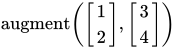

Concatenation in the other direction may of course be done by transposition:
■ augment([[x][y]], [[z][w]])
[[x][y][z][w]]
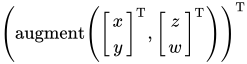
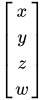

Trith
[1 2 3] [4 5 6] concatUNIX Shell
Using proper built-in Bash arrays:
array1=( 1 2 3 4 5 )
array2=( 6 7 8 9 10 )
botharrays=( ${array1[@]} ${array2[@]} )Whitespace-delimited strings work in much the same way:
array1='1 2 3 4 5'
array2='6 7 8 9 10'
# Concatenated to a Bash array ...
botharrays_a=( $array1 $array2 )
# Concatenated to a string ...
botharrays_s="$array1 $array2"Ursa
# create two streams (the ursa equivalent of arrays)
# a contains the numbers 1-10, b contains 11-20
decl int<> a b
decl int i
for (set i 1) (< i 11) (inc i)
append i a
end for
for (set i 11) (< i 21) (inc i)
append i b
end for
# append the values in b to a
append b a
# output a to the console
out a endl consoleVala
int[] array_concat(int[]a,int[]b){
int[] c = new int[a.length + b.length];
Memory.copy(c, a, a.length * sizeof(int));
Memory.copy(&c[a.length], b, b.length * sizeof(int));
return c;
}
void main(){
int[] a = {1,2,3,4,5};
int[] b = {6,7,8};
int[] c = array_concat(a,b);
foreach(int i in c){
stdout.printf("%d\n",i);
}
}VBA
Option Explicit
Sub MainConcat_Array()
Dim Aray_1() As Variant, Aray_2() As Variant
Dim Result() As Variant
Aray_1 = Array(1, 2, 3, 4, 5, #11/24/2017#, "azerty")
Aray_2 = Array("A", "B", "C", 18, "End")
Result = Concat_Array(Aray_1, Aray_2)
Debug.Print "With Array 1 : " & Join(Aray_1, ", ")
Debug.Print "And Array 2 : " & Join(Aray_2, ", ")
Debug.Print "The result is Array 3 : " & Join(Result, ", ")
End Sub
Function Concat_Array(A1() As Variant, A2() As Variant) As Variant()
Dim TmpA1() As Variant, N As Long, i As Long
N = UBound(A1) + 1
TmpA1 = A1
ReDim Preserve TmpA1(N + UBound(A2))
For i = N To UBound(TmpA1)
TmpA1(i) = A2(i - N)
Next
Concat_Array = TmpA1
End Function- Output:
With Array 1 : 1, 2, 3, 4, 5, 24/11/2017, azerty And Array 2 : A, B, C, 18, End The result is Array 3 : 1, 2, 3, 4, 5, 24/11/2017, azerty, A, B, C, 18, End
VBScript
Function ArrayConcat(arr1, arr2)
ReDim ret(UBound(arr1) + UBound(arr2) + 1)
For i = 0 To UBound(arr1)
ret(i) = arr1(i)
Next
offset = Ubound(arr1) + 1
For i = 0 To UBound(arr2)
ret(i + offset) = arr2(i)
Next
ArrayConcat = ret
End Function
arr1 = array(10,20,30)
arr2 = array(40,50,60)
WScript.Echo "arr1 = array(" & Join(arr1,", ") & ")"
WScript.Echo "arr2 = array(" & Join(arr2,", ") & ")"
arr3 = ArrayConcat(arr1, arr2)
WScript.Echo "arr1 + arr2 = array(" & Join(arr3,", ") & ")"- Output:
arr1 = array(10, 20, 30) arr2 = array(40, 50, 60) arr1 + arr2 = array(10, 20, 30, 40, 50, 60)
Visual Basic .NET
Dim iArray1() As Integer = {1, 2, 3}
Dim iArray2() As Integer = {4, 5, 6}
Dim iArray3() As Integer = Nothing
iArray3 = iArray1.Concat(iArray2).ToArrayV (Vlang)
V (Vlang) uses a << operator for array concatenation. Destination array needs to be mutable.
// V, array concatenation
// Tectonics: v run array-concatenation.v
module main
// starts here
pub fn main() {
mut arr1 := [1,2,3,4]
arr2 := [5,6,7,8]
arr1 << arr2
println(arr1)
}- Output:
$ v run array-concatenation.v [1, 2, 3, 4, 5, 6, 7, 8]
Wart
Wart doesn't have arrays yet, just lists.
a <- '(1 2 3)
b <- '(4 5 6)
a+b
# => (1 2 3 4 5 6)Wren
var arr1 = [1,2,3]
var arr2 = [4,5,6]
System.print(arr1 + arr2)- Output:
[1, 2, 3, 4, 5, 6]
XPL0
A way to concatenate two XPL0 arrays when you know their size (and usually it is so). Works on Raspberry Pi. MAlloc works differently in other versions.
func Array_concat(A, AN, B, BN, S);
int A, AN, B, BN, S;
int P;
[
P:= MAlloc(S * (AN + BN));
CopyMem(P, A, AN*S);
CopyMem(P + AN*S, B, BN*S);
return P;
];
\ testing
int A, B, C, I, SizeOf;
[
A:= [ 1, 2, 3, 4, 5 ];
B:= [ 6, 7, 8, 9, 0 ];
SizeOf:= @B - @A;
C:= Array_concat(A, 5, B, 5, SizeOf);
for I:= 0 to 10-1 do
[IntOut(0, C(I)); ChOut(0, ^ )];
Release(C);
]- Output:
1 2 3 4 5 6 7 8 9 0
Yabasic
sub arrayConcatenation(a(), b())
local ta, tb, nt, i
ta = arraysize(a(), 1)
tb = arraysize(b(), 1)
nt = ta + tb
redim a(nt)
for i = ta + 1 to nt
a(i) = b(i - ta)
next i
return nt
end sub
//===============================
SIZE = 5
dim a(SIZE)
dim b(SIZE)
for i = 1 to SIZE
a(i) = i
b(i) = i + SIZE
next i
nt = arrayConcatenation(a(), b())
for i = 1 to nt
print a(i);
if i < nt print ", ";
next i
printYacas
Concat({1,2,3}, {4,5,6})
Out> {1, 2, 3, 4, 5, 6}Yorick
a = [1,2,3];
b = [4,5,6];
ab = grow(a, b);Z80 Assembly
The routine Monitor_Memdump displays a hexdump to the Amstrad CPC's screen.
Credit to Keith of ChibiAkumas for creating it.
org $8000
ld hl,TestArray1 ; pointer to first array
ld de,ArrayRam ; pointer to ram area
ld bc,6 ; size of first array
ldir
; DE is already adjusted past the last entry
; of the first array
ld hl,TestArray2 ; pointer to second array
ld bc,4 ; size of second array
ldir
call Monitor_MemDump
db 32 ; hexdump 32 bytes (only the bytes from the arrays will be shown in the output for clarity)
dw ArrayRam ; start dumping from ArrayRam
ret ; return to basic
ArrayRam:
ds 24,0 ;24 bytes of ram initialized to zero
org $9000
TestArray2:
byte $23,$45,$67,$89
; just to prove that this doesn't rely on the arrays
; being "already concatenated" I've stored them
; in the reverse order.
TestArray1:
byte $aa,$bb,$cc,$dd,$ee,$ff- Output:
801D: AA BB CC DD EE FF 23 45 67 89
Zig
There are no hidden memory allocations in Zig.
const std = @import("std");
pub fn main() !void {
var gpa = std.heap.GeneralPurposeAllocator(.{}){};
defer _ = gpa.deinit();
const allocator = gpa.allocator();
var array1 = [_]u32{ 1, 2, 3, 4, 5 };
var array2 = [_]u32{ 6, 7, 8, 9, 10, 11, 12 };
const slice3 = try std.mem.concat(allocator, u32, &[_][]const u32{ &array1, &array2 });
defer allocator.free(slice3);
// Same result, alternative syntax
const slice4 = try std.mem.concat(allocator, u32, &[_][]const u32{ array1[0..], array2[0..] });
defer allocator.free(slice4);
std.debug.print(
"Array 1: {any}\nArray 2: {any}\nSlice 3: {any}\nSlice 4: {any}\n",
.{ array1, array2, slice3, slice4 },
);
}- Output:
Array 1: { 1, 2, 3, 4, 5 }
Array 2: { 6, 7, 8, 9, 10, 11, 12 }
Slice 3: { 1, 2, 3, 4, 5, 6, 7, 8, 9, 10, 11, 12 }
Slice 4: { 1, 2, 3, 4, 5, 6, 7, 8, 9, 10, 11, 12 }
zkl
Lists (both mutable and read only), no built in support for numeric vectors/arrays/matrices
T(1,2).extend(T(4,5,6)) //-->L(1,2,4,5,6)
T(1,2).extend(4,5,6) //-->L(1,2,4,5,6)zonnon
module Main;
import
System.Collections.ArrayList as Array,
System.Console as Console;
type
Vector = array {math} * of integer;
procedure Concat(x,y: Vector): Vector;
var
i,k: integer;
res: Vector;
begin
res := new Vector(len(x) + len(y));
k := 0;
for i := 0 to len(x) - 1 do
res[k] := x[i];inc(k)
end;
for i := 0 to len(y) - 1 do
res[k] := y[i];inc(k)
end;
return res
end Concat;
procedure Concat2(x,y: Array): Array;
var
i: integer;
res: Array;
begin
res := new Array(x.Count + y.Count);
for i := 0 to x.Count - 1 do
res.Add(x[i]);
end;
for i := 0 to y.Count - 1 do
res.Add(y[i]);
end;
return res
end Concat2;
procedure WriteVec(x: Vector);
var
i: integer;
begin
for i := 0 to len(x) - 1 do;
write(x[i]:3)
end;
writeln;
end WriteVec;
procedure WriteAry(x: Array);
var
i: integer;
begin
for i := 0 to x.Count - 1 do;
Console.Write("{0,3}",x[i])
end;
writeln;
end WriteAry;
var
a,b: Vector;
x,y: Array;
begin
a := [1,2,3,4];
b := [6,7,8,9];
WriteVec(Concat(a,b));
x := new Array(4);
y := new Array(4);
x.Add(2);x.Add(4);x.Add(6);x.Add(8);
y.Add(3);y.Add(5);y.Add(9);y.Add(11);
WriteAry(Concat2(x,y));
end Main.- Output:
1 2 3 4 6 7 8 9 2 4 6 8 3 5 9 11
Zsh
Concatenating arrays.
a=(1 2 3)
b=(a b c)
c=($a $b)Pushing a single element into an array.
a+=4Pushing another array into an array.
a+=($b)ZX Spectrum Basic
10 LET x=10
20 LET y=20
30 DIM a(x)
40 DIM b(y)
50 DIM c(x+y)
60 FOR i=1 TO x
70 LET c(i)=a(i)
80 NEXT i
90 FOR i=1 TO y
100 LET c(x+i)=b(i)
110 NEXT i
120 FOR i=1 TO x+y
130 PRINT c(i);", ";
140 NEXT i- Simple
- Programming Tasks
- Data Structures
- 11l
- 68000 Assembly
- 8th
- AArch64 Assembly
- ABAP
- ACL2
- Action!
- ActionScript
- Ada
- Aime
- ALGOL 68
- ALGOL W
- Amazing Hopper
- AntLang
- Apex
- APL
- AppleScript
- ARM Assembly
- Arturo
- ATS
- AutoHotkey
- AutoIt
- Avail
- AWK
- Babel
- Bash
- BASIC
- Applesoft BASIC
- Chipmunk Basic
- GW-BASIC
- Minimal BASIC
- MSX Basic
- Quite BASIC
- BaCon
- BBC BASIC
- Commodore BASIC
- Run BASIC
- BASIC256
- Binary Lambda Calculus
- BQN
- Bracmat
- Burlesque
- C
- C sharp
- C++
- Ceylon
- Clojure
- COBOL
- CoffeeScript
- Common Lisp
- Component Pascal
- Crystal
- D
- Delphi
- Diego
- Dyalect
- E
- EasyLang
- EchoLisp
- ECL
- Ecstasy
- Efene
- EGL
- Ela
- Elena
- Elixir
- Elm
- Emacs Lisp
- EMal
- Erlang
- ERRE
- Euphoria
- F Sharp
- Factor
- Fantom
- FBSL
- Forth
- Fortran
- Free Pascal
- FreeBASIC
- Frink
- FunL
- Futhark
- FutureBasic
- Gambas
- GAP
- Genie
- GLSL
- Go
- Gosu
- Groovy
- Haskell
- HicEst
- Hy
- I
- Icon
- Unicon
- IDL
- Idris
- Inform 7
- Insitux
- Ioke
- J
- Jakt
- Java
- JavaScript
- Joy
- Jq
- Julia
- K
- Klingphix
- Klong
- Kotlin
- LabVIEW
- Lambdatalk
- Lang
- Lang5
- Langur
- Lasso
- LDPL
- Ldpl-std
- LFE
- Liberty BASIC
- LIL
- Limbo
- Lingo
- Little
- Logo
- Lua
- M2000 Interpreter
- Maple
- Mathcad
- Mathematica
- Wolfram Language
- MATLAB
- Octave
- Maxima
- Mercury
- Min
- MiniScript
- Nanoquery
- Neko
- Nemerle
- NetRexx
- NewLISP
- Nial
- Nim
- Nu
- Oberon-2
- Objeck
- Objective-C
- OCaml
- Odin
- Oforth
- Onyx
- OoRexx
- Order
- OxygenBasic
- Oz
- PARI/GP
- Pascal
- Perl
- Phix
- Phix/basics
- Phixmonti
- PHP
- Picat
- PicoLisp
- Pike
- PL/I
- Plain English
- Pony
- PostScript
- Initlib
- PowerShell
- Processing
- Prolog
- PureBasic
- Python
- Q
- QBasic
- QB64
- Quackery
- R
- Racket
- Raku
- RapidQ
- Rapira
- REBOL
- Red
- ReScript
- Retro
- REXX
- Ring
- RLaB
- RPL
- Ruby
- Rust
- S-lang
- SASL
- Scala
- Scheme
- Seed7
- SenseTalk
- SETL
- Sidef
- Simula
- Slate
- Slope
- SmallBASIC
- Smalltalk
- SNOBOL4
- SparForte
- Standard ML
- Stata
- Swift
- Tailspin
- Tcl
- TI-89 BASIC
- Trith
- UNIX Shell
- Ursa
- Vala
- VBA
- VBScript
- Visual Basic .NET
- V (Vlang)
- Wart
- Wren
- XPL0
- Yabasic
- Yacas
- Yorick
- Z80 Assembly
- Zig
- Zkl
- Zonnon
- Zsh
- ZX Spectrum Basic
- Pages with too many expensive parser function calls