
Subtractive generator

You are encouraged to solve this task according to the task description, using any language you may know.
A subtractive generator calculates a sequence of random numbers, where each number is congruent to the subtraction of two previous numbers from the sequence.
The formula is

for some fixed values of , and , all positive integers. Supposing that , then the state of this generator is the list of the previous numbers from to . Many states generate uniform random integers from to , but some states are bad. A state, filled with zeros, generates only zeros. If is even, then a state, filled with even numbers, generates only even numbers. More generally, if is a factor of , then a state, filled with multiples of , generates only multiples of .


All subtractive generators have some weaknesses. The formula correlates , and ; these three numbers are not independent, as true random numbers would be. Anyone who observes consecutive numbers can predict the next numbers, so the generator is not cryptographically secure. The authors of Freeciv (utility/rand.c) and xpat2 (src/testit2.c) knew another problem: the low bits are less random than the high bits.


The subtractive generator has a better reputation than the linear congruential generator, perhaps because it holds more state. A subtractive generator might never multiply numbers: this helps where multiplication is slow. A subtractive generator might also avoid division: the value of is always between and , so a program only needs to add to negative numbers.
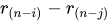

The choice of and affects the period of the generator. A popular choice is and , so the formula is



The subtractive generator from xpat2 uses

The implementation is by J. Bentley and comes from program_tools/universal.c of the DIMACS (netflow) archive at Rutgers University. It credits Knuth, TAOCP, Volume 2, Section 3.2.2 (Algorithm A).
Bentley uses this clever algorithm to seed the generator.
- Start with a single in range to .
- Set and . The inclusion of avoids some bad states (like all zeros, or all multiples of 10).
- Compute using the subtractive formula .
- Reorder these 55 values so , , , ..., .
- This is the same order as , , , ..., .
- This rearrangement exploits how 34 and 55 are relatively prime.
- Compute the next 165 values to . Store the last 55 values.












This generator yields the sequence , , and so on. For example, if the seed is 292929, then the sequence begins with , , . By starting at , this generator avoids a bias from the first numbers of the sequence. This generator must store the last 55 numbers of the sequence, so to compute the next . Any array or list would work; a ring buffer is ideal but not necessary.





Implement a subtractive generator that replicates the sequences from xpat2.
11l
Deque[Int] s
V seed = 292929

s.append(seed)
s.append(1)

L(n) 2..54
   s.append((s[n - 2] - s[n - 1]) % 10 ^ 9)

Deque[Int] r
L(n) 55
   V i = (34 * (n + 1)) % 55
   r.append(s[i])

F py_mod(a, b)
   R ((a % b) + b) % b

F getnextr()
   :r.append(py_mod((:r[0] - :r[31]), 10 ^ 9))
   :r.pop_left()
   R :r[54]

L 0 .< 219 - 54
   getnextr()

L 5
print(‘result = ’getnextr())- Output:
result = 467478574
result = 512932792
result = 539453717
result = 20349702
result = 615542081
Ada
subtractive_generator.ads:
package Subtractive_Generator is
   type State is private;
   procedure Initialize (Generator : in out State; Seed : Natural);
   procedure Next (Generator : in out State; N : out Natural);
private
   type Number_Array is array (Natural range <>) of Natural;
   type State is record
      R    : Number_Array (0 .. 54);
      Last : Natural;
   end record;
end Subtractive_Generator;
subtractive_generator.adb:
package body Subtractive_Generator is

   procedure Initialize (Generator : in out State; Seed : Natural) is
      S : Number_Array (0 .. 1);
      I : Natural := 0;
      J : Natural := 1;
   begin
      S (0) := Seed;
      S (1) := 1;
      Generator.R (54) := S (0);
      Generator.R (33) := S (1);
      for N in 2 .. Generator.R'Last loop
         S (I) := (S (I) - S (J)) mod 10 ** 9;
         Generator.R ((34 * N - 1) mod 55) := S (I);
         I := (I + 1) mod 2;
         J := (J + 1) mod 2;
      end loop;
      Generator.Last := 54;
      for I in 1 .. 165 loop
         Subtractive_Generator.Next (Generator => Generator, N => J);
      end loop;
   end Initialize;

   procedure Next (Generator : in out State; N : out Natural) is
   begin
      Generator.Last := (Generator.Last + 1) mod 55;
      Generator.R (Generator.Last) :=
        (Generator.R (Generator.Last)
         - Generator.R ((Generator.Last - 24) mod 55)) mod 10 ** 9;
      N := Generator.R (Generator.Last);
   end Next;

end Subtractive_Generator;
Example main.adb:
with Ada.Text_IO;
with Subtractive_Generator;

procedure Main is
   Random : Subtractive_Generator.State;
   N      : Natural;
begin
   Subtractive_Generator.Initialize (Generator => Random,
                                     Seed      => 292929);
   for I in 220 .. 222 loop
      Subtractive_Generator.Next (Generator => Random, N => N);
      Ada.Text_IO.Put_Line (Integer'Image (I) & ":" & Integer'Image (N));
   end loop;
end Main;
- Output:
 220: 467478574
 221: 512932792
 222: 539453717
AutoHotkey
r := InitR(292929)

Loop, 10
	Out .= (A_Index + 219) ":`t" GetRand(r) "`n"

MsgBox, % Out

GetRand(r) {
	i := Mod(r["j"], 55)
	, r[i] := Mod(r[i] - r[Mod(i + 31, 55)], r["m"])
	, r["j"] += 1
	return, (r[i] < 0 ? r[i] + r["m"] : r[i])
}

InitR(Seed) {
	r := {"j": 0, "m": 10 ** 9}, s := {0: Seed, 1: 1}
	Loop, 53
		s[A_Index + 1] := Mod(s[A_Index - 1] - s[A_Index], r["m"])
	Loop, 55
		r[A_Index - 1] := s[Mod(34 * A_Index, 55)]
	Loop, 165
		i := Mod(A_Index + 54, 55)
		, r[i] := Mod(r[i] - r[Mod(A_Index + 30, 55)], r["m"])
	return, r
}
- Output:
220:	467478574
221:	512932792
222:	539453717
223:	20349702
224:	615542081
225:	378707948
226:	933204586
227:	824858649
228:	506003769
229:	380969305
BASIC
BBC BASIC
      dummy% = FNsubrand(292929)
      FOR i% = 1 TO 10
        PRINT FNsubrand(0)
      NEXT
      END

      DEF FNsubrand(s%)
      PRIVATE r%(), p% : DIM r%(54)
      IF s% = 0 THEN
        p% = (p% + 1) MOD 55
        r%(p%) = r%(p%) - r%((p% + 31) MOD 55)
        IF r%(p%) < 0 r%(p%) += 10^9
        = r%(p%)
      ENDIF
      LOCAL i%
      r%(54) = s% : r%(33) = 1
      p% = 12
      FOR i% = 2 TO 54
        r%(p%) = r%((p%+42) MOD 55) - r%((p%+21) MOD 55)
        IF r%(p%) < 0 r%(p%) += 10^9
        p% = (p% + 34) MOD 55
      NEXT
      FOR i% = 55 TO 219
        IF FNsubrand(0)
      NEXT
      = 0
- Output:
 467478574
 512932792
 539453717
  20349702
 615542081
 378707948
 933204586
 824858649
 506003769
 380969305
FreeBASIC
Const As Integer mod_ = 1e9
Dim Shared As Integer state(0 To 55)
Dim Shared As Integer sk = 0, sj = 0

Declare Function subrand() As Integer

Sub subrandSeed (p1 As Integer)
    Dim As Integer i, j, p2
    state(0) = p1 Mod mod_
    p2 = 1
    j = 21

    For i = 1 To 54
        If j >= 55 Then j -= 55
        state(j) = p2
        p2 = p1 - p2
        If p2 < 0 Then p2 += mod_
        p1 = state(j)
        j += 21
    Next
    sk = 0
    sj = 24
    For i = 1 To 165
        subrand()
    Next
End Sub

Function subrand() As Integer
    If sk = sj Then
        subrandSeed(0)
    Else
        If sk = 0 Then sk = 54 Else sk -= 1
        If sj = 0 Then sj = 54 Else sj -= 1
        Dim As Integer x = state(sk) - state(sj)
        If x < 0 Then x += mod_
        state(sk) = x
        Return x
    End If
End Function

subrandSeed(292929)
For i As Integer = 0 To 9
    Print Using "r[###] = &"; i+220; subrand()
Next i

Sleep- Output:
Same as Kotlin entry
Gambas
Public mod_ As Integer = 1e9
Public state[55] As Integer
Public sk As Integer = 0
Public sj As Integer = 0

Public Sub Main()

  subrandSeed(292929)
  For i As Integer = 0 To 9
    Print "r["; i + 220; "] = "; subrand()
  Next

End

Sub subrandSeed(p1 As Integer)

  Dim i As Integer
  Dim p2 As Integer = 1
  Dim j As Integer = 21

  state[0] = p1 Mod mod_

  For i = 1 To 54
    If j >= 55 Then j -= 55
    state[j] = p2
    p2 = p1 - p2
    If p2 < 0 Then p2 += mod_
    p1 = state[j]
    j += 21
  Next
  sk = 0
  sj = 24
  For i = 1 To 165
    subrand()
  Next

End Sub

Function subrand() As Integer

  If sk = sj Then
    subrandSeed(0)
  Else
    If sk = 0 Then sk = 54 Else sk -= 1
    If sj = 0 Then sj = 54 Else sj -= 1
    Dim x As Integer = state[sk] - state[sj]
    If x < 0 Then x += mod_
    state[sk] = x
    Return x
  End If

End Function
uBasic/4tH
Push 292929 : Gosub 100 : d = Pop()

For i = 1 To 10
  Push 0 : Gosub 100
  Print Pop()
Next

End

100 s = Pop()
    If s = 0 Then
       p = (p + 1) % 55
       @(p) = @(p) - @((p + 31) % 55)
       If @(p) < 0 Then
          @(p) = @(p) + 1000000000
       Endif
       Push (@(p)) : Return
    Endif

    @(54) = s : @(33) = 1
    p = 12

    For i = 2 To 54
      @(p) = @((p + 42) % 55) - @((p + 21) % 55)
      If @(p) < 0 Then
          @(p) = @(p) + 1000000000
      Endif
      p = (p + 34) % 55
    Next

    For i = 55 To 219
        Push 0 : Gosub 100 : d = Pop()
    Next

    Push 0 : Return
- Output:
467478574
512932792
539453717
20349702
615542081
378707948
933204586
824858649
506003769
380969305

0 OK, 0:864
Bracmat
This is a translation of the C example.
1000000000:?MOD;
tbl$(state,55);
0:?si:?sj;

(subrand-seed=
  i,j,p2
.   1:?p2
  & mod$(!arg,!MOD):?(0$?state)
  & 1:?i
  & 21:?j
  &   whl
    ' ( !i:<55
      & (!j:~<55&!j+-55:?j|)
      & !p2:?(!j$?state)
      & (   !arg+-1*!p2:?p2:<0
          & !p2+!MOD:?p2
        |
        )
      & !(!j$state):?arg
      & !i+1:?i
      & !j+21:?j
      )
  & 0:?s1:?i
  & 24:?sj
  &   whl
    ' ( !i:<165
      & subrand$
      & !i+1:?i
      ));

(subrand=
  x
.   (!si:!sj&subrand-seed$0|)
  & (!si:>0&!si+-1|54):?si
  & (!sj:>0&!sj+-1|54):?sj
  & (   !(!si$state)+-1*!(!sj$state):?x:<0
      & !x+!MOD:?x
    |
    )
  & !x:?(!si$?state));

(Main=
  i
.   subrand-seed$292929
  & 0:?i
  &   whl
    ' ( !i:<10
      & out$(subrand$)
      & !i+1:?i
      ));

Main$;- Output:
467478574
512932792
539453717
20349702
615542081
378707948
933204586
824858649
506003769
380969305
C
This is basically the same as the reference C code, only differs in that it's C89.
#include<stdio.h>

#define MOD 1000000000
int state[55], si = 0, sj = 0;

int subrand();

void subrand_seed(int p1)
{
	int i, j, p2 = 1;

	state[0] = p1 % MOD;
	for (i = 1, j = 21; i < 55; i++, j += 21) {
		if (j >= 55) j -= 55;
		state[j] = p2;
		if ((p2 = p1 - p2) < 0) p2 += MOD;
		p1 = state[j];
	}
	si = 0;
	sj = 24;
	for (i = 0; i < 165; i++) subrand();
}

int subrand()
{
	int x;
	if (si == sj) subrand_seed(0);

	if (!si--) si = 54;
	if (!sj--) sj = 54;
	if ((x = state[si] - state[sj]) < 0) x += MOD;

	return state[si] = x;
}

int main()
{
	subrand_seed(292929);
	int i;
	for (i = 0; i < 10; i++) printf("%d\n", subrand());

	return 0;
}
C#
public class SubtractiveGenerator {
    public static int MAX = 1000000000;
    private int[] state;
    private int pos;

    private int mod(int n) {
        return ((n % MAX) + MAX) % MAX;
    }

    public SubtractiveGenerator(int seed) {
        state = new int[55];

        int[] temp = new int[55];
        temp[0] = mod(seed);
        temp[1] = 1;
        for(int i = 2; i < 55; ++i)
            temp[i] = mod(temp[i - 2] - temp[i - 1]);

        for(int i = 0; i < 55; ++i)
            state[i] = temp[(34 * (i + 1)) % 55];

        pos = 54;
        for(int i = 55; i < 220; ++i)
            next();
    }

    public int next() {
        int temp = mod(state[(pos + 1) % 55] - state[(pos + 32) % 55]);
        pos = (pos + 1) % 55;
        state[pos] = temp;
        return temp;
    }

    static void Main(string[] args) {
        SubtractiveGenerator gen = new SubtractiveGenerator(292929);
        for(int i = 220; i < 230; ++i)
            Console.WriteLine(i.ToString() + ": " + gen.next().ToString());
    }
}
- Output:
220: 467478574
221: 512932792
222: 539453717
223: 20349702
224: 615542081
225: 378707948
226: 933204586
227: 824858649
228: 506003769
229: 380969305
C++
// written for clarity not efficiency.

#include <iostream>
using std::cout;
using std::endl;

#include <boost/array.hpp>
#include <boost/circular_buffer.hpp>

class Subtractive_generator {
private:
    static const int param_i = 55;
    static const int param_j = 24;
    static const int initial_load = 219;
    static const int mod = 1e9;
    boost::circular_buffer<int> r;
public:
    Subtractive_generator(int seed);
    int next();
    int operator()(){return next();}
};

Subtractive_generator::Subtractive_generator(int seed)
:r(param_i)
{
    boost::array<int, param_i> s;
    s[0] = seed;
    s[1] = 1;
    for(int n = 2; n < param_i; ++n){
        int t = s[n-2]-s[n-1];
        if (t < 0 ) t+= mod;
        s[n] = t;
    }

    for(int n = 0; n < param_i; ++n){
	int i = (34 * (n+1)) % param_i;
        r.push_back(s[i]);
    }
    for(int n = param_i; n <= initial_load; ++n) next();
}

int Subtractive_generator::next()
{
    int t = r[0]-r[31];
    if (t < 0) t += mod;
    r.push_back(t);
    return r[param_i-1];
}

int main()
{
    Subtractive_generator rg(292929);

    cout << "result = " << rg() << endl;
    cout << "result = " << rg() << endl;
    cout << "result = " << rg() << endl;
    cout << "result = " << rg() << endl;
    cout << "result = " << rg() << endl;
    cout << "result = " << rg() << endl;
    cout << "result = " << rg() << endl;

    return 0;
}
- Output:
result = 467478574
result = 512932792
result = 539453717
result = 20349702
result = 615542081
result = 378707948
result = 933204586
Clojure
(defn xpat2-with-seed
  "produces an xpat2 function initialized from seed"
  [seed]
  (let [e9 1000000000
        fs (fn [[i j]] [j (mod (- i j) e9)])
        s (->> [seed 1] (iterate fs) (map first) (take 55) vec)
        rinit (map #(-> % inc (* 34) (mod 55) s) (range 55))
        r-atom (atom [54 (int-array rinit)])
        update (fn [[nprev r]]
                  (let [n (-> nprev inc (mod 55))
                        rx #(get r (-> n (- %) (mod 55)))
                        rn (-> (rx 55) (- (rx 24)) (mod e9))
                        _ (aset-int r n rn)]
                    [n r]))
        xpat2 #(let [[n r] (swap! r-atom update)]
                (get r n))
        _ (dotimes [_ 165] (xpat2))]
    xpat2))

(def xpat2 (xpat2-with-seed 292929))

(println (xpat2) (xpat2) (xpat2)) ; prints: 467478574 512932792 539453717
Common Lisp
(defun sub-rand (state)
  (let ((x (last state)) (y (last state 25)))
    ;; I take "circular buffer" very seriously (until some guru
    ;; points out it's utterly wrong thing to do)
    (setf (cdr x) state)
    (lambda () (setf x (cdr x)
		     y (cdr y)
		     (car x) (mod (- (car x) (car y)) (expt 10 9))))))

;; returns an RNG with Bentley seeding
(defun bentley-clever (seed)
  (let ((s (list 1 seed))  f)
    (dotimes (i 53)
      (push (mod (- (cadr s) (car s)) (expt 10 9)) s))
    (setf f (sub-rand
	      (loop for i from 1 to 55 collect
		    (elt s (- 54 (mod (* 34 i) 55))))))
    (dotimes (x 165) (funcall f))
    f))

;; test it (output same as everyone else's)
(let ((f (bentley-clever 292929)))
  (dotimes (x 10) (format t "~a~%" (funcall f))))
D
import std.stdio;

struct Subtractive {
    enum MOD = 1_000_000_000;
    private int[55] state;
    private int si, sj;

    this(in int p1) pure nothrow {
        subrandSeed(p1);
    }

    void subrandSeed(int p1) pure nothrow {
        int p2 = 1;

        state[0] = p1 % MOD;
        for (int i = 1, j = 21; i < 55; i++, j += 21) {
            if (j >= 55)
                j -= 55;
            state[j] = p2;
            if ((p2 = p1 - p2) < 0)
                p2 += MOD;
            p1 = state[j];
        }

        si = 0;
        sj = 24;
        foreach (i; 0 .. 165)
            subrand();
    }

    int subrand() pure nothrow {
        if (si == sj)
            subrandSeed(0);

        if (!si--)
            si = 54;
        if (!sj--)
            sj = 54;

        int x = state[si] - state[sj];
        if (x < 0)
            x += MOD;

        return state[si] = x;
    }
}

void main() {
    auto gen = Subtractive(292_929);
    foreach (i; 0 .. 10)
        writeln(gen.subrand());
}
- Output:
467478574
512932792
539453717
20349702
615542081
378707948
933204586
824858649
506003769
380969305
dc
[*
 * (seed) lsx --
 * Seeds the subtractive generator.
 * Uses register R to hold the state.
 *]sz
[
 [* Fill ring buffer R[0] to R[54]. *]sz
 d 54:R SA              [A = R[54] = seed]sz
 1 d 33:R SB            [B = R[33] = 1]sz
 12 SC                  [C = index 12, into array R.]sz
 [55 -]SI
 [                      [Loop until C is 54:]sz
  lA lB - d lC:R         [R[C] = A - B]sz
  lB sA sB               [Parallel let A = B and B = A - B]sz
  lC 34 + d 55 !>I d sC  [C += 34 (mod 55)]sz
  54 !=L
 ]d SL x
 [* Point R[55] and R[56] into ring buffer. *]sz
 0 55:R                 [R[55] = index 0, of 55th last number.]sz
 31 56:R                [R[56] = index 31, of 24th last number.]sz
 [* Stir ring buffer. *]sz
 165 [                  [Loop 165 times:]sz
  55;R;R 56;R;R - 55;R:R [Discard a random number.]sz
  55;R 1 + d 55 !>I 55:R [R[55] += 1 (mod 55)]sz
  56;R 1 + d 55 !>I 56:R [R[56] += 1 (mod 55)]sz
  1 - d 0 <L
 ]d sL x
 LAsz LBsz LCsz LIsz LLsz
]ss

[*
 * lrx -- (random number from 0 to 10^9 - 1)
 * Returns the next number from the subtractive generator.
 * Uses register R, seeded by lsx.
 *]sz
[
 55;R;R 56;R;R -        [R[R[55]] - R[R[56]] is next random number.]sz
 d 55;R:R               [Put it in R[R[55]]. Also leave it on stack.]sz
 [55 -]SI
 55;R 1 + d 55 !>I 55:R [R[55] += 1 (mod 55)]sz
 56;R 1 + d 55 !>I 56:R [R[56] += 1 (mod 55)]sz
 [1000000000 +]sI
 1000000000 % d 0 >I    [Random number = it (mod 10^9)]sz
 LIsz
]sr


[* Seed with 292929 and print first three random numbers. *]sz
292929 lsx
lrx psz
lrx psz
lrx psz
This program prints 467478574, 512932792, 539453717.
This implementation never uses multiplication, but it does use modulus (remainder from division) to put each random number in range from 0 to 10^9 - 1.
EasyLang
MOD = 1000000000
len state[] 55
arrbase state[] 0
global si sj .
funcdecl subrand .
proc subrand_seed p1 . .
   p2 = 1
   state[0] = p1 mod MOD
   j = 21
   for i = 1 to 54
      state[j] = p2
      p2 = (p1 - p2) mod MOD
      p1 = state[j]
      j = (j + 21) mod 55
   .
   si = 0
   sj = 24
   for i = 0 to 164
      h = subrand
      h = h
   .
.
func subrand .
   if si = sj
      subrand_seed 0
   .
   si = (si - 1) mod 55
   sj = (sj - 1) mod 55
   x = (state[si] - state[sj]) mod MOD
   state[si] = x
   return x
.
subrand_seed 292929
for i to 10
   print subrand
.
Elixir
defmodule Subtractive do
  def new(seed) when seed in 0..999_999_999 do
    s = Enum.reduce(1..53, [1, seed], fn _,[a,b|_]=acc -> [b-a | acc] end)
        |> Enum.reverse
        |> List.to_tuple
    state = for i <- 1..55, do: elem(s, rem(34*i, 55))
    {:ok, _pid} = Agent.start_link(fn -> state end, name: :Subtractive)
    Enum.each(1..220, fn _ -> rand end) # Discard first 220 elements of sequence.
  end

  def rand do
    state = Agent.get(:Subtractive, &(&1))
    n = rem(Enum.at(state, -55) - Enum.at(state, -24) + 1_000_000_000, 1_000_000_000)
    :ok = Agent.update(:Subtractive, fn _ -> tl(state) ++ [n] end)
    hd(state)
  end
end

Subtractive.new(292929)
for _ <- 1..10, do: IO.puts Subtractive.rand
- Output:
467478574
512932792
539453717
20349702
615542081
378707948
933204586
824858649
506003769
380969305
F#
Similar to Haskell, using lazy evaluation.
[<EntryPoint>]
let main argv =
    let m = 1000000000
    let init = Seq.unfold (fun ((i, s2, s1)) -> Some((s2,i), (i+1, s1, (m+s2-s1)%m))) (0, 292929, 1)
            |> Seq.take 55
            |> Seq.sortBy (fun (_,i) -> (34*i+54)%55)
            |> Seq.map fst
    let rec r = seq {
        yield! init
        yield! Seq.map2 (fun u v -> (m+u-v)%m) r (Seq.skip 31 r)
    }

    r |> Seq.skip 220 |> Seq.take 3
    |> Seq.iter (printfn "%d")
    0
- Output:
467478574
512932792
539453717
Fortran
module subgenerator
  implicit none

  integer, parameter :: modulus = 1000000000
  integer :: s(0:54), r(0:54)

contains

subroutine initgen(seed)
  integer :: seed
  integer :: n, rnum

  s(0) = seed
  s(1) = 1

  do n = 2, 54
    s(n) = mod(s(n-2) - s(n-1), modulus)
    if (s(n) < 0) s(n) = s(n) + modulus
  end do

  do n = 0, 54
    r(n) = s(mod(34*(n+1), 55))
  end do

  do n = 1, 165
    rnum = subrand()
  end do

end subroutine initgen

integer function subrand()
  integer, save :: p1 = 0
  integer, save :: p2 = 31

  r(p1) = mod(r(p1) - r(p2), modulus)
  if (r(p1) < 0) r(p1) = r(p1) + modulus
  subrand = r(p1)
  p1 = mod(p1 + 1, 55)
  p2 = mod(p2 + 1, 55)

end function subrand
end module subgenerator

program subgen_test
  use subgenerator
  implicit none

  integer :: seed = 292929
  integer :: i

  call initgen(seed)
  do i = 1, 10
    write(*,*) subrand()
  end do

end program
- Output:
    467478574
    512932792
    539453717
    20349702
    615542081
    378707948
    933204586
    824858649
    506003769
    380969305
Go
package main

import (
    "fmt"
    "os"
)

// A fairly close port of the Bentley code, but parameterized to better
// conform to the algorithm description in the task, which didn't assume
// constants for i, j, m, and seed.  also parameterized here are k,
// the reordering factor, and s, the number of intial numbers to discard,
// as these are dependant on i.
func newSG(i, j, k, s, m, seed int) func() int {
    // check parameters for range and mutual consistency
    assert(i > 0, "i must be > 0")
    assert(j > 0, "j must be > 0")
    assert(i > j, "i must be > j")
    assert(k > 0, "k must be > 0")
    p, q := i, k
    if p < q {
        p, q = q, p
    }
    for q > 0 {
        p, q = q, p%q
    }
    assert(p == 1, "k, i must be relatively prime")
    assert(s >= i, "s must be >= i")
    assert(m > 0, "m must be > 0")
    assert(seed >= 0, "seed must be >= 0")
    // variables for closure f
    arr := make([]int, i)
    a := 0
    b := j
    // f is Bently RNG lprand
    f := func() int {
        if a == 0 {
            a = i
        }
        a--
        if b == 0 {
            b = i
        }
        b--
        t := arr[a] - arr[b]
        if t < 0 {
            t += m
        }
        arr[a] = t
        return t
    }
    // Bentley seed algorithm sprand
    last := seed
    arr[0] = last
    next := 1
    for i0 := 1; i0 < i; i0++ {
        ii := k * i0 % i
        arr[ii] = next
        next = last - next
        if next < 0 {
            next += m
        }
        last = arr[ii]
    }
    for i0 := i; i0 < s; i0++ {
        f()
    }
    // return the fully initialized RNG
    return f
}

func assert(p bool, m string) {
    if !p {
        fmt.Println(m)
        os.Exit(1)
    }
}

func main() {
    // 1st test case included in program_tools/universal.c.
    // (2nd test case fails.  A single digit is missing, indicating a typo.)
    ptTest(0, 1, []int{921674862, 250065336, 377506581})

    // reproduce 3 values given in task description
    skip := 220
    sg := newSG(55, 24, 21, skip, 1e9, 292929)
    for n := skip; n <= 222; n++ {
        fmt.Printf("r(%d) = %d\n", n, sg())
    }
}

func ptTest(nd, s int, rs []int) {
    sg := newSG(55, 24, 21, 220+nd, 1e9, s)
    for _, r := range rs {
        a := sg()
        if r != a {
            fmt.Println("Fail")
            os.Exit(1)
        }
    }
}
- Output:
r(220) = 467478574
r(221) = 512932792
r(222) = 539453717
Haskell
subtractgen :: Int -> [Int]
subtractgen seed = drop 220 out
  where
    out = mmod $ r <> zipWith (-) out (drop 31 out)
      where
        r = take 55 $ shuffle $ cycle $ take 55 s
        shuffle x = (:) . head <*> shuffle $ drop 34 x
        s = mmod $ seed : 1 : zipWith (-) s (tail s)
        mmod = fmap (`mod` 10 ^ 9)

main :: IO ()
main = mapM_ print $ take 10 $ subtractgen 292929
- Output:
467478574
512932792
539453717
20349702
615542081
378707948
933204586
824858649
506003769
380969305
Icon and Unicon
- Output:
467478574
512932792
539453717
20349702
615542081
378707948
933204586
824858649
506003769
380969305
J
sg.ijs
Loops are hidden in a generalized power conjunction ^: . f^:n y evaluates f n times, as in f(f(f(...f(y)))...) . Yes! f^:(-1) IS the inverse of f . When known.
came_from_locale_sg_=: coname''
cocurrent'sg' NB. install the state of rng sg into locale sg

SEED=: 292929
'I J M first_Bentley_number B2'=: 55 24 1e9 34 165
SG=: 1 : 'M&|@:-/@:(m&{)'
r=: (I|(first_Bentley_number*>:i.I)) { (, _2 _1 SG)^:(I-2) 1,~SEED

sg=: 3 : 0
t=. (, (-I,J)SG)^:y r
r=: y }. t
t {.~ -y
)
discard=. sg B2

cocurrent came_from_locale  NB. return to previous locale
sg=: sg_sg_                 NB. make a local name for sg in locale sg
Use:
$ jconsole
   load'sg.ijs'
   sg 2
467478574 512932792
   sg 4
539453717 20349702 615542081 378707948
Java
import java.util.function.IntSupplier;
import static java.util.stream.IntStream.generate;

public class SubtractiveGenerator implements IntSupplier {
    static final int MOD = 1_000_000_000;
    private int[] state = new int[55];
    private int si, sj;

    public SubtractiveGenerator(int p1) {
        subrandSeed(p1);
    }

    void subrandSeed(int p1) {
        int p2 = 1;

        state[0] = p1 % MOD;
        for (int i = 1, j = 21; i < 55; i++, j += 21) {
            if (j >= 55)
                j -= 55;
            state[j] = p2;
            if ((p2 = p1 - p2) < 0)
                p2 += MOD;
            p1 = state[j];
        }

        si = 0;
        sj = 24;
        for (int i = 0; i < 165; i++)
            getAsInt();
    }

    @Override
    public int getAsInt() {
        if (si == sj)
            subrandSeed(0);

        if (si-- == 0)
            si = 54;
        if (sj-- == 0)
            sj = 54;

        int x = state[si] - state[sj];
        if (x < 0)
            x += MOD;

        return state[si] = x;
    }

    public static void main(String[] args) {
        generate(new SubtractiveGenerator(292_929)).limit(10)
                .forEach(System.out::println);
    }
}
467478574
512932792
539453717
20349702
615542081
378707948
933204586
824858649
506003769
380969305
jq
Adapted from Wren
Works with gojq, the Go implementation of jq
Note that `subrand` as defined here returns the object representing the current state of the PRNG, with .x set to the most recent PRN.
Note also that because jq does not support forward declarations except insofar as a subfunction may call its parent (or grandparent, etc), we have defined `subrand` as an accessible subfunction of `subrandSeed`.
# If $p is null, then call `subrand`,
# which sets .x as the PRN and which expects the the input to
# be the PRNG state, which is updated.
def subrandSeed($p):

  def subrand:
    if (.si == .sj) then subrandSeed(0) else . end
    | .si |= (if . == 0 then 54 else . - 1 end)
    | .sj |= (if . == 0 then 54 else . - 1 end)
    | .mod as $mod
    | .x = ((.state[.si] - .state[.sj]) | if . < 0 then . + $mod else . end)
    | .state[.si] = .x ;

  if $p == null then subrand
  else
  {mod: 1e9,  state: [],  si: 0,  sj: 0,  p: $p,  p2: 1,  j: 21}
  | .state[0] = ($p % .mod)
  | reduce range(1; 55) as $i (.;
        if .j >= 55 then .j += -55 else . end
        | .state[.j] = .p2
        | .p2 = .p - .p2
        | if .p2 < 0 then .p2 = .p2 + .mod else . end
        | .p = .state[.j]
        | .j += 21)
  | .si = 0
  | .sj = 24
  | reduce range(1; 166) as $i (.; subrand)
  end;

def subrand:
  subrandSeed(null);

subrandSeed(292929)
| foreach range(0; 10) as $i (.;
    subrand;
"r[\($i+220)] = \(.x)")- Output:
r[220] = 467478574
r[221] = 512932792
r[222] = 539453717
r[223] = 20349702
r[224] = 615542081
r[225] = 378707948
r[226] = 933204586
r[227] = 824858649
r[228] = 506003769
r[229] = 380969305
Julia
Here is a script, which does not use multiplicative operators, without relying on the optimizer.
i,j,m,d,seed = 55,24,10^9,34,292929     # parameters
s = Array{Int32}(undef,i); r = similar(s)
s[1:2] = [seed,1]                       # table initialization
for n = 3:i; (s[n] = s[n-2]-s[n-1]) < 0 && (s[n] += m) end
t = 1; for u=1:i; (global t+=d)>i && (t-=i); r[u]=s[t] end # permutation, r = s[(d*(1:i) .% i).+1]

u,v,n = i,i-j,i-1
while (n += 1) > 0
    (global u += 1) > i && (u = 1)      # circular indexing: u,v = ((n,n-j) .% i).+1
    (global v += 1) > i && (v = 1)
    (r[u] -= r[v]) < 0 && (r[u] += m)   # table update
    n < 220 && continue                 # 165 silent values
    print((n,r[u]))                     # show (index,value) of next pseudorandom number
    x = readline(stdin)                 # wait until the ENTER key is pressed
    length(x) > 0 && break              # any other key before ENTER => exit
end
- Output:
(220, 467478574)
(221, 512932792)
(222, 539453717)
(223, 20349702)
(224, 615542081)
(225, 378707948)
(226, 933204586)
(227, 824858649)
(228, 506003769)
(229, 380969305)
(230, 442823364)
(231, 994162810)
(232, 261423281)
Kotlin
// version 1.1.51

const val MOD = 1_000_000_000

val state = IntArray(55)
var si = 0
var sj = 0

fun subrandSeed(p: Int) {
    var p1 = p
    var p2 = 1
    state[0] = p1 % MOD
    var j = 21
    for (i in 1..54) {
        if (j >=55) j -= 55
        state[j] = p2
        p2 = p1 - p2
        if (p2 < 0) p2 += MOD
        p1 = state[j]
        j += 21
    }
    si = 0
    sj = 24
    repeat(165) { subrand() }
}

fun subrand(): Int {
    if (si == sj) subrandSeed(0)
    if (si-- == 0) si = 54
    if (sj-- == 0) sj = 54
    var x = state[si] - state[sj]
    if (x < 0) x += MOD
    state[si] = x
    return x
}

fun main(args: Array<String>) {
    subrandSeed(292_929)
    for (i in 0..9) println("r[${i + 220}] = ${subrand()}")
}
- Output:
r[220] = 467478574
r[221] = 512932792
r[222] = 539453717
r[223] = 20349702
r[224] = 615542081
r[225] = 378707948
r[226] = 933204586
r[227] = 824858649
r[228] = 506003769
r[229] = 380969305
Lua
function SubGen(seed)
  local n, r, s = 54, {}, { [0]=seed, 1 }
  for n = 2,54 do s[n] = (s[n-2] - s[n-1]) % 1e9 end
  for n = 0,54 do r[n] = s[(34*(n+1))%55] end
  local next = function()
    n = (n+1) % 55
    r[n] = (r[(n-55)%55] - r[(n-24)%55]) % 1e9
    return r[n]
  end
  for n = 55,219 do next() end
  return next
end
subgen = SubGen(292929)
for n = 220,229 do print(n,subgen()) end
- Output:
220     467478574
221     512932792
222     539453717
223     20349702
224     615542081
225     378707948
226     933204586
227     824858649
228     506003769
229     380969305
Mathematica/Wolfram Language
initialize[n_] :=
 Module[{buffer},
  buffer =
   Join[Nest[Flatten@{#, Mod[Subtract @@ #[[-2 ;;]], 10^9]} &, {n, 1},
       53][[1 + Mod[34 Range@54, 55]]], {n}];
  Nest[nextValue, buffer, 165]]

  nextValue[buffer_] :=
 Flatten@{Rest@buffer, Mod[Subtract @@ buffer[[{1, 32}]], 10^9]}
buffer = initialize[292929];
Do[Print@Last[buffer = nextValue[buffer]], {10}]

467478574
512932792
539453717
20349702
615542081
378707948
933204586
824858649
506003769
380969305
Nim
import deques, sequtils

template shfl(idx): untyped = (K*(idx+1)) mod I

func mutuallyprime(I, K: int16): bool {.compiletime.} =
  ## compile time check shuffling works properly
  let
    x = {1'i16..I}
    s = x.toSeq
  var r: set[int16]
  for n in 0..<I:
    r.incl s[n.shfl]
  r == x

func `%`(i: int, m: int): int = (if i < 0: i+m else: i)
  ## positive modulo, and we don't need to test if > m
  ## because (i-j) is always less than m

template next(state): untyped =
  state.addLast (state[^I]-state[^J]) % M
  discard state.popFirst()

func seedGen[I, J, K, M: static int](seed: range[0..M-1]): Deque[int] =
  var s = @[seed, 1]
  for _ in 2..<I:
    s.add (s[^2]-s[^1]) % M
  #reorder and put into ring buffer
  for i in 0..<I:
    result.addLast s[i.shfl]
  #cycle through the next 165 values
  for _ in 0..<3*I:
    result.next

func initSubGen[I, J, K, M: static int](seed: range[0..M-1]): auto =
  ##check parameters at compile time
  ##seed will be checked to be in the range 0..M-1
  static:
    for x in [I, J, K, M]:
      assert x > 0, "all params must be positive"
    assert I > J, "I must be > J"
    assert mutuallyprime(I, K), "I, K must be relatively prime"
  var r = seedGen[I, J, K, M](seed)
  result = proc(): int =
    r.next
    r.peekLast

let subGen* = initSubGen[55, 24, 34, 1e9.int]

when isMainModule:
  let rand = subGen(292929)
  for _ in 1..3:
    echo rand()
- Output:
467478574
512932792
539453717
OCaml
let _mod = 1_000_000_000
let state = Array.create 55 0
let si = ref 0
let sj = ref 0

let rec subrand_seed _p1 =
  let p1 = ref _p1 in
  let p2 = ref 1 in
  state.(0) <- !p1 mod _mod;
  let j = ref 21 in
  for i = 1 to pred 55 do
    if !j >= 55 then j := !j - 55;
    state.(!j) <- !p2;
    p2 := !p1 - !p2;
    if !p2 < 0 then p2 := !p2 + _mod;
    p1 := state.(!j);
    j := !j + 21;
  done;
  si := 0;
  sj := 24;
  for i = 0 to pred 165 do ignore (subrand()) done

and subrand() =
  if !si = !sj then subrand_seed 0;
  decr si;  if !si < 0 then si := 54;
  decr sj;  if !sj < 0 then sj := 54;
  let x = state.(!si) - state.(!sj) in
  let x = if x < 0 then x + _mod else x in
  state.(!si) <- x;
  (x)

let () =
  subrand_seed 292929;
  for i = 1 to 10 do Printf.printf "%d\n" (subrand()) done
- Output:
$ ocaml sub_gen.ml
467478574
512932792
539453717
20349702
615542081
378707948
933204586
824858649
506003769
380969305
ooREXX
/*REXX program uses a subtractive generaTor,and creates a sequence of ranDom numbers. */
/* array index must be positive! */
s=.array~new
r=.array~new
s[1]=292929
s[2]=1
billion=1e9
numeric digits 20
ci=55
Do i=2 To ci-1
  s[i+1]=mod(s[i-1]-s[i],billion)
  End
cp=34
Do j=0 To ci-1
  r[j+1]=s[mod(cp*(j+1),ci)+1]
  End
m=219
cj= 24
Do k=ci To m
  _=k//ci
  r[_+1]=mod(r[mod(k-ci,ci)+1]-r[mod(k-cj,ci)+1],billion)
  End
t=235
Do n=m+1 To t
  _=n//ci
  r[_+1]=mod(r[mod(n-ci,ci)+1]-r[mod(n-cj,ci)+1],billion)
  Say right(r[_+1],40)
  End
Exit
mod: Procedure
Parse Arg a,b
Return ((a//b)+b)//b- output when using the default input:
same as with REXX
PARI/GP
sgv=vector(55,i,random(10^9));sgi=1;
sg()=sgv[sgi=sgi%55+1]=(sgv[sgi]-sgv[(sgi+30)%55+1])%10^9
Perl
use 5.10.0;
use strict;

{ # bracket state data into a lexical scope
	my @state;
	my $mod = 1_000_000_000;

	sub bentley_clever {
		my @s = ( shift() % $mod, 1);
		push @s, ($s[-2] - $s[-1]) % $mod	while @s < 55;
		@state = map($s[(34 + 34 * $_) % 55], 0 .. 54);
		subrand() for (55 .. 219);
	}

	sub subrand()
	{
		bentley_clever(0) unless @state; # just incase

		my $x = (shift(@state) - $state[-24]) % $mod;
		push @state, $x;
		$x;
	}
}

bentley_clever(292929);
say subrand() for (1 .. 10);
- Output:
467478574
512932792
539453717
20349702
615542081
...
Phix
with javascript_semantics
sequence state = repeat(0,55)
integer pos

constant MAX = 1e9
function cap(integer n)
    if n<0 then n += MAX end if
    return n
end function

function next()
    pos = mod(pos,55)+1
    integer temp = cap(state[pos]-state[mod(pos+30,55)+1])
    state[pos] = temp
    return temp
end function

procedure init(integer seed)
    sequence temp = repeat(0,55)
    temp[1] = cap(seed)
    temp[2] = 1
    for i=3 to 55 do
        temp[i] = cap(temp[i-2]-temp[i-1])
    end for
    for i=1 to 55 do
        state[i] = temp[mod(34*i,55)+1]
    end for
    pos = 55
    for i=55 to 219 do
        {} = next()
    end for
end procedure

init(292929)
for i=220 to 222 do
    printf(1,"%d: %d\n",{i,next()})
end for
- Output:
220: 467478574
221: 512932792
222: 539453717
PicoLisp
Using a circular list (as a true "ring" buffer).
(setq
   *Bentley (apply circ (need 55))
   *Bentley2 (nth *Bentley 32) )

(de subRandSeed (S)
   (let (N 1  P (nth *Bentley 55))
      (set P S)
      (do 54
         (set (setq P (nth P 35)) N)
         (when (lt0 (setq N (- S N)))
            (inc 'N 1000000000) )
         (setq S (car P)) ) )
   (do 165 (subRand)) )

(de subRand ()
   (when (lt0 (dec *Bentley (pop '*Bentley2)))
      (inc *Bentley 1000000000) )
   (pop '*Bentley) )
Test:
(subRandSeed 292929)
(do 7 (println (subRand)))- Output:
467478574
512932792
539453717
20349702
615542081
378707948
933204586
PL/I
subtractive_generator: procedure options (main);

   declare (r, s) (0:54) fixed binary (31);
   declare (i, n, seed)  fixed binary (31);

   /* Bentley's initialization */
   seed = 292929;
   s(0) = seed; s(1) = 1;

   /* Compute s2,s3,...,s54 using the subtractive formula sn = s(n-2) - s(n-1)(mod 10**9). */
   do n = 2 to hbound(s,1);
      s(n) = mod ( s(n-2) - s(n-1), 1000000000);
   end;

   /* Rearrange initial values. */
   do n = 0 to hbound(r,1);
      r(n) = s( mod(34*(n+1), 55));
   end;

   do n = 55 to 219;
      i = mod (n, 55);
      r(i) = mod ( r(mod(n-55, 55)) - r(mod(n-24, 55)), 1000000000);
   end;

   do n = 220 to 235;
      i = mod(n, 55);
      r(i) = mod ( r(mod(n-55, 55)) - r(mod(n-24, 55)), 1000000000);
      put skip list (r(i));
   end;

end subtractive_generator;
Required 3 results:
467478574
512932792
539453717
Subsequent values:
20349702
615542081
378707948
933204586
824858649
506003769
380969305
442823364
994162810
261423281
139610325
80746560
563900213
PowerShell
The so-called modulus operator in PowerShell (%) returns a remainder not a modulus. Hence the need for the custom Mod function when working with negative numbers. ( X % M + M ) % M can be replaced with ( X + M ) % M when X is always between -M and M, as is the case in this task, but the former is used for clarity. The first 55 generated values are placed directly into their reordered slots in the ring. An array object is used along with a rotating index object to simulate a ring.
function Get-SubtractiveRandom ( [int]$Seed )
    {
    function Mod ( [int]$X, [int]$M = 1000000000 ) { ( $X % $M + $M ) % $M }

    If ( $Seed )
        {
        $R = New-Object int[] 55

        $N1 = 55 - 1
        $N2 = ( $N1 + 34 ) % 55

        $R[$N1] = $Seed
        $R[$N2] = 1

        ForEach ( $x in 2..(55-1) )
            {
            $N0, $N1, $N2 = $N1, $N2, ( ( $N2 + 34 ) % 55 )
            $R[$N2] = Mod ( $R[$N0] - $R[$N1] )
            }

        $i = -55 - 1
        $j = -24 - 1

        ForEach ( $x in 55..219 )
            {
            $i = ++$i % 55
            $j = ++$j % 55
            $R[$i] = Mod ( $R[$i] - $R[$j] )
            }

        $Script:RandomRing  = $R
        $Script:RandomIndex = $i
        }

    $i = $Script:RandomIndex = ++$Script:RandomIndex % 55
    $j = ( $i + 55 - 24 ) % 55

    return ( $Script:RandomRing[$i] = Mod ( $Script:RandomRing[$i] - $Script:RandomRing[$j] ) )
    }


Get-SubtractiveRandom 292929
Get-SubtractiveRandom
Get-SubtractiveRandom
Get-SubtractiveRandom
Get-SubtractiveRandom
- Output:
467478574
512932792
539453717
20349702
615542081
Python
Python: With explanation
Uses collections.deque as a ring buffer
import collections
s= collections.deque(maxlen=55)
#    Start with a single seed in range 0 to 10**9 - 1.
seed = 292929

#    Set s0 = seed and s1 = 1.
#    The inclusion of s1 = 1 avoids some bad states
#    (like all zeros, or all multiples of 10).
s.append(seed)
s.append(1)

#    Compute s2,s3,...,s54 using the subtractive formula
#    sn = s(n - 2) - s(n - 1)(mod 10**9).
for n in xrange(2, 55):
    s.append((s[n-2] - s[n-1]) % 10**9)

#    Reorder these 55 values so r0 = s34, r1 = s13, r2 = s47, ...,
#                               rn = s(34 * (n + 1)(mod 55)).

r = collections.deque(maxlen=55)
for n in xrange(55):
    i = (34 * (n+1)) % 55
    r.append(s[i])
#        This is the same order as s0 = r54, s1 = r33, s2 = r12, ...,
#                                  sn = r((34 * n) - 1(mod 55)).
#        This rearrangement exploits how 34 and 55 are relatively prime.
#    Compute the next 165 values r55 to r219. Store the last 55 values.


def getnextr():
    """get next random number"""
    r.append((r[0]-r[31])%10**9)
    return r[54]

# rn = r(n - 55) - r(n - 24)(mod 10**9) for n >= 55
for n in xrange(219 - 54):
    getnextr()

# now fully initilised
# print first five numbers
for i in xrange(5):
    print "result = ", getnextr()
Python: As a class within a module
Python 2 and 3 compatable.
import collections

_ten2nine = 10**9

class Subtractive_generator():

    def __init__(self, seed=292929):
        self.r = collections.deque(maxlen=55)
        s = collections.deque(maxlen=55)
        s.extend([seed, 1])
        s.extend((s[n-2] - s[n-1]) % _ten2nine for n in range(2, 55))
        self.r.extend(s[(34 * (n+1)) % 55] for n in range(55))
        for n in range(219 - 54):
            self()

    def __call__(self):
        r = self.r
        r.append((r[0] - r[31]) % _ten2nine)
        return r[54]

if __name__ == '__main__':
    srand = Subtractive_generator()
    print([srand() for i in range(5)])
- Output:
[467478574, 512932792, 539453717, 20349702, 615542081]
Quackery
  [ stack ]              is randoms ( --> s )

  ' [ 292929 1 ]
  53 times
    [ dup  -2 peek
      over -1 peek
      - 1000000000 mod
      join ]
  dup witheach
    [ swap
      i^ 34 * 1 - 55 mod
      poke ]
  randoms put

  [ randoms take
    behead over 30 peek
    - 1000000000 mod
    tuck join
    randoms put ]        is rand    ( --> n )

  165 times [ rand drop ]

10 times [ rand echo cr ]- Output:
467478574
512932792
539453717
20349702
615542081
378707948
933204586
824858649
506003769
380969305
Racket
#lang racket
(define (make-initial-state a-list max-i)
  (for/fold ((state a-list))
            ((i (in-range (length a-list) max-i)))
    (append state (list (- (list-ref state (- i 2)) (list-ref state (- i 1))))))) ;from the seed and 1 creates the initial state

(define (shuffle a-list)
  (for/list ((i (in-range (length a-list))))
    (list-ref a-list (modulo (* 34 (add1 i)) 55))))  ;shuffles the state

(define (advance-state state (times 1))
  (cond ((= 0 times) state)
        (else (advance-state
               (cdr (append state
                            (list (modulo (- (list-ref state 0) (list-ref state 31))
                                          (expt 10 9)))))
                             (sub1 times)))))  ;takes a state and the times it must be advanced, and returns the new state

(define (create-substractive-generator s0)
  (define s1 1)
  (define first-state (make-initial-state (list s0 s1) 55))
  (define shuffled-state (shuffle first-state))
  (define last-state (advance-state shuffled-state 165))
  (lambda ((m (expt 10 9)))
    (define new-state (advance-state last-state))
    (set! last-state new-state)
    (modulo (car (reverse last-state)) m)))                    ;the lambda is a function with an optional argument
                                                               ;that returns a new random number each time it's called
(define rand (create-substractive-generator 292929))
(build-list 3 (lambda (_) (rand)))  ;returns a list made from the 3 wanted numbers
Raku
(formerly Perl 6)
sub bentley-clever($seed) {
    constant $mod = 1_000_000_000;
    my @seeds = ($seed % $mod, 1, (* - *) % $mod ... *)[^55];
    my @state = @seeds[ 34, (* + 34 ) % 55 ... 0 ];

    sub subrand() {
        push @state, (my $x = (@state.shift - @state[*-24]) % $mod);
        $x;
    }

    subrand for 55 .. 219;

    &subrand ... *;
}

my @sr = bentley-clever(292929);
.say for @sr[^10];
Here we just make the seeder return the random sequence as a lazy list.
- Output:
467478574
512932792
539453717
20349702
615542081
378707948
933204586
824858649
506003769
380969305
REXX
Some optimization was done so that the first two do loops executed faster.
/*REXX program uses a  subtractive generator, and creates a sequence of random numbers. */
s.0= 292929;                             s.1= 1;                       billion= 1e9
numeric digits 20
cI= 55;           do i=2    for cI-2;    s.i= mod( s(i-2)  -  s(i-1),  billion)
                  end   /*i*/
Cp= 34
                  do j=0    for cI;      r.j= s( mod( cP * (j+1), cI))
                  end   /*j*/
m= 219;   Cj= 24
                  do k=cI   to m;        _= k // cI
                  r._= mod( r( mod(k-cI, cI))  -  r( mod(k-cJ, cI) ),  billion)
                  end   /*m*/
t= 235
                  do n=m+1  to t;     _= n // cI
                  r._= mod( r( mod(n-cI, cI))  -  r( mod(n-cJ, cI) ),  billion)
                  say   right(r._, 40)
                  end   /*n*/
exit 0                                           /*stick a fork in it,  we're all done. */
/*──────────────────────────────────────────────────────────────────────────────────────*/
mod: procedure;   parse arg a,b;         return  ( (a // b)  +  b)  //  b
r:                parse arg #;           return  r.#
s:                parse arg #;           return  s.#
- output when using the default input:
                               467478574
                               512932792
                               539453717
                                20349702
                               615542081
                               378707948
                               933204586
                               824858649
                               506003769
                               380969305
                               442823364
                               994162810
                               261423281
                               139610325
                                80746560
                               563900213
RPL
Here, most data manipulation is performed directly in the stack. This requires less code, but slows down execution: when handling large amounts of data in RPL, it is better to store them in array variables and perform operations directly on them.
| RPL code | Comment |
|---|---|
≪ 1
   2 54 START DUP2 - 1E9 MOD NEXT
   55 →ARRY 'SEEDS' STO
   0 54 FOR j
     'SEEDS' j 1 + 34 * 55 MOD GET 1 + GET NEXT
   55 →ARRY 'SEEDS' STO
≫ 'INITX' STO

≪
   SEEDS ARRY→ DROP
   55 ROLL 25 PICK - 1E9 MOD
   55 →ARRY 'SEEDS' STO
≫ 'XPAT2' STO
|
INITX ( seed -- ) calculate in stack s(n)=mod(s(n-2)-s(n-1),10^9) for 2≤n≤54 Store s(0)..s(54) as an array in SEEDS variable for j=0 to 54 r(j) = s(mod(34*(j+1),55)) & keep it in stack Store r(0)..r(54) as an array in SEEDS variable XPAT2 ( -- ) Put SEEDS in stack r(n+1) = mod(r(n-55)-r(n-24),10^9) Transfer stack to SEEDS |
- Input:
≪ 292929 INITX
   55 222 START XPAT2 NEXT
   220 222 FOR j SEEDS j GET NEXT
≫ EVAL
- Output:
3: 467478574
2: 512932792
1: 539453717
Runs in 97 seconds on a basic HP-28S
Ruby
This implementation aims for simplicity, not speed. SubRandom#rand pushes to and shifts from an array; this might be slower than a ring buffer. The seeding method must call rand 55 extra times (220 times instead of 165 times). The code also calls Ruby's modulus operator, which always returns a non-negative integer if the modulus is positive.
# SubRandom is a subtractive random number generator which generates
# the same sequences as Bentley's generator, as used in xpat2.
class SubRandom
  # The original seed of this generator.
  attr_reader :seed

  # Creates a SubRandom generator with the given _seed_.
  # The _seed_ must be an integer from 0 to 999_999_999.
  def initialize(seed = Kernel.rand(1_000_000_000))
    (0..999_999_999).include? seed or
      raise ArgumentError, "seed not in 0..999_999_999"

    # @state = 55 elements.
    ary = [seed, 1]
    53.times { ary << ary[-2] - ary[-1] }
    @state = []
    34.step(1870, 34) {|i| @state << ary[i % 55] }

    220.times { rand }  # Discard first 220 elements of sequence.

    @seed = seed        # Save original seed.
  end

  # Duplicates internal state so SubRandom#dup never shares state.
  def initialize_copy(orig)
    @state = @state.dup
  end

  # Returns the next random integer, from 0 to 999_999_999.
  def rand
    @state << (@state[-55] - @state[-24]) % 1_000_000_000
    @state.shift
  end
end

rng = SubRandom.new(292929)
p (1..3).map { rng.rand }
[467478574, 512932792, 539453717]
Rust
This implementation uses a ring buffer in the form of a Vec<i32>. It is fully configurable, although the seeding algorithm is only implemented for a generator with i = 55, j = 24, and m = 109.
Like C, Rust's % will give negative results for some negative parameters. This algorithm uses the i32::rem_euclid() method instead.
struct SubtractiveGenerator {
    /// m in the formula
    modulo: i32,
    /// i and j in the formula
    offsets: (u32, u32),
    /// r in the formula. It is used as a ring buffer.
    state: Vec<i32>,
    /// n in the formula
    position: usize,
}

impl SubtractiveGenerator {
    fn new(modulo: i32, first_offset: u32, second_offset: u32) -> Self {
        // The state size has to fit into a usize to index state properly
        // without overflow.
        let state_size: usize = first_offset.try_into().unwrap();

        // Both offsets have to fit in i32 for the substractions to work
        // without overflow.
        assert!(first_offset <= i32::MAX as u32);
        assert!(first_offset > second_offset);
        SubtractiveGenerator {
            modulo,
            offsets: (first_offset, second_offset),
            state: Vec::with_capacity(state_size),
            position: 0,
        }
    }
}

impl Iterator for SubtractiveGenerator {
    type Item = i32;

    fn next(&mut self) -> Option<<Self as Iterator>::Item> {
        let state_size = self.offsets.0 as usize;

        assert_eq!(self.state.len(), state_size);

        self.position = (self.position + 1) % self.offsets.0 as usize;

        let i1 = (self.position as i32 - self.offsets.0 as i32).rem_euclid(state_size as i32);
        let i2 = (self.position as i32 - self.offsets.1 as i32).rem_euclid(state_size as i32);

        let p1 = self.state[i1 as usize];
        let p2 = self.state[i2 as usize];

        self.state[self.position] = (p1 - p2).rem_euclid(self.modulo);

        Some(self.state[self.position])
    }
}

/// Returns a pre-seeded subtractive generator, which generates the same
/// sequences as Bentley's generator, as used in xpat2.
fn get_seeded_xpat2_gen(seed: i32) -> SubtractiveGenerator {
    let mut gen = SubtractiveGenerator::new(1_000_000_000, 55, 24);

    let state_size = gen.offsets.0 as usize;

    let mut pre_state = Vec::with_capacity(state_size);
    pre_state.push(seed);
    pre_state.push(1);
    for i in 2..state_size {
        pre_state.push((pre_state[i - 2] - pre_state[i - 1]).rem_euclid(gen.modulo));
    }

    for i in 0..state_size {
        gen.state.push(pre_state[(34 * (i + 1)) % 55]);
    }

    gen.position = 54;
    for _ in 0..165 {
        gen.next();
    }

    gen
}

fn main() {
    let gen = get_seeded_xpat2_gen(292929);

    for n in gen.take(5) {
        println!("{}", n);
    }
}
467478574
512932792
539453717
20349702
615542081
Seed7
$ include "seed7_05.s7i";

const integer: MOD is 1000000000;

const type: subtractiveGenerator is new struct
    var array integer: state is [0 .. 54] times 0;
    var integer: si is 0;
    var integer: sj is 24;
  end struct;

const func integer: subrand (inout subtractiveGenerator: generator) is forward;

const func subtractiveGenerator: subrandSeed (in var integer: p1) is func
  result
    var subtractiveGenerator: generator is subtractiveGenerator.value;
  local
    var integer: p2 is 1;
    var integer: i is 0;
    var integer: j is 21;
  begin
    generator.state[0] := p1 mod MOD;
    for i range 1 to 54 do
      generator.state[j] := p2;
      p2 := (p1 - p2) mod MOD;
      p1 := generator.state[j];
      j := (j + 21) mod 55;
    end for;
    for i range 1 to 165 do
      ignore(subrand(generator));
    end for;
  end func;

const func integer: subrand (inout subtractiveGenerator: generator) is func
  result
    var integer: subrand is 0;
  begin
    if generator.si = generator.sj then
      generator := subrandSeed(0);
    end if;
    generator.si := pred(generator.si) mod 55;
    generator.sj := pred(generator.sj) mod 55;
    subrand := (generator.state[generator.si] - generator.state[generator.sj]) mod MOD;
    generator.state[generator.si] := subrand;
  end func;

const proc: main is func
  local
    var subtractiveGenerator: gen is subrandSeed(292929);
    var integer: i is 0;
  begin
    for i range 1 to 10 do
      writeln(subrand(gen));
    end for;
end func;- Output:
467478574
512932792
539453717
20349702
615542081
378707948
933204586
824858649
506003769
380969305
Sidef
class SubRandom(seed, state=[]) {

    const mod = 1_000_000_000;

    method init {
        var s = [seed % mod, 1];
        53.times {
            s.append((s[-2] - s[-1]) % mod);
        }
        state = s.range.map {|i| s[(34 + 34*i) % 55] };
        range(55, 219).each { self.subrand };
    }

    method subrand {
        var x = ((state.shift - state[-24]) % mod);
        state.append(x);
        return x;
    }
}

var r = SubRandom(292929);
10.times { say r.subrand };
- Output:
467478574
512932792
539453717
20349702
615542081
378707948
933204586
824858649
506003769
380969305
Tcl
package require Tcl 8.5
namespace eval subrand {
    variable mod 1000000000 state [lrepeat 55 0] si 0 sj 0

    proc seed p1 {
	global subrand::mod subrand::state subrand::si subrand::sj
	set p2 1
	lset state 0 [expr {$p1 % $mod}]
	for {set i 1; set j 21} {$i < 55} {incr i; incr j 21} {
	    if {$j >= 55} {incr j -55}
	    lset state $j $p2
	    if {[set p2 [expr {$p1 - $p2}]] < 0} {incr p2 $mod}
	    set p1 [lindex $state $j]
	}
	set si 0
	set sj 24
	for {set i 0} {$i < 165} {incr i} { gen }
    }

    proc gen {} {
	global subrand::mod subrand::state subrand::si subrand::sj
	if {$si == $sj} {seed 0}
	if {[incr si -1] < 0} {set si 54}
	if {[incr sj -1] < 0} {set sj 54}
	set x [expr {[lindex $state $si] - [lindex $state $sj]}]
	if {$x < 0} {incr x $mod}
	lset state $si $x
	return $x
    }
}

subrand::seed 292929
for {set i 0} {$i < 10} {incr i} {
    puts [subrand::gen]
}
Wren
var mod = 1e9
var state = List.filled(55, 0)
var si = 0
var sj = 0

var subrand // forward declaration

var subrandSeed = Fn.new { |p|
    var p2 = 1
    state[0] = p % mod
    var j = 21
    for (i in 1..54) {
        if (j >= 55) j = j - 55
        state[j] = p2
        p2 = p - p2
        if (p2 < 0) p2 = p2 + mod
        p = state[j]
        j = j + 21
    }
    si = 0
    sj = 24
    for (i in 1..165) subrand.call()
}

subrand = Fn.new {
    if (si == sj) subrandSeed.call(0)
    si = (si == 0) ? 54 : si - 1
    sj = (sj == 0) ? 54 : sj - 1
    var x = state[si] - state[sj]
    if (x < 0) x = x + mod
    state[si] = x
    return x
}

subrandSeed.call(292929)
for (i in 0..9) System.print("r[%(i+220)] = %(subrand.call())")
- Output:
r[220] = 467478574
r[221] = 512932792
r[222] = 539453717
r[223] = 20349702
r[224] = 615542081
r[225] = 378707948
r[226] = 933204586
r[227] = 824858649
r[228] = 506003769
r[229] = 380969305
zkl
fcn rand_sub(x){
   var ring=L(),m=(1e9).toInt();
   mod:='wrap(n){ if(n<0) n+m else n };
   if(not ring){
      seed:=L( (if(vm.numArgs) x else m-1), 1);
      foreach n in ([2 .. 54]){ seed.append((seed[n-2]-seed[n-1]):mod(_)) }
      foreach n in (55){ ring.append(seed[(34*(n+1))%55]) }
      do(220-ring.len()){ self.fcn() } // 165
   }
   ring.append((ring.pop(0)-ring[-24]):mod(_));
   return(ring[-1]);
}
do(4){ println(rand_sub(292929)) } //seed ignored after first call- Output:
467478574
512932792
539453717
20349702
- Programming Tasks
- Randomness
- 11l
- Ada
- AutoHotkey
- BASIC
- BBC BASIC
- FreeBASIC
- Gambas
- UBasic/4tH
- Bracmat
- C
- C sharp
- C++
- Boost
- Clojure
- Common Lisp
- D
- Dc
- EasyLang
- Elixir
- F Sharp
- Fortran
- Go
- Haskell
- Icon
- Unicon
- J
- Java
- Jq
- Julia
- Kotlin
- Lua
- Mathematica
- Wolfram Language
- Nim
- OCaml
- OoREXX
- PARI/GP
- Perl
- Phix
- PicoLisp
- PL/I
- PowerShell
- Python
- Quackery
- Racket
- Raku
- REXX
- RPL
- Ruby
- Rust
- Seed7
- Sidef
- Tcl
- Wren
- Zkl