
Draw a clock

You are encouraged to solve this task according to the task description, using any language you may know.
- Task
Draw a clock.
More specific:
- Draw a time keeping device. It can be a stopwatch, hourglass, sundial, a mouth counting "one thousand and one", anything. Only showing the seconds is required, e.g.: a watch with just a second hand will suffice. However, it must clearly change every second, and the change must cycle every so often (one minute, 30 seconds, etc.) It must be drawn; printing a string of numbers to your terminal doesn't qualify. Both text-based and graphical drawing are OK.
- The clock is unlikely to be used to control space flights, so it needs not be hyper-accurate, but it should be usable, meaning if one can read the seconds off the clock, it must agree with the system clock.
- A clock is rarely (never?) a major application: don't be a CPU hog and poll the system timer every microsecond, use a proper timer/signal/event from your system or language instead. For a bad example, many OpenGL programs update the frame-buffer in a busy loop even if no redraw is needed, which is very undesirable for this task.
- A clock is rarely (never?) a major application: try to keep your code simple and to the point. Don't write something too elaborate or convoluted, instead do whatever is natural, concise and clear in your language.
- Key points
- animate simple object
- timed event
- polling system resources
- code clarity
ActionScript
package  {

    import flash.display.Graphics;
    import flash.display.Shape;
    import flash.display.Sprite;
    import flash.events.Event;
    import flash.events.TimerEvent;
    import flash.utils.Timer;

    public class Clock extends Sprite {

        // Changes of hands (in degrees) per second
        private static const HOUR_HAND_CHANGE:Number = 1 / 120;  // 360 / (60 * 60 * 12)
        private static const MINUTE_HAND_CHANGE:Number = 0.1;      // 360 / (60 * 60)
        private static const SECOND_HAND_CHANGE:Number = 6;        // 360 / 60

        private var _timer:Timer;

        private var _hHand:Shape;
        private var _mHand:Shape;
        private var _sHand:Shape;

        public function Clock() {
            if ( stage ) _init();
            else addEventListener(Event.ADDED_TO_STAGE, _init);
        }

        private function _init(e:Event = null):void {

            var i:uint;

            var base:Shape = new Shape(), hHand:Shape = new Shape(), mHand:Shape = new Shape();
            var sHand:Shape = new Shape(), hub:Shape = new Shape();

            var size:Number = 500;
            var c:Number = size / 2;
            x = 30;
            y = 30;

            var baseGraphics:Graphics = base.graphics;

            baseGraphics.lineStyle(5, 0xEE0000);
            baseGraphics.beginFill(0xFFDDDD);
            baseGraphics.drawCircle(c, c, c);

            var uAngle:Number = Math.PI / 30;

            var markerStart:Number = c - 30;
            var markerEnd:Number = c - 15;

            var markerX1:Number, markerY1:Number, markerX2:Number, markerY2:Number;
            var angle:Number, angleSin:Number, angleCos:Number;

            baseGraphics.endFill();

            var isMajorMarker:Boolean = true;

            for ( i = 0; i < 60; i++ ) {
                // Draw the markers

                angle = uAngle * i;
                angleSin = Math.sin(angle);
                angleCos = Math.cos(angle);

                markerX1 = c + markerStart * angleCos;
                markerY1 = c + markerStart * angleSin;
                markerX2 = c + markerEnd * angleCos;
                markerY2 = c + markerEnd * angleSin;

                if ( i % 5 == 0 ) {
                    baseGraphics.lineStyle(3, 0x000080);
                    isMajorMarker = true;
                }
                else if ( isMajorMarker ) {
                    baseGraphics.lineStyle(1, 0x000080);
                    isMajorMarker = false;
                }

                baseGraphics.moveTo(markerX1, markerY1);
                baseGraphics.lineTo(markerX2, markerY2);
            }

            addChild(base);

            sHand.graphics.lineStyle(2, 0x00BB00);
            sHand.graphics.moveTo(0, 0);
            sHand.graphics.lineTo(0, 40 - c);
            sHand.x = sHand.y = c;

            mHand.graphics.lineStyle(8, 0x444444);
            mHand.graphics.moveTo(0, 0);
            mHand.graphics.lineTo(0, 50 - c);
            mHand.x = mHand.y = c;

            hHand.graphics.lineStyle(8, 0x777777);
            hHand.graphics.moveTo(0, 0);
            hHand.graphics.lineTo(0, 120 - c);
            hHand.x = hHand.y = c;

            hub.graphics.lineStyle(4, 0x664444);
            hub.graphics.beginFill(0xCC9999);
            hub.graphics.drawCircle(c, c, 5);

            _hHand = hHand;
            _mHand = mHand;
            _sHand = sHand;

            addChild(mHand);
            addChild(hHand);
            addChild(sHand);
            addChild(hub);

            var date:Date = new Date();

            // Since millisecond precision is not needed, round it up to the nearest second.
            var seconds:Number = date.seconds + ((date.milliseconds > 500) ? 1 : 0);
            var minutes:Number = date.minutes + seconds / 60;
            var hours:Number = (date.hours + minutes / 60) % 12;

            sHand.rotation = seconds * 6;
            mHand.rotation = minutes * 6;
            hHand.rotation = hours * 30;

            _timer = new Timer(1000);  // 1 second = 1000 ms
            _timer.addEventListener(TimerEvent.TIMER, _onTimerTick);
            _timer.start();

        }

        private function _onTimerTick(e:TimerEvent):void {
            _hHand.rotation += HOUR_HAND_CHANGE;
            _mHand.rotation += MINUTE_HAND_CHANGE;
            _sHand.rotation += SECOND_HAND_CHANGE;
        }

    }

}
Ada
with Ada.Numerics.Elementary_Functions;
with Ada.Calendar.Formatting;
with Ada.Calendar.Time_Zones;

with SDL.Video.Windows.Makers;
with SDL.Video.Renderers.Makers;
with SDL.Events.Events;

procedure Draw_A_Clock is
   use Ada.Calendar;
   use Ada.Calendar.Formatting;
   Window   : SDL.Video.Windows.Window;
   Renderer : SDL.Video.Renderers.Renderer;
   Event    : SDL.Events.Events.Events;
   Offset   : Time_Zones.Time_Offset;

   procedure Draw_Clock (Stamp : Time)
   is
      use SDL.C;
      use Ada.Numerics.Elementary_Functions;
      Radi : constant array (0 .. 59) of int := (0 | 15 | 30 | 45 => 2,
                                                 5 | 10 | 20 | 25 | 35 | 40 | 50 | 55 => 1,
                                                 others => 0);
      Diam : constant array (0 .. 59) of int := (0 | 15 | 30 | 45 => 5,
                                                 5 | 10 | 20 | 25 | 35 | 40 | 50 | 55 => 3,
                                                 others => 1);
      Width  : constant int   := Window.Get_Surface.Size.Width;
      Height : constant int   := Window.Get_Surface.Size.Height;
      Radius : constant Float := Float (int'Min (Width, Height));
      R_1    : constant Float := 0.48 * Radius;
      R_2    : constant Float := 0.35 * Radius;
      R_3    : constant Float := 0.45 * Radius;
      R_4    : constant Float := 0.47 * Radius;
      Hour   : constant Hour_Number   := Formatting.Hour   (Stamp, Offset);
      Minute : constant Minute_Number := Formatting.Minute (Stamp, Offset);
      Second : constant Second_Number := Formatting.Second (Stamp);

      function To_X (A : Float; R : Float) return int is
         (Width / 2 + int (R * Sin (A, 60.0)));

      function To_Y (A : Float; R : Float) return int is
         (Height / 2 - int (R * Cos (A, 60.0)));

   begin
      SDL.Video.Renderers.Makers.Create (Renderer, Window.Get_Surface);
      Renderer.Set_Draw_Colour ((0, 0, 150, 255));
      Renderer.Fill (Rectangle => (0, 0, Width, Height));
      Renderer.Set_Draw_Colour ((200, 200, 200, 255));
      for A in 0 .. 59 loop
         Renderer.Fill (Rectangle => (To_X (Float (A), R_1) - Radi (A),
                                      To_Y (Float (A), R_1) - Radi (A), Diam (A), Diam (A)));
      end loop;
      Renderer.Set_Draw_Colour ((200, 200, 0, 255));
      Renderer.Draw (Line => ((Width / 2, Height / 2),
                              (To_X (5.0 * (Float (Hour) + Float (Minute) / 60.0), R_2),
                               To_Y (5.0 * (Float (Hour) + Float (Minute) / 60.0), R_2))));
      Renderer.Draw (Line => ((Width / 2, Height / 2),
                              (To_X (Float (Minute) + Float (Second) / 60.0, R_3),
                               To_Y (Float (Minute) + Float (Second) / 60.0, R_3))));
      Renderer.Set_Draw_Colour ((220, 0, 0, 255));
      Renderer.Draw (Line => ((Width / 2, Height / 2),
                              (To_X (Float (Second), R_4),
                               To_Y (Float (Second), R_4))));
      Renderer.Fill (Rectangle => (Width / 2 - 3, Height / 2 - 3, 7, 7));
   end Draw_Clock;

   function Poll_Quit return Boolean is
      use type SDL.Events.Event_Types;
   begin
      while SDL.Events.Events.Poll (Event) loop
         if Event.Common.Event_Type = SDL.Events.Quit then
            return True;
         end if;
      end loop;
      return False;
   end Poll_Quit;

begin
   Offset := Time_Zones.UTC_Time_Offset;

   if not SDL.Initialise (Flags => SDL.Enable_Screen) then
      return;
   end if;

   SDL.Video.Windows.Makers.Create (Win      => Window,
                                    Title    => "Draw a clock",
                                    Position => SDL.Natural_Coordinates'(X => 10, Y => 10),
                                    Size     => SDL.Positive_Sizes'(300, 300),
                                    Flags    => SDL.Video.Windows.Resizable);
   loop
      Draw_Clock (Clock);
      Window.Update_Surface;
      delay 0.200;
      exit when Poll_Quit;
   end loop;

   Window.Finalize;
   SDL.Finalise;
end Draw_A_Clock;
Amazing Hopper
"Clock" dibujado en modo texto con Hopper-Jambo.

/*
  Execute with:
 $ hopper jm/clock.jambo -x -o bin/clock
 $ rxvt -g 500x250 -fn "xft:FantasqueSansMono-Regular:pixelsize=1" -e ./bin/clock
*/

#include <jambo.h>

#define ONESECOND   1000

Main
   Cls
   xp=120, yp=160, size=100, hs=0,ms=0,ss=0, w=0, PI_12=0, PI_60=0

   lasth=0, lastm=0, lasts=0, lasttime=0
   Let (hs:=Mul(0.45, size)), Let (ms:=Mul(0.75,size)), Let (ss:=ms)
   Let (PI_12:= Div(M_PI,12))
   Let (PI_60:= Div(M_PI,60))

   Color back '14'
   Gosub 'Draw body clock'

   Tic ( last time )
   Loop
      On time ( ONE SECOND ~= last time ){
          Gosub 'draw clock'
      }
   Until ( Keypressed )
End

Subrutines

Define 'draw clock'
   h=0, m=0,s=0, t=0
   Get only time, Move to 't'
   Hours(t), Minutes(t), Seconds(t), Move to 'h, m, s'

   Color back '0'
   Draw a line (xp, yp, #(xp+(hs*sin(d2r(lasth)))), \
                        #(yp+(hs*cos(d2r(lasth)))) )
   Draw a line (#(xp-1), #(yp-1), #(xp+(hs*sin(d2r(lasth)))),\
                                  #(yp+(hs*cos(d2r(lasth)))) )
   Draw a line (#(xp+1), #(yp+1), #(xp+(hs*sin(d2r(lasth)))),\
                                  #(yp+(hs*cos(d2r(lasth)))) )

   Draw a line (xp, yp, #(xp+(ms*sin(d2r(lastm)))), \
                        #(yp+(ms*cos(d2r(lastm)))) )
   Draw a line (#(xp-1), #(yp-1), #(xp+(ms*sin(d2r(lastm)))),\
                                  #(yp+(ms*cos(d2r(lastm)))) )

   Draw a line (xp, yp, #(xp+(ss*sin(d2r(lasts)))), \
                        #(yp+(ss*cos(d2r(lasts)))) )

   Let ( lasts := #(s*6-90) )
   Let ( lastm := #(m*6-90) )
   Let ( lasth := #((h * 30)+(m/12)*6-90) )

   Color back '15'
   Draw a line (xp, yp, #(xp+(hs*sin(d2r(lasth)))), \
                        #(yp+(hs*cos(d2r(lasth)))) )
   Draw a line (#(xp-1), #(yp-1), #(xp+(hs*sin(d2r(lasth)))),\
                                  #(yp+(hs*cos(d2r(lasth)))) )
   Draw a line (#(xp+1), #(yp+1), #(xp+(hs*sin(d2r(lasth)))),\
                                  #(yp+(hs*cos(d2r(lasth)))) )

   Color back '3'
   Draw a line (xp, yp, #(xp+(ms*sin(d2r(lastm)))),\
                        #(yp+(ms*cos(d2r(lastm)))) )
   Draw a line (#(xp-1), #(yp-1), #(xp+(ms*sin(d2r(lastm)))),\
                                  #(yp+(ms*cos(d2r(lastm)))) )

   Color back '13'
   Draw a line (xp, yp, #(xp+(ss*sin(d2r(lasts)))), \
                        #(yp+(ss*cos(d2r(lasts)))) )
Return

Define 'Draw body clock'
   Draw a circle ( xp, yp, size )
   Draw a circle ( xp, yp, {size} Minus '5' )

   /* hour circles ticks*/
   Loop for( i=1, #( i<=12), ++i )
       Let (w:=#(2*i*PI_12))
       Loop for ( j=5, #(j>0), --j )
           Draw a circle ( #(xp+size*sin(w)), #(yp+size*cos(w)), j )
       Next
   Next

   /* minutes ticks */
   Loop for ( i=1, #( i<=60), ++i )
       Let (w:=#(2*i*PI_60))
       Draw a line ( #(xp+(size-20)*sin(w)), #(yp+(size-20)*cos(w)),\
                     #(xp+(size-10)*sin(w)), #(yp+(size-10)*cos(w)))
   Next
Return
AutoHotkey
requires the GDI+ Library from http://www.autohotkey.com/forum/viewtopic.php?t=32238 this code from http://www.autohotkey.com/forum/viewtopic.php?p=231836#231836 draws a very nice clock with GDI+
; gdi+ ahk analogue clock example written by derRaphael
; Parts based on examples from Tic's GDI+ Tutorials and of course on his GDIP.ahk

; This code has been licensed under the terms of EUPL 1.0

#SingleInstance, Force
#NoEnv
SetBatchLines, -1

; Uncomment if Gdip.ahk is not in your standard library
;#Include, Gdip.ahk

If !pToken := Gdip_Startup()
{
   MsgBox, 48, gdiplus error!, Gdiplus failed to start. Please ensure you have gdiplus on your system
   ExitApp
}
OnExit, Exit

SysGet, MonitorPrimary, MonitorPrimary
SysGet, WA, MonitorWorkArea, %MonitorPrimary%
WAWidth := WARight-WALeft
WAHeight := WABottom-WATop

Gui, 1: -Caption +E0x80000 +LastFound +AlwaysOnTop +ToolWindow +OwnDialogs
Gui, 1: Show, NA
hwnd1 := WinExist()

ClockDiameter := 180
Width := Height := ClockDiameter + 2         ; make width and height slightly bigger to avoid cut away edges
CenterX := CenterY := floor(ClockDiameter/2) ; Center x

; Prepare our pGraphic so we have a 'canvas' to work upon
   hbm := CreateDIBSection(Width, Height), hdc := CreateCompatibleDC()
   obm := SelectObject(hdc, hbm), G := Gdip_GraphicsFromHDC(hdc)
   Gdip_SetSmoothingMode(G, 4)

; Draw outer circle
   Diameter := ClockDiameter
   pBrush := Gdip_BrushCreateSolid(0x66008000)
   Gdip_FillEllipse(G, pBrush, CenterX-(Diameter//2), CenterY-(Diameter//2),Diameter, Diameter)
   Gdip_DeleteBrush(pBrush)

; Draw inner circle
   Diameter := ceil(ClockDiameter - ClockDiameter*0.08)  ; inner circle is 8 % smaller than clock's diameter
   pBrush := Gdip_BrushCreateSolid(0x80008000)
   Gdip_FillEllipse(G, pBrush, CenterX-(Diameter//2), CenterY-(Diameter//2),Diameter, Diameter)
   Gdip_DeleteBrush(pBrush)

; Draw Second Marks
   R1 := Diameter//2-1                        ; outer position
   R2 := Diameter//2-1-ceil(Diameter//2*0.05) ; inner position
   Items := 60                                ; we have 60 seconds
   pPen := Gdip_CreatePen(0xff00a000, floor((ClockDiameter/100)*1.2)) ; 1.2 % of total diameter is our pen width
   GoSub, DrawClockMarks
   Gdip_DeletePen(pPen)

; Draw Hour Marks
   R1 := Diameter//2-1                       ; outer position
   R2 := Diameter//2-1-ceil(Diameter//2*0.1) ; inner position
   Items := 12                               ; we have 12 hours
   pPen := Gdip_CreatePen(0xc0008000, ceil((ClockDiameter//100)*2.3)) ; 2.3 % of total diameter is our pen width
   GoSub, DrawClockMarks
   Gdip_DeletePen(pPen)

   ; The OnMessage will let us drag the clock
   OnMessage(0x201, "WM_LBUTTONDOWN")
   UpdateLayeredWindow(hwnd1, hdc, WALeft+((WAWidth-Width)//2), WATop+((WAHeight-Height)//2), Width, Height)
   SetTimer, sec, 1000

sec:
; prepare to empty previously drawn stuff
   Gdip_SetSmoothingMode(G, 1)   ; turn off aliasing
   Gdip_SetCompositingMode(G, 1) ; set to overdraw

; delete previous graphic and redraw background
   Diameter := ceil(ClockDiameter - ClockDiameter*0.18)  ; 18 % less than clock's outer diameter

   ; delete whatever has been drawn here
   pBrush := Gdip_BrushCreateSolid(0x00000000) ; fully transparent brush 'eraser'
   Gdip_FillEllipse(G, pBrush, CenterX-(Diameter//2), CenterY-(Diameter//2),Diameter, Diameter)
   Gdip_DeleteBrush(pBrush)

   Gdip_SetCompositingMode(G, 0) ; switch off overdraw
   pBrush := Gdip_BrushCreateSolid(0x66008000)
   Gdip_FillEllipse(G, pBrush, CenterX-(Diameter//2), CenterY-(Diameter//2),Diameter, Diameter)
   Gdip_DeleteBrush(pBrush)
   pBrush := Gdip_BrushCreateSolid(0x80008000)
   Gdip_FillEllipse(G, pBrush, CenterX-(Diameter//2), CenterY-(Diameter//2),Diameter, Diameter)
   Gdip_DeleteBrush(pBrush)

; Draw HoursPointer
   Gdip_SetSmoothingMode(G, 4)   ; turn on antialiasing
   t := A_Hour*360//12 + (A_Min*360//60)//12 +90
   R1 := ClockDiameter//2-ceil((ClockDiameter//2)*0.5) ; outer position
   pPen := Gdip_CreatePen(0xa0008000, floor((ClockDiameter/100)*3.5))
   Gdip_DrawLine(G, pPen, CenterX, CenterY
      , ceil(CenterX - (R1 * Cos(t * Atan(1) * 4 / 180)))
      , ceil(CenterY - (R1 * Sin(t * Atan(1) * 4 / 180))))
   Gdip_DeletePen(pPen)

; Draw MinutesPointer
   t := A_Min*360//60+90
   R1 := ClockDiameter//2-ceil((ClockDiameter//2)*0.25) ; outer position
   pPen := Gdip_CreatePen(0xa0008000, floor((ClockDiameter/100)*2.7))
   Gdip_DrawLine(G, pPen, CenterX, CenterY
      , ceil(CenterX - (R1 * Cos(t * Atan(1) * 4 / 180)))
      , ceil(CenterY - (R1 * Sin(t * Atan(1) * 4 / 180))))
   Gdip_DeletePen(pPen)

; Draw SecondsPointer
   t := A_Sec*360//60+90
   R1 := ClockDiameter//2-ceil((ClockDiameter//2)*0.2) ; outer position
   pPen := Gdip_CreatePen(0xa000FF00, floor((ClockDiameter/100)*1.2))
   Gdip_DrawLine(G, pPen, CenterX, CenterY
      , ceil(CenterX - (R1 * Cos(t * Atan(1) * 4 / 180)))
      , ceil(CenterY - (R1 * Sin(t * Atan(1) * 4 / 180))))
   Gdip_DeletePen(pPen)

   UpdateLayeredWindow(hwnd1, hdc) ;, xPos, yPos, ClockDiameter, ClockDiameter)
return

DrawClockMarks:
   Loop, % Items
      Gdip_DrawLine(G, pPen
         , CenterX - ceil(R1 * Cos(((a_index-1)*360//Items) * Atan(1) * 4 / 180))
         , CenterY - ceil(R1 * Sin(((a_index-1)*360//Items) * Atan(1) * 4 / 180))
         , CenterX - ceil(R2 * Cos(((a_index-1)*360//Items) * Atan(1) * 4 / 180))
         , CenterY - ceil(R2 * Sin(((a_index-1)*360//Items) * Atan(1) * 4 / 180)) )
return

WM_LBUTTONDOWN() {
   PostMessage, 0xA1, 2
   return
}

esc::
Exit:
   SelectObject(hdc, obm)
   DeleteObject(hbm)
   DeleteDC(hdc)
   Gdip_DeleteGraphics(G)
   Gdip_Shutdown(pToken)
   ExitApp
Return
AWK
# syntax: GAWK -f DRAW_A_CLOCK.AWK [-v xc="*"]
BEGIN {
#   clearscreen_cmd = "clear" ; sleep_cmd = "sleep 1s" # Unix
    clearscreen_cmd = "CLS" ; sleep_cmd = "TIMEOUT /T 1 >NUL" # MS-Windows
    clock_build_digits()
    while (1) {
      now = strftime("%H:%M:%S")
      t[1] = substr(now,1,1)
      t[2] = substr(now,2,1)
      t[3] = 10
      t[4] = substr(now,4,1)
      t[5] = substr(now,5,1)
      t[6] = 10
      t[7] = substr(now,7,1)
      t[8] = substr(now,8,1)
      if (prev_now != now) {
        system(clearscreen_cmd)
        for (v=1; v<=8; v++) {
          printf("\t")
          for (h=1; h<=8; h++) {
            printf("%-8s",a[t[h],v])
          }
          printf("\n")
        }
        prev_now = now
      }
      system(sleep_cmd)
    }
    exit(0)
}
function clock_build_digits(  arr,i,j,x,y) {
    arr[1] = " 0000     1    2222   3333      4  555555  6666   777777 8888   9999         "
    arr[2] = "0    0   11   2    2 3    3    44  5      6      7     78    8 9    9        "
    arr[3] = "0   00  1 1        2      3   4 4  5      6           7 8    8 9    9   ::   "
    arr[4] = "0  0 0    1       2    333   4  4  555555 66666      7   8888  9    9   ::   "
    arr[5] = "0 0  0    1     22        3 444444      5 6    6    7   8    8  99999        "
    arr[6] = "00   0    1    2          3     4       5 6    6   7    8    8      9   ::   "
    arr[7] = "0    0    1   2      3    3     4  5    5 6    6  7     8    8      9   ::   "
    arr[8] = " 0000  1111111222222  3333      4   5555   6666   7      8888   9999         "
    for (i=1; i<=8; i++) {
      if (xc != "") {
        gsub(/[0-9:]/,substr(xc,1,1),arr[i]) # change "0-9" and ":" to substitution character
      }
      y++
      x = -1
      for (j=1; j<=77; j=j+7) {
        a[++x,y] = substr(arr[i],j,7)
      }
    }
}
- Sample run and output:
GAWK -f DRAW_A_CLOCK.AWK -v xc="#"

         ####    ####              #     ####            ####    ####
        #    #  #    #            ##    #    #          #    #  #    #
        #   ##  #    #    ##     # #    #    #    ##    #   ##  #   ##
        #  # #   ####     ##       #    #    #    ##    #  # #  #  # #
        # #  #  #    #             #     #####          # #  #  # #  #
        ##   #  #    #    ##       #         #    ##    ##   #  ##   #
        #    #  #    #    ##       #         #    ##    #    #  #    #
         ####    ####           #######  ####            ####    ####
BASIC
AmigaBASIC
xp=320:yp=95:size=150
CIRCLE (xp,yp),size,,,,.5
lasth=0:lastm=0:lasts=0
hs=.25*size:ms=.45*size:ss=ms
pi=3.141592

FOR i=1 TO 12
  w=2*i*pi/12
  CIRCLE (xp+size*SIN(w),yp+size/2*COS(w)),size/15
NEXT

ON TIMER(1) GOSUB Clock
TIMER ON

loop: GOTO loop

Clock:
  t$=TIME$
  h=VAL(MID$(t$,1,2))
  m=VAL(MID$(t$,4,2))
  s=VAL(MID$(t$,7,2))
  LOCATE 1,1:PRINT t$
  LINE (xp,yp)-(xp+2*hs*SIN(lasth),yp-hs*COS(lasth)),0
  LINE (xp,yp)-(xp+2*ms*SIN(lastm),yp-ms*COS(lastm)),0
  LINE (xp,yp)-(xp+2*ss*SIN(lasts),yp-ss*COS(lasts)),0
  lasth=2*pi*(h/12+m/720)
  lastm=2*pi*m/60
  lasts=2*pi*s/60
  LINE (xp,yp)-(xp+2*hs*SIN(lasth),yp-hs*COS(lasth)),1
  LINE (xp,yp)-(xp+2*ms*SIN(lastm),yp-ms*COS(lastm)),1
  LINE (xp,yp)-(xp+2*ss*SIN(lasts),yp-ss*COS(lasts)),2
  RETURN
BaCon
Using GTK3 as a graphical toolkit.
OPTION GUI TRUE
PRAGMA GUI gtk3

CONST HLEN = 140
CONST ALEN = 90

id = GUIDEFINE(" \
    { type=WINDOW name=window callback=delete-event resizable=0 title=\"Analog Clock\" } \
    { type=DRAWING_AREA name=drawing parent=window callback=draw width-request=300 height-request=300 } ")

WHILE TRUE
    SELECT GUIEVENT$(id)
        CASE "window"
            BREAK
        CASE "drawing"
            CALL Draw
    ENDSELECT
WEND

SUB Draw

    LOCAL context TYPE GdkDrawingContext*
    LOCAL cr TYPE cairo_t*
    LOCAL gdk TYPE GdkWindow*

    ' Get drawing window
    CALL GUIGET(id, "drawing", "window", &gdk)

    ' Setup drawing context
    context = gdk_window_begin_draw_frame(gdk, gdk_window_get_clip_region(gdk))

    ' Get cairo context
    cr = gdk_drawing_context_get_cairo_context(context)

    ' Clear
    CALL cairo_set_source_rgba(cr, 1, 1, 1, 1)
    CALL cairo_rectangle(cr, 0, 0, 300, 300)
    CALL cairo_fill(cr)

    ' Draw centre
    CALL cairo_set_source_rgba(cr, 0, 0, 0, 1)
    CALL cairo_arc(cr, 150, 150, 10, 0, 2*PI)
    CALL cairo_fill(cr)

    ' Draw second
    s = SECOND(NOW)*6-90
    CALL cairo_set_line_width(cr, 1)
    CALL cairo_move_to(cr, 150, 150)
    CALL cairo_line_to(cr, 150 + HLEN*COS(RAD(s)), 150 + HLEN*SIN(RAD(s)))
    CALL cairo_stroke(cr)
    CALL cairo_fill(cr)

    ' Draw minute
    m = MINUTE(NOW)*6-90
    CALL cairo_set_line_width(cr, 2)
    CALL cairo_move_to(cr, 150, 150)
    CALL cairo_line_to(cr, 150 + HLEN*COS(RAD(m)), 150 + HLEN*SIN(RAD(m)))
    CALL cairo_stroke(cr)
    CALL cairo_fill(cr)

    ' Draw hour
    h = IIF(HOUR(NOW)>12, HOUR(NOW)-12, HOUR(NOW))*30+(MINUTE(NOW)/12)*6-90
    CALL cairo_move_to(cr, 150, 150)
    CALL cairo_line_to(cr, 150 + ALEN*COS(RAD(h)), 150 + ALEN*SIN(RAD(h)))
    CALL cairo_stroke(cr)
    CALL cairo_fill(cr)

    ' Finish drawing
    CALL gdk_window_end_draw_frame(gdk, context)

    ' Draw each second
    ALARM Draw, 1000

ENDSUB
uBasic/4tH
This program requires an ANSI terminal for the best results.
Dim @c(3)
                                       ' clock digits
@c(0) := " _     _  _     _     __ _  _    "
@c(1) := "/ \\ /|  ) _)|_||_  /   /(_)(_) * "
@c(2) := "\\_/  | /_ _)  | _)(_) / (_) /  * "

p = 0                                  ' previous time equals zero

Do                                     ' repeat forever
  Do
    t = Time() % 86400                 ' get the time and encode it
    t = ((t / 3600) * 10000) + ((t % 3600) / 60) * 100 + ((t % 3600) % 60)
    Until t > p                        ' until a second has been passed
  Loop

  p = t : Print "\e[2J\e[H"            ' set old time to new time
                                       ' clear screen
  For x = 0 To 2                       ' for all rows
    d = t                              ' preserve time
    For y = 5 To 0 Step -1             ' get all digit columns
      Print Show(FUNC(_Figure(d/(10^y), x)));
      If y%2 = 0 Then If y Then Print Show(FUNC(_Figure(10, x)));
      d = d%(10^y)                     ' get next digit column
    Next : Print                       ' next column, terminate row
  Next                                 ' next row
Loop                                   ' next second
End
                                       ' get figure row/column
_Figure: Param (2) : Return (Clip(Chop(@c(b@), a@ * 3), (10-a@) * 3))- Output:
 _  _     _        _  _
/ \(_) * / \|_| * |_ (_)
\_/ /  * \_/  | *  _)(_)
BBC BASIC
CLS
xp=320:yp=160:size=150
CIRCLE xp, yp, size
lasth=0:lastm=0:lasts=0
hs=.25*size:ms=.45*size:ss=ms

FOR i=1 TO 12
  w=2*i*PI/12
  CIRCLE FILL xp+size*SIN(w), yp+size*COS(w),size/15
NEXT

lasttime$ = TIME$
WHILE TRUE
    IF lasttime$ <> TIME$ THENPROCclock:lasttime$=TIME$
    WAIT
ENDWHILE

DEFPROCclock
  t$=TIME$
  h=VAL(MID$(t$,17,2))
  m=VAL(MID$(t$,20,2))
  s=VAL(MID$(t$,23,2))
  PRINT TAB(0,0);t$
  GCOL 0,0
  LINE xp, yp, xp+2*hs*SIN(lasth), yp+hs*COS(lasth)
  LINE xp, yp, xp+2*ms*SIN(lastm), yp+ms*COS(lastm)
  LINE xp, yp, xp+2*ss*SIN(lasts), yp+ss*COS(lasts)
  lasth=2*PI*(h/12+m/720)
  lastm=2*PI*m/60
  lasts=2*PI*s/60
  GCOL 0, 1
  LINE xp, yp, xp+2*hs*SIN(lasth), yp+hs*COS(lasth)
  LINE xp, yp, xp+2*ms*SIN(lastm), yp+ms*COS(lastm)
  GCOL 0, 2
  LINE xp, yp, xp+2*ss*SIN(lasts), yp+ss*COS(lasts)
ENDPROC
Commodore BASIC
To be entered in upper/lowercase mode but run in uppercase + graphics mode.
10 gosub 1500: rem setup clock digit strings
20 ti$ = "123456"
25 rem do some other stuff after this line
30 print x: x=x+1
40 for i=0 to 500: next
50 gosub 1000: rem display the time
60 goto 30
70 end
1000 t$ = ti$
1010 for i=1 to 6
1020   t(i) = val(mid$(t$,i,1))
1030 next
1040 print chr$(19);
1050 for j=1 to 5
1055   print tab(19);
1060   for i=1 to 6
1070     k=t(i)*3+1
1080     print mid$(z$(j),k,3);
1090     rem if j<5 then print" ";: goto 1130
1100     if i=2 then print" ";
1110     if i=4 then print" ";
1130   next
1140   print
1150 next
1160 return
1500 dim z$(5)
1510 z$(1) = "UCI I UCICCIB BCCCUCIUCIUCI"
1520 z$(2) = "B B B   B  BB BB  B  B BB B"
1530 z$(3) = "B B B UCK CBJCBJCIBCIBCIJCB"
1540 z$(4) = "B B B B    B  B  BB BB B  B"
1550 z$(5) = "JCKCCCJCCCCK  BCCKJCKJCK CK"
1560 return
IS-BASIC
100 PROGRAM "Clock.bas"
110 OPTION ANGLE DEGREES
120 LET CH=1:LET CH2=2
130 SET VIDEO MODE 1:SET VIDEO COLOR 1:SET VIDEO X 26:SET VIDEO Y 25
140 OPEN #1:"video:"
150 OPEN #2:"video:"
160 DO
170   LET H=VAL(TIME$(1:2)):LET M=VAL(TIME$(4:5)):LET S=VAL(TIME$(7:))
180   SET #CH:INK 3:PLOT #CH:420,420,ANGLE 90-30*H-M/2;FORWARD 200
190   PLOT #CH:420,420,ANGLE 90-6*M;FORWARD 350
200   SET #CH:INK 2:PLOT #CH:420,420,ANGLE 90-6*S;FORWARD 300
210   SET #CH:INK 1:PLOT #CH:420,420,ELLIPSE 12,12,ELLIPSE 400,400
230   PLOT #CH:394,812,:PRINT #CH:"12":PLOT #CH:784,434,:PRINT #CH:"3"
240   PLOT #CH:406,58,:PRINT #CH:"6":PLOT #CH:28,434,:PRINT #CH:"9"
250   DISPLAY #CH:AT 1 FROM 1 TO 25
260   CLEAR #CH2
270   LET T=CH:LET CH=CH2:LET CH2=T
280 LOOP UNTIL INKEY$=CHR$(27)
290 CLOSE #2
300 CLOSE #1
310 TEXT
Batch File
::Draw a Clock Task from Rosetta Code Wiki
::Batch File Implementation
::
::Directly open the Batch File...
@echo off & mode 44,8
title Sample Batch Clock
setlocal enabledelayedexpansion
chcp 65001

	::Set the characters...
set "#0_1=█████"
set "#0_2=█   █"
set "#0_3=█   █"
set "#0_4=█   █"
set "#0_5=█████"

set "#1_1=    █"
set "#1_2=    █"
set "#1_3=    █"
set "#1_4=    █"
set "#1_5=    █"

set "#2_1=█████"
set "#2_2=    █"
set "#2_3=█████"
set "#2_4=█    "
set "#2_5=█████"

set "#3_1=█████"
set "#3_2=    █"
set "#3_3=█████"
set "#3_4=    █"
set "#3_5=█████"

set "#4_1=█   █"
set "#4_2=█   █"
set "#4_3=█████"
set "#4_4=    █"
set "#4_5=    █"

set "#5_1=█████"
set "#5_2=█    "
set "#5_3=█████"
set "#5_4=    █"
set "#5_5=█████"

set "#6_1=█████"
set "#6_2=█    "
set "#6_3=█████"
set "#6_4=█   █"
set "#6_5=█████"

set "#7_1=█████"
set "#7_2=    █"
set "#7_3=    █"
set "#7_4=    █"
set "#7_5=    █"

set "#8_1=█████"
set "#8_2=█   █"
set "#8_3=█████"
set "#8_4=█   █"
set "#8_5=█████"

set "#9_1=█████"
set "#9_2=█   █"
set "#9_3=█████"
set "#9_4=    █"
set "#9_5=█████"

set "#C_1= "
set "#C_2=█"
set "#C_3= "
set "#C_4=█"
set "#C_5= "

:clock_loop
	::Clear display [leaving a whitespace]...
for /l %%C in (1,1,5) do set "display%%C= "

	::Get current time [all spaces will be replaced to zero]...
	::Also, all colons will be replaced to "C" because colon has a function in variables...
set "curr_time=%time: =0%"
set "curr_time=%curr_time::=C%"

	::Process the numbers to display [we will now use the formats we SET above]...
for /l %%T in (0,1,7) do (
	::Check for each number and colons...
	for %%N in (0 1 2 3 4 5 6 7 8 9 C) do (
		if "!curr_time:~%%T,1!"=="%%N" (
			::Now, barbeque each formatted char in 5 rows...
			for /l %%D in (1,1,5) do set "display%%D=!display%%D!!#%%N_%%D! "
		)
	)
)

	::Refresh the clock...
cls
echo.
echo.[%display1%]
echo.[%display2%]
echo.[%display3%]
echo.[%display4%]
echo.[%display5%]
echo.
timeout /t 1 /nobreak >nul
goto :clock_loop- Output:
[ █████ █████   █   █ █████   █████ █████ ]
[     █     █ █ █   █     █ █ █     █   █ ]
[ █████ █████   █████     █   █████ █████ ]
[ █     █     █     █     █ █     █     █ ]
[ █████ █████       █     █   █████ █████ ]
C
Draws a crude clock in terminal. C99, compiled with gcc -std=c99.
#include <stdio.h>
#include <stdlib.h>
#include <math.h>
#include <time.h>
#include <sys/time.h>

#define PI 3.14159265
const char * shades = " .:-*ca&#%@";

/* distance of (x, y) from line segment (0, 0)->(x0, y0) */
double dist(double x, double y, double x0, double y0) {
	double l = (x * x0 + y * y0) / (x0 * x0 + y0 * y0);

	if (l > 1) {
		x -= x0;
		y -= y0;
	} else if (l >= 0) {
		x -= l * x0;
		y -= l * y0;
	}
	return sqrt(x * x + y * y);
}

enum { sec = 0, min, hur }; // for subscripts

void draw(int size)
{
#	define for_i for(int i = 0; i < size; i++)
#	define for_j for(int j = 0; j < size * 2; j++)

	double angle, cx = size / 2.;
	double sx[3], sy[3], sw[3];
	double fade[] = { 1, .35, .35 }; /* opacity of each arm */
	struct timeval tv;
	struct tm *t;

	/* set width of each arm */
	sw[sec] = size * .02;
	sw[min] = size * .03;
	sw[hur] = size * .05;

every_second:
	gettimeofday(&tv, 0);
	t = localtime(&tv.tv_sec);

	angle = t->tm_sec * PI / 30;
	sy[sec] = -cx * cos(angle);
	sx[sec] =  cx * sin(angle);

	angle = (t->tm_min + t->tm_sec / 60.) / 30 * PI;
	sy[min] = -cx * cos(angle) * .8;
	sx[min] =  cx * sin(angle) * .8;

	angle = (t->tm_hour + t->tm_min / 60.) / 6 * PI;
	sy[hur] = -cx * cos(angle) * .6;
	sx[hur] =  cx * sin(angle) * .6;

	printf("\033[s"); /* save cursor position */
	for_i {
		printf("\033[%d;0H", i);  /* goto row i, col 0 */
		double y = i - cx;
		for_j {
			double x = (j - 2 * cx) / 2;

			int pix = 0;
			/* calcs how far the "pixel" is from each arm and set
			 * shade, with some anti-aliasing.  It's ghetto, but much
			 * easier than a real scanline conversion.
			 */
			for (int k = hur; k >= sec; k--) {
				double d = dist(x, y, sx[k], sy[k]);
				if (d < sw[k] - .5)
					pix = 10 * fade[k];
				else if (d < sw[k] + .5)
					pix = (5 + (sw[k] - d) * 10) * fade[k];
			}
			putchar(shades[pix]);
		}
	}
	printf("\033[u"); /* restore cursor pos so you can bg the job -- value unclear */

	fflush(stdout);
	sleep(1); /* sleep 1 can at times miss a second, but will catch up next update */
	goto every_second;
}

int main(int argc, char *argv[])
{
	int s;
	if (argc <= 1 || (s = atoi(argv[1])) <= 0) s = 20;
	draw(s);
	return 0;
}
Clock in xlib (for X windows)
// clockrosetta.c - https://rosettacode.org/wiki/Draw_a_clock

// # Makefile
// CFLAGS = -O3 -Wall -Wfatal-errors -Wpedantic -Werror
// LDLIBS = -lX11 -lXext -lm
// all:  clockrosetta

#define SIZE 500

#include <X11/Xlib.h>
#include <X11/Xutil.h>
#include <stdio.h>
#include <stdlib.h>
#include <unistd.h>
#include <sys/select.h>
#include <time.h>
#include <X11/extensions/Xdbe.h>
#include <math.h>

static XdbeBackBuffer dbewindow = 0;
static Display *display;
static Window window;
static int needseg = 1;
static double d2r;
static XSegment seg[61];
static GC gc;
static int mw = SIZE / 2;
static int mh = SIZE / 2;

static void
draw(void)
  {
  struct tm *ptm;
  int i;
  double angle;
  double delta;
  int radius = (mw < mh ? mw : mh) - 2;
  XPoint pt[3];
  double onetwenty = 3.1415926 * 2 / 3;
  XdbeSwapInfo swapi;
   time_t newtime;

  if(dbewindow == 0)
    {
    dbewindow = XdbeAllocateBackBufferName(display, window, XdbeBackground);
    XClearWindow(display, window);
    }

  time(&newtime);
  ptm = localtime(&newtime);

  if(needseg)
    {
    d2r = atan2(1.0, 0.0) / 90.0;
    for(i = 0; i < 60; i++)
      {
      angle = (double)i * 6.0 * d2r;
      delta = i % 5 ? 0.97 : 0.9;
      seg[i].x1 = mw + radius * delta * sin(angle);
      seg[i].y1 = mh - radius * delta * cos(angle);
      seg[i].x2 = mw + radius * sin(angle);
      seg[i].y2 = mh - radius * cos(angle);
      }
    needseg = 0;
    }

  angle = (double)(ptm->tm_sec) * 6.0 * d2r;
  seg[60].x1 = mw;
  seg[60].y1 = mh;
  seg[60].x2 = mw + radius * 0.9 * sin(angle);
  seg[60].y2 = mh - radius * 0.9 * cos(angle);
  XDrawSegments(display, dbewindow, gc, seg, 61);

  angle = (double)ptm->tm_min * 6.0 * d2r;
  pt[0].x = mw + radius * 3 / 4 * sin(angle);
  pt[0].y = mh - radius * 3 / 4 * cos(angle);
  pt[1].x = mw + 6 * sin(angle + onetwenty);
  pt[1].y = mh - 6 * cos(angle + onetwenty);
  pt[2].x = mw + 6 * sin(angle - onetwenty);
  pt[2].y = mh - 6 * cos(angle - onetwenty);
  XFillPolygon(display, dbewindow, gc, pt, 3, Nonconvex, CoordModeOrigin);

  angle = (double)(ptm->tm_hour * 60 + ptm->tm_min) / 2.0 * d2r;
  pt[0].x = mw + radius / 2 * sin(angle);
  pt[0].y = mh - radius / 2 * cos(angle);
  pt[1].x = mw + 6 * sin(angle + onetwenty);
  pt[1].y = mh - 6 * cos(angle + onetwenty);
  pt[2].x = mw + 6 * sin(angle - onetwenty);
  pt[2].y = mh - 6 * cos(angle - onetwenty);
  XFillPolygon(display, dbewindow, gc, pt, 3, Nonconvex, CoordModeOrigin);

  swapi.swap_window = window;
  swapi.swap_action = XdbeBackground;
  XdbeSwapBuffers(display, &swapi, 1);
  }

int
main(int argc, char *argv[])
  {
  Atom wm_both_protocols[1];
  Atom wm_delete;
  Atom wm_protocols;
  Window root;
  XEvent event;
  XSetWindowAttributes attr;
  fd_set fd;
  int exposed = 0;
  int more = 1;
  struct timeval tv;

  display = XOpenDisplay(NULL);

  if(display == NULL)
    {
    fprintf(stderr,"Error: The display cannot be opened\n");
    exit(1);
    }

  root = DefaultRootWindow(display);
  wm_delete = XInternAtom(display, "WM_DELETE_WINDOW", False);
  wm_protocols = XInternAtom(display, "WM_PROTOCOLS", False);

  attr.background_pixel = 0x000000;
  attr.event_mask = KeyPress | KeyRelease |
    ButtonPressMask | ButtonReleaseMask | ExposureMask;

  window = XCreateWindow(display, root,
    0, 0, SIZE, SIZE, 0,
    CopyFromParent, InputOutput, CopyFromParent,
    CWBackPixel | CWEventMask,
    &attr
    );

  XStoreName(display, window, "Clock for RosettaCode");

  wm_both_protocols[0] = wm_delete;
  XSetWMProtocols(display, window, wm_both_protocols, 1);

  gc = XCreateGC(display, window, 0, NULL);
  XSetForeground(display, gc, 0xFFFF80);

  XMapWindow(display, window);

  while(more)
    {
    if(QLength(display) > 0)
      {
      XNextEvent(display, &event);
      }
    else
      {
      int maxfd = ConnectionNumber(display);

      XFlush(display);
      FD_ZERO(&fd);
      FD_SET(ConnectionNumber(display), &fd);

      event.type = LASTEvent;
      tv.tv_sec = 0;
      tv.tv_usec = 250000;
      if(select(maxfd + 1, &fd, NULL, NULL, &tv) > 0)
        {
        if(FD_ISSET(ConnectionNumber(display), &fd))
          {
          XNextEvent(display, &event);
          }
        }
      }

    switch(event.type)
      {
    case Expose:
      exposed = 1;
      draw();
      break;

    case ButtonRelease:
    case KeyRelease:
      more = 0;
    case ButtonPress:  // ignore
    case KeyPress:     // ignore
      break;

    case LASTEvent:  // the timeout comes here
      if(exposed) draw();
      break;

    case ConfigureNotify:
      mw = event.xconfigure.width / 2;
      mh = event.xconfigure.height / 2;
      needseg = 1;
      break;


    case ClientMessage: // for close request from WM
      if(event.xclient.window == window &&
        event.xclient.message_type == wm_protocols &&
        event.xclient.format == 32 &&
        event.xclient.data.l[0] == wm_delete)
        {
        more = 0;
        }
      break;

//    default:
//      printf("unexpected event.type %d\n", event.type);;
      }
    }

  XCloseDisplay(display);
  exit(0);
  }

// END
C#
using System;
using System.Drawing;
using System.Drawing.Drawing2D;
using System.Windows.Forms;

public class Clock : Form
{
    static readonly float degrees06 = (float)Math.PI / 30;
    static readonly float degrees30 = degrees06 * 5;
    static readonly float degrees90 = degrees30 * 3;

    readonly int margin = 20;

    private Point p0;

    public Clock()
    {
        Size = new Size(500, 500);
        StartPosition = FormStartPosition.CenterScreen;
        Resize += (sender, args) => ResetSize();
        ResetSize();
        var timer = new Timer() { Interval = 1000, Enabled = true };
        timer.Tick += (sender, e) => Refresh();
        DoubleBuffered = true;
    }

    private void ResetSize()
    {
        p0 = new Point(ClientRectangle.Width / 2, ClientRectangle.Height / 2);
        Refresh();
    }

    protected override void OnPaint(PaintEventArgs e)
    {
        base.OnPaint(e);
        e.Graphics.SmoothingMode = SmoothingMode.AntiAlias;

        drawFace(e.Graphics);

        var time = DateTime.Now;
        int second = time.Second;
        int minute = time.Minute;
        int hour = time.Hour;

        float angle = degrees90 - (degrees06 * second);
        DrawHand(e.Graphics, Pens.Red, angle, 0.95);

        float minsecs = (minute + second / 60.0F);
        angle = degrees90 - (degrees06 * minsecs);
        DrawHand(e.Graphics, Pens.Black, angle, 0.9);

        float hourmins = (hour + minsecs / 60.0F);
        angle = degrees90 - (degrees30 * hourmins);
        DrawHand(e.Graphics, Pens.Black, angle, 0.6);
    }

    private void drawFace(Graphics g)
    {
        int radius = Math.Min(p0.X, p0.Y) - margin;
        g.FillEllipse(Brushes.White, p0.X - radius, p0.Y - radius, radius * 2, radius * 2);

        for (int h = 0; h < 12; h++)
            DrawHand(g, Pens.LightGray, h * degrees30, -0.05);

        for (int m = 0; m < 60; m++)
            DrawHand(g, Pens.LightGray, m * degrees06, -0.025);
    }

    private void DrawHand(Graphics g, Pen pen, float angle, double size)
    {
        int radius = Math.Min(p0.X, p0.Y) - margin;

        int x0 = p0.X + (size > 0 ? 0 : Convert.ToInt32(radius * (1 + size) * Math.Cos(angle)));
        int y0 = p0.Y + (size > 0 ? 0 : Convert.ToInt32(radius * (1 + size) * Math.Sin(-angle)));

        int x1 = p0.X + Convert.ToInt32(radius * (size > 0 ? size : 1) * Math.Cos(angle));
        int y1 = p0.Y + Convert.ToInt32(radius * (size > 0 ? size : 1) * Math.Sin(-angle));

        g.DrawLine(pen, x0, y0, x1, y1);
    }

    [STAThread]
    static void Main()
    {
        Application.Run(new Clock());
    }
}
C++

#include <windows.h>
#include <string>
#include <math.h>

//--------------------------------------------------------------------------------------------------
using namespace std;

//--------------------------------------------------------------------------------------------------
const int BMP_SIZE = 300, MY_TIMER = 987654, CENTER = BMP_SIZE >> 1, SEC_LEN = CENTER - 20,
          MIN_LEN = SEC_LEN - 20, HOUR_LEN = MIN_LEN - 20;
const float PI = 3.1415926536f;

//--------------------------------------------------------------------------------------------------
class vector2
{
public:
    vector2() { x = y = 0; }
    vector2( int a, int b ) { x = a; y = b; }
    void set( int a, int b ) { x = a; y = b; }
    void rotate( float angle_r )
    {
	float _x = static_cast<float>( x ),
	      _y = static_cast<float>( y ),
	       s = sinf( angle_r ),
	       c = cosf( angle_r ),
	       a = _x * c - _y * s,
	       b = _x * s + _y * c;

	x = static_cast<int>( a );
	y = static_cast<int>( b );
    }
    int x, y;
};
//--------------------------------------------------------------------------------------------------
class myBitmap
{
public:
    myBitmap() : pen( NULL ), brush( NULL ), clr( 0 ), wid( 1 ) {}
    ~myBitmap()
    {
	DeleteObject( pen );
	DeleteObject( brush );
	DeleteDC( hdc );
	DeleteObject( bmp );
    }

    bool create( int w, int h )
    {
	BITMAPINFO    bi;
	ZeroMemory( &bi, sizeof( bi ) );
	bi.bmiHeader.biSize        = sizeof( bi.bmiHeader );
	bi.bmiHeader.biBitCount    = sizeof( DWORD ) * 8;
	bi.bmiHeader.biCompression = BI_RGB;
	bi.bmiHeader.biPlanes      = 1;
	bi.bmiHeader.biWidth       =  w;
	bi.bmiHeader.biHeight      = -h;

	HDC dc = GetDC( GetConsoleWindow() );
	bmp = CreateDIBSection( dc, &bi, DIB_RGB_COLORS, &pBits, NULL, 0 );
	if( !bmp ) return false;

	hdc = CreateCompatibleDC( dc );
	SelectObject( hdc, bmp );
	ReleaseDC( GetConsoleWindow(), dc );

	width = w; height = h;
	return true;
    }

    void clear( BYTE clr = 0 )
    {
	memset( pBits, clr, width * height * sizeof( DWORD ) );
    }

    void setBrushColor( DWORD bClr )
    {
	if( brush ) DeleteObject( brush );
	brush = CreateSolidBrush( bClr );
	SelectObject( hdc, brush );
    }

    void setPenColor( DWORD c )
    {
	clr = c;
	createPen();
    }

    void setPenWidth( int w )
    {
	wid = w;
	createPen();
    }

    void saveBitmap( string path )
    {
	BITMAPFILEHEADER fileheader;
	BITMAPINFO       infoheader;
	BITMAP           bitmap;
	DWORD            wb;

	GetObject( bmp, sizeof( bitmap ), &bitmap );
	DWORD* dwpBits = new DWORD[bitmap.bmWidth * bitmap.bmHeight];

        ZeroMemory( dwpBits, bitmap.bmWidth * bitmap.bmHeight * sizeof( DWORD ) );
	ZeroMemory( &infoheader, sizeof( BITMAPINFO ) );
	ZeroMemory( &fileheader, sizeof( BITMAPFILEHEADER ) );

	infoheader.bmiHeader.biBitCount = sizeof( DWORD ) * 8;
	infoheader.bmiHeader.biCompression = BI_RGB;
	infoheader.bmiHeader.biPlanes = 1;
	infoheader.bmiHeader.biSize = sizeof( infoheader.bmiHeader );
	infoheader.bmiHeader.biHeight = bitmap.bmHeight;
	infoheader.bmiHeader.biWidth = bitmap.bmWidth;
	infoheader.bmiHeader.biSizeImage = bitmap.bmWidth * bitmap.bmHeight * sizeof( DWORD );

	fileheader.bfType    = 0x4D42;
	fileheader.bfOffBits = sizeof( infoheader.bmiHeader ) + sizeof( BITMAPFILEHEADER );
	fileheader.bfSize    = fileheader.bfOffBits + infoheader.bmiHeader.biSizeImage;

	GetDIBits( hdc, bmp, 0, height, ( LPVOID )dwpBits, &infoheader, DIB_RGB_COLORS );

	HANDLE file = CreateFile( path.c_str(), GENERIC_WRITE, 0, NULL, CREATE_ALWAYS, FILE_ATTRIBUTE_NORMAL, NULL );
	WriteFile( file, &fileheader, sizeof( BITMAPFILEHEADER ), &wb, NULL );
	WriteFile( file, &infoheader.bmiHeader, sizeof( infoheader.bmiHeader ), &wb, NULL );
	WriteFile( file, dwpBits, bitmap.bmWidth * bitmap.bmHeight * 4, &wb, NULL );
	CloseHandle( file );

	delete [] dwpBits;
    }

    HDC getDC() const     { return hdc; }
    int getWidth() const  { return width; }
    int getHeight() const { return height; }

private:
    void createPen()
    {
	if( pen ) DeleteObject( pen );
	pen = CreatePen( PS_SOLID, wid, clr );
	SelectObject( hdc, pen );
    }

    HBITMAP bmp;
    HDC     hdc;
    HPEN    pen;
    HBRUSH  brush;
    void    *pBits;
    int     width, height, wid;
    DWORD   clr;
};
//--------------------------------------------------------------------------------------------------
class clock
{
public:
    clock()
    {
	_bmp.create( BMP_SIZE, BMP_SIZE );
	_bmp.clear( 100 );
	_bmp.setPenWidth( 2 );
	_ang = DegToRadian( 6 );
    }

    void setNow()
    {
	GetLocalTime( &_sysTime );
	draw();
    }

    float DegToRadian( float degree ) { return degree * ( PI / 180.0f ); }

    void setHWND( HWND hwnd ) { _hwnd = hwnd; }

private:
    void drawTicks( HDC dc )
    {
	vector2 line;
	_bmp.setPenWidth( 1 );
	for( int x = 0; x < 60; x++ )
	{
	    line.set( 0, 50 );
	    line.rotate( static_cast<float>( x + 30 ) * _ang );
	    MoveToEx( dc, CENTER - static_cast<int>( 2.5f * static_cast<float>( line.x ) ), CENTER - static_cast<int>( 2.5f * static_cast<float>( line.y ) ), NULL );
	    LineTo( dc, CENTER - static_cast<int>( 2.81f * static_cast<float>( line.x ) ), CENTER - static_cast<int>( 2.81f * static_cast<float>( line.y ) ) );
	}

	_bmp.setPenWidth( 3 );
	for( int x = 0; x < 60; x += 5 )
	{
	    line.set( 0, 50 );
	    line.rotate( static_cast<float>( x + 30 ) * _ang );
	    MoveToEx( dc, CENTER - static_cast<int>( 2.5f * static_cast<float>( line.x ) ), CENTER - static_cast<int>( 2.5f * static_cast<float>( line.y ) ), NULL );
	    LineTo( dc, CENTER - static_cast<int>( 2.81f * static_cast<float>( line.x ) ), CENTER - static_cast<int>( 2.81f * static_cast<float>( line.y ) ) );
	}
    }

    void drawHands( HDC dc )
    {
	float hp = DegToRadian( ( 30.0f * static_cast<float>( _sysTime.wMinute ) ) / 60.0f );
	int h = ( _sysTime.wHour > 12 ? _sysTime.wHour - 12 : _sysTime.wHour ) * 5;

	_bmp.setPenWidth( 3 );
	_bmp.setPenColor( RGB( 0, 0, 255 ) );
	drawHand( dc, HOUR_LEN, ( _ang * static_cast<float>( 30 + h ) ) + hp );

	_bmp.setPenColor( RGB( 0, 128, 0 ) );
	drawHand( dc, MIN_LEN, _ang * static_cast<float>( 30 + _sysTime.wMinute ) );

	_bmp.setPenWidth( 2 );
	_bmp.setPenColor( RGB( 255, 0, 0 ) );
	drawHand( dc, SEC_LEN, _ang * static_cast<float>( 30 + _sysTime.wSecond ) );
    }

    void drawHand( HDC dc, int len, float ang )
    {
	vector2 line;
	line.set( 0, len );
	line.rotate( ang );
	MoveToEx( dc, CENTER, CENTER, NULL );
	LineTo( dc, line.x + CENTER, line.y + CENTER );
    }

    void draw()
    {
	HDC dc = _bmp.getDC();

	_bmp.setBrushColor( RGB( 250, 250, 250 ) );
	Ellipse( dc, 0, 0, BMP_SIZE, BMP_SIZE );
	_bmp.setBrushColor( RGB( 230, 230, 230 ) );
	Ellipse( dc, 10, 10, BMP_SIZE - 10, BMP_SIZE - 10 );

	drawTicks( dc );
	drawHands( dc );

	_bmp.setPenColor( 0 ); _bmp.setBrushColor( 0 );
	Ellipse( dc, CENTER - 5, CENTER - 5, CENTER + 5, CENTER + 5 );

	_wdc = GetDC( _hwnd );
	BitBlt( _wdc, 0, 0, BMP_SIZE, BMP_SIZE, dc, 0, 0, SRCCOPY );
	ReleaseDC( _hwnd, _wdc );
    }

    myBitmap   _bmp;
    HWND       _hwnd;
    HDC        _wdc;
    SYSTEMTIME _sysTime;
    float      _ang;
};
//--------------------------------------------------------------------------------------------------
class wnd
{
public:
    wnd() { _inst = this; }
    int wnd::Run( HINSTANCE hInst )
    {
	_hInst = hInst;
	_hwnd = InitAll();
	SetTimer( _hwnd, MY_TIMER, 1000, NULL );
	_clock.setHWND( _hwnd );

	ShowWindow( _hwnd, SW_SHOW );
	UpdateWindow( _hwnd );

	MSG msg;
	ZeroMemory( &msg, sizeof( msg ) );
	while( msg.message != WM_QUIT )
	{
	    if( PeekMessage( &msg, NULL, 0, 0, PM_REMOVE ) != 0 )
	    {
		TranslateMessage( &msg );
		DispatchMessage( &msg );
	    }
	}
	return UnregisterClass( "_MY_CLOCK_", _hInst );
    }
private:
    void wnd::doPaint( HDC dc ) { _clock.setNow(); }
    void wnd::doTimer()         { _clock.setNow(); }
    static int WINAPI wnd::WndProc( HWND hWnd, UINT msg, WPARAM wParam, LPARAM lParam )
    {
	switch( msg )
	{
	    case WM_DESTROY: PostQuitMessage( 0 ); break;
	    case WM_PAINT:
	    {
		PAINTSTRUCT ps;
		HDC dc = BeginPaint( hWnd, &ps );
		_inst->doPaint( dc );
		EndPaint( hWnd, &ps );
		return 0;
	    }
	    case WM_TIMER: _inst->doTimer(); break;
	    default:
		return DefWindowProc( hWnd, msg, wParam, lParam );
	}
	return 0;
    }

    HWND InitAll()
    {
	WNDCLASSEX wcex;
	ZeroMemory( &wcex, sizeof( wcex ) );
	wcex.cbSize           = sizeof( WNDCLASSEX );
	wcex.style           = CS_HREDRAW | CS_VREDRAW;
	wcex.lpfnWndProc   = ( WNDPROC )WndProc;
	wcex.hInstance     = _hInst;
	wcex.hCursor       = LoadCursor( NULL, IDC_ARROW );
	wcex.hbrBackground = ( HBRUSH )( COLOR_WINDOW + 1 );
	wcex.lpszClassName = "_MY_CLOCK_";

	RegisterClassEx( &wcex );

	RECT rc = { 0, 0, BMP_SIZE, BMP_SIZE };
	AdjustWindowRect( &rc, WS_SYSMENU | WS_CAPTION, FALSE );
	int w = rc.right - rc.left, h = rc.bottom - rc.top;
	return CreateWindow( "_MY_CLOCK_", ".: Clock -- PJorente :.", WS_SYSMENU, CW_USEDEFAULT, 0, w, h, NULL, NULL, _hInst, NULL );
    }

    static wnd* _inst;
    HINSTANCE  _hInst;
    HWND       _hwnd;
    clock      _clock;
};
wnd* wnd::_inst = 0;
//--------------------------------------------------------------------------------------------------
int APIENTRY _tWinMain( HINSTANCE hInstance, HINSTANCE hPrevInstance, LPTSTR lpCmdLine, int nCmdShow )
{
    wnd myWnd;
    return myWnd.Run( hInstance );
}
//--------------------------------------------------------------------------------------------------
ContextFree
startshape START

TIME_IN_SECONDS = 60

shape START {
	SECOND_HAND[r (TIME_IN_SECONDS*-6)]
	CIRCLE[s 50 50]
}


shape SECOND_HAND
{
	TRIANGLE [[z 1 s 1 30 y 0.26 b 1]]
}
Delphi
Form application
unit main;

interface

uses
  Winapi.Windows, System.SysUtils, System.Classes, Vcl.Graphics, Vcl.Forms,
  Vcl.ExtCtrls;

type
  TClock = class(TForm)
    tmrTimer: TTimer;
    procedure FormResize(Sender: TObject);
    procedure tmrTimerTimer(Sender: TObject);
  private
    { Private declarations }
    const
      degrees06 = PI / 30;
      degrees30 = degrees06 * 5;
      degrees90 = degrees30 * 3;
      margin = 20;
    var
      p0: TPoint;
      MinP0XY: Integer;
    class function IfThen(Condition: Boolean; TrueValue, FalseValue: Integer):
      Integer; overload; static;
    class function IfThen(Condition: Boolean; TrueValue, FalseValue: Double):
      Double; overload; static;
    procedure Paint; override;
    procedure DrawHand(Color: TColor; Angle, Size: Double; aWidth: Integer = 2);
    procedure DrawFace;
    procedure DrawCenter;
    procedure DrawNumbers(Angle: Double; Value: Integer);
  public
    { Public declarations }
  end;

var
  Clock: TClock;

implementation

{$R *.dfm}

{ TClock }

procedure TClock.DrawCenter;
var
  radius: Integer;
begin
  radius := 6;
  with Canvas do
  begin
    pen.Color := clNone;
    Brush.Color := clBlack;
    Ellipse(p0.x - radius, p0.y - radius, p0.x + radius, p0.y + radius);
  end;
end;

procedure TClock.DrawFace;
var
  radius, h, m: Integer;
begin
  radius := MinP0XY - margin;
  with Canvas do
  begin
    Pen.Color := clBlack;
    Pen.Width := 2;
    Brush.Color := clWhite;
    Ellipse(p0.x - radius, p0.y - radius, p0.x + radius, p0.y + radius);
    for m := 0 to 59 do
      DrawHand(clGray, m * degrees06, -0.08, 2);

    for h := 0 to 11 do
    begin
      DrawHand(clBlack, h * degrees30, -0.09, 3);
      DrawNumbers((h + 3) * degrees30, 12 - h);
    end;
  end;
end;

procedure TClock.DrawHand(Color: TColor; Angle, Size: Double; aWidth: Integer = 2);
var
  radius, x0, y0, x1, y1: Integer;
begin
  radius := MinP0XY - margin;

  x0 := p0.X + (IfThen(Size > 0, 0, Round(radius * (Size + 1) * cos(Angle))));
  y0 := p0.Y + (IfThen(Size > 0, 0, Round(radius * (Size + 1) * sin(-Angle))));

  x1 := p0.X + round(radius * IfThen(Size > 0, Size, 1) * cos(Angle));
  y1 := p0.y + round(radius * IfThen(Size > 0, Size, 1) * sin(-Angle));

  with Canvas do
  begin
    Pen.Color := Color;
    pen.Width := aWidth;
    MoveTo(x0, y0);
    LineTo(x1, y1);
  end;
end;

procedure TClock.DrawNumbers(Angle: Double; Value: Integer);
var
  radius, x0, y0, x1, y1, h, w: Integer;
  Size: Double;
  s: string;
begin
  radius := MinP0XY - margin;
  Size := 0.85;
  s := (Value).ToString;

  x1 := p0.X + round(radius * Size * cos(Angle));
  y1 := p0.y + round(radius * Size * sin(-Angle));

  with Canvas do
  begin
    radius := 5;
    Font.Size := 12;
    w := TextWidth(s);
    h := TextHeight(s);

    x0 := x1 - (w div 2);
    y0 := y1 - (h div 2);

    TextOut(x0, y0, s);
  end;
end;

procedure TClock.FormResize(Sender: TObject);
begin
  p0 := Tpoint.create(ClientRect.CenterPoint);
  MinP0XY := p0.x;
  if MinP0XY > p0.Y then
    MinP0XY := p0.y;
  Refresh();
end;

class function TClock.IfThen(Condition: Boolean; TrueValue, FalseValue: Double): Double;
begin
  if Condition then
    exit(TrueValue);
  exit(FalseValue);
end;

class function TClock.IfThen(Condition: Boolean; TrueValue, FalseValue: Integer): Integer;
begin
  if Condition then
    exit(TrueValue);
  exit(FalseValue);
end;

procedure TClock.Paint;
var
  t: TDateTime;
  second, minute, hour: Integer;
  angle, minsecs, hourmins: Double;
begin
  inherited;

  t := time;
  second := trunc(Frac(t * 24 * 60) * 60);
  minute := trunc(Frac(t * 24) * 60);
  hour := trunc(t * 24);

  DrawFace;

  angle := degrees90 - (degrees06 * second);
  DrawHand(clred, angle, 0.95, 3);

  minsecs := (minute + second / 60.0);

  angle := degrees90 - (degrees06 * minsecs);
  DrawHand(clGreen, angle, 0.8, 4);

  hourmins := (hour + minsecs / 60.0);
  angle := degrees90 - (degrees30 * hourmins);
  DrawHand(clBlue, angle, 0.6, 5);

  DrawCenter;

  Caption := Format('%.2d:%.2d:%.2d', [hour, minute, second]);
end;

procedure TClock.tmrTimerTimer(Sender: TObject);
begin
  Refresh;
end;

end.
Resources:
object Clock: TClock
  Left = 0
  Top = 0
  Caption = 'Draw_a_clock'
  ClientHeight = 462
  ClientWidth = 484
  Color = clBtnFace
  DoubleBuffered = True
  Font.Charset = DEFAULT_CHARSET
  Font.Color = clWindowText
  Font.Height = -11
  Font.Name = 'Tahoma'
  Font.Style = []
  OldCreateOrder = False
  Position = poDesktopCenter
  OnResize = FormResize
  PixelsPerInch = 96
  TextHeight = 13
  object tmrTimer: TTimer
    OnTimer = tmrTimerTimer
    Left = 16
    Top = 8
  end
end
- Output:
![[1]](https://i.postimg.cc/QXNfPV6B/Draw-a-clock-Delphi.png)
EasyLang
proc draw hour min sec . .
   # dial
   color 333
   move 50 50
   circle 45
   color 797
   circle 44
   color 333
   for i range0 60
      a = i * 6
      move 50 + sin a * 40 50 + cos a * 40
      circle 0.25
   .
   for i range0 12
      a = i * 30
      move 50 + sin a * 40 50 + cos a * 40
      circle 1
   .
   # hour
   linewidth 2
   color 000
   a = (hour * 60 + min) / 2
   move 50 50
   line 50 + sin a * 32 50 + cos a * 32
   # min
   linewidth 1.5
   a = (sec + min * 60) / 10
   move 50 50
   line 50 + sin a * 40 50 + cos a * 40
   # sec
   linewidth 1
   color 700
   a = sec * 6
   move 50 50
   line 50 + sin a * 40 50 + cos a * 40
.
on timer
   if t <> floor systime
      t = floor systime
      h$ = timestr t
      sec = number substr h$ 18 2
      min = number substr h$ 15 2
      hour = number substr h$ 12 2
      if hour > 12
         hour -= 12
      .
      draw hour min sec
   .
   timer 0.1
.
timer 0
Evaldraw
A clock that shows hours, minutes and seconds all moving each millisecond.

(){
 cls(0);
 drawclock(150);
}
drawclock(rad) {
 hand_color = 0x6a6a6a;
 seconds_color = 0xff0000;
 radius_notches = rad*.95;
 radius_numbers = rad*.85;
 small_notch_size =rad*0.04;
 big_notch_size = rad*0.08;
 cx=rad+1;
 cy=rad+1;

 // Face background
 setcol(0x5aaaaa); drawsph(cx,cy,rad);

 // Highlight from stopwatch.kc
 setcol(0xffffff); gldisable(GL_DEPTH_TEST);
 glbegin(GL_COMPLEX); glsettex("whitepix.tga");
 for(a=3.5;a<=4.5;a+=.25) { gltexcoord(0,0); glvertex(cos(a)*rad*.55+cx,sin(a)*rad*.55+cy); }
 for(a=4.5;a>=3.5;a-=.25) { gltexcoord(0,0); glvertex(cos(a)*rad*.45+cx,sin(a)*rad*.45+cy); }
 glend();

 moveto(cx-4*6, cy-.5*rad);
 setfont(6,8);
 setcol(0); printf("Evaltime");

 // Face
 setcol(0x015151);
 hr=0;
 for(i=0; i<60; i++)
 {
   a = i/60*2*pi - pi/2;
   ca=cos(a);
   sa=sin(a);
   if (i%5==0)
   {
     hour = hr; if (hour==0) hour=12;
     draw_hour(cx,cy,ca,sa,radius_numbers,hour);
     hr++;

     r=radius_notches;
     x=cx + ca*r; y=cy+sa*r;
     drawcone(x,y,big_notch_size*.5,x+big_notch_size*ca,y+big_notch_size*sa,-big_notch_size*.5,0);
   } else {
    r=radius_notches;
    x=cx + ca*r; y=cy+sa*r;
    drawcone(x,y,small_notch_size*.5,x+small_notch_size*ca,y+small_notch_size*sa,-small_notch_size*.5,0);
   }
 }


 int_hours = klock(6);
 int_minutes = klock(7);
 int_seconds = klock(8);
 int_millis = klock(9);

 // Hour and Minute hand
 hours = (int_hours+int_minutes/60.0) / 24.0;
 a = hours * 2*pi - pi/2;
 drawhand(cx,cy,a, rad*.64, 6,4, hand_color);
 a = ( (int_minutes+int_seconds/60+int_millis/1000/60) / 60) * 2*pi - pi/2;
 drawhand(cx,cy,a, rad*.84, 4,2, hand_color);

 a = ((int_seconds+int_millis/1000) / 60) * 2*pi - pi/2;
 drawhand(cx,cy,a, rad*.9, 3,1, seconds_color);
}

draw_hour(cx,cy,ca,sa,r,hr) {
  x=cx + ca*r; y=cy+sa*r;
  ofs=0; if(hr>9 || hr==0) ofs=5;
  setfont(9,16);
  moveto(x-4.5-ofs,y-8);
  printf("%g", hr);
}
drawhand(cx,cy,angle,forward,r0,r1,kolor) {
 back = .19*forward;
 sx=cx - cos(angle)*back;
 sy=cy - sin(angle)*back;
 ex=cx + cos(angle)*forward;
 ey=cy + sin(angle)*forward;
 setcol(0);
 drawcone(sx,sy,r0+1,ex,ey,r1+1);
 setcol(kolor);
 drawsph(cx,cy,r0+3);
 drawcone(sx,sy,-r0,ex,ey,r1);
}
F#
open System.Text.RegularExpressions

let numberTemplate = """
 _     _  _     _     __ _  _
/ \ /|  ) _)|_||_  /   /(_)(_) *
\_/  | /_ _)  | _)(_) / (_) /  *
"""
let g =
    numberTemplate.Split([|'\n';'\r'|], System.StringSplitOptions.RemoveEmptyEntries)
    |> Array.map (fun s ->
        Regex.Matches(s, "...")
        |> Seq.cast<Match>
        |> Seq.map (fun m -> m.ToString())
        |> Seq.toArray)

let idx c =
    let v c = ((int) c) - ((int) '0')
    let i = v c
    if 0 <= i && i <= 9 then i
    elif c = ':' then 10
    else failwith ("Cannot draw character " + c.ToString())

let draw (s :string) =
    System.Console.Clear()
    g
    |> Array.iter (fun a ->
        s.ToCharArray() |> Array.iter (fun c ->
            let i = idx c
            printf "%s" (a.[i]))
        printfn ""
        )

[<EntryPoint>]
let main argv =
    let showTime _ = draw (System.String.Format("{0:HH:mm:ss}", (System.DateTime.Now)))
    let timer = new System.Timers.Timer(500.)
    timer.AutoReset <- true // The timer triggers cyclically
    timer.Elapsed // An event stream
    |> Observable.subscribe showTime |> ignore // Subscribe to the event stream
    timer.Start() // Now it counts
    System.Console.ReadLine() |> ignore // Until return is hit
    showTime ()
    0
- Output:
 _  _     _        _  __
  ) _) *   ) /  *  _)  /
 /_ _) *  /_(_) *  _) /
Forth
Display a digital clock in ANS Forth.
Dependancies:
1. Assumes there is a video interrupt counter somewhere in the system with 1/60 second interval.
2. Assumes it is running in a multi-tasking Forth system with the word PAUSE that gives time back to the other tasks on the system.
3. Assumes a 16 bit CPU.
4. Assumes big-endian memory organization.
HEX
8379 CONSTANT TICKER   \ address of 1/60 second counter

CREATE PDT ( -- addr) \ bit pattern descriptors for 0..9 and colon
        0038 , 444C , 5464 , 4438 , ( 0)
        0010 , 3010 , 1010 , 1038 , ( 1)
        0038 , 4404 , 1820 , 407C , ( 2)
        007C , 0810 , 0804 , 4438 , ( 3)
        0008 , 1828 , 487C , 0808 , ( 4)
        007C , 4078 , 0404 , 4438 , ( 5)
        0038 , 4040 , 7844 , 4438 , ( 6)
        007C , 0408 , 1020 , 2020 , ( 7)
        0038 , 4444 , 3844 , 4438 , ( 8)
        0038 , 4444 , 3C04 , 0438 , ( 9)
        0000 , 3030 , 0030 , 3000 , ( :)

: ]PDT  ( 0..9 -- addr) [CHAR] 0 - 8 * PDT + ;

: BIG.TYPE ( caddr len -- )
    8 0
    DO
        CR
        2DUP BOUNDS
        ?DO
            I C@ ]PDT J + C@         \ PDT char, byte# J
            2 7 DO                   \ from bit# 7 to 2
                DUP 1 I LSHIFT AND   \ mask out each bit
                IF    [char] * EMIT  \ if true emit a character
                ELSE  SPACE          \ else print space
                THEN
            -1 +LOOP  DROP
        LOOP
    LOOP
    2DROP ;

DECIMAL

CREATE SECONDS  0 , 0 ,   \ 2 CELLS, holds a double integer

: SECONDS++  ( -- )  SECONDS 2@ 1 M+  SECONDS 2! ;

\  subtract old value from new value until ticker changes.
: 1/60  ( -- )
        TICKER DUP @  ( -- addr value)
        BEGIN
             PAUSE    \ *Gives time to other Forth processes while we wait
             OVER @   \ read ticker addr
             OVER -   \ subtract from old value
        UNTIL
        2DROP ;

: SEXTAL ( -- ) 6 BASE ! ;
: 1SEC   ( -- ) 60 0 DO  1/60  LOOP   SECONDS++  ;
: ##:    ( -- ) # SEXTAL # DECIMAL [CHAR] : HOLD  ;
: .TIME  ( d --) <#  ##: ##: # # #> BIG.TYPE ;

: CLOCK  ( -- )
         DECIMAL  \ set task's local radix
         BEGIN
            1SEC
            0 0 AT-XY  SECONDS 2@ .TIME
            ?TERMINAL
         UNTIL
         2DROP ;
Fortran
Uses system commands to clear the screen, sleep and obtain time
!Digital Text implemented as in C version - Anant Dixit (Oct, 2014)
program clock
implicit none
integer :: t(8)
do
  call date_and_time(values=t)
  call sleep(1)
  call system('clear')
  call digital_display(t(5),t(6),t(7))
end do
end program

subroutine digital_display(H,M,S)
!arguments
integer :: H, M, S
!local
character(len=*), parameter :: nfmt='(A8)', cfmt='(A6)'
character(len=88), parameter :: d1 = ' 00000     1     22222   33333      4   5555555  66666  7777777  88888   99999        '
character(len=88), parameter :: d2 = '0     0   11    2     2 3     3    44   5       6     6 7     7 8     8 9     9  ::   '
character(len=88), parameter :: d3 = '0    00  1 1          2       3   4 4   5       6             7 8     8 9     9  ::   '
character(len=88), parameter :: d4 = '0   0 0    1         2        3  4  4   5       6            7  8     8 9     9  ::   '
character(len=88), parameter :: d5 = '0  0  0    1        2      333  4444444 555555  666666      7    88888   999999       '
character(len=88), parameter :: d6 = '0 0   0    1       2          3     4         5 6     6    7    8     8       9  ::   '
character(len=88), parameter :: d7 = '00    0    1      2           3     4         5 6     6   7     8     8       9  ::   '
character(len=88), parameter :: d8 = '0     0    1     2      3     3     4   5     5 6     6  7      8     8 9     9  ::   '
character(len=88), parameter :: d9 = ' 00000  1111111 2222222  33333      4    55555   66666  7        88888   99999        '
integer :: h1, h2, m1, m2, s1, s2
h1 = 1+8*floor(dble(H)/10.D0)
h2 = 1+8*modulo(H,10)
m1 = 1+8*floor(dble(M)/10.D0)
m2 = 1+8*modulo(M,10)
s1 = 1+8*floor(dble(S)/10.D0)
s2 = 1+8*modulo(S,10)

write(*,nfmt,advance='no') d1(h1:h1+8)
write(*,nfmt,advance='no') d1(h2:h2+8)
write(*,cfmt,advance='no') d1(81:88)
write(*,nfmt,advance='no') d1(m1:m1+8)
write(*,nfmt,advance='no') d1(m2:m2+8)
write(*,cfmt,advance='no') d1(81:88)
write(*,nfmt,advance='no') d1(s1:s1+8)
write(*,nfmt) d1(s2:s2+8)

write(*,nfmt,advance='no') d2(h1:h1+8)
write(*,nfmt,advance='no') d2(h2:h2+8)
write(*,cfmt,advance='no') d2(81:88)
write(*,nfmt,advance='no') d2(m1:m1+8)
write(*,nfmt,advance='no') d2(m2:m2+8)
write(*,cfmt,advance='no') d2(81:88)
write(*,nfmt,advance='no') d2(s1:s1+8)
write(*,nfmt) d2(s2:s2+8)

write(*,nfmt,advance='no') d3(h1:h1+8)
write(*,nfmt,advance='no') d3(h2:h2+8)
write(*,cfmt,advance='no') d3(81:88)
write(*,nfmt,advance='no') d3(m1:m1+8)
write(*,nfmt,advance='no') d3(m2:m2+8)
write(*,cfmt,advance='no') d3(81:88)
write(*,nfmt,advance='no') d3(s1:s1+8)
write(*,nfmt) d3(s2:s2+8)

write(*,nfmt,advance='no') d4(h1:h1+8)
write(*,nfmt,advance='no') d4(h2:h2+8)
write(*,cfmt,advance='no') d4(81:88)
write(*,nfmt,advance='no') d4(m1:m1+8)
write(*,nfmt,advance='no') d4(m2:m2+8)
write(*,cfmt,advance='no') d4(81:88)
write(*,nfmt,advance='no') d4(s1:s1+8)
write(*,nfmt) d4(s2:s2+8)

write(*,nfmt,advance='no') d5(h1:h1+8)
write(*,nfmt,advance='no') d5(h2:h2+8)
write(*,cfmt,advance='no') d5(81:88)
write(*,nfmt,advance='no') d5(m1:m1+8)
write(*,nfmt,advance='no') d5(m2:m2+8)
write(*,cfmt,advance='no') d5(81:88)
write(*,nfmt,advance='no') d5(s1:s1+8)
write(*,nfmt) d5(s2:s2+8)

write(*,nfmt,advance='no') d6(h1:h1+8)
write(*,nfmt,advance='no') d6(h2:h2+8)
write(*,cfmt,advance='no') d6(81:88)
write(*,nfmt,advance='no') d6(m1:m1+8)
write(*,nfmt,advance='no') d6(m2:m2+8)
write(*,cfmt,advance='no') d6(81:88)
write(*,nfmt,advance='no') d6(s1:s1+8)
write(*,nfmt) d6(s2:s2+8)

write(*,nfmt,advance='no') d7(h1:h1+8)
write(*,nfmt,advance='no') d7(h2:h2+8)
write(*,cfmt,advance='no') d7(81:88)
write(*,nfmt,advance='no') d7(m1:m1+8)
write(*,nfmt,advance='no') d7(m2:m2+8)
write(*,cfmt,advance='no') d7(81:88)
write(*,nfmt,advance='no') d7(s1:s1+8)
write(*,nfmt) d7(s2:s2+8)

write(*,nfmt,advance='no') d8(h1:h1+8)
write(*,nfmt,advance='no') d8(h2:h2+8)
write(*,cfmt,advance='no') d8(81:88)
write(*,nfmt,advance='no') d8(m1:m1+8)
write(*,nfmt,advance='no') d8(m2:m2+8)
write(*,cfmt,advance='no') d8(81:88)
write(*,nfmt,advance='no') d8(s1:s1+8)
write(*,nfmt) d8(s2:s2+8)

write(*,nfmt,advance='no') d9(h1:h1+8)
write(*,nfmt,advance='no') d9(h2:h2+8)
write(*,cfmt,advance='no') d9(81:88)
write(*,nfmt,advance='no') d9(m1:m1+8)
write(*,nfmt,advance='no') d9(m2:m2+8)
write(*,cfmt,advance='no') d9(81:88)
write(*,nfmt,advance='no') d9(s1:s1+8)
write(*,nfmt) d9(s2:s2+8)

end subroutine
Preview:
 22222   33333           1     88888           1       1
2     2 3     3  ::     11    8     8  ::     11      11
      2       3  ::    1 1    8     8  ::    1 1     1 1
     2        3  ::      1    8     8  ::      1       1
    2      333           1     88888           1       1
   2          3  ::      1    8     8  ::      1       1
  2           3  ::      1    8     8  ::      1       1
 2      3     3  ::      1    8     8  ::      1       1
2222222  33333        1111111  88888        1111111 1111111
FreeBASIC
' version 05-04-2017
' compile with: fbc -s gui

Const As Double deg2rad = Atn(1) / 45
Const As UInteger w = 199, h = 199
Const As UInteger x0 = w \ 2, y0 = h \ 2 ' center

Dim As UInteger x, x1, x2, x3, y, y1, y2, y3
Dim As String sys_time, press
Dim As Integer hours, minutes, seconds
Dim As Double angle, a_sin, a_cos

ScreenRes w, h, 8  ' 8bit color depth (palette)
WindowTitle "Simple Clock"

' create image 8bit (palette) and set pixels to 15 (white)
Dim clockdial As Any Ptr = ImageCreate(w, h, 15, 8)

If clockdial = 0 Then
    Print "Failed to create image."
    Sleep
    End -1
End If

' draw clockdial in memory
Circle clockdial, (x0, y0), 94 ,0
Circle clockdial, (x0, y0), 90 ,0

For x = 0 To 174 Step 6
    a_sin = Sin(x * deg2rad)
    a_cos = Cos(x * deg2rad)

    x1 = 94 * a_sin : y1 = 94 * a_cos
    If x Mod 30 = 0 Then
        x2 = 85 * a_sin : y2 = 85 * a_cos
    Else
        x2 = 90 * a_sin : y2 = 90 * a_cos
    End If

    Line clockdial, (x0 + x1, y0 + y1) - (x0 + x2, y0 + y2), 0
    Line clockdial, (x0 - x1, y0 - y1) - (x0 - x2, y0 - y2), 0
Next

'draw clock
Do
    sys_time = Time
    hours   = (sys_time[0] - Asc("0")) * 10 + sys_time[1] - Asc("0")
    minutes = (sys_time[3] - Asc("0")) * 10 + sys_time[4] - Asc("0")
    seconds = (sys_time[6] - Asc("0")) * 10 + sys_time[7] - Asc("0")

    If hours > 12 Then hours -= 12

    angle = (180 - (hours * 30 + minutes / 2)) * deg2rad
    x1 = 65 * Sin(angle)
    y1 = 65 * Cos(angle)

    angle = (180 - (minutes * 6 + seconds / 10)) * deg2rad
    x2 = 80 * Sin(angle)
    y2 = 80 * Cos(angle)

    angle = (180 - seconds * 6) * deg2rad
    x3 = 90 * Sin(angle)
    y3 = 90 * Cos(angle)

    ScreenLock
    ' load image, setting pixels
    Put (0, 0), clockdial, PSet
    Line (x0, y0) - (x0 + x1, y0 + y1), 1   ' hour hand blue
    Line (x0, y0) - (x0 + x2, y0 + y2), 2   ' minute hand green
    Line (x0, y0) - (x0 + x3, y0 + y3), 12  ' second hand red
    ScreenUnLock

    Sleep 300, 1 ' wait 300 ms, don't respond to keys pressed

    ' press esc or mouse click on close window to stop program
    press = InKey
    If press = Chr(27) Or press = Chr(255) + "k" Then Exit Do

Loop

ImageDestroy(clockdial)

End
FunL
import concurrent.{scheduleAtFixedRate, scheduler}

val ROW = 10
val COL = 20
val digits = array( [
  "   __",
  " /  /",
  "/__/ ",
  "     ",
  "    /",
  "   / ",
  "   __",
  "  __/",
  "/__  ",
  "   __",
  "  __/",
  " __/ ",
  "     ",
  " /__/",
  "   / ",
  "   __",
  " /__ ",
  " __/ ",
  "   __",
  " /__ ",
  "/__/ ",
  "   __",
  "    /",
  "   / ",
  "   __",
  " /__/",
  "/__/ ",
  "   __",
  " /__/",
  " __/ "
  ] )
val colon = array( [
  "  ",
  " .",
  ". "
  ] )

def displayTime =
  def pad( n ) = if n < 10 then '0' + n else n

  t = $time
  s = (t + $timeZoneOffset)\1000%86400
  time = pad( s\3600 ) + ':' + pad( s%3600\60 ) + ':' + pad( s%60 )

  for row <- 0:3
    print( if $os.startsWith('Windows') then '\n' else '\u001B[' + (ROW + row) + ';' + COL + 'H' )

    for ch <- time
      print( if ch == ':' then colon(row) else digits(int(ch)*3 + row) )

  println()
  t

if not $os.startsWith( 'Windows' )
  print( '\u001B[2J\u001B[?25l' )

scheduleAtFixedRate( displayTime, 1000 - displayTime()%1000, 1000 )
readLine()
scheduler().shutdown()

if not $os.startsWith( 'Windows' )
print( '\u001B[?25h' )- Output:
  __   __     __   __          __
  __/ /  / .  __/    / . /__/    /
/__  /__/ . /__     / .    /    /
FutureBasic
This FB code produces a stand-alone executable application for a Macintosh.
output file "Rosetta Code Clock"

_window = 1
begin enum 1
  _clockView
  _one
  _two
  _three
  _four
  _five
  _six
  _seven
  _eight
  _nine
  _ten
  _eleven
  _twelve
end enum

local fn BuildWindow
  CALayerRef           layer, hoursLayer, minutesLayer, secondsLayer
  CAShapeLayerRef      shapeLayer, hubLayer
  CATextLayerRef       textLayer
  BezierPathRef        circle, hub
  CGPoint              pt
  CGRect               r, frame
  CFDateRef            dt
  CFTimeInterval       ti
  CGFloat              h, m, s, ha, ma, sa
  NSUInteger           i
  CFStringRef          num
  CABasicAnimationRef  secondsAnimation, minutesAnimation, hoursAnimation

  // Window
  r = fn CGRectMake( 0, 0, 500, 500 )
  window _window, @"FutureBasic Rosetta Code Clock", r
  WindowSetBackgroundColor( _window, fn ColorBlack )

  // View to hold clock layers
  view _clockView, r, _window
  ViewSetWantsLayer(    _clockView, YES )
  layer = fn ViewLayer( _clockView      )
  frame = fn ViewFrame( _clockView      )

  // Blank clock face
  shapeLayer = fn CAShapeLayerInit
  circle = fn BezierPathWithOvalInRect( fn CGRectInset( r, 35, 35 ) )
  CAShapeLayerSetPath(        shapeLayer, circle           )
  CAShapeLayerSetLineWidth(   shapeLayer, 6.5              )
  CAShapeLayerSetLineCap(     shapeLayer, kCALineCapRound  )
  CAShapeLayerSetFillColor(   shapeLayer, fn ColorDarkGray )
  CAShapeLayerSetStrokeColor( shapeLayer, fn ColorWithRGB( 0.711, 0.533, 0.258, 1.0 ) )
  CALayerAddSublayer( layer, shapeLayer )

  // Clock numerals
  for i = _one to _twelve
    if i = _one    then pt = fn CGPointMake( frame.size.width / 2 +  95, frame.size.height / 2 + 115 ) : num = @"1"
    if i = _two    then pt = fn CGPointMake( frame.size.width / 2 + 160, frame.size.height / 2 +  45 ) : num = @"2"
    if i = _three  then pt = fn CGPointMake( frame.size.width / 2 + 180, frame.size.height / 2 -  40 ) : num = @"3"
    if i = _four   then pt = fn CGPointMake( frame.size.width / 2 + 155, frame.size.height / 2 - 125 ) : num = @"4"
    if i = _five   then pt = fn CGPointMake( frame.size.width / 2 +  90, frame.size.height / 2 - 190 ) : num = @"5"
    if i = _six    then pt = fn CGPointMake( frame.size.width / 2,       frame.size.height / 2 - 215 ) : num = @"6"
    if i = _seven  then pt = fn CGPointMake( frame.size.width / 2 -  90, frame.size.height / 2 - 190 ) : num = @"7"
    if i = _eight  then pt = fn CGPointMake( frame.size.width / 2 - 155, frame.size.height / 2 - 125 ) : num = @"8"
    if i = _nine   then pt = fn CGPointMake( frame.size.width / 2 - 185, frame.size.height / 2 -  40 ) : num = @"9"
    if i = _ten    then pt = fn CGPointMake( frame.size.width / 2 - 155, frame.size.height / 2 +  45 ) : num = @"10"
    if i = _eleven then pt = fn CGPointMake( frame.size.width / 2 -  90, frame.size.height / 2 + 115 ) : num = @"11"
    if i = _twelve then pt = fn CGPointMake( frame.size.width / 2,       frame.size.height / 2 + 145 ) : num = @"12"
    textLayer = fn CATextLayerInit
    CATextLayerSetString(          textLayer, num                             )
    CATextLayerSetFont(            textLayer, @"Times"                        )
    CATextLayerSetFontSize(        textLayer, 50.0                            )
    CATextLayerSetForegroundColor( textLayer, fn ColorGreen                   )
    CALayerSetAnchorPoint(         textLayer, fn CGPointMake( 0.5, 0  )       )
    CATextLayerSetAlignmentMode(   textLayer, kCAAlignmentCenter              )
    CALayerSetPosition(            textLayer, pt                              )
    CALayerSetBounds(              textLayer, fn CGRectMake(  0, 0, 70, 65 )  )
    CALayerAddSublayer( layer, textLayer )
  next

  // Hours layer
  hoursLayer = fn CALayerInit
  CALayerSetBackgroundColor( hoursLayer, fn ColorWhite )
  CALayerSetAnchorPoint(     hoursLayer, fn CGPointMake( 0.5, 0  ) )
  CALayerSetPosition(        hoursLayer, fn CGPointMake( frame.size.width / 2, frame.size.height / 2 ) )
  CALayerSetBounds(          hoursLayer, fn CGRectMake(  0, 0, 10, frame.size.width / 2 -90 ) )
  CALayerSetCornerRadius(    hoursLayer, 4.0 )
  CALayerAddSublayer( layer, hoursLayer )

  // Minutes layer
  minutesLayer = fn CALayerInit
  CALayerSetBackgroundColor( minutesLayer, fn ColorWhite )
  CALayerSetAnchorPoint(     minutesLayer, fn CGPointMake( 0.5, 0  ) )
  CALayerSetPosition(        minutesLayer, fn CGPointMake( frame.size.width / 2, frame.size.height / 2 ) )
  CALayerSetBounds(          minutesLayer, fn CGRectMake(  0, 0, 6, frame.size.width / 2 -45 ) )
  CALayerSetCornerRadius(    minutesLayer, 3.0 )
  CALayerAddSublayer( layer, minutesLayer )

  // Seconds layer
  secondsLayer = fn CALayerInit
  CALayerSetBackgroundColor( secondsLayer, fn ColorWithRGB( 0.502, 0.000, 0.251, 1.0 ) )
  CALayerSetAnchorPoint(     secondsLayer, fn CGPointMake(  0.5, 0  ) )
  CALayerSetPosition(        secondsLayer, fn CGPointMake(  frame.size.width / 2, frame.size.height / 2 ) )
  CALayerSetBounds(          secondsLayer, fn CGRectMake(   0, 0, 3, frame.size.width / 2 -35 ) )
  CALayerAddSublayer( layer, secondsLayer )

  // Timing functions and calculations
  dt = fn CalendarStartOfDayForDate( fn CalendarCurrent, fn DateInit )
  ti = fn DateTimeIntervalSinceDate( fn DateInit, dt                 )

  h = ti / 3600.0
  m = ( h - int(h) ) * 60.0
  s = ( m - int(m) ) * 60.0

  ha = h / 12.0 * 360.0
  ma = m / 60.0 * 360.0
  sa = s / 60.0 * 360.0

  // Rotation calculation
  CALayerSetTransform( secondsLayer, fn CATransform3DMakeRotation( sa / 180.0 * PI, 0, 0, 1 ) )
  CALayerSetTransform( minutesLayer, fn CATransform3DMakeRotation( ma / 180.0 * PI, 0, 0, 1 ) )
  CALayerSetTransform( hoursLayer,   fn CATransform3DMakeRotation( ha / 180.0 * PI, 0, 0, 1 ) )

  // Animations for each clock hand
  secondsAnimation  = fn CABasicAnimationWithKeyPath( @"transform.rotation.z" )
  CAMediaTimingSetRepeatCount(       secondsAnimation, INFINITY )
  CAMediaTimingSetDuration(          secondsAnimation, 60       )
  CAAnimationSetRemovedOnCompletion( secondsAnimation, NO       )
  CABasicAnimationSetFromValue(      secondsAnimation, @( -sa * PI / 180 ) )
  CABasicAnimationSetByValue(        secondsAnimation, @( -2 * PI ) )
  CAAnimationSetTimingFunction(      secondsAnimation, fn CAMediaTimingFunctionWithName( kCAMediaTimingFunctionLinear ) )
  CALayerAddAnimation( secondsLayer, secondsAnimation, @"SecondAnimationKey" )

  minutesAnimation = fn CABasicAnimationWithKeyPath( @"transform.rotation.z" )
  CAMediaTimingSetRepeatCount(       minutesAnimation, INFINITY )
  CAMediaTimingSetDuration(          minutesAnimation, 60 * 60  )
  CAAnimationSetRemovedOnCompletion( minutesAnimation, NO       )
  CABasicAnimationSetFromValue(      minutesAnimation, @( -ma * PI / 180 )  )
  CABasicAnimationSetByValue(        minutesAnimation, @( -2 * PI ) )
  CAAnimationSetTimingFunction(      minutesAnimation, fn CAMediaTimingFunctionWithName( kCAMediaTimingFunctionLinear ) )
  CALayerAddAnimation( minutesLayer, minutesAnimation, @"MinutesAnimationKey" )

  hoursAnimation = fn CABasicAnimationWithKeyPath( @"transform.rotation.z" )
  CAMediaTimingSetRepeatCount(       hoursAnimation, INFINITY     )
  CAMediaTimingSetDuration(          hoursAnimation, 60 * 60 * 12 )
  CAAnimationSetRemovedOnCompletion( hoursAnimation, NO           )
  CABasicAnimationSetFromValue(      hoursAnimation, @( -ha * PI / 180 )  )
  CABasicAnimationSetByValue(        hoursAnimation, @( -2 * PI ) )
  CAAnimationSetTimingFunction(      hoursAnimation, fn CAMediaTimingFunctionWithName( kCAMediaTimingFunctionLinear ) )
  CALayerAddAnimation( hoursLayer,   hoursAnimation, @"HoursAnimationKey" )

  // Center hub
  hubLayer = fn CAShapeLayerInit
  r = fn CGRectMake( 244, 242, 16, 16 )
  hub = fn BezierPathWithOvalInRect( r )
  CAShapeLayerSetPath(       hubLayer, hub           )
  CAShapeLayerSetLineWidth(  hubLayer, 1.5           )
  CAShapeLayerSetFillColor(  hubLayer, fn ColorBlack )
  CALayerAddSublayer( layer, hubLayer )
end fn


local fn DoDialog( ev as long, tag as long )
  select ( ev )
    case _viewWantsUpdateLayer : DialogEventSetBool(YES)
    case _windowWillClose      : end
  end select
end fn

on dialog fn DoDialog

fn BuildWindow

HandleEvents- Output:

Go
package main

import (
	"golang.org/x/net/websocket"
	"flag"
	"fmt"
	"html/template"
	"io"
	"math"
	"net/http"
	"time"
)

var (
	Portnum  string
	Hostsite string
)

type PageSettings struct {
	Host string
	Port string
}

const (
	Canvaswidth  = 512
	Canvasheight = 512
	//color constants
	HourColor   = "#ff7373" // pinkish
	MinuteColor = "#00b7e4" //light blue
	SecondColor = "#b58900" //gold
)

func main() {
	flag.StringVar(&Portnum, "Port", "1234", "Port to host server.")
	flag.StringVar(&Hostsite, "Site", "localhost", "Site hosting server")
	flag.Parse()
	http.HandleFunc("/", webhandler)
	http.Handle("/ws", websocket.Handler(wshandle))
	err := http.ListenAndServe(Hostsite+":"+Portnum, nil)
	if err != nil {
		fmt.Println(err)
	}
	fmt.Println("server running")
}

func webhandler(w http.ResponseWriter, r *http.Request) {
	wsurl := PageSettings{Host: Hostsite, Port: Portnum}
	template, _ := template.ParseFiles("clock.html")
	template.Execute(w, wsurl)
}

//Given a websocket connection,
//serves updating time function
func wshandle(ws *websocket.Conn) {
	for {
		hour, min, sec := time.Now().Clock()
		hourx, houry := HourCords(hour, Canvasheight/2)
		minx, miny := MinSecCords(min, Canvasheight/2)
		secx, secy := MinSecCords(sec, Canvasheight/2)
		msg := "CLEAR\n"
		msg += fmt.Sprintf("HOUR %d %d %s\n", hourx, houry, HourColor)
		msg += fmt.Sprintf("MIN %d %d %s\n", minx, miny, MinuteColor)
		msg += fmt.Sprintf("SEC %d %d %s", secx, secy, SecondColor)
		io.WriteString(ws, msg)
		time.Sleep(time.Second / 60.0)
	}
}

//Given current minute or second time(i.e 30 min, 60 minutes)
//and the radius, returns pair of cords to draw line to
func MinSecCords(ctime int, radius int) (int, int) {
	//converts min/sec to angle and then to radians

	theta := ((float64(ctime)*6 - 90) * (math.Pi / 180))
	x := float64(radius) * math.Cos(theta)
	y := float64(radius) * math.Sin(theta)
	return int(x) + 256, int(y) + 256
}

//Given current hour time(i.e. 12, 8) and the radius,
//returns pair of cords to draw line to
func HourCords(ctime int, radius int) (int, int) {
	//converts hours to angle and then to radians
	theta := ((float64(ctime)*30 - 90) * (math.Pi / 180))
	x := float64(radius) * math.Cos(theta)
	y := float64(radius) * math.Sin(theta)
	return int(x) + 256, int(y) + 256
}
The following html file, 'clock.html', should be in the same folder as the wsclock binary.
<!DOCTYPE html>
<meta charset="utf-8" />
<title>Clock</title>
<script language="javascript" type="text/javascript">

  var connurl = "ws://{{.Host}}:{{.Port}}/ws";
  //var ctx;
  var secondhand;
  var minutehand;
  var hourhand;
  function wsConnect()
  {
	//get contexts for drawing
    //var canvas = document.getElementById( "canvas" );
    //ctx = canvas.getContext( '2d' );
	var canvas = document.getElementById("rim");
    //draw circle for rim
    rim =  canvas.getContext('2d');
    rim.beginPath();
    rim.arc(256,256,256,0,2*Math.PI);
    rim.stroke();
    //minute hand
    canvas = document.getElementById("minutehand");
    minutehand = canvas.getContext('2d');
    //hour hand
    canvas = document.getElementById("hourhand");
    hourhand = canvas.getContext('2d');
    //second hand
    canvas = document.getElementById("secondhand");
    secondhand = canvas.getContext('2d');

    ws = new WebSocket( connurl );
    ws.onopen = function( e ) {
      console.log( "CONNECTED" );
      ws.send( "READY" );
    };
    /*ws.onclose = function( e ) {
      console.log( "DISCONNECTED" );
    };*/
    ws.onmessage = function( e ) {
      var data = e.data.split("\n");
      for ( var line in data ) {
        var msg = data[line].split(" ");
        var cmd = msg[0];
        if (cmd =="CLEAR"){
          minutehand.clearRect(0,0,512,512);
          secondhand.clearRect(0,0,512,512);
          hourhand.clearRect(0,0,512,512);
        }else if (cmd === "HOUR"){
          renderline(hourhand, msg);
        }else if (cmd === "MIN"){
          renderline(minutehand, msg);
        }else if (cmd === "SEC"){
          renderline(secondhand, msg);
        }else if (cmd ===""){
          cmd = "";
        }else{
          console.log("BAD COMMAND: "+cmd + "; "+msg);
        }
      }
    };
    ws.onerror = function( e ) {
      console.log( 'WS Error: ' + e.data );
    };
  }
  //render line given paramets
  function renderline(ctx, msg){
    ctx.clearRect(0,0,512,512);
    ctx.width = ctx.width;
    var x = parseInt(msg[1],10);
    var y = parseInt(msg[2],10);
    var color = msg[3];
    ctx.strokeStyle = color;
    ctx.beginPath();
    ctx.moveTo(256,256);
    ctx.lineTo(x,y);
    ctx.stroke();
  }

  window.addEventListener( "load", wsConnect, false );

</script>

<body>
    <h2>Clock</h2>

  <canvas id="rim" width="512" height="512" style="position: absolute; left: 0; top: 0; z-index: 0;">
        Sorry, your browser does not support Canvas
  </canvas>
	<canvas id="hourhand" width="512" height="512"style="position: absolute; left: 0; top: 0; z-index: 1;">
        Sorry, your browser does not support Canvas
  </canvas>
	<canvas id="minutehand" width="512" height="512"style="position: absolute; left: 0; top: 0; z-index: 2;">
        Sorry, your browser does not support Canvas
  </canvas>
	<canvas id="secondhand" width="512" height="512"style="position: absolute; left: 0; top: 0; z-index: 3;">
        Sorry, your browser does not support Canvas
  </canvas>

</body>
</html>
GUISS
Start,Programs,Accessories,Analogue Clock==GUISS==
Start,Programs,Accessories,Analogue ClockHaskell
import Control.Concurrent
import Data.List
import System.Time

-- Library: ansi-terminal
import System.Console.ANSI

number :: (Integral a) => a -> [String]
number 0 =
  ["██████"
  ,"██  ██"
  ,"██  ██"
  ,"██  ██"
  ,"██████"]
number 1 =
  ["    ██"
  ,"    ██"
  ,"    ██"
  ,"    ██"
  ,"    ██"]
number 2 =
  ["██████"
  ,"    ██"
  ,"██████"
  ,"██    "
  ,"██████"]
number 3 =
  ["██████"
  ,"    ██"
  ,"██████"
  ,"    ██"
  ,"██████"]
number 4 =
  ["██  ██"
  ,"██  ██"
  ,"██████"
  ,"    ██"
  ,"    ██"]
number 5 =
  ["██████"
  ,"██    "
  ,"██████"
  ,"    ██"
  ,"██████"]
number 6 =
  ["██████"
  ,"██    "
  ,"██████"
  ,"██  ██"
  ,"██████"]
number 7 =
  ["██████"
  ,"    ██"
  ,"    ██"
  ,"    ██"
  ,"    ██"]
number 8 =
  ["██████"
  ,"██  ██"
  ,"██████"
  ,"██  ██"
  ,"██████"]
number 9 =
  ["██████"
  ,"██  ██"
  ,"██████"
  ,"    ██"
  ,"██████"]

colon :: [String]
colon =
  ["      "
  ,"  ██  "
  ,"      "
  ,"  ██  "
  ,"      "]

newline :: [String]
newline =
  ["\n"
  ,"\n"
  ,"\n"
  ,"\n"
  ,"\n"]

space :: [String]
space =
  [" "
  ," "
  ," "
  ," "
  ," "]

leadingZero :: (Integral a) => a -> [[String]]
leadingZero num =
  let (tens, ones) = divMod num 10
  in [number tens, space, number ones]

fancyTime :: CalendarTime -> String
fancyTime time =
  let hour   = leadingZero $ ctHour time
      minute = leadingZero $ ctMin time
      second = leadingZero $ ctSec time
      nums   = hour ++ [colon] ++ minute ++ [colon] ++ second ++ [newline]
  in concat $ concat $ transpose nums

main :: IO ()
main = do
  time <- getClockTime >>= toCalendarTime
  putStr $ fancyTime time
  threadDelay 1000000
  setCursorColumn 0
  cursorUp 5
  main
Output:
    ██ ██████      ██████ ██████      ██████ ██████
    ██ ██  ██  ██      ██ ██  ██  ██      ██ ██  ██
    ██ ██████      ██████ ██  ██      ██████ ██  ██
    ██ ██  ██  ██      ██ ██  ██  ██  ██     ██  ██
    ██ ██████      ██████ ██████      ██████ ██████
Icon and Unicon
Two Examples in Icon: The clock is resizeable. The clock hands, the displayed hours and the clock itself are resized automatically.
1. Clock using conventional Graphics
2. Clock using Turtle Graphics
J
Graphical clock (tested on jqt -- j903):
{{
  require'gl2'
  coinsert 'jgl2'
  clock_face_paint=: {{
    try.
      'H M S'=. _3{.6!:0''
      glclear''
      center=. 2-~<.-:glqwh''
      glpen 2: glrgb 0 0 0 255
      glellipse 1+,0 2*/center
      center {{ gllines <.2+(m,m)+,0.97 1*/m*+.j.y}}"0^j.2r12p1*i.12
      center {{ gllines <.2+(m,m)+,0.92 0.99*/m*+.j.y}}"0^j.2r4p1*i.4
      hand=: center {{
        glpen 2: glbrush glrgb<.4{.255*x,4#1
        gllines<.2+m,m*1++.j.n*^j.1p1+y
        EMPTY
      }}
      1 0 0 (0.8) hand 2r60p1*S
      0 1 0 (0.7) hand 2r60p1*M+60%~S
      0 0 1 (0.4) hand 2r12p1*H+60%~M+60%~S
    catch.
      echo 13!:12''
    end.
    EMPTY
  }}
  clock_timer=: glpaint
  wd {{)n
    pc clock closeok;
    cc face isigraph;
    set face wh 200 200;
    ptimer 100;
    pshow;
}}
}}1
Some alternatives:
Note'rudimentary 4 second clock'
 advances an arrow at roughly 1 second intervals,
 accurate to the nearest half second.
 Please replace draw with a verb demonstrating one of
 j's fantastic graphical capabilities.
 x draw y
 x are session seconds
 y is the initial value, session seconds at tic start in the example
   tic^:8 seconds''
)

delay=:6!:3    NB. "sleep"
seconds=:6!:1  NB. session time in seconds
Pass_y =: (]`[`)(`:6)  NB. adverb that evaluates the verb and returns y

round =: [: <. 0.5&+   NB. round to nearest integer
PICTURES=: u:16b2190+i.4 NB. whoot arrows
draw=: [: smoutput PICTURES ((|~ #)~ { [) [: round -

tic=: (>. draw Pass_y <.) ([: seconds 0 $ delay@1:)
The result of 3.18... is the session time at which the example began.
tic^:8 seconds''  NB. demonstrate for 8 exciting seconds
↑
→
↓
←
↑
→
↓
←
3.18325
Here's a graphical variant (caution: this update mechanism fails on newer J implementations, partially because of version drift in the underlying Qt mechanisms and how those shortcomings have resulted in interface changes):
require'plot'
N=:0.01*i.629
O=: [: j./ 1 2 o./ ]

delay=:6!:3    NB. "sleep"
clock=: [: plot (O N),N*/~0.07 0.11 0.15(*O) 2r24p1 2r60p1 2r60p1*_3{.6!:0 bind ''
delay@1:@clock^:9e99''
Java
import java.awt.*;
import java.awt.event.*;
import static java.lang.Math.*;
import java.time.LocalTime;
import javax.swing.*;

class Clock extends JPanel {

    final float degrees06 = (float) (PI / 30);
    final float degrees30 = degrees06 * 5;
    final float degrees90 = degrees30 * 3;

    final int size = 590;
    final int spacing = 40;
    final int diameter = size - 2 * spacing;
    final int cx = diameter / 2 + spacing;
    final int cy = diameter / 2 + spacing;

    public Clock() {
        setPreferredSize(new Dimension(size, size));
        setBackground(Color.white);

        new Timer(1000, (ActionEvent e) -> {
            repaint();
        }).start();
    }

    @Override
    public void paintComponent(Graphics gg) {
        super.paintComponent(gg);
        Graphics2D g = (Graphics2D) gg;
        g.setRenderingHint(RenderingHints.KEY_ANTIALIASING,
                RenderingHints.VALUE_ANTIALIAS_ON);

        drawFace(g);

        final LocalTime time  = LocalTime.now();
        int hour = time.getHour();
        int minute = time.getMinute();
        int second = time.getSecond();

        float angle = degrees90 - (degrees06 * second);
        drawHand(g, angle, diameter / 2 - 30, Color.red);

        float minsecs = (minute + second / 60.0F);
        angle = degrees90 - (degrees06 * minsecs);
        drawHand(g, angle, diameter / 3 + 10, Color.black);

        float hourmins = (hour + minsecs / 60.0F);
        angle = degrees90 - (degrees30 * hourmins);
        drawHand(g, angle, diameter / 4 + 10, Color.black);
    }

    private void drawFace(Graphics2D g) {
        g.setStroke(new BasicStroke(2));
        g.setColor(Color.white);
        g.fillOval(spacing, spacing, diameter, diameter);
        g.setColor(Color.black);
        g.drawOval(spacing, spacing, diameter, diameter);
    }

    private void drawHand(Graphics2D g, float angle, int radius, Color color) {
        int x = cx + (int) (radius * cos(angle));
        int y = cy - (int) (radius * sin(angle));
        g.setColor(color);
        g.drawLine(cx, cy, x, y);
    }

    public static void main(String[] args) {
        SwingUtilities.invokeLater(() -> {
            JFrame f = new JFrame();
            f.setDefaultCloseOperation(JFrame.EXIT_ON_CLOSE);
            f.setTitle("Clock");
            f.setResizable(false);
            f.add(new Clock(), BorderLayout.CENTER);
            f.pack();
            f.setLocationRelativeTo(null);
            f.setVisible(true);
        });
    }
}
JavaScript
Tested on Gecko. Put the following in a <script> tag somewhere, and call init_clock() after body load.
var sec_old = 0;
function update_clock() {
	var t = new Date();
	var arms = [t.getHours(), t.getMinutes(), t.getSeconds()];
	if (arms[2] == sec_old) return;
	sec_old = arms[2];

	var c = document.getElementById('clock');
	var ctx = c.getContext('2d');
	ctx.fillStyle = "rgb(0,200,200)";
	ctx.fillRect(0, 0, c.width, c.height);
	ctx.fillStyle = "white";
	ctx.fillRect(3, 3, c.width - 6, c.height - 6);
	ctx.lineCap = 'round';

	var orig = { x: c.width / 2, y: c.height / 2 };
	arms[1] += arms[2] / 60;
	arms[0] += arms[1] / 60;
	draw_arm(ctx, orig, arms[0] * 30, c.width/2.5 - 15, c.width / 20,  "green");
	draw_arm(ctx, orig, arms[1] * 6,  c.width/2.2 - 10, c.width / 30,  "navy");
	draw_arm(ctx, orig, arms[2] * 6,  c.width/2.0 - 6,  c.width / 100, "maroon");
}

function draw_arm(ctx, orig, deg, len, w, style)
{
	ctx.save();
	ctx.lineWidth = w;
	ctx.lineCap = 'round';
	ctx.translate(orig.x, orig.y);
	ctx.rotate((deg - 90) * Math.PI / 180);
	ctx.strokeStyle = style;
	ctx.beginPath();
	ctx.moveTo(-len / 10, 0);
	ctx.lineTo(len, 0);
	ctx.stroke();
	ctx.restore();
}

function init_clock() {
	var clock = document.createElement('canvas');
	clock.width = 100;
	clock.height = 100;
	clock.id = "clock";
	document.body.appendChild(clock);

	window.setInterval(update_clock, 200);
}
digital
<!DOCTYPE html>
<html lang="en">
<head>
    <meta charset="UTF-8">
    <style>
        canvas {
            background-color: black;
        }
    </style>
</head>
<body>
    <canvas></canvas>
    <script>
        var canvas = document.querySelector("canvas");
        canvas.width = window.innerWidth;
        canvas.height = window.innerHeight;

        var g = canvas.getContext("2d");

        // which leds are on or off for each digit
        var masks = ["1110111", "0010010", "1011101", "1011011", "0111010",
            "1101011", "1101111", "1010010", "1111111", "1111011"];

        // horizontal and vertical layouts in scalable units
        var vertices = [
            [
                [0, 0], [1, 1], [7, 1], [8, 0], [7, -1], [1, -1]
            ],
            [
                [0, 0], [-1, 1], [-1, 7], [0, 8], [1, 7], [1, 1]
            ]
        ];

        function Led(x, y, idx, ox, oy) {
            // starting points in scalable units
            this.x = x;
            this.y = y;

            // horizontal or vertical layout
            this.idx = idx;

            // pixel values to create small gaps between the leds
            this.offset_x = ox;
            this.offset_y = oy;
        }

        var leds = [];
        leds.push(new Led(0, 0, 0, 0, -1));
        leds.push(new Led(0, 0, 1, -1, 0));
        leds.push(new Led(8, 0, 1, 1, 0));
        leds.push(new Led(0, 8, 0, 0, 1));
        leds.push(new Led(0, 8, 1, -1, 2));
        leds.push(new Led(8, 8, 1, 1, 2));
        leds.push(new Led(0, 16, 0, 0, 3));

        var onColor, offColor;

        function drawDigitalClock(color1, color2, size) {

            var clockWidth = (6 * 15 + 2 * 10) * size;
            var clockHeight = 20 * size;
            var x = (canvas.width - clockWidth) / 2;
            var y = (canvas.height - clockHeight) / 2;

            onColor = color1;
            offColor = color2;

            g.clearRect(0, 0, canvas.width, canvas.height);

            var date = new Date();
            var segments = [date.getHours(), date.getMinutes(), date.getSeconds()];

            segments.forEach(function (value, index) {
                x = drawDigits(x, y, size, value);
                if (index < 2) {
                    x = drawSeparator(x, y, size);
                }
            });
        }

        function drawDigits(x, y, size, timeUnit) {

            var digit1 = Math.floor(timeUnit / 10);
            var digit2 = timeUnit % 10;

            x = drawLeds(x, y, size, masks[digit1]);
            x = drawLeds(x, y, size, masks[digit2]);

            return x;
        }

        function drawSeparator(x, y, size) {

            g.fillStyle = onColor;
            g.fillRect(x + 0.5 * size, y + 3 * size, 2 * size, 2 * size);
            g.fillRect(x + 0.5 * size, y + 10 * size, 2 * size, 2 * size);

            return x + size * 10;
        }

        function drawLeds(x, y, size, mask) {

            leds.forEach(function (led, i) {

                g.fillStyle = mask[i] == '1' ? onColor : offColor;

                var xx = x + led.x * size + led.offset_x;
                var yy = y + led.y * size + led.offset_y;

                drawLed(xx, yy, size, vertices[led.idx]);
            });

            return x + size * 15;
        }

        function drawLed(x, y, size, vertices) {

            g.beginPath();
            g.moveTo(x, y);

            vertices.forEach(function (vertex) {
                g.lineTo(x + vertex[0] * size, y + vertex[1] * size);
            });

            g.closePath();
            g.fill();
        }

        setInterval(drawDigitalClock, 1000, "#00FF00", "#002200", 12);
    </script>

</body>
</html>
Julia
using Gtk, Colors, Graphics, Dates

const radius = 300
const win = GtkWindow("Clock", radius, radius)
const can = GtkCanvas()
push!(win, can)

global drawcontext = []

function drawline(ctx, l, color)
    isempty(l) && return
    p = first(l)
    move_to(ctx, p.x, p.y)
    set_source(ctx, color)
    for i = 2:length(l)
        p = l[i]
        line_to(ctx, p.x, p.y)
    end
    stroke(ctx)
end

function clockbody(ctx)
    set_coordinates(ctx, BoundingBox(0, 100, 0, 100))
    rectangle(ctx, 0, 0, 100, 100)
    set_source(ctx, colorant"yellow")
    fill(ctx)
    set_source(ctx, colorant"blue")
    arc(ctx, 50, 50, 45, 45, 360)
    stroke(ctx)
    for hr in 1:12
        radians = hr * pi / 6.0
        drawline(ctx, [Point(50 + 0.95 * 45 * sin(radians),
            50 - 0.95 * 45 * cos(radians)),
            Point(50 + 1.0 * 45 * sin(radians),
            50 - 1.0 * 45 * cos(radians))], colorant"blue")
    end
end

Gtk.draw(can) do widget
    ctx = getgc(can)
    if length(drawcontext) < 1
        push!(drawcontext, ctx)
    else
        drawcontext[1] = ctx
    end
    clockbody(ctx)
end

function update(can)
    dtim = now()
    hr = hour(dtim)
    mi = minute(dtim)
    sec = second(dtim)
    if length(drawcontext) < 1
        return
    end
    ctx = drawcontext[1]
    clockbody(ctx)
    rad = (hr % 12) * pi / 6.0 + mi * pi / 360.0
    drawline(ctx, [Point(50, 50),
        Point(50 + 45 * 0.5 * sin(rad), 50 - 45 * 0.5 * cos(rad))], colorant"black")
    stroke(ctx)
    rad = mi * pi / 30.0  + sec * pi / 1800.0
    drawline(ctx, [Point(50, 50),
        Point(50 + 0.7 * 45 * sin(rad), 50 - 0.7 * 45 * cos(rad))], colorant"darkgreen")
    stroke(ctx)
    rad = sec * pi / 30.0
    drawline(ctx, [Point(50, 50),
        Point(50 + 0.9 * 45 * sin(rad), 50 - 0.9 * 45 * cos(rad))], colorant"red")
    stroke(ctx)
    reveal(can)
end

Gtk.showall(win)
sloc = Base.Threads.SpinLock()
lock(sloc)
signal_connect(win, :destroy) do widget
    unlock(sloc)
end
while !trylock(sloc)
    update(win)
    sleep(1.0)
end
Kotlin
// version 1.1

import java.awt.*
import java.time.LocalTime
import javax.swing.*

class Clock : JPanel() {
    private val degrees06: Float = (Math.PI / 30.0).toFloat()
    private val degrees30: Float = degrees06 * 5.0f
    private val degrees90: Float =  degrees30 * 3.0f
    private val size = 590
    private val spacing = 40
    private val diameter = size - 2 * spacing
    private val cx = diameter / 2 + spacing
    private val cy = cx

    init {
        preferredSize = Dimension(size, size)
        background =  Color.white
        Timer(1000) {
            repaint()
        }.start()
    }

    override public fun paintComponent(gg: Graphics) {
        super.paintComponent(gg)
        val g = gg as Graphics2D
        g.setRenderingHint(RenderingHints.KEY_ANTIALIASING, RenderingHints.VALUE_ANTIALIAS_ON)
        drawFace(g)
        val time  = LocalTime.now()
        val hour = time.hour
        val minute = time.minute
        val second = time.second
        var angle: Float = degrees90 - degrees06 * second
        drawHand(g, angle, diameter / 2 - 30, Color.red)
        val minsecs: Float = minute + second / 60.0f
        angle = degrees90 - degrees06 * minsecs
        drawHand(g, angle, diameter / 3 + 10, Color.black)
        val hourmins: Float = hour + minsecs / 60.0f
        angle = degrees90 - degrees30 * hourmins
        drawHand(g, angle, diameter / 4 + 10, Color.black)
    }

    private fun drawFace(g: Graphics2D) {
        g.stroke = BasicStroke(2.0f)
        g.color = Color.yellow
        g.fillOval(spacing, spacing, diameter, diameter)
        g.color = Color.black
        g.drawOval(spacing, spacing, diameter, diameter)
    }

    private fun drawHand(g: Graphics2D, angle: Float, radius: Int, color: Color) {
        val x: Int  = cx + (radius.toDouble() * Math.cos(angle.toDouble())).toInt()
        val y: Int =  cy - (radius.toDouble() * Math.sin(angle.toDouble())).toInt()
        g.color = color
        g.drawLine(cx, cy, x, y)
    }
}

fun main(args: Array<String>) {
    SwingUtilities.invokeLater {
        val f = JFrame()
        f.defaultCloseOperation = JFrame.EXIT_ON_CLOSE
        f.title = "Clock"
        f.isResizable = false
        f.add(Clock(), BorderLayout.CENTER)
        f.pack()
        f.setLocationRelativeTo(null)
        f.isVisible = true
    }
}
Lambdatalk
The {watch} expression displays three thick arc of circles, red for hours, green for minutes and blue for seconds, growing from 0° to 360° according to the time, and the full date inside following this format yyy/mm/dd hh:mm:ss. The output can be seen in http://lambdaway.free.fr/lambdawalks/?view=watch
1) lambdatalk code
{watch}    // displays the watch

{def watch
  {watch.init}
  {div {@ id="watch"}}
}

{def watch.draw
 {lambda {:r :g :b}
  {svg {@ style="width:300px; height:300px;"}
  {let { {:r :r} {:g :g} {:b :b} {:t {date}} }
   {watch.path 150 150 100 20 :r 1 :t}
   {watch.path 150 150 120 20 :g 2 :t}
   {watch.path 150 150 140 20 :b 3 :t}
   {watch.digit :t} }}}}

{def watch.path
 {lambda {:x :y :r :e :c :i :t}
  {path {@ d="{watch.arc :x :y :r {watch.time :i :t}}"
           fill="none" stroke=":c" stroke-width=":e"}} }}

{def watch.arc
 {lambda {:x :y :r :t}
  {let { {:x :x} {:y :y} {:r :r}
         {:start {watch.pol2car :x :y :r :t}}
         {:end   {watch.pol2car :x :y :r 0}}
         {:flag  {if {<= :t 180} then 0 else 1}} }
    M {car :start} {cdr :start}
    A :r :r 0 :flag 0 {car :end} {cdr :end} }}}

{def watch.time
 {lambda {:i :t}
  {if {= :i 1}
   then {/ {* 360 {% {S.get {+ :i 2} :t} 12}} 12}
   else {/ {* 360 {S.get {+ :i 2} :t}} 60} }}}

{def watch.pol2car
 {lambda {:cx :cy :r :t}
  {let { {:cx :cx} {:cy :cy} {:r :r}
         {:T {* {- :t 90} {/ {PI} 180}}} }
    {cons {+ :cx {* :r {cos :T}}}
          {+ :cy {* :r {sin :T}}}} }}}

{def watch.digit
 {lambda {:t}
  {text {@ x="50%" y="48%"
           base-line="middle"
           text-anchor="middle"
           font-size="2.0em"
           stroke="#ccc"}
        {S.get 0 :t}/{S.get 1 :t}/{S.get 2 :t} }
  {text {@ x="50%" y="58%"
           base-line="middle"
           text-anchor="middle"
           font-size="2.0em"
           stroke="#ccc"}
        {S.get 3 :t} : {S.get 4 :t} : {S.get 5 :t} } }}

2) javascript code (for timing)

{script
  var update = function () {
    document.getElementById("watch").innerHTML =
      LAMBDATALK.eval_forms( "{watch.draw #f00 #0f0 #00f}" )
  };
  LAMBDATALK.DICT['watch.init'] = function () {
    setTimeout( update, 10);
    setInterval( update, 1000);
    return ''
  };
}
Liberty BASIC
LB has a timer to call a routine at regular intervals. The example is a cut-down version of the full clock supplied with LB as an example.
    WindowWidth  =120
    WindowHeight =144
    nomainwin

    open "Clock" for graphics_nsb_nf as #clock
    #clock "trapclose [exit]"
    #clock "fill white"
    for angle =0 to 330 step 30
        #clock "up ; home ; north ; turn "; angle
        #clock "go 40 ; down ; go 5"
    next angle

    #clock "flush"

    timer 1000, [display]
    wait

[display]  ' called only when seconds have changed
    time$   =time$()
    seconds =val( right$( time$, 2))
    ' delete the last drawn segment, if there is one
    if segId >2 then #clock "delsegment "; segId -1
    ' center the turtle
    #clock "up ; home ; down ; north"
    ' erase each hand if its position has changed
    if oldSeconds <>seconds then #clock, "size 1 ; color white ; turn "; oldSeconds *6 ; " ; go 38 ; home ; color black ; north" : oldSeconds =seconds
    ' redraw all three hands, second hand first
    #clock "size 1 ; turn "; seconds * 6 ; " ; go 38"
    ' flush to end segment, then get the next segment id #
    #clock "flush"
    #clock "segment"
    input #clock, segId

    wait

[exit]
    close #clock

    end
Locomotive Basic
Because the Amstrad CPC does not have an RTC, we first have to ask the user for the current time. The seconds hand is drawn in XOR ink mode so that it can be removed without affecting the other hands.
10 mode 1:defint a-y:deg
20 input "Current time (HH:MM)";t$
30 h=val(mid$(t$,1,2))
40 m=val(mid$(t$,4,2))
50 cls
60 r=150:s=-1
70 ph=0:pm=0
80 origin 320,200
90 for a=0 to 360 step 6
100 if a mod 30>0 then z=.9 else z=.8
110 move z*r*sin(a),z*r*cos(a)
120 draw r*sin(a),r*cos(a)
130 next
140 move 0,r
150 for a=0 to 360 step 6
160 draw r*sin(a),r*cos(a)
170 next
180 every 50 gosub 220
190 ' ENDLESS_LOOP
200 goto 200
210 ' NEW_SEC
220 s=s+1
230 if s=60 then s=0:m=m+1
240 if m=60 then m=0:h=h+1
250 if h=24 then h=0
260 if s=0 then gosub 300
270 if s>0 then gosub 420
280 return
290 ' DRAW_ALL
300 locate 1,1
310 print using "##";h;
320 print ":";
330 print using "##";m;
340 frame:move 0,0:draw .5*r*sin(ph),.5*r*cos(ph),0,0
350 frame:move 0,0:draw .7*r*sin(pm),.7*r*cos(pm),0,0
360 frame:move 0,0:draw .8*r*sin(6*59),.8*r*cos(6*59),0,0
370 pm=6*m
380 frame:move 0,0:draw .7*r*sin(pm),.7*r*cos(pm),1,0
390 ph=30*h+.5*m
400 frame:move 0,0:draw .5*r*sin(ph),.5*r*cos(ph),1,0
410 ' DRAW_SEC
420 a=6*s
430 ' uses "frame" and XOR ink mode for drawing -- requires BASIC 1.1
440 if a>0 then frame:move 0,0:draw .8*r*sin(a-6),.8*r*cos(a-6),3,1
450 frame:move 0,0:draw .8*r*sin(a),.8*r*cos(a),3,1
460 return
Lua
Several nice clocks in the LÖVE-forum
M2000 Interpreter
Low demand for CPU. A LED style clock. Using Space Bar we can tongle the backround from BLACK to Transparent. Esc for quit.

\\ if you have two monitors:
\\ Window mode, 1     \\ mode is a read only variable return the size of current font
// Window mode, 2    // selecet monitor 2
cls, 0
window 6, window

Module Led_Clock{
	Escape Off
	Smooth off
	Dim D(-1 to 9)
	D(-1)=(0,0,0,0,0,0,0)
	D(0)=(1,1,1,0,1,1,1)
	D(1)=(0,0,1,0,0,1,0)
	D(2)=(1,0,1,1,1,0,1)
	D(3)=(1,0,1,1,0,1,1)
	D(4)=(0,1,1,1,0,1,0)
	D(5)=(1,1,0,1,0,1,1)
	D(6)=(1,1,0,1,1,1,1)
	D(7)=(1,0,1,0,0,1,0)
	D(8)=(1,1,1,1,1,1,1)
	D(9)=(1,1,1,1,0,1,1)
	N=240
	XX=(scale.x-N*75) div 2
	YY=scale.y-N*22
	NN=N
	BackColor=0
	CLS BackColor, 0
	Back {CLS BackColor,0}
	desktop 255, BackColor
	Forecolor=12
	C=BackColor-Forecolor
	pen BackColor
	for i=0 to 9: cc=d(i): cc*=c:next
	m=1
	move XX+N*23.2, YY+N*5.2
	polygon BackColor-C, N,-N, N,N, -N, N, -N, -N
	move XX+N*23.2,YY+N*13.2
	polygon BackColor-C, N,-N, N,N, -N, N, -N, -N
	move XX+N*49.2,YY+N*5.2
	polygon BackColor-C, N,-N, N,N, -N, N, -N, -N
	move XX+N*49.2,YY+N*13.2
	polygon BackColor-C, N,-N, N,N, -N, N, -N, -N
	dsk=True
	every 1000/2 {
		k=now
		k1=val(str$(k, "hh"))
		k2=val(str$(k, "nn"))
		k3=val(str$(k, "ss"))
		LED(XX, D(k1 div 10))
		LED(XX+N*12, D(k1 mod 10))
		LED(XX+N*26, D(k2 div 10))
		LED(XX+N*38, D(k2 mod 10))
		LED(XX+N*52, D(k3 div 10))
		LED(XX+N*64, D(k3 mod 10))
		refresh 1000
		if keypress(32) then
			dsk~
			if dsk then 	desktop 255 else desktop 255, BackColor
		end if
		if keypress(27)  or mouse=2 then exit
	}
	desktop 255
	pen 14
	refresh 50
	mode 16
	wait 1000
	Escape On

	sub LED(XX, S())
		move XX+N*1.2, YY+NN
		\\ LED  - UPPER
		polygon BackColor-S(0), N,-N,N*6,0, N,N, -N, N,-N*6,0, -N, -N
		\\ LED | LEFT UPPER
		move XX+N*1.2-N*1.2, YY+N*1.2+NN
		polygon BackColor-S(1), N,-N,N,N,0,N*6,-N, N, -N, -N, 0, -N*6
		move XX+N*1.2+N*7.2, YY+N*1.2+NN
		\\ LED | RIGHT UPPER
		polygon BackColor-S(2), N,-N,N,N,0,N*6,-N, N, -N, -N, 0, -N*6
		move XX+N*1.2, YY+N*8.4+NN
		\\ LED - MIDDLE
		polygon BackColor-S(3), N,-N,N*6,0, N,N, -N, N,-N*6,0, -N, -N
		\\ LED | LEFT BOTTOM
		move XX+N*1.2-N*1.2, YY+N*9.6+NN
		polygon BackColor-S(4), N,-N,N,N,0,N*6,-N, N, -N, -N, 0, -N*6
		\\ LED | RIGHT BOTTOM
		move XX+N*1.2+N*7.2, YY+N*9.6+NN
		polygon BackColor-S(5), N,-N,N,N,0,N*6,-N, N, -N, -N, 0, -N*6
		\\ LED - BOTTOM
		move XX+N*1.2, YY+N*16.8+NN
		polygon BackColor-S(6), N,-N,N*6,0, N,N, -N, N,-N*6,0, -N, -N
	end sub
}
Led_Clock
Mathematica / Wolfram Language
Dynamic[ClockGauge[], UpdateInterval -> 1]
MATLAB / Octave
  u = [0:360]*pi/180;
  while(1)
     s = mod(now*60*24,1)*2*pi;
     plot([0,sin(s)],[0,cos(s)],'-',sin(u),cos(u),'k-');
     pause(1);
  end;
MiniScript
This solution works with Mini Micro, and uses its default SpriteDisplay.
// draw a clock hand, then copy it to an image
gfx.clear color.clear
gfx.fillPoly [[60,5], [64,10], [128,5], [64,0]], color.yellow
handImg = gfx.getImage(0,0, 128,10)

clear  // clear all displays

// prepare the face sprite
faceImg = file.loadImage("/sys/pics/shapes/CircleThinInv.png")
face = new Sprite
face.image = faceImg
face.scale = 2
face.x = 480; face.y = 320
display(4).sprites.push face

// prepare the hand sprite (from previously created image)
hand = new Sprite
hand.image = handImg
hand.x = face.x; hand.y = face.y
display(4).sprites.push hand

// main loop
while true
	hand.rotation = 90 - floor(time) % 60 * 6
	wait
end while
NetRexx
/* NetRexx */
options replace format comments java crossref symbols binary

import javax.swing.Timer

-- .+....1....+....2....+....3....+....4....+....5....+....6....+....7....+....8
class RClockSwing public extends JFrame
  -- . . . . . . . . . . . . . . . . . . . . . . . . . . . . . . . . . . . . . .
  properties constant
    K_TITLE = String "Clock"
    isTrue = boolean (1 == 1)
    isFalse = \isTrue
  properties inheritable
    content = Container

  -- ~ ~ ~ ~ ~ ~ ~ ~ ~ ~ ~ ~ ~ ~ ~ ~ ~ ~ ~ ~ ~ ~ ~ ~ ~ ~ ~ ~ ~ ~ ~ ~ ~ ~ ~ ~ ~ ~
  method RClockSwing() public
    this(K_TITLE)
    return

  -- ~ ~ ~ ~ ~ ~ ~ ~ ~ ~ ~ ~ ~ ~ ~ ~ ~ ~ ~ ~ ~ ~ ~ ~ ~ ~ ~ ~ ~ ~ ~ ~ ~ ~ ~ ~ ~ ~
  method RClockSwing(title = String) public
    super(title)
    initFrame()
    return

  -- ~ ~ ~ ~ ~ ~ ~ ~ ~ ~ ~ ~ ~ ~ ~ ~ ~ ~ ~ ~ ~ ~ ~ ~ ~ ~ ~ ~ ~ ~ ~ ~ ~ ~ ~ ~ ~ ~
  method initFrame() private
    content = getContentPane()
    content.setLayout(BorderLayout())
    content.add(RClockSwing.Panel(), BorderLayout.CENTER)
    setResizable(isFalse)
    pack()
    return

  -- ~ ~ ~ ~ ~ ~ ~ ~ ~ ~ ~ ~ ~ ~ ~ ~ ~ ~ ~ ~ ~ ~ ~ ~ ~ ~ ~ ~ ~ ~ ~ ~ ~ ~ ~ ~ ~ ~
  method main(args = String[]) public static
    clockFace = JFrame
    clockFace = RClockSwing()
    clockFace.setDefaultCloseOperation(JFrame.EXIT_ON_CLOSE)
    clockFace.setVisible(isTrue)
    return

--..+....1....+....2....+....3....+....4....+....5....+....6....+....7....+....8
class RClockSwing.Panel shared extends JPanel implements ActionListener
  properties constant
    degrees450 = double Math.PI * 2.5
    degrees006 = double Math.PI / 30.0
    degrees030 = double degrees006 * 5
    size = int 350
    spacing = int 10
    diameter = int size - 2 * spacing
    x1 = int diameter / 2 + spacing
    y1 = int diameter / 2 + spacing

  -- ~ ~ ~ ~ ~ ~ ~ ~ ~ ~ ~ ~ ~ ~ ~ ~ ~ ~ ~ ~ ~ ~ ~ ~ ~ ~ ~ ~ ~ ~ ~ ~ ~ ~ ~ ~ ~ ~
  method Panel() public
    super()
    initPanel()
    return

  -- ~ ~ ~ ~ ~ ~ ~ ~ ~ ~ ~ ~ ~ ~ ~ ~ ~ ~ ~ ~ ~ ~ ~ ~ ~ ~ ~ ~ ~ ~ ~ ~ ~ ~ ~ ~ ~ ~
  method initPanel() public
    setPreferredSize(Dimension(size, size))
    setBackground(Color.WHITE)
    ptimer = Timer(1000, this)
    ptimer.start()
    return

  -- ~ ~ ~ ~ ~ ~ ~ ~ ~ ~ ~ ~ ~ ~ ~ ~ ~ ~ ~ ~ ~ ~ ~ ~ ~ ~ ~ ~ ~ ~ ~ ~ ~ ~ ~ ~ ~ ~
  method paintComponent(gr = Graphics) public
    super.paintComponent(gr)
    g2 = Graphics2D gr
    g2.setRenderingHint(RenderingHints.KEY_ANTIALIASING, RenderingHints.VALUE_ANTIALIAS_ON)
    gr.setColor(Color.black)
    gr.drawOval(spacing, spacing, diameter, diameter)
    cdate = Calendar.getInstance()
    hours   = cdate.get(Calendar.HOUR)
    minutes = cdate.get(Calendar.MINUTE)
    seconds = cdate.get(Calendar.SECOND)
    angle = double degrees450 - (degrees006 * seconds)
    drawHand(gr, angle, int (diameter / 2 - 10), Color.red)
    minsecs = double (minutes + seconds / 60.0)
    angle = degrees450 - (degrees006 * minsecs)
    drawHand(gr, angle, int (diameter / 3), Color.black)
    hourmins = double (hours + minsecs / 60.0)
    angle = degrees450 - (degrees030 * hourmins)
    drawHand(gr, angle, int (diameter / 4), Color.black)
    return

  -- ~ ~ ~ ~ ~ ~ ~ ~ ~ ~ ~ ~ ~ ~ ~ ~ ~ ~ ~ ~ ~ ~ ~ ~ ~ ~ ~ ~ ~ ~ ~ ~ ~ ~ ~ ~ ~ ~
  method drawHand(gr = Graphics, angle = double, radius = int, color = Color) public
    x2 = x1 + (int (radius * Math.cos(angle)))
    y2 = y1 + (int (radius * Math.sin(-angle)))
    gr.setColor(color)
    gr.drawLine(x1, y1, x2, y2)
    return

  -- ~ ~ ~ ~ ~ ~ ~ ~ ~ ~ ~ ~ ~ ~ ~ ~ ~ ~ ~ ~ ~ ~ ~ ~ ~ ~ ~ ~ ~ ~ ~ ~ ~ ~ ~ ~ ~ ~
  method actionPerformed(evt = ActionEvent) public
    repaint()
    return
Nim
Text
import times, os

const
  t = ["⡎⢉⢵","⠀⢺⠀","⠊⠉⡱","⠊⣉⡱","⢀⠔⡇","⣏⣉⡉","⣎⣉⡁","⠊⢉⠝","⢎⣉⡱","⡎⠉⢱","⠀⠶⠀"]
  b = ["⢗⣁⡸","⢀⣸⣀","⣔⣉⣀","⢄⣀⡸","⠉⠉⡏","⢄⣀⡸","⢇⣀⡸","⢰⠁⠀","⢇⣀⡸","⢈⣉⡹","⠀⠶ "]

while true:
  let x = getClockStr()
  stdout.write "\e[H\e[J"
  for c in x: stdout.write t[c.ord - '0'.ord]
  echo ""
  for c in x: stdout.write b[c.ord - '0'.ord]
  echo ""
  sleep 1000
Using SDL
## needs sdl2 ("nimble install sdl2")

import sdl2, times, math

let
  size = [400, 400]
  center = [size[0] div 2, size[1] div 2]
  ra = 0.4 * float(size[0])

discard sdl2.init(INIT_EVERYTHING)

var
  window: WindowPtr
  render: RendererPtr

window = createWindow("studio", 100, 100, cint(size[0]), cint(size[1]), SDL_WINDOW_SHOWN)
render = createRenderer(window, -1, Renderer_Accelerated or
    Renderer_PresentVsync or Renderer_TargetTexture)

var
  evt = sdl2.defaultEvent
  runGame = true
  r: Rect

r.w = 6
r.h = 6
let rh = r.w div 2

while runGame:
  let
    n = now()
    h = n.hour
    m = n.minute
    hm = float(h) + float(m) / 60
    s = n.second
  while pollEvent evt:
    if evt.kind == QuitEvent:
      runGame = false
      break
  render.setDrawColor(0, 0, 0)
  render.clear
  render.setDrawColor(255, 0, 0)

  for i in 0..11:
    r.x = cint(center[0] - rh + int(ra * sin(2.0 * PI * float(i) / 12.0)))
    r.y = cint(center[1] - rh - int(ra * cos(2.0 * PI * float(i) / 12.0)))
    render.fillRect(r)
  for i in 0..s:
    r.x = cint(center[0] - rh + int(0.9 * ra * sin(2.0 * PI * float(i) / 60.0)))
    r.y = cint(center[1] - rh - int(0.9 * ra * cos(2.0 * PI * float(i) / 60.0)))
    render.fillRect(r)
  render.drawLine(cint(center[0]), cint(center[1]),
    cint(center[0] + int(0.5 * ra * sin(2.0 * PI * float(hm) / 12.0))),
    cint(center[1] - int(0.5 * ra * cos(2.0 * PI * float(hm) / 12.0))))
  render.drawLine(cint(center[0]), cint(center[1]),
    cint(center[0] + int(0.8 * ra * sin(2.0 * PI * float(m) / 60.0))),
    cint(center[1] - int(0.8 * ra * cos(2.0 * PI * float(m) / 60.0))))

  render.present()
  delay(100)

destroy render
destroy window
OCaml
Using only the standard library of OCaml with its Graphics module:
#!/usr/bin/env ocaml
#load "unix.cma"
#load "graphics.cma"
open Graphics

let pi = 4.0 *. atan 1.0
let angle v max = float v /. max *. 2.0 *. pi

let () =
  open_graph "";
  set_window_title "OCaml Clock";
  resize_window 256 256;
  auto_synchronize false;
  let w = size_x ()
  and h = size_y () in
  let rec loop () =
    clear_graph ();

    let point radius r a =
      let x = int_of_float (radius *. sin a)
      and y = int_of_float (radius *. cos a) in
      fill_circle (w/2+x) (h/2+y) r;
    in
    set_color (rgb 192 192 192);
    point 84.0 8 0.0;
    point 84.0 8 (angle  90 360.0);
    point 84.0 8 (angle 180 360.0);
    point 84.0 8 (angle 270 360.0);
    set_color (rgb 224 224 224);
    point 84.0 6 (angle  30 360.0);
    point 84.0 6 (angle  60 360.0);
    point 84.0 6 (angle 120 360.0);
    point 84.0 6 (angle 150 360.0);
    point 84.0 6 (angle 210 360.0);
    point 84.0 6 (angle 240 360.0);
    point 84.0 6 (angle 300 360.0);
    point 84.0 6 (angle 330 360.0);

    set_line_width 9;
    set_color (rgb 192 192 192);
    draw_circle (w/2) (h/2) 100;

    let tm = Unix.localtime (Unix.gettimeofday ()) in
    let sec = angle tm.Unix.tm_sec 60.0 in
    let min = angle tm.Unix.tm_min 60.0 in
    let hour = angle (tm.Unix.tm_hour * 60 + tm.Unix.tm_min) (24.0 *. 60.0) in
    let hour = hour *. 2.0 in

    let hand t radius width color =
      let x = int_of_float (radius *. sin t)
      and y = int_of_float (radius *. cos t) in
      set_line_width width;
      set_color color;
      moveto (w/2) (h/2);  rlineto x y;
    in
    hand sec  90.0 2 (rgb 0 128 255);
    hand min  82.0 4 (rgb 0 0 128);
    hand hour 72.0 6 (rgb 255 0 128);

    synchronize ();
    Unix.sleep 1;
    loop ()
  in
  try loop ()
  with _ -> close_graph ()
GTK + Cairo
Using the libraries GTK2 and Cairo and their OCaml bindings LablGTK and ocaml-cairo.
# compile with:
ocamlopt -I +lablgtk2 -I +cairo -o gtkclock.opt \
         unix.cmxa lablgtk.cmxa cairo.cmxa cairo_lablgtk.cmxa gtkInit.cmx gtkclock.ml
let pi = 4.0 *. atan 1.0
let angle v max = float v /. max *. 2.0 *. pi

let draw area _ =
  let cr = Cairo_lablgtk.create area#misc#window in
  let { Gtk.width = width; Gtk.height = height } = area#misc#allocation in
  let scale p = float (min width height) *. 0.5 *. p in
  let center_x, center_y = float width /. 2.0, float height /. 2.0 in
  let invert_y y = float height -. y in

  Cairo.set_source_rgb cr 0.8 0.8 0.8;
  Cairo.paint cr;  (* background *)

  Cairo.set_source_rgb cr 1.0 1.0 1.0;

  Cairo.arc cr center_x center_y (scale 0.9) 0.0 (2.0 *. pi);
  Cairo.set_line_width cr (scale 0.02);
  Cairo.stroke cr;

  let point a =
    let radius = (scale 0.9) in
    let x = radius *. sin a
    and y = radius *. cos a in
    let r = scale 0.04 in
    Cairo.arc cr (center_x +. x) (invert_y (center_y +. y)) r 0.0 (2.0 *. pi);
    Cairo.fill cr;
  in
  for i = 0 to pred 12 do
    point (angle (i * 30) 360.0)
  done;

  let tm = Unix.localtime (Unix.gettimeofday ()) in
  let sec = angle tm.Unix.tm_sec 60.0 in
  let min = angle tm.Unix.tm_min 60.0 in
  let hour = angle (tm.Unix.tm_hour * 60 + tm.Unix.tm_min) (12.0 *. 60.0) in

  Cairo.set_line_cap cr Cairo.LINE_CAP_ROUND;

  let hand t radius lwidth (r, g, b) =
    let x = radius *. sin t
    and y = radius *. cos t in
    Cairo.set_line_width cr (scale lwidth);
    Cairo.move_to cr center_x center_y;
    Cairo.line_to cr (center_x +. x) (invert_y (center_y +. y));
    Cairo.set_source_rgb cr r g b;
    Cairo.stroke cr;
  in
  hand sec  (scale 0.9) 0.04 (0.0, 0.5, 1.0);
  hand min  (scale 0.7) 0.06 (0.0, 0.0, 0.5);
  hand hour (scale 0.6) 0.09 (1.0, 0.0, 0.5);
  true

let animate area =
  ignore (GMain.Timeout.add 200 (fun () ->
    GtkBase.Widget.queue_draw area#as_widget; true))

let () =
  let w = GWindow.window ~title:"OCaml GtkCairo Clock" () in
  ignore (w#connect#destroy GMain.quit);
  let f = GBin.frame ~shadow_type:`IN ~packing:w#add () in
  let area = GMisc.drawing_area ~width:200 ~height:200 ~packing:f#add () in
  area#misc#set_double_buffered true;
  ignore (area#event#connect#expose (draw area));
  animate area;
  w#show ();
  GMain.main ()
ooRexx
version 1 runs under Windows
A screenshot of my clock can be seen on my dropbox:
https://www.dropbox.com/sh/h0dycdshv04c5lz/5oHFfI3t14?n=132389230
It runs nicely on Windows 7 with ooRexx installed.
/* REXX ---------------------------------------------------------------
* 09.02.2014 Walter Pachl with a little, well considerable, help from
*                         a friend (Mark Miesfeld)
* 1) downstripped an example contained in the ooRexx distribution
* 2) constructed the squares for seconds, minutes, and hours
* 3) constructed second-, minute- and hour hand
* 5) removed lots of unnecessary code (courtesy mark Miesfeld again)
* 6) painted the background white
* 7) display date as well as time as text
* 21.02.2014 Attempts to add a minimize icon keep failing
*--------------------------------------------------------------------*/
 d = .drawDlg~new
 if d~initCode <> 0 then do
    say 'The Draw dialog was not created correctly.  Aborting.'
    return d~initCode
 end
 d~execute("SHOWTOP")
 return 0

::requires "ooDialog.cls"
::requires 'rxmath' library

::class 'drawDlg' subclass UserDialog

::attribute interrupted unguarded

::method init
   expose walterFont

   forward class (super) continue
   -- colornames:
   --  1 dark red      7 light grey   13 red
   --  2 dark green    8 pale green   14 light green
   --  3 dark yellow   9 light blue   15 yellow
   --  4 dark blue    10 white        16 blue
   --  5 purple       11 grey         17 pink
   --  6 blue grey    12 dark grey    18 turquoise

   self~interrupted = .true

   -- Create a font to write the nice big letters and digits
   opts = .directory~new
   opts~weight = 700
   walterFont = self~createFontEx("Arial",14,opts)

-- if \self~createcenter(200, 230,"Walter's Clock","MINIMIZEBOX", ,"System",14) then
   if \self~createcenter(200, 230,"Walter's Clock",,,"System",14) then
      self~initCode = 1
-- self~connectDraw(100, "clock", .true)

::method defineDialog
-- self~createPushButton(/*IDC_PB_DRAW*/100,0,0,240,200,"NOTAB OWNERDRAW") -- The drawing surface.
-- self~createPushButton(/*IDC_PB_DRAW*/100,0,0,240,180,"DISABLED NOTAB") -- better. ???
   self~createPushButton(/*IDC_PB_DRAW*/100,0,0,200,200,"DISABLED NOTAB") -- better. ???

   self~createPushButton(IDCANCEL,160,212, 35, 12,,"&Cancel")

::method initDialog unguarded
   expose x y dc myPen change
   change = 0
   x = self~factorx
   y = self~factory
   dc = self~getButtonDC(100)
 --+  myPen   = self~createPen(1,'solid',0)
   t    = .TimeSpan~fromMicroSeconds(500000) -- .5 seconds
   msg  = .Message~new(self, 'clock')
   alrm = .Alarm~new(t, msg)

::method interrupt unguarded

   self~interrupted = .true

::method cancel unguarded   -- Stop the drawing program and quit.
   expose x y
   self~hide
   self~interrupted = .true
   return self~cancel:super

::method leaving unguarded  -- Best place to clean up resources
   expose dc myPen walterFont

 --+  self~deleteObject(myPen)
   self~freeButtonDC(/*IDC_PB_DRAW*/100,dc)
   self~deleteFont(walterFont)

::method clock unguarded                           /* draw individual pixels */
   expose x y dc myPen change walterFont
-- Say 'clock started'
   mx = trunc(20*x); my = trunc(20*y); size = 400

 --+  curPen = self~objectToDC(dc, myPen)

   -- Select the nice big letters and digits into the device context to use to
   -- to write with:
   curFont = self~fontToDC(dc, walterFont)

   -- Create a white brush and select it into the device to paint with.
   whiteBrush = self~createBrush(10)
   curBrush   = self~objectToDC(dc, whiteBrush)

-- Paint the drawing area surface with the white brush
--   self~rectangle(dc, 1, 1, 500, 450, 'FILL') -- how does that relate to the 180 above ???
--   self~rectangle(dc, 1, 1, 480, 400, 'FILL') -- how does that relate to the 180 above ???

   button = self~newPushButton(100)
   clRect = button~clientRect;  -- Say clRect
   self~rectangle(dc, clRect~left+10, clRect~top+10, clRect~right-10, clRect~bottom-10, 'FILL')

   self~transparentText(dc)
   self~writeDirect(dc, 55,20*y,"Walter's Clock")
   self~writeDirect(dc,236, 56,'12')
   self~writeDirect(dc,428,220,'3')
   self~writeDirect(dc,245,375,'6')
   self~writeDirect(dc, 60,220,'9')
   self~opaqueText(dc)

   -- These 5 lines just have the effect of showing "Walter's Clock" first
   -- for a brief instant before the other drawing shows.  If you want it all
   -- to show at once, then remove this.
/*
   if change \= 2 then do
     call msSleep 1000
     change = 2
     end
*/
   self~interrupted = .false

   sec=0
   min=0
   hhh=0
   fact=rxCalcPi()/180
   Parse Value '-1 -1 -1 -1' With hho mmo sso hopo

   do dalpha=0 To 359 by 30 until self~interrupted
     alpha = dalpha*fact
     zxa=trunc(250+124*rxCalcSin(alpha,,'R'))
     zya=trunc(230-110*rxCalcCos(alpha,,'R'))
     hhh=right(hhh,2,0)
     hhh.hhh=right(zxa,3) right(zya,3)
     hhh+=1
     self~draw_square(dc,zxa,zya,3,5)
     self~draw_square(dc,zxa,zya,2,10)
     End
   Do a=0 To 59
     a=right(a,2,0)
     alpha=a*6*fact
     sin.a=rxCalcSin(alpha,,'R')
     cos.a=rxCalcCos(alpha,,'R')
     sin.0mhh.a=sin.a
     cos.0mhh.a=cos.a
     End
   Do hoi=0 To 12*60-1
     hoi=right(hoi,3,0)
     alpha=(hoi/2)*fact
     sin.0hoh.hoi=rxCalcSin(alpha,,'R')
     cos.0hoh.hoi=rxCalcCos(alpha,,'R')
     End
   do dalpha=0 To 359 by 6 until self~interrupted
      alpha = dalpha*fact
      zxa=trunc(250+165*rxCalcSin(alpha,,'R'))
      zya=trunc(230-140*rxCalcCos(alpha,,'R'))
      sec=right(min,2,0)
      sec.sec=right(zxa,3) right(zya,3)
      sec+=1
      self~draw_square(dc,zxa,zya,3,5)
      self~draw_square(dc,zxa,zya,2,10)
      zxa=trunc(250+140*rxCalcSin(alpha,,'R'))
      zya=trunc(230-125*rxCalcCos(alpha,,'R'))
      min=right(min,2,0)
      min.min=right(zxa,3) right(zya,3)
      --Call lineout 'pos.xxx',right(min,2) 'min='min.min
      min+=1
      self~draw_square(dc,zxa,zya,3,5)
      self~draw_square(dc,zxa,zya,2,10)
      End

   do dalpha=0 by 6 until self~interrupted
      alpha=dalpha*fact
      zxa=trunc(250+165*rxCalcSin(alpha,,'R'))
      zya=trunc(230-140*rxCalcCos(alpha,,'R'))
      time=time()
      parse Var time hh ':' mm ':' ss
      If hh>=12 Then hh=right(hh-12,2,0)
      self~writeDirect(dc, 355,40,time)
      date=date()
      self~writeDirect(dc, 355,60,date)
      If hh<>hho Then Do
        If hho>=0 Then Do
          Parse Var hhh.hho hx hy
          self~draw_square(dc,hx,hy,2,10)
          End
        Parse Var hhh.hh hx hy
        self~draw_square(dc,hx,hy,2,2)
        End
      If mm<>mmo Then Do
        If mmo>=0 Then Do
          Parse Var min.mmo mx my
          self~draw_square(dc,mx,my,2,10)
          End
        Parse Var min.mm mx my
        self~draw_square(dc,mx,my,2,2)
        End
      If ss<>sso Then Do
        If sso>=0 Then Do
          Parse Var sec.sso sx sy
          self~draw_square(dc,sx,sy,2,10)
          self~draw_second_hand(dc,sso,sin.,cos.,10)
          End
        Parse Var sec.ss sx sy
        self~draw_square(dc,sx,sy,2, 2)
        self~draw_second_hand(dc,ss,sin.,cos.,16)
        self~draw_square(dc,250,230,4,1)
        hop=right(hh*60+mm,3,0)
        self~draw_hour_hand(dc,hop,sin.,cos.,13)
        self~draw_minute_hand(dc,mm,sin.,cos.,14)
        End
      If mm<>mmo Then Do
        If hopo>=0 Then
          self~draw_hour_hand(dc,hopo,sin.,cos.,10)
        hop=right(hh*60+mm,3,0)
        self~draw_hour_hand(dc,hop,sin.,cos.,13)
        hopo=hop
        If mmo>=0 Then
          self~draw_minute_hand(dc,mmo,sin.,cos.,10)
        self~draw_minute_hand(dc,mm,sin.,cos.,14)
        End
      self~draw_square(dc,250,230,4,1)
      hho=hh
      mmo=mm
      sso=ss

      call msSleep 100
      self~pause
   end
--   if kpix >= size then kpix = 1

   self~interrupted = .true
 --+  self~objectToDC(dc, curPen)
   self~objectToDC(dc, curBrush)

::method pause
   j = msSleep(10)

::method draw_square
  Use Arg dc, x, y, d, c
  Do zx=x-d to x+d
    Do zy=y-d to y+d
      self~drawPixel(dc, zx, zy, c)
      End
    End

::method draw_hour_hand
  Use Arg dc, hp, sin., cos., color
  Do p=1 To 60
    zx=trunc(250+p*sin.0hoh.hp)
    zy=trunc(230-p*cos.0hoh.hp)
    self~draw_square(dc, zx, zy, 2, color)
    End

::method draw_minute_hand
  Use Arg dc, mp, sin., cos., color
  Do p=1 To 80
    zx=trunc(250+p*sin.0mhh.mp)
    zy=trunc(230-p*cos.0mhh.mp)
    self~draw_square(dc, zx, zy, 1, color)
    End

::method draw_second_hand
  Use Arg dc, sp, sin., cos., color
  Do p=1 To 113
    zx=trunc(250+p*sin.sp)
    zy=trunc(230-p*(140/165)*cos.sp)
    self~draw_square(dc, zx, zy, 0, color)
    End

::method quot
  Parse Arg x,y
  If y=0 Then Return '??'
  Else Return x/y
version 2 runs under Windows, Linux, and MacOSX
A screenshot of this clock can be seen on my dropbox (clocka.jpg)
https://www.dropbox.com/sh/h0dycdshv04c5lz/5oHFfI3t14?n=132389230
/* REXX ---------------------------------------------------------------
   Name: clock.rxj
   Purpose: create a graphical clock that shows the current time
            -- modelled after the Java program
               at <?http:?//rosettacode.?org/wiki/Draw_a_clock#Java>?

   Needs: - ooRexx (cf. https://sourceforge.net/projects/oorexx/ )
          - BSF4ooRexx (Rexx-Java-bridge, cf.
               https://sourceforge.net/projects/bsf4oorexx/ )
          - Java (cf. http://www.java.com )
   Created: 2014-09-04
   Author:  Rony G. Flatscher
*--------------------------------------------------------------------*/
   -- import Java classes, make them available as ooRexx classes
call bsf.import "java.awt.Color"         , "awtColor"
call bsf.import "java.awt.RenderingHints", "awtRenderingHints"
call bsf.import "java.lang.Math"         , "jMath"
call bsf.import "javax.swing.JFrame"     , "swingJFrame"
call bsf.import "javax.swing.Timer"      , "swingTimer"

rxClock=.RexxClock~new                 -- create Rexx clock object
jrxClock=BSFCreateRexxProxy(rxClock)   -- box Rexx object into a Java object (a Java RexxProxy)

   /* extend Java class JPanel, make sure 'paintComponent' method invocations will get
      forwarded to a RexxProxy object that needs to be supplied upon instantiating this
      extended Java class; this method is defined in JPanel's superclass 'javax.swing.JComponent'  */
exjClz=bsf.createProxyClass("javax.swing.JPanel", "RexxJavaClock", "javax.swing.JComponent paintComponent")
javaClock=exjClz~new(jrxClock)   -- create a Java object, supply it the Java RexxProxy that processes method invocations
javaClock~setPreferredSize(.bsf~new("java.awt.Dimension", rxClock~size, rxClock~size))
javaClock~setBackground(.awtColor~white)

   -- create a JFrame, configure it a little bit
f=.swingJFrame~new
f~defaultCloseOperation=.swingJFrame~EXIT_ON_CLOSE
f~title                ="ooRexx Clock"
f~resizable            =.false
   -- add the clock (a JPanel) to it
f~contentPane~add(javaClock, bsf.loadClass("java.awt.BorderLayout")~CENTER)
f~pack                        -- let the layout manager do its work
f~locationRelativeTo   =.nil  -- no specific location (will be centered)

   /* create Rexx object that sends repaint messages to cause the clock to be updated whenever
      the swing Timer (see below) issues the "actionPerformed" event; to release the lock when
      the 'windowClosing' event is issued    */
rxEH=.RexxEventHandler~new

   /* box Rexx object as a Java object, supply the Java object (javaClock) as user data (will be
      be made available under the entry name "userdata" in the slotDir directory, appended
      to callbacks as additional argument); declare this Java proxy object to implement
      the interfaces 'java.awt.event.ActionListener' and 'java.awt.event.WindowListener'  */
jrxEH=BSFCreateRexxProxy(rxEH, javaClock, "java.awt.event.ActionListener", "java.awt.event.WindowListener")

   /* SwingTimer will cause every second the actionPerformed() event to be issued,
      bsf.dispatch() to bypass ooRexx method resolution into .Object (has a 'start' method)  */
.swingTimer~new(1000, jrxEH)~bsf.dispatch("start")
f~addWindowListener(jrxEH)  -- this allows us to get notified when the JFrame gets closed
f~~setVisible(.true)~~toFront -- show JFrame, make sure it is in the very front

say "..." pp(.DateTime~new) "Rexx main program, now waiting until JFrame gets closed ..."
rxEH~wait      -- wait
say "..." pp(.DateTime~new) "Rexx main program, JFrame got closed."


::requires "BSF.CLS"    -- get the Java camouflaging support for ooRexx

/* This class controls the painting of the clock.  */
::class RexxClock          -- will be used for an extension of javax.swing.JPanel overriding paintComponent
::method init              -- constructor, used for initializing
  expose degrees06 degrees30 degrees90 size spacing diameter x y

  degrees06 = .JMath~toRadians(6)
  degrees30 = degrees06 * 5
  degrees90 = degrees30 * 3

  size = 550
  spacing = 20;
  diameter = size - 2 * spacing
  x = trunc(diameter / 2) + spacing
  y = trunc(diameter / 2) + spacing

::attribute size get       -- make size accessible for clients

::method paintComponent
  expose degrees06 degrees30 degrees90 size spacing diameter x y
  use arg g, slotDir
  -- call dump2 slotDir, .datetime~new "- paintComponent's slotDir:"

  jobj=slotDir~javaObject  -- as the Java object invoked paintComponent the message to the rexx object will supply that Java object
  jobj~paintComponent_forwardToSuper(g)   -- now invoke the method in the (Java) superclass first

  g~setRenderingHint(.awtRenderingHints~KEY_ANTIALIASING, .awtRenderingHints~VALUE_ANTIALIAS_ON)

  g~setColor(.awtColor~black)
  g~drawOval(spacing, spacing, diameter, diameter)
  date=.dateTime~new       -- use ooRexx' date and time

  angle = degrees90 - (degrees06 * date~seconds)
  self~drawHand(g, angle, diameter / 2 - 30, .awtColor~red)

  minsecs = (date~minutes + date~seconds / 60)
  angle = degrees90 - (degrees06 * minsecs)
  self~drawHand(g, angle, diameter / 3 + 10, .awtColor~green)

  hourmins = (date~hours + minsecs / 60)
  angle = degrees90 - (degrees30 * hourmins)
  self~drawHand(g, angle, diameter / 4 + 10, .awtColor~black)


 ::method drawHand
   expose x y
   use arg g, angle, radius, color

   x2 = trunc(x + radius * .jMath~cos(angle))
   y2 = trunc(y + radius * .jMath~sin(-angle))  -- flip y-axis
   g~setColor(color)
   g~drawLine(x, y, x2, y2)


/* The following Rexx class implements the event handlers for a java.awt.event.WindowListener to be
   able to learn when the JFrame gets closed (event "windowClosing").

   In addition it implements the java.awt.event.ActionListener for updating the clock every second
   (using a swing Timer that causes the "actionPerformed" event to be issued).
*/
::class RexxEventHandler
::method init     -- constructor for initialization
  expose wait     -- object variable to serve as a control variable
  wait=.true      -- initialize lock

::method wait     -- method to allow for blocking
  expose wait
  guard on when wait<>.true   -- the caller will be blocked until this condition turns to .false

::method windowClosing        -- Window event when window gets closed, release wait lock
  expose wait
  wait=.false     -- release lock

::method unknown  -- catch all other window-events

::method actionPerformed   -- this event will be caused every second by the swing Timer
  use arg eventObj, slotDir
  slotDir~userData~repaint -- fetch the Java object and send it the repaint message
[[out}}
... [2017-01-26T17:17:51.527000] Rexx main program, now waiting until JFrame gets closed ...
... [2017-01-26T17:17:58.762000] Rexx main program, JFrame got closed.
Perl
use utf8;                # interpret source code as UTF8
binmode STDOUT, ':utf8'; # allow printing wide chars without warning
$|++;                    # disable output buffering

my ($rows, $cols) = split /\s+/, `stty size`;
my $x = int($rows / 2 - 1);
my $y = int($cols / 2 - 16);

my @chars = map {[ /(...)/g ]}
            ("┌─┐  ╷╶─┐╶─┐╷ ╷┌─╴┌─╴╶─┐┌─┐┌─┐   ",
             "│ │  │┌─┘╶─┤└─┤└─┐├─┐  │├─┤└─┤ : ",
             "└─┘  ╵└─╴╶─┘  ╵╶─┘└─┘  ╵└─┘╶─┘   ");

while (1) {
    my @indices = map { ord($_) - ord('0') } split //,
                  sprintf("%02d:%02d:%02d", (localtime(time))[2,1,0]);

    clear();
    for (0 .. $#chars) {
      position($x + $_, $y);
      print "@{$chars[$_]}[@indices]";
    }
    position(1, 1);

    sleep 1;
}

sub clear { print "\e[H\e[J" }
sub position { printf "\e[%d;%dH", shift, shift }
- Output:
     ╷ ┌─╴     ╶─┐ ┌─┐     ┌─┐ ┌─╴
     │ ├─┐  :  ┌─┘ │ │  :  │ │ └─┐
     ╵ └─┘     └─╴ └─┘     └─┘ ╶─┘
Phix
Resizeable, appearance similar to Mathematica. You can run this online here.
--
-- demo\rosetta\Clock.exw
-- ======================
--
with javascript_semantics
include pGUI.e
Ihandle dlg, canvas, hTimer
cdCanvas cd_canvas

procedure draw_hand(atom degrees, atom r, baseangle, baselen, cx, cy)
    atom a = PI-(degrees+90)*PI/180,
         -- tip
         x1 = cos(a)*(r),
         y1 = sin(a)*(r),
         -- base
         x2 = cos(a+PI-baseangle)*baselen,
         y2 = sin(a+PI-baseangle)*baselen,
         x3 = cos(a+PI+baseangle)*baselen,
         y3 = sin(a+PI+baseangle)*baselen
    cdCanvasSetLineWidth(cd_canvas,1)
    cdCanvasLine(cd_canvas,cx+x1,cy+y1,cx+x2,cy+y2)
    cdCanvasLine(cd_canvas,cx+x2,cy+y2,cx+x3,cy+y3)
    cdCanvasLine(cd_canvas,cx+x3,cy+y3,cx+x1,cy+y1)
    cdCanvasBegin(cd_canvas,CD_FILL)
    cdCanvasVertex(cd_canvas,cx+x1,cy+y1)
    cdCanvasVertex(cd_canvas,cx+x2,cy+y2)
    cdCanvasVertex(cd_canvas,cx+x3,cy+y3)
    cdCanvasEnd(cd_canvas)
end procedure

procedure draw_clock(atom cx, cy, d)
    atom w = 2+floor(d/25)
    cdCanvasFont(cd_canvas, "Helvetica", CD_PLAIN, floor(d/15))
    cdCanvasSetLineWidth(cd_canvas, w)
    cdCanvasArc(cd_canvas, cx, cy, d, d, 0, 360)
    d -= w+8
    w = 1+floor(d/50)
    for i=6 to 360 by 6 do
        integer h = remainder(i,30)=0
        cdCanvasSetLineWidth(cd_canvas, max(floor(w*(1+h)/3),1))
        atom a = PI-(i+90)*PI/180,
             x1 = cos(a)*d/2, x2 = cos(a)*(d/2-w*(2+h)*.66),
             y1 = sin(a)*d/2, y2 = sin(a)*(d/2-w*(2+h)*.66)
        cdCanvasLine(cd_canvas, cx+x1, cy+y1, cx+x2, cy+y2)
        if h then
            x1 = cos(a)*(d/2-w*4.5)
            y1 = sin(a)*(d/2-w*4.5)
            cdCanvasText(cd_canvas,cx+x1,cy+y1,sprintf("%d",{i/30}))
        end if
    end for
    atom {hour,mins,secs,msecs} = date(true)[DT_HOUR..DT_MSEC]
    if IupGetInt(hTimer,"TIME")<1000 then
        -- (if showing once a second, always land on exact
        --  seconds, ie completely ignore msecs, otherwise
        --  show smooth running (fractional) second hand.)
        secs += msecs/1000
    end if
    mins += secs/60
    hour += mins/60
    atom r = d/2
    draw_hand(hour*360/12,r-w*9,0.3,d/20,cx,cy)
    draw_hand(mins*360/60,r-w*2,0.2,d/16,cx,cy)
    cdCanvasSetForeground(cd_canvas, CD_RED)
    draw_hand(secs*360/60,r-w*2,0.05,d/16,cx,cy)
    cdCanvasSetForeground(cd_canvas, CD_BLACK)
end procedure

function redraw_cb(Ihandle /*ih*/, integer /*posx*/, /*posy*/)
    integer {width, height} = IupGetIntInt(canvas, "DRAWSIZE"),
            r = floor(min(width,height)*0.9),
            cx = floor(width/2),
            cy = floor(height/2)
    cdCanvasActivate(cd_canvas)
    cdCanvasClear(cd_canvas)
    draw_clock(cx,cy,r)
    cdCanvasFlush(cd_canvas)
    return IUP_DEFAULT
end function

function timer_cb(Ihandle /*ih*/)
    IupUpdate(canvas)
    return IUP_IGNORE
end function

function map_cb(Ihandle ih)
    IupGLMakeCurrent(canvas)
    if platform()=JS then
        cd_canvas = cdCreateCanvas(CD_IUP, canvas)
    else
        atom res = IupGetDouble(NULL, "SCREENDPI")/25.4
        cd_canvas = cdCreateCanvas(CD_GL, "10x10 %g", {res})
    end if
    cdCanvasSetBackground(cd_canvas, CD_WHITE)
    cdCanvasSetForeground(cd_canvas, CD_BLACK)
    cdCanvasSetTextAlignment(cd_canvas, CD_CENTER)
    return IUP_DEFAULT
end function

function canvas_resize_cb(Ihandle /*canvas*/)
    integer {canvas_width, canvas_height} = IupGetIntInt(canvas, "DRAWSIZE")
    atom res = IupGetDouble(NULL, "SCREENDPI")/25.4
    cdCanvasSetAttribute(cd_canvas, "SIZE", "%dx%d %g", {canvas_width, canvas_height, res})
    return IUP_DEFAULT
end function

procedure main()
    IupOpen()

    canvas = IupGLCanvas("RASTERSIZE=350x350")
    IupSetCallbacks(canvas, {"MAP_CB", Icallback("map_cb"),
                             "ACTION", Icallback("redraw_cb"),
                             "RESIZE_CB", Icallback("canvas_resize_cb")})

    hTimer = IupTimer(Icallback("timer_cb"), 40)    -- smooth secs
--  hTimer = IupTimer(Icallback("timer_cb"), 1000)  -- tick seconds

    dlg = IupDialog(canvas, "TITLE=Clock")
    IupShow(dlg)
    IupSetAttribute(canvas, "RASTERSIZE", NULL) -- release the minimum limitation
    if platform()!=JS then
        IupMainLoop()
        IupClose()
    end if
end procedure

main()
The distribution also contains demo\tinEWGdemo\tindemo\clock.exw, which is a win32-only digital affair (whereas the above should be fine on 32/64 and win/lnx).
PicoLisp
This is an animated ASCII drawing of the "Berlin-Uhr", a clock built to display the time according to the principles of set theory, which is installed in Berlin since 1975. See www.surveyor.in-berlin.de/berlin/uhr/indexe.html.
(de draw Lst
   (for L Lst
      (for X L
         (cond
            ((num? X) (space X))
            ((sym? X) (prin X))
            (T (do (car X) (prin (cdr X)))) ) )
      (prinl) ) )

(de bigBox (N)
   (do 2
      (prin "|")
      (for I 4
         (prin (if (> I N) "          |" " ======== |")) )
      (prinl) ) )

(call 'clear)          # Clear screen
(call "tput" "civis")  # Set cursor invisible

(push '*Bye '(call "tput" "cnorm"))  # Set cursor visible on exit

(loop
   (call "tput" "cup" 0 0)  # Cursor to top left
   (let Time (time (time))
      (draw (20 (5 . _)) (19 / 5 \\))
      (if (onOff (NIL))
         (draw (18 / 7 \\) (18 \\ 7 /))
         (draw (18 / 2 (3 . "#") 2 \\) (18 \\ 2 (3 . "#") 2 /)) )
      (draw
         (19 \\ (5 . _) /)
         (+ (10 . -) + (10 . -) + (10 . -) + (10 . -) +) )
      (bigBox (/ (car Time) 5))
      (draw (+ (10 . -) + (10 . -) + (10 . -) + (10 . -) +))
      (bigBox (% (car Time) 5))
      (draw (+ (43 . -) +))
      (do 2
         (prin "|")
         (for I `(range 5 55 5)
            (prin
               (cond
                  ((> I (cadr Time)) "   |")
                  ((=0 (% I 3)) " # |")
                  (T " = |") ) ) )
         (prinl) )
      (draw (+ (43 . -) +))
      (bigBox (% (cadr Time) 5))
      (draw (+ (10 . -) + (10 . -) + (10 . -) + (10 . -) +)) )
   (wait 1000) )
The six '#' characters in the "circle" on top toggle on/off every second. This is the display at 17:46
                    _____
                   /     \
                  /  ###  \
                  \  ###  /
                   \_____/
+----------+----------+----------+----------+
| ======== | ======== | ======== |          |
| ======== | ======== | ======== |          |
+----------+----------+----------+----------+
| ======== | ======== |          |          |
| ======== | ======== |          |          |
+-------------------------------------------+
| = | = | # | = | = | # | = | = | # |   |   |
| = | = | # | = | = | # | = | = | # |   |   |
+-------------------------------------------+
| ======== |          |          |          |
| ======== |          |          |          |
+----------+----------+----------+----------+
Processing
This simple example of an analog wall clock uses the Processing built-in time functions second(), minute(), and hour(). For each hand it rotates the sketch canvas and then draws a straight line.
void draw() {
  drawClock();
}
void drawClock() {
  background(192);
  translate(width/2, height/2);
  float s = second() * TWO_PI / 60.0;
  float m = minute() * TWO_PI / 60.0;
  float h = hour() * TWO_PI / 12.0;
  rotate(s);
  strokeWeight(1);
  line(0, 0, 0, -width*0.5);
  rotate(-s+m);
  strokeWeight(2);
  line(0, 0, 0, -width*0.4);
  rotate(-m+h);
  strokeWeight(4);
  line(0, 0, 0, -width*0.2);
}
The sketch redraws at Processing's default 60fps. To redraw the screen only when the second hand changes, add a global variable and change draw() as follows:
int lastSec = second();
void draw() {
  if (lastSec!=second()) {
    drawClock();
    lastSec=second();
  }
}
One of the official Processing language examples is a more graphically detailed Clock example.
Processing Python mode
last_sec = second()

def draw():
    global last_sec
    if last_sec != second():
        draw_clock()
        last_sec = second()

def draw_clock():
    background(192)
    translate(width / 2, height / 2)
    s = second() * TWO_PI / 60.0
    m = minute() * TWO_PI / 60.0
    h = hour() * TWO_PI / 12.0
    rotate(s)
    strokeWeight(1)
    line(0, 0, 0, -width * 0.5)
    rotate(-s + m)
    strokeWeight(2)
    line(0, 0, 0, -width * 0.4)
    rotate(-m + h)
    strokeWeight(4)
    line(0, 0, 0, -width * 0.2)
PureBasic

#MiddleX = 90 + 1 ;x,y must be odd numbers, minimum width is 67
#MiddleY = #MiddleX
#len_sh = (#MiddleX - 8) * 0.97 ;length of second-hand
#len_mh = (#MiddleX - 8) * 0.88 ;length of minute-hand
#len_hh = (#MiddleX - 8) * 0.66 ;length of hour-hand
#clockFace_img = 0
#clock_gad = 0
#clock_win = 0

Define cx = #MiddleX, cy = #MiddleY, i, ri.f
Define c_gray = RGB($CC, $CC, $CC), c_mgray = RGB($99, $99, $99)
Define c_white = RGB(255, 255, 255), c_black =RGB(0, 0, 0)
Define c_red = RGB(255, 0, 0), c_blue = RGB(0, 0, 255)
Define c_dcyan = RGB($27, $BC, $D8), c_lgreen = RGB($60, $E0, $9)
Define c_yellow = RGB($F4, $D5, $0B)

CreateImage(#clockFace_img, cx * 2 - 1, cy * 2 - 1)
StartDrawing(ImageOutput(#clockFace_img))
  Box(0, 0, cx * 2 - 1, cy * 2 - 1, c_mgray)
  Circle(cx, cy, cx - 2, c_dcyan)
  For i = 0 To 359 Step 30
    ri = Radian(i)
    Circle(cx + Sin(ri) * (cx - 5), cy + Cos(ri) * (cx - 5), 3, c_gray)
  Next
StopDrawing()
OpenWindow(#clock_win, 0, 0, cx * 2, cy * 2, "Clock")
ImageGadget(#clock_gad, 0, 0, cx * 2, cy * 2, ImageID(#clockFace_img))

Define x, y, rad_s.f, rad_m.f, rad_h.f, t$
Repeat
  event = WaitWindowEvent(25)
  If event = 0
    rad_s = Radian(360 - (Second(Date()) * 6) + 180)
    rad_m = Radian(360 - (Minute(Date()) * 6) + 180)
    rad_h = Radian(360 - (((Hour(Date()) - 1) * 30) + 180) - (Minute(Date()) / 2))

    StartDrawing(ImageOutput(#clockFace_img))
      Circle(cx, cy, cx - 8, c_lgreen)
      t$ = FormatDate("%mm-%dd-%yyyy", Date())
      x = cx - (TextWidth(t$) + 2) / 2
      y = (cy - (TextHeight(t$) + 2) - 4) / 2
      Box(x, y, TextWidth(t$) + 2, TextHeight(t$) + 2, c_black)
      DrawText(x + 2, y + 2, t$, c_black, c_yellow)
      LineXY(cx, cy, cx + Sin(rad_s) * #len_sh, cy + Cos(rad_s) * #len_sh, c_white)
      LineXY(cx, cy, cx + Sin(rad_m) * #len_mh, cy + Cos(rad_m) * #len_mh, c_red)
      LineXY(cx, cy, cx + Sin(rad_h) * #len_hh, cy + Cos(rad_h) * #len_hh, c_black)
      Circle(cx, cy, 4, c_blue)
    StopDrawing()
    SetGadgetState(#clock_gad, ImageID(#clockFace_img))
  EndIf
Until event = #PB_Event_CloseWindow
Python
Textmode
import time

def chunks(l, n=5):
    return [l[i:i+n] for i in range(0, len(l), n)]

def binary(n, digits=8):
    n=int(n)
    return '{0:0{1}b}'.format(n, digits)

def secs(n):
    n=int(n)
    h='x' * n
    return "|".join(chunks(h))

def bin_bit(h):
    h=h.replace("1","x")
    h=h.replace("0"," ")
    return "|".join(list(h))


x=str(time.ctime()).split()
y=x[3].split(":")

s=y[-1]
y=map(binary,y[:-1])

print bin_bit(y[0])
print
print bin_bit(y[1])
print
print secs(s)
There is a 3D analog clock in the VPython contributed section
Quackery
  [ $ "turtleduck.qky" loadfile
    $ "bigrat.qky"     loadfile ] now!

  [ $ \
import datetime
sec = datetime.timedelta(seconds=1)
time_will_be = datetime.datetime.now()+sec
hours = time_will_be.hour
minutes = time_will_be.minute
seconds = time_will_be.second
to_stack([hours, minutes, seconds])
\ python ]                                 is time+1 (   --> [ )


  [ $ \
import time
current_time = time.time()
time_to_sleep = 1.0 - (current_time % 1.0)
time.sleep(time_to_sleep)
\ python ]                                 is wait   (   -->   )

  [ 3 wide
    60 times
      [  240 1 fly
          10 1 walk
        -250 1 fly
          1 60 turn ]
    7 wide
    12 times
      [  235 1 fly
          12 1 walk
        -247 1 fly
          1 12 turn ]
    9 wide
    4 times
      [  233 1 fly
          14 1 walk
        -247 1 fly
           1 4 turn ]
    1 wide
    ' [ 0 0 0  ] fill
      [ 10 1 circle ] ]                    is face   (   -->   )

  [ 12 wide
    unpack rot dip
     [ 43200 rot
       720 v+ ]
    12 v+
    2dup turn
    175 1 walk
    -175 1 fly
    -v turn ]                              is hour   ( [ -->   )

  [ 8 wide
    unpack rot drop
    3600 rot
    60 v+
    2dup turn
    200 1 walk
    -200 1 fly
    -v turn ]                              is minute ( [ -->   )

  [ 4 wide
    2 peek
    dup 60 turn
    225 1 walk
    -225 1 fly
    negate 60 turn ]                       is second ( [ -->   )

  [ turtle
    0 frames
    [ clear -1 4 turn
      face
      time+1 dup dup
      second minute hour
      wait
frame 1 4 turn again ] ] is clock ( --> )- Output:
The audio, On the Teeth of Wheels by Beat Frequency, is a sonification of the Stern-Brocot sequence#Quackery. It was discovered independently by Moritz Stern (1858) and Achille Brocot (1861), along with its visualisation, the Stern-Brocot tree. Brocot was a watchmaker, and used the sequence to find best approximations for gear ratios.
The book "A Treatise On The Teeth of Wheels, Demonstrating The Best Form Which Can Be Given To Them For The Purposes Of Machinery; Such As Clockwork And Millwork, And The Art Of Finding Their Numbers" predates the sequence, being written by Charles Étienne Louis Camus in 1749-1752, (and translated from French to English by John Isaac Hawkins in 1873), but shows a method relying in part on guesswork to achieve the same end.
Racket
Draws an analog clock in a new GUI window:
#lang racket/gui

(require racket/date slideshow/pict)

(define (clock h m s [r 100])
  (define (draw-hand length angle
                     #:width [width 1]
                     #:color [color "black"])
    (dc (λ (dc dx dy)
          (define old-pen (send dc get-pen))
          (send dc set-pen (new pen% [width width] [color color]))
          (send dc draw-line
                (+ dx r) (+ dy r)
                (+ dx r (* length (sin angle)))
                (+ dy r (* length (cos angle))))
          (send dc set-pen old-pen))
      (* 2 r) (* 2 r)))
  (cc-superimpose
   (for/fold ([pict (circle (* 2 r))])
             ([angle (in-range 0 (* 2 pi) (/ pi 6))]
              [hour (cons 12 (range 1 12))])
     (define angle* angle)
     (define r* (* r 0.8))
     (define txt (text (number->string hour) '(bold . "Helvetica")))
     (define x (- (* r* (sin angle*)) (/ (pict-width txt) 2)))
     (define y (+ (* r* (cos angle*)) (/ (pict-height txt) 2)))
     (pin-over pict (+ r x) (- r y) txt))
   (draw-hand (* r 0.7) (+ pi (* (modulo h 12) (- (/ pi 6))))
              #:width 3)
   (draw-hand (* r 0.5) (+ pi (* m (- (/ pi 30))))
              #:width 2)
   (draw-hand (* r 0.7) (+ pi (* s (- (/ pi 30))))
              #:color "red")
   (disk (* r 0.1))))

(define f (new frame% [label "Clock"] [width 300] [height 300]))

(define c
  (new canvas%
       [parent f]
       [paint-callback
        (λ (c dc)
          (define date (current-date))
          (draw-pict (clock (date-hour date)
                            (date-minute date)
                            (date-second date)
                            (/ (send c get-width) 2))
                     dc 0 0))]))

(define t
  (new timer%
       [notify-callback (λ () (send c refresh-now))]
       [interval 1000]))

(send f show #t)
Raku
(formerly Perl 6)
my ($rows,$cols) = qx/stty size/.words;
my $v = floor $rows / 2;
my $h = floor $cols / 2 - 16;

my @t = < ⡎⢉⢵ ⠀⢺⠀ ⠊⠉⡱ ⠊⣉⡱ ⢀⠔⡇ ⣏⣉⡉ ⣎⣉⡁ ⠊⢉⠝ ⢎⣉⡱ ⡎⠉⢱ ⠀⠶⠀>;
my @b = < ⢗⣁⡸ ⢀⣸⣀ ⣔⣉⣀ ⢄⣀⡸ ⠉⠉⡏ ⢄⣀⡸ ⢇⣀⡸ ⢰⠁⠀ ⢇⣀⡸ ⢈⣉⡹ ⠀⠶⠀>;

loop {
    my @x = DateTime.now.Str.substr(11,8).ords X- ord('0');
    print "\e[H\e[J";
    print "\e[$v;{$h}H";
    print ~@t[@x];
    print "\e[{$v+1};{$h}H";
    print ~@b[@x];
    print "\e[H";
    sleep 1;
}
- Output:
⠀⢺⠀ ⢀⠔⡇ ⠀⠶⠀ ⠊⠉⡱ ⠊⣉⡱ ⠀⠶⠀ ⣏⣉⡉ ⡎⢉⢵
⢀⣸⣀ ⠉⠉⡏ ⠀⠶⠀ ⣔⣉⣀ ⢄⣀⡸ ⠀⠶⠀ ⢄⣀⡸ ⢗⣁⡸
A simpler version that does not clear the screen:
constant @t = < ⡎⢉⢵ ⠀⢺⠀ ⠊⠉⡱ ⠊⣉⡱ ⢀⠔⡇ ⣏⣉⡉ ⣎⣉⡁ ⠊⢉⠝ ⢎⣉⡱ ⡎⠉⢱ ⠀⠶⠀>;
constant @b = < ⢗⣁⡸ ⢀⣸⣀ ⣔⣉⣀ ⢄⣀⡸ ⠉⠉⡏ ⢄⣀⡸ ⢇⣀⡸ ⢰⠁⠀ ⢇⣀⡸ ⢈⣉⡹ ⠀⠶⠀>;

signal(SIGINT).tap: { print "\e[?25h\n"; exit }
print "\e7\e[?25l"; # saves cursor position, make it invisible
loop {
    my @x = DateTime.now.Str.substr(11,8).ords X- ord('0');
    put ~.[@x] for @t, @b;
    sleep 1;
    print "\e8"; # restores cursor position
}
Finally a more minimalist version that shows three progress bars (hours, minutes, seconds):
print "\e7";
loop {
    my $time = DateTime.now;
    put '#' x $_ ~ '.' x (24 - $_) given $time.hour.round;
    put '#' x $_ ~ '.' x (60 - $_) given $time.minute.round;
    put '#' x $_ ~ '.' x (60 - $_) given $time.second.round;
    sleep 1;
    print "\e8";
}
END put "\n";
Red
Minimalistic
Red [Needs: 'View]
view [t: h4 rate 1 on-time [t/data: now/time]]
- Output:
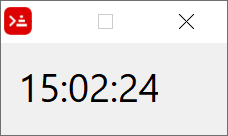
Analog
Red [
	Needs: 'View
	Purpose: {simple analog clock based on Nenad Rakocevic's eve-clock.red,
see http://www.red-lang.org/2016/07/eve-style-clock-demo-in-red-livecoded.html}
]

view [ base 100x100 transparent rate 1 now draw [
   circle 50x50 45
   hour: rotate 0 50x50 [pen #023963 line 50x50 50x20]
   min:  rotate 0 50x50 [pen #023963 line 50x50 50x10]
   sec:  rotate 0 50x50 [pen #CE0B46 line 50x50 50x10]
] on-time [
   time: now/time
   hour/2: 30 * time/hour
   min/2:  6  * time/minute
   sec/2:  6  * time/second
]]
- Output:

REXX
This REXX program draws a digital clock; it shows the seconds if the terminal screen is wide enough.
The clock displayed is displayed in a 24 hour format..
The $T.REX program does the heavy lifting of actually creating the blocked characters.
This REXX program was written when CRTs were used for terminal displays and therefore creeping was utilized to avoid phosphor burn-in.
If using:
- PC/REXX
- Personal REXX
- R4
- ROO
the color of the display can be specified.
/*REXX program displays the  current (local) time  as a  digital clock  on the terminal.*/
trace off                                        /*turn off tracing/possible host errors*/
parse arg !                                      /*obtain optional arguments from the CL*/
if !all(arg())  then exit                        /*was there a request for some help?   */
if !cms         then address ''                  /*If CMS,  then initialize ADDRESS name*/

signal on halt                                   /*initialize target label when HALTed. */
signal on noValue                                /*     "        "     "     "  noValue.*/
signal on syntax                                 /*     "        "     "     "  syntax. */

parse var ! ops                                  /*obtain optional arguments from the CL*/
ops = space(ops)                                 /*elide superfluous blanks from options*/
blinkSecs = 1                                    /*amount of time between displays.     */
creep     = 1                                    /*moves the output "around" the screen.*/
tops      = '.C=blue .BC=░ .BS=1 .BLOCK=12'      /*options to be specified for  $T.REXX */

  do while ops\==''                              /*process all the specified options.   */
  parse var ops _1 2 1 _ . 1 y ops               /*extract various information from opt.*/
  upper _                                        /*uppercase the    _    REXX variavle. */
           select
           when _==','                    then nop              /*ignore any comma used.*/
           when _1==.  &  pos("=",_)\==0  then tops= tops y     /*add this value to TOPS*/
           when abbn('BLINKSECs')         then blinksecs= no()  /*use/not use BLINKSECs.*/
           when abbn('CREEPs')            then creep= no()      /* "   "   "  CREEPs.   */
           otherwise                      call er 55,y          /*whoops! Invalid option*/
           end   /*select*/
  end            /*while ops¬==''*/

if \!pcrexx  then  blinkSecs= 0                  /*Not PC/REXX?  Then turn off BLINKSECS*/
tops= space(tops)                                /*elide superfluous blanks in  TOPS.   */
parse value  scrsize()  with  sd sw .            /*obtain the terminal screen dimensions*/
oldTime=                                         /*blank out the OLDTIME for comparison.*/
           do until queued()\==0                 /*if user entered some text, then QUIT.*/
           ct= time()                            /*obtain the current  (system)  time.  */
           mn= substr(ct, 4, 2)                  /*extract the minutes part of the time.*/
           ss= right(ct, 2)                      /*   "     "  seconds   "  "   "    "  */
           i_= 0                                 /*REXX variable used for display creep.*/
           p_= 0                                 /*  "      "      "   "     "      "   */
           call blinksec
           if ct==oldTime  then  if !cms  then 'CP SLEEP'       /*sleep for one second. */
                                          else call delay 1     /*  "    "   "     "    */

           if creep  then do;            p_ = 3  + right(mn, 1) /*perform display creep.*/
                          if sd>26  then p_ = p_ +  left(mn, 1)
                          if sd>33  then p_ = p_ +  left(mn, 1)
                          if sd>44  then p_ = p_ +  left(mn, 1) + right(mn, 1)
                          end
           _p= - p_                              /*change the sign of the  P_  number.  */
           i_= 2 + left(ct, 1)                   /*obtain indentation size base on  HH. */
           if sw>108  then ctt= ct               /*maybe use wider  format for the clock*/
                      else ctt= left(ct, 5)      /*maybe use narrow    "    "   "    "  */
           r= $t('.P='_p  ".I="i_  tops  ctt)    /*where the rubber meets the road.     */
           if r\==0   then leave                 /*Had an error in  $T ?   Then quit.   */
           oldTime= time()                       /*save the new time, it may be the same*/
           end   /*forever*/
exit 0                                           /*stick a fork in it,  we're all done. */

/*═════════════════════════════general 1-line subs══════════════════════════════════════════════════════════════════════════════════════════════════════════════════════════════════════════════════════════════════════════════════════════════════════*/
!all:  !!=!;!=space(!);upper !;call !fid;!nt=right(!var('OS'),2)=='NT';!cls=word('CLS VMFCLEAR CLRSCREEN',1+!cms+!tso*2);if arg(1)\==1 then return 0;if wordpos(!,'? ?SAMPLES ?AUTHOR ?FLOW')==0 then return 0;!call=']$H';call '$H' !fn !;!call=;return 1
!cal:     if symbol('!CALL')\=="VAR"  then !call=;      return !call
!env:     !env= 'ENVIRONMENT';    if !sys=="MSDOS"  |  !brexx  |  !r4  |  !roo  then !env= 'SYSTEM';    if !os2  then !env= "OS2"!env;    !ebcdic= 3=='f3'x;    if !crx  then !env= "DOS";      return
!fid:     parse upper source !sys !fun !fid . 1 . . !fn !ft !fm .;   call !sys;   if !dos  then do;   _= lastpos('\', !fn);   !fm= left(!fn, _);   !fn= substr(!fn, _+1);   parse var !fn !fn '.' !ft;   end;   return word(0 !fn !ft !fm, 1 +('0'arg(1)))
!rex:     parse upper version !ver !vernum !verdate .; !brexx= 'BY'==!vernum; !kexx= "KEXX"==!ver; !pcrexx= 'REXX/PERSONAL'==!ver | "REXX/PC"==!ver; !r4= 'REXX-R4'==!ver; !regina="REXX-REGINA"==left(!ver, 11); !roo='REXX-ROO'==!ver; call !env; return
!sys:     !cms= !sys=='CMS';    !os2= !sys=="OS2";    !tso= !sys=='TSO'  |  !sys=="MVS";    !vse= !sys=='VSE';    !dos= pos("DOS", !sys)\==0  |  pos('WIN', !sys)\==0  |  !sys=="CMD";    !crx= left(!sys, 6)=='DOSCRX';    call !rex;              return
!var:     call !fid;   if !kexx  then return space( dosenv( arg(1) ) );                      return space( value( arg(1), , !env))
$t:       !call= ']$T';  call "$T"  arg(1);   !call=;                                        return result
abb:      parse upper arg abbu;     parse arg abb;      return abbrev(abbu, _, abbl(abb) )
abbl:     @abc = 'abcdefghijklmnopqrstuvwxyz';          return verify(arg(1)'a', @abc, 'M') - 1
abbn:     parse arg abbn;                               return abb(abbn) | abb('NO'abbn)
blinksec: if \blinksecs  then return;      bsec= ' ';      ss2= right(ss, 2);      if sw<=80  then bsec= copies(" ", 2 + ss2)  ss2;      call scrwrite 1 + right(mn, 1), 1, bsec, , , 1;      call cursor sd - right(mn, 1), sw - length(bsec);     return
er:       parse arg _1,_2;  call '$ERR'  "14"p(_1)  p(word(_1, 2)  !fid(1))  _2;  if _1<0  then return _1;    exit result
err:      call er '-'arg(1),arg(2);                     return ''
erx:      call er '-'arg(1),arg(2);                     exit 0
halt:     call er .1
no:       if arg(1)\==''  then call er 01,arg(2);        return left(_, 2) \== 'NO'
noValue:  !sigl= sigl;         call er 17,!fid(2)  !fid(3)  !sigl          condition('D')  sourceline(!sigl)
p:        return word( arg(1), 1)
syntax:   !sigl= sigl;         call er 13,!fid(2)  !fid(3)  !sigl  !cal()  condition('D')  sourceline(!sigl)
- Programming notes
The $CLOCK.REX REXX program makes use of $T.REX REXX program which is used to display text and/or create big blocked characters.
The $T.REX REXX program is included here ──► $T.REX.
The help for the $T.REX REXX program is included here ──► $T.HEL.
The $CLOCK.REX REXX program makes use of $ERR.REX REXX program which is used to display error messages (via $T.REX).
The $ERR REXX program is included here ──► $ERR.REX.
This REXX program makes use of SCRSIZE REXX program (or BIF) which is used to determine the screen size of the terminal (console).
The SCRSIZE.REX REXX program is included here ──► SCRSIZE.REX.
Some REXXes have the SCRSIZE routine as a BIF.
Some older REXXes don't have a changestr BIF, so one is included here ──► CHANGESTR.REX.
REXX programs not included are $H.REX which shows help and other documentation.
- output when using the default inputs:
     ░░░░░░░░     ░░░░░░░░                     ░░       ░░░░░░░░░░                     ░░░     ░░░░░░░░░░
    ░░░░░░░░░░   ░░░░░░░░░░                   ░░░       ░░░░░░░░░░                    ░░░░     ░░░░░░░░░░
    ░░      ░░   ░░      ░░                  ░░░░       ░░                           ░░ ░░     ░░
    ░░      ░░           ░░       ░░           ░░       ░░               ░░         ░░  ░░     ░░
          ░░            ░░        ░░           ░░       ░░               ░░        ░░   ░░     ░░
         ░░           ░░░                      ░░       ░░░░░░░                   ░░░░░░░░░░   ░░░░░░░
       ░░             ░░░                      ░░       ░░░░░░░░                  ░░░░░░░░░░   ░░░░░░░░
     ░░                 ░░                     ░░              ░░                       ░░            ░░
    ░░                   ░░                    ░░               ░░                      ░░             ░░
    ░░      ░░   ░░      ░░       ░░           ░░       ░░      ░░       ░░             ░░     ░░      ░░
    ░░░░░░░░░░   ░░░░░░░░░░       ░░         ░░░░░░     ░░░░░░░░░░       ░░            ░░░░    ░░░░░░░░░░
    ░░░░░░░░░░    ░░░░░░░░                   ░░░░░░      ░░░░░░░░                      ░░░░     ░░░░░░░░
- output (when the terminal screen is less than 109 bytes)
      ░░░░░░░░     ░░░░░░░░                  ░░░░░░░░    ░░░░░░░░░░
     ░░░░░░░░░░   ░░░░░░░░░░                ░░░░░░░░░░   ░░░░░░░░░░
     ░░      ░░   ░░      ░░                ░░      ░░   ░░
     ░░      ░░           ░░       ░░       ░░      ░░   ░░
           ░░            ░░        ░░             ░░     ░░
          ░░           ░░░                       ░░      ░░░░░░░
        ░░             ░░░                     ░░        ░░░░░░░░
      ░░                 ░░                  ░░                 ░░
     ░░                   ░░                ░░                   ░░
     ░░      ░░   ░░      ░░       ░░       ░░      ░░   ░░      ░░
     ░░░░░░░░░░   ░░░░░░░░░░       ░░       ░░░░░░░░░░   ░░░░░░░░░░
     ░░░░░░░░░░    ░░░░░░░░                 ░░░░░░░░░░    ░░░░░░░░
Ruby

Shoes.app(:width=>205, :height => 228, :title => "A Clock") do
  def draw_ray(width, start, stop, ratio)
    angle = Math::PI * 2 * ratio - Math::PI/2
    strokewidth width
    cos = Math::cos(angle)
    sin = Math::sin(angle)
    line 101+cos*start, 101+sin*start, 101+cos*stop, 101+sin*stop
  end

  def update
    t = Time.now
    @time.text = t.strftime("%H:%M:%S")
    h, m, s = (t.hour % 12).to_f, t.min.to_f, t.sec.to_f
    s += t.to_f - t.to_i  # add the fractional seconds

    @hands.clear do
      draw_ray(3, 0, 70, (h + m/60)/12)
      draw_ray(2, 0, 90, (m + s/60)/60)
      draw_ray(1, 0, 95, s/60)
    end
  end

  # a place for the text display
  @time = para(:align=>"center", :family => "monospace")

  # draw the clock face
  stack(:width=>203, :height=>203) do
    strokewidth 1
    fill gradient(deepskyblue, aqua)
    oval 1, 1, 200
    fill black
    oval 98, 98, 6
    # draw the minute indicators
    0.upto(59) {|m| draw_ray(1, (m % 5 == 0 ? 96 : 98), 100, m.to_f/60)}
  end.move(0,23)

  # the drawing area for the hands
  @hands = stack(:width=>203, :height=>203) {}.move(0,23)

  animate(5) {update}
end
Inspired by the PicoLisp solution, here's an implementation of the Berlin-Uhr clock.

Shoes.app(:title => "Berlin-Uhr Clock", :width => 209, :height => 300) do
  background lightgrey

  Red = rgb(255, 20, 20)
  Yellow = rgb(173, 255, 47)
  Green = rgb(154, 205, 50)
  Gray = rgb(128, 128, 128)

  @time = para(:align => "center")
  stack do
    fill Gray
    stroke black
    strokewidth 2
    @seconds = oval 75, 3, 50
    @hrs_a  =  4.times.collect {|i| rect   51*i,  56, 48, 30, 4}
    @hrs_b  =  4.times.collect {|i| rect   51*i,  89, 48, 30, 4}
    @mins_a = 11.times.collect {|i| rect 2+18*i, 122, 15, 30, 4}
    @mins_b =  4.times.collect {|i| rect   51*i, 155, 48, 30, 4}
    # some decoration
    fill white
    stroke darkslategray
    rect -10, -30, 75, 70, 10
    rect 140, -30, 75, 70, 10
    rect -13, 192, 105, 100, 10
    rect 110, 192, 105, 100, 10
  end.move(3,20)

  animate(1) do
    now = Time.now
    @time.text = now.strftime("%H:%M:%S")
    @seconds.style(:fill => now.sec.even? ? Green : Gray)
    a, b = now.hour.divmod(5)
    4.times {|i| @hrs_a[i].style(:fill => i < a ? Red : Gray)}
    4.times {|i| @hrs_b[i].style(:fill => i < b ? Red : Gray)}
    a, b = now.min.divmod(5)
    11.times {|i| @mins_a[i].style(:fill => i < a ? (i%3==2 ? Red : Yellow) : Gray)}
    4.times  {|i| @mins_b[i].style(:fill => i < b ? Yellow : Gray)}
  end

  keypress do |key|
    case key
    when :control_q, "\x11" then exit
    end
  end
end
JRubyArt is port of processing to ruby
def setup
  sketch_title 'Clock'
  stroke 255
  font = create_font 'NimbusRoman-Regular', 20
  text_font font
end

def draw
  background 0
  fill 80
  no_stroke
  clock_x = lambda do |val, adj, length|
    DegLut.cos((val * adj).to_i - 90) * length + width / 2
  end
  clock_y = lambda do |val, adj, length|
    DegLut.sin((val * adj).to_i - 90) * length + height / 2
  end
  ellipse 100, 100, 160, 160
  stroke 220
  stroke_weight 6
  t = Time.now
  line(100, 100, clock_x.call(t.hour % 12 + (t.min / 60.0), 30, 50),
    clock_y.call(t.hour % 12 + (t.min / 60.0), 30, 50))
  stroke_weight 3
  line(100, 100, clock_x.call(t.min + (t.sec / 60.0), 6, 60),
    clock_y.call(t.min + (t.sec / 60.0), 6, 60))
  stroke 255, 0, 0
  stroke_weight 1
  line(100, 100, clock_x.call(t.sec, 6, 72), clock_y.call(t.sec, 6, 72))
  # Draw the minute ticks
  stroke_weight 2
  stroke 255
  (0..360).step(6) do |a|
    x = 100 + DegLut.cos(a) * 72
    y = 100 + DegLut.sin(a) * 72
    point x, y
  end
  fill 200
  text t.strftime('%H:%M:%S'), 50, 200
end

def settings
  size 200, 220
  smooth 8
end
Run BASIC

' --------------------------------------------
' clock. I got nothing but time
' ---------------------------------------------
n	= 12 ' num of points
r	= 95 ' radius
pi	= 22/7
alpha	= pi * 2 / n
dim points(n)
graphic #g2, 200, 200
' --------------------------------------
' Draw the clock
' --------------------------------------
#g2 size(2) 'pen size
#g2 down()
#g2 font("arial", 20, "bold")
#g2 place(85,30)
#g2 "\12"
#g2 place(170,105)
#g2 "\3"
#g2 place(10,105)
#g2 "\9"
#g2 place(90,185)
#g2 "\6"
for i = 0 to n - 1
	theta = alpha * i
	px = cos( theta ) * r
	py = sin( theta ) * r
	px = px + 100
	py = py + 100
	#g2 place(px,py)
	#g2 circle(2)
next i

[shoTime]
' -------------------------
' clear previous sec,min,hr
' -------------------------
r	= 63
p	= se
#g2 color("white")
gosub [h2Dot]
r	= 50
p	= mi
#g2 color("white")
gosub [h2Dot]
r	= 30 ' radius
p	= hr * 5
#g2 color("white")
gosub [h2Dot]

' -------------------------
' Show new time
' -------------------------
a$	= time$()
hr	= val(word$(a$,1,":"))
mi	= val(word$(a$,2,":"))
se	= val(word$(a$,3,":"))

' put time on the clock - gimme a hand
#g2 size(4)
' second hand
n	= 60
r	= 63
p	= se
#g2 color("blue")
gosub [h2Dot]

' minute hand
r	= 50
p	= mi
#g2 color("green")
gosub [h2Dot]

' hour hand
r	= 30 ' radius
p	= hr * 5
#g2 color("red")
gosub [h2Dot]

render #g2
end

' a one liner
[h2Dot]
alpha	= pi * 2 / n
i 	= p - 15
theta 	= alpha * i
px 	= cos( theta ) * r
py 	= sin( theta ) * r
px 	= px + 100
py 	= py + 100
#g2 place(px,py)
#g2 circle(2)
#g2 line(100,100,px,py)
RETURN
Rust
// cargo-deps: time="0.1"
extern crate time;

use std::thread;
use std::time::Duration;

const TOP: &str = " ⡎⢉⢵ ⠀⢺⠀ ⠊⠉⡱ ⠊⣉⡱ ⢀⠔⡇ ⣏⣉⡉ ⣎⣉⡁ ⠊⢉⠝ ⢎⣉⡱ ⡎⠉⢱ ⠀⠶⠀";
const BOT: &str = " ⢗⣁⡸ ⢀⣸⣀ ⣔⣉⣀ ⢄⣀⡸ ⠉⠉⡏ ⢄⣀⡸ ⢇⣀⡸ ⢰⠁⠀ ⢇⣀⡸ ⢈⣉⡹ ⠀⠶⠀";

fn main() {
    let top: Vec<&str> = TOP.split_whitespace().collect();
    let bot: Vec<&str> = BOT.split_whitespace().collect();

    loop {
        let tm = &time::now().rfc822().to_string()[17..25];
        let top_str: String = tm.chars().map(|x| top[x as usize - '0' as usize]).collect();
        let bot_str: String = tm.chars().map(|x| bot[x as usize - '0' as usize]).collect();

        clear_screen();
        println!("{}", top_str);
        println!("{}", bot_str);

        thread::sleep(Duration::from_secs(1));
    }
}

fn clear_screen() {
    println!("{}[H{}[J", 27 as char, 27 as char);
}
Scala
Circular ASCII clock
Generates and prints a simple ASCII clock every second
import java.util.{ Timer, TimerTask }
import java.time.LocalTime
import scala.math._

object Clock extends App {
  private val (width, height) = (80, 35)

  def getGrid(localTime: LocalTime): Array[Array[Char]] = {
    val (minute, second) = (localTime.getMinute, localTime.getSecond())
    val grid = Array.fill[Char](height, width)(' ')

    def toGridCoord(x: Double, y: Double): (Int, Int) =
      (floor((y + 1.0) / 2.0 * height).toInt, floor((x + 1.0) / 2.0 * width).toInt)

    def makeText(grid: Array[Array[Char]], r: Double, theta: Double, str: String) {
      val (row, col) = toGridCoord(r * cos(theta), r * sin(theta))
      (0 until str.length).foreach(i =>
        if (row >= 0 && row < height && col + i >= 0 && col + i < width) grid(row)(col + i) = str(i))
    }

    def makeCircle(grid: Array[Array[Char]], r: Double, c: Char) {
      var theta = 0.0
      while (theta < 2 * Pi) {
        val (row, col) = toGridCoord(r * cos(theta), r * sin(theta))
        if (row >= 0 && row < height && col >= 0 && col < width) grid(row)(col) = c
        theta = theta + 0.01
      }
    }

    def makeHand(grid: Array[Array[Char]], maxR: Double, theta: Double, c: Char) {
      var r = 0.0
      while (r < maxR) {
        val (row, col) = toGridCoord(r * cos(theta), r * sin(theta))
        if (row >= 0 && row < height && col >= 0 && col < width) grid(row)(col) = c
        r = r + 0.01
      }
    }

    makeCircle(grid, 0.98, '@')
    makeHand(grid, 0.6, (localTime.getHour() + minute / 60.0 + second / 3600.0) * Pi / 6 - Pi / 2, 'O')
    makeHand(grid, 0.85, (minute + second / 60.0) * Pi / 30 - Pi / 2, '*')
    makeHand(grid, 0.90, second * Pi / 30 - Pi / 2, '.')

    (1 to 12).foreach(n => makeText(grid, 0.87, n * Pi / 6 - Pi / 2, n.toString))
    grid
  } // def getGrid(

  private val timerTask = new TimerTask {
    private def printGrid(grid: Array[Array[Char]]) = grid.foreach(row => println(row.mkString))
    def run() = printGrid(getGrid(LocalTime.now()))
  }
  (new Timer).schedule(timerTask, 0, 1000)
}
Berliner Uhr
See [The Berlin set theory clock]
import java.time.LocalTime
import java.awt.{ Color, Graphics }

/** The Berlin clock as a Java (8.0) applet
 */
class QDclock extends java.applet.Applet with Runnable {
  val bclockThread: Thread = new Thread(this, "QDclock")

  override def init() = resize(242, 180) // fixed size, at first... doesn't work...

  override def start() = if (!bclockThread.isAlive()) bclockThread.start()

  def run() {
    while (true) {
      repaint()
      try Thread.sleep(1000) catch { case _: Throwable => sys.exit(-1) }
    }
  }

  override def update(g: Graphics) {
    val now = LocalTime.now

    def booleanToColor(cond: Boolean, colorOn: Color = Color.red): Color =
      if (cond) colorOn else Color.black

    g.setColor(booleanToColor(now.getSecond() % 2 == 0, Color.yellow))
    g.fillOval(100, 4, 40, 40)

    val (stu, min) = (now.getHour(), now.getMinute()) match {
      case (0, 0)     => (24, 0)
      case (hrs, min) => (hrs, min)
    }

    def drawRectangle(color: Color, rect: (Int, Int, Int, Int)) {
      g.setColor(color)
      g.fillRoundRect(rect._1, rect._2, rect._3, rect._4, 4, 4)
    }

    for (i <- 0 until 4) {
      drawRectangle(booleanToColor(stu / ((i + 1) * 5) > 0), (i * 60 + 2, 46, 58, 30))
      drawRectangle(booleanToColor(stu % 5 > i), (i * 60 + 2, 78, 58, 30))
      drawRectangle(booleanToColor(min % 5 > i, Color.yellow), (i * 60 + 2, 142, 58, 30))
    }

    for (i <- 0 until 11) {
      drawRectangle(booleanToColor(min / ((i + 1) * 5) > 0,
        if (2 to 8 by 3 contains i) Color.red else Color.yellow), (i * 20 + 10, 110, 18, 30))
    }
  }
}
Scheme
Translation of a Tcl example at http://wiki.tcl.tk/1011 The program displays an analogue clock with three hands, updating once a second.
(import (scheme base)
        (scheme inexact)
        (scheme time)
        (pstk))

(define PI 3.1415927)

;; Draws the hands on the canvas using the current time, and repeats each second
(define (hands canvas)
  (canvas 'delete 'withtag "hands")

  (let* ((time (current-second)) ; no time locality used, so displays time in GMT
         (hours (floor (/ time 3600)))
         (rem (- time (* hours 3600)))
         (mins (floor (/ rem 60)))
         (secs (- rem (* mins 60)))
         (second-angle (* secs (* 2 PI 1/60)))
         (minute-angle (* mins (* 2 PI 1/60)))
         (hour-angle (* hours (* 2 PI 1/12))))
    (canvas 'create 'line ; second hand
            100 100
            (+ 100 (* 90 (sin second-angle)))
            (- 100 (* 90 (cos second-angle)))
            'width: 1 'tags: "hands")
    (canvas 'create 'line ; minute hand
            100 100
            (+ 100 (* 85 (sin minute-angle)))
            (- 100 (* 85 (cos minute-angle)))
            'width: 3
            'capstyle: "projecting"
            'tags: "hands")
    (canvas 'create 'line ; hour hand
            100 100
            (+ 100 (* 60 (sin hour-angle)))
            (- 100 (* 60 (cos hour-angle)))
            'width: 7
            'capstyle: "projecting"
            'tags: "hands"))
  (tk/after 1000 (lambda () (hands canvas))))

;; Create the initial frame, clock frame and hours
(let ((tk (tk-start)))
  (tk/wm 'title tk "GMT Clock")

  (let ((canvas (tk 'create-widget 'canvas)))
    (tk/pack canvas)
    (canvas 'configure 'height: 200 'width: 200)
    (canvas 'create 'oval 2 2 198 198 'fill: "white" 'outline: "black")
    (do ((h 1 (+ 1 h)))
      ((> h 12) )
      (let ((angle (- (/ PI 2) (* h PI 1/6))))
        (canvas 'create 'text
                (+ 100 (* 90 (cos angle)))
                (- 100 (* 90 (sin angle)))
                'text: (number->string h)
                'font: "{Helvetica -12}")))

    (hands canvas))
  (tk-event-loop tk))
Scratch
One can view the Scratch solution to this task and inspect its code at the Scratch Website. (The code for visual programming languages is difficult to post directly here at Rosetta Code.)
True to the spirit of the task description, this is a very bare-bones clock. It's a blank-faced analog clock having second (red), minute (green) and hour (blue) hands. Each hand is a sprite, which has its own script to provide a movement. When the program is started, all hands are positioned at the pivot and rotated to indicate the current (apparently local) time. The second hand is then put into an infinite loop that provides the tick, moving it every second to the current second. I found that a loop delay of 0.1 seconds resulted is smooth operation of the second hand. When the second hand reaches 0, it broadcasts a set_minute signal. Acting upon this signal, the minute hand advances to the current minute. When the minute is 0 modulo 12, is broadcasts a set_hour signal. The hour hand responds to this signal by advancing by a fifth of an hour (so that like the minute and second hands, it advances 60 times as it makes a complete circuit of the clock face).
Seed7
The example program clock3.sd7 from the Seed7 package can be used for this task.
$ include "seed7_05.s7i";
  include "float.s7i";
  include "math.s7i";
  include "draw.s7i";
  include "keybd.s7i";
  include "time.s7i";
  include "duration.s7i";

const integer: WINDOW_WIDTH is 200;
const integer: WINDOW_HEIGHT is 200;
const color: BACKGROUND is White;
const color: FOREGROUND is Black;
const color: CLOCKCOLOR is Aqua;

const proc: main is func
  local
    var char: command is ' ';
    var time: start_time is time.value;
    var float: alpha is 0.0;
    var integer: x is 0;
  begin
    screen(WINDOW_WIDTH, WINDOW_HEIGHT);
    clear(curr_win, BACKGROUND);
    KEYBOARD := GRAPH_KEYBOARD;
    command := getc(KEYBOARD, NO_WAIT);
    while command <> 'q' do
      start_time := truncToSecond(time(NOW));
      clear(curr_win, BACKGROUND);
      fcircle(100, 100, 95, CLOCKCOLOR);
      circle(100, 100, 95, FOREGROUND);
      for x range 0 to 60 do
        alpha := flt(x-15) * PI / 30.0;
        if x mod 5 = 0 then
          lineTo(100 + round(cos(alpha)*95.0),
                 100 + round(sin(alpha)*95.0),
                 100 + round(cos(alpha)*85.0),
                 100 + round(sin(alpha)*85.0), FOREGROUND);
        else
          lineTo(100 + round(cos(alpha)*95.0),
                 100 + round(sin(alpha)*95.0),
                 100 + round(cos(alpha)*92.0),
                 100 + round(sin(alpha)*92.0), FOREGROUND);
        end if;
      end for;
      alpha := flt(start_time.second-15) * PI / 30.0;
      lineTo(100, 100, 100 + round(cos(alpha)*85.0), 100 + round(sin(alpha)*85.0), FOREGROUND);
      alpha := flt(start_time.minute-15) * PI / 30.0;
      lineTo(100 + round(cos(alpha-PI/2.0)*5.0),
             100 + round(sin(alpha-PI/2.0)*5.0),
             100 + round(cos(alpha)*75.0),
             100 + round(sin(alpha)*75.0), FOREGROUND);
      lineTo(100 + round(cos(alpha+PI/2.0)*5.0),
             100 + round(sin(alpha+PI/2.0)*5.0),
             100 + round(cos(alpha)*75.0),
             100 + round(sin(alpha)*75.0), FOREGROUND);
      alpha := (flt(start_time.hour)+flt(start_time.minute)/60.0-3.0) * PI / 6.0;
      lineTo(100 + round(cos(alpha-PI/2.0)*7.0),
             100 + round(sin(alpha-PI/2.0)*7.0),
             100 + round(cos(alpha)*50.0),
             100 + round(sin(alpha)*50.0), FOREGROUND);
      lineTo(100 + round(cos(alpha+PI/2.0)*7.0),
             100 + round(sin(alpha+PI/2.0)*7.0),
             100 + round(cos(alpha)*50.0),
             100 + round(sin(alpha)*50.0), FOREGROUND);
      fcircle(100, 100, 7, CLOCKCOLOR);
      circle(100, 100, 7, FOREGROUND);
      flushGraphic;
      await(start_time + 1 . SECONDS);
      command := getc(KEYBOARD, NO_WAIT);
    end while;
  end func;
Sidef
STDOUT.autoflush(true)

var (rows, cols) = `stty size`.nums...

var x = (rows/2 - 1  -> int)
var y = (cols/2 - 16 -> int)

var chars = [
                 "┌─┐  ╷╶─┐╶─┐╷ ╷┌─╴┌─╴╶─┐┌─┐┌─┐   ",
                 "│ │  │┌─┘╶─┤└─┤└─┐├─┐  │├─┤└─┤ : ",
                 "└─┘  ╵└─╴╶─┘  ╵╶─┘└─┘  ╵└─┘╶─┘   "
             ].map {|s| s.split(3) }

func position(i,j) {
    "\e[%d;%dH" % (i, j)
}

func indices {
    var t = Time.local
    "%02d:%02d:%02d" % (t.hour, t.min, t.sec) -> split(1).map{|c| c.ord - '0'.ord }
}

loop {
    print "\e[H\e[J"
    for i in ^chars {
      print position(x + i, y)
      print [chars[i][indices()]].join(' ')
    }
    print position(1, 1)
    Sys.sleep(0.1)
}
- Output:
   ╷ ┌─╴     ╷ ╷ ┌─┐     ╶─┐ ┌─╴
   │ └─┐  :  └─┤ └─┤  :  ╶─┤ └─┐
   ╵ ╶─┘       ╵ ╶─┘     ╶─┘ ╶─┘
SVG
<svg viewBox="0 0 100 100" width="480px" height="480px" xmlns="http://www.w3.org/2000/svg">
<circle cx="50" cy="50" r="48" style="fill:peru; stroke:black; stroke-width:2" />
<g transform="translate(50,50) rotate(0)" style="fill:none; stroke-linecap:round">
  <line y2="-36" style="stroke:black; stroke-width:5">
    <animateTransform
      attributeName="transform"
      type="rotate"
      by="30"
      dur="3600s"
      accumulate="sum"
      repeatCount="indefinite"/>
  </line>
  <line y2="-42" style="stroke:white; stroke-width:2">
    <animateTransform
      attributeName="transform"
      type="rotate"
      by="6"
      dur="60s"
      accumulate="sum"
      repeatCount="indefinite"/>
  </line>
  <line y2="-46" style="stroke:red; stroke-width:1">
    <animateTransform
      attributeName="transform"
      type="rotate"
      calcMode="discrete"
      by="6"
      dur="1s"
      accumulate="sum"
      repeatCount="indefinite"/>
  </line>
</g>
<circle cx="50" cy="50" r="4" style="fill:gold; stroke:black; stroke-width:1" />
</svg>
Tcl

package require Tcl 8.5
package require Tk

# GUI code
pack [canvas .c -width 200 -height 200]
.c create oval 20 20 180 180 -width 10 -fill {} -outline grey70
.c create line 0 0 1 1 -tags hour   -width 6 -cap round -fill black
.c create line 0 0 1 1 -tags minute -width 4 -cap round -fill black
.c create line 0 0 1 1 -tags second -width 2 -cap round -fill grey30
proc updateClock t {
    scan [clock format $t -format "%H %M %S"] "%d%d%d" h m s
    # On an analog clock, the hour and minute hands move gradually
    set m [expr {$m + $s/60.0}]
    set h [expr {($h % 12 + $m/60.0) * 5}]
    foreach tag {hour minute second} value [list $h $m $s] len {50 80 80} {
	.c coords $tag 100 100 \
	    [expr {100 + $len*sin($value/30.0*3.14159)}] \
	    [expr {100 - $len*cos($value/30.0*3.14159)}]
    }
}

# Timer code, accurate to within a quarter second
set time 0
proc ticker {} {
    global time
    set t [clock seconds]
    after 250 ticker
    if {$t != $time} {
	set time $t
	updateClock $t
    }
}
ticker
Note that though this code does poll the system timer approximately four times a second, this is a cheap operation; the GUI update (the relatively expensive part) only happens once a second. The amount of system processing power consumed by this code isn't noticeable on my system; it vanishes with respect to the other processing normally happening.
VBScript
The only way to do animation in VBScript is to use ANSI codes in the console. The program will work only in Windows 10 or up. Should be invoked from cscript
'ANSI Clock

'ansi escape functions
ans0=chr(27)&"["
sub cls()  wscript.StdOut.Write ans0 &"2J"&ans0 &"?25l":end sub
sub torc(r,c,s)  wscript.StdOut.Write ans0 & r & ";" & c & "f"  & s :end sub

'bresenham
Sub draw_line(r1,c1, r2,c2,c)
  Dim x,y,xf,yf,dx,dy,sx,sy,err,err2
  x =r1    : y =c1
  xf=r2    : yf=c2
  dx=Abs(xf-x) : dy=Abs(yf-y)
  If x<xf Then sx=+1: Else sx=-1
  If y<yf Then sy=+1: Else sy=-1
  err=dx-dy
  Do
    torc x,y,c
    If x=xf And y=yf Then Exit Do
    err2=err+err
    If err2>-dy Then err=err-dy: x=x+sx
    If err2< dx Then err=err+dx: y=y+sy
  Loop
End Sub

const pi180=0.017453292519943
'center of the clock
const r0=13
const c0=26

'angles
nangi=-30*pi180
aangi=-6*pi180
ang0=90*pi180

'lengths of hands
lh=7
lm=9
ls=9
ln=12


while 1
     cls

    'dial
    angn=ang0+nangi
    for i=1 to 12
      torc r0-cint(ln*sin(angn)),cint(c0+2*ln*cos(angn)),i
      angn=angn+nangi
    next

    'get time and display it in numbers
    t=now()
    torc 1,1, hour(t) &":"& minute(t) &":"& second(t)

    'angle for each hand
    angh=ang0+hour(t) *nangi
    angm=ang0+minute(t) *aangi
    angS=ang0+second(t) *aangi

    'draw them
    draw_line r0,c0,cint(r0-ls*sin(angs)),cint(c0+2*ls*cos(angs)),"."
    draw_line r0,c0,cint(r0-lm*sin(angm)),cint(c0+2*lm*cos(angm)),"*"
    draw_line r0,c0,cint(r0-lh*sin(angh)),cint(c0+2*lh*cos(angh)),"W"
    torc r0,c0,"O"

    'wait one second
    wscript.sleep(1000)
wend- Output:
15:8:37                  12

             11                      1


    10                               **       2
                                   **
                                 **
                               **
                             **
                           **
 9                       OWWWWWWWWWWWWWW         3
                       ..
                     ..
                   ..
                  .
                ..
    8         ..                              4
             .


             7                       5

                         6
V (Vlang)
// Written by Stefan Schroeder in 2021 for the v project examples.
// github.com/vlang/v/blob/master/examples/clock/clock.v
import os
import gg
import gx
import math
import time

const (
	// All coordinates are designed for a clock size of this many pixel.
	// You cannot change the size of the clock by adjusting this value.
	design_size = 700
	center      = 350

	// Half the width of a tic-mark.
	tw          = 9
	// Height of a minute tic-mark. (hour is twice, 3-hour is thrice)
	th          = 25
	// Padding of tic-mark to window border
	tp          = 10

	tic_color   = gx.Color{
		r: 50
		g: 50
		b: 50
	}
	hand_color        = gx.black
	second_hand_color = gx.red
)

struct App {
	minutes_tic []f32 = [f32(center - tw), tp, center + tw, tp, center + tw, tp, center + tw,
	tp + 1 * th, center - tw, tp + 1 * th]
	hours_tic []f32 = [f32(center - tw), tp, center + tw, tp, center + tw, tp, center + tw, tp + 2 * th,
	center - tw, tp + 2 * th]
	hours3_tic []f32 = [f32(center - tw), tp, center + tw, tp, center + tw, tp, center + tw, tp + 3 * th,
	center - tw, tp + 3 * th]

	hour_hand   []f32 = [f32(329), 161, 350, 140, 371, 161, 371, 413, 329, 413]
	minute_hand []f32 = [f32(334.25), 40.25, 350, 24.5, 365.75, 40.25, 365.75, 427, 334.25, 427]
	second_hand []f32 = [f32(345.8), 38.5, 350, 34.3, 354.2000, 38.5, 358.75, 427, 341.25, 427]
	mut:
	gg        &gg.Context = unsafe { nil }
	draw_flag bool        = true
	dpi_scale f32 = 1.0
}

fn on_frame(mut app App) {
	if !app.draw_flag {
		return
	}
	app.gg.begin()

	for i in 0 .. 60 { // draw minute tics
		draw_convex_poly_rotate(mut app.gg, app.dpi_scale, app.minutes_tic, tic_color,
			i * 6)
	}
	for i in 0 .. 12 { // hours
		draw_convex_poly_rotate(mut app.gg, app.dpi_scale, app.hours_tic, tic_color, i * 30)
	}
	for i in 0 .. 4 { // 3 hours
		draw_convex_poly_rotate(mut app.gg, app.dpi_scale, app.hours3_tic, tic_color,
			i * 90)
	}

	n := time.now()

	// draw hour hand
	i := f32(n.hour) + f32(n.minute) / 60.0
	draw_convex_poly_rotate(mut app.gg, app.dpi_scale, app.hour_hand, hand_color, i * 30)

	// draw minute hand
	mut j := f32(n.minute)
	if n.second == 59 { // make minute hand move smoothly
		j += f32(math.sin(f32(n.microsecond) / 1e6 * math.pi / 2.0))
	}
	draw_convex_poly_rotate(mut app.gg, app.dpi_scale, app.minute_hand, hand_color, j * 6)

	// draw second hand with smooth transition
	k := f32(n.second) + f32(math.sin(f32(n.microsecond) / 1e6 * math.pi / 2.0))
	draw_convex_poly_rotate(mut app.gg, app.dpi_scale, app.second_hand, second_hand_color,
		0 + k * 6)

	app.gg.end()
}

// Rotate a polygon round the centerpoint
[manualfree]
fn draw_convex_poly_rotate(mut ctx gg.Context, dpi_scale f32, points []f32, c gx.Color, angle f32) {
	sa := math.sin(math.pi * angle / 180.0)
	ca := math.cos(math.pi * angle / 180.0)

	mut rotated_points := []f32{cap: points.len}
	for i := 0; i < points.len / 2; i++ {
		x := points[2 * i]
		y := points[2 * i + 1]
		xn := f32((x - center) * ca - (y - center) * sa)
		yn := f32((x - center) * sa + (y - center) * ca)
		rotated_points << (xn + center) * dpi_scale
		rotated_points << (yn + center) * dpi_scale
	}
	ctx.draw_convex_poly(rotated_points, c)
	unsafe { rotated_points.free() }
}

fn (mut app App) resize() {
	size := gg.window_size()
	// avoid calls when minimized
	if size.width < 2 && size.height < 2 {
		return
	}
	w := f32(size.width) / design_size
	h := f32(size.height) / design_size
	app.dpi_scale = if w < h { w } else { h }
}

fn on_event(e &gg.Event, mut app App) {
	match e.typ {
		.resized, .resumed {
			app.resize()
		}
		.iconified {
			app.draw_flag = false
		}
		.restored {
			app.draw_flag = true
			app.resize()
		}
		else {
			if e.typ == .key_down {
				match e.key_code {
					.q {
						println('Good bye.')
						// do we need to free anything here?
						app.gg.quit()
					}
					else {}
				}
			}
		}
	}
}

fn on_init(mut app App) {
	app.resize()
}

fn main() {
	println("Press 'q' to quit.")
	mut font_path := os.resource_abs_path(os.join_path('..', 'assets', 'fonts', 'RobotoMono-Regular.ttf'))
	$if android {
		font_path = 'fonts/RobotoMono-Regular.ttf'
	}

	mut app := &App{}

	app.gg = gg.new_context(
		width: design_size
		height: design_size
		window_title: 'Clock!'
		bg_color: gx.white
		user_data: app
		frame_fn: on_frame
		event_fn: on_event
		init_fn: on_init
		font_path: font_path
	)

	app.gg.run()
}
Wren
import "graphics" for Canvas, Color
import "dome" for Window
import "math" for Math

var Degrees06 = Num.pi / 30
var Degrees30 = Degrees06 * 5
var Degrees90 = Degrees30 * 3

class Clock {
    construct new(hour, minute, second) {
        Window.title = "Clock"
        _size = 590
        Window.resize(_size, _size)
        Canvas.resize(_size, _size)
        _spacing = 40
        _diameter = _size - 2 * _spacing
        _cx = (_diameter / 2).floor + _spacing
        _cy = _cx
        _hour = hour
        _minute = minute
        _second = second
    }

    drawFace() {
        var radius = (_diameter / 2).floor
        Canvas.circlefill(_cx, _cy, radius, Color.yellow)
        Canvas.circle(_cx, _cy, radius, Color.black)
    }

    drawHand(angle, radius, color) {
        var x = _cx + (radius * Math.cos(angle)).truncate
        var y = _cy - (radius * Math.sin(angle)).truncate
        Canvas.line(_cx, _cy, x, y, color, 2)
    }

    drawClock() {
        Canvas.cls(Color.white)
        drawFace()
        var angle = Degrees90 - Degrees06 * _second
        drawHand(angle, (_diameter/2).floor - 30, Color.red)
        var minsecs = _minute + _second/60
        angle = Degrees90 - Degrees06 * minsecs
        drawHand(angle, (_diameter / 3).floor + 10, Color.black)
        var hourmins = _hour + minsecs / 60
        angle = Degrees90 - Degrees30 * hourmins
        drawHand(angle, (_diameter / 4).floor + 10, Color.black)
    }

    init() {
        _frame = 0
        drawClock()
    }

    update() {
        _frame = _frame + 1
        if (_frame == 60) {
            _frame = 0
            _second = _second + 1
            if (_second == 60) {
               _minute = _minute + 1
               _second = 0
                if (_minute == 60) {
                    _hour = _hour + 1
                    _minute = 0
                    if (_hour == 24) _hour = 0
                }
            }
        }
    }

    draw(alpha) {
        drawClock()
    }
}

var Game = Clock.new(0, 0, 0) // start at midnight
Yabasic
digital clock
clear screen
open window 300,100
backcolor 0, 0, 0
window origin "cc"

// Display digital clock
sub digital_clock()
    local t$(1), void
    static as$

    void = token(time$, t$(), "-")

    if t$(3) <> as$ then
        draw_clock(t$(1), t$(2), t$(3))
        as$ = t$(3)
    end if
end sub

sub draw_clock(hour$, mint$, ssec$)
    local d$(1), void

    void = token(date$, d$(), "-")
    clear window
    color 200, 255, 0
    text -140, -30, d$(3) + "/" + d$(2) + "/" + d$(4), "modern12"
    text 0, 0, hour$ + ":" + mint$ + ":" + ssec$, "cc", "swiss50"
end sub

if peek$("library") = "main" then
    repeat
        digital_clock()
    until(upper$(inkey$(.01))="ESC")
    exit
end if
graphical analog clock
#!/usr/bin/yabasic
REM yaclock
DEG_PER_RAD = 57.257751

winx = 480
winy = 480

radius = min(winx,winy) / 2 - 1
hx = (winx/2) - 1
hy = (winy/2) - 1

REM length of the hands (90% of the radius of the clock face)
shand = int(radius * .9)
mhand = int(radius * .9)
hhand = int(radius * .5)

REM drop coords by one since graphics are 0 based

winx = winx - 1
winy = winy - 1

clear screen

open window winx,winy

clockface()

do

	hour = val(mid$(time$,1,2))
	mins = val(mid$(time$,4,2))
	sec  = val(mid$(time$,7,2))

	updatehand("sec")
	updatehand("mins")
	updatehand("hour")

	pause .25

loop

sub updatehand(hand$)

	switch(hand$)
		case "sec"
			h_len = shand
			angle = sec * 6
			width = 6
			color 255,0,0
			ox = osx
			oy = osy
			oxm1 = osxm1
			oxm2 = osxm2
			oym1 = osym1
			oym2 = osym2
			break
		case "mins"
			h_len = mhand
			angle = mins * 6 + int(sec/10)
			width = 12
			color 0,255,0
			ox = omx
			oy = omy
			oxm1 = omxm1
			oxm2 = omxm2
			oym1 = omym1
			oym2 = omym2
			break
		case "hour"
			h_len = hhand
			angle = ((hour * 30) + (minutes / 12) * 6) + int(mins/2)
			width = 15
			color 0,0,255
			ox = ohx
			oy = ohy
			oxm1 = ohxm1
			oxm2 = ohxm2
			oym1 = ohym1
			oym2 = ohym2
			break
	end switch

	h_angle1 = angle - width
	if h_angle1 < 0 then
		h_angle1 = h_angle1 + 360
	endif
	h_angle1 = h_angle1 / DEG_PER_RAD

	h_angle2 = angle + width
	if h_angle2 > 360 then
		h_angle2 = h_angle2 - 360
	endif
	h_angle2 = h_angle2 / DEG_PER_RAD

	angle = angle / DEG_PER_RAD

	x = (hx + (sin(angle) * h_len))
	xm1 = (hx + (sin(h_angle1) * int(h_len * .2)))
	xm2 = (hx + (sin(h_angle2) * int(h_len * .2)))

	y = (hy - (cos(angle) * h_len))
	ym1 = (hy - (cos(h_angle1) * int(h_len * .2)))
	ym2 = (hy - (cos(h_angle2) * int(h_len * .2)))

	clear line hx,hy,oxm1,oym1
	clear line hx,hy,oxm2,oym2
	clear line oxm1,oym1,ox,oy
	clear line oxm2,oym2,ox,oy
	line hx,hy,xm1,ym1
	line hx,hy,xm2,ym2
	line xm1,ym1,x,y
	line xm2,ym2,x,y

	REM save off the old vals
	switch(hand$)
		case "sec"
			osx = x
			osy = y
			osxm1 = xm1
			osxm2 = xm2
			osym1 = ym1
			osym2 = ym2
			break
		case "mins"
			omx = x
			omy = y
			omxm1 = xm1
			omxm2 = xm2
			omym1 = ym1
			omym2 = ym2
			break
		case "hour"
			ohx = x
			ohy = y
			ohxm1 = xm1
			ohxm2 = xm2
			ohym1 = ym1
			ohym2 = ym2
			break
	end switch
end sub

sub clockface()
	circle hx,hy,radius

	htick = radius / 10
	mtick = htick / 2

	for z=0 to 360 step 6
		REM  Begin at zero deg and stop before 360 deg

		REM draw the hour markers
		angle = z
		angle = angle / DEG_PER_RAD
		x2 = (hx + (sin(angle) * radius))
		y2 = (hy - (cos(angle) * radius))
		if mod(z,30) = 0 then
			tick = htick
		else
			tick = mtick
		endif
		x3 = (hx + (sin(angle) * (radius - tick)))
		y3 = (hy - (cos(angle) * (radius - tick)))
		color 255,0,0
		line x2,y2,x3,y3
		color 0,0,0
	next z
end sub
zkl
var
  t=T("⡎⢉⢵","⠀⢺⠀","⠊⠉⡱","⠊⣉⡱","⢀⠔⡇","⣏⣉⡉","⣎⣉⡁","⠊⢉⠝","⢎⣉⡱","⡎⠉⢱","⠀⠶⠀"),
  b=T("⢗⣁⡸","⢀⣸⣀","⣔⣉⣀","⢄⣀⡸","⠉⠉⡏","⢄⣀⡸","⢇⣀⡸","⢰⠁⠀","⢇⣀⡸","⢈⣉⡹","⠀⠶ ");
while(True){
   x:=Time.Date.ctime()[11,8]  // or Time.Date.to24HString() (no seconds)
      .pump(List,fcn(n){ n.toAsc() - 0x30 }); //-->L(2,3,10,4,3,10,5,2)
   print("\e[H\e[J");	// home and clear screen on ANSI terminals
   println(x.pump(String,t.get),"\n",x.pump(String,b.get));
   Atomic.sleep(1);
}- Output:
⠊⠉⡱⠊⣉⡱⠀⠶⠀⢀⠔⡇⠊⣉⡱⠀⠶⠀⣏⣉⡉⠊⠉⡱
⣔⣉⣀⢄⣀⡸⠀⠶ ⠉⠉⡏⢄⣀⡸⠀⠶ ⢄⣀⡸⣔⣉⣀
ZX Spectrum Basic
Chapter 18 of the BASIC manual supplied with the ZX Spectrum includes two programs to implement a clock - each uses different timing methods. The first - using a PAUSE command to hold for a second - is far less accurate, while the second - reading the three-byte system frames counter - is more CPU hungry (since ZX Spectrum Basic can't multitask, this doesn't really matter). With a tweak, the second is shown below.
10 REM First we draw the clock face
20 FOR n=1 TO 12
30 PRINT AT 10-10*COS (n/6*PI),16+10*SIN (n/6*PI);n
40 NEXT n
50 DEF FN t()=INT (65536*PEEK 23674+256*PEEK 23673+PEEK 23672)/50: REM number of seconds since start
100 REM Now we start the clock
110 LET t1=FN t()
120 LET a=t1/30*PI: REM a is the angle of the second hand in radians
130 LET sx=72*SIN a: LET sy=72*COS a
140 PLOT 131,91: DRAW OVER 1;sx,sy: REM draw hand
200 LET t=FN t()
210 IF INT t<=INT t1 THEN GO TO 200: REM wait for time for next hand; the INTs were not in the original but force it to wait for the next second
220 PLOT 131,91: DRAW OVER 1;sx,sy: REM rub out old hand
230 LET t1=t: GO TO 120- Programming Tasks
- Solutions by Programming Task
- Date and time
- ActionScript
- Ada
- SDLAda
- Amazing Hopper
- AutoHotkey
- AWK
- BASIC
- AmigaBASIC
- BaCon
- UBasic/4tH
- BBC BASIC
- Commodore BASIC
- IS-BASIC
- Batch File
- C
- C sharp
- C++
- ContextFree
- Delphi
- Winapi.Windows
- System.SysUtils
- System.Classes
- Vcl.Graphics
- Vcl.Forms
- Vcl.ExtCtrls
- EasyLang
- Evaldraw
- F Sharp
- Forth
- Fortran
- FreeBASIC
- FunL
- FutureBasic
- Go
- GUISS
- Haskell
- Ansi-terminal
- Icon
- Unicon
- J
- Java
- JavaScript
- Julia
- Kotlin
- Lambdatalk
- Liberty BASIC
- Locomotive Basic
- Lua
- LÖVE
- M2000 Interpreter
- Mathematica
- Wolfram Language
- MATLAB
- Octave
- MiniScript
- NetRexx
- Nim
- Text
- Using SDL
- SDL2
- OCaml
- Ocaml-cairo
- LablGTK2
- OoRexx
- Perl
- Phix
- Phix/pGUI
- Phix/online
- PicoLisp
- Processing
- Processing Python mode
- PureBasic
- Python
- VPython
- Quackery
- Racket
- Raku
- Red
- REXX
- Ruby
- Shoes
- RubyGems
- JRubyArt
- Run BASIC
- Rust
- Scala
- Scheme
- Scheme/PsTk
- Scratch
- Seed7
- Sidef
- SVG
- Tcl
- Tk
- VBScript
- V (Vlang)
- Wren
- DOME
- Yabasic
- Zkl
- ZX Spectrum Basic
- ACL2/Omit
- Lilypond/Omit
- TUSCRIPT/Omit