
Roots of a quadratic function

You are encouraged to solve this task according to the task description, using any language you may know.
Write a program to find the roots of a quadratic equation, i.e., solve the equation . Your program must correctly handle non-real roots, but it need not check that .


The problem of solving a quadratic equation is a good example of how dangerous it can be to ignore the peculiarities of floating-point arithmetic. The obvious way to implement the quadratic formula suffers catastrophic loss of accuracy when one of the roots to be found is much closer to 0 than the other. In their classic textbook on numeric methods Computer Methods for Mathematical Computations, George Forsythe, Michael Malcolm, and Cleve Moler suggest trying the naive algorithm with , , and . (For double-precision floats, set .) Consider the following implementation in Ada:


with Ada.Text_IO;                        use Ada.Text_IO;
with Ada.Numerics.Elementary_Functions;  use Ada.Numerics.Elementary_Functions;

procedure Quadratic_Equation is
   type Roots is array (1..2) of Float;
   function Solve (A, B, C : Float) return Roots is
      SD : constant Float := sqrt (B**2 - 4.0 * A * C);
      AA : constant Float := 2.0 * A;
   begin
      return ((- B + SD) / AA, (- B - SD) / AA);
   end Solve;

   R : constant Roots := Solve (1.0, -10.0E5, 1.0);
begin
   Put_Line ("X1 =" & Float'Image (R (1)) & " X2 =" & Float'Image (R (2)));
end Quadratic_Equation;
- Output:
X1 = 1.00000E+06 X2 = 0.00000E+00
As we can see, the second root has lost all significant figures. The right answer is that X2 is about . The naive method is numerically unstable.

Suggested by Middlebrook (D-OA), a better numerical method: to define two parameters and

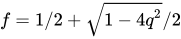
and the two roots of the quardratic are: and


Task: do it better. This means that given , , and , both of the roots your program returns should be greater than . Or, if your language can't do floating-point arithmetic any more precisely than single precision, your program should be able to handle . Either way, show what your program gives as the roots of the quadratic in question. See page 9 of
"What Every Scientist Should Know About Floating-Point Arithmetic" for a possible algorithm.


11l
F quad_roots(a, b, c)
   V sqd = Complex(b^2 - 4*a*c) ^ 0.5
   R ((-b + sqd) / (2 * a),
      (-b - sqd) / (2 * a))

V testcases = [(3.0, 4.0, 4 / 3),
               (3.0, 2.0, -1.0),
               (3.0, 2.0, 1.0),
               (1.0, -1e9, 1.0),
               (1.0, -1e100, 1.0)]

L(a, b, c) testcases
   V (r1, r2) = quad_roots(a, b, c)
   print(r1, end' ‘ ’)
print(r2)- Output:
-0.666667+0i -0.666667+0i
0.333333+0i -1+0i
-0.333333+0.471405i -0.333333-0.471405i
1e+09+0i 0i
1e+100+0i 0i
Ada
with Ada.Text_IO;                        use Ada.Text_IO;
with Ada.Numerics.Elementary_Functions;  use Ada.Numerics.Elementary_Functions;

procedure Quadratic_Equation is
   type Roots is array (1..2) of Float;
   function Solve (A, B, C : Float) return Roots is
      SD : constant Float := sqrt (B**2 - 4.0 * A * C);
      X  : Float;
   begin
      if B < 0.0 then
         X := (- B + SD) / (2.0 * A);
         return (X, C / (A * X));
      else
         X := (- B - SD) / (2.0 * A);
         return (C / (A * X), X);
      end if;
   end Solve;

   R : constant Roots := Solve (1.0, -10.0E5, 1.0);
begin
   Put_Line ("X1 =" & Float'Image (R (1)) & " X2 =" & Float'Image (R (2)));
end Quadratic_Equation;
Here precision loss is prevented by checking signs of operands. On errors, Constraint_Error is propagated on numeric errors and when roots are complex.
- Output:
X1 = 1.00000E+06 X2 = 1.00000E-06
ALGOL 68
quadratic equation:
BEGIN

  MODE ROOTS  = UNION([]REAL, []COMPL);
  MODE QUADRATIC = STRUCT(REAL a,b,c);

  PROC solve  = (QUADRATIC q)ROOTS:
  BEGIN
    REAL a = a OF q, b = b OF q, c = c OF q;
    REAL sa = b**2 - 4*a*c;
    IF sa >=0 THEN # handle the +ve case as REAL #
      REAL sqrt sa = ( b<0 | sqrt(sa) | -sqrt(sa));
      REAL r1 = (-b + sqrt sa)/(2*a),
           r2 = (-b - sqrt sa)/(2*a);
      []REAL((r1,r2))
    ELSE # handle the -ve case as COMPL conjugate pairs #
      COMPL compl sqrt sa = ( b<0 | complex sqrt(sa) | -complex sqrt(sa));
      COMPL r1 = (-b + compl sqrt sa)/(2*a),
            r2 = (-b - compl sqrt sa)/(2*a);
      []COMPL (r1, r2)
    FI
  END # solve #;

  PROC real  evaluate = (QUADRATIC q, REAL x )REAL:  (a OF q*x + b OF q)*x + c OF q;
  PROC compl evaluate = (QUADRATIC q, COMPL x)COMPL: (a OF q*x + b OF q)*x + c OF q;

  # only a very tiny difference between the 2 examples #
  []QUADRATIC test = ((1, -10e5, 1), (1, 0, 1), (1,-3,2), (1,3,2), (4,0,4), (3,4,5));

  FORMAT real fmt = $g(-0,8)$;
  FORMAT compl fmt = $f(real fmt)"+"f(real fmt)"i"$;
  FORMAT quadratic fmt = $f(real fmt)" x**2 + "f(real fmt)" x + "f(real fmt)" = 0"$;

  FOR index TO UPB test DO
    QUADRATIC quadratic = test[index];
    ROOTS r = solve(quadratic);

# Output the two different scenerios #
    printf(($"Quadratic: "$, quadratic fmt, quadratic, $l$));
    CASE r IN
      ([]REAL r):
        printf(($"REAL x1 = "$, real fmt, r[1],
                   $", x2 = "$, real fmt, r[2],  $"; "$,
                $"REAL y1 = "$, real fmt, real evaluate(quadratic,r[1]),
                   $", y2 = "$, real fmt, real evaluate(quadratic,r[2]), $";"ll$
        )),
      ([]COMPL c):
        printf(($"COMPL x1,x2 = "$, real fmt, re OF c[1], $"+/-"$,
                                    real fmt, ABS im OF c[1], $"; "$,
                  $"COMPL y1 = "$, compl fmt, compl evaluate(quadratic,c[1]),
                      $", y2 = "$, compl fmt, compl evaluate(quadratic,c[2]), $";"ll$
        ))
    ESAC
  OD
END # quadratic_equation #- Output:
Quadratic: 1.00000000 x**2 + -1000000.00000000 x + 1.00000000 = 0
REAL x1 = 999999.99999900, x2 = .00000100; REAL y1 = -.00000761, y2 = -.00000761;

Quadratic: 1.00000000 x**2 + .00000000 x + 1.00000000 = 0
COMPL x1,x2 = .00000000+/-1.00000000; COMPL y1 = .00000000+.00000000i, y2 = .00000000+.00000000i;

Quadratic: 1.00000000 x**2 + -3.00000000 x + 2.00000000 = 0
REAL x1 = 2.00000000, x2 = 1.00000000; REAL y1 = .00000000, y2 = .00000000;

Quadratic: 1.00000000 x**2 + 3.00000000 x + 2.00000000 = 0
REAL x1 = -2.00000000, x2 = -1.00000000; REAL y1 = .00000000, y2 = .00000000;

Quadratic: 4.00000000 x**2 + .00000000 x + 4.00000000 = 0
COMPL x1,x2 = .00000000+/-1.00000000; COMPL y1 = .00000000+.00000000i, y2 = .00000000+.00000000i;

Quadratic: 3.00000000 x**2 + 4.00000000 x + 5.00000000 = 0
COMPL x1,x2 = -.66666667+/-1.10554160; COMPL y1 = .00000000+.00000000i, y2 = .00000000+-.00000000i;
AutoHotkey
ahk forum: discussion
MsgBox % quadratic(u,v, 1,-3,2) ", " u ", " v
MsgBox % quadratic(u,v, 1,3,2) ", " u ", " v
MsgBox % quadratic(u,v, -2,4,-2) ", " u ", " v
MsgBox % quadratic(u,v, 1,0,1) ", " u ", " v
SetFormat FloatFast, 0.15e
MsgBox % quadratic(u,v, 1,-1.0e8,1) ", " u ", " v

quadratic(ByRef x1, ByRef x2, a,b,c) { ; -> #real roots {x1,x2} of ax²+bx+c
   If (a = 0)
      Return -1 ; ERROR: not quadratic
   d := b*b - 4*a*c
   If (d < 0) {
      x1 := x2 := ""
      Return 0
   }
   If (d = 0) {
      x1 := x2 := -b/2/a
      Return 1
   }
   x1 := (-b - (b<0 ? -sqrt(d) : sqrt(d)))/2/a
   x2 := c/a/x1
   Return 2
}
BBC BASIC
      FOR test% = 1 TO 7
        READ a$, b$, c$
        PRINT "For a = " ; a$ ", b = " ; b$ ", c = " ; c$ TAB(32) ;
        PROCsolvequadratic(EVAL(a$), EVAL(b$), EVAL(c$))
      NEXT
      END

      DATA 1, -1E9, 1
      DATA 1, 0, 1
      DATA 2, -1, -6
      DATA 1, 2, -2
      DATA 0.5, SQR(2), 1
      DATA 1, 3, 2
      DATA 3, 4, 5

      DEF PROCsolvequadratic(a, b, c)
      LOCAL d, f
      d = b^2 - 4*a*c
      CASE SGN(d) OF
        WHEN 0:
          PRINT "the single root is " ; -b/2/a
        WHEN +1:
          f = (1 + SQR(1-4*a*c/b^2))/2
          PRINT "the real roots are " ; -f*b/a " and " ; -c/b/f
        WHEN -1:
          PRINT "the complex roots are " ; -b/2/a " +/- " ; SQR(-d)/2/a "*i"
      ENDCASE
      ENDPROC
- Output:
For a = 1, b = -1E9, c = 1      the real roots are 1E9 and 1E-9
For a = 1, b = 0, c = 1         the complex roots are 0 +/- 1*i
For a = 2, b = -1, c = -6       the real roots are 2 and -1.5
For a = 1, b = 2, c = -2        the real roots are -2.73205081 and 0.732050808
For a = 0.5, b = SQR(2), c = 1  the single root is -1.41421356
For a = 1, b = 3, c = 2         the real roots are -2 and -1
For a = 3, b = 4, c = 5         the complex roots are -0.666666667 +/- 1.1055416*i
C
Code that tries to avoid floating point overflow and other unfortunate loss of precissions: (compiled with gcc -std=c99 for complex, though easily adapted to just real numbers)
#include <stdio.h>
#include <stdlib.h>
#include <complex.h>
#include <math.h>

typedef double complex cplx;

void quad_root
(double a, double b, double c, cplx * ra, cplx *rb)
{
	double d, e;
	if (!a) {
		*ra = b ? -c / b : 0;
		*rb = 0;
		return;
	}
	if (!c) {
		*ra = 0;
		*rb = -b / a;
		return;
	}

	b /= 2;
	if (fabs(b) > fabs(c)) {
		e = 1 - (a / b) * (c / b);
		d = sqrt(fabs(e)) * fabs(b);
	} else {
		e = (c > 0) ? a : -a;
		e = b * (b / fabs(c)) - e;
		d = sqrt(fabs(e)) * sqrt(fabs(c));
	}

	if (e < 0) {
		e = fabs(d / a);
		d = -b / a;
		*ra = d + I * e;
		*rb = d - I * e;
		return;
	}

	d = (b >= 0) ? d : -d;
	e = (d - b) / a;
	d = e ? (c / e) / a : 0;
	*ra = d;
	*rb = e;
	return;
}

int main()
{
	cplx ra, rb;
	quad_root(1, 1e12 + 1, 1e12, &ra, &rb);
	printf("(%g + %g i), (%g + %g i)\n",
		creal(ra), cimag(ra), creal(rb), cimag(rb));

	quad_root(1e300, -1e307 + 1, 1e300, &ra, &rb);
	printf("(%g + %g i), (%g + %g i)\n",
		creal(ra), cimag(ra), creal(rb), cimag(rb));

	return 0;
}
- Output:
(-1e+12 + 0 i), (-1 + 0 i)
(1.00208e+07 + 0 i), (9.9792e-08 + 0 i)
#include <stdio.h>
#include <math.h>
#include <complex.h>

void roots_quadratic_eq(double a, double b, double c, complex double *x)
{
  double delta;

  delta = b*b - 4.0*a*c;
  x[0] = (-b + csqrt(delta)) / (2.0*a);
  x[1] = (-b - csqrt(delta)) / (2.0*a);
}
void roots_quadratic_eq2(double a, double b, double c, complex double *x)
{
  b /= a;
  c /= a;
  double delta = b*b - 4*c;
  if ( delta < 0 ) {
    x[0] = -b/2 + I*sqrt(-delta)/2.0;
    x[1] = -b/2 - I*sqrt(-delta)/2.0;
  } else {
    double root = sqrt(delta);
    double sol = (b>0) ? (-b - root)/2.0 : (-b + root)/2.0;
    x[0] = sol;
    x[1] = c/sol;
  }
}
int main()
{
  complex double x[2];

  roots_quadratic_eq(1, -1e20, 1, x);
  printf("x1 = (%.20le, %.20le)\nx2 = (%.20le, %.20le)\n\n",
	 creal(x[0]), cimag(x[0]),
	 creal(x[1]), cimag(x[1]));
  roots_quadratic_eq2(1, -1e20, 1, x);
  printf("x1 = (%.20le, %.20le)\nx2 = (%.20le, %.20le)\n\n",
	 creal(x[0]), cimag(x[0]),
	 creal(x[1]), cimag(x[1]));

  return 0;
}
x1 = (1.00000000000000000000e+20, 0.00000000000000000000e+00)
x2 = (0.00000000000000000000e+00, 0.00000000000000000000e+00)

x1 = (1.00000000000000000000e+20, 0.00000000000000000000e+00)
x2 = (9.99999999999999945153e-21, 0.00000000000000000000e+00)
C#
using System;
using System.Numerics;

class QuadraticRoots
{
    static Tuple<Complex, Complex> Solve(double a, double b, double c)
    {
        var q = -(b + Math.Sign(b) * Complex.Sqrt(b * b - 4 * a * c)) / 2;
        return Tuple.Create(q / a, c / q);
    }

    static void Main()
    {
        Console.WriteLine(Solve(1, -1E20, 1));
    }
}
- Output:
((1E+20, 0), (1E-20, 0))
C++
#include <iostream>
#include <utility>
#include <complex>

typedef std::complex<double> complex;

std::pair<complex, complex>
 solve_quadratic_equation(double a, double b, double c)
{
  b /= a;
  c /= a;
  double discriminant = b*b-4*c;
  if (discriminant < 0)
    return std::make_pair(complex(-b/2, std::sqrt(-discriminant)/2),
                          complex(-b/2, -std::sqrt(-discriminant)/2));

  double root = std::sqrt(discriminant);
  double solution1 = (b > 0)? (-b - root)/2
                            : (-b + root)/2;

  return std::make_pair(solution1, c/solution1);
}

int main()
{
  std::pair<complex, complex> result = solve_quadratic_equation(1, -1e20, 1);
  std::cout << result.first << ", " << result.second << std::endl;
}
- Output:
(1e+20,0), (1e-20,0)
Clojure
(defn quadratic
  "Compute the roots of a quadratic in the form ax^2 + bx + c = 1.
   Returns any of nil, a float, or a vector."
  [a b c]
  (let [sq-d (Math/sqrt (- (* b b) (* 4 a c)))
        f    #(/ (% b sq-d) (* 2 a))]
    (cond
       (neg? sq-d)  nil
       (zero? sq-d) (f +)
       (pos? sq-d)  [(f +) (f -)]
       :else nil))) ; maybe our number ended up as NaN
- Output:
user=> (quadratic 1.0 1.0 1.0)
nil
user=> (quadratic 1.0 2.0 1.0)
1.0
user=> (quadratic 1.0 3.0 1.0)
[2.618033988749895 0.3819660112501051]
Common Lisp
(defun quadratic (a b c)
  (list
   (/ (+ (- b) (sqrt (- (expt b 2) (* 4 a c)))) (* 2 a))
   (/ (- (- b) (sqrt (- (expt b 2) (* 4 a c)))) (* 2 a))))
D
import std.math, std.traits;

CommonType!(T1, T2, T3)[] naiveQR(T1, T2, T3)
                                 (in T1 a, in T2 b, in T3 c)
pure nothrow if (isFloatingPoint!T1) {
    alias ReturnT = typeof(typeof(return).init[0]);
    if (a == 0)
        return [ReturnT(c / b)]; // It's a linear function.
    immutable ReturnT det = b ^^ 2 - 4 * a * c;
    if (det < 0)
        return []; // No real number root.
    immutable SD = sqrt(det);
    return [(-b + SD) / 2 * a, (-b - SD) / 2 * a];
}

CommonType!(T1, T2, T3)[] cautiQR(T1, T2, T3)
                                 (in T1 a, in T2 b, in T3 c)
pure nothrow if (isFloatingPoint!T1) {
    alias ReturnT = typeof(typeof(return).init[0]);
    if (a == 0)
        return [ReturnT(c / b)]; // It's a linear function.
    immutable ReturnT det = b ^^ 2 - 4 * a * c;
    if (det < 0)
        return []; // No real number root.
    immutable SD = sqrt(det);

    if (b * a < 0) {
        immutable x = (-b + SD) / 2 * a;
        return [x, c / (a * x)];
    } else {
        immutable x = (-b - SD) / 2 * a;
        return [c / (a * x), x];
    }
}

void main() {
    import std.stdio;
    writeln("With 32 bit float type:");
    writefln("   Naive: [%(%g, %)]", naiveQR(1.0f, -10e5f, 1.0f));
    writefln("Cautious: [%(%g, %)]", cautiQR(1.0f, -10e5f, 1.0f));
    writeln("\nWith 64 bit double type:");
    writefln("   Naive: [%(%g, %)]", naiveQR(1.0, -10e5, 1.0));
    writefln("Cautious: [%(%g, %)]", cautiQR(1.0, -10e5, 1.0));
    writeln("\nWith real type:");
    writefln("   Naive: [%(%g, %)]", naiveQR(1.0L, -10e5L, 1.0L));
    writefln("Cautious: [%(%g, %)]", cautiQR(1.0L, -10e5L, 1.0L));
}
- Output:
With 32 bit float type:
   Naive: [1e+06, 0]
Cautious: [1e+06, 1e-06]

With 64 bit double type:
   Naive: [1e+06, 1.00001e-06]
Cautious: [1e+06, 1e-06]

With real type:
   Naive: [1e+06, 1e-06]
Cautious: [1e+06, 1e-06]
Delphi
See Pascal.
Elixir
defmodule Quadratic do
  def roots(a, b, c) do
    IO.puts "Roots of a quadratic function (#{a}, #{b}, #{c})"
    d = b * b - 4 * a * c
    a2 = a * 2
    cond do
      d > 0 ->
        sd = :math.sqrt(d)
        IO.puts "  the real roots are #{(- b + sd) / a2} and #{(- b - sd) / a2}"
      d == 0 ->
        IO.puts "  the single root is #{- b / a2}"
      true ->
        sd = :math.sqrt(-d)
        IO.puts "  the complex roots are #{- b / a2} +/- #{sd / a2}*i"
    end
  end
end

Quadratic.roots(1, -2, 1)
Quadratic.roots(1, -3, 2)
Quadratic.roots(1, 0, 1)
Quadratic.roots(1, -1.0e10, 1)
Quadratic.roots(1, 2, 3)
Quadratic.roots(2, -1, -6)
- Output:
Roots of a quadratic function (1, -2, 1)
  the single root is 1.0
Roots of a quadratic function (1, -3, 2)
  the real roots are 2.0 and 1.0
Roots of a quadratic function (1, 0, 1)
  the complex roots are 0.0 +/- 1.0*i
Roots of a quadratic function (1, -1.0e10, 1)
  the real roots are 1.0e10 and 0.0
Roots of a quadratic function (1, 2, 3)
  the complex roots are -1.0 +/- 1.4142135623730951*i
Roots of a quadratic function (2, -1, -6)
  the real roots are 2.0 and -1.5
ERRE
PROGRAM QUADRATIC

PROCEDURE SOLVE_QUADRATIC
  D=B*B-4*A*C
  IF ABS(D)<1D-6 THEN D=0 END IF
  CASE SGN(D) OF
    0->
       PRINT("the single root is ";-B/2/A)
    END ->
    1->
       F=(1+SQR(1-4*A*C/(B*B)))/2
       PRINT("the real roots are ";-F*B/A;"and ";-C/B/F)
    END ->
    -1->
       PRINT("the complex roots are ";-B/2/A;"+/-";SQR(-D)/2/A;"*i")
    END ->
  END CASE
END PROCEDURE

BEGIN
  PRINT(CHR$(12);) ! CLS
  FOR TEST%=1 TO 7 DO
     READ(A,B,C)
     PRINT("For a=";A;",b=";B;",c=";C;TAB(32);)
     SOLVE_QUADRATIC
  END FOR
  DATA(1,-1E9,1)
  DATA(1,0,1)
  DATA(2,-1,-6)
  DATA(1,2,-2)
  DATA(0.5,1.4142135,1)
  DATA(1,3,2)
  DATA(3,4,5)
END PROGRAM
- Output:
For a= 1 ,b=-1E+09 ,c= 1       the real roots are  1E+09 and  1E-09
For a= 1 ,b= 0 ,c= 1           the complex roots are  0 +/- 1 *i
For a= 2 ,b=-1 ,c=-6           the real roots are  2 and -1.5
For a= 1 ,b= 2 ,c=-2           the real roots are -2.732051 and  .7320508
For a= .5 ,b= 1.414214 ,c= 1   the single root is -1.414214
For a= 1 ,b= 3 ,c= 2           the real roots are -2 and -1
For a= 3 ,b= 4 ,c= 5           the complex roots are -.6666667 +/- 1.105542 *i
Factor
:: quadratic-equation ( a b c -- x1 x2 )
    b sq a c * 4 * - sqrt :> sd
    b 0 <
    [ b neg sd + a 2 * / ]
    [ b neg sd - a 2 * / ] if :> x
    x c a x * / ;
( scratchpad ) 1 -1.e20 1 quadratic-equation
--- Data stack:
1.0e+20
9.999999999999999e-21
Middlebrook method
:: quadratic-equation2 ( a b c -- x1 x2 )
 a c * sqrt b / :> q
 1 4 q sq * - sqrt 0.5 * 0.5 + :> f
 b neg a / f * c neg b / f / ;
( scratchpad ) 1 -1.e20 1 quadratic-equation
--- Data stack:
1.0e+20
1.0e-20
Forth
Without locals:
: quadratic ( fa fb fc -- r1 r2 )
  frot frot
  ( c a b )
  fover 3 fpick f* -4e f*  fover fdup f* f+
  ( c a b det )
  fdup f0< if abort" imaginary roots" then
  fsqrt
  fover f0< if fnegate then
  f+ fnegate
  ( c a b-det )
  2e f/ fover f/
  ( c a r1 )
  frot frot f/ fover f/ ;
With locals:
: quadratic { F: a F: b F: c -- r1 r2 }
  b b f*  4e a f* c f* f-
  fdup f0< if abort" imaginary roots" then
  fsqrt
  b f0< if fnegate then b f+ fnegate 2e f/ a f/
  c a f/ fover f/ ;

\ test
1 set-precision
1e -1e6 1e quadratic fs. fs.     \ 1e-6 1e6
Fortran
Fortran 90
PROGRAM QUADRATIC

 IMPLICIT NONE
 INTEGER, PARAMETER :: dp = SELECTED_REAL_KIND(15)
 REAL(dp) :: a, b, c, e, discriminant, rroot1, rroot2
 COMPLEX(dp) :: croot1, croot2

 WRITE(*,*) "Enter the coefficients of the equation ax^2 + bx + c"
 WRITE(*, "(A)", ADVANCE="NO") "a = "
 READ *, a
 WRITE(*,"(A)", ADVANCE="NO") "b = "
 READ *, b
 WRITE(*,"(A)", ADVANCE="NO") "c = "
 READ *, c

 WRITE(*,"(3(A,E23.15))") "Coefficients are: a = ", a, "   b = ", b, "   c = ", c
 e = 1.0e-9_dp
 discriminant = b*b - 4.0_dp*a*c

 IF (ABS(discriminant) < e) THEN
    rroot1 = -b / (2.0_dp * a)
    WRITE(*,*) "The roots are real and equal:"
    WRITE(*,"(A,E23.15)") "Root = ", rroot1
 ELSE IF (discriminant > 0) THEN
    rroot1 = -(b + SIGN(SQRT(discriminant), b)) / (2.0_dp * a)
    rroot2 = c / (a * rroot1)
    WRITE(*,*) "The roots are real:"
    WRITE(*,"(2(A,E23.15))") "Root1 = ", rroot1, "  Root2 = ", rroot2
 ELSE
    croot1 = (-b + SQRT(CMPLX(discriminant))) / (2.0_dp*a)
    croot2 = CONJG(croot1)
    WRITE(*,*) "The roots are complex:"
    WRITE(*,"(2(A,2E23.15,A))") "Root1 = ", croot1, "j ", "  Root2 = ", croot2, "j"
 END IF
- Output:
Coefficients are: a =   0.300000000000000E+01   b =   0.400000000000000E+01   c =   0.133333333330000E+01
The roots are real and equal:
Root =  -0.666666666666667E+00

Coefficients are: a =   0.300000000000000E+01   b =   0.200000000000000E+01   c =  -0.100000000000000E+01
The roots are real:
Root1 =  -0.100000000000000E+01  Root2 =   0.333333333333333E+00

Coefficients are: a =   0.300000000000000E+01   b =   0.200000000000000E+01   c =   0.100000000000000E+01
The roots are complex:
Root1 =  -0.333333333333333E+00  0.471404512723287E+00j   Root2 =  -0.333333333333333E+00 -0.471404512723287E+00j

Coefficients are: a =   0.100000000000000E+01   b =  -0.100000000000000E+07   c =   0.100000000000000E+01
The roots are real:
Root1 =   0.999999999999000E+06  Root2 =   0.100000000000100E-05
Fortran I
Source code written in FORTRAN I (october 1956) for the IBM 704.
COMPUTE ROOTS OF A QUADRATIC FUNCTION - 1956
      READ 100,A,B,C
 100  FORMAT(3F8.3)
      PRINT 100,A,B,C
      DISC=B**2-4.*A*C
      IF(DISC),1,2,3
 1    XR=-B/(2.*A)
      XI=SQRT(-DISC)/(2.*A)
      XJ=-XI
      PRINT 311
      PRINT 312,XR,XI,XR,XJ
 311  FORMAT(13HCOMPLEX ROOTS)
 312  FORMAT(4HX1=(,2E12.4,6H),X2=(,2E12.4,1H))
      GO TO 999
 2    X1=-B/(2.*A)
      X2=X1
      PRINT 321
      PRINT 332,X1,X2
 321  FORMAT(16HEQUAL REAL ROOTS)
      GO TO 999
 3    X1= (-B+SQRT(DISC)) / (2.*A)
      X2= (-B-SQRT(DISC)) / (2.*A)
      PRINT 331
      PRINT 332,X1,X2
 331  FORMAT(10HREAL ROOTS)
 332  FORMAT(3HX1=,E12.5,4H,X2=,E12.5)
 999  STOP
FreeBASIC
' version 20-12-2020
' compile with: fbc -s console

#Include Once "gmp.bi"

Sub solvequadratic_n(a As Double ,b As Double, c As Double)

    Dim As Double f, d = b ^ 2 - 4 * a * c

    Select Case Sgn(d)
        Case 0
            Print "1: the single root is "; -b / 2 / a
        Case 1
            Print "1: the real roots are "; (-b + Sqr(d)) / 2 * a; " and ";(-b - Sqr(d)) / 2 * a
        Case -1
            Print "1: the complex roots are "; -b / 2 / a; " +/- "; Sqr(-d) / 2 / a; "*i"
    End Select

End Sub

Sub solvequadratic_c(a As Double ,b As Double, c As Double)

    Dim As Double f, d = b ^ 2 - 4 * a * c
    Select Case Sgn(d)
        Case 0
            Print "2: the single root is "; -b / 2 / a
        Case 1
            f = (1 + Sqr(1 - 4 * a *c / b ^ 2)) / 2
            Print "2: the real roots are ";  -f * b / a; " and "; -c / b / f
        Case -1
            Print "2: the complex roots are "; -b / 2 / a; " +/- "; Sqr(-d) / 2 / a; "*i"
    End Select
End Sub

Sub solvequadratic_gmp(a_ As Double ,b_ As Double, c_ As Double)

    #Define PRECISION 1024 ' about 300 digits
    #Define MAX 25

    Dim As ZString Ptr text
    text = Callocate (1000)
    Mpf_set_default_prec(PRECISION)

    Dim As Mpf_ptr a, b, c, d, t
    a = Allocate(Len(__mpf_struct)) : Mpf_init_set_d(a, a_)
    b = Allocate(Len(__mpf_struct)) : Mpf_init_set_d(b, b_)
    c = Allocate(Len(__mpf_struct)) : Mpf_init_set_d(c, c_)
    d = Allocate(Len(__mpf_struct)) : Mpf_init(d)
    t = Allocate(Len(__mpf_struct)) : Mpf_init(t)

    mpf_mul(d, b, b)
    mpf_set_ui(t, 4)
    mpf_mul(t, t, a)
    mpf_mul(t, t, c)
    mpf_sub(d, d, t)

    Select Case mpf_sgn(d)
        Case 0
            mpf_neg(t, b)
            mpf_div_ui(t, t, 2)
            mpf_div(t, t, a)
            Gmp_sprintf(text,"%.*Fe", MAX, t)
            Print "3: the single root is "; *text
        Case Is > 0
            mpf_sqrt(d, d)
            mpf_add(a, a, a)
            mpf_neg(t, b)
            mpf_add(t, t, d)
            mpf_div(t, t, a)
            Gmp_sprintf(text,"%.*Fe", MAX, t)
            Print "3: the real roots are "; *text; " and ";
            mpf_neg(t, b)
            mpf_sub(t, t, d)
            mpf_div(t, t, a)
            Gmp_sprintf(text,"%.*Fe", MAX, t)
            Print *text
        Case Is < 0
            mpf_neg(t, b)
            mpf_div_ui(t, t, 2)
            mpf_div(t, t, a)
            Gmp_sprintf(text,"%.*Fe", MAX, t)
            Print "3: the complex roots are "; *text; " +/- ";
            mpf_neg(t, d)
            mpf_sqrt(t, t)
            mpf_div_ui(t, t, 2)
            mpf_div(t, t, a)
            Gmp_sprintf(text,"%.*Fe", MAX, t)
            Print *text; "*i"
    End Select

End Sub

' ------=< MAIN >=------

Dim As Double a, b, c
Print "1: is the naieve way"
Print "2: is the cautious way"
Print "3: is the naieve way with help of GMP"
Print

For i As Integer = 1 To 10
    Read a, b, c
    Print "Find root(s) for "; Str(a); "X^2"; IIf(b < 0, "", "+");
    Print Str(b); "X"; IIf(c < 0, "", "+"); Str(c)
    solvequadratic_n(a, b , c)
    solvequadratic_c(a, b , c)
    solvequadratic_gmp(a, b , c)
    Print
Next

' empty keyboard buffer
While Inkey <> "" : Wend
Print : Print "hit any key to end program"
Sleep
End

Data 1, -1E9, 1
Data 1, 0, 1
Data 2, -1, -6
Data 1, 2, -2
Data 0.5, 1.4142135623731, 1
Data 1, 3, 2
Data 3, 4, 5
Data 1, -1e100, 1
Data 1, -1e200, 1
Data 1, -1e300, 1- Output:
1: is the naieve way
2: is the cautious way
3: is the naieve way with help of GMP

Find root(s) for 1X^2-1000000000X+1
1: the real roots are  1000000000 and  0
2: the real roots are  1000000000 and  1e-009
3: the real roots are 9.9999999999999999900000000e+08 and 1.0000000000000000010000000e-09

Find root(s) for 1X^2+0X+1
1: the complex roots are -0 +/-  1*i
2: the complex roots are -0 +/-  1*i
3: the complex roots are 0.0000000000000000000000000e+00 +/- 1.0000000000000000000000000e+00*i

Find root(s) for 2X^2-1X-6
1: the real roots are  8 and -6
2: the real roots are  2 and -1.5
3: the real roots are 2.0000000000000000000000000e+00 and -1.5000000000000000000000000e+00

Find root(s) for 1X^2+2X-2
1: the real roots are  0.7320508075688772 and -2.732050807568877
2: the real roots are -2.732050807568877 and  0.7320508075688773
3: the real roots are 7.3205080756887729352744634e-01 and -2.7320508075688772935274463e+00

Find root(s) for 0.5X^2+1.4142135623731X+1
1: the real roots are -0.3535533607909526 and -0.3535534203955974
2: the real roots are -1.414213681582389 and -1.414213443163811
3: the real roots are -1.4142134436707580875788206e+00 and -1.4142136810754419733330398e+00

Find root(s) for 1X^2+3X+2
1: the real roots are -1 and -2
2: the real roots are -2 and -0.9999999999999999
3: the real roots are -1.0000000000000000000000000e+00 and -2.0000000000000000000000000e+00

Find root(s) for 3X^2+4X+5
1: the complex roots are -0.6666666666666666 +/-  1.105541596785133*i
2: the complex roots are -0.6666666666666666 +/-  1.105541596785133*i
3: the complex roots are -6.6666666666666666666666667e-01 +/- 1.1055415967851332830383109e+00*i

Find root(s) for 1X^2-1e+100X+1
1: the real roots are  1e+100 and  0
2: the real roots are  1e+100 and  1e-100
3: the real roots are 1.0000000000000000159028911e+100 and 9.9999999999999998409710889e-101

Find root(s) for 1X^2-1e+200X+1
1: the real roots are  1.#INF and -1.#INF
2: the real roots are  1e+200 and  1e-200
3: the real roots are 9.9999999999999996973312221e+199 and 0.0000000000000000000000000e+00

Find root(s) for 1X^2-1e+300X+1
1: the real roots are  1.#INF and -1.#INF
2: the real roots are  1e+300 and  1e-300
3: the real roots are 1.0000000000000000525047603e+300 and 0.0000000000000000000000000e+00
GAP
QuadraticRoots := function(a, b, c)
  local d;
  d := Sqrt(b*b - 4*a*c);
  return [ (-b+d)/(2*a), (-b-d)/(2*a) ];
end;

# Hint : E(12) is a 12th primitive root of 1
QuadraticRoots(2, 2, -1);
# [ 1/2*E(12)^4-1/2*E(12)^7+1/2*E(12)^8+1/2*E(12)^11,
#   1/2*E(12)^4+1/2*E(12)^7+1/2*E(12)^8-1/2*E(12)^11 ]

# This works also with floating-point numbers
QuadraticRoots(2.0, 2.0, -1.0);
# [ 0.366025, -1.36603 ]
Go
package main

import (
    "fmt"
    "math"
)

func qr(a, b, c float64) ([]float64, []complex128) {
    d := b*b-4*a*c
    switch {
    case d == 0:
        // single root
        return []float64{-b/(2*a)}, nil
    case d > 0:
        // two real roots
        if b < 0 {
            d = math.Sqrt(d)-b
        } else {
            d = -math.Sqrt(d)-b
        }
        return []float64{d/(2*a), (2*c)/d}, nil
    case d < 0:
        // two complex roots

        den := 1/(2*a)
        t1 := complex(-b*den, 0)
        t2 := complex(0, math.Sqrt(-d)*den)
        return nil, []complex128{t1+t2, t1-t2}
    }
    // otherwise d overflowed or a coefficient was NAN
    return []float64{d}, nil
}

func test(a, b, c float64) {
    fmt.Print("coefficients: ", a, b, c, " -> ")
    r, i := qr(a, b, c)
    switch len(r) {
    case 1:
        fmt.Println("one real root:", r[0])
    case 2:
        fmt.Println("two real roots:", r[0], r[1])
    default:
        fmt.Println("two complex roots:", i[0], i[1])
    }
}

func main() {
    for _, c := range [][3]float64{
        {1, -2, 1},
        {1, 0, 1},
        {1, -10, 1},
        {1, -1000, 1},
        {1, -1e9, 1},
    } {
        test(c[0], c[1], c[2])
    }
}
- Output:
coefficients: 1 -2 1 -> one real root: 1
coefficients: 1 0 1 -> two complex roots: (0+1i) (-0-1i)
coefficients: 1 -10 1 -> two real roots: 9.898979485566356 0.10102051443364381
coefficients: 1 -1000 1 -> two real roots: 999.998999999 0.001000001000002
coefficients: 1 -1e+09 1 -> two real roots: 1e+09 1e-09
Haskell
import Data.Complex (Complex, realPart)

type CD = Complex Double

quadraticRoots :: (CD, CD, CD) -> (CD, CD)
quadraticRoots (a, b, c)
  | 0 < realPart b =
    ( (2 * c) / (- b - d),
      (- b - d) / (2 * a)
    )
  | otherwise =
    ( (- b + d) / (2 * a),
      (2 * c) / (- b + d)
    )
  where
    d = sqrt $ b ^ 2 - 4 * a * c

main :: IO ()
main =
  mapM_
    (print . quadraticRoots)
    [ (3, 4, 4 / 3),
      (3, 2, -1),
      (3, 2, 1),
      (1, -10e5, 1),
      (1, -10e9, 1)
    ]
- Output:
((-0.6666666666666666) :+ 0.0,(-0.6666666666666666) :+ 0.0)
(0.3333333333333333 :+ 0.0,(-1.0) :+ 0.0)
((-0.33333333333333326) :+ 0.4714045207910316,(-0.3333333333333333) :+ (-0.47140452079103173))
(999999.999999 :+ 0.0,1.000000000001e-6 :+ 0.0)
(1.0e10 :+ 0.0,1.0e-10 :+ 0.0)
Icon and Unicon
Works in both languages.
procedure main()
    solve(1.0, -10.0e5, 1.0)
end

procedure solve(a,b,c)
    d := sqrt(b*b - 4.0*a*c)
    roots := if b < 0 then [r1 := (-b+d)/(2.0*a), c/(a*r1)]
                      else [r1 := (-b-d)/(2.0*a), c/(a*r1)]
    write(a,"*x^2 + ",b,"*x + ",c," has roots ",roots[1]," and ",roots[2])
end
- Output:
->rqf 1.0 -0.000000001 1.0
1.0*x^2 + -1000000.0*x + 1.0 has roots 999999.999999 and 1.000000000001e-06
->
IDL
compile_OPT IDL2

print, "input a, press enter, input b, press enter, input c, press enter"
read,a,b,c
Promt='Enter values of a,b,c and hit enter'

a0=0.0
b0=0.0
c0=0.0   ;make them floating point variables

x=-b+sqrt((b^2)-4*a*c)
y=-b-sqrt((b^2)-4*a*c)
z=2*a
d= x/z
e= y/z

print, d,e
IS-BASIC
100 PROGRAM "Quadratic.bas"
110 PRINT "Enter coefficients a, b and c:":INPUT PROMPT "a= ,b= ,c= ":A,B,C
120 IF A=0 THEN
130   PRINT "The coefficient of x^2 can not be 0."
140 ELSE
150   LET D=B^2-4*A*C
160   SELECT CASE SGN(D)
170   CASE 0
180     PRINT "The single root is ";-B/2/A
190   CASE 1
200     PRINT "The real roots are ";(-B+SQR(D))/(2*A);"and ";(-B-SQR(D))/(2*A)
210   CASE -1
220     PRINT "The complex roots are ";-B/2/A;"+/- ";STR$(SQR(-D)/2/A);"*i"
230   END SELECT
240 END IF
J
Solution use J's built-in polynomial solver:
p.
This primitive converts between the coefficient form of a polynomial (with the exponents being the array indices of the coefficients) and the multiplier-and-roots for of a polynomial (with two boxes, the first containing the multiplier and the second containing the roots).
Example using inputs from other solutions and the unstable example from the task description:
   coeff =. _3 |.\ 3 4 4r3   3 2 _1   3 2 1   1 _1e6 1   1 _1e9 1
   > {:"1 p. coeff
         _0.666667           _0.666667
                _1            0.333333
_0.333333j0.471405 _0.333333j_0.471405
               1e6                1e_6
               1e9                1e_9
Of course p. generalizes to polynomials of arbitrary order (which isn't as great as that might sound, because of practical limitations). Given the coefficients p. returns the multiplier and roots of the polynomial. Given the multiplier and roots it returns the coefficients. For example using the cubic :

   p. 0 16 _12 2   NB. return multiplier ; roots
+-+-----+
|2|4 2 0|
+-+-----+
   p. 2 ; 4 2 0    NB. return coefficients
0 16 _12 2
Exploring the limits of precision:
   1{::p. 1 _1e5 1                   NB. display roots
100000 1e_5
   1 _1e5 1 p. 1{::p. 1 _1e5 1       NB. test roots
_3.38436e_7 0
   1 _1e5 1 p. 1e5 1e_5              NB. test displayed roots
1 9.99999e_11
   1e5 1e_5 - 1{::p. 1 _1e5 1        NB. find difference
1e_5 _1e_15
   1 _1e5 1 p. 1e5 1e_5-1e_5 _1e_15  NB. test displayed roots with adjustment
_3.38436e_7 0
When these "roots" are plugged back into the original polynomial, the results are nowhere near zero. However, double precision floating point does not have enough bits to represent the (extremely close) answers that would give a zero result.
Middlebrook formula implemented in J
q_r=: verb define
  'a b c' =. y
  q=. b %~ %: a * c
  f=. 0.5 + 0.5 * %:(1-4*q*q)
  (-b*f%a),(-c%b*f)
)

   q_r 1 _1e6 1
1e6 1e_6
Java
public class QuadraticRoots {
    private static class Complex {
        double re, im;

        public Complex(double re, double im) {
            this.re = re;
            this.im = im;
        }

        @Override
        public boolean equals(Object obj) {
            if (obj == this) {return true;}
            if (!(obj instanceof Complex)) {return false;}
            Complex other = (Complex) obj;
            return (re == other.re) && (im == other.im);
        }

        @Override
        public String toString() {
            if (im == 0.0) {return String.format("%g", re);}
            if (re == 0.0) {return String.format("%gi", im);}
            return String.format("%g %c %gi", re,
                (im < 0.0 ? '-' : '+'), Math.abs(im));
        }
    }

    private static Complex[] quadraticRoots(double a, double b, double c) {
        Complex[] roots = new Complex[2];
        double d = b * b - 4.0 * a * c;  // discriminant
        double aa = a + a;

        if (d < 0.0) {
            double re = -b / aa;
            double im = Math.sqrt(-d) / aa;
            roots[0] = new Complex(re, im);
            roots[1] = new Complex(re, -im);
        } else if (b < 0.0) {
            // Avoid calculating -b - Math.sqrt(d), to avoid any
            // subtractive cancellation when it is near zero.
            double re = (-b + Math.sqrt(d)) / aa;
            roots[0] = new Complex(re, 0.0);
            roots[1] = new Complex(c / (a * re), 0.0);
        } else {
            // Avoid calculating -b + Math.sqrt(d).
            double re = (-b - Math.sqrt(d)) / aa;
            roots[1] = new Complex(re, 0.0);
            roots[0] = new Complex(c / (a * re), 0.0);
        }
        return roots;
    }

    public static void main(String[] args) {
        double[][] equations = {
            {1.0, 22.0, -1323.0},   // two distinct real roots
            {6.0, -23.0, 20.0},     //   with a != 1.0
            {1.0, -1.0e9, 1.0},     //   with one root near zero
            {1.0, 2.0, 1.0},        // one real root (double root)
            {1.0, 0.0, 1.0},        // two imaginary roots
            {1.0, 1.0, 1.0}         // two complex roots
        };
        for (int i = 0; i < equations.length; i++) {
            Complex[] roots = quadraticRoots(
                equations[i][0], equations[i][1], equations[i][2]);
            System.out.format("%na = %g   b = %g   c = %g%n",
                equations[i][0], equations[i][1], equations[i][2]);
            if (roots[0].equals(roots[1])) {
                System.out.format("X1,2 = %s%n", roots[0]);
            } else {
                System.out.format("X1 = %s%n", roots[0]);
                System.out.format("X2 = %s%n", roots[1]);
            }
        }
    }
}
- Output:
a = 1.00000   b = 22.0000   c = -1323.00
X1 = 27.0000
X2 = -49.0000

a = 6.00000   b = -23.0000   c = 20.0000
X1 = 2.50000
X2 = 1.33333

a = 1.00000   b = -1.00000e+09   c = 1.00000
X1 = 1.00000e+09
X2 = 1.00000e-09

a = 1.00000   b = 2.00000   c = 1.00000
X1,2 = -1.00000

a = 1.00000   b = 0.00000   c = 1.00000
X1 = 1.00000i
X2 = -1.00000i

a = 1.00000   b = 1.00000   c = 1.00000
X1 = -0.500000 + 0.866025i
X2 = -0.500000 - 0.866025i
jq
Currently jq does not include support for complex number operations, so a small library is included in the first section.
The second section defines quadratic_roots(a;b;c), which emits a stream of 0 or two solutions, or the value true if a==b==c==0.
The third section defines a function for producing a table showing (i, error, solution) for solutions to x^2 - 10^i + 1 = 0 for various values of i.
Section 1: Complex numbers (scrolling window)
# Complex numbers as points [x,y] in the Cartesian plane
def real(z): if (z|type) == "number" then z else z[0] end;

def imag(z): if (z|type) == "number" then 0 else z[1] end;

def plus(x; y):
    if (x|type) == "number" then
       if  (y|type) == "number" then [ x+y, 0 ]
       else [ x + y[0], y[1]]
       end
    elif (y|type) == "number" then plus(y;x)
    else [ x[0] + y[0], x[1] + y[1] ]
    end;

def multiply(x; y):
    if (x|type) == "number" then
       if  (y|type) == "number" then [ x*y, 0 ]
       else [x * y[0], x * y[1]]
       end
    elif (y|type) == "number" then multiply(y;x)
    else [ x[0] * y[0] - x[1] * y[1],  x[0] * y[1] + x[1] * y[0]]
    end;

def negate(x): multiply(-1; x);

def minus(x; y): plus(x; multiply(-1; y));

def conjugate(z):
  if (z|type) == "number" then [z, 0]
  else  [z[0], -(z[1]) ]
  end;

def invert(z):
  if (z|type) == "number" then [1/z, 0]
  else
    ( (z[0] * z[0]) + (z[1] * z[1]) ) as $d
   # use "0 + ." to convert -0 back to 0
    | [ z[0]/$d, (0 + -(z[1]) / $d)]
  end;

def divide(x;y): multiply(x; invert(y));

def magnitude(z):
  real( multiply(z; conjugate(z))) | sqrt;

# exp^z
def complex_exp(z):
  def expi(x): [ (x|cos), (x|sin) ];
  if (z|type) == "number" then z|exp
  elif z[0] == 0 then expi(z[1])  # for efficiency
  else multiply( (z[0]|exp); expi(z[1]) )
  end ;

def complex_sqrt(z):
  if imag(z) == 0 and real(z) >= 0 then [(real(z)|sqrt), 0]
  else
    magnitude(z) as $r
    | if $r == 0 then [0,0]
      else
      (real(z)/$r) as $a
      | (imag(z)/$r) as $b
      | $r | sqrt as $r
      | (($a | acos) / 2)
      | [ ($r * cos), ($r * sin)]
      end
  end ;
Section 2: quadratic_roots(a;b;c)
# If there are infinitely many solutions, emit true;
# if none, emit empty;
# otherwise always emit two.
# For numerical accuracy, Middlebrook's approach is adopted:
def quadratic_roots(a; b; c):
  if a == 0 and b == 0 then
     if c == 0 then true # infinitely many
     else empty          # none
     end
  elif a == 0 then [-c/b, 0]
  elif b == 0 then (complex_sqrt(1/a) | (., negate(.)))
  else
    divide( plus(1.0; complex_sqrt( minus(1.0; (4 * a * c / (b*b))))); 2) as $f
    | negate(divide(multiply(b; $f); a)),
      negate(divide(c; multiply(b; $f)))
  end
;
Section 3: Produce a table showing [i, error, solution] for solutions to x^2 - 10^i + 1 = 0
def example:
  def pow(i): . as $in | reduce range(0;i) as $i (1; . * $in);
  def poly(a;b;c): plus( plus( multiply(a; multiply(.;.)); multiply(b;.)); c);
  def abs: if . < 0 then -. else . end;
  def zero(z):
    if z == 0 then 0
    else (magnitude(z)|abs) as $zero
    | if $zero < 1e-10 then "+0" else $zero end
    end;
  def lpad(n): tostring | (n - length) * " " + .;

  range(0; 13) as $i
  | (- (10|pow($i))) as $b
  | quadratic_roots(1; $b; 1) as $x
  | $x | poly(1; $b; 1) as $zero
  | "\($i|lpad(4)): error = \(zero($zero)|lpad(18)) x=\($x)"
;

example- Output:
(scrolling window)
$ jq -M -r -n -f Roots_of_a_quadratic_function.jq
   0: error =                 +0 x=[0.5,0.8660254037844386]
   0: error =                 +0 x=[0.5000000000000001,-0.8660254037844387]
   1: error =                 +0 x=[9.898979485566356,0]
   1: error =                 +0 x=[0.10102051443364382,-0]
   2: error =                 +0 x=[99.98999899979995,0]
   2: error =                 +0 x=[0.010001000200050014,-0]
   3: error = 1.1641532182693481e-10 x=[999.998999999,0]
   3: error =                 +0 x=[0.0010000010000019998,-0]
   4: error =                 +0 x=[9999.999899999999,0]
   4: error =                 +0 x=[0.00010000000100000003,-0]
   5: error =                 +0 x=[99999.99999,0]
   5: error =                 +0 x=[1.0000000001e-05,-0]
   6: error =    0.0001220703125 x=[999999.9999989999,0]
   6: error =                 +0 x=[1.000000000001e-06,-0]
   7: error =           0.015625 x=[9999999.9999999,0]
   7: error =                 +0 x=[1.0000000000000101e-07,-0]
   8: error =                  1 x=[99999999.99999999,0]
   8: error =                 +0 x=[1e-08,-0]
   9: error =                  1 x=[1000000000,0]
   9: error =                 +0 x=[1e-09,-0]
  10: error =                  1 x=[10000000000,0]
  10: error =                 +0 x=[1e-10,-0]
  11: error =                  1 x=[100000000000,0]
  11: error =                 +0 x=[1e-11,-0]
  12: error =                  1 x=[1000000000000,0]
  12: error =                 +0 x=[1e-12,-0]
Julia
This solution is an implementation of algorithm from the Goldberg paper cited in the task description. It does check for a=0 and returns the linear solution in that case. Julia's sqrt throws a domain error for negative real inputs, so negative discriminants are converted to complex by adding 0im prior to taking the square root.
Alternative solutions might make use of Julia's Polynomials or Roots packages.
using Printf

function quadroots(x::Real, y::Real, z::Real)
    a, b, c = promote(float(x), y, z)
    if a ≈ 0.0 return [-c / b] end
    Δ = b ^ 2 - 4a * c
    if Δ ≈ 0.0 return [-sqrt(c / a)] end
    if Δ < 0.0 Δ = complex(Δ) end
    d = sqrt(Δ)
    if b < 0.0
        d -= b
        return [d / 2a, 2c / d]
    else
        d = -d - b
        return [2c / d, d / 2a]
    end
end

a = [1, 1, 1.0, 10]
b = [10, 2, -10.0 ^ 9, 1]
c = [1, 1, 1, 1]

for (x, y, z) in zip(a, b, c)
    @printf "The roots of %.2fx² + %.2fx + %.2f\n\tx₀ = (%s)\n" x y z join(round.(quadroots(x, y, z), 2), ", ")
end
- Output:
The roots of 1.00x² + 10.00x + 1.00
	x₀ = (-0.1, -9.9)
The roots of 1.00x² + 2.00x + 1.00
	x₀ = (-1.0)
The roots of 1.00x² + -1000000000.00x + 1.00
	x₀ = (1.0e9, 0.0)
The roots of 10.00x² + 1.00x + 1.00
	x₀ = (-0.05 + 0.31im, -0.05 - 0.31im)
K
K6
   / naive method
   / sqr[x] and sqrt[x] must be provided
   quf:{[a;b;c]; s:sqrt[sqr[b]-4*a*c];(-b+s;-b-s)%2*a}

   quf[0.5;-2.5;2]
1.0 4.0
   quf[1;8;15]
-5.0 -3.0
   quf[1;10;1]
-9.898979485566356 -0.10102051443364424
Kotlin
import java.lang.Math.*

data class Equation(val a: Double, val b: Double, val c: Double) {
    data class Complex(val r: Double, val i: Double) {
        override fun toString() = when {
            i == 0.0 -> r.toString()
            r == 0.0 -> "${i}i"
            else -> "$r + ${i}i"
        }
    }

    data class Solution(val x1: Any, val x2: Any) {
        override fun toString() = when(x1) {
            x2 -> "X1,2 = $x1"
            else -> "X1 = $x1, X2 = $x2"
        }
    }

    val quadraticRoots by lazy {
        val _2a = a + a
        val d = b * b - 4.0 * a * c  // discriminant
         if (d < 0.0) {
            val r = -b / _2a
            val i = sqrt(-d) / _2a
            Solution(Complex(r, i), Complex(r, -i))
        } else {
            // avoid calculating -b +/- sqrt(d), to avoid any
            // subtractive cancellation when it is near zero.
            val r = if (b < 0.0) (-b + sqrt(d)) / _2a else (-b - sqrt(d)) / _2a
            Solution(r, c / (a * r))
        }
    }
}

fun main(args: Array<String>) {
    val equations = listOf(Equation(1.0, 22.0, -1323.0),   // two distinct real roots
                           Equation(6.0, -23.0, 20.0),     //  with a != 1.0
                           Equation(1.0, -1.0e9, 1.0),     //  with one root near zero
                           Equation(1.0, 2.0, 1.0),        // one real root (double root)
                           Equation(1.0, 0.0, 1.0),        // two imaginary roots
                           Equation(1.0, 1.0, 1.0))        // two complex roots

    equations.forEach { println("$it\n" + it.quadraticRoots) }
}
- Output:
Equation(a=1.0, b=22.0, c=-1323.0)
X1 = -49.0, X2 = 27.0
Equation(a=6.0, b=-23.0, c=20.0)
X1 = 2.5, X2 = 1.3333333333333333
Equation(a=1.0, b=-1.0E9, c=1.0)
X1 = 1.0E9, X2 = 1.0E-9
Equation(a=1.0, b=2.0, c=1.0)
X1,2 = -1.0
Equation(a=1.0, b=0.0, c=1.0)
X1 = 1.0i, X2 = -1.0i
Equation(a=1.0, b=1.0, c=1.0)
X1 = -0.5 + 0.8660254037844386i, X2 = -0.5 + -0.8660254037844386i
lambdatalk
1) using lambdas:

{def equation
 {lambda {:a :b :c}
  {b equation :a*x{sup 2}+:b*x+:c=0}
  {{lambda {:a' :b' :d}
   {if {> :d 0}
   then {{lambda {:b' :d'}
         {equation.disp {+ :b' :d'} {- :b' :d'} 2 real roots}
        } :b' {/ {sqrt :d} :a'}}
   else {if {< :d 0}
   then {{lambda {:b' :d'}
         {equation.disp [:b',:d'] [:b',-:d'] 2 complex roots}
        } :b' {/ {sqrt {- :d}} :a'} }
   else {equation.disp :b'  :b' one real double root}
  }}
  } {* 2 :a} {/ {- :b} {* 2 :a}} {- {* :b :b} {* 4 :a :c}} } }}

2) using let:

{def equation
 {lambda {:a :b :c}
  {b equation :a*x{sup 2}+:b*x+:c=0}
  {let { {:a' {* 2 :a}}
         {:b' {/ {- :b} {* 2 :a}}}
         {:d  {- {* :b :b} {* 4 :a :c}}} }
   {if {> :d 0}
    then {let { {:b' :b'}
                {:d' {/ {sqrt :d} :a'}} }
          {equation.disp {+ :b' :d'} {- :b' :d'} 2 real roots} }
    else {if {< :d 0}
    then {let { {:b' :b'}
                {:d' {/ {sqrt {- :d}} :a'}} }
          {equation.disp [:b',:d'] [:b',-:d'] 2 complex roots} }
    else  {equation.disp :b' :b' one real double root} }} }}}

3) a function to display results in an HTML table format

{def equation.disp
 {lambda {:x1 :x2 :txt}
  {table {@ style="background:#ffa"}
   {tr {td :txt:    }}
   {tr {td x1 = :x1 }}
   {tr {td x2 = :x2 }} } }}

4) testing:

equation 1*x2+1*x+-1=0
2 real roots:
 x1 = 0.6180339887498949
 x2 = -1.618033988749895

equation 1*x2+1*x+1=0
2 complex roots:
 x1 = [-0.5,0.8660254037844386]
 x2 = [-0.5,-0.8660254037844386]

equation 1*x2+-2*x+1=0
one real double root:
 x1 = 1
 x2 = 1
Liberty BASIC
a=1:b=2:c=3
    'assume a<>0
    print quad$(a,b,c)
    end

function quad$(a,b,c)
    D=b^2-4*a*c
    x=-1*b
    if D<0 then
        quad$=str$(x/(2*a));" +i";str$(sqr(abs(D))/(2*a));" , ";str$(x/(2*a));" -i";str$(sqr(abs(D))/abs(2*a))
    else
        quad$=str$(x/(2*a)+sqr(D)/(2*a));" , ";str$(x/(2*a)-sqr(D)/(2*a))
    end if
end function
Logo
to quadratic :a :b :c
  localmake "d sqrt (:b*:b - 4*:a*:c)
  if :b < 0 [make "d minus :d]
  output list (:d-:b)/(2*:a) (2*:c)/(:d-:b)
end
Lua
In order to correctly handle complex roots, qsolve must be given objects from a suitable complex number library, like that from the Complex Numbers article. However, this should be enough to demonstrate its accuracy:
function qsolve(a, b, c)
  if b < 0 then return qsolve(-a, -b, -c) end
  val = b + (b^2 - 4*a*c)^(1/2) --this never exhibits instability if b > 0
  return -val / (2 * a), -2 * c / val --2c / val is the same as the "unstable" second root
end

for i = 1, 12 do
  print(qsolve(1, 0-10^i, 1))
end
The "trick" lies in avoiding subtracting large values that differ by a small amount, which is the source of instability in the "normal" formula. It is trivial to prove that 2c/(b + sqrt(b^2-4ac)) = (b - sqrt(b^2-4ac))/2a.
Maple
solve(a*x^2+b*x+c,x);

solve(1.0*x^2-10.0^9*x+1.0,x,explicit,allsolutions);

fsolve(x^2-10^9*x+1,x,complex);- Output:
                                (1/2)                     (1/2)
                   /          2\             /          2\
              -b + \-4 a c + b /         b + \-4 a c + b /
              -----------------------, - ----------------------
                        2 a                       2 a

                                    9                -9
                      1.000000000 10 , 1.000000000 10

                                    -9                9
                      1.000000000 10  , 1.000000000 10
Mathematica/Wolfram Language
Possible ways to do this are (symbolic and numeric examples):
Solve[a x^2 + b x + c == 0, x]
Solve[x^2 - 10^5 x + 1 == 0, x]
Root[#1^2 - 10^5 #1 + 1 &, 1]
Root[#1^2 - 10^5 #1 + 1 &, 2]
Reduce[a x^2 + b x + c == 0, x]
Reduce[x^2 - 10^5 x + 1 == 0, x]
FindInstance[x^2 - 10^5 x + 1 == 0, x, Reals, 2]
FindRoot[x^2 - 10^5 x + 1 == 0, {x, 0}]
FindRoot[x^2 - 10^5 x + 1 == 0, {x, 10^6}]
gives back:




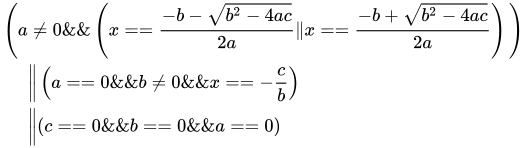



Note that some functions do not really give the answer (like reduce) rather it gives another way of writing it (boolean expression). However note that reduce gives the explicit cases for a zero and nonzero, b zero and nonzero, et cetera. Some functions are numeric by nature, other can handle both symbolic and numeric. In generals the solution will be exact if the input is exact. Any exact result can be approximated to arbitrary precision using the function N[expression,number of digits]. Further notice that some functions give back exact answers in a different form then others, however the answers are both correct, the answers are just written differently.
MATLAB / Octave
roots([1 -3 2]) % coefficients in decreasing order of power e.g. [x^n ... x^2 x^1 x^0]
Maxima
solve(a*x^2 + b*x + c = 0, x);

/*                2                         2
            sqrt(b  - 4 a c) + b      sqrt(b  - 4 a c) - b
     [x = - --------------------, x = --------------------]
                    2 a                       2 a              */

fpprec: 40$

solve(x^2 - 10^9*x + 1 = 0, x);
/* [x = 500000000 - sqrt(249999999999999999),
    x = sqrt(249999999999999999) + 500000000] */

bfloat(%);
/* [x = 1.0000000000000000009999920675269450501b-9,
    x = 9.99999999999999998999999999999999999b8] */
МК-61/52
П2	С/П	/-/	<->	/	2	/	П3	x^2	С/П
ИП2	/	-	Вx	<->	КвКор	НОП	x>=0	28	ИП3
x<0	24	<->	/-/	+	/	Вx	С/П	/-/	КвКор
ИП3	С/П
Input: a С/П b С/П c С/П
- Output:
x1 - РX; x2 - РY (or error message, if D < 0).
Modula-3
MODULE Quad EXPORTS Main;

IMPORT IO, Fmt, Math;

TYPE Roots = ARRAY [1..2] OF LONGREAL;

VAR r: Roots;

PROCEDURE Solve(a, b, c: LONGREAL): Roots =
  VAR sd: LONGREAL := Math.sqrt(b * b - 4.0D0 * a * c);
      x: LONGREAL;
  BEGIN
    IF b < 0.0D0 THEN
      x := (-b + sd) / (2.0D0 * a);
      RETURN Roots{x, c / (a * x)};
    ELSE
      x := (-b - sd) / (2.0D0 * a);
      RETURN Roots{c / (a * x), x};
    END;
  END Solve;

BEGIN
  r := Solve(1.0D0, -10.0D5, 1.0D0);
  IO.Put("X1 = " & Fmt.LongReal(r[1]) & " X2 = " & Fmt.LongReal(r[2]) & "\n");
END Quad.
Nim
import math, complex, strformat

const Epsilon = 1e-15

type

  SolKind = enum solDouble, solFloat, solComplex

  Roots = object
    case kind: SolKind
    of solDouble:
      fvalue: float
    of solFloat:
      fvalues: (float, float)
    of solComplex:
      cvalues: (Complex64, Complex64)


func quadRoots(a, b, c: float): Roots =
  if a == 0:
    raise newException(ValueError, "first coefficient cannot be null.")
  let den = a * 2
  let Δ = b * b - a * c * 4
  if abs(Δ) < Epsilon:
    result = Roots(kind: solDouble, fvalue: -b / den)
  elif Δ < 0:
    let r = -b / den
    let i = sqrt(-Δ) / den
    result = Roots(kind: solComplex, cvalues: (complex64(r, i), complex64(r, -i)))
  else:
    let r = (if b < 0: -b + sqrt(Δ) else: -b - sqrt(Δ)) / den
    result = Roots(kind: solFloat, fvalues: (r, c / (a * r)))


func `$`(r: Roots): string =
  case r.kind
  of solDouble:
    result = $r.fvalue
  of solFloat:
    result = &"{r.fvalues[0]}, {r.fvalues[1]}"
  of solComplex:
    result = &"{r.cvalues[0].re} + {r.cvalues[0].im}i, {r.cvalues[1].re} + {r.cvalues[1].im}i"


when isMainModule:

  const Equations = [(1.0, -2.0, 1.0),
                    (10.0, 1.0, 1.0),
                    (1.0, -10.0, 1.0),
                    (1.0, -1000.0, 1.0),
                    (1.0, -1e9, 1.0)]

  for (a, b, c) in Equations:
    echo &"Equation: {a=}, {b=}, {c=}"
    let roots = quadRoots(a, b, c)
    let plural = if roots.kind == solDouble: "" else: "s"
    echo &"    root{plural}: {roots}"
- Output:
Equation: a=1.0, b=-2.0, c=1.0
    root: 1.0
Equation: a=10.0, b=1.0, c=1.0
    roots: -0.05 + 0.3122498999199199i, -0.05 + -0.3122498999199199i
Equation: a=1.0, b=-10.0, c=1.0
    roots: 9.898979485566356, 0.1010205144336438
Equation: a=1.0, b=-1000.0, c=1.0
    roots: 999.998999999, 0.001000001000002
Equation: a=1.0, b=-1000000000.0, c=1.0
    roots: 1000000000.0, 1e-09
OCaml
type quadroots =
  | RealRoots of float * float
  | ComplexRoots of Complex.t * Complex.t ;;

let quadsolve a b c =
  let d = (b *. b) -. (4.0 *. a *. c) in
  if d < 0.0
  then
    let r = -. b /. (2.0 *. a)
    and i = sqrt(-. d) /. (2.0 *. a) in
    ComplexRoots ({ Complex.re = r; Complex.im = i },
                  { Complex.re = r; Complex.im = (-.i) })
  else
    let r =
      if b < 0.0
      then ((sqrt d) -. b) /. (2.0 *. a)
      else ((sqrt d) +. b) /. (-2.0 *. a)
    in
    RealRoots (r, c /. (r *. a))
;;
- Output:
# quadsolve 1.0 0.0 (-2.0) ;;
- : quadroots = RealRoots (-1.4142135623730951, 1.4142135623730949)

# quadsolve 1.0 0.0 2.0 ;;
- : quadroots =
ComplexRoots ({Complex.re = 0.; Complex.im = 1.4142135623730951},
 {Complex.re = 0.; Complex.im = -1.4142135623730951})

# quadsolve 1.0 (-1.0e5) 1.0 ;;
- : quadroots = RealRoots (99999.99999, 1.0000000001000001e-005)
Octave
See MATLAB.
PARI/GP
roots(a,b,c)=polrootsreal(Pol([a,b,c]))Otherwise, coding directly:
roots(a,b,c)={
  b /= a;
  c /= a;
  my (delta = b^2 - 4*c, root=sqrt(delta));
  if (delta < 0,
    [root-b,-root-b]/2
  ,
    my(sol=if(b>0, -b - root,-b + root)/2);
    [sol,c/sol]
  )
};
Either way,
roots(1,-1e9,1)gives one root around 0.000000001000000000000000001 and one root around 999999999.999999999.
Pascal
some parts translated from Modula2
Program QuadraticRoots;

var
  a, b, c, q, f: double;

begin
  a := 1;
  b := -10e9;
  c := 1;
  q := sqrt(a * c) / b;
  f := (1 + sqrt(1 - 4 * q * q)) / 2;

  writeln ('Version 1:');
  writeln ('x1: ', (-b * f / a):16, ', x2: ', (-c / (b * f)):16);

  writeln ('Version 2:');
  q := sqrt(b * b - 4 * a * c);
  if b < 0 then
  begin
    f :=  (-b + q) / 2 * a;
    writeln ('x1: ', f:16, ', x2: ', (c / (a * f)):16);
  end
  else
  begin
    f := (-b - q) / 2 * a;
    writeln ('x1: ', (c / (a * f)):16, ', x2: ', f:16);
  end;
end.
- Output:
Version 1:
x1:  1.00000000E+010, x2:  1.00000000E-010
Version 2:
x1:  1.00000000E+010, x2:  1.00000000E-010
Perl
When using Math::Complex perl automatically convert numbers when necessary.
use Math::Complex;

($x1,$x2) = solveQuad(1,2,3);

print "x1 = $x1, x2 = $x2\n";

sub solveQuad
{
	my ($a,$b,$c) = @_;
	my $root = sqrt($b**2 - 4*$a*$c);
	return ( -$b + $root )/(2*$a), ( -$b - $root )/(2*$a);
}
Phix
procedure solve_quadratic(sequence t3)
    atom {a,b,c} = t3,
         d = b*b-4*a*c, f
    string s = sprintf("for a=%g,b=%g,c=%g",t3), t
    sequence u
    if abs(d)<1e-6 then d=0 end if
    switch sign(d) do
        case 0: t = "single root is %g"
                u = {-b/2/a}
        case 1: t = "real roots are %g and %g"
                f = (1+sqrt(1-4*a*c/(b*b)))/2
                u = {-f*b/a,-c/b/f}
        case-1: t = "complex roots are %g +/- %g*i"
                u = {-b/2/a,sqrt(-d)/2/a}
    end switch
    printf(1,"%-25s the %s\n",{s,sprintf(t,u)})
end procedure

constant tests = {{1,-1E9,1},
                  {1,0,1},
                  {2,-1,-6},
                  {1,2,-2},
                  {0.5,1.4142135,1},
                  {1,3,2},
                  {3,4,5}}

papply(tests,solve_quadratic)
for a=1,b=-1e+9,c=1       the real roots are 1e+9 and 1e-9
for a=1,b=0,c=1           the complex roots are 0 +/- 1*i
for a=2,b=-1,c=-6         the real roots are 2 and -1.5
for a=1,b=2,c=-2          the real roots are -2.73205 and 0.732051
for a=0.5,b=1.41421,c=1   the single root is -1.41421
for a=1,b=3,c=2           the real roots are -2 and -1
for a=3,b=4,c=5           the complex roots are -0.666667 +/- 1.10554*i
PicoLisp
(scl 40)

(de solveQuad (A B C)
   (let SD (sqrt (- (* B B) (* 4 A C)))
      (if (lt0 B)
         (list
            (*/ (- SD B) A 2.0)
            (*/ C 2.0 (*/ A A (- SD B) `(* 1.0 1.0))) )
         (list
            (*/ C 2.0 (*/ A A (- 0 B SD) `(* 1.0 1.0)))
            (*/ (- 0 B SD) A 2.0) ) ) ) )

(mapcar round
   (solveQuad 1.0 -1000000.0 1.0)
(6 .) )- Output:
-> ("999,999.999999" "0.000001")
PL/I
   declare (c1, c2) float complex,
           (a, b, c, x1, x2) float;

   get list (a, b, c);
   if b**2 < 4*a*c then
      do;
         c1 = (-b + sqrt(b**2 - 4+0i*a*c)) / (2*a);
         c2 = (-b - sqrt(b**2 - 4+0i*a*c)) / (2*a);
         put data (c1, c2);
      end;
   else
      do;
         x1 = (-b + sqrt(b**2 - 4*a*c)) / (2*a);
         x2 = (-b - sqrt(b**2 - 4*a*c)) / (2*a);
         put data (x1, x2);
      end;
Python
This solution compares the naïve method with three "better" methods.
#!/usr/bin/env python3

import math
import cmath
import numpy

def quad_discriminating_roots(a,b,c, entier = 1e-5):
    """For reference, the naive algorithm which shows complete loss of
    precision on the quadratic in question.  (This function also returns a
    characterization of the roots.)"""
    discriminant = b*b - 4*a*c
    a,b,c,d =complex(a), complex(b), complex(c), complex(discriminant)
    root1 = (-b + cmath.sqrt(d))/2./a
    root2 = (-b - cmath.sqrt(d))/2./a
    if abs(discriminant) < entier:
        return "real and equal", abs(root1), abs(root1)
    if discriminant > 0:
        return "real", root1.real, root2.real
    return "complex", root1, root2

def middlebrook(a, b, c):
    try:
        q = math.sqrt(a*c)/b
        f = .5+ math.sqrt(1-4*q*q)/2
    except ValueError:
        q = cmath.sqrt(a*c)/b
        f = .5+ cmath.sqrt(1-4*q*q)/2
    return (-b/a)*f, -c/(b*f)

def whatevery(a, b, c):
    try:
        d = math.sqrt(b*b-4*a*c)
    except ValueError:
        d = cmath.sqrt(b*b-4*a*c)
    if b > 0:
        return div(2*c, (-b-d)), div((-b-d), 2*a)
    else:
        return div((-b+d), 2*a), div(2*c, (-b+d))

def div(n, d):
    """Divide, with a useful interpretation of division by zero."""
    try:
        return n/d
    except ZeroDivisionError:
        if n:
            return n*float('inf')
        return float('nan')

testcases = [
    (3, 4, 4/3),    # real, equal
    (3, 2, -1),     # real, unequal
    (3, 2, 1),      # complex
    (1, -1e9, 1),   # ill-conditioned "quadratic in question" required by task.
    (1, -1e100, 1),
    (1, -1e200, 1),
    (1, -1e300, 1),
]

print('Naive:')
for c in testcases:
    print("{} {:.5} {:.5}".format(*quad_discriminating_roots(*c)))

print('\nMiddlebrook:')
for c in testcases:
    print(("{:.5} "*2).format(*middlebrook(*c)))

print('\nWhat Every...')
for c in testcases:
    print(("{:.5} "*2).format(*whatevery(*c)))

print('\nNumpy:')
for c in testcases:
    print(("{:.5} "*2).format(*numpy.roots(c)))
- Output:
Naive:
real and equal 0.66667 0.66667
real 0.33333 -1.0
complex (-0.33333+0.4714j) (-0.33333-0.4714j)
real 1e+09 0.0
real 1e+100 0.0
real nan nan
real nan nan

Middlebrook:
-0.66667 -0.66667
(-1+0j) (0.33333+0j)
(-0.33333-0.4714j) (-0.33333+0.4714j)
1e+09 1e-09
1e+100 1e-100
1e+200 1e-200
1e+300 1e-300

What Every...
-0.66667 -0.66667
0.33333 -1.0
(-0.33333+0.4714j) (-0.33333-0.4714j)
1e+09 1e-09
1e+100 1e-100
inf 0.0
inf 0.0

Numpy:
-0.66667 -0.66667
-1.0 0.33333
(-0.33333+0.4714j) (-0.33333-0.4714j)
1e+09 1e-09
1e+100 1e-100
1e+200 1e-200
1e+300 0.0
R
qroots <- function(a, b, c) {
  r <- sqrt(b * b - 4 * a * c + 0i)
  if (abs(b - r) > abs(b + r)) {
    z <- (-b + r) / (2 * a)
  } else {
    z <- (-b - r) / (2 * a)
  }
  c(z, c / (z * a))
}

qroots(1, 0, 2i)
[1] -1+1i  1-1i

qroots(1, -1e9, 1)
[1] 1e+09+0i 1e-09+0i
Using the builtin polyroot function (note the order of coefficients is reversed):
polyroot(c(2i, 0, 1))
[1] -1+1i  1-1i

polyroot(c(1, -1e9, 1))
[1] 1e-09+0i 1e+09+0i
Racket
#lang racket
(define (quadratic a b c)
  (let* ((-b (- b))
         (delta (- (expt b 2) (* 4 a c)))
         (denominator (* 2 a)))
    (list
     (/ (+ -b (sqrt delta)) denominator)
     (/ (- -b (sqrt delta)) denominator))))

;(quadratic 1 0.0000000000001 -1)
;'(0.99999999999995 -1.00000000000005)
;(quadratic 1 0.0000000000001 1)
;'(-5e-014+1.0i -5e-014-1.0i)
Raku
(formerly Perl 6)
Works with previous versions also but will return slightly less precise results.
Raku has complex number handling built in.
for
[1, 2, 1],
[1, 2, 3],
[1, -2, 1],
[1, 0, -4],
[1, -10⁶, 1]
-> @coefficients {
    printf "Roots for %d, %d, %d\t=> (%s, %s)\n",
    |@coefficients, |quadroots(@coefficients);
}

sub quadroots (*[$a, $b, $c]) {
    ( -$b + $_ ) / (2 × $a),
    ( -$b - $_ ) / (2 × $a)
    given
    ($b² - 4 × $a × $c ).Complex.sqrt.narrow
}
- Output:
Roots for 1, 2, 1	=> (-1, -1)
Roots for 1, 2, 3	=> (-1+1.4142135623730951i, -1-1.4142135623730951i)
Roots for 1, -2, 1	=> (1, 1)
Roots for 1, 0, -4	=> (2, -2)
Roots for 1, -1000000, 1	=> (999999.999999, 1.00000761449337e-06)
REXX
version 1
The REXX language doesn't have a sqrt function, nor does it support complex numbers natively.
Since "unlimited" decimal precision is part of the REXX language, the numeric digits was increased
(from a default of 9) to 200 to accommodate when a root is closer to zero than the other root.
Note that only nine decimal digits (precision) are shown in the displaying of the output.
This REXX version supports complex numbers for the result.
/*REXX program finds the  roots  (which may be complex)  of a quadratic function.       */
parse arg  a b c .                               /*obtain the specified arguments: A B C*/
call quad  a,b,c                                 /*solve quadratic function via the sub.*/
r1= r1/1;  r2= r2/1;   a= a/1;  b= b/1;  c= c/1  /*normalize numbers to a new precision.*/
if r1j\=0  then r1=r1||left('+',r1j>0)(r1j/1)"i" /*Imaginary part? Handle complex number*/
if r2j\=0  then r2=r2||left('+',r2j>0)(r2j/1)"i" /*   "        "      "       "      "  */
              say '    a ='   a                  /*display the normalized value of   A. */
              say '    b ='   b                  /*   "     "       "       "    "   B. */
              say '    c ='   c                  /*   "     "       "       "    "   C. */
      say;    say 'root1 ='   r1                 /*   "     "       "       "   1st root*/
              say 'root2 ='   r2                 /*   "     "       "       "   2nd root*/
exit 0                                           /*stick a fork in it,  we're all done. */
/*──────────────────────────────────────────────────────────────────────────────────────*/
quad: parse arg aa,bb,cc;     numeric digits 200 /*obtain 3 args; use enough dec. digits*/
      $= sqrt(bb**2-4*aa*cc);       L= length($) /*compute  SQRT (which may be complex).*/
      r= 1 /(aa+aa);   ?= right($, 1)=='i'       /*compute reciprocal of 2*aa;  Complex?*/
      if ?  then do;  r1= -bb   *r;   r2=r1;          r1j= left($,L-1)*r;   r2j=-r1j;  end
            else do;  r1=(-bb+$)*r;   r2=(-bb-$)*r;   r1j= 0;               r2j= 0;    end
      return
/*──────────────────────────────────────────────────────────────────────────────────────*/
sqrt: procedure; parse arg x 1 ox; if x=0  then return 0; d= digits(); m.= 9; numeric form
      numeric digits 9; h= d+6; x=abs(x); parse value format(x,2,1,,0) 'E0' with g 'E' _ .
      g=g*.5'e'_%2;   do j=0  while h>9;      m.j=h;              h=h%2+1;       end /*j*/
                      do k=j+5  to 0  by -1;  numeric digits m.k; g=(g+x/g)*.5;  end /*k*/
      numeric digits d;         return (g/1)left('i', ox<0)     /*make complex if OX<0. */
- output when using the input of: 1 -10e5 1
    a = 1
    b = -1000000
    c = 1

root1 = 1000000
root2 = 0.000001
The following output is when Regina 3.9.3 REXX is used.
- output when using the input of: 1 -10e9 1
    a = 1
    b = -1.0E+10
    c = 1

root1 = 1.000000000E+10
root2 = 1E-10
The following output is when R4 REXX is used.
- output when using the input of: 1 -10e9 1
    a = 1
    b = -1E+10
    c = 1

root1 = 1E+10
root2 = 0.0000000001
- output when using the input of: 3 2 1
    a = 3
    b = 2
    c = 1

root1 = -0.333333333+0.471404521i
root2 = -0.333333333-0.471404521i
{{out|output|text= when using the input of: 1 0 1
    a = 1
    b = 0
    c = 1

root1 = 0+1i
root2 = 0-1i
Version 2
/* REXX ***************************************************************
* 26.07.2913 Walter Pachl
**********************************************************************/
  Numeric Digits 30
  Parse Arg a b c 1 alist
  Select
    When a='' | a='?' Then
      Call exit 'rexx qgl a b c solves a*x**2+b*x+c'
    When words(alist)<>3 Then
      Call exit 'three numbers are required'
    Otherwise
      Nop
    End
  gl=a'*x**2'
  Select
    When b<0 Then gl=gl||b'*x'
    When b>0 Then gl=gl||'+'||b'*x'
    Otherwise Nop
    End
  Select
    When c<0 Then gl=gl||c
    When c>0 Then gl=gl||'+'||c
    Otherwise Nop
    End
  Say gl '= 0'

  d=b**2-4*a*c
  If d<0 Then Do
    dd=sqrt(-d)
    r=-b/(2*a)
    i=dd/(2*a)
    x1=r'+'i'i'
    x2=r'-'i'i'
    End
  Else Do
    dd=sqrt(d)
    x1=(-b+dd)/(2*a)
    x2=(-b-dd)/(2*a)
    End
  Say 'x1='||x1
  Say 'x2='||x2
  Exit
sqrt:
/* REXX ***************************************************************
* EXEC to calculate the square root of x with high precision
**********************************************************************/
  Parse Arg x
  prec=digits()
  prec1=2*prec
  eps=10**(-prec1)
  k = 1
  Numeric Digits prec1
  r0= x
  r = 1
  Do i=1 By 1 Until r=r0 | (abs(r*r-x)<eps)
    r0 = r
    r  = (r + x/r) / 2
    k  = min(prec1,2*k)
    Numeric Digits (k + 5)
    End
  Numeric Digits prec
  Return (r+0)
exit: Say arg(1)
Exit
- Output:
Version 1:
    a = 1
    b = -1
    c = 0

root1 = 1
root2 = 0

Version 2:
1*x**2-1.0000000001*x+1.e-9 = 0
x1=0.9999999991000000000025
x2=0.0000000009999999999975
Ring
x1 = 0
x2 = 0
quadratic(3, 4, 4/3.0)  # [-2/3]
see "x1 = " + x1 + " x2 = " + x2 + nl
quadratic(3, 2, -1)      # [1/3, -1]
see "x1 = " + x1 + " x2 = " + x2 + nl
quadratic(-2,  7, 15)    # [-3/2, 5]
see "x1 = " + x1 + " x2 = " + x2 + nl
quadratic(1, -2,  1)     # [1]
see "x1 = " + x1 + " x2 = " + x2 + nl

func quadratic a, b, c
     sqrtDiscriminant = sqrt(pow(b,2) - 4*a*c)
     x1 = (-b + sqrtDiscriminant) / (2.0*a)
     x2 = (-b - sqrtDiscriminant) / (2.0*a)
     return [x1, x2]
RPL
RPL can solve quadratic functions directly :
'x^2-1E9*x+1' 'x' QUAD
returns
1: '(1000000000+s1*1000000000)/2'
which can then be turned into roots by storing 1 or -1 in the s1 variable and evaluating the formula:
DUP 1 's1' STO EVAL SWAP -1 's1' STO EVAL
hence returning
2: 1000000000
1: 0
So let's implement the algorithm proposed by the task:
| RPL code | Comment |
|---|---|
≪
   IF DUP TYPE 1 == THEN
      IF DUP IM NOT THEN RE END END
≫ 'REALZ' STO
 .
≪ → a b c
  ≪ IF b NOT THEN c a / NEG √ DUP NEG ELSE
        a c * √ b /
        1 SWAP SQ 4 * - √ 2 / 0.5 +
        b * NEG
        DUP a / REALZ
        c ROT / REALZ END
≫ ≫ 'QROOT' STO
|
REALZ ( number → number ) if number is a complex with no imaginary part, then turn it into a real QROOT ( a b c → r1 r2 ) if b=0 then roots are obvious, else q = sqrt(a*c)/b f = 1/2+sqrt(1-4*q^2)/2 get -b*f root1 = -b/a*f root2 = -c/(b*f) |
1 -1E9 1 QROOT
actually returns a more correct answer:
2: 1000000000
1: .000000001
Ruby
The CMath#sqrt method will return a Complex instance if necessary.
require 'cmath'

def quadratic(a, b, c)
  sqrt_discriminant = CMath.sqrt(b**2 - 4*a*c)
  [(-b + sqrt_discriminant) / (2.0*a), (-b - sqrt_discriminant) / (2.0*a)]
end

p quadratic(3, 4, 4/3.0)  # [-2/3]
p quadratic(3, 2, -1)     # [1/3, -1]
p quadratic(3, 2,  1)     # [(-1/3 + sqrt(2/9)i), (-1/3 - sqrt(2/9)i)]
p quadratic(1, 0,  1)     # [(0+i), (0-i)]
p quadratic(1, -1e6, 1)   # [1e6, 1e-6]
p quadratic(-2,  7, 15)   # [-3/2, 5]
p quadratic(1, -2,  1)    # [1]
p quadratic(1,  3,  3)    # [(-3 + sqrt(3)i)/2), (-3 - sqrt(3)i)/2)]
- Output:
[-0.6666666666666666, -0.6666666666666666]
[0.3333333333333333, -1.0]
[(-0.3333333333333333+0.47140452079103173i), (-0.3333333333333333-0.47140452079103173i)]
[(0.0+1.0i), (0.0-1.0i)]
[999999.999999, 1.00000761449337e-06]
[-1.5, 5.0]
[1.0, 1.0]
[(-1.5+0.8660254037844386i), (-1.5-0.8660254037844386i)]
Run BASIC
print "FOR 1,2,3 => ";quad$(1,2,3)
print "FOR 4,5,6 => ";quad$(4,5,6)

FUNCTION quad$(a,b,c)
    d  = b^2-4 * a*c
    x  = -1*b
    if d<0 then
        quad$ = str$(x/(2*a));" +i";str$(sqr(abs(d))/(2*a))+" , "+str$(x/(2*a));" -i";str$(sqr(abs(d))/abs(2*a))
    else
        quad$ = str$(x/(2*a)+sqr(d)/(2*a))+" , "+str$(x/(2*a)-sqr(d)/(2*a))
    end if
END FUNCTION
FOR 1,2,3 => -1 +i1.41421356 , -1 -i1.41421356 FOR 4,5,6 => -0.625 +i1.05326872 , -0.625 -i1.05326872
Scala
Using Complex class from task Arithmetic/Complex.
import ArithmeticComplex._
object QuadraticRoots {
  def solve(a:Double, b:Double, c:Double)={
    val d = b*b-4.0*a*c
    val aa = a+a

    if (d < 0.0) {  // complex roots
      val re= -b/aa;
      val im = math.sqrt(-d)/aa;
      (Complex(re, im), Complex(re, -im))
    }
    else { // real roots
      val re=if (b < 0.0) (-b+math.sqrt(d))/aa else (-b -math.sqrt(d))/aa
      (re, (c/(a*re)))
    }
  }
}
Usage:
val equations=Array(
  (1.0, 22.0, -1323.0),   // two distinct real roots
  (6.0, -23.0, 20.0),     //   with a != 1.0
  (1.0, -1.0e9, 1.0),     //   with one root near zero
  (1.0, 2.0, 1.0),        // one real root (double root)
  (1.0, 0.0, 1.0),        // two imaginary roots
  (1.0, 1.0, 1.0)         // two complex roots
);

equations.foreach{v =>
  val (a,b,c)=v
  println("a=%g   b=%g   c=%g".format(a,b,c))
  val roots=solve(a, b, c)
  println("x1="+roots._1)
  if(roots._1 != roots._2) println("x2="+roots._2)
  println
}
- Output:
a=1.00000   b=22.0000   c=-1323.00
x1=-49.0
x2=27.0

a=6.00000   b=-23.0000   c=20.0000
x1=2.5
x2=1.3333333333333333

a=1.00000   b=-1.00000e+09   c=1.00000
x1=1.0E9
x2=1.0E-9

a=1.00000   b=2.00000   c=1.00000
x1=-1.0

a=1.00000   b=0.00000   c=1.00000
x1=-0.0 + 1.0i
x2=-0.0 + -1.0i

a=1.00000   b=1.00000   c=1.00000
x1=-0.5 + 0.8660254037844386i
x2=-0.5 + -0.8660254037844386i
Scheme
(define (quadratic a b c)
	(if (= a 0)
	(if (= b 0) 'fail (- (/ c b)))
	(let ((delta (- (* b b) (* 4 a c))))
	(if (and (real? delta) (> delta 0))
		(let ((u (+ b (* (if (>= b 0) 1 -1) (sqrt delta)))))
			(list (/ u -2 a) (/ (* -2 c) u)))
		(list
			(/ (- (sqrt delta) b) 2 a)
			(/ (+ (sqrt delta) b) -2 a))))))


; examples

(quadratic 1 -1 -1)
; (1.618033988749895 -0.6180339887498948)

(quadratic 1 0 -2)
; (-1.4142135623730951 1.414213562373095)

(quadratic 1 0 2)
; (0+1.4142135623730951i 0-1.4142135623730951i)

(quadratic 1+1i 2 5)
; (-1.0922677260818898-1.1884256155834088i 0.09226772608188982+2.1884256155834088i)

(quadratic 0 4 3)
; -3/4

(quadratic 0 0 1)
; fail

(quadratic 1 2 0)
; (-2 0)

(quadratic 1 2 1)
; (-1 -1)

(quadratic 1 -1e5 1)
; (99999.99999 1.0000000001000001e-05)
Seed7
$ include "seed7_05.s7i";
  include "float.s7i";
  include "math.s7i";

const type: roots is new struct
    var float: x1 is 0.0;
    var float: x2 is 0.0;
  end struct;

const func roots: solve (in float: a, in float: b, in float: c) is func
  result
    var roots: solution is roots.value;
  local
    var float: sd is 0.0;
    var float: x is 0.0;
  begin
    sd := sqrt(b**2 - 4.0 * a * c);
    if b < 0.0 then
      x := (-b + sd) / 2.0 * a;
      solution.x1 := x;
      solution.x2 := c / (a * x);
    else
      x := (-b - sd) / 2.0 * a;
      solution.x1 := c / (a * x);
      solution.x2 := x;
    end if;
  end func;

const proc: main is func
  local
    var roots: r is roots.value;
  begin
    r := solve(1.0, -10.0E5, 1.0);
    writeln("X1 = " <& r.x1 digits 6 <& " X2 = " <& r.x2 digits 6);
end func;- Output:
X1 = 1000000.000000 X2 = 0.000001
Sidef
var sets = [
            [1,    2,  1],
            [1,    2,  3],
            [1,   -2,  1],
            [1,    0, -4],
            [1, -1e6,  1],
           ]

func quadroots(a, b, c) {
    var root = sqrt(b**2 - 4*a*c)

    [(-b + root) / (2 * a),
     (-b - root) / (2 * a)]
}

sets.each { |coefficients|
    say ("Roots for #{coefficients}",
        "=> (#{quadroots(coefficients...).join(', ')})")
}
- Output:
Roots for [1, 2, 1]=> (-1, -1)
Roots for [1, 2, 3]=> (-1+1.41421356237309504880168872420969807856967187538i, -1-1.41421356237309504880168872420969807856967187538i)
Roots for [1, -2, 1]=> (1, 1)
Roots for [1, 0, -4]=> (2, -2)
Roots for [1, -1000000, 1]=> (999999.999998999999999998999999999997999999999995, 0.00000100000000000100000000000200000000000500000000002)
Stata
mata
: polyroots((-2,0,1))
                 1             2
    +-----------------------------+
  1 |   1.41421356   -1.41421356  |
    +-----------------------------+

: polyroots((2,0,1))
                  1              2
    +-------------------------------+
  1 |  -1.41421356i    1.41421356i  |
    +-------------------------------+
Tcl
package require math::complexnumbers
namespace import math::complexnumbers::complex math::complexnumbers::tostring

proc quadratic {a b c} {
    set discrim [expr {$b**2 - 4*$a*$c}]
    set roots [list]
    if {$discrim < 0} {
        set term1 [expr {(-1.0*$b)/(2*$a)}]
        set term2 [expr {sqrt(abs($discrim))/(2*$a)}]
        lappend roots [tostring [complex $term1 $term2]] \
                [tostring [complex $term1 [expr {-1 * $term2}]]]
    } elseif {$discrim == 0} {
        lappend roots [expr {-1.0*$b / (2*$a)}]
    } else {
        lappend roots [expr {(-1*$b + sqrt($discrim)) / (2 * $a)}] \
                [expr {(-1*$b - sqrt($discrim)) / (2 * $a)}]
    }
    return $roots
}

proc report_quad {a b c} {
    puts [format "%sx**2 + %sx + %s = 0" $a $b $c]
    foreach root [quadratic $a $b $c] {
        puts "    x = $root"
    }
}

# examples on this page
report_quad 3 4 [expr {4/3.0}] ;# {-2/3}
report_quad 3 2 -1    ;# {1/3, -1}
report_quad 3 2  1    ;# {(-1/3 + sqrt(2/9)i), (-1/3 - sqrt(2/9)i)}
report_quad 1 0  1    ;# {(0+i), (0-i)}
report_quad 1 -1e6 1  ;# {1e6, 1e-6}
# examples from http://en.wikipedia.org/wiki/Quadratic_equation
report_quad -2  7 15  ;# {5, -3/2}
report_quad  1 -2  1  ;# {1}
report_quad  1  3  3  ;# {(-3 - sqrt(3)i)/2), (-3 + sqrt(3)i)/2)}
- Output:
3x**2 + 4x + 1.3333333333333333 = 0
    x = -0.6666666666666666
3x**2 + 2x + -1 = 0
    x = 0.3333333333333333
    x = -1.0
3x**2 + 2x + 1 = 0
    x = -0.3333333333333333+0.47140452079103173i
    x = -0.3333333333333333-0.47140452079103173i
1x**2 + 0x + 1 = 0
    x = i
    x = -i
1x**2 + -1e6x + 1 = 0
    x = 999999.999999
    x = 1.00000761449337e-6
-2x**2 + 7x + 15 = 0
    x = -1.5
    x = 5.0
1x**2 + -2x + 1 = 0
    x = 1.0
1x**2 + 3x + 3 = 0
    x = -1.5+0.8660254037844386i
    x = -1.5-0.8660254037844386i
TI-89 BASIC
TI-89 BASIC has built-in numeric and algebraic solvers.
solve(x^2-1E9x+1.0)
returns
x=1.E-9 or x=1.E9
Wren
import "./complex" for Complex

var quadratic = Fn.new { |a, b, c|
    var d = b*b - 4*a*c
    if (d == 0) {
        // single root
        return [[-b/(2*a)], null]
    }
    if (d > 0) {
        // two real roots
        var sr = d.sqrt
        d = (b < 0) ? sr - b : -sr - b
        return [[d/(2*a), 2*c/d], null]
    }
    // two complex roots
    var den = 1 / (2*a)
    var t1 = Complex.new(-b*den, 0)
    var t2 = Complex.new(0, (-d).sqrt * den)
    return [[], [t1+t2, t1-t2]]
}

var test = Fn.new { |a, b, c|
    System.write("coefficients: %(a), %(b), %(c) -> ")
    var roots = quadratic.call(a, b, c)
    var r = roots[0]
    if (r.count == 1) {
        System.print("one real root: %(r[0])")
    } else if (r.count == 2) {
        System.print("two real roots: %(r[0]) and %(r[1])")
    } else {
        var i = roots[1]
        System.print("two complex roots: %(i[0]) and %(i[1])")
    }
}

var coeffs = [
    [1, -2, 1],
    [1,  0, 1],
    [1, -10, 1],
    [1, -1000, 1],
    [1, -1e9, 1]
]

for (c in coeffs) test.call(c[0], c[1], c[2])
- Output:
coefficients: 1, -2, 1 -> one real root: 1
coefficients: 1, 0, 1 -> two complex roots: 0 + i and 0 - i
coefficients: 1, -10, 1 -> two real roots: 9.8989794855664 and 0.10102051443364
coefficients: 1, -1000, 1 -> two real roots: 999.998999999 and 0.001000001000002
coefficients: 1, -1000000000, 1 -> two real roots: 1000000000 and 1e-09
XPL0
include xpllib; \for Print

func real QuadRoots(A, B, C);   \Return roots of quadratic equation
real A, B, C;
real D, E, R;
[R:= [0., 0., 0.];
R(0):= 0.;  R(1):= 0.;  R(2):= 0.;
D:= B*B - 4.*A*C;
case of
D = 0.: [R(0):= -B / (2.*A);            \single root
         R(1):= R(0);
        ];
D > 0.: [if B < 0. then                 \two real roots
                E:=  sqrt(D) - B
        else    E:= -sqrt(D) - B;
        R(0):= E / (2.*A);
        R(1):= 2. * C / E;
        ];
D < 0.: [R(0):= -B / (2.*A);            \real
         R(2):= sqrt(-D) /(2.*A);       \imaginary
        ]
other   [];                     \D overflowed or a coefficient was NaN
return R;
];

func Test(A, B, C);
real A, B, C;
real R;
[Print("coefficients: %g, %g, %g  -> ", A, B, C);
R:= QuadRoots(A, B, C);
if R(2) # 0. then
        Print("two complex roots: %g+%gi, %g-%gi\n", R(0), R(2), R(0), R(2))
else    [if R(0) = R(1) then
                Print("one real root: %g\n", R(0))
        else    Print("two real roots: %15.15g, %15.15g\n", R(0), R(1));
        ];
];

real C;  int I;
[C:=  [ [1., -2., 1.],
        [1., 0., 1.],
        [1., -10., 1.],
        [1., -1000., 1.],
        [1., -1e9, 1.],
        [1., -4., 6.] ];
for I:= 0 to 5 do
        Test(C(I,0), C(I,1), C(I,2));
]- Output:
coefficients: 1, -2, 1  -> one real root: 1
coefficients: 1, 0, 1  -> two complex roots: 0+1i, 0-1i
coefficients: 1, -10, 1  -> two real roots: 9.89897948556636, 0.101020514433644
coefficients: 1, -1000, 1  -> two real roots: 999.998999999, 0.001000001000002
coefficients: 1, -1e9, 1  -> two real roots: 1000000000, 0.000000001
coefficients: 1, -4, 6  -> two complex roots: 2+1.41421i, 2-1.41421i
zkl
zkl doesn't have a complex number package.
fcn quadratic(a,b,c){ b=b.toFloat();
   println("Roots of a quadratic function %s, %s, %s".fmt(a,b,c));
   d,a2:=(b*b - 4*a*c), a+a;
   if(d>0){
      sd:=d.sqrt();
      println("  the real roots are %s and %s".fmt((-b + sd)/a2,(-b - sd)/a2));
   }
   else if(d==0) println("  the single root is ",-b/a2);
   else{
      sd:=(-d).sqrt();
      println("  the complex roots are %s and \U00B1;%si".fmt(-b/a2,sd/a2));
   }
}
foreach a,b,c in (T( T(1,-2,1), T(1,-3,2), T(1,0,1), T(1,-1.0e10,1), T(1,2,3), T(2,-1,-6)) ){
quadratic(a,b,c)
}- Output:
Roots of a quadratic function 1, -2, 1
  the single root is 1
Roots of a quadratic function 1, -3, 2
  the real roots are 2 and 1
Roots of a quadratic function 1, 0, 1
  the complex roots are 0 and ±1i
Roots of a quadratic function 1, -1e+10, 1
  the real roots are 1e+10 and 0
Roots of a quadratic function 1, 2, 3
  the complex roots are -1 and ±1.41421i
Roots of a quadratic function 2, -1, -6
  the real roots are 2 and -1.5
- Programming Tasks
- Arithmetic operations
- Clarified and Needing Review
- 11l
- Ada
- ALGOL 68
- AutoHotkey
- BBC BASIC
- C
- C sharp
- C++
- Clojure
- Common Lisp
- D
- Delphi
- Elixir
- ERRE
- Factor
- Forth
- Fortran
- FreeBASIC
- GMP
- GAP
- Go
- Haskell
- Icon
- Unicon
- IDL
- IS-BASIC
- J
- Java
- Jq
- Julia
- K
- Kotlin
- Lambdatalk
- Liberty BASIC
- Logo
- Lua
- Maple
- Mathematica
- Wolfram Language
- MATLAB
- Octave
- Maxima
- МК-61/52
- Modula-3
- Nim
- OCaml
- PARI/GP
- Pascal
- Perl
- Phix
- PicoLisp
- PL/I
- Python
- NumPy
- R
- Racket
- Raku
- REXX
- Ring
- RPL
- Ruby
- Run BASIC
- Scala
- Scheme
- Seed7
- Sidef
- Stata
- Tcl
- Tcllib
- TI-89 BASIC
- Wren
- Wren-complex
- XPL0
- Zkl
- M4/Omit