
Matrix multiplication

You are encouraged to solve this task according to the task description, using any language you may know.
- Task
Multiply two matrices together.
They can be of any dimensions, so long as the number of columns of the first matrix is equal to the number of rows of the second matrix.
11l
F matrix_mul(m1, m2)
   assert(m1[0].len == m2.len)
   V r = [[0.0] * m2[0].len] * m1.len
   L(j) 0 .< m1.len
      L(i) 0 .< m2[0].len
         V s = 0.0
         L(k) 0 .< m2.len
            s += m1[j][k] * m2[k][i]
         r[j][i] = s
   R r

F to_str(m)
   V result = ‘([’
   L(r) m
      I result.len > 2
         result ‘’= "]\n ["
      L(val) r
         result ‘’= ‘#5.2’.format(val)
   R result‘])’

V a = [[1.0,  1.0,  1.0,   1.0],
       [2.0,  4.0,  8.0,  16.0],
       [3.0,  9.0, 27.0,  81.0],
       [4.0, 16.0, 64.0, 256.0]]

V b = [[    4.0, -3.0  ,  4/3.0,   -1/4.0],
       [-13/3.0, 19/4.0, -7/3.0,  11/24.0],
       [  3/2.0, -2.0  ,  7/6.0,   -1/4.0],
       [ -1/6.0,  1/4.0, -1/6.0,   1/24.0]]

print(to_str(a))
print(to_str(b))
print(to_str(matrix_mul(a, b)))
print(to_str(matrix_mul(b, a)))- Output:
([    1.00    1.00    1.00    1.00]
 [    2.00    4.00    8.00   16.00]
 [    3.00    9.00   27.00   81.00]
 [    4.00   16.00   64.00  256.00])
([    4.00   -3.00    1.33   -0.25]
 [   -4.33    4.75   -2.33    0.46]
 [    1.50   -2.00    1.17   -0.25]
 [   -0.17    0.25   -0.17    0.04])
([    1.00    0.00   -0.00   -0.00]
 [    0.00    1.00   -0.00   -0.00]
 [    0.00    0.00    1.00    0.00]
 [    0.00    0.00    0.00    1.00])
([    1.00    0.00    0.00    0.00]
 [    0.00    1.00   -0.00    0.00]
 [    0.00    0.00    1.00    0.00]
 [    0.00    0.00   -0.00    1.00])
360 Assembly
*        Matrix multiplication     06/08/2015
MATRIXRC CSECT                     Matrix multiplication
         USING  MATRIXRC,R13
SAVEARA  B      STM-SAVEARA(R15)
         DC     17F'0'
STM      STM    R14,R12,12(R13)
         ST     R13,4(R15)
         ST     R15,8(R13)
         LR     R13,R15
         LA     R7,1               i=1
LOOPI1   CH     R7,M               do i=1 to m (R7)
         BH     ELOOPI1
         LA     R8,1               j=1
LOOPJ1   CH     R8,P               do j=1 to p (R8)
         BH     ELOOPJ1
         LR     R1,R7              i
         BCTR   R1,0
         MH     R1,P
         LR     R6,R8              j
         BCTR   R6,0
         AR     R1,R6
         SLA    R1,2
         LA     R6,0
         ST     R6,C(R1)           c(i,j)=0
         LA     R9,1               k=1
LOOPK1   CH     R9,N               do k=1 to n (R9)
         BH     ELOOPK1
         LR     R1,R7              i
         BCTR   R1,0
         MH     R1,P
         LR     R6,R8              j
         BCTR   R6,0
         AR     R1,R6
         SLA    R1,2
         L      R2,C(R1)           R2=c(i,j)
         LR     R10,R1             R10=offset(i,j)
         LR     R1,R7              i
         BCTR   R1,0
         MH     R1,N
         LR     R6,R9              k
         BCTR   R6,0
         AR     R1,R6
         SLA    R1,2
         L      R3,A(R1)           R3=a(i,k)
         LR     R1,R9              k
         BCTR   R1,0
         MH     R1,P
         LR     R6,R8              j
         BCTR   R6,0
         AR     R1,R6
         SLA    R1,2
         L      R4,B(R1)           R4=b(k,j)
         LR     R15,R3             a(i,k)
         MR     R14,R4             a(i,k)*b(k,j)
         LR     R3,R15
         AR     R2,R3              R2=R2+a(i,k)*b(k,j)
         ST     R2,C(R10)          c(i,j)=c(i,j)+a(i,k)*b(k,j)
         LA     R9,1(R9)           k=k+1
         B      LOOPK1
ELOOPK1  LA     R8,1(R8)           j=j+1
         B      LOOPJ1
ELOOPJ1  LA     R7,1(R7)           i=i+1
         B      LOOPI1
ELOOPI1  MVC    Z,=CL80' '         clear buffer
         LA     R7,1
LOOPI2   CH     R7,M               do i=1 to m
         BH     ELOOPI2
         LA     R8,1
LOOPJ2   CH     R8,P               do j=1 to p
         BH     ELOOPJ2
         LR     R1,R7              i
         BCTR   R1,0
         MH     R1,P
         LR     R6,R8              j
         BCTR   R6,0
         AR     R1,R6
         SLA    R1,2
         L      R6,C(R1)           c(i,j)
         LA     R3,Z
         AH     R3,IZ
         XDECO  R6,W
         MVC    0(5,R3),W+7        output c(i,j)
         LH     R3,IZ
         LA     R3,5(R3)
         STH    R3,IZ
         LA     R8,1(R8)           j=j+1
         B      LOOPJ2
ELOOPJ2  XPRNT  Z,80               print buffer
         MVC    IZ,=H'0'
         LA     R7,1(R7)           i=i+1
         B      LOOPI2
ELOOPI2  L      R13,4(0,R13)
         LM     R14,R12,12(R13)
         XR     R15,R15
         BR     R14
A        DC     F'1',F'2',F'3',F'4',F'5',F'6',F'7',F'8'  a(4,2)
B        DC     F'1',F'2',F'3',F'4',F'5',F'6'            b(2,3)
C        DS     12F                                      c(4,3)
N        DC     H'2'               dim(a,2)=dim(b,1)
M        DC     H'4'               dim(a,1)
P        DC     H'3'               dim(b,2)
Z        DS     CL80
IZ       DC     H'0'
W        DS     CL16
         YREGS
END MATRIXRC- Output:
    9   12   15
   19   26   33
   29   40   51
   39   54   69
Action!
INCLUDE "D2:PRINTF.ACT" ;from the Action! Tool Kit

DEFINE PTR="CARD"

TYPE Matrix=[
  BYTE width,height
  PTR data] ;INT ARRAY

PROC PrintMatrix(Matrix POINTER m)
  BYTE i,j
  INT ARRAY d
  CHAR ARRAY s(10)

  d=m.data
  FOR j=0 TO m.height-1
  DO
    FOR i=0 TO m.width-1
    DO
      StrI(d(j*m.width+i),s)
      PrintF("%2S ",s)
    OD
    PutE()
  OD
RETURN

PROC Create(MATRIX POINTER m BYTE w,h INT ARRAY a)
  m.width=w
  m.height=h
  m.data=a
RETURN

PROC MatrixMul(Matrix POINTER m1,m2,res)
  BYTE i,j,k
  INT ARRAY d1,d2,dres,sum

  IF m1.width#m2.height THEN
    Print("Invalid size of matrices for multiplication!")
    Break()
  FI
  d1=m1.data
  d2=m2.data
  dres=res.data

  res.width=m2.width
  res.height=m1.height

  FOR j=0 TO res.height-1
  DO
    FOR i=0 TO res.width-1
    DO
      sum=0
      FOR k=0 TO m1.width-1
      DO
        sum==+d1(k+j*m1.width)*d2(i+k*m2.width)
      OD
      dres(j*res.width+i)=sum
    OD
  OD
RETURN

PROC Main()
  MATRIX m1,m2,res
  INT ARRAY
    d1=[2 1 4 0 1 1],
    d2=[6 3 65535 0 1 1 0 4 65534 5 0 2],
    dres(8)

  Put(125) PutE() ;clear the screen

  Create(m1,3,2,d1)
  Create(m2,4,3,d2)
  Create(res,0,0,dres)
  MatrixMul(m1,m2,res)

  PrintMatrix(m1)
  PutE() PrintE("multiplied by") PutE()
  PrintMatrix(m2)
  PutE() PrintE("equals") PutE()
  PrintMatrix(res)
RETURN- Output:
Screenshot from Atari 8-bit computer
 2  1  4
 0  1  1

multiplied by

 6  3 -1  0
 1  1  0  4
-2  5  0  2

equals

 5 27 -2 12
-1  6  0  6
Ada
Ada has matrix multiplication predefined for any floating-point or complex type. The implementation is provided by the standard library packages Ada.Numerics.Generic_Real_Arrays and Ada.Numerics.Generic_Complex_Arrays correspondingly. The following example illustrates use of real matrix multiplication for the type Float:
with Ada.Text_IO;               use Ada.Text_IO;
with Ada.Numerics.Real_Arrays;  use Ada.Numerics.Real_Arrays;

procedure Matrix_Product is

   procedure Put (X : Real_Matrix) is
      type Fixed is delta 0.01 range -100.0..100.0;
   begin
      for I in X'Range (1) loop
         for J in X'Range (2) loop
            Put (Fixed'Image (Fixed (X (I, J))));
         end loop;
         New_Line;
      end loop;
   end Put;

   A : constant Real_Matrix :=
         (  ( 1.0,  1.0,  1.0,   1.0),
            ( 2.0,  4.0,  8.0,  16.0),
            ( 3.0,  9.0, 27.0,  81.0),
            ( 4.0, 16.0, 64.0, 256.0)
         );
   B : constant Real_Matrix :=
         (  (  4.0,     -3.0,      4.0/3.0,  -1.0/4.0 ),
            (-13.0/3.0, 19.0/4.0, -7.0/3.0,  11.0/24.0),
            (  3.0/2.0, -2.0,      7.0/6.0,  -1.0/4.0 ),
            ( -1.0/6.0,  1.0/4.0, -1.0/6.0,   1.0/24.0)
         );
begin
   Put (A * B);
end Matrix_Product;
- Output:
 1.00 0.00 0.00 0.00
 0.00 1.00 0.00 0.00
 0.00 0.00 1.00 0.00
 0.00 0.00 0.00 1.00
The following code illustrates how matrix multiplication could be implemented from scratch:
package Matrix_Ops is
   type Matrix is array (Natural range <>, Natural range <>) of Float;
   function "*" (Left, Right : Matrix) return Matrix;
end Matrix_Ops;

package body Matrix_Ops is
   ---------
   -- "*" --
   ---------
   function "*" (Left, Right : Matrix) return Matrix is
      Temp : Matrix(Left'Range(1), Right'Range(2)) := (others =>(others => 0.0));
   begin
      if Left'Length(2) /= Right'Length(1) then
         raise Constraint_Error;
      end if;

      for I in Left'range(1) loop
         for J in Right'range(2) loop
            for K in Left'range(2) loop
               Temp(I,J) := Temp(I,J) + Left(I, K)*Right(K, J);
            end loop;
         end loop;
      end loop;
      return Temp;
   end "*";
end Matrix_Ops;
ALGOL 68
An example of user defined Vector and Matrix Multiplication Operators:
MODE FIELD = LONG REAL; # field type is LONG REAL #
INT default upb:=3;
MODE VECTOR = [default upb]FIELD;
MODE MATRIX = [default upb,default upb]FIELD;

# crude exception handling #
PROC VOID raise index error := VOID: GOTO exception index error;

# define the vector/matrix operators #
OP * = (VECTOR a,b)FIELD: ( # basically the dot product #
    FIELD result:=0;
    IF LWB a/=LWB b OR UPB a/=UPB b THEN raise index error FI;
    FOR i FROM LWB a TO UPB a DO result+:= a[i]*b[i] OD;
    result
  );

 OP * = (VECTOR a, MATRIX b)VECTOR: ( # overload vector times matrix #
    [2 LWB b:2 UPB b]FIELD result;
    IF LWB a/=LWB b OR UPB a/=UPB b THEN raise index error FI;
    FOR j FROM 2 LWB b TO 2 UPB b DO result[j]:=a*b[,j] OD;
    result
  );
# this is the task portion #
OP * = (MATRIX a, b)MATRIX: ( # overload matrix times matrix #
    [LWB a:UPB a, 2 LWB b:2 UPB b]FIELD result;
    IF 2 LWB a/=LWB b OR 2 UPB a/=UPB b THEN raise index error FI;
    FOR k FROM LWB result TO UPB result DO result[k,]:=a[k,]*b OD;
    result
  );

 # Some sample matrices to test #
test:(
  MATRIX a=((1,  1,  1,   1), # matrix A #
            (2,  4,  8,  16),
            (3,  9, 27,  81),
            (4, 16, 64, 256));

  MATRIX b=((  4  , -3  ,  4/3,  -1/4 ), # matrix B #
            (-13/3, 19/4, -7/3,  11/24),
            (  3/2, -2  ,  7/6,  -1/4 ),
            ( -1/6,  1/4, -1/6,   1/24));

  MATRIX prod = a * b; # actual multiplication example of A x B #

  FORMAT real fmt = $g(-6,2)$; # width of 6, with no '+' sign, 2 decimals #
  PROC real matrix printf= (FORMAT real fmt, MATRIX m)VOID:(
    FORMAT vector fmt = $"("n(2 UPB m-1)(f(real fmt)",")f(real fmt)")"$;
    FORMAT matrix fmt = $x"("n(UPB m-1)(f(vector fmt)","lxx)f(vector fmt)");"$;
    # finally print the result #
    printf((matrix fmt,m))
  );

  # finally print the result #
  print(("Product of a and b: ",new line));
  real matrix printf(real fmt, prod)
  EXIT

  exception index error:
    putf(stand error, $x"Exception: index error."l$)
)- Output:
 Product of a and b:
 ((  1.00, -0.00, -0.00, -0.00),
  ( -0.00,  1.00, -0.00, -0.00),
  ( -0.00, -0.00,  1.00, -0.00),
  ( -0.00, -0.00, -0.00,  1.00));
Parallel processing
Alternatively - for multicore CPUs - use the following parallel code... The next step might be to augment with Strassen's O(n^log2(7)) recursive matrix multiplication algorithm:
int default upb := 3;
mode field = long real;
mode vector = [default upb]field;
mode matrix = [default upb, default upb]field;

¢ crude exception handling ¢
proc void raise index error := void: goto exception index error;

sema idle cpus = level ( 8 - 1 ); ¢ 8 = number of CPU cores minus parent CPU ¢

¢ define an operator to slice array into quarters ¢
op top = (matrix m)int: ( ⌊m + ⌈m ) %2,
   bot = (matrix m)int: top m + 1,
   left = (matrix m)int: ( 2 ⌊m + 2 ⌈m ) %2,
   right = (matrix m)int: left m + 1,
   left = (vector v)int: ( ⌊v + ⌈v ) %2,
   right = (vector v)int: left v + 1;
prio top = 8, bot = 8, left = 8, right = 8; ¢ Operator priority - same as LWB & UPB ¢

op × = (vector a, b)field: ( ¢ dot product ¢
  if (⌊a, ⌈a) ≠ (⌊b, ⌈b) then raise index error fi;
  if ⌊a = ⌈a then
    a[⌈a] × b[⌈b]
  else
    field begin, end;
    []proc void schedule=(
      void: begin:=a[:left a] × b[:left b],
      void: end  :=a[right a:] × b[right b:]
    );
    if level idle cpus = 0 then ¢ use current CPU ¢
      for thread to ⌈schedule do schedule[thread] od
    else
      par ( ¢ run vector in parallel ¢
        schedule[1], ¢ assume parent CPU ¢
        ( ↓idle cpus; schedule[2]; ↑idle cpus)
      )
    fi;
    begin+end
  fi
);

op × = (matrix a, b)matrix: ¢ matrix multiply ¢
  if (⌊a, 2 ⌊b) = (⌈a, 2 ⌈b) then
    a[⌊a, ] × b[, 2 ⌈b] ¢ dot product ¢
  else
    [⌈a, 2 ⌈b] field out;
    if (2 ⌊a, 2 ⌈a) ≠ (⌊b, ⌈b) then raise index error fi;
    []struct(bool required, proc void thread) schedule = (
      ( true, ¢ calculate top left corner ¢
        void: out[:top a, :left b] := a[:top a, ] × b[, :left b]),
      ( ⌊a ≠ ⌈a, ¢ calculate bottom left corner ¢
        void: out[bot a:, :left b] := a[bot a:, ] × b[, :left b]),
      ( 2 ⌊b ≠ 2 ⌈b, ¢ calculate top right corner ¢
        void: out[:top a, right b:] := a[:top a, ] × b[, right b:]),
      ( (⌊a, 2 ⌊b) ≠ (⌈a, 2 ⌈b) , ¢ calculate bottom right corner ¢
        void: out[bot a:, right b:] := a[bot a:, ] × b[, right b:])
    );
    if level idle cpus = 0 then ¢ use current CPU ¢
      for thread to ⌈schedule do (required →schedule[thread] | thread →schedule[thread] ) od
    else
      par ( ¢ run vector in parallel ¢
        thread →schedule[1], ¢ thread is always required, and assume parent CPU ¢
        ( required →schedule[4] | ↓idle cpus; thread →schedule[4]; ↑idle cpus),
           ¢ try to do opposite corners of matrix in parallel if CPUs are limited ¢
        ( required →schedule[3] | ↓idle cpus; thread →schedule[3]; ↑idle cpus),
        ( required →schedule[2] | ↓idle cpus; thread →schedule[2]; ↑idle cpus)
      )
    fi;
    out
  fi;

format real fmt = $g(-6,2)$; ¢ width of 6, with no '+' sign, 2 decimals ¢
proc real matrix printf= (format real fmt, matrix m)void:(
  format vector fmt = $"("n(2 ⌈m-1)(f(real fmt)",")f(real fmt)")"$;
  format matrix fmt = $x"("n(⌈m-1)(f(vector fmt)","lxx)f(vector fmt)");"$;
  ¢ finally print the result ¢
  printf((matrix fmt,m))
);

¢ Some sample matrices to test ¢
matrix a=((1,  1,  1,   1), ¢ matrix A ¢
          (2,  4,  8,  16),
          (3,  9, 27,  81),
          (4, 16, 64, 256));

matrix b=((  4  , -3  ,  4/3,  -1/4 ), ¢ matrix B ¢
          (-13/3, 19/4, -7/3,  11/24),
          (  3/2, -2  ,  7/6,  -1/4 ),
          ( -1/6,  1/4, -1/6,   1/24));

matrix c = a × b; ¢ actual multiplication example of A x B ¢

print((" A x B =",new line));
real matrix printf(real fmt, c).

exception index error:
  putf(stand error, $x"Exception: index error."l$)
Amazing Hopper
#include <hopper.h>
main:
   first matrix=0, second matrix=0,a=-1
   {5,2},rand array(a),mulby(10),ceil, cpy(first matrix), puts,{"\n"},puts
   {2,3},rand array(a),mulby(10),ceil, cpy(second matrix), puts,{"\n"},puts
   {first matrix,second matrix},mat mul, println
exit(0)
Alternatively, the follow code in macro-natural-Hopper:
#include <natural.h>
#include <hopper.h>
main:
   get a matrix of '5,2' integer random numbers, remember it in 'first matrix' and put it with a newline
   get a matrix of '2,3' integer random numbers, remember it in 'second matrix' and put it with a newline
   now take 'first matrix', and take 'second matrix', and multiply it; then, print with a new line.
exit(0)- Output:
2 2
1 5
3 4
6 6
4 8

7 1 6
6 2 4

26 6 20
37 11 26
45 11 34
78 18 60
76 20 56
APL
Matrix multiply in APL is just +.×. For example:
    x  ←  +.×

    A  ←  ↑A*¨⊂A←⍳4   ⍝  Same  A  as in other examples (1 1 1 1⍪ 2 4 8 16⍪ 3 9 27 81,[0.5] 4 16 64 256)
    B  ←  ⌹A          ⍝  Matrix inverse of A

    'F6.2' ⎕FMT A x B
1.00  0.00  0.00  0.00
0.00  1.00  0.00  0.00
0.00  0.00  1.00  0.00
0.00  0.00  0.00  1.00
By contrast, A×B is for element-by-element multiplication of arrays of the same shape, and if they are simple elements, this is ordinary multiplication.
AppleScript
--------------------- MATRIX MULTIPLY --------------------

-- matrixMultiply :: Num a => [[a]] -> [[a]] -> [[a]]
to matrixMultiply(a, b)
    script rows
        property xs : transpose(b)

        on |λ|(row)
            script columns
                on |λ|(col)
                    my dotProduct(row, col)
                end |λ|
            end script

            map(columns, xs)
        end |λ|
    end script

    map(rows, a)
end matrixMultiply


--------------------------- TEST -------------------------
on run
    matrixMultiply({¬
        {-1, 1, 4}, ¬
        {6, -4, 2}, ¬
        {-3, 5, 0}, ¬
        {3, 7, -2} ¬
            }, {¬
        {-1, 1, 4, 8}, ¬
        {6, 9, 10, 2}, ¬
        {11, -4, 5, -3}})

    --> {{51, -8, 26, -18}, {-8, -38, -6, 34},
    --     {33, 42, 38, -14}, {17, 74, 72, 44}}
end run


-------------------- GENERIC FUNCTIONS -------------------

-- dotProduct :: [n] -> [n] -> Maybe n
on dotProduct(xs, ys)
    script mult
        on |λ|(a, b)
            a * b
        end |λ|
    end script

    if length of xs is not length of ys then
        missing value
    else
        sum(zipWith(mult, xs, ys))
    end if
end dotProduct


-- foldr :: (a -> b -> a) -> a -> [b] -> a
on foldr(f, startValue, xs)
    tell mReturn(f)
        set v to startValue
        set lng to length of xs
        repeat with i from lng to 1 by -1
            set v to |λ|(v, item i of xs, i, xs)
        end repeat
        return v
    end tell
end foldr


-- map :: (a -> b) -> [a] -> [b]
on map(f, xs)
    tell mReturn(f)
        set lng to length of xs
        set lst to {}
        repeat with i from 1 to lng
            set end of lst to |λ|(item i of xs, i, xs)
        end repeat
        return lst
    end tell
end map


-- min :: Ord a => a -> a -> a
on min(x, y)
    if y < x then
        y
    else
        x
    end if
end min


-- Lift 2nd class handler function into 1st class script wrapper
-- mReturn :: Handler -> Script
on mReturn(f)
    if class of f is script then
        f
    else
        script
            property |λ| : f
        end script
    end if
end mReturn


-- product :: Num a => [a] -> a
on product(xs)
    script mult
        on |λ|(a, b)
            a * b
        end |λ|
    end script

    foldr(mult, 1, xs)
end product


-- sum :: Num a => [a] -> a
on sum(xs)
    script add
        on |λ|(a, b)
            a + b
        end |λ|
    end script

    foldr(add, 0, xs)
end sum


-- transpose :: [[a]] -> [[a]]
on transpose(xss)
    script column
        on |λ|(_, iCol)
            script row
                on |λ|(xs)
                    item iCol of xs
                end |λ|
            end script

            map(row, xss)
        end |λ|
    end script

    map(column, item 1 of xss)
end transpose


-- zipWith :: (a -> b -> c) -> [a] -> [b] -> [c]
on zipWith(f, xs, ys)
    set lng to min(length of xs, length of ys)
    set lst to {}
    tell mReturn(f)
        repeat with i from 1 to lng
            set end of lst to |λ|(item i of xs, item i of ys)
        end repeat
        return lst
    end tell
end zipWith
- Output:
{{51, -8, 26, -18}, {-8, -38, -6, 34}, {33, 42, 38, -14}, {17, 74, 72, 44}}
Arturo
printMatrix: function [m][
    loop m 'row -> print map row 'val [pad to :string .format:".2f" val 6]
    print "--------------------------------"
]

multiply: function [a,b][
    X: size a
    Y: size first b
    result: array.of: @[X Y] 0

    loop 0..X-1 'i [
        loop 0..Y-1 'j [
            loop 0..(size first a)-1 'k ->
                result\[i]\[j]: result\[i]\[j] + a\[i]\[k] * b\[k]\[j]
        ]
    ]
    return result
]

A: [[1.0  1.0  1.0   1.0]
    [2.0  4.0  8.0  16.0]
    [3.0  9.0 27.0  81.0]
    [4.0 16.0 64.0 256.0]]

B: @[@[     4.0  0-3.0   4/3.0 0-1/4.0]
     @[0-13/3.0 19/4.0 0-7/3.0 11/24.0]
     @[   3/2.0  0-2.0   7/6.0 0-1/4.0]
     @[ 0-1/6.0  1/4.0 0-1/6.0  1/24.0]]

printMatrix A
printMatrix B
printMatrix multiply A B
printMatrix multiply B A
- Output:
  1.00   1.00   1.00   1.00
  2.00   4.00   8.00  16.00
  3.00   9.00  27.00  81.00
  4.00  16.00  64.00 256.00
--------------------------------
  4.00  -3.00   1.33  -0.25
 -4.33   4.75  -2.33   0.46
  1.50  -2.00   1.17  -0.25
 -0.17   0.25  -0.17   0.04
--------------------------------
  1.00   0.00  -0.00  -0.00
  0.00   1.00  -0.00  -0.00
  0.00   0.00   1.00   0.00
  0.00   0.00   0.00   1.00
--------------------------------
  1.00   0.00   0.00   0.00
  0.00   1.00  -0.00   0.00
  0.00   0.00   1.00   0.00
  0.00   0.00  -0.00   1.00
--------------------------------
AutoHotkey
ahk discussion
Matrix("b","  ; rows separated by ","
, 1   2       ; entries separated by space or tab
, 2   3
, 3   0")
MsgBox % "B`n`n" MatrixPrint(b)
Matrix("c","
, 1 2 3
, 3 2 1")
MsgBox % "C`n`n" MatrixPrint(c)

MatrixMul("a",b,c)
MsgBox % "B * C`n`n" MatrixPrint(a)

MsgBox % MatrixMul("x",b,b)


Matrix(_a,_v) { ; Matrix structure: m_0_0 = #rows, m_0_1 = #columns, m_i_j = element[i,j], i,j > 0
   Local _i, _j = 0
   Loop Parse, _v, `,
      If (A_LoopField != "") {
         _i := 0, _j ++
         Loop Parse, A_LoopField, %A_Space%%A_Tab%
            If (A_LoopField != "")
               _i++, %_a%_%_i%_%_j% := A_LoopField
      }
   %_a% := _a, %_a%_0_0 := _j, %_a%_0_1 := _i
}
MatrixPrint(_a) {
   Local _i = 0, _t
   Loop % %_a%_0_0 {
      _i++
      Loop % %_a%_0_1
         _t .= %_a%_%A_Index%_%_i% "`t"
      _t .= "`n"
   }
   Return _t
}
MatrixMul(_a,_b,_c) {
   Local _i = 0, _j, _k, _s
   If (%_b%_0_0 != %_c%_0_1)
      Return "ERROR: inner dimensions " %_b%_0_0 " != " %_c%_0_1
   %_a% := _a, %_a%_0_0 := %_b%_0_0, %_a%_0_1 := %_c%_0_1
   Loop % %_c%_0_1 {
      _i++, _j := 0
      Loop % %_b%_0_0 {
         _j++, _k := _s := 0
         Loop % %_b%_0_1
            _k++, _s += %_b%_%_k%_%_j% * %_c%_%_i%_%_k%
         %_a%_%_i%_%_j% := _s
      }
   }
}
Using Objects
Multiply_Matrix(A,B){
	if (A[1].Count() <> B.Count())
		return ["Dimension Error"]
	R := [], RRows := A.Count(), RCols:= b[1].Count()
	Loop, % RRows {
		RRow:=A_Index
		loop, % RCols {
			RCol:=A_Index, v := 0
			loop % A[1].Count()
				col := A_Index, v += A[RRow, col] * B[col, RCol]
			R[RRow,RCol] := v
		}
	}
	return R
}
Examples:
A := [[1,2]
	, [3,4]
	, [5,6]
	, [7,8]]

B := [[1,2,3]
	, [4,5,6]]

if Res := Multiply_Matrix(A,B)
	MsgBox % Print(Res)
else
	MsgBox Error
return
Print(M){
	for i, row in M
		for j, col in row
			Res .= (A_Index=1?"":"`t") col (Mod(A_Index,M[1].MaxIndex())?"":"`n")
	return Trim(Res,"`n")
}
- Output:
9	12	15
19	26	33
29	40	51
39	54	69
AWK
# Usage: GAWK -f MATRIX_MULTIPLICATION.AWK filename
# Separate matrices a and b by a blank line
BEGIN {
    ranka1 = 0; ranka2 = 0
    rankb1 = 0; rankb2 = 0
    matrix = 1 # Indicate first (1) or second (2) matrix
    i = 0
}
NF == 0 {
    if (++matrix > 2) {
        printf("Warning: Ignoring data below line %d.\n", NR)
    }
    i = 0
    next
}
{
    # Store first matrix in a, second matrix in b
    if (matrix == 1) {
        ranka1 = ++i
        ranka2 = max(ranka2, NF)
        for (j = 1; j <= NF; j++)
            a[i,j] = $j
    }
    if (matrix == 2) {
        rankb1 = ++i
        rankb2 = max(rankb2, NF)
        for (j = 1; j <= NF; j++)
            b[i,j] = $j
    }
}
END {
    # Check ranks of a and b
    if ((ranka1 < 1) || (ranka2 < 1) || (rankb1 < 1) || (rankb2 < 1) ||
        (ranka2 != rankb1)) {
        printf("Error: Incompatible ranks (%dx%d)*(%dx%d).\n", ranka1, ranka2, rankb1, rankb2)
        exit
    }
    # Multiplication c = a * b
    for (i = 1; i <= ranka1; i++) {
        for (j = 1; j <= rankb2; j++) {
            c[i,j] = 0
            for (k = 1; k <= ranka2; k++)
                c[i,j] += a[i,k] * b[k,j]
        }
    }
    # Print matrix c
    for (i = 1; i <= ranka1; i++) {
        for (j = 1; j <= rankb2; j++)
            printf("%g%s", c[i,j], j < rankb2 ? " " : "\n")
    }
}
function max(m, n) {
    return m > n ? m : n
}
Input:
6.5 2 3
4.5 1 5

10 16 23 50
12 -8 16 -4
70 60 -1 -2
- Output:
299. 268. 178.5 311.
407. 364. 114.5 211.
BASIC
Assume the matrices to be multiplied are a and b
 IF (LEN(a,2) = LEN(b)) 'if valid dims
        n = LEN(a,2)
        m = LEN(a)
        p = LEN(b,2)

        DIM ans(0 TO m - 1, 0 TO p - 1)

        FOR i = 0 TO m - 1
                FOR j = 0 TO p - 1
                        FOR k = 0 TO n - 1
                                ans(i, j) = ans(i, j) + (a(i, k) * b(k, j))
                        NEXT k, j, i

        'print answer
        FOR i = 0 TO m - 1
                FOR j = 0 TO p - 1
                        PRINT ans(i, j);
                NEXT j
                PRINT
        NEXT i
 ELSE
        PRINT "invalid dimensions"
 END IF
Applesoft BASIC
A nine-liner that fits on one screen. The code and variable names are similar to BASIC with DATA from Full BASIC.
 1  FOR K = 0 TO 1:M = O:N = P: READ O,P: IF K THEN  DIM B(O,P): IF N <  > O THEN  PRINT "INVALID DIMENSIONS": STOP
 2  IF  NOT K THEN  DIM A(O,P)
 3  FOR I = 1 TO O: FOR J = 1 TO P: IF K THEN  READ B(I,J)
 4  IF  NOT K THEN  READ A(I,J)
 5  NEXT J,I,K: DIM AB(M,P): FOR I = 1 TO M: FOR J = 1 TO P: FOR K = 1 TO N:AB(I,J) = AB(I,J) + (A(I,K) * B(K,J)): NEXT K,J,I: FOR I = 1 TO M: FOR J = 1 TO P: PRINT  MID$ (S$,1 + (J = 1),1)AB(I,J);:S$ = " " +  CHR$ (13): NEXT J,I
 10000  DATA4,2
 10010  DATA1,2,3,4,5,6,7,8
 20000  DATA2,3
 20010  DATA1,2,3,4,5,6
Full BASIC
DIM matrix1(4,2),matrix2(2,3)

MAT READ matrix1
DATA 1,2
DATA 3,4
DATA 5,6
DATA 7,8

MAT READ matrix2
DATA 1,2,3
DATA 4,5,6

MAT product=matrix1*matrix2
MAT PRINT product
- Output:
 9             12            15
 19            26            33
 29            40            51
 39            54            69
BBC BASIC
BBC BASIC has built-in matrix multiplication (assumes default lower bound of 0):
      DIM matrix1(3,1), matrix2(1,2), product(3,2)

      matrix1() = 1, 2, \
      \           3, 4, \
      \           5, 6, \
      \           7, 8

      matrix2() = 1, 2, 3, \
      \           4, 5, 6

      product() = matrix1() . matrix2()

      FOR row% = 0 TO DIM(product(),1)
        FOR col% = 0 TO DIM(product(),2)
          PRINT product(row%,col%),;
        NEXT
        PRINT
      NEXT
- Output:
         9        12        15
        19        26        33
        29        40        51
        39        54        69
BQN
Mul is a matrix multiplication idiom from BQNcrate.
Mul ← +˝∘×⎉1‿∞

(>⟨
  ⟨1, 2, 3⟩
  ⟨4, 5, 6⟩
  ⟨7, 8, 9⟩
⟩) Mul >⟨
  ⟨1,  2,  3, 4⟩
  ⟨5,  6,  7, 8⟩
  ⟨9, 10, 11, 12⟩
⟩
┌─
╵ 20  23  26  29
  56  68  80  92
  92 113 134 155
                 ┘
Burlesque
blsq ) {{1 2}{3 4}{5 6}{7 8}}{{1 2 3}{4 5 6}}mmsp
9 12 15
19 26 33
29 40 51
39 54 69
C
#include <stdio.h>

#define MAT_ELEM(rows,cols,r,c) (r*cols+c)

//Improve performance by assuming output matrices do not overlap with
//input matrices. If this is C++, use the __restrict extension instead
#ifdef __cplusplus
    typedef double * const __restrict MAT_OUT_t;
#else
    typedef double * const restrict MAT_OUT_t;
#endif
typedef const double * const MAT_IN_t;

static inline void mat_mult(
    const int m,
    const int n,
    const int p,
    MAT_IN_t a,
    MAT_IN_t b,
    MAT_OUT_t c)
{
    for (int row=0; row<m; row++) {
        for (int col=0; col<p; col++) {
            c[MAT_ELEM(m,p,row,col)] = 0;
            for (int i=0; i<n; i++) {
                c[MAT_ELEM(m,p,row,col)] += a[MAT_ELEM(m,n,row,i)]*b[MAT_ELEM(n,p,i,col)];
            }
        }
    }
}

static inline void mat_show(
    const int m,
    const int p,
    MAT_IN_t a)
{
    for (int row=0; row<m;row++) {
        for (int col=0; col<p;col++) {
            printf("\t%7.3f", a[MAT_ELEM(m,p,row,col)]);
        }
        putchar('\n');
    }
}

int main(void)
{
    double a[4*4] = {1, 1,   1,   1,
                     2, 4,   8,  16,
                     3, 9,  27,  81,
                     4, 16, 64, 256};

    double b[4*3] = {    4.0,   -3.0,  4.0/3,
                     -13.0/3, 19.0/4, -7.0/3,
                       3.0/2,   -2.0,  7.0/6,
                      -1.0/6,  1.0/4, -1.0/6};

    double c[4*3] = {0};

    mat_mult(4,4,3,a,b,c);
    mat_show(4,3,c);
    return 0;
}
C#
This code should work with any version of the .NET Framework and C# language
Class
public class Matrix
{
	int n;
	int m;
	double[,] a;

	public Matrix(int n, int m)
	{
		if (n <= 0 || m <= 0)
			throw new ArgumentException("Matrix dimensions must be positive");
		this.n = n;
		this.m = m;
		a = new double[n, m];
	}

	//indices start from one
	public double this[int i, int j]
	{
		get { return a[i - 1, j - 1]; }
		set { a[i - 1, j - 1] = value; }
	}

	public int N { get { return n; } }
	public int M { get { return m; } }

	public static Matrix operator*(Matrix _a, Matrix b)
	{
		int n = _a.N;
		int m = b.M;
		int l = _a.M;
		if (l != b.N)
			throw new ArgumentException("Illegal matrix dimensions for multiplication. _a.M must be equal b.N");
		Matrix result = new Matrix(_a.N, b.M);
		for(int i = 0; i < n; i++)
			for (int j = 0; j < m; j++)
			{
				double sum = 0.0;
				for (int k = 0; k < l; k++)
					sum += _a.a[i, k]*b.a[k, j];
				result.a[i, j] = sum;
			}
		return result;
	}
}
Extension Method
Implementation of matrix multiplication and matrix display for 2D arrays using an extension method
public static class LinearAlgebra
{
    public static double[,] Product(this double[,] a, double[,] b)
    {
        int na = a.GetLength(0), ma = a.GetLength(1);
        int nb = b.GetLength(0), mb = b.GetLength(1);

        if (ma != nb)
        {
            throw new ArgumentException("Incompatible Matrix Sizes.", nameof(b));
        }
        double[,] c = new double[na, mb];
        for (int i = 0; i < na; i++)
        {
            for (int j = 0; j < mb; j++)
            {
                double sum = 0;
                for (int k = 0; k < ma; k++)
                {
                    sum += a[i, k] * b[k, j];
                }
                c[i, j] = sum;
            }
        }
        return c;
    }
    public static string Show(this double[,] a, string formatting = "g4", int columnWidth = 12)
    {
        int na = a.GetLength(0), ma = a.GetLength(1);
        StringBuilder sb = new StringBuilder();
        for (int i = 0; i < na; i++)
        {
            sb.Append("|");
            for (int j = 0; j < ma; j++)
            {
                sb.Append(" ");
                if (columnWidth > 0)
                {
                    sb.Append(a[i, j].ToString(formatting).PadLeft(columnWidth));
                }
                else if (columnWidth < 0)
                {
                    sb.Append(a[i, j].ToString(formatting).PadRight(columnWidth));
                }
                else
                {
                    throw new ArgumentOutOfRangeException(nameof(columnWidth), "Must be non-negative");
                }
            }
            sb.AppendLine(" |");
        }
        return sb.ToString();
    }
}
class Program
{
    static void Main(string[] args)
    {
        double[,] A = new double[,] { { 1, 2, 3 }, { 4, 5, 6 } };
        double[,] B = new double[,] { { 8, 7, 6 }, { 5, 4, 3 }, { 2, 1, 0 } };

        double[,] C = A.Product(B);
        Console.WriteLine("A=");
        Console.WriteLine(A.Show("f4", 8));
        Console.WriteLine("B=");
        Console.WriteLine(B.Show("f4", 8));
        Console.WriteLine("C=A*B");
        Console.WriteLine(C.Show("f4", 8));

    }
}
- Output:
A=
|   1.0000   2.0000   3.0000 |
|   4.0000   5.0000   6.0000 |

B=
|   8.0000   7.0000   6.0000 |
|   5.0000   4.0000   3.0000 |
|   2.0000   1.0000   0.0000 |

C=A*B
|  24.0000  18.0000  12.0000 |
|  69.0000  54.0000  39.0000 |
C++
#include <iostream>
#include <blitz/tinymat.h>

int main()
{
  using namespace blitz;

  TinyMatrix<double,3,3> A, B, C;

  A = 1, 2, 3,
      4, 5, 6,
      7, 8, 9;

  B = 1, 0, 0,
      0, 1, 0,
      0, 0, 1;

  C = product(A, B);

  std::cout << C << std::endl;
}
- Output:
(3,3):
 [          1         2         3 ]
 [          4         5         6 ]
 [          7         8         9 ]
Generic solution
main.cpp
#include <iostream>
#include "matrix.h"

#if !defined(ARRAY_SIZE)
    #define ARRAY_SIZE(x) (sizeof((x)) / sizeof((x)[0]))
#endif

int main() {
    int  am[2][3] = {
        {1,2,3},
        {4,5,6},
    };
    int  bm[3][2] = {
        {1,2},
        {3,4},
        {5,6}
    };

    Matrix<int> a(ARRAY_SIZE(am), ARRAY_SIZE(am[0]), am[0], ARRAY_SIZE(am)*ARRAY_SIZE(am[0]));
    Matrix<int> b(ARRAY_SIZE(bm), ARRAY_SIZE(bm[0]), bm[0], ARRAY_SIZE(bm)*ARRAY_SIZE(bm[0]));
    Matrix<int> c;

    try {
        c = a * b;
        for (unsigned int i = 0; i < c.rowNum(); i++) {
            for (unsigned int j = 0; j < c.colNum(); j++) {
                std::cout <<  c[i][j] << "  ";
            }
            std::cout << std::endl;
        }
    } catch (MatrixException& e) {
        std::cerr << e.message() << std::endl;
        return e.errorCode();
    }

} /* main() */
matrix.h
#ifndef _MATRIX_H
#define	_MATRIX_H

#include <sstream>
#include <string>
#include <vector>

#define MATRIX_ERROR_CODE_COUNT 5
#define MATRIX_ERR_UNDEFINED "1 Undefined exception!"
#define MATRIX_ERR_WRONG_ROW_INDEX "2 The row index is out of range."
#define MATRIX_ERR_MUL_ROW_AND_COL_NOT_EQUAL "3 The row number of second matrix must be equal with the column number of first matrix!"
#define MATRIX_ERR_MUL_ROW_AND_COL_BE_GREATER_THAN_ZERO "4 The number of rows and columns must be greater than zero!"
#define MATRIX_ERR_TOO_FEW_DATA "5 Too few data in matrix."

class MatrixException {
private:
    std::string message_;
    int errorCode_;
public:
    MatrixException(std::string message = MATRIX_ERR_UNDEFINED);

    inline std::string message() {
        return message_;
    };

    inline int errorCode() {
        return errorCode_;
    };
};

MatrixException::MatrixException(std::string message) {
    errorCode_ = MATRIX_ERROR_CODE_COUNT + 1;
    std::stringstream ss(message);
    ss >> errorCode_;
    if (errorCode_ < 1) {
        errorCode_ = MATRIX_ERROR_CODE_COUNT + 1;
    }
    std::string::size_type pos = message.find(' ');
    if (errorCode_ <= MATRIX_ERROR_CODE_COUNT && pos != std::string::npos) {
        message_ = message.substr(pos + 1);
    } else {
        message_ = message + " (This an unknown and unsupported exception!)";
    }
}

/**
 * Generic class for matrices.
 */
template <class T>
class Matrix {
private:
    std::vector<T> v; // the data of matrix
    unsigned int m;   // the number of rows
    unsigned int n;   // the number of columns
protected:

    virtual void clear() {
        v.clear();
        m = n = 0;
    }
public:

    Matrix() {
        clear();
    }
    Matrix(unsigned int, unsigned int, T* = 0, unsigned int = 0);
    Matrix(unsigned int, unsigned int, const std::vector<T>&);

    virtual ~Matrix() {
        clear();
    }
    Matrix& operator=(const Matrix&);
    std::vector<T> operator[](unsigned int) const;
    Matrix operator*(const Matrix&);

    inline unsigned int rowNum() const {
        return m;
    }

    inline unsigned int colNum() const {
        return n;
    }

    inline unsigned int size() const {
        return v.size();
    }

    inline void add(const T& t) {
        v.push_back(t);
    }
};

template <class T>
Matrix<T>::Matrix(unsigned int row, unsigned int col, T* data, unsigned int dataLength) {
    clear();
    if (row > 0 && col > 0) {
        m = row;
        n = col;
        unsigned int mxn = m * n;
        if (dataLength && data) {
            for (unsigned int i = 0; i < dataLength && i < mxn; i++) {
                v.push_back(data[i]);
            }
        }
    }
}

template <class T>
Matrix<T>::Matrix(unsigned int row, unsigned int col, const std::vector<T>& data) {
    clear();
    if (row > 0 && col > 0) {
        m = row;
        n = col;
        unsigned int mxn = m * n;
        if (data.size() > 0) {
            for (unsigned int i = 0; i < mxn && i < data.size(); i++) {
                v.push_back(data[i]);
            }
        }
    }
}

template<class T>
Matrix<T>& Matrix<T>::operator=(const Matrix<T>& other) {
    clear();
    if (other.m > 0 && other.n > 0) {
        m = other.m;
        n = other.n;
        unsigned int mxn = m * n;
        for (unsigned int i = 0; i < mxn && i < other.size(); i++) {
            v.push_back(other.v[i]);
        }
    }
    return *this;
}

template<class T>
std::vector<T> Matrix<T>::operator[](unsigned int index) const {
    std::vector<T> result;
    if (index >= m) {
        throw MatrixException(MATRIX_ERR_WRONG_ROW_INDEX);
    } else if ((index + 1) * n > size()) {
        throw MatrixException(MATRIX_ERR_TOO_FEW_DATA);
    } else {
        unsigned int begin = index * n;
        unsigned int end = begin + n;
        for (unsigned int i = begin; i < end; i++) {
            result.push_back(v[i]);
        }
    }
    return result;
}

template<class T>
Matrix<T> Matrix<T>::operator*(const Matrix<T>& other) {
    Matrix result(m, other.n);
    if (n != other.m) {
        throw MatrixException(MATRIX_ERR_MUL_ROW_AND_COL_NOT_EQUAL);
    } else if (m <= 0 || n <= 0 || other.n <= 0) {
        throw MatrixException(MATRIX_ERR_MUL_ROW_AND_COL_BE_GREATER_THAN_ZERO);
    } else if (m * n > size() || other.m * other.n > other.size()) {
        throw MatrixException(MATRIX_ERR_TOO_FEW_DATA);
    } else {
        for (unsigned int i = 0; i < m; i++) {
            for (unsigned int j = 0; j < other.n; j++) {
                T temp = v[i * n] * other.v[j];
                for (unsigned int k = 1; k < n; k++) {
                    temp += v[i * n + k] * other.v[k * other.n + j];
                }
                result.v.push_back(temp);
            }
        }
    }
    return result;
}

#endif	/* _MATRIX_H */
- Output:
22  28
49  64
Ceylon
alias Matrix => Integer[][];

void printMatrix(Matrix m) {
	value strings = m.collect((row) => row.collect(Integer.string));
	value maxLength = max(expand(strings).map(String.size)) else 0;
	value padded = strings.collect((row) => row.collect((s) => s.padLeading(maxLength)));
	for (row in padded) {
		print("[``", ".join(row)``]");
	}
}

Matrix? multiplyMatrices(Matrix a, Matrix b) {

	function rectangular(Matrix m) =>
			if (exists firstRow = m.first)
			then m.every((row) => row.size == firstRow.size)
			else false;

	function rowCount(Matrix m) => m.size;
	function columnCount(Matrix m) => m[0]?.size else 0;

	if (!rectangular(a) || !rectangular(b) || columnCount(a) != rowCount(b)) {
		return null;
	}

	function getNumber(Matrix m, Integer x, Integer y) {
		assert (exists number = m[y]?.get(x));
		return number;
	}

	function getRow(Matrix m, Integer rowIndex) {
		assert (exists row = m[rowIndex]);
		return row;
	}

	function getColumn(Matrix m, Integer columnIndex) => {
		for (y in 0:rowCount(m))
		getNumber(m, columnIndex, y)
	};

	return [
		for (y in 0:rowCount(a)) [
			for (x in 0:columnCount(b))
			sum { 0, for ([a1, b1] in zipPairs(getRow(a, y), getColumn(b, x))) a1 * b1 }
		]
	];
}

shared void run() {
    value m = [[1, 2, 3], [4, 5, 6]];
    printMatrix(m);
    print("---------");
    print("multiplied by");
    value m2 = [[7, 8], [9, 10], [11, 12]];
    printMatrix(m2);
    print("---------");
    print("equals:");
    value result = multiplyMatrices(m, m2);
    if (exists result) {
        printMatrix(result);
    }
    else {
        print("something went wrong!");
    }
}
- Output:
[1, 2, 3]
[4, 5, 6]
---------
multiplied by
[ 7,  8]
[ 9, 10]
[11, 12]
---------
equals:
[ 58,  64]
[139, 154]
Chapel
Overload the '*' operator for arrays
proc *(a:[], b:[]) {

    if (a.eltType != b.eltType) then
        writeln("type mismatch: ", a.eltType, " ", b.eltType);

    var ad = a.domain.dims();
    var bd = b.domain.dims();
    var (arows, acols) = ad;
    var (brows, bcols) = bd;
    if (arows != bcols) then
        writeln("dimension mismatch: ", ad, " ", bd);

    var c:[{arows, bcols}] a.eltType = 0;

    for i in arows do
        for j in bcols do
            for k in acols do
                c(i,j) += a(i,k) * b(k,j);

    return c;
}
example usage (I could not figure out the syntax for multi-dimensional array literals)
var m1:[{1..2, 1..2}] int;
m1(1,1) = 1; m1(1,2) = 2;
m1(2,1) = 3; m1(2,2) = 4;
writeln(m1);

var m2:[{1..2, 1..2}] int;
m2(1,1) = 2; m2(1,2) = 3;
m2(2,1) = 4; m2(2,2) = 5;
writeln(m2);

var m3 = m1 * m2;
writeln(m3);

var m4:[{1..2, 1..3}] int;
m4(1, 1) = 1; m4(1, 2) = 2; m4(1, 3) = 3;
m4(2, 1) = 4; m4(2, 2) = 5; m4(2, 3) = 6;
writeln(m4);

var m5:[{1..3, 1..2}] int;
m5(1, 1) = 6; m5(1, 2) = -1;
m5(2, 1) = 3; m5(2, 2) =  2;
m5(3, 1) = 0; m5(3, 2) = -3;
writeln(m5);

writeln(m4 * m5);
Clojure
(defn transpose
  [s]
  (apply map vector s))

(defn nested-for
  [f x y]
  (map (fn [a]
         (map (fn [b]
                (f a b)) y))
       x))

(defn matrix-mult
  [a b]
  (nested-for (fn [x y] (reduce + (map * x y))) a (transpose b)))

(def ma [[1 1 1 1] [2 4 8 16] [3 9 27 81] [4 16 64 256]])
(def mb [[4 -3 4/3 -1/4] [-13/3 19/4 -7/3 11/24] [3/2 -2 7/6 -1/4] [-1/6 1/4 -1/6 1/24]])
- Output:
=> (matrix-mult ma mb)
((1 0 0 0) (0 1 0 0) (0 0 1 0) (0 0 0 1))
Common Lisp
(defun matrix-multiply (a b)
  (flet ((col (mat i) (mapcar #'(lambda (row) (elt row i)) mat))
         (row (mat i) (elt mat i)))
    (loop for row from 0 below (length a)
          collect (loop for col from 0 below (length (row b 0))
                        collect (apply #'+ (mapcar #'* (row a row) (col b col)))))))

;; example use:
(matrix-multiply '((1 2) (3 4)) '((-3 -8 3) (-2 1 4)))
(defun matrix-multiply (matrix1 matrix2)
 (mapcar
  (lambda (row)
   (apply #'mapcar
    (lambda (&rest column)
     (apply #'+ (mapcar #'* row column))) matrix2)) matrix1))
The following version uses 2D arrays as inputs.
(defun mmul (A B)
  (let* ((m (car (array-dimensions A)))
         (n (cadr (array-dimensions A)))
         (l (cadr (array-dimensions B)))
         (C (make-array `(,m ,l) :initial-element 0)))
    (loop for i from 0 to (- m 1) do
              (loop for k from 0 to (- l 1) do
                    (setf (aref C i k)
                          (loop for j from 0 to (- n 1)
                                sum (* (aref A i j)
                                       (aref B j k))))))
    C))
Example use:
(mmul #2a((1 2) (3 4)) #2a((-3 -8 3) (-2 1 4)))
#2A((-7 -6 11) (-17 -20 25))
Another version:
(defun mmult (a b)
  (loop
       with m = (array-dimension a 0)
       with n = (array-dimension a 1)
       with l = (array-dimension b 1)
       with c = (make-array (list m l) :initial-element 0)
       for i below m do
              (loop for k below l do
                    (setf (aref c i k)
                          (loop for j below n
                                sum (* (aref a i j)
                                       (aref b j k)))))
       finally (return c)))
D
Basic Version
import std.stdio, std.string, std.conv, std.numeric,
       std.array, std.algorithm;

bool isRectangular(T)(in T[][] M) pure nothrow {
    return M.all!(row => row.length == M[0].length);
}

T[][] matrixMul(T)(in T[][] A, in T[][] B) pure nothrow
in {
    assert(A.isRectangular && B.isRectangular &&
           !A.empty && !B.empty && A[0].length == B.length);
} body {
    auto result = new T[][](A.length, B[0].length);
    auto aux = new T[B.length];

    foreach (immutable j; 0 .. B[0].length) {
        foreach (immutable k, const row; B)
            aux[k] = row[j];
        foreach (immutable i, const ai; A)
            result[i][j] = dotProduct(ai, aux);
    }

    return result;
}

void main() {
    immutable a = [[1, 2], [3, 4], [3, 6]];
    immutable b = [[-3, -8, 3,], [-2, 1, 4]];

    immutable form = "[%([%(%d, %)],\n %)]]";
    writefln("A = \n" ~ form ~ "\n", a);
    writefln("B = \n" ~ form ~ "\n", b);
    writefln("A * B = \n" ~ form, matrixMul(a, b));
}
- Output:
A =
[[1, 2],
 [3, 4],
 [3, 6]]

B =
[[-3, -8, 3],
 [-2, 1, 4]]

A * B =
[[-7, -6, 11],
 [-17, -20, 25],
 [-21, -18, 33]]
Short Version
import std.stdio, std.range, std.array, std.numeric, std.algorithm;

T[][] matMul(T)(in T[][] A, in T[][] B) pure nothrow /*@safe*/ {
    const Bt = B[0].length.iota.map!(i=> B.transversal(i).array).array;
    return A.map!(a => Bt.map!(b => a.dotProduct(b)).array).array;
}

void main() {
    immutable a = [[1, 2], [3, 4], [3, 6]];
    immutable b = [[-3, -8, 3,], [-2, 1, 4]];

    immutable form = "[%([%(%d, %)],\n %)]]";
    writefln("A = \n" ~ form ~ "\n", a);
    writefln("B = \n" ~ form ~ "\n", b);
    writefln("A * B = \n" ~ form, matMul(a, b));
}
The output is the same.
Pure Short Version
import std.stdio, std.range, std.numeric, std.algorithm;

T[][] matMul(T)(immutable T[][] A, immutable T[][] B) pure nothrow {
    immutable Bt = B[0].length.iota.map!(i=> B.transversal(i).array)
                   .array;
    return A.map!((in a) => Bt.map!(b => a.dotProduct(b)).array).array;
}

void main() {
    immutable a = [[1, 2], [3, 4], [3, 6]];
    immutable b = [[-3, -8, 3,], [-2, 1, 4]];

    immutable form = "[%([%(%d, %)],\n %)]]";
    writefln("A = \n" ~ form ~ "\n", a);
    writefln("B = \n" ~ form ~ "\n", b);
    writefln("A * B = \n" ~ form, matMul(a, b));
}
The output is the same.
Stronger Statically Typed Version
All array sizes are verified at compile-time (and no matrix is copied). Same output.
import std.stdio, std.string, std.numeric, std.algorithm, std.traits;

alias TMMul_helper(M1, M2) = Unqual!(ForeachType!(ForeachType!M1))
                             [M2.init[0].length][M1.length];

void matrixMul(T, T2, size_t k, size_t m, size_t n)
              (in ref T[m][k] A, in ref T[n][m] B,
               /*out*/ ref T2[n][k] result) pure nothrow /*@safe*/ @nogc
if (is(T2 == Unqual!T)) {
    static if (hasIndirections!T)
        T2[m] aux;
    else
        T2[m] aux = void;

    foreach (immutable j; 0 .. n) {
        foreach (immutable i, const ref bi; B)
            aux[i] = bi[j];
        foreach (immutable i, const ref ai; A)
            result[i][j] = dotProduct(ai, aux);
    }
}

void main() {
    immutable int[2][3] a = [[1, 2], [3, 4], [3, 6]];
    immutable int[3][2] b = [[-3, -8, 3,], [-2, 1, 4]];

    enum form = "[%([%(%d, %)],\n %)]]";
    writefln("A = \n" ~ form ~ "\n", a);
    writefln("B = \n" ~ form ~ "\n", b);
    TMMul_helper!(typeof(a), typeof(b)) result = void;
    matrixMul(a, b, result);
    writefln("A * B = \n" ~ form, result);
}
Delphi
program Matrix_multiplication;

{$APPTYPE CONSOLE}

uses
  System.SysUtils;

type
  TMatrix = record
    values: array of array of Double;
    Rows, Cols: Integer;
    constructor Create(Rows, Cols: Integer);
    class operator Multiply(a: TMatrix; b: TMatrix): TMatrix;
    function ToString: string;
  end;

{ TMatrix }

constructor TMatrix.Create(Rows, Cols: Integer);
var
  i: Integer;
begin
  Self.Rows := Rows;
  self.Cols := Cols;
  SetLength(values, Rows);
  for i := 0 to High(values) do
    SetLength(values[i], Cols);
end;

class operator TMatrix.Multiply(a, b: TMatrix): TMatrix;
var
  rows, cols, l: Integer;
  i, j: Integer;
  sum: Double;
  k: Integer;
begin
  rows := a.Rows;
  cols := b.Cols;
  l := a.Cols;
  if l <> b.Rows then
    raise Exception.Create('Illegal matrix dimensions for multiplication');
  result := TMatrix.create(a.rows, b.Cols);
  for i := 0 to rows - 1 do
    for j := 0 to cols - 1 do
    begin
      sum := 0.0;
      for k := 0 to l - 1 do
        sum := sum + (a.values[i, k] * b.values[k, j]);
      result.values[i, j] := sum;
    end;
end;

function TMatrix.ToString: string;
var
  i, j: Integer;
begin
  Result := '[';
  for i := 0 to 2 do
  begin
    if i > 0 then
      Result := Result + #10;
    Result := Result + '[';
    for j := 0 to 2 do
    begin
      if j > 0 then
        Result := Result + ', ';
      Result := Result + format('%5.2f', [values[i, j]]);
    end;
    Result := Result + ']';
  end;
  Result := Result + ']';
end;

var
  a, b, r: TMatrix;
  i, j: Integer;

begin
  a := TMatrix.Create(3, 3);
  b := TMatrix.Create(3, 3);
  a.values := [[1, 2, 3], [4, 5, 6], [7, 8, 9]];
  b.values := [[2, 2, 2], [5, 5, 5], [7, 7, 7]];
  r := a * b;

  Writeln('a: ');
  Writeln(a.ToString, #10);
  Writeln('b: ');
  Writeln(b.ToString, #10);
  Writeln('a * b:');
  Writeln(r.ToString);
  readln;

end.
- Output:
a:
[[ 1,00,  2,00,  3,00]
[ 4,00,  5,00,  6,00]
[ 7,00,  8,00,  9,00]]

b:
[[ 2,00,  2,00,  2,00]
[ 5,00,  5,00,  5,00]
[ 7,00,  7,00,  7,00]]

a * b:
[[33,00, 33,00, 33,00]
[75,00, 75,00, 75,00]
[117,00, 117,00, 117,00]]
EasyLang
proc matmul . m1[][] m2[][] r[][] .
   r[][] = [ ]
   for i to len m1[][]
      r[][] &= [ ]
      for j = 1 to len m2[1][]
         r[i][] &= 0
         for k to len m2[][]
            r[i][j] += m1[i][k] * m2[k][j]
         .
      .
   .
.
mat1[][] = [ [ 1 2 3 ] [ 4 5 6 ] ]
mat2[][] = [ [ 1 2 ] [ 3 4 ] [ 5 6 ] ]
matmul mat1[][] mat2[][] erg[][]
print erg[][]- Output:
[
 [ 22 28 ]
 [ 49 64 ]
]
EGL
program Matrix_multiplication type BasicProgram {}

	function main()
		a float[][] = [[1,2,3],[4,5,6]];
		b float[][] = [[1,2],[3,4],[5,6]];
		c float[][] = mult(a, b);
	end

	function mult(a float[][], b float[][]) returns(float[][])
		if(a.getSize() == 0)
			return (new float[0][0]);
		end
		if(a[1].getSize() != b.getSize())
			return (null); //invalid dims
		end

	   	n int = a[1].getSize();
	   	m int = a.getSize();
	   	p int = b[1].getSize();

		ans float[0][0];
		ans.resizeAll([m, p]);

		// Calculate dot product.
		for(i int from 1 to m)
			for(j int from 1 to p)
				for(k int from 1 to n)
	            	                ans[i][j] += a[i][k] * b[k][j];
				end
			end
		end
		return (ans);
	end
end
Ela
open list

mmult a b = [ [ sum $ zipWith (*) ar bc \\ bc <- (transpose b) ] \\ ar <- a ]

[[1, 2],
 [3, 4]] `mmult` [[-3, -8, 3],
                  [-2,  1, 4]]
Elixir
  def mult(m1, m2) do
    Enum.map m1, fn (x) -> Enum.map t(m2), fn (y) -> Enum.zip(x, y)
        |> Enum.map(fn {x, y} -> x * y end)
        |> Enum.sum
      end
    end
  end

  def t(m) do # transpose
    List.zip(m) |> Enum.map(&Tuple.to_list(&1))
  end
Emacs Lisp
(defvar M1 '((2 1 4)
             (0 1 1)))

(defvar M2 '(( 6  3 -1  0)
             ( 1  1  0  4)
             (-2  5  0  2)))

(seq-map (lambda (a1)
           (seq-map (lambda (a2) (apply #'+ (seq-mapn #'* a1 a2)))
                    (apply #'seq-mapn #'list M2)))
         M1)
- Output:
((5 27 -2 12) (-1 6 0 6))
ELLA
Sample originally from ftp://ftp.dra.hmg.gb/pub/ella (a now dead link) - Public release.
Code for matrix multiplication hardware design verification:
MAC ZIP = ([INT n]TYPE t: vector1 vector2) -> [n][2]t:
  [INT k = 1..n](vector1[k], vector2[k]).

MAC TRANSPOSE = ([INT n][INT m]TYPE t: matrix) -> [m][n]t:
  [INT i = 1..m] [INT j = 1..n] matrix[j][i].

MAC INNER_PRODUCT{FN * = [2]TYPE t -> TYPE s, FN + = [2]s -> s}
                 = ([INT n][2]t: vector) -> s:
  IF n = 1 THEN *vector[1]
  ELSE *vector[1] + INNER_PRODUCT {*,+} vector[2..n]
  FI.

MAC MATRIX_MULT {FN * = [2]TYPE t->TYPE s, FN + = [2]s->s} =
([INT n][INT m]t: matrix1, [m][INT p]t: matrix2) -> [n][p]s:
BEGIN
  LET transposed_matrix2 = TRANSPOSE matrix2.
OUTPUT [INT i = 1..n][INT j = 1..p]
       INNER_PRODUCT{*,+}ZIP(matrix1[i],transposed_matrix2[j])
END.


TYPE element = NEW elt/(1..20),
     product = NEW prd/(1..1200).

FN PLUS = (product: integer1 integer2) -> product:
  ARITH integer1 + integer2.

FN MULT = (element: integer1 integer2) -> product:
  ARITH integer1 * integer2.

FN MULT_234 = ([2][3]element:matrix1, [3][4]element:matrix2) ->
             [2][4]product:
  MATRIX_MULT{MULT,PLUS}(matrix1, matrix2).

FN TEST = () -> [2][4]product:
( LET m1 = ((elt/2, elt/1, elt/1),
            (elt/3, elt/6, elt/9)),
      m2 = ((elt/6, elt/1, elt/3, elt/4),
            (elt/9, elt/2, elt/8, elt/3),
            (elt/6, elt/4, elt/1, elt/2)).
  OUTPUT
    MULT_234 (m1, m2)
).

COM test: just displaysignal MOC
Erlang
%% Multiplies two matrices. Usage example:
%% $ matrix:multiply([[1,2,3],[4,5,6]], [[4,4],[0,0],[1,4]])
%% If the dimentions are incompatible, an error is thrown.
%%
%% The erl shell may encode the lists output as strings. In order to prevent such
%% behaviour, BEFORE running matrix:multiply, run shell:strings(false) to disable
%% auto-encoding. When finished, run shell:strings(true) to reset the defaults.

-module(matrix).
-export([multiply/2]).

transpose([[]|_]) ->
    [];
transpose(B) ->
  [lists:map(fun hd/1, B) | transpose(lists:map(fun tl/1, B))].


red(Pair, Sum) ->
    X = element(1, Pair),   %gets X
    Y = element(2, Pair),   %gets Y
    X * Y + Sum.

%% Mathematical dot product. A x B = d
%% A, B = 1-dimension vector
%% d    = scalar
dot_product(A, B) ->
    lists:foldl(fun red/2, 0, lists:zip(A, B)).


%% Exposed function. Expected result is C = A x B.
multiply(A, B) ->
    %% First transposes B, to facilitate the calculations (It's easier to fetch
    %% row than column wise).
    multiply_internal(A, transpose(B)).


%% This function does the actual multiplication, but expects the second matrix
%% to be transposed.
multiply_internal([Head | Rest], B) ->
    % multiply each row by Y
    Element = multiply_row_by_col(Head, B),

    % concatenate the result of this multiplication with the next ones
    [Element | multiply_internal(Rest, B)];

multiply_internal([], B) ->
    % concatenating and empty list to the end of a list, changes nothing.
    [].


multiply_row_by_col(Row, [Col_Head | Col_Rest]) ->
    Scalar = dot_product(Row, Col_Head),

    [Scalar | multiply_row_by_col(Row, Col_Rest)];

multiply_row_by_col(Row, []) ->
    [].
- Output:
[[7,16],[22,40]]
ERRE
PROGRAM MAT_PROD

DIM A[3,1],B[1,2],ANS[3,2]

BEGIN

DATA(1,2,3,4,5,6,7,8)
DATA(1,2,3,4,5,6)

FOR I=0 TO 3 DO
   FOR J=0 TO 1 DO
      READ(A[I,J])
   END FOR
END FOR

FOR I=0 TO 1 DO
   FOR J=0 TO 2 DO
      READ(B[I,J])
   END FOR
END FOR

FOR I=0 TO UBOUND(ANS,1) DO
  FOR J=0 TO UBOUND(ANS,2) DO
     FOR K=0 TO UBOUND(A,2) DO
        ANS[I,J]=ANS[I,J]+(A[I,K]*B[K,J])
     END FOR
  END FOR
END FOR
! print answer
  FOR I=0 TO UBOUND(ANS,1) DO
     FOR J=0 TO UBOUND(ANS,2) DO
        PRINT(ANS[I,J],)
     END FOR
     PRINT
  END FOR

END PROGRAM- Output:
        9        12        15
       19        26        33
       29        40        51
       39        54        69
Euphoria
function matrix_mul(sequence a, sequence b)
    sequence c
    if length(a[1]) != length(b) then
        return 0
    else
        c = repeat(repeat(0,length(b[1])),length(a))
        for i = 1 to length(a) do
            for j = 1 to length(b[1]) do
                for k = 1 to length(a[1]) do
                    c[i][j] += a[i][k]*b[k][j]
                end for
            end for
        end for
        return c
    end if
end function
Excel
Excel's MMULT function yields the matrix product of two arrays.
The formula in cell B2 here populates the B2:D3 grid:
- Output:
| fx | =MMULT(F2#, F6#) | ||||||||
|---|---|---|---|---|---|---|---|---|---|
| A | B | C | D | E | F | G | H | ||
| 1 | Matrix product | M1 | |||||||
| 2 | -7 | -6 | 11 | 1 | 2 | ||||
| 3 | -17 | -20 | 25 | 3 | 4 | ||||
| 4 | |||||||||
| 5 | M2 | ||||||||
| 6 | -3 | -8 | 3 | ||||||
| 7 | -2 | 1 | 4 | ||||||
F#
let MatrixMultiply (matrix1 : _[,] , matrix2 : _[,]) =
    let result_row = (matrix1.GetLength 0)
    let result_column = (matrix2.GetLength 1)
    let ret = Array2D.create result_row result_column 0
    for x in 0 .. result_row - 1 do
        for y in 0 .. result_column - 1 do
            let mutable acc = 0
            for z in 0 .. (matrix1.GetLength 1) - 1 do
                acc <- acc + matrix1.[x,z] * matrix2.[z,y]
            ret.[x,y] <- acc
    ret
Factor
The built-in word m. multiplies matrices:
( scratchpad ) USE: math.matrices
               { { 1 2 } { 3 4 } }  { { -3 -8 3 } { -2 1 4 } } m. .
{ { -7 -6 11 } { -17 -20 25 } }
Fantom
Using a list of lists representation. The multiplication is done using three nested loops.
class Main
{
  // multiply two matrices (with no error checking)
  public static Int[][] multiply (Int[][] m1, Int[][] m2)
  {
    Int[][] result := [,]
    m1.each |Int[] row1|
    {
      Int[] row := [,]
      m2[0].size.times |Int colNumber|
      {
        Int value := 0
        m2.each |Int[] row2, Int index|
        {
          value += row1[index] * row2[colNumber]
        }
        row.add (value)
      }
     result.add (row)
    }
    return result
  }

  public static Void main ()
  {
    m1 := [[1,2,3],[4,5,6]]
    m2 := [[1,2],[3,4],[5,6]]

    echo ("${m1} times ${m2} = ${multiply(m1,m2)}")
  }
}- Output:
[[1, 2, 3], [4, 5, 6]] times [[1, 2], [3, 4], [5, 6]] = [[22, 28], [49, 64]]
Fermat
Array a[3,2]
Array b[2,3]
[a]:=[(2,3,5,7,11,13)]
[b]:=[(1,1,2,3,5,8)]
[a]*[b]- Output:
[[  9,  25, 66, `
    14, 39, 103, `
    18, 49, 129   ]]
Forth
S" fsl-util.fs" REQUIRED
S" fsl/dynmem.seq" REQUIRED
: F+! ( addr -- ) ( F: r -- )  DUP F@ F+ F! ;
: FSQR ( F: r1 -- r2 ) FDUP F* ;
S" fsl/gaussj.seq" REQUIRED

3 3 float matrix A{{
1e 2e 3e  4e 5e 6e  7e 8e 9e  3 3 A{{ }}fput
3 3 float matrix B{{
3e 3e 3e  2e 2e 2e  1e 1e 1e  3 3 B{{ }}fput
float dmatrix C{{    \ result

A{{ 3 3 B{{ 3 3 & C{{ mat*
3 3 C{{ }}fprint
Fortran
In ISO Fortran 90 or later, use the MATMUL intrinsic function to perform Matrix Multiply; use RESHAPE and SIZE intrinsic functions to form the matrices themselves:
real, dimension(n,m) :: a = reshape( [ (i, i=1, n*m) ], [ n, m ] )
real, dimension(m,k) :: b = reshape( [ (i, i=1, m*k) ], [ m, k ] )
real, dimension(size(a,1), size(b,2)) :: c    ! C is an array whose first dimension (row) size
                                              ! is the same as A's first dimension size, and
                                              ! whose second dimension (column) size is the same
                                              ! as B's second dimension size.

c = matmul( a, b )

print *, 'A'
do i = 1, n
    print *, a(i,:)
end do

print *,
print *, 'B'
do i = 1, m
    print *, b(i,:)
end do

print *,
print *, 'C = AB'
do i = 1, n
    print *, c(i,:)
end do
For Intel 14.x or later (with compiler switch -assume realloc_lhs)
        program mm
          real   , allocatable :: a(:,:),b(:,:)
          integer              :: l=5,m=6,n=4
          a = reshape([1:l*m],[l,m])
          b = reshape([1:m*n],[m,n])
          print'(<n>f15.7)',transpose(matmul(a,b))
        end program
FreeBASIC
type Matrix
    dim as double m( any , any )
    declare constructor ( )
    declare constructor ( byval x as uinteger , byval y as uinteger )
end type

constructor Matrix ( )
end constructor

constructor Matrix ( byval x as uinteger , byval y as uinteger )
    redim this.m( x - 1 , y - 1 )
end constructor

operator * ( byref a as Matrix , byref b as Matrix ) as Matrix
    dim as Matrix ret
    dim as uinteger i, j, k
    if ubound( a.m , 2 ) = ubound( b.m , 1 ) and ubound( a.m , 1 ) = ubound( b.m , 2 ) then
        redim ret.m( ubound( a.m , 1 ) , ubound( b.m , 2 ) )
        for i = 0 to ubound( a.m , 1 )
            for j = 0 to ubound( b.m , 2 )
                for k = 0 to ubound( b.m , 1 )
                    ret.m( i , j ) += a.m( i , k ) * b.m( k , j )
                next k
            next j
        next i
    end if
    return ret
end operator

'some garbage matrices for demonstration
dim as Matrix a = Matrix(4 , 2)
a.m(0 , 0) = 1 : a.m(0 , 1) = 0
a.m(1 , 0) = 0 : a.m(1 , 1) = 1
a.m(2 , 0) = 2 : a.m(2 , 1) = 3
a.m(3 , 0) = 0.75 : a.m(3 , 1) = -0.5
dim as Matrix b = Matrix( 2 , 4 )
b.m(0 , 0) = 3.1 : b.m(0 , 1) = 1.6 : b.m(0 , 2) = -99 : b.m (0, 3) = -8
b.m(1 , 0) = 2.7 : b.m(1 , 1) = 0.6 : b.m(1 , 2) = 0 : b.m(1,3) = 21
dim as Matrix c = a * b
print c.m(0, 0), c.m(0, 1), c.m(0, 2), c.m(0, 3)
print c.m(1, 0), c.m(1, 1), c.m(1, 2), c.m(1, 3)
print c.m(2, 0), c.m(2, 1), c.m(2, 2), c.m(2, 3)
print c.m(3, 0), c.m(3, 1), c.m(3, 2), c.m(3, 3)
Frink
matprod[a is array, b is array] :=
{
   c = makeArray[[length[a], length[b@0]], 0]

   a_row = length[a]-1
   a_col = length[a@0]-1
   b_col = length[b]-1

   for row = 0 to a_row
      for col = 0 to b_col
         for inc = 0 to a_col
            c@row@col = c@row@col + (a@row@inc * b@inc@col)

   return c
}
Futhark
Note that the transposition need not be manifested, but is merely a change of indexing.
fun main(x: [n][m]int, y: [m][p]int): [n][p]int =
  map (fn xr => map (fn yc => reduce (+) 0 (zipWith (*) xr yc))
                    (transpose y))
       x
GAP
# Built-in
A := [[1, 2], [3, 4], [5, 6], [7, 8]];
B := [[1, 2, 3], [4, 5, 6]];

PrintArray(A);
#  [ [  1,  2 ],
#    [  3,  4 ],
#    [  5,  6 ],
#    [  7,  8 ] ]

PrintArray(B);
#  [ [  1,  2,  3 ],
#    [  4,  5,  6 ] ]

PrintArray(A * B);
#  [ [   9,  12,  15 ],
#    [  19,  26,  33 ],
#    [  29,  40,  51 ],
#    [  39,  54,  69 ] ]
Generic
generic coordinaat
{
 ecs
 uuii

 coordinaat() { ecs=+a uuii=+a}

 coordinaat(ecs_set uuii_set) { ecs = ecs_set uuii=uuii_set }

 operaator<(c)
 {
   iph ecs < c.ecs return troo
   iph c.ecs < ecs return phals
   iph uuii < c.uuii return troo
   return phals
 }

 operaator==(connpair) // eecuuols and not eecuuols deriiu phronn operaator<
 {
   iph this < connpair return phals
   iph connpair < this return phals
   return troo
 }

 operaator!=(connpair)
 {
   iph this < connpair return troo
   iph connpair < this return troo
   return phals
 }

 too_string()
 {
     return "(" + ecs.too_string() + "," + uuii.too_string() + ")"
 }

 print()
 {
   str = too_string()
   str.print()
 }

 println()
 {
   str = too_string()
   str.println()
 }
}

generic nnaatrics
{
  s         // this is a set of coordinaat/ualioo pairs.
  iteraator // this field holds an iteraator phor the nnaatrics.

  nnaatrics()   // no parameters required phor nnaatrics construction.
  {
   s = nioo set()   // create a nioo set of coordinaat/ualioo pairs.
   iteraator = nul // the iteraator is initially set to nul.
  }

  nnaatrics(copee)   // copee the nnaatrics.
  {
   s = nioo set()   // create a nioo set of coordinaat/ualioo pairs.
   iteraator = nul // the iteraator is initially set to nul.

   r = copee.rouus
   c = copee.cols
   i = 0
   uuiil i < r
   {
     j = 0
     uuiil j < c
     {
        this[i j] = copee[i j]
       j++
     }
     i++
   }
  }

  begin { get { return s.begin } } // property: used to commence manual iteraashon.

  end { get { return s.end } } // property: used to dephiin the end itenn of iteraashon

  operaator<(a) // les than operaator is corld bii the avl tree algorithnns
  {             // this operaator innpliis phor instance that you could potenshalee hav sets ou nnaatricss.
    iph cees < a.cees  // connpair the cee sets phurst.
       return troo
    els iph a.cees < cees
       return phals
    els                // the cee sets are eecuuol thairphor connpair nnaatrics elennents.
    {
     phurst1 = begin
     lahst1 = end
     phurst2 = a.begin
     lahst2 = a.end

     uuiil phurst1 != lahst1 && phurst2 != lahst2
     {
       iph phurst1.daata.ualioo < phurst2.daata.ualioo
        return troo
       els
       {
         iph phurst2.daata.ualioo < phurst1.daata.ualioo
          return phals
         els
         {
            phurst1 = phurst1.necst
            phurst2 = phurst2.necst
         }
       }
     }

     return phals
    }
  }

    operaator==(connpair) // eecuuols and not eecuuols deriiu phronn operaator<
    {
     iph this < connpair return phals
     iph connpair < this return phals
     return troo
    }

    operaator!=(connpair)
    {
     iph this < connpair return troo
     iph connpair < this return troo
     return phals
    }


   operaator[cee_a cee_b] // this is the nnaatrics indexer.
   {
       set
       {
           trii { s >> nioo cee_ualioo(new coordinaat(cee_a cee_b)) } catch {}
           s << nioo cee_ualioo(new coordinaat(nioo integer(cee_a) nioo integer(cee_b)) ualioo)
       }
       get
       {
          d = s.get(nioo cee_ualioo(new coordinaat(cee_a cee_b)))
          return d.ualioo
       }
   }

  operaator>>(coordinaat) // this operaator reennoous an elennent phronn the nnaatrics.
  {
   s >> nioo cee_ualioo(coordinaat)
   return this
  }

  iteraat() // and this is how to iterate on the nnaatrics.
  {
      iph iteraator.nul()
      {
         iteraator = s.lepht_nnohst
         iph iteraator == s.heder
             return nioo iteraator(phals nioo nun())
         els
             return nioo iteraator(troo iteraator.daata.ualioo)
      }
      els
      {
         iteraator = iteraator.necst

         iph iteraator == s.heder
         {
             iteraator = nul
             return nioo iteraator(phals nioo nun())
         }
         els
             return nioo iteraator(troo iteraator.daata.ualioo)
      }
   }

   couunt // this property returns a couunt ou elennents in the nnaatrics.
   {
      get
      {
         return s.couunt
      }
   }

   ennptee // is the nnaatrics ennptee?
   {
       get
       {
           return s.ennptee
       }
   }


   lahst // returns the ualioo of the lahst elennent in the nnaatrics.
   {
       get
       {
           iph ennptee
                 throuu "ennptee nnaatrics"
           els
               return s.lahst.ualioo
       }
   }

    too_string() // conuerts the nnaatrics too aa string
    {
       return s.too_string()
    }

    print() // prints the nnaatrics to the consohl.
    {
        out = too_string()
        out.print()
    }

   println() // prints the nnaatrics as a liin too the consohl.
    {
        out = too_string()
        out.println()
    }

   cees // return the set ou cees ou the nnaatrics (a set of coordinaats).
   {
      get
      {
          k = nioo set()
          phor e : s k << e.cee
          return k
      }
   }

  operaator+(p)
  {
     ouut = nioo nnaatrics()
     phurst1 = begin
     lahst1 = end
     phurst2 = p.begin
     lahst2 = p.end
     uuiil phurst1 != lahst1 && phurst2 != lahst2
     {
        ouut[phurst1.daata.cee.ecs phurst1.daata.cee.uuii] = phurst1.daata.ualioo + phurst2.daata.ualioo
        phurst1 = phurst1.necst
        phurst2 = phurst2.necst
     }
     return ouut
  }

  operaator-(p)
  {
     ouut = nioo nnaatrics()
     phurst1 = begin
     lahst1 = end
     phurst2 = p.begin
     lahst2 = p.end
     uuiil phurst1 != lahst1 && phurst2 != lahst2
     {
        ouut[phurst1.daata.cee.ecs phurst1.daata.cee.uuii] = phurst1.daata.ualioo - phurst2.daata.ualioo
        phurst1 = phurst1.necst
        phurst2 = phurst2.necst
     }
     return ouut
  }

  rouus
  {
     get
     {
        r = +a
        phurst1 = begin
        lahst1 = end
        uuiil phurst1 != lahst1
        {
            iph r < phurst1.daata.cee.ecs r = phurst1.daata.cee.ecs
            phurst1 = phurst1.necst
        }
        return r + +b
     }
  }

  cols
  {
     get
     {
        c = +a
        phurst1 = begin
        lahst1 = end
        uuiil phurst1 != lahst1
        {
            iph c < phurst1.daata.cee.uuii c = phurst1.daata.cee.uuii
            phurst1 = phurst1.necst
        }
        return c + +b
     }
  }

  operaator*(o)
  {
      iph cols != o.rouus throw "rouus-cols nnisnnatch"
      reesult = nioo nnaatrics()
      rouu_couunt = rouus
      colunn_couunt = o.cols
      loop = cols
      i = +a
      uuiil i < rouu_couunt
      {
        g = +a
        uuiil g < colunn_couunt
        {
           sunn = +a.a
           h = +a
           uuiil h < loop
           {
             a = this[i  h]

             b = o[h  g]
             nn = a * b
             sunn = sunn +  nn
             h++
           }

            reesult[i  g] = sunn

            g++
         }
        i++
     }
     return reesult
 }

  suuop_rouus(a  b)
  {
    c = cols
    i = 0
    uuiil u < cols
    {
      suuop = this[a  i]
      this[a  i] = this[b  i]
      this[b  i] = suuop
      i++
    }
  }

  suuop_colunns(a  b)
  {
    r = rouus
    i = 0
    uuiil i < rouus
    {
     suuopp = this[i  a]
     this[i  a] = this[i  b]
     this[i  b] = suuop
     i++
    }
  }

  transpohs
  {
     get
     {
         reesult = new nnaatrics()

         r = rouus
         c = cols
         i=0
         uuiil i < r
         {
              g = 0
              uuiil g < c
              {
                 reesult[g  i] = this[i  g]
                 g++
              }
             i++
         }

         return reesult
      }
   }

   deternninant
   {
        get
        {
            rouu_couunt = rouus
            colunn_count = cols

            if rouu_couunt != colunn_count
                throw "not a scuuair nnaatrics"

            if rouu_couunt == 0
               throw "the nnaatrics is ennptee"

            if rouu_couunt == 1
               return this[0  0]

            if rouu_couunt == 2
                return this[0  0] * this[1  1] -
                       this[0  1] * this[1  0]

            temp = nioo nnaatrics()

            det = 0.0
            parity = 1.0

            j = 0
            uuiil j < rouu_couunt
            {
                 k = 0
                 uuiil k < rouu_couunt-1
                 {
                      skip_col = phals

                      l = 0
                      uuiil l < rouu_couunt-1
                      {
                           if l == j skip_col = troo

                           if skip_col
                               n = l + 1
                           els
                               n = l

                            temp[k  l] = this[k + 1  n]
                            l++
                       }
                       k++
                  }

                  det = det + parity * this[0  j] * temp.deeternninant

                  parity = 0.0 - parity
                  j++
            }

        return det
      }
  }

   ad_rouu(a  b)
   {
       c = cols
       i = 0
       uuiil i < c
       {
         this[a  i] = this[a  i] + this[b  i]
         i++
        }
   }

   ad_colunn(a  b)
   {
       c = rouus
       i = 0
       uuiil i < c
       {
         this[i  a] = this[i  a] + this[i  b]
         i++
        }
   }

   subtract_rouu(a  b)
   {
       c = cols
       i = 0
       uuiil i < c
       {
         this[a  i] = this[a  i] - this[b  i]
         i++
        }
   }

   subtract_colunn(a  b)
   {
       c = rouus
       i = 0
       uuiil i < c
       {
         this[i  a] = this[i  a] - this[i  b]
         i++
        }
   }

   nnultiplii_rouu(rouu  scalar)
   {
       c = cols
       i = 0
       uuiil i < c
       {
          this[rouu  i] = this[rouu  i] * scalar
           i++
       }
   }

   nnultiplii_colunn(colunn  scalar)
   {
       r = rouus
       i = 0
       uuiil i < r
       {
          this[i  colunn] = this[i  colunn] * scalar
           i++
       }
   }

   diuiid_rouu(rouu  scalar)
   {
       c = cols
       i = 0
       uuiil i < c
       {
          this[rouu  i] = this[rouu  i] / scalar
           i++
       }
   }

   diuiid_colunn(colunn  scalar)
   {
       r = rouus
       i = 0
       uuiil i < r
       {
          this[i  colunn] = this[i  colunn] / scalar
           i++
       }
   }

   connbiin_rouus_ad(a b phactor)
   {
       c = cols
       i = 0
       uuiil i < c
       {
          this[a  i] = this[a  i] + phactor * this[b  i]
          i++
       }
    }

   connbiin_rouus_subtract(a b phactor)
   {
       c = cols
       i = 0
       uuiil i < c
       {
          this[a  i] = this[a  i] - phactor * this[b  i]
          i++
       }
    }

   connbiin_colunns_ad(a b phactor)
   {
       r = rouus
       i = 0
       uuiil i < r
       {
          this[i  a] = this[i  a] + phactor * this[i  b]
          i++
       }
    }

   connbiin_colunns_subtract(a b phactor)
   {
       r = rouus
       i = 0
       uuiil i < r
       {
          this[i  a] = this[i  a] - phactor * this[i  b]
          i++
       }
    }

    inuers
    {
        get
        {
            rouu_couunt = rouus
            colunn_couunt = cols

            iph rouu_couunt != colunn_couunt
                throw "nnatrics not scuuair"

            els iph rouu_couunt == 0
                throw "ennptee nnatrics"

            els iph rouu_couunt == 1
            {
                r = nioo nnaatrics()
                r[0  0] = 1.0 / this[0  0]
                return r
            }

            gauss = nioo nnaatrics(this)

            i = 0
            uuiil i < rouu_couunt
            {
                 j = 0
                 uuiil j < rouu_couunt
                 {
                       iph i == j

                            gauss[i  j + rouu_couunt] = 1.0
                        els
                            gauss[i  j + rouu_couunt] = 0.0
                      j++
                 }

                 i++
             }

              j = 0
              uuiil j < rouu_couunt
              {
                 iph gauss[j  j] == 0.0
                 {
                      k = j + 1

                      uuiil k < rouu_couunt
                      {
                          if gauss[k  j] != 0.0 {gauss.nnaat.suuop_rouus(j  k) break }
                           k++
                       }

                       if k == rouu_couunt throw "nnatrics is singioolar"
                 }

                 phactor = gauss[j  j]
                 iph phactor != 1.0 gauss.diuiid_rouu(j  phactor)

                 i = j+1
                 uuiil i < rouu_couunt
                 {
                     gauss.connbiin_rouus_subtract(i  j  gauss[i  j])
                     i++
                  }

                 j++
              }

              i = rouu_couunt - 1
              uuiil i > 0
              {
                  k = i - 1
                  uuiil k >= 0
                  {
                      gauss.connbiin_rouus_subtract(k  i  gauss[k  i])
                      k--
                  }
                  i--
              }

               reesult = nioo nnaatrics()

                i = 0
                uuiil i < rouu_couunt
                {
                     j = 0
                     uuiil  j < rouu_couunt
                     {
                         reesult[i  j] = gauss[i  j + rouu_couunt]
                         j++
                     }
                    i++
                }

              return reesult
            }
        }

}
Go
Library gonum/mat
package main

import (
    "fmt"

    "gonum.org/v1/gonum/mat"
)

func main() {
    a := mat.NewDense(2, 4, []float64{
        1, 2, 3, 4,
        5, 6, 7, 8,
    })
    b := mat.NewDense(4, 3, []float64{
        1, 2, 3,
        4, 5, 6,
        7, 8, 9,
        10, 11, 12,
    })
    var m mat.Dense
    m.Mul(a, b)
    fmt.Println(mat.Formatted(&m))
}
- Output:
⎡ 70   80   90⎤
⎣158  184  210⎦
Library go.matrix
package main

import (
    "fmt"

    mat "github.com/skelterjohn/go.matrix"
)

func main() {
    a := mat.MakeDenseMatrixStacked([][]float64{
        {1, 2, 3, 4},
        {5, 6, 7, 8},
    })
    b := mat.MakeDenseMatrixStacked([][]float64{
        {1, 2, 3},
        {4, 5, 6},
        {7, 8, 9},
        {10, 11, 12},
    })
    fmt.Printf("Matrix A:\n%v\n", a)
    fmt.Printf("Matrix B:\n%v\n", b)
    p, err := a.TimesDense(b)
    if err != nil {
        fmt.Println(err)
        return
    }
    fmt.Printf("Product of A and B:\n%v\n", p)
}
- Output:
Matrix A:
{1, 2, 3, 4,
 5, 6, 7, 8}
Matrix B:
{ 1,  2,  3,
  4,  5,  6,
  7,  8,  9,
 10, 11, 12}
Product of A and B:
{ 70,  80,  90,
 158, 184, 210}
2D representation
package main

import "fmt"

type Value float64
type Matrix [][]Value

func Multiply(m1, m2 Matrix) (m3 Matrix, ok bool) {
    rows, cols, extra := len(m1), len(m2[0]), len(m2)
    if len(m1[0]) != extra {
        return nil, false
    }
    m3 = make(Matrix, rows)
    for i := 0; i < rows; i++ {
        m3[i] = make([]Value, cols)
        for j := 0; j < cols; j++ {
            for k := 0; k < extra; k++ {
                m3[i][j] += m1[i][k] * m2[k][j]
            }
        }
    }
    return m3, true
}

func (m Matrix) String() string {
    rows := len(m)
    cols := len(m[0])
    out := "["
    for r := 0; r < rows; r++ {
        if r > 0 {
            out += ",\n "
        }
        out += "[ "
        for c := 0; c < cols; c++ {
            if c > 0 {
                out += ", "
            }
            out += fmt.Sprintf("%7.3f", m[r][c])
        }
        out += " ]"
    }
    out += "]"
    return out
}

func main() {
    A := Matrix{[]Value{1, 2, 3, 4},
        []Value{5, 6, 7, 8}}
    B := Matrix{[]Value{1, 2, 3},
        []Value{4, 5, 6},
        []Value{7, 8, 9},
        []Value{10, 11, 12}}
    P, ok := Multiply(A, B)
    if !ok {
        panic("Invalid dimensions")
    }
    fmt.Printf("Matrix A:\n%s\n\n", A)
    fmt.Printf("Matrix B:\n%s\n\n", B)
    fmt.Printf("Product of A and B:\n%s\n\n", P)
}
- Output:
Matrix A:
[[   1.000,   2.000,   3.000,   4.000 ],
 [   5.000,   6.000,   7.000,   8.000 ]]

Matrix B:
[[   1.000,   2.000,   3.000 ],
 [   4.000,   5.000,   6.000 ],
 [   7.000,   8.000,   9.000 ],
 [  10.000,  11.000,  12.000 ]]

Product of A and B:
[[  70.000,  80.000,  90.000 ],
 [ 158.000, 184.000, 210.000 ]]
Flat representation
package main

import "fmt"

type matrix struct {
    stride int
    ele    []float64
}

func (m *matrix) print(heading string) {
    if heading > "" {
        fmt.Print("\n", heading, "\n")
    }
    for e := 0; e < len(m.ele); e += m.stride {
        fmt.Printf("%8.3f ", m.ele[e:e+m.stride])
        fmt.Println()
    }
}

func (m1 *matrix) multiply(m2 *matrix) (m3 *matrix, ok bool) {
    if m1.stride*m2.stride != len(m2.ele) {
        return nil, false
    }
    m3 = &matrix{m2.stride, make([]float64, (len(m1.ele)/m1.stride)*m2.stride)}
    for m1c0, m3x := 0, 0; m1c0 < len(m1.ele); m1c0 += m1.stride {
        for m2r0 := 0; m2r0 < m2.stride; m2r0++ {
            for m1x, m2x := m1c0, m2r0; m2x < len(m2.ele); m2x += m2.stride {
                m3.ele[m3x] += m1.ele[m1x] * m2.ele[m2x]
                m1x++
            }
            m3x++
        }
    }
    return m3, true
}

func main() {
    a := matrix{4, []float64{
        1, 2, 3, 4,
        5, 6, 7, 8,
    }}
    b := matrix{3, []float64{
        1, 2, 3,
        4, 5, 6,
        7, 8, 9,
        10, 11, 12,
    }}
    p, ok := a.multiply(&b)
    a.print("Matrix A:")
    b.print("Matrix B:")
    if !ok {
        fmt.Println("not conformable for matrix multiplication")
        return
    }
    p.print("Product of A and B:")
}
Output is similar to 2D version.
Groovy
Without Indexed Loops
Uses transposition to avoid indirect element access via ranges of indexes. "assertConformable()" asserts that a & b are both rectangular lists of lists, and that row-length (number of columns) of a is equal to the column-length (number of rows) of b.
def assertConformable = { a, b ->
    assert a instanceof List
    assert b instanceof List
    assert a.every { it instanceof List && it.size() == b.size() }
    assert b.every { it instanceof List && it.size() == b[0].size() }
}

def matmulWOIL = { a, b ->
    assertConformable(a, b)

    def bt = b.transpose()
    a.collect { ai ->
        bt.collect { btj ->
            [ai, btj].transpose().collect { it[0] * it[1] }.sum()
        }
    }
}
Without Transposition
Uses ranges of indexes, the way that matrix multiplication is typically defined. Not as elegant, but it avoids expensive transpositions. Reuses "assertConformable()" from above.
def matmulWOT = { a, b ->
    assertConformable(a, b)

    (0..<a.size()).collect { i ->
        (0..<b[0].size()).collect { j ->
            (0..<b.size()).collect { k -> a[i][k] * b[k][j] }.sum()
        }
    }
}
Test:
def m4by2 = [ [  1,  2 ],
              [  3,  4 ],
              [  5,  6 ],
              [  7,  8 ] ]

def m2by3 = [ [  1,  2,  3 ],
              [  4,  5,  6 ] ]

matmulWOIL(m4by2, m2by3).each { println it }
println()
matmulWOT(m4by2, m2by3).each { println it }
- Output:
[9, 12, 15]
[19, 26, 33]
[29, 40, 51]
[39, 54, 69]

[9, 12, 15]
[19, 26, 33]
[29, 40, 51]
[39, 54, 69]
Haskell
With List and transpose
A somewhat inefficient version with lists (transpose is expensive):
import Data.List

 mmult :: Num a => [[a]] -> [[a]] -> [[a]]
 mmult a b = [ [ sum $ zipWith (*) ar bc | bc <- (transpose b) ] | ar <- a ]

 -- Example use:
 test = [[1, 2],
         [3, 4]] `mmult` [[-3, -8, 3],
                          [-2,  1, 4]]
With Array
A more efficient version, based on arrays:
import Data.Array

 mmult :: (Ix i, Num a) => Array (i,i) a -> Array (i,i) a -> Array (i,i) a
 mmult x y
   | x1 /= y0 || x1' /= y0'  = error "range mismatch"
   | otherwise               = array ((x0,y1),(x0',y1')) l
   where
     ((x0,x1),(x0',x1')) = bounds x
     ((y0,y1),(y0',y1')) = bounds y
     ir = range (x0,x0')
     jr = range (y1,y1')
     kr = range (x1,x1')
     l  = [((i,j), sum [x!(i,k) * y!(k,j) | k <- kr]) | i <- ir, j <- jr]
With List and without transpose
multiply :: Num a => [[a]] -> [[a]] -> [[a]]
multiply us vs = map (mult [] vs) us
  where
    mult xs [] _ = xs
    mult xs _ [] = xs
    mult [] (zs : zss) (y : ys) = mult (map (y *) zs) zss ys
    mult xs (zs : zss) (y : ys) =
      mult
        (zipWith (\u v -> u + v * y) xs zs)
        zss
        ys

main :: IO ()
main =
  mapM_ print $
    multiply
      [[1, 2], [3, 4]]
      [[-3, -8, 3], [-2, 1, 4]]
- Output:
[-7,-6,11]
[-17,-20,25]
With List and without transpose - shorter
mult :: Num a => [[a]] -> [[a]] -> [[a]]
mult uss vss =
  let go xs
        | null xs = []
        | otherwise = foldl1 (zipWith (+)) xs
   in go . zipWith (flip (map . (*))) vss <$> uss

main :: IO ()
main =
  mapM_ print $
    mult [[1, 2], [3, 4]] [[-3, -8, 3], [-2, 1, 4]]
- Output:
[-7,-6,11]
[-17,-20,25]
With Numeric.LinearAlgebra
import Numeric.LinearAlgebra

a, b :: Matrix I
a = (2 >< 2) [1, 2, 3, 4]

b = (2 >< 3) [-3, -8, 3, -2, 1, 4]

main :: IO ()
main = print $ a <> b
- Output:
(2><3)
 [  -7,  -6, 11
 , -17, -20, 25 ]
HicEst
REAL :: m=4, n=2, p=3, a(m,n), b(n,p), res(m,p)

a = $ ! initialize to 1, 2, ..., m*n
b = $ ! initialize to 1, 2, ..., n*p

res = 0
DO i = 1, m
  DO j = 1, p
    DO k = 1, n
      res(i,j) = res(i,j) + a(i,k) * b(k,j)
    ENDDO
  ENDDO
ENDDO

DLG(DefWidth=4, Text=a, Text=b,Y=0, Text=res,Y=0)
a b res
1 2 1 2 3 9 12 15
3 4 4 5 6 19 26 33
5 6 29 40 51
7 8 39 54 69Icon and Unicon
Using the provided matrix library:
And a hand-crafted multiply procedure:
- Output:
Multiply:
1 2 3
4 5 6
by:
1 2
3 4
5 6
Result:
22 28
49 64
IDL
result = arr1 # arr2
Idris
import Data.Vect

Matrix : Nat -> Nat -> Type -> Type
Matrix m n t = Vect m (Vect n t)

multiply : Num t => Matrix m1 n t -> Matrix n m2 t -> Matrix m1 m2 t
multiply a b = multiply' a (transpose b)
  where
        dot : Num t => Vect n t -> Vect n t -> t
        dot v1 v2 = sum $ map (\(s1, s2) => (s1 * s2)) (zip v1 v2)

        multiply' : Num t => Matrix m1 n t -> Matrix m2 n t -> Matrix m1 m2 t
        multiply' (a::as) b = map (dot a) b :: multiply' as b
        multiply' [] _ = []
J
Matrix multiply in J is +/ .*. For example:
   mp  =:  +/ .*      NB.  Matrix product

   A  =:  ^/~>:i. 4   NB.  Same  A  as in other examples (1 1 1 1, 2 4 8 16, 3 9 27 81,:4 16 64 256)
   B  =:  %.A         NB.  Matrix inverse of A

   '6.2' 8!:2 A mp B
1.00  0.00  0.00  0.00
0.00  1.00  0.00  0.00
0.00  0.00  1.00  0.00
0.00  0.00  0.00  1.00
The notation is for a generalized inner product so that
x ~:/ .*. y   NB. boolean inner product ( ~: is "not equal" (exclusive or) and *. is "and")
x *./ .=  y   NB. which rows of x are the same as vector y?
x + / .=  y   NB. number of places where a value in row x equals the corresponding value in y
The general inner product extends to multidimensional arrays, requiring only that x and y be conformable (trailing dimension of array x equals the leading dimension of array y). For example, the matrix multiplication of two dimensional arrays requires x to have the same numbers of rows as y has columns, as you would expect.
Note also that mp=: +/@:*"1 _ functions identically.
Perhaps it would have made more sense to define something more like dot=: conjunction def 'u/@:v"1 _' so that matrix multiplication would be +dot* -- this would also correspond to the original APL implementation.
Java
public static double[][] mult(double a[][], double b[][]){//a[m][n], b[n][p]
   if(a.length == 0) return new double[0][0];
   if(a[0].length != b.length) return null; //invalid dims

   int n = a[0].length;
   int m = a.length;
   int p = b[0].length;

   double ans[][] = new double[m][p];

   for(int i = 0;i < m;i++){
      for(int j = 0;j < p;j++){
         for(int k = 0;k < n;k++){
            ans[i][j] += a[i][k] * b[k][j];
         }
      }
   }
   return ans;
}
JavaScript
ES5
Iterative
for the print() function
Extends Matrix Transpose#JavaScript
// returns a new matrix
Matrix.prototype.mult = function(other) {
    if (this.width != other.height) {
        throw "error: incompatible sizes";
    }

    var result = [];
    for (var i = 0; i < this.height; i++) {
        result[i] = [];
        for (var j = 0; j < other.width; j++) {
            var sum = 0;
            for (var k = 0; k < this.width; k++) {
                sum += this.mtx[i][k] * other.mtx[k][j];
            }
            result[i][j] = sum;
        }
    }
    return new Matrix(result);
}

var a = new Matrix([[1,2],[3,4]])
var b = new Matrix([[-3,-8,3],[-2,1,4]]);
print(a.mult(b));
- Output:
-7,-6,11
-17,-20,25
Functional
(function () {
    'use strict';

    // matrixMultiply:: [[n]] -> [[n]] -> [[n]]
    function matrixMultiply(a, b) {
        var bCols = transpose(b);

        return a.map(function (aRow) {
            return bCols.map(function (bCol) {
                return dotProduct(aRow, bCol);
            });
        });
    }

    // [[n]] -> [[n]] -> [[n]]
    function dotProduct(xs, ys) {
        return sum(zipWith(product, xs, ys));
    }

    return matrixMultiply(
        [[-1,  1,  4],
         [ 6, -4,  2],
         [-3,  5,  0],
         [ 3,  7, -2]],

        [[-1,  1,  4,  8],
         [ 6,  9, 10,  2],
         [11, -4,  5, -3]]
    );

    // --> [[51, -8, 26, -18], [-8, -38, -6, 34],
    //        [33, 42, 38, -14], [17, 74, 72, 44]]


    // GENERIC LIBRARY FUNCTIONS

    // (a -> b -> c) -> [a] -> [b] -> [c]
    function zipWith(f, xs, ys) {
        return xs.length === ys.length ? (
            xs.map(function (x, i) {
                return f(x, ys[i]);
            })
        ) : undefined;
    }

    // [[a]] -> [[a]]
    function transpose(lst) {
        return lst[0].map(function (_, iCol) {
            return lst.map(function (row) {
                return row[iCol];
            });
        });
    }

    // sum :: (Num a) => [a] -> a
    function sum(xs) {
        return xs.reduce(function (a, x) {
            return a + x;
        }, 0);
    }

    // product :: n -> n -> n
    function product(a, b) {
        return a * b;
    }

})();
- Output:
[[51, -8, 26, -18], [-8, -38, -6, 34],
      [33, 42, 38, -14], [17, 74, 72, 44]]
ES6
((() => {
    "use strict";

    // -------------- MATRIX MULTIPLICATION --------------

    // matrixMultiply :: Num a => [[a]] -> [[a]] -> [[a]]
    const matrixMultiply = a =>
        b => {
            const cols = transpose(b);

            return a.map(
                compose(
                    f => cols.map(f),
                    dotProduct
                )
            );
        };


    // ---------------------- TEST -----------------------
    const main = () =>
        JSON.stringify(matrixMultiply(
            [
                [-1, 1, 4],
                [6, -4, 2],
                [-3, 5, 0],
                [3, 7, -2]
            ]
        )([
            [-1, 1, 4, 8],
            [6, 9, 10, 2],
            [11, -4, 5, -3]
        ]));


    // --------------------- GENERIC ---------------------

    // compose (<<<) :: (b -> c) -> (a -> b) -> a -> c
    const compose = (...fs) =>
        // A function defined by the right-to-left
        // composition of all the functions in fs.
        fs.reduce(
            (f, g) => x => f(g(x)),
            x => x
        );


    // dotProduct :: Num a => [[a]] -> [[a]] -> [[a]]
    const dotProduct = xs =>
        // Sum of the products of the corresponding
        // values in two lists of the same length.
        compose(sum, zipWith(mul)(xs));


    // mul :: Num a => a -> a -> a
    const mul = a =>
        b => a * b;


    // sum :: (Num a) => [a] -> a
    const sum = xs =>
        xs.reduce((a, x) => a + x, 0);


    // transpose :: [[a]] -> [[a]]
    const transpose = rows =>
        // The columns of the input transposed
        // into new rows.
        // Simpler version of transpose, assuming input
        // rows of even length.
        Boolean(rows.length) ? rows[0].map(
            (_, i) => rows.flatMap(
                v => v[i]
            )
        ) : [];


    // zipWith :: (a -> b -> c) -> [a] -> [b] -> [c]
    const zipWith = f =>
        // A list constructed by zipping with a
        // custom function, rather than with the
        // default tuple constructor.
        xs => ys => xs.map(
            (x, i) => f(x)(ys[i])
        ).slice(
            0, Math.min(xs.length, ys.length)
        );

    // MAIN ---
    return main();
}))();
- Output:
[[51,-8,26,-18],[-8,-38,-6,34],[33,42,38,-14],[17,74,72,44]]
jq
In the following, an m by n matrix is represented by an array of m arrays, each of which is of length n.
The function multiply(A;B) assumes its arguments are numeric matrices of the proper dimensions. Note that preallocating the resultant matrix would actually slow things down.
def dot_product(a; b):
  a as $a | b as $b
  | reduce range(0;$a|length) as $i (0; . + ($a[$i] * $b[$i]) );

# transpose/0 expects its input to be a rectangular matrix (an array of equal-length arrays)
def transpose:
  if (.[0] | length) == 0 then []
  else [map(.[0])] + (map(.[1:]) | transpose)
  end ;

# A and B should both be numeric matrices, A being m by n, and B being n by p.
def multiply(A; B):
  A as $A | B as $B
  | ($B[0]|length) as $p
  | ($B|transpose) as $BT
  | reduce range(0; $A|length) as $i
       ([]; reduce range(0; $p) as $j
         (.; .[$i][$j] = dot_product( $A[$i]; $BT[$j] ) )) ;
Example
((2|sqrt)/2) as $r | [ [$r, $r],  [(-($r)), $r]] as $R
| multiply($R;$R)
- Output:
[[0,1.0000000000000002],[-1.0000000000000002,0]]
Jsish
Based on Javascript matrix entries.
Uses module listed in Matrix Transpose#Jsish
/* Matrix multiplication, in Jsish */
require('Matrix');

if (Interp.conf('unitTest')) {
    var a = new Matrix([[1,2],[3,4]]);
    var b = new Matrix([[-3,-8,3],[-2,1,4]]);
;    a;
;    b;
;    a.mult(b);
}

/*
=!EXPECTSTART!=
a ==> { height:2, mtx:[ [ 1, 2 ], [ 3, 4 ] ], width:2 }
b ==> { height:2, mtx:[ [ -3, -8, 3 ], [ -2, 1, 4 ] ], width:3 }
a.mult(b) ==> { height:2, mtx:[ [ -7, -6, 11 ], [ -17, -20, 25 ] ], width:3 }
=!EXPECTEND!=
*/
- Output:
prompt$ jsish -u matrixMultiplication.jsi
[PASS] matrixMultiplication.jsi
Julia
The multiplication is denoted by *
julia> [1 2 3 ; 4 5 6] * [1 2 ; 3 4 ; 5 6]  # product of a 2x3 by a 3x2
2x2 Array{Int64,2}:
 22  28
 49  64

julia> [1 2 3] * [1,2,3]   # product of a row vector by a column vector
1-element Array{Int64,1}:
 14
K
  (1 2;3 4)_mul (5 6;7 8)
(19 22
 43 50)
Klong
    mul::{[a b];b::+y;{a::x;+/'{a*x}'b}'x}
    [[1 2] [3 4]] mul [[5 6] [7 8]]
[[19 22]
 [43 50]]
Kotlin
// version 1.1.3

typealias Vector = DoubleArray
typealias Matrix = Array<Vector>

operator fun Matrix.times(other: Matrix): Matrix {
    val rows1 = this.size
    val cols1 = this[0].size
    val rows2 = other.size
    val cols2 = other[0].size
    require(cols1 == rows2)
    val result = Matrix(rows1) { Vector(cols2) }
    for (i in 0 until rows1) {
        for (j in 0 until cols2) {
            for (k in 0 until rows2) {
                result[i][j] += this[i][k] * other[k][j]
            }
        }
    }
    return result
}

fun printMatrix(m: Matrix) {
    for (i in 0 until m.size) println(m[i].contentToString())
}

fun main(args: Array<String>) {
    val m1 = arrayOf(
        doubleArrayOf(-1.0,  1.0,  4.0),
        doubleArrayOf( 6.0, -4.0,  2.0),
        doubleArrayOf(-3.0,  5.0,  0.0),
        doubleArrayOf( 3.0,  7.0, -2.0)
    )
    val m2 = arrayOf(
        doubleArrayOf(-1.0,  1.0,  4.0,  8.0),
        doubleArrayOf( 6.0,  9.0, 10.0,  2.0),
        doubleArrayOf(11.0, -4.0,  5.0, -3.0)
    )
    printMatrix(m1 * m2)
}
- Output:
[51.0, -8.0, 26.0, -18.0]
[-8.0, -38.0, -6.0, 34.0]
[33.0, 42.0, 38.0, -14.0]
[17.0, 74.0, 72.0, 44.0]
Lambdatalk
{require lib_matrix}

1) applying a matrix to a vector

{def M
 {M.new [[1,2,3],
         [4,5,6],
         [7,8,-9]]}}
-> M

{def V {M.new [1,2,3]} }
-> V

{M.multiply {M} {V}}
-> [14,32,-4]

2) matrix multiplication

{M.multiply {M} {M}}
-> [[ 30, 36,-12],
    [ 66, 81,-12],
    [-24,-18,150]]
Lang5
[[1 2 3] [4 5 6]] 'm dress
[[1 2] [3 4] [5 6]] 'm dress * .- Output:
[
  [   22    28  ]
  [   49    64  ]
]
LFE
Use the LFE transpose/1 function from Matrix transposition.
(defun matrix* (matrix-1 matrix-2)
  (list-comp
    ((<- a matrix-1))
    (list-comp
      ((<- b (transpose matrix-2)))
      (lists:foldl #'+/2 0
                   (lists:zipwith #'*/2 a b)))))
Usage example in the LFE REPL:
> (set ma '((1 2)
            (3 4)
            (5 6)
            (7 8)))
((1 2) (3 4) (5 6) (7 8))
> (set mb (transpose ma))
((1 3 5 7) (2 4 6 8))
> (matrix* ma mb)
((5 11 17 23) (11 25 39 53) (17 39 61 83) (23 53 83 113))
Liberty BASIC
There is no native matrix capability. A set of functions is available at http://www.diga.me.uk/RCMatrixFuncs.bas implementing matrices of arbitrary dimension in a string format.
MatrixA$ ="4, 4,         1,  1,  1,  1,         2,  4,  8,  16,             3,  9, 27,  81,          4, 16, 64, 256"
MatrixB$ ="4, 4,         4, -3,  4/3, -1/4 ,   -13/3, 19/4, -7/3, 11/24,    3/2, -2, 7/6, -1/4,   -1/6, 1/4, -1/6, 1/24"

print "Product of two matrices"
call DisplayMatrix MatrixA$
print "         *"
call DisplayMatrix MatrixB$
print "         ="
MatrixP$ =MatrixMultiply$( MatrixA$, MatrixB$)
call DisplayMatrix MatrixP$- Output:
Product of two matrices
| 1.00000 1.00000 1.00000 1.00000 |
| 2.00000 4.00000 8.00000 16.00000 |
| 3.00000 9.00000 27.00000 81.00000 |
| 4.00000 16.00000 64.00000 256.00000 |

*
| 4.00000 -3.00000 1.33333 -0.25000 |
| -4.33333 4.75000 -2.33333 0.45833 |
| 1.50000 -2.00000 1.16667 -0.25000 |
| -0.16667 0.25000 -0.16667 0.04167 |

=
| 1.00000 0.00000 0.00000 0.00000 |
| 0.00000 1.00000 0.00000 0.00000 |
| 0.00000 0.00000 1.00000 0.00000 |
| 0.00000 0.00000 0.00000 1.00000 |
Logo
TO LISTVMD :A :F :C :NV
;PROCEDURE LISTVMD
;A = LIST
;F = ROWS
;C = COLS
;NV = NAME OF MATRIX / VECTOR NEW
;this procedure transform a list in matrix / vector square or rect

(LOCAL "CF "CC "NV "T "W)
MAKE "CF 1
MAKE "CC 1
MAKE "NV (MDARRAY (LIST :F :C) 1)
MAKE "T :F * :C
FOR [Z 1 :T][MAKE "W ITEM :Z :A
MDSETITEM (LIST :CF :CC) :NV :W
MAKE "CC :CC + 1
IF :CC = :C + 1 [MAKE "CF :CF + 1 MAKE "CC 1]]
OUTPUT :NV
END
::::::::::::::::::::::::::::::::::::::::::::::::::::::::::::::::
::::::::::::::::::::::::::::::::::::::::::::::::::::::::::::::::


TO XX
; MAIN PROGRAM
;LRCVS 10.04.12
; THIS PROGRAM multiplies two "square" matrices / vector ONLY!!!
; THE RECTANGULAR NOT WORK!!!

CT CS HT

; FIRST DATA MATRIX / VECTOR
MAKE "A [1 3 5 7 9 11 13 15 17 19 21 23 25 27 29 31 33 35 37 39 41 43 45 47 49]
MAKE "FA 5 ;"ROWS
MAKE "CA 5 ;"COLS

; SECOND DATA MATRIX / VECTOR
MAKE "B [2 4 6 8 10 12 14 16 18 20 22 24 26 28 30 32 34 36 38 40 42 44 46 48 50]
MAKE "FB 5 ;"ROWS
MAKE "CB 5 ;"COLS


IF (OR :FA <> :CA :FB <>:CB) [PRINT "Las_matrices/vector_no_son_cuadradas THROW
"TOPLEVEL ]
IFELSE (OR :CA <> :FB :FA <> :CB) [PRINT
"Las_matrices/vector_no_son_compatibles THROW "TOPLEVEL ][MAKE "MA LISTVMD :A
:FA :CA "MA MAKE "MB LISTVMD :B :FB :CB "MB] ;APPLICATION <<< "LISTVMD"

PRINT (LIST "THIS_IS: "ROWS "X "COLS)
PRINT []
PRINT (LIST :MA "=_M1 :FA "ROWS "X :CA "COLS)
PRINT []
PRINT (LIST :MB "=_M2 :FA "ROWS "X :CA "COLS)
PRINT []


MAKE "T :FA * :CB
MAKE "RE (ARRAY :T 1)


MAKE "CO 0
FOR [AF 1 :CA][
FOR [AC 1 :CA][
MAKE "TEMP 0
FOR [I 1 :CA ][
MAKE "TEMP :TEMP + (MDITEM (LIST :I :AF) :MA) * (MDITEM (LIST :AC :I) :MB)]
MAKE "CO :CO + 1
SETITEM :CO :RE :TEMP]]


PRINT []
PRINT (LIST "THIS_IS: :FA "ROWS "X :CB "COLS)
SHOW LISTVMD :RE :FA :CB "TO ;APPLICATION <<< "LISTVMD"
END


::::::::::::::::::::::::::::::::::::::::::::::::::::::::::::::::::::::::::::::::\


               M1 * M2 RESULT / SOLUTION

 1  3  5  7  9    2  4  6  8 10    830 1880 2930 3980 5030
11 13 15 17 19   12 14 16 18 20    890 2040 3190 4340 5490
21 23 25 27 29 X 22 24 26 28 30 =  950 2200 3450 4700 5950
31 33 35 37 39   32 34 36 38 40   1010 2360 3710 5060 6410
41 43 45 47 49   42 44 46 48 50   1070 2520 3970 5420 6870

::::::::::::::::::::::::::::::::::::::::::::::::::::::::::::::::::::::::::::::::\


NOW IN LOGO!!!!


THIS_IS: ROWS X COLS

{{1 3 5 7 9} {11 13 15 17 19} {21 23 25 27 29} {31 33 35 37 39} {41 43 45 47
49}} =_M1 5 ROWS X 5 COLS

{{2 4 6 8 10} {12 14 16 18 20} {22 24 26 28 30} {32 34 36 38 40} {42 44 46 48
50}} =_M2 5 ROWS X 5 COLS


THIS_IS: 5 ROWS X 5 COLS
{{830 1880 2930 3980 5030} {890 2040 3190 4340 5490} {950 2200 3450 4700 5950}
{1010 2360 3710 5060 6410} {1070 2520 3970 5420 6870}}
Lua
function MatMul( m1, m2 )
    if #m1[1] ~= #m2 then       -- inner matrix-dimensions must agree
        return nil
    end

    local res = {}

    for i = 1, #m1 do
        res[i] = {}
        for j = 1, #m2[1] do
            res[i][j] = 0
            for k = 1, #m2 do
                res[i][j] = res[i][j] + m1[i][k] * m2[k][j]
            end
        end
    end

    return res
end

-- Test for MatMul
mat1 = { { 1, 2, 3 }, { 4, 5, 6 } }
mat2 = { { 1, 2 }, { 3, 4 }, { 5, 6 } }
erg = MatMul( mat1, mat2 )
for i = 1, #erg do
    for j = 1, #erg[1] do
        io.write( erg[i][j] )
        io.write("  ")
    end
    io.write("\n")
end
SciLua
Using the sci.alg library from scilua.org
local alg = require("sci.alg")
mat1 = alg.tomat{{1, 2, 3}, {4, 5, 6}}
mat2 = alg.tomat{{1, 2}, {3, 4}, {5, 6}}
mat3 = mat1[] ** mat2[]
print(mat3)
- Output:
+22.00000,+28.00000
+49.00000,+64.00000
M2000 Interpreter
Module CheckMatMult {
	\\ Matrix Multiplication
	\\ we use array pointers so we pass arrays byvalue but change this by reference
	\\ this can be done because always arrays passed by reference,
	\\ and Read statement decide if this goes to a pointer of array or copied to a local array
	\\ the first line of code for MatMul is: Read a as array, b as array
	\\ interpreter insert this at function construction.
	\\ if a pointer inside function change to point to a new array, the this has no reflect to the passed array.
	Function MatMul(a as array, b as array) {
		if dimension(a)<>2 or dimension(b)<>2 then Error "Need two 2D arrays "
		let a2=dimension(a,2), b1=dimension(b,1)
		if a2<>b1 then Error "Need columns of first array equal to rows of second array"
		let a1=dimension(a,1), b2=dimension(b,2)
		let aBase=dimension(a,1,0)-1, bBase=dimension(b,1,0)-1
		let aBase1=dimension(a,2,0)-1, bBase1=dimension(b,2,0)-1
		link a,b to a(), b()  ' change interface for arrays
		dim base 1, c(a1, b2)
		for i=1 to a1 : let ia=i+abase : for j=1 to b2 : let jb=j+bBase1 : for k=1 to a2
		c(i,j)+=a(ia,k+aBase1)*b(k+bBase,jb)
		next k : next j : next i
		\\ redim to base 0
		dim base 0, c(a1, b2)
		=c()
	}
	\\ define arrays with different base per dimension
	\\ res() defined as empty array
	dim a(10 to 13, 4), b(4, 2 to 5), res()
	\\ numbers from ADA task
	a(10,0)= 1, 1, 1, 1, 2, 4, 8, 16, 3, 9, 27, 81, 4, 16, 64, 256
	b(0,2)= 4, -3, 4/3, -1/4, -13/3, 19/4, -7/3, 11/24, 3/2, -2, 7/6, -1/4, -1/6, 1/4, -1/6, 1/24
	res()=MatMul(a(), b())
	for i=0 to 3 :for j=0 to 3
	Print res(i,j),
	next j : Print : next i
}
CheckMatMult
Module CheckMatMult2 {
	\\ Matrix Multiplication
	\\ pass arrays by reference
	\\ if we change a passed array here, to a new array then this change also the reference array.
	Function MatMul(&a(),&b()) {
		if dimension(a())<>2 or dimension(b())<>2 then Error "Need two 2D arrays "
		let a2=dimension(a(),2), b1=dimension(b(),1)
		if a2<>b1 then Error "Need columns of first array equal to rows of second array"
		let a1=dimension(a(),1), b2=dimension(b(),2)
		let aBase=dimension(a(),1,0)-1, bBase=dimension(b(),1,0)-1
		let aBase1=dimension(a(),2,0)-1, bBase1=dimension(b(),2,0)-1
		dim base 1, c(a1, b2)
		for i=1 to a1 : let ia=i+abase : for j=1 to b2 : let jb=j+bBase1 : for k=1 to a2
		c(i,j)+=a(ia,k+aBase1)*b(k+bBase,jb)
		next k : next j : next i
		\\ redim to base 0
		dim base 0, c(a1, b2)
		=c()
	}
	\\ define arrays with different base per dimension
	\\ res() defined as empty array
	dim a(10 to 13, 4), b(4, 2 to 5), res()
	\\ numbers from ADA task
	a(10,0)= 1, 1, 1, 1, 2, 4, 8, 16, 3, 9, 27, 81, 4, 16, 64, 256
	b(0,2)= 4, -3, 4/3, -1/4, -13/3, 19/4, -7/3, 11/24, 3/2, -2, 7/6, -1/4, -1/6, 1/4, -1/6, 1/24
	res()=MatMul(&a(), &b())
	for i=0 to 3 :for j=0 to 3
	Print res(i,j),
	next j : Print : next i
}
CheckMatMult2- Output:
 1 0 0 0
 0 1 0 0
 0 0 1 0
 0 0 0 1
Maple
A := <<1|2|3>,<4|5|6>>;

B := <<1,2,3>|<4,5,6>|<7,8,9>|<10,11,12>>;

A . B;- Output:
                                    [1  2  3]
                               A := [       ]
                                    [4  5  6]

                                  [1  4  7  10]
                                  [           ]
                             B := [2  5  8  11]
                                  [           ]
                                  [3  6  9  12]

                             [14  32   50   68]
                             [                ]
                             [32  77  122  167]
MathCortex
>> A = [2,3; -2,1]
 2           3
-2           1

>> B = [1,2;4,2]
 1           2
 4           2

>> A * B
 14          10
2 -2Mathematica/Wolfram Language
The Wolfram Language supports both dot products and element-wise multiplication of matrices.
This computes a dot product:
Dot[{{a, b}, {c, d}}, {{w, x}, {y, z}}]
With the following output:
{{a w + b y, a x + b z}, {c w + d y, c x + d z}}
This also computes a dot product, using the infix . notation:
{{a, b}, {c, d}} . {{w, x}, {y, z}}
This does element-wise multiplication of matrices:
Times[{{a, b}, {c, d}}, {{w, x}, {y, z}}]
With the following output:
{{a w, b x}, {c y, d z}}
Alternative infix notations '*' and ' ' (space, indicating multiplication):
{{a, b}, {c, d}}*{{w, x}, {y, z}}
{{a, b}, {c, d}} {{w, x}, {y, z}}
In all cases matrices can be fully symbolic or numeric or mixed symbolic and numeric. Numeric matrices support arbitrary numerical magnitudes, arbitrary precision as well as complex numbers:
Dot[{{85, 60, 65}, {54, 99, 33}, {46, 52, 87}}, {{89, 77, 98}, {55, 27, 25}, {80, 68, 85}}]
With the following output:
{{16065, 12585, 15355}, {12891, 9075, 10572}, {13914, 10862, 13203}}
MATLAB
Matlab contains two methods of multiplying matrices: by using the "mtimes(matrix,matrix)" function, or the "*" operator.
>> A = [1 2;3 4]

A =

     1     2
     3     4

>> B = [5 6;7 8]

B =

     5     6
     7     8

>> A * B

ans =

    19    22
    43    50

>> mtimes(A,B)

ans =

    19    22
    43    50
Maxima
a: matrix([1, 2],
          [3, 4],
          [5, 6],
          [7, 8])$

b: matrix([1, 2, 3],
          [4, 5, 6])$

a . b;
/* matrix([ 9, 12, 15],
          [19, 26, 33],
          [29, 40, 51],
          [39, 54, 69]) */
Nial
|A :=  4 4 reshape 1 1 1 1 2 4 8 16 3 9 27 81 4 16 64 256
=1  1  1   1
=2  4  8  16
=3  9 27  81
=4 16 64 256
|B := inverse A

|A innerproduct B
=1.        0.     8.3e-17     -2.9e-16
=1.3e-15   1.     -4.4e-16    -3.3e-16
=0.        0.      1.         4.4e-16
=0.        0.      0.         1.
Nim
import strfmt

type Matrix[M, N: static[int]] = array[M, array[N, float]]

let a = [[1.0,  1.0,  1.0,   1.0],
         [2.0,  4.0,  8.0,  16.0],
         [3.0,  9.0, 27.0,  81.0],
         [4.0, 16.0, 64.0, 256.0]]

let b = [[    4.0, -3.0  ,  4/3.0,   -1/4.0],
         [-13/3.0, 19/4.0, -7/3.0,  11/24.0],
         [  3/2.0, -2.0  ,  7/6.0,   -1/4.0],
         [ -1/6.0,  1/4.0, -1/6.0,   1/24.0]]

proc `$`(m: Matrix): string =
  result = "(["
  for r in m:
    if result.len > 2: result.add "]\n ["
    for val in r: result.add val.format("8.2f")
  result.add "])"

proc `*`[M, P, N](a: Matrix[M, P]; b: Matrix[P, N]): Matrix[M, N] =
  for i in result.low .. result.high:
    for j in result[0].low .. result[0].high:
      for k in a[0].low .. a[0].high:
        result[i][j] += a[i][k] * b[k][j]

echo a
echo b
echo a * b
echo b * a
- Output:
([    1.00    1.00    1.00    1.00]
 [    2.00    4.00    8.00   16.00]
 [    3.00    9.00   27.00   81.00]
 [    4.00   16.00   64.00  256.00])
([    4.00   -3.00    1.33   -0.25]
 [   -4.33    4.75   -2.33    0.46]
 [    1.50   -2.00    1.17   -0.25]
 [   -0.17    0.25   -0.17    0.04])
([    1.00    0.00   -0.00   -0.00]
 [    0.00    1.00   -0.00   -0.00]
 [    0.00    0.00    1.00    0.00]
 [    0.00    0.00    0.00    1.00])
([    1.00    0.00    0.00    0.00]
 [    0.00    1.00   -0.00    0.00]
 [    0.00    0.00    1.00    0.00]
 [    0.00    0.00   -0.00    1.00])
OCaml
This version works on arrays of arrays of ints:
let matrix_multiply x y =
  let x0 = Array.length x
  and y0 = Array.length y in
  let y1 = if y0 = 0 then 0 else Array.length y.(0) in
  let z = Array.make_matrix x0 y1 0 in
  for i = 0 to x0-1 do
    for j = 0 to y1-1 do
      for k = 0 to y0-1 do
        z.(i).(j) <- z.(i).(j) + x.(i).(k) * y.(k).(j)
      done
    done
  done;
  z
# matrix_multiply [|[|1;2|];[|3;4|]|] [|[|-3;-8;3|];[|-2;1;4|]|];;
- : int array array = [|[|-7; -6; 11|]; [|-17; -20; 25|]|]
This version works on lists of lists of ints:
(* equivalent to (apply map ...) *)
let rec mapn f lists =
  assert (lists <> []);
  if List.mem [] lists then
    []
  else
    f (List.map List.hd lists) :: mapn f (List.map List.tl lists)

let matrix_multiply m1 m2 =
  List.map
    (fun row ->
      mapn
       (fun column ->
         List.fold_left (+) 0
          (List.map2 ( * ) row column))
       m2)
    m1
# matrix_multiply [[1;2];[3;4]] [[-3;-8;3];[-2;1;4]];;
- : int list list = [[-7; -6; 11]; [-17; -20; 25]]
Octave
a = zeros(4);
% prepare the matrix
% 1 1 1 1
% 2 4 8 16
% 3 9 27 81
% 4 16 64 256
for i = 1:4
  for j = 1:4
    a(i, j) = i^j;
  endfor
endfor
b = inverse(a);
a * b
Ol
This short version works on lists of lists length less than 253 rows and less than 253 columns.
; short version based on 'apply'
(define (matrix-multiply matrix1 matrix2)
(map
   (lambda (row)
      (apply map
         (lambda column
            (apply + (map * row column)))
         matrix2))
   matrix1))
> (matrix-multiply '((1 2) (3 4)) '((-3 -8 3) (-2 1 4)))
((-7 -6 11) (-17 -20 25))
This long version works on lists of lists with any matrix dimensions.
; long version based on recursive cycles
(define (matrix-multiply A B)
   (define m (length A))
   (define n (length (car A)))
   (assert (eq? (length B) n) ===> #true)
   (define q (length (car B)))
   (define (at m x y)
      (lref (lref m x) y))


   (let mloop ((i (- m 1)) (rows #null))
      (if (< i 0)
         rows
         (mloop
            (- i 1)
            (cons
               (let rloop ((j (- q 1)) (r #null))
                  (if (< j 0)
                     r
                     (rloop
                        (- j 1)
                        (cons
                           (let loop ((k 0) (c 0))
                              (if (eq? k n)
                                 c
                                 (loop (+ k 1) (+ c (* (at A i k) (at B k j))))))
                           r))))
               rows)))))
Testing large matrices:
; [372x17] * [17x372]
(define M 372)
(define N 17)

; [0 1 2 ... 371]
; [1 2 3 ... 372]
; [2 3 4 ... 373]
; ...
; [16 17 ... 387]
(define A (map (lambda (i)
                  (iota M i))
            (iota N)))

; [0 1 2 ... 16]
; [1 2 3 ... 17]
; [2 3 4 ... 18]
; ...
; [371 372 ... 387]
(define B (map (lambda (i)
                  (iota N i))
            (iota M)))

(for-each print (matrix-multiply A B))
- Output:
(17090486 17159492 17228498 17297504 17366510 17435516 17504522 17573528 17642534 17711540 17780546 17849552 17918558 17987564 18056570 18125576 18194582)
(17159492 17228870 17298248 17367626 17437004 17506382 17575760 17645138 17714516 17783894 17853272 17922650 17992028 18061406 18130784 18200162 18269540)
(17228498 17298248 17367998 17437748 17507498 17577248 17646998 17716748 17786498 17856248 17925998 17995748 18065498 18135248 18204998 18274748 18344498)
(17297504 17367626 17437748 17507870 17577992 17648114 17718236 17788358 17858480 17928602 17998724 18068846 18138968 18209090 18279212 18349334 18419456)
(17366510 17437004 17507498 17577992 17648486 17718980 17789474 17859968 17930462 18000956 18071450 18141944 18212438 18282932 18353426 18423920 18494414)
(17435516 17506382 17577248 17648114 17718980 17789846 17860712 17931578 18002444 18073310 18144176 18215042 18285908 18356774 18427640 18498506 18569372)
(17504522 17575760 17646998 17718236 17789474 17860712 17931950 18003188 18074426 18145664 18216902 18288140 18359378 18430616 18501854 18573092 18644330)
(17573528 17645138 17716748 17788358 17859968 17931578 18003188 18074798 18146408 18218018 18289628 18361238 18432848 18504458 18576068 18647678 18719288)
(17642534 17714516 17786498 17858480 17930462 18002444 18074426 18146408 18218390 18290372 18362354 18434336 18506318 18578300 18650282 18722264 18794246)
(17711540 17783894 17856248 17928602 18000956 18073310 18145664 18218018 18290372 18362726 18435080 18507434 18579788 18652142 18724496 18796850 18869204)
(17780546 17853272 17925998 17998724 18071450 18144176 18216902 18289628 18362354 18435080 18507806 18580532 18653258 18725984 18798710 18871436 18944162)
(17849552 17922650 17995748 18068846 18141944 18215042 18288140 18361238 18434336 18507434 18580532 18653630 18726728 18799826 18872924 18946022 19019120)
(17918558 17992028 18065498 18138968 18212438 18285908 18359378 18432848 18506318 18579788 18653258 18726728 18800198 18873668 18947138 19020608 19094078)
(17987564 18061406 18135248 18209090 18282932 18356774 18430616 18504458 18578300 18652142 18725984 18799826 18873668 18947510 19021352 19095194 19169036)
(18056570 18130784 18204998 18279212 18353426 18427640 18501854 18576068 18650282 18724496 18798710 18872924 18947138 19021352 19095566 19169780 19243994)
(18125576 18200162 18274748 18349334 18423920 18498506 18573092 18647678 18722264 18796850 18871436 18946022 19020608 19095194 19169780 19244366 19318952)
(18194582 18269540 18344498 18419456 18494414 18569372 18644330 18719288 18794246 18869204 18944162 19019120 19094078 19169036 19243994 19318952 19393910)
ooRexx
/*REXX program multiplies two matrices together,                      */
/* displays the matrices and the result.                              */
Signal On syntax
x.=0
a=.matrix~new('A',4,2,1 2 3 4 5 6 7 8) /* create matrix A             */
b=.matrix~new('B',2,3,1 2 3 4 5 6)     /* create matrix B             */
If a~cols<>b~rows Then
  Call exit 'Matrices are incompatible for matrix multiplication',
            'a~cols='a~cols'<>b~rows='||b~rows
-- say a~name'[2,2] changed from' a~set(2,2,4711) 'to 4711' ; Pull .
c=multMat(a,b)                   /* multiply A x B                    */
a~show
b~show
c~show
Exit

multMat: Procedure
  Use Arg a,b
  c.=0
  Do i=1 To a~rows
    Do j=1 To b~cols
      Do k=1 To a~cols
        c.i.j=c.i.j+a~element(i,k)*b~element(k,j)
        End /*k*/
      End /*j*/
    End /*i*/
  mm=''
  Do i=1 To a~rows
    Do j=1 To b~cols
      mm=mm C.i.j
      End /*j*/
    End /*i*/
  c=.matrix~new('C',a~rows,b~cols,mm)
  Return c
/*--------------------------------------------------------------------*/
Exit:
  Say arg(1)
  Exit
Syntax:
  Say 'Syntax raised in line' sigl
  Say sourceline(sigl)
  Say 'rc='rc '('errortext(rc)')'
  Say '***** There was a problem!'
  Exit

::class Matrix
/********************************************************************
* Matrix is implemented as an array of rows
* where each row is an arryay of elements.
********************************************************************/
::Attribute name
::Attribute rows
::Attribute cols

::Method init
  expose m name rows cols
  Use Arg name,rows,cols,elements
  If words(elements)<>(rows*cols) Then Do
    Say 'incorrect number of elements ('words(elements)')<>'||(rows*cols)
    m=.nil
    Return
    End
  m=.array~new
  Do r=1 To rows
    ro=.array~new
    Do c=1 To cols
      Parse Var elements e elements
      ro~append(e)
      End
    m~append(ro)
    End

::Method element   /* get an element's value */
  expose m
  Use Arg r,c
  ro=m[r]
  Return ro[c]

::Method set       /* set an element's value and return its previous */
  expose m
  Use Arg r,c,new
  ro=m[r]
  old=ro[c]
  ro[c]=new
  Return old

::Method show      /* display the matrix */
  expose m name rows cols
  z='+'
  b6=left('',6)
  Say ''
  Say b6 copies('-',7) 'matrix' name copies('-',7)
  w=0
  Do r=1 To rows
    ro=m[r]
    Do c=1 To cols
      x=ro[c]
      w=max(w,length(x))
      End
    End
  Say b6 b6 '+'copies('-',cols*(w+1)+1)'+' /* top border              */
  Do r=1 To rows
    ro=m[r]
    line='|' right(ro[1],w)         /* element of first colsumn       */                       /* start with long vertical bar   */
    Do c=2 To cols                  /* loop for other columns         */
      line=line right(ro[c],w)      /* append the elements            */
      End /* c */
    Say b6 b6 line '|'              /* append a long vertical bar.    */
    End /* r */
  Say b6 b6 '+'copies('-',cols*(w+1)+1)'+' /* bottom border           */
Return- Output:
       ------- matrix A -------
              +-----+
              | 1 2 |
              | 3 4 |
              | 5 6 |
              | 7 8 |
              +-----+

       ------- matrix B -------
              +-------+
              | 1 2 3 |
              | 4 5 6 |
              +-------+

       ------- matrix C -------
              +----------+
              |  9 12 15 |
              | 19 26 33 |
              | 29 40 51 |
              | 39 54 69 |
              +----------+
OxygenBasic
Generic MatMul:
  'generic with striding pointers
  'def typ float
  typedef float typ
  '
  function MatMul(typ *r,*a,*b, int n=4) 'NxN MATRIX : N=1..
  ============================================================
  int ystep=sizeof typ
  int xstep=n*sizeof typ
  int i,j,k
  sys px
  for i=1 to n
    px=@a
    for j=1 to n
      r=0
      for k=1 to n
        r+=(a*b)
        @a+=xstep
        @b+=ystep
      next
      @r+=ystep
      px+=ystep
      @a=px
      @b-=xstep
    next
    @a-=xstep
    @b+=xstep
  next
  end function
When using matrices in Video graphics, speed is important. Here is a matrix multiplier written in OxygenBasics's x86 Assembly code.
  'Example of matrix layout mapped to an array of 4x4 cells
  '
  '  0 4 8 C
  '  1 5 9 D
  '  2 6 A E
  '  3 7 B F
  '

  % MatrixType double

  sub MatrixMul(MatrixType *A,*B,*C, sys n)
  '========================================
  '
  '
  #if leftmatch matrixtype single
    % OneStep 4
    % mtype single
  #endif
  '
  #if leftmatch matrixtype double
    % OneStep 8
    % mtype double
  #endif

  sys pa=@A, pb=@B, pc=@C
  sys ColStep=OneStep*n

  mov ecx,pa
  mov edx,pb
  mov eax,pc

  mov esi,n
  (
  call column : dec esi : jg repeat
  )
  exit sub

  column:
  '======

  mov edi,n
  (
  call cell : dec edi : jg repeat
  )
  add edx,ColStep
  sub ecx,ColStep
  ret

  cell: ' row A * column B
  '=======================

  'matrix data is stored ascending vertically then horizontally
  'thus rows are minor, columns are major
  '
  push  ecx
  push  edx
  push  eax
  mov   eax,4
  fldz
  (
  fld   mtype [ecx]
  fmul  mtype [edx]
  faddp st1
  add   ecx,ColStep 'next column of matrix A
  add   edx,OneStep 'next row of matrix B
  dec eax
  jnz repeat
  )
  pop eax
  fstp mtype [eax] 'assign to next row of matrix C
  '
  pop edx
  pop ecx
  add   eax,OneStep 'next cell in column of matrix C (columns then rows)
  add   ecx,OneStep 'next row of matrix A
  ret
  '
  end sub


  function ShowMatrix(MatrixType*A,sys n) as string
  '================================================
    string cr=chr(13)+chr(10), tab=chr(9)
    function="MATRIX " n "x" n cr cr
    sys i,j,m
    '
    for i=1 to n
      m=0
      for j=1 to n
        function+=str( A[m+i] ) tab
        m+=n
      next
      function+=cr
    next
  end function

  'TEST
  '====

  % n 4
  MatrixType A[n*n],B[n*n],C[n*n]


  'reading vertically (minor) then left to right (major)

  A <= 4,0,0,1, 0,4,0,0, 0,0,4,0, 0,0,0,4

  B <= 2,0,0,2, 0,2,0,0, 0,0,2,0, 0,0,0,2


  MatrixMul A,B,C,n

  Print ShowMatrix C,n
PARI/GP
M*NPerl
For most applications involving extensive matrix arithmetic, using the CPAN module called "PDL" (that stands for "Perl Data Language") would probably be the easiest and most efficient approach. That said, here's an implementation of matrix multiplication in plain Perl.
This function takes two references to arrays of arrays and returns the product as a reference to a new anonymous array of arrays.
sub mmult
 {
  our @a; local *a = shift;
  our @b; local *b = shift;
  my @p = [];
  my $rows = @a;
  my $cols = @{ $b[0] };
  my $n = @b - 1;
  for (my $r = 0 ; $r < $rows ; ++$r)
     {
      for (my $c = 0 ; $c < $cols ; ++$c)
         {
          $p[$r][$c] += $a[$r][$_] * $b[$_][$c]
           foreach 0 .. $n;
         }
     }
  return [@p];
 }

sub display { join("\n" => map join(" " => map(sprintf("%4d", $_), @$_)), @{+shift})."\n" }

@a =
(
   [1, 2],
   [3, 4]
);

@b =
(
   [-3, -8, 3],
   [-2,  1, 4]
);

$c = mmult(\@a,\@b);
display($c)
- Output:
  -7  -6  11
 -17 -20  25
Phix
with javascript_semantics
function matrix_mul(sequence a, b)
    integer {ha,wa,hb,wb} = apply({a,a[1],b,b[1]},length)
    if wa!=hb then crash("invalid aguments") end if
    sequence c = repeat(repeat(0,wb),ha)
    for i=1 to ha do
        for j=1 to wb do
            for k=1 to wa do
                c[i][j] += a[i][k]*b[k][j]
            end for
        end for
    end for
    return c
end function

ppOpt({pp_Nest,1,pp_IntFmt,"%3d",pp_FltFmt,"%3.0f",pp_IntCh,false})

constant A = { { 1, 2 },
               { 3, 4 },
               { 5, 6 },
               { 7, 8 }},
         B = { { 1, 2, 3 },
               { 4, 5, 6 }}
pp(matrix_mul(A,B))

constant C = { { 1,  1,  1,   1 },
               { 2,  4,  8,  16 },
               { 3,  9, 27,  81 },
               { 4, 16, 64, 256 }},
         D = { {    4,   -3,  4/3, -1/ 4 },
               {-13/3, 19/4, -7/3, 11/24 },
               {  3/2,   -2,  7/6, -1/ 4 },
               { -1/6,  1/4, -1/6,  1/24 }}
pp(matrix_mul(C,D))

constant F = {{1, 2, 3},
              {4, 5, 6},
              {7, 8, 9}},
         G = {{1, 0, 0},
              {0, 1, 0},
              {0, 0, 1}}
pp(matrix_mul(F,G))

constant H = {{1,2},
              {3,4}},
         I = {{5,6},
              {7,8}}
pp(matrix_mul(H,I))

constant r = sqrt(2)/2,
         R = {{ r,r},
              {-r,r}}
pp(matrix_mul(R,R))

-- large matrix example from OI:
function row(integer i, l) return tagset(i+l,i) end function
constant J = apply(true,row,{tagset(16,0),371}),
         K = apply(true,row,{tagset(371,0),16})
pp(shorten(apply(true,shorten,{matrix_mul(J,K),{""},2}),"",2))
- Output:
{{  9, 12, 15},
 { 19, 26, 33},
 { 29, 40, 51},
 { 39, 54, 69}}
{{  1,  0,  0,  0},
 {  0,  1,  0,  0},
 {  0,  0,  1,  0},
 {  0,  0,  0,  1}}
{{  1,  2,  3},
 {  4,  5,  6},
 {  7,  8,  9}}
{{ 19, 22},
 { 43, 50}}
{{  0,  1},
 { -1,  0}}
{{17090486,17159492, `...`, 18125576,18194582},
 {17159492,17228870, `...`, 18200162,18269540},
 `...`,
 {18125576,18200162, `...`, 19244366,19318952},
 {18194582,18269540, `...`, 19318952,19393910}}
Note that you get some "-0" in the second result under p2js due to differences in rounding behaviour between JavaScript and desktop/Phix.
PicoLisp
(de matMul (Mat1 Mat2)
   (mapcar
      '((Row)
         (apply mapcar Mat2
            '(@ (sum * Row (rest))) ) )
      Mat1 ) )

(matMul
   '((1 2 3) (4 5 6))
'((6 -1) (3 2) (0 -3)) )- Output:
-> ((12 -6) (39 -12))
PL/I
/* Matrix multiplication of A by B, yielding C */
MMULT: procedure (a, b, c);
   declare (a, b, c)(*,*) float controlled;
   declare (i, j, m, n, p) fixed binary;

   if hbound(a,2) ^= hbound(b,1) then
      do;
         put skip list
            ('Matrices are incompatible for matrix multiplication');
         signal error;
      end;

   m = hbound(a, 1); p = hbound(b, 2);
   if allocation(c) > 0 then free c;

   allocate c(m,p);

   do  i = 1 to m;
      do j = 1 to p;
         c(i,j) = sum(a(i,*) * b(*,j) );
      end;
   end;
end MMULT;
Pop11
define matmul(a, b) -> c;
    lvars ba = boundslist(a), bb = boundslist(b);
    lvars i, i0 = ba(1), i1 = ba(2);
    lvars j, j0 = bb(1), j1 = bb(2);
    lvars k, k0 = bb(3), k1 = bb(4);
    if length(ba) /= 4 then
        throw([need_2d_array ^a])
    endif;
    if length(bb) /= 4 then
        throw([need_2d_array ^b])
    endif;
    if ba(3) /= j0 or ba(4) /= j1 then
        throw([dimensions_do_not_match ^a ^b]);
    endif;
    newarray([^i0 ^i1 ^k0 ^k1], 0) -> c;
    for i from i0 to i1 do
        for k from k0 to k1 do
            for j from j0 to j1 do
                c(i, k) + a(i, j)*b(j, k) -> c(i, k);
            endfor;
        endfor;
    endfor;
enddefine;
PowerShell
function multarrays($a, $b) {
    $n,$m,$p = ($a.Count - 1), ($b.Count - 1), ($b[0].Count - 1)
    if ($a[0].Count -ne $b.Count) {throw "Multiplication impossible"}
    $c = @(0)*($a[0].Count)
    foreach ($i in 0..$n) {
        $c[$i] = foreach ($j in 0..$p) {
            $sum = 0
            foreach ($k in 0..$m){$sum += $a[$i][$k]*$b[$k][$j]}
            $sum
        }
    }
    $c
 }

function show($a) { $a | foreach{"$_"}}

$a = @(@(1,2),@(3,4))
$b = @(@(5,6),@(7,8))
$c = @(5,6)
"`$a ="
show $a
""
"`$b ="
show $b
""
"`$c ="
$c
""
"`$a * `$b ="
show (multarrays $a $b)
" "
"`$a * `$c ="
show (multarrays $a $c)
Output:
$a =
1 2
3 4

$b =
5 6
7 8

$c =
5
6

$a * $b =
19 22
43 50

$a * $c =
17
39
Prolog
% SWI-Prolog has transpose/2 in its clpfd library
:- use_module(library(clpfd)).

% N is the dot product of lists V1 and V2.
dot(V1, V2, N) :- maplist(product,V1,V2,P), sumlist(P,N).
product(N1,N2,N3) :- N3 is N1*N2.

% Matrix multiplication with matrices represented
% as lists of lists. M3 is the product of M1 and M2
mmult(M1, M2, M3) :- transpose(M2,MT), maplist(mm_helper(MT), M1, M3).
mm_helper(M2, I1, M3) :- maplist(dot(I1), M2, M3).
PureBasic
Matrices represented as integer arrays with rows in the first dimension and columns in the second.
Procedure multiplyMatrix(Array a(2), Array b(2), Array prd(2))
  Protected ar = ArraySize(a())    ;#rows for matrix a
  Protected ac = ArraySize(a(), 2) ;#cols for matrix a
  Protected br = ArraySize(b())    ;#rows for matrix b
  Protected bc = ArraySize(b(), 2) ;#cols for matrix b

  If ac = br
    Dim prd(ar, bc)

    Protected i, j, k
    For i = 0 To ar
      For j = 0 To bc
        For k = 0 To br ;ac
          prd(i, j) = prd(i, j) + (a(i, k) * b(k, j))
        Next
      Next
    Next

    ProcedureReturn #True  ;multiplication performed, product in prd()
  Else
    ProcedureReturn #False ;multiplication not performed, dimensions invalid
  EndIf
EndProcedure
Additional code to demonstrate use.
DataSection
  Data.i 2,3           ;matrix a (#rows, #cols)
  Data.i 1,2,3, 4,5,6  ;elements by row

  Data.i 3,1           ;matrix b (#rows, #cols)
  Data.i 1, 5, 9       ;elements by row
EndDataSection

Procedure displayMatrix(Array a(2), text.s)
  Protected i, j
  Protected columns = ArraySize(a(), 2), rows = ArraySize(a(), 1)

  PrintN(text + ": (" + Str(rows + 1) + ", " + Str(columns + 1) + ")")
  For i = 0 To rows
    For j = 0 To columns
      Print(LSet(Str(a(i, j)), 4, " "))
    Next
    PrintN("")
  Next
  PrintN("")
EndProcedure

Procedure loadMatrix(Array a(2))
  Protected rows, columns, i, j
  Read.i rows
  Read.i columns

  Dim a(rows - 1, columns - 1)

  For i = 0 To rows - 1
    For j = 0 To columns - 1
      Read.i a(i, j)
    Next
  Next
EndProcedure

Dim a(0,0)
Dim b(0,0)
Dim c(0,0)

If OpenConsole()
  loadMatrix(a()): displayMatrix(a(), "matrix a")
  loadMatrix(b()): displayMatrix(b(), "matrix b")

  If multiplyMatrix(a(), b(), c())
    displayMatrix(c(), "product of a * b")
  Else
    PrintN("product of a * b is undefined")
  EndIf

  Print(#CRLF$ + #CRLF$ + "Press ENTER to exit")
  Input()
  CloseConsole()
EndIf- Output:
matrix a: (2, 3)
1   2   3
4   5   6

matrix b: (3, 1)
1
5
9

product of a * b: (2, 1)
38
83
Python
a=((1,  1,  1,   1), # matrix A #
     (2,  4,  8,  16),
     (3,  9, 27,  81),
     (4, 16, 64, 256))

b=((  4  , -3  ,  4/3.,  -1/4. ), # matrix B #
     (-13/3., 19/4., -7/3.,  11/24.),
     (  3/2., -2.  ,  7/6.,  -1/4. ),
     ( -1/6.,  1/4., -1/6.,   1/24.))


def MatrixMul( mtx_a, mtx_b):
    tpos_b = zip( *mtx_b)
    rtn = [[ sum( ea*eb for ea,eb in zip(a,b)) for b in tpos_b] for a in mtx_a]
    return rtn


v = MatrixMul( a, b )

print 'v = ('
for r in v:
    print '[',
    for val in r:
        print '%8.2f '%val,
    print ']'
print ')'


u = MatrixMul(b,a)

print 'u = '
for r in u:
    print '[',
    for val in r:
        print '%8.2f '%val,
    print ']'
print ')'
Another one,
from operator import mul

def matrixMul(m1, m2):
  return map(
    lambda row:
      map(
        lambda *column:
          sum(map(mul, row, column)),
        *m2),
    m1)
Using list comprehensions, multiplying matrices represented as lists of lists. (Input is not validated):
def mm(A, B):
    return [[sum(x * B[i][col] for i,x in enumerate(row)) for col in range(len(B[0]))] for row in A]
Another one, use numpy the most popular array package for python
import numpy as np
np.dot(a,b)
#or if a is an array
a.dot(b)
R
a %*% bRacket
#lang racket
(define (m-mult m1 m2)
  (for/list ([r m1])
    (for/list ([c (apply map list m2)])
      (apply + (map * r c)))))
(m-mult '((1 2) (3 4)) '((5 6) (7 8)))
;; -> '((19 22) (43 50))
Alternative:
#lang racket
(require math)
(matrix* (matrix [[1 2] [3 4]]) (matrix [[5 6] [7 8]]))
;; -> (array #[#[19 22] #[43 50]])
Raku
(formerly Perl 6)
There are three ways in which this example differs significantly from the original Perl 5 code. These are not esoteric differences; all three of these features typically find heavy use in Raku.
First, we can use a real signature that can bind two arrays as arguments, because the default in Raku is not to flatten arguments unless the signature specifically requests it. We don't need to pass the arrays with backslashes because the binding choice is made lazily by the signature itself at run time; in Perl 5 this choice must be made at compile time. Also, we can bind the arrays to formal parameters that are really lexical variable names; in Perl 5 they can only be bound to global array objects (via a typeglob assignment).
Second, we use the X cross operator in conjunction with a two-parameter closure to avoid writing nested loops. The X cross operator, along with Z, the zip operator, is a member of a class of operators that expect lists on both sides, so we call them "list infix" operators. We tend to define these operators using capital letters so that they stand out visually from the lists on both sides. The cross operator makes every possible combination of the one value from the first list followed by one value from the second. The right side varies most rapidly, just like an inner loop. (The X and Z operators may both also be used as meta-operators, Xop or Zop, distributing some other operator "op" over their generated list. All metaoperators in Raku may be applied to user-defined operators as well.)
Third is the use of prefix ^ to generate a list of numbers in a range. Here it is used on an array to generate all the indexes of the array. We have a way of indicating a range by the infix .. operator, and you can put a ^ on either end to exclude that endpoint. We found ourselves writing 0 ..^ @a so often that we made ^@a a shorthand for that. It's pronounced "upto". The array is evaluated in a numeric context, so it returns the number of elements it contains, which is exactly what you want for the exclusive limit of the range.
sub mmult(@a,@b) {
    my @p;
    for ^@a X ^@b[0] -> ($r, $c) {
        @p[$r][$c] += @a[$r][$_] * @b[$_][$c] for ^@b;
    }
    @p;
}

my @a = [1,  1,  1,   1],
        [2,  4,  8,  16],
        [3,  9, 27,  81],
        [4, 16, 64, 256];

my @b = [  4  , -3  ,  4/3,  -1/4 ],
        [-13/3, 19/4, -7/3,  11/24],
        [  3/2, -2  ,  7/6,  -1/4 ],
        [ -1/6,  1/4, -1/6,   1/24];

.say for mmult(@a,@b);- Output:
[1 0 0 0]
[0 1 0 0]
[0 0 1 0]
[0 0 0 1]
Note that these are not rounded values, but exact, since all the math was done in rationals. Hence we need not rely on format tricks to hide floating-point inaccuracies.
Just for the fun of it, here's a functional version that uses no temp variables or side effects. Some people will find this more readable and elegant, and others will, well, not.
sub mmult(\a,\b) {
    [
        for ^a -> \r {
            [
                for ^b[0] -> \c {
                    [+] a[r;^b] Z* b[^b;c]
                }
            ]
        }
    ]
}
Here we use Z with an "op" of *, which is a zip with multiply. This, along with the [+] reduction operator, replaces the inner loop. We chose to split the outer X loop back into two loops to make it convenient to collect each subarray value in [...]. It just collects all the returned values from the inner loop and makes an array of them. The outer loop simply returns the outer array.
For conciseness, the above could be written as:
multi infix:<×> (@A, @B) {
	@A.map: -> @a { do [+] @a Z× @B[*;$_] for ^@B[0] }
}
Which overloads the built-in × operator for Positional operands. You’ll notice we are using × inside of the definition; since the arguments there are Scalar, it multiplies two numbers. Also, do is an alternative to parenthesising the loop for getting its result.
Here is a more functional version, expressing the product of two matrices as the cross dot product of the first matrix with the transpose of the second :
sub infix:<·> { [+] @^a Z* @^b }
sub infix:<×>(@A, @B) { (@A X· [Z] @B).rotor(@B) }
Rascal
public rel[real, real, real] matrixMultiplication(rel[real x, real y, real v] matrix1, rel[real x, real y, real v] matrix2){
	if (max(matrix1.x) == max(matrix2.y)){
		p = {<x1,y1,x2,y2, v1*v2> | <x1,y1,v1> <- matrix1, <x2,y2,v2> <- matrix2};

		result = {};
		for (y <- matrix1.y){
			for (x <- matrix2.x){
				v = (0.0 | it + v | <x1, y1, x2, y2, v> <- p,  x==x2 && y==y1, x1==y2 && y2==x1);
				result += <x,y,v>;
			}
		}
		return result;
	}
	else throw "Matrix sizes do not match.";

//a matrix, given by a relation of the x-coordinate, y-coordinate and value.
public rel[real x, real y, real v] matrixA = {
<0.0,0.0,12.0>, <0.0,1.0, 6.0>, <0.0,2.0,-4.0>,
<1.0,0.0,-51.0>, <1.0,1.0,167.0>, <1.0,2.0,24.0>,
<2.0,0.0,4.0>, <2.0,1.0,-68.0>, <2.0,2.0,-41.0>
};
REXX
/*REXX program calculates the Kronecker product   of   two arbitrary size   matrices. */
Signal On syntax
x.=0
amat=4X2 1 2 3 4 5 6 7 8         /* define A matrix size and elements */
bmat=2X3 1 2 3 4 5 6             /* "      B    "     "   "     "     */
Call makeMat 'A',amat            /* construct A matrix from elements  */
Call makeMat 'B',bmat            /* "         B    "     "     "      */
If cols.A<>rows.B Then
  Call exit 'Matrices are incompatible for matrix multiplication',
            'cols.A='cols.A'<>rows.B='rows.B
Call multMat                     /* multiply A x B                    */
Call showMat 'A',amat            /* display matrix A                  */
Call showMat 'B',bmat            /* "          "   B                  */
Call showMat 'C',mm              /* "          "   C                  */
Exit
/*--------------------------------------------------------------------*/
makeMat:
  Parse Arg what,size elements   /*elements: e.1.1 e.1.2 - e.rows cols*/
  Parse Var size rows 'X' cols
  x.what.shape=rows cols
  Parse Value rows cols With rows.what cols.what
  n=0
  Do r=1 To rows
    Do c=1 To cols
      n=n+1
      element=word(elements,n)
      x.what.r.c=element
      End
    End
  Return
/*--------------------------------------------------------------------*/
multMat:
/* x.C.*.* = x.A.*.* x x.B.*.*                                        */
  Do i=1 To rows.A
    Do j=1 To cols.B
      Do k=1 To cols.A
        x.C.i.j=x.C.i.j+x.A.i.k*x.B.k.j
        End /*k*/
      End /*j*/
    End /*i*/
  mm=rows.A||'X'||cols.B
  Do i=1 To rows.A
    Do j=1 To cols.B
      mm=mm x.C.i.j
      End /*j*/
    End /*i*/
  Call makeMat 'C',mm
  Return
/*--------------------------------------------------------------------*/
showMat:
  Parse Arg what,size .
  Parse Var size rows 'X' cols
  z='+'
  b6=left('',6)
  Say ''
  Say b6 copies('-',7) 'matrix' what copies('-',7)
  w=0
  Do r=1 To rows
    Do c=1 To cols
      w=max(w,length(x.what.r.c))
      End
    End
  Say b6 b6 '+'copies('-',cols*(w+1)+1)'+' /* top border              */
  Do r=1 To rows
    line='|' right(x.what.r.1,w)    /* element of first colsumn       */                       /* start with long vertical bar   */
    Do c=2 To cols                  /* loop for other columns         */
      line=line right(x.what.r.c,w) /* append the elements            */
      End /* c */
    Say b6 b6 line '|'              /* append a long vertical bar.    */
    End /* r */
  Say b6 b6 '+'copies('-',cols*(w+1)+1)'+' /* bottom border           */
  Return
exit:
  Say arg(1)
  Exit

Syntax:
  Say 'Syntax raised in line' sigl
  Say sourceline(sigl)
  Say 'rc='rc '('errortext(rc)')'
  Say '***** There was a problem!'
Exit- output when using the internal default input:
       ------- matrix A -------
              +-----+
              | 1 2 |
              | 3 4 |
              | 5 6 |
              | 7 8 |
              +-----+

       ------- matrix B -------
              +-------+
              | 1 2 3 |
              | 4 5 6 |
              +-------+

       ------- matrix C -------
              +----------+
              |  9 12 15 |
              | 19 26 33 |
              | 29 40 51 |
              | 39 54 69 |
              +----------+
Ring
load "stdlib.ring"
n = 3
C = newlist(n,n)
A = [[1,2,3], [4,5,6], [7,8,9]]
B = [[1,0,0], [0,1,0], [0,0,1]]
for i = 1 to n
    for j = 1 to n
       for k = 1 to n
           C[i][k] += A[i][j] * B[j][k]
       next
    next
next
for i = 1 to n
    for j = 1 to n
        see C[i][j] + " "
    next
    see nl
next
Output:
123
456
789
RPL
The * operator can multiply numbers of any kind together, matrices - and even lists in latest RPL versions.
[[1 2 3][4 5 6]] [[3 1][4 1][5 9]] *
- Output:
1:  [[ 26 30 ]
     [ 62 63 ]]
Ruby
Using 'matrix' from the standard library:
require 'matrix'

Matrix[[1, 2],
       [3, 4]] * Matrix[[-3, -8, 3],
[-2, 1, 4]]- Output:
Matrix[[-7, -6, 11], [-17, -20, 25]]
Version for lists:
def matrix_mult(a, b)
  a.map do |ar|
    b.transpose.map { |bc| ar.zip(bc).map{ |x| x.inject(&:*) }.sum }
  end
end
Rust
struct Matrix {
    dat: [[f32; 3]; 3]
}

impl Matrix {
    pub fn mult_m(a: Matrix, b: Matrix) -> Matrix
    {
        let mut out = Matrix {
            dat: [[0., 0., 0.],
                  [0., 0., 0.],
                  [0., 0., 0.]
                  ]
        };

        for i in 0..3{
            for j in 0..3 {
                for k in 0..3 {
                    out.dat[i][j] += a.dat[i][k] * b.dat[k][j];
                }
            }
        }

        out
    }

    pub fn print(self)
    {
        for i in 0..3 {
            for j in 0..3 {
                print!("{} ", self.dat[i][j]);
            }
            print!("\n");
        }
    }
}

fn main()
{
    let  a = Matrix {
        dat: [[1., 2., 3.],
              [4., 5., 6.],
              [7., 8., 9.]
              ]
    };

    let  b = Matrix {
        dat: [[1., 0., 0.],
              [0., 1., 0.],
              [0., 0., 1.]]
    };


        let c = Matrix::mult_m(a, b);


    c.print();
}
S-lang
% Matrix multiplication is a built-in with the S-Lang octothorpe operator.
variable A = [1,2,3,4,5,6];
reshape(A, [2,3]);             % reshape 1d array to 2 rows, 3 columns
printf("A is %S\n", A); print(A);

variable B = [1:6];            % index range, 1 to 6 same as above in A
reshape(B, [3,2]);             % reshape to 3 rows, 2 columns
printf("\nB is %S\n", B); print(B);

printf("\nA # B is %S\n", A#B);
print(A#B);

% Multiply binary operator is different, dimensions need to be equal
reshape(B, [2,3]);
printf("\nA * B is %S (with reshaped B to match A)\n", A*B);
print(A*B);- Output:
prompt$ slsh matrix_mul.sl
A is Integer_Type[2,3]
1 2 3
4 5 6

B is Integer_Type[3,2]
1 2
3 4
5 6

A # B is Float_Type[2,2]
22.0 28.0
49.0 64.0

A * B is Integer_Type[2,3] (with B reshaped to match A)
1 4 9
16 25 36
Scala
Assuming an array of arrays representation:
def mult[A](a: Array[Array[A]], b: Array[Array[A]])(implicit n: Numeric[A]) = {
  import n._
  for (row <- a)
  yield for(col <- b.transpose)
        yield row zip col map Function.tupled(_*_) reduceLeft (_+_)
}
For any subclass of Seq (which does not include Java-specific arrays):
def mult[A, CC[X] <: Seq[X], DD[Y] <: Seq[Y]](a: CC[DD[A]], b: CC[DD[A]])
(implicit n: Numeric[A]): CC[DD[A]] = {
  import n._
  for (row <- a)
  yield for(col <- b.transpose)
        yield row zip col map Function.tupled(_*_) reduceLeft (_+_)
}
Examples:
scala> Array(Array(1, 2), Array(3, 4)) res0: Array[Array[Int]] = Array(Array(1, 2), Array(3, 4)) scala> Array(Array(-3, -8, 3), Array(-2, 1, 4)) res1: Array[Array[Int]] = Array(Array(-3, -8, 3), Array(-2, 1, 4)) scala> mult(res0, res1) res2: Array[scala.collection.mutable.GenericArray[Int]] = Array(GenericArray(-7, -6, 11), GenericArray(-17, -20, 25)) scala> res0.map(_.toList).toList res5: List[List[Int]] = List(List(1, 2), List(3, 4)) scala> res1.map(_.toList).toList res6: List[List[Int]] = List(List(-3, -8, 3), List(-2, 1, 4)) scala> mult(res5, res6) res7: Seq[Seq[Int]] = List(List(-7, -6, 11), List(-17, -20, 25))
A fully generic multiplication that returns the same collection as received is possible, but much more verbose.
Scheme
This version works on lists of lists:
(define (matrix-multiply matrix1 matrix2)
(map
(lambda (row)
(apply map
(lambda column
(apply + (map * row column)))
matrix2))
matrix1))> (matrix-multiply '((1 2) (3 4)) '((-3 -8 3) (-2 1 4))) ((-7 -6 11) (-17 -20 25))
Seed7
const type: matrix is array array float;
const func matrix: (in matrix: left) * (in matrix: right) is func
result
var matrix: result is matrix.value;
local
var integer: i is 0;
var integer: j is 0;
var integer: k is 0;
var float: accumulator is 0.0;
begin
if length(left[1]) <> length(right) then
raise RANGE_ERROR;
else
result := length(left) times length(right[1]) times 0.0;
for i range 1 to length(left) do
for j range 1 to length(right) do
accumulator := 0.0;
for k range 1 to length(left) do
accumulator +:= left[i][k] * right[k][j];
end for;
result[i][j] := accumulator;
end for;
end for;
end if;
end func;Original source: [1]
SequenceL
- The product of the m×p matrix A with the p×n matrix B is the m×n matrix whose (i,j)'th entry is
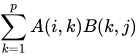

The SequenceL definition mirrors that definition more or less exactly:
matmul(A(2), B(2)) [i,j] :=
let k := 1...size(B);
in sum( A[i,k] * B[k,j] );
//Example Use
a := [[1, 2],
[3, 4]];
b := [[-3, -8, 3],
[-2, 1, 4]];
test := matmul(a, b);It can be written a little more simply using the all keyword:
matmul(A(2), B(2)) [i,j] := sum( A[i,all] * B[all,j] );Sidef
func matrix_multi(a, b) {
var m = [[]]
for r in ^a {
for c in ^b[0] {
for i in ^b {
m[r][c] := 0 += (a[r][i] * b[i][c])
}
}
}
return m
}
var a = [
[1, 2],
[3, 4],
[5, 6],
[7, 8]
]
var b = [
[1, 2, 3],
[4, 5, 6]
]
for line in matrix_multi(a, b) {
say line.map{|i|'%3d' % i }.join(', ')
}- Output:
9, 12, 15 19, 26, 33 29, 40, 51 39, 54, 69
SPAD
(1) -> A:=matrix [[1,2],[3,4],[5,6],[7,8]]
+1 2+
| |
|3 4|
(1) | |
|5 6|
| |
+7 8+
Type: Matrix(Integer)
(2) -> B:=matrix [[1,2,3],[4,5,6]]
+1 2 3+
(2) | |
+4 5 6+
Type: Matrix(Integer)
(3) -> A*B
+9 12 15+
| |
|19 26 33|
(3) | |
|29 40 51|
| |
+39 54 69+
Type: Matrix(Integer)Domain:Matrix(R)
SQL
CREATE TABLE a (x integer, y integer, e real);
CREATE TABLE b (x integer, y integer, e real);
-- test data
-- A is a 2x2 matrix
INSERT INTO a VALUES(0,0,1); INSERT INTO a VALUES(1,0,2);
INSERT INTO a VALUES(0,1,3); INSERT INTO a VALUES(1,1,4);
-- B is a 2x3 matrix
INSERT INTO b VALUES(0,0,-3); INSERT INTO b VALUES(1,0,-8); INSERT INTO b VALUES(2,0,3);
INSERT INTO b VALUES(0,1,-2); INSERT INTO b VALUES(1,1, 1); INSERT INTO b VALUES(2,1,4);
-- C is 2x2 * 2x3 so will be a 2x3 matrix
SELECT rhs.x, lhs.y, (SELECT sum(a.e*b.e) FROM a, b
WHERE a.y = lhs.y
AND b.x = rhs.x
AND a.x = b.y)
INTO TABLE c
FROM a AS lhs, b AS rhs
WHERE lhs.x = 0 AND rhs.y = 0;Standard ML
structure IMatrix = struct
fun dot(x,y) = Vector.foldli (fn (i,xi,agg) => agg+xi*Vector.sub(y,i)) 0 x
fun x*y =
let
open Array2
in
tabulate ColMajor (nRows x, nCols y, fn (i,j) => dot(row(x,i),column(y,j)))
end
end;
(* for display *)
fun toList a =
let
open Array2
in
List.tabulate(nRows a, fn i => List.tabulate(nCols a, fn j => sub(a,i,j)))
end;
(* example *)
let
open IMatrix
val m1 = Array2.fromList [[1,2],[3,4]]
val m2 = Array2.fromList [[~3,~8,3],[~2,1,4]]
in
toList (m1*m2)
end;Output:
val it = [[~7,~6,11],[~17,~20,25]] : int list listStata
Stata matrices
. mat a=1,2,3\4,5,6
. mat b=1,1,0,0\1,0,0,1\0,0,1,1
. mat c=a*b
. mat list c
c[2,4]
c1 c2 c3 c4
r1 3 1 3 5
r2 9 4 6 11Mata
: a=1,2,3\4,5,6
: b=1,1,0,0\1,0,0,1\0,0,1,1
: a*b
1 2 3 4
+---------------------+
1 | 3 1 3 5 |
2 | 9 4 6 11 |
+---------------------+Swift
@inlinable
public func matrixMult<T: Numeric>(_ m1: [[T]], _ m2: [[T]]) -> [[T]] {
let n = m1[0].count
let m = m1.count
let p = m2[0].count
guard m != 0 else {
return []
}
precondition(n == m2.count)
var ret = Array(repeating: Array(repeating: T.zero, count: p), count: m)
for i in 0..<m {
for j in 0..<p {
for k in 0..<n {
ret[i][j] += m1[i][k] * m2[k][j]
}
}
}
return ret
}
@inlinable
public func printMatrix<T>(_ matrix: [[T]]) {
guard !matrix.isEmpty else {
print()
return
}
let rows = matrix.count
let cols = matrix[0].count
for i in 0..<rows {
for j in 0..<cols {
print(matrix[i][j], terminator: " ")
}
print()
}
}
let m1 = [
[6.5, 2, 3],
[4.5, 1, 5]
]
let m2 = [
[10.0, 16, 23, 50],
[12, -8, 16, -4],
[70, 60, -1, -2]
]
let m3 = matrixMult(m1, m2)
printMatrix(m3)- Output:
299.0 268.0 178.5 311.0 407.0 364.0 114.5 211.0
Tailspin
operator (A matmul B)
$A -> \[i](
$B(1) -> \[j](@: 0;
1..$B::length -> @: $@ + $A($i;$) * $B($;$j);
$@ !\) !
\) !
end matmul
templates printMatrix&{w:}
templates formatN
@: [];
$ -> #
'$@ -> $::length~..$w -> ' ';$@(last..1:-1)...;' !
when <1..> do ..|@: $ mod 10; $ ~/ 10 -> #
when <=0?($@ <[](0)>)> do ..|@: 0;
end formatN
$... -> '|$(1) -> formatN;$(2..last)... -> ', $ -> formatN;';|
' !
end printMatrix
def a: [[1, 2, 3], [4, 5, 6]];
'a:
' -> !OUT::write
$a -> printMatrix&{w:2} -> !OUT::write
def b: [[0, 1], [2, 3], [4, 5]];
'
b:
' -> !OUT::write
$b -> printMatrix&{w:2} -> !OUT::write
'
axb:
' -> !OUT::write
($a matmul $b) -> printMatrix&{w:2} -> !OUT::write- Output:
a: | 1, 2, 3| | 4, 5, 6| b: | 0, 1| | 2, 3| | 4, 5| axb: |16, 22| |34, 49|
Tcl
package require Tcl 8.5
namespace path ::tcl::mathop
proc matrix_multiply {a b} {
lassign [size $a] a_rows a_cols
lassign [size $b] b_rows b_cols
if {$a_cols != $b_rows} {
error "incompatible sizes: a($a_rows, $a_cols), b($b_rows, $b_cols)"
}
set temp [lrepeat $a_rows [lrepeat $b_cols 0]]
for {set i 0} {$i < $a_rows} {incr i} {
for {set j 0} {$j < $b_cols} {incr j} {
set sum 0
for {set k 0} {$k < $a_cols} {incr k} {
set sum [+ $sum [* [lindex $a $i $k] [lindex $b $k $j]]]
}
lset temp $i $j $sum
}
}
return $temp
}Using the print_matrix procedure defined in Matrix Transpose#Tcl
% print_matrix [matrix_multiply {{1 2} {3 4}} {{-3 -8 3} {-2 1 4}}]
-7 -6 11
-17 -20 25
TI-83 BASIC
Store your matrices in [A] and [B].
Disp [A]*[B]An error will show if the matrices have invalid dimensions for multiplication.
Other way: enter directly your matrices:
[[1,2][3,4][5,6][7,8]]*[[1,2,3][4,5,6]]- Output:
[[9 12 15] [19 26 33] [29 40 51] [39 54 69]]]
TI-89 BASIC
[1,2; 3,4; 5,6; 7,8] → m1
[1,2,3; 4,5,6] → m2
m1 * m2Or without the variables:
[1,2; 3,4; 5,6; 7,8] * [1,2,3; 4,5,6]The result (without prettyprinting) is:
[[9,12,15][19,26,33][29,40,51][39,54,69]]Transd
#lang transd
MainModule: {
_start: (λ (with n 5
A (for i in Range(n) project (for k in Range(n) project k))
B (for i in Range(n) project (for k in Range(n) project (- n k)))
C (for i in Range(n) project (for k in Range(n) project 0))
(for i in Range( n ) do
(for j in Range( n ) do
(for k in Range( n ) do
(+= (get (get C i) j) (* (get (get A i) k) (get (get B k) j)))
)))
(lout C))
)
}- Output:
[[50, 40, 30, 20, 10], [50, 40, 30, 20, 10], [50, 40, 30, 20, 10], [50, 40, 30, 20, 10], [50, 40, 30, 20, 10]]
UNIX Shell
#!/bin/bash
DELAY=0 # increase this if printing of matrices should be slower
echo "This script takes two matrices, henceforth called A and B,
and returns their product, AB.
For the time being, matrices can have integer components only.
"
read -p "Number of rows of matrix A: " arows
read -p "Number of columns of matrix A: " acols
brows="$acols"
echo
echo "Number of rows of matrix B: "$brows
read -p "Number of columns of matrix B: " bcols
crows="$arows"
ccols="$bcols"
echo
echo "Number of rows of matrix AB: " $crows
echo "Number of columns of matrix AB: " $ccols
echo
echo
matrixa=( )
matrixb=( )
# input matrix A
maxlengtha=0
for ((row=1; row<=arows; row++)); do
for ((col=1; col<=acols; col++)); do
checkentry="false"
while [ "$checkentry" != "true" ]; do
read -p "Enter component A[$row, $col]: " number
index=$(((row-1)*acols+col))
matrixa[$index]="$number"
[ "${matrixa[$index]}" -eq "$number" ] && checkentry="true"
echo
done
entry="${matrixa[$index]}"
[ "${#entry}" -gt "$maxlengtha" ] && maxlengtha="${#entry}"
done
echo
done
# print matrix A to guard against errors
if [ "$maxlengtha" -le "5" ]; then
width=8
else
width=$((maxlengtha + 3))
fi
echo "This is matrix A:
"
for ((row=1; row<=arows; row++)); do
for ((col=1; col<=acols; col++)); do
index=$(((row-1)*acols+col))
printf "%${width}d" "${matrixa[$index]}"
sleep "$DELAY"
done
echo; echo # printf %s "\n\n" does not work...
done
echo
echo
# input matrix B
maxlengthb=0
for ((row=1; row<=brows; row++)); do
for ((col=1; col<=bcols; col++)); do
checkentry="false"
while [ "$checkentry" != "true" ]; do
read -p "Enter component B[$row, $col]: " number
index=$(((row-1)*bcols+col))
matrixb[$index]="$number"
[ "${matrixb[$index]}" -eq "$number" ] && checkentry="true"
echo
done
entry="${matrixb[$index]}"
[ "${#entry}" -gt "$maxlengthb" ] && maxlengthb="${#entry}"
done
echo
done
# print matrix B to guard against errors
if [ "$maxlengthb" -le "5" ]; then
width=8
else
width=$((maxlengthb + 3))
fi
echo "This is matrix B:
"
for ((row=1; row<=brows; row++)); do
for ((col=1; col<=bcols; col++)); do
index=$(((row-1)*bcols+col))
printf "%${width}d" "${matrixb[$index]}"
sleep "$DELAY"
done
echo; echo # printf %s "\n\n" does not work...
done
read -p "Hit enter to continue"
# calculate matrix C := AB
maxlengthc=0
time for ((row=1; row<=crows; row++)); do
for ((col=1; col<=ccols; col++)); do
# calculate component C[$row, $col]
runningtotal=0
for ((j=1; j<=acols; j++)); do
rowa="$row"
cola="$j"
indexa=$(((rowa-1)*acols+cola))
rowb="$j"
colb="$col"
indexb=$(((rowb-1)*bcols+colb))
entry_from_A=${matrixa[$indexa]}
entry_from_B=${matrixb[$indexb]}
subtotal=$((entry_from_A * entry_from_B))
((runningtotal+=subtotal))
done
number="$runningtotal"
# store component in the result array
index=$(((row-1)*ccols+col))
matrixc[$index]="$number"
entry="${matrixc[$index]}"
[ "${#entry}" -gt "$maxlengthc" ] && maxlengthc="${#entry}"
done
done
echo
read -p "Hit enter to continue"
echo
# print the matrix C
if [ "$maxlengthc" -le "5" ]; then
width=8
else
width=$((maxlengthc + 3))
fi
echo "The product matrix is:
"
for ((row=1; row<=crows; row++)); do
for ((col=1; col<=ccols; col++)); do
index=$(((row-1)*ccols+col))
printf "%${width}d" "${matrixc[$index]}"
sleep "$DELAY"
done
echo; echo # printf %s "\n\n" does not work...
done
echo
echoUrsala
There is a library function for matrix multiplication of IEEE double precision floating point numbers. This example shows how to define and use a matrix multiplication function over any chosen field given only the relevant product and sum functions, in this case for the built in rational number type.
#import rat
a =
<
<1/1, 1/1, 1/1, 1/1>,
<2/1, 4/1, 8/1, 16/1>,
<3/1, 9/1, 27/1, 81/1>,
<4/1, 16/1, 64/1, 256/1>>
b =
<
< 4/1, -3/1, 4/3, -1/4>,
<-13/3, 19/4, -7/3, 11/24>,
< 3/2, -2/1, 7/6, -1/4>,
< -1/6, 1/4, -1/6, 1/24>>
mmult = *rK7lD *rlD sum:-0.+ product*p
#cast %qLL
test = mmult(a,b)- Output:
< <1/1,0/1,0/1,0/1>, <0/1,1/1,0/1,0/1>, <0/1,0/1,1/1,0/1>, <0/1,0/1,0/1,1/1>>
VBA
Using Excel. The resulting matrix should be smaller than 5461 elements.
Function matrix_multiplication(a As Variant, b As Variant) As Variant
matrix_multiplication = WorksheetFunction.MMult(a, b)
End FunctionVBScript
Dim matrix1(2,2)
matrix1(0,0) = 3 : matrix1(0,1) = 7 : matrix1(0,2) = 4
matrix1(1,0) = 5 : matrix1(1,1) = -2 : matrix1(1,2) = 9
matrix1(2,0) = 8 : matrix1(2,1) = -6 : matrix1(2,2) = -5
Dim matrix2(2,2)
matrix2(0,0) = 9 : matrix2(0,1) = 2 : matrix2(0,2) = 1
matrix2(1,0) = -7 : matrix2(1,1) = 3 : matrix2(1,2) = -10
matrix2(2,0) = 4 : matrix2(2,1) = 5 : matrix2(2,2) = -6
Call multiply_matrix(matrix1,matrix2)
Sub multiply_matrix(arr1,arr2)
For i = 0 To UBound(arr1)
For j = 0 To 2
WScript.StdOut.Write (arr1(i,j) * arr2(i,j)) & vbTab
Next
WScript.StdOut.WriteLine
Next
End Sub- Output:
27 14 4 -35 -6 -90 32 -30 30
Visual FoxPro
LOCAL ARRAY a[4,2], b[2,3], c[4,3]
CLOSE DATABASES ALL
*!* The arrays could be created directly but I prefer to do this:
CREATE CURSOR mat1 (c1 I, c2 I)
CREATE CURSOR mat2 (c1 I, c2 I, c3 I)
*!* Since matrix multiplication of integer arrays
*!* involves only multiplication and addition,
*!* the result will contain integers
CREATE CURSOR result (c1 I, c2 I, c3 I)
INSERT INTO mat1 VALUES (1, 2)
INSERT INTO mat1 VALUES (3, 4)
INSERT INTO mat1 VALUES (5, 6)
INSERT INTO mat1 VALUES (7, 8)
SELECT * FROM mat1 INTO ARRAY a
INSERT INTO mat2 VALUES (1, 2, 3)
INSERT INTO mat2 VALUES (4, 5, 6)
SELECT * FROM mat2 INTO ARRAY b
STORE 0 TO c
MatMult(@a,@b,@c)
SELECT result
APPEND FROM ARRAY c
BROWSE
PROCEDURE MatMult(aa, bb, cc)
LOCAL n As Integer, m As Integer, p As Integer, i As Integer, j As Integer, k As Integer
IF ALEN(aa,2) = ALEN(bb,1)
n = ALEN(aa,2)
m = ALEN(aa,1)
p = ALEN(bb,2)
FOR i = 1 TO m
FOR j = 1 TO p
FOR k = 1 TO n
cc[i,j] = cc[i,j] + aa[i,k]*bb[k,j]
ENDFOR
ENDFOR
ENDFOR
ELSE
? "Invalid dimensions"
ENDIF
ENDPROCWren
import "./matrix" for Matrix
import "./fmt" for Fmt
var a = Matrix.new([
[1, 2],
[3, 4],
[5, 6],
[7, 8]
])
var b = Matrix.new([
[1, 2, 3],
[4, 5, 6]
])
System.print("Matrix A:\n")
Fmt.mprint(a, 2, 0)
System.print("\nMatrix B:\n")
Fmt.mprint(b, 2, 0)
System.print("\nMatrix A x B:\n")
Fmt.mprint(a * b, 3, 0)- Output:
Matrix A: | 1 2| | 3 4| | 5 6| | 7 8| Matrix B: | 1 2 3| | 4 5 6| Matrix A x B: | 9 12 15| | 19 26 33| | 29 40 51| | 39 54 69|
XPL0
proc Mat4x1Mul(M, V); \Multiply matrix M times column vector V
real M, \4x4 matrix [M] * [V] -> [V]
V; \column vector
real W(4); \working copy of column vector
int R; \row
[for R:= 0 to 4-1 do
W(R):= M(R,0)*V(0) + M(R,1)*V(1) + M(R,2)*V(2) + M(R,3)*V(3);
for R:= 0 to 4-1 do V(R):= W(R);
];
proc Mat4x4Mul(M, N); \Multiply matrix M times matrix N
real M, N; \4x4 matrices [M] * [N] -> [N]
real W(4,4); \working copy of matrix N
int C; \column
[for C:= 0 to 4-1 do
[W(0,C):= M(0,0)*N(0,C) + M(0,1)*N(1,C) + M(0,2)*N(2,C) + M(0,3)*N(3,C);
W(1,C):= M(1,0)*N(0,C) + M(1,1)*N(1,C) + M(1,2)*N(2,C) + M(1,3)*N(3,C);
W(2,C):= M(2,0)*N(0,C) + M(2,1)*N(1,C) + M(2,2)*N(2,C) + M(2,3)*N(3,C);
W(3,C):= M(3,0)*N(0,C) + M(3,1)*N(1,C) + M(3,2)*N(2,C) + M(3,3)*N(3,C);
];
for C:= 0 to 4-1 do
[N(0,C):= W(0,C);
N(1,C):= W(1,C);
N(2,C):= W(2,C);
N(3,C):= W(3,C);
];
];XSLT 1.0
With input document ...
<?xml-stylesheet href="matmul.templ.xsl" type="text/xsl"?>
<mult>
<A>
<r><c>1</c><c>2</c></r>
<r><c>3</c><c>4</c></r>
<r><c>5</c><c>6</c></r>
<r><c>7</c><c>8</c></r>
</A>
<B>
<r><c>1</c><c>2</c><c>3</c></r>
<r><c>4</c><c>5</c><c>6</c></r>
</B>
</mult>... and this referenced stylesheet ...
<xsl:stylesheet version="1.0"
xmlns:xsl="http://www.w3.org/1999/XSL/Transform"
>
<xsl:output method="html"/>
<xsl:template match="/mult">
<table>
<tr><td>╭</td><td colspan="{count(*[2]/*[1]/*)}"/><td>╮</td></tr>
<xsl:call-template name="prodMM">
<xsl:with-param name="A" select="*[1]/*"/>
<xsl:with-param name="B" select="*[2]/*"/>
</xsl:call-template>
<tr><td>╰</td><td colspan="{count(*[2]/*[1]/*)}"/><td>╯</td></tr>
</table>
</xsl:template>
<xsl:template name="prodMM">
<xsl:param name="A"/>
<xsl:param name="B"/>
<xsl:if test="$A/*">
<tr>
<td>│</td>
<xsl:call-template name="prodVM">
<xsl:with-param name="a" select="$A[1]/*"/>
<xsl:with-param name="B" select="$B"/>
</xsl:call-template>
<td>│</td>
</tr>
<xsl:call-template name="prodMM">
<xsl:with-param name="A" select="$A[position()>1]"/>
<xsl:with-param name="B" select="$B"/>
</xsl:call-template>
</xsl:if>
</xsl:template>
<xsl:template name="prodVM">
<xsl:param name="a"/>
<xsl:param name="B"/>
<xsl:param name="col" select="1"/>
<xsl:if test="$B/*[$col]">
<td align="right">
<xsl:call-template name="prod">
<xsl:with-param name="a" select="$a"/>
<xsl:with-param name="b" select="$B/*[$col]"/>
</xsl:call-template>
</td>
<xsl:call-template name="prodVM">
<xsl:with-param name="a" select="$a"/>
<xsl:with-param name="B" select="$B"/>
<xsl:with-param name="col" select="$col+1"/>
</xsl:call-template>
</xsl:if>
</xsl:template>
<xsl:template name="prod">
<xsl:param name="a"/>
<xsl:param name="b"/>
<xsl:if test="not($a)">0</xsl:if>
<xsl:if test="$a">
<xsl:variable name="res">
<xsl:call-template name="prod">
<xsl:with-param name="a" select="$a[position()>1]"/>
<xsl:with-param name="b" select="$b[position()>1]"/>
</xsl:call-template>
</xsl:variable>
<xsl:value-of select="$a[1] * $b[1] + $res"/>
</xsl:if>
</xsl:template>
</xsl:stylesheet>- Output:
(in a browser)
╭ ╮ │ 9 12 15 │ │ 19 26 33 │ │ 29 40 51 │ │ 39 54 69 │ ╰ ╯
You may try in your browser: [[2]]
A slightly smaller version of above stylesheet making use of (Non-"XSLT 1.0") EXSLT functions can be founde here: [[3]]
Yabasic
dim a(4, 2)
a(0, 0) = 1 : a(0, 1) = 2
a(1, 0) = 3 : a(1, 1) = 4
a(2, 0) = 5 : a(2, 1) = 6
a(3, 0) = 7 : a(3, 1) = 8
dim b(2, 3)
b(0, 0) = 1 : b(0, 1) = 2 : b(0, 2) = 3
b(1, 0) = 4 : b(1, 1) = 5 : b(1, 2) = 6
dim prod(arraysize(a(),1), arraysize(b(),2))
if (arraysize(a(),2) = arraysize(b(),1)) then
for i = 0 to arraysize(a(),1)
for j = 0 to arraysize(b(),2)
for k = 0 to arraysize(a(),2)
prod(i, j) = prod(i, j) + (a(i, k) * b(k, j))
next k
next j
next i
for i = 0 to arraysize(prod(),1)-1
for j = 0 to arraysize(prod(),2)-1
print prod(i, j),
next j
print
next i
else
print "invalid dimensions"
end if
end
zkl
Using the GNU Scientific Library:
var [const] GSL=Import("zklGSL"); // libGSL (GNU Scientific Library)
A:=GSL.Matrix(4,2).set(1,2, 3,4, 5,6, 7,8);
B:=GSL.Matrix(2,3).set(1,2,3, 4,5,6);
(A*B).format().println(); // creates a new matrix- Output:
9.00, 12.00, 15.00
19.00, 26.00, 33.00
29.00, 40.00, 51.00
39.00, 54.00, 69.00
Or, using lists:
fcn matMult(a,b){
n,m,p:=a[0].len(),a.len(),b[0].len();
ans:=(0).pump(m,List().write, (0).pump(p,List,0).copy); // matrix of zeros
foreach i,j,k in (m,p,n){ ans[i][j]+=a[i][k]*b[k][j]; }
ans
}a:=L( L(1,2,), L(3,4,), L(5,6,), L(7,8) );
b:=L( L(1,2,3,), L(4,5,6) );
printM(matMult(a,b));
fcn printM(m){ m.pump(Console.println,rowFmt) }
fcn rowFmt(row){ ("%4d "*row.len()).fmt(row.xplode()) }- Output:
9 12 15 19 26 33 29 40 51 39 54 69
zonnon
module MatrixOps;
type
Matrix = array {math} *,* of integer;
procedure WriteMatrix(x: array {math} *,* of integer);
var
i,j: integer;
begin
for i := 0 to len(x,0) - 1 do
for j := 0 to len(x,1) - 1 do
write(x[i,j]);
end;
writeln;
end
end WriteMatrix;
procedure Multiplication;
var
a,b: Matrix;
begin
a := [[1,2],[3,4],[5,6],[7,8]];
b := [[1,2,3],[4,5,6]];
WriteMatrix(a * b);
end Multiplication;
begin
Multiplication;
end MatrixOps.ZPL
program matmultSUMMA;
prototype GetSingleDim(infile:file):integer;
prototype GetInnerDim(infile1:file; infile2:file):integer;
config var
Afilename: string = "";
Bfilename: string = "";
Afile: file = open(Afilename,file_read);
Bfile: file = open(Bfilename,file_read);
default_size:integer = 4;
m:integer = GetSingleDim(Afile);
n:integer = GetInnerDim(Afile,Bfile);
p:integer = GetSingleDim(Bfile);
iters: integer = 1;
printinput: boolean = false;
verbose: boolean = true;
dotiming: boolean = false;
region
RA = [1..m,1..n];
RB = [1..n,1..p];
RC = [1..m,1..p];
FCol = [1..m,*];
FRow = [*,1..p];
var
A : [RA] double;
B : [RB] double;
C : [RC] double;
Aflood : [FCol] double;
Bflood : [FRow] double;
procedure ReadA();
var step:double;
[RA] begin
if (Afile != znull) then
read(Afile,A);
else
step := 1.0/(m*n);
A := ((Index1-1)*n + Index2)*step + 1.0;
end;
end;
procedure ReadB();
var step:double;
[RB] begin
if (Bfile != znull) then
read(Bfile,B);
else
step := 1.0/(n*p);
B := ((Index1-1)*p + Index2)*step + 1.0;
end;
end;
procedure matmultSUMMA();
var
i: integer;
it: integer;
runtime: double;
[RC] begin
ReadA();
ReadB();
if (printinput) then
[RA] writeln("A is:\n",A);
[RB] writeln("B is:\n",B);
end;
ResetTimer();
for it := 1 to iters do
C := 0.0; -- zero C
for i := 1 to n do
[FCol] Aflood := >>[,i] A; -- flood A col
[FRow] Bflood := >>[i,] B; -- flood B row
C += (Aflood * Bflood); -- multiply
end;
end;
runtime := CheckTimer();
if (verbose) then
writeln("C is:\n",C);
end;
if (dotiming) then
writeln("total runtime = %12.6f":runtime);
writeln("actual runtime = %12.6f":runtime/iters);
end;
end;
procedure GetSingleDim(infile:file):integer;
var dim:integer;
begin
if (infile != znull) then
read(infile,dim);
else
dim := default_size;
end;
return dim;
end;
procedure GetInnerDim(infile1:file; infile2:file):integer;
var
col:integer;
row:integer;
retval:integer;
begin
retval := -1;
if (infile1 != znull) then
read(infile1,col);
retval := col;
end;
if (infile2 != znull) then
read(infile2,row);
if (retval = -1) then
retval := row;
else
if (row != col) then
halt("ERROR: Inner dimensions don't match");
end;
end;
end;
if (retval = -1) then
retval := default_size;
end;
return retval;
end;- Programming Tasks
- Matrices
- 11l
- 360 Assembly
- Action!
- Action! Tool Kit
- Ada
- ALGOL 68
- Amazing Hopper
- APL
- AppleScript
- Arturo
- AutoHotkey
- AWK
- BASIC
- Applesoft BASIC
- BBC BASIC
- BQN
- Burlesque
- C
- C sharp
- Class
- Extension Method
- C++
- Blitz++
- Ceylon
- Chapel
- Clojure
- Common Lisp
- D
- Delphi
- System.SysUtils
- EasyLang
- EGL
- Ela
- Elixir
- Emacs Lisp
- ELLA
- Erlang
- ERRE
- Euphoria
- Excel
- F Sharp
- Factor
- Fantom
- Fermat
- Forth
- Forth Scientific Library
- Fortran
- FreeBASIC
- Frink
- Futhark
- Futhark examples needing attention
- Examples needing attention
- GAP
- Generic
- Go
- Groovy
- Haskell
- HicEst
- Icon
- Unicon
- IDL
- Idris
- J
- Java
- JavaScript
- Jq
- Jsish
- Julia
- K
- Klong
- Kotlin
- Lambdatalk
- Lang5
- LFE
- Liberty BASIC
- Logo
- Lua
- M2000 Interpreter
- Maple
- MathCortex
- Mathematica
- Wolfram Language
- MATLAB
- Maxima
- Nial
- Nim
- Strfmt
- OCaml
- Octave
- Ol
- OoRexx
- OxygenBasic
- PARI/GP
- Perl
- Phix
- PicoLisp
- PL/I
- Pop11
- PowerShell
- Prolog
- PureBasic
- Python
- R
- Racket
- Raku
- Rascal
- REXX
- Ring
- RPL
- Ruby
- Rust
- S-lang
- Scala
- Scheme
- Seed7
- SequenceL
- Sidef
- SPAD
- SQL
- Standard ML
- Stata
- Swift
- Tailspin
- Tcl
- TI-83 BASIC
- TI-89 BASIC
- Transd
- UNIX Shell
- Ursala
- VBA
- VBScript
- Visual FoxPro
- Wren
- Wren-matrix
- Wren-fmt
- XPL0
- XSLT 1.0
- Yabasic
- Zkl
- Zonnon
- ZPL
- Pages with too many expensive parser function calls