
Continued fraction

You are encouraged to solve this task according to the task description, using any language you may know.
A number may be represented as a continued fraction (see Mathworld for more information) as follows:
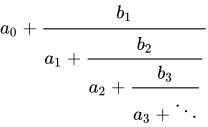
The task is to write a program which generates such a number and prints a real representation of it. The code should be tested by calculating and printing the square root of 2, Napier's Constant, and Pi, using the following coefficients:
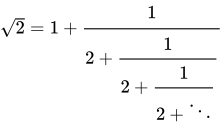
For the square root of 2, use then . is always .


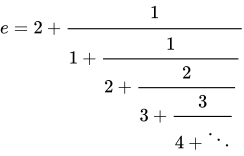
For Napier's Constant, use , then . then .


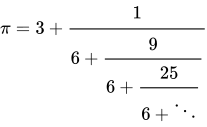
For Pi, use then . .



- See also
-
- Continued fraction/Arithmetic for tasks that do arithmetic over continued fractions.
11l
F calc(f_a, f_b, =n = 1000)
   V r = 0.0
   L n > 0
      r = f_b(n) / (f_a(n) + r)
      n--
   R f_a(0) + r

print(calc(n -> I n > 0 {2} E 1, n -> 1))
print(calc(n -> I n > 0 {n} E 2, n -> I n > 1 {n - 1} E 1))
print(calc(n -> I n > 0 {6} E 3, n -> (2 * n - 1) ^ 2))
Action!
INCLUDE "D2:REAL.ACT" ;from the Action! Tool Kit

DEFINE PTR="CARD"
DEFINE JSR="$20"
DEFINE RTS="$60"

PROC CoeffA=*(INT n REAL POINTER res)
  [JSR $00 $00 ;JSR to address set by SetCoeffA
   RTS]

PROC CoeffB=*(INT n REAL POINTER res)
  [JSR $00 $00 ;JSR to address set by SetCoeffB
   RTS]

PROC SetCoeffA(PTR p)
  PTR addr

  addr=CoeffA+1 ;location of address of JSR
  PokeC(addr,p)
RETURN

PROC SetCoeffB(PTR p)
  PTR addr

  addr=CoeffB+1 ;location of address of JSR
  PokeC(addr,p)
RETURN

PROC Calc(PTR funA,funB INT count REAL POINTER res)
  INT i
  REAL a,b,tmp

  SetCoeffA(funA)
  SetCoeffB(funB)

  IntToReal(0,res)
  i=count
  WHILE i>0
  DO
    CoeffA(i,a)
    CoeffB(i,b)
    RealAdd(a,res,tmp)
    RealDiv(b,tmp,res)
    i==-1
  OD
  CoeffA(0,a)
  RealAdd(a,res,tmp)
  RealAssign(tmp,res)
RETURN

PROC sqrtA(INT n REAL POINTER res)
  IF n>0 THEN
    IntToReal(2,res)
  ELSE
    IntToReal(1,res)
  FI
RETURN

PROC sqrtB(INT n REAL POINTER res)
  IntToReal(1,res)
RETURN

PROC napierA(INT n REAL POINTER res)
  IF n>0 THEN
    IntToReal(n,res)
  ELSE
    IntToReal(2,res)
  FI
RETURN

PROC napierB(INT n REAL POINTER res)
  IF n>1 THEN
    IntToReal(n-1,res)
  ELSE
    IntToReal(1,res)
  FI
RETURN

PROC piA(INT n REAL POINTER res)
  IF n>0 THEN
    IntToReal(6,res)
  ELSE
    IntToReal(3,res)
  FI
RETURN

PROC piB(INT n REAL POINTER res)
  REAL tmp

  IntToReal(2*n-1,tmp)
  RealMult(tmp,tmp,res)
RETURN

PROC Main()
  REAL res

  Put(125) PutE() ;clear the screen

  Calc(sqrtA,sqrtB,50,res)
  Print(" Sqrt2=") PrintRE(res)

  Calc(napierA,napierB,50,res)
  Print("Napier=") PrintRE(res)

  Calc(piA,piB,500,res)
  Print("    Pi=") PrintRE(res)
RETURN- Output:
Screenshot from Atari 8-bit computer
 Sqrt2=1.41421356
Napier=2.71828182
    Pi=3.14159265
Ada
(The source text for these examples can also be found on Bitbucket.)
Generic function for estimating continued fractions:
generic
   type Scalar is digits <>;

   with function A (N : in Natural)  return Natural;
   with function B (N : in Positive) return Natural;
function Continued_Fraction (Steps : in Natural) return Scalar;
function Continued_Fraction (Steps : in Natural) return Scalar is
   function A (N : in Natural)  return Scalar is (Scalar (Natural'(A (N))));
   function B (N : in Positive) return Scalar is (Scalar (Natural'(B (N))));

   Fraction : Scalar := 0.0;
begin
   for N in reverse Natural range 1 .. Steps loop
      Fraction := B (N) / (A (N) + Fraction);
   end loop;
   return A (0) + Fraction;
end Continued_Fraction;
Test program using the function above to estimate the square root of 2, Napiers constant and pi:
with Ada.Text_IO;

with Continued_Fraction;

procedure Test_Continued_Fractions is
   type Scalar is digits 15;

   package Square_Root_Of_2 is
      function A (N : in Natural)  return Natural is (if N = 0 then 1 else 2);
      function B (N : in Positive) return Natural is (1);

      function Estimate is new Continued_Fraction (Scalar, A, B);
   end Square_Root_Of_2;

   package Napiers_Constant is
      function A (N : in Natural)  return Natural is (if N = 0 then 2 else N);
      function B (N : in Positive) return Natural is (if N = 1 then 1 else N-1);

      function Estimate is new Continued_Fraction (Scalar, A, B);
   end Napiers_Constant;

   package Pi is
      function A (N : in Natural)  return Natural is  (if N = 0 then 3 else 6);
      function B (N : in Positive) return Natural is ((2 * N - 1) ** 2);

      function Estimate is new Continued_Fraction (Scalar, A, B);
   end Pi;

   package Scalar_Text_IO is new Ada.Text_IO.Float_IO (Scalar);
   use Ada.Text_IO, Scalar_Text_IO;
begin
   Put (Square_Root_Of_2.Estimate (200), Exp => 0); New_Line;
   Put (Napiers_Constant.Estimate (200), Exp => 0); New_Line;
   Put (Pi.Estimate (10000),             Exp => 0); New_Line;
end Test_Continued_Fractions;
Using only Ada 95 features
This example is exactly the same as the preceding one, but implemented using only Ada 95 features.
generic
   type Scalar is digits <>;

   with function A (N : in Natural)  return Natural;
   with function B (N : in Positive) return Natural;
function Continued_Fraction_Ada95 (Steps : in Natural) return Scalar;
function Continued_Fraction_Ada95 (Steps : in Natural) return Scalar is
   function A (N : in Natural)  return Scalar is
   begin
      return Scalar (Natural'(A (N)));
   end A;

   function B (N : in Positive) return Scalar is
   begin
      return Scalar (Natural'(B (N)));
   end B;

   Fraction : Scalar := 0.0;
begin
   for N in reverse Natural range 1 .. Steps loop
      Fraction := B (N) / (A (N) + Fraction);
   end loop;
   return A (0) + Fraction;
end Continued_Fraction_Ada95;
with Ada.Text_IO;

with Continued_Fraction_Ada95;

procedure Test_Continued_Fractions_Ada95 is
   type Scalar is digits 15;

   package Square_Root_Of_2 is
      function A (N : in Natural)  return Natural;
      function B (N : in Positive) return Natural;

      function Estimate is new Continued_Fraction_Ada95 (Scalar, A, B);
   end Square_Root_Of_2;

   package body Square_Root_Of_2 is
      function A (N : in Natural) return Natural is
      begin
         if N = 0 then
            return 1;
         else
            return 2;
         end if;
      end A;

      function B (N : in Positive) return Natural is
      begin
         return 1;
      end B;
   end Square_Root_Of_2;

   package Napiers_Constant is
      function A (N : in Natural)  return Natural;
      function B (N : in Positive) return Natural;

      function Estimate is new Continued_Fraction_Ada95 (Scalar, A, B);
   end Napiers_Constant;

   package body Napiers_Constant is
      function A (N : in Natural) return Natural is
      begin
         if N = 0 then
            return 2;
         else
            return N;
         end if;
      end A;

      function B (N : in Positive) return Natural is
      begin
          if N = 1 then
             return 1;
          else
             return N - 1;
          end if;
      end B;
   end Napiers_Constant;

   package Pi is
      function A (N : in Natural)  return Natural;
      function B (N : in Positive) return Natural;

      function Estimate is new Continued_Fraction_Ada95 (Scalar, A, B);
   end Pi;

   package body Pi is
      function A (N : in Natural) return Natural is
      begin
         if N = 0 then
            return 3;
         else
            return 6;
         end if;
      end A;

      function B (N : in Positive) return Natural is
      begin
         return (2 * N - 1) ** 2;
      end B;
   end Pi;

   package Scalar_Text_IO is new Ada.Text_IO.Float_IO (Scalar);
   use Ada.Text_IO, Scalar_Text_IO;
begin
   Put (Square_Root_Of_2.Estimate (200), Exp => 0); New_Line;
   Put (Napiers_Constant.Estimate (200), Exp => 0); New_Line;
   Put (Pi.Estimate (10000),             Exp => 0); New_Line;
end Test_Continued_Fractions_Ada95;
- Output:
 1.41421356237310
 2.71828182845905
 3.14159265358954
ALGOL 68
PROC cf = (INT steps, PROC (INT) INT a, PROC (INT) INT b) REAL:
BEGIN
  REAL result;
  result := 0;
  FOR n FROM steps BY -1 TO 1 DO
      result := b(n) / (a(n) + result)
  OD;
  a(0) + result
END;

PROC asqr2 = (INT n) INT: (n = 0 | 1 | 2);
PROC bsqr2 = (INT n) INT: 1;

PROC anap = (INT n) INT: (n = 0 | 2 | n);
PROC bnap = (INT n) INT: (n = 1 | 1 | n - 1);

PROC api = (INT n) INT: (n = 0 | 3 | 6);
PROC bpi = (INT n) INT: (n = 1 | 1 | (2 * n - 1) ** 2);

INT precision = 10000;

print (("Precision: ", precision, newline));
print (("Sqr(2):    ", cf(precision, asqr2, bsqr2), newline));
print (("Napier:    ", cf(precision, anap, bnap), newline));
print (("Pi: ", cf(precision, api, bpi)))- Output:
Precision:      +10000
Sqr(2):    +1.41421356237310e  +0
Napier:    +2.71828182845905e  +0
Pi:        +3.14159265358954e  +0
Arturo
calc: function [f, n][
    [a, b, temp]: 0.0

    loop n..1 'i [
        [a, b]: call f @[i]
        temp: b // a + temp
    ]
    [a, b]: call f @[0]
    return a + temp
]

sqrt2: function [n][
    (n > 0)? -> [2.0, 1.0] -> [1.0, 1.0]
]

napier: function [n][
    a: (n > 0)? -> to :floating n -> 2.0
    b: (n > 1)? -> to :floating n-1 -> 1.0
    @[a, b]
]

Pi: function [n][
    a: (n > 0)? -> 6.0 -> 3.0
    b: ((2 * to :floating n)-1) ^ 2
    @[a, b]
]

print calc 'sqrt2 20
print calc 'napier 15
print calc 'Pi 10000
- Output:
1.414213562373095
2.718281828459046
3.141592653589544
ATS
A fairly direct translation of the C version without using advanced features of the type system:
#include
"share/atspre_staload.hats"
//
(* ****** ****** *)
//
(*
** a coefficient function creates double values from in paramters
*)
typedef coeff_f = int -> double
//
(*
** a continued fraction is described by a record of two coefficent
** functions a and b
*)
typedef frac = @{a= coeff_f, b= coeff_f}
//
(* ****** ****** *)

fun calc
(
  f: frac, n: int
) : double = let
//
(*
** recursive definition of the approximation
*)
fun loop
(
  n: int, r: double
) : double =
(
if n = 0
  then f.a(0) + r
  else loop (n - 1, f.b(n) / (f.a(n) + r))
// end of [if]
)
//
in
  loop (n, 0.0)
end // end of [calc]

(* ****** ****** *)

val sqrt2 = @{
  a= lam (n: int): double => if n = 0 then 1.0 else 2.0
,
  b= lam (n: int): double => 1.0
} (* end of [val] *)

val napier = @{
  a= lam (n: int): double => if n = 0 then 2.0 else 1.0 * n
,
  b= lam (n: int): double => if n = 1 then 1.0 else n - 1.0
} (* end of [val] *)

val pi = @{
  a= lam (n: int): double => if n = 0 then 3.0 else 6.0
,
  b= lam (n: int): double => let val x = 2.0 * n - 1 in x * x end
}

(* ****** ****** *)

implement
main0 () =
(
  println! ("sqrt2  = ", calc(sqrt2,  100));
  println! ("napier = ", calc(napier, 100));
  println! ("  pi   = ", calc(  pi  , 100));
) (* end of [main0] *)
AutoHotkey
sqrt2_a(n) ; function definition is as simple as that
{
return n?2.0:1.0
}

sqrt2_b(n)
{
return 1.0
}

napier_a(n)
{
return n?n:2.0
}

napier_b(n)
{
return n>1.0?n-1.0:1.0
}

pi_a(n)
{
return n?6.0:3.0
}

pi_b(n)
{
return (2.0*n-1.0)**2.0 ; exponentiation operator
}

calc(f,expansions)
{
r:=0,i:=expansions
; A nasty trick: the names of the two coefficient functions are generated dynamically
; a dot surrounded by spaces means string concatenation
f_a:=f . "_a",f_b:=f . "_b"

while i>0 {
; You can see two dynamic function calls here
r:=%f_b%(i)/(%f_a%(i)+r)
i--
}

return %f_a%(0)+r
}

Msgbox, % "sqrt 2 = " . calc("sqrt2", 1000) . "`ne = " . calc("napier", 1000) . "`npi = " . calc("pi", 1000)
Output with Autohotkey v1 (currently 1.1.16.05):
sqrt 2 = 1.414214
e = 2.718282
pi = 3.141593
Output with Autohotkey v2 (currently alpha 56):
sqrt 2 = 1.4142135623730951
e = 2.7182818284590455
pi = 3.1415926533405418
Note the far superiour accuracy of v2.
Axiom
Axiom provides a ContinuedFraction domain:
get(obj) == convergents(obj).1000 -- utility to extract the 1000th value
get continuedFraction(1, repeating [1], repeating [2]) :: Float
get continuedFraction(2, cons(1,[i for i in 1..]), [i for i in 1..]) :: Float
get continuedFraction(3, [i^2 for i in 1.. by 2], repeating [6]) :: Float
Output:
   (1)  1.4142135623 730950488
                                                                  Type: Float

   (2)  2.7182818284 590452354
                                                                  Type: Float

   (3)  3.1415926538 39792926
                                                                  Type: Float
The value for has an accuracy to only 9 decimal places after 1000 iterations, with an accuracy to 12 decimal places after 10000 iterations.

We could re-implement this, with the same output:
cf(initial, a, b, n) ==
  n=1 => initial
  temp := 0
  for i in (n-1)..1 by -1 repeat
    temp := a.i/(b.i+temp)
  initial+temp
cf(1, repeating [1], repeating [2], 1000) :: Float
cf(2, cons(1,[i for i in 1..]), [i for i in 1..], 1000) :: Float
cf(3, [i^2 for i in 1.. by 2], repeating [6], 1000) :: Float
BBC BASIC
      *FLOAT64
      @% = &1001010

      PRINT "SQR(2) = " ; FNcontfrac(1, 1, "2", "1")
      PRINT "     e = " ; FNcontfrac(2, 1, "N", "N")
      PRINT "    PI = " ; FNcontfrac(3, 1, "6", "(2*N+1)^2")
      END

      REM a$ and b$ are functions of N
      DEF FNcontfrac(a0, b1, a$, b$)
      LOCAL N, expr$
      REPEAT
        N += 1
        expr$ += STR$(EVAL(a$)) + "+" + STR$(EVAL(b$)) + "/("
      UNTIL LEN(expr$) > (65500 - N)
      = a0 + b1 / EVAL (expr$ + "1" + STRING$(N, ")"))
- Output:
SQR(2) = 1.414213562373095
     e = 2.718281828459046
    PI = 3.141592653588017
C
/* calculate approximations for continued fractions */
#include <stdio.h>

/* kind of function that returns a series of coefficients */
typedef double (*coeff_func)(unsigned n);

/* calculates the specified number of expansions of the continued fraction
 * described by the coefficient series f_a and f_b */
double calc(coeff_func f_a, coeff_func f_b, unsigned expansions)
{
	double a, b, r;
	a = b = r = 0.0;

	unsigned i;
	for (i = expansions; i > 0; i--) {
		a = f_a(i);
		b = f_b(i);
		r = b / (a + r);
	}
	a = f_a(0);

	return a + r;
}

/* series for sqrt(2) */
double sqrt2_a(unsigned n)
{
	return n ? 2.0 : 1.0;
}

double sqrt2_b(unsigned n)
{
	return 1.0;
}

/* series for the napier constant */
double napier_a(unsigned n)
{
	return n ? n : 2.0;
}

double napier_b(unsigned n)
{
	return n > 1.0 ? n - 1.0 : 1.0;
}

/* series for pi */
double pi_a(unsigned n)
{
	return n ? 6.0 : 3.0;
}

double pi_b(unsigned n)
{
	double c = 2.0 * n - 1.0;

	return c * c;
}

int main(void)
{
	double sqrt2, napier, pi;

	sqrt2  = calc(sqrt2_a,  sqrt2_b,  1000);
	napier = calc(napier_a, napier_b, 1000);
	pi     = calc(pi_a,     pi_b,     1000);

	printf("%12.10g\n%12.10g\n%12.10g\n", sqrt2, napier, pi);

	return 0;
}
- Output:
 1.414213562
 2.718281828
 3.141592653
C#
using System;
using System.Collections.Generic;

namespace ContinuedFraction {
    class Program {
        static double Calc(Func<int, int[]> f, int n) {
            double temp = 0.0;
            for (int ni = n; ni >= 1; ni--) {
                int[] p = f(ni);
                temp = p[1] / (p[0] + temp);
            }
            return f(0)[0] + temp;
        }

        static void Main(string[] args) {
            List<Func<int, int[]>> fList = new List<Func<int, int[]>>();
            fList.Add(n => new int[] { n > 0 ? 2 : 1, 1 });
            fList.Add(n => new int[] { n > 0 ? n : 2, n > 1 ? (n - 1) : 1 });
            fList.Add(n => new int[] { n > 0 ? 6 : 3, (int) Math.Pow(2 * n - 1, 2) });

            foreach (var f in fList) {
                Console.WriteLine(Calc(f, 200));
            }
        }
    }
}
- Output:
1.4142135623731
2.71828182845905
3.14159262280485
C++
#include <iomanip>
#include <iostream>
#include <tuple>

typedef std::tuple<double,double> coeff_t; // coefficients type
typedef coeff_t (*func_t)(int); // callback function type

double calc(func_t func, int n)
{
    double a, b, temp = 0;
    for (; n > 0; --n) {
        std::tie(a, b) = func(n);
        temp = b / (a + temp);
    }
    std::tie(a, b) = func(0);
    return a + temp;
}

coeff_t sqrt2(int n)
{
    return coeff_t(n > 0 ? 2 : 1, 1);
}

coeff_t napier(int n)
{
    return coeff_t(n > 0 ? n : 2, n > 1 ? n - 1 : 1);
}

coeff_t pi(int n)
{
    return coeff_t(n > 0 ? 6 : 3, (2 * n - 1) * (2 * n - 1));
}

int main()
{
    std::streamsize old_prec = std::cout.precision(15); // set output digits
    std::cout
        << calc(sqrt2, 20) << '\n'
        << calc(napier, 15) << '\n'
        << calc(pi, 10000) << '\n'
        << std::setprecision(old_prec); // reset precision
}
- Output:
1.41421356237309
2.71828182845905
3.14159265358954
Chapel
Functions don't take other functions as arguments, so I wrapped them in a dummy record each.
proc calc(f, n) {
        var r = 0.0;

        for k in 1..n by -1 {
                var v = f.pair(k);
                r = v(2) / (v(1) + r);
        }

        return f.pair(0)(1) + r;
}

record Sqrt2 {
        proc pair(n) {
                return (if n == 0 then 1 else 2,
                        1);
        }
}

record Napier {
        proc pair(n) {
                return (if n == 0 then 2 else n,
                        if n == 1 then 1 else n - 1);
        }
}
record Pi {
        proc pair(n) {
                return (if n == 0 then 3 else 6,
                        (2*n - 1)**2);
        }
}

config const n = 200;
writeln(calc(new Sqrt2(), n));
writeln(calc(new Napier(), n));
writeln(calc(new Pi(), n));
Clojure
(defn cfrac
  [a b n]
  (letfn [(cfrac-iter [[x k]] [(+ (a k) (/ (b (inc k)) x)) (dec k)])]
    (ffirst (take 1 (drop (inc n) (iterate cfrac-iter [1 n]))))))

(def sq2 (cfrac #(if (zero? %) 1.0 2.0) (constantly 1.0) 100))
(def e (cfrac #(if (zero? %) 2.0 %) #(if (= 1 %) 1.0 (double (dec %))) 100))
(def pi (cfrac #(if (zero? %) 3.0 6.0) #(let [x (- (* 2.0 %) 1.0)] (* x x)) 900000))
- Output:
user=> sq2 e pi
1.4142135623730951
2.7182818284590455
3.141592653589793
COBOL
       identification division.
       program-id. show-continued-fractions.

       environment division.
       configuration section.
       repository.
           function continued-fractions
           function all intrinsic.

       procedure division.
       fractions-main.

       display "Square root 2 approximately   : "
               continued-fractions("sqrt-2-alpha", "sqrt-2-beta", 100)
       display "Napier constant approximately : "
               continued-fractions("napier-alpha", "napier-beta", 40)
       display "Pi approximately              : "
               continued-fractions("pi-alpha", "pi-beta", 10000)

       goback.
       end program show-continued-fractions.

      *> **************************************************************
       identification division.
       function-id. continued-fractions.

       data division.
       working-storage section.
       01 alpha-function       usage program-pointer.
       01 beta-function        usage program-pointer.
       01 alpha                usage float-long.
       01 beta                 usage float-long.
       01 running              usage float-long.
       01 i                    usage binary-long.

       linkage section.
       01 alpha-name           pic x any length.
       01 beta-name            pic x any length.
       01 iterations           pic 9 any length.
       01 approximation        usage float-long.

       procedure division using
           alpha-name beta-name iterations
           returning approximation.

       set alpha-function to entry alpha-name
       if alpha-function = null then
           display "error: no " alpha-name " function" upon syserr
           goback
       end-if
       set beta-function to entry beta-name
       if beta-function = null then
           display "error: no " beta-name " function" upon syserr
           goback
       end-if

       move 0 to alpha beta running
       perform varying i from iterations by -1 until i = 0
           call alpha-function using i returning alpha
           call beta-function using i returning beta
           compute running = beta / (alpha + running)
       end-perform
       call alpha-function using 0 returning alpha
       compute approximation = alpha + running

       goback.
       end function continued-fractions.

      *> ******************************
       identification division.
       program-id. sqrt-2-alpha.

       data division.
       working-storage section.
       01 result               usage float-long.

       linkage section.
       01 iteration            usage binary-long unsigned.

       procedure division using iteration returning result.
       if iteration equal 0 then
           move 1.0 to result
       else
           move 2.0 to result
       end-if

       goback.
       end program sqrt-2-alpha.

      *> ******************************
       identification division.
       program-id. sqrt-2-beta.

       data division.
       working-storage section.
       01 result               usage float-long.

       linkage section.
       01 iteration            usage binary-long unsigned.

       procedure division using iteration returning result.
       move 1.0 to result

       goback.
       end program sqrt-2-beta.

      *> ******************************
       identification division.
       program-id. napier-alpha.

       data division.
       working-storage section.
       01 result               usage float-long.

       linkage section.
       01 iteration            usage binary-long unsigned.

       procedure division using iteration returning result.
       if iteration equal 0 then
           move 2.0 to result
       else
           move iteration to result
       end-if

       goback.
       end program napier-alpha.

      *> ******************************
       identification division.
       program-id. napier-beta.

       data division.
       working-storage section.
       01 result               usage float-long.

       linkage section.
       01 iteration            usage binary-long unsigned.

       procedure division using iteration returning result.
       if iteration = 1 then
           move 1.0 to result
       else
           compute result = iteration - 1.0
       end-if

       goback.
       end program napier-beta.

      *> ******************************
       identification division.
       program-id. pi-alpha.

       data division.
       working-storage section.
       01 result               usage float-long.

       linkage section.
       01 iteration            usage binary-long unsigned.

       procedure division using iteration returning result.
       if iteration equal 0 then
           move 3.0 to result
       else
           move 6.0 to result
       end-if

       goback.
       end program pi-alpha.

      *> ******************************
       identification division.
       program-id. pi-beta.

       data division.
       working-storage section.
       01 result               usage float-long.

       linkage section.
       01 iteration            usage binary-long unsigned.

       procedure division using iteration returning result.
       compute result = (2 * iteration - 1) ** 2

       goback.
       end program pi-beta.
- Output:
prompt$ cobc -xj continued-fractions.cob
Square root 2 approximately   : 1.414213562373095
Napier constant approximately : 2.718281828459045
Pi approximately              : 3.141592653589543
CoffeeScript
# Compute a continuous fraction of the form
# a0 + b1 / (a1 + b2 / (a2 + b3 / ...
continuous_fraction = (f) ->
  a = f.a
  b = f.b
  c = 1
  for n in [100000..1]
    c = b(n) / (a(n) + c)
  a(0) + c

# A little helper.
p = (a, b) ->
  console.log a
  console.log b
  console.log "---"

do ->
  fsqrt2 =
    a: (n) -> if n is 0 then 1 else 2
    b: (n) -> 1
  p Math.sqrt(2), continuous_fraction(fsqrt2)

  fnapier =
    a: (n) -> if n is 0 then 2 else n
    b: (n) -> if n is 1 then 1 else n - 1
  p Math.E, continuous_fraction(fnapier)

  fpi =
    a: (n) ->
      return 3 if n is 0
      6
    b: (n) ->
      x = 2*n - 1
      x * x
  p Math.PI, continuous_fraction(fpi)
- Output:
> coffee continued_fraction.coffee
1.4142135623730951
1.4142135623730951
---
2.718281828459045
2.7182818284590455
---
3.141592653589793
3.141592653589793
---
Common Lisp
(defun estimate-continued-fraction (generator n)
  (let ((temp 0))
    (loop for n1 from n downto 1
       do (multiple-value-bind (a b)
	      (funcall generator n1)
	    (setf temp (/ b (+ a temp)))))
    (+ (funcall generator 0) temp)))

(format t "sqrt(2) = ~a~%" (coerce (estimate-continued-fraction
				    (lambda (n)
				      (values (if (> n 0) 2 1) 1)) 20)
				   'double-float))
(format t "napier's = ~a~%" (coerce (estimate-continued-fraction
				     (lambda (n)
				       (values (if (> n 0) n 2)
					       (if (> n 1) (1- n) 1))) 15)
				    'double-float))

(format t "pi = ~a~%" (coerce (estimate-continued-fraction
			       (lambda (n)
				 (values (if (> n 0) 6 3)
					 (* (1- (* 2 n))
					    (1- (* 2 n))))) 10000)
			      'double-float))
- Output:
sqrt(2) = 1.4142135623730947d0
napier's = 2.7182818284590464d0
pi = 3.141592653589543d0
D
import std.stdio, std.functional, std.traits;

FP calc(FP, F)(in F fun, in int n) pure nothrow if (isCallable!F) {
    FP temp = 0;

    foreach_reverse (immutable ni; 1 .. n + 1) {
        immutable p = fun(ni);
        temp = p[1] / (FP(p[0]) + temp);
    }
    return fun(0)[0] + temp;
}

int[2] fSqrt2(in int n) pure nothrow {
    return [n > 0 ? 2 : 1,   1];
}

int[2] fNapier(in int n) pure nothrow {
    return [n > 0 ? n : 2,   n > 1 ? (n - 1) : 1];
}

int[2] fPi(in int n) pure nothrow {
    return [n > 0 ? 6 : 3,   (2 * n - 1) ^^ 2];
}

alias print = curry!(writefln, "%.19f");

void main() {
    calc!real(&fSqrt2, 200).print;
    calc!real(&fNapier, 200).print;
    calc!real(&fPi, 200).print;
}
- Output:
1.4142135623730950487
2.7182818284590452354
3.1415926228048469486
dc
[20k 0 200 si [li lbx r li lax + / li 1 - dsi 0<:]ds:x 0 lax +]sf

[[2q]s2[0<2 1]sa[R1]sb]sr                   # sqrt(2)
[[R2q]s2[d 0=2]sa[R1q]s1[d 1=1 1-]sb]se     # e
[[3q]s3[0=3 6]sa[2*1-d*]sb]sp               # pi

c lex lfx p
lrx lfx p
lpx lfx p- Output:
3.14159262280484694855
1.41421356237309504880
2.71828182845904523536
20 decimal places and 200 iterations.
EasyLang
numfmt 8 0
func calc_sqrt .
   n = 100
   sum = n
   while n >= 1
      a = 1
      if n > 1
         a = 2
      .
      b = 1
      sum = a + b / sum
      n -= 1
   .
   return sum
.
func calc_e .
   n = 100
   sum = n
   while n >= 1
      a = 2
      if n > 1
         a = n - 1
      .
      b = 1
      if n > 1
         b = n - 1
      .
      sum = a + b / sum
      n -= 1
   .
   return sum
.
func calc_pi .
   n = 100
   sum = n
   while n >= 1
      a = 3
      if n > 1
         a = 6
      .
      b = 2 * n - 1
      b *= b
      sum = a + b / sum
      n -= 1
   .
   return sum
.
print calc_sqrt
print calc_e
print calc_pi
Elixir
defmodule CFrac do
  def compute([a | _], []), do: a
  def compute([a | as], [b | bs]), do: a + b/compute(as, bs)

  def sqrt2 do
    a = [1 | Stream.cycle([2]) |> Enum.take(1000)]
    b = Stream.cycle([1]) |> Enum.take(1000)
    IO.puts compute(a, b)
  end

  def exp1 do
    a = [2 | Stream.iterate(1, &(&1 + 1)) |> Enum.take(1000)]
    b = [1 | Stream.iterate(1, &(&1 + 1)) |> Enum.take(999)]
    IO.puts compute(a, b)
  end

  def pi do
    a = [3 | Stream.cycle([6]) |> Enum.take(1000)]
    b = 1..1000 |> Enum.map(fn k -> (2*k - 1)**2 end)
    IO.puts compute(a, b)
  end
end
- Output:
>elixir -e CFrac.sqrt2()
1.4142135623730951

>elixir -e CFrac.exp1()
2.7182818284590455

>elixir -e CFrac.pi()
3.141592653340542
Erlang
-module(continued).
-compile([export_all]).

pi_a (0) -> 3;
pi_a (_N) -> 6.

pi_b (N) ->
    (2*N-1)*(2*N-1).

sqrt2_a (0) ->
    1;
sqrt2_a (_N) ->
    2.

sqrt2_b (_N) ->
    1.

nappier_a (0) ->
    2;
nappier_a (N) ->
    N.

nappier_b (1) ->
    1;
nappier_b (N) ->
    N-1.

continued_fraction(FA,_FB,0) -> FA(0);
continued_fraction(FA,FB,N) ->
    continued_fraction(FA,FB,N-1,FB(N)/FA(N)).

continued_fraction(FA,_FB,0,Acc) -> FA(0) + Acc;
continued_fraction(FA,FB,N,Acc) ->
    continued_fraction(FA,FB,N-1,FB(N)/ (FA(N) + Acc)).

test_pi (N) ->
    continued_fraction(fun pi_a/1,fun pi_b/1,N).

test_sqrt2 (N) ->
    continued_fraction(fun sqrt2_a/1,fun sqrt2_b/1,N).

test_nappier (N) ->
    continued_fraction(fun nappier_a/1,fun nappier_b/1,N).
- Output:
29> continued:test_pi(1000).
3.141592653340542
30> continued:test_sqrt2(1000).
1.4142135623730951
31> continued:test_nappier(1000).
2.7182818284590455
F#
The Functions
// I provide four functions:-
// cf2S general purpose continued fraction to sequence of float approximations
// cN2S Normal continued fractions (a-series always 1)
// cfSqRt uses cf2S to calculate sqrt of float
// π takes a sequence of b values returning the next until the list is exhausted after which  it injects infinity
// Nigel Galloway: December 19th., 2018
let cf2S α β=let n0,g1,n1,g2=β(),α(),β(),β()
             seq{let (Π:decimal)=g1/n1 in yield n0+Π; yield! Seq.unfold(fun(n,g,Π)->let a,b=α(),β() in let Π=Π*g/n in Some(n0+Π,(b+a/n,b+a/g,Π)))(g2+α()/n1,g2,Π)}
let cN2S = cf2S (fun()->1M)
let cfSqRt n=(cf2S (fun()->n-1M) (let mutable n=false in fun()->if n then 2M else (n<-true; 1M)))
let π n=let mutable π=n in (fun ()->match π with h::t->π<-t; h |_->9999999999999999999999999999M)
The Tasks
cfSqRt 2M |> Seq.take 10 |> Seq.pairwise |> Seq.iter(fun(n,g)->printfn "%1.14f < √2 < %1.14f" (min n g) (max n g))
- Output:
1.40000000000000 < √2 < 1.50000000000000
1.40000000000000 < √2 < 1.41666666666667
1.41379310344828 < √2 < 1.41666666666667
1.41379310344828 < √2 < 1.41428571428571
1.41420118343195 < √2 < 1.41428571428571
1.41420118343195 < √2 < 1.41421568627451
1.41421319796954 < √2 < 1.41421568627451
1.41421319796954 < √2 < 1.41421362489487
1.41421355164605 < √2 < 1.41421362489487
cfSqRt 0.25M |> Seq.take 30 |> Seq.iter (printfn "%1.14f")
- Output:
0.62500000000000
0.53846153846154
0.51250000000000
0.50413223140496
0.50137362637363
0.50045745654163
0.50015243902439
0.50005080784473
0.50001693537461
0.50000564506114
0.50000188167996
0.50000062722587
0.50000020907520
0.50000006969172
0.50000002323057
0.50000000774352
0.50000000258117
0.50000000086039
0.50000000028680
0.50000000009560
0.50000000003187
0.50000000001062
0.50000000000354
0.50000000000118
0.50000000000039
0.50000000000013
0.50000000000004
0.50000000000001
0.50000000000000
0.50000000000000
let aπ()=let mutable n=0M in (fun ()->n<-n+1M;let b=n+n-1M in b*b)
let bπ()=let mutable n=true in (fun ()->match n with true->n<-false;3M |_->6M)
cf2S (aπ()) (bπ()) |> Seq.take 10 |> Seq.pairwise |> Seq.iter(fun(n,g)->printfn "%1.14f < π < %1.14f" (min n g) (max n g))
- Output:
3.13333333333333 < π < 3.16666666666667
3.13333333333333 < π < 3.14523809523810
3.13968253968254 < π < 3.14523809523810
3.13968253968254 < π < 3.14271284271284
3.14088134088134 < π < 3.14271284271284
3.14088134088134 < π < 3.14207181707182
3.14125482360776 < π < 3.14207181707182
3.14125482360776 < π < 3.14183961892940
3.14140671849650 < π < 3.14183961892940
let pi = π [3M;7M;15M;1M;292M;1M;1M;1M;2M;1M;3M;1M;14M;2M;1M;1M;2M;2M;2M;2M]
cN2S pi |> Seq.take 10 |> Seq.pairwise |> Seq.iter(fun(n,g)->printfn "%1.14f < π < %1.14f" (min n g) (max n g))
- Output:
3.14150943396226 < π < 3.14285714285714
3.14150943396226 < π < 3.14159292035398
3.14159265301190 < π < 3.14159292035398
3.14159265301190 < π < 3.14159265392142
3.14159265346744 < π < 3.14159265392142
3.14159265346744 < π < 3.14159265361894
3.14159265358108 < π < 3.14159265361894
3.14159265358108 < π < 3.14159265359140
3.14159265358939 < π < 3.14159265359140
let ae()=let mutable n=0.5M in (fun ()->match n with 0.5M->n<-0M; 1M |_->n<-n+1M; n)
let be()=let mutable n=0.5M in (fun ()->match n with 0.5M->n<-0M; 2M |_->n<-n+1M; n)
cf2S (ae()) (be()) |> Seq.take 10 |> Seq.pairwise |> Seq.iter(fun(n,g)->printfn "%1.14f < e < %1.14f" (min n g) (max n g))
- Output:
2.66666666666667 < e < 3.00000000000000
2.66666666666667 < e < 2.72727272727273
2.71698113207547 < e < 2.72727272727273
2.71698113207547 < e < 2.71844660194175
2.71826333176026 < e < 2.71844660194175
2.71826333176026 < e < 2.71828369389345
2.71828165766640 < e < 2.71828369389345
2.71828165766640 < e < 2.71828184277783
2.71828182735187 < e < 2.71828184277783
Apéry's constant
See Continued fractions for Zeta(2) and Zeta(3) section II. Zeta(3)
let aπ()=let mutable n=0 in (fun ()->n<-n+1;-decimal(pown n 6))
let bπ()=let mutable n=0M in (fun ()->n<-n+1M; (2M*n-1M)*(17M*n*n-17M*n+5M))
cf2S (aπ()) (bπ()) |>Seq.map(fun n->6M/n) |> Seq.take 10 |> Seq.pairwise |> Seq.iter(fun(n,g)->printfn "%1.20f < p < %- 1.20f" (min n g) (max n g));;
- Output:
1.20205479452054794521 < p < 1.20205690119184928874
1.20205690119184928874 < p < 1.20205690315781676650
1.20205690315781676650 < p < 1.20205690315959270361
1.20205690315959270361 < p < 1.20205690315959428400
1.20205690315959428400 < p < 1.20205690315959428540
1.20205690315959428540 < p < 1.20205690315959428540
1.20205690315959428540 < p < 1.20205690315959428540
1.20205690315959428540 < p < 1.20205690315959428540
1.20205690315959428540 < p < 1.20205690315959428540
Factor
cfrac-estimate uses rational arithmetic and never truncates the intermediate result. When terms is large, cfrac-estimate runs slow because numerator and denominator grow big.
USING: arrays combinators io kernel locals math math.functions
  math.ranges prettyprint sequences ;
IN: rosetta.cfrac

! Every continued fraction must implement these two words.
GENERIC: cfrac-a ( n cfrac -- a )
GENERIC: cfrac-b ( n cfrac -- b )

! square root of 2
SINGLETON: sqrt2
M: sqrt2 cfrac-a
    ! If n is 1, then a_n is 1, else a_n is 2.
    drop { { 1 [ 1 ] } [ drop 2 ] } case ;
M: sqrt2 cfrac-b
    ! Always b_n is 1.
    2drop 1 ;

! Napier's constant
SINGLETON: napier
M: napier cfrac-a
    ! If n is 1, then a_n is 2, else a_n is n - 1.
    drop { { 1 [ 2 ] } [ 1 - ] } case ;
M: napier cfrac-b
    ! If n is 1, then b_n is 1, else b_n is n - 1.
    drop { { 1 [ 1 ] } [ 1 - ] } case ;

SINGLETON: pi
M: pi cfrac-a
    ! If n is 1, then a_n is 3, else a_n is 6.
    drop { { 1 [ 3 ] } [ drop 6 ] } case ;
M: pi cfrac-b
    ! Always b_n is (n * 2 - 1)^2.
    drop 2 * 1 - 2 ^ ;

:: cfrac-estimate ( cfrac terms -- number )
    terms cfrac cfrac-a             ! top = last a_n
    terms 1 - 1 [a,b] [ :> n
        n cfrac cfrac-b swap /      ! top = b_n / top
        n cfrac cfrac-a +           ! top = top + a_n
    ] each ;

:: decimalize ( rational prec -- string )
    rational 1 /mod             ! split whole, fractional parts
    prec 10^ *                  ! multiply fraction by 10 ^ prec
    [ >integer unparse ] bi@    ! convert digits to strings
    :> fraction
    "."                         ! push decimal point
    prec fraction length -
    dup 0 < [ drop 0 ] when
    "0" <repetition> concat     ! push padding zeros
    fraction 4array concat ;

<PRIVATE
: main ( -- )
    " Square root of 2: " write
    sqrt2 50 cfrac-estimate 30 decimalize print
    "Napier's constant: " write
    napier 50 cfrac-estimate 30 decimalize print
    "               Pi: " write
    pi 950 cfrac-estimate 10 decimalize print ;
PRIVATE>

MAIN: main
- Output:
 Square root of 2: 1.414213562373095048801688724209
Napier's constant: 2.718281828459045235360287471352
               Pi: 3.1415926538
Felix
fun pi (n:int) : (double*double) =>
    let a = match n with | 0 => 3.0 | _ => 6.0 endmatch in
    let b = pow(2.0 * n.double - 1.0, 2.0) in
    (a,b);

fun sqrt_2 (n:int) : (double*double) =>
    let a = match n with | 0 => 1.0 | _ => 2.0 endmatch in
    let b = 1.0 in
    (a,b);

fun napier (n:int) : (double*double) =>
    let a = match n with | 0 => 2.0 | _ => n.double endmatch in
    let b = match n with | 1 => 1.0 | _ => (n.double - 1.0) endmatch in
    (a,b);

fun cf_iter (steps:int) (f:int -> double*double)  = {
    var acc = 0.0;
    for var n in steps downto 0 do
        var a, b = f(n);
        acc = if (n > 0) then (b / (a + acc)) else (acc + a);
    done
    return acc;
}

println$ cf_iter 200 sqrt_2; // => 1.41421
println$ cf_iter 200 napier; // => 2.71818
println$ cf_iter 1000 pi; // => 3.14159
Forth
: fsqrt2 1 s>f 0> if 2 s>f else fdup then ;
: fnapier dup dup 1 > if 1- else drop 1 then s>f dup 1 < if drop 2 then s>f ;
: fpi dup 2* 1- dup * s>f 0> if 6 else 3 then s>f ;
                                       ( n -- f1 f2)
: cont.fraction                        ( xt n -- f)
  1 swap 1+ 0 s>f                      \ calculate for 1 .. n
  do i over execute frot f+ f/ -1 +loop
  0 swap execute fnip f+               \ calcucate for 0
;
- Output:
' fsqrt2  200 cont.fraction f. cr 1.4142135623731
 ok
' fnapier 200 cont.fraction f. cr 2.71828182845905
 ok
' fpi     200 cont.fraction f. cr 3.14159268391981
 ok
Fortran
module continued_fractions
  implicit none

  integer, parameter :: long = selected_real_kind(7,99)

  type continued_fraction
    integer                            :: a0, b1
    procedure(series), pointer, nopass :: a, b
  end type

  interface
    pure function series (n)
      integer, intent(in) :: n
      integer             :: series
    end function
  end interface

contains

  pure function define_cf (a0,a,b1,b) result(x)
    integer, intent(in)           :: a0
    procedure(series)             :: a
    integer, intent(in), optional :: b1
    procedure(series),   optional :: b
    type(continued_fraction)      :: x
    x%a0 = a0
    x%a => a
    if ( present(b1) ) then
       x%b1 = b1
    else
       x%b1 = 1
    end if
    if ( present(b) ) then
       x%b => b
    else
       x%b => const_1
    end if
  end function define_cf

  pure integer function const_1(n)
    integer,intent(in) :: n
    const_1 = 1
  end function

  pure real(kind=long) function output(x,iterations)
    type(continued_fraction), intent(in) :: x
    integer,                  intent(in) :: iterations
    integer                              :: i
    output = x%a(iterations)
    do i = iterations-1,1,-1
      output = x%a(i) + (x%b(i+1) / output)
    end do
    output = x%a0 + (x%b1 / output)
  end function output

end module continued_fractions


program examples
  use continued_fractions

  type(continued_fraction) :: sqr2,napier,pi

  sqr2   = define_cf(1,a_sqr2)
  napier = define_cf(2,a_napier,1,b_napier)
  pi     = define_cf(3,a=a_pi,b=b_pi)

  write (*,*) output(sqr2,10000)
  write (*,*) output(napier,10000)
  write (*,*) output(pi,10000)

contains

  pure integer function a_sqr2(n)
    integer,intent(in) :: n
    a_sqr2 = 2
  end function

  pure integer function a_napier(n)
    integer,intent(in) :: n
    a_napier = n
  end function

  pure integer function b_napier(n)
    integer,intent(in) :: n
    b_napier = n-1
  end function

  pure integer function a_pi(n)
    integer,intent(in) :: n
    a_pi = 6
  end function

  pure integer function b_pi(n)
    integer,intent(in) :: n
    b_pi = (2*n-1)*(2*n-1)
  end function

end program examples
- Output:
   1.4142135623730951
   2.7182818284590455
   3.1415926535895435
FreeBASIC
#define MAX 70000

function sqrt2_a( n as uinteger ) as uinteger
    return iif(n,2,1)
end function

function sqrt2_b( n as uinteger ) as uinteger
    return 1
end function

function napi_a( n as uinteger ) as uinteger
   return iif(n,n,2)
end function

function napi_b( n as uinteger ) as uinteger
   return iif(n>1,n-1,1)
end function

function pi_a( n as uinteger ) as uinteger
    return iif(n,6,3)
end function

function pi_b( n as uinteger ) as uinteger
    return (2*n-1)^2
end function

function calc_contfrac( an as function (as uinteger) as uinteger, bn as function (as uinteger) as uinteger, byval iter as uinteger ) as double
    dim as double r
    dim as integer i
    for i = iter to 1 step -1
        r = bn(i)/(an(i)+r)
    next i
    return an(0)+r
end function

print calc_contfrac( @sqrt2_a, @sqrt2_b, MAX )
print calc_contfrac( @napi_a, @napi_b, MAX )
print calc_contfrac( @pi_a, @pi_b, MAX )
Fōrmulæ
Fōrmulæ programs are not textual, visualization/edition of programs is done showing/manipulating structures but not text. Moreover, there can be multiple visual representations of the same program. Even though it is possible to have textual representation —i.e. XML, JSON— they are intended for storage and transfer purposes more than visualization and edition.
Programs in Fōrmulæ are created/edited online in its website.
In this page you can see and run the program(s) related to this task and their results. You can also change either the programs or the parameters they are called with, for experimentation, but remember that these programs were created with the main purpose of showing a clear solution of the task, and they generally lack any kind of validation.
Solution
The following function definition creates a continued fraction:

The function accepts the following parameters:
| Parameter | Description |
|---|---|
| a₀ | Value for a₀ |
| λa | Lambda expression to define aᵢ |
| λb | Lambda expression to define bᵢ |
| depth | Depth to calculate the continued fraction |
Since Fōrmulæ arithmetic simplifies numeric results as they are generated, the result is not a continued fraction by default.
If we want to create the structure, we can introduce the parameters as string or text expressions (or lambda expressions that produce them). Because string or text expressions are not reduced when they are operands of additions and divisions, the structure is preserved, such as follows:


Case 1.

In this case
- a₀ is 1
- λa is n ↦ 2
- λb is n ↦ 1
Let us show the results as a table, for several levels of depth (1 to 10).
The columns are:
- The depth
- The "textual" call, in order to generate the structure
- The normal (numeric) call. Since arithmetic operations are exact by default, it is usually a rational number.
- The value of the normal (numeric) call, forced to be shown as a decimal number, by using the Math.Numeric expression (the N(x) expression)


Case 2.

In this case
- a₀ is 2
- λa is n ↦ n
- λb is n ↦ 1 if n = 1, n - 1 elsewhere


Case 3.
In this case
- a₀ is 3
- λa is n ↦ 6
- λb is n ↦ 2(n - 1)²


Go
package main

import "fmt"

type cfTerm struct {
    a, b int
}

// follows subscript convention of mathworld and WP where there is no b(0).
// cf[0].b is unused in this representation.
type cf []cfTerm

func cfSqrt2(nTerms int) cf {
    f := make(cf, nTerms)
    for n := range f {
        f[n] = cfTerm{2, 1}
    }
    f[0].a = 1
    return f
}

func cfNap(nTerms int) cf {
    f := make(cf, nTerms)
    for n := range f {
        f[n] = cfTerm{n, n - 1}
    }
    f[0].a = 2
    f[1].b = 1
    return f
}

func cfPi(nTerms int) cf {
    f := make(cf, nTerms)
    for n := range f {
        g := 2*n - 1
        f[n] = cfTerm{6, g * g}
    }
    f[0].a = 3
    return f
}

func (f cf) real() (r float64) {
    for n := len(f) - 1; n > 0; n-- {
        r = float64(f[n].b) / (float64(f[n].a) + r)
    }
    return r + float64(f[0].a)
}

func main() {
    fmt.Println("sqrt2:", cfSqrt2(20).real())
    fmt.Println("nap:  ", cfNap(20).real())
    fmt.Println("pi:   ", cfPi(20).real())
}
- Output:
sqrt2: 1.4142135623730965
nap:   2.7182818284590455
pi:    3.141623806667839
Groovy
import java.util.function.Function

import static java.lang.Math.pow

class Test {
    static double calc(Function<Integer, Integer[]> f, int n) {
        double temp = 0

        for (int ni = n; ni >= 1; ni--) {
            Integer[] p = f.apply(ni)
            temp = p[1] / (double) (p[0] + temp)
        }
        return f.apply(0)[0] + temp
    }

    static void main(String[] args) {
        List<Function<Integer, Integer[]>> fList = new ArrayList<>()
        fList.add({ n -> [n > 0 ? 2 : 1, 1] })
        fList.add({ n -> [n > 0 ? n : 2, n > 1 ? (n - 1) : 1] })
        fList.add({ n -> [n > 0 ? 6 : 3, (int) pow(2 * n - 1, 2)] })

        for (Function<Integer, Integer[]> f : fList)
            System.out.println(calc(f, 200))
    }
}
- Output:
1.4142135623730951
2.7182818284590455
3.141592622804847
Haskell
import Data.List (unfoldr)
import Data.Char (intToDigit)

-- continued fraction represented as a (possibly infinite) list of pairs
sqrt2, napier, myPi :: [(Integer, Integer)]
sqrt2 = zip (1 : [2,2 ..]) [1,1 ..]

napier = zip (2 : [1 ..]) (1 : [1 ..])

myPi = zip (3 : [6,6 ..]) ((^ 2) <$> [1,3 ..])

-- approximate a continued fraction after certain number of iterations
approxCF
  :: (Integral a, Fractional b)
  => Int -> [(a, a)] -> b
approxCF t = foldr (\(a, b) z -> fromIntegral a + fromIntegral b / z) 1 . take t

-- infinite decimal representation of a real number
decString
  :: RealFrac a
  => a -> String
decString frac = show i ++ '.' : decString_ f
  where
    (i, f) = properFraction frac
    decString_ = map intToDigit . unfoldr (Just . properFraction . (10 *))

main :: IO ()
main =
  mapM_
    (putStrLn .
     take 200 . decString . (approxCF 950 :: [(Integer, Integer)] -> Rational))
    [sqrt2, napier, myPi]
- Output:
1.414213562373095048801688724209698078569671875376948073176679737990732478462107038850387534327641572735013846230912297024924836055850737212644121497099935831413222665927505592755799950501152782060571
2.718281828459045235360287471352662497757247093699959574966967627724076630353547594571382178525166427427466391932003059921817413596629043572900334295260595630738132328627943490763233829880753195251019
3.141592653297590947683406834261190738869139611505752231394089152890909495973464508817163306557131591579057202097715021166512662872910519439747609829479577279606075707015622200744006783543589980682386
import Data.Ratio ((%), denominator, numerator)
import Data.Bool (bool)

-- ignoring the task-given pi sequence: sucky convergence
-- pie = zip (3:repeat 6) (map (^2) [1,3..])
pie = zip (0 : [1,3 ..]) (4 : map (^ 2) [1 ..])

sqrt2 = zip (1 : repeat 2) (repeat 1)

napier = zip (2 : [1 ..]) (1 : [1 ..])

-- truncate after n terms
cf2rat n = foldr (\(a, b) f -> (a % 1) + ((b % 1) / f)) (1 % 1) . take n

-- truncate after error is at most 1/p
cf2rat_p p s = f $ map ((\i -> (cf2rat i s, cf2rat (1 + i) s)) . (2 ^)) [0 ..]
  where
    f ((x, y):ys)
      | abs (x - y) < (1 / fromIntegral p) = x
      | otherwise = f ys

-- returns a decimal string of n digits after the dot; all digits should
-- be correct (doesn't mean it's the best approximation! the decimal
-- string is simply truncated to given digits: pi=3.141 instead of 3.142)
cf2dec n = ratstr n . cf2rat_p (10 ^ n)
  where
    ratstr l a = show t ++ '.' : fracstr l n d
      where
        d = denominator a
        (t, n) = quotRem (numerator a) d
        fracstr 0 _ _ = []
        fracstr l n d = show t ++ fracstr (l - 1) n1 d
          where
            (t, n1) = quotRem (10 * n) d

main :: IO ()
main = mapM_ putStrLn [cf2dec 200 sqrt2, cf2dec 200 napier, cf2dec 200 pie]
Icon
- Output:
$ icon continued-fraction-task.icn
 sqrt 2.0 = 1.414213562
        e = 2.718281828
       pi = 3.141592411
J
   cfrac=: +`% / NB. Evaluate a list as a continued fraction

   sqrt2=: cfrac 1 1,200$2 1x
   pi=:cfrac 3, , ,&6"0 *:<:+:>:i.100x
   e=: cfrac 2 1, , ,~"0 >:i.100x

   NB. translate from fraction to decimal string
   NB. translated from factor
   dec =: (-@:[ (}.,'.',{.) ":@:<.@:(* 10x&^)~)"0

   100 10 100 dec sqrt2, pi, e
1.4142135623730950488016887242096980785696718753769480731766797379907324784621205551109457595775322165
3.1415924109
2.7182818284590452353602874713526624977572470936999595749669676277240766303535475945713821785251664274
Note that there are two kinds of continued fractions. The kind here where we alternate between a and b values, but in some other tasks b is always 1 (and not included in the list we use to represent the continued fraction). The other kind is evaluated in J using (+%)/ instead of +`%/.
Java
import static java.lang.Math.pow;
import java.util.*;
import java.util.function.Function;

public class Test {
    static double calc(Function<Integer, Integer[]> f, int n) {
        double temp = 0;

        for (int ni = n; ni >= 1; ni--) {
            Integer[] p = f.apply(ni);
            temp = p[1] / (double) (p[0] + temp);
        }
        return f.apply(0)[0] + temp;
    }

    public static void main(String[] args) {
        List<Function<Integer, Integer[]>> fList = new ArrayList<>();
        fList.add(n -> new Integer[]{n > 0 ? 2 : 1, 1});
        fList.add(n -> new Integer[]{n > 0 ? n : 2, n > 1 ? (n - 1) : 1});
        fList.add(n -> new Integer[]{n > 0 ? 6 : 3, (int) pow(2 * n - 1, 2)});

        for (Function<Integer, Integer[]> f : fList)
            System.out.println(calc(f, 200));
    }
}
1.4142135623730951
2.7182818284590455
3.141592622804847
jq
We take one of the points of interest here to be the task of representing the infinite series a0, a1, .... and b0, b1, .... compactly, preferably functionally. For the type of series typically encountered in continued fractions, this is most readily accomplished in jq 1.4 using a filter (a function), here called "next", which, given the triple [i, [a[i], b[i]], will produce the next triple [i+1, a[i+1], b[i+1]].
Another point of interest is avoiding having to specify the number of iterations. The approach adopted here allows one to specify the desired accuracy; in some cases, it is feasible to specify that the computation should continue until the accuracy permitted by the underlying floating point representation is achieved. This is done by specifying delta as 0, as shown in the examples.
We therefore proceed in two steps: continued_fraction( first; next; count ) computes an approximation based on the first "count" terms; and then continued_fraction_delta(first; next; delta) computes the continued fraction until the difference in approximations is less than or equal to delta, which may be 0, as previously noted.
# "first" is the first triple, e.g. [1,a,b];
# "count" specifies the number of terms to use.
def continued_fraction( first; next; count ):
  # input: [i, a, b]
  def cf:
      if .[0] == count then 0
      else next as $ab
      | .[1] + (.[2] / ($ab | cf))
      end ;
  first | cf;

# "first" and "next" are as above;
# if delta is 0 then continue until there is no detectable change.
def continued_fraction_delta(first; next; delta):
  def abs: if . < 0 then -. else . end;
  def cf:
    # state: [n, prev]
    .[0] as $n | .[1] as $prev
    |  continued_fraction(first; next; $n+1) as $this
    | if $prev == null then [$n+1, $this] | cf
      elif delta <= 0 and ($prev == $this) then $this
      elif (($prev - $this)|abs) <= delta then $this
      else [$n+1, $this] | cf
      end;
[2,null] | cf;Examples:
The convergence for pi is slow so we select delta = 1e-12 in that case.
"Value  :        Direct      : Continued Fraction",
 "2|sqrt : \(2|sqrt) : \(continued_fraction_delta( [1,1,1]; [.[0]+1, 2, 1]; 0))",
 "1|exp  : \(1|exp)  : \(2 + (1 / (continued_fraction_delta( [1,1,1]; [.[0]+1, .[1]+1, .[2]+1]; 0))))",
"pi : \(1|atan * 4) : \(continued_fraction_delta( [1,3,1]; .[0]+1 | [., 6, ((2*. - 1) | (.*.))]; 1e-12)) (1e-12)"- Output:
$ jq -M -n -r -f Continued_fraction.jq
Value  :        Direct      : Continued Fraction
2|sqrt : 1.4142135623730951 : 1.4142135623730951
1|exp  : 2.718281828459045  : 2.7182818284590455
pi     : 3.141592653589793  : 3.1415926535892935 (1e-12)
Julia
High performant lazy evaluation on demand with Julias iterators.
using .Iterators: countfrom, flatten, repeated, zip
using .MathConstants: ℯ
using Printf

function cf(a₀, a, b = repeated(1))
	m = BigInt[a₀ 1; 1 0]
    for (aᵢ, bᵢ) ∈ zip(a, b)
        m *= [aᵢ 1; bᵢ 0]
        isapprox(m[1]/m[2], m[3]/m[4]; atol = 1e-12) && break
    end
	m[1]/m[2]
end

out((k, v)) = @printf "%2s: %.12f ≈ %.12f\n" k v eval(k)

foreach(out, (
    :(√2) => cf(1, repeated(2)),
    :ℯ    => cf(2, countfrom(), flatten((1, countfrom()))),
    :π    => cf(3, repeated(6), (k^2 for k ∈ countfrom(1, 2)))))
- Output:
√2: 1.414213562373 ≈ 1.414213562373
 ℯ: 2.718281828459 ≈ 2.718281828459
 π: 3.141592653590 ≈ 3.141592653590
Klong
cf::{[f g i];f::x;g::y;i::z;
     f(0)+z{i::i-1;g(i+1)%f(i+1)+x}:*0}
cf({:[0=x;1;2]};{x;1};1000)
cf({:[0=x;2;x]};{:[x>1;x-1;x]};1000)
cf({:[0=x;3;6]};{((2*x)-1)^2};1000)
- Output:
:triad
1.41421356237309504
2.71828182845904523
3.14159265334054205
Kotlin
// version 1.1.2

typealias Func = (Int) -> IntArray

fun calc(f: Func, n: Int): Double {
    var temp = 0.0
    for (i in n downTo 1) {
        val p = f(i)
        temp = p[1] / (p[0] + temp)
    }
    return f(0)[0] + temp
}

fun main(args: Array<String>) {
    val pList = listOf<Pair<String, Func>>(
        "sqrt(2)" to { n -> intArrayOf(if (n > 0) 2 else 1, 1) },
        "e      " to { n -> intArrayOf(if (n > 0) n else 2, if (n > 1) n - 1 else 1) },
        "pi     " to { n -> intArrayOf(if (n > 0) 6 else 3, (2 * n - 1) * (2 * n - 1)) }
    )
    for (pair in pList) println("${pair.first} = ${calc(pair.second, 200)}")
}
- Output:
sqrt(2) = 1.4142135623730951
e       = 2.7182818284590455
pi      = 3.141592622804847
Lambdatalk
{def gcf
 {def gcf.rec
  {lambda {:f :n :r}
   {if {< :n 1}
    then {+ {car {:f 0}} :r}
    else {gcf.rec :f
                   {- :n 1}
                   {let { {:r :r}
                          {:ab {:f :n}}
                        } {/ {cdr :ab}
                             {+ {car :ab} :r}} }}}}}
 {lambda {:f :n}
  {gcf.rec :f :n 0}}}

{def phi
 {lambda {:n}
  {cons 1 1}}}

{gcf phi 50}
-> 1.618033988749895

{def sqrt2
 {lambda {:n}
  {cons {if {> :n 0} then 2 else 1} 1}}}

{gcf sqrt2 25}
-> 1.4142135623730951

{def napier
 {lambda {:n}
  {cons {if {> :n 0} then :n else 2} {if {> :n 1} then {- :n 1} else 1} }}}

{gcf napier 20}
-> 2.7182818284590455

{def fpi
 {lambda {:n}
  {cons {if {> :n 0} then 6 else 3} {pow {- {* 2 :n} 1} 2} }}}

{gcf fpi 500}
-> 3.1415926 516017554
// only 8 exact decimals for 500 iterations
// A very very slow convergence.
// Here is a quicker version without any obvious pattern

{def pi
 {lambda {:n}
  {cons {A.get :n {A.new 3 7 15 1 292 1 1 1 2 1 3 1 14 2 1 1}} 1}}}

{gcf pi 15}
-> 3.1415926 53589793

// Much quicker, 15 exact decimals after 15 iterations
Lua
function calc(fa, fb, expansions)
    local a = 0.0
    local b = 0.0
    local r = 0.0
    local i = expansions
    while i > 0 do
        a = fa(i)
        b = fb(i)
        r = b / (a + r)
        i = i - 1
    end
    a = fa(0)
    return a + r
end

function sqrt2a(n)
    if n ~= 0 then
        return 2.0
    else
        return 1.0
    end
end

function sqrt2b(n)
    return 1.0
end

function napiera(n)
    if n ~= 0 then
        return n
    else
        return 2.0
    end
end

function napierb(n)
    if n > 1.0 then
        return n - 1.0
    else
        return 1.0
    end
end

function pia(n)
    if n ~= 0 then
        return 6.0
    else
        return 3.0
    end
end

function pib(n)
    local c = 2.0 * n - 1.0
    return c * c
end

function main()
    local sqrt2  = calc(sqrt2a,  sqrt2b,  1000)
    local napier = calc(napiera, napierb, 1000)
    local pi     = calc(pia,     pib,     1000)
    print(sqrt2)
    print(napier)
    print(pi)
end

main()
- Output:
1.4142135623731
2.718281828459
3.1415926533405
Maple
contfrac:=n->evalf(Value(NumberTheory:-ContinuedFraction(n)));
contfrac(2^(0.5));
contfrac(Pi);
contfrac(exp(1));
Mathematica / Wolfram Language
sqrt2=Function[n,{1,Transpose@{Array[2&,n],Array[1&,n]}}];
napier=Function[n,{2,Transpose@{Range[n],Prepend[Range[n-1],1]}}];
pi=Function[n,{3,Transpose@{Array[6&,n],Array[(2#-1)^2&,n]}}];
approx=Function[l,
	N[Divide@@First@Fold[{{#2.#[[;;,1]],#2.#[[;;,2]]},#[[1]]}&,{{l[[2,1,1]]l[[1]]+l[[2,1,2]],l[[2,1,1]]},{l[[1]],1}},l[[2,2;;]]],10]];
r2=approx/@{sqrt2@#,napier@#,pi@#}&@10000;r2//TableForm
- Output:
1.414213562
2.718281828
3.141592654
Maxima
cfeval(x) := block([a, b, n, z], a: x[1], b: x[2], n: length(a), z: 0,
   for i from n step -1 thru 2 do z: b[i]/(a[i] + z), a[1] + z)$

cf_sqrt2(n) := [cons(1, makelist(2, i, 2, n)), cons(0, makelist(1, i, 2, n))]$

cf_e(n) := [cons(2, makelist(i, i, 1, n - 1)), append([0, 1], makelist(i, i, 1, n - 2))]$

cf_pi(n) := [cons(3, makelist(6, i, 2, n)), cons(0, makelist((2*i - 1)^2, i, 1, n - 1))]$

cfeval(cf_sqrt2(20)), numer;   /* 1.414213562373097 */
% - sqrt(2), numer;            /* 1.3322676295501878*10^-15 */

cfeval(cf_e(20)), numer;       /* 2.718281828459046 */
% - %e, numer;                 /* 4.4408920985006262*10^-16 */

cfeval(cf_pi(20)), numer;      /* 3.141623806667839 */
% - %pi, numer;                /* 3.115307804568701*10^-5 */


/* convergence is much slower for pi */
fpprec: 20$
x: cfeval(cf_pi(10000))$
bfloat(x - %pi);               /* 2.4999999900104930006b-13 */
NetRexx
/* REXX ***************************************************************
* Derived from REXX ... Derived from PL/I with a little "massage"
* SQRT2=  1.41421356237309505              <- PL/I Result
*         1.41421356237309504880168872421  <- NetRexx Result 30 digits
* NAPIER= 2.71828182845904524
*         2.71828182845904523536028747135
* PI=     3.14159262280484695
*         3.14159262280484694855146925223
* 07.09.2012 Walter Pachl
* 08.09.2012 Walter Pachl simplified (with the help of a friend)
**********************************************************************/
options replace format comments java crossref savelog symbols
  class CFB public

properties static
  Numeric Digits 30
  Sqrt2 =1
  napier=2
  pi    =3
  a     =0
  b     =0

method main(args = String[]) public static
  Say 'SQRT2='.left(7)  calc(sqrt2,  200)
  Say 'NAPIER='.left(7) calc(napier, 200)
  Say 'PI='.left(7)     calc(pi,     200)
  Return

method get_Coeffs(form,n) public static
  select
    when form=Sqrt2 Then do
      if n > 0 then a = 2; else a = 1
      b = 1
      end
    when form=Napier Then do
      if n > 0 then a = n; else a = 2
      if n > 1 then b = n - 1; else b = 1
      end
    when form=pi Then do
      if n > 0 then a = 6; else a = 3
      b = (2*n - 1)**2
      end
    end
  Return

method calc(form,n)  public static
  temp=0
  loop ni = n to 1 by -1
    Get_Coeffs(form,ni)
    temp = b/(a + temp)
    end
  Get_Coeffs(form,0)
  return (a + temp)
Who could help me make a,b,sqrt2,napier,pi global (public) variables? This would simplify the solution:-)
I got this help and simplified the program.
However, I am told that 'my' value of pi is incorrect. I will investigate!
Apparently the coefficients given in the task description are only good for an approximation. One should, therefore, not SHOW more that 15 digits. See http://de.wikipedia.org/wiki/Kreiszahl
See Rexx for a better computation
Nim
proc calc(f: proc(n: int): tuple[a, b: float], n: int): float =
  var a, b, temp = 0.0
  for i in countdown(n, 1):
    (a, b) = f(i)
    temp = b / (a + temp)
  (a, b) = f(0)
  a + temp

proc sqrt2(n: int): tuple[a, b: float] =
  if n > 0:
    (2.0, 1.0)
  else:
    (1.0, 1.0)

proc napier(n: int): tuple[a, b: float] =
  let a = if n > 0: float(n) else: 2.0
  let b = if n > 1: float(n - 1) else: 1.0
  (a, b)

proc pi(n: int): tuple[a, b: float] =
  let a = if n > 0: 6.0 else: 3.0
  let b = (2 * float(n) - 1) * (2 * float(n) - 1)
  (a, b)

echo calc(sqrt2, 20)
echo calc(napier, 15)
echo calc(pi, 10000)
- Output:
1.414213562373095
2.718281828459046
3.141592653589544
OCaml
let pi = 3, fun n -> ((2*n-1)*(2*n-1), 6)
and nap = 2, fun n -> (max 1 (n-1), n)
and root2 = 1, fun n -> (1, 2) in

let eval (i,f) k =
  let rec frac n =
    let a, b = f n in
    float a /. (float b +.
      if n >= k then 0.0 else frac (n+1)) in
  float i +. frac 1 in

Printf.printf "sqrt(2)\t= %.15f\n" (eval root2 1000);
Printf.printf "e\t= %.15f\n" (eval nap 1000);
Printf.printf "pi\t= %.15f\n" (eval pi 1000);
Output (inaccurate due to too few terms):
sqrt(2)	= 1.414213562373095
e	= 2.718281828459046
pi	= 3.141592653340542
PARI/GP
Partial solution for simple continued fractions.
back(v)=my(t=contfracpnqn(v));t[1,1]/t[2,1]*1.
back(vector(100,i,2-(i==1)))
Output:
%1 = 1.4142135623730950488016887242096980786
Pascal
This console application is written in Delphi, which allows the results to be displayed to 17 correct decimal places (Free Pascal seems to allow only 16). As in the jq solution, we aim to work forwards and stop as soon the desired precision has been reached, rather than guess a suitable number of terms and work backwards. In this program, the continued fraction is converted to an infinite sum, each term after the first being the difference between consecutive convergents. The convergence for pi is very slow (as others have noted) so as well as the c.f. in the task description an alternative is given from the Wikipedia article "Continued fraction".
program ContFrac_console;

{$APPTYPE CONSOLE}

uses
  SysUtils;

type TCoeffFunction = function( n : integer) : extended;

// Calculate continued fraction as a sum, working forwards.
// Stop on reaching a term with absolute value less than epsilon,
//   or on reaching the maximum number of terms.
procedure CalcContFrac( a, b : TCoeffFunction;
                        epsilon : extended;
                        maxNrTerms : integer = 1000); // optional, with default
var
  n : integer;
  sum, term, u, v : extended;
  whyStopped : string;
begin
  sum := a(0);
  term := b(1)/a(1);
  v := a(1);
  n := 1;
  repeat
    sum := sum + term;
    inc(n);
    u := v;
    v := a(n) + b(n)/u;
    term := -term * b(n)/(u*v);
  until (Abs(term) < epsilon) or (n >= maxNrTerms);
  if n >= maxNrTerms then whyStopped := 'too many terms'
                     else whyStopped := 'converged';
  WriteLn( SysUtils.Format( '%21.17f after %d terms (%s)',
                            [sum, n, whyStopped]));
end;

//---------------- a and b for sqrt(2) ----------------
function a_sqrt2( n : integer) : extended;
begin
  if n = 0 then result := 1
           else result := 2;
end;
function b_sqrt2( n : integer) : extended;
begin
  result := 1;
end;

//---------------- a snd b for e  ----------------
function a_e( n : integer) : extended;
begin
  if n = 0 then result := 2
           else result := n;
end;
function b_e( n : integer) : extended;
begin
  if n = 1 then result := 1
           else result := n - 1;
end;

//-------- Rosetta Code a and b for pi --------
function a_pi( n : integer) : extended;
begin
  if n = 0 then result := 3
           else result := 6;
end;
function b_pi( n : integer) : extended;
var
  temp : extended;
begin
  temp := 2*n - 1;
  result := temp*temp;
end;

//-------- More efficient a and b for pi --------
function a_pi_alt( n : integer) : extended;
begin
  if n = 0 then result := 0
           else result := 2*n - 1;
end;
function b_pi_alt( n : integer) : extended;
var
  temp : extended;
begin
  if n = 1 then
    result := 4
  else begin
    temp := n - 1;
    result := temp*temp;
  end;
end;

//---------------- Main routine ----------------
// Unlike Free Pascal, Delphi does not require
//   an @ sign before the function names.
begin
  WriteLn( 'sqrt(2)');
  CalcContFrac( a_sqrt2, b_sqrt2, 1E-20);
  WriteLn( 'e');
  CalcContFrac( a_e, b_e, 1E-20);
  WriteLn( 'pi');
  CalcContFrac( a_pi, b_pi, 1E-20);
  WriteLn( 'pi (alternative formula)');
  CalcContFrac( a_pi_alt, b_pi_alt, 1E-20);
end.
- Output:
sqrt(2)
  1.41421356237309505 after 27 terms (converged)
e
  2.71828182845904524 after 20 terms (converged)
pi
  3.14159265383979293 after 1000 terms (too many terms)
pi (alternative formula)
  3.14159265358979324 after 29 terms (converged)
Perl
Use closures to implement the infinite lists of coeffficients.
use strict;
use warnings;
no warnings 'recursion';
use experimental 'signatures';

sub continued_fraction ($a, $b, $n = 100) {
    $a->() + ($n and $b->() / continued_fraction($a, $b, $n-1));
}

printf "√2  ≈ %.9f\n", continued_fraction do { my $n; sub { $n++ ? 2 : 1  } },              sub { 1                 };
printf "e   ≈ %.9f\n", continued_fraction do { my $n; sub { $n++ or 2     } },  do { my $n; sub { $n++ or 1       } };
printf "π   ≈ %.9f\n", continued_fraction do { my $n; sub { $n++ ? 6 : 3  } },  do { my $n; sub { (2*$n++ + 1)**2 } }, 1000;
printf "π/2 ≈ %.9f\n", continued_fraction do { my $n; sub { 1/($n++ or 1) } },              sub { 1                 }, 1000;
- Output:
√2  ≈ 1.414213562
e   ≈ 2.718281828
π   ≈ 3.141592653
π/2 ≈ 1.570717797
Phix
with javascript_semantics
constant precision = 10000

function continued_fraction(integer f, steps=precision)
    atom a, b, res = 0
    for n=steps to 1 by -1 do
        {a, b} = f(n)
        res := b / (a + res)
    end for
    {a} = f(0)
    return a + res
end function

function sqr2(integer n) return {iff(n=0?1:2),1} end function

function nap(integer n) return {iff(n=0?2:n),iff(n=1?1:n-1)} end function

function pi(integer n) return {iff(n=0?3:6),power(2*n-1,2)} end function

printf(1,"Precision: %d\n", {precision})
printf(1,"Sqr(2):    %.10g\n", {continued_fraction(sqr2)})
printf(1,"Napier:    %.10g\n", {continued_fraction(nap)})
printf(1,"Pi:        %.10g\n", {continued_fraction(pi)})
- Output:
Precision: 10000
Sqr(2):    1.414213562
Napier:    2.718281828
Pi:        3.141592654
Picat
For Pi a test is added with a higher precision (200 -> 2000) to get a better result.
Recursion
go =>

  % square root 2
  continued_fraction(200, sqrt_2_ab, V1),
  printf("sqrt(2) = %w (diff: %0.15f)\n", V1, V1-sqrt(2)),

  % napier
  continued_fraction(200, napier_ab, V2),
  printf("e       = %w (diff: %0.15f)\n", V2, V2-math.e),

  % pi
  continued_fraction(200, pi_ab, V3),
  printf("pi      = %w (diff: %0.15f)\n", V3, V3-math.pi),
  % get a better precision
  continued_fraction(20000, pi_ab, V3b),
  printf("pi      = %w (diff: %0.15f)\n", V3b, V3b-math.pi),
  nl.

continued_fraction(N, Compute_ab, V) ?=>
  continued_fraction(N,  Compute_ab, 0, V).

continued_fraction(0,  Compute_ab, Temp, V) ?=>
  call(Compute_ab, 0, A, _),
  V = A + Temp.

continued_fraction(N, Compute_ab, Tmp, V) =>
  call(Compute_ab, N, A, B),
  Tmp1 = B / (A + Tmp),
  N1 = N - 1,
  continued_fraction(N1, Compute_ab, Tmp1, V).

% definitions for square root of 2
sqrt_2_ab(0, 1, 1).
sqrt_2_ab(_, 2, 1).

% definitions for napier
napier_ab(0, 2, _).
napier_ab(1, 1, 1).
napier_ab(N, N, V) :-
	V is N - 1.

% definitions for pi
pi_ab(0, 3, _).
pi_ab(N, 6, V) :-
V is (2 * N - 1)*(2 * N - 1).- Output:
sqrt(2) = 1.414213562373095 (diff: 0.000000000000000)
e       = 2.718281828459046 (diff: 0.000000000000000)
pi      = 3.141592622804847 (diff: -0.000000030784946)
pi      = 3.141592653589762 (diff: -0.000000000000031)
Iterative
(from Python's Fast Iterative version)
continued_fraction_it(Fun, N) = Ret =>
  Temp = 0.0,
  foreach(I in N..-1..1)
     [A,B] = apply(Fun,I),
     Temp := B / (A + Temp)
  end,
  F = apply(Fun,0),
  Ret = F[1] + Temp.

fsqrt2(N)  = [cond(N > 0, 2, 1),1].
fnapier(N) = [cond(N > 0, N,2), cond(N>1,N-1,1)].
fpi(N)     = [cond(N>0,6,3), (2*N-1) ** 2].
Which has exactly the same output as the recursive version.
PicoLisp
(scl 49)
(de fsqrt2 (N A)
   (default A 1)
   (cond
      ((> A (inc N)) 2)
      (T
         (+
            (if (=1 A) 1.0 2.0)
            (*/ `(* 1.0 1.0) (fsqrt2 N (inc A))) ) ) ) )
(de pi (N A)
   (default A 1)
   (cond
      ((> A (inc N)) 6.0)
      (T
         (+
            (if (=1 A) 3.0 6.0)
            (*/
               (* (** (dec (* 2 A)) 2) 1.0)
               1.0
               (pi N (inc A)) ) ) ) ) )
(de napier (N A)
   (default A 0)
   (cond
      ((> A N) (* A 1.0))
      (T
         (+
            (if (=0 A) 2.0 (* A 1.0))
            (*/
               (if (> 1 A) 1.0 (* A 1.0))
               1.0
               (napier N (inc A)) ) ) ) ) )
(prinl (format (fsqrt2 200) *Scl))
(prinl (format (napier 200) *Scl))
(prinl (format (pi 200) *Scl))- Output:
1.4142135623730950488016887242096980785696718753770
2.7182818284590452353602874713526624977572470937000
3.1415926839198062649342019294083175420335002640134
PL/I
/* Version for SQRT(2) */
test: proc options (main);
   declare n fixed;

denom: procedure (n) recursive returns (float (18));
   declare n fixed;
   n = n + 1;
   if n > 100 then return (2);
   return (2 + 1/denom(n));
end denom;

   put (1 + 1/denom(2));

end test;- Output:
1.41421356237309505E+0000
Version for NAPIER:
test: proc options (main);
   declare n fixed;

denom: procedure (n) recursive returns (float (18));
   declare n fixed;
   n = n + 1;
   if n > 100 then return (n);
   return (n + n/denom(n));
end denom;

   put (2 + 1/denom(0));

end test;
2.71828182845904524E+0000
Version for SQRT2, NAPIER, PI
/* Derived from continued fraction in Wiki Ada program */

continued_fractions:                         /* 6 Sept. 2012 */
   procedure options (main);
   declare (Sqrt2 initial (1), napier initial (2), pi initial (3)) fixed (1);

Get_Coeffs: procedure (form, n, coefA, coefB);
      declare form fixed (1), n fixed, (coefA, coefB) float (18);

      select (form);
         when (Sqrt2) do;
               if n > 0 then coefA = 2; else coefA = 1;
               coefB = 1;
            end;
         when (Napier) do;
               if n > 0 then coefA = n; else coefA = 2;
               if n > 1 then coefB = n - 1; else coefB = 1;
            end;
         when (Pi) do;
               if n > 0 then coefA = 6; else coefA = 3;
               coefB = (2*n - 1)**2;
            end;
      end;
   end Get_Coeffs;

   Calc: procedure (form, n) returns (float (18));
      declare form fixed (1), n fixed;
      declare (A, B) float (18);
      declare Temp float (18) initial (0);
      declare ni fixed;

      do ni = n to 1 by -1;
         call Get_Coeffs (form, ni, A, B);
         Temp = B/(A + Temp);
      end;
      call Get_Coeffs (form, 0, A, B);
      return (A + Temp);
   end Calc;

   put      edit ('SQRT2=',  calc(sqrt2,  200)) (a(10), f(20,17));
   put skip edit ('NAPIER=', calc(napier, 200)) (a(10), f(20,17));
   put skip edit ('PI=',     calc(pi,   99999)) (a(10), f(20,17));

end continued_fractions;- Output:
SQRT2=     1.41421356237309505
NAPIER=    2.71828182845904524
PI=        3.14159265358979349
Prolog
continued_fraction :-
	% square root 2
	continued_fraction(200, sqrt_2_ab, V1),
	format('sqrt(2) = ~w~n', [V1]),

	% napier
	continued_fraction(200, napier_ab, V2),
	format('e       = ~w~n', [V2]),

	% pi
	continued_fraction(200, pi_ab, V3),
	format('pi      = ~w~n', [V3]).


% code for continued fractions
continued_fraction(N, Compute_ab, V) :-
	continued_fraction(N,  Compute_ab, 0, V).

continued_fraction(0,  Compute_ab, Temp, V) :-
	call(Compute_ab, 0, A, _),
	V is A + Temp.

continued_fraction(N, Compute_ab, Tmp, V) :-
	call(Compute_ab, N, A, B),
	Tmp1 is B / (A + Tmp),
	N1 is N - 1,
	continued_fraction(N1, Compute_ab, Tmp1, V).

% specific codes for examples
% definitions for square root of 2
sqrt_2_ab(0, 1, 1).
sqrt_2_ab(_, 2, 1).

% definitions for napier
napier_ab(0, 2, _).
napier_ab(1, 1, 1).
napier_ab(N, N, V) :-
	V is N - 1.

% definitions for pi
pi_ab(0, 3, _).
pi_ab(N, 6, V) :-
	V is (2 * N - 1)*(2 * N - 1).
- Output:
 ?- continued_fraction.
sqrt(2) = 1.4142135623730951
e       = 2.7182818284590455
pi      = 3.141592622804847
true .
Python
from fractions import Fraction
import itertools
try: zip = itertools.izip
except: pass

# The Continued Fraction
def CF(a, b, t):
  terms = list(itertools.islice(zip(a, b), t))
  z = Fraction(1,1)
  for a, b in reversed(terms):
    z = a + b / z
  return z

# Approximates a fraction to a string
def pRes(x, d):
  q, x = divmod(x, 1)
  res = str(q)
  res += "."
  for i in range(d):
    x *= 10
    q, x = divmod(x, 1)
    res += str(q)
  return res

# Test the Continued Fraction for sqrt2
def sqrt2_a():
  yield 1
  for x in itertools.repeat(2):
    yield x

def sqrt2_b():
  for x in itertools.repeat(1):
    yield x

cf = CF(sqrt2_a(), sqrt2_b(), 950)
print(pRes(cf, 200))
#1.41421356237309504880168872420969807856967187537694807317667973799073247846210703885038753432764157273501384623091229702492483605585073721264412149709993583141322266592750559275579995050115278206057147


# Test the Continued Fraction for Napier's Constant
def Napier_a():
  yield 2
  for x in itertools.count(1):
    yield x

def Napier_b():
  yield 1
  for x in itertools.count(1):
    yield x

cf = CF(Napier_a(), Napier_b(), 950)
print(pRes(cf, 200))
#2.71828182845904523536028747135266249775724709369995957496696762772407663035354759457138217852516642742746639193200305992181741359662904357290033429526059563073813232862794349076323382988075319525101901

# Test the Continued Fraction for Pi
def Pi_a():
  yield 3
  for x in itertools.repeat(6):
    yield x

def Pi_b():
  for x in itertools.count(1,2):
    yield x*x

cf = CF(Pi_a(), Pi_b(), 950)
print(pRes(cf, 10))
#3.1415926532
Fast iterative version
from decimal import Decimal, getcontext

def calc(fun, n):
    temp = Decimal("0.0")

    for ni in xrange(n+1, 0, -1):
        (a, b) = fun(ni)
        temp = Decimal(b) / (a + temp)

    return fun(0)[0] + temp

def fsqrt2(n):
    return (2 if n > 0 else 1, 1)

def fnapier(n):
    return (n if n > 0 else 2, (n - 1) if n > 1 else 1)

def fpi(n):
    return (6 if n > 0 else 3, (2 * n - 1) ** 2)

getcontext().prec = 50
print calc(fsqrt2, 200)
print calc(fnapier, 200)
print calc(fpi, 200)
- Output:
1.4142135623730950488016887242096980785696718753770
2.7182818284590452353602874713526624977572470937000
3.1415926839198062649342019294083175420335002640134
Quackery
  [ $ "bigrat.qky" loadfile ] now!

  [ 1 min
    [ table
      [ 1 1 ]
      [ 2 1 ] ] do ]     is sqrt2  ( n --> n/d )

  [ dup 2 min
    [ table
      [ drop 2 1 ]
      [ 1 ]
      [ dup 1 - ] ] do ] is napier ( n --> n/d )

    [ dup 1 min
    [ table
      [ drop 3 1 ]
      [ 2 * 1 - dup *
        6 swap ] ]  do ] is pi     ( n --> n/d )

  [ ]'[ temp put
    0 1
    rot times
      [ i 1+
        temp share do
        v+ 1/v ]
    0 temp take do v+ ]  is cf     ( n --> n/d )

  1000 cf sqrt2   10 point$ echo$ cr
  1000 cf napier  10 point$ echo$ cr
1000 cf pi 10 point$ echo$ cr- Output:
1.4142135624
2.7136688544
3.1413776152
Racket
Using Doubles
This version uses standard double precision floating point numbers:
#lang racket
(define (calc cf n)
  (match/values (cf 0)
    [(a0 b0)
     (+ a0
        (for/fold ([t 0.0]) ([i (in-range (+ n 1) 0 -1)])
          (match/values (cf i)
                        [(a b) (/ b (+ a t))])))]))

(define (cf-sqrt i)   (values  (if (> i 0) 2 1)  1))
(define (cf-napier i) (values  (if (> i 0) i 2)  (if (> i 1) (- i 1) 1)))
(define (cf-pi i)     (values  (if (> i 0) 6 3)  (sqr (- (* 2 i) 1))))

(calc cf-sqrt   200)
(calc cf-napier 200)
(calc cf-pi     200)
Output:
1.4142135623730951
2.7182818284590455
3.1415926839198063
Version - Using Doubles
This versions uses big floats (arbitrary precision floating point):
#lang racket
(require math)
(bf-precision 2048) ; in bits

(define (calc cf n)
  (match/values (cf 0)
    [(a0 b0)
     (bf+ (bf a0)
        (for/fold ([t (bf 0)]) ([i (in-range (+ n 1) 0 -1)])
          (match/values (cf i)
                        [(a b) (bf/ (bf b) (bf+ (bf a) t))])))]))

(define (cf-sqrt i)   (values  (if (> i 0) 2 1)  1))
(define (cf-napier i) (values  (if (> i 0) i 2)  (if (> i 1) (- i 1) 1)))
(define (cf-pi i)     (values  (if (> i 0) 6 3)  (sqr (- (* 2 i) 1))))

(calc cf-sqrt   200)
(calc cf-napier 200)
(calc cf-pi     200)
Output:
(bf #e1.4142135623730950488016887242096980785696718753769480731766797379907324784621070388503875343276415727350138462309122970249248360558507372126441214970999358960036439214262599769155193770031712304888324413327207659690547583107739957489062466508437105234564161085482146113860092820802430986649987683947729823677905101453725898480737256099166805538057375451207262441039818826744940289448489312217214883459060818483750848688583833366310472320771259749181255428309841375829513581694269249380272698662595131575038315461736928338289219865139248048189188905788104310928762952913687232022557677738108337499350045588767581063729)
(bf #e2.71828182845904523536028747135266249775724709369995957496696762772407663035354759457138217852516642742746639193200305992181741359662904357290033429526059563073813232862794349076323382988075319525101901157383418793070215408914993488416750924476146066808226480016847741185374234544243710753907774499206955170276183860626133138458300075204493382656029760673711320070932870912744374704723624212700454495421842219077173525899689811474120614457405772696521446961165559468253835854362096088934714907384964847142748311021268578658461064714894910680584249490719358138073078291397044213736982988247857479512745588762993966446075)
(bf #e3.14159268391980626493420192940831754203350026401337226640663040854412059241988978103217808449508253393479795573626200366332733859609651462659489470805432281782785922056335606047700127154963266242144951481397480765182268219697420028007903565511884267297358842935537138583640066772149177226656227031792115896439889412205871076985598822285367358003457939603015797225018209619662200081521930463480571130673429337524564941105654923909951299948539893933654293161126559643573974163405197696633200469475250152247413175932572922175467223988860975105100904322239324381097207835036465269418118204894206705789759765527734394105147)
Raku
(formerly Perl 6)
sub continued-fraction(:@a, :@b, Int :$n = 100)
{
    my $x = @a[$n - 1];
    $x = @a[$_ - 1] + @b[$_] / $x for reverse 1 ..^ $n;
    $x;
}

printf "√2 ≈%.9f\n", continued-fraction(:a(1, |(2 xx *)), :b(Nil, |(1 xx *)));
printf "e  ≈%.9f\n", continued-fraction(:a(2, |(1 .. *)), :b(Nil, 1, |(1 .. *)));
printf "π  ≈%.9f\n", continued-fraction(:a(3, |(6 xx *)), :b(Nil, |((1, 3, 5 ... *) X** 2)));
- Output:
√2 ≈ 1.414213562
e  ≈ 2.718281828
π  ≈ 3.141592654
A more original and a bit more abstract method would consist in viewing a continued fraction on rank n as a function of a variable x:
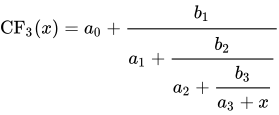
Or, more consistently:
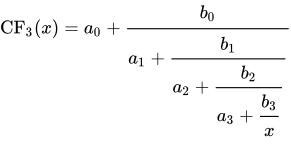
Viewed as such, could be written recursively:


Or in other words:

where
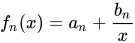

Raku has a builtin composition operator. We can use it with the triangular reduction metaoperator, and evaluate each resulting function at infinity (any value would do actually, but infinite makes it consistent with this particular task).
sub continued-fraction(@a, @b) {
    map { .(Inf) }, [\o] map { @a[$_] + @b[$_] / * }, ^Inf
}

printf "√2 ≈ %.9f\n", continued-fraction((1, |(2 xx *)), (1 xx *))[10];
printf "e  ≈ %.9f\n", continued-fraction((2, |(1 .. *)), (1, |(1 .. *)))[10];
printf "π  ≈ %.9f\n", continued-fraction((3, |(6 xx *)), ((1, 3, 5 ... *) X** 2))[100];
- Output:
√2 ≈ 1.414213552
e  ≈ 2.718281827
π  ≈ 3.141592411
REXX
version 1
The cf subroutine (for Continued Fractions) isn't limited to positive integers.
Any form of REXX numbers (negative, exponentiated, decimal fractions) can be used.
Note the use of negative fractions for the ß terms when computing √ ½ .
There isn't any practical limit for the decimal digits that can be used, although 100k digits would be a bit unwieldy to display.
A generalized √ function was added to calculate a few low integers (and also 1/2).
More code is used for nicely formatting the output than the continued fraction calculation.
/*REXX program  calculates and displays  values of  various  continued fractions.       */
parse arg terms digs .
if terms=='' | terms==","  then terms=500
if  digs=='' |  digs==","  then  digs=100
numeric digits digs                              /*use  100  decimal digits for display.*/
b.=1                                             /*omitted ß terms are assumed to be  1.*/
/*══════════════════════════════════════════════════════════════════════════════════════*/
a.=2;                                                           call tell '√2',      cf(1)
/*══════════════════════════════════════════════════════════════════════════════════════*/
a.=1;  do N=2  by  2  to terms; a.N=2; end;                     call tell '√3',      cf(1)     /*also:  2∙sin(π/3) */
/*══════════════════════════════════════════════════════════════════════════════════════*/
a.=2                  /*              ___ */
      do N=2  to 17   /*generalized  √ N  */
      b.=N-1;                          NN=right(N, 2);          call tell 'gen √'NN, cf(1)
      end   /*N*/
/*══════════════════════════════════════════════════════════════════════════════════════*/
a.=2;   b.=-1/2;                                                call tell 'gen √ ½', cf(1)
/*══════════════════════════════════════════════════════════════════════════════════════*/
  do j=1 for terms; a.j=j;  if j>1   then b.j=a.p; p=j; end;    call tell 'e',       cf(2)
/*══════════════════════════════════════════════════════════════════════════════════════*/
a.=1;                                                           call tell 'φ, phi',  cf(1)
/*══════════════════════════════════════════════════════════════════════════════════════*/
a.=1;    do j=1 for terms;  if j//2  then a.j=j;        end;    call tell 'tan(1)',  cf(1)
/*══════════════════════════════════════════════════════════════════════════════════════*/
         do j=1 for terms;                a.j=2*j+1;    end;    call tell 'coth(1)', cf(1)
/*══════════════════════════════════════════════════════════════════════════════════════*/
         do j=1 for terms;                a.j=4*j+2;    end;    call tell 'coth(½)', cf(2)    /*also:  [e+1]÷[e-1] */
/*══════════════════════════════════════════════════════════════════════════════════════*/
                     terms=100000
a.=6;    do j=1  for terms;  b.j=(2*j-1)**2;            end;    call tell 'π, pi',   cf(3)
exit                                             /*stick a fork in it,  we're all done. */
/*──────────────────────────────────────────────────────────────────────────────────────*/
cf:      procedure expose a. b. terms;  parse arg C;     !=0;    numeric digits 9+digits()
                                          do k=terms  by -1  for terms;  d=a.k+!;  !=b.k/d
                                          end   /*k*/
         return !+C
/*──────────────────────────────────────────────────────────────────────────────────────*/
tell:    parse arg ?,v;   $=left(format(v)/1,1+digits());    w=50    /*50 bytes of terms*/
         aT=;     do k=1;  _=space(aT a.k);  if length(_)>w  then leave;  aT=_;  end /*k*/
         bT=;     do k=1;  _=space(bT b.k);  if length(_)>w  then leave;  bT=_;  end /*k*/
                          say right(?,8)   "="    $     '  α terms='aT  ...
         if b.1\==1  then say right("",12+digits())     '  ß terms='bT  ...
         a=;   b.=1;  return       /*only 50 bytes of  α & ß terms  ↑   are displayed.  */
output
      √2 = 1.414213562373095048801688724209698078569671875376948073176679737990732478462107038850387534327641573   α terms=2 2 2 2 2 2 2 2 2 2 2 2 2 2 2 2 2 2 2 2 2 2 2 2 2 ...
      √3 = 1.732050807568877293527446341505872366942805253810380628055806979451933016908800037081146186757248576   α terms=1 2 1 2 1 2 1 2 1 2 1 2 1 2 1 2 1 2 1 2 1 2 1 2 1 ...
 gen √ 2 = 1.414213562373095048801688724209698078569671875376948073176679737990732478462107038850387534327641573   α terms=2 2 2 2 2 2 2 2 2 2 2 2 2 2 2 2 2 2 2 2 2 2 2 2 2 ...
 gen √ 3 = 1.732050807568877293527446341505872366942805253810380628055806979451933016908800037081146186757248576   α terms=2 2 2 2 2 2 2 2 2 2 2 2 2 2 2 2 2 2 2 2 2 2 2 2 2 ...
                                                                                                                   ß terms=2 2 2 2 2 2 2 2 2 2 2 2 2 2 2 2 2 2 2 2 2 2 2 2 2 ...
 gen √ 4 = 2                                                                                                       α terms=2 2 2 2 2 2 2 2 2 2 2 2 2 2 2 2 2 2 2 2 2 2 2 2 2 ...
                                                                                                                   ß terms=3 3 3 3 3 3 3 3 3 3 3 3 3 3 3 3 3 3 3 3 3 3 3 3 3 ...
 gen √ 5 = 2.236067977499789696409173668731276235440618359611525724270897245410520925637804899414414408378782275   α terms=2 2 2 2 2 2 2 2 2 2 2 2 2 2 2 2 2 2 2 2 2 2 2 2 2 ...
                                                                                                                   ß terms=4 4 4 4 4 4 4 4 4 4 4 4 4 4 4 4 4 4 4 4 4 4 4 4 4 ...
 gen √ 6 = 2.449489742783178098197284074705891391965947480656670128432692567250960377457315026539859433104640235   α terms=2 2 2 2 2 2 2 2 2 2 2 2 2 2 2 2 2 2 2 2 2 2 2 2 2 ...
                                                                                                                   ß terms=5 5 5 5 5 5 5 5 5 5 5 5 5 5 5 5 5 5 5 5 5 5 5 5 5 ...
 gen √ 7 = 2.645751311064590590501615753639260425710259183082450180368334459201068823230283627760392886474543611   α terms=2 2 2 2 2 2 2 2 2 2 2 2 2 2 2 2 2 2 2 2 2 2 2 2 2 ...
                                                                                                                   ß terms=6 6 6 6 6 6 6 6 6 6 6 6 6 6 6 6 6 6 6 6 6 6 6 6 6 ...
 gen √ 8 = 2.828427124746190097603377448419396157139343750753896146353359475981464956924214077700775068655283145   α terms=2 2 2 2 2 2 2 2 2 2 2 2 2 2 2 2 2 2 2 2 2 2 2 2 2 ...
                                                                                                                   ß terms=7 7 7 7 7 7 7 7 7 7 7 7 7 7 7 7 7 7 7 7 7 7 7 7 7 ...
 gen √ 9 = 3                                                                                                       α terms=2 2 2 2 2 2 2 2 2 2 2 2 2 2 2 2 2 2 2 2 2 2 2 2 2 ...
                                                                                                                   ß terms=8 8 8 8 8 8 8 8 8 8 8 8 8 8 8 8 8 8 8 8 8 8 8 8 8 ...
 gen √10 = 3.162277660168379331998893544432718533719555139325216826857504852792594438639238221344248108379300295   α terms=2 2 2 2 2 2 2 2 2 2 2 2 2 2 2 2 2 2 2 2 2 2 2 2 2 ...
                                                                                                                   ß terms=9 9 9 9 9 9 9 9 9 9 9 9 9 9 9 9 9 9 9 9 9 9 9 9 9 ...
 gen √11 = 3.316624790355399849114932736670686683927088545589353597058682146116484642609043846708843399128290651   α terms=2 2 2 2 2 2 2 2 2 2 2 2 2 2 2 2 2 2 2 2 2 2 2 2 2 ...
                                                                                                                   ß terms=10 10 10 10 10 10 10 10 10 10 10 10 10 10 10 10 10 ...
 gen √12 = 3.464101615137754587054892683011744733885610507620761256111613958903866033817600074162292373514497151   α terms=2 2 2 2 2 2 2 2 2 2 2 2 2 2 2 2 2 2 2 2 2 2 2 2 2 ...
                                                                                                                   ß terms=11 11 11 11 11 11 11 11 11 11 11 11 11 11 11 11 11 ...
 gen √13 = 3.605551275463989293119221267470495946251296573845246212710453056227166948293010445204619082018490718   α terms=2 2 2 2 2 2 2 2 2 2 2 2 2 2 2 2 2 2 2 2 2 2 2 2 2 ...
                                                                                                                   ß terms=12 12 12 12 12 12 12 12 12 12 12 12 12 12 12 12 12 ...
 gen √14 = 3.741657386773941385583748732316549301756019807778726946303745467320035156306939027976809895194379572   α terms=2 2 2 2 2 2 2 2 2 2 2 2 2 2 2 2 2 2 2 2 2 2 2 2 2 ...
                                                                                                                   ß terms=13 13 13 13 13 13 13 13 13 13 13 13 13 13 13 13 13 ...
 gen √15 = 3.872983346207416885179265399782399610832921705291590826587573766113483091936979033519287376858673518   α terms=2 2 2 2 2 2 2 2 2 2 2 2 2 2 2 2 2 2 2 2 2 2 2 2 2 ...
                                                                                                                   ß terms=14 14 14 14 14 14 14 14 14 14 14 14 14 14 14 14 14 ...
 gen √16 = 4                                                                                                       α terms=2 2 2 2 2 2 2 2 2 2 2 2 2 2 2 2 2 2 2 2 2 2 2 2 2 ...
                                                                                                                   ß terms=15 15 15 15 15 15 15 15 15 15 15 15 15 15 15 15 15 ...
 gen √17 = 4.123105625617660549821409855974077025147199225373620434398633573094954346337621593587863650810684297   α terms=2 2 2 2 2 2 2 2 2 2 2 2 2 2 2 2 2 2 2 2 2 2 2 2 2 ...
                                                                                                                   ß terms=16 16 16 16 16 16 16 16 16 16 16 16 16 16 16 16 16 ...
 gen √ ½ = 0.707106781186547524400844362104849039284835937688474036588339868995366239231053519425193767163820786   α terms=2 2 2 2 2 2 2 2 2 2 2 2 2 2 2 2 2 2 2 2 2 2 2 2 2 ...
                                                                                                                   ß terms=-0.5 -0.5 -0.5 -0.5 -0.5 -0.5 -0.5 -0.5 -0.5 -0.5 ...
       e = 2.718281828459045235360287471352662497757247093699959574966967627724076630353547594571382178525166427   α terms=1 2 3 4 5 6 7 8 9 10 11 12 13 14 15 16 17 18 19 20 ...
  φ, phi = 1.618033988749894848204586834365638117720309179805762862135448622705260462818902449707207204189391137   α terms=1 1 1 1 1 1 1 1 1 1 1 1 1 1 1 1 1 1 1 1 1 1 1 1 1 ...
  tan(1) = 1.557407724654902230506974807458360173087250772381520038383946605698861397151727289555099965202242984   α terms=1 1 3 1 5 1 7 1 9 1 11 1 13 1 15 1 17 1 19 1 21 1 ...
 coth(1) = 1.313035285499331303636161246930847832912013941240452655543152967567084270461874382674679241480856303   α terms=3 5 7 9 11 13 15 17 19 21 23 25 27 29 31 33 35 37 ...
 coth(½) = 2.163953413738652848770004010218023117093738602150792272533574119296087634783339486574409418809750115   α terms=6 10 14 18 22 26 30 34 38 42 46 50 54 58 62 66 70 ...
   π, pi = 3.141592653589792988470143264530440384041017830472772036746332303472711537960073664096818977224037083   α terms=6 6 6 6 6 6 6 6 6 6 6 6 6 6 6 6 6 6 6 6 6 6 6 6 6 ...
Note: even with 200 digit accuracy and 100,000 terms, the last calculation of pi is only accurate to 15 digits.
version 2 derived from PL/I
/* REXX **************************************************************
* Derived from PL/I with a little "massage"
* SQRT2=     1.41421356237309505              <- PL/I Result
*            1.41421356237309504880168872421  <- REXX Result 30 digits
* NAPIER=    2.71828182845904524
*            2.71828182845904523536028747135
* PI=        3.14159262280484695
*            3.14159262280484694855146925223
* 06.09.2012 Walter Pachl
**********************************************************************/
  Numeric Digits 30
  Parse Value '1 2 3 0 0' with Sqrt2 napier pi a b
  Say left('SQRT2=' ,10) calc(sqrt2,  200)
  Say left('NAPIER=',10) calc(napier, 200)
  Say left('PI='    ,10) calc(pi,     200)
  Exit

Get_Coeffs: procedure Expose a b Sqrt2 napier pi
  Parse Arg form, n
  select
    when form=Sqrt2 Then do
      if n > 0 then a = 2; else a = 1
      b = 1
      end
    when form=Napier Then do
      if n > 0 then a = n; else a = 2
      if n > 1 then b = n - 1; else b = 1
      end
    when form=pi Then do
      if n > 0 then a = 6; else a = 3
      b = (2*n - 1)**2
      end
    end
  Return

Calc: procedure Expose a b Sqrt2 napier pi
  Parse Arg form,n
  Temp=0
  do ni = n to 1 by -1
    Call Get_Coeffs form, ni
    Temp = B/(A + Temp)
    end
  call Get_Coeffs  form, 0
  return (A + Temp)
version 3 better approximation
/* REXX *************************************************************
* The task description specifies a continued fraction for pi
* that gives a reasonable approximation.
* Literature shows a better CF that yields pi with a precision of
* 200 digits.
* http://de.wikipedia.org/wiki/Kreiszahl
*                    1
* pi = 3 + ------------------------
*                      1
*          7 + --------------------
*                         1
*              15 + ---------------
*                            1
*                   1 + -----------
*
*                       292 + ...
*
* This program uses that CF and shows the first 50 digits
* PI =3.1415926535897932384626433832795028841971693993751...
* PIX=3.1415926535897932384626433832795028841971693993751...
* 201 correct digits
* 18.09.2012 Walter Pachl
**********************************************************************/
  pi='3.1415926535897932384626433832795028841971'||,
     '693993751058209749445923078164062862089986280348'||,
     '253421170679821480865132823066470938446095505822'||,
     '317253594081284811174502841027019385211055596446'||,
     '229489549303819644288109756659334461284756482337'||,
     '867831652712019091456485669234603486104543266482'||,
     '133936072602491412737245870066063155881748815209'||,
     '209628292540917153643678925903600113305305488204'||,
     '665213841469519415116094330572703657595919530921'||,
     '861173819326117931051185480744623799627495673518'||,
     '857527248912279381830119491298336733624'
  Numeric Digits 1000
  al='7 15 1 292 1 1 1 2 1 3 1 14 2 1 1 2 2 2 2 1 84 2',
     '1 1 15 3 13 1 4 2 6 6 99 1 2 2 6 3 5 1 1 6 8 1 7 1 2',
     '3 7 1 2 1 1 12 1 1 1 3 1 1 8 1 1 2 1 6 1 1 5 2 2 3 1',
     '2 4 4 16 1 161 45 1 22 1 2 2 1 4 1 2 24 1 2 1 3 1 2',
     '1 1 10 2 5 4 1 2 2 8 1 5 2 2 26 1 4 1 1 8 2 42 2 1 7',
     '3 3 1 1 7 2 4 9 7 2 3 1 57 1 18 1 9 19 1 2 18 1 3 7',
     '30 1 1 1 3 3 3 1 2 8 1 1 2 1 15 1 2 13 1 2 1 4 1 12',
     '1 1 3 3 28 1 10 3 2 20 1 1 1 1 4 1 1 1 5 3 2 1 6 1 4'
  a.=3
  Do i=1 By 1 while al<>''
    Parse Var al a.i al
    End
  pix=calc(194)
  Do e=1 To length(pi)
    If substr(pix,e,1)<>substr(pi,e,1) Then Leave
    End
  Numeric Digits 50
  Say 'PI ='||(pi+0)||'...'
  Say 'PIX='||(pix+0)||'...'
  Say (e-1) 'correct digits'
  Exit

Get_Coeffs: procedure Expose a b a.
  Parse Arg n
  a=a.n
  b=1
  Return

Calc: procedure Expose a b a.
  Parse Arg n
  Temp=0
  do ni = n to 1 by -1
    Call Get_Coeffs ni
    Temp = B/(A + Temp)
    end
  call Get_Coeffs 0
  return (A + Temp)
Ring
# Project : Continued fraction

see "SQR(2) = " + contfrac(1, 1, "2", "1") + nl
see "        e = " + contfrac(2, 1, "n", "n") + nl
see "       PI = " + contfrac(3, 1, "6", "(2*n+1)^2") + nl

func contfrac(a0, b1, a, b)
        expr = ""
        n = 0
        while len(expr) < (700 - n)
                 n = n + 1
                 eval("temp1=" + a)
                 eval("temp2=" + b)
                 expr = expr + string(temp1) + char(43) + string(temp2) + "/("
        end
        str = copy(")",n)
        eval("temp3=" + expr + "1" + str)
        return a0 + b1 / temp3
Output:
SQR(2) = 1.414213562373095
         e = 2.718281828459046
        PI = 3.141592653588017
RPL
This task demonstrates how both global and local variables, arithmetic expressions and stack can be used together to build a compact and versatile piece of code.
| RPL code | Comment |
|---|---|
≪
 4 ROLL ROT → an bn
 ≪ 'N' STO 0 WHILE N 2 ≥ REPEAT
       an + INV bn * EVAL
      'N' 1 STO- END
    an + / + EVAL
    'N' PURGE
≫ ≫ ‘→CFRAC’ STO
|
→CFRAC ( a0 an b1 bn N -- x ) Unstack an and bn Loop from N to 2 Calculate Nth fraction Decrement counter Calculate last fraction with b1 in stack, then add a0 Discard N variable - not mandatory but hygienic |
- Input:
1 2 1 1 100 →CFRAC
2 'N' 1 'N-1' 100 →CFRAC
3 6 1 '(2*N-1)^2' 1000 →CFRAC
1 1 1 1 100 →CFRAC
1 '2-MOD(N,2)' 1 1 100 →CFRAC
- Output:
5: 1.41421356237
4: 2.71828182846
3: 3.14159265334
2: 1.61803398875
1: 1.73205080757
Ruby
require 'bigdecimal'

# square root of 2
sqrt2 = Object.new
def sqrt2.a(n); n == 1 ? 1 : 2; end
def sqrt2.b(n); 1; end

# Napier's constant
napier = Object.new
def napier.a(n); n == 1 ? 2 : n - 1; end
def napier.b(n); n == 1 ? 1 : n - 1; end

pi = Object.new
def pi.a(n); n == 1 ? 3 : 6; end
def pi.b(n); (2*n - 1)**2; end

# Estimates the value of a continued fraction _cfrac_, to _prec_
# decimal digits of precision. Returns a BigDecimal. _cfrac_ must
# respond to _cfrac.a(n)_ and _cfrac.b(n)_ for integer _n_ >= 1.
def estimate(cfrac, prec)
  last_result = nil
  terms = prec

  loop do
    # Estimate continued fraction for _n_ from 1 to _terms_.
    result = cfrac.a(terms)
    (terms - 1).downto(1) do |n|
      a = BigDecimal cfrac.a(n)
      b = BigDecimal cfrac.b(n)
      digits = [b.div(result, 1).exponent + prec, 1].max
      result = a + b.div(result, digits)
    end
    result = result.round(prec)

    if result == last_result
      return result
    else
      # Double _terms_ and try again.
      last_result = result
      terms *= 2
    end
  end
end

puts estimate(sqrt2, 50).to_s('F')
puts estimate(napier, 50).to_s('F')
puts estimate(pi, 10).to_s('F')
- Output:
$ ruby cfrac.rb
1.41421356237309504880168872420969807856967187537695
2.71828182845904523536028747135266249775724709369996
3.1415926536
Rust
use std::iter;

// Calculating a continued fraction is quite easy with iterators, however
// writing a proper iterator adapter is less so. We settle for a macro which
// for most purposes works well enough.
//
// One limitation with this iterator based approach is that we cannot reverse
// input iterators since they are not usually DoubleEnded. To circumvent this
// we can collect the elements and then reverse them, however this isn't ideal
// as we now have to store elements equal to the number of iterations.
//
// Another is that iterators cannot be resused once consumed, so it is often
// required to make many clones of iterators.
macro_rules! continued_fraction {
    ($a:expr, $b:expr ; $iterations:expr) => (
        ($a).zip($b)
            .take($iterations)
            .collect::<Vec<_>>().iter()
            .rev()
            .fold(0 as f64, |acc: f64, &(x, y)| {
                x as f64 + (y as f64 / acc)
            })
    );

    ($a:expr, $b:expr) => (continued_fraction!($a, $b ; 1000));
}

fn main() {
    // Sqrt(2)
    let sqrt2a = (1..2).chain(iter::repeat(2));
    let sqrt2b = iter::repeat(1);
    println!("{}", continued_fraction!(sqrt2a, sqrt2b));


    // Napier's Constant
    let napiera = (2..3).chain(1..);
    let napierb = (1..2).chain(1..);
    println!("{}", continued_fraction!(napiera, napierb));


    // Pi
    let pia = (3..4).chain(iter::repeat(6));
    let pib = (1i64..).map(|x| (2 * x - 1).pow(2));
    println!("{}", continued_fraction!(pia, pib));
}
- Output:
1.4142135623730951
2.7182818284590455
3.141592653339042
Scala
Note that Scala-BigDecimal provides a precision of 34 digits. Therefore we take a limitation of 32 digits to avoiding rounding problems.
object CF extends App {
  import Stream._
  val sqrt2 = 1 #:: from(2,0) zip from(1,0)
  val napier = 2 #:: from(1) zip (1 #:: from(1))
  val pi = 3 #:: from(6,0) zip (from(1,2) map {x=>x*x})

  // reference values, source: wikipedia
  val refPi     = "3.14159265358979323846264338327950288419716939937510"
  val refNapier = "2.71828182845904523536028747135266249775724709369995"
  val refSQRT2  = "1.41421356237309504880168872420969807856967187537694"

  def calc(cf: Stream[(Int, Int)], numberOfIters: Int=200): BigDecimal = {
    (cf take numberOfIters toList).foldRight[BigDecimal](1)((a, z) => a._1+a._2/z)
  }

  def approx(cfV: BigDecimal, cfRefV: String): String = {
    val p: Pair[Char,Char] => Boolean = pair =>(pair._1==pair._2)
    ((cfV.toString+" "*34).substring(0,34) zip cfRefV.toString.substring(0,34))
      .takeWhile(p).foldRight[String]("")((a:Pair[Char,Char],z)=>a._1+z)
  }

  List(("sqrt2",sqrt2,50,refSQRT2),("napier",napier,50,refNapier),("pi",pi,3000,refPi)) foreach {t=>
    val (name,cf,iters,refV) = t
    val cfV = calc(cf,iters)
    println(name+":")
    println("ref value: "+refV.substring(0,34))
    println("cf value:  "+(cfV.toString+" "*34).substring(0,34))
    println("precision: "+approx(cfV,refV))
    println()
  }
}
- Output:
sqrt2:
ref value: 1.41421356237309504880168872420969
cf value:  1.41421356237309504880168872420969
precision: 1.41421356237309504880168872420969

napier:
ref value: 2.71828182845904523536028747135266
cf value:  2.71828182845904523536028747135266
precision: 2.71828182845904523536028747135266

pi:
ref value: 3.14159265358979323846264338327950
cf value:  3.14159265358052780404906362935452
precision: 3.14159265358
For higher accuracy of pi we have to take more iterations. Unfortunately the foldRight function in calc isn't tail recursiv - therefore a stack overflow exception will be thrown for higher numbers of iteration, thus we have to implement an iterative way for calculation:
object CFI extends App {
  import Stream._
  val sqrt2 = 1 #:: from(2,0) zip from(1,0)
  val napier = 2 #:: from(1) zip (1 #:: from(1))
  val pi = 3 #:: from(6,0) zip (from(1,2) map {x=>x*x})

  // reference values, source: wikipedia
  val refPi     = "3.14159265358979323846264338327950288419716939937510"
  val refNapier = "2.71828182845904523536028747135266249775724709369995"
  val refSQRT2  = "1.41421356237309504880168872420969807856967187537694"

  def calc_i(cf: Stream[(Int, Int)], numberOfIters: Int=50): BigDecimal = {
    val cfl = cf take numberOfIters toList
    var z: BigDecimal = 1.0
    for (i <- 0 to cfl.size-1 reverse)
      z=cfl(i)._1+cfl(i)._2/z
    z
  }

  def approx(cfV: BigDecimal, cfRefV: String): String = {
    val p: Pair[Char,Char] => Boolean = pair =>(pair._1==pair._2)
    ((cfV.toString+" "*34).substring(0,34) zip cfRefV.toString.substring(0,34))
      .takeWhile(p).foldRight[String]("")((a:Pair[Char,Char],z)=>a._1+z)
  }

  List(("sqrt2",sqrt2,50,refSQRT2),("napier",napier,50,refNapier),("pi",pi,50000,refPi)) foreach {t=>
    val (name,cf,iters,refV) = t
    val cfV = calc_i(cf,iters)
    println(name+":")
    println("ref value: "+refV.substring(0,34))
    println("cf value:  "+(cfV.toString+" "*34).substring(0,34))
    println("precision: "+approx(cfV,refV))
    println()
  }
}
- Output:
sqrt2:
ref value: 1.41421356237309504880168872420969
cf value:  1.41421356237309504880168872420969
precision: 1.41421356237309504880168872420969

napier:
ref value: 2.71828182845904523536028747135266
cf value:  2.71828182845904523536028747135266
precision: 2.71828182845904523536028747135266

pi:
ref value: 3.14159265358979323846264338327950
cf value:  3.14159265358983426214354599901745
precision: 3.141592653589
Scheme
The following code relies on a library implementing SRFI 41 (lazy streams). Most Scheme interpreters include an implementation.
#!r6rs
(import (rnrs base (6))
        (srfi :41 streams))

(define nats (stream-cons 0 (stream-map (lambda (x) (+ x 1)) nats)))

(define (build-stream fn) (stream-map fn nats))

(define (stream-cycle s . S)
  (cond
    ((stream-null? (car S)) stream-null)
    (else (stream-cons (stream-car s)
                       (apply stream-cycle (append S (list (stream-cdr s))))))))

(define (cf-floor cf) (stream-car cf))
(define (cf-num cf) (stream-car (stream-cdr cf)))
(define (cf-denom cf) (stream-cdr (stream-cdr cf)))

(define (cf-integer? x) (stream-null? (stream-cdr x)))

(define (cf->real x)
  (let refine ((x x) (n 65536))
    (cond
      ((= n 0) +inf.0)
      ((cf-integer? x) (cf-floor x))
      (else (+ (cf-floor x)
               (/ (cf-num x)
                  (refine (cf-denom x) (- n 1))))))))

(define (real->cf x)
  (let-values (((integer-part fractional-part) (div-and-mod x 1)))
    (if (= fractional-part 0.0)
        (stream (exact integer-part))
        (stream-cons
         (exact integer-part)
         (stream-cons
          1
          (real->cf (/ fractional-part)))))))


(define sqrt2 (stream-cons 1 (stream-constant 1 2)))

(define napier
  (stream-append (stream 2 1)
                 (stream-cycle (stream-cdr nats) (stream-cdr nats))))

(define pi
  (stream-cons 3
               (stream-cycle (build-stream (lambda (n) (expt (- (* 2 (+ n 1)) 1) 2)))
                             (stream-constant 6))))
Test:
> (cf->real sqrt2)
1.4142135623730951
> (cf->real napier)
2.7182818284590455
> (cf->real pi)
3.141592653589794
Sidef
func continued_fraction(a, b, f, n = 1000, r = 1) {
    f(func (r) {
        r < n ? (a(r) / (b(r) + __FUNC__(r+1))) : 0
    }(r))
}

var params = Hash(
    "φ"  => [ { 1 }, { 1 }, { 1 + _ } ],
    "√2" => [ { 1 }, { 2 }, { 1 + _ } ],
    "e"  => [ { _ }, { _ }, { 1 + 1/_ } ],
    "π"  => [ { (2*_ - 1)**2 }, { 6 }, { 3 + _ } ],
    "τ"  => [ { _**2 }, { 2*_ + 1 }, { 8 / (1 + _) } ],
)

for k in (params.keys.sort) {
    printf("%2s ≈ %s\n", k, continued_fraction(params{k}...))
}
- Output:
 e ≈ 2.7182818284590452353602874713526624977572470937
 π ≈ 3.14159265383979292596359650286939597045138933078
 τ ≈ 6.28318530717958647692528676655900576839433879875
 φ ≈ 1.61803398874989484820458683436563811772030917981
√2 ≈ 1.41421356237309504880168872420969807856967187538
Swift
extension BinaryInteger {
  @inlinable
  public func power(_ n: Self) -> Self {
    return stride(from: 0, to: n, by: 1).lazy.map({_ in self }).reduce(1, *)
  }
}

public struct CycledSequence<WrappedSequence: Sequence> {
  private var seq: WrappedSequence
  private var iter: WrappedSequence.Iterator

  init(seq: WrappedSequence) {
    self.seq = seq
    self.iter = seq.makeIterator()
  }
}

extension CycledSequence: Sequence, IteratorProtocol {
  public mutating func next() -> WrappedSequence.Element? {
    if let ele = iter.next() {
      return ele
    } else {
      iter = seq.makeIterator()

      return iter.next()
    }
  }
}

extension Sequence {
  public func cycled() -> CycledSequence<Self> {
    return CycledSequence(seq: self)
  }
}

public struct ChainedSequence<Element> {
  private var sequences: [AnySequence<Element>]
  private var iter: AnyIterator<Element>
  private var curSeq = 0

  init(chain: ChainedSequence) {
    self.sequences = chain.sequences
    self.iter = chain.iter
    self.curSeq = chain.curSeq
  }

  init<Seq: Sequence>(_ seq: Seq) where Seq.Element == Element {
    sequences = [AnySequence(seq)]
    iter = sequences[curSeq].makeIterator()
  }

  func chained<Seq: Sequence>(with seq: Seq) -> ChainedSequence where Seq.Element == Element {
    var res = ChainedSequence(chain: self)

    res.sequences.append(AnySequence(seq))

    return res
  }
}

extension ChainedSequence: Sequence, IteratorProtocol {
  public mutating func next() -> Element? {
    if let el = iter.next() {
      return el
    }

    curSeq += 1

    guard curSeq != sequences.endIndex else {
      return nil
    }

    iter = sequences[curSeq].makeIterator()

    return iter.next()
  }
}

extension Sequence {
  public func chained<Seq: Sequence>(with other: Seq) -> ChainedSequence<Element> where Seq.Element == Element {
    return ChainedSequence(self).chained(with: other)
  }
}

func continuedFraction<T: Sequence, V: Sequence>(
  _ seq1: T,
  _ seq2: V,
  iterations: Int = 1000
) -> Double where T.Element: BinaryInteger, T.Element == V.Element {
  return zip(seq1, seq2).prefix(iterations).reversed().reduce(0.0, { Double($1.0) + (Double($1.1) / $0) })
}

let sqrtA = [1].chained(with: [2].cycled())
let sqrtB = [1].cycled()

print("√2 ≈ \(continuedFraction(sqrtA, sqrtB))")

let napierA = [2].chained(with: 1...)
let napierB = [1].chained(with: 1...)

print("e ≈ \(continuedFraction(napierA, napierB))")

let piA = [3].chained(with: [6].cycled())
let piB = (1...).lazy.map({ (2 * $0 - 1).power(2) })

print("π ≈ \(continuedFraction(piA, piB))")
- Output:
√2 ≈ 1.4142135623730951
e ≈ 2.7182818284590455
π ≈ 3.141592653339042
import Foundation

func calculate(n: Int, operation: (Int) -> [Int])-> Double {
    var tmp: Double = 0
    for ni in stride(from: n, to:0, by: -1) {
                var p = operation(ni)
                tmp = Double(p[1])/(Double(p[0]) + tmp);
            }
            return Double(operation(0)[0]) + tmp;
}

func sqrt (n: Int) -> [Int] {
    return [n > 0 ? 2 : 1, 1]
}

func napier (n: Int) -> [Int] {
    var res = [n > 0 ? n : 2, n > 1 ? (n - 1) : 1]
    return res
}

func pi(n: Int) -> [Int] {
    var res = [n > 0 ? 6 : 3,  Int(pow(Double(2 * n - 1), 2))]
    return res
}
print (calculate(n: 200, operation: sqrt));
print (calculate(n: 200, operation: napier));
print (calculate(n: 200, operation: pi));
Tcl
Note that Tcl does not provide arbitrary precision floating point numbers by default, so all result computations are done with IEEE doubles.
package require Tcl 8.6

# Term generators; yield list of pairs
proc r2 {} {
    yield {1 1}
    while 1 {yield {2 1}}
}
proc e {} {
    yield {2 1}
    while 1 {yield [list [incr n] $n]}
}
proc pi {} {
    set n 0; set a 3
    while 1 {
	yield [list $a [expr {(2*[incr n]-1)**2}]]
	set a 6
    }
}

# Continued fraction calculator
proc cf {generator {termCount 50}} {
    # Get the chunk of terms we want to work with
    set terms [list [coroutine cf.c $generator]]
    while {[llength $terms] < $termCount} {
	lappend terms [cf.c]
    }
    rename cf.c {}

    # Merge the terms to compute the result
    set val 0.0
    foreach pair [lreverse $terms] {
	lassign $pair a b
	set val [expr {$a + $b/$val}]
    }
    return $val
}

# Demonstration
puts [cf r2]
puts [cf e]
puts [cf pi 250]; # Converges more slowly
- Output:
1.4142135623730951
2.7182818284590455
3.1415926373965735
VBA
Public Const precision = 10000
Private Function continued_fraction(steps As Integer, rid_a As String, rid_b As String) As Double
    Dim res As Double
    res = 0
    For n = steps To 1 Step -1
       res = Application.Run(rid_b, n) / (Application.Run(rid_a, n) + res)
    Next n
    continued_fraction = Application.Run(rid_a, 0) + res
End Function

Function sqr2_a(n As Integer) As Integer
    sqr2_a = IIf(n = 0, 1, 2)
End Function

Function sqr2_b(n As Integer) As Integer
    sqr2_b = 1
End Function

Function nap_a(n As Integer) As Integer
    nap_a = IIf(n = 0, 2, n)
End Function

Function nap_b(n As Integer) As Integer
    nap_b = IIf(n = 1, 1, n - 1)
End Function

Function pi_a(n As Integer) As Integer
    pi_a = IIf(n = 0, 3, 6)
End Function

Function pi_b(n As Integer) As Long
    pi_b = IIf(n = 1, 1, (2 * n - 1) ^ 2)
End Function

Public Sub main()
    Debug.Print "Precision:", precision
    Debug.Print "Sqr(2):", continued_fraction(precision, "sqr2_a", "sqr2_b")
    Debug.Print "Napier:", continued_fraction(precision, "nap_a", "nap_b")
    Debug.Print "Pi:", continued_fraction(precision, "pi_a", "pi_b")
End Sub- Output:
Precision:     10000
Sqr(2):        1,4142135623731
Napier:        2,71828182845905
Pi:            3,14159265358954
Visual Basic .NET
Module Module1
    Function Calc(f As Func(Of Integer, Integer()), n As Integer) As Double
        Dim temp = 0.0
        For ni = n To 1 Step -1
            Dim p = f(ni)
            temp = p(1) / (p(0) + temp)
        Next
        Return f(0)(0) + temp
    End Function

    Sub Main()
        Dim fList = {
            Function(n As Integer) New Integer() {If(n > 0, 2, 1), 1},
            Function(n As Integer) New Integer() {If(n > 0, n, 2), If(n > 1, n - 1, 1)},
            Function(n As Integer) New Integer() {If(n > 0, 6, 3), Math.Pow(2 * n - 1, 2)}
            }

        For Each f In fList
            Console.WriteLine(Calc(f, 200))
        Next
    End Sub

End Module
- Output:
1.4142135623731
2.71828182845905
3.14159262280485
Wren
var calc = Fn.new { |f, n|
    var t = 0
    for (i in n..1) {
        var p = f.call(i)
        t = p[1] / (p[0] + t)
    }
    return f.call(0)[0] + t
}

var pList = [
    ["sqrt(2)", Fn.new { |n| [(n > 0) ? 2 : 1, 1] }],
    ["e      ", Fn.new { |n| [(n > 0) ? n : 2, (n > 1) ? n - 1 : 1] }],
    ["pi     ", Fn.new { |n| [(n > 0) ? 6 : 3, (2*n - 1) * (2*n - 1)] }]
]
for (p in pList) System.print("%(p[0]) = %(calc.call(p[1], 200))")
- Output:
sqrt(2) = 1.4142135623731
e       = 2.718281828459
pi      = 3.1415926228048
XPL0
The number of iterations (N) needed to get the 13 digits of accuracy was determined by experiment.
include c:\cxpl\codes;
int     N;
real    A, B, F;
[Format(1, 15);
A:= 2.0;  B:= 1.0;  N:= 16;
IntOut(0, N); CrLf(0);
F:= 0.0;
while N>=1 do [F:= B/(A+F);  N:= N-1];
RlOut(0, 1.0+F);  CrLf(0);
RlOut(0, sqrt(2.0));  CrLf(0);

N:= 13;
IntOut(0, N); CrLf(0);
F:= 0.0;
while N>=2 do [F:= float(N-1)/(float(N)+F);  N:= N-1];
RlOut(0, 2.0 + 1.0/(1.0+F));  CrLf(0);
RlOut(0, Exp(1.0));  CrLf(0);

N:= 10000;
IntOut(0, N); CrLf(0);
F:= 0.0;
while N>=1 do [F:= float(sq(2*N-1))/(6.0+F);  N:= N-1];
RlOut(0, 3.0+F);  CrLf(0);
RlOut(0, ACos(-1.0));  CrLf(0);
]- Output:
16
1.414213562372820
1.414213562373100
13
2.718281828459380
2.718281828459050
10000
3.141592653589540
3.141592653589790
zkl
fcn cf(fa,fb,a0){fcn(fa,fb,a0,n){
   a0 + [n..1,-1].reduce(
        'wrap(p,n){ fb(n)/(fa(n)+p) },0.0) }.fp(fa,fb,a0)
}
cf creates a function that calculates the continued fraction from the bottom up. The new function takes a single parameter, n, which is used to calculate the nth term.
sqrt2:=cf((2.0).noop,(1.0).noop,1.0);
   sqrt2(200) : "%.20e".fmt(_).println();
nap:=cf((0.0).create,fcn(n){ (n==1) and 1.0 or (n-1).toFloat() },2.0);
   println(nap(15) - (1.0).e);
pi:=cf((6.0).noop,fcn(n){ n=2*n-1; (n*n).toFloat() },3.0);
   println(pi(1000) - (1.0).pi);
(1.0).create(n) --> n, (1.0).noop(n) --> 1.0
- Output:
1.41421356237309514547e+00
1.33227e-15
-2.49251e-10
ZX Spectrum Basic
10 LET a0=1: LET b1=1: LET a$="2": LET b$="1": PRINT "SQR(2) = ";: GO SUB 1000
20 LET a0=2: LET b1=1: LET a$="N": LET b$="N": PRINT "e = ";: GO SUB 1000
30 LET a0=3: LET b1=1: LET a$="6": LET b$="(2*N+1)^2": PRINT "PI = ";: GO SUB 1000
100 STOP
1000 LET n=0: LET e$="": LET p$=""
1010 LET n=n+1
1020 LET e$=e$+STR$ VAL a$+"+"+STR$ VAL b$+"/("
1030 IF LEN e$<(4000-n) THEN GO TO 1010
1035 FOR i=1 TO n: LET p$=p$+")": NEXT i
1040 PRINT a0+b1/VAL (e$+"1"+p$)
1050 RETURN- Programming Tasks
- Solutions by Programming Task
- 11l
- Action!
- Action! Tool Kit
- Ada
- ALGOL 68
- Arturo
- ATS
- AutoHotkey
- Axiom
- BBC BASIC
- C
- C sharp
- C++
- Chapel
- Clojure
- COBOL
- CoffeeScript
- Common Lisp
- D
- Dc
- EasyLang
- Elixir
- Erlang
- F Sharp
- Factor
- Felix
- Forth
- Fortran
- FreeBASIC
- Fōrmulæ
- Go
- Groovy
- Haskell
- Icon
- J
- Java
- Jq
- Julia
- Klong
- Kotlin
- Lambdatalk
- Lua
- Maple
- Mathematica
- Wolfram Language
- Maxima
- NetRexx
- Nim
- OCaml
- PARI/GP
- Pascal
- Perl
- Phix
- Picat
- PicoLisp
- PL/I
- Prolog
- Python
- Quackery
- Racket
- Raku
- REXX
- Ring
- RPL
- Ruby
- Rust
- Scala
- Scheme
- Sidef
- Swift
- Tcl
- VBA
- Visual Basic .NET
- Wren
- XPL0
- Zkl
- ZX Spectrum Basic