
Sort an integer array

You are encouraged to solve this task according to the task description, using any language you may know.
Sorting Algorithm
This is a sorting algorithm. It may be applied to a set of data in order to sort it.
For comparing various sorts, see compare sorts.
For other sorting algorithms, see sorting algorithms, or:
Heap sort | Merge sort | Patience sort | Quick sort
O(n log2n) sorts
Shell Sort
O(n2) sorts
Bubble sort |
Cocktail sort |
Cocktail sort with shifting bounds |
Comb sort |
Cycle sort |
Gnome sort |
Insertion sort |
Selection sort |
Strand sort
other sorts
Bead sort |
Bogo sort |
Common sorted list |
Composite structures sort |
Custom comparator sort |
Counting sort |
Disjoint sublist sort |
External sort |
Jort sort |
Lexicographical sort |
Natural sorting |
Order by pair comparisons |
Order disjoint list items |
Order two numerical lists |
Object identifier (OID) sort |
Pancake sort |
Quickselect |
Permutation sort |
Radix sort |
Ranking methods |
Remove duplicate elements |
Sleep sort |
Stooge sort |
[Sort letters of a string] |
Three variable sort |
Topological sort |
Tree sort
- Task
Sort an array (or list) of integers in ascending numerical order.
Use a sorting facility provided by the language/library if possible.
11l
nums = [2,4,3,1,2]
nums.sort()
You could also use the built-in sorted() function:
nums = sorted([2,4,3,1,2])4D
English
ARRAY INTEGER($nums;0)
APPEND TO ARRAY($nums;2)
APPEND TO ARRAY($nums;4)
APPEND TO ARRAY($nums;3)
APPEND TO ARRAY($nums;1)
APPEND TO ARRAY($nums;2)
SORT ARRAY($nums)  ` sort in ascending order
SORT ARRAY($nums;<)  ` sort in descending order
Français
TABLEAU ENTIER($nombres;0)
AJOUTER A TABLEAU($nombres;2)
AJOUTER A TABLEAU($nombres;4)
AJOUTER A TABLEAU($nombres;3)
AJOUTER A TABLEAU($nombres;1)
AJOUTER A TABLEAU($nombres;2)
TRIER TABLEAU($nombres)  ` pour effectuer un tri par ordre croissant
TRIER TABLEAU($nombres;<)  ` pour effectuer un tri par ordre décroissant
8th
[ 10,2,100 ] ' n:cmp a:sort . cr
Output is: [2,10,100]
AArch64 Assembly
/* ARM assembly AARCH64 Raspberry PI 3B */
/*  program integerSort64.s  with selection sort  */

/*******************************************/
/* Constantes file                         */
/*******************************************/
/* for this file see task include a file in language AArch64 assembly */
.include "../includeConstantesARM64.inc"

/*********************************/
/* Initialized data              */
/*********************************/
.data
szMessSortOk:       .asciz "Table sorted.\n"
szMessSortNok:      .asciz "Table not sorted !!!!!.\n"
sMessResult:        .asciz "Value  : @ \n"
szCarriageReturn:   .asciz "\n"

.align 4
#TableNumber:      .quad   1,3,6,2,5,9,10,8,4,7
TableNumber:     .quad   10,9,8,7,6,5,4,3,2,1
                 .equ NBELEMENTS, (. - TableNumber) / 8
/*********************************/
/* UnInitialized data            */
/*********************************/
.bss
sZoneConv:       .skip 24
/*********************************/
/*  code section                 */
/*********************************/
.text
.global main
main:                                              // entry of program
    ldr x0,qAdrTableNumber                         // address number table
    mov x1,0
    mov x2,NBELEMENTS                              // number of élements
    bl selectionSort
    ldr x0,qAdrTableNumber                         // address number table
    bl displayTable

    ldr x0,qAdrTableNumber                         // address number table
    mov x1,NBELEMENTS                              // number of élements
    bl isSorted                                    // control sort
    cmp x0,1                                       // sorted ?
    beq 1f
    ldr x0,qAdrszMessSortNok                       // no !! error sort
    bl affichageMess
    b 100f
1:                                                 // yes
    ldr x0,qAdrszMessSortOk
    bl affichageMess
100:                                               // standard end of the program
    mov x0,0                                       // return code
    mov x8,EXIT                                    // request to exit program
    svc 0                                          // perform the system call

qAdrsZoneConv:            .quad sZoneConv
qAdrszCarriageReturn:     .quad szCarriageReturn
qAdrsMessResult:          .quad sMessResult
qAdrTableNumber:          .quad TableNumber
qAdrszMessSortOk:         .quad szMessSortOk
qAdrszMessSortNok:        .quad szMessSortNok
/******************************************************************/
/*     control sorted table                                   */
/******************************************************************/
/* x0 contains the address of table */
/* x1 contains the number of elements  > 0  */
/* x0 return 0  if not sorted   1  if sorted */
isSorted:
    stp x2,lr,[sp,-16]!              // save  registers
    stp x3,x4,[sp,-16]!              // save  registers
    mov x2,0
    ldr x4,[x0,x2,lsl 3]
1:
    add x2,x2,1
    cmp x2,x1
    bge 99f
    ldr x3,[x0,x2, lsl 3]
    cmp x3,x4
    blt 98f
    mov x4,x3
    b 1b
98:
    mov x0,0                       // not sorted
    b 100f
99:
    mov x0,1                       // sorted
100:
    ldp x3,x4,[sp],16              // restaur  2 registers
    ldp x2,lr,[sp],16              // restaur  2 registers
    ret                            // return to address lr x30
/******************************************************************/
/*         selection sort                                              */
/******************************************************************/
/* x0 contains the address of table */
/* x1 contains the first element    */
/* x2 contains the number of element */
selectionSort:
    stp x1,lr,[sp,-16]!              // save  registers
    stp x2,x3,[sp,-16]!              // save  registers
    stp x4,x5,[sp,-16]!              // save  registers
    stp x6,x7,[sp,-16]!              // save  registers
    mov x3,x1                        // start index i
    sub x7,x2,1                      // compute n - 1
1:                                   // start loop
    mov x4,x3
    add x5,x3,1                      // init index 2
2:
    ldr x1,[x0,x4,lsl 3]             // load value A[mini]
    ldr x6,[x0,x5,lsl 3]             // load value A[j]
    cmp x6,x1                        // compare value
    csel x4,x5,x4,lt                 // j -> mini
    add x5,x5,1                      // increment index j
    cmp x5,x2                        // end ?
    blt 2b                           // no -> loop
    cmp x4,x3                        // mini <> j ?
    beq 3f                           // no
    ldr x1,[x0,x4,lsl 3]             // yes swap A[i] A[mini]
    ldr x6,[x0,x3,lsl 3]
    str x1,[x0,x3,lsl 3]
    str x6,[x0,x4,lsl 3]
3:
    add x3,x3,1                      // increment i
    cmp x3,x7                        // end ?
    blt 1b                           // no -> loop

100:
    ldp x6,x7,[sp],16                // restaur  2 registers
    ldp x4,x5,[sp],16                // restaur  2 registers
    ldp x2,x3,[sp],16                // restaur  2 registers
    ldp x1,lr,[sp],16                // restaur  2 registers
    ret                              // return to address lr x30

/******************************************************************/
/*      Display table elements                                */
/******************************************************************/
/* x0 contains the address of table */
displayTable:
    stp x1,lr,[sp,-16]!              // save  registers
    stp x2,x3,[sp,-16]!              // save  registers
    mov x2,x0                        // table address
    mov x3,0
1:                                   // loop display table
    ldr x0,[x2,x3,lsl 3]
    ldr x1,qAdrsZoneConv
    bl conversion10                  // décimal conversion
    ldr x0,qAdrsMessResult
    ldr x1,qAdrsZoneConv
    bl strInsertAtCharInc            // insert result at @ character
    bl affichageMess                 // display message
    add x3,x3,1
    cmp x3,NBELEMENTS - 1
    ble 1b
    ldr x0,qAdrszCarriageReturn
    bl affichageMess
100:
    ldp x2,x3,[sp],16               // restaur  2 registers
    ldp x1,lr,[sp],16               // restaur  2 registers
    ret                             // return to address lr x30
/********************************************************/
/*        File Include fonctions                        */
/********************************************************/
/* for this file see task include a file in language AArch64 assembly */
.include "../includeARM64.inc"
Action!
INCLUDE "D2:SORT.ACT" ;from the Action! Tool Kit

PROC PrintArray(INT ARRAY a INT size)
  INT i

  Put('[)
  FOR i=0 TO size-1
  DO
    IF i>0 THEN Put(' ) FI
    PrintI(a(i))
  OD
  Put(']) PutE()
RETURN

PROC Test(INT ARRAY a INT size BYTE order)
  PrintE("Array before sort:")
  PrintArray(a,size)
  SortI(a,size,order)
  PrintE("Array after sort:")
  PrintArray(a,size)
  PutE()
RETURN

PROC Main()
  DEFINE ASCENDING="0"
  INT ARRAY
    a(10)=[1 4 65535 0 3 7 4 8 20 65530],
    b(21)=[10 9 8 7 6 5 4 3 2 1 0
      65535 65534 65533 65532 65531
      65530 65529 65528 65527 65526],
    c(8)=[101 102 103 104 105 106 107 108],
    d(12)=[1 65535 1 65535 1 65535 1
      65535 1 65535 1 65535]

  Put(125) PutE() ;clear screen
  Test(a,10,ASCENDING)
  Test(b,21,ASCENDING)
  Test(c,8,ASCENDING)
  Test(d,12,ASCENDING)
RETURN- Output:
Screenshot from Atari 8-bit computer

Array before sort:
[1 4 -1 0 3 7 4 8 20 -6]
Array after sort:
[-6 -1 0 1 3 4 4 7 8 20]

Array before sort:
[10 9 8 7 6 5 4 3 2 1 0 -1 -2 -3 -4 -5 -6 -7 -8 -9 -10]
Array after sort:
[-10 -9 -8 -7 -6 -5 -4 -3 -2 -1 0 1 2 3 4 5 6 7 8 9 10]

Array before sort:
[101 102 103 104 105 106 107 108]
Array after sort:
[101 102 103 104 105 106 107 108]

Array before sort:
[1 -1 1 -1 1 -1 1 -1 1 -1 1 -1]
Array after sort:
[-1 -1 -1 -1 -1 -1 1 1 1 1 1 1]
ActionScript
//Comparison function must returns Numbers even though it deals with integers.
function compare(x:int, y:int):Number
{
	return Number(x-y);
}
var nums:Vector.<int> = Vector.<int>([5,12,3,612,31,523,1,234,2]);
nums.sort(compare);
Ada
with Gnat.Heap_Sort_G;

procedure Integer_Sort is
   -- Heap sort package requires data to be in index values starting at
   -- 1 while index value 0 is used as temporary storage
   type Int_Array is array(Natural range <>) of Integer;
   Values : Int_Array := (0,1,8,2,7,3,6,4,5);

   -- define move and less than subprograms for use by the heap sort package
   procedure Move_Int(From : Natural; To : Natural) is
   begin
      Values(To) := Values(From);
   end Move_Int;

   function Lt_Int(Left, Right : Natural) return Boolean is
   begin
      return Values(Left) < Values (Right);
   end Lt_Int;

   -- Instantiate the generic heap sort package
   package Heap_Sort is new Gnat.Heap_Sort_G(Move_Int, Lt_Int);

begin
   Heap_Sort.Sort(8);
end Integer_Sort;

requires an Ada05 compiler, e.g GNAT GPL 2007
with Ada.Containers.Generic_Array_Sort;

procedure Integer_Sort is
   --
   type Int_Array is array(Natural range <>) of Integer;
   Values : Int_Array := (0,1,8,2,7,3,6,4,5);

   -- Instantiate the generic sort package from the standard Ada library
   procedure Sort is new Ada.Containers.Generic_Array_Sort
     (Index_Type   => Natural,
      Element_Type => Integer,
      Array_Type   => Int_Array);

begin
   Sort(Values);
end Integer_Sort;
ALGOL 68
CO PR READ "shell_sort.a68" PR CO
MODE TYPE = INT;

PROC in place shell sort = (REF[]TYPE seq)REF[]TYPE:(
    INT inc := ( UPB seq + LWB seq + 1 ) OVER 2;
    WHILE inc NE 0 DO
        FOR index FROM LWB seq TO UPB seq DO
            INT i := index;
            TYPE el = seq[i];
            WHILE ( i  - LWB seq >= inc | seq[i - inc] > el | FALSE ) DO
                seq[i] := seq[i - inc];
                i -:= inc
            OD;
            seq[i] := el
        OD;
        inc := IF inc = 2 THEN 1 ELSE ENTIER(inc * 5 / 11) FI
    OD;
    seq
);

PROC shell sort = ([]TYPE seq)[]TYPE:
  in place shell sort(LOC[LWB seq: UPB seq]TYPE:=seq);

print((shell sort((2, 4, 3, 1, 2)), new line))
Output:
+1 +2 +2 +3 +4
ALGOL W
Algol W doesn't have standard sorting facilities. This uses the Algol W quicksort sample in the Sorting Algorithms Quicksort task.
begin
    % use the quicksort procedure from the Sorting_Algorithms/Quicksort task %
    % Quicksorts in-place the array of integers v, from lb to ub - external  %
    procedure quicksort ( integer array v( * )
                        ; integer value lb, ub
                        ) ; algol "sortingAlgorithms_Quicksort" ;
    % sort an integer array with the quicksort routine                       %
    begin
        integer array t ( 1 :: 5 );
        integer p;
        p := 1;
        for v := 2, 3, 1, 9, -2 do begin t( p ) := v; p := p + 1; end;
        quicksort( t, 1, 5 );
        for i := 1 until 5 do writeon( i_w := 1, s_w := 1, t( i ) )
    end
end.- Output:
-2 1 2 3 9
APL
      X←63 92 51 92 39 15 43 89 36 69
      X[⍋X]
15 36 39 43 51 63 69 89 92 92
AppleScript
AppleScript has no native sort function.
Later versions of AppleScript (OS X 10.10 onwards) do allow access to the ObjC NSArray library, but while this approach can yield reasonably fast sorts, it is slow in terms of scripter time, requiring digestion of the ObjC library documentation, and leading to code like the sort function below, which is possibly more messy than it is worth for the purposes of casual end-user scripting, for which AppleScript was presumably designed.
use framework "Foundation"

-- sort :: [a] -> [a]
on sort(lst)
    ((current application's NSArray's arrayWithArray:lst)'s ¬
        sortedArrayUsingSelector:"compare:") as list
end sort

-- TEST -----------------------------------------------------------------------
on run

    map(sort, [[9, 1, 8, 2, 8, 3, 7, 0, 4, 6, 5], ¬
        ["alpha", "beta", "gamma", "delta", "epsilon", "zeta", "eta", ¬
            "theta", "iota", "kappa", "lambda", "mu"]])

end run


-- GENERIC FUNCTIONS  ---------------------------------------------------------

-- map :: (a -> b) -> [a] -> [b]
on map(f, xs)
    tell mReturn(f)
        set lng to length of xs
        set lst to {}
        repeat with i from 1 to lng
            set end of lst to |λ|(item i of xs, i, xs)
        end repeat
        return lst
    end tell
end map

-- Lift 2nd class handler function into 1st class script wrapper
-- mReturn :: Handler -> Script
on mReturn(f)
    if class of f is script then
        f
    else
        script
            property |λ| : f
        end script
    end if
end mReturn
- Output:
{{0, 1, 2, 3, 4, 5, 6, 7, 8, 8, 9},
{"alpha", "beta", "delta", "epsilon", "eta", "gamma",
"iota", "kappa", "lambda", "mu", "theta", "zeta"}}
ARM Assembly
/* ARM assembly Raspberry PI  */
/*  program integerSort.s  with selection sort */

 /* REMARK 1 : this program use routines in a include file
   see task Include a file language arm assembly
   for the routine affichageMess conversion10
   see at end of this program the instruction include */
/* for constantes see task include a file in arm assembly */
/************************************/
/* Constantes                       */
/************************************/
.include "../constantes.inc"

/*********************************/
/* Initialized data              */
/*********************************/
.data
szMessSortOk:       .asciz "Table sorted.\n"
szMessSortNok:      .asciz "Table not sorted !!!!!.\n"
sMessResult:        .asciz "Value  : @ \n"
szCarriageReturn:   .asciz "\n"

.align 4
TableNumber:      .int   1,3,6,2,5,9,10,8,4,7
#TableNumber:     .int   10,9,8,7,6,5,4,3,2,1
                 .equ NBELEMENTS, (. - TableNumber) / 4
/*********************************/
/* UnInitialized data            */
/*********************************/
.bss
sZoneConv:            .skip 24
/*********************************/
/*  code section                 */
/*********************************/
.text
.global main
main:                                              @ entry of program

1:
    ldr r0,iAdrTableNumber                         @ address number table
    mov r1,#0
    mov r2,#NBELEMENTS                             @ number of élements
    bl selectionSort
    ldr r0,iAdrTableNumber                         @ address number table
    bl displayTable

    ldr r0,iAdrTableNumber                         @ address number table
    mov r1,#NBELEMENTS                             @ number of élements
    bl isSorted                                    @ control sort
    cmp r0,#1                                      @ sorted ?
    beq 2f
    ldr r0,iAdrszMessSortNok                       @ no !! error sort
    bl affichageMess
    b 100f
2:                                                 @ yes
    ldr r0,iAdrszMessSortOk
    bl affichageMess
100:                                               @ standard end of the program
    mov r0, #0                                     @ return code
    mov r7, #EXIT                                  @ request to exit program
    svc #0                                         @ perform the system call

iAdrszCarriageReturn:     .int szCarriageReturn
iAdrsMessResult:          .int sMessResult
iAdrTableNumber:          .int TableNumber
iAdrszMessSortOk:         .int szMessSortOk
iAdrszMessSortNok:        .int szMessSortNok
/******************************************************************/
/*     control sorted table                                   */
/******************************************************************/
/* r0 contains the address of table */
/* r1 contains the number of elements  > 0  */
/* r0 return 0  if not sorted   1  if sorted */
isSorted:
    push {r2-r4,lr}                                    @ save registers
    mov r2,#0
    ldr r4,[r0,r2,lsl #2]
1:
    add r2,#1
    cmp r2,r1
    movge r0,#1
    bge 100f
    ldr r3,[r0,r2, lsl #2]
    cmp r3,r4
    movlt r0,#0
    blt 100f
    mov r4,r3
    b 1b
100:
    pop {r2-r4,lr}
    bx lr                                              @ return
/******************************************************************/
/*         selection sort                                              */
/******************************************************************/
/* r0 contains the address of table */
/* r1 contains the first element    */
/* r2 contains the number of element */
selectionSort:
    push {r1-r7,lr}                                        @ save registers
    mov r3,r1                                              @ start index i
    sub r7,r2,#1                                           @ compute n - 1
1:                                                         @ start loop
    mov r4,r3
    add r5,r3,#1                                           @ init index 2
2:
    ldr r1,[r0,r4,lsl #2]                                  @ load value A[mini]
    ldr r6,[r0,r5,lsl #2]                                  @ load value A[j]
    cmp r6,r1                                              @ compare value
    movlt r4,r5                                            @ j -> mini
    add r5,#1                                              @ increment index j
    cmp r5,r2                                              @ end ?
    blt 2b                                                 @ no -> loop
    cmp r4,r3                                              @ mini <> j ?
    beq 3f                                                 @ no
    ldr r1,[r0,r4,lsl #2]                                  @ yes swap A[i] A[mini]
    ldr r6,[r0,r3,lsl #2]
    str r1,[r0,r3,lsl #2]
    str r6,[r0,r4,lsl #2]
3:
    add r3,#1                                              @ increment i
    cmp r3,r7                                              @ end ?
    blt 1b                                                 @ no -> loop

100:
    pop {r1-r7,lr}
    bx lr                                                  @ return

/******************************************************************/
/*      Display table elements                                */
/******************************************************************/
/* r0 contains the address of table */
displayTable:
    push {r0-r3,lr}                                    @ save registers
    mov r2,r0                                          @ table address
    mov r3,#0
1:                                                     @ loop display table
    ldr r0,[r2,r3,lsl #2]
    ldr r1,iAdrsZoneConv                               @
    bl conversion10                                    @ décimal conversion
    ldr r0,iAdrsMessResult
    ldr r1,iAdrsZoneConv                               @ insert conversion
    bl strInsertAtCharInc
    bl affichageMess                                   @ display message
    add r3,#1
    cmp r3,#NBELEMENTS - 1
    ble 1b
    ldr r0,iAdrszCarriageReturn
    bl affichageMess
100:
    pop {r0-r3,lr}
    bx lr
iAdrsZoneConv:           .int sZoneConv
/***************************************************/
/*      ROUTINES INCLUDE                           */
/***************************************************/
.include "../affichage.inc"
Arturo
arr: [2 3 5 8 4 1 6 9 7]
sort 'arr ; in-place

loop arr => print
- Output:
1
2
3
4
5
6
7
8
9
AutoHotkey
numbers = 5 4 1 2 3
sort, numbers, N D%A_Space%
Msgbox % numbers
AWK
# syntax: GAWK -f SORT_AN_INTEGER_ARRAY.AWK
BEGIN {
    split("9,10,3,1234,99,1,200,2,0,-2",arr,",")
    show("@unsorted","unsorted")
    show("@val_num_asc","sorted ascending")
    show("@val_num_desc","sorted descending")
    exit(0)
}
function show(sequence,description,  i) {
    PROCINFO["sorted_in"] = sequence
    for (i in arr) {
      printf("%s ",arr[i])
    }
    printf("\t%s\n",description)
}
output:
9 10 3 1234 99 1 200 2 0 -2     unsorted
-2 0 1 2 3 9 10 99 200 1234     sorted ascending
1234 200 99 10 9 3 2 1 0 -2     sorted descending
Axe
There is no ascending sort function in Axe, but there is a descending sort function. One can either implement a custom ascending sorting function or simply reverse the output from SortD.
2→{L₁}
4→{L₁+1}
3→{L₁+2}
1→{L₁+3}
2→{L₁+4}

SortD(L₁,5)
Babel
Use the sortval operator to sort an array of integers (val-array in Babel terminology). The following code creates a list of random values, converts it to a val-array, sorts that val-array, then converts it back to a list for display using the lsnum utility.
babel> nil { zap {1 randlf 100 rem} 20 times collect ! } nest dup lsnum ! --> Create a list of random numbers
( 20 47 69 71 18 10 92 9 56 68 71 92 45 92 12 7 59 55 54 24 )
babel> ls2lf                                                              --> Convert list to array for sorting
babel> dup {fnord} merge_sort                                             --> The internal sort operator
babel> ar2ls lsnum !                                                      --> Display the results
( 7 9 10 12 18 20 24 45 47 54 55 56 59 68 69 71 71 92 92 92 )
In Babel, lists and arrays are distinct. If you want to sort a list, use the lssort utility:
babel> ( 68 73 63 83 54 67 46 53 88 86 49 75 89 83 28 9 34 21 20 90 )
babel> {lt?} lssort ! lsnum !
( 9 20 21 28 34 46 49 53 54 63 67 68 73 75 83 83 86 88 89 90 )
To reverse the sort-order, use the 'gt?' predicate instead of the 'lt?' predicate:
babel> ( 68 73 63 83 54 67 46 53 88 86 49 75 89 83 28 9 34 21 20 90 ) {gt?} lssort ! lsnum !
( 90 89 88 86 83 83 75 73 68 67 63 54 53 49 46 34 28 21 20 9 )
BaCon
' Sort an integer array
DECLARE values[5] TYPE NUMBER
values[0] = 23
values[1] = 32
values[2] = 12
values[3] = 21
values[4] = 01

SORT values

FOR i = 0 TO 3
    PRINT values[i], ", ";
NEXT
PRINT values[4]- Output:
prompt$ ./sort-integer
1, 12, 21, 23, 32
Use SORT array DOWN for descending sort order.
BBC BASIC
Uses the supplied SORTLIB library.
      INSTALL @lib$+"SORTLIB"
      sort% = FN_sortinit(0,0)

      DIM array(8)
      array() = 8, 2, 5, 9, 1, 3, 6, 7, 4

      C% = DIM(array(),1) + 1
      CALL sort%, array(0)

      FOR i% = 0 TO DIM(array(),1) - 1
        PRINT ; array(i%) ", ";
      NEXT
      PRINT ; array(i%)
Output:
1, 2, 3, 4, 5, 6, 7, 8, 9
Beads
beads 1 program 'Sort an integer array'
calc main_init
	var arr = [4, 1, 2, -1, 3, 0, 2]
	var newarr : array of num
	loop across:arr sort:val count:c val:v
		newarr[c] = v
Befunge
Elements of the array are read from standard input, preceded by their quantity. The algorithm uses counting sort and allows numbers between 1 and 60, inclusive.
v
> 543** >     :#v_ $&>           :#v_ 1 > :0g >    :#v_ $ 1+: 543** `! #v_ 25*,@
        ^-1p0\0:<    ^-1 p0\+1 g0:&<          ^-1\.:\<
                                        ^                               <
BQN
∧ [4, 1, 2, ¯9, ¯5, 3, 6, 9, ¯2]
- Output:
⟨ ¯9 ¯5 ¯2 1 2 3 4 6 9 ⟩
Bracmat
As a Computer Algebra system, Bracmat transforms expressions to a canonical form. Terms in a sum are sorted and, where possible, added together. So the task is partially solved by expressing the list as a sum of terms. Evaluating the list sorts the list, but also adds like terms. To illustrate, this is what happens when entering our list at the prompt:
{?} (9.)+(-2.)+(1.)+(2.)+(8.)+(0.)+(1.)+(2.)
{!} (-2.)+(0.)+2*(1.)+2*(2.)+(8.)+(9.)
The use of a computationally inert operator like the dot . is essential:
{?} (9)+(-2)+(1)+(2)+(8)+(0)+(1)+(2)
{!} 21
To complete the task need to unfold the terms with a numerical factor >1:
{sort takes a list of space-separated integers}
(sort=
  sum elem sorted n
.   0:?sum
  &   whl
    ' (!arg:%?elem ?arg&(!elem.)+!sum:?sum)
  & :?sorted
  &   whl
    ' ( !sum:?n*(?elem.)+?sum
      &   whl
        ' ( !n+-1:~<0:?n
          & !sorted !elem:?sorted
          )
      )
  & !sorted);

out$sort$(9 -2 1 2 8 0 1 2);- Output:
-2 0 1 1 2 2 8 9
This solution becomes very ineffective for long lists. To add a single term to an already sorted sum of N terms requires on average N/2 steps. It is much more efficient to merge two already sorted sums of about equal length. Also, adding elements to the end of the list 'sorted' is costly. Better is to prepend elements to a list, which will have inverted sorting order, and to invert this list in an extra loop.
Burlesque
{1 3 2 5 4}><C
#include <stdlib.h>  /* qsort() */
#include <stdio.h>   /* printf() */

int intcmp(const void *aa, const void *bb)
{
    const int *a = aa, *b = bb;
    return (*a < *b) ? -1 : (*a > *b);
}

int main()
{
    int nums[5] = {2,4,3,1,2};
    qsort(nums, 5, sizeof(int), intcmp);
    printf("result: %d %d %d %d %d\n",
      nums[0], nums[1], nums[2], nums[3], nums[4]);
    return 0;
}
Caution: An older version of intcmp() did return *a - *b. This is only correct when the subtraction does not overflow. Suppose that *a = 2000000000 and *b = -2000000000 on a machine with 32-bit int. The subtraction *a - *b would overflow to -294967296, and intcmp() would believe *a < *b, but the correct answer is *a > *b.
C#
using System;
using System.Collections.Generic;

public class Program {
    static void Main() {
        int[] unsorted = { 6, 2, 7, 8, 3, 1, 10, 5, 4, 9 };
        Array.Sort(unsorted);
    }
}
C++
Simple Array
#include <algorithm>

int main()
{
    int nums[] = {2,4,3,1,2};
    std::sort(nums, nums+sizeof(nums)/sizeof(int));
    return 0;
}
std::vector
#include <algorithm>
#include <vector>

int main()
{
    std::vector<int> nums;
    nums.push_back(2);
    nums.push_back(4);
    nums.push_back(3);
    nums.push_back(1);
    nums.push_back(2);
    std::sort(nums.begin(), nums.end());
    return 0;
}
std::list
#include <list>

int main()
{
    std::list<int> nums;
    nums.push_back(2);
    nums.push_back(4);
    nums.push_back(3);
    nums.push_back(1);
    nums.push_back(2);
    nums.sort();
    return 0;
}
Clean
We use list and array comprehensions to convert an array to and from a list in order to use the built-in sort on lists.
import StdEnv

sortArray :: (a e) -> a e | Array a e & Ord e
sortArray array = {y \\ y <- sort [x \\ x <-: array]}

Start :: {#Int}
Start = sortArray {2, 4, 3, 1, 2}
Clojure
(sort [5 4 3 2 1]) ; sort can also take a comparator function
(1 2 3 4 5)
COBOL
       PROGRAM-ID. sort-ints.

       DATA DIVISION.
       WORKING-STORAGE SECTION.
       01  array-area             VALUE "54321".
           03  array              PIC 9 OCCURS 5 TIMES.
       01  i                      PIC 9.

       PROCEDURE DIVISION.
       main-line.
           PERFORM display-array
           SORT array ASCENDING array
           PERFORM display-array

           GOBACK
           .
       display-array.
           PERFORM VARYING i FROM 1 BY 1 UNTIL 5 < i
               DISPLAY array (i) " " NO ADVANCING
           END-PERFORM
           DISPLAY SPACE
           .
Common Lisp
In Common Lisp, the sort function takes a predicate that is used as the comparator. This parameter can be any two-argument function. To sort a sequence (list or array) of integers, call sort with the < operator as the predicate:
CL-USER> (sort #(9 -2 1 2 8 0 1 2) #'<)
#(-2 0 1 1 2 2 8 9)
Crystal
Example demonstrating the support for copy sort and in-place sort (like Ruby)
a = [5, 4, 3, 2, 1]
puts a.sort
# => [1, 2, 3, 4, 5]

puts a
# => [5, 4, 3, 2, 1]

a.sort!
puts a
# => [1, 2, 3, 4, 5]
D
import std.stdio, std.algorithm;

void main() {
    auto data = [2, 4, 3, 1, 2];
    data.sort(); // in-place
    assert(data == [1, 2, 2, 3, 4]);
}
Delphi
uses Types, Generics.Collections;

var
  a: TIntegerDynArray;
begin
  a := TIntegerDynArray.Create(5, 4, 3, 2, 1);
  TArray.Sort<Integer>(a);
end;
DWScript
var a : array of Integer := [5, 4, 3, 2, 1];
a.Sort; // ascending natural sort
PrintLn(a.Map(IntToStr).Join(','));  // 1,2,3,4,5
Déjà Vu
!. sort [ 5 4 3 2 1 ]- Output:
[ 1 2 3 4 5 ]
E
[2,4,3,1,2].sort()EGL
The following works in EDT with Rich UI and stand-alone programs.
program SortExample

    function main()
        test1 int[] = [1,-1,8,-8,2,-2,7,-7,3,-3,6,-6,9,-9,4,-4,5,-5,0];
        test1.sort(sortFunction);

	for(i int from 1 to test1.getSize())
	    SysLib.writeStdout(test1[i]);
	end
    end

    function sortFunction(a any in, b any in) returns (int)
        return (a as int) - (b as int);
    end

endThe following works in RBD but only with Rich UI programs.
test1 int[] = [1,-1,8,-8,2,-2,7,-7,3,-3,6,-6,9,-9,4,-4,5,-5,0];
RUILib.sort(test1, sortFunction);


function sortFunction(a any in, b any in) returns (int)
    return ((a as int) - (b as int));
end
Eiffel
Using a SORTED_TWO_WAY_LIST means that the contents of the list will be sorted ascending automatically. The list can be easily sorted in reverse. There is a call for `sort' to manually initiate sorting.
local
	l_array: SORTED_TWO_WAY_LIST [INTEGER]
do
	create l_array.make_from_iterable (<<9,8,7,6,5,4,3,2,1,0>>)
end
Elena
ELENA 5.0 :
import system'routines;
import extensions;

public program()
{
    var unsorted := new int[]{6, 2, 7, 8, 3, 1, 10, 5, 4, 9};

    console.printLine(unsorted.clone().sort(ifOrdered).asEnumerable())
}
Elixir
list = [2, 4, 3, 1, 2]
IO.inspect Enum.sort(list)
IO.inspect Enum.sort(list, &(&1>&2))
- Output:
[1, 2, 2, 3, 4]
[4, 3, 2, 2, 1]
Erlang
List = [2, 4, 3, 1, 2].
SortedList = lists:sort(List).
Euphoria
include sort.e
print(1,sort({20, 7, 65, 10, 3, 0, 8, -60}))
F#
// sorting an array in place
let nums = [| 2; 4; 3; 1; 2 |]
Array.sortInPlace nums

// create a sorted copy of a list
let nums2 = [2; 4; 3; 1; 2]
let sorted = List.sort nums2
Factor
{ 1 4 9 2 3 0 5 } natural-sort .
Fantom
The List collection contains a sort method which uses the usual comparison method for the data in the list; the sort is done 'in place'.
fansh> a := [5, 1, 4, 2, 3]
[5, 1, 4, 2, 3]
fansh> a.sort
[1, 2, 3, 4, 5]
fansh> a
[1, 2, 3, 4, 5]
Forth
Win32Forth
create test-data 2 , 4 , 3 , 1 , 2 ,
test-data 5 cell-sort
ANS/ISO Forth
Uses quicksort http://rosettacode.org/wiki/Sorting_algorithms/Quicksort#Forth
Standard Forth does not have a library sort
100000 CONSTANT SIZE

CREATE MYARRAY   SIZE CELLS ALLOT

: []   ( n addr -- addr[n])  SWAP CELLS + ;

: FILLIT ( -- ) ( reversed order)
  SIZE 0  DO   SIZE I -   I MYARRAY [] !  LOOP ;

: SEEIT  ( -- )
  SIZE 0 DO  I MYARRAY [] ?   LOOP ;

\ define non-standard words used by Quicksort author
1 CELLS CONSTANT CELL
CELL NEGATE CONSTANT -CELL
: CELL-   CELL - ;

: MID ( l r -- mid ) OVER - 2/ -CELL AND + ;

: EXCH    ( addr1 addr2 -- )
  OVER @ OVER @        ( read values)
  SWAP ROT ! SWAP ! ;  ( exchange values)

: PARTITION ( l r -- l r r2 l2 )
  2DUP MID @ >R ( r: pivot )
  2DUP
  BEGIN
    SWAP BEGIN  DUP @  R@  < WHILE CELL+ REPEAT
    SWAP BEGIN  R@ OVER @  < WHILE CELL- REPEAT
    2DUP <= IF 2DUP EXCH  >R CELL+ R> CELL-  THEN
    2DUP >
  UNTIL
  R> DROP ;

: QSORT ( l r -- )
  PARTITION  SWAP ROT
  2DUP < IF RECURSE ELSE 2DROP THEN
  2DUP < IF RECURSE ELSE 2DROP THEN ;

: QUICKSORT ( array len -- )
  DUP 2 < IF 2DROP EXIT THEN  1- CELLS OVER + QSORT ;</LANG>
Test at the console
<syntaxhighlight lang="forth">FILLIT ok
MYARRAY SIZE QUICKSORT ok
Fortran
CALL ISORT@(b, a, n)
! n = number of elements
! a = array to be sorted
! b = array of indices of a. b(1) 'points' to the minimum value etc.
FreeBASIC
Qsort is not buildin, but include in the compiler package.
' version 11-03-2016
' compile with: fbc -s console

#Include Once "crt/stdlib.bi"      ' needed for qsort subroutine

' Declare Sub qsort (ByVal As Any Ptr, <== point to start of array
'                    ByVal As size_t,  <== size of array
'                    ByVal As size_t,  <== size of array element
' ByVal As Function(ByVal As Any Ptr, ByVal As Any Ptr) As Long)  <== callback function
' declare callback function with Cdecl to ensures that the parameters are passed in the correct order
'
' size of long: 4 bytes on 32bit OS, 8 bytes on 64bit OS

' ascending
 Function callback Cdecl (ByVal element1 As Any Ptr, ByVal element2 As Any Ptr) As Long
     Function = *Cast(Long Ptr, element1) - *Cast(Long Ptr, element2)
End Function

' Function callback Cdecl (ByVal element1 As Any Ptr, ByVal element2 As Any Ptr) As Long
' Dim As Long e1 = *Cast(Long Ptr, element1)
' Dim As Long e2 = *Cast(Long Ptr, element2)
' Dim As Long result = Sgn(e1 - e2)
' If Sgn(e1) = -1 And Sgn(e2) = -1 Then result = -result
'     Function = result
' End Function

' ------=< MAIN >=------

Dim As Long i, array(20)

Dim As Long lb = LBound(array)
Dim As Long ub = UBound(array)

For i = lb To ub     ' fill array
    array(i) = 10 - i
Next

Print
Print "unsorted array"
For i = lb To ub     ' display array
    Print Using "###";array(i);
Next
Print : Print

' sort array
qsort(@array(lb), ub - lb +1, SizeOf(array), @callback)

Print "sorted array"
For i = lb To ub     ' show sorted array
    Print Using "###";array(i);
Next
Print

' empty keyboard buffer
While Inkey <> "" : Wend
Print : Print "hit any key to end program"
Sleep
End- Output:
unsorted array
 10  9  8  7  6  5  4  3  2  1  0 -1 -2 -3 -4 -5 -6 -7 -8 -9-10

sorted array
-10 -9 -8 -7 -6 -5 -4 -3 -2 -1  0  1  2  3  4  5  6  7  8  9 10
Frink
The following sorts an array in-place.
a = [5, 2, 4, 1, 6, 7, 9, 3, 8, 0]
sort[a]
FunL
nums = [5, 2, 78, 2, 578, -42]
println( sort(nums) )           // sort in ascending order
println( nums.sortWith((>)) ) // sort in descending order- Output:
[-42, 2, 2, 5, 78, 578]
[578, 78, 5, 2, 2, -42]
FutureBasic
window 1, @"Sort an integer array"

void local fn DoIt
  CFArrayRef array = @[@13,@71,@42,@8,@5,@27]
  array = fn ArraySortedArrayUsingSelector( array, @"compare:" )
  print fn ArrayComponentsJoinedByString( array, @", " )
end fn

fn DoIt

HandleEvents- Output:
5, 8, 13, 27, 42, 71
Fōrmulæ
Fōrmulæ programs are not textual, visualization/edition of programs is done showing/manipulating structures but not text. Moreover, there can be multiple visual representations of the same program. Even though it is possible to have textual representation —i.e. XML, JSON— they are intended for storage and transfer purposes more than visualization and edition.
Programs in Fōrmulæ are created/edited online in its website.
In this page you can see and run the program(s) related to this task and their results. You can also change either the programs or the parameters they are called with, for experimentation, but remember that these programs were created with the main purpose of showing a clear solution of the task, and they generally lack any kind of validation.
Solution


Gambas
Click this link to run this code
Public Sub Main()
Dim iArray As Integer[] = [8, 2, 5, 9, 1, 3, 6, 7, 4]
Dim iTemp As Integer
Dim sOutput As String

For Each iTemp In iArray.Sort()
  sOutput &= iTemp & ", "
Next

Print Left(sOutput, -2)

End
Output:
1, 2, 3, 4, 5, 6, 7, 8, 9
GAP
a := [ 8, 2, 5, 9, 1, 3, 6, 7, 4 ];
# Make a copy (with "b := a;", b and a would point to the same list)
b := ShallowCopy(a);

# Sort in place
Sort(a);
a;
# [ 1, 2, 3, 4, 5, 6, 7, 8, 9 ]

# Sort without changing the argument
SortedList(b);
# [ 1, 2, 3, 4, 5, 6, 7, 8, 9 ]
b;
# [ 8, 2, 5, 9, 1, 3, 6, 7, 4 ]
Go
package main
import "fmt"
import "sort"

func main() {
  nums := []int {2, 4, 3, 1, 2}
  sort.Ints(nums)
  fmt.Println(nums)
}
Golfscript
[2 4 3 1 2]$Groovy
println ([2,4,0,3,1,2,-12].sort())
Output:
[-12, 0, 1, 2, 2, 3, 4]
Haskell
nums = [2,4,3,1,2] :: [Int]
sorted = List.sort nums
HicEst
DIMENSION array(100)

   array = INT( RAN(100) )
   SORT(Vector=array, Sorted=array)
Huginn
main() {
  nums = [2, 4, 3, 1, 2];
  nums.sort();
}
Icon and Unicon
Icon and Unicon lists allow mixed type and the built-in function 'sort' will deal with mixed type arrays by sorting by type first then value. Integers sort before, reals, strings, lists, tables, etc. As a result a list of mixed numeric valuess (i.e. integers and reals) will not sort by numeric value, rather the reals will appear after the integers. Sort returns a sorted copy of it's argument. It will also perform some type conversion, such converting an unordered set into an ordered list.
In the example below, L will remain an unsorted list and S will be sorted.
IDL
result = array[sort(array)]
Inform 7
let L be {5, 4, 7, 1, 18};
sort L;
Io
mums := list(2,4,3,1,2)
sorted := nums sort  # returns a new sorted array.  'nums' is unchanged
nums sortInPlace  # sort 'nums' "in-place"
J
/:~
The verb /:~ sorts anything that J can represent. For example:
   ] a=: 10 ?@$ 100    NB. random vector
63 92 51 92 39 15 43 89 36 69
   /:~ a
15 36 39 43 51 63 69 89 92 92
Arrays of any rank are treated as lists of component arrays. Thus /:~ sorts not only atoms within a list, but whole lists within a table, tables within a three-axis array, and so on. The level of structure at which sorting occurs may also be specified, so that /:~"1 sorts the atoms within the finest-grained list within the array, regardless of the overall rank of the array. See the Total Array Ordering essay on the JWiki for more details.
This code also applies to any data type.
Java
Array
import java.util.Arrays;

public class Example {
    public static void main(String[] args)
    {
        int[] nums = {2,4,3,1,2};
        Arrays.sort(nums);
    }
}
List
import java.util.Arrays;
import java.util.Collections;
import java.util.List;

public class Example {
    public static void main(String[] args)
    {
        List<Integer> nums = Arrays.asList(2,4,3,1,2);
        Collections.sort(nums);
    }
}
JavaScript
JavaScript sorts lexically by default, so "10000" comes before "2". To sort numerically, a custom comparator is used.
function int_arr(a, b) {
  return a - b;
}
var numbers = [20, 7, 65, 10, 3, 0, 8, -60];
numbers.sort(int_arr);
document.write(numbers);
Jinja
from jinja2 import Template
print(Template("{{ [53, 17, 42, 61, 35] | sort }}").render())
Descending order:
from jinja2 import Template
print(Template("{{ [53, 17, 42, 61, 35] | sort(reverse=true) }}").render())
jq
jq's builtin sort filter sorts the elements of an array in ascending order:
[2,1,3] | sort # => [1,2,3]Julia
Julia has both out-of-place (sort) and in-place (sort!) sorting functions in its standard-library:
julia> a = [4,2,3,1]
4-element Int32 Array:
 4
 2
 3
 1
julia> sort(a) #out-of-place/non-mutating sort
4-element Int32 Array:
 1
 2
 3
 4

julia> a
4-element Int32 Array:
 4
 2
 3
 1

julia> sort!(a) # in-place/mutating sort
4-element Int32 Array:
 1
 2
 3
 4

julia> a
4-element Int32 Array:
 1
 2
 3
 4
K
  num: -10?10              / Integers from 0 to 9 in random order
5 9 4 2 0 3 6 1 8 7

  srt: {x@<x}              / Generalized sort ascending
  srt num
0 1 2 3 4 5 6 7 8 9
Kotlin
// version 1.0.6

fun main(args: Array<String>) {
   val ints = intArrayOf(6, 2, 7, 8, 3, 1, 10, 5, 4, 9)
   ints.sort()
   println(ints.joinToString(prefix = "[", postfix = "]"))
}
- Output:
[1, 2, 3, 4, 5, 6, 7, 8, 9, 10]
Lambdatalk
1) sorting digits in a number returns a new number of ordered digits
{W.sort < 51324}
-> 12345

2) sorting a sequence of numbers returns a new ordered sequence of these numbers
{S.sort < 51 111 33 2 41}
-> 2 33 41 51 111

3) sorting an array of numbers returns the same array ordered
{A.sort! < {A.new 51 111 33 2 41}}
-> [2,33,41,51,111]
Lasso
local(array) = array(5,20,3,2,6,1,4)
#array->sort
#array // 1, 2, 3, 4, 5, 6, 20

// Reverse the sort order
#array->sort(false)
#array // 20, 6, 5, 4, 3, 2, 1
Liberty BASIC
LB has an array-sort command. Parameters are arrayname, start term, finish term.
N =20
dim IntArray( N)

print "Original order"
for i =1 to N
    t =int( 1000 *rnd( 1))
    IntArray( i) =t
    print t
next i

sort IntArray(), 1, N

print "Sorted oprder"
for i =1 to N
    print IntArray( i)
next i
Lingo
l = [7, 4, 23]
l.sort()
put l
-- [4, 7, 23]
LiveCode
LiveCode can sort lines or items natively. The delimiter for items can be set to any single character, but defaults to comma.
put "3,2,5,4,1" into X
sort items of X numeric
put X
-- outputs "1,2,3,4,5"
Lua
t = {4, 5, 2}
table.sort(t)
print(unpack(t))
Maple
sort([5,7,8,3,6,1]);
sort(Array([5,7,8,3,6,1]))Mathematica/Wolfram Language
numbers=Sort[{2,4,3,1,2}]
MATLAB
a = [4,3,7,-2,9,1]; b = sort(a)     % b contains elements of a in ascending order
[b,idx] = sort(a)                   % b contains a(idx)
Maxima
sort([9, 4, 3, 7, 6, 1, 10, 2, 8, 5]);
MAXScript
arr = #(5, 4, 3, 2, 1)
arr = sort arr
Mercury
:- module sort_int_list.
:- interface.
:- import_module io.

:- pred main(io::di, uo::uo) is det.

:- implementation.
:- import_module list.

main(!IO) :-
  Nums = [2, 4, 0, 3, 1, 2],
  list.sort(Nums, Sorted),
  io.write(Sorted, !IO),
  io.nl(!IO).
min
(5 2 1 3 4) '> sort print- Output:
(1 2 3 4 5)
Modula-3
Modula-3 provides a generic ArraySort module, as well as an instance of that module for integers called IntArraySort.
MODULE ArraySort EXPORTS Main;

IMPORT IntArraySort;

VAR arr := ARRAY [1..10] OF INTEGER{3, 6, 1, 2, 10, 7, 9, 4, 8, 5};

BEGIN
  IntArraySort.Sort(arr);
END ArraySort.
MUMPS
SORTARRAY(X,SEP)
 ;X is the list of items to sort
 ;X1 is the temporary array
 ;SEP is the separator string between items in the list X
 ;Y is the returned list
 ;This routine uses the inherent sorting of the arrays
 NEW I,X1,Y
 SET Y=""
 FOR I=1:1:$LENGTH(X,SEP) SET X1($PIECE(X,SEP,I))=""
 SET I="" FOR  SET I=$O(X1(I)) Q:I=""  SET Y=$SELECT($L(Y)=0:I,1:Y_SEP_I)
 KILL I,X1
 QUIT Y
Output:
USER>W $$SORTARRAY^ROSETTA("3,5,1,99,27,16,0,-1",",")
-1,0,1,3,5,16,27,99
Nanoquery
'sort' in the Nanoquery standard library has a Quicksort function.
% import sort
% println sort({2,4,3,1,2})
[1, 2, 2, 3, 4]
Neko
/**
 <doc><h2>Sort integer array, in Neko</h2>
   <p>Array sort function modified from Haxe codegen with -D neko-source</p>
   <p>The Neko target emits support code for Haxe basics, sort is included</p>
   <p>Tectonics:<br />prompt$ nekoc sort.neko<br />prompt$ neko sort</p>
 </doc>
**/

var sort = function(a) {
    var i = 0;
    var len = $asize(a);
    while ( i < len ) {
        var swap = false;
        var j = 0;
        var max = (len - i) - 1;
        while ( j < max ) {
            if ( (a[j] - a[j + 1]) > 0 ) {
                var tmp = a[j + 1];
                a[j + 1] = a[j];
                a[j] = tmp;
                swap = true;
            }
            j += 1;
        }
        if ( $not(swap) )
            break;;
        i += 1;
    }
    return a;
}

var arr = $array(5,3,2,1,4)
$print(arr, "\n")

/* Sorts in place */
sort(arr)
$print(arr, "\n")

/* Also returns the sorted array for chaining */
$print(sort($array(3,1,4,1,5,9,2,6,5,3,5,8)), "\n")
- Output:
prompt$ nekoc sort.neko
prompt$ neko sort.n
[5,3,2,1,4]
[1,2,3,4,5]
[1,1,2,3,3,4,5,5,5,6,8,9]
Nemerle
using System.Console;

module IntSort
{
    Main() : void
    {
        def nums = [1, 5, 3, 7, 2, 8, 3, 9];
        def sorted = nums.Sort((x, y) => x.CompareTo(y));

        WriteLine(nums);
        WriteLine(sorted);
    }
}
Output:
[1, 5, 3, 7, 2, 8, 3, 9]
[1, 2, 3, 3, 5, 7, 8, 9]
NetRexx
/* NetRexx */
options replace format comments java crossref savelog symbols binary

ia = int[]
ia = [ 2, 4, 3, 1, 2, -1, 0, -2 ]

display(ia)
Arrays.sort(ia)
display(ia)

-- Display results
method display(in = int[]) public static

  sorted = Rexx('')

  loop ix = 0 for in.length
    sorted = sorted || Rexx(in[ix]).right(4)
    end ix

  say sorted.strip('t')

  return
Output
   2   4   3   1   2  -1   0  -2
  -2  -1   0   1   2   2   3   4
NetRexx reimplementations of the Rexx samples from below:
/* NetRexx */
options replace format comments java crossref savelog symbols

/*REXX program to sort an integer array.*/

numeric digits 20    /*handle larger numbers.*/
a = ''
a[ 1]=               1
a[ 2]=               0
a[ 3]=              -1
a[ 4]=               0
a[ 5]=               5
a[ 6]=               0
a[ 7]=             -61
a[ 8]=               0
a[ 9]=            1385
a[10]=               0
a[11]=          -50521
a[12]=               0
a[13]=         2702765
a[14]=               0
a[15]=      -199360981
a[16]=               0
a[17]=     19391512145
a[18]=               0
a[19]=  -2404879675441
a[20]=               0
a[21]= 370371188237525

size = 21                          /*we have a list of 21 Euler numbers.*/
tell('un-sorted', a, size)
a[0] = size
esort(a, 1)
tell('   sorted', a, size)

return

/*----------------------------------ESORT subroutine--------------------*/
method esort(a, size) public static
--esort: procedure expose a.;

  h = a[0]

  loop while h > 1
    h = h % 2
    loop i = 1 for a[0] - h
      j = i
      k = h + i
      loop while a[k] < a[j]
        t    = a[j]
        a[j] = a[k]
        a[k] = t
        if h >= j then leave
        j = j - h
        k = k - h
        end
      end i
    end

return

/*----------------------------------TELL subroutine---------------------*/
method tell(arg, a, size) public static
--tell:

  say arg.center(40, '-')
  loop j = 1 for size
    say arg 'array element' j.right(size.length)'='a[j].right(25)
    end j
  say

  return
Output
---------------un-sorted----------------
un-sorted array element  1=                        1
un-sorted array element  2=                        0
un-sorted array element  3=                       -1
un-sorted array element  4=                        0
un-sorted array element  5=                        5
un-sorted array element  6=                        0
un-sorted array element  7=                      -61
un-sorted array element  8=                        0
un-sorted array element  9=                     1385
un-sorted array element 10=                        0
un-sorted array element 11=                   -50521
un-sorted array element 12=                        0
un-sorted array element 13=                  2702765
un-sorted array element 14=                        0
un-sorted array element 15=               -199360981
un-sorted array element 16=                        0
un-sorted array element 17=              19391512145
un-sorted array element 18=                        0
un-sorted array element 19=           -2404879675441
un-sorted array element 20=                        0
un-sorted array element 21=          370371188237525

---------------   sorted----------------
   sorted array element  1=           -2404879675441
   sorted array element  2=               -199360981
   sorted array element  3=                   -50521
   sorted array element  4=                      -61
   sorted array element  5=                       -1
   sorted array element  6=                        0
   sorted array element  7=                        0
   sorted array element  8=                        0
   sorted array element  9=                        0
   sorted array element 10=                        0
   sorted array element 11=                        0
   sorted array element 12=                        0
   sorted array element 13=                        0
   sorted array element 14=                        0
   sorted array element 15=                        0
   sorted array element 16=                        1
   sorted array element 17=                        5
   sorted array element 18=                     1385
   sorted array element 19=                  2702765
   sorted array element 20=              19391512145
   sorted array element 21=          370371188237525
/* NetRexx */
options replace format comments java crossref savelog symbols

/*REXX program to sort an interesting integer list.*/

bell = '1 1 2 5 15 52 203 877 4140 21147 115975'      /*some Bell numbers.*/
bern = '1 -1 1 0 -1 0 1 0 -1 0 5 0 -691 0 7 0 -3617'  /*some Bernoulli num*/
perrin = '3 0 2 3 2 5 5 7 10 12 17 22 29 39 51 68 90' /*some Perrin nums. */
list = bell bern perrin                               /*combine the three.*/

size = list.words

a = 0
loop j = 1 for size
  a[j] = list.word(j)
  end j

say '  as is='list
a[0] = size
esort(a, size)
bList = ''

loop j = 1 for size
  bList = bList a[j]
  end j

blist = bList.strip
say ' sorted='bList

return

/*----------------------------------ESORT subroutine--------------------*/
method esort(a, size) public static
--esort: procedure expose a.;

  h = a[0]

  loop while h > 1
    h = h % 2
    loop i = 1 for a[0] - h
      j = i
      k = h + i
      loop while a[k] < a[j]
        t    = a[j]
        a[j] = a[k]
        a[k] = t
        if h >= j then leave
        j = j - h
        k = k - h
        end
      end i
    end

return
Output
  as is=1 1 2 5 15 52 203 877 4140 21147 115975 1 -1 1 0 -1 0 1 0 -1 0 5 0 -691 0 7 0 -3617 3 0 2 3 2 5 5 7 10 12 17 22 29 39 51 68 90
 sorted=-3617 -691 -1 -1 -1 0 0 0 0 0 0 0 0 1 1 1 1 1 2 2 2 3 3 5 5 5 5 7 7 10 12 15 17 22 29 39 51 52 68 90 203 877 4140 21147 115975
Nial
sort >= 9 6 8 7 1 10
= 10 9 8 7 6 1
Nim
import algorithm

var a: array[0..8, int] = [2, 3, 5, 8, 4, 1, 6, 9, 7]
a.sort(Ascending)
for x in a:
  echo x
- Output:
1
2
3
4
5
6
7
8
9
Niue
Library
2 6 1 0 3 8 sort .s
0 1 2 3 6 8
Objeck
bundle Default {
  class Sort {
    function : Main(args : System.String[]) ~ Nil {
      nums := Structure.IntVector->New([2,4,3,1,2]);
      nums->Sort();
    }
  }
}
Objective-C
NSArray *nums = @[@2, @4, @3, @1, @2];
NSArray *sorted = [nums sortedArrayUsingSelector:@selector(compare:)];
OCaml
Array
let nums = [|2; 4; 3; 1; 2|]
Array.sort compare nums
List
let nums = [2; 4; 3; 1; 2]
let sorted = List.sort compare nums
Octave
The variable v can be a vector or a matrix (columns will be sorted).
sortedv = sort(v);
Oforth
[ 8, 2, 5, 9, 1, 3, 6, 7, 4 ] sortooRexx
a = .array~of(4, 1, 6, -2, 99, -12)
say "The sorted numbers are"
say a~sortWith(.numericComparator~new)~makeString
Output:
The sorted numbers are
-12
-2
1
4
6
99
Order
Passing the less-than operator to the built-in sequence (i.e. list) sort function:
#include <order/interpreter.h>

ORDER_PP( 8seq_sort(8less, 8seq(2, 4, 3, 1, 2)) )
Oz
declare
  Nums = [2 4 3 1 2]
  Sorted = {List.sort Nums Value.'<'}
in
  {Show Sorted}
PARI/GP
vecsort(v)Peloton
Sorting a list of numbers as strings and as numbers (from the manual.)
Construct a list of numbers
<@ LETCNSLSTLIT>L|65^84^1^25^77^4^47^2^42^44^41^25^69^3^51^45^4^39^</@>
Numbers sort as strings
<@ ACTSRTENTLST>L</@>
<@ SAYDMPLST>L</@>
<@ ACTSRTENTLSTLIT>L|__StringDescending</@>
<@ SAYDMPLST>L</@>

Construct another list of numbers
<@ LETCNSLSTLIT>list|65^84^1^25^77^4^47^2^42^44^41^25^69^3^51^45^4^39^</@>
Numbers sorted as numbers
<@ ACTSRTENTLSTLIT>list|__Numeric</@>
<@ SAYDMPLST>list</@>
<@ ACTSRTENTLSTLIT>list|__NumericDescending</@>
<@ SAYDMPLST>list</@>
Output
Construct a list of numbers

Numbers sort as strings

1^2^25^25^3^39^4^4^41^42^44^45^47^51^65^69^77^84^

84^77^69^65^51^47^45^44^42^41^4^4^39^3^25^25^2^1^

Construct another list of numbers

Numbers sorted as numbers

1^2^3^4^4^25^25^39^41^42^44^45^47^51^65^69^77^84^

84^77^69^65^51^47^45^44^42^41^39^25^25^4^4^3^2^1^
Perl
@nums = (2,4,3,1,2);
@sorted = sort {$a <=> $b} @nums;
Phix
?sort({9, 10, 3, 1, 4, 5, 8, 7, 6, 2})
Phixmonti
include ..\Utilitys.pmt

( 9 10 3 1 4 5 8 7 6 2 ) sort print
PHP
<?php
$nums = array(2,4,3,1,2);
sort($nums);
?>
PicoLisp
The sort function in PicoLisp returns already by default an ascending list (of any type, not only integers):
(sort (2 4 3 1 2))
-> (1 2 2 3 4)
PL/I
DCL (T(10)) FIXED BIN(31); /* scratch space of length N/2 */

MERGE: PROCEDURE (A,LA,B,LB,C);
   DECLARE (A(*),B(*),C(*)) FIXED BIN(31);
   DECLARE (LA,LB) FIXED BIN(31) NONASGN;
   DECLARE (I,J,K) FIXED BIN(31);

   I=1; J=1; K=1;
   DO WHILE ((I <= LA) & (J <= LB));
      IF(A(I) <= B(J)) THEN
         DO; C(K)=A(I); K=K+1; I=I+1; END;
      ELSE
         DO; C(K)=B(J); K=K+1; J=J+1; END;
   END;
   DO WHILE (I <= LA);
      C(K)=A(I); I=I+1; K=K+1;
   END;
   RETURN;
END MERGE;

MERGESORT: PROCEDURE (A,N) RECURSIVE ;
     DECLARE (A(*))               FIXED BINARY(31);
     DECLARE N                    FIXED BINARY(31) NONASGN;
     DECLARE Temp                 FIXED BINARY;
     DECLARE (M,I)                FIXED BINARY;
     DECLARE AMP1(N)              FIXED BINARY(31) BASED(P);
     DECLARE P POINTER;
    IF (N=1) THEN RETURN;
   M = trunc((N+1)/2);
   IF (M>1) THEN CALL MERGESORT(A,M);
   P=ADDR(A(M+1));
   IF (N-M > 1) THEN CALL MERGESORT(AMP1,N-M);
   IF A(M) <= AMP1(1) THEN RETURN;
   DO I=1 to M; T(I)=A(I); END;
   CALL MERGE(T,M,AMP1,N-M,A);
   RETURN;
END MERGESORT;
Pop11
Pop11 library function sorts lists. So we first convert array to list, then sort and finally convert back:
lvars ar = {2 4 3 1 2};
;;; Convert array to list.
;;; destvector leaves its results and on the pop11 stack + an integer saying how many there were
destvector(ar);
;;; conslist uses the items left on the stack plus the integer, to make a list of those items.
lvars ls = conslist();
;;; Sort it
sort(ls) -> ls;
;;; Convert list to array
destlist(ls);
consvector() -> ar;
The above can be abbreviated to more economical, but possibly more opaque, syntax, using pop11 as a functional language:
lvars ar = {2 4 3 1 2};
consvector(destlist(sort(conslist(destvector(ar))))) -> ar;
;;; print the sorted vector:
ar =>
** {1 2 2 3 4}
(The list created by conslist will be garbage-collected.)
Alternatively, using the datalist function, even more economically:
lvars ar = {2 4 3 1 2};
consvector(destlist(sort(datalist(ar)))) -> ar;
or in Forth-like pop11 postfix syntax:
lvars ar = {2 4 3 1 2};
ar.datalist.sort.destlist.consvector -> ar;
Potion
(7, 5, 1, 2, 3, 8, 9) sort join(", ") printPowerBASIC
PowerBASIC has several options available for sorting. At its simplest, an array (of any type) is sorted using ARRAY SORT:
ARRAY SORT x()Options are available to limit sorting to only part of the array, collate string arrays, sort multiple arrays together, etc. (Details here.)
PowerShell
34,12,23,56,1,129,4,2,73 | Sort-Object
Prolog
 ?- msort([10,5,13,3, 85,3,1], L).
L = [1,3,3,5,10,13,85].
Note that sort/2 removes duplicates.
PureBasic
Dim numbers(20)
For i = 0 To 20
   numbers(i) = Random(1000)
Next

SortArray(numbers(), #PB_Sort_Ascending)
Python
nums = [2,4,3,1,2]
nums.sort()
Note: The array nums is sorted in place.
Interpreter: Python 2.4 (and above)
You could also use the built-in sorted() function
nums = sorted([2,4,3,1,2])
Quackery
As a dialogue in the Quackery shell.
/O> [] 20 times [ 10 random join ]
... dup echo cr
... sort
... echo cr
...
[ 5 2 5 0 4 5 1 5 1 1 0 3 7 2 0 9 6 1 8 7 ]
[ 0 0 0 1 1 1 1 2 2 3 4 5 5 5 5 6 7 7 8 9 ]
R
nums <- c(2,4,3,1,2)
sorted <- sort(nums)
Racket
-> (sort '(1 9 2 8 3 7 4 6 5) <)
'(1 2 3 4 5 6 7 8 9)
Raku
(formerly Perl 6)
If @a contains only numbers:
my @sorted = sort @a;
For an in-place sort:
@a .= sort;
Rascal
Rascal has a built-in sort function that sort the elements of a list. Additionally, one can give a LessThenOrEqual function to compare the elements (See documentation).
rascal>import List;
ok

rascal>a = [1, 4, 2, 3, 5];
list[int]: [1,4,2,3,5]

rascal>sort(a)
list[int]: [1,2,3,4,5]

rascal>sort(a, bool(int a, int b){return a >= b;})
list[int]: [5,4,3,2,1]
Raven
Sort list in place:
[ 2 4 3 1 2 ] sortREBOL
sort [2 4 3 1 2]
Red
>> nums: [3 2 6 4 1 9 0 5 7]
== [3 2 6 4 1 9 0 5 7]
>> sort nums
== [0 1 2 3 4 5 6 7 9]
REXX
sort an array
This REXX version creates an array with over a score of Euler numbers (integers), then sorts it.
/*REXX program sorts an array (using E─sort), in this case, the array contains integers.*/
numeric digits 30                                /*enables handling larger Euler numbers*/
                          @.  =              0;            @.1 =               1
                          @.3 =             -1;            @.5 =               5
                          @.7 =            -61;            @.9 =            1385
                          @.11=         -50521;            @.13=         2702765
                          @.15=     -199360981;            @.17=     19391512145
                          @.19= -2404879675441;            @.21= 370371188237525
#= 21                                            /*indicate there're  21 Euler  numbers.*/
call tell  'unsorted'                            /*display the array before the  eSort. */
call eSort     #                                 /*sort the array of some Euler numbers.*/
call tell  '  sorted'                            /*display the array  after  the eSort. */
exit                                             /*stick a fork in it,  we're all done. */
/*──────────────────────────────────────────────────────────────────────────────────────*/
eSort: procedure expose @.;   parse arg N;     h=N                   /*an eXchange sort.*/
              do  while h>1;                   h= h%2                /*define a segment.*/
                 do i=1  for N-h;              j=i;     k= h+i       /*sort top segment.*/
                    do  while  @.k<@.j                               /*see if need swap.*/
                        parse value  @.j @.k   with   @.k @.j        /*swap two elements*/
                        if h>=j  then leave;   j= j-h;   k= k-h      /*this part sorted?*/
                        end   /*while @.k<@.j*/
                    end       /*i*/
              end             /*while h>1*/
       return
/*──────────────────────────────────────────────────────────────────────────────────────*/
tell:  say copies('─', 65);       _= left('',9);                       w= length(#)
              do j=1  for #;  say _ arg(1)  'array element'   right(j, w)"="right(@.j, 20)
              end   /*j*/
       return
- output when using the default internal input:
─────────────────────────────────────────────────────────────────
          unsorted array element  1=                   1
          unsorted array element  2=                   0
          unsorted array element  3=                  -1
          unsorted array element  4=                   0
          unsorted array element  5=                   5
          unsorted array element  6=                   0
          unsorted array element  7=                 -61
          unsorted array element  8=                   0
          unsorted array element  9=                1385
          unsorted array element 10=                   0
          unsorted array element 11=              -50521
          unsorted array element 12=                   0
          unsorted array element 13=             2702765
          unsorted array element 14=                   0
          unsorted array element 15=          -199360981
          unsorted array element 16=                   0
          unsorted array element 17=         19391512145
          unsorted array element 18=                   0
          unsorted array element 19=      -2404879675441
          unsorted array element 20=                   0
          unsorted array element 21=     370371188237525
─────────────────────────────────────────────────────────────────
            sorted array element  1=      -2404879675441
            sorted array element  2=          -199360981
            sorted array element  3=              -50521
            sorted array element  4=                 -61
            sorted array element  5=                  -1
            sorted array element  6=                   0
            sorted array element  7=                   0
            sorted array element  8=                   0
            sorted array element  9=                   0
            sorted array element 10=                   0
            sorted array element 11=                   0
            sorted array element 12=                   0
            sorted array element 13=                   0
            sorted array element 14=                   0
            sorted array element 15=                   0
            sorted array element 16=                   1
            sorted array element 17=                   5
            sorted array element 18=                1385
            sorted array element 19=             2702765
            sorted array element 20=         19391512145
            sorted array element 21=     370371188237525
sort a list
This REXX version creates a list with a bunch of interesting integers, then sorts it.
Because it so much more efficient to sort an array, an array is built from the list,
it is then sorted, and then the list is re-constituted.
/*REXX program sorts  (using E─sort)  and displays a list of some interesting integers. */
  Bell=  1 1 2 5 15 52 203 877 4140 21147 115975           /*a few  Bell          "     */
  Bern= '1 -1 1 0 -1 0 1 0 -1 0 5 0 -691 0 7 0 -3617'      /*"  "   Bernoulli     "     */
Perrin=  3 0 2 3 2 5 5 7 10 12 17 22 29 39 51 68 90        /*"  "   Perrin        "     */
  list= Bell  Bern  Perrin                                 /*throw them all ───► a pot. */
say 'unsorted =' list                                      /*display what's being shown.*/
#= words(list)                                             /*nice to have # of elements.*/
                              do j=1  for #                /*build an array, a single   */
                              @.j=word(list, j)            /*     ··· element at a time.*/
                              end    /*j*/
call eSort #                                               /*sort the collection of #s. */
$=;                           do k=1  for #;   $= $ @.k    /*build a list from the array*/
                              end    /*k*/
say '  sorted =' space($)                                  /*display the sorted list.   */
exit                                              /*stick a fork in it,  we're all done.*/
/*──────────────────────────────────────────────────────────────────────────────────────*/
eSort: procedure expose @.;   parse arg N;       h= N                /*an eXchange sort.*/
              do  while h>1;                     h= h % 2            /*define a segment.*/
                do i=1  for N-h;                 j= i;      k= h + i /*sort top segment.*/
                  do  while  @.k<@.j                                 /*see if need swap.*/
                  parse value  @.j  @.k   with   @.k  @.j            /*swap two elements*/
                  if h>=j  then leave;           j= j - h;  k= k - h /*this part sorted?*/
                  end   /*while @.k<@.j*/
                end     /*i*/
              end       /*while h>1*/
       return
- output when using the default internal inputs:
(Shown at 5/6 size.)
unsorted = 1 1 2 5 15 52 203 877 4140 21147 115975 1 -1 1 0 -1 0 1 0 -1 0 5 0 -691 0 7 0 -3617 3 0 2 3 2 5 5 7 10 12 17 22 29 39 51 68 90
  sorted = -3617 -691 -1 -1 -1 0 0 0 0 0 0 0 0 1 1 1 1 1 2 2 2 3 3 5 5 5 5 7 7 10 12 15 17 22 29 39 51 52 68 90 203 877 4140 21147 115975
Ring
aArray = [2,4,3,1,2]
see sort(aArray)
RPL
{2 4 3 1 2} SORT
- Output:
1: { 1 2 2 3 4 }
Ruby
nums = [2,4,3,1,2]
sorted = nums.sort      # returns a new sorted array.  'nums' is unchanged
p sorted                #=> [1, 2, 2, 3, 4]
p nums                  #=> [2, 4, 3, 1, 2]

nums.sort!              # sort 'nums' "in-place"
p nums                  #=> [1, 2, 2, 3, 4]
Rust
Uses merge sort in place (undocumented), allocating ~2*n memory where n is a length of an array.
fn main() {
    let mut a = vec!(9, 8, 7, 6, 5, 4, 3, 2, 1, 0);

    a.sort();
    println!("{:?}", a);
}
Sather
class MAIN is
   main is
      arr: ARRAY{INT} := |4, 6, 7, 2, 1, 0, 100, 21, 34|;
      #OUT+"unsorted: " + arr + "\n";

      -- sort in place:
      arr.sort;

      #OUT+"  sorted: " + arr + "\n";
   end;
end;
Output:
unsorted: {4,6,7,2,1,0,100,21,34}
  sorted: {0,1,2,4,6,7,21,34,100}
Scala
Array
Scala's "default" Array is a mutable data structure, very close to Java's Array. Generally speaking, that means an "array" is not very Scala-lesque, even as mutable data structures go. It can serves a purpose, though. If array is the right data type for your need, then that is how you sort it.
import scala.compat.Platform

object Sort_an_integer_array extends App {
  val array = Array((for (i <- 0 to 10) yield scala.util.Random.nextInt()):
    _* /*Sequence is passed as multiple parameters to Array(xs : T*)*/)

  /** Function test the array if it is in order */
  def isSorted[T](arr: Array[T]) = array.sliding(2).forall(pair => pair(0) <= pair(1))

  assert(!isSorted(array), "Not random")
  scala.util.Sorting.quickSort(array)
  assert(isSorted(array), "Not sorted")

  println(s"Array in sorted order.\nSuccessfully completed without errors. [total ${Platform.currentTime - executionStart} ms]")
}
List
println(List(5,2,78,2,578,-42).sorted)
//--> List(-42, 2, 2, 5, 78, 578)
Scheme
Same as Common Lisp
(sort #(9 -2 1 2 8 0 1 2) #'<)
Sorting is also available through SRFIs. SRFI 132 provides separate list-sort and vector-sort routines:
> (import (srfi 132))
> (list-sort < '(9 -2 1 2 8 0 1 2))
(-2 0 1 1 2 2 8 9)

> (vector-sort < #(9 -2 1 2 8 0 1 2))
#(-2 0 1 1 2 2 8 9)
SRFI 132 replaced the older SRFI 95, which is still found in many implementations. SRFI 95 provides a generic sort function (but note the order of the sequence and comparator!):
> (import (srfi 95))
> (sort '(9 -2 1 2 8 0 1 2) <)
(-2 0 1 1 2 2 8 9)
> (sort #(9 -2 1 2 8 0 1 2) <)
#(-2 0 1 1 2 2 8 9)
Seed7
var array integer: nums is [] (2, 4, 3, 1, 2);

nums := sort(nums);
Sidef
var nums = [2,4,3,1,2];
var sorted = nums.sort;  # returns a new sorted array.
nums.sort!;              # sort 'nums' "in-place"
Slate
#(7 5 2 9 0 -1) sortSmalltalk
#(7 5 2 9 0 -1) asSortedCollection
or destructive:
#(7 5 2 9 0 -1) sort
SparForte
As a structured script.
#!/usr/local/bin/spar
pragma annotate( summary, "int_sort" )
              @( description, "Sort an array (or list) of integers in ascending" )
              @( description, "numerical order. Use a sorting facility provided by" )
              @( description, "the language/library if possible." )
              @( category, "tutorials" )
              @( author, "Ken O. Burtch" )
              @( see_also, "http://rosettacode.org/wiki/Sort_an_integer_array" );
pragma license( unrestricted );

pragma software_model( nonstandard );
pragma restriction( no_external_commands );

procedure int_sort is
  type int_array is array (1..9) of integer;
  int_values : int_array := (0,1,8,2,7,3,6,4,5);
begin
  arrays.heap_sort( int_values );
  for i in arrays.first( int_values )..arrays.last( int_values ) loop
    ? int_values(i);
  end loop;
end int_sort;
Sparkling
var arr = { 2, 8, 1, 4, 6, 5, 3, 7, 0, 9 };
sort(arr);
Standard ML
The Standard ML Basis library does not have any sorting facilities. But each implementation of Standard ML has its own.
Array
- val nums = Array.fromList [2, 4, 3, 1, 2];
val nums = [|2,4,3,1,2|] : int array
- ArrayQSort.sort Int.compare nums;
val it = () : unit
- nums;
val it = [|1,2,2,3,4|] : int array
- load "Arraysort";
> val it = () : unit
- load "Int";
> val it = () : unit
- val nums = Array.fromList [2, 4, 3, 1, 2];
> val nums = <array> : int array
- Arraysort.sort Int.compare nums;
> val it = () : unit
- Array.foldr op:: [] nums;
> val it = [1, 2, 2, 3, 4] : int list
List
- val nums = [2, 4, 3, 1, 2];
val nums = [2,4,3,1,2] : int list
- val sorted = ListMergeSort.sort op> nums;
val sorted = [1,2,2,3,4] : int list
- load "Listsort";
> val it = () : unit
- load "Int";
> val it = () : unit
- val nums = [2, 4, 3, 1, 2];
> val nums = [2, 4, 3, 1, 2] : int list
- val sorted = Listsort.sort Int.compare nums;
> val sorted = [1, 2, 2, 3, 4] : int list
Stata
Sort a Stata dataset
See sort in Stata help.
. clear
. matrix a=(2,9,4,7,5,3,6,1,8)'
. qui svmat a
. sort a
. list

     +----+
     | a1 |
     |----|
  1. |  1 |
  2. |  2 |
  3. |  3 |
  4. |  4 |
  5. |  5 |
     |----|
  6. |  6 |
  7. |  7 |
  8. |  8 |
  9. |  9 |
     +----+
Sort a macro list
See macrolists in Stata help for other functions on lists stored in macros.
. local a 2 9 4 7 5 3 6 1 8
. di "`: list sort a'"
1 2 3 4 5 6 7 8 9
Mata
See Mata's sort function.
mata
: a=2\9\4\7\5\3\6\1\8

: sort(a,1)
       1
    +-----+
  1 |  1  |
  2 |  2  |
  3 |  3  |
  4 |  4  |
  5 |  5  |
  6 |  6  |
  7 |  7  |
  8 |  8  |
  9 |  9  |
    +-----+
end
Swift
Sort in place
var nums = [2, 4, 3, 1, 2]
nums.sortInPlace()
print(nums)
or
var nums = [2, 4, 3, 1, 2]
nums.sortInPlace(<)
print(nums)var nums = [2, 4, 3, 1, 2]
nums.sort(<)
println(nums)or
var nums = [2, 4, 3, 1, 2]
sort(&nums)
println(nums)
or
var nums = [2, 4, 3, 1, 2]
sort(&nums, <)
println(nums)
Return new array
You could also create a new sorted array without affecting the original one:
let nums = [2,4,3,1,2].sort()
print(nums)
or
let nums = [2,4,3,1,2].sort(<)
print(nums)let nums = sorted([2,4,3,1,2])
println(nums)or
let nums = [2,4,3,1,2].sorted(<)
println(nums)
Tcl
set result [lsort -integer $unsorted_list]TI-83 BASIC
Store input into L1, run prgmSORTBTIN, and L2 will be L1, only sorted.
:L1→L2
:SortA(L2)
SortA is found via: [LIST] → ENTER. SortD is also available for a descending sort.
Toka
This can be done by using the bubble sort library:
needs bsort
arrayname number_elements bsort
See the Toka entry on Bubble Sort for a full example.
UNIX Shell
Each shell parameter separates the integers using the default IFS whitespace (space, tab, newline).
nums="2 4 3 1 5"
sorted=`printf "%s\n" $nums | sort -n`
echo $sorted  # prints 1 2 3 4 5
Alternate solution: sorted=`for i in $nums; do echo $i; done | sort -n`
Some shells have real arrays. You still need IFS to split the string from sort -n to an array.
set -A nums 2 4 3 1 5
set -A sorted $(printf "%s\n" ${nums[*]} | sort -n)
echo ${sorted[*]}  # prints 1 2 3 4 5
Users of bash, ksh93 and mksh can probably use the nums=(2 4 3 1 2) syntax.
Ursa
decl int<> nums
append 2 4 3 1 2 nums
sort nums
Ursala
using the built in sort operator, -<, with the nleq library function for comparing natural numbers
#import nat

#cast %nL

example = nleq-< <39,47,40,53,14,23,88,52,78,62,41,92,88,66,5,40>
output:
<5,14,23,39,40,40,41,47,52,53,62,66,78,88,88,92>
V (Vlang)
fn main() {
   mut nums := [3, 2, 4, 1, 6, 7, 5, 0]
   nums.sort()
   println(nums)
}- Output:
[0, 1, 2, 3, 4, 5, 6, 7]
WDTE
let a => import 'arrays';
a.sort [39; 47; 40; 53; 14; 23; 88; 52; 78; 62; 41; 92; 88; 66; 5; 40] < -- io.writeln io.stdout;
Wortel
@sort [39 47 40 53 14 23 88 52 78 62 41 92 88 66 5 40]Wren
import "./sort" for Sort

var a = [7, 10, 2, 4, 6, 1, 8, 3, 9, 5]
Sort.quick(a)
System.print(a)- Output:
[1, 2, 3, 4, 5, 6, 7, 8, 9, 10]
XPL0
include c:\cxpl\codes;          \intrinsic 'code' declarations

proc    SSort(A, N);            \Shell sort array in ascending order
int     A;                      \address of array
int     N;                      \number of elements in array (size)
int     I, J, Gap, JG, T;
[Gap:= N>>1;
while Gap > 0 do
        [for I:= Gap to N-1 do
                [J:= I - Gap;
                loop    [JG:= J + Gap;
                        if A(J) <= A(JG) then quit;
                        T:= A(J);   A(J):= A(JG);   A(JG):= T;  \swap elements
                        J:= J - Gap;
                        if J < 0 then quit;
                        ];
                ];
        Gap:= Gap>>1;
        ];
];      \SSort

int A, I;
[A:= [3, 1, 4, 1, 5, 9, 2, 6, 5, 4];
SSort(A, 10);
for I:= 0 to 10-1 do [IntOut(0, A(I));  ChOut(0, ^ )];
CrLf(0);
]
Output:
1 1 2 3 4 4 5 5 6 9
Yabasic
export sub shell_sort(x())
// Shell sort based on insertion sort

   local gap, i, j, first, last, tempi, tempj

   last = arraysize(x(),1)
   gap = int(last / 10) + 1
   while(TRUE)
	first = gap + 1
	for i = first to last
	   	tempi = x(i)
	    	j = i - gap
	    	while(TRUE)
			tempj = x(j)
			if tempi >= tempj then
		    		j = j + gap
		    		break
			end if
			x(j+gap) = tempj
			if j <= gap then
		    		break
			end if
			j = j - gap
	    	wend
	    	x(j) = tempi
	next i
	if gap = 1 then
	   	return
	else
	   	gap = int(gap / 3.5) + 1
	end if
   wend
end sub

if peek$("library") = "main" then

	clear screen

	ITEMS = 100
	dim numeros(ITEMS)

	for n = 1 to ITEMS
		numeros(n) = ran(ITEMS + 1)
	next n

	print time$
	shell_sort(numeros())
	print time$
	print "Press a key to see ordered numbers."
	inkey$

	for n = 1 to ITEMS
		print numeros(n),", ";
	next n

end if
Yorick
In Yorick, sort returns an index list into the array that will put it in sorted order.
nums = [2,4,3,1,2];
nums = nums(sort(nums));
zkl
In place sorting read/write list:
a:=L(4,5,2,6); a.sort(); a.println() //--> L(2,4,5,6)Sort a read only list:
a:=T(4,5,2,6); b:=a.sort();
b.println(); //--> L(2,4,5,6)
a.println(); //--> L(4,5,2,6)
Zoea
program: sort_integer_array
  input: [2,4,3,1]
  output: [1,2,3,4]
Zoea Visual
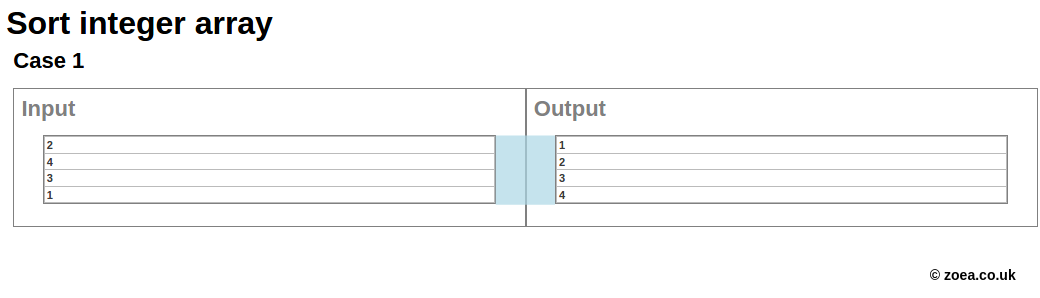
- Programming Tasks
- Sorting
- Sorting Algorithms
- 11l
- 4D
- 8th
- AArch64 Assembly
- Action!
- Action! Tool Kit
- ActionScript
- Ada
- ALGOL 68
- ALGOL W
- APL
- AppleScript
- ARM Assembly
- Arturo
- AutoHotkey
- AWK
- Axe
- Babel
- BaCon
- BBC BASIC
- Beads
- Befunge
- BQN
- Bracmat
- Burlesque
- C
- C sharp
- C++
- Clean
- Clojure
- COBOL
- Common Lisp
- Crystal
- D
- Delphi
- DWScript
- Déjà Vu
- E
- EGL
- Eiffel
- Elena
- Elixir
- Erlang
- Euphoria
- F Sharp
- Factor
- Fantom
- Forth
- Fortran
- FreeBASIC
- Frink
- FunL
- FutureBasic
- Fōrmulæ
- Gambas
- GAP
- Go
- Golfscript
- Groovy
- Haskell
- HicEst
- Huginn
- Icon
- Unicon
- IDL
- Inform 7
- Io
- J
- Java
- JavaScript
- Jinja
- Jq
- Julia
- K
- Kotlin
- Lambdatalk
- Lasso
- Liberty BASIC
- Lingo
- LiveCode
- Lua
- Maple
- Mathematica
- Wolfram Language
- MATLAB
- Maxima
- MAXScript
- Mercury
- Min
- Modula-3
- MUMPS
- Nanoquery
- Neko
- Nemerle
- NetRexx
- Nial
- Nim
- Niue
- Objeck
- Objective-C
- OCaml
- Octave
- Oforth
- OoRexx
- Order
- Oz
- PARI/GP
- Peloton
- Perl
- Phix
- Phix/basics
- Phixmonti
- PHP
- PicoLisp
- PL/I
- Pop11
- Potion
- PowerBASIC
- PowerShell
- Prolog
- PureBasic
- Python
- Quackery
- R
- Racket
- Raku
- Rascal
- Raven
- REBOL
- Red
- REXX
- Ring
- RPL
- Ruby
- Rust
- Sather
- Scala
- Scheme
- Scheme/SRFIs
- Seed7
- Sidef
- Slate
- Smalltalk
- SparForte
- Sparkling
- Standard ML
- Stata
- Swift
- Tcl
- TI-83 BASIC
- Toka
- UNIX Shell
- Ursa
- Ursala
- V (Vlang)
- WDTE
- Wortel
- Wren
- Wren-sort
- XPL0
- Yabasic
- Yorick
- Zkl
- Zoea
- Zoea Visual
- Pages with too many expensive parser function calls