
Remove duplicate elements

You are encouraged to solve this task according to the task description, using any language you may know.
Sorting Algorithm
This is a sorting algorithm. It may be applied to a set of data in order to sort it.
For comparing various sorts, see compare sorts.
For other sorting algorithms, see sorting algorithms, or:
Heap sort | Merge sort | Patience sort | Quick sort
O(n log2n) sorts
Shell Sort
O(n2) sorts
Bubble sort |
Cocktail sort |
Cocktail sort with shifting bounds |
Comb sort |
Cycle sort |
Gnome sort |
Insertion sort |
Selection sort |
Strand sort
other sorts
Bead sort |
Bogo sort |
Common sorted list |
Composite structures sort |
Custom comparator sort |
Counting sort |
Disjoint sublist sort |
External sort |
Jort sort |
Lexicographical sort |
Natural sorting |
Order by pair comparisons |
Order disjoint list items |
Order two numerical lists |
Object identifier (OID) sort |
Pancake sort |
Quickselect |
Permutation sort |
Radix sort |
Ranking methods |
Remove duplicate elements |
Sleep sort |
Stooge sort |
[Sort letters of a string] |
Three variable sort |
Topological sort |
Tree sort
Given an Array, derive a sequence of elements in which all duplicates are removed.
There are basically three approaches seen here:
- Put the elements into a hash table which does not allow duplicates. The complexity is O(n) on average, and O(n2) worst case. This approach requires a hash function for your type (which is compatible with equality), either built-in to your language, or provided by the user.
- Sort the elements and remove consecutive duplicate elements. The complexity of the best sorting algorithms is O(n log n). This approach requires that your type be "comparable", i.e., have an ordering. Putting the elements into a self-balancing binary search tree is a special case of sorting.
- Go through the list, and for each element, check the rest of the list to see if it appears again, and discard it if it does. The complexity is O(n2). The up-shot is that this always works on any type (provided that you can test for equality).
11l
V items = [‘1’, ‘2’, ‘3’, ‘a’, ‘b’, ‘c’, ‘2’, ‘3’, ‘4’, ‘b’, ‘c’, ‘d’]
V unique = Array(Set(items))
print(unique)- Output:
[1, 2, 3, 4, a, b, c, d]
360 Assembly
*        Remove duplicate elements - 18/10/2015
REMDUP   CSECT
         USING  REMDUP,R15         set base register
         SR     R6,R6              i=0
         LA     R8,1               k=1
LOOPK    C      R8,N               do k=1 to n
         BH     ELOOPK
         LR     R1,R8              k
         SLA    R1,2
         L      R9,T-4(R1)         e=t(k)
         LR     R7,R8              k
         BCTR   R7,0               j=k-1
LOOPJ    C      R7,=F'1'           do j=k-1 to 1 by -1
         BL     ELOOPJ
         LR     R1,R7              j
         SLA    R1,2
         L      R2,T-4(R1)         t(j)
         CR     R9,R2              if e=t(j) then goto iter
         BE     ITER
         BCTR   R7,0               j=j-1
         B      LOOPJ
ELOOPJ   LA     R6,1(R6)           i=i+1
         LR     R1,R6              i
         SLA    R1,2
         ST     R9,T-4(R1)         t(i)=e
ITER     LA     R8,1(R8)           k=k+1
         B      LOOPK
ELOOPK   LA     R10,PG             pgi=@pg
         LA     R8,1               k=1
LOOP     CR     R8,R6              do k=1 to i
         BH     ELOOP
         LR     R1,R8              k
         SLA    R1,2
         L      R2,T-4(R1)         t(k)
         XDECO  R2,PG+80           edit t(k)
         MVC    0(3,R10),PG+89     output t(k) on 3 char
         LA     R10,3(R10)         pgi=pgi+3
         LA     R8,1(R8)           k=k+1
         B      LOOP
ELOOP    XPRNT  PG,80              print buffer
         XR     R15,R15            set return code
         BR     R14                return to caller
T        DC     F'6',F'6',F'1',F'5',F'6',F'2',F'1',F'7',F'5',F'22'
         DC     F'4',F'19',F'1',F'1',F'6',F'8',F'9',F'10',F'11',F'12'
N        DC     A((N-T)/4)         number of T items
PG       DC     CL92' '
         YREGS
END REMDUP- Output:
6 1 5 2 7 22 4 19 8 9 10 11 12
8080 Assembly
This routine works on arrays of bytes, and keeps track of which bytes it has seen in a 256-byte array.
		org	100h
		jmp	test
		;;;;;;;;;;;;;;;;;;;;;;;;;;;;;;;;;;;;;;;;;;;;;;;;;;;;;;;;;;;;;;;
		;; Given an array of bytes starting at HL with length BC,
		;; remove all duplicates in the array. The new end of the array
		;; is returned in HL. A page of memory (256 bytes) is required
		;; to mark which bytes have been seen.
uniqpage:	equ	3	; Page to use - a compile-time constant.
				; This would need to be set to a page that
				; the rest of the program doesn't need.
uniq:		xra	a	; Zero out the page
		lxi	d,uniqpage * 256
uniqzero:	stax	d	; Zero out a byte
		inr	e	; And do the next byte
		jnz	uniqzero
		mov	d,h	; Keep a second pointer to the array in DE
		mov	e,l
uniqpos:	ldax	d	; Read from high pointer
		mov	m,a	; Write to low pointer
		inx	d	; Increment the high pointer
		push	h	; Keep low pointer around
		mvi	h,uniqpage
		mov	l,a	; Have we seen this byte yet?
		cmp	m
		mov	m,a	; No matter what, we've certainly seen it now
		pop	h	; Bring back the low pointer
		jz	uniqno	; If we already had it, don't increment low ptr
		inx	h	; IF we didn't, do increment it
uniqno:		dcx	b	; One fewer byte left
		mov	a,b	; If there are zero bytes left,
		ora	c
		rz		; Then return to caller
		jmp	uniqpos	; Otherwise, do the next byte
		;;;;;;;;;;;;;;;;;;;;;;;;;;;;;;;;;;;;;;;;;;;;;;;;;;;;;;;;;;;;;;;
		;; Testing code: read a string from the CP/M console, run
		;; uniq, then print the output.
test:		lxi	d,bufdef	; Read a string
		mvi	c,10
		call	5
		lxi	d,nl		; Output on new line
		mvi	c,9
		call	5
		;;;;;;;;;;;;;;;;;;;;;;;;;;;;;;;;;;;;;;;;;;;;;;;;;;;;;;;;;;;;;;;
		lda	bufdef+1	; Length of input string
		mov	c,a		; Extend to 16-bit (since uniq supports
		mvi	b,0		; long arrays)
		lxi	h,buf		; Location of input string
		call	uniq		; Only the unique bytes
		;;;;;;;;;;;;;;;;;;;;;;;;;;;;;;;;;;;;;;;;;;;;;;;;;;;;;;;;;;;;;;;
		mvi	m,'$'		; Mark the (string) end with '$'
		lxi 	d,buf		; Print the string, which now has had
		mvi	c,9		; all duplicates removed.
		jmp	5
nl:		db	13,10,'$'
bufdef:		db	127,0
buf:
ACL2
(remove-duplicates xs)
Action!
INCLUDE "D2:SORT.ACT" ;from the Action! Tool Kit

PROC PrintArray(INT ARRAY a INT size)
  INT i

  Put('[)
  FOR i=0 TO size-1
  DO
    IF i>0 THEN Put(' ) FI
    PrintI(a(i))
  OD
  Put(']) PutE()
RETURN

PROC RemoveDuplicates(INT ARRAY src INT srcLen
  INT ARRAY dst INT POINTER dstLen)
  INT i
  CHAR curr,prev

  IF srcLen=0 THEN
    dstLen^=0
    RETURN
  FI

  SortI(src,srcLen,0)
  dst(0)=src(0)
  dstLen^=1 prev=src(0)
  FOR i=1 TO srcLen-1
  DO
    curr=src(i)
    IF curr#prev THEN
      dst(dstLen^)=curr
      dstLen^==+1
    FI
    prev=curr
  OD
RETURN

PROC Test(INT ARRAY src INT srcLen)
  INT ARRAY dst(100)
  INT dstLen

  PrintE("Input array:")
  PrintArray(src,srcLen)
  RemoveDuplicates(src,srcLen,dst,@dstLen)
  PrintE("Unique items:")
  PrintArray(dst,dstLen)
  PutE()
RETURN

PROC Main()
  INT ARRAY src1(9)=[1 3 65534 0 12 1 65534 52 3]
  INT ARRAY src2(26)=[3 2 1 3 2 5 2 1 6 3 4 2 5 3 1 5 3 5 2 1 3 7 4 5 7 6]
  INT ARRAY src3(1)=[6502]

  Put(125) PutE() ;clear screen
  Test(src1,9)
  Test(src2,26)
  Test(src3,1)
RETURN- Output:
Screenshot from Atari 8-bit computer

Input array:
[1 3 -2 0 12 1 -2 52 3]
Unique items:
[-2 0 1 3 12 52]

Input array:
[3 2 1 3 2 5 2 1 6 3 4 2 5 3 1 5 3 5 2
1 3 7 4 5 7 6]
Unique items:
[1 2 3 4 5 6 7]

Input array:
[6502]
Unique items:
[6502]
Ada
with Ada.Containers.Ordered_Sets, Ada.Text_IO;
use Ada.Text_IO;

procedure Duplicate is
	package Int_Sets is new Ada.Containers.Ordered_Sets (Integer);
	Nums : constant array (Natural range <>) of Integer := (1,2,3,4,5,5,6,7,1);
	Unique : Int_Sets.Set;
begin
	for n of Nums loop
		Unique.Include (n);
	end loop;
	for e of Unique loop
		Put (e'img);
	end loop;
end Duplicate;
Aime
Using an index:
index x;

list(1, 2, 3, 1, 2, 3, 4, 1).ucall(i_add, 1, x, 0);
x.i_vcall(o_, 1, " ");
o_newline();- Output:
1 2 3 4
Order preserving solution:
index x;

for (, integer a in list(8, 2, 1, 8, 2, 1, 4, 8)) {
    if ((x[a] += 1) == 1) {
        o_(" ", a);
    }
}
o_newline();- Output:
8 2 1 4
ALGOL 68
Using the associative array code from Associative_array/Iteration#ALGOL_68
# use the associative array in the Associate array/iteration task    #
# this example uses strings - for other types, the associative       #
# array modes AAELEMENT and AAKEY should be modified as required     #
PR read "aArray.a68" PR

# returns the unique elements of list                                #
PROC remove duplicates = ( []STRING list )[]STRING:
     BEGIN
        REF AARRAY elements := INIT LOC AARRAY;
        INT        count    := 0;
        FOR pos FROM LWB list TO UPB list DO
            IF NOT ( elements CONTAINSKEY list[ pos ] ) THEN
                # first occurance of this element                    #
                elements // list[ pos ] := "";
                count +:= 1
            FI
        OD;
        # construct an array of the unique elements from the         #
        # associative array - the new list will not necessarily be   #
        # in the original order                                      #
        [ count ]STRING result;
        REF AAELEMENT e := FIRST elements;
        FOR pos WHILE e ISNT nil element DO
            result[ pos ] := key OF e;
            e := NEXT elements
        OD;
        result
     END; # remove duplicates #

# test the duplicate removal                                         #
print( ( remove duplicates( ( "A", "B", "D", "A", "C", "F", "F", "A" ) ), newline ) )
Amazing Hopper
#include <hopper.h>

main:
   x=-1
   {30} rand array (x), mulby(10), ceil, mov(x)
   {"Original Array:\n",x}, println
   {x}array(SORT),
   {x}sets(UNIQUE), mov(x)
   {"Final array:\n",x},  println

   y={}
   {"C","Go","Go","C","Cobol","java","Ada"} pushall(y)
   {"java","algol-68","C","java","fortran"} pushall(y)
   {"\nOriginal Array:\n",y}, println
   {y}array(SORT),
   {y}sets(UNIQUE), mov(y)
   {"Final array:\n",y},  println
exit(0)- Output:
Original Array:
3 9 1 10 3 7 6 5 2 7 4 7 4 2 2 2 2 8 2 10 4 9 2 4 9 3 4 3 4 7
Final array:
1 2 3 4 5 6 7 8 9 10

Original Array:
C Go Go C Cobol java Ada java algol-68 C java fortran
Final array:
Ada C Cobol Go algol-68 fortran java
APL
The primitive monad ∪ means "unique", so:
∪ 1 2 3 1 2 3 4 1
1 2 3 4
w←1 2 3 1 2 3 4 1
     ((⍳⍨w)=⍳⍴w)/w
1 2 3 4
AppleScript
Idiomatic
unique({1, 2, 3, "a", "b", "c", 2, 3, 4, "b", "c", "d"})

on unique(x)
    set R to {}
    repeat with i in x
        if i is not in R then set end of R to i's contents
    end repeat
    return R
end unique
Idiomatic 2 (more robust)
While it's quite common to see 'is in', 'is not in', 'contains', and 'does not contain' used in the above way for convenience when the scripter knows the code will only be used to check for simple objects, the commands actually compare sections of list rather than individual elements.
{1, 2, 3, {4, 5}} contains {2, 3} --> true
{1, 2, 3, {4, 5}} contains {4, 5} --> false
{1, 2, 3, {4, 5}} contains {{4, 5}} --> true
If the search term presented is anything other than a list, it's silently coerced to one for the search.
3 is in {1, 2, 3, {4, 5}} --> {3} is in {1, 2, 3, {4, 5}} --> true
So for robustness in case the elements sought may already be lists, or records, it's best to wrap them explicitly in list braces.
unique({1, 2, 3, "a", "b", "c", 2, 3, 4, "c", {b:"c"}, {"c"}, "c", "d"})

on unique(x)
    set R to {}
    repeat with i in x
        set i to i's contents
        if {i} is not in R then set end of R to i
    end repeat
    return R
end unique
- Output:
{1, 2, 3, "a", "b", "c", 4, {b:"c"}, {"c"}, "d"}
Functional
Or, more generally, we can allow for customised definitions of equality and duplication, by following the Haskell prelude in defining a nub :: [a] -> [a] function which is a special case of nubBy :: (a -> a -> Bool) -> [a] -> [a]
In the following example, equality is defined as case-insensitive for strings. We would obtain a different list of unique strings by adjusting the Eq :: a -> a -> Bool function to make it consider case.
-- CASE-INSENSITIVE UNIQUE ELEMENTS ------------------------------------------

-- nub :: [a] -> [a]
on nub(xs)
    -- Eq :: a -> a -> Bool
    script Eq
        on |λ|(x, y)
            ignoring case
                x = y
            end ignoring
        end |λ|
    end script

    nubBy(Eq, xs)
end nub


-- TEST ----------------------------------------------------------------------
on run
    {intercalate(space, ¬
        nub(splitOn(space, "4 3 2 8 0 1 9 5 1 7 6 3 9 9 4 2 1 5 3 2"))), ¬
        intercalate("", ¬
            nub(characters of "abcabc ABCABC"))}

    --> {"4 3 2 8 0 1 9 5 7 6", "abc "}
end run


-- GENERIC FUNCTIONS ---------------------------------------------------------

-- filter :: (a -> Bool) -> [a] -> [a]
on filter(f, xs)
    tell mReturn(f)
        set lst to {}
        set lng to length of xs
        repeat with i from 1 to lng
            set v to item i of xs
            if |λ|(v, i, xs) then set end of lst to v
        end repeat
        return lst
    end tell
end filter

-- intercalate :: Text -> [Text] -> Text
on intercalate(strText, lstText)
    set {dlm, my text item delimiters} to {my text item delimiters, strText}
    set strJoined to lstText as text
    set my text item delimiters to dlm
    return strJoined
end intercalate

-- Lift 2nd class handler function into 1st class script wrapper
-- mReturn :: Handler -> Script
on mReturn(f)
    if class of f is script then
        f
    else
        script
            property |λ| : f
        end script
    end if
end mReturn

-- nubBy :: (a -> a -> Bool) -> [a] -> [a]
on nubBy(fnEq, xxs)

    set lng to length of xxs
    if lng > 1 then
        set x to item 1 of xxs
        set xs to items 2 thru -1 of xxs
        set p to mReturn(fnEq)

        -- notEq :: a -> Bool
        script notEq
            on |λ|(a)
                not (p's |λ|(a, x))
            end |λ|
        end script

        {x} & nubBy(fnEq, filter(notEq, xs))
    else
        xxs
    end if
end nubBy

-- splitOn :: Text -> Text -> [Text]
on splitOn(strDelim, strMain)
    set {dlm, my text item delimiters} to {my text item delimiters, strDelim}
    set lstParts to text items of strMain
    set my text item delimiters to dlm
    return lstParts
end splitOn
- Output:
{"4 3 2 8 0 1 9 5 7 6", "abc "}
AppleScriptObjC
use AppleScript version "2.4" -- OS X 10.10 (Yosemite) or later
use framework "Foundation"

set aList to {1, 2, 3, "a", "b", "c", 2, 3, 4, "c", {b:"c"}, {"c"}, "c", "d"}
set orderedSet to current application's class "NSOrderedSet"'s orderedSetWithArray:(aList)
return orderedSet's array() as list
- Output:
{1, 2, 3, "a", "b", "c", 4, {b:"c"}, {"c"}, "d"}
Arturo
arr: [1 2 3 2 1 2 3 4 5 3 2 1]

print unique arr
- Output:
1 2 3 4 5
ATS
ATS2 implementation for values having an equality predicate
This method runs no worse than O(n*n) in the number of elements. It is an example of the brute-force technique.
The implementation is for non-linear types, only. I implement the predicate as a non-linear closure.
(* Remove duplicate elements.

   This implementation is for elements that have an "equals" (or
   "equivalence") predicate. It runs O(n*n) in the number of
   elements. *)

#include "share/atspre_staload.hats"

(* How the remove_dups template function will be called. *)
extern fn {a : t@ype}
remove_dups
          {n   : int}
          (eq  : (a, a) -<cloref> bool,
           src : arrayref (a, n),
           n   : size_t n,
           dst : arrayref (a, n),
           m   : &size_t? >> size_t m)
    :<!refwrt> #[m : nat | m <= n]
               void

(* An implementation of the remove_dups template function. *)
implement {a}
remove_dups {n} (eq, src, n, dst, m) =
  if n = i2sz 0 then
    m := i2sz 0
  else
    let
      fun
      peruse_src
                {i : int | 1 <= i; i <= n}
                {j : int | 1 <= j; j <= i}
                .<n - i>.
                (i : size_t i,
                 j : size_t j)
          :<!refwrt> [m : int | 1 <= m; m <= n]
                     size_t m =
        let
          fun
          already_seen
                    {k : int | 0 <= k; k <= j}
                    .<j - k>.
                    (x : a,
                     k : size_t k)
              :<!ref> bool =
            if k = j then
              false
            else if eq (x, dst[k]) then
              true
            else
              already_seen (x, succ k)
        in
          if i = n then
            j
          else if already_seen (src[i], i2sz 0) then
            peruse_src (succ i, j)
          else
            begin
              dst[j] := src[i];
              peruse_src (succ i, succ j)
            end
        end

      prval () = lemma_arrayref_param src (* Prove 0 <= n. *)
    in
      dst[0] := src[0];
      m := peruse_src (i2sz 1, i2sz 1)
    end

implement                       (* A demonstration with strings. *)
main0 () =
  let
    val eq = lam (x : string, y : string) : bool =<cloref> (x = y)

    val src =
      arrayref_make_list<string>
        (10, $list ("a", "c", "b", "e", "a",
                    "a", "d", "d", "b", "c"))
    val dst = arrayref_make_elt<string> (i2sz 10, "?")
    var m : size_t
  in
    remove_dups<string> (eq, src, i2sz 10, dst, m);
    let
      prval [m : int] EQINT () = eqint_make_guint m
      var i : natLte m
    in
      for (i := 0; i2sz i <> m; i := succ i)
        print! (" ", dst[i] : string);
      println! ()
    end
end- Output:
a c b e d
ATS2 implementation for linear values having an equality predicate
This method runs no worse than O(n*n) in the number of elements. It is another example of the brute-force technique.
This implementation can handle elements of linear type. I implement the predicate as a template function. There are two interfaces: one for an array, and one for a linked list.
(* Remove duplicate elements.

   This implementation is for elements that have an "equals" (or
   "equivalence") predicate. It runs O(n*n) in the number of
   elements. It uses a linked list and supports linear types.

   The equality predicate is implemented as a template function. *)

#include "share/atspre_staload.hats"
staload UN = "prelude/SATS/unsafe.sats"

#define NIL list_vt_nil ()
#define ::  list_vt_cons

(*------------------------------------------------------------------*)
(* Interfaces                                                       *)

extern fn {a : vt@ype}
array_remove_dups
          {n      : int}
          {p_arr  : addr}
          (pf_arr : array_v (a, p_arr, n) |
           p_arr  : ptr p_arr,
           n      : size_t n)
    :<!wrt> [m : nat | m <= n]
            @(array_v (a, p_arr, m),
              array_v (a?, p_arr + (m * sizeof a), n - m) |
              size_t m)

extern fn {a : vt@ype}
list_vt_remove_dups
          {n   : int}
          (lst : list_vt (a, n))
    :<!wrt> [m : nat | m <= n]
            list_vt (a, m)

extern fn {a : vt@ype}
remove_dups$eq :
  (&a, &a) -<> bool

extern fn {a : vt@ype}
remove_dups$clear :
  (&a >> a?) -< !wrt > void

(*------------------------------------------------------------------*)
(* Implementation of array_remove_dups                              *)

(* The implementation for arrays converts to a list_vt, does the
   removal duplicates, and then writes the data back into the original
   array. *)
implement {a}
array_remove_dups {n} {p_arr} (pf_arr | p_arr, n) =
  let
    var lst = array_copy_to_list_vt<a> (!p_arr, n)
    var m : int
    val lst = list_vt_remove_dups<a> lst
    val m = list_vt_length lst
    prval [m : int] EQINT () = eqint_make_gint m
    prval @(pf_uniq, pf_rest) =
      array_v_split {a?} {p_arr} {n} {m} pf_arr
    val () = array_copy_from_list_vt<a> (!p_arr, lst)
  in
    @(pf_uniq, pf_rest | i2sz m)
  end

(*------------------------------------------------------------------*)
(* Implementation of list_vt_remove_dups                            *)

(* The list is worked on "in place". That is, no nodes are copied or
   moved to new locations, except those that are removed and freed. *)

fn {a : vt@ype}
remove_equal_elements
          {n   : int}
          (x   : &a,
           lst : &list_vt (a, n) >> list_vt (a, m))
    :<!wrt> #[m : nat | m <= n]
            void =
  let
    fun {a : vt@ype}
    remove_elements
              {n : nat}
              .<n>.
              (x   : &a,
               lst : &list_vt (a, n) >> list_vt (a, m))
        :<!wrt> #[m : nat | m <= n]
                void =
      case+ lst of
      | NIL => ()
      | @ (head :: tail) =>
        if remove_dups$eq (head, x) then
          let
            val new_lst = tail
            val () = remove_dups$clear<a> head
            val () = free@{a}{0} lst
            val () = lst := new_lst
          in
            remove_elements {n - 1} (x, lst)
          end
        else
          let
            val () = remove_elements {n - 1} (x, tail)
            prval () = fold@ lst
          in
          end

    prval () = lemma_list_vt_param lst
  in
    remove_elements {n} (x, lst)
  end

fn {a : vt@ype}
remove_dups
          {n   : int}
          (lst : &list_vt (a, n) >> list_vt (a, m))
    :<!wrt> #[m : nat | m <= n]
            void =
  let
    fun
    rmv_dups  {n : nat}
              .<n>.
              (lst : &list_vt (a, n) >> list_vt (a, m))
        :<!wrt> #[m : nat | m <= n]
                void =
      case+ lst of
      | NIL => ()
      | head :: NIL => ()
      | @ head :: tail =>
        let
          val () = remove_equal_elements (head, tail)
          val () = rmv_dups tail
          prval () = fold@ lst
        in
        end

    prval () = lemma_list_vt_param lst
  in
    rmv_dups {n} lst
  end

implement {a}
list_vt_remove_dups {n} lst =
  let
    var lst = lst
  in
    remove_dups {n} lst;
    lst
  end

(*------------------------------------------------------------------*)

implement
remove_dups$eq<Strptr1> (s, t) =
  ($UN.strptr2string s = $UN.strptr2string t)

implement
remove_dups$clear<Strptr1> s =
  strptr_free s

implement
array_uninitize$clear<Strptr1> (i, s) =
  strptr_free s

implement
fprint_ref<Strptr1> (outf, s) =
  fprint! (outf, $UN.strptr2string s)

implement                   (* A demonstration with linear strings. *)
main0 () =
  let
    #define N 10

    val data =
      $list_vt{Strptr1}
        (string0_copy "a", string0_copy "c", string0_copy "b",
         string0_copy "e", string0_copy "a", string0_copy "a",
         string0_copy "d", string0_copy "d", string0_copy "b",
         string0_copy "c")
    var arr : @[Strptr1][N]
    val () = array_copy_from_list_vt<Strptr1> (arr, data)

    prval pf_arr = view@ arr
    val p_arr = addr@ arr

    val [m : int]
        @(pf_uniq, pf_abandoned | m) =
      array_remove_dups<Strptr1> (pf_arr | p_arr, i2sz N)

    val () = fprint_array_sep<Strptr1> (stdout_ref, !p_arr, m, " ")
    val () = println! ()

    val () = array_uninitize<Strptr1> (!p_arr, m)
    prval () = view@ arr :=
      array_v_unsplit (pf_uniq, pf_abandoned)
  in
  end

(*------------------------------------------------------------------*)- Output:
a c b e d
ATS2 implementation for values having both order and equality predicates
Sort the elements and then keep only the first element of each run of equal elements.
This method is limited in speed by the speed of the sorting algorithm. That can vary greatly according to algorithm and circumstances, but typically is much better than O(n*n). Below (simply because it is convenient) I use the quicksort that is in the ATS2 prelude.
(* Remove duplicate elements.

   The elements are sorted and then only unique values are kept. *)


#include "share/atspre_staload.hats"

(* How the remove_dups template function will be called. *)
extern fn {a : t@ype}
remove_dups
          {n   : int}
          (lt  : (a, a) -<cloref> bool, (* "less than" *)
           eq  : (a, a) -<cloref> bool, (* "equals" *)
           src : arrayref (a, n),
           n   : size_t n,
           dst : arrayref (a, n),
           m   : &size_t? >> size_t m)
    : #[m : nat | m <= n]
      void

implement {a}
remove_dups {n} (lt, eq, src, n, dst, m) =
  if n = i2sz 0 then
    m := i2sz 0
  else
    let
      prval () = lemma_arrayref_param src (* Prove 0 <= n. *)

      (* Sort a copy of src. *)
      val arr = arrayptr_refize (arrayref_copy (src, n))
      implement array_quicksort$cmp<a> (x, y) =
        if x \lt y then ~1 else 1
      val () = arrayref_quicksort<a> (arr, n)

      (* Copy only the first element of each run of equal elements. *)
      val () = dst[0] := arr[0]
      fun
      loop {i : int | 1 <= i; i <= n}
           {j : int | 1 <= j; j <= i}
           .<n - i>.
           (i : size_t i,
            j : size_t j)
          : [m : int | 1 <= m; m <= n]
            size_t m =
        if i = n then
          j
        else if arr[pred i] \eq arr[i] then
          loop (succ i, j)
        else
          begin
            dst[j] := arr[i];
            loop (succ i, succ j)
          end
      val () = m := loop (i2sz 1, i2sz 1)
    in
    end

implement                       (* A demonstration. *)
main0 () =
  let
    val src =
      arrayref_make_list<string>
        (10, $list ("a", "c", "b", "e", "a",
                    "a", "d", "d", "b", "c"))
    val dst = arrayref_make_elt<string> (i2sz 10, "?")
    var m : size_t
  in
    remove_dups<string> (lam (x, y) => x < y,
                         lam (x, y) => x = y,
                         src, i2sz 10, dst, m);
    let
      prval [m : int] EQINT () = eqint_make_guint m
      var i : natLte m
    in
      for (i := 0; i2sz i <> m; i := succ i)
        print! (" ", dst[i]);
      println! ()
    end
end- Output:
a b c d e
ATS2 implementation using a radix sort
This method runs in O(nw) time, where n is the number of elements n and w is a factor that is constant for elements that are fixed-size integers.
The implementation is for unsigned integers and puts the unique numbers into a second array in ascending order.
Radix sorting can sort an array of elements only into the encoding order of their keys, but that is a common case. Here the only reason to sort at all is to quickly eliminate duplicates.
(* Remove duplicate elements.

   The best sorting algorithms, it is said, are O(n log n) and require
   an order predicate.

   But this is true only for a general sorting routine. A radix sort
   for fixed-size integers is O(n), and requires no order predicate.
   Here I use such a radix sort. *)

#include "share/atspre_staload.hats"
staload UN = "prelude/SATS/unsafe.sats"

(* How the remove_dups template function will be called. *)
extern fn {tk : tkind}
remove_dups
          {n   : int}
          (src : arrayref (g0uint tk, n),
           n   : size_t n,
           dst : arrayref (g0uint tk, n),
           m   : &size_t? >> size_t m)
    : #[m : nat | m <= n]
      void

(*------------------------------------------------------------------*)
(* A radix sort for unsigned integers, copied from my contribution to
   the radix sort task. *)

extern fn {a  : vt@ype}
          {tk : tkind}
g0uint_radix_sort
          {n   : int}
          (arr : &array (a, n) >> _,
           n   : size_t n)
    :<!wrt> void

extern fn {a  : vt@ype}
          {tk : tkind}
g0uint_radix_sort$key
          {n   : int}
          {i   : nat | i < n}
          (arr : &RD(array (a, n)),
           i   : size_t i)
    :<> g0uint tk

fn {}
bin_sizes_to_indices
          (bin_indices : &array (size_t, 256) >> _)
    :<!wrt> void =
  let
    fun
    loop {i           : int | i <= 256}
         {accum       : int}
         .<256 - i>.
         (bin_indices : &array (size_t, 256) >> _,
          i           : size_t i,
          accum       : size_t accum)
        :<!wrt> void =
      if i <> i2sz 256 then
        let
          prval () = lemma_g1uint_param i
          val elem = bin_indices[i]
        in
          if elem = i2sz 0 then
            loop (bin_indices, succ i, accum)
          else
            begin
              bin_indices[i] := accum;
              loop (bin_indices, succ i, accum + g1ofg0 elem)
            end
        end
  in
    loop (bin_indices, i2sz 0, i2sz 0)
  end

fn {a  : vt@ype}
   {tk : tkind}
count_entries
          {n            : int}
          {shift        : nat}
          (arr          : &RD(array (a, n)),
           n            : size_t n,
           bin_indices  : &array (size_t?, 256)
                          >> array (size_t, 256),
           all_expended : &bool? >> bool,
           shift        : int shift)
    :<!wrt> void =
  let
    fun
    loop {i : int | i <= n}
         .<n - i>.
         (arr          : &RD(array (a, n)),
          bin_indices  : &array (size_t, 256) >> _,
          all_expended : &bool >> bool,
          i            : size_t i)
        :<!wrt> void =
      if i <> n then
        let
          prval () = lemma_g1uint_param i
          val key : g0uint tk = g0uint_radix_sort$key<a><tk> (arr, i)
          val key_shifted = key >> shift
          val digit = ($UN.cast{uint} key_shifted) land 255U
          val [digit : int] digit = g1ofg0 digit
          extern praxi set_range :
            () -<prf> [0 <= digit; digit <= 255] void
          prval () = set_range ()
          val count = bin_indices[digit]
          val () = bin_indices[digit] := succ count
        in
          all_expended := all_expended * iseqz key_shifted;
          loop (arr, bin_indices, all_expended, succ i)
        end

    prval () = lemma_array_param arr
  in
    array_initize_elt<size_t> (bin_indices, i2sz 256, i2sz 0);
    all_expended := true;
    loop (arr, bin_indices, all_expended, i2sz 0)
  end

fn {a  : vt@ype}
   {tk : tkind}
sort_by_digit
          {n            : int}
          {shift        : nat}
          (arr1         : &RD(array (a, n)),
           arr2         : &array (a, n) >> _,
           n            : size_t n,
           all_expended : &bool? >> bool,
           shift        : int shift)
    :<!wrt> void =
  let
    var bin_indices : array (size_t, 256)
  in
    count_entries<a><tk> (arr1, n, bin_indices, all_expended, shift);
    if all_expended then
      ()
    else
      let
        fun
        rearrange {i : int | i <= n}
                  .<n - i>.
                  (arr1        : &RD(array (a, n)),
                   arr2        : &array (a, n) >> _,
                   bin_indices : &array (size_t, 256) >> _,
                   i           : size_t i)
            :<!wrt> void =
          if i <> n then
            let
              prval () = lemma_g1uint_param i
              val key = g0uint_radix_sort$key<a><tk> (arr1, i)
              val key_shifted = key >> shift
              val digit = ($UN.cast{uint} key_shifted) land 255U
              val [digit : int] digit = g1ofg0 digit
              extern praxi set_range :
                () -<prf> [0 <= digit; digit <= 255] void
              prval () = set_range ()
              val [j : int] j = g1ofg0 bin_indices[digit]

              (* One might wish to get rid of this assertion somehow,
                 to eliminate the branch, should it prove a
                 problem. *)
              val () = $effmask_exn assertloc (j < n)

              val p_dst = ptr_add<a> (addr@ arr2, j)
              and p_src = ptr_add<a> (addr@ arr1, i)
              val _ = $extfcall (ptr, "memcpy", p_dst, p_src,
                                 sizeof<a>)
              val () = bin_indices[digit] := succ (g0ofg1 j)
            in
              rearrange (arr1, arr2, bin_indices, succ i)
            end

        prval () = lemma_array_param arr1
      in
        bin_sizes_to_indices<> bin_indices;
        rearrange (arr1, arr2, bin_indices, i2sz 0)
      end
  end

fn {a  : vt@ype}
   {tk : tkind}
g0uint_sort {n    : pos}
            (arr1 : &array (a, n) >> _,
             arr2 : &array (a, n) >> _,
             n    : size_t n)
    :<!wrt> void =
  let
    fun
    loop {idigit_max, idigit : nat | idigit <= idigit_max}
         .<idigit_max - idigit>.
         (arr1       : &array (a, n) >> _,
          arr2       : &array (a, n) >> _,
          from1to2   : bool,
          idigit_max : int idigit_max,
          idigit     : int idigit)
        :<!wrt> void =
      if idigit = idigit_max then
        begin
          if ~from1to2 then
            let
              val _ =
                $extfcall (ptr, "memcpy", addr@ arr1, addr@ arr2,
                           sizeof<a> * n)
            in
            end
        end
      else if from1to2 then
        let
          var all_expended : bool
        in
          sort_by_digit<a><tk> (arr1, arr2, n, all_expended,
                                8 * idigit);
          if all_expended then
            ()
          else
            loop (arr1, arr2, false, idigit_max, succ idigit)
        end
      else
        let
          var all_expended : bool
        in
          sort_by_digit<a><tk> (arr2, arr1, n, all_expended,
                                8 * idigit);
          if all_expended then
            let
              val _ =
                $extfcall (ptr, "memcpy", addr@ arr1, addr@ arr2,
                           sizeof<a> * n)
            in
            end
          else
            loop (arr1, arr2, true, idigit_max, succ idigit)
        end
  in
    loop (arr1, arr2, true, sz2i sizeof<g1uint tk>, 0)
  end

#define SIZE_THRESHOLD 256

extern praxi
unsafe_cast_array
          {a   : vt@ype}
          {b   : vt@ype}
          {n   : int}
          (arr : &array (b, n) >> array (a, n))
    :<prf> void

implement {a} {tk}
g0uint_radix_sort {n} (arr, n) =
  if n <> 0 then
    let
      prval () = lemma_array_param arr

      fn
      sort {n    : pos}
           (arr1 : &array (a, n) >> _,
            arr2 : &array (a, n) >> _,
            n    : size_t n)
          :<!wrt> void =
        g0uint_sort<a><tk> (arr1, arr2, n)
    in
      if n <= SIZE_THRESHOLD then
        let
          var arr2 : array (a, SIZE_THRESHOLD)
          prval @(pf_left, pf_right) =
            array_v_split {a?} {..} {SIZE_THRESHOLD} {n} (view@ arr2)
          prval () = view@ arr2 := pf_left
          prval () = unsafe_cast_array{a} arr2

          val () = sort (arr, arr2, n)

          prval () = unsafe_cast_array{a?} arr2
          prval () = view@ arr2 :=
            array_v_unsplit (view@ arr2, pf_right)
        in
        end
      else
        let
          val @(pf_arr2, pfgc_arr2 | p_arr2) = array_ptr_alloc<a> n
          macdef arr2 = !p_arr2
          prval () = unsafe_cast_array{a} arr2

          val () = sort (arr, arr2, n)

          prval () = unsafe_cast_array{a?} arr2
          val () = array_ptr_free (pf_arr2, pfgc_arr2 | p_arr2)
        in
        end
    end

(*------------------------------------------------------------------*)
(* An implementation of the remove_dups template function, which also
   sorts the elements. *)

implement {tk}
remove_dups {n} (src, n, dst, m) =
  if n = i2sz 0 then
    m := i2sz 0
  else
    let
      prval () = lemma_arrayref_param src (* Prove 0 <= n. *)

      (* Sort a copy of src. *)
      val arrptr = arrayref_copy (src, n)
      val @(pf_arr | p_arr) = arrayptr_takeout_viewptr arrptr
      val () = g0uint_radix_sort<g0uint tk><tk> (!p_arr, n)
      prval () = arrayptr_addback (pf_arr | arrptr)

      (* Copy only the first element of each run of equals. *)
      val () = dst[0] := arrptr[0]
      fun
      loop {i : int | 1 <= i; i <= n}
           {j : int | 1 <= j; j <= i}
           .<n - i>.
           (arrptr : !arrayptr (g0uint tk, n),
            i      : size_t i,
            j      : size_t j)
          : [m : int | 1 <= m; m <= n]
            size_t m =
        if i = n then
          j
        else if arrptr[pred i] = arrptr[i] then
          loop (arrptr, succ i, j)
        else
          begin
            dst[j] := arrptr[i];
            loop (arrptr, succ i, succ j)
          end
      val () = m := loop (arrptr, i2sz 1, i2sz 1)

      val () = arrayptr_free arrptr
    in
    end

(*------------------------------------------------------------------*)
(* A demonstration. *)

implement
main0 () =
  let
    implement
    g0uint_radix_sort$key<uint><uintknd> (arr, i) =
      arr[i]

    val src =
      arrayref_make_list<uint>
        (10, $list (1U, 3U, 2U, 5U, 1U, 1U, 4U, 4U, 2U, 3U))

    val dst = arrayref_make_elt<uint> (i2sz 10, 123456789U)
    var m : size_t
  in
    remove_dups<uintknd> (src, i2sz 10, dst, m);
    let
      prval [m : int] EQINT () = eqint_make_guint m
      var i : natLte m
    in
      for (i := 0; i2sz i <> m; i := succ i)
        print! (" ", dst[i]);
      println! ()
    end
  end

(*------------------------------------------------------------------*)- Output:
1 2 3 4 5
ATS2 implementation using a hash table
The speed of this method depends on the speed of the hash table.
(* Remove duplicate elements.

   Elements already seen are put into a hash table. *)

#include "share/atspre_staload.hats"

(* Use hash tables from the libats/ML library. *)
staload "libats/ML/SATS/hashtblref.sats"
staload _ = "libats/ML/DATS/hashtblref.dats"
staload _ = "libats/DATS/hashfun.dats"
staload _ = "libats/DATS/hashtbl_chain.dats"
staload _ = "libats/DATS/linmap_list.dats"

(* How the remove_dups template function will be called. *)
extern fn {key, a  : t@ype}
remove_dups
          {n    : int}
          (key  : a -<cloref> key,
           src  : arrayref (a, n),
           n    : size_t n,
           dst  : arrayref (a, n),
           m    : &size_t? >> size_t m)
    : #[m : nat | m <= n]
      void

implement {key, a}
remove_dups {n} (key, src, n, dst, m) =
  if n = i2sz 0 then
    m := i2sz 0
  else
    let
      prval () = lemma_arrayref_param src (* Prove 0 <= n. *)

      fun
      loop {i : nat | i <= n}
           {j : nat | j <= i}
           .<n - i>.
           (ht : hashtbl (key, a),
            i  : size_t i,
            j  : size_t j)
          : [m : nat | m <= n]
            size_t m =
        if i = n then
          j
        else
          let
            val x = src[i]
            val k = key x
          in
            case+ hashtbl_search<key, a> (ht, k) of
            | ~ None_vt () =>
              begin     (* An element not yet encountered. Copy it. *)
                hashtbl_insert_any<key, a> (ht, k, x);
                dst[j] := x;
                loop (ht, succ i, succ j)
              end
            | ~ Some_vt _ =>
              begin     (* An element already encountered. Skip it. *)
                loop (ht, succ i, j)
              end
          end;
    in
      m := loop (hashtbl_make_nil<key, a> (i2sz 1024),
                 i2sz 0, i2sz 0)
    end

implement                       (* A demonstration. *)
main0 () =
  let
    val src =
      arrayref_make_list<string>
        (10, $list ("a", "c", "b", "e", "a",
                    "a", "d", "d", "b", "c"))
    val dst = arrayref_make_elt<string> (i2sz 10, "?")
    var m : size_t
  in
    remove_dups<string, string> (lam s => s, src, i2sz 10, dst, m);
    let
      prval [m : int] EQINT () = eqint_make_guint m
      var i : natLte m
    in
      for (i := 0; i2sz i <> m; i := succ i)
        print! (" ", dst[i]);
      println! ()
    end
end- Output:
a c b e d
ATS2 implementation for values containing a mutable seen flag
This method runs O(n) in the number of elements. It can be useful when you are working with references to complicated data structures. It works only if the array contains references to structures, rather than the structures themselves.
This implementation is for non-linear types only and happens to demonstrate "ordinary" imperative programming in ATS2: without dependent types, proofs, etc. The code is still safe against over-running array boundaries, but the safety is enforced by run-time checks rather than proofs.
(* Remove duplicate elements.

   This implementation is for elements that contain a "this has been
   seen" flag. It is O(n) in the number of elements.

   Also, this implementation demonstrates that imperative programming,
   without dependent types or proofs, is possible in ATS. *)

#include "share/atspre_staload.hats"

(* A tuple in the heap. *)
typedef seen_or_not (a : t@ype+) = '(a, ref bool)

(* How the remove_dups function will be called. *)
extern fn {a : t@ype}
remove_dups
          (given_data          : arrszref (seen_or_not a),
           space_for_result    : arrszref (seen_or_not a),
           num_of_unique_elems : &size_t? >> size_t)
    : void

implement {a}
remove_dups (given_data, space_for_result, num_of_unique_elems) =
  let
    macdef seen (i) = given_data[,(i)].1

    var i : size_t
    var j : size_t
  in
    (* Clear all the "seen" flags. *)
    for (i := i2sz 0; i <> size given_data; i := succ i)
      !(seen i) := false;

    (* Loop through given_data, copying (pointers to) any values that
       have not yet been seen. *)
    j := i2sz 0;
    for (i := i2sz 0; i <> size given_data; i := succ i)
      if !(seen i) then
        ()          (* Skip any element that has already been seen. *)
      else
        begin
          !(seen i) := true;    (* Mark the element as seen. *)
          space_for_result[j] := given_data[i];
          j := succ j
        end;

    num_of_unique_elems := j
  end

implement                       (* A demonstration. *)
main0 () =
  let
    (* Define some values. *)
    val a = '("a", ref<bool> false)
    val b = '("b", ref<bool> false)
    val c = '("c", ref<bool> false)
    val d = '("d", ref<bool> false)
    val e = '("e", ref<bool> false)

    (* Fill an array with values. *)
    val data =
      arrszref_make_list ($list (a, c, b, e, a, a, d, d, b, c))

    (* Allocate storage for the result. *)
    val unique_elems = arrszref_make_elt (i2sz 10, a)
    var num_of_unique_elems : size_t

    var i : size_t
  in
    (* Remove duplicates. *)
    remove_dups<string> (data, unique_elems, num_of_unique_elems);

    (* Print the results. *)
    for (i := i2sz 0; i <> num_of_unique_elems; i := succ i)
      print! (" ", unique_elems[i].0);
    println! ()
end- Output:
a c b e d
AutoHotkey
Built in Sort has an option to remove duplicates
a = 1,2,1,4,5,2,15,1,3,4
Sort, a, a, NUD`,
MsgBox % a  ; 1,2,3,4,5,15
AWK
We produce an array a with duplicates from a string; then index a second array b with the contents of a, so that duplicates make only one entry; then produce a string with the keys of b, which is finally output.
$ awk 'BEGIN{split("a b c d c b a",a);for(i in a)b[a[i]]=1;r="";for(i in b)r=r" "i;print r}'
a b c d
BASIC
ANSI BASIC
100 REM Remove duplicate elements
110 DIM DataArray(1 TO 7), ResultArray(1 TO 7)
120 ! Set the data.
130 FOR I = 1 TO 7
140    READ DataArray(I)
150 NEXT I
160 ! Remove duplicates
170 LET ResultArray(1) = DataArray(1)
180 LET LastResultIndex = 1
190 LET Position = 1
200 DO WHILE Position < UBOUND(DataArray)
210    LET Position = Position + 1
220    LET IsNewNumber = -1
230    FOR ResultIndex = 1 TO LastResultIndex
240       IF DataArray(Position) = ResultArray(ResultIndex) THEN
250          LET IsNewNumber = 0
260          EXIT FOR
270       END IF
280    NEXT ResultIndex
290    IF IsNewNumber = -1 THEN
300       LET LastResultIndex = LastResultIndex + 1
310       LET ResultArray(LastResultIndex) = DataArray(Position)
320    END IF
330 LOOP
340 FOR ResultIndex = 1 TO LastResultIndex
350    PRINT ResultArray(ResultIndex)
360 NEXT ResultIndex
370 DATA 1, 2, 2, 3, 4, 5, 5
380 END
- Output:
 1
 2
 3
 4
 5
Applesoft BASIC
100 DIM L$(15)
110 L$(0) = "NOW"
120 L$(1) = "IS"
130 L$(2) = "THE"
140 L$(3) = "TIME"
150 L$(4) = "FOR"
160 L$(5) = "ALL"
170 L$(6) = "GOOD"
180 L$(7) = "MEN"
190 L$(8) = "TO"
200 L$(9) = "COME"
210 L$(10) = "TO"
220 L$(11) = "THE"
230 L$(12) = "AID"
240 L$(13) = "OF"
250 L$(14) = "THE"
260 L$(15) = "PARTY."

300 N = 15
310 GOSUB 400
320 FOR I = 0 TO N
330     PRINT L$(I) " " ;
340 NEXT
350 PRINT
360 END

400 REMREMOVE DUPLICATES
410 FOR I = N TO 1 STEP -1
420    I$ = L$(I)
430    FOR J = 0 TO I - 1
440        EQ = I$ = L$(J)
450        IF NOT EQ THEN NEXT J
460    IF EQ THEN GOSUB 500
470 NEXT I
480 RETURN

500 REMREMOVE ELEMENT
510 L$(I) = L$(N)
520 L$(N) = ""
530 N = N - 1
540 RETURN
BASIC256
arraybase 1
max = 10
dim res(max)
dim dat(max)
dat[1] = 1: dat[2] = 2: dat[3] = 1: dat[4] = 4: dat[5] = 5
dat[6] = 2: dat[7] = 15: dat[8] = 1: dat[9] = 3: dat[10] = 4
res[1] = dat[1]

cont = 1
posic = 1
while posic < max
	posic += 1
	esnuevo = 1
	indice = 1
	while indice <= cont and esnuevo = 1
		if dat[posic] = res[indice] then esnuevo = 0
		indice += 1
	end while
	if esnuevo = 1 then
		cont += 1
		res[cont] = dat[posic]
	end if
end while

for i = 1 to cont
	print res[i]; "  ";
next i
end
BBC BASIC
      DIM list$(15)
      list$() = "Now", "is", "the", "time", "for", "all", "good", "men", \
      \         "to", "come", "to", "the", "aid", "of", "the", "party."
      num% = FNremoveduplicates(list$())
      FOR i% = 0 TO num%-1
        PRINT list$(i%) " " ;
      NEXT
      PRINT
      END

      DEF FNremoveduplicates(l$())
      LOCAL i%, j%, n%, i$
      n% = 1
      FOR i% = 1 TO DIM(l$(), 1)
        i$ = l$(i%)
        FOR j% = 0 TO i%-1
          IF i$ = l$(j%) EXIT FOR
        NEXT
        IF j%>=i% l$(n%) = i$ : n% += 1
      NEXT
      = n%
- Output:
Now is the time for all good men to come aid of party.
FreeBASIC
' FB 1.05.0 Win64

Sub removeDuplicates(a() As Integer, b() As Integer)
  Dim lb As Integer = LBound(a)
  Dim ub As Integer = UBound(a)
  If ub = -1 Then Return '' empty array
  Redim b(lb To ub)
  b(lb) = a(lb)
  Dim count As Integer = 1
  Dim unique As Boolean

  For i As Integer = lb + 1 To ub
    unique = True
    For j As Integer = lb to i - 1
      If a(i) = a(j) Then
        unique = False
        Exit For
      End If
    Next j
    If unique Then
      b(lb + count) = a(i)
      count += 1
    End If
  Next i

  If count > 0 Then Redim Preserve b(lb To lb + count - 1)
End Sub

Dim a(1 To 10) As Integer = {1, 2, 1, 4, 5, 2, 15, 1, 3, 4}
Dim b() As Integer
removeDuplicates a(), b()

For i As Integer = LBound(b) To UBound(b)
  Print b(i); " ";
Next

Print
Print "Press any key to quit"
Sleep- Output:
1 2 4 5 15 3
FutureBasic
include "NSLog.incl"

CFArrayRef    array, unique
OrderedSetRef ordered

array  = @[@"A", @"B", @"C", @"B", @"A", @"C", @"A", @"C", @"A", @"B", @"C"]
ordered = fn OrderedSetWithArray( array )
NSLog( @"%@", fn OrderedSetArray( ordered ) )

HandleEvents- Output:
(
    A,
    B,
    C
)
Gambas
Click this link to run this code
Public Sub Main()
Dim sString As String[] = Split("Now is the time for all the good men to come to the aid of the good party 1 2 1 3 3 3 2 1 1 2 3 4 33 2 5 4 333 5", " ")
Dim sFix As New String[]
Dim sTemp As String

For Each sTemp In sString
  sTemp &= " "
  If InStr(sFix.Join(" ") & " ", sTemp) Then Continue
  sFix.Add(Trim(sTemp))
Next

Print sFix.Join(" ")

End
Output:
Now is the time for all good men to come aid of party 1 2 3 4 33 5 333
GW-BASIC
10   ' Remove Duplicates
20   OPTION BASE 1
30   LET MAXI% = 7
40   DIM D(7), R(7): ' data, result
50   ' Set the data.
60   FOR I% = 1 TO 7
70    READ D(I%)
80   NEXT I%
90   ' Remove duplicates.
100  LET R(1) = D(1)
110  LET LRI% = 1: ' last index of result
120  LET P% = 1: ' position
130  WHILE P% < MAXI%
140   LET P% = P% + 1
150   LET ISNEW = 1: ' is a new number?
160   LET RI% = 1: ' current index of result
170   WHILE (RI% <= LRI%) AND ISNEW
180    IF D(P%) = R(RI%) THEN LET ISNEW = 0
190    LET RI% = RI% + 1
200   WEND
210   IF ISNEW THEN LET LRI% = LRI% + 1: LET R(LRI%) = D(P%)
220  WEND
230  FOR RI% = 1 TO LRI%
240   PRINT R(RI%)
250  NEXT RI%
260  END
1000 DATA 1, 2, 2, 3, 4, 5, 5
- Output:
1
2
3
4
5
IS-BASIC
100 PROGRAM "RemoveDu.bas"
110 RANDOMIZE
120 NUMERIC ARR(1 TO 20),TOP
130 LET TOP=FILL(ARR)
140 CALL WRITE(ARR,TOP)
150 LET TOP=REMOVE(ARR)
160 CALL WRITE(ARR,TOP)
170 DEF WRITE(REF A,N)
180   FOR I=1 TO N
190     PRINT A(I);
200   NEXT
210   PRINT
220 END DEF
230 DEF FILL(REF A)
240   LET FILL=UBOUND(A):LET A(LBOUND(A))=1
250   FOR I=LBOUND(A)+1 TO UBOUND(A)
260     LET A(I)=A(I-1)+RND(3)
270   NEXT
280 END DEF
290 DEF REMOVE(REF A)
300   LET ST=0
310   FOR I=LBOUND(A)+1 TO UBOUND(A)
320     IF A(I-1)=A(I) THEN LET ST=ST+1
330     IF ST>0 THEN LET A(I-ST)=A(I)
340   NEXT
350   LET REMOVE=UBOUND(A)-ST
360 END DEF- Output:
START
 1  1  2  4  5  7  9  10  12  14  16  16  16  17  18  20  20  22  23  23
 1  2  4  5  7  9  10  12  14  16  17  18  20  22  23
ok
START
 1  2  4  5  5  5  7  8  9  9  10  10  10  12  14  15  17  17  18  20
 1  2  4  5  7  8  9  10  12  14  15  17  18  20
ok
START
 1  3  3  4  5  6  8  10  11  12  14  16  16  16  16  18  18  19  21  21
 1  3  4  5  6  8  10  11  12  14  16  18  19  21
ok
START
 1  3  3  4  5  5  7  9  11  13  13  14  16  17  17  18  19  19  20  21
 1  3  4  5  7  9  11  13  14  16  17  18  19  20  21
ok
START
 1  2  3  5  5  6  6  7  8  10  12  14  15  17  17  19  21  23  25  25
 1  2  3  5  6  7  8  10  12  14  15  17  19  21  23  25
ok
Liberty BASIC
LB has arrays, but here the elements are stored in a space-separated string. Template:Works sith
a$ =" 1 $23.19 2 elbow 3 2 Bork 4 3 elbow 2 $23.19 "
print "Original set of elements = ["; a$; "]"
b$ =removeDuplicates$( a$)
print "With duplicates removed  = ["; b$; "]"
end

function removeDuplicates$( in$)
    o$ =" "
    i  =1
    do
        term$    =word$( in$, i, " ")
        if instr( o$, " "; term$; " ") =0 and term$ <>" " then o$ =o$ +term$ +" "
        i        =i +1
    loop until term$ =""
    removeDuplicates$ =o$
end function- Output:
 Original set of elements = [ 1 $23.19 2 elbow 3 2 Bork 4 3 elbow 2 $23.19 ]
 With duplicates removed  = [ 1 $23.19 2 elbow 3 Bork 4  ]
Microsoft Small Basic
' Set the data.
dataArray[1] = 1
dataArray[2] = 2
dataArray[3] = 2
dataArray[4] = 3
dataArray[5] = 4
dataArray[6] = 5
dataArray[7] = 5

resultArray[1] = dataArray[1]
lastResultIndex = 1
position = 1
While position < Array.GetItemCount(dataArray)
  position = position + 1
  isNewNumber = 1 ' logical 1
  resultIndex = 1
  While (resultIndex <= lastResultIndex) And isNewNumber = 1
    If dataArray[position] = resultArray[resultIndex] Then
      isNewNumber = 0
    EndIf
    resultIndex = resultIndex + 1
  EndWhile
  If isNewNumber = 1 Then
    lastResultIndex = lastResultIndex + 1
    resultArray[lastResultIndex] = dataArray[position]
  EndIf
EndWhile
For resultIndex = 1 To lastResultIndex
  TextWindow.WriteLine(resultArray[resultIndex])
EndFor
PureBasic
Task solved with the built in Hash Table which are called Maps in PureBasic
NewMap MyElements.s()

For i=0 To 9              ;Mark 10 items at random, causing high risk of duplication items.
  x=Random(9)
  t$="Number "+str(x)+" is marked"
  MyElements(str(x))=t$   ; Add element 'X' to the hash list or overwrite if already included.
Next

ForEach MyElements()
  Debug MyElements()
Next
Output may look like this, e.g. duplicated items are automatically removed as they have the same hash value.
Number 0 is marked
Number 2 is marked
Number 5 is marked
Number 6 is marked
Run BASIC
a$ = "2 3 5 7 11 13 17 19 cats 222 -100.2 +11 1.1 +7 7. 7 5 5 3 2 0 4.4 2"

for i = 1 to len(a$)
  a1$ = word$(a$,i)
  if a1$ = "" then exit for
  for i1 = 1 to len(b$)
    if a1$ = word$(b$,i1) then [nextWord]
  next i1
  b$ = b$ + a1$ + " "
[nextWord]
next i

 print "Dups:";a$
 print "No Dups:";b$
Dups:2 3 5 7 11 13 17 19 cats 222 -100.2 +11 1.1 +7 7. 7 5 5 3 2 0 4.4 2 No Dups:2 3 5 7 11 13 17 19 cats 222 -100.2 +11 1.1 +7 7. 0 4.4
True BASIC
OPTION BASE 1
LET max = 10
DIM dat(10), res(10)
FOR i = 1 TO max
    READ dat(i)
NEXT i

DATA 1, 2, 1, 4, 5, 2, 15, 1, 3, 4

LET res(1) = dat(1)
LET count = 1
LET posic = 1
DO WHILE posic < max
   LET posic = posic + 1
   LET esnuevo = 1
   LET indice = 1
   DO WHILE (indice <= count) AND esnuevo = 1
      IF dat(posic) = res(indice) THEN LET esnuevo = 0
      LET indice = indice + 1
   LOOP
   IF esnuevo = 1 THEN
      LET count = count + 1
      LET res(count) = dat(posic)
   END IF
LOOP

FOR i = 1 TO count
    PRINT res(i);
NEXT i
END
VBA
Hash Table Approach Input list (variant : Long, Double, Boolean and Strings) : Array(1.23456789101112E+16, True, False, True, "Alpha", 1, 235, 4, 1.25, 1.25, "Beta", 1.23456789101112E+16, "Delta", "Alpha", "Charlie", 1, 2, "Foxtrot", "Foxtrot", "Alpha", 235)
Option Explicit

Sub Main()
Dim myArr() As Variant, i As Long

    myArr = Remove_Duplicate(Array(1.23456789101112E+16, True, False, True, "Alpha", 1, 235, 4, 1.25, 1.25, "Beta", 1.23456789101112E+16, "Delta", "Alpha", "Charlie", 1, 2, "Foxtrot", "Foxtrot", "Alpha", 235))
'return :
    For i = LBound(myArr) To UBound(myArr)
        Debug.Print myArr(i)
    Next
End Sub

Private Function Remove_Duplicate(Arr As Variant) As Variant()
Dim myColl As New Collection, Temp() As Variant, i As Long, cpt As Long

    ReDim Temp(UBound(Arr))
    For i = LBound(Arr) To UBound(Arr)
        On Error Resume Next
        myColl.Add CStr(Arr(i)), CStr(Arr(i))
        If Err.Number > 0 Then
            On Error GoTo 0
        Else
            Temp(cpt) = Arr(i)
            cpt = cpt + 1
        End If
    Next i
    ReDim Preserve Temp(cpt - 1)
    Remove_Duplicate = Temp
End Function- Output:
 1.23456789101112E+16
True
False
Alpha
 1
 235
 4
 1.25
Beta
Delta
Charlie
 2
Foxtrot
VBScript
Hash Table Approach
Function remove_duplicates(list)
	arr = Split(list,",")
	Set dict = CreateObject("Scripting.Dictionary")
	For i = 0 To UBound(arr)
		If dict.Exists(arr(i)) = False Then
			dict.Add arr(i),""
		End If
	Next
	For Each key In dict.Keys
		tmp = tmp & key & ","
	Next
	remove_duplicates = Left(tmp,Len(tmp)-1)
End Function

WScript.Echo remove_duplicates("a,a,b,b,c,d,e,d,f,f,f,g,h")- Output:
a,b,c,d,e,f,g,h
Yabasic
data "Now", "is", "the", "time", "for", "all", "good", "men", "to", "come", "to", "the", "aid", "of", "the", "party.", ""

do
    read p$
    if p$ = "" break
    if not instr(r$, p$) r$ = r$ + p$ + " "
loop

print r$
BQN
⍷ 2‿4‿9‿7‿3‿7‿4‿1‿9‿2‿5‿7‿2‿2‿8‿9‿6‿6‿5‿8
- Output:
⟨ 2 4 9 7 3 1 5 8 6 ⟩
Bracmat
Here are three solutions. The first one (A) uses a hash table, the second (B) uses a pattern for spotting the elements that have a copy further on in the list and only adds those elements to the answer that don't have copies further on. The third solution (C) utilises an mechanism that is very typical of Bracmat, namely that sums (and also products) always are transformed to a normalised form upon evaluation. Normalisation means that terms are ordered in a unique way and that terms that are equal, apart from a numerical factor, are replaced by a single term with a numerical factor that is the sum of the numerical factors of each term. The answer is obtained by replacing all numerical factors by 1 as the last step.
The list contains atoms and also a few non-atomic expressions. The hash table needs atomic keys, so we apply the str function when searching and inserting elements.
2 3 5 7 11 13 17 19 cats 222 (-100.2) "+11" (1.1) "+7" (7.) 7 5 5 3 2 0 (4.4) 2:?LIST

(A=
  ( Hashing
  =   h elm list
    .   new$hash:?h
      &   whl
        ' ( !arg:%?elm ?arg
          & ( (h..find)$str$!elm
            | (h..insert)$(str$!elm.!elm)
            )
          )
      & :?list
      &   (h..forall)
        $ (
          = .!arg:(?.?arg)&!arg !list:?list
          )
      & !list
  )
& put$("Solution A:" Hashing$!LIST \n,LIN)
);

(B=
  ( backtracking
  =   answr elm
    .     :?answr
        &   !arg
          :   ?
              (   %?`elm
                  ?
                  ( !elm ?
                  | &!answr !elm:?answr
                  )
              & ~
              )
      | !answr
  )
& put$("Solution B:" backtracking$!LIST \n,LIN)
);

(C=
  ( summing
  =   sum car LIST
    .   !arg:?LIST
      & 0:?sum
      &   whl
        ' ( !LIST:%?car ?LIST
          & (.!car)+!sum:?sum
          )
      &   whl
        ' ( !sum:#*(.?el)+?sum
          & !el !LIST:?LIST
          )
      & !LIST
  )
& put$("Solution C:" summing$!LIST \n,LIN)
);

( !A
& !B
& !C
&
)
Only solution B produces a list with the same order of elements as in the input.
Solution A: 19 (4.4) 17 11 13 (1.1) (7.) 222 +11 7 5 3 2 0 cats (-100.2) +7
Solution B: 11 13 17 19 cats 222 (-100.2) +11 (1.1) +7 (7.) 7 5 3 0 (4.4) 2
Solution C: (7.) (4.4) (1.1) (-100.2) cats 222 19 17 13 11 7 5 3 2 0 +7 +11
Brat
some_array = [1 1 2 1 'redundant' [1 2 3] [1 2 3] 'redundant']

unique_array = some_array.unique
C
O(n^2) version, using linked lists
Since there's no way to know ahead of time how large the new data structure will need to be, we'll return a linked list instead of an array.
#include <stdio.h>
#include <stdlib.h>

struct list_node {int x; struct list_node *next;};
typedef struct list_node node;

node * uniq(int *a, unsigned alen)
 {if (alen == 0) return NULL;
  node *start = malloc(sizeof(node));
  if (start == NULL) exit(EXIT_FAILURE);
  start->x = a[0];
  start->next = NULL;

  for (int i = 1 ; i < alen ; ++i)
     {node *n = start;
      for (;; n = n->next)
         {if (a[i] == n->x) break;
          if (n->next == NULL)
             {n->next = malloc(sizeof(node));
              n = n->next;
              if (n == NULL) exit(EXIT_FAILURE);
              n->x = a[i];
              n->next = NULL;
              break;}}}

  return start;}

int main(void)
   {int a[] = {1, 2, 1, 4, 5, 2, 15, 1, 3, 4};
    for (node *n = uniq(a, 10) ; n != NULL ; n = n->next)
        printf("%d ", n->x);
    puts("");
    return 0;}
- Output:
1 2 4 5 15 3
O(n^2) version, pure arrays
#include <stdio.h>
#include <stdlib.h>
#include <stdbool.h>
#include <string.h>

/* Returns `true' if element `e' is in array `a'. Otherwise, returns `false'.
 * Checks only the first `n' elements. Pure, O(n).
 */
bool elem(int *a, size_t n, int e)
{
    for (size_t i = 0; i < n; ++i)
        if (a[i] == e)
            return true;

    return false;
}

/* Removes the duplicates in array `a' of given length `n'. Returns the number
 * of unique elements. In-place, order preserving, O(n ^ 2).
 */
size_t nub(int *a, size_t n)
{
    size_t m = 0;

    for (size_t i = 0; i < n; ++i)
        if (!elem(a, m, a[i]))
            a[m++] = a[i];

    return m;
}

/* Out-place version of `nub'. Pure, order preserving, alloc < n * sizeof(int)
 * bytes, O(n ^ 2).
 */
size_t nub_new(int **b, int *a, size_t n)
{
    int *c = malloc(n * sizeof(int));
    memcpy(c, a, n * sizeof(int));
    int m = nub(c, n);
    *b = malloc(m * sizeof(int));
    memcpy(*b, c, m * sizeof(int));
    free(c);
    return m;
}

int main(void)
{
    int a[] = {1, 2, 1, 4, 5, 2, 15, 1, 3, 4};
    int *b;

    size_t n = nub_new(&b, a, sizeof(a) / sizeof(a[0]));

    for (size_t i = 0; i < n; ++i)
        printf("%d ", b[i]);
    puts("");

    free(b);
    return 0;
}
- Output:
1 2 4 5 15 3
Sorting method
Using qsort and return uniques in-place:
#include <stdio.h>
#include <stdlib.h>

int icmp(const void *a, const void *b)
{
#define _I(x) *(const int*)x
	return _I(a) < _I(b) ? -1 : _I(a) > _I(b);
#undef _I
}

/* filter items in place and return number of uniques.  if a separate
   list is desired, duplicate it before calling this function */
int uniq(int *a, int len)
{
	int i, j;
	qsort(a, len, sizeof(int), icmp);
	for (i = j = 0; i < len; i++)
		if (a[i] != a[j]) a[++j] = a[i];
	return j + 1;
}

int main()
{
	int x[] = {1, 2, 1, 4, 5, 2, 15, 1, 3, 4};
	int i, len = uniq(x, sizeof(x) / sizeof(x[0]));
	for (i = 0; i < len; i++) printf("%d\n", x[i]);

	return 0;
}
- Output:
1
2
3
4
5
15
C#
int[] nums = { 1, 1, 2, 3, 4, 4 };
List<int> unique = new List<int>();
foreach (int n in nums)
    if (!unique.Contains(n))
        unique.Add(n);
int[] nums = {1, 1, 2, 3, 4, 4};
int[] unique = nums.Distinct().ToArray();
C++
This version uses std::set, which requires its element type be comparable using the < operator.
#include <set>
#include <iostream>
using namespace std;

int main() {
    typedef set<int> TySet;
    int data[] = {1, 2, 3, 2, 3, 4};

    TySet unique_set(data, data + 6);

    cout << "Set items:" << endl;
    for (TySet::iterator iter = unique_set.begin(); iter != unique_set.end(); iter++)
          cout << *iter << " ";
    cout << endl;
}
This version uses hash_set, which is part of the SGI extension to the Standard Template Library. It is not part of the C++ standard library. It requires that its element type have a hash function.
#include <ext/hash_set>
#include <iostream>
using namespace std;

int main() {
    typedef __gnu_cxx::hash_set<int> TyHash;
    int data[] = {1, 2, 3, 2, 3, 4};

    TyHash unique_set(data, data + 6);

    cout << "Set items:" << endl;
    for (TyHash::iterator iter = unique_set.begin(); iter != unique_set.end(); iter++)
          cout << *iter << " ";
    cout << endl;
}
This version uses unordered_set, which is part of the TR1, which is likely to be included in the next version of C++. It is not part of the C++ standard library. It requires that its element type have a hash function.
#include <tr1/unordered_set>
#include <iostream>
using namespace std;

int main() {
    typedef tr1::unordered_set<int> TyHash;
    int data[] = {1, 2, 3, 2, 3, 4};

    TyHash unique_set(data, data + 6);

    cout << "Set items:" << endl;
    for (TyHash::iterator iter = unique_set.begin(); iter != unique_set.end(); iter++)
          cout << *iter << " ";
    cout << endl;
}
Alternative method working directly on the array:
#include <iostream>
#include <iterator>
#include <algorithm>

// helper template
template<typename T> T* end(T (&array)[size]) { return array+size; }

int main()
{
  int data[] = { 1, 2, 3, 2, 3, 4 };
  std::sort(data, end(data));
  int* new_end = std::unique(data, end(data));
  std::copy(data, new_end, std::ostream_iterator<int>(std::cout, " ");
  std::cout << std::endl;
}
Using sort, unique, and erase on a vector.
#include <algorithm>
#include <iostream>
#include <vector>

int main() {
  std::vector<int> data = {1, 2, 3, 2, 3, 4};

  std::sort(data.begin(), data.end());
  data.erase(std::unique(data.begin(), data.end()), data.end());

  for(int& i: data) std::cout << i << " ";
  std::cout << std::endl;
  return 0;
}
CafeOBJ
The parametrized module NO-DUP-LIST(ELEMENTS :: TRIV) defines the signature of a space separated list structure. The removal of duplicates is handled by the equational properties listed after the signature in brackets {}. There is no user written code in module NO-DUP-LIST. The binary operation (_ _) is associative, commutative, and idempotent, meaning (x , x) = x. This list structure does not permit duplicates, they are removed during evaluation (called reduction in CafeOBJ). Using this module we can perform set union, just by evaluating two lists e.g:
red (1 2 3 4) (3 2 1 5) .
  --> (4 5 1 2 3):Int
mod! NO-DUP-LIST(ELEMENTS :: TRIV)  {
    op __ : Elt Elt -> Elt { comm assoc idem assoc }
}

-- Runs on Version 1.5.1(PigNose0.99) of CafeOBJ
-- The tests are performed after opening instantiated NO-DUP-LIST with various concrete types.
-- Test on lists of INT
open NO-DUP-LIST(INT) .
red 2  1  2  1  2  1  3 .
-- Gives (2  1  3):Int
open NO-DUP-LIST(INT) .
reduce 1   1  2  1  1  .
close
open NO-DUP-LIST(CHARACTER) .
reduce  'a'  'b'  'a'  'a'  .
close
open NO-DUP-LIST(STRING) .
reduce  "abc"  "def"  "abc"  "abc"  "abc" .
close
How does work?
The evaluation automatically uses right associativity. So starting with:
(1 1 2 1 1)
The system places appropriate brackets on the entire expression:
(1 ((1 2) (1 1)))
Idempotency is applied at rightmost inner brackets: We get rewrite (1 1) -> 1. The term is now:
(1 ((1 2) 1))
Any further occurrence of 1 will be removed.
Idempotency is applied at inner brackets (1 2) . We get rewrite (1 2) -> 2 . The term is now:
(1 (2 1))
By already established idempotency we finally get
(2 1)
Ceylon
<String|Integer>[] data = [1, 2, 3, "a", "b", "c", 2, 3, 4, "b", "c", "d"];
<String|Integer>[] unique = HashSet { *data }.sequence();
Clojure
user=> (distinct [1 3 2 9 1 2 3 8 8 1 0 2])
(1 3 2 9 8 0)
user=>
CoffeeScript
data = [ 1, 2, 3, "a", "b", "c", 2, 3, 4, "b", "c", "d" ]
set = []
set.push i for i in data when not (i in set)

console.log data
console.log set
- Output:
[ 1, 2, 3, 'a', 'b', 'c', 2, 3, 4, 'b', 'c', 'd' ]
[ 1, 2, 3, 'a', 'b', 'c', 4, 'd' ]
Common Lisp
To remove duplicates non-destructively:
(remove-duplicates '(1 3 2 9 1 2 3 8 8 1 0 2))
> (9 3 8 1 0 2)
Or, to remove duplicates in-place:
(delete-duplicates '(1 3 2 9 1 2 3 8 8 1 0 2))
> (9 3 8 1 0 2)
Crystal
Copied and modified from the Ruby version.
ary = [1, 1, 2, 2, "a", [1, 2, 3], [1, 2, 3], "a"]
p ary.uniq
[1, 2, "a", [1, 2, 3]]
D
void main() {
    import std.stdio, std.algorithm;

    [1, 3, 2, 9, 1, 2, 3, 8, 8, 1, 0, 2]
    .sort()
    .uniq
    .writeln;
}
- Output:
[0, 1, 2, 3, 8, 9]
Using an associative array:
void main() {
    import std.stdio;

    immutable data = [1, 3, 2, 9, 1, 2, 3, 8, 8, 1, 0, 2];

    bool[int] hash;
    foreach (el; data)
        hash[el] = true;
    hash.byKey.writeln;
}
- Output:
[8, 0, 1, 9, 2, 3]
Like code D#1, but with an array returned:
void main()
{
    import std.stdio, std.algorithm, std.array;

    auto a = [5,4,32,7,6,4,2,6,0,8,6,9].sort.uniq.array;
    a.writeln;
}
- Output:
[0, 2, 4, 5, 6, 7, 8, 9, 32]
Delphi
Generics were added in Delphi2009.
program RemoveDuplicateElements;

{$APPTYPE CONSOLE}

uses Generics.Collections;

var
  i: Integer;
  lIntegerList: TList<Integer>;
const
  INT_ARRAY: array[1..7] of Integer = (1, 2, 2, 3, 4, 5, 5);
begin
  lIntegerList := TList<Integer>.Create;
  try
  for i in INT_ARRAY do
    if not lIntegerList.Contains(i) then
      lIntegerList.Add(i);

  for i in lIntegerList do
    Writeln(i);
  finally
    lIntegerList.Free;
  end;
end.
- Output:
1
2
3
4
5
Déjà Vu
}
for item in [ 1 10 1 :hi :hello :hi :hi ]:
	@item
!. keys set{- Output:
[ 1 :hello 10 :hi ]
E
[1,2,3,2,3,4].asSet().getElements()EasyLang
a[] = [ 1 2 1 4 5 2 15 1 3 4 ]
for a in a[]
   found = 0
   for b in b[]
      if a = b
         found = 1
         break 1
      .
   .
   if found = 0
      b[] &= a
   .
.
print b[]
ECL
inNumbers   := DATASET([{1},{2},{3},{4},{1},{1},{7},{8},{9},{9},{0},{0},{3},{3},{3},{3},{3}], {INTEGER Field1});
DEDUP(SORT(inNumbers,Field1));
- Output:
0
1
2
3
4
7
8
9
Elena
ELENA 6.x :
import extensions;
import system'collections;
import system'routines;

public program()
{
    var nums := new int[]{1,1,2,3,4,4};
    auto unique := new Map<int, int>();

    nums.forEach::(n){ unique[n] := n };

    console.printLine(unique.MapValues.asEnumerable())
}- Output:
1,2,3,4
Ecstasy
module RetainUniqueValues {
    void run() {
        Int[] array = [1, 2, 3, 2, 1, 2, 3, 4, 5, 3, 2, 1];
        array = array.distinct().toArray();

        @Inject Console console;
        console.print($"result={array}");
    }
}
- Output:
result=[1, 2, 3, 4, 5]
Elixir
Elixir has an Enum.uniq built-in function.
defmodule RC do
  # Set approach
  def uniq1(list), do: MapSet.new(list) |> MapSet.to_list

  # Sort approach
  def uniq2(list), do: Enum.sort(list) |> Enum.dedup

  # Go through the list approach
  def uniq3(list), do: uniq3(list, [])

  defp uniq3([], res), do: Enum.reverse(res)
  defp uniq3([h|t], res) do
    if h in res, do: uniq3(t, res), else: uniq3(t, [h | res])
  end
end

num = 10000
max = div(num, 10)
list = for _ <- 1..num, do: :rand.uniform(max)
funs = [&Enum.uniq/1, &RC.uniq1/1, &RC.uniq2/1, &RC.uniq3/1]
Enum.each(funs, fn fun ->
  result = fun.([1,1,2,1,'redundant',1.0,[1,2,3],[1,2,3],'redundant',1.0])
  :timer.tc(fn ->
    Enum.each(1..100, fn _ -> fun.(list) end)
  end)
  |> fn{t,_} -> IO.puts "#{inspect fun}:\t#{t/1000000}\t#{inspect result}" end.()
end)
- Output:
&Enum.uniq/1:   0.296   [1, 2, 'redundant', 1.0, [1, 2, 3]]
&RC.uniq1/1:    0.686   [1, 2, 1.0, [1, 2, 3], 'redundant']
&RC.uniq2/1:    0.921   [1, 1.0, 2, [1, 2, 3], 'redundant']
&RC.uniq3/1:    1.497   [1, 2, 'redundant', 1.0, [1, 2, 3]]
Erlang
List = [1, 2, 3, 2, 2, 4, 5, 5, 4, 6, 6, 5].
UniqueList = gb_sets:to_list(gb_sets:from_list(List)).
% Alternatively the builtin:
Unique_list = lists:usort( List ).
Euphoria
include sort.e

function uniq(sequence s)
    sequence out
    s = sort(s)
    out = s[1..1]
    for i = 2 to length(s) do
        if not equal(s[i],out[$]) then
            out = append(out, s[i])
        end if
    end for
    return out
end function

constant s = {1, 2, 1, 4, 5, 2, 15, 1, 3, 4}
? s
? uniq(s)- Output:
{1,2,1,4,5,2,15,1,3,4}
{1,2,3,4,5,15}
F#
The simplest way is to build a set from the given array (this actually works for any enumerable input sequence type, not just arrays):
set [|1;2;3;2;3;4|]
gives:
val it : Set<int> = seq [1; 2; 3; 4]
Factor
USING: sets ;
V{ 1 2 1 3 2 4 5 } members .

V{ 1 2 3 4 5 }
Forth
Forth has no built-in hashtable facility, so the easiest way to achieve this goal is to take the "uniq" program as an example.
The word uniq, if given a sorted array of cells, will remove the duplicate entries and return the new length of the array. For simplicity, uniq has been written to process cells (which are to Forth what "int" is to C), but could easily be modified to handle a variety of data types through deferred procedures, etc.
The input data is assumed to be sorted.
\ Increments a2 until it no longer points to the same value as a1
\ a3 is the address beyond the data a2 is traversing.
: skip-dups ( a1 a2 a3 -- a1 a2+n )
    dup rot ?do
      over @ i @ <> if drop i leave then
    cell +loop ;

\ Compress an array of cells by removing adjacent duplicates
\ Returns the new count
: uniq ( a n -- n2 )
   over >r             \ Original addr to return stack
   cells over + >r     \ "to" addr now on return stack, available as r@
   dup begin           ( write read )
      dup r@ <
   while
      2dup @ swap !    \ copy one cell
      cell+ r@ skip-dups
      cell 0 d+        \ increment write ptr only
   repeat  r> 2drop  r> - cell / ;
Here is another implementation of "uniq" that uses a popular parameters and local variables extension words. It is structurally the same as the above implementation, but uses less overt stack manipulation.
: uniqv { a n \ r e -- n }
    a n cells+ to e
    a dup to r
    \ the write address lives on the stack
    begin
      r e <
    while
      r @ over !
      r cell+ e skip-dups to r
      cell+
    repeat
    a - cell / ;
To test this code, you can execute:
create test 1 , 2 , 3 , 2 , 6 , 4 , 5 , 3 , 6 ,
here test - cell / constant ntest
: .test ( n -- ) 0 ?do test i cells + ? loop ;

test ntest 2dup cell-sort uniq .test
- Output:
1 2 3 4 5 6 ok
Fortran
Fortran has no built-in hash functions or sorting functions but the code below implements the compare all elements algorithm.
program remove_dups
  implicit none
  integer :: example(12)         ! The input
  integer :: res(size(example))  ! The output
  integer :: k                   ! The number of unique elements
  integer :: i, j

  example = [1, 2, 3, 2, 2, 4, 5, 5, 4, 6, 6, 5]
  k = 1
  res(1) = example(1)
  outer: do i=2,size(example)
     do j=1,k
        if (res(j) == example(i)) then
           ! Found a match so start looking again
           cycle outer
        end if
     end do
     ! No match found so add it to the output
     k = k + 1
     res(k) = example(i)
  end do outer
  write(*,advance='no',fmt='(a,i0,a)') 'Unique list has ',k,' elements: '
  write(*,*) res(1:k)
end program remove_dups
Same as above but using 'ANY' to check if the input number already exists in the array of unique elements:
program remove_dups
    implicit none
    integer :: example(12)         ! The input
    integer :: res(size(example))  ! The output
    integer :: k                   ! The number of unique elements
    integer :: i

    example = [1, 2, 3, 2, 2, 4, 5, 5, 4, 6, 6, 5]
    k = 1
    res(1) = example(1)
    do i=2,size(example)
        ! if the number already exist in res check next
        if (any( res == example(i) )) cycle
        ! No match found so add it to the output
        k = k + 1
        res(k) = example(i)
    end do

    write(*,advance='no',fmt='(a,i0,a)') 'Unique list has ',k,' elements: '
    write(*,*) res(1:k)
end program remove_dups
- Output:
Unique list has 6 elements: 1 2 3 4 5 6
Frink
The following demonstrates two of the simplest ways of removing duplicates.
b = [1, 5, 2, 6, 6, 2, 2, 1, 9, 8, 6, 5]

// One way, using OrderedList.  An OrderedList is a type of array that keeps
// its elements in order.  The items must be comparable.
a = new OrderedList
println[a.insertAllUnique[b]]

// Another way, using the "set" datatype and back to an array.
println[toArray[toSet[b]]- Output:
Note that sets are not guaranteed to be printed in any specific order.
[1, 2, 5, 6, 8, 9]
[9, 8, 6, 5, 2, 1]
GAP
# Built-in, using sets (which are also lists)
a := [ 1, 2, 3, 1, [ 4 ], 5, 5, [4], 6 ];
# [ 1, 2, 3, 1, [ 4 ], 5, 5, [ 4 ], 6 ]
b := Set(a);
# [ 1, 2, 3, 5, 6, [ 4 ] ]
IsSet(b);
# true
IsList(b);
# true
Go
Map solution
package main

import "fmt"

func uniq(list []int) []int {
	unique_set := make(map[int]bool, len(list))
	for _, x := range list {
		unique_set[x] = true
	}
	result := make([]int, 0, len(unique_set))
	for x := range unique_set {
		result = append(result, x)
	}
	return result
}

func main() {
	fmt.Println(uniq([]int{1, 2, 3, 2, 3, 4})) // prints: [3 4 1 2] (but in a semi-random order)
}
Map preserving order
It takes only small changes to the above code to preserver order. Just store the sequence in the map:
package main

import "fmt"

func uniq(list []int) []int {
	unique_set := make(map[int]int, len(list))
	i := 0
	for _, x := range list {
		if _, there := unique_set[x]; !there {
			unique_set[x] = i
			i++
		}
	}
	result := make([]int, len(unique_set))
	for x, i := range unique_set {
		result[i] = x
	}
	return result
}

func main() {
	fmt.Println(uniq([]int{1, 2, 3, 2, 3, 4})) // prints: [1 2 3 4]
}
Float64, removing duplicate NaNs
In solutions above, you just replace int with another type to use for a list of another type. (See Associative_arrays/Creation#Go for acceptable types.) Except a weird thing happens with NaNs. They (correctly) don't compare equal, so you have to special case them if you want to remove duplicate NaNs:
package main

import (
	"fmt"
	"math"
)

func uniq(list []float64) []float64 {
	unique_set := map[float64]int{}
	i := 0
	nan := false
	for _, x := range list {
		if _, exists := unique_set[x]; exists {
			continue
		}
		if math.IsNaN(x) {
			if nan {
				continue
			} else {
				nan = true
			}
		}
		unique_set[x] = i
		i++
	}
	result := make([]float64, len(unique_set))
	for x, i := range unique_set {
		result[i] = x
	}
	return result
}

func main() {
	fmt.Println(uniq([]float64{1, 2, math.NaN(), 2, math.NaN(), 4})) // Prints [1 2 NaN 4]
}
Any type using reflection
Go doesn't have templates or generics, but it does have reflection. Using this it's possible to build a version that will work on almost any array or slice type. Using the reflect package for this does make the code less readable.
Normally in Go this type of solution is somewhat rare. Instead, for very short code (such as min, max, abs) it's common to cast or make a type specific function by hand as needed. For longer code, often an interface can be used instead (see the sort package for an example).
Note: due to details with how Go handles map keys that contain a NaN somewhere (including within a complex or even within a sub struct field) this version simply omits any NaN containing values it comes across and returns a bool to indicate if that happened. This version is otherwise a translation of the above order preserving map implementation, it does not for example call reflect.DeepEqual so elements with pointers to distinct but equal values will be treated as non-equal.
package main

import (
	"fmt"
	"math"
	"reflect"
)

func uniq(x interface{}) (interface{}, bool) {
	v := reflect.ValueOf(x)
	if !v.IsValid() {
		panic("uniq: invalid argument")
	}
	if k := v.Kind(); k != reflect.Array && k != reflect.Slice {
		panic("uniq: argument must be an array or a slice")
	}
	elemType := v.Type().Elem()
	intType := reflect.TypeOf(int(0))
	mapType := reflect.MapOf(elemType, intType)
	m := reflect.MakeMap(mapType)
	i := 0
	for j := 0; j < v.Len(); j++ {
		x := v.Index(j)
		if m.MapIndex(x).IsValid() {
			continue
		}
		m.SetMapIndex(x, reflect.ValueOf(i))
		if m.MapIndex(x).IsValid() {
			i++
		}
	}
	sliceType := reflect.SliceOf(elemType)
	result := reflect.MakeSlice(sliceType, i, i)
	hadNaN := false
	for _, key := range m.MapKeys() {
		ival := m.MapIndex(key)
		if !ival.IsValid() {
			hadNaN = true
		} else {
			result.Index(int(ival.Int())).Set(key)
		}
	}

	return result.Interface(), hadNaN
}

type MyType struct {
	name  string
	value float32
}

func main() {
	intArray := [...]int{5, 1, 2, 3, 2, 3, 4}
	intSlice := []int{5, 1, 2, 3, 2, 3, 4}
	stringSlice := []string{"five", "one", "two", "three", "two", "three", "four"}
	floats := []float64{1, 2, 2, 4,
		math.NaN(), 2, math.NaN(),
		math.Inf(1), math.Inf(1), math.Inf(-1), math.Inf(-1)}
	complexes := []complex128{1, 1i, 1 + 1i, 1 + 1i,
		complex(math.NaN(), 1), complex(1, math.NaN()),
		complex(math.Inf(+1), 1), complex(1, math.Inf(1)),
		complex(math.Inf(-1), 1), complex(1, math.Inf(1)),
	}
	structs := []MyType{
		{"foo", 42},
		{"foo", 2},
		{"foo", 42},
		{"bar", 42},
		{"bar", 2},
		{"fail", float32(math.NaN())},
	}

	fmt.Print("intArray: ", intArray, " → ")
	fmt.Println(uniq(intArray))
	fmt.Print("intSlice: ", intSlice, " → ")
	fmt.Println(uniq(intSlice))
	fmt.Print("stringSlice: ", stringSlice, " → ")
	fmt.Println(uniq(stringSlice))
	fmt.Print("floats: ", floats, " → ")
	fmt.Println(uniq(floats))
	fmt.Print("complexes: ", complexes, "\n → ")
	fmt.Println(uniq(complexes))
	fmt.Print("structs: ", structs, " → ")
	fmt.Println(uniq(structs))
	// Passing a non slice or array will compile put
	// then produce a run time panic:
	//a := 42
	//uniq(a)
	//uniq(nil)
}
- Output:
intArray: [5 1 2 3 2 3 4] → [5 1 2 3 4] false
intSlice: [5 1 2 3 2 3 4] → [5 1 2 3 4] false
stringSlice: [five one two three two three four] → [five one two three four] false
floats: [1 2 2 4 NaN 2 NaN +Inf +Inf -Inf -Inf] → [1 2 4 +Inf -Inf] true
complexes: [(1+0i) (0+1i) (1+1i) (1+1i) (NaN+1i) (1+NaNi) (+Inf+1i) (1+Infi) (-Inf+1i) (1+Infi)]
 → [(1+0i) (0+1i) (1+1i) (+Inf+1i) (1+Infi) (-Inf+1i)] true
structs: [{foo 42} {foo 2} {foo 42} {bar 42} {bar 2} {fail NaN}] → [{foo 42} {foo 2} {bar 42} {bar 2}] true
Groovy
def list = [1, 2, 3, 'a', 'b', 'c', 2, 3, 4, 'b', 'c', 'd']
assert list.size() == 12
println "             Original List: ${list}"

// Filtering the List (non-mutating)
def list2 = list.unique(false)
assert list2.size() == 8
assert list.size() == 12
println "             Filtered List: ${list2}"

// Filtering the List (in place)
list.unique()
assert list.size() == 8
println "   Original List, filtered: ${list}"

def list3 = [1, 2, 3, 'a', 'b', 'c', 2, 3, 4, 'b', 'c', 'd']
assert list3.size() == 12

// Converting to Set
def set = list as Set
assert set.size() == 8
println "                       Set: ${set}"
- Output:
             Original List: [1, 2, 3, a, b, c, 2, 3, 4, b, c, d]
             Filtered List: [1, 2, 3, a, b, c, 4, d]
   Original List, filtered: [1, 2, 3, a, b, c, 4, d]
                       Set: [1, 2, 3, a, b, c, 4, d]
Haskell
Usage
 print $ unique [4, 5, 4, 2, 3, 3, 4]

[4,5,2,3]
Sorted result using Set
O(n ln(n)). Requires there is a partial ordering of elements.
import qualified Data.Set as Set

unique :: Ord a => [a] -> [a]
unique = Set.toList . Set.fromList
Unsorted result using Set
O(n ln(n)). Retains original order. Requires there is a partial ordering of elements.
import Data.Set

unique :: Ord a => [a] -> [a]
unique = loop empty
  where
    loop s []                    = []
    loop s (x : xs) | member x s = loop s xs
                    | otherwise  = x : loop (insert x s) xs
Using filter
O(n^2). Retains original order. Only requires that elements can be compared for equality.
import Data.List

unique :: Eq a => [a] -> [a]
unique []       = []
unique (x : xs) = x : unique (filter (x /=) xs)
Standard Library
import Data.List
Data.List.nub :: Eq a => [a] -> [a]
Data.List.Unique.unique :: Ord a => [a] -> [a]
HicEst
REAL ::      nums(12)
CHARACTER :: workspace*100

nums = (1, 3, 2, 9, 1, 2, 3, 8, 8, 1, 0, 2)
WRITE(Text=workspace) nums                   ! convert to string
EDIT(Text=workspace, SortDelDbls=workspace)  ! do the job for a string
READ(Text=workspace, ItemS=individuals) nums ! convert to numeric

WRITE(ClipBoard) individuals, "individuals: ", nums ! 6 individuals: 0 1 2 3 8 9 0 0 0 0 0 0
Icon and Unicon
This solution preserves the original order of the elements.
A sample run is:
->noDups a b c d c a b e
a
b
c
d
e
->
IDL
non_repeated_values = array[uniq(array, sort( array))]
Inform 7
To decide which list of Ks is (L - list of values of kind K) without duplicates:
	let result be a list of Ks;
	repeat with X running through L:
		add X to result, if absent;
	decide on result.
J
The verb ~. removes duplicate items from any array (numeric, character, or other; vector, matrix, rank-n array). For example:
   ~. 4 3 2 8 0 1 9 5 1 7 6 3 9 9 4 2 1 5 3 2
4 3 2 8 0 1 9 5 7 6
   ~. 'chthonic eleemosynary paronomasiac'
chtoni elmsyarp
Or (since J defines an item of an n dimensional array as its n-1 dimensional sub arrays):
   0 1 1 2 0 */0 1 2
0 0 0
0 1 2
0 1 2
0 2 4
0 0 0
   ~. 0 1 1 2 0 */0 1 2
0 0 0
0 1 2
0 2 4
Jakt
The array version preserves order based on first occurrence.
fn deduplicated<T>(anon array: [T]) throws -> [T] {
    mut existing_items: {T} = {}
    mut result: [T] = []
    for value in array {
        if not existing_items.contains(value) {
            existing_items.add(value)
            result.push(value)
        }
    }
    return result
}

fn deduplicated_set<T>(anon array: [T]) throws -> {T} {
    mut result: {T} = {}
    for value in array {
        result.add(value)
    }
    return result
}


fn main() {
    let array = [1, 2, 3, 3, 2, 5, 4]
    println("{}", deduplicated(array))
    println("{}", deduplicated_set(array))
}
Java
There is more than 1 way to achieve this. The most logical approach will depend on your application.
import java.util.ArrayList;
import java.util.Iterator;
import java.util.LinkedHashSet;
import java.util.List;
import java.util.Set;
One way would be to add the values to a Set object, which only allows for unique values.
int[] removeDuplicates(int[] values) {
    /* use a LinkedHashSet to preserve order */
    Set<Integer> set = new LinkedHashSet<>();
    for (int value : values)
        set.add(value);
    values = new int[set.size()];
    Iterator<Integer> iterator = set.iterator();
    int index = 0;
    while (iterator.hasNext())
        values[index++] = iterator.next();
    return values;
}
Alternately, you could simply add the values to a mutable List, checking if the list already contains the value before adding it.
int[] removeDuplicates(int[] values) {
    List<Integer> list = new ArrayList<>();
    for (int value : values)
        if (!list.contains(value)) list.add(value);
    values = new int[list.size()];
    int index = 0;
    for (int value : list)
        values[index++] = value;
    return values;
}
[2, 1, 4, 1, 1, 3, 1, 3, 1, 4, 3, 2, 3, 4, 3, 2, 2, 3, 3, 3]
[2, 1, 4, 3]

[2, 4, 1, 4, 1, 4, 3, 1, 1, 3, 4, 4, 4, 4, 2, 1, 1, 2, 3, 2]
[2, 4, 1, 3]
Alternate approaches
import java.util.*;

class Test {

    public static void main(String[] args) {

        Object[] data = {1, 1, 2, 2, 3, 3, 3, "a", "a", "b", "b", "c", "d"};
        Set<Object> uniqueSet = new HashSet<Object>(Arrays.asList(data));
        for (Object o : uniqueSet)
            System.out.printf("%s ", o);
    }
}
1 a 2 b 3 c d
import java.util.*;

class Test {

    public static void main(String[] args) {

        Object[] data = {1, 1, 2, 2, 3, 3, 3, "a", "a", "b", "b", "c", "d"};
        Arrays.stream(data).distinct().forEach((o) -> System.out.printf("%s ", o));
    }
}
1 2 3 a b c d
JavaScript
This uses the === "strict equality" operator, which does no type conversions (4 == "4" is true but 4 === "4" is false)
function unique(ary) {
    // concat() with no args is a way to clone an array
    var u = ary.concat().sort();
    for (var i = 1; i < u.length; ) {
        if (u[i-1] === u[i])
            u.splice(i,1);
        else
            i++;
    }
    return u;
}

var ary = [1, 2, 3, "a", "b", "c", 2, 3, 4, "b", "c", "d", "4"];
var uniq = unique(ary);
for (var i = 0; i < uniq.length; i++)
    print(uniq[i] + "\t" + typeof(uniq[i]));
1 - number
2 - number
3 - number
4 - number
4 - string
a - string
b - string
c - string
d - string
Or, extend the prototype for Array:
Array.prototype.unique = function() {
    var u = this.concat().sort();
    for (var i = 1; i < u.length; ) {
        if (u[i-1] === u[i])
            u.splice(i,1);
        else
            i++;
    }
    return u;
}
var uniq = [1, 2, 3, "a", "b", "c", 2, 3, 4, "b", "c", "d"].unique();
With reduce and arrow functions (ES6):
Array.prototype.unique = function() {
   return this.sort().reduce( (a,e) => e === a[a.length-1] ? a : (a.push(e), a), [] )
}
With sets and spread operator (ES6):
Array.prototype.unique = function() {
    return [... new Set(this)]
}
If, however, the array is homogenous, or we wish to interpret it as such by using JavaScript's Abstract Equality comparison (as in '==', see http://www.ecma-international.org/ecma-262/5.1/#sec-11.9.3) then it proves significantly faster to use a hash table.
For example, in ES 5:
function uniq(lst) {
  var u = [],
    dct = {},
    i = lst.length,
    v;

  while (i--) {
    v = lst[i], dct[v] || (
      dct[v] = u.push(v)
    );
  }
  u.sort(); // optional

  return u;
}
Or, to allow for customised definitions of equality and duplication, we can follow the Haskell prelude in defining a nub :: [a] -> [a] function which is a special case of nubBy :: (a -> a -> Bool) -> [a] -> [a]
(function () {
    'use strict';

    // nub :: [a] -> [a]
    function nub(xs) {

        // Eq :: a -> a -> Bool
        function Eq(a, b) {
            return a === b;
        }

        // nubBy :: (a -> a -> Bool) -> [a] -> [a]
        function nubBy(fnEq, xs) {
            var x = xs.length ? xs[0] : undefined;

            return x !== undefined ? [x].concat(
                nubBy(fnEq, xs.slice(1)
                    .filter(function (y) {
                        return !fnEq(x, y);
                    }))
            ) : [];
        }

        return nubBy(Eq, xs);
    }


    // TEST

    return [
        nub('4 3 2 8 0 1 9 5 1 7 6 3 9 9 4 2 1 5 3 2'.split(' '))
        .map(function (x) {
            return Number(x);
        }),
        nub('chthonic eleemosynary paronomasiac'.split(''))
        .join('')
    ]

})();
- Output:
[[4, 3, 2, 8, 0, 1, 9, 5, 7, 6], "chtoni elmsyarp"]
Joy
DEFINE uniq == [[]] [[in] [swap pop] [cons] ifte] primrec.jq
If it is acceptable to alter the ordering of elements, then the builtin (fast) filter, unique, can be used. It can be used for arrays with elements of any JSON type and returns the distinct elements in sorted order.
[4,3,2,1,1,2,3,4] | uniqueIf all but the first occurrence of each element should be deleted, then the following function could be used. It retains the advantage of imposing no restrictions on the types of elements in the array and for that reason is slightly more complex than would otherwise be required.
def removeAllButFirst:

  # The hash table functions all expect the hash table to be the input.

  # Is x in the hash table?
  def hashed(x):
    (x|tostring) as $value
    | .[$value] as $bucket
    | $bucket and (.[$value] | index([x]));

  # Add x to the hash table:
  def add_hash(x):
    (x|tostring) as $value
    | .[$value] as $bucket
    | if $bucket and ($bucket | index([x])) then .
      else .[$value] += [x]
      end;

  reduce .[] as $item
    ( [[], {}]; # [array, hash]
      if .[1] | hashed($item) then .
      else [ (.[0] + [$item]), (.[1] | add_hash($item)) ]
      end)
  | .[0];
Julia
a = [1, 2, 3, 4, 1, 2, 3, 4]
@show unique(a) Set(a)
- Output:
unique(a) = [1, 2, 3, 4]
Set(a) = Set([4, 2, 3, 1])
K
(Inspired by the J version.)
   a:4 5#20?13   / create a random 4 x 5 matrix
(12 7 12 4 3
 6 3 7 4 7
 3 8 3 1 2
 2 12 6 4 1)

   ,/a           / flatten to array
12 7 12 4 3 6 3 7 4 7 3 8 3 1 2 2 12 6 4 1

   ?,/a          / distinct elements
12 7 4 3 6 8 1 2

   ?"chthonic eleemosynary paronomasiac"
"chtoni elmsyarp"

   ?("this";"that";"was";"that";"was";"this")
("this"
 "that"
 "was")

   0 1 1 2 0 *\: 0 1 2
(0 0 0
 0 1 2
 0 1 2
 0 2 4
 0 0 0)

   ?0 1 1 2 0 *\: 0 1 2
(0 0 0
 0 1 2
 0 2 4)
Klingphix
( )

( "Now" "is" "the" "time" "for" "all" "good" "men" "to" "come" "to" "the" "aid" "of" "the" "party." )

len [
    get rot over find
    not (
        [swap 0 put]
        [nip]
    ) if
    swap
] for

swap print drop nl

"End " input- Output:
("Now", "is", "the", "time", "for", "all", "good", "men", "to", "come", "aid", "of", "party.")
End
Kotlin
fun main(args: Array<String>) {
    val data = listOf(1, 2, 3, "a", "b", "c", 2, 3, 4, "b", "c", "d")
    val set = data.distinct()

    println(data)
    println(set)
}
- Output:
[1, 2, 3, a, b, c, 2, 3, 4, b, c, d]
[1, 2, 3, a, b, c, 4, d]
Lang5
: dip  swap '_ set execute _ ;

: remove-duplicates
    [] swap do unique? length 0 == if break then loop drop ;
: unique?
    0 extract swap "2dup in if drop else append then" dip ;

[1 2 6 3 6 4 5 6] remove-duplicates .
Built-in function:
[1 2 6 3 6 4 5 6] 's distinct
[1 2 6 3 6 4 5 6] 's dress dup union .
Lasso
local(
	x = array(3,4,8,1,8,1,4,5,6,8,9,6),
	y = array
)
with n in #x where #y !>> #n do => { #y->insert(#n) }
// result: array(3, 4, 8, 1, 5, 6, 9)
Lambdatalk
{def removedup
 {def removedup.loop
  {lambda {:a :b}
   {if {A.empty? :a}
    then :b
    else {removedup.loop {A.rest :a}
                         {if {= {A.in? {A.first :a} :b} -1}
                          then {A.addlast! {A.first :a} :b}
                          else :b}}}}}
 {lambda {:s}
  {S.replace (\[|\]|,) by space in
   {A.disp
    {removedup.loop {A.new :s} {A.new}}}}}}
-> removedup

{removedup 1 2 3 a b c 2 3 4 b c d}
->  1 2 3 a b c 4 d
Logo
show remdup [1 2 3 a b c 2 3 4 b c d] ; [1 a 2 3 4 b c d]Lua
items = {1,2,3,4,1,2,3,4,"bird","cat","dog","dog","bird"}
flags = {}
io.write('Unique items are:')
for i=1,#items do
   if not flags[items[i]] then
      io.write(' ' .. items[i])
      flags[items[i]] = true
   end
end
io.write('\n')
- Output:
Unique items are: 1 2 3 4 bird cat dog
Lua doesn't accept Not-a-Number (NaN) and nil as table key, we can handle them like this (Lua 5.3):
local items = {1,2,3,4,1,2,3,4,0/0,nil,"bird","cat","dog","dog","bird",0/0}

function rmdup(t)
  local r,dup,c,NaN = {},{},1,{}
  for i=1,#t do
    local e = t[i]
    local k = e~=e and NaN or e
    if k~=nil and not dup[k] then
      c, r[c], dup[k]= c+1, e, true
    end
  end
  return r
end

print(table.concat(rmdup(items),' '))
- Output:
1 2 3 4 nan bird cat dog
M2000 Interpreter
Example of using a Stack object for two types, number (by default 1 is double type), and a list for fast search, append, delete. A stack object is a collection type, which we can use Push to add on top or use Data to append to bottom. A module call pass parameters to current stack, as a frame over, with the left item at the top of the stack.
Flush   // current stack has no items
// Number pop a number from stack of values
// Letter pop a string from stack of values
Module TestList {
	// current stack has a number, 101
	// we can create a private stack
	a=stack:=1, 1, "c", "d", 2, 2, 3, 3, 3, "a", "a", "b", "b"
	// A list use key/values or key/Key as value. Keys can be number or strings
	// Duplicate not allowed. Exist( list_type, key_to_exam) return true if key exist
	// Lists are inventories types wich can't hold duplicates (error produce if append a duplicate)
	// Lists have O(1) for insert, delete, search (using Hash Table)
	b=list
	stack a {
		// replace current stack with a, old current stack kept
		while not empty
			if islet then   // if is letter (string)
				if not exist(b, stackitem$()) then Append b, letter$ else drop
			else.if not exist(b, stackitem()) then
				Append b, number
			else
				drop   // drop the item
			end if
		end while
	}
	// now old current stack return as current stack
	// we can sort the b list
	Sort b
	Print b  // print the list, using right align on columns for numbers, left for strings.
	Print Number=101  // true
}
TestList 101
Actual spaces on the result line are according to column width. Here is just one space.
- Output:
1 2 3a b c d
Maple
This is simplest with a list, which is an immutable array.
> L := [ 1, 2, 1, 2, 3, 3, 2, 1, "a", "b", "b", "a", "c", "b" ];
      L := [1, 2, 1, 2, 3, 3, 2, 1, "a", "b", "b", "a", "c", "b"]

> [op]({op}(L));
                        [1, 2, 3, "a", "b", "c"]
That is idiomatic, but perhaps a bit cryptic; here is a more verbose equivalent:
> convert( convert( L, 'set' ), 'list' );
                        [1, 2, 3, "a", "b", "c"]
For an Array, which is mutable, the table solution works well in Maple.
> A := Array( L ):
> for u in A do T[u] := 1 end: Array( [indices]( T, 'nolist' ) );
                        [1, 2, 3, "c", "a", "b"]
Note that the output (due to the Array() constructor) is in fact an Array.
Mathematica/Wolfram Language
Built-in function:
DeleteDuplicates[{0, 2, 1, 4, 2, 0, 3, 1, 1, 1, 0, 3}]
gives back:
{0, 2, 1, 4, 3}
Delete duplicates and return sorted elements:
Union[{0, 2, 1, 4, 2, 0, 3, 1, 1, 1, 0, 3}]
- gives back
- :
{0, 1, 2, 3, 4}
MATLAB
MATLAB has a built-in function, "unique(list)", which performs this task.
Sample Usage:
>> unique([1 2 6 3 6 4 5 6])

ans =

     1     2     3     4     5     6
NOTE: The unique function only works for vectors and not for true arrays.
Maxima
unique([8, 9, 5, 2, 0, 7, 0, 0, 4, 2, 7, 3, 9, 6, 6, 2, 4, 7, 9, 8, 3, 8, 0, 3, 7, 0, 2, 7, 6, 0]);
[0, 2, 3, 4, 5, 6, 7, 8, 9]
MAXScript
uniques = #(1, 2, 3, "a", "b", "c", 2, 3, 4, "b", "c", "d")
for i in uniques.count to 1 by -1 do
(
    id = findItem uniques uniques[i]
    if (id != i) do deleteItem uniques i
)
MiniScript
items = [1, 2, 3, "a", "b", "c", 2, 3, 4, "b", "c", "d"]
d = {}
for i in items
    d.push i
end for
print d.indexes
- Output:
["b", 1, "d", 3, "a", 4, "c", 2]
ML
mLite
A bit like option 3, except copying each element as encountered, and checking to see if it has already been encountered
fun mem (x, []) = false
      | (x eql a, a :: as) = true
      | (x, _ :: as) = mem (x, as)
;
fun remdup
		([], uniq) = rev uniq
	|	(h :: t, uniq) = if mem(h, uniq) then
				remdup (t, uniq)
			else
				remdup (t, h :: uniq)
	|	L =	remdup (L, [])

;
println ` implode ` remdup ` explode "the quick brown fox jumped over the lazy dog";
println ` remdup [1,2,3,4,4,3,2,1, "dog","cat","dog", 1.1, 2.2, 3.3, 1.1];
- Output:
the quickbrownfxjmpdvlazyg
[1, 2, 3, 4, dog, cat, 1.1, 2.2, 3.3]
Modula-2
MODULE RemoveDuplicates;

FROM STextIO IMPORT
  WriteLn;
FROM SWholeIO IMPORT
  WriteInt;

TYPE
  TArrayRange = [1 .. 7];
  TArray = ARRAY TArrayRange OF INTEGER;

VAR
  DataArray, ResultArray: TArray;
  ResultIndex, LastResultIndex, Position: CARDINAL;
  IsNewNumber: BOOLEAN;

BEGIN
  (* Set the data. *);
  DataArray[1] := 1;
  DataArray[2] := 2;
  DataArray[3] := 2;
  DataArray[4] := 3;
  DataArray[5] := 4;
  DataArray[6] := 5;
  DataArray[7] := 5;

  ResultArray[1] := DataArray[1];
  LastResultIndex := 1;
  Position := 1;
  WHILE Position < HIGH(DataArray) DO
    INC(Position);
    IsNewNumber := TRUE;
    ResultIndex := 1;
    WHILE (ResultIndex <= LastResultIndex) AND IsNewNumber DO
      IF DataArray[Position] = ResultArray[ResultIndex] THEN
        IsNewNumber := FALSE;
      END;
      INC(ResultIndex);
    END;
    IF IsNewNumber THEN
      INC(LastResultIndex);
      ResultArray[LastResultIndex] := DataArray[Position];
    END
  END;
  FOR ResultIndex := 1 TO LastResultIndex DO
    WriteInt(ResultArray[ResultIndex], 1);
    WriteLn;
  END;
END RemoveDuplicates.
MUMPS
We'll take advantage of the fact that an array can only have one index of any specific value. Sorting into canonical order is a side effect. If the indices are strings containing the separator string, they'll be split apart.
REMDUPE(L,S)
 ;L is the input listing
 ;S is the separator between entries
 ;R is the list to be returned
 NEW Z,I,R
 FOR I=1:1:$LENGTH(L,S) SET Z($PIECE(L,S,I))=""
 ;Repack for return
 SET I="",R=""
 FOR  SET I=$O(Z(I)) QUIT:I=""  SET R=$SELECT($L(R)=0:I,1:R_S_I)
 KILL Z,I
 QUIT R
Example:
USER>W $$REMDUPE^ROSETTA("1,2,3,4,5,2,5,""HELLO"",42,""WORLD""",",")
1,2,3,4,5,42,"HELLO","WORLD"
Nanoquery
After executing, the list 'unique' will contain only the unique items.
items   = {1, 2, 3, "a", "b", "c", 2, 3, 4, "b", "c", "d"}
unique  = {}

for item in items
    if not item in unique
        unique.append(item)
    end
end
Neko
/**
 Remove duplicate elements, in Neko
*/

var original = $array(1, 2, 1, 4, 5, 2, 15, 1, 3, 4)

/* Create a table with only unique elements from the array */
var dedup = function(a) {
    var size = $asize(a)
    var hash = $hnew(size)
    while size > 0 {
        var v = a[size - 1]
        var k = $hkey(v)
        $hset(hash, k, v, null)
        size -= 1
    }
    return hash
}

/* Show the original list and the unique values */
$print(original, "\n")
var show = function(k, v) $print(v, " ")
$hiter(dedup(original), show)
$print("\n")
- Output:
prompt$ nekoc remove-duplicates.neko
prompt$ neko remove-duplicates.n
[1,2,1,4,5,2,15,1,3,4]
1 2 3 4 5 15
Nemerle
using System.Console;

module RemDups
{
    Main() : void
    {
        def nums = array[1, 4, 6, 3, 6, 2, 7, 2, 5, 2, 6, 8];
        def unique = $[n | n in nums].RemoveDuplicates();
        WriteLine(unique);
    }
}
NetRexx
This sample takes advantage of the NetRexx built-in Rexx object's indexed string capability (associative arrays). Rexx indexed strings act very like hash tables:
/* NetRexx */
options replace format comments java crossref symbols nobinary

-- Note: Task requirement is to process "arrays".  The following converts arrays into simple lists of words:
--       Putting the resulting list back into an array is left as an exercise for the reader.
a1 = [2, 3, 5, 7, 11, 13, 17, 19, 'cats', 222, -100.2, +11, 1.1, +7, '7.', 7, 5, 5, 3, 2, 0, 4.4, 2]
a2 = [1, 2, 3, 'a', 'b', 'c', 2, 3, 4, 'b', 'c', 'd']
a3 = ['Now', 'is', 'the', 'time', 'for', 'all', 'good', 'men', 'to', 'come', 'to', 'the', 'aid', 'of', 'the', 'party.']
x = 0
lists = ''
x = x + 1; lists[0] = x; lists[x] = array2wordlist(a1)
x = x + 1; lists[0] = x; lists[x] = array2wordlist(a2)
x = x + 1; lists[0] = x; lists[x] = array2wordlist(a3)

loop ix = 1 to lists[0]
  nodups_list = remove_dups(lists[ix])
  say ix.right(4)':' lists[ix]
  say ''.right(4)':' nodups_list
  say
  end ix

return

-- =============================================================================
method remove_dups(list) public static

  newlist = ''
  nodups = '0'
  loop w_ = 1 to list.words()
    ix = list.word(w_)
    nodups[ix] = nodups[ix] + 1 -- we can even collect a count of dups if we want
    end w_
  loop k_ over nodups
    newlist = newlist k_
    end k_

  return newlist.space

-- =============================================================================
method array2wordlist(ra = Rexx[]) public static

  wordlist = ''
  loop r_ over ra
    wordlist = wordlist r_
    end r_

return wordlist.space- Output:
   1: 2 3 5 7 11 13 17 19 cats 222 -100.2 11 1.1 7 7. 7 5 5 3 2 0 4.4 2
    : 13 2 3 17 19 7. 4.4 5 222 7 -100.2 1.1 cats 0 11

   2: 1 2 3 a b c 2 3 4 b c d
    : c 2 d 3 4 a b 1

   3: Now is the time for all good men to come to the aid of the party.
    : Now aid for men to the party. come time of is all good
NewLISP
(unique '(1 2 3 a b c 2 3 4 b c d))
Nial
uniques := [1, 2, 3, 'a', 'b', 'c', 2, 3, 4, 'b', 'c', 'd']
cull uniques
=+-+-+-+-+-+-+-+-+
=|1|2|3|a|b|c|4|d|
=+-+-+-+-+-+-+-+-+
Using strand form
cull 1 1 2 2 3 3
=1 2 3
Nim
import sequtils, algorithm, intsets

# Go through the list, and for each element, check the rest of the list to see
# if it appears again,
var items = @[1, 2, 3, 2, 3, 4, 5, 6, 7]
echo deduplicate(items) # O(n^2)

proc filterDup(xs: openArray[int]): seq[int] =
  result = @[xs[0]]
  var last = xs[0]
  for x in xs[1..xs.high]:
    if x != last:
      result.add(x)
      last = x

#  Put the elements into a hash table which does not allow duplicates.
var s = initIntSet()
for x in items:
  s.incl(x)
echo s

# Sort the elements and remove consecutive duplicate elements.
sort(items, system.cmp[int]) # O(n log n)
echo filterDup(items) # O(n)
Oberon-2
MODULE RD;

IMPORT Out;

TYPE
  TArray = ARRAY 7 OF INTEGER;

VAR
  DataArray,ResultArray:TArray;
  ResultIndex,LastResultIndex,Position:LONGINT;
  IsNewNumber:BOOLEAN;

PROCEDURE Init(VAR A:TArray);
BEGIN
  A[0] := 1; A[1] := 2; A[2] := 2; A[3] := 3;
  A[4] := 4; A[5] := 5; A[6] := 5;
END Init;

BEGIN
  Init(DataArray);
  ResultArray[0] := DataArray[0];
  LastResultIndex := 0;
  Position := 0;
  WHILE Position < LEN(DataArray)-1 DO
    INC(Position);
    IsNewNumber := TRUE;
    ResultIndex := 0;
    WHILE(ResultIndex <= LastResultIndex) & (IsNewNumber) DO
      IF DataArray[Position] = ResultArray[ResultIndex] THEN
	IsNewNumber := FALSE;
      END;
      INC(ResultIndex);
    END;
    IF IsNewNumber THEN
      INC(LastResultIndex);
      ResultArray[LastResultIndex] := DataArray[Position];
    END;
  END;
  FOR ResultIndex := 0 TO LastResultIndex DO
    Out.Int(ResultArray[ResultIndex],0); Out.Char(' ');
  END;
  Out.Ln;
END RD.
Objeck
use Structure;

bundle Default {
  class Unique {
    function : Main(args : String[]) ~ Nil {
      nums := [1, 1, 2, 3, 4, 4];
      unique := IntVector->New();

      each(i : nums) {
        n := nums[i];
        if(unique->Has(n) = false) {
          unique->AddBack(n);
        };
      };

      each(i : unique) {
        unique->Get(i)->PrintLine();
      };
    }
  }
}
Objective-C
NSArray *items = [NSArray arrayWithObjects:@"A", @"B", @"C", @"B", @"A", nil];

NSSet *unique = [NSSet setWithArray:items];
OCaml
let uniq lst =
  let unique_set = Hashtbl.create (List.length lst) in
  List.iter (fun x -> Hashtbl.replace unique_set x ()) lst;
  Hashtbl.fold (fun x () xs -> x :: xs) unique_set []

let _ =
  uniq [1;2;3;2;3;4]
Another solution (preserves order of first occurrence):
let uniq lst =
  let seen = Hashtbl.create (List.length lst) in
  List.filter (fun x -> let tmp = not (Hashtbl.mem seen x) in
                        Hashtbl.replace seen x ();
                        tmp) lst

let _ =
  uniq [1;2;3;2;3;4]
Solution reversing list order :
let uniq l =
  let rec tail_uniq a l =
    match l with
      | [] -> a
      | hd::tl -> tail_uniq (hd::a) (List.filter (fun x -> x  != hd) tl) in
tail_uniq [] lList.sort_uniq compare [1;2;3;2;3;4]Octave
input=[1 2 6 4 2 32 5 5 4 3 3 5 1  2 32 4 4];
output=unique(input);
Oforth
The list is converted to a set to remove duplicate elements
- Output:
import: set

[ 1, 2, 3, 1, 2, 4, 1, 3, 4, 5 ] asSet println
[1, 2, 3, 4, 5]
ooRexx
data = .array~of(1, 2, 3, "a", "b", "c", 2, 3, 4, "b", "c", "d")
uniqueData = .set~new~union(data)~makearray~sort

say "Unique elements are"
say
do item over uniqueData
   say item
end- Output:
Unique elements are

1
2
3
4
a
b
c
d
Oz
The following solutions only works if the value type is allowed as a key in a dictionary.
declare

  fun {Nub Xs}
     D = {Dictionary.new}
  in
     for X in Xs do D.X := unit end
     {Dictionary.keys D}
  end

in

  {Show {Nub [1 2 1 3 5 4 3 4 4]}}
PARI/GP
Sort and remove duplicates. Other methods should be implemented as well.
rd(v)={
  vecsort(v,,8)
};
Pascal
Program RemoveDuplicates;

const
  iArray: array[1..7] of integer = (1, 2, 2, 3, 4, 5, 5);

var
  rArray: array[1..7] of integer;
  i, pos, last: integer;
  newNumber: boolean;

begin
  rArray[1] := iArray[1];
  last := 1;
  pos := 1;
  while pos < high(iArray) do
  begin
    inc(pos);
    newNumber := true;
    for i := low(rArray) to last do
      if iArray[pos] = rArray[i] then
      begin
        newNumber := false;
	break;
      end;
    if newNumber then
    begin
      inc(last);
      rArray[last] := iArray[pos];
    end;
  end;
  for i := low(rArray) to last do
    writeln (rArray[i]);
end.- Output:
% ./RemoveDuplicates
1
2
3
4
5
Perl
(this version even preserves the order of first appearance of each element)
use List::MoreUtils qw(uniq);

my @uniq = uniq qw(1 2 3 a b c 2 3 4 b c d);
It is implemented like this:
my %seen;
my @uniq = grep {!$seen{$_}++} qw(1 2 3 a b c 2 3 4 b c d);
Note: the following two solutions convert elements to strings in the result, so if you give it references they will lose the ability to be dereferenced.
Alternately:
my %hash = map { $_ => 1 } qw(1 2 3 a b c 2 3 4 b c d);
my @uniq = keys %hash;
Alternately:
my %seen;
@seen{qw(1 2 3 a b c 2 3 4 b c d)} = ();
my @uniq = keys %seen;
Phix
Standard builtin. The "STABLE" option preserves order of first occurence. Applies to any data type. The default option for unique(), "SORT", obviously produces sorted output, and there is one other recognised option, "PRESORTED", which can be used either to avoid an unnecessary sort, or to only remove adjacent duplicates.
with javascript_semantics
?join(unique(split("Now is the time for all good men to come to the aid of the party."),"STABLE"))
?unique({1, 2, 1, 4, 5, 2, 15, 1, 3, 4},"STABLE")
?unique({1, 2, 3, "a", "b", "c", 2, 3, 4, "b", "c", "d"},"STABLE")
?unique({1,3,2,9,1,2,3,8,8,1,0,2},"STABLE")
?unique("chthonic eleemosynary paronomasiac","STABLE")
- Output:
"Now is the time for all good men to come aid of party."
{1,2,4,5,15,3}
{1,2,3,"a","b","c",4,"d"}
{1,3,2,9,8,0}
"chtoni elmsyarp"
Phixmonti
"Now" "is" "the" "time" "for" "all" "good" "men" "to" "come" "to" "the" "aid" "of" "the" "party." stklen tolist

0 tolist var newlist

len for
    get newlist over find
    not if
        swap 0 put var newlist
    else
        drop drop
    endif
endfor

newlist print drop
PHP
$list = array(1, 2, 3, 'a', 'b', 'c', 2, 3, 4, 'b', 'c', 'd');
$unique_list = array_unique($list);
PicoLisp
There is a built-in function
(uniq (2 4 6 1 2 3 4 5 6 1 3 5))- Output:
-> (2 4 6 1 3 5)
PL/I
*process mar(1,72);
remdup: Proc options(main);
   declare t(20) fixed initial (6, 6, 1, 5, 6, 2, 1, 7,
      5, 22, 4, 19, 1, 1, 6, 8, 9, 10, 11, 12);
   declare (i, j, k, n, e) fixed;

   put skip list ('Input:');
   put edit ((t(k) do k = 1 to hbound(t))) (skip,20(f(3)));
   n = hbound(t,1);
   i = 0;
outer:
   do k = 1 to n;
      e = t(k);
      do j = k-1 to 1 by -1;
          if e = t(j) then iterate outer;
      end;
      i = i + 1;
      t(i) = e;
   end;

   put skip list ('Unique elements are:');
   put edit ((t(k) do k = 1 to i)) (skip,20(f(3)));
end;- Output:
Input:
  6  6  1  5  6  2  1  7  5 22  4 19  1  1  6  8  9 10 11 12
Unique elements are:
  6  1  5  2  7 22  4 19  8  9 10 11 12
Pop11
;;; Initial array
lvars ar = {1 2 3 2 3 4};
;;; Create a hash table
lvars ht= newmapping([], 50, 0, true);
;;; Put all array as keys into the hash table
lvars i;
for i from 1 to length(ar) do
   1 -> ht(ar(i))
endfor;

;;; Collect keys into a list
lvars ls = [];
appdata(ht, procedure(x); cons(front(x), ls) -> ls; endprocedure);
PostScript
[10 8 8 98 32 2 4 5 10 ] dup length dict begin aload let* currentdict {pop} map endPowerShell
The common array for both approaches:
$data = 1,2,3,1,2,3,4,1Using a hash table to remove duplicates:
$h = @{}
foreach ($x in $data) {
    $h[$x] = 1
}
$h.Keys
Sorting and removing duplicates along the way can be done with the Sort-Object cmdlet.
$data | Sort-Object -UniqueRemoving duplicates without sorting can be done with the Select-Object cmdlet.
$data | Select-Object -UniqueProlog
uniq(Data,Uniques) :- sort(Data,Uniques).Example usage:
?- uniq([1, 2, 3, 2, 3, 4],Xs).
Xs = [1, 2, 3, 4]
Because sort/2 is GNU prolog and not ISO here is an ISO compliant version:
member1(X,[H|_]) :- X==H,!.
member1(X,[_|T]) :- member1(X,T).

distinct([],[]).
distinct([H|T],C) :- member1(H,T),!, distinct(T,C).
distinct([H|T],[H|C]) :- distinct(T,C).
Example usage:
?- distinct([A, A, 1, 2, 3, 2, 3, 4],Xs).
Xs = [A, 1, 2, 3, 4]
Python
If all the elements are hashable (this excludes list, dict, set, and other mutable types), we can use a set:
items = [1, 2, 3, 'a', 'b', 'c', 2, 3, 4, 'b', 'c', 'd']
unique = list(set(items))
or if we want to keep the order of the elements
items = [1, 2, 3, 'a', 'b', 'c', 2, 3, 4, 'b', 'c', 'd']
unique = []
helperset = set()
for x in items:
    if x not in helperset:
        unique.append(x)
        helperset.add(x)
If all the elements are comparable (i.e. <, >=, etc. operators; this works for list, dict, etc. but not for complex and many other types, including most user-defined types), we can sort and group:
import itertools
items = [1, 2, 3, 'a', 'b', 'c', 2, 3, 4, 'b', 'c', 'd']
unique = [k for k,g in itertools.groupby(sorted(items))]
If both of the above fails, we have to use the brute-force method, which is inefficient:
items = [1, 2, 3, 'a', 'b', 'c', 2, 3, 4, 'b', 'c', 'd']
unique = []
for x in items:
if x not in unique:
unique.append(x)
another way of removing duplicate elements from a list, while preserving the order would be to use OrderedDict module like so
from collections import OrderedDict as od
print(list(od.fromkeys([1, 2, 3, 'a', 'b', 'c', 2, 3, 4, 'b', 'c', 'd']).keys()))See also http://www.peterbe.com/plog/uniqifiers-benchmark and http://aspn.activestate.com/ASPN/Cookbook/Python/Recipe/52560
We may also need to specify the particular type (or degree) of uniqueness and duplication that is at issue. Case-insensitive, with strings ? Unique with respect to a particular key in the case of dictionaries ?
One way to do this is to require an equality predicate, or perhaps a key function, in addition to a list to be pruned. For example, using itertools.groupby, at the cost of needing a sort and discarding order:
from itertools import (groupby)
# nubByKey :: (a -> b) -> [a] -> [a]
def nubByKey(k, xs):
return list(list(v)[0] for _, v in groupby(sorted(xs, key=k), key=k))
xs = [
'apple', 'apple',
'ampersand', 'aPPLE', 'Apple',
'orange', 'ORANGE', 'Orange', 'orange', 'apple'
]
for k in [
id, # default case sensitive uniqueness
lambda x: x.lower(), # case-insensitive uniqueness
lambda x: x[0], # unique first character (case-sensitive)
lambda x: x[0].lower(), # unique first character (case-insensitive)
]:
print (
nubByKey(k, xs)
)- Output:
['apple', 'aPPLE', 'Apple', 'orange', 'ORANGE', 'Orange', 'ampersand'] ['ampersand', 'apple', 'orange'] ['Apple', 'ORANGE', 'apple', 'orange'] ['apple', 'orange']
Or alternatively, using an equality predicate with a recursive function which scales less well, but does preserve order:
# nubByEq :: (a -> a -> Bool) -> [a] -> [a]
def nubByEq(eq, xs):
def go(yys, xxs):
if yys:
y = yys[0]
ys = yys[1:]
return go(ys, xxs) if (
elemBy(eq, y, xxs)
) else (
[y] + go(ys, [y] + xxs)
)
else:
return []
return go(xs, [])
# elemBy :: (a -> a -> Bool) -> a -> [a] -> Bool
def elemBy(eq, x, xs):
if xs:
return eq(x, xs[0]) or elemBy(eq, x, xs[1:])
else:
return False
xs = [
'apple', 'apple',
'ampersand', 'aPPLE', 'Apple',
'orange', 'ORANGE', 'Orange', 'orange', 'apple'
]
for eq in [
lambda a, b: a == b, # default case sensitive uniqueness
lambda a, b: a.lower() == b.lower(), # case-insensitive uniqueness
lambda a, b: a[0] == b[0], # unique first char (case-sensitive)
lambda a, b: a[0].lower() == b[0].lower(), # unique first char (any case)
]:
print (
nubByEq(eq, xs)
)A briefer definition of which might be in terms of filter:
# nubBy :: (a -> a -> Bool) -> [a] -> [a]
def nubBy(p, xs):
def go(xs):
if xs:
x = xs[0]
return [x] + go(
list(filter(
lambda y: not p(x, y),
xs[1:]
))
)
else:
return []
return go(xs)- Output:
['apple', 'ampersand', 'aPPLE', 'Apple', 'orange', 'ORANGE', 'Orange'] ['apple', 'ampersand', 'orange'] ['apple', 'Apple', 'orange', 'ORANGE'] ['apple', 'orange']
Qi
(define remove-duplicates
[] -> []
[A|R] -> (remove-duplicates R) where (element? A R)
[A|R] -> [A|(remove-duplicates R)])
(remove-duplicates [a b a a b b c d e])Quackery
uniquewithsorts a nest and removes duplicate items from it.
The appropriate test for ordering two items is specified after uniquewith,
so uniquewith > would be appropriate for a nest of numbers, and return the nest
sorted in ascending numerical order, and uniquewith $< would be appropriate for
a nest of strings sorted in descending order.
[ dup [] = iff ]else[ done
' sortwith nested
]'[ nested join do
behead dup dip nested rot
witheach
[ tuck != if
[ dup dip
[ nested join ] ] ]
drop ] is uniquewith ( [ --> [ )
' [ 1 2 3 5 6 7 8 1 2 3 4 5 6 7 ] uniquewith > echo- Output:
[ 1 2 3 4 5 6 7 8 ]
R
items <- c(1,2,3,2,4,3,2)
unique (items)Racket
Using the built-in function
-> (remove-duplicates '(2 1 3 2.0 a 4 5 b 4 3 a 7 1 3 x 2))
'(2 1 3 2.0 a 4 5 b 7 x)Using a hash-table:
(define (unique/hash lst)
(hash-keys (for/hash ([x (in-list lst)]) (values x #t))))Using a set:
(define unique/set (compose1 set->list list->set))A definition that works with arbitrary sequences and allows specification of an equality predicate.
(define (unique seq #:same-test [same? equal?])
(for/fold ([res '()])
([x seq] #:unless (memf (curry same? x) res))
(cons x res)))-> (unique '(2 1 3 2.0 a 4 5 b 4 3 a 7 1 3 x 2)) '(1 2 3 a b x 4 5 7 2.0) -> (unique '(2 1 3 2.0 4 5 4.0 3 7 1 3 2) #:same-test =) '(7 5 4 3 1 2) -> (unique #(2 1 3 2.0 4 5 4.0 3 7 1 3 2)) '(7 5 4 3 1 2) -> (apply string (unique "absbabsbdbfbd")) "fdsba"
Raku
(formerly Perl 6)
my @unique = [1, 2, 3, 5, 2, 4, 3, -3, 7, 5, 6].unique;Or just make a set of it.
set(1,2,3,5,2,4,3,-3,7,5,6).listRaven
[ 1 2 3 'a' 'b' 'c' 2 3 4 'b' 'c' 'd' ] as items
items copy unique print
list (8 items)
0 => 1
1 => 2
2 => 3
3 => "a"
4 => "b"
5 => "c"
6 => 4
7 => "d"REBOL
print mold unique [1 $23.19 2 elbow 3 2 Bork 4 3 elbow 2 $23.19]- Output:
[1 $23.19 2 elbow 3 Bork 4]
Red
>> items: [1 "a" "c" 1 3 4 5 "c" 3 4 5]
>> unique items
== [1 "a" "c" 3 4 5]REXX
Note that in REXX, strings are quite literal.
- +7 is different from 7 (but compares numerically equal).
- 00 is different from 0 (but compares numerically equal).
- ─0 is different from 0 (but compares numerically equal).
- 7. is different from 7 (but compares numerically equal).
- Ab is different from AB (but can compare equal if made case insensitive).
Note that all the REXX examples below don't care what type of element is used, integer, floating point, character, binary, ···
version 1, using method 1
/*REXX program removes any duplicate elements (items) that are in a list (using a hash).*/
$= '2 3 5 7 11 13 17 19 cats 222 -100.2 +11 1.1 +7 7. 7 5 5 3 2 0 4.4 2' /*item list.*/
say 'original list:' $
say right( words($), 17, '─') 'words in the original list.'
z=; @.= /*initialize the NEW list & index list.*/
do j=1 for words($); y= word($, j) /*process the words (items) in the list*/
if @.y=='' then z= z y; @.y= . /*Not duplicated? Add to Z list,@ array*/
end /*j*/
say
say 'modified list:' space(z) /*stick a fork in it, we're all done. */
say right( words(z), 17, '─') 'words in the modified list.'- output when using the default input list:
original list: 2 3 5 7 11 13 17 19 cats 222 -100.2 +11 1.1 +7 7. 7 5 5 3 2 0 4.4 ──────────────23 words in the original list. modified list: 2 3 5 7 11 13 17 19 cats 222 -100.2 +11 1.1 +7 7. 0 4.4 ──────────────17 words in the modified list.
version 2, using a modified method 3
Instead of discard an element if it's a duplicated, it just doesn't add it to the new list.
Sorting of the list elements isn't necessary.
/*REXX program removes any duplicate elements (items) that are in a list (using a list).*/
$= '2 3 5 7 11 13 17 19 cats 222 -100.2 +11 1.1 +7 7. 7 5 5 3 2 0 4.4 2' /*item list.*/
say 'original list:' $
say right( words($), 17, '─') 'words in the original list.'
#= words($) /*process all the words in the list. */
do j=# by -1 for #; y= word($, j) /*get right-to-Left. */
_= wordpos(y, $, j + 1); if _\==0 then $= delword($, _, 1) /*Dup? Then delete it*/
end /*j*/
say
say 'modified list:' space($) /*stick a fork in it, we're all done. */
say right( words(z), 17, '─') 'words in the modified list.'- output is identical to the 1st REXX version.
version 3, using method 3
/*REXX program removes any duplicate elements (items) that are in a list (using 2 lists)*/
old = '2 3 5 7 11 13 17 19 cats 222 -100.2 +11 1.1 +7 7. 7 5 5 3 2 0 4.4 2'
say 'original list:' old
say right( words(old), 17, '─') 'words in the original list.'
new= /*start with a clean (list) slate. */
do j=1 for words(old); _= word(old, j) /*process the words in the OLD list. */
if wordpos(_, new)==0 then new= new _ /*Doesn't exist? Then add word to NEW.*/
end /*j*/
say
say 'modified list:' space(new) /*stick a fork in it, we're all done. */
say right( words(new), 17, '─') 'words in the modified list.'- output is identical to the 1st REXX version.
version 4, using method 1 (hash table) via REXX stems
/* REXX ************************************************************
* 26.11.2012 Walter Pachl
* added: show multiple occurrences
**********************************************************************/
old='2 3 5 7 11 13 17 19 cats 222 -100.2 +11 1.1 +7 7. 7 5 5',
'3 2 0 4.4 2'
say 'old list='old
say 'words in the old list=' words(old)
new=''
found.=0
count.=0
Do While old<>''
Parse Var old w old
If found.w=0 Then Do
new=new w
found.w=1
End
count.w=count.w+1
End
say 'new list='strip(new)
say 'words in the new list=' words(new)
Say 'Multiple occurrences:'
Say 'occ word'
Do While new<>''
Parse Var new w new
If count.w>1 Then
Say right(count.w,3) w
End- Output:
old list=2 3 5 7 11 13 17 19 cats 222 -100.2 +11 1.1 +7 7. 7 5 5 3 2 0 4.4 2 words in the old list= 23 new list=2 3 5 7 11 13 17 19 cats 222 -100.2 +11 1.1 +7 7. 0 4.4 words in the new list= 17 Multiple occurrences: occ word 3 2 2 3 3 5 2 7
Ring
list = ["Now", "is", "the", "time", "for", "all", "good", "men", "to", "come", "to", "the", "aid", "of", "the", "party."]
for i = 1 to len(list)
for j = i + 1 to len(list)
if list[i] = list[j] del(list, j) j-- ok
next
next
for n = 1 to len(list)
see list[n] + " "
next
see nlOutput:
Now is the time for all good men to come aid of party.
RPL
We follow here a fourth way, which requires few words and take advantage of the (relative) speed of the POS function.
| RPL code | Comment |
|---|---|
≪ → input
≪ { }
1 input SIZE FOR j
input j GET
IF DUP2 POS THEN DROP ELSE + END
NEXT
≫ ≫ ‘NODUP’ STO
|
NODUP ( { a b a...c } -- { a b..c } )
Initialize output list
Go through input list
If input[j] already in output list
then forget it else add it to output list
End loop
|
{ 1 2 3 'a' 'b' 'c' 2 3 4 'b' 'c' 'd' } NODUP
- Output:
1: { 1 2 3 'a' 'b' 'c' 4 'd' }
Ruby
Ruby has an Array#uniq built-in method, which returns a new array by removing duplicate values in self.
ary = [1,1,2,1,'redundant',[1,2,3],[1,2,3],'redundant']
p ary.uniq # => [1, 2, "redundant", [1, 2, 3]]You can also write your own uniq method.
class Array
# used Hash
def uniq1
each_with_object({}) {|elem, h| h[elem] = true}.keys
end
# sort (requires comparable)
def uniq2
sorted = sort
pre = sorted.first
sorted.each_with_object([pre]){|elem, uniq| uniq << (pre = elem) if elem != pre}
end
# go through the list
def uniq3
each_with_object([]) {|elem, uniq| uniq << elem unless uniq.include?(elem)}
end
end
ary = [1,1,2,1,'redundant',[1,2,3],[1,2,3],'redundant']
p ary.uniq1 #=> [1, 2, "redundant", [1, 2, 3]]
p ary.uniq2 rescue nil # Error (not comparable)
p ary.uniq3 #=> [1, 2, "redundant", [1, 2, 3]]
ary = [1,2,3,7,6,5,2,3,4,5,6,1,1,1]
p ary.uniq1 #=> [1, 2, 3, 7, 6, 5, 4]
p ary.uniq2 #=> [1, 2, 3, 4, 5, 6, 7]
p ary.uniq3 #=> [1, 2, 3, 7, 6, 5, 4]A version without implementing class declarations:
def unique(array)
pure = Array.new
for i in array
flag = false
for j in pure
flag = true if j==i
end
pure << i unless flag
end
return pure
end
unique ["hi","hey","hello","hi","hey","heyo"] # => ["hi", "hey", "hello", "heyo"]
unique [1,2,3,4,1,2,3,5,1,2,3,4,5] # => [1,2,3,4,5]Rust
use std::collections::HashSet;
use std::hash::Hash;
fn remove_duplicate_elements_hashing<T: Hash + Eq>(elements: &mut Vec<T>) {
let set: HashSet<_> = elements.drain(..).collect();
elements.extend(set.into_iter());
}
fn remove_duplicate_elements_sorting<T: Ord>(elements: &mut Vec<T>) {
elements.sort_unstable(); // order does not matter
elements.dedup();
}
fn main() {
let mut sample_elements = vec![0, 0, 1, 1, 2, 3, 2];
println!("Before removal of duplicates : {:?}", sample_elements);
remove_duplicate_elements_sorting(&mut sample_elements);
println!("After removal of duplicates : {:?}", sample_elements);
}- Output:
Before removal of duplicates : [0, 0, 1, 1, 2, 3, 2] After removal of duplicates : [1, 0, 3, 2]
Scala
val list = List(1,2,3,4,2,3,4,99)
val l2 = list.distinct
// l2: scala.List[scala.Int] = List(1,2,3,4,99)
val arr = Array(1,2,3,4,2,3,4,99)
val arr2 = arr.distinct
// arr2: Array[Int] = Array(1, 2, 3, 4, 99)Scheme
(define (remove-duplicates l)
(cond ((null? l)
'())
((member (car l) (cdr l))
(remove-duplicates (cdr l)))
(else
(cons (car l) (remove-duplicates (cdr l))))))
(remove-duplicates '(1 2 1 3 2 4 5))(1 3 2 4 5)Alternative approach:
(define (remove-duplicates l)
(do ((a '() (if (member (car l) a) a (cons (car l) a)))
(l l (cdr l)))
((null? l) (reverse a))))
(remove-duplicates '(1 2 1 3 2 4 5))(1 2 3 4 5)The function 'delete-duplicates' is also available in srfi-1.
Seed7
$ include "seed7_05.s7i";
const proc: main is func
local
const array integer: data is [] (1, 3, 2, 9, 1, 2, 3, 8, 8, 1, 0, 2);
var set of integer: dataSet is (set of integer).value;
var integer: number is 0;
begin
for number range data do
incl(dataSet, number);
end for;
writeln(dataSet);
end func;- Output:
{0, 1, 2, 3, 8, 9}
SETL
items := [0,7,6,6,4,9,7,1,2,3,2];
print(unique(items));Output in arbitrary order (convert tuple->set then set->tuple):
proc unique(items);
return [item: item in {item: item in items}];
end proc;Preserving source order
proc unique(items);
seen := {};
return [item: item in items, nps in {#seen} | #(seen with:= item) > nps];
end proc;
proc unique(items);
seen := {};
return [item: item in items, nps in {#seen} | #(seen with:= item) > nps];
end proc;items := [0,7,6,6,4,9,7,1,2,3,2];
print(unique(items));Output in arbitrary order (convert tuple->set then set->tuple):
proc unique(items);
return [item: item in {item: item in items}];
end proc;SETL4
set = new('set')
* Add all the elements of the array to the set.
add(set,array)Sidef
var ary = [1,1,2,1,'redundant',[1,2,3],[1,2,3],'redundant'];
say ary.uniq.dump;
say ary.last_uniq.dump;- Output:
[1, 2, 'redundant', [1, 2, 3]] [2, 1, [1, 2, 3], 'redundant']
Slate
[|:s| #(1 2 3 4 1 2 3 4) >> s] writingAs: Set.
"==> {"Set traitsWindow" 1. 2. 3. 4}"Smalltalk
"Example of creating a collection"
|a|
a := #( 1 1 2 'hello' 'world' #symbol #another 2 'hello' #symbol ).
a asSet.- Output:
Set (1 2 #symbol 'world' #another 'hello' )
the above has the disadvantage of loosing the original order (because Sets are unordered, and the hashing shuffles elements into an arbitrary order). When tried, I got:
Set('world' 1 #another 'hello' #symbol 2)
on my system. This can be avoided by using an ordered set (which has also O(n) complexity) as below:
|a|
a := #( 1 1 2 'hello' 'world' #symbol #another 2 'hello' #symbol ).
a asOrderedSet.- Output:
OrderedSet(1 2 'hello' 'world' #symbol #another)
Sparkling
function undupe(arr) {
var t = {};
foreach(arr, function(key, val) {
t[val] = true;
});
var r = {};
foreach(t, function(key) {
r[sizeof r] = key;
});
return r;
}SQL
This is not a particularly efficient solution, but it gets the job done.
/*
This code is an implementation of "Remove duplicate elements" in SQL ORACLE 19c
p_in_str -- input string
p_delimiter -- delimeter
*/
with
function remove_duplicate_elements(p_in_str in varchar2, p_delimiter in varchar2 default ',') return varchar2 is
v_in_str varchar2(32767) := replace(p_in_str,p_delimiter,',');
v_res varchar2(32767);
begin
--
execute immediate 'select listagg(distinct cv,:p_delimiter) from (select (column_value).getstringval() cv from xmltable(:v_in_str))'
into v_res using p_delimiter, v_in_str;
--
return v_res;
--
end;
--Test
select remove_duplicate_elements('1, 2, 3, "a", "b", "c", 2, 3, 4, "b", "c", "d"') as res from dual
union all
select remove_duplicate_elements('3 9 1 10 3 7 6 5 2 7 4 7 4 2 2 2 2 8 2 10 4 9 2 4 9 3 4 3 4 7',' ') as res from dual
;- Output:
1,2,3,4,a,b,c,d 1 10 2 3 4 5 6 7 8 9
Stata
Duplicates in a dataset
Stata can report duplicate lines, or remove them. See duplicates in Stata help.
. clear all
. input x y
1 1
1 1
1 2
2 1
2 2
1 1
2 1
2 1
1 2
2 2
end
. duplicates drop x y, force
. list
+-------+
| x y |
|-------|
1. | 1 1 |
2. | 1 2 |
3. | 2 1 |
4. | 2 2 |
+-------+Mata
The uniqrows function removes duplicate rows from a matrix.
. mata
: a=1,1\1,1\1,2\2,1\2,2\1,1\2,1\2,1\1,2\2,2
: a
1 2
+---------+
1 | 1 1 |
2 | 1 1 |
3 | 1 2 |
4 | 2 1 |
5 | 2 2 |
6 | 1 1 |
7 | 2 1 |
8 | 2 1 |
9 | 1 2 |
10 | 2 2 |
+---------+
: uniqrows(a)
1 2
+---------+
1 | 1 1 |
2 | 1 2 |
3 | 2 1 |
4 | 2 2 |
+---------+Swift
Requires elements to be hashable:
println(Array(Set([3,2,1,2,3,4])))- Output:
[2, 3, 1, 4]
Another solution (preserves order of first occurrence). Also requires elements to be hashable:
func uniq<T: Hashable>(lst: [T]) -> [T] {
var seen = Set<T>(minimumCapacity: lst.count)
return lst.filter { x in
let unseen = !seen.contains(x)
seen.insert(x)
return unseen
}
}
println(uniq([3,2,1,2,3,4]))- Output:
[3, 2, 1, 4]
Only requires elements to be equatable, but runs in O(n^2):
func uniq<T: Equatable>(lst: [T]) -> [T] {
var seen = [T]()
return lst.filter { x in
let unseen = find(seen, x) == nil
if (unseen) {
seen.append(x)
}
return unseen
}
}
println(uniq([3,2,1,2,3,4]))- Output:
[3, 2, 1, 4]
Tcl
The concept of an "array" in Tcl is strictly associative - and since there cannot be duplicate keys, there cannot be a redundant element in an array.
What is called "array" in many other languages is probably better represented by the "list" in Tcl (as in LISP).
With the correct option, the lsort command will remove duplicates.
set result [lsort -unique $listname]TSE SAL
//
// Go through the list, and for each element, check the rest of the list to see if it appears again, and discard it if it does.
//
INTEGER PROC FNBlockGetUniqueAllToBufferB( INTEGER bufferI )
INTEGER B = FALSE
INTEGER downB = TRUE
STRING s[255] = ""
IF ( NOT ( IsBlockInCurrFile() ) ) Warn( "Please mark a block" ) B = FALSE RETURN( B ) ENDIF // return from the current procedure if no block is marked
PushPosition()
PushBlock()
GotoBlockBegin()
WHILE ( ( IsCursorInBlock() ) AND ( downB ) )
s = GetText( 1, MAXSTRINGLEN )
PushPosition()
PushBlock()
GotoBufferId( bufferI )
IF NOT LFind( s, "" )
AddLine( s )
ENDIF
PopBlock()
PopPosition()
downB = Down()
ENDWHILE
PopPosition()
PopBlock()
B = TRUE
RETURN( B )
END
//
PROC Main()
INTEGER bufferI = 0
PushPosition()
bufferI = CreateTempBuffer()
PopPosition()
Message( FNBlockGetUniqueAllToBufferB( bufferI ) ) // gives e.g. TRUE
GotoBufferId( bufferI )
END- Output:
Input This is a test1 This is a test2 This is a test2 This is a test2 This is a test2 This is a test2 This is a test3 This is a test3 This is a test3 This is a test3 This is a test3 This is a test4
Output This is a test1 This is a test2 This is a test3 This is a test4
TUSCRIPT
$$ MODE TUSCRIPT
list_old="b'A'A'5'1'2'3'2'3'4"
list_sort=MIXED_SORT (list_old)
list_new=REDUCE (list_sort)
PRINT list_old
PRINT list_new- Output:
(sorted)
b'A'A'5'1'2'3'2'3'4 1'2'3'4'5'A'b
or
$$ MODE TUSCRIPT
list_old="b'A'A'5'1'2'3'2'3'4"
DICT list CREATE
LOOP l=list_old
DICT list LOOKUP l,num
IF (num==0) DICT list ADD l
ENDLOOP
DICT list unload list
list_new=JOIN (list)
PRINT list_old
PRINT list_new- Output:
b'A'A'5'1'2'3'2'3'4 b'A'5'1'2'3'4
UnixPipes
Assuming a sequence is represented by lines in a file.
bash$ # original list
bash$ printf '6\n2\n3\n6\n4\n2\n'
6
2
3
6
4
2
bash$ # made uniq
bash$ printf '6\n2\n3\n6\n4\n2\n'|sort -n|uniq
2
3
4
6
bash$or
bash$ # made uniq
bash$ printf '6\n2\n3\n6\n4\n2\n'|sort -nu
2
3
4
6
bash$Ursala
The algorithm is to partition the list by equality and take one representative from each class, which can be done by letting the built in partition operator, |=, use its default comparison relation. This works on lists of any type including character strings but the comparison is based only on structural equivalence. It's up to the programmer to decide whether that's a relevant criterion for equivalence or else specify a better one.
#cast %s
example = |=hS& 'mississippi'- Output:
'mspi'
Vedit macro language
The input "array" is an edit buffer where each line is one element.
Sort(0, File_Size) // sort the data
While(Replace("^(.*)\N\1$", "\1", REGEXP+BEGIN+NOERR)){} // remove duplicatesVim Script
call filter(list, 'count(list, v:val) == 1')Visual FoxPro
LOCAL i As Integer, n As Integer, lcOut As String
CLOSE DATABASES ALL
CLEAR
CREATE CURSOR nums (num I)
INDEX ON num TAG num COLLATE "Machine"
SET ORDER TO 0
n = 50
RAND(-1)
FOR i = 1 TO n
INSERT INTO nums VALUES (RanInt(1, 10))
ENDFOR
SELECT num, COUNT(num) As cnt FROM nums ;
GROUP BY num INTO CURSOR grouped
LIST OFF TO FILE grouped.txt NOCONSOLE
lcOut = ""
SCAN
lcOut = lcOut + TRANSFORM(num) + ","
ENDSCAN
lcOut = LEFT(lcOut, LEN(lcOut)-1)
? lcOut
FUNCTION RanInt(tnLow As Integer, tnHigh As Integer) As Integer
RETURN INT((tnHigh - tnLow + 1)*RAND() + tnLow)
ENDFUNC- Output:
NUM COUNT 1 6 2 5 3 6 4 8 5 4 6 3 7 8 8 7 9 3 Unique Values: 1,2,3,4,5,6,7,8,9
V (Vlang)
const list = 'a,1,a,b,b,c,d,e,d,0,f,f,5,f,g,h,1,3,3'
fn main() {
println(unique(list))
}
fn unique(list string) []string {
mut new_list := []string{}
for word in list.split(',') {
if new_list.any(it == word.str()) == false {
new_list << word
}
}
new_list.sort()
return new_list
}- Output:
['0', '1', '3', '5', 'a', 'b', 'c', 'd', 'e', 'f', 'g', 'h']
Wart
def (dedup l)
let exists (table)
collect+each x l
unless exists.x
yield x
exists.x <- 1- Output:
dedup '(1 3 2 9 1 2 3 8 8 1 0 2) => (1 3 2 9 8 0)
Wortel
@uniq [1 2 3 2 1 2 3] ; returns [1 2 3]Wren
import "./sort" for Sort
// Using a map - order of distinct items is undefined.
var removeDuplicates1 = Fn.new { |a|
if (a.count <= 1) return a
var m = {}
for (e in a) m[e] = true
return m.keys.toList
}
// Sort elements and remove consecutive duplicates.
var removeDuplicates2 = Fn.new { |a|
if (a.count <= 1) return a
Sort.insertion(a)
for (i in a.count-1..1) {
if (a[i] == a[i-1]) a.removeAt(i)
}
return a
}
// Iterate through list and for each element check if it occurs later in the list.
// If it does, discard it.
var removeDuplicates3 = Fn.new { |a|
if (a.count <= 1) return a
var i = 0
while (i < a.count-1) {
var j = i + 1
while(j < a.count) {
if (a[i] == a[j]) {
a.removeAt(j)
} else {
j = j + 1
}
}
i = i + 1
}
return a
}
var a = [1,2,3,4,1,2,3,5,1,2,3,4,5]
System.print("Original: %(a)")
System.print("Method 1: %(removeDuplicates1.call(a.toList))") // copy original each time
System.print("Method 2: %(removeDuplicates2.call(a.toList))")
System.print("Method 3: %(removeDuplicates3.call(a.toList))")- Output:
Original: [1, 2, 3, 4, 1, 2, 3, 5, 1, 2, 3, 4, 5] Method 1: [2, 1, 3, 5, 4] Method 2: [1, 2, 3, 4, 5] Method 3: [1, 2, 3, 4, 5]
XBS
func RemoveDuplicates(Array){
set NewArray = [];
foreach(k,v as Array){
if (NewArray->includes(v)){
Array->splice(toint(k),1);
} else {
NewArray->push(v);
}
}
}
set Arr = ["Hello",1,2,"Hello",3,1];
log(Arr);
RemoveDuplicates(Arr);
log(Arr);- Output:
Hello,1,2,Hello,3,1 Hello,1,2,3
XPL0
code Text=12; \built-in routine to display a string of characters
string 0; \use zero-terminated strings (not MSb terminated)
func StrLen(S); \Return number of characters in an ASCIIZ string
char S;
int I;
for I:= 0, -1>>1-1 do \(limit = 2,147,483,646 if 32 bit, or 32766 if 16 bit)
if S(I) = 0 then return I;
func Unique(S); \Remove duplicate bytes from string
char S;
int I, J, K, L;
[L:= StrLen(S); \string length
for I:= 0 to L-1 do \for all characters in string...
for J:= I+1 to L-1 do \scan rest of string for duplicates
if S(I) = S(J) then \if duplicate then
[for K:= J+1 to L do \ shift rest of string down (including
S(K-1):= S(K); \ terminating zero)
L:= L-1 \ string is now one character shorter
];
return S; \return pointer to string
];
Text(0, Unique("Pack my box with five dozen liquor jugs."))- Output:
Pack myboxwithfvedznlqurjgs.
zkl
Using built ins:
zkl: Utils.Helpers.listUnique(T(1,3,2,9,1,2,3,8,8,"8",1,0,2,"8"))
L(1,3,2,9,8,"8",0)
zkl: "1,3,2,9,1,2,3,8,8,1,0,2".unique()
,012389Where listUnique is brute force:
fcn listUnique(xs){
xs.reduce(fcn(us,s){us.holds(s) and us or us.append(s)},L()) }Zoea
program: remove_duplicate_elements
input: [1,2,1,3,2,4,1]
output: [1,2,3,4]Zoea Visual
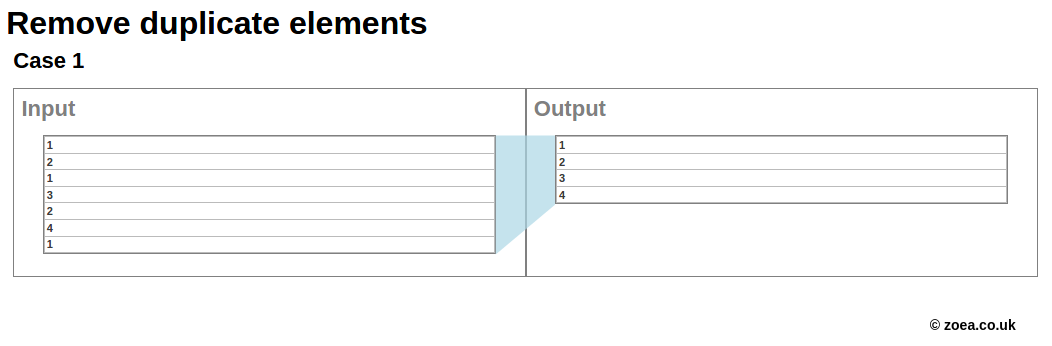
- Programming Tasks
- Sorting Algorithms
- Sorting
- 11l
- 360 Assembly
- 8080 Assembly
- ACL2
- Action!
- Action! Tool Kit
- Ada
- Aime
- ALGOL 68
- Amazing Hopper
- APL
- AppleScript
- Arturo
- ATS
- AutoHotkey
- AWK
- BASIC
- ANSI BASIC
- Applesoft BASIC
- BASIC256
- BBC BASIC
- FreeBASIC
- FutureBasic
- Gambas
- GW-BASIC
- IS-BASIC
- Liberty BASIC
- Microsoft Small Basic
- PureBasic
- Run BASIC
- True BASIC
- VBA
- VBScript
- Yabasic
- BQN
- Bracmat
- Brat
- C
- C sharp
- C++
- CafeOBJ
- Ceylon
- Clojure
- CoffeeScript
- Common Lisp
- Crystal
- D
- Delphi
- Déjà Vu
- E
- EasyLang
- ECL
- Elena
- Ecstasy
- Elixir
- Erlang
- Euphoria
- F Sharp
- Factor
- Forth
- Fortran
- Frink
- GAP
- Go
- Groovy
- Haskell
- HicEst
- Icon
- Unicon
- IDL
- Inform 7
- J
- Jakt
- Java
- JavaScript
- Joy
- Jq
- Julia
- K
- Klingphix
- Kotlin
- Lang5
- Lasso
- Lambdatalk
- Logo
- Lua
- M2000 Interpreter
- Maple
- Mathematica
- Wolfram Language
- MATLAB
- Maxima
- MAXScript
- MiniScript
- ML
- MLite
- Modula-2
- MUMPS
- Nanoquery
- Neko
- Nemerle
- NetRexx
- NewLISP
- Nial
- Nim
- Oberon-2
- Objeck
- Objective-C
- OCaml
- Octave
- Oforth
- OoRexx
- Oz
- PARI/GP
- Pascal
- Perl
- Phix
- Phixmonti
- PHP
- PicoLisp
- PL/I
- Pop11
- PostScript
- Initlib
- PowerShell
- Prolog
- Python
- Qi
- Quackery
- R
- Racket
- Raku
- Raven
- REBOL
- Red
- REXX
- Ring
- RPL
- Ruby
- Rust
- Scala
- Scheme
- Seed7
- SETL
- SETL4
- Sidef
- Slate
- Smalltalk
- Sparkling
- SQL
- Stata
- Swift
- Tcl
- TSE SAL
- TUSCRIPT
- UnixPipes
- Ursala
- Vedit macro language
- Vim Script
- Visual FoxPro
- V (Vlang)
- Wart
- Wortel
- Wren
- Wren-sort
- XBS
- XPL0
- Zkl
- Zoea
- Zoea Visual
- Pages with too many expensive parser function calls